


Abstract
Taylor Swift’s songwriting is frequently analyzed through the lens of confessional songwriting, blurring the boundaries between factual and fictional storytelling. This article proposes understanding her work as transmedia meta-autobiographies, a genre characterized by self-reflexivity and the questioning of autobiographical rules. Drawing on Mueller-Greene’s definition of meta-autobiography and intersectional theories, the study analyzes Swift’s lyrics, music videos, and paratextual elements, specifically focusing on selected works after her split with Big Machine Records, as this marks a different era in her creative work and is also linked to the discourse around her re-recordings. The analysis demonstrates how Swift utilizes transmedia storytelling to perform the act of remembering and writing, effectively staging her “self” across various media formats. This self-representation could according to the rules of the genre function as a counter-narrative to traditional male-centric autobiographical forms by centering girlhood. However, the article also highlights contradictions regarding authenticity and the commodification of this identity.
1. To the Swifties—Introduction
Before Taylor Swift sings Dear John during her Eras Tour—for the first time since 2012—she addresses her fans regarding the song’s connection to her short-lived relationship with John Mayer, framed by the album’s re-release:
I’m not putting this album out so that you can go and should feel the need to defend me on the internet against someone you think I might have written a song about 14 billion years ago.(Swift in Madani 2023)
This disclaimer, but also the reactions of her fans—discussed by Swift herself in her latest interview with The New York Times, describing part of her fandom searching for clues in her work as “going to an extreme place” (New York Times 2026)—reveal how Swift’s songs blur the boundaries between factual and fictional storytelling and simultaneously can be read as a work on the self, or, to quote Swift from her self-critical song Anti-Hero: “It’s me, hi” (Swift 2022a).
This interplay between fiction and reality in Swift’s songwriting invites a deeper theoretical exploration of the concept of meta-autobiography, a term that captures the multifaceted nature of self-representation in media texts. To frame this discussion, the article will turn to Mueller-Greene’s definition of meta-autobiographies, which provides a lens for examining how Swift’s narratives function within this genre. After applying these genre parameters to Swift’s work, the article employs an intersectional lens to analyze how her positionality nuances—and at times contradicts—the subversive potential of meta-autobiographies.
2. Swiftly Defined—Theoretical Foundation
Mueller-Greene defines meta-autobiographies as texts—in this case, media texts—that “stand out due to an accumulation of fictional and self-reflexive elements, without therefore already being somewhere between autobiography and novel” (Mueller-Greene 2018, p. 132)1. The focus is thus not on distinguishing between the fictional and the factual; as Nünning argues, meta-autobiographies can be equally weighted toward either (cf. Nünning 2009, p. 134). Mueller-Greene identifies “a pronounced tendency towards the metaisation of autobiographical memory and narration” (Mueller-Greene 2018, p. 132)2 in texts of this genre, which both exposes the connection between memory and narration (cf. Mueller-Greene 2018, p. 132) and invites “critical questioning of the narrative” (Benner 2019, p. 20)3. Although there is an apparent overlap between meta-autobiographical texts and autofiction—a term first coined by Serge Doubrovsky in 1977—it is essential to distinguish between the two and clarify why Swift’s work is better categorized as meta-autobiographical rather than autofictional. On the surface, these genres share key parameters. As Bitto (2021, p. 2) notes, autofictional texts establish a close relationship between the author and the “I” of the text. Similarly to meta-autobiographical texts, “autofiction blends truth and fiction in a highly self-conscious way” (Dix 2023, p. 8). Despite these similarities, Mueller-Greene problematizes the term “autofiction” due to its emphasis on “fiction” for texts that clearly highlight the identity and coalescence of the author, narrative voice, and protagonist (cf. Mueller-Greene 2018, p. 129). This specific mode of self-representation can be found throughout Swift’s work—a central hypothesis of this study. Furthermore, meta-autobiographies also question the rules of autobiographic writing (cf. Struth 2016, p. 11). Schaser emphasizes that until the 20th century, autobiographical texts were primarily written and read as “narrative[s] of western rationality, progress, and superiority” (Schaser 2019, p. 289)—in other words: as life stories of “‘great men’” (ibid.). According to Nünning, meta-autobiographies as well as auto-fictional texts address “the valid selection criteria for biographical representations” (Nünning 2009, p. 136)4 and often serve to stage marginalised, hybrid voices—as Sheppard states (cf. Sheppard 2018, p. 88). Similarly to autofiction—which has been labeled a “bad genre” (Gronemann 2019, p. 241)—the judgment ascribing it “low cultural capital” (Dix 2018, p. 9) often stems from the fact that its authors are predominantly female (cf. ibid.) and their stories are perceived as being of a purely personal nature. The subversive potential of the genre lies in both its authorship and its focus, allowing for a questioning of categories of difference such as “age”, “gender”, “class”, or “race” while serving as a medium of self-narration. There is, however, an inherent ironic tension in this application: as one of the most influential contemporary singer-songwriters, Swift can hardly be classified as marginalized. Yet, while a meta-autobiographical reading of Swift’s work suggests the potential for counter-narratives that oppose the ‘grand narratives’ of “‘great men’” (Schaser 2019, p. 89) that defined the autobiographical space (cf. ibid.), this article argues that Swift’s girlhood is less a radical subversion and more a calculated performance. This performance, situated at the intersection of “gender” and “age”, is furthermore underscored—and limited—by white, upper-class privilege.
By seeking to highlight these interdependencies, this article follows an intersectional approach to Swift’s work, as defined by Lykke, to showcase “how different categorizations are interwoven—how gender, for example, is interwoven with race, ethnicity, class and sexuality” (Lykke 2010, p. 51). Finally, the transmedia aspect of the meta-autobiography needs to be explained, as it allows the transfer of this primarily literary category to Swift’s audio–visual work. By referring to meta-autobiographies as transmedia phenomena, this article applies two distinct facets of the term “transmedia.” First, transmediality is understood as “phenomena that manifest themselves across media” (Thon 2016, p. 11). Both genres in general and the specific genre of meta-autobiography are examples of such transmediality. Theoretical discourse supports this transfer, as it repeatedly identifies meta-autobiographical elements in media environments beyond the literary field: from television comedy—such as Larry David’s Curb Your Enthusiasm or Ricky Gervais’s Extras—to celebrity studies (cf. Kreknin 2020, p. 199) and graphic storytelling (cf. Michael 2018, p. 107). Within songwriting and music, the term has not seen extensive use. Nevertheless, confessional and self-reflective works by artists such as Carly Simon (You’re So Vain) or Alanis Morissette (Jagged Little Pill) can be read in this meta-autobiographical vein. This is only one dimension of transmediality as it relates to Swift’s oeuvre. The second dimension is that of transmedia storytelling, defined by Henry Jenkins as “a process where integral elements of a fiction get dispersed systematically across multiple delivery channels for the purpose of creating a unified and coordinated entertainment experience” (Jenkins 2007). Swift’s oeuvre is dispersed among various media: music videos, live performances—first and foremost The Eras Tour, which reimagines her albums as distinct aesthetic eras—documentaries, interviews, cover art, and merchandise. Crucial to framing Swift’s work as meta-autobiography is the fact that transmedia storytelling “is all about memory” (Harvey 2015, p. 38). Characters, plots, and themes must be remembered across different media to consider them part of the same storyworld. Similarly, Swift’s audience must recall the “lore” of her persona to decode her storytelling, resulting in an immersive experience for the fanbase. On the other hand, transmedia storytelling also carries a strategic and economic dimension (cf. Jenkins 2015, p. 242). This suggests an underlying tension in Swift’s work between the self-reflective staging of her persona and a calculated commercial performance.
Understanding Swift’s songwriting through the lens of meta-autobiographical narratives opens up a deeper exploration of her transmedia self-representation. By applying this framework, the article can now delve into how Swift constructs and performs her autobiographical “self” across her body of work and how this self is constructed within the parameters of “gender” and “age”.
3. “I’m Harder to Forget than I Was to Leave” (Swift 2021b)—Swift’s Work as Meta-Autobiographical Performances of the Self
The practical application of Mueller-Greene’s theory is most visible in how Swift constructs her persona. Fan forums, reviews, and the popular discourse are replete with signifiers of Swift’s songwriting as performances of “me”—[t]he “me” being Taylor Swift threefold: as singer, songwriter, and persona—which is how “persona works in popular music: the voice, the image, and a history are co-produced in the studio so as to cohere and convince” (Fogarty and Arnold 2021, p. 4). The concept of “persona” is crucial here, as it appears to contradict the claim of authenticity, a vital aspect of meta-autobiographies—indeed, Dubrofsky regards “authentic behavior as behavior that appears un-premeditated, spontaneous, unplanned, without forethought, not under a person’s control, and behavior a person is unable to repress or regulate” (Dubrofsky 2016, p. 187).
Fogarty and Arnold in contrast point out that the performed, the staged—in the double sense of the word—persona of Swift and her songwriting do not seem to be at odds with authenticity or at least a version of it:
And yet, at the core of these performed personas, we encounter a consistent claim to authenticity, signalling her good girl truth, enhanced by her biography of having been raised on a Christmas tree farm as a polite, innocent, Christian child.(Fogarty and Arnold 2021, pp. 2–3)
Authenticity in Swift’s world thus appears as a form of cultural capital that, once earned, can be adjusted and re-evaluated. Furthermore, this authenticity is explicitly “girl-coded”. The importance of girlhood for Swift’s brand as pointed out by Fogarty and Arnold is a staple of her career. Prins argues that “Swift’s persona is built on a highly marketable gendered, raced and classed identity” (Prins 2020, p. 144). Rossman adds that “Swift defines herself by markers of girlhood and femininity that her audience embraces, even when not always falling strictly into the demographic of ‘girl.’ Swift unites her fandom within this girlish social space” (Rossman 2022). Furthermore, girlhood as a defining feature of Swift’s brand is evident not only in the narratives she creates in her early works but also in her voice—described by Pecknold as containing “the irritating vocal imperfections of a teenage girl” (Pecknold 2016, p. 77). It is argued here that it might not only be the audience which no longer fits in the realm of “girl”, but rather Swift herself. This marks a first potential avenue of criticism beyond the re-recordings of her works; it raises the question of how Swift can still call upon an authentic experience of girlhood while being a woman in her thirties.
Additionally, to what extent can this girlhood be read as an expression of female agency as opposed to an expression of tamed femininity? Swift’s The Man—if read as a meta-autobiography—demands an even playing field, especially in regard to dating:
- They’d say I played the field before I found someone to commit to
- And that would be okay
- For me to do
- Every conquest I had made would make me more of a boss to you
(Swift 2019)
Many of Swift’s other songs highlight girlhood instead as a commodity that can be taken—calling upon discourses of female innocence and virginity, be it Dear John, in which the lyrical I asks “Don’t you think I was too young to be messed with?” (Swift 2023), or be it Would’ve, Could’ve, Should’ve—also framed as dealing with the aftermath of the John Mayer relationship—in which the lyrical I demands “Give me back my girlhood, it was mine first” (Swift 2022b). While not disputing the age difference between Swift and Mayer during their relationship, both songs equate girlhood with a lack of agency. Bherer argues that for YA literature “the application of feminist thought and strategies requires its own set of negotiations to navigate the tight space between irony and ridicule, self-expression and confession, and power and vulnerability” (Bherer 2017, p. 277). Considering Swift’s audience, her work can be read as part of the Young Adult (YA) and New Adult (NA) media discourse; thus, Bherer’s argument is highly applicable. Following this line of reasoning, Swift’s invocation of youth and femininity creates a gendered binary between “power and vulnerability” (ibid.).
Whereas both Dear John and Would’ve, Could’ve, Should’ve either portray the re-recorded or recalled experience of a young Swift, 2024’s So Long, London features an adult lyrical I lamenting the loss of youth in the context of a broken relationship: “And I’m pissed off you let me give you all that youth for free” (Swift 2024d). Again, (female) youth is portrayed as a commodity. The commodification of girlhood undermines the subversive potential of Swift’s meta-autobiographies; rather than challenging dominant gendered hierarchies, her work arguably reinforces them by linking female youth to traditional ideals of beauty, innocence, and vulnerability.
Before continuing this intersectional lens, however, the “meta”-aspect of Swift’s songwriting must first be further established—that is, the question of the “self-reflexivity” of her work, of her songs being “a display of being self-aware, of acknowledging what one is doing while one is doing it” (Dubrofsky 2016, p. 189), as Dubrofsky defines it. The focus will primarily be on the re-recording and movie version of All Too Well and Swift’s album The Tortured Poets Department. For The Tortured Poets Department, McCausland has outlined a specific literary aesthetic that defines the album. Rather than being a necessarily authentic performance of Swift’s ideal of a songwriter, she seems—according to McCausland—“to be courting the kind of reception and discussion that academics have been engaging in for a while now” (McCausland 2024) by placing her songwriting in a distinct literary context.
Swift references not only literature as a system in both the paratext and texts of The Tortured Poets Department, but also the medium of film, particularly the silent film era. This can be observed in the lyrics of Clara Bow as well as in the imagery of the video to Fortnight, starting with its use of title cards (Swift 2024b).
At first glance, it might seem paradoxical that a singer and songwriter is using the silent film as a reference for the first release of her new album. Is this just part of Swift’s desire—as McCausland poses—to gain “the reception and discussion that academics have been engaging in for a while now” (McCausland 2024)? Or is this system reference linked to understanding Swift’s work as a meta-autobiography? Firstly, the focus on the silent film period in the video goes hand in hand with the establishment of the persona performed by Swift in the video as a writer. The video is permeated with shots of both the Swift and the Post Malone character sitting on a typewriter—even though the lyrical I asks in the titular The Tortured Poets Department “Who Uses Typewriters anyway?” (Swift 2024g). With close-ups of the typewriter (cf. Swift 2024b), the song’s lyrics appearing on the paper, and the typing hands, the (self-reflexive) act of writing is foregrounded in the video: The physical act of writing serves as a meta-reflection on the medium. The audience watches, albeit a fictional, act of the making of the product as they are simultaneously listening to it.
This follows Struth’s definition of meta-autobiographies highlighting the performative element of narrating while performing the self by means of staging the narrative or writing process (cf. Struth 2016, p. 466). Secondly, the black-white aesthetic that marks The Tortured Poets Department—down to the candles sold as part of the merch collection—in combination with the video to Fortnight can also be read as more than a stylistic choice. Rather, they highlight the focus on remembering that defines both Swift’s work and meta-autobiographies. The whole album can be read as a play on autobiographical writing, with a wide array of literary and media references used. That the album serves as a self-aware and self-reflective look back on a specific period in Swift’s life is portrayed by the Summary Poem that forms the epilogue—yet another reference to literature—of the album, or perhaps more so anthology. In this paratextual element, Swift not only imagines herself as “The Chairman of The Tortured Poets Department” (Swift 2024e), but she furthermore outlines a way of perceiving the album for the audience. First of all, the lyrical I clearly states:
- With a summary of my findings
- A debrief, a detailed rewinding
- For the purpose of warning
- For the sake of reminding
(Swift 2024e)
The act of remembering is, thus, placed in the centre of the album. Reading further, the lyrical I acknowledges that
- As you might all unfortunately recall
- I had been struck with a case
- of a restricted humanity
- Which explains my plea here today
- of temporary insanity
(Swift 2024e)
Besides this poem, the release of The Tortured Poets Departments and its variants is accompanied by hand-written and voice notes, encouraging an intimate reception of the album—as sharing secrets about interpersonal relationships—thereby amounting to a “performative intimacy” (McNutt 2020, p. 75).
The media combination that Swift employs in the paratext of The Tortured Poets Department is a strategy that has been tried and proven during her earlier works. Journals accompany the release of specific Lover variants: “Through this connection, Swift encourages fans to reread her narrative, as well as reexperience the moments captured in the journals. This remediation is both technological, as it works across on- and offline boundaries, and emotional, as it turns the distanced text into an immediate experience” (Rossman 2022). Thus, the poem and the accompanying materials turn the experience of listening to the album into an invitation to share the emotional experience of the lyrical I. The quoted “plea” in the poem can be read as a reference to her short-lived and tumultuous relationship with Matty Healy, following the break-up with Joe Alwyn and preceding the relationship with Travis Kelce. This quick progression of relationships is further highlighted by the lines: “And so I was out of the oven/And into the microwave/Out of the slammer and into a tidal wave” (Swift 2024e) and can be gleaned from the structure of the album, specifically the “Track 5” tradition, where the fifth song is reserved for her most vulnerable narratives. Swift claims this convention is driven by fan demand (cf. New York Times 2026), a move that foregrounds the parasocial connection with her audience while downplaying the deliberate marketing strategy underlying such brand consistencies—referring to Alwyn, whereas subsequent songs like But Daddy I Love Him, I Can Fix Him (No Really I Can), The Smallest Man Who Ever Lived deal with the Healy relationship, before songs like The Alchemy or So High School begin referencing her new relationship with Kelce. Healy seems to hold a specific place in the album, as can be gleaned from the poem, in which the lyrical I states:
- “In summation, it was not a love affair!”
- I screamed while bringing my fists
- to my coffee ringed desk
- It was a mutual manic phase.
- It was self harm.
- It was house and then cardiac arrest.
- A smirk creeps onto this poet’s face
- Because it’s the worst men that I write best
(Swift 2024e)
The epilogue, thus, does not only give a direction to the reader and listener but also serves as a meta-reflection on the process of writing. This focus can also be seen in the lines referencing her muses: “My muses, acquired like bruises” (Swift 2024e). Furthermore, writing is staged as a physical process, one that involves the body, that inevitably leaves traces on the body—imagery recurring in meta-reflective depictions of writing in literature (Zanetti 2023, p. 7). Lines like “veins of pitch black ink” (Swift 2024e) are another example of this mode of reflective representation. Swift’s life story appears like a two-fold process: the lyrical I lived through the story twice—once during the experience and once through the process of remembering and writing.
Following, not every song lyric is dissected for its autobiographical value. This includes questions of whether So High School, with its line “You know how to ball, I know Aristotle” (Swift 2024c), referring to the football star Kelce, or if it’s Matty Healy in his “Jehovah’s Witness suit” that “kicked out the stage lights, but […] [was] still performing” (Swift 2024f). Nor does the analysis focus on the various references to other artists and poets, such as Dylan Thomas or Patti Smith in The Tortured Poets Department. Instead, this section on The Tortured Poets Department shall ultimately focus on the song Clara Bow, in which the lyrical I traces a line from the silent film star Clara Bow to Stevie Nicks and finally to Swift herself. In doing so, the song laments the pressures female artists face in a male-dominated industry perpetually in search of the next “young” face:
- You look like Taylor Swift
- In this light, we’re lovin’ it
- You’ve got edge, she never did
- The future’s bright, dazzling
(Swift 2024a)
Rather than a simple discussion of the pitfalls of fame in a youth-obsessed industry—sentiments that Swift also addressed in Nothing New (Taylor’s Version), but that she also prescribes to due to her persistent staging of girlhood—the song once more stresses the argument that Swift’s work can serve as transmedia meta-autobiographies with the song implicitly addressing the matter of who gets to be remembered, who gets their biographies written, and how. The song additionally questions the rules of autobiographical writing, as Nünning discusses in regard to the function of the genre (cf. Nünning 2009, p. 136). As shown in this cursory analysis of Swift’s latest album, her songwriting and its paratextual framing exhibit clear connections to meta-autobiographies.
One last example is the short film version of Swift’s re-recording of All Too Well. The re-recording process in and of itself raises questions of authenticity and memory, as well as power and agency. Swift frames these re-recordings as a way to reclaim her “voice”—or potentially her royalties—during the legal proceedings regarding the sales of her masters to Scooter Braun. As such, they can be read as an act of female empowerment:
I will be going forward with my original rerecording schedule and will be embarking on that effort soon. I know this will diminish the value of my old masters, but I hope you will understand that this is my only way of regaining the sense of pride I once had when hearing songs from my first six albums […](Swift 2020)
At the same time they also question the authenticity of the memories she portrays in these re-recorded songs, which themselves function as a remediation of a remediation—twice recorded and experienced. For the fandom, however, they serve as an authentic testament that demands loyalty and in turn reinforces the para-social relationship between fan and celebrity. As Swift states, the re-recordings will allow “my fans to listen to those albums without feelings of guilt for benefiting Scooter” (Swift 2020). Read as a meta-autobiography, the re-recordings by design are a way of reflecting on the narratives of the past.
This aspect is even more heightened in Swift’s movie version of All Too Well. The song itself deals with her relationship with Jake Gyllenhaal—and subsequently, the release of the filmic version led to calls for Jake Gyllenhaal and his sister Maggie to give back Swift’s scarf, which her alter ego and lyrical I in the movie version had left at “your sister’s house” (Swift 2021a). The calls were echoed, for example, by Dionne Warwick on X/Twitter (cf. Ill. 1: Biographical Negotiations on Twitter/X).
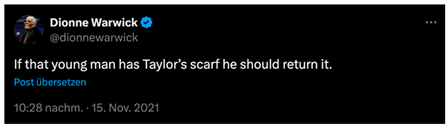
[Ill. 1: Biographical Negotiations on Twitter/X]
On top of that, the act of remembering is written into the lyrical structure of the song:
- Wind in my hair, you were there, you remember it all
- Down the stairs, you were there, you remember it all
- It was rare, I was there, I remember it all too well
(Swift 2021a)
Furthermore, in a metafictional sense, literary fiction and its reception are mirrored in the short film, allowing literary fiction to thus remain a central reference point of the audio–visual representation, as shown in the final images of the short film. Not only does the title card show that the actress and songwriter overlap in the role “Her”, underlining once more the personal union between the remembering entity and the singer/songwriter (cf. Swift 2021a).
What’s more, the adult, mature “her” also imagines herself as a book author—the book named All too well as well, thereby creating a nested and self-reflective connection that utilizes literary fiction as pre-text (cf. ibid.).
By showcasing the act of growing older—also referenced in the lyrics “I get older” (ibid.)—of the character in the short film, the act of remembering, of recalling the past, becomes visible to the audience. By turning the adult “her” into an author, the film showcases the process of “making” a memory—the “her” was there, she remembers, she edits the memory and so, at the end of the short film, everything is “[a]ll too well.” Despite this seemingly happy ending, the All Too Well short film ultimately demonstrates that Swift’s process of “making” memory is a double-edged sword. While it asserts her agency as a self-aware author, it also transforms this memory into a commodity to be marketed. This tension suggests that her meta-autobiographies do not merely reflect the past, but rather repackage it for commercial resale.
4. “I’m the Problem” (Swift 2022a)—Questioning the Subversive Potential of Swift’s Meta-Autobiographies
As pointed out, meta-autobiographies offer subversive potential by showcasing the voices of—in the field of autobiographical writing—often marginalized voices, be it regarding “gender”, “age”, “class”, or “nationality” (cf. Sheppard 2018, p. 88). This process of marginalization is often highlighted in regard to Swift’s reception, as argued by McCausland:
There’s a classist and potentially racist issue here, too, with curricula tending to prioritise the same very narrow selections of canonical poets, who are mostly, if not entirely, white and upper- or upper-middle class. Or—just as troublingly—is it the fact that this ‘poet’ is a charming blonde woman who makes no apology for her girlishness, her quirks, her very feelingy feelings; […](McCausland 2024)
Glasenapp reaches a similar verdict and declares that only two of her albums—folklore and evermore—garnered Swift critical acclaim for her songwriting, her poetry (cf. Glasenapp 2024). However, the perceived marginalization of Swift’s work is directly contradicted by her overwhelming economic power and significant industry recognition, including her induction into the Songwriters Hall of Fame and her consistent ranking among the most influential songwriters of her generation.
But let’s assume this tendency to downplay Swift’s accolades. It aligns with a broader treatment of girls and young women and their interests, as discussed by Warwick and Adrian: “In mainstream popular culture images, girls are frequently depicted as frivolous, silly, and deserving of contempt, and sonic clichés of girls’ voices are similar” (Warwick and Adrian 2016, p. 2). Swift herself addressed this double standard in her acceptance speech for the Billboard Woman of the Decade Award:
There are going to be people along the way who will try to undercut your success or take credit for your accomplishments…but if you just focus on the work and you don’t let those people sidetrack you, someday when you get where you’re going, you’ll look around and you will know that it was you…who put you there, and that will be the greatest feeling in the world.(Swift in Schiller 2019)
Furthermore, Glasenapp references the feminist potential of Swift’s songwriting—pointing to songs like Mad Woman and The Man (cf. Glasenapp 2024). Following this argument, her focus on the power of girlhood could be read as an example of the subversive potential of her transmedia meta-autobiographies.
However, two main points complicate this reading. First is the aforementioned linkage of Swift’s performance of girlhood to discourses of vulnerability and its subsequent commodification. This critique is further strengthened when considering how Swift’s performances of girlhood are intrinsically tied “to consumerism” (Warwick and Adrian 2016, p. 6). Swift’s lauding of female agency is part of a million-dollar merch industry that includes the releases of multiple variants of her albums. Warwick and Adrian discuss this connection in regard to the “girl power” of the ‘90s, but argue that “the phrase nonetheless propelled girls into the spotlight and reclaimed girlhood as a space of potential might” (Warwick and Adrian 2016, p. 6). The perceived consumeristic aspect of Swift’s performances of girlhood could then be read as a necessary evil, a way to establish female voices in a heavily gendered space (cf. McNutt 2020, p. 75). In contrast, Rossman declares “Swift herself is […] using the authentic diary structure to shape her own brand image, masking her commercial desires by underpinning them all with emotional stories” (Rossman 2022).
Sloan highlights the commercialism of Swift’s narrative as well:
Swift’s activism cannot avoid the trap of neoliberal feminism, in which the notion of activism is sold as part of a celebrity’s social brand (Isaksen and Eltantawy 2019). Swift, whose net assets top $360 million, can only speak so much for the plight of underpaid and under-credited women.(Sloan 2021, p. 23)
Sloan’s judgment is even more of note, as Swift’s songwriting is peppered with appeals to a female underdog narrative—repeated by The New York Times in their review of her 1989 tour (cf. Caramanica 2015)—one which calls upon a shared female middle-class identity in opposition to a male upper-class identity. One example is the lyrical I’s comparisons in I Bet You Think About Me:
- You grew up in a silver-spoon gated community
- Glamorous, shiny, bright Beverly Hills
- I was raised on a farm, no, it wasn’t a mansion
- Just livin’ room dancin’ and kitchen table bills
(Swift 2021b)
The popular reception of the song notes that the “Mr. Superior” in the song probably refers—once again—to Jake Gyllenhaal, contrasting his Beverly Hills upbringing (cf. Genius 2021) with her humble beginnings—full of “kitchen table bills” (Swift 2021b). The narrative of farm vs. city life portrayed in the song is not necessarily an accurate depiction: “[S]he grew up on a Christmas-tree farm, but her parents were not exactly farmers. Her mother worked in finance, and her father, a descendant of three generations of bank presidents, is a stockbroker for Merrill Lynch” (Widdicombe 2011). It was this background that potentially helped Swift secure her first record deal—indeed, her father invested in the record company (cf. Borchetta 2019). The narrative of the female underdog is thus a construed narrative, a play on memory that calls upon a shared female identity as one with a lack of means and age. Once more the legal and financial drama surrounding Swift’s masters and her re-recordings highlights this narrative. In 2025, Swift penned a letter to her fans announcing the purchase of her masters. The letter not only frames Swift’s music once more as “memories” (Swift 2025), but as Swift herself fighting against a system that was rigged against her: “I almost stopped thinking it could ever happen, after 20 years of having the carrot dangled and yanked away” (Swift 2025). Only her hard work—as per the narrative—made the purchase of her masters, and thus the reclaiming of her voice, possible. Ultimately, this underdog persona clashes with Swift’s reality as one of the most financially successful artists. Her success is built upon the strategic monetization of this narrative, sold to fans through an array of album variants and an extensive merchandise empire.
If it’s not “gender”, “age”, or “class” that offers the subversive potential of Swift’s work, is it potentially “race”? Didn’t McCausland discuss the “classist and potentially racist issue” (McCausland 2024) with Swift’s perceived marginalization by critics, the understanding “that ‘poet’ refers to a white man”—and not a white woman? Notwithstanding the “Whiteness” of the Western canon, Swift doesn’t seem to be the answer to that. Not only—as Fogarty and Arnold point out—has she “become an archetype of whiteness in the modern pop music world” (Fogarty and Arnold 2021, p. 2), but “[h]er lack of collaborators of colour, especially women of colour, is another glaring omission for a self-styled feminist” (Sloan 2021, p. 23), as Sloan argues.
5. “I Remember It All Too Well” (Swift 2021a)—Conclusions
This reading of Swift’s work as examples of transmedia meta-autobiographies has showcased how the remembered and narrated self emerges through storytelling, and how the past becomes present. It was furthermore highlighted that Swift’s work could be read as a counter-narrative to the “narrative[s] of western rationality, progress, and superiority” (Schaser 2019, p. 289) that dominate the autobiographical space. By holding space for performances of girlhood, her work selectively resists these narratives despite the fact that discussions of her work continue to be shaped by a gendered gaze. For a considerable amount of time, this gaze was responsible for the dismissal of her work as “‘unserious’” (Dix 2018, p. 2), a verdict typical of responses to autofictional and meta-autobiographical works.
While the critical acclaim she has gathered for her work—her second place in the Billboard list of the Greatest Popstars of the 21st century, being the youngest inductee into the Songwriters Hall of Fame, among others—and her record-breaking popularity all display the relevance of female voices and narratives, her work nevertheless reveals problematic discourses concerning the intersection of “gender” and “age”—and here only discussed as an extension—“race”, and “class”. Furthermore, by foregrounding the “Swift” persona and focusing on distinctly individualized experiences—predominantly romantic relationships—her work fails to realize the broader potential of self-reflective genres to “operate as a form of testimony or witness-bearing with regard to past cultural and/or political struggles” (Dix 2023, p. 8). Rather than fulfilling the promise of the genre by broadening the space for different voices, Swift’s work performs a limited and limiting female identity.
The Instagram and Tik-Tok posts documenting Taylor Swift’s Eras Tour that are marked by performances and celebrations of girlhood—be it the displays and exchanges of friendship bracelets, the glittery makeup, or the bedazzled outfits in rainbow colours—declare the tour as a safe space for “the girls”, yet the question remains: was “[t]he girlhood […] really girlhooding” (louiseanog 2024), and if so, for whom? It seems to be for Swift only.
Funding
This research received no external funding.
Institutional Review Board Statement
Not applicable.
Informed Consent Statement
Not applicable.
Data Availability Statement
No new data were created or analyzed in this study.
Conflicts of Interest
The author declares no conflicts of interest.
Notes
| 1 | Own translation. |
| 2 | Own translation. |
| 3 | Own translation. |
| 4 | Own translation. |
References
- Benner, Julia. 2019. “This book contains private information”. Kinder- und jugendliterarische Tagebuchliteratur. In Time Warp und Taschenuhr. Zeit in Kinder- und Jugendliteratur. Fernkurs Kinder- und Jugendliteratur. Edited by Heidi Lexe and Kathrin Wexberg. Vienna: Stube, pp. 20–32. [Google Scholar]
- Bherer, Valerie. 2017. Girls Write Back. Feminism and Disordered Writing. In Gender(ed) Identities Critical Rereadings of Gender in Children’s and Young Adult Literature. Edited by Tricia Clasen and Holly Hassel. New York: Routledge, pp. 268–78. [Google Scholar]
- Bitto, Gregor. 2021. Autofiktion(en) in der antiken Literatur. In Auf der Suche nach Autofiktion in der antiken Literatur. Edited by Gregor Bitto and Maria Bardo. Berlin and Boston: De Gruyter, pp. 1–13. [Google Scholar]
- Borchetta, Scott. 2019. So, It’s Time For Some Truth…. Big Machine Label Group. Available online: https://themusicuniverse.com/scott-borchetta-taylor-swift-so-its-time-some-truth/ (accessed on 30 June 2019).
- Caramanica, Jon. 2015. Review: On Taylor Swift’s ‘1989’ Tour, the Underdog Emerges as Cool Kid. The New York Times. May 21. Available online: https://www.nytimes.com/2015/05/22/arts/music/review-taylor-swift-1989-tour.html (accessed on 21 May 2015).
- Dix, Hywel. 2018. Introduction: Autofiction in English: The Story so Far. In Autofiction in English. Edited by Hywel Dix. Cham: Palgrave McMillan, pp. 1–23. [Google Scholar]
- Dix, Hywel. 2023. Autofiction and Cultural Memory. London and New York: Routledge. [Google Scholar]
- Dubrofsky, Rachel E. 2016. A Vernacular of Surveillance: Taylor Swift and Miley Cyrus Perform White Authenticity. Surveillance & Society 14: 184–96. Available online: https://digitalcommons.usf.edu/spe_facpub/909/ (accessed on 1 June 2024). [CrossRef] [Scilit]
- Fogarty, Mary, and Gina Arnold. 2021. Are You Ready for It? Re-Evaluating Taylor Swift. Contemporary Music Review 40: 1–10. [Google Scholar] [CrossRef] [Scilit]
- Genius. 2021. I Bet You Think About Me (Taylor’s Version) [From the Vault]. Available online: https://genius.com/Taylor-swift-i-bet-you-think-about-me-taylors-version-from-the-vault-lyrics (accessed on 1 December 2024).
- Glasenapp, Jörn. 2024. Taylor Swift tell me why. Zeit Campus. July 16. Available online: https://www.zeit.de/campus/2024/04/taylor-swift-world-tour-musik-einfluss-wirtschaft-wahlen (accessed on 16 July 2024).
- Gronemann, Claudia. 2019. Autofiction. In Handbook of Autobiography/Autofiction. Volume I: Theory and Concepts. Edited by Martina Wagner-Egelhaaf. Berlin: Walter de Gruyter, pp. 241–46. [Google Scholar]
- Harvey, Colin B. 2015. Fantastic Transmedia: Narrative, Play and Memory Across Science Fiction and Fantasy Storyworlds. New York: Palgrave MacMillan. [Google Scholar]
- Isaksen, Judy L., and Nahed Eltantawy. 2019. What happens when a celebrity feminist slings microaggressive shade?: Twitter and the pushback against neoliberal feminism. Celebrity Studies 12: 549–64. [Google Scholar] [CrossRef] [Scilit]
- Jenkins, Henry. 2007. Transmedia Storytelling 101: Confessions of an Aca-Fan. Henry Jenkins. Available online: http://www.henryjenkins.org/2007/03/transmedia_storytelling_101.html (accessed on 22 March 2007).
- Jenkins, Henry. 2015. Transmedia Storytelling: Die Herrschaft des Mutterschiffes. In New Media Culture: Mediale Phänomene der Netzkultur. Edited by Christian Stiegler, Patrick Breitenbach and Thomas Zorbach. Bielefeld: Transcript, pp. 237–47. [Google Scholar]
- Kreknin, Innokentij. 2020. Autofiktion. In Handbuch Literatur & Pop. Edited by Moritz Baßler and Eckhard Schumacher. Berlin: De Gruyter, pp. 199–213. [Google Scholar]
- louiseanog. 2024. The Girlhood Was Girlhooding. Available online: https://www.tiktok.com/@louiseanog/photo/7351994317990333702?image_index=4 (accessed on 18 May 2026).
- Lykke, Nina. 2010. Feminist Studies: A Guide to Intersectional Theory, Methodology and Writing. New York: Routledge. [Google Scholar]
- Madani, Doha. 2023. Taylor Swift Asks Fans Not to ‘Defend’ Her Against Exes Ahead of the ‘Speak Now’ Re-Recording. NBC News. Available online: https://www.nbcnews.com/pop-culture/pop-culture-news/taylor-swift-asks-fans-not-defend-exes-ahead-speak-now-re-recording-rcna91029 (accessed on 25 June 2023).
- McCausland, Elly. 2024. Is Taylor Swift a Poet? Yes. Is That the Wrong Question to Ask? Also Yes. Swifterature. Available online: https://swifterature.com/2024/04/18/is-taylor-swift-a-poet/ (accessed on 18 April 2024).
- McNutt, Myles. 2020. From ‘Mine’ to ‘Ours’: Gendered Hierarchies of Authorship and the Limits of Taylor Swift’s Paratextual Feminism. Communication, Culture & Critique 13: 72–91. [Google Scholar] [CrossRef] [Scilit]
- Michael, Olga. 2018. Graphic Autofiction and the Visualization of Trauma in Lynda Barry and Phoebe Gloeckner’s Graphic Memoirs. In Autofiction in English. Edited by Hywel Dix. Cham: Palgrave McMillan, pp. 105–24. [Google Scholar]
- Mueller-Greene, Claudia. 2018. Das im fiktionalen Gestrüpp verschwindende Ich: Metaisierung, Fiktionalität und Liminalität in faktualen metaautobiographischen Texten am Beispiel von Günter Grass’ „Beim Häuten der Zwiebel”. In Sich Selbst Erzählen. Autobiographie—Autofiktion—Autorschaft. Edited by Sonja Arnold, Stephanie Catani, Anita Gröger, Christoph Jürgensen, Klaus Schenk and Martina Wagner-Engelhaaf. Kiel: Ludwig, pp. 123–50. [Google Scholar]
- New York Times. 2026. Taylor Swift on the ‘Detective Work’ of Her Fans. YouTube. Available online: https://www.youtube.com/shorts/K7xQiYlPasA (accessed on 29 April 2026).
- Nünning, Ansgar. 2009. Fiktionale Metabiographien. In Handbuch Biographie. Methoden, Traditionen, Theorien. Edited by Christian Klein. Stuttgart and Weimar: J.B. Metzler, pp. 132–36. [Google Scholar]
- Pecknold, Diane. 2016. “These Stupid Little Sounds in Her Voice”. Valuing and Vilifying the New Girl Voice. In Voicing Girlhood in Popular Music. Performance, Authority, Authenticity. Edited by Jacqueline Warwick and Allison Adrian. New York: Routledge, pp. 77–98. [Google Scholar]
- Prins, Annelot. 2020. From awkward teen girl to aryan goddess meme: Taylor Swift and the hijacking of star texts. Celebrity Studies 11: 144–48. [Google Scholar] [CrossRef] [Scilit]
- Rossman, Margaret. 2022. Taylor Swift, Remediating the Self, and Nostalgic Girlhood in Tween Music Fandom. Transformative Works and Cultures 38. [Google Scholar] [CrossRef] [Scilit]
- Schaser, Angelika. 2019. Gender. In Handbook of Autobiography/Autofiction. Volume I: Theory and Concepts. Edited by Martina Wagner-Egelhaaf. Berlin: De Gruyter, pp. 287–92. [Google Scholar]
- Schiller, Rebecca. 2019. Taylor Swift Accepts Woman of the Decade Award at Billboard’s Women in Music: Read Her Full Speech. Billboard. Available online: https://www.billboard.com/music/awards/taylor-swift-woman-of-the-decade-speech-billboard-women-in-music-8546156/ (accessed on 13 December 2019).
- Sheppard, Lisa. 2018. Autoethnography in Post-British Literatures: A Comparative Reading of Charlotte Williams and Jackie Kay. In Autofiction in English. Edited by Hywel Dix. Cham: Palgrave McMillan, pp. 87–103. [Google Scholar]
- Sloan, Nate. 2021. Taylor Swift and the Work of Songwriting. Contemporary Music Review 40: 11–26. [Google Scholar] [CrossRef] [Scilit]
- Struth, Christiane. 2016. Die Metaautobiographie. Theorie, Poetik und Typologie Eines Neueren Genres der Englischsprachigen Erzählliteratur. Trier: Wissenschaftlicher Verlag Trier. [Google Scholar]
- Swift, Taylor. 2019. The Man. In Lover. New York: Republic Records. [Google Scholar]
- Swift, Taylor. 2020. Letter from Taylor Swift. Twitter/X. Available online: https://x.com/taylorswift13/status/1328471874318311425 (accessed on 16 November 2020).
- Swift, Taylor. 2021a. All Too Well (10 Minute Version) (Taylor’s Version). In Red (Taylor’s Version). New York: Republic Records. [Google Scholar]
- Swift, Taylor. 2021b. I Bet You Think About Me (Taylor’s Version). In Red (Taylor’s Version). New York: Republic Records. [Google Scholar]
- Swift, Taylor. 2022a. Anti-Hero. In Midnights. New York: Republic Records. [Google Scholar]
- Swift, Taylor. 2022b. Would’ve, Could’ve, Should’ve. In Midnights. New York: Republic Records. [Google Scholar]
- Swift, Taylor. 2023. Dear John (Taylor’s Version). In Speak Now (Taylor’s Version). New York: Republic Records. [Google Scholar]
- Swift, Taylor. 2024a. Clara Bow. In The Tortured Poets Department. New York: Republic Records. [Google Scholar]
- Swift, Taylor. 2024b. Fortnight. In The Tortured Poets Department. New York: Republic Records. [Google Scholar]
- Swift, Taylor. 2024c. So High School. In The Tortured Poets Department. New York: Republic Records. [Google Scholar]
- Swift, Taylor. 2024d. So Long, London. In The Tortured Poets Department. New York: Republic Records. [Google Scholar]
- Swift, Taylor. 2024e. Summary Poem. In The Tortured Poets Department. New York: Republic Records. [Google Scholar]
- Swift, Taylor. 2024f. The Smallest Man Who Ever Lived. In The Tortured Poets Department. New York: Republic Records. [Google Scholar]
- Swift, Taylor. 2024g. The Tortured Poets Department. In The Tortured Poets Department. New York: Republic Records. [Google Scholar]
- Swift, Taylor. 2025. My Letter. Available online: https://www.taylorswift.com/read-my-letter/ (accessed on 25 July 2025).
- Thon, Jan-Noël. 2016. Transmedial Narratology and Contemporary Media Culture. Lincoln: University of Nebraska Press. [Google Scholar]
- Warwick, Jacqueline, and Allison Adrian. 2016. Introduction. In Voicing Girlhood in Popular Music. Performance, Authority, Authenticity. Edited by Jacqueline Warwick and Allison Adrian. New York: Routledge, pp. 1–11. [Google Scholar]
- Widdicombe, Lizzie. 2011. You Belong with Me. The New Yorker. October 3. Available online: https://www.newyorker.com/magazine/2011/10/10/taylor-swift-profile-you-belong-with-me?currentPage=all (accessed on 3 October 2011).
- Zanetti, Sandro. 2023. Was Bleibt, Was Kommt? Die Zeit der Literatur. Zurich: Diaphanes. [Google Scholar]
Disclaimer/Publisher’s Note: The statements, opinions and data contained in all publications are solely those of the individual author(s) and contributor(s) and not of MDPI and/or the editor(s). MDPI and/or the editor(s) disclaim responsibility for any injury to people or property resulting from any ideas, methods, instructions or products referred to in the content. |
© 2026 by the author. Licensee MDPI, Basel, Switzerland. This article is an open access article distributed under the terms and conditions of the Creative Commons Attribution (CC BY) license.