


Abstract
This study examines the hypothetical issue of the impact of ancient Egyptian beliefs on Africa as a whole. Several focal points are explored. These include (1). The situation of the discipline of folklore within allied academic specializations. (2). Culture diffusion within Africa, and (3). Spoken folk stories as the only field that integrates, in the space and time continuum, culture on the one hand, with its bearers/(society), on the other. (4). [Beside the] colonial past, the problem, is a result of a number of academic factors that include: (a). The establishment at universities of African studies departments that confine the continent to the sub-Saharan tier excluding Africa of the North; thus, folklore is isolated without a proper stage for studying it academically (see Dorson 1972); (b). The stereotyping concerning the capacity of scholars with unfamiliar names or recognized departmental membership as capable of dealing with theory or innovation, though some of their ideas are adopted by the famous without accrediting the source; (c). Ignoring the unfamiliarity for the family (especially under conditions of secrecy; cf. bias, ethnocentrism); and (d). Inadequacy of academic classroom pedagogy on the basics of verbal lore. Folklore in its original, mainly verbal branches, as represented by Stith Thompson’s monumental works on motif (1955–1958), and its predecessor by Antti Aarne on Type, (1910, 1928, 1961/1964), whose coverage, especially on Africa of the North, is seriously lacking in both the Type and Motif Indexes. The tracking of this line begins with recent calls for need for morphological studies of a South African tale (Dseagu [2001] 2021). An association among various regions of Africa with ancient Egypt concerning mythological contacts merits this investigation.
1. Introduction
world-swallowing Monster in Southern African Folklore (Dseagu [2001] 2021).
- (A).
- It may be asked: Is this call justified?
- (B).
- Is the call for a comparison of the effectiveness of morphology (Dundes 1964) as compared to diffusion relevant?
In reference to issue A on the impractical need of morphology for mass classification (see Gilet 1998, Vladimir Propp and the Universal Folktale: recommissioning an old paradigm. Evaluating that study), El-Shamy wrote:
From a typological perspective, the conclusions that Gilet offers are indicative of a problem with his approach and [insufficient] awareness of folkloristic typology. The tale belongs to type AaTh 590A, The Treacherous Wife, a subtype of AT 590, The Prince and the Arm Bands, which is inaccurately labeled [by The Type Index] and needlessly set apart from type 315, The Faithless Sister. As pointed out elsewhere (El-Shamy [1980] 1984, p. 241 Notes) narratives that may be classified under types AT 315, 590, and 590A actually, [should have been considered as] belonging to the same tale-type. In type 315 the sister plots against her brother, in type 590 the mother plots against her son, while in Type 590A, it is the wife who plots against her husband (El-Shamy [1980] 1984, p. 241). The differences among these three branches of the same tale-type are mainly differences in sentiment toward a female relative rather than of narrative content; Ital., added.(El-Shamy 2011, p. 157)
With Reference to issue B on the effectiveness of morphological analysis, the following data in the present article should clarify the situation, especially in light of the impracticality of issue A, in addition to how African folklore has been addressed in institutions of higher education.
2. The Status of African (Verbal) Folklore in a Folklore Department
Regarding the source, folklorists and Africanists recently advanced a theory (that proved to be an oversight) by R.M. Dorson in 1972, who was the dean and most influential scholar of folklore studies in the USA. In his African folklore, he wrote that an African folklore did not emerge in Africa until the early 1970s, and that African folklore emerged only when a middle Western-like social class was formed in sub-Saharan Africa [(at the hands of the Western-educated natives)]. Consequently, dealing with African folklore became a legitimate field for folklorists, rather than for anthropologists only. (My Ital.). (Dorson 1972, p. 4).
Another of Dorson’s oversights as Gen. Editor is his accepting Haring’s “A Characteristic African Folktale Pattern” to be included in his book as “a morphological study of an African folktale” (Haring 1972, pp. 165–79). Following Dorson who—like Haring—was unaware of the long-established typological identification of this story as AT 91, Monkey (Cat, [Tortoise]) who Left his Heart at Home), he asserted that, The tale belongs to the familiar genre of trickster stories (cf. “folklore in Arica” or “African folklore”), citing an impressive list of authorities, none of whom seems to have heard of tale-type AT 91, nor of Victor Chauvin’s Bibliographie (Chauvin 1892–1922, Vol. II, 99, No. 57 Kalîlah—the presumed source of the story in oriental folk literature), nor is it likely that any of the [indigenous] African listeners from Kenya, Rhodesia, or Dahomey whom Haring lists at the conclusion of his article have heard about the tales mentioned by these sources (a case of “Folklore in Africa vs. Arican Folklore”). Haring concluded:
Whatever cultural values are reflected in the style of the pattern of this tale in Kenya, Rhodesia, or Dahomey; and whatever the relations of performer and audience, the motifimes/[(i.e., basic abstract units of a plot)] in their actual occurrence are the successfully realized artistic experiences. My Ital.(Haring 1972, p. 179; citing Dundes (1964), on p. 183 n. 8 of Dundes’ essay)
The pattern Haring presents proves to be unintended evidence of cultural Diffusion, rather than of morphological analysis, which in this case is nothing but mere speculation. On Diffusion, cf., Marzolph (2020) where he clearly shows that major European sources of fairy tales (e.g., the Grimm Brothers, Anderson, etc.) were familiar with Arabic and other oriental collections of folk stories (El-Shamy 2023).
Additionally, Alan Dundes—who championed the negative attitude towards Aarne-Thompson’s tale-type concept (and The Historical-Geographical School Method) along with the research by its followers and devised the Proppian structural/morphological model in its stead (Dundes 1964); on Gilet 1998, see El-Shamy 2001, pp. 53–57—changed his stand on typology in a manner that duplicates El-Shamy’s views. Hence, according to Dundes’ revised stand, he writes:
THE PAUCITY OF FOLKLORISTIC STUDIES ON MISUNDERSTOOD AFRICAN FOLKLOREIt must be said at the outset that the six-volume Motif-Index of Folk-Literature and the Aarne-Thompson tale Type Index constitute two of the most valuable tools in the professional folklorist’s arsenal of aids for analysis. This is so regardless of any legitimate criticisms of these two remarkable indices, the use of which serves to distinguish scholarly studies of folk narrative from those conducted by a host of amateurs and dilettantes.(Dundes 1997, pp. 195–202)
- Taban Lo Liyong, Ed. (Liyong 1972): Popular Culture of East Africa. This booklet provides a section on mainly verbal folklore (pp. 57–158); it is an example of the scarcity of African studies. Although texts of such genres as “Myths”, “Folk Tales”, “songs”, “riddles”, “Fables” (p. 23) are presented, Liyong limits his presentations to ethnic/“tribal” groups but makes no use of any folkloristic research approach.
- Ruth Finnegan, Oral Literature in Africa.
Another example of the scarcity of such studies is Finnegan’s (1970) Oral Literature in Africa. For decades, this meticulously researched book has been the banner for the study of its subject matter for social and cultural anthropologists and folklorists alike. Its superb research and scope of coverage are probably still unmatched. However, Finnegan seems to disagree with Thompson’s concepts of motif and myth as they apply to African folklore. Although she cites Stith Thompson’s works, she makes no use of Thompson’s motif (Thompson 1955–1958) or tale-type (1971, 2 n. 1, pp. 320–21). She perceives ‘motifs’ as including plots, subject matter, types of character, and action, etc. She also seems to adopt a fairly wide definition that perceives folk literature as covering folktales, myths, ballads, etc., …. (1971, n. 3, pp. 361–62) which she finds at variance with European definition of ‘folktale’: For Finnegan, myths are the embodiment of dogma/[cf., religious faith, which as a genre, renders it within the domain of anthropology not folklore].
Therefore, Finnegan’s analysis, despite its merits, is insufficient for a folklorist. Yet, she, unintentionally, but for reasons different from those Haring’s (1972), provided proof (see above) that what is known as sub-Saharan Africa actually extends from the Cape in the south to the Mediterranean Sea in the North. That unrecognized information on Finnegan’s part includes, for example, the following tale-types:
AT 155, The Ungrateful Serpent Returned to Captivity. [Usually by clever umpire]. (n. 2, p. 337): reported from the Hottontot (South Africa), the Limbas, Ghana (i.e., from South Central and West Africa).
HeS 327J$, Girl Abandoned by Jealous Playmates (or by her Sisters). She falls into the power of an ogre. Wacici and Her Friends, pp. 358–60: Which comes from the Agikuyu/kikuyu.(See Sigrid 2007: Whose collection comes from the Nama-speaking people of Namibia)
AT 613, The Two Travelers (Truth and Falsehood). [Evil person blinds and mutilates his good hearted companion (brother)] pp. 378–79, Falsehood is More Profitable than Truth. From Ancient Egypt, reported from the Hausa of Nigeria.
HeS 613A$, Who may Remain in Town: Truth or Falsehood? Umpires decide in favor of Falsehood (Evil): under the title One Cannot Help an Unlucky Man, pp. 356–57: Reported from the Hausa of Nigeria.
AT 653A, The Rarest Thing in the World. [Magic objects used to resuscitate princess: which was the most instrumental?], p. 337; description of action, n. 4, and from Klipple’s (1938 dissertation), pp. 755 ff. [(Which Tompson (1961/1964) does not recognize nor cite for any African occurrences)].
AT 1655, The Profitable Exchange. [Hypocritical gift giver and the spiraling demands for damages]. p. 337 n. 2: which is reported from the Hottontot, Kagatla, Yao, Limba, and Ghana (i.e., from South and Central West Africa).
The data cited above, and the pattern of information detected from Anthropologist-Africanist Finnegan’s presentations, and El-Shamy’s (1988) should be seen as proof to an Africa whose shared folktales extend Northward beyond the sub-Sahara. It also shows the indispensability of the Aarne–Thompson comparative approach for dealing with verbal/oral/literature (a case of “African folklore” vs. “folklore in Africa”; see also Crowley (1981), below. In this respect Crowley argues that the Sahara acted as a bridge between north of it and south (see Diop—of which the present writer learned only lately (October 2026, with the difference that our case deal with the Egyptianness of literature rather than the race of the continent which Diop sees)—in the “Bibliography”. The Ital. are mine).
In Dseagu’s view ([2001] 2021 ff):
- (1).
- “The appropriate analytical tool for this [South African] multiple texts investigation is a morphological analysis. [And
- (2).
- ] that the recommended research model is The Morphology of North American Indian Folktales. (Dundes 1964)”.
However, it is doubtful that reaching a meaningful conclusion about the morphology of The Swallowing Monster in Southern African Folklore in terms of Propp’s 31 functions/(narrative moves (see El-Shamy 2011), would lead to explaining its evolution and travel through time and space. Yet the more definite answer should await the outcome of exploring Africa’s narrative traditions from both tiers: north and south of the Sahara.
Thus, we may conclude that Dsaegu’s quest for an exploration of Africa as a Continent in a Morphological Investigation is not justified.1
3. How Current Literature from Ancient Egypt on Africa Is Handled
Due to the stereotyping atmosphere in folklore scholarship (even by Enzyklopädie des Märchens, which never reported Folktales of Egypt (El-Shamy [1980] 1984) to its potential article contributors as their policy requires) and folklorists’ reluctance to consider the continuities between the ancient and certain aspects of the modern, a study of this topic is does not exist. Dorson, despite the massive evidence Folktales of Egypt presents and his view that its author/(El-Shamy) is,
“unusually, even uniquely qualified.(In: El-Shamy [1980] 1984, p. xxxvii)
Dorson still wrote that the connections between ancient Egyptian narratives and modern ones: are tenuous and treacherous”.(Dorson in El-Shamy [1980] 1984, p. ix. My Ital.)
Dorson also overlooked Brunner-Traut’s (1965) work cited in Foltales of Egypt (El-Shamy [1980] 1984, pp. 245, 259, 261, 262, 289, 296), and the prominent similarites between Tale no. 14, “The Noble and the Vile” and the ancient Egyptian account of “The Blinding of Truth by Falsehood”.(El-Shamy [1980] 1984, pp. 96–100, 262)
Egyptologist Edward F. Wente states:
In Egyptian texts and iconography the concept of Truth is regularly personified as the goddess Maat [i.e., MaCt], the daughter of Re. However, in this allegorical tale Truth is conceived of as a male who was blinded at his brother Falsehood’s behest because of circumstances, not quite clear involving Truth’s treatment of a dagger that belonged to Falsehood. The theme of sibling rivalry is reminiscent of the Horus and Seth feud and The Tale of the Two Brothers. In none of these myths or stories is the antagonist totally annihilated, but rather a resolution is effected [(sic., i.e., affected)] so that a harmonious situation is achieved with the elimination of further strife. Such a resolution of conflicting opposites is typically Egyptian and reflects the application of the principle of Maat, which embraces the concepts of balance and harmony as well as truth.(Wente 1972: In Simpson, p. 127)
We may argue here that this ancient Egyptian account seems to have developed into two independent narratives in modern Egyptian lore and to has generated a number of proverbial expressions and songs. The first part concerning the unjust decision and the blinding of truth appears as a belief legend recurrent in rural areas. It combines motif K451.1, “Unjust umpire decides a religious dispute” with motif N61, “Wager that falsehood is better than truth”. Like the ancient Egyptian maintaining of Maat/[i.e., maCt] (motifs A1100.1$, balance and harmony as well as truth: The Maat/Mayet-principle of world order; P795.5$, Maat/[(i.e., MaCt]: Accommodation between good and evil (motifs A167.1.1$, Council of the nine gods. (tâsûC/The Ennead); K451.1.1$, The tâsûC unjustly judges dispute. Types: 613B$, 875B4).
It is briefly stated that:
Truth and Falsehood are partners who own a farm jointly. Falsehood cheats Truth out of his share, then his land, then his house, and finally wants him to leave the village. They agree to ask the first man they meet to umpir their case; the umpire states, Truth should leave the village, and Falsehood should remain. This entire narrative is usually summed up in the proverbial form: We said, ‘Truth!’ They replied, ‘Get out of the village!’ (Cf. The Hausa text of the tale titled “One Cannot Help an Unlucky Man”, type HeS 613A$). A number of narrators have pointed out that the contents of the tale and those of a frequently recurrent folk song are identical. The song may have originated as a reference to the incident cited in the ancient account. The song states:
| khasîs yiqûl li el-`sîl, | `taCâla niCmilak khaddâm |
| Vile says to Noble, | `Come, we will make you a servant. |
| tâkul witshrab wi tibqâ | min dimn el-khudâm, khaddâm |
| You will eat and drink and | among servants, you will be a servant …’. |
Simpson, in his introduction to Erman’s The Ancient Egyptians (1972, pp. 127–32), gives the same ancient narrative, [that] certainly reflects the avenging of Osiris by Horus (Erman 1966, p. x). Similarly, Brunner Traut, addressing herself to F. von der Leyen’s inquiry into the nature of the clever youth who does not know his father, concludes that this youth is no one but the boy Horus who strove for justice for his father Osiris (El-Shamy [1980] 1984, p. 262). Thus the conflict between Falsehood and Truth is actually the conflict between Osiris and his younger [evil] brother Seth (Also cf., El-Shamy 1983, pp. 341–46, “Noble and Vile”).
The impracticality of morphological studies has been pointed out: see Conclusion: Lore and Theory: El-Shamy (2004b, Hasan, n. 2, p. xii); see also, Typology and the Study of African Folklore. In: African Folklore: An Encyclopedia. Phillip M. Peek and K. Yankah, eds.(El-Shamy 2004b, Routledge [p.s., Note: El-Shamy’s name is suppressed/not cited])
Crowley (1981), in his review of Folktales of Egypt. In: Research in African Literatures, pp. 398–400, concluded: “the Sahara proved to be a bridge to the north rather than a barrier”. (My Ital) and described this work further as “A tour de-force” and “A major contribution to African studies and to international distributional studies in folklore” […]. [Note: No response from any of El-Shamy’s colleagues].
A dilemma faced in folklore scholarship is the presence of powerful theories that seem to make sense from an abstract perspective but fail when applied to real live uses of folklore (El-Shamy 2004b, p. 296) My Ital.
Haring’s morphological study turned out to be an unintended proof of the validity of comparative and crosscultural folk narrative studies in both segments of African, and that the unity of the two sigmets is more deep-rooted than academically thought. In this case, it is present from the Cape to the Mediterranean, a Continuum, as HeS: 705A$, Born from Pregnant Man, Raised by Bird (Animal): the Falcon’s (Kite’s) Daughter. (A man’s mother mutilates his wife and takes her place in bed). (Also is present under AT, 705, Born from a Fish) (El-Shamy 1988, pp. 161–62). The distribution of this new tale-type extends from northern Egypt (text no. 1) to southern Africa (text no. 45) as follows: as of the Year 2004 it has 49 occurrences across the African Continent; thus, its traditionality is established (see n. 2, above).
4. The Overlooking/Ignoring of Ancient Egyptian Legacy in Africa
Despite some supposedly reliable reports (e.g., Britannica, for example), recently asserting erroneously that “Surprisingly, ancient Egyptians did not leave any explicit records detailing solar eclipses,” (Paul Morley/Fotolia). (My Ital.). https://www.britannica.com/list/the-sun-was-eaten-6-ways-cultures-have-explained-eclipses (accessed on 19 January 2026).
The theme/(motif) of the world being swallowed seems to have its roots in religious/(mythological) accounts of African antiquity:
“The chief of Ra’s [supreme deity] enemies was Apep, or Apophis, a huge serpent which lived in the waters of Nun or in the depths of the celestial Nile and who each day attempted to obstruct the passage of the solar barque. This was a serious challenge to Ra. […]. Stormy weather would be interpreted by the Egyptians as a momentary victory of the serpent Apep. Likewise, when there was a total eclipse, the Egyptians imagined that Apep had swallowed the solar barque.”(My Ital.) (Ions 1968, Egyptian Mythology, p. 42)
From the present writer’s childhood memories in Egypt in the late 1940s, it may be reported that during the moon eclipse, indigenous children would go on the street shouting: yâ banât el-hoor sayyibu el-Qamar/(O nymphs [of Paradise], release/let go of the moon). Motifs A7048.1$, Lunar eclipse; A755.8.5$, Moon’s waning (or eclipse) caused by attack by supernatural adversary (deity, demon); A737.1.2.1$, Houris (nymphs of Paradise) capture moon, thus causing eclipse.
In this case, applying the folkloristic device of the motif in the Thompson tradition (Thompson 1955–1958) would have led Dseagu ([2001] 2021 ff) to already available data of immediate relevance to what the Motif Index offered in the sphere of his own quest for incidets of South African tales in the north (in addition to other demographic/tribal data). Although the text is from South Africa’s Bantus, these southern-most Bantu groups had migrated from the North where they had once lived as far north as Singa in the middle of the Sudan bordering Egypt (Murdock 1959, p. 59; El-Shamy [1980] 1984, p. 289). See: (AT 318, Pt. II, IV). E.g., Lindblom (1928) Vol. 2, no. 16, “The Man Who Was Killed by his Brothers, but Came to Life Again”, and no. 17, “The Brothers Sun and Moon and the Pretty Girl.)”. See El-Shamy ([1980] 1984, p. 243).
One of the most salient cases of the association of a fairytale with the legendary motifs, is perhaps, the worldwide known Cinderella (AT, 510—510A), for which there is no specific motif in the Motif Index except the broad, nonspecific Mot., L102, “Unpromising heroine” to which the word Cinderella was added by the present writer.
Thompson (1964) Stith, in The Types of the Folktale records his findings on a Cuban text of Type 511A* given below. The present writer argues that this Cuban rendition is more likely a distorted text/(i.e., adapted to its context) borrowed from North Africa [where many people of Spanish descent came to the Americas]. It also demonstrates the original inaccuracies viz-à-vis typifying Cinderella. (See El-Shamy 2017, pp. 103–31).
0511A*, The Helpful Cow. A girl is treated cruelly by an old woman. […]. For lack of food she faints in the stable. When she revives, a cow is licking her face. The latter tells her to pull off her right horn and she will find whatever she wants. From the horn come many things to eat. […]. The cow dies and becomes an angel [cf. Goddess Hathor, App. 3, below] and flies to Heaven.(My Ital.)
Spanish American: Hansen (**542) (Cuba).
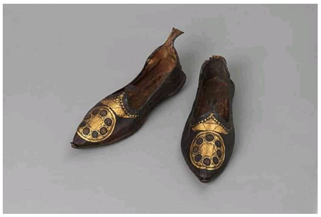
(Thompson 1964, p. 179; cf. ATU 511A*, Vol. I, p. 298). TI//In her book: The Egyptian Cinderella (Climo [1989] 1993), reports that the tale of Rhodopis and the rose-red slippers (see Appendix A, below) is one of the world’s oldest Cinderella stories. It was first recorded by the Roman historian Strabo in the first century B.C. Climo asserts that “whether fictitious or factual, What is fact is that a Greek slave girl, Rhodopis, married the Pharaoh Amasis (Dynasty XXVI, 570-526 B.C.) and became his queen.”(Cf. AT 510).2
Also, Sigrid (2007) Children Born from Eggs provides evidence of monogenesis or diffusion between Africa of the South and that of the North. She sums up her study as follows:
[…] The African hero saves his sister from dark forces and succeeds in taking her home.(Sigrid 2007, p. 300)
A number of unacknowledged/unrecognized motifs and tale-types (in available Indexes) tend to reinforce Shhmidt’s conclusion. These include HeS, tale-type HeS, 311D$, A Woman is Rescued from Magician (Ogre, Witch) by a Relative Other than her father or Brother (e.g., rescued by her husband, paterna-cousin, fiancé, etc.); HeS, 123C$, Predator (Ogre, Wolf, etc.) Gains Access to Children’s Home on Tree Top. They are rescued by their brother (father). Stronger evidence may be found in HeS, 327J$, Girl Abandoned by Jealous Playmates (or by her Sisters). She falls into the power of an ogre. Companion new motifs for this plot are: K2297.3.l$, Treacherous (jealous) playmates abandon girl in wilderness; and Mot., Sl.1$, Girl’s pleading for help cruelly ignored by all relatives (El-Shamy 1999, 2004a).
Considering both sets of data from above and below the Sahara together (i.e., North Africa; cf., n. 2, above) would have lent more support to folktale researchers concerning the findings about each segment.
Egyptologists in Egypt (and elsewhere) seek similarities and links between ancient artifacts (mummies, jewelry, attire, food, etc.) and modern counterparts and practices. Regrettably, their emphasis on material culture items tends to conceal similarities of current folk speech and its possible association with ancient Egyptian parole (as illustrated by the reference to cats in the process of telling this tale. Tale-type HeS, 1442$, Stupid Woman (Co-wife) is Deceived into Imitating Foolishly: she kills her child (El-Shamy 1999, no. 31, pp. 247–51; see Appendix B, below).
British Egyptologist Budge (1904) offers one of these attempts based on a ritual he had seen in Upper Egypt where inhabitants chopped up a rope at a ritual. That rope-chopping practice is represented by the new Mot., A1536.1$, Origin of the ritual (custom) of chopping rope during public assembly. Commemoration of killing of evil serpent (deity). In: Budge, Gods (Budge 1904, II, p. 193).
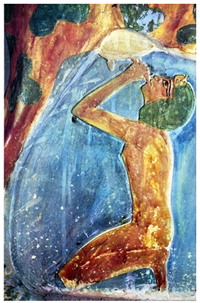
Another case is tale-type, AT 511A, The Little Red Ox. [(Cow helps orphans (brother and sister)]. [The present writer should report here that in Arab versions an Ox is never mentioned as a character the AT, Type-Index reports]. AT 511A is given in Tales Arab Women Tell (El-Shamy 1999), from the Nile Delta, no. 36, pp. 287–89, under the general category of Brother and Sister. (See image in Appendix C, below), where the goddess Hathor is depicted as a cow providing safety and nourishment/milk for the orphan boy-deity Horus.Also see (El-Shamy 1999, n. 695, p. 398)
AT 511A, The Little Red Ox. [Cow helps orphans (brother and sister)].
In this context, El-Shamy wrote:
Several themes in our story[(AT, 511A)] may be traced back to ancient Egyptian beliefs. Some of the characteristics and functions of the spirit El-Khidr parallel those of the god Heh and goddess Buto. Buto was also named the green one and she-who supplies cool water. [Mot., al-Khidr/(the Green-one): benevolent spirit associated with vegetation and water]. (El-Shamy [1980] 1984, no. 23, p. 271; 2004a). Additional elements betraying the possibility of that association are found in common tales. One of these is How El-Khidr Gained Immortality.(Mot., F440.3$, El-Shamy [1980] 1984, no. 23, pp. 137–38)
However, the most important sub-Saharan African text is found, so far, among the Zande of southern Sudan; it appears in Pritchard (1967). In this story:
A sister plots against her twin brother and has him killed. She then plants the bones, which are gradually self-transmuted into a man whom she marries. (Pritchard, no. 32).
This story manifests characteristics not found in other variants and may well prove to be one of the oldest oral forms of this story. It may also provide the missing link between the modern renditions of the part dealing with bringing back to life a dismembered person found in this tale-type and its ancient Egyptian counterpart found in the myth of Isis and Osiris (see Budge 1904, II, pp. 186–94; Spence 1927, pp. 68–80).
Within the context of the Sudan, it is significant here to indicate that the core of the story’s plot pivots around brother and sister: AT 720, My Mother Slew Me; My Father Ate Me. The Juniper Tree. The boy’s bones transformed into a bird is an example of that brother-sister association (El-Shamy 1999, No. 37, pp. 289–92, 445–46). Trying to remember tales outside the typical context of tale-telling (i.e., being an informant: p. 44, Résumé 4, “The Green Sparrow”). The reincarnation in the form of plant or animal of a woman’s murdered brother has its counterpart in the ancient Egyptian belief account/(myth) of Isis and Osiris. (El-Shamy 1999, p. 289, no 37, also see: n. 285).
The narrator, Mrs. Sayyidah, said: There is a tale about a boy and his sister. His stepmother killed him and cooked him. His sister buried his bones. (I don’t remember it well) but he became a green sparrow and would chant as he sat on top of a tree:
I am the green sparrow, the green.
I walk on top of the wall with a waggle, with a waggle.
My stepmother slaughtered me, slaughtered me.
And my father … [el-Cars/(the pimp] ate my flesh, ate my flesh.
And my dear sister gathered my bones, my bones.
And my dear sister buried my bones.
He put needles [which he had bought from a vendor for a song] in his father’s mouth and his father died and did the same with his stepmother and she died.
The tale ends with that situation.Also see Budge (1931, Romances, pt. 3, No. 11, pp. 394–403)
The ancient Egyptian account, it may be pointed out, is found among various East African groups who tell it with astonishing fidelity to the corresponding portions of the ancient text (AT 318, Pt. II, IV). (See, e.g., Lindblom (1928), Vol. 2, no. 16, “The Man Who Was Killed by his brothers, but Came to Life Again”, and no. 17, “The Brothers Sun and Moon and the Pretty Girl”).
It is worth noting here that the religious account of Isis and Osiris, cited below, especially with reference to the themes of sister’s treachery, dismemberment, resuscitation, and loss of phallus, overlaps with the ancient Egyptian tale of The Two Brothers, AT type 318, The Faithless Wife and its derivative (HeS, 318A$, The Man who Lost his Organ/[(phallus)] and then Regained it, where the accused younger brother severs his own phallus to prove his innocence[…]). This tale-type was reported in modern times in Müller (1905, No. 22, Shhauri/[dialect]; 1907).See Wente, in: (Simpson 1972, pp. 92–107)
Similarly, our present text (overlapping tale-types, 315, 590, 590A) with a current tale which is doubtlessly associated with the portion which represents AT Type 318 in the ancient Egyptian tale of The Two Brothers. Additional Egyptian variants from Nubia, Siwa Oasis, and eastern Africa were collected recently.(El-Shamy 2004a)
The pregnancy of the virgin sister by treachery in a current haddûtah/(fairytale, or local legend), designated as new tale-type: HeS, 872A$, The Pregnancy of the Virgin Sister by Treachery. (El-Shamy 1999, p. 58 n. 99; 2004a).
The tale may be summarized as follows:
A brother’s wife (sister-in-law) becomes jealous of her husband’s virgin sister [since all are dwelling together]. She coaxes the sister into drinking a liquid she had tainted with sperms/semen [presumably from her own husband, i.e., the virgin’s brother]. The sister became pregnant. Some woman living as a darweeshah (fem. Dervish/anchorite) on the location where the brother took his sister to kill overheard the sister’s pleading. She came out [of her seclusion] to help. She recited some taCâzîm/(verbal incantations), then ordered the impregnation-causing agent to exit the sister’s body from where it had entered: The sister vomited and the dervish woman said to the brother, “This is the part [(organ)] from which pregnancy entered. Your sister is a virgin”. The brother took his sister back to their home and sent his wife back to her own father.(El-Shamy 2004a, Ital. is mine)
A related theme concerning the exit/expulsion of an intruding supernatural being from a living creature (usually a human) occurs in a contemporary exorcism event:
A jinn-woman possessing a virtuous young man negotiated leaving (exiting) his body via a small wound on his toe [rather than out of his eye or other vital organ].(El-Shamy 1983, p. 7)
Although the link between the two accounts may seem tenuous, the possibility of the derivation of the modern exorcistic practice from the ancient Egyptian one, despite millennia of time, is present. The concluding event in which the innocence of the accused is established. (See exchange of Thoth with Seth’s semen, below, cf. “Where shall I come from?” a statement by Seth’s semen/sperm (See: Wente, in: Simpson 1972, pp. 120–21. Ital. is mine) that became a standard procedure in the paraphernalia of mashâyikh/charlatans’ work tools).3
A related development of tale-type 318 “the Egyptian Two Brothers Tale”, Pt. IV, is HeS, 318A$, The Man who Lost his Organ and then Regained it. The perfidious (ungrateful) wife.
S. T. Hollis (1990) identifies this tale as “The Oldest Fairy Tale in the World”. It may be summarized as follows:
Because of the treachery of the wife of the older brother, or the wife (or the father’s wife, (which appears only in the east African renditions), a young man has his phallus severed (in the Nubian variants, as is the case in the ancient Egyptian text, the injury is self-inflicted: In “The Two Brothers” text), so as to prove own innocence, the hero commits the severance, then regains his missing organ through the help of angels or other supernatural beings; (compare the role of the seven vaguely defined ‘shadow’; probably a recollection of the seven/nine Hathors in the ancient Egyptian text). The culprit is punished.(El-Shamy 1999, no. 25, pp. 209, 272; 2004a)
Previous folkloristic studies on the ancient “The Two Brothers” and related tale-types ignored the modern oral texts. For example, Liungman’s often quoted study copied in French as Le conte de Bata et Anubis et l’origine du conte merveilleux oriental européen, (Liungman 1964, p. 114) fails to include the readily available data from South Arabia. It has been clearly noted that:
Liungman’s findings about the origin and the dissemination of the [ancient] tale, as represented by his maps (pp. 11, 51) will have to be reconsidered.(El-Shamy [1980] 1984, pp. 243–44; note: Not included in Uther’s Index/ATU [My Ital.])
5. Expressions and Words from Ancient Egyptian Spoken Language(s) Are Unrecognized in Current Spoken Egyptian Arabic
Arabic had become the formal language in Egypt (after the Arab arrival in Egypt in 641 CE.). Yet, there are numerous expressions that circulate among members of the population thought to be nonsensical or unacknowledged Arabic.
Words that have recently been identified as ancient Egyptian are: Caish = living, not the Arabic/khubz; marmatoan = a person who is a dump; Sekhmet (goddess) = Ommina el-ghoulah/our mother the Ogress; Barrah = outside; Mumm = food; Meza`atqt = joyfully cheerful; Fashkharah = showing off/bragging; itwakas = proved to be good for nothing/total failure; fasookhah = ridiculous hang down/dangler, etc.
The literati category of the Egyptian and other Arab populations did not have the novel as a medium for their intellectual enjoyment. This was also the case with folktale-street telling except for the undocumented A Thousand Nights and a Night.4
It may be possible to add the dialectical word bissah/bessah (cat) to this list of newly identified ancient Egyptian words in current spoken Arabic. For example,
Mrs. CÎd (a Bedouin who has been living in the desert around Cairo for decades and is a cowife, was telling the present writer the tale titled “Finger Joint”/(i.e., supernatural Thumbling). To entangle her natural/(human) cowife (cf., the narrator’s familial situation) the supernatural cowife performed the tricky act of claiming that she smeared the walls of their house with honey and cheese to give them a glowing paintjob. The naive normal cowife imitated the act but with the shocking results of a pack of cats storming in and licking the walls.(El-Shamy 1999, p. 250)
The narrator (Mrs. CÎ d) used the vernacular word el-`ebsâss/(i.e., pl. form of el-bessah to refer to the cats (no. 31, p. 260 n. 631). Since the collector (i.e., the present writer, a Cairene then) had never heard this word before, he inquired “What is elebsâss?” The narrator tried to find the proper word but could not, then in visible frustration, struggled with words and finally asserting a bissah! one of those [street animals] that one sees around!/[(meaning) a cat].
(In classical Arabic, a cat is labeled hirrah, sinnawrah, qittah; but not bissah).
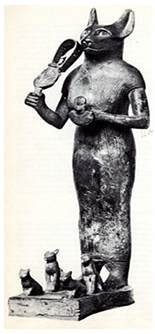
(For the presumed notions that link cats to the supernatural, (e.g., the ancient Egyptian goddess Bast/Bastet; see Ions 1968, Bast, p. 64, and pp. 103, 119, and Appendix B, below).
It is worth noting that the foundation of these fairytales is “The Brother-Sister Syndrome” (El-Shamy 1981) exemplified in the life account/myth/history of Isis and her husband-brother Osiris, and the conflict between two brothers, Osiris and evil Seth, (Mot., A164.1, Brother-sister marriage of the gods; cf., type HeS 872$, Brother and Sister: Separation and Subsequent Reunion; twelve subtypes indicate the tale’s demographic spread. (Also see Mot., P798.1.0.5$, Triads revolving around brother and sister as unbalanced (Sethian Syndrome). S73.1.4, Fratricide motivated by love-jealousy (El-Shamy 2004a)).
6. Morphology Contrasted to Diffusion Studies
In another situation, motifs that occur as constituents of a modern Märchen/fairytale and as myth/faith/creed in the ancient Egyptian account of conflict between the two deities of good and evil (Horus and Set/Seth) should be viewed in context. For the ancients who believed in the religious sacredness of that account, their creed is survived as key motifs in tale-type: AT, 613, The Two Travelers (Truth and Falsehood). The tale seems to have its roots in the ancient Egyptian religious account of a conflict between Truth and Falsehood. The written text dates back to the 19th Dynasty of the thirteenth century B.C. The translation of the ancient text appears in Gardiner, p. 2. It is also given with valuable comments in Lefébvre (p. 159), and Brunner Traut, no. 6. A more recent translation and notes are provided in Simpson (1972, p. 127).
In the ancient accounts,
Although the episode of the son is missing from all available modern variants, the general pattern and beliefs associated with the ancient Egyptian account still live in current oral traditions of Egypt (see El-Shamy [1980] 1984, p. 262; 2004a, type HeS, 613A1$, The Vile Dyer Seeks to Eliminate the Noble Barber (Abu Qîr and Abu Sîr)).Falsehood accuses his older brother, Truth, of having lost or damaged an extraordinarily huge knife or sword and asks the Ennead (Mot., A167.1.1$, Council of the nine gods. (tâsûC: The Ennead) that Truth be blinded and forced to serve as the keeper of his gate). They agree (Mot., K0451.1, “Unjust umpire decides a religious dispute”). Still jealous of Truth’s virtue, Falsehood orders two of his brother’s servants to take him to the desert and throw him to lions. They spare his life, leave him at the foot of a hill, and report to Falsehood that his brother has been torn apart by a lion (motif K512, Compassionate executioner). Truth is discovered by some maids/[housekeepers] who report his beauty to their mistress. She sleeps with him, and he begets a child; nonetheless, Truth still serves as her doorkeeper. The child grows up and goes to school, where he is reproached for being fatherless. He inquires of his mother, and she points out his father (mot. H1381.2.2.1, Boy twitted with illegitimacy seeks unknown father). The father tells him the story. To vindicate his father, the son leaves a fine steer with Falsehood’s shepherds. Falsehood admires the calf, slaughters it, and eats it. The son demands his calf back and claims that it was of supernatural size or that it gave birth to sixty calves daily (motif X1237, Lie: remarkable ox or steer). The matter is taken to [a tribunal by] the gods, and they state that such a calf cannot exist. The youth then asks them, “How can there be a knife as large as you had stated before?” (motif J1163, “Pleading for accused by means of parable”). The son then reveals his identity. Falsehood contests (pp. 131–32) the youth’s claim and swears that Truth is dead and wagers to lose his eyes and to serve as Truth’s doorkeeper if Truth is proved to be alive (motifs N2.3.3, Eyes wagered; A0167.1.1$, Council of the nine gods. (tâsûC, The Ennead)). The youth produces Truth, his father, and the punishment is carried out. And thus, the dispute between Truth and Falsehood is resolved.
7. Conception from Eating
He-S, 872A$, The Pregnancy of the Virgin Sister by Treachery.
The magic food (in the modern tale) is usually a fruit (e.g., apple, orange). Also, in the second segment of Subtype A, the enigmatic rhymes about the act of the supernatural conception are used more frequently to reveal what had happened to the heroine than to constitute a riddle to be solved by a suitor in order to win her hand […]. Thus, both the specific motif T511.5.1, conception from eating fish and the riddle derived thereof (mot. H691, Riddles of weight) seem to be the least frequently encountered elements of this tale; they appear only sporadically in Europe mainly in the Baltic Sea area and fail to occur in the Middle East or sub-Saharan Africa. It is therefore preferable not to view them as the identifying themes/(marks) for AT 705, Born from a Fish.
There is evidence indicating that the basic themes and motifs in AT 705—706 date back to ancient Near Eastern religious beliefs (exoterically labeled “myths”). The highly salient motif of male pregnancy due to eating or drinking, is found in the ancient Egyptian account of the conflict between Horus and Seth for the rule. Seth who had made homosexual advances towards Horus was tricked by Horus’ mother, Isis, into eating lettuce which had Horus’ semen on it; he (Seth) became pregnant and gave birth to the Moon. The theme of the falcon mother raising an infant in a tree suggests the ancient Egyptian goddess Hathor, whose name meant the house of Horus, and who was believed to dwell in a holy sun tree. The theme of mutilation (by cutting off hands and/or piercing eyes) and subsequent restoration of damaged body organs/(parts) corresponds to the acts of Isis cutting off the contaminated hand of her son (Horus) and replacing it with another one which was pure, and to other related themes involving Horus and Seth. Also, the theme of a union contrary to nature, which appears as mother-son incest in the modern tale may be compared to the homosexual act in the ancient Egyptian text. (El-Shamy [1980] 1984, p. 1213, my Ital.).
Egyptologist Wente wrote:
[….] Seth told Horus: Come, let’s make holiday in my house. Horus told him: I’ll do so, surely; I’ll do so, I’ll do so. Now afterward, (at) evening time, bed was prepared for them, and they both lay down. But during the night Seth caused his phallus to become stiff and inserted it between Horus’s thighs ([Type HeS, 1424B$/cf., Seduction by other tricks. Sexual intercourse under pretence of strengthening, increasing eyesight, (or the like, [i.e., celebrating, etc.; Mot., T59.2$, No penetration sexual intercourse. ‘Brushing’/tafreesh)]. Then Horus placed his hands between his thighs and received Seth’s semen. Horus went to tell his mother Isis: Help me, Isis, my mother, come and see what Seth has done to me. And he opened his hand(s) and let her see Seth’s semen. She let out a loud shriek, seized her copper (knife), cut off his hand(s), threw them into the water, and restored for him hand(s) that were equivalent. Then she fetched some fragrant ointment and applied it to Horus’s phallus. She caused it to become stiff and inserted it into a pot, and he caused his semen to flow down into it.
Isis at morning time went carrying the semen of Horus to the garden of Seth and said to Seth’s gardener: What sort of vegetable is it that Seth eats here in your company? So the gardener told her: He doesn’t eat any vegetable here in my company except lettuce. And Isis added the semen of Horus onto it. Seth returned according to his daily habit and ate the lettuce, which he regularly ate. Thereupon he became pregnant with the semen of Horus [(Mot., T532.1.3, Impregnation by eating leaf of lettuce)]. So, Seth went to tell Horus: Come, let’s go that I may contend with you in the tribunal. Horus told him: I’ll do so, surely; I’ll do so, I’ll do so.
They both went to the tribunal and stood in the presence of the Great Ennead. They were told: Speak concerning yourselves. […]. Then Thoth, lord of script and scribe of truth for the Ennead, put his hand on Horus’s shoulder and said: Come out, you semen of Seth. And it answered him from the water in the interior of the marsh. Thoth put his hand on Seth’s shoulder and said: Come out, you semen of Horus. Then it said to him: Where shall I come from? Thoth said to it: Come out from his ear. Thereupon it said to him: Is it from his ear that I should issue forth, seeing that I am divine seed? [Mot., A165.6, Thoth, Scribe of the gods]. Wente, (in: Simpson 1972, pp. 120–21. Hassan ([1945] 2000), pp. 135–37, passim. My Ital).
In a contemporary religious legend titled Fadloun:
Also, see “The Pregnancy of the Virgin Sister by Treachery’ in a contemporary haddûtah (fairytale)”: HeS, 872A$, The Pregnancy of the Virgin Sister by Treachery, above.
8. Fadloun Al-CAbid (the Pious)
Type HeS, 917$, Innocent (Chaste) Man Slandered as Seducer (Rapist): Subsequently Vindicated
Fadloun the Pious, who was extremely handsome, was falsely accused by a young woman that he had killed her servant, raped her and ruined her seal (virginity). Fadloun was transferred to Mecca where he was tried by Caliph Omar (major figure in Sunni Islam [ruled, 643–644 CE]) and sentenced to death. While the arrangements for the execution were taking place, Fadloun called on Imam Ali, (a major figure in Shiite Islam and prophet Mohammed’s cousin and son-in-law, (601–661 CE), for help). The Imam heard Fadloun’s plea from his residence in Kufa, Iraq. The Imam struck the girl with the side of his sword on her back, a fetus slipped out of her womb and declared that Fadloun was not his father and that his actual father was a slave owned by the young woman (the mother) who wanted to take revenge on Fadloun because he did not yield to her seduction. Fadloun was freed and the guilty were punished. (My Ital.). (El-Shamy 1964, pp. 104–5, Résumé). “An Annotated Collection of Egyptian Folktales Collected from an Egyptian Sailor in Brooklyn, New York.” Indiana University master’s thesis. https://www.researchgate.net/profile/Hasan-El-Shamy/publications; or: https://www.researchgate.net/publication/374332169_An_Annotated_Collection_of_Egyptian_Folktales_Collected_From_an_Egyptian_Sailor_in_Brooklyn_New_York (accessed on 16 January 2026).
9. Survival in Modern Time of the Experiences of Goddess Isis’ in Phoenicia
See: HeS, 872A$, The Pregnancy of the Virgin Sister by Treachery.
From ancient Myth/Belief to Contemporary Fairytale: Type HeS, 1442$, Stupid Woman (Co-wife) is Deceived into Imitating Foolishly: she kills her child.
A contemporary haddûtah (fairytale) gives the following account:
Tamarisk (tamr-hinnah) shrub and its smell play a significant role in Egyptian folk singing. Although its flower has a poignant odor and, consequently, is not offered for sale, it still is thought of as fragrant and is sung about. From the present writer’s childhood, the following song was learned):
| Ya tamr hinnah, | Ya tamr hinnah, |
| O, you, tamarisk, | O, you, tamarisk, |
| khilîtî bînâ | wi biC idtî Cannâ |
| You have let us down, | and you stayed aloof from us |
| el-wadd kullu mala el-ganâyin | el-ward kullu mala el-ganâyin |
| All the flowers filled the gardens, | all the flowers filled the gardens |
| `ishmiCna `inti | `illi shârdah minna |
| Why is it that you | are the one who is evading us |
| Ya tamr hinnah! | |
| O, you, tamarisk! | |
| (Listen to: https://www.youtube.com/watch?v=FeAUfWHQ3tI) (accessed on 8 June 2025) | |
On the ‘myth’ of Isis and the tamarisk ‘tree’ which grew around her husband-brother, (see Budge 1904, pp. 186–93; and Ions 1968, pp. 20–21, passim); also see “The Cumin Field Guard” below, Mot., D1393.1.2$, “Tree grows around object (person) and encloses it (him)”.
Tale-type, HeS 1442$, The tale may be summarized as follows:
A man marries two women, the second is a tulbah (wished for child/Thumbling). The second wife, Thumbling, performs various household chores (painting, cleaning, cooking, etc.) with supernatural speed and efficiency. When the first (normal) wife asks how Tumbling did it, Thumbling would give deceptive answers. One such chore was bathing her young and giving them a healthy glow. When the normal first wife inquired as to how Thumbling managed that, Thumbling claimed that she toasted (cf., singeing) the children in oven fire. The first wife stupidly imitated by placing her young in the lit oven. They were burnt to death. The husband divorced the first wife and sent her to her father’s home. [Thus, the trickster character won].(El-Shamy 1999, Finger Joint, No. 31, pp. 247–51)
The most significant association between a supernatural character and the tamarisk shrub (“tree”) seems to be the following fairytale from the city of Suez in Egypt. The text may be summarized as follows:
A barren woman prayed for a child even if it happened to be a tamarisk branch. God granted her a tamarisk branch for a child. The twig used to turn into a girl and clean the house when her mother was away. Once the king’s son passed by and smelled the aroma of tamarisk, even though it was not in season; he took the plant, whose fragrance was tafooh/(permeating) into his own garden. She used to emerge in the morning and shout at the gardener a [magic formula] that caused him to be turned upside-down. […]. The king’s son travels away, and during his absence his bin-Camm/(paternal-she-cousin)—presumed to marry him, ordered the tamarisk shrub destroyed and buried. The gardener, who felt sorry for her, received supernatural help, and restored the tamarisk back to life.
(Mot., F346.4$, “Fairy helps mortal (Adamite) with household chores (cooking, spinning, laundering, etc)).” (is reminiscent of Isis in Phoenicia hovering over the queen’s infant in order to burn his mortal quality.)
(The remainder of the text complies with tale-type HeS, 1442$, (given as an act of vengeance against the paternal-she-cousin due to her hiqd/(intense hate/abhorrence: Mot., W179.1$, Power of hatred (envy, jealousy, malice, hiqd, etc.).
10. The Cumin Field Guard
Narrated by Mervat H., a thirteen-year-old schoolgirl, from the city of el-Sinbillawain, in northeastern Egypt. She had heard this children’s tale from her paternal grandmother and older sister.
The theme of a she-swallow guarding a precious tree (see El-Shamy 1999, p. 92) seems to go back to Egyptian antiquity (Plutarch’s Mythological History of Isis and Osiris), (see Budge 1904, The Gods of the Egyptians, Vol. II., p. 189).
In her search for the corpse of Osiris, the goddess Isis is reported to have gone to Phoenicia, served as a nurse to the queen’s infant, and played this role vis-à-vis a tamarisk tree which had grown to enclose the casket entombing Osiris’s corpse. […].
“Isis attempted to use her powers to confer immortality on the child, suckling it with only her finger and, at night, singeing/[scorching] it with a sacred purifying flame in order to burn away the mortal quality of its body. But one day the queen surprised her new nurse, who in the form of a swallow was flying round and round the great tree. Her cries of alarm broke the spell and the chance of immortality for her son was irretrievably lost”. […].(Ions, pp. 58–59)
11. The Modern haddûtah/(Fairytale) May Be Summarized as Follows
There was once a woman who did not beget any children. She said [in an imploring tone], O Lord, I [wish to] beget, even if a she-sparrow. The Lord responded to her plea, and she begot a she-sparrow. Her [the she-sparrow’s] mother was happy with her, and her father owned a field of cumin. He said to her, “She-sparrow, go and guard the cumin field!” So, She-sparrow went to guard the cumin field. Someone came to steal some cumin. She said [angrily, in chant], “Take your hand off, may your hand gets cut off! [May what is] above you [become] underneath, and [what is] underneath [becomes] above, […]”.
Immediately, the man became upside-down, […].
Her story spread in the village. A pasha/(Lord) heard the story and said [to himself], by God, I will go and bring some cumin! [So], he went to the field and took along his horse-attendant. [When he got to the field], he said [in a commanding voice], Carriage driver, get down and bring some cumin! The driver got down and went to bring some cumin, but when he reached out with his hand to get the cumin, he heard a voice [of a She-sparrow’s] saying, take your hand off, may your hand get cut off. [May what is] above you [become] underneath, and [what is] underneath [becomes] above you. You and your master!
He looked [only] to find himself [immediately] upside-down. The driver became scared and ran away. The pasha stepped down, out of the carriage and went to take some cumin. He was listening, and when he heard her, she-who was saying “Take your hand off, may your hand gets cut off! [May what is] above you [become] underneath, and [what is] underneath [becomes] above you, you, and your master!”
He [quickly] put out his hand [in the direction of the voice] and seized her; she kept on chirruping: “Mother, don’t think that I am guarding the cumin. I am in the pasha’s hand, going to Constantinople.” She went home and knocked on the door.
Her mother asked: “Who is it? She[-sparrow] replied, Open, mother. I was in Constantinople, and I have brought you fine things. …, etc.”
And that is it [i.e., the tale ended]. And bit by bit, the tale is over [(a stylized ending)]. Z10.2.0.1$, Neutral/(nonsensical) end formulas: tûta tûta, firghit el-haddûtah/Bit by bit; the tales came to end.
12. Conclusions: The Symbiotic Relations Between Africa of the North and Africa of the South
To reiterate, the call by Dseagu (2002, [made repeatedly up to the present time via the WEB]) for a Morphological analysis of The Swallowing Monster in Southern African Folklore is impractical and is likely to lead to limited and redundant conclusions. It is an outcome of insufficient knowledge of the actual history of folkloristic studies in this field. Based on the premise of culture diffusion, the Thompson analytical device termed “Motif” and its companion AT (Aarne-Thompson “Tale-type”) hold more promise in exploring perplexing issues in Africa, north and south of the Sahara, despite the initial pitfalls of incompleteness, selectivity, suppression of data, etc., plaguing the early applications of these devices to Africa. The continuity of lore throughout Africa from the Cape to the Mediterranean Sea has been involuntarily established through studies seeking to prove its lack of relevance (e.g., Haring 1972; cf., Finnegan 1970).
13. The Ancient Egyptian Myth of Isis and Her Brother-Husband: Believed, Written, Inscribed, Painted and Sculpted
The ancient Egyptian Myth of Isis and her brother-husband left an unmistakable impact in terms of affecting scores of tale-types and motifs surviving in contemporary Egypt (and elsewhere in Africa) until today (as detailed above; also see the lists of types and motifs, below). It and other ancient Egyptian narrative data survived the effects of negligence along with lack of knowledge (or suppression) by scholars. Yet, the account still has more to reveal.
That myth should be explored as a possible mother/(womb out of which) literature, especially the spoken genres, was born.
The reasons for the absence of “Ancient Egyptian Mythology” is the total lack of knowledge of folkloric terms. In their quest to be like the West, Arab literary scholars adopted Home’s (12th century BC) as a goal to emulate. Consequently, the terms legend, myth, epic, among others, were used synonymously.
The ancient Egyptians left an unmistakable impact in terms of affecting scores of tale-types and motifs surviving in contemporary Egypt (and elsewhere in Africa) until today (as detailed above; also see the lists of types and motifs, below). It and other ancient Egyptian narrative data survived the effects of negligence along with lack of knowledge (or suppression) by scholars. Yet, the narrative account still has more to reveal.
14. The Homerian Influence
However, Younis’/Yûnis’ doctoral dissertation (Younis [1953] 1956, Cairo University), which was the first in dialectical Arabic to be allowed by Cairo University, marked the beginning of confusion of the meaning of its references: legend/history with “epic” in the Homer tradition (12th C, B.C.).
Meanwhile Sulaymân Mazhar’s, ‘Asâtîr min al-Sharq (Legends/Epics from the East), (Cairo, Mazhar 1958), did not mention ancient Egyptian myth; other literary scholars (e.g., Masdî (Al-), Hajjâjî (Al-)) drifted into epic in the Homer tradition.
Unfortunately, Yuonis/Yûnis, using his position of authority against available evidence, bestowed the accomplishments in the field on his disciple(s). The misconception of Epic/“malhamah”/[lit., heap of flesh] dominated.
Quoting William Kelly Simpson and E. Littmann, Simpson points out in his introduction to The Literature of Ancient Egypt. (New Haven: University Press, 1972), that “The [formal] culture of [ancient] Egypt was not expressed in epics or drama, (n. 29, p. 2) Ital. are mine”. Meanwhile, Littmann (1955). Arabische Märchen und Schwänke aus Ägypten. In: Akademie der Wissenschaften und der Literatur. Abhandlungen der Klasse der Literatur. (Wiesbaden 1955).
Masdî (Al-), M. Jamâl-al-Dîn. For example, reported that Dunshway [a nationalistic play about the tyranny of colonial powers]. (Cairo: al-Hay’ah, 1974), reports that certain writers are re-creating this historical [nationalistic] legend into a ‘malhamah’/(‘epic’ [cf., Homer]), p. 110.
El-Shamy, Hasan. “Egyptian Balladry and its European Parallel”. https://www.researchgate.net/publication/393052915_Egyptian_Balladry_its_EU_Parallels/stats (accessed on 8 June 2025).
Hajjâjî (Al-), Ahmad. Sh. Al-‘Ustûrah fî al-masrah al-Misrî al-MuCâsiri, (The Epic/he legend in the Contemporary Egyptian Theater). (Cairo: Dâr al-Thaqâfah, Hajjâjî n.d.).
Yuonis/Yûnis, Abdel-Hameed. al-Hilaliyyah fi al-tarikh wa al-`adab al-shaCbi (Cairo University, Younis [1953] 1956).
Yûnis/Younis, CAbd al-Hamîd. al-Hilâliyyah fî al-târîkh wa ‘al-‘Adab al-ShaCbî (Al-Hilâliyyah in History and Folk Literature). (Cairo: Younis [1953] 1956).
Yûnis, CAbd al-Hamîd. MuCgam al-Folklore. (Dictionary of Folklore). (Beirut: Maktabat Lubnân, Yûnis 1983).
Funding
This research received no external funding.
Institutional Review Board Statement
Not applicable.
Informed Consent Statement
Not applicable.
Data Availability Statement
No new data were created or analyzed in this study. Data sharing is not applicable to this article.
Conflicts of Interest
The author declares no conflicts of interest.
Appendix A
Golden shoes of the period of Roman historian Strabo: 1st C. B.C. (linked to Climo’s type 510-510A, Cinderella).
Appendix B
BAST/BASTET/linked to el-ebsâss, and to tale-type HeS,1442$. (Ions 1968, p. 94).
Appendix C
Hathor Feeding Horus. Linked here to AT, 511A (Ions, p. 57).
Appendix D. Register of Tale-Types
0091, Monkey (Cat) who Left his Heart at Home [which is an excuse that leads to escaping 000 from would be killer],
0123C$, Predator (Ogre, Wolf, etc.) Gains Access to Children’s Home on Tree Top. They are rescued by their brother (father).
0155, The Ungrateful Serpent Returned to Captivity.
0311D$, A Woman is Rescued from Magician (Ogre, Witch) by a Relative Other than her Father or Brother (e.g., rescued by her Husband, Paterna-cousin, Fiancé, etc.).
0318, The Faithless Wife. Batu: the Egyptian Two Brothers Tale.
0318A$, The Man who Lost his Organ/[(phallus)] and then Regained it).
0327J$, Girl Abandoned by Jealous Playmates (or by her Sisters). She falls into the power of an ogre.
0510A, Cinderella.
0511A, The little Red Ox.
0511A* The Helpful Cow. [Not to be confused with 0511A, The little Red Ox].
0591A$, The Thieving Starling. Female bird steals from men. [Zraizrah].
0613, The Two Travelers (Truth and Falsehood).
0613A$, Who may Remain in Town: Truth or Falsehood?
0653A, The Rarest Thing in the World.
0700, Tom Thumb. [Adventures of a boy who is the size of a finger joint].
0872$, Brother and Sister: Separation and Subsequent Reunion.
0872A$, The Pregnancy of the Virgin Sister by Treachery.
0705A$, Born from Pregnant Man, Raised by Bird (Animal): the Falcon’s (Kite’s) Daughter. (A man’s mother mutilates his wife and takes her place in bed).
917$, Innocent (Chaste) Man Slandered as Seducer (Rapist): Subsequently Vindicated. (Batu/Baîtî and Anubu’s wife [his sister-in-law], Joseph and Pharaoh’s wife, etc.).
1424B$/cf., Seduction by other tricks. Sexual intercourse under pretence of strengthening, increasing eyesight, (or the like, [i.e., celebrating, etc.]
1442$, Stupid Woman (Co-wife) is Deceived into Imitating Foolishly: she kills her child.
1655, The Profitable Exchange.
Appendix E. Register of Motifs
A0123.7.2.4$, Green deity (god, saint, culture-hero). Miscellaneous.
A0165.6, Thoth, Scribe of the gods.,
A0167.1.1$, Council of the nine gods. (tâsûC: The Ennead).
A1100.1$, Balance and harmony as well as truth: The Maat/Mayet-principle of world order.
A1536.1$, Origin of the ritual (custom) of chopping rope during public assembly. Commemoration of killing of evil serpent (deity).
A164.1, Brother-sister marriage of the gods.
A7048.1$, Lunar eclipse.
A0737.1.2.1$, Houris (nymphs of Paradise) capture moon, thus causing eclipse.
A0755.8.5$, Moon’s waning (or eclipse) caused by attack by supernatural adversary (deity, demon).
B0470, Helpful fish.
D1393.1.2$, Tree grows around object (person) and encloses it (him).
F0346.4$, Fairy helps mortal (Adamite) with household chores (cooking, spinning, laundering, etc.).
F0440.3$, al-Khidr/(the Green-one): benevolent spirit associated with vegetation and water.
H0691, Riddles of weight.
H1381.2.2.1, Boy twitted with illegitimacy seeks unknown father).
J1163, Pleading for accused by means of parable.
K0451.1, Unjust umpire decides a religious dispute.
K0451.1.1$, The tâsûC unjustly judges dispute.
L0102, Unpromising heroine.
N0002.3.3, Eyes wagered.
N0061, Wager that falsehood is better than truth.
P0253.10.1$, Sister as her brother’s ‘first love’.
S0073.1.4, Fratricide motivated by love-jealousy.
Notes
| 1 | Example: Sample of distribution of a tale within the Continent of Africa is type: HeS, 705A$, Born from Pregnant Man, Raised by Bird (Animal): the Falcon’s (Kite’s) Daughter. (A man’s mother mutilates his wife and takes her place in bed). El-Shamy 1988, no. 1 & 2”. pp. 150–63, pp. 160–62. (49 texts in continuous geographic manner covering the following regions: NILE VALLEY: EGYPT AND SUDAN; ALGERIA, BERBERS; LEVANT COAST: PALESTINE, SYRIA; MESOPOTAMIA: IRAQ, SUB-SAHARAN AFRICA: SOMALIA, MASAI, KIKUYU, KAMBA, SOUTHERN AFRICA: BA-SUTO: WEST AFRICA: NIGERIA, YORUBA.) Also see Crowley (1981) below, and compare the indexes by: Jason (1975); and Nowak (1969), no. 194 (AT 705, Born from a Fish). |
| 2 | A motif/theme for which there is no specific motif in the Motif Index (Thompson 1955–1958) except the broad, nonspecific Mot., L102, “Unpromising heroine” to which the word Cinderella was added by El-Shamy. |
| 3 | Secular legal systems have recently (1980) sanctioned the fundamental belief premises on the basis of which “magic” is believed to operate. A practitioner of “magic through contact with jinn” [shaikh/charlatan, a practice recently outlawed] was tried in civil court for defrauding his female clients and practicing medicine without a license. The trial judge—in congruence of formal religious dogma—asserted that jinn do exist and that they may indeed gain control of a person. Consequently, like crimes committed while being “drunk,” “insane,” or “under the influence of al-quwâ al-khafiyyah (invisible powers/forces, i.e., jinn) is, legally, not responsible for his own actions. The accused was pronounced “Innocent.” (El-Shamy 2009, p. 79, n. 256). |
| 4 | The author of the first true novel in Arabic literature dedicated that work to his sister. During his studies in France, the pioneer Egyptian novelist M.H. Haykal wrote Zaynab (Haykal [1914] 1967), which depicts rural social scenes and the tragic end of, Zaynab, a poor beautiful peasant girl who was forced to marry a person she could not love and died of both misery and disease. In his dedication to his literary creation, Haykal, in accordance with “The Brother Sister Syndrome”, described his own sister as “the first of Egypt’s youth with whom I have been in love”—new Mot., P253.10.1$, Sister as her brother’s ‘first love’ (Haykal [1914] 1967, Preface). Also cf. El-Shamy (1990) “Oral Traditional Tales and the Thousand Nights and a Night: The Demographic Factor”—in: The Telling of Stories: Approaches to a Traditional Craft. (Morton Nøjgaard et al., eds. Odense, Denmark, Odense University Press: 1990, pp. 63–117). |
References
- Brunner-Traut, Emma. 1965. Altägyptische Märchen: Mythen und Andere volkstümliche Erzählungen. Hamitic literature. Düsseldorf: Bechtermünz Verlag. [Google Scholar]
- Budge, Ernest A. Wallis. 1904. The Gods of the Egyptians, or Studies in Egyptian Mythology. 2 vols. London: Methuen & Co. [Google Scholar]
- Budge, Ernest A. Wallis, ed. and trans. 1931. Egyptian Tales and Romances. London: T. Butterworth. [Google Scholar]
- Chauvin, Victor. 1892–1922. Bibliographie des Ouvrages Arabes ou Relatifs aux Arabes: Publiés dans l’Europe Chrétienne de 1810 à 1885. 12 vols. Liége: H. Vaillant-Carmanne. [Google Scholar]
- Climo, Shirley. 1993. The Egyptian Cinderella. New York: HarperCollins. First published 1989. [Google Scholar]
- Crowley, Daniel. 1981. Review of Folktales of Egypt: Collected, Translated and Annotated with Middle Eastern and [Sub-Saharan] African Parallels. Research in African Literatures 12: 398–400. [Google Scholar]
- Dorson, Richard M., ed. 1972. African Folklore. Garden City and New York: Doubleday. [Google Scholar]
- Dseagu, Samuel A. 2002. African Folklore: An Encyclopedia. In African Folklore: An Encyclopedia. Edited by Philip M. Peek and Kwesi Yankah. New York: Routledge. [Google Scholar]
- Dseagu, Samuel A. 2021. The Swallowing Monster in Southern African Folklore: Need for Morphological Investigation. Academic Letters. First published 2001. [Google Scholar] [CrossRef] [Scilit]
- Dundes, Alan. 1964. The Morphology of North American Indian Folktales. FFC No. 195. Helsinki: Suomalainen Tiedeakatemia. [Google Scholar]
- Dundes, Alan. 1997. Projective Inversion in the Ancient Egyptian `Tale of Two Brothers. Journal of American Folklore 115: 378–94. [Google Scholar] [CrossRef] [Scilit]
- El-Shamy, Hasan M. 1964. An Annotated Collection of Egyptian Folktales Collected from an Egyptian Sailor in Brooklyn, New York. Master’s thesis, Indiana University, Bloomington, IN, USA. Available online: https://www.researchgate.net/profile/Hasan-El-Shamy/publications (accessed on 16 January 2026).
- El-Shamy, Hasan M. 1981. The Brother-Sister Syndrome in Arab Family Life Socio-cultural Factors in Arab Psychiatry: A Critical Review. International Journal of Sociology of the Family 11: 313–23. [Google Scholar]
- El-Shamy, Hasan M. 1983. Belief Characters as Anthropomorphic Psychosocial Realities. The Egyptian Case. al-kitâb al-sanawî li-Cilm al-‘igtimâC [Annual Review of Sociology] 3: 7–36. Available online: https://www.researchgate.net/publication/45256302_Belief_Characters_as_Anthropomorphic_Psychosocial_Realities_The_Egyptian_Case (accessed on 16 January 2026).
- El-Shamy, Hasan M. 1984. Folktales of Egypt: Collected, Translated and Annotated with Middle Eastern and [Sub-Saharan] African Parallels. Chicago: University of Chicago Press. First published 1980. [Google Scholar]
- El-Shamy, Hasan M. 1988. A Type Index for Tales of the Arab World. Fabula 29: 150–63. [Google Scholar]
- El-Shamy, Hasan M. 1990. The Traditional Structure of Sentiments in Mahfouz’s Trilogy: A Behaviorist Folkloristic Reading. Al-Arabiyya 23: 53–74. [Google Scholar]
- El-Shamy, Hasan M. 1999. A Response to Heda Jason’s Review [of El-Shamy’s Folk Traditions of the Arab World]: Issues Related to the Computerized Typology and Motif Classification. Asian Folklore Studies 57: 345–55. [Google Scholar] [CrossRef] [Scilit]
- El-Shamy, Hasan M. 2001. Review of Vladimir Propp and the Universal Folktale: Recommissioning an old paradigm story as initiation. Asian Folklore Studies 61: 153–57. [Google Scholar]
- El-Shamy, Hasan M. 2004a. [DOTTI]. Types of the Folktale in the Arab World: A Demographically Oriented Tale-Type Index. Bloomington: Indiana University Press. [Google Scholar]
- El-Shamy, Hasan M. 2004b. Typology and the Study of African Folklore. In African Folklore: An Encyclopedia. Edited by Phillip M. Peek and Kwesi Yankah. London: Routledge. Available online: https://www.researchgate.net/publication/374290501_N_E_Africa_By_El-Shamy (accessed on 16 January 2026).
- El-Shamy, Hasan M. 2009. Review of Children Born from Eggs: African Magic Tales-Texts and Discussions (Afrika erzaehlt Band 9). Journal of Folklore Research: An International Journal of Folklore and Ethnomusicology. Available online: https://scholarworks.iu.edu/dspace/handle/2022/14127 (accessed on 16 January 2026).
- El-Shamy, Hasan M. 2011. Motif. In The Cambridge Encyclopedia of Language Sciences. Edited by Patrick C. Hogan. Cambridge: Cambridge University Press. [Google Scholar]
- El-Shamy, Hasan M. 2017. Typology and Cultural Analysis. In George List, Animal Tales from the Caribbean. Edited by John McDowell, Juan Sebastian Rojas and Hasan El-Shamy. Bloomington: Indiana University Press. [Google Scholar]
- El-Shamy, Hasan M. 2023. "Why a Folk Religion May Not Exist Among Followers of An Abrahamic Faith: The Case of Sunni Islam in Egypt. In Living Folk Religions. Edited by Sravana Borkataky-Varma and Aaron Michael Ullrey. London: Routledge, pp. 64–85. [Google Scholar]
- Erman, Adolf, ed. 1966. The Ancient Egyptians: A Sourcebook of Their Writings. New York: Harper & Row. [Google Scholar]
- Finnegan, Ruth. 1970. Oral Literature in Africa. Oxford: Oxford University Press. [Google Scholar]
- Gilet, Peter. 1998. Vladimir Propp and the Universal Folktale: Recommissioning an Old Paradigm—Story as Initiation. New York: Peter Lang Inc., International Academic Publishers. [Google Scholar]
- Hajjâjî, Ahmad Shams al-Din al-. n.d. Al-Usturah fi al-Masrah al-Misri al-Mu’asir [The Myth in Contemporary Egyptian Theater]. Cairo: Dar al-Thaqafah.
- Haring, Lee. 1972. A Characteristic African Folklore Pattern. In African Folklore. Edited by Dorson. Gardeen City and New York: Doubleday, pp. 165–79. [Google Scholar]
- Hassan, Salîm. 2000. MawsûCat Misr al-Qadîmah/(Encyclopedia of Ancient Egypt). Vol. 17: Al-‘adab al-Misrî al-Qadîm (Ancient Egyptian Literature). Cairo: al-Hay’ah. First published 1945. [Google Scholar]
- Haykal, Muhammd Husayn. 1967. Zaynab: Manâzir wa ‘akhlâq rîfiyyah [Zaynab: Rural Scenes and Manners], 3rd ed. Autobiographical Novel. Cairo: Maktabat al-Nahḍah al-Miṣriyyah. First published 1914. [Google Scholar]
- Hollis, Susan T. 1990. The Ancient Egyptian Tale of Two Brother: The Oldest Fairy Tale in the World. Norman and London: University of Oklahoma Press. [Google Scholar]
- Ions, Veronica. 1968. Egyptian Mythology. Paul Hamlyn: Middlesex Feltham. [Google Scholar]
- Jason, Heda. 1975. Types of Oral Tales in Israel. Jerusalem: Israel Ethnographic Society. [Google Scholar]
- Klipple, May Augusta. 1938. African Folk Tales with Foreign Analogues. Ph.D. dissertation, Indiana University, Bloomington, IN, USA. [Google Scholar]
- Lindblom, Gerhard. 1928. Kamba Folklore. Pt. 1, Tales of Animals. Uppsala: Appelberg. [Google Scholar]
- Littmann, Enno. 1955. Arabische Märchen und Schwänke aus Ägypten. In Akademie der Wissenschaften und der Literatur. Abhandlungen der Klasse der Literatur. Wiesbaden: Franz Steiner Verlag. [Google Scholar]
- Liungman, Waldemar. 1964. Sagan om Bata och Anubis och den Orientalisk Eurpeiska Undersagans Urspring. Djursholm: Författarens bokmaskin. [Google Scholar]
- Liyong, Taban Lo, ed. and trans. 1972. Popular Culture of East Africa. Oral Literature. Nairobi: Longman. [Google Scholar]
- Marzolph, Ulrich. 2020. 101 Middle Eastern Tales and Their Impact on Western Oral Traditions. Detroit: Wayne State University Press. [Google Scholar]
- Mazhar, Sulaymân. 1958. ‘Asâtîr min al-Sharq (Legends/Epics from the East). Cairo: Dâr al-Ma‘ârif. [Google Scholar]
- Murdock, G. Peter. 1959. Africa: Its Peoples and Their Culture History. New York: McGraw-Hill. [Google Scholar]
- Müller, David H. 1905. Mehri und Soqutri Sprache pt. II Soqotri Texte. Südarabische Expedition. Vienna: Alfred Hölder, vol. 6. [Google Scholar]
- Müller, David H. 1907. Die Mehri und Soqutri Sprache, pt. III Shhauri Texte. Vienna: Südarabische Expedition, vol. 7. [Google Scholar]
- Nowak, Ursula. 1969. Beiträge zur Typologie des arabischen Volksmärchens. Doctoral dissertation, University of Freiburg, Freiburg im Breisgau, Germany. [Google Scholar]
- Pritchard, Edward Evan. 1967. The Zande Trickster. Oxford: Clarendon Press. [Google Scholar]
- Sigrid, Schmidt, ed. 2007. Children Born from Eggs: African Magic Tales—Texts and Discussions. Cologne: Rudiger Koppe Verlag. [Google Scholar]
- Simpson, William Kelly, ed. 1972. The Literature of Ancient Egypt: An Anthology of Stories, Instructions, and Poetry. New Haven: Yale University Press. [Google Scholar]
- Spence, Lewis. 1927. Myths and Legends of Ancient Egypt. New York: Dingwall-Rock. [Google Scholar]
- Thompson, Stith. 1955–1958. Motif Index of Folk Literature. 6 vols. Bloomington: Indiana University Press. [Google Scholar]
- Thompson, Stith. 1964. The Types of the Folktale: And Bibliography, 2nd ed. FFC No 184. Helsinki: Suomalainen Tiedeakatemia. [Google Scholar]
- Wente, Edward F., Jr. 1972. The Tale of the Two Brothers. In The Literature of Ancient Egypt. Edited by William Kelly Simpson. New Haven: Yale University Press, pp. 92–107. [Google Scholar]
- Younis, CAbd al-Hamîd. 1956. al-Hilâliyyah fî al-Târîkh wa ‘al-‘Adab al-ShaCbî [Al-Hilâliyyah in History and Folk Literature]. Cairo: Cairo Univesity. First published 1953. [Google Scholar]
- Yûnis, CAbd al-Hamîd. 1983. MuCgam al-Folklore [Dictionary of Folklore]. Beirut: Maktabat Lubnân. [Google Scholar]
Disclaimer/Publisher’s Note: The statements, opinions and data contained in all publications are solely those of the individual author(s) and contributor(s) and not of MDPI and/or the editor(s). MDPI and/or the editor(s) disclaim responsibility for any injury to people or property resulting from any ideas, methods, instructions or products referred to in the content. |
© 2026 by the author. Licensee MDPI, Basel, Switzerland. This article is an open access article distributed under the terms and conditions of the Creative Commons Attribution (CC BY) license.