


Abstract
Recreational fisheries contribute significantly to global economies through tourism, employment, and ecosystem service valorization. However, a systematic understanding of their economic magnitude and regional disparities remains fragmented. This study conducts a systematic review of 112 peer-reviewed articles published between 1991 and 2024, synthesizing the economic evidence across three key domains: consumer behavior, resource management, and ecological interactions. Consistent with previous research, our systematic synthesis documents a pronounced imbalance in the existing evidence base: studies from high-income countries more frequently report established management frameworks (e.g., bag limits, catch-per-unit-effort monitoring) and robust economic valuation mechanisms (e.g., Willingness to Pay estimation), whereas low- and middle-income countries face significant barriers in infrastructure and resource quantification. We identify that non-market valuation methods, particularly the travel cost method and consumer surplus analysis, are critical for internalizing the environmental value of fisheries. Furthermore, while ecological restoration demonstrates clear positive feedback loops for local economies, the sector exhibits high vulnerability to external shocks, such as the COVID-19 pandemic. This review highlights the urgent need to bridge the data gap in developing regions and suggests that transferring successful adaptive management models from developed nations is essential for achieving equitable and sustainable growth in the global recreational fishery economy.
Key Contribution:
The research on the global recreational fishery economy shows polarization, with high-income countries paying much more attention to the recreational fishery economy than low- and middle-income countries. Sea bass is the favorite species of recreational anglers. Fishing effort, catch volume, and catch quota are basic management tools to alleviate the pressure of recreational fishing. Ecological protection, restoration, and environmental governance have brought direct economic benefits, which are increasingly valued by government management agencies. Willingness to Pay, consumer surplus, and travel cost estimation represent key research directions in economic contribution and consumer behavior analysis.
1. Introduction
Recreational fisheries are defined as fishing activities primarily for leisure or personal consumption, where the catch is not sold or used for livelihood [1,2,3]. This definition commonly includes recreational angling, sport fishing, charter-based recreational fishing, and catch-and-release fishing. However, the boundary between recreational fisheries and other forms of non-commercial fishing is not always clear across countries [4,5,6]. In some contexts, non-commercial fishing may also include subsistence, customary, cultural, or household-consumption-oriented fishing, which may serve food security, livelihood, or community functions rather than primarily recreational purposes [7,8]. Therefore, in this review, recreational fisheries refer to fishing activities that were explicitly framed in the original studies as recreational, leisure-oriented, sport-related, or angling-based, while purely commercial, subsistence, or livelihood-dependent fishing activities were excluded unless they were clearly discussed in relation to recreational fisheries. Currently, recreational fisheries have become a key part of the global fisheries industries playing multiple positive roles in the economic, socio-cultural, and ecological domains [6,9,10,11]. Globally, participation is substantial across high-, middle-, and low-income countries (high-, middle-, and low-income countries: classified according to the World Bank (2025) based on gross national income (GNI) per capita in 2024—high-income (above USD 14,005), middle-income (USD 1146–14,005), and low-income (USD 1145 or below)). In developed countries, about 10% of people participate in recreational fishing [12]. Specifically in Europe, approximately 9 million people participate, accounting for 1.6% of the total population. At the same time, in the southeastern Atlantic region of the United States [13] and the Balagne region of Corsica, France [14], the catch of recreational fishing has exceeded that of commercial fishing [1,15].
Despite the sector’s rapid growth and increasing integration with the tourism industry [16,17], economic evaluations remain predominantly fragmented and focused on local scales. Existing studies often employ varying methodologies to assess specific events or regions, limiting the ability to draw global comparisons. For example, Schilling et al. [18] used the travel cost method to assess the economic value of two recreational spearfishing competitions held in New South Wales, Australia. Carlen et al. [19] used the zero-inflated Poisson model to estimate the value of recreational fishing in Sweden, as well as differences between households. Although differences in research infrastructure, monitoring capacity, and data availability between high-income and low- and middle-income countries are well recognized [20,21], their implications for the development and interpretation of recreational fishery economics remain insufficiently synthesized [22]. Therefore, the issue is not merely that studies are unevenly distributed across countries, but that this imbalance may shape the types of economic evidence available, the valuation methods used, and the extent to which findings can be compared across different institutional and socio-economic contexts.
These challenges are particularly evident in developing regions and in contexts where fisheries are undergoing structural transformation. In developing countries, systematic statistics on participation, economic output, and employment are often absent, creating a significant data gap [20,21]. Concurrently, the transition of traditional fishermen to recreational fisheries faces multiple challenges, such as unstable income, lack of service skills, and insufficient policy and financing support [23,24]. These issues not only affect the willingness of fishermen to switch production but also limit the industrialization and scale development of recreational fisheries. Additionally, while many regions have implemented policies such as fishing permits, catch quotas, fishing bans, and minimum fishing sizes, the economic benefits assessment, social acceptance, and compliance studies related to these policies remain limited [25]. A comprehensive global assessment that links economic impact methods, livelihood transformation mechanisms, and policy effects is currently lacking [26].
To address these knowledge gaps, this study presents a systematic review of the recreational fishery economy from three key perspectives: economic valuation and consumer behavior, resource utilization and management, and environmental and ecological impacts. By systematically analyzing the peer-reviewed literature published between 1991 and 2024, we aim to identify global patterns and inform sustainable development policies. Specifically, this review addresses three core questions: (1) What economic valuation approaches and behavioral patterns consistently emerge across countries? (2) How are resource management instruments—such as CPUE-informed regulations and bag or size limits—linked to economic outcomes? (3) Under what ecological or disturbance conditions (e.g., habitat restoration, COVID-19) do economic benefits fluctuate?
2. Materials and Methods
This systematic review was conducted in accordance with the Preferred Reporting Items for Systematic Reviews and Meta-Analyses (PRISMA) guidelines, and the systematic review was not registered [27]. We did systematic reviews in accordance with PRISMA primarily following a process of systematic retrieval, screening, and inclusion of study from databases. Hence, a systematic literature search was firstly performed in the Web of Science Core Collection database to identify peer-reviewed articles related to the recreational fishery economy. The search utilized the topic string: “recreational fish” AND (“economic” OR “spend” OR “travel” OR “survey”). The above keywords were searched using both the topic and title fields to ensure comprehensive coverage of relevant studies, and the temporal scope was defined from 1 January 1991 to 31 December 2024.
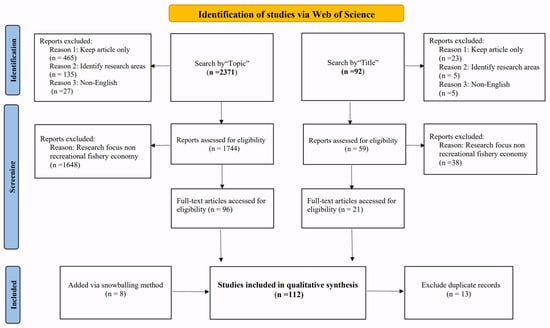
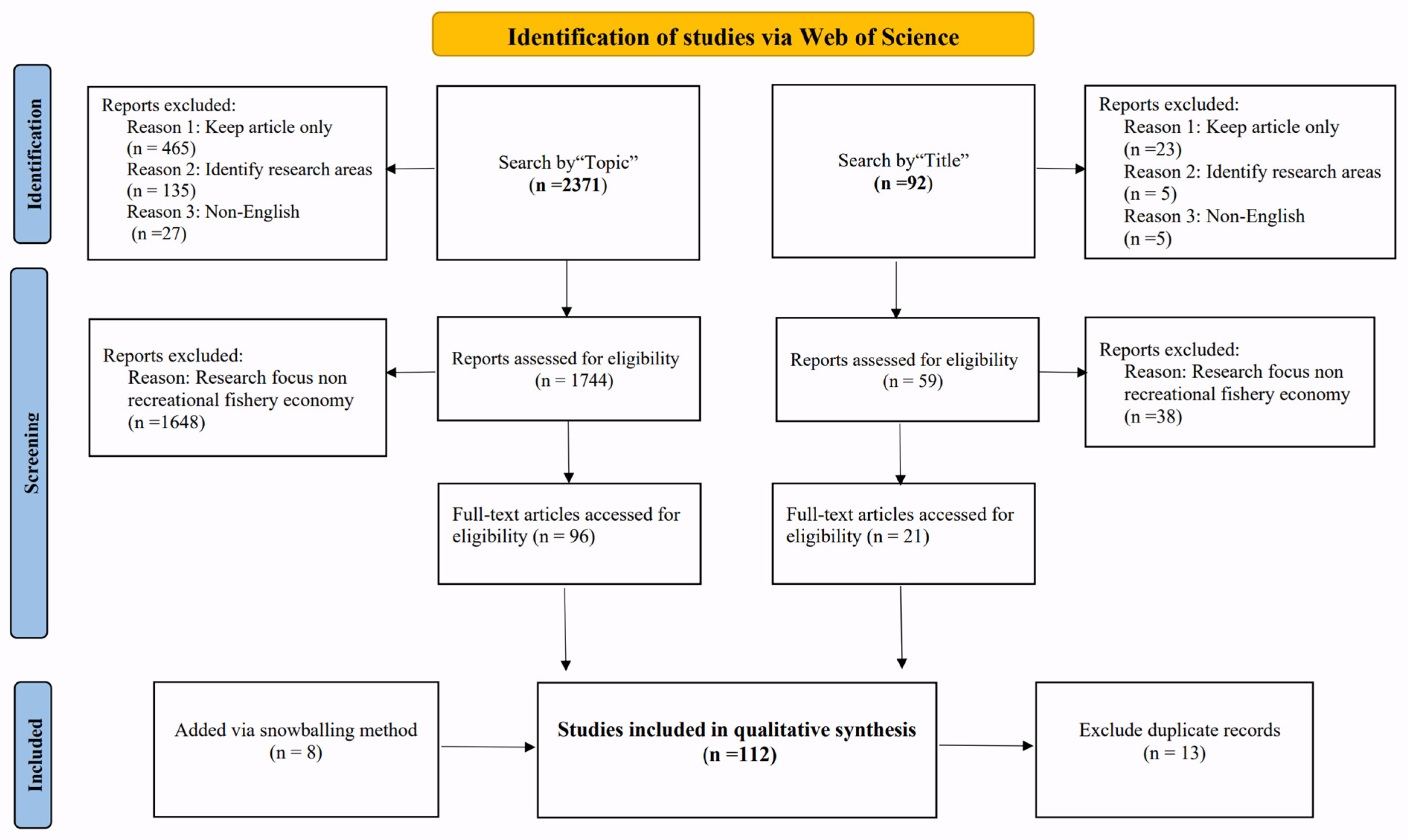
To ensure relevance and quality, the following inclusion and exclusion criteria were applied: (1) Language: Only publications in English were included due to the language proficiency of the author team. This eligibility criterion defines the scope of the evidence base analyzed in this study and implies that the results represent the English-language scholarly literature on recreational fishery economics rather than the full global body of literature. (2) Document Type: Only peer-reviewed articles were retained, excluding conference proceedings and editorial materials; this is intended to ensure the quality of the literature review. (3) Subject Categories: The search was restricted to five relevant domains: Sociology, Business Economics, Marine and Freshwater Biology, Water Resources, and Sport Sciences. (4) Focus: Studies were included only if the economic dimension of recreational fisheries (e.g., expenditure, travel cost, economic impact) was a primary focus; studies treating economic factors merely as supplementary variables were excluded. To enhance readability and comparability, this paper adjusts all Consumer Price Index (CPI) and Purchasing Power Parity (PPP) figures, converting all economic data to a uniform constant USD value as of May 2026. In addition to the database search, a snowball sampling method [28,29] was employed to check the reference lists of selected papers for further relevant studies. Additionally, to ensure the consistency and rigor of the inclusion criteria, the review process was conducted through consensus review by the two authors (first and last authors). A structured data extraction table was developed for all included studies, capturing methodological design, research objectives, evaluation indicators, geographic coverage, and key findings. This dataset is provided as Supplementary Material to enhance transparency and reproducibility. The complete screening process is illustrated in Figure 1, and detailed metadata for the included studies (n = 112) are provided in the Supplementary Material.
Figure 1.
The PRISMA diagram delineates the review workflow, encompassing database search, identification, screening, and final study inclusion (n = 112).
3. Results
3.1. Bibliometric Features and Regional Distribution
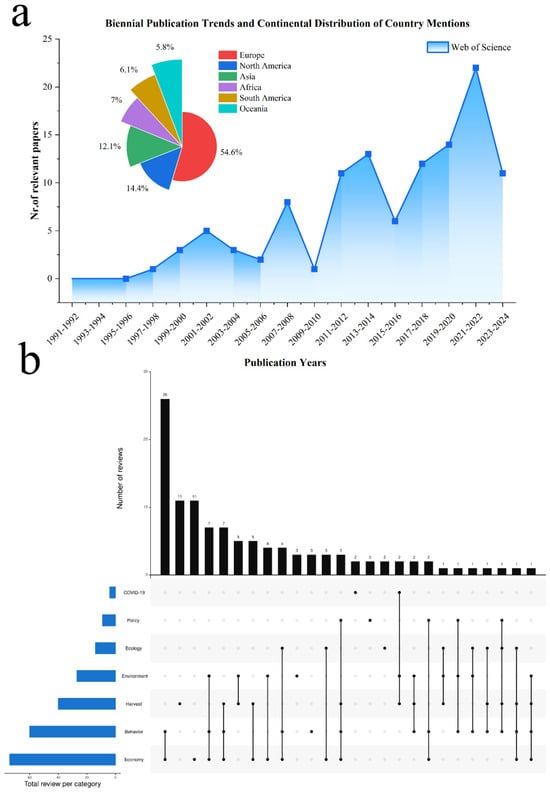
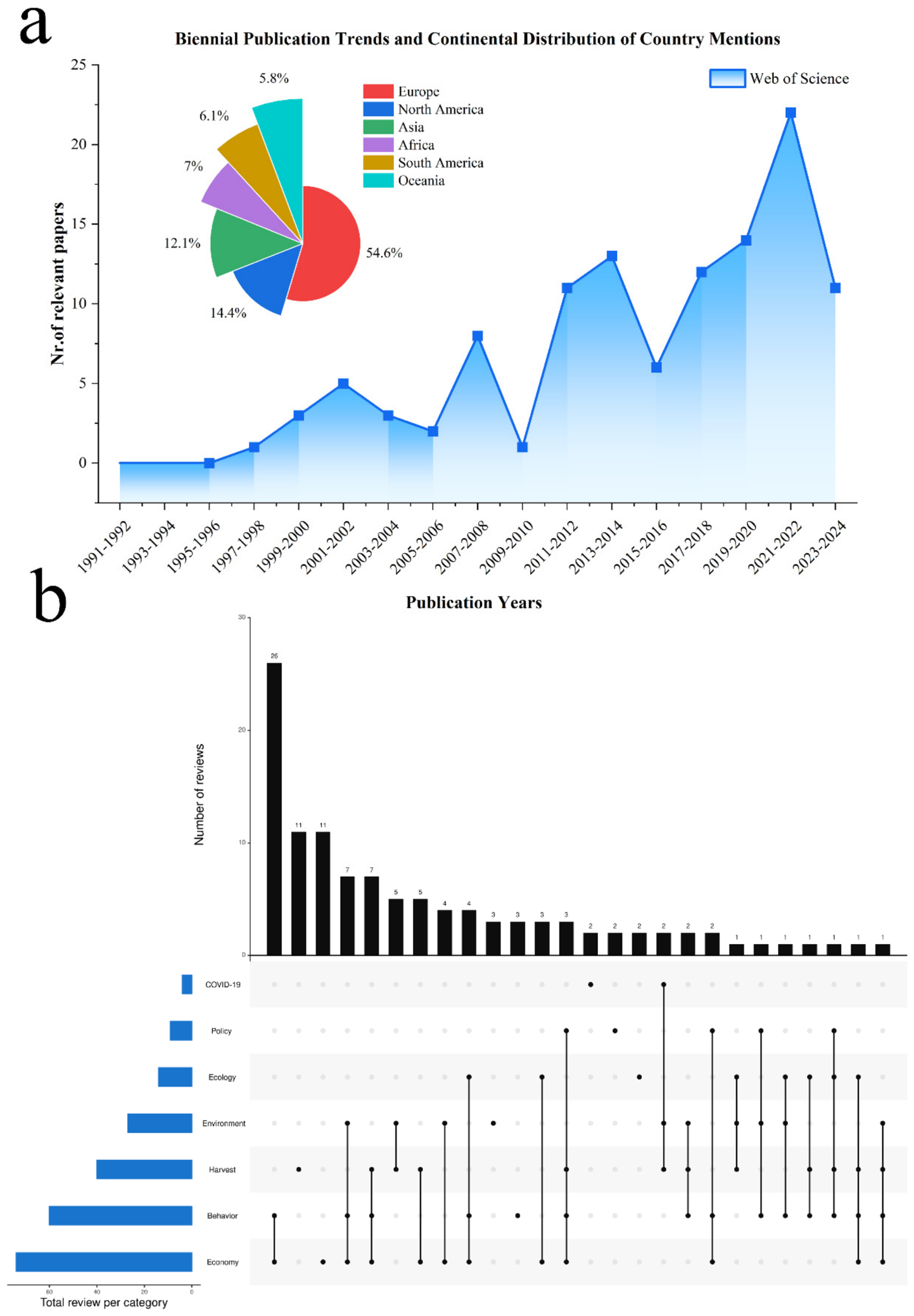
As shown in Figure 2, studies on the global recreational fishery economy began in 1997, following an upward trajectory that peaked in 2022. This trend underscores the increasing global interest in the recreational fishery economy over the past decade. Figure 2 provides an overview of the key dimensions of recreational fishery economics studies and their interconnections. Notably, the intersection of economic dimensions and behavior are the most prominent overlap (n = 26). The five central themes—economic dimensions, behavior, catch, ecology, and environment—intersect in various ways, collectively accounting for 83.1% of the total overlap.
Figure 2.
Biennial trends in relevant publications, continental distribution of country mentions and UpSet chart of distribution themes. (a) Study counts and publication timepoints across biennial intervals (1991–2024); the variable-radius pie chart shows the proportion of country mentions attributed to each continent. (b) UpSet plot showing the distribution of studies reviews across key categories in the recreational fishery economy. Among them, the connecting lines indicate the number of co-occurrences of the linked topics in the study, while the unconnected dots represent topics that appear independently.
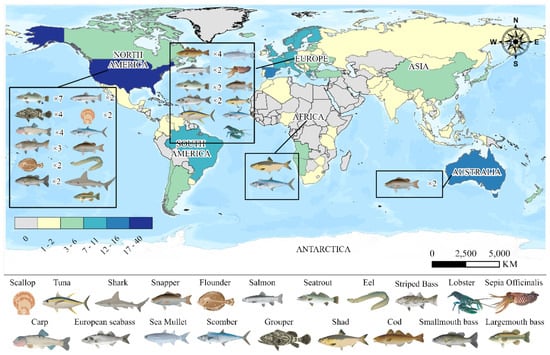
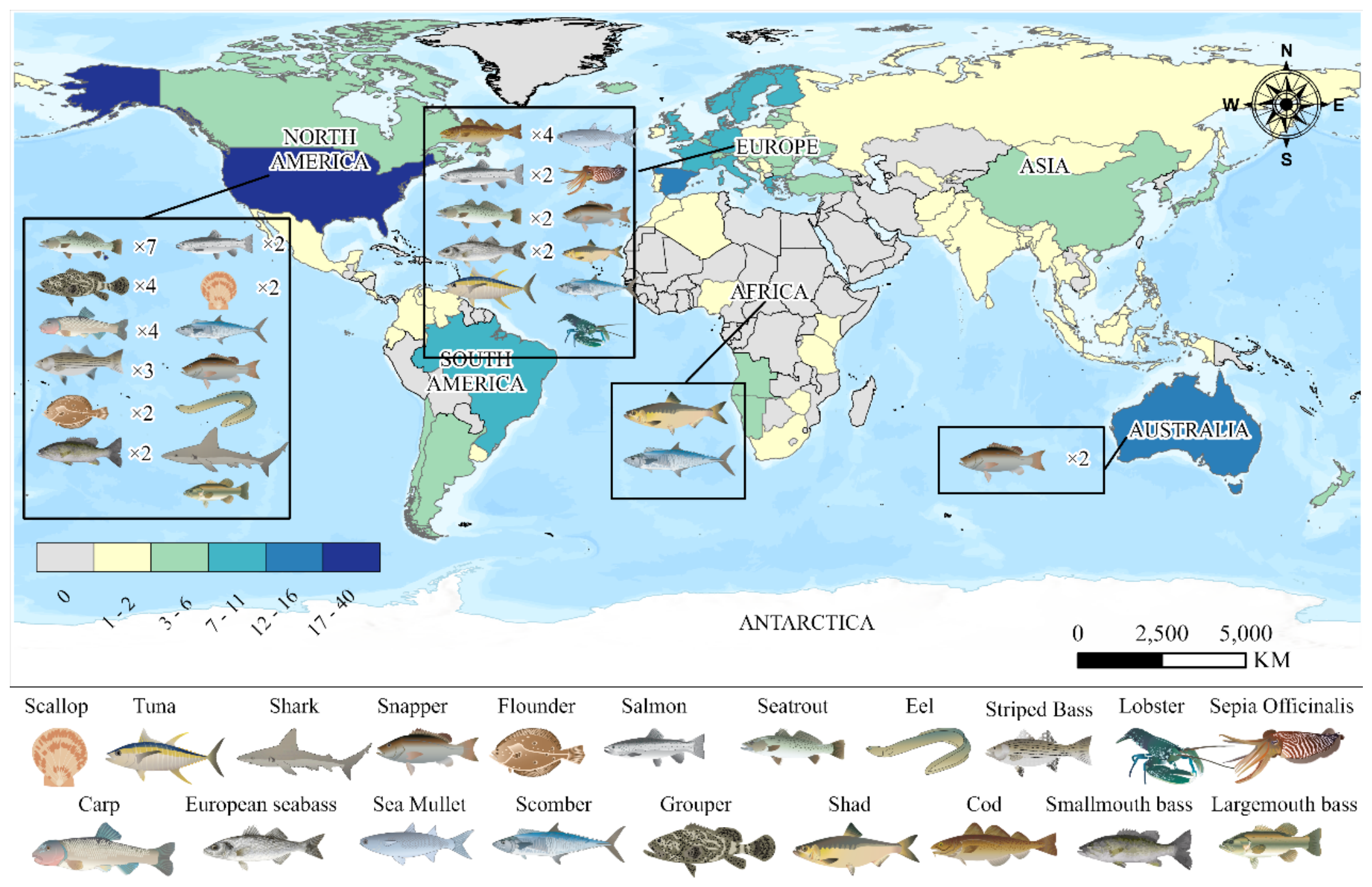
Published studies related to the recreational fishery economy are distributed worldwide (Figure 3). At the continental level, Europe leads in the number of publications, with 171 region mentions (a paper may be counted in multiple regions) focusing on specific regions within European countries, followed by North America with 45 region mentions. At the national level, the United States leads by a significant margin, with 37 papers mentioning the region, followed by Spain, which was mentioned 15 times. Similarly, in terms of the distribution of species studied across regions, North America and Europe also dominate, with 13 and 11 species studied in North America and Europe, respectively.
Figure 3.
Frequency of studies areas and distribution of studies species across continents. The distribution of studies areas in the reviewed studies, and the depth of colors are directly proportional to the number of studies studying that area; the degree of depth is detailed in the legend. Fish species represent the distribution of species studied across continents; quantity represents the frequency of occurrence of a certain fish species in the study area.
3.2. Economic Valuation and Consumer Behavior Subject
A total of 73 studies (≈65.18% of the screened studies) addressed the economic impacts of recreational fisheries. These investigations primarily employed two broad methodological frameworks: (1) revealed preference approaches, such as the travel cost method (TCM) and input–output (I-O) modeling, which estimate market-based expenditures and regional impacts; (2) stated preference approaches, including Willingness to Pay (WTP) surveys and choice experiments (CEs), which quantify non-market values and consumer surplus.
3.2.1. Regional Economic Contributions and Travel Costs
Approaches based on actual expenditures focus on capturing the direct flow of money into local economies. The travel cost method (TCM) estimates the demand curve for recreational sites based on travel expenses and visitation patterns, allowing for the calculation of consumer surplus, which represents the net benefit received by users [30]. Terashima et al. [31] applied TCM to Tango Bay, Japan, finding that approximately 150,000 fishers visited annually and generated JPY 3.8 billion (≈USD 48.5 million) in total travel expenditures, with an annual consumer surplus of about JPY 11.7 billion (≈USD 149.4 million). Rolfe and Prayaga [32] used TCM for three major freshwater dams in Queensland, Australia, estimating separate consumer surpluses for frequent versus occasional fishers. These cases illustrate how TCM yields site-level economic values and how consumer surplus quantifies additional welfare beyond direct costs.
Input–output (I-O) modeling traces how recreational fishing expenditures circulate through the economy, estimating impacts on output, income, and employment in multiple sectors. After review, three studies used I-O or social-accounting frameworks to assess regional impacts of recreational fisheries. Zhao et al. [3] applied an input–output analysis for China’s recreational fishery and found that, although the overall economic contribution was relatively small compared to other countries, recreational fishery had a notably stronger employment-inducing effect than primary sectors like agriculture or commercial fishing. In the U.S., Hutt et al. [33] used an I-O approach for two Mississippi reservoirs (trophy crappie fisheries) and estimated about USD 2.15 million in total economic output and 126 jobs supported by fishers’ expenditures. Potts and Bova [34] used a social-accounting model for South African recreational fisheries and estimated an annual economic activity of ZAR 32.6 billion (≈USD 3.32 billion) and that about 94,070 full-time jobs were sustained. These examples demonstrate that I-O models can capture the broader economic linkages of recreational fisheries, showing how fisher spending fuels income and jobs across tourism, retail, and service sectors in a region.
3.2.2. Willingness to Pay and Behavioral Preferences
Stated preference methods assess the welfare fishers derive beyond direct costs, often expressed as Willingness to Pay (WTP) or consumer surplus (CS). Gren and Marbuah [35] estimate, based on a European meta-analysis, that total PPP-adjusted WTP for recreational fisheries may reach USD 11.4 billion [≈USD 12.95 billion (2026)], with daily WTP ranging from USD 9 to 62 [≈USD 10.23–70.49 (2026)] across countries. These values reflect the social benefits fishers place beyond trip costs and reveal clear regional variation. Pita et al. [36] reported mean WTP for a fishing trip of about €7.40 (≈USD 10.78) in Galicia (Spain) versus €3.05 (≈USD 4.44) in Madeira (Portugal), reflecting differences in local preferences and income levels. Overall, WTP studies quantify the consumer surplus (or welfare) that fishers derive and allow for comparison of recreational fishing’s non-market value across regions or scenarios.
A total of 62 studies related to CS were identified, accounting for 55.36% of the total studies. These studies frequently employed advanced economic modeling techniques such as choice experiments (CE) and discrete choice experiments (DCE) to assess the welfare derived from recreational fishing activities. These methodologies help quantify the economic benefits to consumers, providing valuable insights into how fishers’ preferences and behaviors respond to policy changes and environmental factors.
Taking CE as an example, Andrews et al. [37] used the CE method to assess the consumer surplus of British marine fishers, showing significant benefits from fishing and how policy changes, like fishing regulations, could affect their welfare. Lee et al. [38] used the choice experiment to show that stricter fishing restrictions in the Sundays River Estuary could enhance sustainability but reduce fishers’ consumer surplus. Taking DCE as an example, Carr-Harris and Steinback [39] used DCE to evaluate public attitudes towards fishing restrictions on Atlantic striped bass. Scheld et al. [40] applied a mixed logit model to analyze fishers’ preferences for travel and regulations, showing how regulatory changes impact welfare.
In summary, these studies underscore the utility of experimental choice modeling techniques in quantifying consumer surplus and understanding the behavioral responses of recreational fishers to policy and environmental changes. These findings are critical for guiding the design of policies that balance ecological sustainability with the economic interests of recreational fishery participants.
3.3. Resource Utilization and Management
The study retrieved 42 studies—comprising 37.50% of all sources reviewed—that explicitly examined catch per unit effort (CPUE) in recreational fisheries along with related economic considerations. These studies consistently highlight CPUE as an essential indicator for assessing fishery resource status and informing management decisions [41]. Many of the identified CPUE-focused studies emphasize the metric’s value in resource management contexts. CPUE provides a standardized measure of catch success relative to effort, making it useful for monitoring recreational fish stock exploitation over time. CPUE itself is not an economic value indicator; it is an ecological/resource status indicator, but it can be indirectly translated into economic impact by influencing catch success rate, fishing experience, participation rate, number of trips, WTP, consumer spending, and management policies. For example, Barrella et al. [42] reported an average recreational catch rate of approximately 4.2 fish per day (about 488 g per fisher per fishing day) in coastal waters, illustrating how CPUE can quantify typical harvest levels and serve as a baseline for sustainable yield assessments.
CPUE has also been applied in competitive recreational fishing to characterize fishing performance and pressure. Terlizzi et al. [43] analyzed Italian marine spearfishing tournaments conducted between 2009 and 2020 and reported an overall mean CPUE of 0.47 ± 0.01 kg spearfisher−1 h−1. In a different competitive fishery, Lopez-Mengual et al. [44] analyzed recreational Atlantic bluefin tuna contests on the Urla Peninsula, Türkiye, and reported a mean CPUE of 5.56 ± 0.49 kg day−1. CPUE also varied among designated fishing areas, ranging from 3.06 ± 12.52 to 14.53 ± 21.44 kg day−1. Together, these studies illustrate how CPUE can be used to characterize temporal and spatial variation in fishing performance within organized recreational fishing events.
In summary, evidence from these 41 studies underscores CPUE’s multifaceted role in recreational fisheries, which not only serves as a practical metric for monitoring and managing fish stocks but also intersects with the socio-economic dimensions of fisher behavior and fishery valuation in the context of sustainability.
Compared with CPUE, management instruments such as bag and size limits have a more direct connection with economic outcomes because they can alter anglers’ expected catch, participation decisions, Willingness to Pay, and trip demand. Ten studies mentioned bag and size limits. Bag and size limits are an important means of managing recreational fishery resources [39,45,46], and their development not only needs to be based on the ecological carrying capacity of different water bodies, but also needs to consider factors such as the population size and growth cycle of fish in the water body. While bag and size limits may cut recreational fishermen’s short-term catch, long-term fish population recovery will draw more recreational fishing, enhance economic benefits, and establish a sustainable development model of “short-term pains, long-term benefits” [47].
The studies on bag and size limits in recreational fishing show that fishers’ Willingness to Pay and participation rates are influenced by the specific limits imposed. Bronnmann et al. [48] found that fishers in Germany favored the current five-cod limit and were willing to pay more for a limit of seven, but opposed both stricter and looser restrictions. Carter et al. [49] demonstrated that increasing the bag limit for Gag Mycteroperca microlepis by just one fish led to a 12% increase in fishing trips. Carter and Liese [50] quantified the economic loss for fishers when bag limits for grouper and mackerel were reduced, highlighting the broader economic consequences of policy changes. Therefore, when formulating management policies, it is necessary to comprehensively consider the impact of bag and size limits on fishers’ willingness, behavior, and attitude to pay, as well as their value and ecological balance when releasing target fish species, in order to avoid underestimating the overall economic benefits of recreational fisheries.
3.4. Environmental and Ecological Impacts
A total of 24 studies have studied the impact of ecology on the recreational fishery economy. The recreational fishery economy not only highly relies on the abundance and stability of fish resources but also has a good ecological environment that can attract ecological tourists to participate in recreational fishing activities. The primitive state of recreational fishing is often a major selling point for recreational fishing companies.
The health status of fish populations directly affects fishery resources and their contribution to the recreational fishery economy [21,51]. Maar et al. [52] showed that recreational fishing causes negligible ecological losses but generates high economic returns per lost bluefin tuna. Moksness et al. [45] showed that cod populations, when richer, lead to higher catch levels, which attract more fishing tourists and thereby directly stimulate the local economic dimensions.
Good water quality and ecosystems can attract more recreational fishers, thereby stimulating economic growth in local fisheries. Among the retrieved studies, 14 studies addressed environmental factors, including four studies on environmental pollution and four on climate change.
Regarding environmental pollution, Navrud [53] reported that the Norwegian government invested 40 million euros to neutralize acidic sediments, yielding social benefits two–four times the investment cost, thereby boosting both use and non-use values of recreational fisheries.
Concerning climate change, Erbay et al. [54] identified adverse weather conditions—particularly in winter—as a key constraint on fishing frequency, reducing participation opportunities. Lynch et al. [55] emphasized that species redistribution due to temperature sensitivity disrupts fishing patterns, threatening the economic stability of recreational fisheries. Smith and Lamborn [56] applied the Random Utility Model (RUM) to demonstrate that fishers’ site choices in Utah, USA, depend heavily on daily weather conditions, suggesting that managers could mitigate welfare losses by anticipating these changes. Hughes [57] projected that by 2100, cold-water fisheries in the U.S. would be confined to western and northeastern regions, while ocean acidification would endanger many recreational species, severely impacting the sector’s economic dimensions.
4. Discussion
4.1. Global Disparities in Recreational Fisheries: Underrepresentation of LMICs and Uneven Species Distribution
This study emphasizes the significant imbalance in regional and species distribution within global recreational fishery economics research. Quantitatively, the regional imbalance is particularly striking when comparing high-income countries with low- and middle-income countries. In total, 79 countries or regions were identified as research subjects, with 31 high-income countries accounting for 39.2% of the total. However, among the 310 recorded mentions of geographic areas, high-income countries appeared 211 times, representing a disproportionately high 68.1%. The concentration of studies in high-income countries should not be interpreted as a novel observation in itself, as differences in research infrastructure, fisheries monitoring systems, licensing records, and data availability between high-income and low- and middle-income countries are already widely recognized. The more important implication of this pattern is that the current evidence base of recreational fishery economics is shaped by the institutional and data environments in which recreational fishing is formally recognized, monitored, and economically evaluated. As a result, existing economic estimates, valuation approaches, and policy discussions may disproportionately reflect the conditions of countries with more developed recreational fisheries governance systems and data infrastructures. This notable imbalance underscores a significant geographic bias in the current body of recreational fishery economics research, with a predominant focus on high-income countries and insufficient attention given to low- and middle-income regions. However, it cannot be ruled out that this was due to the exclusion of non-English literature, conference proceedings, or editorials during the retrieval process. Therefore, the observed geographical imbalance should be interpreted as a characteristic of the English-language evidence base rather than a direct representation of global research activity. This distinction is important because conclusions regarding regional dominance, research capacity, and thematic concentration may differ when the non-English literature and regionally published studies are taken into account.
Regionally, North America and Europe dominate the academic landscape, with the United States leading by a considerable margin. While European countries contribute fewer studies than the U.S., their overall geographical coverage is extensive, with nearly all publishing relevant studies. This imbalance can be attributed to the long history of recreational fisheries in the U.S. and Europe, where well-established industry chains and management frameworks prevail [5,58]. Among the publications classified by fishing environment, 22 focused on inland freshwater rivers or lakes, whereas 15 examined marine recreational fisheries. Twelve of the marine studies were conducted in high-income countries. This concentration may partly reflect the extensive coastlines, established monitoring systems, and greater availability of fisheries data in these countries [59]. To address this issue, greater attention should be given to the development of the recreational fishery economy in low- and middle-income countries. Future research should focus on selecting countries or regions with varying income levels and geographical characteristics as case studies. Successful adaptive management experiences from developed countries may provide useful references for developing countries [60]; however, these approaches should not be directly replicated, but should instead be adapted to local socio-economic, cultural, geographic, ecological, institutional, and enforcement contexts, with particular attention paid to strengthening data collection and statistical systems [61]. Enforcement and compliance should also be considered, as effective monitoring may reduce conflicts with commercial fishers and improve the accuracy of recreational fishery assessments [25,62], as recommended by the European Union’s Common Fisheries Policy.
From a species perspective, the uneven distribution of research across regions and species may lead to a skewed understanding of the global recreational fisheries economy, highlighting the need to increase focus on under-researched areas and unique fish species in those regions.
4.2. Problems and Improvements in the Economic Evaluation of Recreational Fisheries
The results of studies on consumer behavior and Willingness to Pay (WTP) demonstrate that these variables are largely dependent on the chosen economic evaluation method. However, a limitation common across most studies is the reliance on a single model (such as the travel cost method (TCM) or discrete choice experiment (DCE)), often without a comparative analysis between different methodologies. A notable oversight in these studies is the failure to consider time costs when calculating WTP, which may lead to an incomplete representation of the industry’s true value and result in blind spots in policy-making (e.g., overstating net income or economic benefits). Several factors contribute to this neglect. Firstly, time cost is inherently challenging to quantify, as it is subjective and influenced by various factors [63]. Although formulas exist to estimate time costs, no unified standard has been established. Secondly, challenges arise in the data collection process, particularly in obtaining relevant data on time costs. Finally, existing economic evaluation models—especially traditional approaches like TCM and DCE—primarily focus on material costs while neglecting time costs, which are subjective and difficult to measure.
The gaps identified in these methods underscore the need for future research to adopt a more comprehensive evaluation framework. It is essential to incorporate time and experience costs into traditional economic models to enhance the accuracy and reliability of economic assessments.
4.3. Resilience and Adaptability in Recreational Fisheries Management: Short-Term Shocks and Long-Term Structural Impacts
Effective management of recreational fisheries requires a delicate balance between ecological protection, economic benefits, and the capacity to withstand external shocks, such as the COVID-19 pandemic. Resource management policies, including CPUE regulations and bag limits, are critical tools for ecological governance. These policies not only assist in evaluating and managing fish populations but also directly influence the ecological balance of fisheries [64]. However, the effectiveness of these policies is contingent upon finding the optimal balance. For instance, overly stringent bag limits may cause dissatisfaction among anglers and fail to achieve the desired ecological outcomes, while excessively relaxed restrictions can disrupt the ecological equilibrium. The success of management measures such as catch quotas or bag limits also depends on fisher participation in decision-making processes. Engaging recreational, small-scale commercial, and subsistence fishers in quota-setting or regulation adjustments can improve compliance, reduce conflicts, and ensure that policies reflect local socio-economic and cultural realities [65]. Therefore, policies should aim to achieve an optimal sustainable management range that balances ecological protection with meaningful recreational fishing experiences [66]. Ecological conditions play a pivotal role in shaping the participation and behavior of recreational fishers. A healthy ecological environment generally leads to increased visitation rates, extended stay durations, and greater economic benefits for the local economy [67]. The interplay between ecological health and effective resource management policies is essential for the sustainable development of recreational fisheries.
Simultaneously, the fisheries sector must be resilient to external shocks. This review introduces an analytical framework of resilience and adaptability to analyze this capability. In the recreational fisheries sector, resilience refers to the industry’s ability to absorb short-term disruptions, maintain core recreational and economic functions, and recover after shocks. Adaptability refers to the ability of fishermen, managers, and related industries to adjust practices, institutional, and economic strategies in response to long-term ecological, social, and policy changes. This distinction is significant because some impacts, such as declining fish stocks, changes in governance capacity, climate-related ecological shifts, data limitations, and the transition from conventional to recreational fisheries, represent long-term structural pressures. A well-known example of a short-term shock in recent years is the COVID-19 pandemic. The COVID-19 pandemic provides a clear example of how crises can severely disrupt recreational fishing activities, reduce tourist participation, and result in significant economic losses for the industry [68,69]. The impact of COVID-19 on recreational fisheries underscores the sector’s vulnerability to unforeseen crises. Research has shown that the pandemic led to decreased fishing frequency [70], both direct and indirect economic losses [71], and negative effects on the physical and mental health of fishers [72].
To enhance resilience in the face of such disruptions, it is essential for managers to integrate internal management measures—such as CPUE and bag limits—while also developing strategies to cope with external shocks. By improving the adaptability of the management framework—such as implementing flexible regulations that can be swiftly adjusted in response to crises like COVID-19, including shifting from annual to seasonal or monthly quota allocations, adaptive bag limits based on real-time catch data, and digital permit systems for dynamic effort adjustments—the recreational fisheries sector can better endure external shocks while continuing to promote ecological protection and economic benefits. A comprehensive approach that includes resource protection, adaptive management strategies, and resilience-building measures is vital for ensuring the long-term sustainability and resilience of the recreational fisheries sector.
5. Conclusions
This study confirms that recreational fishing constitutes a highly polarized and complex global social ecosystem. High-income countries are at the forefront of policy framework design and management mechanisms, adopting methodologies to optimize economic contributions and consumer behavior. These countries also implement refined management measures, including catch limits and fishing quotas. However, the literature suggests that governance structures (e.g., unclear responsibilities of management departments or a lack of emphasis on the management of recreational fisheries) and resource utilization patterns (e.g., no catch-and-release policies or fishing license policies) pose significant challenges to low- and middle-income countries, although these findings are based on existing research rather than fieldwork. This imbalance highlights the significant differentiation in the development of the global recreational fisheries economy.
It is important to note that this observed imbalance reflects the structure of the English-language literature included in this review, which may be influenced by the exclusion of non-English publications and regionally published studies. Therefore, the interpretation of global representativeness should be made with caution, the existing knowledge system is predominantly shaped by high-income countries, leading to a serious lack of assessment regarding the economic potential of recreational fisheries in low- and middle-income countries. This bias impedes a comprehensive understanding of the global contribution of recreational fisheries. Future research should prioritize greater representation of low- and middle-income countries to ensure a fair evaluation of the economic potential of each country.
Furthermore, the current evaluation methodology system is fragmented and lacks a unified framework, hindering global policy coordination and sustainable development. The inconsistency in research methods and the limitations of available data make it difficult to integrate global recreational fishery economics policies, affecting cooperation and response strategies between regions. It is, therefore, essential to introduce more inclusive evaluation models—especially those incorporating multiple dimensions such as time costs and social-psychological factors—in order to promote the standardization and coordination of global recreational fishery economics research.
Supplementary Materials
The following supporting information can be downloaded at: https://www.mdpi.com/article/10.3390/fishes11080474/s1, File S1: The 112 studies ultimately included.
Author Contributions
W.S.: writing—original draft, conceptualization, methodology, software, data curation. G.C.: conceptualization, validation, visualization, writing—review and editing. B.H.: software, validation, project administration. X.C.: conceptualization, supervision, writing—review and editing. Q.Z.: investigation, supervision, resources, writing—review and editing. All authors have read and agreed to the published version of the manuscript.
Funding
This research was funded by National Natural Science Foundation of China, grant number 42425603; and China Postdoctoral Science Foundation, grant number 2024M751780.
Institutional Review Board Statement
Not applicable.
Data Availability Statement
The data are available from the corresponding author on reasonable request.
Acknowledgments
The authors sincerely thank the Academic Editor and anonymous reviewers for their constructive comments and valuable suggestions. We also thank the Assistant Editor for their patience and support throughout the editorial process.
Conflicts of Interest
The authors declare that they have no known competing financial interests or personal relationships that could have appeared to influence the work reported in this study.
References
- Scheufele, G.; Pascoe, S. Estimation and use of recreational fishing values in management decisions. Ambio 2022, 51, 1275–1286. [Google Scholar] [CrossRef] [Scilit] [PubMed]
- Cooke, S.J.; Twardek, W.M.; Lennox, R.J.; Zolderdo, A.J.; Bower, S.D.; Gutowsky, L.F.G.; Danylchuk, A.J.; Arlinghaus, R.; Beard, D. The nexus of fun and nutrition: Recreational fishing is also about food. Fish Fish. 2018, 19, 201–224. [Google Scholar] [CrossRef] [Scilit]
- Zhao, Q.; Chen, X.; Chen, G.; Qi, S. The socioeconomic contribution of the recreational fishery based on input–output analysis: The case of China. Mar. Policy 2022, 143, 105177. [Google Scholar] [CrossRef] [Scilit]
- Nyboer, E.A.; Embke, H.S.; Robertson, A.M.; Arlinghaus, R.; Bower, S.; Baigun, C.; Beard, D.; Cooke, S.J.; Cowx, I.G.; Koehn, J.D.; et al. Overturning stereotypes: The fuzzy boundary between recreational and subsistence inland fisheries. Fish Fish. 2022, 23, 1282–1298. [Google Scholar] [CrossRef] [Scilit]
- Potts, W.M.; Downey-Breedt, N.; Obregon, P.; Hyder, K.; Bealey, R.; Sauer, W.H.H. What constitutes effective governance of recreational fisheries?—A global review. Fish Fish. 2020, 21, 91–103. [Google Scholar] [CrossRef] [Scilit]
- Pawson, M.; Glenn, H.; Padda, G. The definition of marine recreational fishing in Europe. Mar. Policy 2008, 32, 339–350. [Google Scholar] [CrossRef] [Scilit]
- Nguyen, V.M.-A.; Fiorella, K.J.; Castello, L.; Badhon, M.K.; Beaudoin, C.; Coffin-Schmitt, J.; Cooke, S.J.; Fisk, A.T.; Nyboer, E.; O’kEefe, D.M.; et al. Provisioning fisheries: A framework for recognizing the fuzzy boundary around commercial, subsistence, and recreational fisheries. Fisheries 2025, 50, 366–379. [Google Scholar] [CrossRef] [Scilit]
- Funge-Smith, S.; Bennett, A. A fresh look at inland fisheries and their role in food security and livelihoods. Fish Fish. 2019, 20, 1176–1195. [Google Scholar] [CrossRef] [Scilit]
- Arlinghaus, R.; Abbott, J.K.; Fenichel, E.P.; Carpenter, S.R.; Hunt, L.M.; Alós, J.; Klefoth, T.; Cooke, S.J.; Hilborn, R.; Jensen, O.P.; et al. Governing the recreational dimension of global fisheries. Proc. Natl. Acad. Sci. USA 2019, 116, 5209–5213. [Google Scholar] [CrossRef] [Scilit] [PubMed]
- Zhao, Q.; Chen, X.; Bo, H. Review on the research of recreational fisheries in the world. J. Shanghai Ocean Univ. 2020, 29, 295–304. [Google Scholar]
- Song, Y.; Tian, T.; Yang, J.; Liu, M.; Wu, Z.; Gao, D.; Yin, Z.; Li, X. Study on the Development Model of Recreational Tourism Under the Back ground of Marine Ranching. Ocean Dev. Manag. 2021, 39, 110–116. [Google Scholar]
- Audzijonyte, A.; Mateos-González, F.; Dainys, J.; Gundelund, C.; Skov, C.; DeWeber, J.T.; Venturelli, P.; Vienožinskis, V.; Smith, C. High-resolution app data reveal sustained increases in recreational fishing effort in Europe during and after COVID-19 lockdowns. R. Soc. Open Sci. 2023, 10, 230408. [Google Scholar] [CrossRef] [Scilit] [PubMed]
- Shertzer, K.W.; Williams, E.H.; Craig, J.K.; Fitzpatrick, E.E.; Klibansky, N.; Siegfried, K.I. Recreational sector is the dominant source of fishing mortality for oceanic fishes in the Southeast United States Atlantic Ocean. Fish. Manag. Ecol. 2019, 26, 621–629. [Google Scholar] [CrossRef] [Scilit]
- Dainys, J.; Jakubavičiūtė, E.; Gorfine, H.; Kirka, M.; Raklevičiūtė, A.; Morkvėnas, A.; Pūtys, Ž.; Ložys, L.; Audzijonyte, A. Impacts of recreational angling on fish population recovery after a commercial fishing ban. Fishes 2022, 7, 232. [Google Scholar] [CrossRef] [Scilit]
- Radford, Z.; Hyder, K.; Zarauz, L.; Mugerza, E.; Ferter, K.; Prellezo, R.; Strehlow, H.V.; Townhill, B.; Lewin, W.-C.; Weltersbach, M.S. The impact of marine recreational fishing on key fish stocks in European waters. PLoS ONE 2018, 13, e0201666. [Google Scholar] [CrossRef] [Scilit] [PubMed]
- Patiyal, R.S.; Pauline, A. Livelihood Opportunities with Recreational Fisheries and Ecotourism. In Fisheries and Aquaculture of the Temperate Himalayas; Springer Nature: Singapore, 2023. [Google Scholar]
- Shih, C.-H.; Wang, X.-R.; Lu, Y.-M.; Chu, T.-J. Assessing the Role of Policy in the Evolution of Recreational Fisheries in Chinese Fishing Villages: An Analytical Hierarchy Process (AHP) and Delphi Method Analysis. Fishes 2024, 9, 353. [Google Scholar] [CrossRef] [Scilit]
- Schilling, H.T.; Riley, I.J.; Puckeridge, A.C.; Milne-Muller, A.; Callaghan, C.T. Economic value of regional spearfishing competitions. Fish. Res. 2022, 250, 106289. [Google Scholar] [CrossRef] [Scilit]
- Carlén, O.; Bostedt, G.; Brännlund, R.; Persson, L. The value of recreational fishing in Sweden–Estimates based on a nationwide survey. Fish. Manag. Ecol. 2021, 28, 351–361. [Google Scholar] [CrossRef] [Scilit]
- Bower, S.D.; Aas, Ø.; Arlinghaus, R.; Beard, T.D.; Cowx, I.G.; Danylchuk, A.J.; Freire, K.M.F.; Potts, W.M.; Sutton, S.G.; Cooke, S.J. Knowledge Gaps and Management Priorities for Recreational Fisheries in the Developing World. Rev. Fish. Sci. Aquac. 2020, 28, 518–535. [Google Scholar] [CrossRef] [Scilit]
- Hyder, K.; Maravelias, C.D.; Kraan, M.; Radford, Z.; Prellezo, R. Marine recreational fisheries—Current state and future opportunities. ICES J. Mar. Sci. 2020, 77, 2171–2180. [Google Scholar] [CrossRef] [Scilit]
- Abbott, J.K.; Lew, D.K.; Whitehead, J.C.; Woodward, R.T. The Future of Fishing for Fun: The Economics and Sustainable Management of Recreational Fisheries. Rev. Environ. Econ. Policy 2022, 16, 262–281. [Google Scholar] [CrossRef] [Scilit] [PubMed]
- Yang, C.-K.; Yang, H.-C.; Lee, J.-M. Research on the Key Success Factors for the Transformation of the Traditional Fishery to Recreational Fishery in Taiwan’s Outlying Islands. Fishes 2022, 7, 337. [Google Scholar] [CrossRef] [Scilit]
- Miret-Pastor, L.; Molina-García, A.; García-Aranda, C.; Herrera-Racionero, P. The connection between recreational fishing and the traditional fishing sector in the emerging area of marine tourism: Challenges and opportunities for diversification with the European Fisheries Fund (EFF). ICES J. Mar. Sci. 2020, 77, 2369–2374. [Google Scholar] [CrossRef] [Scilit]
- Bova, C.S.; Potts, W.M.; Radford, Z.; Schiefer, P.; Hyder, K. Tools for assessing recreational fisheries compliance—An underappreciated yet essential component of management. Rev. Fish Biol. Fish. 2025, 35, 23–44. [Google Scholar] [CrossRef] [Scilit]
- Chen, G.; Yang, Z.; Zhao, Q.; Chen, X. Understanding the influencing factors affecting the sustainability of China’s coastal recreational fisheries: A spatial spillover perspective. Ocean Coast. Manag. 2025, 260, 107487. [Google Scholar] [CrossRef] [Scilit]
- Parums, D.V. Editorial: Review Articles, Systematic Reviews, Meta-Analysis, and the Updated Preferred Reporting Items for Systematic Reviews and Meta-Analyses (PRISMA) 2020 Guidelines. Med. Sci. Monit. 2021, 27, e934475. [Google Scholar] [CrossRef] [Scilit] [PubMed]
- Wohlin, C. Guidelines for snowballing in systematic literature studies and a replication in Software engineering. In Proceedings of the 18th International Conference on Evaluation and Assessment in Software Engineering, London, UK, 13–14 May 2014; pp. 1–10. [Google Scholar]
- Wohlin, C.; Kalinowski, M.; Felizardo, K.R.; Mendes, E. Successful combination of database search and snowballing for identification of primary studies in systematic literature studies. Inf. Softw. Technol. 2022, 147, 106908. [Google Scholar] [CrossRef] [Scilit]
- Hwang, J.; Bi, X.; Morales, N.; Camp, E.V. The economic value of freshwater fisheries in Florida: An application of the travel cost method for black crappie fishing trips. Fish. Res. 2021, 233, 105754. [Google Scholar] [CrossRef] [Scilit]
- Terashima, Y.; Yamashita, Y.; Asano, K. An economic evaluation of recreational fishing in Tango Bay, Japan. Fish. Sci. 2020, 86, 925–937. [Google Scholar] [CrossRef] [Scilit]
- Rolfe, J.; Prayaga, P. Estimating values for recreational fishing at freshwater dams in Queensland. Aust. J. Agric. Resour. Econ. 2007, 51, 157–174. [Google Scholar] [CrossRef] [Scilit]
- Hutt, C.P.; Hunt, K.M.; Steffen, S.F.; Grado, S.C.; Miranda, L.E. Economic Values and Regional Economic Impacts of Recreational Fisheries in Mississippi Reservoirs. N. Am. J. Fish. Manag. 2013, 33, 44–55. [Google Scholar] [CrossRef] [Scilit]
- Potts, W.M.; Saayman, M.; Saayman, A.; Mann, B.Q.; Van der Merwe, P.; Britz, P.; Bova, C.S. Understanding the economic activity generated by recreational fishing in South Africa provides insights on the role of recreational fisheries for social development. Fish. Manag. Ecol. 2022, 29, 29–43. [Google Scholar] [CrossRef] [Scilit]
- Gren, I.-M.; Marbuah, G. Willingness to pay for recreational fisheries in Europe. Fish. Manag. Ecol. 2024, 31, e12719. [Google Scholar] [CrossRef] [Scilit]
- Pita, P.; Ainsworth, G.B.; Antelo, M.; Gouveia, L.; Martínez-Escauriaza, R.; Tubío, A.; Villasante, S. Economic contribution and social welfare of recreational charter boat fisheries in the northeast Atlantic: The cases of Galicia (Spain) and Madeira archipelago (Portugal). Front. Mar. Sci. 2022, 9, 939533. [Google Scholar] [CrossRef] [Scilit]
- Andrews, B.; Ferrini, S.; Muench, A.; Brown, A.; Hyder, K. Assessing the impact of management on sea anglers in the UK using choice experiments. J. Environ. Manag. 2021, 293, 112831. [Google Scholar] [CrossRef] [Scilit] [PubMed]
- Lee, D.; Hosking, S.; Du Preez, M. A choice experiment application to estimate willingness to pay for controlling excessive recreational fishing demand at the Sundays River Estuary, South Africa. Water SA 2014, 40, 39–48. [Google Scholar] [CrossRef] [Scilit]
- Carr-Harris, A.; Steinback, S. Expected Economic and Biological Impacts of Recreational Atlantic Striped Bass Fishing Policy. Front. Mar. Sci. 2020, 6, 814. [Google Scholar] [CrossRef] [Scilit]
- Scheld, A.M.; Goldsmith, W.M.; White, S.; Small, H.J.; Musick, S. Quantifying the behavioral and economic effects of regulatory change in a recreational cobia fishery. Fish. Res. 2020, 224, 105469. [Google Scholar] [CrossRef] [Scilit]
- Han, Q.; Shan, X.; Jin, X.; Gorfine, H. Contrasting stock status trends obtained from survey and fishery CPUE, taking Larimichthys polyactis in Yellow Sea Large Marine Ecosystem as an example. Ecol. Indic. 2023, 147, 110032. [Google Scholar] [CrossRef] [Scilit]
- Barrella, W.; Ramires, M.; Rotundo, M.M.; Petrere, M.; Clauzet, M.; Giordano, F. Biological and socio-economic aspects of recreational fisheries and their implications for the management of coastal urban areas of south-eastern Brazil. Fish. Manag. Ecol. 2016, 23, 303–314. [Google Scholar] [CrossRef] [Scilit]
- Terlizzi, A.; Tarantino, G.; Sbragaglia, V. Ecological, Social and Economic Aspects of Italian Marine Spearfishing Tournaments (2009–2020). Front. Mar. Sci. 2022, 9, 891246. [Google Scholar] [CrossRef] [Scilit]
- Lopez-Mengual, I.; Ceyhan, T.; Ulaş, A. Temporal-Spatial Influences on Atlantic Bluefin Tuna CPUE in Recreational Fishery in the Aegean Sea: A Generalized Additive Model Approach. Turk. J. Fish. Aquat. Sci. 2024, 24, TRJFAS26100. [Google Scholar] [CrossRef] [Scilit]
- Moksness, E.; Gjøsæter, J.; Lagaillarde, G.; Mikkelsen, E.; Olsen, E.M.; Sandersen, H.T.; Vølstad, J.H. Effects of Fishing Tourism in a Coastal Municipality: A Case Study from Risør, Norway. Ecol. Soc. 2011, 16, 11–21. [Google Scholar] [CrossRef] [Scilit]
- Moreau, C.M.; Matthias, B.G. Using Limited Data to Identify Optimal Bag and Size Limits to Prevent Overfishing. N. Am. J. Fish. Manag. 2018, 38, 747–758. [Google Scholar] [CrossRef] [Scilit]
- Chiaramonte, L.V.; Meyer, K.A. Effect of Bag Limits on Angler Harvest, Catch Rates, and Satisfaction at Put-and-Take Community Pond Fisheries. N. Am. J. Fish. Manag. 2022, 42, 1550–1560. [Google Scholar] [CrossRef] [Scilit]
- Bronnmann, J.; Koemle, D.; Meyerhoff, J.; Weltersbach, M.S.; Strehlow, H.V.; Arlinghaus, R. Willingness to pay for harvest regulations and catch outcomes in recreational fisheries: A stated preference study of German cod anglers. Fish. Res. 2023, 259, 106536. [Google Scholar] [CrossRef] [Scilit]
- Carter, D.W.; Lovell, S.; Records, D.; Liese, C. The Effect of Changes in Trip Costs and Gag Regulations on Recreational Fishing Demand in the Gulf of Mexico. N. Am. J. Fish. Manag. 2022, 42, 1465–1476. [Google Scholar] [CrossRef] [Scilit]
- Carter, D.W.; Liese, C. The Economic Value of Catching and Keeping or Releasing Saltwater Sport Fish in the Southeast USA. N. Am. J. Fish. Manag. 2012, 32, 613–625. [Google Scholar] [CrossRef] [Scilit]
- Cooke, S.J.; Cowx, I.G. The Role of Recreational Fishing in Global Fish Crises. BioScience 2004, 54, 857–859. [Google Scholar] [CrossRef] [Scilit]
- Maar, K.; Riisager-Simonsen, C.; MacKenzie, B.R.; Skov, C.; Aarestrup, K.; Svendsen, J.C. Economic expenditures by recreational anglers in a recovering atlantic bluefin tuna fishery. PLoS ONE 2022, 17, e0271823. [Google Scholar] [CrossRef] [Scilit] [PubMed]
- Navrud, S. Economic valuation of inland recreational fisheries: Empirical studies and their policy use in Norway. Fish. Manag. Ecol. 2001, 8, 369–382. [Google Scholar] [CrossRef] [Scilit]
- Erbay, M.; Carlson, A.; Grati, F. Evaluating the unexplored recreational fishing in the Turkish Black Sea: Socio-economic significance and environmental impact. Front. Mar. Sci. 2024, 11, 1386911. [Google Scholar] [CrossRef] [Scilit]
- Lynch, A.J.; Embke, H.S.; Nyboer, E.A.; Wood, L.E.; Thorpe, A.; Phang, S.C.; Viana, D.F.; Golden, C.D.; Milardi, M.; Arlinghaus, R.; et al. Inland recreational fisheries contribute nutritional benefits and economic value but are vulnerable to climate change. Nat. Food 2024, 5, 433–443. [Google Scholar] [CrossRef] [Scilit] [PubMed]
- Smith, J.W.; Lamborn, C.C. The influence of population growth and weather on the value of recreational angling trips within Utah (USA). Fish. Res. 2024, 274, 106976. [Google Scholar] [CrossRef] [Scilit]
- Hughes, R.M. Recreational fisheries in the USA: Economics, management strategies, and ecological threats. Fish. Sci. 2015, 81, 1–9. [Google Scholar] [CrossRef] [Scilit]
- Holder, P.E.; Jeanson, A.L.; Lennox, R.J.; Brownscombe, J.W.; Arlinghaus, R.; Danylchuk, A.J.; Bower, S.D.; Hyder, K.; Hunt, L.M.; Fenichel, E.P.; et al. Preparing for a changing future in recreational fisheries: 100 research questions for global consideration emerging from a horizon scan. Rev. Fish Biol. Fish. 2020, 30, 137–151. [Google Scholar] [CrossRef] [Scilit]
- Drius, M.; Bongiorni, L.; Depellegrin, D.; Menegon, S.; Pugnetti, A.; Stifter, S. Tackling challenges for Mediterranean sustainable coastal tourism: An ecosystem service perspective. Sci. Total Environ. 2019, 652, 1302–1317. [Google Scholar] [CrossRef] [Scilit] [PubMed]
- Leong, K.M.; Torres, A.; Wise, S.; Hospital, J. Beyond Recreation: When Fishing Motivations are more than Sport or Pleasure. 2020. Available online: https://repository.library.noaa.gov/view/noaa/23706 (accessed on 3 August 2026).
- Solomon, C.T.; Dassow, C.J.; Iwicki, C.M.; Jensen, O.P.; Jones, S.E.; Sass, G.G.; Trudeau, A.; van Poorten, B.T.; Whittaker, D. Frontiers in modelling social–ecological dynamics of recreational fisheries: A review and synthesis. Fish Fish. 2020, 21, 973–991. [Google Scholar] [CrossRef] [Scilit]
- Mackay, M.; Jennings, S.; van Putten, E.; Sibly, H.; Yamazaki, S. When push comes to shove in recreational fishing compliance, think ‘nudge’. Mar. Policy 2018, 95, 256–266. [Google Scholar] [CrossRef] [Scilit]
- Yuan, L.-L.; Wang, S.-J. Recreational value of glacier tourism resources: A travel cost analysis for Yulong Snow Mountain. J. Mt. Sci. 2019, 15, 1446–1459. [Google Scholar] [CrossRef] [Scilit]
- Hilborn, R.; Stokes, K.; Maguire, J.-J.; Smith, T.; Botsford, L.W.; Mangel, M.; Orensanz, J.; Parma, A.; Rice, J.; Bell, J.; et al. When can marine reserves improve fisheries management? Ocean Coast. Manag. 2004, 47, 197–205. [Google Scholar] [CrossRef] [Scilit]
- Arlinghaus, R.; Alós, J.; Beardmore, B.; Daedlow, K.; Dorow, M.; Fujitani, M.; Hühn, D.; Haider, W.; Hunt, L.M.; Johnson, B.M.; et al. Understanding and Managing Freshwater Recreational Fisheries as Complex Adaptive Social-Ecological Systems. Rev. Fish. Sci. Aquac. 2017, 25, 1–41. [Google Scholar] [CrossRef] [Scilit]
- Lawrence, K.S. Assessing the value of recreational sea angling in South West England. Fish. Manag. Ecol. 2005, 12, 369–375. [Google Scholar] [CrossRef] [Scilit]
- Scholtz, M.; Kruger, M.; Saayman, M. Determinants of visitor length of stay at three coastal national parks in South Africa. J. Ecotourism 2015, 14, 21–47. [Google Scholar] [CrossRef] [Scilit]
- Smith, S.L.; Golden, A.S.; Ramenzoni, V.; Zemeckis, D.R.; Jensen, O.P. Adaptation and resilience of commercial fishers in the Northeast United States during the early stages of the COVID-19 pandemic. PLoS ONE 2020, 15, e0243886. [Google Scholar] [CrossRef] [Scilit] [PubMed]
- Mejía, C.V.; Rodríguez, G.; Tanner, M.K.; Ramírez-González, J.; Moity, N.; Andrade, S.; Paladines, M.J.B.; Cáceres, R.; Castrejón, M.; Pittman, J. Fishing during the “new normality”: Social and economic changes in Galapagos small-scale fisheries due to the COVID-19 pandemic. Marit. Stud. 2022, 21, 193–208. [Google Scholar] [CrossRef] [Scilit] [PubMed]
- Hook, S.A.; Brown, A.; Bell, B.; Kroese, J.; Radford, Z.; Hyder, K. The Impact of COVID-19 on Participation, Effort, Physical Activity, and Well-Being of Sea Anglers in the UK. Front. Mar. Sci. 2022, 9, 815617. [Google Scholar] [CrossRef] [Scilit]
- Guerra-Marrero, A.; Couce-Montero, L.; Jiménez-Alvarado, D.; Espino-Ruano, A.; Núñez-González, R.; Sarmiento-Lezcano, A.; del Pino, Á.S.; Castro, J.J. Preliminary assessment of the impact of Covid-19 Pandemic in the small-scale and recreational fisheries of the Canary Islands. Mar. Policy 2021, 133, 104712. [Google Scholar] [CrossRef] [Scilit] [PubMed]
- Pita, P.; Ainsworth, G.B.; Alba, B.; Anderson, A.B.; Antelo, M.; Alós, J.; Artetxe, I.; Baudrier, J.; Castro, J.J.; Chicharro, B.; et al. First Assessment of the Impacts of the COVID-19 Pandemic on Global Marine Recreational Fisheries. Front. Mar. Sci. 2021, 8, 735741. [Google Scholar] [CrossRef] [Scilit]
Disclaimer/Publisher’s Note: The statements, opinions and data contained in all publications are solely those of the individual author(s) and contributor(s) and not of MDPI and/or the editor(s). MDPI and/or the editor(s) disclaim responsibility for any injury to people or property resulting from any ideas, methods, instructions or products referred to in the content. |
© 2026 by the authors. Licensee MDPI, Basel, Switzerland. This article is an open access article distributed under the terms and conditions of the Creative Commons Attribution (CC BY) license.