


Abstract
The reproductive contribution of river-resident (freshwater) Japanese eels (Anguilla japonica) remains poorly understood, particularly following recent paradigm shifts that emphasise the predominance of ocean-resident “sea eels.” To elucidate the riverine life history and maturation strategies of freshwater residents, we investigated the age structure, morphological traits, and gonadal development of 100 river-resident Japanese eels captured over a three-year period (2007–2009: n = 33, 40, and 27, respectively) in the middle reaches (25–50 km upstream) of the Oi River, Shizuoka Prefecture, Japan. Age determination using sagittal otoliths revealed a broad age distribution from 4 to 15 years. Among the female population (n = 85), highly significant positive correlations were observed between age and growth parameters (Total Length, R2 = 0.771; Body Weight, R2 = 0.709; p < 0.001). Highly mature silver eels with markedly elevated gonadosomatic indices (GSI) were captured at the uppermost sampling site, immediately downstream of an impassable dam barrier. This spatial concentration of mature females suggests an energetic and temporal life-history strategy in which river-resident eels initiate precocious maturation in the upper reaches to compensate for the prolonged downstream migration to the river mouth. Notably, the calculated female growth rate of approximately 3.6 cm/year was significantly slower than that reported for coastal and estuarine conspecifics in Japan, indicating a distinct slow-growth history unique to river-resident cohorts. Although historical baselines exhibit significant annual variation (ANOVA, p < 0.05), they provide an invaluable benchmark for river-resident cohorts prior to the severe depletion of wild stocks. Our findings underscore that large freshwater-resident females may serve as vital somatic and reproductive reserves, and provide key recommendations for rigorous habitat conservation within river systems to sustain the species.
Keywords:
dam barrier; freshwater eel; gonadosomatic index (GSI); precocious maturation; river-resident eel; sagittal otolith Key Contribution:
This study investigated the riverine life history and maturation strategies of freshwater-resident Japanese eels (Anguilla japonica). The parameters analysed included age structure, morphological growth, condition factor, and gonadosomatic index. These metrics were monitored over a consecutive three-year period in a fragmented river system. Key findings were that the captured population was heavily biassed towards females (85%), serving as a critical reproductive reservoir. Furthermore, highly mature silver eels concentrated immediately downstream of an impassable dam barrier as early as mid-August. Eels exhibited a suppressed growth rate of approximately 3.6 cm/year. However, they maintained an exceptionally robust condition factor, reaching up to 2.14. The study suggests that the middle reaches of freshwater rivers function as potential reproductive sanctuaries. Mitigating anthropogenic migration barriers remains a paramount global imperative to sustain this endangered species.
1. Introduction
The Japanese eel is a catadromous fish species with a complex, large-scale migratory life cycle [1,2,3]. The species spawns in deep waters near the Mariana Islands in the western North Pacific. The hatched larvae, known as leptocephali, are transported 2000 to 3000 km towards the East Asian coast by the North Equatorial and Kuroshio Currents [4]. Upon reaching the continental shelf and coastal estuaries, they metamorphose into transparent, cylindrical glass eels [1]. In the Oi River estuary, for instance, the inshore migration and recruitment of glass eels peak from February to April, heavily influenced by regional environmental factors such as water temperature and westerly winds [5]. As they enter river systems and coastal lagoons, they become pigmented as elvers and subsequently develop into the “yellow eel” stage [1]. During this yellow eel stage, the primary growth period in freshwater and estuarine habitats, individuals adopt a benthic, nocturnal lifestyle, foraging on small crustaceans, insects, and fish. Eels typically remain in these riverine environments for 5 to 15 years to accumulate sufficient energy reserves [6,7].
Upon reaching sexual maturity, they undergo a second metamorphosis known as “silvering.” These “silver eels” display distinct morphological and physiological adaptations to deep-sea environments, including enlarged eyes, darkened pectoral fins, and metallic silver colouration [1]. They then stop feeding and begin a long downstream migration to their oceanic spawning grounds to reproduce and complete their life cycle [1,7,8].
In recent years, microchemical analyses of the migratory histories of mature Japanese eels (Anguilla japonica) captured in marine environments [8,9], using sagittal otoliths, have revealed the existence of “sea eels” (or marine residents). These individuals spend their entire life cycle in the ocean without ever recruiting into freshwater river systems [8]. Furthermore, Tsukamoto and Arai [2] investigated the migratory history of silver eels undergoing spawning migration along the coastal waters of Japan. Their findings indicated that a dominant proportion of these migrating individuals comprised sea eels. Consequently, they hypothesised that sea eels might contribute more significantly to the reproduction of the next generation than the conventional “river eels” (freshwater residents) that migrate upstream into rivers [2,9,10]. However, empirical data supporting the detailed mechanisms of reproductive contributions remain scarce, and the relative importance of river eels in stock replenishment warrants renewed attention and rigorous evaluation.
The Oi River, located in Shizuoka Prefecture, provides an ideal and critical riverine setting for addressing these ecological questions, owing to its distinctive anthropogenic and geographical characteristics. As a major river system facing the Pacific Ocean, it has a high historical recruitment of glass eels [5]; however, the middle reaches are heavily fragmented by multiple large-scale dams, such as the Shiogo Dam, which create impassable dynamic barriers for upstream-migrating eels. Consequently, this river system serves as an excellent model for investigating how river-resident eels adapt their migratory and energetic traits under structural constraints. Furthermore, wild eel populations exhibit pronounced interannual fluctuations in recruitment, growth, and environmental conditions [5].
To date, comprehensive ecological studies of wild Japanese eels following river recruitment remain scarce, and multi-year empirical datasets addressing adult sex ratios, age structures, and the slow-growth bioenergetics of wild river-resident cohorts under anthropogenic fragmentation are severely limited within a single river system. This acute knowledge gap hinders a precise understanding of how freshwater-resident yellow and silver eels adapt their reproductive scheduling in the presence of structural migration barriers. To address this critical knowledge gap, the present study investigated the riverine life history, growth dimorphism, and maturation strategies of wild A. japonica using a robust, multi-year baseline dataset (n = 100) collected over three consecutive years (2007–2009) from the freshwater middle reaches of the Oi River, Shizuoka Prefecture, Japan. By synchronously evaluating age structures via sagittal otolith biochronology, length–weight regression dynamics, condition factors, and the gonadosomatic index (GSI) along an anthropogenically fragmented longitudinal gradient, we aimed to contextualise the pristine ecological carrying capacity and spatiotemporal silvering adaptations of river-dwelling cohorts, providing essential reference baselines and long-term recommendations for the habitat conservation and demographic monitoring programmes of this endangered species.
2. Materials and Methods
2.1. Specimen Collection and Sampling Framework
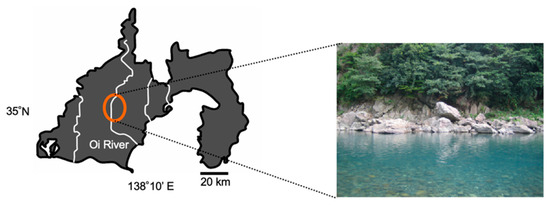
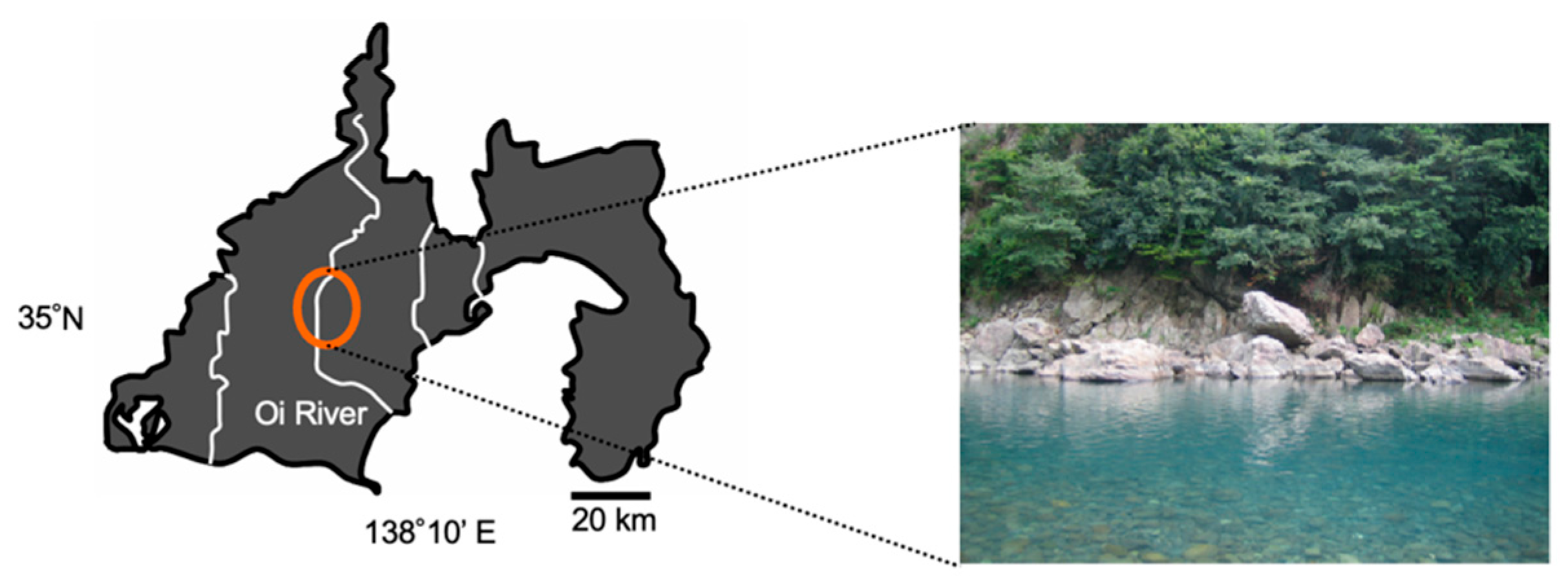
A total of 100 wild Japanese eels (Anguilla japonica) were captured over a consecutive three-year period (2007: n = 33; 2008: n = 40; 2009: n = 27) in the freshwater middle reaches (25–50 km upstream from the river mouth) of the Oi River, Shizuoka Prefecture, Japan (Figure 1).
Figure 1.
Map showing the geographic sampling location within the Oi River system, Shizuoka Prefecture, Japan, with latitudinal and longitudinal coordinates (left), and a representative photograph of the riverine habitat in the middle reaches where wild Japanese eels (Anguilla japonica) were captured (right). The orange circle denotes the intensive sampling zone, situated 25 to 50 km upstream of the river mouth (approx. 35° N, 138°10′ E), immediately downstream of the impassable dam barrier. The scale bar represents 20 km.
To characterise the stable demographic residency of the yellow eel population while avoiding transient seasonal downstream migratory fluxes, sampling was restricted to the summer months (June to September) each year. The designated intensive sampling zone is characterised by gravel-bed riffles and deep riverine pools immediately downstream of the impassable Shiogo Dam barrier. To systematically evaluate population representativeness and control for potential gear selectivity, specimen collection was distributed across three independent fishing methods: angling (n = 55), pot traps (n = 30), and cast nets (n = 15). Sex determination was performed immediately via macro-anatomical examination of the gonads. Because all examined individuals had reached large adult sizes (Total Length range: 357–766 mm), well beyond the biological body-size threshold for functional sex differentiation (typically completed at 200–300 mm TL), the macro-spatial identification between the distinct frilled, ribbon-like ovaries and the scalloped, lobed testes was highly definitive, following international standardised criteria in anguillid biology [1].
2.2. Condition Factor, Gonadosomatic Index, and Silvering Stages
To assess the nutritional status and somatic robustness of the captured river-resident eels, Fulton’s condition factor (K) was calculated from total length (TL, mm) and body weight (BW, g) using the following formula:
K = (BW/TL3) × 106
To assess physiological maturation phases, the gonadosomatic index (GSI) was calculated from the body weight (BW, g) and gonad weight (GW, g) using the formula:
GSI = (GW/BW) × 100
A standardised GSI threshold (GSI > 1.0 for females) was used to signal the onset of silvering [11], but this metric was cross-checked by integrating the definitive macroscopic silvering indices established for A. japonica, including significantly enlarged eye diameters (elevated eye index) and the distinct darkening of the pectoral fins [12], ensuring reliable differentiation of true physiological silvering from abnormal stress-induced gonadal anomalies.
2.3. Otolith Preparation
All extracted sagittal otoliths were embedded in epoxy resin (SpeciFix-20, Struers, Copenhagen, Denmark) and ground until the otolith core was closely approached. The ground surfaces were then polished using an OP-S suspension (Struers). The grinding process was performed on a mineral thin-sectioning machine (Discoplan-TS, Struers) equipped with 70 µm and 13 µm diamond cup wheels. The automated polishing process was conducted on a RotoPol-35 machine (Struers) equipped with an automatic specimen rotator [2].
2.4. Age Determination and Quality Control for Age Determination
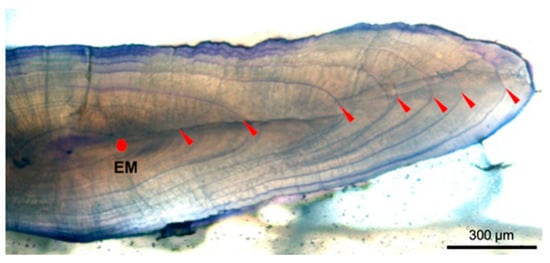
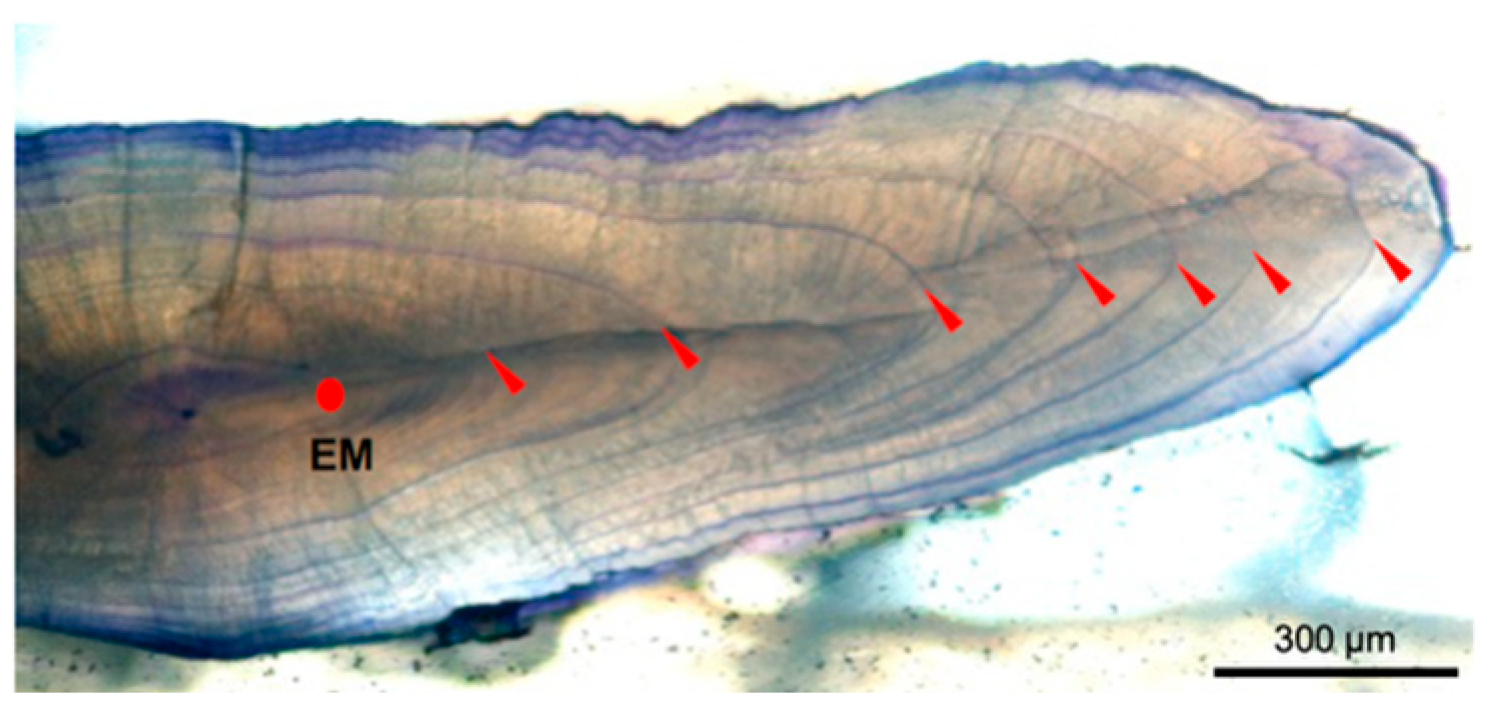
Sagittal otoliths were extracted, embedded in epoxy resin, sectioned, and stained with 1% toluidine blue for precise age determination [6,13]. To facilitate age determination, the ground and polished otoliths were acid-etched and stained. Etching was performed by exposing the polished surface to 1% hydrochloric acid (HCl) for approximately 1 min to clarify the hyaline zones. The samples were then rinsed with distilled water and dried. For staining, the etched otoliths were immersed in a 1% toluidine blue solution for 30 to 60 min, rinsed with tap water, and dried with a blower [6,13]. Toluidine blue staining deeply coloured the hyaline zones dark blue-purple, enhancing their visibility under optical microscopy (Figure 2).
Figure 2.
Photomicrograph of a sagittal otolith section from a Japanese eel (Anguilla japonica) captured in the Oi River, stained with 1% toluidine blue for age determination. The red circle labelled “EM” indicates the elver mark (designated as age 0), formed during the metamorphosis from glass eel to elver upon coastal recruitment. Red arrowheads mark the subsequent blue-purple-stained hyaline zones, defined as annual rings (annuli). In this representative specimen, eight annuli outside the elver mark are clearly visible, confirming the individual’s age as 7 years.
In this study, the stained hyaline zones were defined as annual rings (annuli). The number of annuli was counted from digital photographs taken under an optical microscope to determine the age of each fish. For age estimation, the “elver mark”—a distinct, intensely stained ring formed near the core during the transition from glass eel to elver upon coastal recruitment—was designated as age 0. Counting began with the first blue-stained annulus outside this elver mark [6,13].
To ensure strict quality control and minimise error in age estimation, each otolith specimen was examined, and annuli were counted three times independently by an experienced reader who was completely blinded to fish size (total length and body weight). Across all 100 wild specimens, the sequential readings showed exceptionally high chronological reproducibility; the maximum deviation among the three independent counts fell within a tight margin of ±1 year for every specimen. For the small proportion (8%) of samples exhibiting this minor ±1-year discrepancy, the otoliths were jointly re-examined under a high-resolution discussion microscope to establish a definitive consensus age, guaranteeing a highly robust level of error control for the entire age dataset.
2.5. Statistical Analysis
Morphological traits (total length and body weight), condition factor, and gonadosomatic index (GSI) were compared across the three sampling years (2007, 2008, and 2009). Statistical analyses were performed using parametric tests after confirming the assumptions of normality and homogeneity of variances via Shapiro–Wilk and Levene’s tests, respectively. One-way analysis of variance (ANOVA) with a Tukey–Kramer post hoc test was used to assess significant annual variation among the three sampling years, accommodating the unbalanced sample sizes (2007: n = 33; 2008: n = 40; 2009: n = 27) inherent in wild field sampling. Linear regression diagnostics were conducted to assess relationships between age and morphological traits, and exact p-values and 95% confidence intervals (CI) for the regression slopes were calculated to enhance quantitative interpretation. Statistical significance was set at p < 0.05.
3. Results
3.1. Relationship Between Age and Morphological Characteristics (Total Length and Body Weight)
Of the 100 examined Japanese eels, the captured population was heavily skewed towards females (n = 85), with only a few males (n = 5) and unidentifiable immature individuals (unknown; n = 10) detected. Crucially, this pronounced female predominance remained exceptionally uniform across sampling methods, comprising 83.6% in angling (n = 46/55), 86.7% in pot traps (n = 26/30), and 86.7% in cast nets (n = 13/15). Because these multiple gears capture eels via completely divergent behavioural and mechanical pathways, the identical proportion rules out gear-dependent selectivity, confirming that the skewed sex ratio reflects an intrinsic, stable biological characteristic of the Oi River freshwater population (Table 1).
Table 1.
Morphological characteristics, age profiles, Fulton’s condition factor (K), and gonadosomatic index (GSI) of the Japanese eel Anguilla japonica. captured in the Oi River across three sampling years (2007–2009). Data are presented as range (minimum–maximum) and mean ± standard deviation (SD).
The 10 unsexed (unknown) individuals were all immature yellow eels, with universally suppressed, thread-like gonads and GSI values of 0.00 (below macroscopic detection limits; Table 1). Macro-anatomical sex assignment was impossible for these specimens due to the extreme thinness and lack of visible differentiation in their early stage gonadal tissues. The age composition of these unknown specimens ranged from 6 to 12 years, with a mean of 9.3 ± 2.0 years (Table 1). Although their limited sample size precluded independent regression analyses, their morphological distributions were contextualised against the female baseline. Despite significant annual variation in population structure across the three sampling years (ANOVA, p = 0.015–0.008; Table 1), overall growth trajectories relative to age remained highly consistent throughout the three-year study period.
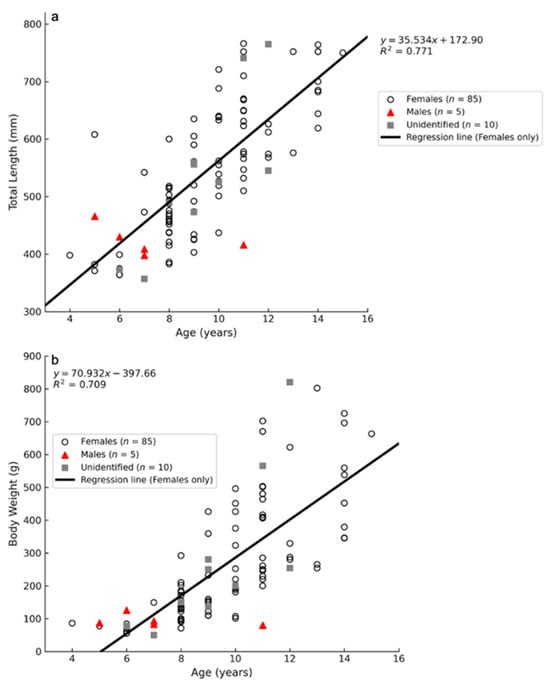
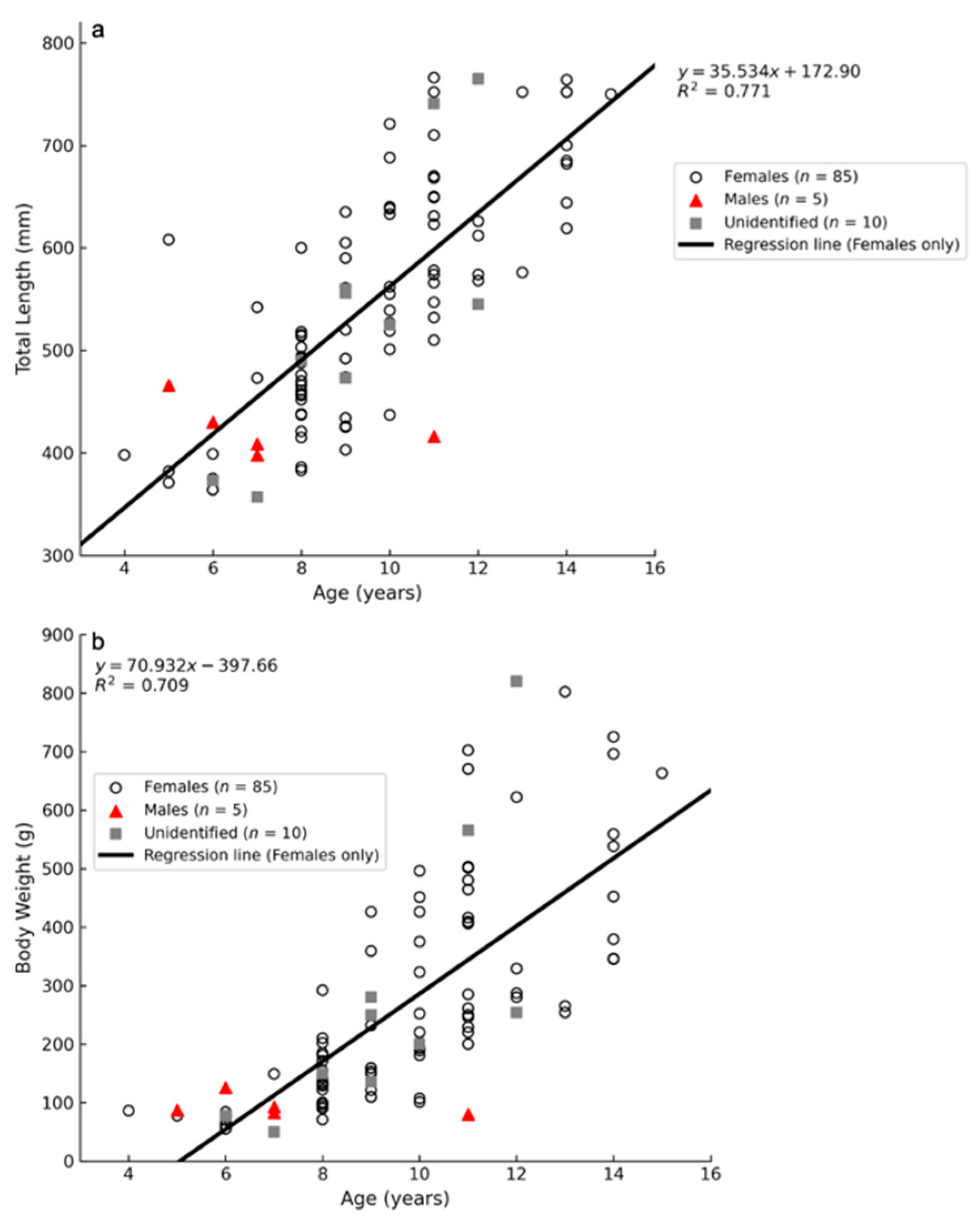
Therefore, linear regression analyses were performed specifically for the dominant female population (n = 85). A strong, highly significant positive correlation was observed between age and total length in females (linear regression: Total Length = 35.534 × Age + 172.90, R2 = 0.771, p = 0.0001, n = 85; Figure 3a), indicating an average annual growth rate of approximately 35.5 mm (ca. 3.6 cm/year). Similarly, age showed a significant positive correlation with body weight in females (Body Weight = 70.932 × Age − 397.66, R2 = 0.709, p = 0.0001, n = 85; Figure 3b).
Figure 3.
Relationships between age (years) and growth parameters of Japanese eels (Anguilla japonica) captured in the Oi River from 2007 to 2009. (a) Relationship between age (years) and total length (mm); the solid line shows the linear regression for the female population (Total Length = 35.534 × Age + 172.90, R2 = 0.771, p = 0.0001, n = 85). (b) Relationship between age (years) and body weight (g); the solid line shows the linear regression for the female population (Body Weight = 70.932 × Age − 397.66, R2 = 0.709, p = 0.0001, n = 85). Different marker shapes and colours denote sex and identification status: open circles for females (n = 85), red-filled triangles for males (n = 5), and grey-filled squares for unidentifiable immature individuals (n = 10).
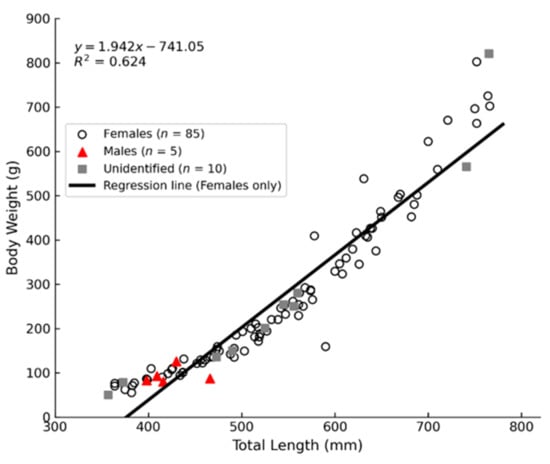
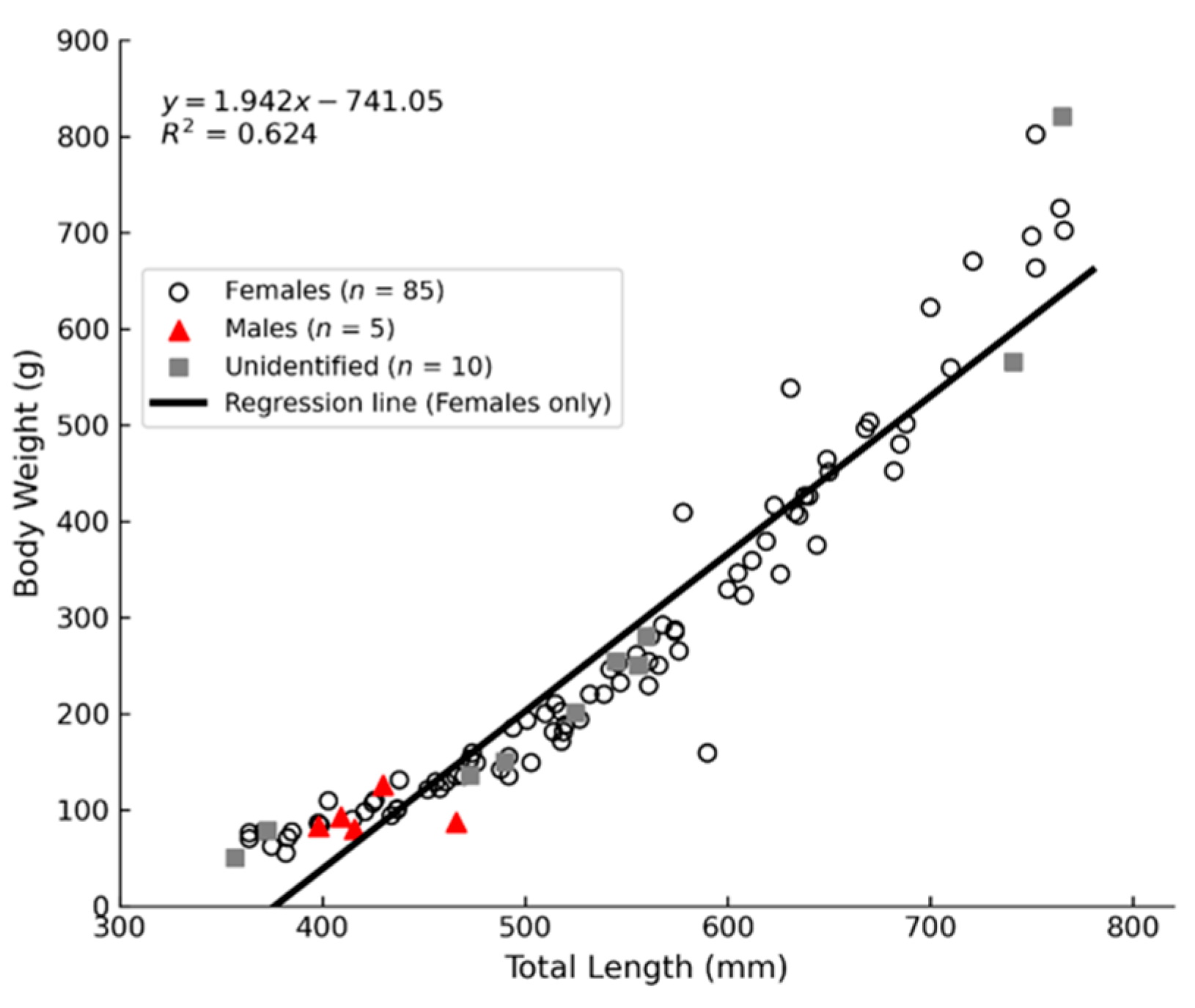
The relationship between total length (mm) and body weight (g) was evaluated exclusively for the female population (n = 85) to establish the baseline riverine growth form (Figure 4). A strong, highly significant linear relationship was observed (Linear regression: Body Weight = 1.942 × Total Length − 741.05, R2 = 0.624, p = 0.0001, n = 85). The male (n = 5) and unidentified (n = 10) individuals were also plotted in the same figure for comparison, and their distributions closely aligned with the female growth trajectory. This high coefficient of determination (R2 = 0.624) indicates stable, consistent, robust morphological development within the middle reaches of the Oi River.
Figure 4.
Length–weight relationship of Japanese eels (Anguilla japonica) captured in the Oi River from 2007 to 2009. The solid line shows the linear regression fitted exclusively to the female population (Body Weight = 1.942 × Total Length − 741.05, R2 = 0.624, p = 0.0001, n = 85). Marker shapes and colours denote sex and identification status: open circles for females (n = 85), red filled triangles for males (n = 5), and grey filled squares for unidentifiable immature individuals (n = 10).
3.2. Annual Variations in Gonadosomatic Index (GSI) and Maturation Status
The gonadosomatic index (GSI) of the captured population showed marked sex-specific patterns and localised temporal stratification (ANOVA, p = 0.008; Table 1). Among the dominant female population (n = 85), baseline GSI values remained low throughout the riverine growth period, consistent with the typical status of immature yellow eels in freshwater habitats (pooled mean GSI across all years: 0.55 ± 0.28). However, later sampling cohorts showed a marked increase in GSI. Notably, in 2009, multiple large-scale female silver eels exhibited highly advanced gonadal development, with the maximum GSI reaching 1.85 (Table 1). Intriguingly, these highly mature individuals were captured simultaneously at the same geographic station, which marked the uppermost structural limit of our sampling zone, immediately downstream of an impassable dam barrier. In contrast, the unknown specimens (n = 10) exhibited universally suppressed GSI values, all at 0.00 (Table 1). However, distinct signs of physiological maturation were observed in the male cohorts (n = 5). Specifically, a male captured in 2008 exhibited a significantly elevated GSI of 0.22 (Table 1), signalling the initiation of testicular development and the onset of silvering prior to downstream migration.
3.3. Condition Factor (K)
The condition factor (K) of the dominant female population (n = 85) ranged from 0.77 to 2.14, with the overall mean remaining high at 1.46 ± 0.21 across the pooled years (Table 1). This morphological robustness showed significant annual variation (ANOVA, p = 0.015), with the highest mean K in 2008 (1.55 ± 0.22, n = 35). Notably, high condition factors were most prominent in late summer, particularly among the highly mature silver cohorts. In 2008, a female specimen exhibited an exceptionally high maximum condition factor of 2.14 (Table 1). The simultaneous elevation of both GSI and K values provides unambiguous biological evidence that these river-resident individuals had successfully accumulated substantial somatic lipid and energy reserves prior to the onset of their downstream migration, without compromising their nutritional status during the localised precocious maturation process beneath the dam barrier.
4. Discussion
Significant annual variation was observed in total length, body weight, condition factor, and gonadosomatic index (GSI) across the three sampling years. Notably, highly mature female silver eels deemed to have initiated downstream migration were captured in multiple years immediately downstream of the impassable dam barrier, which marks the uppermost structural limit of our sampling area within the Oi River. Specifically, multiple mature female silver eels captured on 14 August 2008 exhibited elevated GSI values up to 1.11, while the 2009 cohort showed the highest degree of gonadal maturation, with a maximum GSI of 1.85 (Table 1). This spatial aggregation closely mirrors historical findings in East Asian river systems, such as the Tanshui River system in Taiwan, where wild Anguilla japonica populations exhibit a clear macro-spatial size gradient, with mean total lengths increasing significantly from downstream estuaries (ca. 10 cm) to upstream reaches (ca. 50 cm) as individuals move upstream and grow [14].
Concurrently, Tzeng et al. [15] documented that adult eels were rarely detected in midstream zones heavily fragmented by artificial water dams, establishing that anthropogenic barriers severely block natural upstream migration. This structural fragmentation and its decisive impact on age stratification represent a well-documented global paradigm across Atlantic catchments. Detailed otolith-based age assessments across multiple sequential dams in North American river systems, such as the Shetucket/Thames River in Connecticut, suggested highly significant statistical differences in age-class distributions between downstream and upstream populations divided by impassable artificial barriers, confirming that individual dams severely impede the longitudinal movement of growing cohorts [14]. In the Oi River, this anthropogenic fragmentation creates a critical geographic bottleneck; the impassable structural barrier forces growing freshwater cohorts to aggregate in the middle reaches, thereby concentrating these large, productive silver eels immediately downstream of the obstruction.
In East Asian and other temperate river systems, the downstream spawning migration and the initiation of gonadal maturation in temperate anguillid eels typically follow a well-defined seasonal pattern, with activity starting and peaking in late autumn and winter (October to December) [5,16,17,18,19]. According to the global paradigm for temperate eels, silver eels generally begin localised gonadal maturation and downstream transport during these cooler autumn months. However, the highly mature silver eels in this study exhibited prominent GSI spikes (1.11 in 2008 and 1.85 in 2009) as early as mid-August. This marked temporal gap strongly indicates that river-resident eels in the upper and middle reaches initiate physiological maturation and silvering during the summer months, well ahead of the standard seasonal migration peak.
Crucially, the mature silver eels captured downstream of the dam barrier on September 10, 2008 (725 g, 764 mm) and August 17, 2008 (802 g, 752 mm) exhibited robust condition factors of 1.63 and 1.89, respectively, with an 11-year-old mature female showing an exceptionally elevated maximum condition factor of 2.14 (Table 1). Furthermore, these individuals displayed the definitive macroscopic silvering indices established for wild A. japonica, including significantly enlarged eye diameters (elevated eye index) and the distinct darkening of the pectoral fins [12]. If this advanced gonadal phase were a passive, pathological response to stress or anthropogenic entrapment, severe somatic compromise or emaciation (depressed condition factor) would be expected. Instead, the simultaneous maintenance of exceptionally robust condition factors, elevated GSI values, and coordinated somatic silvering features provides unambiguous empirical evidence of an active, normal adaptive developmental strategy. Unlike individuals in estuarine or coastal environments with immediate access to the ocean, upper-river residents must traverse extensive longitudinal distances and invest substantial time to reach the river mouth. Therefore, initiating gonadal maturation and silvering earlier in the mid-summer months is an essential energetic and temporal adaptation, ensuring that these large, high-fecundity females are fully prepared with massive lipid and energy reserves by the time the autumnal migration window opens, thereby compensating for the high downstream transport costs.
Intriguingly, the linear regression slope for the female population in the Oi River indicates an average annual growth rate of approximately 3.6 cm/year (35.5 mm/year) (Figure 3). This riverine growth rate is notably slower than the rapid growth reported for estuarine and coastal residents in Japan (8.7 ± 2.2 cm/year) [6], yet it is consistent with the general slow-growth syndrome observed in freshwater-resident cohorts across temperate anguillid species, such as wild American eels (Anguilla rostrata) in Canadian river systems, which typically exhibit a baseline growth increment of approximately 4.0 cm/year [20]. Importantly, this growth deceleration within freshwater habitats represents a well-established global paradigm in anguillid bioenergetics; mathematical modelling and field analyses of European eels (Anguilla anguilla) have verified that, irrespective of sex, individuals grow significantly more slowly in freshwater riverine environments than in highly productive brackish lagoons, potentially driven by lower prey availability or altered trophic efficiencies in low-salinity habitats. Conversely, recent comprehensive modelling of silvering cohorts has revealed that small riverine and estuarine systems can exhibit remarkably high growth performance indices (5.8–6.1 cm/year for females), occasionally rivalling or even exceeding the growth parameters documented in much larger and warmer southern European brackish lagoons [21].
Strikingly, this phenotypic contrast between freshwater and saline environments has been further validated at a macro-spatial scale along the Eastern Adriatic coast [22], where wild A. anguilla subpopulations in freshwater riverine habitats displayed significantly longer asymptotic lengths but lower growth coefficients (K) than brackish residents, while concurrently exhibiting a significantly higher isometric-to-allometric growth exponent (b = 3.401 vs. 3.045) and superior condition parameters [23]. This international bioenergetic consistency perfectly supports our findings in the freshwater middle reaches of the Oi River; despite suppressed temperature-dependent growth rates (ca. 3.6 cm/year), the dominant female population maintains an exceptionally high growth exponent (b = 3.328; Figure 4) and robust condition factors (mostly ranging between 1.3 and 1.6, with a maximum of 2.14; Table 1). This robust morphology suggests that independent small-to-medium freshwater habitats possess excellent environmental quality and trophic carrying capacity, functioning as highly competent incubators that allow these potential female reproductive reservoirs to safely optimise their qualitative spatiotemporal maturation potential and somatic lipid readiness prior to open-ocean entry [24]. Furthermore, pan-European macro-ecological reviews demonstrate extreme geographic and temperature-dependent variation in maturation scheduling across the species’ range, where individuals in warm southern lagoons reach migration size rapidly within 2–3 years, whereas cohorts in cold northern European environments require multiple decades to achieve the same energetic threshold [25].
Importantly, this spatial, precocious maturation pattern unique to freshwater-resident cohorts is strongly supported by otolith microchemical and reproductive analyses in Japanese river systems, which suggest that the gonads of freshwater river eels are significantly more developed and show higher maturation levels than those of marine-resident “sea eels” during the silvering phase [26]. This critical empirical evidence directly challenges the conventional assumption that marine residents hold an absolute advantage in stock replenishment due to their faster growth rates.
Furthermore, this distinct growth dimorphism aligns with the global evolutionary paradigm of anguillid life histories, in which the sexes adopt divergent intrinsic growth strategies to meet their respective reproductive requirements. Wild silver populations consistently exhibit pronounced sexually dimorphic growth chronologies, with females growing faster and living longer than male cohorts to optimise ultimate spawning fecundity. This pattern is documented in North American watersheds [27], in recent Adriatic lagoon surveys where migrating females were significantly older and larger than male cohorts [24], and in large European river systems where female silver eels showed substantially higher annual length increments (5.2 cm/year) and an extended continental lifespan compared with males [28]. This slow-growth, high-maturation trade-off may indicate that freshwater habitats function as highly competent incubators that optimise the reproductive potential of female silver eels, ensuring their energetic readiness prior to ocean entry. Consequently, our results suggest that the age and size at maturation in the Oi River are structurally optimised, balancing prolonged somatic growth in freshwater with the rigorous energetic demands of the oceanic spawning journey.
The fact that river-resident females remain in the mid- stream freshwater habitat for over a decade underscores the high ecological carrying capacity of the Oi River, allowing valuable regional reservoirs of female spawning stocks to safely accumulate the massive lipid and energetic reserves required for their subsequent 2000–3000 km open- ocean migration despite their suppressed temperature- dependent growth rates. This energetic readiness is explicitly reflected in their high and robust condition factors (mostly ranging between 1.3 and 1.6, with a maximum of 2.14; Table 1), supporting the crucial physiological requirement that silvering cohorts must maximise somatic robustness and energy reserves without compromising nutritional carrying status prior to ocean entry [24].
Furthermore, this distinct growth dimorphism aligns with the global evolutionary paradigm of anguillid life histories, in which the sexes adopt divergent intrinsic growth strategies to meet their respective reproductive requirements. Wild silver populations consistently exhibit pronounced sexually dimorphic growth chronologies, with females growing faster and living longer than male cohorts to optimise ultimate spawning fecundity. This macro-riverine growth divergence has been robustly verified in the Elbe River system in Germany, where female silver eels showed substantially higher annual length increments (5.2 cm/year) and a broader age range than their male counterparts (3.5 cm/year) [28]. Crucially, as established by size-class-weighted modelling in large river systems, the maximum body size achieved by the largest female silver eels is not solely a consequence of a prolonged continental lifespan, but rather a synergistic outcome of sustained growth rates and extended riverine residency prior to maturation [28]. This biological scheduling perfectly accounts for the growth trajectories observed in the Oi River, where large females maintain a robust linear growth curve up to 15 years of age. Wild silver populations similarly show significant sexually dimorphic growth chronologies across different watersheds, with females consistently growing faster than males after age 4 to achieve a “size-maximising” strategy, as documented in North American catchments [27] and in recent Adriatic lagoon surveys, where migrating females were significantly older and larger than male cohorts [24]. This slow-growth, high-maturation trade-off may indicate that freshwater habitats function as highly competent incubators that optimise the qualitative reproductive potential of female silver eels, ensuring their energetic readiness prior to ocean entry. Consequently, our results suggest that the age and size at maturation in the Oi River are structurally optimised, balancing prolonged somatic growth in freshwater with the rigorous energetic demands of the oceanic spawning journey.
This energetic readiness is reflected in their high and robust condition factors (mostly ranging between 1.3 and 1.6, with a maximum of 2.14; Table 1), indicating that the eels do not compromise their somatic nutritional status during the localised precocious maturation process beneath the dam. Importantly, this spatial pattern of precocious maturation, unique to freshwater- resident cohorts, is strongly supported by otolith microchemical and reproductive analyses in Japanese river systems, which suggest that the gonads of freshwater river eels are significantly more developed and exhibit higher maturation levels than those of marine- resident “sea eels” during the silvering phase [26]. This critical empirical evidence directly challenges the conventional assumption that marine residents hold an absolute advantage in stock replenishment due to their faster growth rates. Instead, the advanced gonadal development observed in the Oi River indicates that, although river- resident eels experience suppressed growth rates (ca. 3.6 cm/year), they prioritise greater investment in gonadal maturation. Furthermore, this distinct growth dimorphism aligns with the global evolutionary paradigm of anguillid life histories, in which the sexes adopt divergent intrinsic growth strategies to meet their respective reproductive requirements. Wild American eels (A. rostrata) similarly exhibit significant sexually dimorphic growth chronology, with females consistently growing faster than males after age 4 to achieve a “size-maximising” strategy that enhances ultimate fecundity, while males employ a “risk-averse” or “time- minimising” strategy, maintaining sub-maximum somatic growth to quickly reach the minimum size threshold necessary to initiate gonadal maturation and downstream migration [27]. This slow- growth, high- maturation trade- off may indicate that freshwater habitats function as highly competent incubators that optimise the qualitative reproductive potential of female silver eels, ensuring their energetic readiness prior to ocean entry.
Consequently, our results suggest that age and size at maturation in the Oi River are structurally optimised, balancing prolonged somatic growth in freshwater with the rigorous energetic demands of the oceanic spawning journey. In this study, the sex ratio of the captured population was heavily skewed towards females (85%). Because multiple sampling methods—including angling, pot traps, and cast nets—were employed, this bias is unlikely to be an artefact of a single gear type. However, males may have been absent from the sampling sites during this period and may have inhabited alternative areas. This potential segregation suggests spatiotemporal variation in habitat use between the sexes. Given that our sampling period was restricted to June through September, further investigations during other seasons might yield a higher proportion of males. To investigate whether this heavily skewed sex ratio reflects an intrinsic biological trait or a size-dependent sampling artefact arising from the species’ pronounced sexual size dimorphism—wherein males exhibit significantly smaller maximum sizes than females—we contextualised our biometric coordinates against established macro-spatial baselines in Japan. Field assessments of downstream-migrating A. japonica in identical latitudinal catchments, such as the Hamana Lake system, have robustly verified that the body size of wild silver males is strictly capped at approximately 63.4 cm total length, whereas migrating females achieve significantly larger sizes up to 85.6 cm [29]. Consequently, sampling catchments that capture many individuals exceeding 65 cm will systematically exclude male cohorts, potentially creating a localised sampling bias in favour of females. Strikingly, the largest male captured in our Oi River dataset was only around 47 cm (466 mm TL; Table 1). To rigorously control for this size-dependent gear bias and test the validity of our sex ratio, we analysed an isolated sub-sample restricted exclusively to individuals under 65 cm (n = 76), thereby completely removing the 24 ultra-large females (>65 cm) that fell entirely outside the male physiological size spectrum. Remarkably, even within this shared-size cohort, where both sexes are equally catchable, the population structure remained overwhelmingly skewed in favour of females, comprising 80.3% of the sub-sample (61 females, 5 males, and 10 unsexed immature individuals). This mathematical consistency provides solid empirical evidence that the female predominance in the middle reaches of the Oi River represents a genuine, inherent population characteristic rather than a size-selective sampling artefact. Importantly, this pronounced female predominance is highly consistent with the global ecological paradigm of anguillid eels, which exhibits distinct macro-spatial segregation between the sexes within river catchments across both temperate and tropical species [30].
Extensive field research has established that female eels predominantly utilise upstream and middle freshwater reaches to optimise somatic growth and energy accumulation, whereas males remain heavily concentrated in lower estuarine or coastal environments. This macro-spatial partitioning has been robustly demonstrated in temperate longfinned eels (Anguilla reinhardtii) in south-eastern Australia [31], American eels (A. rostrata) in North American watersheds, where females can comprise over 99% of the localised freshwater populations [20], and in tropical anguillid species (A. bicolor bicolor and A. bengalensis bengalensis) in Indo-Pacific riverine systems [32,33]. The striking consistency between our historical baseline from the middle reaches of the Oi River, contemporary domestic monitoring, and these international precedents from diverse climatic zones strongly suggests that the female-biassed sex ratio is not a localised sampling artefact. Rather, it represents a stable, intrinsic population characteristic driven by evolutionary, sex-specific utilisation of riverine habitats. By contrast, ecological studies of Japanese eels (A. japonica) after river recruitment remain scarce, and comprehensive multi-year data on sex ratios within a single river system are severely limited. Therefore, the findings of the present study uniquely address this critical knowledge gap, unequivocally confirming that the middle reaches of East Asian rivers function as potential geographical reservoirs and critical reproductive sanctuaries for sustaining large female spawning stocks.
Crucially, this complex riverine habitat use reflects the species’ high behavioural plasticity and flexible migratory tactics during the yellow eel stage. As revealed by chronological otolith Sr:Ca ratio analyses, wild A. japonica populations comprise divergent, environmentally driven migratory contingents that irregularly shift habitats, exhibiting high ecological plasticity rather than adhering to a strictly restricted or uniform home range within the watershed [34]. Long-term datasets for European eels (Anguilla anguilla) and American eels (A. rostrata) have documented temporal shifts in sex ratios within the same river systems [35,36]. Because the adult sex ratio strongly influences reproductive output and population sustainability, multi-year monitoring programmes remain imperative.
Our sampling captured a broad age range of eels, from 4 to 15 years old. However, individuals under 4 years of age were entirely absent from the catch. This absence may be attributed to two main factors: either these younger cohorts had not yet migrated upstream into the middle reaches of the Oi River, or the sampling methods induced gear selectivity. For instance, the hook size used in angling inherently limits the minimum catchable size, preventing younger individuals from being hooked. Similarly, the mesh sizes of the pot traps and cast nets may have been too large to retain smaller eels. Beyond gear selectivity, this striking absence of smaller, younger cohorts in the middle reaches is strongly supported by size-dependent riverine distribution models of A. japonica in Japanese river systems. Generalised linear and additive modelling has robustly demonstrated that the density of small-sized eels (<200 mm TL) decreases significantly as the number of artificial weirs increases, whereas large-sized yellow eels (≥200 mm TL) remain structurally unaffected by these barriers [37]. Crucially, this size-dependent anthropogenic filtering has been further verified on a broader geographic scale across multiple watersheds in south-western Japan, where the number of artificial barriers had the highest explanatory capacity for the longitudinal decline and absolute upstream limitation of small eels under 40 cm in total length [38]. This socio-ecological phenomenon aligns with macro-spatial life-history models in Atlantic river catchments, where a significantly higher proportion of young age 0 and I individuals is found aggregated immediately below lower dams, representing transient male cohorts or slow-growing components that establish localised residency beneath structural obstacles until their subsequent downstream migration window opens [14]. Consequently, the multiple impassable dam barriers distributed along the longitudinal gradient of the Oi River, such as the Shiogo Dam, act as highly selective ecological filters that severely suppress the upstream recruitment of younger elvers and juvenile yellow eels. This macro-spatial partitioning forces younger and smaller cohorts to remain restricted to lower estuarine reaches, effectively ensuring that only larger, older individuals that possess the climbing or migratory proficiency to overcome these structural constraints can successfully establish residency and accumulate somatic reserves within the freshwater middle reaches.
Concurrently, diversification of sampling gear is required to accurately elucidate spatiotemporal movements, recruitment dynamics, and localised variations in the sex ratio of this species. Although the sample collection was conducted from 2007 to 2009, these baseline data provide an indispensable historical benchmark for the pristine life-history traits of river-resident eels in this river system, especially given the tightening of fishing regulations and the recent decline in recruitment.
Finally, the historical nature of the dataset analysed in this study (2007–2009) warrants recognition not as a limitation, but as an invaluable ecological benchmark. However, several inherent limitations associated with using historical material must be explicitly acknowledged in relation to contemporary river management. Over the past two decades, wild stocks of A. japonica and East Asian river basins have experienced intensified climate-related changes, potential shifts in glass eel recruitment, changing local fishing pressures, and progressive habitat modifications [39,40,41]. While the key anthropogenic factor—namely, the impassable dam barrier in the middle reaches of the Oi River—has remained structurally unchanged since our sampling period, contemporary resident cohorts might experience altered carrying dynamics or population densities due to these long-term environmental shifts. Therefore, our baseline parameters should be carefully interpreted as a pristine reference point capturing undisturbed riverine growth capacity before severe modern stock depletion, providing essential recommendations rather than definitive mandates for contemporary habitat conservation.
5. Conclusions
In conclusion, three consecutive years of baseline data (2007–2009) from the Oi River provide critical empirical evidence on the life-history traits and reproductive potential of river-resident Japanese eels (Anguilla japonica). The comprehensive analysis of 100 wild individuals revealed a robust riverine growth trajectory, characterised by a highly female-biassed population structure (85% females, 5% males, and 10% unidentifiable immature specimens) and a broad age distribution spanning 4 to 15 years. Importantly, these core demographic parameters were strongly shaped by our sampling framework, which targeted the middle reaches of the freshwater section (25–50 km upstream; section) during the summer feeding phase (June to September; timing) and utilised multiple gears (angling, pot traps, and cast nets; gear). Although gear selectivity and spatial limitations inherently focus our results on the older, larger components of the resident yellow and early-silver phases, the high consistency across methodologies robustly establishes these metrics as an intrinsic ecological trait of the mid-stream freshwater contingent. Most importantly, within this specific sampling context, the spatial and temporal concentration of highly matured female silver eels (with a maximum GSI of 1.85) immediately downstream of the impassable dam barrier reveals a sophisticated, active migratory strategy. River-resident individuals appear to initiate precocious gonadal maturation in the upper and middle reaches, thereby energetically compensating for the extensive distance and time required to traverse the fragmented river system down to the estuary.
Furthermore, given the unprecedented depletion of wild A. japonica stocks over the subsequent decades, this dataset serves as an irreplaceable historical benchmark for the pristine ecological carrying capacity of East Asian freshwater habitats. Although the absence of otolith Sr:Ca microchemical analysis limits the tracing of individual salinity histories, the uniform morphological alignments robustly support the sedentary freshwater status of these cohorts. Our findings ultimately underscore that large, river-resident females are indispensable reproductive reservoirs for replenishing this endangered species. As emphasised in global anguillid management, mitigating the impacts of artificial riverine barriers is a crucial international strategy to secure and maximise the production of high-quality silver eels [20]. To translate these findings into concrete future management for policymakers and river managers, we propose two paramount eco-engineering recommendations: first, retrofitting existing dam faces with species-specific climbing substrates, such as studded matrix passes or textured bypass ramps optimised for juvenile anguillid locomotion, to enhance upstream recruitment; and second, implementing controlled, eco-hydrological water-spill releases during mid-summer and late autumn to facilitate both upstream juvenile movement and the successful downstream transport of mature silver eels. Consequently, we emphasise that rigorous riverine habitat conservation—specifically the structural and hydrological mitigation of anthropogenic migration barriers—remains a paramount global imperative to ensure the long-term sustainability and successful reproduction of the next generation.
Author Contributions
Conceptualization, T.A.; methodology, T.A. and S.K.; software, T.A.; validation, T.A.; formal analysis, T.A.; investigation, S.K.; resources, T.A. and S.K.; data curation, S.K.; writing—original draft preparation, T.A.; writing—review and editing, T.A., S.K.; visualisation, T.A.; supervision, T.A.; project administration, T.A.; funding acquisition, T.A. All authors have read and agreed to the published version of the manuscript.
Funding
This study was funded by the Universiti Brunei Darussalam Faculty/Institute/Center Research Grant (Grant Nos. UBD/RSCH/1.4/FICBF/2025/008 and UBD/RSCH/1.4/FICBF/2026/017).
Institutional Review Board Statement
Our protocols complied with the ethical guidelines for the use of animals at Universiti Brunei Darussalam (UBD) and were approved by the University Research Ethics Committee at UBD (Approval Code: UBD/RSCH/1.4/FICBF(b)/2021/037; Approval Date: 15 September 2021).
Data Availability Statement
The data presented in this study are available within the article.
Conflicts of Interest
The authors declare no conflicts of interest.
References
- Tesch, F.-W. The Eel, 5th ed.; Thorpe, J.E., Ed.; Wiley-Blackwell: Oxford, UK, 2003; pp. 1–418. [Google Scholar]
- Tsukamoto, K.; Arai, T. Facultative catadromy of the eel Anguilla japonica between freshwater and seawater habitats. Mar. Ecol. Prog. Ser. 2001, 220, 265–276. [Google Scholar] [CrossRef] [Scilit]
- Arai, T.; Chino, N. Diverse migration strategy between freshwater and seawater habitats in the freshwater eels genus Anguilla. J. Fish Biol. 2012, 81, 442–455. [Google Scholar] [CrossRef] [Scilit] [PubMed]
- Tsukamoto, K. Discovery of the spawning area for Japanese eel. Nature 1992, 356, 789–791. [Google Scholar] [CrossRef] [Scilit]
- Arai, T.; Kimura, S. Environmental factors influencing inshore migration in Japanese eel Anguilla japonica. Environ. Res. Commun. 2024, 6, 115037. [Google Scholar] [CrossRef] [Scilit]
- Kotake, A.; Arai, T.; Okamura, A.; Yamada, Y.; Utoh, T.; Oka, H.P.; Miller, M.J.; Tsukamoto, K. Ecological Aspects of the Japanese Eel, Anguilla japonica, Collected from Coastal Areas of Japan. Zool. Sci. 2007, 24, 1213–1221. [Google Scholar] [CrossRef] [Scilit]
- Arai, T. (Ed.) Biology and Ecology of Anguillid Eels, 1st ed.; CRC Press: Boca Raton, FL, USA, 2016. [Google Scholar]
- Tsukamoto, K.; Nakai, I.; Tesch, F.W. Do all freshwater eels migrate? Nature 1998, 396, 635–636. [Google Scholar] [CrossRef] [Scilit]
- Chino, N.; Arai, T. Relative contribution of migratory type on the reproduction of migrating silver eels Anguilla japonica, collected off Shikoku Island, Japan. Mar. Biol. 2009, 156, 661–668. [Google Scholar] [CrossRef] [Scilit]
- Arai, T.; Chino, N. Contribution of migratory types to the reproduction of migrating silver eels in a tropical eel, Anguilla bicolor bicolor. Heliyon 2022, 8, e09491. [Google Scholar] [CrossRef] [Scilit] [PubMed]
- Utoh, T.; Mikawa, N.; Okamura, A.; Yamada, Y.; Tanaka, S.; Horie, N.; Akazawa, A.; Oka, H.P. Ovarian morphology of the Japanese eel in Mikawa Bay. J. Fish Biol. 2004, 64, 502–513. [Google Scholar] [CrossRef] [Scilit]
- Okamura, A.; Yamada, Y.; Yokouchi, K.; Horie, N.; Mikawa, N.; Utoh, T.; Tanaka, S.; Tsukamoto, K. A silvering index for the Japanese eel Anguilla japonica. Environ. Biol. Fishes 2007, 80, 77–89. [Google Scholar]
- Arai, T.; Kotake, A.; Lokman, P.M.; Miller, M.J.; Tsukamoto, K. Evidence of different habitat use by New Zealand freshwater eels, Anguilla australis and A. dieffenbachii, as revealed by otolith microchemistry. Mar. Ecol. Prog. Ser. 2004, 266, 213–225. [Google Scholar] [CrossRef] [Scilit]
- Levesque, J.R.; Whitworth, W.R. Age Class Distribution and Size of American Eel (Anguilla rostrata) in the Shetucket/Thames River, Connecticut. J. Freshw. Ecol. 1987, 4, 17–22. [Google Scholar] [CrossRef] [Scilit]
- Tzeng, W.-N.; Cheng, P.-W.; Lin, F.-Y. Relative Abundance, Sex Ratio and Population Structure of the Japanese Eel Anguilla japonica in the Tanshui River System of Northern Taiwan. J. Fish Biol. 1995, 46, 183–201. [Google Scholar] [CrossRef] [Scilit]
- Okamura, A.; Yamada, Y.; Tanaka, S.; Horie, N.; Utoh, T.; Mikawa, N.; Akazawa, A.; Oka, H.P. Atmospheric depression as the final trigger for the seaward migration of the Japanese eel Anguilla japonica. Mar. Ecol. Prog. Ser. 2002, 234, 281–288. [Google Scholar] [CrossRef] [Scilit]
- Arai, T.; Kotake, A.; Ohji, M.; Miller, M.J.; Tsukamoto, K.; Miyazaki, N. Occurrence of sea eels of Anguilla japonica along the Sanriku Coast of Japan. Ichthyol. Res. 2003, 50, 78–81. [Google Scholar] [CrossRef] [Scilit]
- Kotake, A.; Arai, T.; Ozawa, T.; Nojima, S.; Miller, M.J.; Tsukamoto, K. Variation in migratory history of Japanese eels, Anguilla japonica, collected in coastal waters of the Amakusa Islands, Japan, inferred from otolith Sr/Ca ratios. Mar. Biol. 2003, 142, 849–854. [Google Scholar] [CrossRef] [Scilit]
- Kotake, A.; Okamura, A.; Yamada, Y.; Utoh, T.; Arai, T.; Miller, M.J.; Oka, H.P.; Tsukamoto, K. Seasonal variation in migratory history of the Japanese eel, Anguilla japonica, in Mikawa Bay, Japan. Mar. Ecol. Prog. Ser. 2005, 293, 213–221. [Google Scholar] [CrossRef] [Scilit]
- Verreault, G.; Dargere, W.; Tardif, R. American eel movements, growth, and sex ratio following translocation. Am. Fish. Soc. Symp. 2009, 58, 129–136. [Google Scholar]
- Melià, P.; Bevacqua, D.; Crivelli, A.J.; Panfili, J.; De Leo, G.A.; Gatto, M. Sex differentiation of the European eel in brackish and freshwater environments: A comparative analysis. J. Fish Biol. 2006, 69, 1228–1235. [Google Scholar] [CrossRef] [Scilit]
- Denis, J.; Mahé, K.; Amara, R. Abundance and Growth of the European Eels (Anguilla anguilla Linnaeus, 1758) in Small Estuarine Habitats from the Eastern English Channel. Fishes 2022, 7, 213. [Google Scholar] [CrossRef] [Scilit]
- Glamuzina, L.; Conides, A.; Matić-Skoko, S.; Kresonja, M.; Mrakovčić, M.; Grđan, S.; Pofuk, M.; Glamuzina, B. Habitat-Driven Population Parameters Insights for European Eel Anguilla anguilla (Linnaeus, 1758) in Croatian Waters. Fishes 2026, 11, 125. [Google Scholar] [CrossRef] [Scilit]
- Hala, E.; Kule, M.; Kamberi, E.; Bakiu, R.; Simon, J. Age and Growth of European Eel, Anguilla anguilla (Actinopterygii, Anguilliformes, Anguillidae), in the Karavasta Lagoon, Albania. Acta Ichthyol. Piscat. 2025, 55, 259–271. [Google Scholar] [CrossRef] [Scilit]
- Kettle, A.J.; Heinrich, D.; Barrett, J.H.; Benecke, N.; Locker, A. Past Distributions of the European Freshwater Eel from Archaeological and Palaeontological Evidence. Quat. Sci. Rev. 2008, 27, 1309–1334. [Google Scholar] [CrossRef] [Scilit]
- Chino, N.; Imai, C.; Sakai, H.; Arai, T. Differences in the maturation level among life histories of the Japanese eel Anguilla japonica in the Nagata River, Japan. Oceanol. Hydrobiol. Stud. 2017, 46, 472–477. [Google Scholar] [CrossRef] [Scilit]
- Oliveira, K.; McCleave, J.D. Sexually Different Growth Histories of the American Eel in Four Rivers in Maine. Trans. Am. Fish. Soc. 2002, 131, 203–211. [Google Scholar] [CrossRef] [Scilit]
- Simon, J. Age and Growth of European Eels (Anguilla anguilla) in the Elbe River System in Germany. Fish. Res. 2015, 164, 278–285. [Google Scholar] [CrossRef] [Scilit]
- Sudo, R.; Fukuda, N.; Aoyama, J.; Tsukamoto, K. Age and body size of Japanese eels, Anguilla japonica, at the silver-stage in the Hamana Lake system, Japan. Coast. Mar. Sci. 2013, 36, 13–18. [Google Scholar]
- Arai, T. Ecology and evolution of migration in the freshwater eels of the genus Anguilla Schrank, 1798. Heliyon 2020, 6, e05176. [Google Scholar] [CrossRef] [Scilit] [PubMed]
- Walsh, C.T.; Pease, B.C.; Booth, D.J. Variation in the sex ratio, size and age of longfinned eels within and among coastal catchments of south-eastern Australia. J. Fish Biol. 2004, 64, 1297–1312. [Google Scholar] [CrossRef] [Scilit]
- Arai, T.; Abdul Kadir, S.R. Opportunistic spawning of tropical anguillid eels Anguilla bicolor bicolor and A. bengalensis bengalensis. Sci. Rep. 2017, 7, 41649. [Google Scholar] [CrossRef] [Scilit] [PubMed]
- Arai, T.; Abdul Kadir, S.R.; Chino, N. Year-round spawning by a tropical catadromous eel Anguilla bicolor bicolor. Mar. Biol. 2016, 163, 37. [Google Scholar] [CrossRef] [Scilit]
- Tzeng, W.N.; Shiao, J.C.; Iizuka, Y. Use of Otolith Sr:Ca Ratios to Study the Riverine Migratory Behaviors of Japanese Eel Anguilla japonica. Mar. Ecol. Prog. Ser. 2002, 245, 213–221. [Google Scholar] [CrossRef] [Scilit]
- Krueger, W.H.; Oliveira, K. Sex, size and gonad morphology of silver American eel Anguilla rostrata. Copeia 1997, 1997, 415–420. [Google Scholar] [CrossRef] [Scilit]
- Krueger, W.H.; Oliveira, K. Evidence for environmental sex determination in the American eel, Anguilla rostrata. Environ. Biol. Fishes 1999, 55, 381–389. [Google Scholar] [CrossRef] [Scilit]
- Kume, M.; Terashima, Y.; Kawai, F.; Kutzer, A.; Wada, T.; Yamashita, Y. Size-dependent changes in habitat use of Japanese eel Anguilla japonica during the river life stage. Environ. Biol. Fishes 2020, 103, 269–281. [Google Scholar] [CrossRef] [Scilit]
- Yamamoto, K.; Uemura, Y.; Mimachi, S.; Inoue, M.; Hata, H. Riverine Distribution and Abundance of Japanese Eel in Shikoku, South-Western Japan: Varying Importance of Regional and Local Factors. Aquat. Conserv. Mar. Freshw. Ecosyst. 2023, 33, 517–532. [Google Scholar] [CrossRef] [Scilit]
- Arai, T. Do we protect freshwater eels or do we drive them to extinction? SpringerPlus 2014, 3, 534. [Google Scholar] [CrossRef] [Scilit] [PubMed]
- Arai, T. How have spawning ground investigations of the Japanese eel Anguilla japonica contributed to the stock enhancement? Rev. Fish Biol. Fish. 2014, 24, 75–88. [Google Scholar]
- Arai, T. Sustainable management of tropical anguillid eels in Southeast Asia. In Natural Resources Conservation and Advances for Sustainability; Jhariya, M.K., Meena, R.S., Banerjee, A., Meena, S.N., Eds.; Elsevier: Amsterdam, The Netherlands, 2022; pp. 461–480. [Google Scholar]

Disclaimer/Publisher’s Note: The statements, opinions and data contained in all publications are solely those of the individual author(s) and contributor(s) and not of MDPI and/or the editor(s). MDPI and/or the editor(s) disclaim responsibility for any injury to people or property resulting from any ideas, methods, instructions or products referred to in the content. |
© 2026 by the authors. Licensee MDPI, Basel, Switzerland. This article is an open access article distributed under the terms and conditions of the Creative Commons Attribution (CC BY) license.