


Abstract
Small shelter structures may affect the spatial use, locomotor state, and group spatial relationships of juvenile black seabream (Acanthopagrus schlegelii), but behavioral responses induced by different structure types remain insufficiently examined using multiple behavioral metrics. In this study, we conducted a tank experiment to test three hypotheses: compared with a structure-free control, cuboid and cylindrical structures would increase juvenile use of the central structure-placement zone, alter locomotor state, and affect inter-individual distance. Three treatments were established, including cuboid structure, cylindrical structure, and structure-free control, and fish behavior was observed under daytime and nighttime conditions. Video tracking and image analysis were used to quantify area-standardized average occurrence rate, average swimming speed, percentage of active time, and inter-individual distance. Both structures increased juvenile use of S1, namely the central structure-placement zone within a radius of 0–20 cm from the shelter-structure center. During the daytime, the average occurrence rates in S1 were 54.1% ± 6.33% and 46.7% ± 2.32% in the cuboid and cylindrical structure groups, respectively, which were higher than those in the structure-free control group (15.2% ± 3.08%). At night, the corresponding values were 50.2% ± 0.55%, 42.8% ± 3.77%, and 13.3% ± 1.57%, respectively. Locomotor behavior and inter-individual distance also varied with structure type, observation period, and diel condition. Under tank conditions, small shelter-like structures altered the short-term spatial use, locomotor state, and group spatial relationships of juvenile black seabream. These findings provide experimental evidence for how juvenile black seabream respond to simple shelter-like structures under controlled tank conditions and may help researchers, hatchery managers, and stock-enhancement practitioners select small structures for short-term behavioral assessment and shelter enrichment.
Keywords:
juvenile black seabream; small shelter-like structure; tank experiment; spatial use; locomotor behavior; inter-individual distance Key Contribution:
This study demonstrates that cuboid and cylindrical shelter-like structures alter the short-term spatial use, locomotor state, and inter-individual distanceof juvenile black seabream under controlled daytime and nighttime tank conditions. These findings provide a behavioral basis for evaluating small shelter structures without directly extrapolating the results to full-scale artificial reef design.
1. Introduction
Fish in complex habitats often use local structural features such as shelter, boundaries, openings, and internal spaces. For juveniles, structures that provide refuge, boundaries, or resting positions may influence spatial selection, activity state, and group spatial relationships [1,2,3]. In controlled tank or aquaculture environments, small shelters, cover objects, and structurally enriched materials are commonly used to examine how fish recognize and use local space [4]. Structural complexity, void spaces, shelter availability, opening form, and shelter size may affect fish residence, aggregation, and shelter choice [5,6,7,8]. Therefore, comparing behavioral responses of juveniles to different small shelter-like structures can help clarify how structural boundaries, openings, and internal spaces influence short-term spatial use by fish.
Black seabream (Acanthopagrus schlegelii) is a coastal reef-associated fish species, and juveniles may be sensitive to local shelter space and boundary structures. Previous studies have found that rectangular gaps, square aperture sizes, and the shape and diameter of openings can affect aggregation and behavioral responses in juvenile black seabream or yellowfin seabream [9,10,11]. These studies indicate that juvenile use of structures depends not only on the presence of a structure, but also on opening form, internal space, boundary length, shelter coverage, and available resting positions. However, for small geometric shelter-like structures such as cuboid and cylindrical structures, whether they can simultaneously alter the spatial distribution, locomotor state, and inter-individual distance of juvenile black seabream remains insufficiently tested.
Diel conditions may further affect juvenile behavioral responses to shelter-like structures. Previous studies have shown that the presence or absence of shelter, as well as the availability of refuge space, can alter fish activity and spatial distribution during daytime and nighttime; dark conditions can also affect the distance between individuals and movement coordination within fish groups [12,13]. Under daytime conditions with visible light, visual cues may help juveniles recognize structure positions and conspecific locations. Under night-time conditions without visible light, non-visual sensory cues may become more important. The lateral line system is a mechanosensory flow-sensing system that detects local water motion and hydrodynamic disturbances generated or modified by nearby boundaries, objects, or prey, and is therefore considered a spatially limited, short-range sensory modality [14,15]. Such short-range lateral-line cues may help juveniles perceive nearby shelter structures in darkness. In addition, the lateral line system is also involved in the regulation of shoaling and nearest-neighbour distance, suggesting a potential role in perceiving nearby conspecifics [16,17].
Based on these considerations, this study established cuboid structure, cylindrical structure, and structure-free control treatments under controlled tank conditions to observe the short-term behavioral responses of juvenile black seabream during daytime and nighttime. In this study, the cuboid and cylindrical structures were defined as small shelter-like structures in a tank, rather than scaled-down models of full-scale artificial reefs in the field. The main reason for conducting this laboratory-based investigation was to clarify whether simple shelter-like structural features can modify the early space use, locomotor state, and group spacing of juvenile black seabream under controlled tank conditions. This is important because juvenile fish often respond to local boundaries, openings, cover, and internal spaces, yet the combined effects of simple structure type on spatial distribution, locomotor activity, and group spacing remain poorly understood. This approach provides a controlled behavioral basis for understanding juvenile responses to small shelter-like structures before these responses are further examined under more complex semi-natural or field-scale conditions. Three hypotheses were tested: (1) compared with the structure-free control, the cuboid and cylindrical structures would increase the area-standardized average occurrence rate of juveniles in the central structure-placement zone, namely S1 within a radius of 0–20 cm from the structure center, and adjacent zones; (2) the two structures would alter juvenile locomotor state, reflected by differences in average swimming speed and percentage of active time among structure types, observation periods, and diel conditions; and (3) the two structures would affect inter-individual distance, reflecting changes in group spatial relationships around the structures. This study aimed to determine whether a small shelter-like structure type and diel condition affect the spatial use, locomotor state, and group spatial relationships of juvenile black seabream.
2. Materials and Methods
2.1. Experimental Animals
A total of 180 juvenile black seabream were purchased from Yuzhenxian Aquaculture Farm, Huanglong Island. The fish had a total length of 5.4 ± 0.7 cm, a body length of 4.3 ± 0.7 cm, and a body mass of 4.6 ± 0.9 g. Before the experiment, the fish were acclimated in a blue cylindrical culture tank with a diameter of 6.0 m and a height of 1.6 m. The culture water was natural seawater filtered through a flowing sand filtration system. During the experiment, water temperature ranged from 28.0 to 29.7 °C, salinity from 29.3 to 32.1, and pH from 8.05 to 8.27. Continuous aeration was provided throughout the 10 d acclimation period, except for short interruptions during feeding, waste removal, and removal of uneaten feed. Fish were fed twice daily, once in the morning and once in the afternoon, with Haitonghao No. 4 sinking marine fish feed produced by Santong Bioengineering Co., Ltd. (Weifang, China). Uneaten feed and feces were removed every 3 d by siphoning. The experiment began after 10 d of acclimation.
2.2. Experimental Apparatus and Design
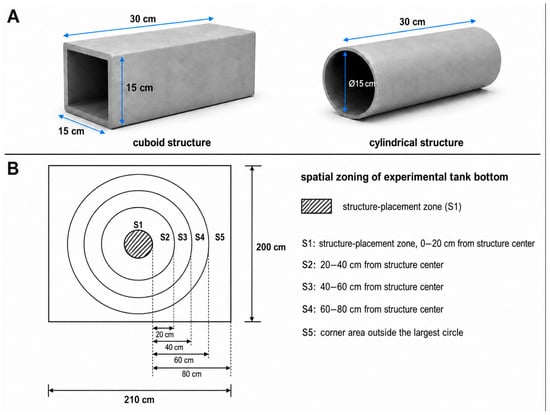
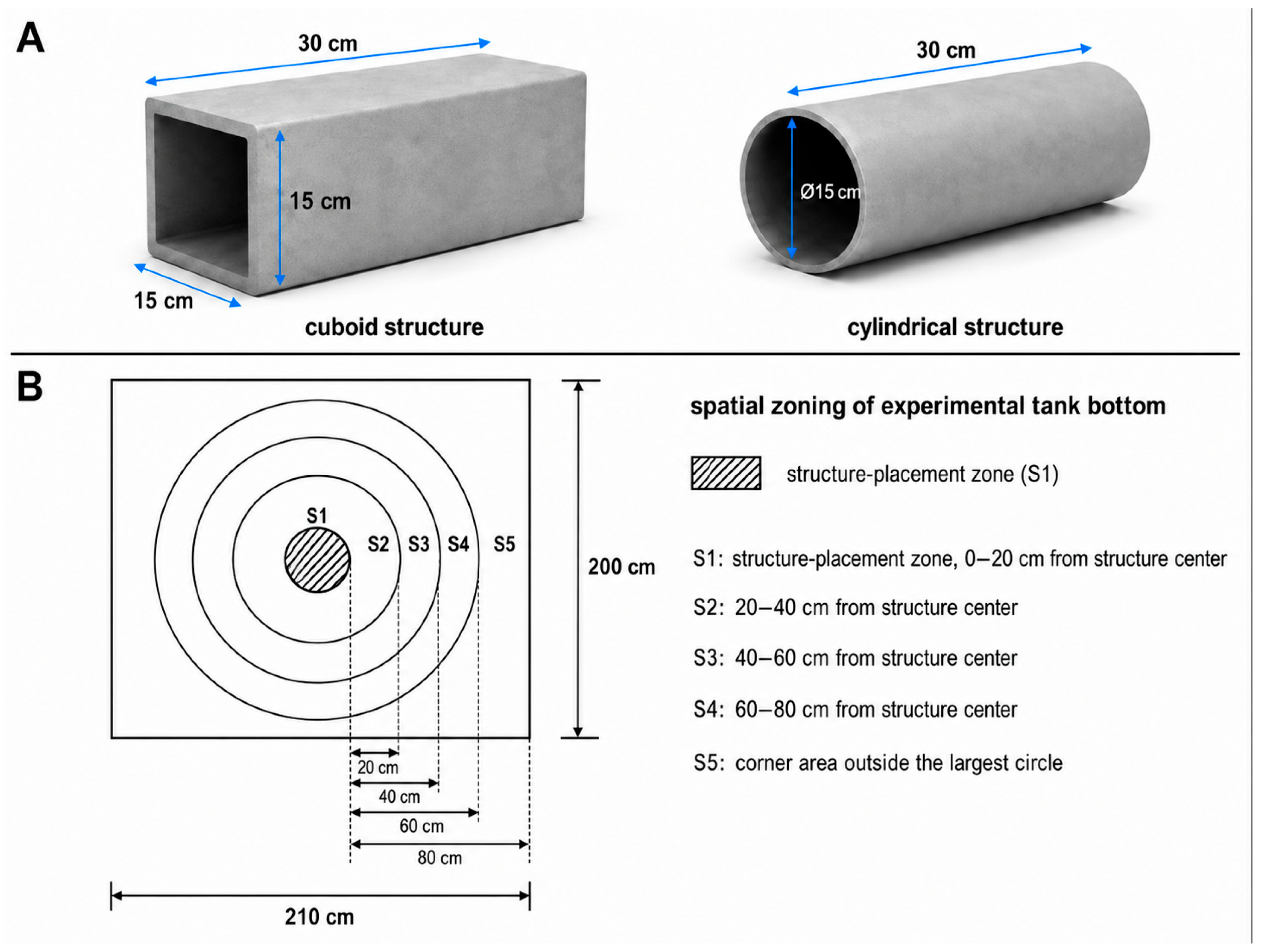
A hollow cuboid structure measuring 30 cm in length, 15 cm in width, and 15 cm in height was made from 3 mm thick white opaque acrylic sheets. A cylindrical structure was made from a white opaque PVC pipe with a wall thickness of 3 mm, a diameter of 15 cm, and a length of 30 cm (Figure 1A). These two structure types were selected because they represent simple and reproducible shelter-like geometries with the same maximum length but contrasting local structural features. The cuboid structure provided flat boundaries, corners, and a rectangular internal space, whereas the cylindrical structure provided a continuous curved cavity and circular openings. Therefore, this comparison was intended to test juvenile responses to two small shelter-like structure types, rather than to isolate the effect of external shape alone or to represent scaled-down full-size artificial reefs. The experimental tank was a white tank measuring 2.1 m in length, 2.0 m in width, and 0.9 m in height, with the water depth set at 0.8 m. Natural seawater filtered through a flowing sand filtration system was used throughout the experiment. The bottom of the tank was divided into four concentric circular zones, with diameters of 40, 80, 120, and 160 cm from the center outward. The corner area outside the largest concentric circle was defined as S5. The radius interval between adjacent concentric circles was 20 cm. For the cuboid and cylindrical structure treatments, the structure was placed at the center of the tank bottom. S1 was then defined as the central structure-placement zone within a radius of 0–20 cm from the structure center (Figure 1B).
Figure 1.
Schematic diagram of the experimental structures and spatial zoning. (A) Small shelter-like structures; (B) spatial zoning of the experimental tank bottom.
According to the observation requirements and diel time settings, the experiment was divided into daytime trials (08:00–12:00) and nighttime trials (20:00–03:00). Each trial lasted 45 min for observation and data collection. To reduce interference from water-surface reflection and surrounding stray light during subsequent image analysis, black cloth was used to shield the area around the tank. The video recording system consisted of multiple devices. A surveillance camera (DS-2DC4120IY-D, Hikvision, Hangzhou, China) was vertically suspended 2 m above the experimental tank to record juvenile fish activity from a top-view perspective throughout the experiment. During daytime trials, an underwater color camera (E5MP3CX10, Xiaoyufu, Shanghai, China) was also used for simultaneous auxiliary observation. Daytime illumination was provided by two 500 W outdoor LED lamps, and light intensity near the water surface was measured using a ZTW1702A illuminometer (CHINT, Shanghai, China). The light intensity was maintained at 100–200 lx. This range was set as a low-to-moderate visible-light condition in a controlled tank to ensure that juveniles could obtain available visual cues during daytime treatments, as previous studies have shown that low light intensity can affect visual behavior and spatial responses in fish [18]. Nighttime treatments were conducted at 0 lx, and the infrared night-vision mode of the overhead surveillance camera was used for recording to avoid interference from visible light on nighttime behavior and to establish a controlled dark-phase experimental condition. Natural underwater nighttime light environments can be influenced by moon phase, cloud cover, water turbidity, and artificial light sources, and are not constantly completely dark. Therefore, the 0 lx treatment in this study mainly represents an experimental condition excluding visible-light stimulation, rather than a complete simulation of all field nighttime environments [19]. During the experiment, water temperature was maintained at 28.0–29.7 °C, salinity at 29.3–32.1, and pH at 8.05–8.27, measured using PH818 and AR8012 water-quality meters (Smart Sensor, Chengdu, China).
Both daytime and nighttime experiments included three treatments: cuboid structure, cylindrical structure, and structure-free control. Each treatment had three replicates, and 10 juvenile black seabream were introduced in each replicate. A total of 90 fish were used for daytime trials and another 90 fish for nighttime trials, giving a total of 180 fish (Table 1). The order of treatments was randomized, and each fish was used only once. At the beginning of each trial, the juvenile fish were gently introduced into the tank from the same fixed point near the tank edge. After each trial, the tank was cleaned and the experimental water was replaced to reduce the possible effects of residual odor, stress cues, and previous trials on subsequent observations. To record the initial response and short-term adjustment process after fish introduction, all video recording devices were started 2 min before fish release. No additional acclimation period was provided in the experimental tank after fish release because this study aimed to record the short-term behavioral responses of juvenile black seabream immediately after introduction into the tank. Continuous video recording was conducted for 45 min from the moment the fish entered the water. Video data were transmitted in real time and synchronously stored on a portable computer.
Table 1.
Experimental grouping and fish allocation.
2.3. Extraction of Behavioral Metrics and Statistical Analysis
A single continuous 45 min video recording was analyzed using EthoVision XT video-tracking software (Version 16.0; Noldus Information Technology, Wageningen, The Netherlands) to extract behavioral metrics of juvenile fish. One frame was extracted every 3 min using FFmpeg (version 6.1; FFmpeg Project, open-source software), yielding 15 images for each experimental trial. The spatial zone occupied by the juvenile fish was recorded from each extracted frame. The raw occurrence rate in each zone was calculated, followed by area correction to reduce the influence of differences in zone area on the spatial distribution results.
The total occurrence frequency of fish in the j-th spatial zone was calculated as follows:
where mij denotes the occurrence frequency of the experimental fish in the j-th zone in the i-th extracted frame, with i = 1, 2, …, 15 and j = 1, 2, …, 5.
The area-standardized average occurrence rate was calculated as follows:
where Pj represents the area-standardized average occurrence rate in the j-th spatial zone, and Aj represents the area of the j-th spatial zone. ∑k=15(Ck/Ak) represents the sum of the area-standardized occurrence densities across the five spatial zones from S1 to S5.
The relative area ratio of zones S1–S4 was 1:3:5:7. Zone S5 represented the corner area of the tank outside the largest concentric circle, and its relative area was (105/π) − 16. Therefore, the relative area ratio of S1–S5 was 1:3:5:7:(105/π − 16).
After calculation using the formulas above, the sum of the area-standardized average occurrence rates across the five zones from S1 to S5 was 100% for each replicate and each observation period. Because the five spatial zones differed greatly in area, raw occurrence frequencies would be strongly affected by zone size. In this study, distance from the structure center was the main spatial factor of interest, whereas unequal zone area was an unavoidable geometric feature of the concentric-zone design. Therefore, area standardization was applied to reduce the influence of unequal zone areas and to allow relative comparisons of spatial use among zones.
To test the effects of treatment group, spatial zone, and observation period on the average occurrence rate, linear mixed-effects models were established separately for the daytime and nighttime datasets. The model structure was as follows:
Average occurrence rate ~ Treatment × Zone × Period + (1|Treatment/Replicate)
In this model, Treatment, Zone, Period, and their interactions were included as fixed effects. Replicate identity was included as a random intercept nested within Treatment. The model was fitted separately for the daytime and nighttime datasets.
Treatment included three levels: cuboid structure, cylindrical structure, and structure-free control; Zone included S1–S5; and Period included 0–15, 15–30, and 30–45 min. The significance of fixed effects was evaluated using likelihood ratio tests, with the significance level set at p < 0.05.
To test the edge-oriented tendency noted for the structure-free control group, additional control-only simple-effect comparisons were performed within the structure-free control treatment. Estimated marginal means were used to compare the area-standardized average occurrence rate among spatial zones, with particular attention to the comparison between S5 and S1 under daytime and nighttime conditions.
For each treatment group, three target juvenile fish were randomly selected from each of the three replicates, and their complete movement trajectories were extracted using EthoVision XT video-tracking software. Thus, trajectory data from nine juvenile fish were obtained for each treatment. The following behavioral metrics were automatically calculated using EthoVision XT:
- (1)
- Average swimming speed (cm/s): the total distance moved by each target fish during the observation period divided by the total observation time.
- (2)
- Active time percentage (%): the proportion of time during which each target fish was in a swimming state relative to the total observation time.
- (3)
- Inter-individual distance (cm): the mean pairwise Euclidean distance among juvenile fish in the experimental tank at the same time point.
To analyze temporal changes in locomotor behavior and inter-individual distance, each 45 min video was divided into three observation periods: 0–15, 15–30, and 30–45 min, and behavioral parameters were extracted separately for each period.
For average swimming speed and percentage of active time, linear mixed-effects models were fitted separately for the daytime and nighttime datasets. Treatment, observation period, and their interaction were included as fixed effects. Replicate tank was included as a random intercept, and fish identity nested within replicate tank was included as an additional random effect to account for repeated measurements of the same fish across observation periods. The model structure was
Y ~ Treatment × Period + (1|Replicate tank) + (1|Replicate tank:Fish identity)
For inter-individual distance, the replicate tank was treated as the experimental unit because this variable was calculated as a group-level metric for fish within the same tank. Treatment, observation period, and their interaction were included as fixed effects, and replicate tank was included as a random intercept. The model structure was:
Y ~ Treatment × Period + (1|Replicate tank)
Fixed effects were evaluated using likelihood-ratio tests under maximum likelihood estimation. When significant treatment × period interactions were detected, post hoc comparisons were conducted among treatments within the same observation period and among periods within the same treatment.
Statistical analyses were conducted in R version 4.5.1 (R Foundation for Statistical Computing, Vienna, Austria). Linear mixed-effects models were fitted using the lme4 package (version 1.1-37) [20], and post hoc comparisons were performed using emmeans (version 2.0.0) [21].
3. Results
Because no additional acclimation period was provided in the experimental tank, all results reported below should be interpreted as short-term post-release behavioral responses during the first 45 min after introduction.
3.1. Effects of Structure Types on the Spatial Distribution of Juvenile Black Seabream
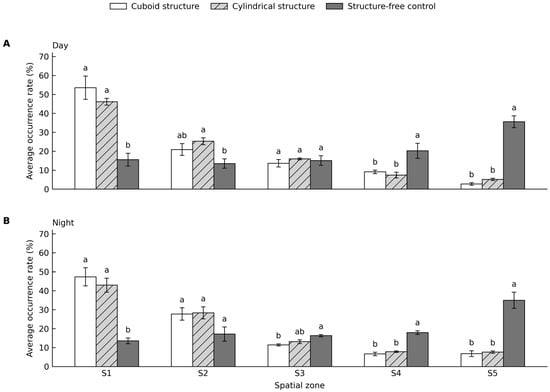
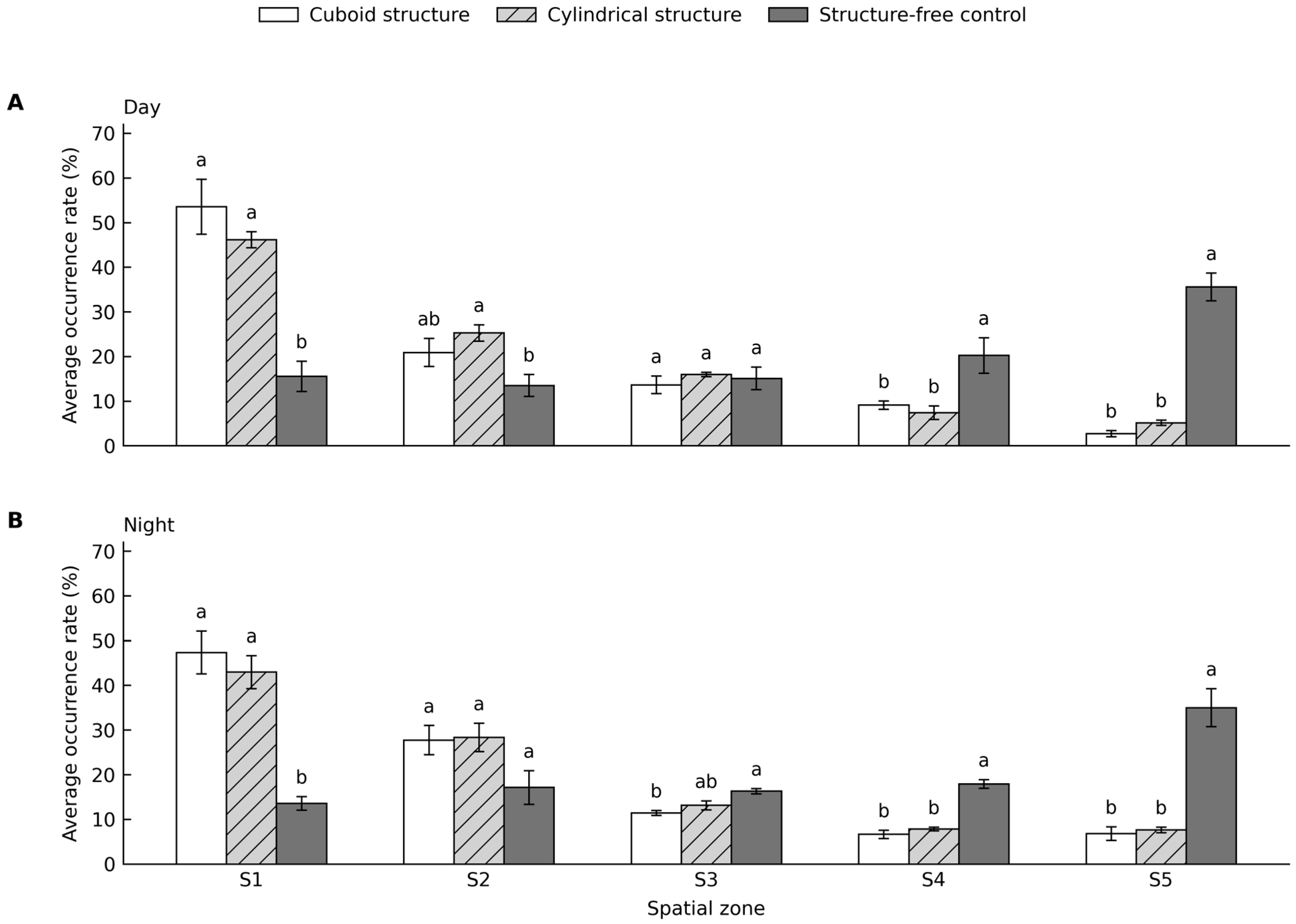
Under daytime conditions, spatial zone, treatment × zone, and treatment × zone × period significantly affected the average occurrence rate, whereas zone × period was not significant (Table 2). Under nighttime conditions, spatial zone, treatment × zone, zone × period, and treatment × zone × period all had significant effects on the average occurrence rate (Table 2). These patterns show that juvenile spatial distribution differed mainly among spatial zones and that the effects of structure type varied across zones under both daytime and nighttime conditions.
Table 2.
Results of linear mixed-effects models testing the effects of structure type, spatial zone, and observation period on the average occurrence rate of juvenile black seabream.
During the daytime, the average occurrence rate in S1 was higher in the cuboid structure group and cylindrical structure group than in the structure-free control group (54.1% ± 6.33%, 46.7% ± 2.32%, and 15.2% ± 3.08%, respectively; p < 0.05; Figure 2A). In S5, the structure-free control group showed a higher average occurrence rate than the cuboid and cylindrical structure groups (34.8% ± 3.34%, 3.0% ± 0.44%, and 5.5% ± 0.26%, respectively; p < 0.05; Figure 2A). Under nighttime conditions, the average occurrence rate in S1 remained higher in the cuboid and cylindrical structure groups than in the structure-free control group (50.2% ± 0.55%, 42.9% ± 3.77%, and 13.4% ± 1.57%, respectively; p < 0.05; Figure 2B). The structure-free control group again showed the highest occurrence rate in S5 (33.7% ± 2.91%; Figure 2B). Additional control-only simple-effect comparisons confirmed this edge-oriented pattern. Within the structure-free control treatment, the average occurrence rate differed significantly among spatial zones under both daytime and nighttime conditions. In particular, S5 was significantly higher than S1 in both diel conditions, indicating that, when no central structure was available, juveniles tended to occur more frequently in the tank-edge or corner area than in the central open area.
Figure 2.
Average occurrence rate across spatial zones among different treatment groups. (A) Daytime condition; (B) nighttime condition. Data are presented as mean ± SE (n = 3). Different lowercase letters within the same spatial zone indicate significant differences among treatment groups (p < 0.05).
3.2. Effects of Small Shelter-like Structure Types on the Locomotor Behavior of Juvenile Black Seabream
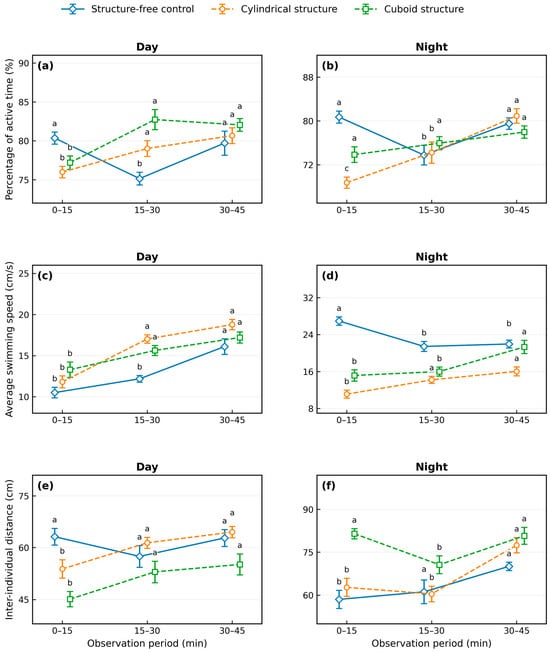
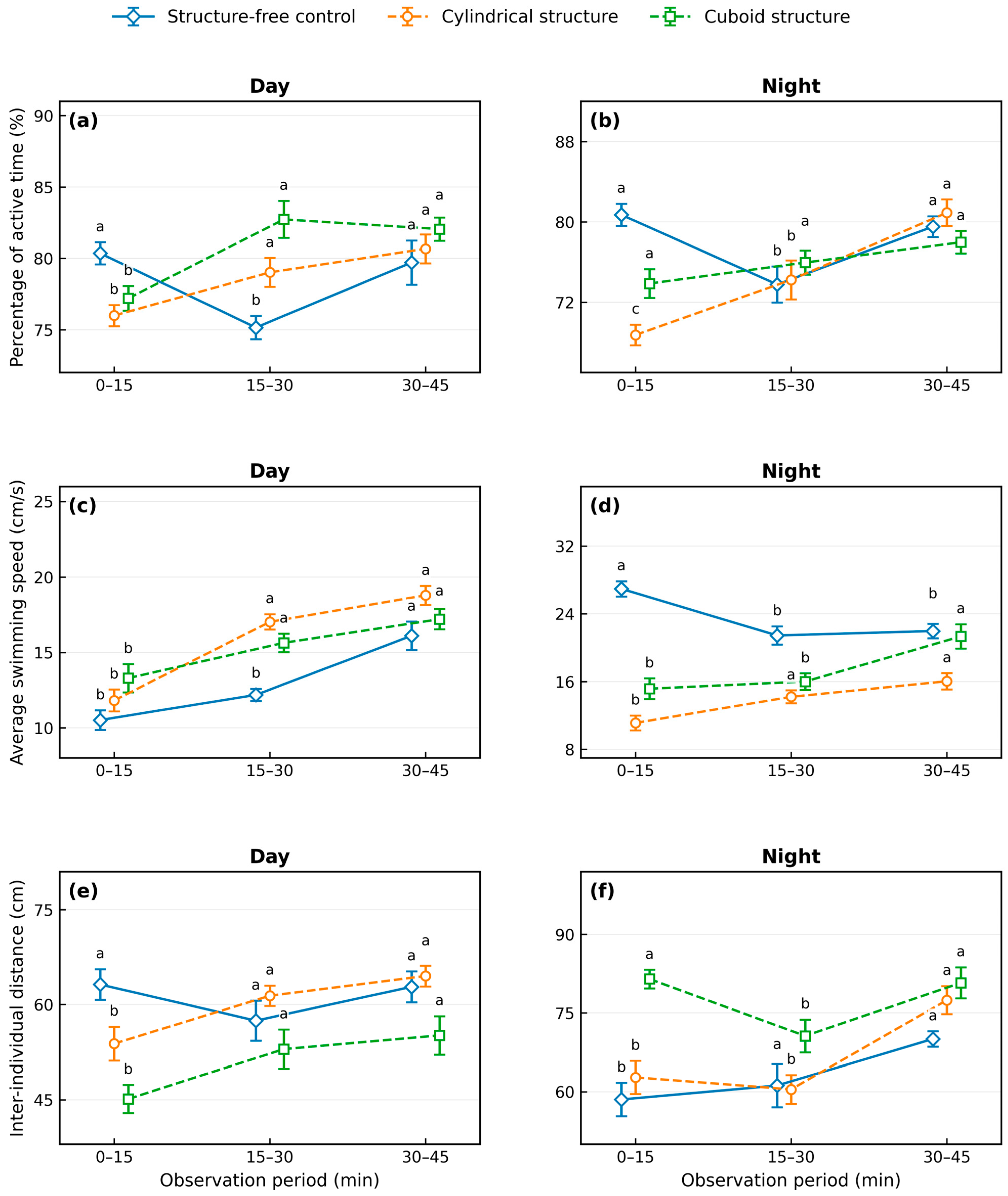
For active time percentage, the linear mixed-effects models showed that treatment, observation period, and their interaction had significant effects under daytime conditions (Table 3). Under nighttime conditions, observation period and the treatment × period interaction were significant, whereas the main effect of treatment was not significant. For average swimming speed, treatment, observation period, and their interaction were significant under both daytime and nighttime conditions (Table 3).
Table 3.
Results of linear mixed-effects models testing the effects of structure type and observation period on locomotor behavior and inter-individual distance of juvenile black seabream.
The temporal patterns of locomotor behavior differed among treatment groups (Figure 3a–d). During the daytime, average swimming speed generally increased with observation time in all three treatment groups. Active time percentage also varied among treatments and periods, with the cuboid and cylindrical structure groups showing relatively higher values during the later observation periods. At night, the structure-free control group maintained a relatively high swimming speed during the initial period, whereas the cuboid and cylindrical structure groups showed lower initial swimming speeds followed by gradual increases.
Figure 3.
Effects of small shelter-like structure types on behavioral traits of juvenile black seabream under daytime and nighttime conditions. (a,b) Percentage of active time; (c,d) average swimming speed; (e,f) inter-individual distance. Values are means ± SE. Different lowercase letters indicate significant differences among observation periods within the same treatment and diel condition based on estimated marginal means comparisons (p < 0.05).
3.3. Effects of Small Shelter-like Structure Types on the Inter-Individual Distance of Juvenile Black Seabream
For inter-individual distance, the linear mixed-effects models showed that treatment, observation period, and their interaction had significant effects under both daytime and nighttime conditions (Table 3). Because inter-individual distance was calculated as a group-level metric, replicate tank was used as the experimental unit.
Inter-individual distance showed treatment-specific temporal patterns (Figure 3e,f). During the daytime, the structure-free control group showed a relatively high inter-individual distance during the initial observation period, whereas the cylindrical structure group showed higher values during the middle and later periods. The cuboid structure group showed lower inter-individual distance during the initial period and a moderate increase thereafter. At night, the cuboid structure group generally showed higher inter-individual distance than the other groups, while the cylindrical structure group increased during the later observation period.
4. Discussion
The main value of this study lies in showing that simple shelter-like structures can simultaneously affect three aspects of juvenile black seabream behavior: local space use, locomotor state, and group spatial relationships. Rather than evaluating large-scale artificial reef performance, this study focused on short-term behavioral responses to small, reproducible structures under controlled tank conditions. The results provide evidence that both cuboid and cylindrical structures increased juvenile use of the central structure-placement zone, and that these structures also modified swimming activity and inter-individual distance under daytime and nighttime conditions. These findings suggest that local structural features, such as boundaries, openings, internal space, and cover, are important components shaping juvenile behavioral responses.
4.1. Spatial Distribution
In this tank experiment, both the cuboid structure and cylindrical structure altered the spatial use of juvenile black seabream. In the two structure treatment groups, juvenile fish occurred more frequently in the central structure-placement zone and adjacent areas, whereas the structure-free control group did not show an obvious centrally concentrated distribution pattern. This indicates that juvenile black seabream actively approached small shelter-like structures with boundaries, openings, and sheltering spaces.
Previous studies have shown that void space, structural complexity, shelter availability, and shelter size can influence fish residence, aggregation, and shelter selection [5,6,7,8]. Studies on juvenile black seabream and juvenile yellowfin seabream further indicate that rectangular gaps, square aperture sizes, and the shape and diameter of openings can affect juvenile aggregation or behavioral responses [9,10,11]. Artificial structure models can also affect structure-associated occupancy and locomotor behavior in black seabream and other fish species [22]. In addition, different artificial structure models have been reported to differ in their attraction effects on black seabream and other marine fishes [23,24]. These studies are consistent with the present results, indicating that local structural characteristics can influence spatial selection and space use by juvenile fish.
The tendency of juvenile fish to approach the structure zone may be related to shelter use and boundary preference. Juvenile black seabream are small in body size and may be more likely to approach structures that provide shelter, boundaries, or resting positions in a novel environment. Previous studies have suggested that predation risk and shelter availability can influence reef fish assemblages [1,25]. Although predators were not included in the present experiment, and predation pressure therefore cannot be directly evaluated, the concentration of juvenile fish around the structure zone can still be interpreted as the use of sheltering space and boundary structures. The cuboid structure had flat boundaries, corners, and internal space, allowing juvenile fish to remain along the boundaries or enter the structure. The cylindrical structure had a continuous tube cavity and curved boundary, which could also provide space for passage, approach, or short-term residence. Therefore, both structures increased juvenile fish use of the central structure-placement zone.
The intensity of structure-zone use differed between daytime and nighttime conditions. Under daytime light conditions, fish can visually recognize structural boundaries, openings, shadows, and the positions of conspecifics, which may facilitate their localization and use of the central structure zone. Under nighttime conditions at 0 lx, the occurrence rate in the central zone decreased to some extent, but both structure groups remained higher than the structure-free control group, indicating that juvenile black seabream could still perceive and use the structures under dark conditions. Previous studies have shown that coral reef fish larvae can use multiple sensory cues, including visual, chemical, and mechanical cues, when recognizing settlement habitats, and that visual cues from conspecifics and predators can also affect habitat selection [26,27]. In addition, both vision and the lateral line system may participate in reef- or structure-oriented behavior in fish [28]. Combined with the present results, the continued approach of juvenile fish to the structure zone at night may be associated with lateral line perception, close-range boundary contact, and the positions of conspecifics, rather than complete dependence on visual information.
The differences between the cuboid and cylindrical structures should not be simply attributed to shape alone. In addition to external morphology, the two structures differed in opening form, internal space, boundary length, sheltering area, and available resting positions. Previous studies have shown that internal sheltering space and external edges can jointly affect the distribution of juvenile fish around structures and their sheltering responses after disturbance, and that the size and internal space of cylindrical shelters can also affect shelter selection by fish [7,8]. Therefore, the spatial distribution differences caused by the cuboid and cylindrical structures in the present study are more appropriately interpreted as the result of differences in small shelter-like structure type, rather than being determined solely by external shape.
4.2. Locomotor Behavior
In this study, average swimming speed and active time percentage differed among structure treatments and observation periods, indicating that small shelter-like structures not only affected the spatial use of juvenile black seabream but also altered their locomotor state. Under daytime conditions, average swimming speed increased with observation time in all treatment groups, and higher swimming speeds were observed in the cylindrical structure group and cuboid structure group during the later observation period. This pattern may reflect short-term adjustment after fish release, as well as structure approach, boundary exploration, and movement within or around the shelter-like structures.
Swimming speed and active time percentage can reflect locomotor intensity, exploratory activity, continuous swimming demand, and potential energy expenditure in fish. Previous studies have shown that physical structures, substrates, and artificial structure models can affect fish residence, activity performance, and swimming behavior in controlled environments [22,29]. In the present study, the gradual increase in average swimming speed during daytime suggests that juvenile black seabream became more active as they adjusted to the tank environment. The two structure groups may have promoted local exploratory movements around boundaries, openings, and internal spaces, rather than simply causing fish to remain stationary near the structure.
Under nighttime conditions, juvenile fish in the structure-free control group maintained higher average swimming speed and active time percentage, whereas the locomotor intensity of fish in the cuboid structure group and cylindrical structure group was relatively lower. Combined with the spatial distribution results, juveniles in the two structure groups still showed relatively high occurrence rates in the central structure-placement zone and adjacent areas. Therefore, the reduced locomotor intensity at night more likely reflected increased short-term use of areas near the structures rather than a decline in activity capacity. In the structure-free control group, the absence of clear shelter and boundaries may have made it more difficult for juveniles to form stable resting positions, resulting in a higher level of continuous swimming. In contrast, the cuboid and cylindrical structures provided accessible local spaces for short-term occupation, allowing juveniles to reduce continuous swimming under dark conditions.
Shelter conditions can alter diel activity allocation and spatial use in fish [12]. In the present study, the lower nighttime locomotor intensity in the two structure groups is consistent with the idea that shelter-like structures may provide local resting or holding positions, thereby reducing the need for continuous movement in open water. This interpretation is also consistent with previous findings that the presence of shelter can reduce maintenance-related energetic costs in juvenile fish [2]. Therefore, the nighttime reduction in swimming speed and active time percentage in the structure groups should not be interpreted as a simple suppression of activity, but rather as a short-term behavioral adjustment associated with local space occupation near the structures.
The diel differences in locomotor state may also be related to light conditions and intrinsic activity rhythms. Under daytime visible-light conditions of 100–200 lx, juvenile fish could use visual cues to recognize structural boundaries, openings, shadows, and the positions of conspecifics, thereby facilitating approach and exploratory behavior. Under nighttime dark conditions of 0 lx, available visual information was markedly reduced, and juveniles were more likely to remain near the structures. Diel activity patterns in fish can be influenced by external conditions such as light, as well as by endogenous circadian rhythms [30,31]. Therefore, the diel differences in locomotor state observed in juvenile black seabream may be associated with the combined effects of light condition, sensory perception, diel activity rhythm, and short-term local use of areas near the structures.
4.3. Inter-Individual Distance
Inter-individual distance reflects the average spatial distance among juvenile fish and can be used to evaluate changes in shoal cohesion and group spatial relationships under different structure treatments [13]. In the present study, inter-individual distance varied with structure type and observation period, indicating that small shelter-like structures affected not only whether juveniles approached the structure-placement zone, but also how individuals were spatially arranged around the structures.
Under daytime conditions, the inter-individual distance showed different temporal trends among treatment groups. The structure-free control group showed a decrease during the 15–30 min period, the cylindrical structure group maintained a relatively high level during the middle and later periods, and the cuboid structure group showed relatively small temporal changes. These results suggest that the effects of small shelter-like structures on group spacing were not simply expressed as increased aggregation or reduced individual distance. Instead, group spacing was likely related to structural boundaries, opening form, internal space, and the availability of local resting positions.
The cuboid and cylindrical structures differed in boundary form, internal space, and opening form, which may have affected how juvenile fish occupied space around the structures. The cuboid structure had flat boundaries, corners, and internal space, providing relatively clear boundary-associated and corner-associated positions. The cylindrical structure had a continuous tube cavity, curved boundary, and open space, allowing juvenile fish to move among the opening, outer edge, and adjacent areas. Previous studies have shown that internal voids, structural complexity, the relative proportions of shelter space and edge structure, and shelter size can affect fish aggregation, sheltering effects, and shelter selection [5,7,8]. Habitat enrichment studies have also used inter-individual distance and nearest-neighbor distance as indicators of shoal cohesion, and have shown that enriched structural environments can alter group spatial relationships and behavioral state in fish [32,33,34]. Therefore, the effects of small shelter-like structures on juvenile black seabream were reflected not only in increased use of the central structure-placement zone, but also in changes in the spatial distances among individuals.
Under nighttime conditions, the cuboid structure group generally showed higher inter-individual distance, while inter-individual distance in the cylindrical structure group increased with observation time. Combined with the spatial distribution results, juvenile fish in the structure groups still occurred more frequently in the central structure-placement zone and adjacent areas at night. Therefore, an increase in inter-individual distance does not necessarily indicate that fish moved away from the structures. Juvenile fish could approach the same structure while occupying internal, edge, and adjacent spaces separately, resulting in a relatively large inter-individual distance. This is especially possible for the cuboid structure, which provided multiple planar boundaries, opening edges, and corner-associated positions.
Changes in light conditions may also affect the spatial relationships within fish groups. Under daytime conditions, visual cues were relatively sufficient, allowing juvenile fish to recognize the positions of conspecifics and maintain group spacing. Under nighttime conditions at 0 lx, visual information was reduced, and the relative positions among individuals may have become more variable. Previous studies have shown that light intensity and light spectrum can influence shoaling behavior and other behavioral responses in fish under laboratory conditions [35,36]. In the present study, the increased inter-individual distance in some structure groups at night may be related to weakened visual cues and the increased availability of separate resting or sheltering positions around the structures. Thus, the nighttime increase in inter-individual distance should be interpreted as a change in local space occupation and group spatial arrangement, rather than simply as weakened attraction to the structures.
4.4. Limitations
Because no additional acclimation period was provided in the experimental tank, the observed responses may include release-related stress, exploratory behavior, wall-edge use, and short-term shoal reorganization. Therefore, these results should be interpreted as short-term post-release behavioral responses rather than stable shelter-use patterns. In addition, because S1 was the smallest spatial zone, area standardization could increase its relative numerical value. Therefore, the area-standardized average occurrence rate should be interpreted as a density-corrected spatial-use index, rather than as a direct residence proportion or stable residence time.
The cuboid and cylindrical structures used in this study were relatively small and mainly represented small shelter-like structures that could provide boundaries, cover, openings, and internal space under tank conditions. They should not be regarded as strict scaled-down models of full-scale artificial reefs in the field.
Because geometric, hydrodynamic, and behavioral ecological scale similarities were not established in this study, and because the results were not validated under field conditions, the findings should not be directly extrapolated to artificial reef engineering design. The behavioral differences between the two structures also cannot be simply interpreted as the effect of shape alone, because surface area, boundary length, internal space, opening form, and available resting positions may have acted simultaneously.
In addition, the juvenile black seabream used in this study were obtained from an aquaculture facility, and behavioral observations were conducted in a closed tank. The experimental conditions lacked water flow, predation risk, substrate variation, complex habitat backgrounds, and natural group structure that occur in the field. Therefore, the results mainly reflect the short-term behavioral responses of aquaculture-origin juvenile black seabream to small shelter-like structures under controlled tank conditions, and cannot directly represent the structure-use processes of wild juvenile black seabream in natural habitats. Future studies should further evaluate the effects of these structural attributes on habitat selection and behavioral regulation in juvenile black seabream by controlling structural parameters, increasing the range of model scales, introducing water flow and predation-risk conditions, and combining semi-natural or field validation.
5. Conclusions
This study provides a controlled tank-based evaluation of how two simple shelter-like structure types affect the short-term behavioral responses of juvenile black seabream. The main finding is that both cuboid and cylindrical structures increased juvenile use of the central structure-placement zone and adjacent areas, indicating that juvenile black seabream can rapidly respond to small structures that provide boundaries, openings, cover, and internal space. A further valuable finding is that these structures not only influence where juveniles occurred, but also altered their locomotor state and inter-individual distance, showing that small shelter-like structures can modify both individual activity and group-level spatial arrangement.
Under daytime and nighttime conditions, juvenile fish showed differences in spatial use and locomotor responses to the structures, suggesting that light conditions, sensory perception, and endogenous rhythms may jointly influence their structure-use behavior. It should be noted that the structures used in this study were small experimental shelter-like structures. Therefore, the results should be mainly interpreted as short-term behavioral responses of juvenile black seabream to small shelter-like structures, and should not be directly extrapolated to the design effects of artificial reefs in the field. Future studies should combine structures at different scales, experiments separating structural parameters, and field validation to further clarify the roles of different structural attributes in habitat selection by juvenile black seabream.
Author Contributions
Conceptualization, Q.C. and W.Q.; methodology, Q.C., Y.C. and W.Q.; software, Q.C.; validation, Q.C., Y.C., R.F., L.O., N.L., W.J. and W.Q.; formal analysis, Q.C.; investigation, Q.C., Y.C., R.F., L.O., N.L. and W.J.; resources, R.F., L.O., N.L., W.J. and W.Q.; data curation, Q.C.; writing—original draft preparation, Q.C.; writing—review and editing, Y.C., R.F., L.O., N.L., W.J. and W.Q.; visualization, Q.C.; supervision, Y.C. and W.Q.; project administration, W.Q.; funding acquisition, W.Q. All authors have read and agreed to the published version of the manuscript.
Funding
This research was funded by the National Key Research and Development Program of China, grant number 2024YFD2401700.
Institutional Review Board Statement
Ethical review and approval were waived for this study because the experiment involved only behavioral observations of juvenile black seabream and did not include invasive procedures or endangered/protected species.
Informed Consent Statement
Not applicable.
Data Availability Statement
The data supporting the findings of this study are available from the corresponding author upon reasonable request. Due to the large size of the original video recordings and tracking files, these files are not publicly available.
Acknowledgments
During the preparation of this manuscript, the author(s) used ChatGPT (GPT-5.5 Thinking; OpenAI, San Francisco, CA, USA) for language editing and translation assistance. The authors have reviewed and edited the output and take full responsibility for the content of this publication.
Conflicts of Interest
The authors declare no conflicts of interest. The funders had no role in the design of the study; in the collection, analyses, or interpretation of data; in the writing of the manuscript; or in the decision to publish the results.
References
- Hixon, M.; Beets, J. Predation, Prey Refuges, and the Structure of Coral-Reef Fish Assemblages. Ecol. Monogr. 1993, 63, 77–101. [Google Scholar] [CrossRef] [Scilit]
- Millidine, K.J.; Armstrong, J.D.; Metcalfe, N.B. Presence of Shelter Reduces Maintenance Metabolism of Juvenile Salmon. Funct. Ecol. 2006, 20, 839–845. [Google Scholar] [CrossRef] [Scilit]
- Roberts, L.J.; Taylor, J.; Garcia De Leaniz, C. Environmental Enrichment Reduces Maladaptive Risk-Taking Behavior in Salmon Reared for Conservation. Biol. Conserv. 2011, 144, 1972–1979. [Google Scholar] [CrossRef] [Scilit]
- Arechavala-Lopez, P.; Cabrera-Álvarez, M.J.; Maia, C.M.; Saraiva, J.L. Environmental Enrichment in Fish Aquaculture: A Review of Fundamental and Practical Aspects. Rev. Aquac. 2022, 14, 704–728. [Google Scholar] [CrossRef] [Scilit]
- Sherman, R.L.; Gilliam, D.S.; Spieler, R.E. Artificial Reef Design: Void Space, Complexity, and Attractants. ICES J. Mar. Sci. 2002, 59, S196–S200. [Google Scholar] [CrossRef] [Scilit]
- Shabi, T.; Ziv, Y.; Yosef, R.; Shashar, N. Deciphering Preferences for Shelter Volume and Distribution by Coral Reef Fish, Using Systematic and Functional Grouping. J. Mar. Sci. Eng. 2024, 12, 186. [Google Scholar] [CrossRef] [Scilit]
- Zhang, Y.; Sun, T.; Ding, G.; Yu, D.; Yang, W.; Sun, Q.; Wang, X.; Lin, H. Moderate Relative Size of Covered and Non-Covered Structures of Artificial Reef Enhances the Sheltering Effect on Reef Fish. Front. Mar. Sci. 2023, 10, 1130626. [Google Scholar] [CrossRef] [Scilit]
- Jones, N.A.R.; Gardella, G.; Webster, M.M. Three-Spined Sticklebacks Show Dimension-Specific Preferences for Shelter. Anim. Behav. 2024, 208, 41–49. [Google Scholar] [CrossRef] [Scilit]
- Wang, M.; Zhang, S.Y.; Wang, W.D.; Yu, B.C. Effects of rectangular gaps of artificial reefs on the aggregation of juvenile black seabream. J. Fish. China 2010, 34, 1762–1768. (In Chinese) [Google Scholar]
- Zhang, H.M.; Xie, X.Y.; Chen, P.M.; Yuan, H.R.; Feng, X.; Tong, F.; Liu, Y.; Cheng, Z.J.; Zou, J.H.; Chen, Z.C. Effects of different square aperture sizes in artificial reef vertical plates on the attraction of juvenile black seabream. S. China Fish. Sci. 2022, 18, 52–58. (In Chinese) [Google Scholar]
- Jiang, M.J.; Guo, Y.; Qin, C.X.; Pan, W.N.; Yu, G.; Ma, Z.H. Behavioral responses of juvenile yellowfin seabream to artificial reef models with different opening shapes and diameters. J. Fish. Sci. China 2023, 30, 1496–1506. (In Chinese) [Google Scholar]
- Larranaga, N.; Steingrimsson, S.O. Shelter Availability Alters Diel Activity and Space Use in a Stream Fish. Behav. Ecol. 2015, 26, 578–586. [Google Scholar] [CrossRef] [Scilit]
- Ginnaw, G.M.; Davidson, I.K.; Harding, H.R.; Simpson, S.D.; Roberts, N.W.; Radford, A.N.; Ioannou, C.C. Effects of Multiple Stressors on Fish Shoal Collective Motion Are Independent and Vary with Shoaling Metric. Anim. Behav. 2020, 168, 7–17. [Google Scholar] [CrossRef] [Scilit]
- Patton, P.; Windsor, S.; Coombs, S. Active Wall Following by Mexican Blind Cavefish (Astyanax mexicanus). J. Comp. Physiol. A 2010, 196, 853–867. [Google Scholar] [CrossRef] [Scilit] [PubMed]
- Schwalbe, M.A.B.; Bassett, D.K.; Webb, J.F. Feeding in the Dark: Lateral-Line-Mediated Prey Detection in the Peacock Cichlid Aulonocara stuartgranti. J. Exp. Biol. 2012, 215, 2060–2071. [Google Scholar] [CrossRef] [Scilit] [PubMed]
- Faucher, K.; Parmentier, E.; Becco, C.; Vandewalle, N.; Vandewalle, P. Fish Lateral System Is Required for Accurate Control of Shoaling Behaviour. Anim. Behav. 2010, 79, 679–687. [Google Scholar] [CrossRef] [Scilit]
- McKee, A.; Soto, A.P.; Chen, P.; McHenry, M.J. The Sensory Basis of Schooling by Intermittent Swimming in the Rummy-Nose Tetra (Hemigrammus rhodostomus). Proc. R. Soc. B Biol. Sci. 2020, 287, 20200568. [Google Scholar] [CrossRef] [Scilit] [PubMed]
- Keep, J.K.; Watson, J.R.; Cramp, R.L.; Jones, M.J.; Gordos, M.A.; Ward, P.J.; Franklin, C.E. Low Light Intensities Increase Avoidance Behaviour of Diurnal Fish Species: Implications for Use of Road Culverts by Fish. J. Fish Biol. 2021, 98, 634–642. [Google Scholar] [CrossRef] [Scilit] [PubMed]
- Bassi, A.; Love, O.P.; Cooke, S.J.; Warriner, T.R.; Harris, C.M.; Madliger, C.L. Effects of Artificial Light at Night on Fishes: A Synthesis with Future Research Priorities. Fish Fish. 2022, 23, 631–647. [Google Scholar] [CrossRef] [Scilit]
- Bates, D.; Maechler, M.; Bolker, B.; Walker, S. Lme4: Linear Mixed-Effects Models Using Eigen and S4; The R Foundation for Statistical Computing: Vienna, Austria, 2025. [Google Scholar]
- Lenth, R.V.; Piaskowski, J. Emmeans: Estimated Marginal Means, Aka Least-Squares Means; The R Foundation for Statistical Computing: Vienna, Austria, 2026. [Google Scholar]
- Lee, W.-Y.; Lan, K.-W.; Chang, H.-H.; Naimullah, M. Residency and Swimming Behavior of Acanthopagrus schlegelii, Trachinotus blochii, and Acanthopagrus latus in Relation to Artificial Reef Models in a Captivity Experiment. Appl. Anim. Behav. Sci. 2022, 257, 105778. [Google Scholar] [CrossRef] [Scilit]
- Li, L.; Chen, D.; Peng, J.X.; Zhang, J.M.; Wang, L.; Chen, S.; Quan, W.M.; Jiang, M.; Jiang, Y.Z. Comparison of attraction effects of different artificial reef models on black seabream, Chinese sea bass, and large yellow croaker. J. Dalian Ocean Univ. 2019, 34, 413–418. (In Chinese) [Google Scholar] [CrossRef]
- Zhou, Y.; Cai, W.; Chen, H.; Chen, P.; Lv, G.; Jia, X. Attraction Effect of Various Artificial Reef Models on Sparus macrocephalus. J. Fish. China 2011, 35, 711–718. (In Chinese) [Google Scholar]
- Caley, M.J.; St John, J. Refuge Availability Structures Assemblages of Tropical Reef Fishes. J. Anim. Ecol. 1996, 65, 414–428. [Google Scholar] [CrossRef] [Scilit] [PubMed]
- Lecchini, D.; Peyrusse, K.; Lanyon, R.G.; Lecellier, G. Importance of Visual Cues of Conspecifics and Predators during the Habitat Selection of Coral Reef Fish Larvae. Comptes Rendus Biol. 2014, 337, 345–351. [Google Scholar] [CrossRef] [Scilit] [PubMed]
- Lecchini, D.; Planes, S.; Galzin, R. Experimental Assessment of Sensory Modalities of Coral-Reef Fish Larvae in the Recognition of Their Settlement Habitat. Behav. Ecol. Sociobiol. 2005, 58, 18–26. [Google Scholar] [CrossRef] [Scilit]
- Chen, F.; Li, J.; Gong, P.H.; Guan, C.T. Effects of visual and lateral line organs on reefing behavior of Sebastes schlegelii. Prog. Fish. Sci. 2025, 46, 108–117. (In Chinese) [Google Scholar] [CrossRef]
- Näslund, J.; Johnsson, J.I. Environmental Enrichment for Fish in Captive Environments: Effects of Physical Structures and Substrates. Fish Fish. 2016, 17, 1–30. [Google Scholar] [CrossRef] [Scilit]
- Sánchez-Vázquez, F.J.; López-Olmeda, J.F.; Vera, L.M.; Migaud, H.; López-Patiño, M.A.; Míguez, J.M. Environmental Cycles, Melatonin, and Circadian Control of Stress Response in Fish. Front. Endocrinol. 2019, 10, 279. [Google Scholar] [CrossRef] [Scilit] [PubMed]
- Reebs, S.G. Plasticity of Diel and Circadian Activity Rhythms in Fishes. Rev. Fish Biol. Fish. 2002, 12, 349–371. [Google Scholar] [CrossRef] [Scilit]
- Guo, Y.; Chen, Z.; Qin, C.; Yu, G.; Zhang, J. Habitat Enrichment Causes Changes in Fish Behavioural Characteristics: A Case Study of Sparus latus. Biology 2024, 13, 364. [Google Scholar] [CrossRef] [Scilit] [PubMed]
- Kleinhappel, T.K.; Pike, T.W.; Burman, O.H.P. Changes in Group Behaviour in Response to a Preferred Environment Reflect Positive Affect. Sci. Rep. 2023, 13, 10576. [Google Scholar] [CrossRef] [Scilit] [PubMed]
- Arechavala-Lopez, P.; Díaz Gil, C.; Saraiva, J.; Moranta, D.; Castanheira, M.F.; Velazquez, S.; Ledesma-Corvi, S.; Mora-Ruiz, M.; Jofre, A. Effects of Structural Environmental Enrichment on Welfare of Juvenile Seabream (Sparus aurata). Aquac. Rep. 2019, 15, 100224. [Google Scholar] [CrossRef] [Scilit]
- O’Connor, E.; Krause, J. Effect of Light Intensity on the Shoaling Behaviour of the Guppy (Poecilia reticulata). J. Fish Biol. 2003, 63, 254. [Google Scholar] [CrossRef] [Scilit]
- Barber, I.; Young, J.; Morrison-Smith, E.; Matthews, E. Effects of Light Intensity and Spectrum on Fish Behaviour in Laboratory Aquaria. J. Fish Biol. 2003, 63, 246. [Google Scholar] [CrossRef] [Scilit]

Disclaimer/Publisher’s Note: The statements, opinions and data contained in all publications are solely those of the individual author(s) and contributor(s) and not of MDPI and/or the editor(s). MDPI and/or the editor(s) disclaim responsibility for any injury to people or property resulting from any ideas, methods, instructions or products referred to in the content. |
© 2026 by the authors. Licensee MDPI, Basel, Switzerland. This article is an open access article distributed under the terms and conditions of the Creative Commons Attribution (CC BY) license.