


Abstract
Charitable interpretation in technically complex domains depends on accurately characterizing the object of interpretation. This article develops a domain-competence condition for evaluating arguments in artificial intelligence (AI) ethics. Domain competence is question-relative rather than synonymous with engineering expertise: sufficient competence requires understanding or verifying the technical and contextual premises that could materially alter a normative conclusion. We propose a counterfactual materiality test to determine that threshold. Functional understanding may be sufficient for many first-order judgments, but questions concerning responsibility, predictability, mitigation, agency, cultural validity, or system design may require deeper attention to mechanisms, model and data provenance, and deployment context. We connect this account to Davidsonian charity and Williamson’s knowledge-maximization proposal, arguing that both presuppose adequate epistemic access to the subject matter. We then develop epistemic interdependence as a practical model of premise tracing, competence matching, verification, and revision. The result is a non-technocratic account of when technical and contextual understanding becomes constitutive of justified ethical analysis in AI.
1. Charity, Knowledge Maximization, and Technical Interpretation
The principle of charity enters philosophy of language as a constraint on interpretation. In Davidson’s account of radical interpretation, an interpreter cannot determine meaning independently of belief, or belief independently of meaning; interpretation therefore proceeds by making a speaker intelligible through a background presumption of broad rationality and agreement [1,2]. Charity is not a command to make every utterance true. It is a constraint on constructing an interpretation under which error, disagreement, and irrationality remain intelligible rather than global.
That picture has been challenged from within epistemology. Williamson argues that truth maximization is too weak a guide to content determination and proposes replacing true belief with knowledge: interpretation should maximize knowledge subject to objective constraints on what a subject is in a position to know [3]. McGlynn develops and tests the knowledge-maximization proposal [4], while Child’s recent reassessment argues that Davidson has resources against some of Williamson’s objections but concedes that the relation between charity and knowledge remains philosophically significant [5]. In argumentation theory, charity has likewise been criticized when generosity in reconstruction becomes detached from fidelity to what a speaker could reasonably mean or support [6]. These debates reveal a shared issue: interpretive principles operate against assumptions about the interpreter’s epistemic access to the world in which an argument is situated.
This issue becomes acute in technical discourse. Consider an argument about whether a language model ‘knows’, ‘deceives’, ‘reasons’, ‘hallucinates’, or acts ‘autonomously’. An interpreter may reconstruct the argument with great logical generosity while relying on an inaccurate model of what the system is doing. The resulting reconstruction can be internally coherent and dialectically strong but directed at the wrong object. We call this interpretive displacement: the strongest version of an argument is reconstructed relative to a materially inaccurate characterization of the subject matter.
Interpretive displacement is not the banal claim that ignorance can cause mistakes. The philosophical question is what kind of understanding is required, when it is required, and how sufficiency can be judged without turning technical expertise into a gatekeeping device. AI ethics provides a useful test case because ethical discourse has expanded rapidly across policy, academia, and professional practice [7], while AI systems are heterogeneous, context-sensitive, and often difficult to characterize from surface behavior alone. Recent work on technological understanding usefully argues that ethical engagement requires an epistemic threshold, while also emphasizing that the relevant threshold need not be mastery of underlying physics or engineering [8]. Our argument begins from that insight but asks how the threshold changes when the normative conclusion itself depends on technical mechanisms.
The paper advances four claims. First, domain competence is question-relative rather than occupational: the relevant standard is not whether an interpreter can code, but whether they can identify and evaluate the technically and contextually material premises of the normative question, including provenance when developer, data, linguistic, or cultural origin could change the conclusion. Second, functional understanding is a necessary baseline and is often sufficient, but it becomes inadequate when different underlying mechanisms or provenance conditions support different normative conclusions. Third, technical knowledge does not itself settle normative questions such as responsibility or moral status; it constrains the space of defensible answers by clarifying causation, control, foreseeability, system capacities, and the context in which those capacities were produced. Fourth, epistemic interdependence is not simply a synonym for interdisciplinarity. It is a rule of epistemic organization: technically or contextually contestable premises on which normative conclusions depend must be validated at the depth appropriate to the claim.
2. What Counts as Sufficient Domain Competence?
Questions about technical competence often take an all-or-nothing form: must an ethicist be able to write code, understand backpropagation, inspect model weights, or build a model from scratch? That framing is mistaken. Competence in technical ethical inquiry is better understood as a question-relative threshold. What a person must understand depends on the normative claim being made and on which technical or contextual facts could change the answer. This approach is consistent with broader work on AI literacy, which treats competence as a set of abilities to understand, critically evaluate, and appropriately use AI rather than as professional-level engineering expertise [9].
We define domain competence as the epistemic ability to identify, characterize, and appropriately rely on the technical and contextual features of a system that are material to a specific normative question. Five capacities are central. First, system characterization: the interpreter can identify the relevant system boundary, task, deployment context, and known limitations without treating the product label ‘AI’ as an explanation. Second, behavior-mechanism discrimination: the interpreter can distinguish evidence about what a system does from claims about why it does it. Third, provenance and cultural-context awareness: the interpreter can identify when developer or manufacturer, model version, training-data provenance, linguistic and cultural composition, fine-tuning or alignment procedures, intended population, or deployment setting could materially affect the claim. Fourth, uncertainty recognition: the interpreter can identify where capabilities, failure modes, cultural validity, or causal explanations are unstable, context-dependent, or empirically unresolved. Fifth, epistemic escalation: the interpreter can recognize when the claim exceeds their own competence and can rely on appropriate technical or contextual evidence, evaluation, or expertise rather than filling the gap with analogy or intuition.
This definition deliberately excludes a universal checklist of technical topics. Backpropagation may be indispensable for one argument and irrelevant to another; reading a model card may be adequate evidence in one context and grossly insufficient in another. The threshold is fixed by normative materiality. We propose the following counterfactual materiality test: a technical or contextual premise is normatively material when, across plausible alternative states of that premise, the justified normative conclusion or recommended action could change. Sufficient domain competence requires enough understanding, or enough warranted reliance on competent evidence, to discriminate among those alternatives.
The identification of normatively material premises itself presupposes a degree of domain competence. An interpreter who lacks sufficient technical understanding may not recognize which features of a system could affect the normative conclusion. This difficulty does not undermine the domain-competence condition; rather, it demonstrates its necessity. The counterfactual materiality test is not intended to generate technical knowledge from ignorance, but to assess the depth of understanding required once relevant technical and contextual dependencies have been identified. Where interpreters cannot identify such dependencies, they have not yet established the epistemic conditions necessary for a justified technology-specific judgment. They must therefore acquire the relevant knowledge or rely on appropriately qualified expertise before advancing that judgment.
Provenance is therefore not merely administrative metadata. Documentation frameworks such as data statements, datasheets for datasets, and model cards were developed because the composition, collection history, intended use, evaluation population, and release context of data and models affect the validity and generalizability of downstream claims [10,11,12]. For generative AI, relevant provenance can include the developer or manufacturer, model family and version, pretraining mixture, languages and cultural sources represented, fine-tuning and preference-alignment data, external retrieval or tool layers, and the population and jurisdiction for which the system was evaluated. A normatively important claim about fairness, reliability, autonomy, or responsibility can therefore fail even when the visible function is correctly described if the underlying provenance is assumed rather than established.
Cultural provenance is a particularly important instance of this point. Culture Driven AI treats culture not as a decorative layer added after technical development, but as a condition shaping cognition, meaning, interactional norms, institutional logics, and expectations about legitimate behavior [13]. Related work on cultural corpora and epistemic world-models argues that training distributions can encode particular assumptions about meaning, causality, and knowledge, so that corpus composition affects which epistemic structures become computationally available [14]. Empirical studies likewise show that cultural alignment varies with prompt language, pretraining mixtures, and language-specific fine-tuning [15,16]. Thus, knowing where a model was developed is not by itself sufficient: developer origin is at most a clue. The relevant competence concerns the traceable cultural and epistemic provenance of the data, alignment procedures, evaluations, and deployment context.
Recent work also shows why this competence cannot be reduced to a single national-culture label. A 2025 survey of 105 cultural-alignment benchmarks found substantial imbalances in which groups and cultural elements are represented and that the overwhelming majority of benchmarks remain majority-focused [17]. AlignCultura provides a 2026 example of a culturally grounded evaluation and alignment pipeline based on a UNESCO cultural taxonomy [18], while mechanistic work using sparse autoencoders reports causal evidence that culturally selective representations can be identified and manipulated within model activations [19]. These findings connect provenance-sensitive competence to mechanism-sensitive competence: cultural context can enter through data composition, evaluation design, alignment procedures, and internal representation rather than through a single external label attached to the model.
The test produces a graded rather than binary account. A clinician deciding whether an unverified language-model output should be treated as authoritative may need only reliable evidence about error rates, context of use, and the system’s lack of guaranteed truth tracking. A hospital deciding whether a harmful output was reasonably foreseeable may additionally need evidence about evaluation design, retrieval or grounding mechanisms, known failure modes, and monitoring. A public institution deploying a model across culturally and linguistically different communities may need provenance evidence about training and alignment data, language coverage, cultural evaluation, and whether the model was validated for the target population. A regulator assigning obligations across a foundation-model developer, fine-tuner, deployer, and professional user may need a still richer account of the technical and organizational chain through which risk was introduced or controlled. None of these tasks requires every participant to become an engineer; each requires the technical and contextual premises that carry normative weight to be adequately understood or verified.
Table 1 summarizes the question-relative dimensions of domain competence. These dimensions are not hierarchical but represent distinct and potentially overlapping forms of understanding required by different normative questions. A particular assessment may require several dimensions simultaneously, particularly where technical mechanisms interact with cultural or deployment contexts.
Table 1.
Question-relative levels of domain competence.
3. Functional Understanding: Necessary, Sometimes Sufficient, Sometimes Not
A strong version of the present argument would hold that functional descriptions of AI are themselves distortions. That stronger claim should be rejected. De Jong’s account of functional understanding is valuable precisely because it lowers the epistemic barrier to meaningful ethical engagement: people can often reason responsibly about a technology by understanding what it can and cannot plausibly do without mastering the details of its implementation [8]. For many questions of ordinary use, that is the correct level of analysis.
The limitation arises when functional description is treated as sufficient for a question whose answer is mechanism-sensitive or provenance-sensitive. Large AI systems illustrate the distinction. Foundation models exhibit capabilities that depend on architecture, training data and objectives, adaptation, prompting, tool access, retrieval, and deployment context [20]. Their cultural behavior can also vary with language, pretraining mixture, alignment data, and evaluation setting [15,16,17,18,19]. Surface similarity therefore does not guarantee normative equivalence. Two systems may both produce fluent text while differing materially in whether an answer is generated from internal statistical patterns, retrieved from a controlled corpus, produced with tool-mediated verification, shaped by culture-specific alignment data, or constrained by a domain-specific pipeline. Those differences can matter to reliability, cultural validity, attribution of control, appropriate oversight, and the feasibility of safeguards.
The familiar case of hallucination makes the distinction clear. It does not take deep technical knowledge to judge that a fabricated citation should not be relied upon. Evidence of recurrent factual error may be enough to support the first-order norm: verify before relying. Research on language models has long warned that fluent generation can be mistaken for grounded understanding [21], and recent philosophy of science distinguishes different forms and epistemic consequences of generative error rather than treating every hallucination as the same phenomenon [22]. Knowing why a system hallucinates therefore does not determine whether a false output is epistemically defective.
But different questions require different depth. Whether a particular failure was foreseeable, whether a provider could reasonably have reduced it, whether retrieval or external verification would have changed the risk, whether a user was entitled to treat the system as a source rather than a generator, and which actor had meaningful control over the relevant failure are not answered merely by observing that hallucinations occur. These are mechanism-sensitive questions. The normative assessment depends on facts about system design, deployment, available safeguards, evidence communicated to users, and the causal location of control.
The same distinction blocks the technocratic conclusion. Technical understanding does not confer normative authority. Engineers may know how a model works while lacking expertise in law, medicine, political legitimacy, distributive justice, or moral philosophy. Conversely, ethicists, lawyers, clinicians, and affected communities can identify harms and values that technical experts overlook. The claim is conditional: when a normative conclusion depends on a technical premise, justification for that conclusion depends on adequate warrant for the premise. Functional understanding is enough where the premise is functional. Mechanism-sensitive understanding is required where the premise is mechanistic or causal.
4. Category Pressure, Responsibility, and Different Objects of AI Ethics
Describing AI as producing ‘ontological novelty’ risks making novelty itself do argumentative work. A more defensible claim is that some AI systems create category pressure: technically generated patterns of action or output make inherited ethical and legal categories difficult to apply without modification. The relevant question is not whether AI is metaphysically unprecedented in an absolute sense, but whether accurate technical characterization changes which concepts are appropriate and how they should be applied.
Responsibility provides the clearest example. The literature on a ‘responsibility gap’ argues that learning and autonomous systems can make conventional ascription difficult when behavior is not straightforwardly predictable from the intentions of a manufacturer or operator [23]. Later work on meaningful human control shifts attention toward conditions under which human actors retain appropriate tracking and tracing relations to autonomous systems [24]. Technical knowledge does not close the responsibility gap by itself. Moral and legal responsibility remain normative concepts. Yet technical facts constrain responsible attribution by showing where control existed, which failures were foreseeable, which interventions were available, and how causal contributions were distributed across developers, deployers, professional users, and institutions.
This point is stronger than the commonplace proposition that facts matter to ethics. The domain-competence condition identifies a class of cases in which an apparently normative disagreement is partly sustained by different, often implicit, technical models of the system. If one account assumes that a model retrieves verified information while another assumes unconstrained generation, the parties are not yet disagreeing only about acceptable risk; they are reasoning from different objects. Before charity can reconstruct the competing arguments, the technical premise must be stabilized.
The same caution applies to debates about the status of AI. Proposals concerning electronic personality or new forms of legal subjectivity have emerged because conventional categories of natural and legal persons do not map neatly onto artificial systems [25]. Technical evidence can clarify capacities such as persistence, autonomy, goal-directedness, memory, learning, and dependence on external operators, but it cannot by itself determine moral status or legal personality. Again, technical knowledge supplies constraints, not conclusions.
It is also important to distinguish three objects of AI ethics. The ethical use of AI concerns how humans and institutions deploy systems and allocate risks, benefits, and responsibilities. The ethical treatment or status of AI concerns whether and under what conditions artificial systems themselves could become objects of moral or legal consideration. Machine ethics concerns the design of systems that recognize, represent, or act under normative constraints; classic work in the field already emphasizes that building explicit ethical agents requires both ethical and technical understanding [26]. These domains overlap, but their competence thresholds differ. A user-safety question may be largely functional; a claim about artificial agency may require deeper understanding of system architecture and behavioral evidence; a machine-ethics proposal may require implementation-level competence. Treating them as one problem obscures what ‘sufficient technical engagement’ means in each case.
5. From Principle Convergence to Analytical Compression
AI ethics has generated a large body of principles, guidelines, and governance frameworks. Comparative studies have documented convergence around values such as beneficence, non-maleficence, autonomy, justice, transparency, fairness, accountability, and explicability [7,27]. The convergence is normatively useful: common principles create a shared vocabulary across institutions and jurisdictions. The difficulty is not that these principles are empty, but that a stable vocabulary can be applied at a level of generality that suppresses technically and culturally important differences among systems and deployment populations.
Whittlestone and colleagues describe both the role and the limits of high-level principles in AI ethics [28]. Morley and colleagues identify a persistent challenge in translating ‘what’ principles require into ‘how’ they can be implemented in practice [29]. Work on algorithmic auditing similarly emphasizes that accountability requires end-to-end attention to the lifecycle of a system rather than a declaration of principles at the point of deployment [30]. A review of 245 AI ethics guidelines also finds substantial convergence alongside gaps in connection to domain-specific regulatory and institutional requirements [31]. Cultural-alignment research adds a parallel warning: benchmark coverage itself can compress minority and intra-cultural variation, making apparently universal evaluations insensitive to the populations in which systems are actually used [17,18].
We call the resulting risk analytical compression. Distinct technical problems are compressed into familiar ethical labels before the technical premises that distinguish them have been examined. A hallucination problem can be labeled ‘reliability’; distribution shift can be labeled ‘fairness’; opaque responsibility chains can be labeled ‘accountability’. Those labels may be correct, but they do not identify which mechanism creates the problem, which actor controls it, or which remedy is feasible. When ethical reasoning remains only at the principle level, different technical causes can become normatively indistinguishable even though they support different interventions.
Analytical compression is therefore not a criticism of AI ethicists as a professional class. Nor is it evidence that principles should be abandoned. It is an epistemic warning about abstraction. The more general the ethical category, the more important it becomes to trace the technical premises connecting that category to a particular system. This also explains why the domain-competence condition is relevant to governance: the gap between principle and practice is often filled by empirical and technical assumptions that receive less scrutiny than the normative principle itself.
6. Epistemic Interdependence Beyond Multidisciplinarity
The proposed remedy is epistemic interdependence. The term does not mean that ethical and technical expertise should be merged into a single discipline, nor that every AI ethics project requires a permanent technical review board. It describes a relation among claims: where a normative conclusion depends on a technically contestable premise, the justification of that conclusion is epistemically dependent on appropriate validation of the premise. Responsible innovation already emphasizes the need to integrate different forms of expertise and responsiveness into technological development [32]. The present proposal adds a more specific rule about how technical and normative claims should be connected.
This differs from multidisciplinarity and interdisciplinarity. Multidisciplinarity can place engineers, lawyers, social scientists, and ethicists on the same project while leaving their reasoning largely parallel. Interdisciplinarity seeks greater integration, but the label alone does not specify which claims require cross-domain validation. Epistemic interdependence is narrower and more demanding: it requires a traceable connection between a normative conclusion and the technical premises on which it depends. Organizational diversity is valuable, but it does not substitute for premise-level integration.
A practical model can be stated in four steps. First, premise tracing: separate normative premises from empirical and technical premises in the argument. Second, competence matching: use the counterfactual materiality test to determine the level of technical understanding required by each material premise. Third, technical verification: support mechanism-sensitive premises with suitable evidence, evaluation, documentation, or review by someone capable of assessing them. Fourth, revision: reopen the normative analysis when relevant system properties, deployment conditions, or evidence materially change. This creates a feedback relation rather than a one-time consultation.
At the level of research and publishing, the model implies that technically consequential claims in AI ethics should be made explicit enough to be reviewed. A philosophy or ethics journal need not create a standing engineering board, but a manuscript whose central normative conclusion turns on a claim about training, inference, autonomy, explainability, or system capability should receive review competent to assess that premise. The relevant standard is claim-sensitive reviewer matching, not technocratic control of philosophical publication.
At the level of education, the model supports technical literacy for ethicists and normative literacy for technical practitioners. Existing AI-literacy frameworks already emphasize the ability to understand how AI works at an appropriate level, evaluate outputs critically, and recognize limitations [9]. For professional AI ethics, that baseline should be supplemented by training in how to identify when a normative argument becomes mechanism-sensitive and how to escalate the question rather than improvising a technical explanation.
At the level of governance, institutions can maintain a technical-and-contextual premise register for important policies or risk assessments: what system properties are assumed; which model and version is in use; who developed or fine-tuned it; what is known about training, alignment, and evaluation provenance; which linguistic and cultural populations were represented; what evidence supports each premise; which conclusions depend on it; and what changes would trigger reassessment. Documentation practices such as data statements, datasheets, and model cards provide partial building blocks for this register [10,11,12]. This is especially useful for systems that are updated, fine-tuned, connected to new tools, localized for new languages or cultures, or moved into new deployment contexts. The objective is not procedural burden for its own sake. It is to make visible the points at which normative reasoning depends on a technical and cultural world that can change beneath it.
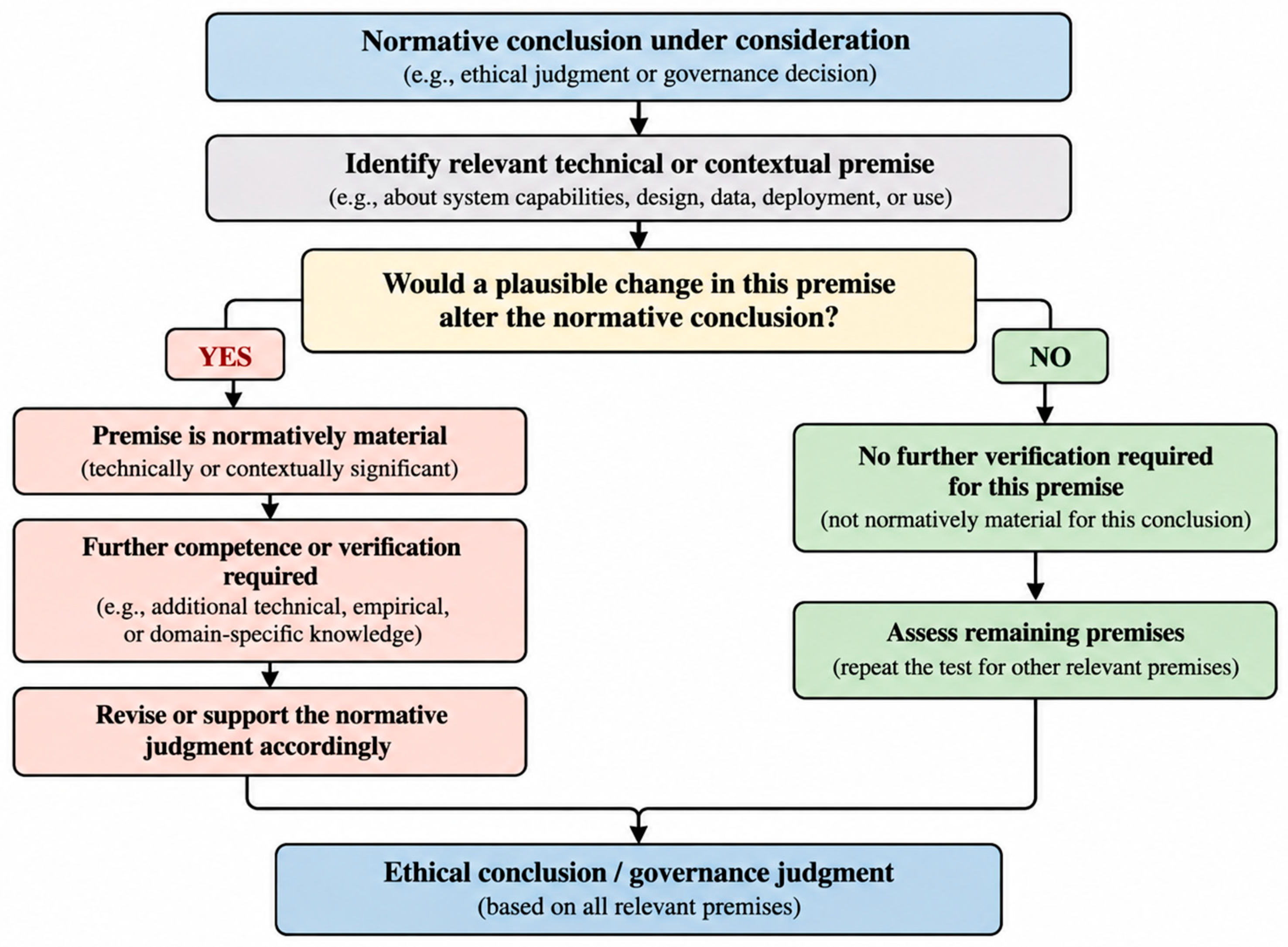
Figure 1 illustrates how this process operates in practice, linking the identification of normatively material premises to the required level of competence, verification, and subsequent revision.
Figure 1.
Domain-competence assessment in AI ethics.
The framework shows how the counterfactual materiality test determines whether a technical or contextual premise requires further competence or verification before a normative conclusion is justified. A negative result indicates only that further verification is unnecessary for the particular premise under examination; it does not establish that the overall normative conclusion is justified, as other relevant premises may still require assessment.
These recommendations also fit longstanding work on linking AI principles to implementation and governance [33]. The distinctive claim here is not simply that ethicists and engineers should collaborate. It is that collaboration should be organized around normatively material technical premises, with the depth of technical engagement determined by the question rather than by disciplinary prestige.
A practical illustration is provided by Mata v. Avianca, Inc. (2023), in which attorneys submitted fabricated judicial authorities generated by ChatGPT and were subsequently sanctioned for their professional conduct [34]. Applying the proposed framework, the initial normative question concerns whether AI-generated citations can be presented as verified legal authorities. The relevant premise is whether the cited decisions have been independently authenticated. The counterfactual materiality test asks whether the ethical judgment would change if the citations had been verified against authoritative legal sources before submission. In that case, the specific failure of presenting nonexistent authorities would not arise. This judgment requires legal competence and an understanding of the system’s limitations, but not detailed knowledge of its computational architecture. However, evaluating whether system design, retrieval mechanisms, or available safeguards contributed to the failure requires additional technical competence. The case thus demonstrates that the depth of domain knowledge required depends on the normative question, while distinguishing technically material information from details that do not affect the judgment [10,11,12].
7. Interpretation Revisited: Why Competence Is Not a Trivial Add-on
We can now return to the concern that the thesis about charitable interpretation is trivial. If the thesis were only ‘people who misunderstand a subject may misinterpret arguments about it’, the objection would be decisive. The domain-competence condition makes a more specific claim. In technically mediated discourse, interpretive success requires an epistemic threshold fixed by the materiality of technical premises to the argument being reconstructed. The threshold can be identified without requiring universal expertise, and failure at that threshold produces a distinctive error: interpretive displacement, in which the argument is reconstructed well relative to the wrong technical object.
Williamson’s knowledge-maximization proposal sharpens rather than dissolves this problem. Knowledge maximization asks interpreters to prefer assignments that maximize what a subject knows, constrained by what the subject is objectively in a position to know [3,4,5]. But applying that constraint requires an account of the epistemic environment. In technical discourse, whether a subject is in a position to know that a system retrieves, predicts, reasons, verifies, remembers, or acts autonomously depends partly on how the system is built and situated. An interpreter who lacks access to those facts may maximize attributed knowledge relative to a false model of the environment. Domain competence therefore functions as a prior constraint on both charity and knowledge maximization: the interpreter must be able to characterize the relevant object well enough for truth, evidence, and knowledge to be assessed in relation to it.
This also explains why technical knowledge can be constitutive of justified ethical analysis without being universally constitutive of ethics. The claim is conditional. Where the ethical conclusion is invariant across the plausible technical alternatives, additional technical depth may be unnecessary. Where the conclusion changes with those alternatives, technical adequacy becomes part of what justifies the conclusion. The counterfactual materiality test marks the difference.
The argument extends beyond AI. Bioethics, environmental ethics, research ethics, and engineering ethics all depend on accurate domain knowledge when normative conclusions turn on specialized facts. AI is nevertheless a particularly revealing case because systems change rapidly, capabilities are often inferred from behavior, the same interface can conceal different technical pipelines, and responsibility is distributed across complex development and deployment chains. These conditions make the competence threshold both difficult to see and costly to ignore.
The resulting position is neither functional reductionism nor technocratic exclusivity. Functional understanding remains the accessible foundation for many ethical judgments. Technical expertise does not determine values. Nor should cultural provenance be reduced to developer nationality or treated as a deterministic label. But ethical interpretation cannot treat technically or contextually material premises as optional background. Charity without competence can make an argument stronger while making its object less accurate; knowledge maximization without competence can optimize knowledge against the wrong epistemic environment. Epistemic interdependence provides the practical corollary: identify the premise, trace its technical and cultural provenance where relevant, match the competence, verify what matters, and revise when the system or context changes.
Author Contributions
Conceptualization, A.Y. and Y.Z.; Methodology, A.Y. and Y.Z.; Validation, Y.Z.; Investigation, A.Y.; Writing—original draft, A.Y.; Writing—review and editing, A.Y.; Visualization, A.Y.; Supervision, Y.Z.; Project administration, A.Y. All authors have read and agreed to the published version of the manuscript.
Funding
This research received no external funding.
Data Availability Statement
The original contributions presented in the study are included in the article, further inquiries can be directed to the corresponding authors.
Acknowledgments
During the preparation and revision of this manuscript, the authors used OpenAI ChatGPT (GPT-5.6 Sol) and Anthropic Claude (Claude Sonnet 5) to assist with translating material originally drafted in another language into English and to improve the readability, clarity, and language of the manuscript. The authors reviewed and edited all outputs and take full responsibility for the content of the publication.
Conflicts of Interest
The authors declare no conflicts of interest.
References
- Davidson, D. Radical Interpretation. Dialectica 1973, 27, 313–328. [Google Scholar] [CrossRef] [Scilit]
- Davidson, D. Inquiries into Truth and Interpretation, 2nd ed.; Oxford University Press: Oxford, UK, 2001. [Google Scholar] [CrossRef] [Scilit]
- Williamson, T. Knowledge Maximization. In The Philosophy of Philosophy; Blackwell: Malden, MA, USA, 2007; pp. 249–279. [Google Scholar] [CrossRef] [Scilit]
- McGlynn, A. Interpretation and Knowledge Maximization. Philos. Stud. 2012, 160, 391–405. [Google Scholar] [CrossRef] [Scilit]
- Child, W. Charity Versus Knowledge Maximization. Topoi 2025, 44, 1227–1239. [Google Scholar] [CrossRef] [Scilit]
- Lewinski, M. The Paradox of Charity. Informal Log. 2012, 32, 403–439. [Google Scholar] [CrossRef] [Scilit]
- Jobin, A.; Ienca, M.; Vayena, E. The Global Landscape of AI Ethics Guidelines. Nat. Mach. Intell. 2019, 1, 389–399. [Google Scholar] [CrossRef] [Scilit]
- de Jong, E. Functional Understanding of Quantum Technologies Is Essential to the Ethical Debate About Their Impact. NanoEthics 2026, 20, 12. [Google Scholar] [CrossRef] [Scilit]
- Long, D.; Magerko, B. What Is AI Literacy? Competencies and Design Considerations. In Proceedings of the 2020 CHI Conference on Human Factors in Computing Systems; ACM: New York, NY, USA, 2020; pp. 1–16. [Google Scholar] [CrossRef] [Scilit]
- Bender, E.M.; Friedman, B. Data Statements for Natural Language Processing: Toward Mitigating System Bias and Enabling Better Science. Trans. Assoc. Comput. Linguist. 2018, 6, 587–604. [Google Scholar] [CrossRef] [Scilit]
- Gebru, T.; Morgenstern, J.; Vecchione, B.; Vaughan, J.W.; Wallach, H.; Daume, H., III; Crawford, K. Datasheets for Datasets. Commun. ACM 2021, 64, 86–92. [Google Scholar] [CrossRef] [Scilit]
- Mitchell, M.; Wu, S.; Zaldivar, A.; Barnes, P.; Vasserman, L.; Hutchinson, B.; Spitzer, E.; Raji, I.D.; Gebru, T. Model Cards for Model Reporting. In Proceedings of the Conference on Fairness, Accountability, and Transparency; ACM: New York, NY, USA, 2019; pp. 220–229. [Google Scholar] [CrossRef] [Scilit]
- Younas, A.; Zeng, Y. Towards Culture Driven Artificial Intelligence to Bridge the Cultural Cognition Gap. Discov. Artif. Intell. 2026, 6, 252. [Google Scholar] [CrossRef] [Scilit]
- Younas, A.; Zeng, Y. Beyond Data Saturation in Large Language Models: Cultural Corpora and the Expansion of Epistemic World-Models. J. Cult. Cogn. Sci. 2026, 10, 211–221. [Google Scholar] [CrossRef] [Scilit]
- AlKhamissi, B.; ElNokrashy, M.; Alkhamissi, M.; Diab, M. Investigating Cultural Alignment of Large Language Models. In Proceedings of the 62nd Annual Meeting of the Association for Computational Linguistics (Volume 1: Long Papers); Association for Computational Linguistics: Bangkok, Thailand, 2024; pp. 12404–12422. [Google Scholar] [CrossRef] [Scilit]
- Masoud, R.I.; Liu, Z.; Ferianc, M.; Treleaven, P.; Rodrigues, M. Cultural Alignment in Large Language Models: An Explanatory Analysis Based on Hofstede’s Cultural Dimensions. In Proceedings of the 31st International Conference on Computational Linguistics; Association for Computational Linguistics: Abu Dhabi, UAE, 2025; pp. 8474–8503. Available online: https://aclanthology.org/2025.coling-main.567/ (accessed on 25 July 2026).
- Wu, M.-C.; Chin, S.-C.; Wood, T.; Goyal, A.; Sadagopan, N. Incorporating Diverse Perspectives in Cultural Alignment: Survey of Evaluation Benchmarks Through a Three-Dimensional Framework. In Proceedings of the 2025 Conference on Empirical Methods in Natural Language Processing; Association for Computational Linguistics: Suzhou, China, 2025; pp. 17026–17061. [Google Scholar] [CrossRef] [Scilit]
- Kashyap, G.S.; Dras, M.; Naseem, U. AlignCultura: Towards Culturally Aligned Large Language Models? In Proceedings of the 64th Annual Meeting of the Association for Computational Linguistics (Volume 1: Long Papers); Association for Computational Linguistics: San Diego, CA, USA, 2026; pp. 37986–37996. [Google Scholar] [CrossRef] [Scilit]
- Zou, C.; Jiao, D.; Hu, L. Deciphering Cultural Representations in Large Language Models via Sparse Autoencoders. In Findings of the Association for Computational Linguistics: ACL 2026; Association for Computational Linguistics: San Diego, CA, USA, 2026; pp. 5656–5677. [Google Scholar] [CrossRef] [Scilit]
- Bommasani, R.; Hudson, D.A.; Adeli, E.; Altman, R.; Arora, S.; von Arx, S.; Bernstein, M.S.; Bohg, J.; Bosselut, A.; Brunskill, E.; et al. On the Opportunities and Risks of Foundation Models. arXiv 2021, arXiv:2108.07258. [Google Scholar] [CrossRef] [Scilit]
- Bender, E.M.; Gebru, T.; McMillan-Major, A.; Shmitchell, S. On the Dangers of Stochastic Parrots: Can Language Models Be Too Big? In Proceedings of the 2021 ACM Conference on Fairness, Accountability, and Transparency; ACM: New York, NY, USA, 2021; pp. 610–623. [Google Scholar] [CrossRef] [Scilit]
- Rathkopf, C. Hallucination, Reliability, and the Role of Generative AI in Science. arXiv 2025, arXiv:2504.08526. [Google Scholar] [CrossRef] [Scilit]
- Matthias, A. The Responsibility Gap: Ascribing Responsibility for the Actions of Learning Automata. Ethics Inf. Technol. 2004, 6, 175–183. [Google Scholar] [CrossRef] [Scilit]
- Santoni de Sio, F.; van den Hoven, J. Meaningful Human Control over Autonomous Systems: A Philosophical Account. Front. Robot. AI 2018, 5, 15. [Google Scholar] [CrossRef] [Scilit]
- Baeyaert, J. Beyond Personhood: The Evolution of Legal Personhood and Its Implications for AI Recognition. Technol. Regul. 2025, 2025, 355–386. [Google Scholar] [CrossRef] [Scilit]
- Moor, J.H. The Nature, Importance, and Difficulty of Machine Ethics. IEEE Intell. Syst. 2006, 21, 18–21. [Google Scholar] [CrossRef] [Scilit]
- Floridi, L.; Cowls, J. A Unified Framework of Five Principles for AI in Society. Harv. Data Sci. Rev. 2019, 1. [Google Scholar] [CrossRef] [Scilit]
- Whittlestone, J.; Nyrup, R.; Alexandrova, A.; Cave, S. The Role and Limits of Principles in AI Ethics. In Proceedings of the 2019 AAAI/ACM Conference on AI, Ethics, and Society; ACM: New York, NY, USA, 2019; pp. 195–200. [Google Scholar] [CrossRef] [Scilit]
- Morley, J.; Floridi, L.; Kinsey, L.; Elhalal, A. From What to How: An Initial Review of Publicly Available AI Ethics Tools, Methods and Research to Translate Principles into Practices. Sci. Eng. Ethics 2020, 26, 2141–2168. [Google Scholar] [CrossRef] [Scilit]
- Raji, I.D.; Smart, A.; White, R.N.; Mitchell, M.; Gebru, T.; Hutchinson, B.; Smith-Loud, J.; Theron, D.; Barnes, P. Closing the AI Accountability Gap: Defining an End-to-End Framework for Internal Algorithmic Auditing. In Proceedings of the 2020 Conference on Fairness, Accountability, and Transparency; ACM: New York, NY, USA, 2020; pp. 33–44. [Google Scholar] [CrossRef] [Scilit]
- Samaan, D.; Cabiddu, F.; Di Lauro, S.; Tursunbayeva, A. Governing AI in the World of Work: An International Review of 245 Ethics Guidelines. OSF Prepr. 2025. [Google Scholar] [CrossRef] [Scilit]
- Stilgoe, J.; Owen, R.; Macnaghten, P. Developing a Framework for Responsible Innovation. Res. Policy 2013, 42, 1568–1580. [Google Scholar] [CrossRef] [Scilit]
- Zeng, Y.; Lu, E.; Huangfu, C. Linking Artificial Intelligence Principles. In Proceedings of the AAAI 2019 Workshop on Artificial Intelligence Safety (SafeAI 2019), Honolulu, HI, USA, 27 January 2019. [Google Scholar]
- Mata v. Avianca, Inc., 678 F. Supp. 3d 443 (S.D.N.Y. 2023). Opinion and Order on Sanctions, United States District Court for the Southern District of New York, 22 June 2023. Available online: https://law.justia.com/cases/federal/district-courts/new-york/nysdce/1:2022cv01461/575368/54/ (accessed on 13 October 2026).

Disclaimer/Publisher’s Note: The statements, opinions and data contained in all publications are solely those of the individual author(s) and contributor(s) and not of MDPI and/or the editor(s). MDPI and/or the editor(s) disclaim responsibility for any injury to people or property resulting from any ideas, methods, instructions or products referred to in the content. |
© 2026 by the authors. Licensee MDPI, Basel, Switzerland. This article is an open access article distributed under the terms and conditions of the Creative Commons Attribution (CC BY) license.