


Abstract
This paper compares two approaches to intensionality within possible-worlds semantics between which Montague seems to have wavered: Frege’s distinction between extensional and intensional environments and Russell’s one-layered proposition-based account. It is shown that the Fregean framework can be embedded within the more restrictive Russelllian ontology by a variation of David Kaplan’s Russelling construction that is fully definable in Montague’s intensional type logic and lends itself to compositional semantic analysis.
1. Background and Motivation
There are two approaches to intensionality in compositional semantics. According to one tradition, going back to Frege [1], any linguistic expression may contribute its sense to the extension (truth value or referent) of a sentence or description in which it occurs. According to the other tradition, originating with Russell [2], the dichotomy of sense and extension can be overcome by having sentences denote propositions to which their parts contribute their own denotations. In his possible worlds version of semantic analysis, Montague wavered between the two approaches, apparently for lack of conclusive evidence in either direction:
It is wrong to maintain—as Frege possibly did in [1]—that an analysis of ordinary English (or German) requires a notion of sense as well as one of denotation. The fact that we have been able to do with denotation alone depends on two novelties of our treatment—our theory of descriptions, according to which descriptive phrases do not denote individuals […]; and our decision to regard sentences as denoting propositions rather than truth values […].Montague [3] (p. 218f.)
I should like, however, to withdraw my emphasis […] on the possibility of doing without a distinction between sense and denotation. While such a distinction can be avoided in special cases, it remains necessary for the general theory, and probably provides the clearest approach even to the special cases in question.Montague [4] (p. 373, fn.)
- In terms of Montague’s [4] standard type-logical notation, the difference between the two types of analysis can be illustrated by a simple extensional example:
| (1) | a. | 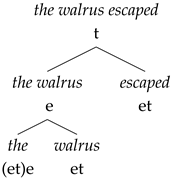 | b. | 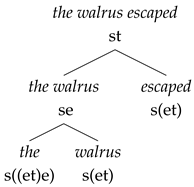 |
| (2) | 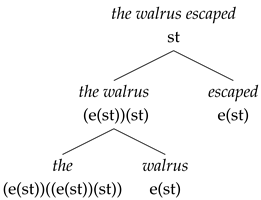 | |||
- The Frege style analysis (1) has two compositional layers a. and b. whose types are systematically related: to each extension type a there corresponds an intension or ‘sense’ type .1 The Russell style analysis can do with one compositional layer of denotations that gets by with (st) as the only sense type.2 Judging from such examples, it may seem that the difference between the two is mainly a matter of locating complexity either in the number of semantic values or in their types. However, when it comes to intensional constructions, the Russellian framework may turn out to be overly restrictive in that it seems to confine intensionality to clausal embedding. Non-specific readings of indefinite objects of verbs like ‘seek’ and ‘owe’ are a case point: whereas Fregean analysis can in principle deal with them as relating subjects to the senses of existential quantifiers (of type (s((et)t))), the Russellian approach seems to be committed to a paraphrase or syntactic reduction along Quinean [6] lines, with at least dubious prospects—as argued by Montague [7] (p. 177). On the other hand, even non-propositional sense types (where ) may be isomorphic to complex types that do not involve non-propositional intensions; thus, the quantifier senses featuring in a surface analyses of intensional transitives are merely converses of objects of type (((et)t)(st)). And indeed while this isolated observation is a far cry from a full-fledged Russellian surface treatment of the construction at hand, such an analysis is not so hard to find and has been proposed in the literature—alongside further alternatives to Frege-style analyses in terms of one-layered, Russell-style denotations; see, e.g., Cresswell [8]. It is therefore natural to ask whether it is always possible to reformulate a given Fregean analysis in Russellian terms. More specifically, one may ask whether compositional semantic analysis ever strictly requires non-propositional senses.
The matter seems to have been settled by Kaplan [9], who sketched a method of coding Fregean senses in terms of a one-layered Russellian hierarchy of denotations and reported that it can be expressed in Church’s [10] intensional type logic; moreover, Parsons [11] extended Kaplan’s embedding and related it to a similar one by Gallin [12] (p. 105). Yet, while these results show that any Fregean type-logical statement about senses is equivalent to a Russellian type-logical proposition about their codes, they do not imply that any Fregean type-logical term denoting a sense is equivalent to a Russellian type-logical term denoting its code: Fregean analyses can be described in Russellian terms, but can they also be performed in Russellian type logic? Montague’s original conundrum, which concerned compositional interpretation and thus the denotations of type-logical terms, is not settled by these results (nor did any of the authors mentioned claim it would be). In fact, Kaplan’s result is confined to the propositional level and based on a coding that lacks permutation invariance; as a result, it is not clear how it could be extended beyond the realm of propositions in purely logical terms. In what follows, a variant of Kaplan’s coding will be developed that is fully expressible in Montague’s [4] type logic and can be used to turn Frege style analyses à la Montague) to Russellian ones, thereby preserving compositionality.
2. Type Logic
2.1. Types
- We start by defining the most important sets of types featuring in the investigations to follow:
- 2-sorted: ;3
- Boolean: t ; and if ;
- Extensional: ;
- Fregean: and ;Russellian: .
- We observe that:4
- (a)
- The following natural concepts pertaining to types will be of importance:
| (3) | a. | The length of a two-sorted type a is defined by the following recursion: |
| ; and . | ||
| b. | For any and any finite sequence of two-sorted types, the type is defined by the following recursion: | |
| ; and |
- It should be noted that the pairs defined in (3-b) merely stand for elements of 2T. In particular, sequences of types are not themselves (‘product’) types. (3-b) gives rise to the following observation:
- (b)
- If , where .
- As usual, types stand for functional domains defined in a set-theoretic possible worlds framework. Starting with and two fixed non-empty sets and we put: whenever . To avoid notational clutter, we will assume that 5 When referring to members of the type domains, the following notational conventions apply, for any and any b :
- .
- The bottom element is defined as follows:0, and x
- If and , “X” [] is the characteristic function of X:“X” ].
- If b = / []“{x}”.
- If and , then:.
- If , then:.6
- ’ is short for:‘that function with domain such that , for any ’.
2.2. Intensional Type Logic
Since the goal is to mimic Frege-style semantics in Russellian terms, we need to define type-theoretic languages that are rich enough to express compositional values. To this end we will employ Montague’s [4] intensional type logic, keeping one (arbitrary) signature fixed throughout what follows. More specifically, we assume that we are given:
- -
- a fixed family of constants of Fregean intension types ;
- -
- a fixed family of variables of Fregean types , where each member is infinite;
- -
- a fixed world/index variable ,
- …with the obvious disjointness requirements. We now put , , and , where is the smallest family such that, for any :7
| if | |
| if and ; | |
| if and | |
| if and ; | |
| if , | |
| if |
As indicated in the margins, the formation rules may be understood as relating to certain string operations producing larger terms by combining their immediate parts and introducing syncategorematic material; the names of these operations are given for future reference. The unfamiliar sub- and superscripts on the equals sign, the -operator, and the application parentheses will mostly be suppressed in what follows. Their intended effect is to split up each syntactic operation into a multitude of constructions—, etc. This redundancy will come in handy later when discussing compositionality (Section 3.4).8
- The second clause of the above definition, which reflects the notorious asymmetry between variables in constants in Montague’s [4] intensional type logic, may come as a surprise in that the constants are not themselves -terms. However, this feature is merely cosmetic: by the interpretation given below, any constant c turns out to be equivalent to the term .
Having fixed the universes and -models can be identified with functions such that whenever . Similarly, -assignments are functions such that whenever . The definition of the denotations of -terms according to F and g then proceeds by the following straightforward recursion:
whenever where ;
whenever ;
, where
iff , whenever ;
, whenever and ;
, whenever and ;9
, whenever , where .
- Next come some notational conventions concerning type-logical terms. If a term does not contain any constants or free variables (which are defined as usual), we will at times omit the superscript on its denotation and write ‘’, or simply ‘’. If F is an -model and , ‘’ means that , for all g; and if and ‘’ is short for ‘, for any -models F’.10 A superscript on the first occurrence of a variable in a term indicates its type. Finally, the following (mostly common) abbreviations will be used whenever , and , where and :
;
;
;
;
;
, where ;
;
;
;
;
;
;
;
;
;
;
;
;
where , s,
and ;11
where , and .
- The above clauses guarantee that the abbreviations are interpreted as expected: each falsum denotes the bottom element ; the negation reverses the truth value of ; conjunctions are true iff both their conjuncts are; a universal quantification expresses that all members of -satisfy ; etc. Similarly, ∼ and ∩ respectively denote Boolean complementation and intersection on propositions (construed as characteristic functions of subsets of ). Moreover, the box operator expresses unrestricted universal quantification over members of : is equivalent to , which is however not among the -terms to be introduced in the next section.
Like the -formation rules, the above abbreviatory conventions may be seen as specifications of certain string operations. But unlike the former, the latter do not introduce new syncategorematic material; rather, they operate on arguments by combining the original syntactic constructions. Thus, e.g., the ’intensional equation’ operates on the terms and to produce a term that is obtained by suitably combining and , as in (); the type-t falsum is a combination of and involving a (fixed) variable v, as in (); negation is a combination of and operating on a formula , as in (¬); etc.:
- ()
- ()
- (¬)
- [= ]
We leave it to the reader to verify that all the abbreviations introduced above can be rewritten by algebraic terms like these, where Greek letters represent their arguments; and if there are no arguments, as in the case of (), they stand for for particular -terms (or, equivalently, 0-place operations). Extending calculus terminology, algebraic terms like the above three are called polynomials over a given algebra (=the syntax of , in this case); in Universal Algebra the operations they form the so-called clone of derived, or polynomial, operations. We will return to them in Section 3.4.12
2.3. Russellian Type Logic
- We now define a sub-language of all terms of which are of Russellian types. For the following we assume that we are given a fixed family of constants such that, for any whenever , and is a bijection between and where will be defined in Section 3.1. We also assume that and are disjoint, which will turn out to be convenient though not crucial. Then family such that, for any :
if and
if and
if and then and
if , and then .
- The expressive range of is illustrated by the following elementary observations:
- (c)
- , whenever and .13
- (d)
- whenever , and .
- (e)
- whenever and .
- Observation (c) implies that, unlike or Montague’s (for which see Gallin [12]) (p. 19), allows for unrestricted -conversion: if well-formed, is always equivalent to the result of replacing all free occurrences of x in by , provided that no variable free in gets bound in the process.
3. Russelling
In this section a translation from to will be introduced that turns type-logical terms denoting Fregean senses into Russellian terms denoting corresponding proxies (or ‘codes’) in . The construction involves three main steps. In Section 3.1, a correspondence between types will be established by shifting each to an in whose domain the codes of objects of type a can be found. The codes themselves will be defined in Section 3.2 as the denotations of certain closed -terms of types . Finally, in Section 3.3, a translation from -terms to -terms will be presented that assigns to each sense-denoting term a Russellian term that denotes ’s Russellian proxy.
3.1. Shifting
The function * on Fregean types a is defined by the following recursion:
;
;
;
;
;
- The rationale of the shift is to only make minimal changes and, in particular, preserve Russellian types. The distinction between three kinds of functional types (where ) allows for a construction of Russellian codes of Fregean functions by assigning codes of -values to codes of arguments in whenever possible. The possibility is given if the Russellian proxies of b-objects exhausts the domain . However, if the latter contains any additional objects, ’s proxy needs to assign them a value in some -definable way, for which the bottom element is a natural option. But then the very existence of bottom elements requires to be Boolean—thence the second case. In the remaining case, where there are non-coding objects in but no bottom elements in , the latter are introduced by raising c to and having ’s code map codes of b-objects to the singletons of the codes of their -values. The details of the construction will be given in the next sub-section. The following list of observations collects some key properties of the shift (where ):
- (f)
- ;
- (g)
- ;
- (h)
- iff ;
- (i)
- , where is a sequence of members of RT;
- (j)
- if .
3.2. Coding
As announced above, the Russellian codes of objects in the Fregean hierarchy will be defined as the functional values of the denotations of certain closed terms . The reason for this detour will become apparent in Section 4. The cursory reader may instead move on to observation k) below, where a direct characterization of the coding functions is given, which is easily verified using the interpretation of -terms in Section 2.2.
- Definition
For any , the term is defined by the following recursion:
- Some properties of can be gleaned from the following observations:
- (k)
- If andif f , where s, then:if ;if then:if then:
- (l)
- If
- (m)
- := : is surjective (onto) but not injective (one-one).
- (k) makes heavy use of the abbreviatory conventions from Section 2.1 above. The characterization of spells out the construction idea sketched in the previous sub-section. The technique of ‘filling up with bottom values’ (as indicated by the ‘upspoon’ operator ⫯), is also employed in the clause for ; its applicability is guaranteed by observation (i) above, which ensures that . No such precaution is needed for since is Boolean.
While the above three observations are more or less immediate, the proof of the following, crucial lemma (to be found in Section A.3 of the Appendix referenced in note 4) is a bit more involved:
-Lemma
For any , is injective (one-one).
3.3. Translating
When it comes to assigning -counterparts to -terms, a handful of auxiliary terms will come in handy. The first of them is a predicate that applies to all and only the codes of objects of a given type. For each the (closed) term is defined by the following recursion:
| If then: |
| if , where then: |
| if , where and , then: := |
| if , where and then: := |
| ; |
| if , then: |
| If then: := |
| ; |
| if , then: |
| . |
- That the predicates defined above do their job is secured by the following lemma:
3.3.1. -Lemma
, for any .
- Next, we define relations holding between codes of functions, their arguments, and their values, thereby separating the cases () where the arguments are of Fregean types from those () where they are in and need to be collected in propositions so as to stay within Russellian bounds. For each the (closed) terms and are defined thusly:
;
;
;
.
- The intended effect of the - and -relations is guaranteed by the following two lemmas:
3.3.2. -Lemma
If and then:
iff
there are and such that: F = and .
3.3.3. -Lemma
If and then:
iff
there is a such that: C = and .
- To prepare the ground for the translation from to , we extend to include a bijection between and such that, for any , whenever .14 It could be dispensed with if we equipped with its own family of variables; but then would no longer be a sub-family of . Given an -model F and an -assignment g, the corresponding -model and -assignment are defined as and , i.e.,
, if and ;
, if and
- The following observation on squiggled variables and starred assignments will turn out to be crucial for the treatment of -operators in the translation of to :
- (n)
- ,
for any -assignment g, and (where .
- We are finally in a position to define the translation of -terms denoting the Fregean senses15 of arbitrary terms to -terms denoting their proxies in the hierarchy of Russellian denotations:
- If , then is defined by the following recursion:
- -
- if for some , then ;
- -
- if , where then ;16
- -
- where , then;
- -
- where , then
- -
- where , then;
- -
- where , then;
- -
- where and , then.
The terms are defined so as to avoid any possible variable clashes. Somewhat more readable versions are given in (o), which is as readily verified as the two subsequent observations on the translation defined above:
- (o)
- The following equivalences hold for any :
- –
- If , then, provided that ;
- –
- if thenprovided that ;
- –
- if where , thenprovided that
- –
- if where , then,provided that
- –
- if , thenprovided that
- (p)
- If and , then
- (q)
- If , , s and , then ;and if , and , then .
Now we can formulate the central result of the current contribution:
3.3.4. Translation Theorem
, for any -term -model F and assignment g.
- In view of the definition if , we immediately get:
Corollary 1.
, for any closed and -model F.
- Since , we also obtain an -internal version of the theorem:
Corollary 2.
, for any closed -term α and -model F.
- Finally, we can combine the two previous corollaries into:
Corollary 3.
, for any closed and -model F.
3.4. Preserving Compositionality17
- The above results are of immediate relevance to the question, brought up in Section 1, about the possibility of reformulating Fregean semantic analyses in Russellian terms. In fact, the Translation Theorem (or Corollary 2) can be used to show that such reformulations can always be found so as to preserve compositionality. A rigorous demonstration of these connections may be given within the framework of Montague’s [4] (pp. 383f.) theory of translation, which is part of his general algebraic framework of compositional interpretation, some familiarity with which is assumed throughout the current section. According to this approach, the syntax of a formal or a (disambiguated) natural language is construed as an algebra consisting of a lexicon and a family of syntactic operations (or ‘constructions’), both regimented as to the categories of the expressions involved. As a case in point, the lexicon of consists of all variables except i, plus all strings of the form ‘c’, where c is a constant; the operations are the families , , , , and ; and the categories largely coincide with the Fregean types.18 The -formation rules of Section 2.3 may be defined in terms of the same operations plus the polynomial operations underlying , ∼, ∩, and , and starting with a restricted class of variables and constants.
Given the algebraic setting, compositional interpretation proceeds via a homomorphic mapping from the syntactic algebra to some suitable algebra of meanings. Due to the unambiguous nature of the syntax,19 the homomorphism may be specified by a function from the lexical expressions to their meanings, plus a family of semantic operations matching the syntactic constructions. In the case of , the meanings are functions from variable assignments to intensions. Hence the lexical assignment serves the constants and variables, and the syntactic constructions are matched with operations over the meanings of arbitrary terms. Thus, the conditions in (4) will hold for any and the operations and corresponding to Id and Cap, where g is an -assignment and :
| (4) | a. | μ(x) = [ : g(x)] |
| b. | |Id|(b,b′)(g)(w) b(g)(w) = b′(g)(w′) | |
| c. | |Cap|(b)(g)(w) = [: b(g)(w′)] |
- Once the lexical meanings and the semantic operations are spelt out along these lines, the algebraic setup guarantees that there is a unique homomorphism that extends and interprets the whole language in a compositional fashion, as in Section 2.2.
Equations like (4) constitute only one of two ways of specifying meanings within the algebraic approach, viz., what is known as direct interpretation, which in the tradition of Montague Grammar, has chiefly been applied to formal languages. For natural languages, indirect interpretation by compositional translation into a (directly) interpreted (logic) language has been much more popular. One of its advantages is that it offers a canonical notation for meanings and semantic operations—like , which used to have the status of a lingua franca throughout a large part of the semantic community.
To make sure that the translation process preserves compositionality, the indirect approach requires a slight extension of the algebraic framework. To this end, the role of the defining equations (4) is played by a system of lexical and compositional translations from a source language to a target language , based on a correspondence of the categories of the two languages:
| (5) | a. | The -categories are mapped to corresponding -categories, where -sentences are matched with -sentences. |
| b. | each lexical item of is assigned a (not necessarily lexical) -translation of the corresponding category; | |
| c. | each -construction gets matched with a polynomial operation on (of the same -arity) whose outputs match those of their -counterparts if the inputs do; |
- Taken together, the category correspondence, the translation of the lexicon, and the matching polynomials form a translation base from to .20 As it turns out, the above translation can be portrayed as the result of a translation base from to . To begin with, instead of (4) we have equations like those in (6), where translates the lexicon and -operations correspond to ’s constructions F:
| (6) | a. | |
| b. | ||
| c. |
- The category correspondence demanded in (5-a) is, of course, the mapping from to , assuming (with Frege and Montague) that the sentences of are its truth-valued terms of type t, whereas (in line with Russellian doctrine), the -sentences denote propositions and are thus terms of type (st). (6-a) then satisfies (5-b) for the case of -variables, each of which translates into a fixed term of the corresponding RT-type; the same is true of the map for -constants c.21 Clauses (6-b&c) illustrate how meets Condition (5-c). It is here where the redundant type indices in our formulation of come to bear: each type b gets its own identity construction Idb, which in turn uniquely determines the formula , the operations , , and featuring on the right hand-side of (6-b), which would not be a unique polynomial without this proliferation of identities. The same reasoning applies to (6-c) and, indeed all other recursion clauses in the definition of inspection of which we leave to the patient reader.
The main point of Montague’s [4] (p. 384) theory of indirect interpretation is that translation bases are eliminable in the presence of a direct compositional interpretation of the target language: the effect of interpreting the translations of the source language can always be attained by a direct compositional interpretation. being a sub-language of , such a direct interpretation is easily constructed, again using general features of the algebraic framework; for this step we again refer to the literature.22 We can thus apply Montague’s elimination theorem to obtain an direct interpretation of that assigns to each term the denotation of its -translation. And we may then employ this alternative -interpretation to turn a given Fregean interpretation into a Russellian one, again applying Montague’s elimination method:
- Remark
- Any compositional indirect interpretation from a (natural) language to induces a compositional direct (re-)interpretation that assigns to each -expression the Russellian proxy of its original intension.
4. Comparison with Kaplan’s Theorem
- To pave the way for a comparison between the above and Kaplan’s embedding of Fregean intensions into the realm of Russellian denotations, a few terminological arrangements are in order. To begin with, let us call any function a type shift. Next, a 1-1 function is said to match a type shift if, for any whenever ; and a -embedding is a family of injective functions . Finally, given a type shift , a matching function f, a -embedding , and an -model F, the -model corresponding to F (via and f) is defined as . Hence, if F is an -model, then corresponds to F via *, , and . In the present context and given this terminology, the result indicated by Kaplan [9] and further detailed by Parsons [11] boils down to the following corollary of the Translation Theorem (where the assignments are suppressed, since the terms to be interpreted are all closed):
4.1. Kaplan’s Theorem
- There is a type shift o and a o-embedding such that, for any -model F and any term with there is a such that:
,
- where corresponds to F via o, , and some 1-1 function matching .
As already mentioned, Kaplan’s result differs from the Translation Theorem above in its scope: it only concerns statements about Fregean senses, not terms denoting them; but then, to be sure:23
Kaplan’s objective was to translate a language equivalent to [Church’s intensional type logic] into a sublanguage with types in [RT], in such a way as to preserve truth for fixed domain models.Parsons [11] (p. 319)
- Clearly, the above version of Kaplan’s Theorem is easily derived from the Translation Theorem, by putting and . However, Kaplan managed to arrive at his result on the basis of a somewhat simpler type shift than the one defined in Section 3.1 above:
4.2. Kaplan’s Shift24
- The function o on Fregean types a is defined by the following recursion:
;
;
;
- Kaplan’s shift appears more compact in that the o-types sometimes come out shorter than their *-counterparts.25 The type of mappings from individual concepts to individuals is a case in point:
- At the same time, the example reveals a weakness of Kaplan’s coding, viz., that it is not definable in purely logical terms. For the codes of ‘referencing’ functions of type ((se)e) need to map all functions of type ((es)t) to corresponding individuals . Now, if happens to be the proxy of an individual concept , the natural choice is to identify with the code of . But what if does not code any individual concept? In this case an arbitrary choice must be made—which cannot be expressed in type logic: as will be explained below, there is no closed type-logical term (like ) interpretable in that would denote Kaplan’s shift in this particular case. At best, one may add an -operator (of type (se)oe) and define the proxies of arbitrary as: that function which maps all codes of individual concepts to their -values and everything else (of type e(st)) to some fixed individual. However, the addition of such an operator would go beyond (and, a fortiori, ) or at least beyond the constants interpreted by . For the purposes of Kaplans’s Theorem this strategy suffices because the -operator can be denoted by an existentially quantified variable. No such move is available for non-Boolean types though.26 However, this lack of logicality only concerns the correspondence between the full hierarchies of Fregean and Russellian denotations, not the translations of the type-logical terms themselves, as long as the latter are restricted to intensional types. It is therefore still conceivable that a similar construction like the above compositional translation based on Kaplan’s original shift can be found.
To substantiate the claims about logicality, we take a global (or ‘model-theoretic’) perspective and let and be arbitrary non-empty sets. We may then define the following (standard) concepts:27
Definition
- -
- A permutation of is a family of bijections such that for any , : .
- -
- If and , is b-invariant (in ) iff , for any permutation of .
- -
- If is logical iff for any family there is an such that is b-invariant in .
- -
- If is embeddable intoc iff for any family there is an injective such that is -invariant in .
- The idea is that permutations only mess around with the identity of the individuals and worlds but preserve the functional or ‘logical’ structure imposed by the type hierarchy. Some properties of permutations are rather obvious. Thus, it is not hard to see that if and are bijective, there is precisely one permutation of such that and ; hence any permutation can be identified by how it permutes individuals and worlds. Furthermore, if is a permutation of , then so is , and for all and all and we have: . As to invariance, two kinds of logical types are easily made out: if is a permutation of and , then is b-invariant in , whence all Boolean types are logical; and so are all types a of the form , given that is a-invariant whenever .
Even if we stay agnostic as to the precise relation between invariance and logicality (in a pre-theoretic sense), we have to acknowledge the fact that there is a connection with type-logical definability:28
- (s)
- If and is closed and does not contain any constants or free variables, then is b-invariant in any family , and hence b is logical.
- By s), the type-logical definability of a -embedding (where is a type shift), guarantees the invariance of each of its members (where ). In particular, then:
- (t)
- For any is -invariant, and hence is logical and a is embeddable into .
- Conversely, if any member of a -embedding fails to be -invariant, cannot be definable in the way is. In this respect, * differs from o, as an inspection of the type of referencing functions reveals:
- (u)
- is not logical.
- As a consequence, ((se)e) is not embeddable into ((se)e)o. And this is not an isolated case. In fact, no type of the form is embeddable into , where ((se)e) and .29 On the other hand, o is well-behaved on the corresponding intensions, which is all the above findings are concerned with, after all. In fact, since ((se)e)(s((se)e))o is Boolean, logicality is not the problem; neither is the existence of 1-1 functions. But then this in itself does not guarantee embeddability—witness contrived (extensional) types like (te)(ee).30 Still we do have:
4.3. o-Lemma
For any , sa is embeddable into .
- The following revision of Kaplan’s shift, which introduces Boolean types whenever needed, is invariant while retaining the basic idea of the original construction:31
4.4. Kaplan’s Shift, Improved
The function + on Fregean types a is defined by the following recursion:
;
;
;
if .
- The improved shift + shares some crucial properties with *:
- (v)
- If , then .
- (w)
- If , then: (I) iff , and (II) iff .
- (x)
- iff .
- (y)
- Any is embeddable into ; hence is always logical.
- In many cases the two shifts agree on their values. Thus we have: (se)* = (se)+ = e(st); and (s((se)t))* = (s((se)t))+ = (e(st))(st) = ((se)e)* = ((se)e)+. Yet at times, they diverge. The type of properties of individuals is a case in point; and so is the type of senses of referencing functions:
(s(et))* = e(st) ≠ ((et)(st)) = (s(et))+
(s((se)e))* = ((e(st))(e(st))) ≠ (((e(st))(et))(st)) = (s((se)e))+
- The example suggest that the +-codes are sometimes more complex than their *-counterparts: not only is |(s(et))* | = = |(s(et))+ |; the former also hosts the converses of the objects of the original type and is thus of the same logical order, whereas the latter hosts (Curried) relations between worlds and (characteristic functions of) sets of individuals and is thus of higher logical order. And similarly for the other example, to which we will turn in due course. More precisely, we may define the order of a type by the following straightforward recursion:32
if ;
and if ,
- Thus we have: ((s(et))*((s(et))+; and (s((se)e))* ((s((se)e))+). As it turns out, these observations are special cases of a general fact:
4.5. -Lemma
If .
- It is tempting to speculate that the type shift * not only outperforms + but is as good as it gets:
4.6. Conjecture
If is a type shift for which there is is a -embedding such that is injective and logical for any , then , for any .
To the extent that the logical complexity of Fregean senses and Russellian denotations are reflected by the order of their type, the *-shift thus turns out to be more parsimonious than the improved version of Kaplan’s shift. However, with a more fine-grained notion of type complexity, matters may become murky. In particular, if cognitive complexity is measured in terms of -arity and order (as proposed by Weicker [21] (pp. 42f.)), + sometimes fares better than *. The type , where ((et)t) and (s((se)e)) is a case in point. As indicated above, we have: (e(st))(e(st)), and thus:
((bc)*) = ;
- but then: (((e(st))(et))(st)) and hence also:
.
- Yet although and are of the same order, the number of arguments of the (Curried) relations hosted by the latter is smaller. More precisely, if we compare their ranks as defined below, we get: :33
4.7. Definition
- -
- The rank of a type is: , where:
- -
- the -arity of a is defined by the following recursion:
if ; and:
if .
- As a consequence the above conjecture does not generalize from orders to the finer-grained ranks .
5. Propositionalism Vindicated?
One might construe the above findings as a plea for propositionalism—the doctrine that propositions are the only senses to be reckoned with: recasting analysis along Fregean lines in Russellian terms could rid the semanticist of the burden of two complexly interacting layers of semantic values. However, the optimistic outlook would be precipitate. For said reformulations usually come with a price. As a case in point, Russelling Montague’s [22] account of Parter’s paradox about rising temperatures would have to simulate quantification over individual concepts by quantification over properties, thus losing the uniqueness Montague attributed to the phenomenon. Moreover, the fusion of the values comes with the sacrifice of the natural distinction between extensional and intensional constructions. So whether the Russellian approach to semantics is to be preferred to the Fregean one, is a matter of weighing pros and cons—and Russelling as such merely a proof of principle.34
Funding
This research was funded within the Reinhart Koselleck Program of the German Science Foundation (grant # ZI 683/13-1).
Data Availability Statement
An Appendix with proofs of selected results and observations can be found under https://thomas-ede-zimmermann.de/KFC.Appendix.pdf, accessed on 24 August 2026.
Acknowledgments
This paper grew out of the research project Propositionalism in Linguistic Semantics. I am indebted to the project collaborators for discussion and support: Maiciej Kleczek, Jan Köpping, Jonathan Mai, Frank Sode, Dina Voloshina—and especially Kristina Liefke, who had been deeply involved in the earlier stages of the research reported here. A number of suggestions following presentations of some of the above material are also highly appreciated; I am particularly grateful to insightful comments by Paul Dekker, Edgar Onea, Greg Scontras and Kai Wehmeier. Finally, I would like to thank Ramona Hiller for her help with turning the manuscript into a LaTeX file and Glyn Morrill for his editorial patience.
Conflicts of Interest
The author declares no conflicts of interest.
Notes
| 1 | See [5] for the relation between the two compositional layers in Fregean analysis and possible worlds semantics. |
| 2 | (6) seems to go against the spirit of Russell [2], who insisted that descriptions—and, presumably, a fortiori determiners—are syncategorematic or ‘incomplete’ expressions that do not have independent denotations (let alone referents). However, functional semantic values may be regarded as merely algebraically modeling the contributions that expressions make to the truth values of the sentences in which they occur, not as their proper denotations or referents; see [5] for more on this perspective. |
| 3 | Here, is the ordered pair of a and b. We usually drop the comma and frequently omit outermost brackets of types, thus abbreviating to or . |
| 4 | Proofs of selected results and observations (not this one, to be sure) can be found under https://thomas-ede-zimmermann.de/KFC.Appendix.pdf, accessed on 24 August 2026. |
| 5 | None of the results hinges on this assumption, but it simplifies the presentation. |
| 6 | It should be noted that , but if . Hence is injective. |
| 7 | is a fragment of the language of two-sorted type theory, which has constants and infinitely many variables of all types in 2T; see Gallin [12] (p. 105), Parsons [11] (pp. 316ff.), and Zimmermann [13] for the relation between the two languages. Following Gallin [12] (pp. 58ff.), may be seen as a notational variant of Montague’s [4] intensional type logic . More specifically, any (where ) is logically equivalent to some , which is obtained by omitting the arguments i of all constants, replacing all other arguments i by preposing ∨ to their functor, and abbreviating by ∧—thence ‘Cup’ and ‘Cap’. According to this procedure (and somewhat paradoxically), whenever . |
| 8 | Incidentally, in his original presentation of , Montague [4] (pp. 384f.) also introduced -operators with subscripts indicating their domain type. |
| 9 | Here, is the ‘modified’ assignment .—It should be noted that the clause also covers the case where and . |
| 10 | Due to our fixed signature and domains policy, ≡ is obviously weaker than the usual notion of logical equivalence to which, however, all the results obtained below easily carry over. |
| 11 | Obviously, here and in the following clause, need to be pairwise distinct, which explains the restriction that : if s occurred twice among b’s argument types, would not be an -term. On the other hand, even in that case (which will not arise in what follows) the ensuing formula of two-sorted type theory would be expressible in , in view of Theorem II of Zimmermann [13] (p. 71). |
| 12 | For reasons indicated by Kracht [14] (p. 202), polynomial operations are usually defined without reference to polynomials, viz. by closing the algebraic operations together with all constant functions and projections (of arbitrary finite -ariness) under functional composition; cf. Cohn [15] (pp. 126ff.). The same technique was used by Montague [4] (p. 375), who also allowed for infinitary syntactic and polynomial operations, which we will however ignore here. |
| 13 | In other words, any (as defined in note 7) is modally closed in the sense of Gallin [12] (p. 14). |
| 14 | Such a bijection can be constructed by a suitable renumbering; see Section A.2.1 of the Appendix referenced in note 4. |
| 15 | or, rather: their possible worlds surrogates—intensions in the tradition of Carnap [16]. |
| 16 | We note in passing that , given that (or that ). |
| 17 | This section replaces a much sketchier passage in the original submission; my profound thanks go to an anonymous reviewer for insisting on a more thorough account. |
| 18 | ‘largely’, because variables also need to be distinguished from other terms of the same type. |
| 19 | Unambiguity comes down to being isomorphic to a term algebra over the lexicon: the set of syntactic structures is the smallest set covering the lexicon and closed under the syntactic operations, whose values on any constellation of arguments cannot be obtained in any other way; see Montague [4] (p. 376) for a precise formulation. |
| 20 | Cf. Montague [4] (pp. 338f.), or the expositions by Halvorsen & Ladusaw [17] (pp. 216ff.) and Link [18] (pp. 241ff.) for details. |
| 21 | One may wonder if the translation of -constants c reverses condition (5-b) in that is lexical whereas its source looks like the result of —but, of course it is not: applications of constants are primitive terms in . |
| 22 | Link [18] (pp. 65ff.) presents a proof of a slightly restricted (= finitary) version of a pertinent remark of Montague’s [4] (p. 376). |
| 23 | The domain restriction in the following quotation alludes to Church’s [10] logic of sense and denotation and is redundant in connection with Montague’s [4] intensional type logic, where fixed domains are a built-in feature. It should be stressed that the sense in which the Translation Theorem strengthens Parsons’s (and presumably Kaplan’s) result solely concerns the range of type-logical terms they cover. There are a host of other respects in which they differ from and exceed the above findings—non-standard models, partial functions, and combinators among them. |
| 24 | as sketched in Kaplan [9] (pp. 728f.) and reported in Parsons [11] (p. 319). |
| 25 | Sometimes, but not always. In fact, as Edgar Onea pointed out to me, Kaplan’s shift sometimes leads to unnecessarily complex results, as in the case of individual properties (s(et)), where it produces the second-order properties ((et)(st)) rather than the straightforward converses (e(st)). |
| 26 | If a is Boolean, will do the job—as it does in Section 3 above. |
| 27 | The notions pertaining to invariance can be traced back to Lindenbaum & Tarski [19] at least; see, e.g. van Benthem [20] (pp. 317ff.) for a formulation in the current framework. |
| 28 | See, e.g., van Benthem [20] (p. 329). |
| 29 | Here tn is defined by the following recursion: t0 = ; and . The key observation for said generalization of u) is that (*) for any , is logical if is. Given (*) and u), a straightforward induction establishes the non-embeddability of any into . (*) can be shown by applying the following functor to a -invariant object to obtain an -invariant one: . The details are left for the reader to figure out. |
| 30 | As is proved in Section A.2.2 of the Appendix referenced in note 4, the following facts hold independently of : (i) (te)(ee) is logical; (ii) contains an injective function; (iii) (te) is not embeddable into (ee). |
| 31 | The idea is captured in the following remark:
|
| 32 | The case in which t deserves special treatment in light of the fact that types of the form host binary relations (conceived as sets of two-place sequences) and should therefore come out as having the same order as corresponding types . |
| 33 | Following Weicker [21] (p. 43), we are assuming a lexicographic ordering of ordered pairs of natural numbers: iff either: or: and . |
| 34 | A fuller discussion of the matters addressed in this section can be found in [23]. |
References
- Frege, G. Über Sinn und Bedeutung. Z. Philos. Philos. Krit. 1892, 100, 25–50. [Google Scholar]
- Russell, B. On Denoting. Mind 1905, 14, 479–493. [Google Scholar] [CrossRef] [Scilit]
- Montague, R. English as a formal language. In Linguaggi Nella Società e Nella Tecnica; Visentini, B., Ed.; Edizioni di Communità: Milan, Italy, 1970; pp. 189–223. [Google Scholar]
- Montague, R. Universal grammar. Theoria 1970, 36, 373–398. [Google Scholar] [CrossRef] [Scilit]
- Zimmermann, T.E. Extensions in Compositional Semantics. In Logic, Language and Computation; Özgün, A., Simpson, A., Zinova, Y., Eds.; Springer Nature: Berlin/Heidelberg, Germany, 2022; pp. 148–172. [Google Scholar]
- Quine, W.V.O. Quantifiers and Propositional Attitudes. J. Philos. 1956, 53, 177–187. [Google Scholar] [CrossRef] [Scilit]
- Montague, R. On the Nature of Certain Philosophical Entities. Monist 1969, 53, 159–195. [Google Scholar] [CrossRef] [Scilit]
- Cresswell, M.J. Logics and Languages; Methuen: London, UK, 1973. [Google Scholar]
- Kaplan, D. How to Russell a Frege-Church. J. Philos. 1975, 72, 716–729. [Google Scholar] [CrossRef] [Scilit]
- Church, A. A formulation of the logic of sense and denotation. In Structure, Method, and Meaning; Henle, P., Ed.; Liberal Arts: New York, NY, USA, 1951; pp. 3–24. [Google Scholar]
- Parsons, C. Intensional Logic in Extensional Language. J. Symb. Log. 1982, 47, 289–328. [Google Scholar] [CrossRef] [Scilit]
- Gallin, D. Intensional and Higher-Order Modal Logic; North-Holland Pub. Company: Amsterdam, The Netherlands, 1975. [Google Scholar]
- Zimmermann, T.E. Intensional Logic and Two-sorted Type Theory. J. Symb. Log. 1989, 54, 65–77. [Google Scholar] [CrossRef] [Scilit]
- Kracht, M. Interpreted Languages and Compositionality; Springer: Dordrecht, The Netherlands, 2011. [Google Scholar]
- Cohn, P.M. Universal Algebra, 2nd ed.; Reidel: Dordrecht, The Netherlands, 1981. [Google Scholar]
- Carnap, R. Meaning and Necessity; University of Chicago Press: Chicago, IL, USA; London, UK, 1947. [Google Scholar]
- Halvorsen, P.K.; Ladusaw, W.A. Montague’s ‘Universal Grammar’: An Introduction for the Linguist. Linguist. Philos. 1979, 3, 185–223. [Google Scholar] [CrossRef] [Scilit]
- Link, G. Montague-Grammatik. Die Logischen Grundlagen; Fink: Munich, Germany, 1979. [Google Scholar]
- Lindenbaum, A.; Tarski, A. Über die Beschränktheit der Ausdrucksmittel deduktiver Theorien. Ergeb. Math. Kolloqu. 1936, 7, 15–22. [Google Scholar]
- van Benthem, J. Logical Constants Across Varying Types. Notre Dame J. Form. Log. 1989, 30, 315–342. [Google Scholar] [CrossRef] [Scilit]
- Weicker, M. The Role of Semantic Complexity for the Acquisition of Adjectives. Ph.D. Thesis, Goethe University Frankfurt, Frankfurt, Germany, 2019. Available online: http://publikationen.ub.uni-frankfurt.de/frontdoor/index/index/docId/50979 (accessed on 24 August 2026).
- Montague, R. The Proper Treatment of Quantification in Ordinary English. In Approaches to Natural Language; Hintikka, J., Moravcsik, J., Suppes, P., Eds.; Reidel: Dordrecht, The Netherlands, 1973; pp. 221–242. [Google Scholar]
- Zimmermann, T.E. Propositions and Attitudes. Z. Sprachwiss. 2025, 44, 4. [Google Scholar]
Disclaimer/Publisher’s Note: The statements, opinions and data contained in all publications are solely those of the individual author(s) and contributor(s) and not of MDPI and/or the editor(s). MDPI and/or the editor(s) disclaim responsibility for any injury to people or property resulting from any ideas, methods, instructions or products referred to in the content. |
© 2026 by the author. Licensee MDPI, Basel, Switzerland. This article is an open access article distributed under the terms and conditions of the Creative Commons Attribution (CC BY) license.