


Abstract
Ongoing processes appear to be both open-ended and, in an important sense, complete. In the context of the Growing Block Theory of time, this combination generates a tension: if a process is genuinely ongoing, it seems incomplete; yet if it is complete, it appears closed and no longer directed at a non-existent future. This paper argues that this tension is only apparent. Building on Stout’s conception of occurrent continuants and on the distinction between temporal existence and temporal location central to Growing Block accounts, I examine two hybrid views according to which a process, considered as ongoing, and processes, considered as having gone on, fall under different categories of persistence. I argue that both versions of the hybrid view ultimately fail to account for the relation between dynamic existence and temporal location in a growing universe. As an alternative, I propose understanding ongoing processes as temporally expanding wholes with open boundaries. In this view, an ongoing process is always complete, though not completed, because its boundary at the edge of becoming is dynamically open rather than a genuine temporal part. This account preserves the motivations behind hybrid views while avoiding their ontological costs.
1. Introduction
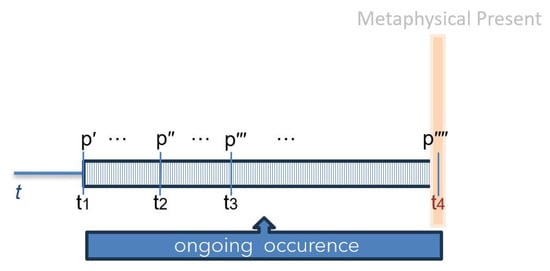
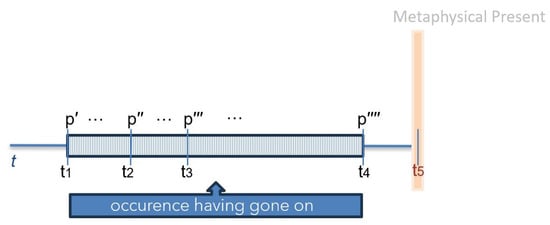
Occurrences can be naturally classified into two categories: ongoing occurrences, when considered from a moment in time during which they are happening, and occurrences having gone on, when considered from a moment after which they have happened. This is visualised by Figure 1 and Figure 2:
Figure 1.
Initial understanding of an ongoing occurrence (ongoing process).
Figure 2.
Initial understanding of an occurrence having gone on.
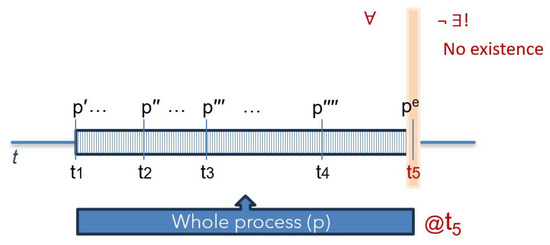
Figure 1 depicts the consideration of the process from a moment in time, while the process is still happening—thus depicting the occurrence as an ongoing process. What is visualised in Figure 2, in contrast, cannot be considered an ongoing process. Rather, looking from a time after which the process has happened, we are considering a process as having gone on. To spell out these two perspectives and substantiate them metaphysically is the aim of this paper. The paper discusses the metaphysical assumptions necessary regarding time and the nature of processes for such an understanding of ongoing processes. Those assumptions will be addressed step by step for clarifying which of them are necessary to reasonably distinguish between an ongoing process and an occurrence having gone on. Other assumptions that can seem initially compelling can be misleading about what an ongoing process is, whether and how they persist in existentially dynamic time, and what they can offer to certain debates. I will present reasons to reject these in what is to come.
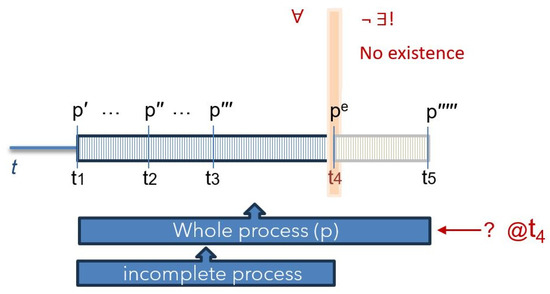
Firstly, an ongoing process is understood as a four-dimensional entity. At each moment in time, what is located then is merely a temporal part of the four-dimensional process, symbolised by p′ to p′′′′. More on temporal location and four-dimensionalism will follow later. Roughly, temporal location is to time what spatial location is to space: it concerns when an entity is to be found. Whether it should be considered as (dynamically) perduring or otherwise is a question to be answered in this paper. The occurrence in Figure 2 is also four-dimensional. It can uncontroversially be considered a whole. We must understand its way of persisting and being a whole in order to address how this may differ from ongoing processes. Whether processes can be considered wholes as well is controversial and is a core question to be answered.
Secondly, both figures include a metaphysical present as a special moment in time (the red moment at the orange vertical line in Figure 1 and Figure 2). Only the ongoing process is partially temporally located1 then (through p′′′′ at t4 in this case, see Figure 1). This moment shall also be the moment from which the reference is made. The occurrence in Figure 2 is referred to from a later moment (t5) that the metaphysical present has shifted to. One is ‘looking back’ into the metaphysical past by referring to it. If this occurrence can/should still be considered a process and if it persists the same way, will be clarified.
Thirdly, there is nothing portrayed beyond what is labeled the ‘metaphysical present’ in each image. Even if the present has shifted, nothing in the t-dimension ever exists beyond it. The underlying time metaphysics for such a view is a specific type of existential dynamism which will be elaborated on later: the Growing Block Theory of time (GBT), originally proposed by C.D. Broad (1923) [1] and recently revised by Correia and Rosenkranz2 (2019) [2]. To give a brief idea already, it can be said that the existential dynamism that underlies C&R’s theory is that there is always one (and always a different) moment in time that is new and last (the red moment in Figure 1 and Figure 2) (cf. C&R 2019, p. 42) [2]3. Nothing beyond this moment exists, and this moment itself did not exist previously, making it new and last at itself. Moments in time are therefore constantly coming into existence at what is called the ‘edge of becoming’ (the last existent moment and temporal edge of the universe). Once they exist, they will never cease to exist in the GBT. Here, existence must be understood in the most fundamental, metaphysical sense, namely an entity exists if it is something at all. This coming into existence corresponds to an existential growth of the universe with time’s progression. If one took the entire universe to be a block, at each new moment a new ‘time-slice’ would be added to that block. This time-slice contains this moment and everything that is spatiotemporally located at that moment. Existential permanentism, on the other hand, (that includes the Moving Spotlight Theory) will never metaphysically accept new entities. What exists is strictly speaking never changing with time: existence is not dynamic in that sense but permanent. This paper will focus on ongoing processes in the Growing Block universe (GB universe). Still, I endorse research on ongoing processes in other theories of existential dynamism (e.g., presentism). Existential permanentism (like eternalism or the Moving Spotlight Theory) does not provide the account of dynamicity that the distinction between an ongoing process and an occurrence merely having gone on requires, as we shall see. The insights on processes, provided in this paper, are therefore applicable only in certain time-metaphysical frameworks but not because the research itself lacks generalisability but because the dynamic nature of ongoing processes requires so. Zachrau clarified in detail that a dynamic metaphysics of time offers the necessary and correct framework for fundamentality of processes and anything ongoing (Zachrau 2024, pp. 74, 110, 152ff.) [3]. This paper will make this necessity explicit.
In what follows, a metaphysical approach to ongoing processes that is based on an aspectual distinction will be developed. In this approach it can be shown that an ongoing process genuinely metaphysically combines being an ongoing occurrence as well as an occurrence having gone on. This cannot be said of occurrences that are entirely located in the past (like the occurrence in Figure 2). It will be explained how a temporal perspective that is genuinely dynamically within ongoing processes differs from a temporal perspective that merely refers to a moment within an occurrence that is metaphysically entirely located in the past. Only with the dynamical perspective can we accurately grasp a process as ongoing (i.e., in its ongoing aspect). The understanding of this aspect allows us to propose a metaphysical account of dynamical persistence and genuine open-endedness of ongoing processes. Existential dynamicity (the foundation for this research) offers a different type of dynamicity than existential permanentism: the constant growing of wholes in a dynamic unification act (an ontological becoming) that follows existential becoming.
The structure of this paper is as follows:
Section 2 clarifies which notion of processes underlies the following sections. Brief overviews of previous debates on clarifying processes and other occurrences will be given. Section 3 will contain more information on existential dynamism and specifically the time-metaphysics account of the Growing Block Theory that the research in this paper is based on. The end of Section 3 already points towards a potential problem with temporal directedness of ongoing processes, that multiple sections will be concerned with. Section 4 addresses if ongoing processes should be considered incomplete in the GB universe, which will be rejected in Section 4 and Section 5. Section 5 ends with a description on what in incomplete process would be in the GB universe and how we accurately regard an occurrence ‘from within’ vs. from temporally outside. Section 6 addresses the completeness of an ongoing process under the assumption that their temporal directedness makes them necessarily temporally open and introduces a metaphysical aspectual understanding of processes. Section 7 will address persistence of an ongoing process by exploring ways to describe their persistence not by perdurantism or endurantism but a mixed “hybrid view”. This may be available if we take the different aspects of processes as proposed in Section 6 to be genuinely metaphysically distinct. Section 7 ends with problems that such a view would face and Section 8 will provide an alternative: a dynamical persistence where an open boundary of an ongoing process will alter the existing four-dimensional whole. Importantly the section discusses which existing entities make up the four-dimensional whole at each moment. Section 9 will finally conclude the current research, point to its limits and address what future endeavours can enrich it.
2. Clarifying “Processes”
What a process is, and what distinguishes it, e.g., from an event, or a state is an ongoing debate with the aim of bringing a clear subdivision into a group of entities mostly referred to as occurrences (see, e.g., Mourelatos 1978, p.423) [4]. All terms used here can be interpreted differently; therefore, a clarifying section is needed. This section does not aim to summarise the debate in temporal order or give a detailed recapitulation of the various approaches. Instead, it aims to clarify why I approach a time-metaphysical debate about what ongoing processes are at all. Then I will briefly introduce a working assumption on what I consider a process and an event, the two terms which will be most relevant later.
In what follows, I use ‘process’ to cover activities, developments, and what authors such as Mourelatos (1978) [4] and Crowther (2018) [5] would call ‘events’—i.e., completed occurrences considered in retrospect. Activities and developments differ in their directedness: activities are directed at themselves, while developments are directed at a telos beyond themselves. Whether a process is referred to as ongoing or as having gone on (in retrospect) is a matter of the aspect under which it is considered, not a difference in ontological category. In the previous literature, the potentially most comprehensive contemporary account of how to distinguish processes from other occurrences is Seibt’s ‘Free Process Theory’. Seibt argues convincingly that occurrence types such as processes, events, and states are not classes of occurrences but modes of occurring, defined through networks of aspectual implications (Seibt 2004, p. 31) [6]. In her account, a terminus denotes an activity just in case, within a given context, it fulfils a specific inferential role, for example, that from ‘N is V-ing’ one can infer ‘N has V-ed’ (the “completeness condition”) (Seibt 2004, p. 26) [6]. This approach successfully addresses the phenomenon of verbal aspect shift: what appears to be a change in ontological category is, in fact, a change in the mode under which an occurrence is conceptualised (cf. Seibt 2004, p. 27) [6]. However, Seibt’s framework is neutral with respect to time metaphysics. The completeness condition tells us that an ongoing activity is conceived of as already completed once it is going on (Seibt 2004, p. 31) [6], but it does not tell us what it is for a process to be ongoing in a world in which later phases do not yet exist. The account of completeness can make Seibt’s completeness condition more understandable in the context of the challenges existential dynamism faces. It is not a challenge of aspectual semantics and ontological classification but of ontological constitution: what does it mean for a process to be a whole at a time when its future is not yet real? Seibt herself notes that aspectological approaches have “conspicuous difficulty” in defining the dynamicity of atelic [i.e., non-developmental] situations in purely lexical or inferential terms (Seibt 2004, p. 28) [6]. The existential dynamicity of the GB universe—the coming into existence of new temporal phases—offers a metaphysical resource for clarifying dynamicity, but it operates at a level that Seibt’s inferential framework is not designed to address. Seibt’s aspectological framework and the account of ongoing processes in the GBT are therefore not strictly orthogonal but operate very differently and are concerned with a different focus (ontological classification vs. constitution).
Investigating what a process is can be traced back to Aristotle’s distinction between energeia and kinêsis: the former term refers to occurrences that are complete at every moment of their going on (such as seeing or thinking), while the latter term refers to occurrences directed at a telos they have not yet reached (such as building a house or crossing the road)4. Once the telos is reached, we will have an entity different from the allotelic process of housebuilding and from the telos (house) itself: a completed event of house-building. An event can be regarded as the completed temporal trace of an ongoing (Zachrau 2024, p. 152) [3]. I will adopt this interpretation for the time being. Crowther (2018) [5] elaborates on the role that linguistic aspect plays in the distinction between processes and events. Although only an incomplete insight into his work is given, by referring to his working assumption on processes and events below, it is certainly helpful to clarify the relation of processes and events that underlie the endeavour of this paper.
Nouns such as ‘the battle’ appear to single out temporal entities which are complete or whole. In the sentence just used, though [‘The Greeks were battling hard.’], ‘battling’ occurs with progressive or imperfective verb aspect, the whole predication serving to focus attention not just on the whole battle that occurred but on the battle as it unfolded or went on over a period of time, that is, from temporally ‘inside’ or ‘within’ the occurrence, as we might put it. Like the distinction between processes and events, the nature of the notion of verb aspect and how to understand the notion of imperfective or progressive verb aspect is one of the things about which there is dispute. But as a working assumption to guide discussion, we might think of processes as what are picked out by imperfective verb predications involving such verb forms as ‘battling’ while events are what are picked out by nouns such as ‘the battle’ (Crowther 2018, p. 59) [5]5.
There are two important elements to take from this:
- Crowther mentions the importance of the aspect at focus (is our sentence focusing on something dynamic or on a whole that is statically temporally laid out?) This is adopted from Seibt (2004) [6] and is of similar importance in an aspect view of processes, where what is referred to under the one term, “process”, differs in dynamicity with respect to the aspect in focus. This is developed in detail in Section 6.
- Crowther provides an example of a completed entity (a long past event) that is described with a focus on its dynamic unfolding with an imperfect verb (battling) from “within”. We can conclude from this that the imperfective verb aspect does not necessarily describe an incomplete metaphysical ongoing for Crowther, as the event is taken to be complete. I will make a more metaphysical claim to support that completeness is in fact given, and it is not only given for events that are picked out by nouns (battle) but also for processes that are picked out by verb forms (battling). The metaphysical approach situated in the GBT will provide us with a better understanding of what “from temporally ‘inside’ or ‘within’ the occurrence” means. I take processes that are ongoing just as much as wholes as I take completed events to be wholes. This is going to stray far from Crowther, who eventually intends a process to be temporal stuff. Crowther (2018, p. 58) [5], following Galton and Mizoguchi (2009) [11], argues that “(A) process, as we understand it, is not a whole and cannot be said to have parts. Here the analogy with matter is close: just as we do not say that water, or sand, forms a whole with parts, so too with walking or singing” (78–79).
- Mourelatos’ division distinguishes processes and events as categorically distinct types of occurrences, according to which processes are mass-like and events are countable and bounded. The present paper follows a different approach by Zachrau (2024, pp. 152–156) [3] and Stout (2016, p. 42) [10]. The distinction between ongoing processes and completed events is taken as a perspectival one: the same occurrence is ongoing (from within its unfolding) and has the aspect of having gone on (concerning its external structure). This perspective is better suited for the GBT context. An external perspective that concerns the location of parts and a perspective that concerns ongoing from the metaphysical within (situated at the edge of becoming)6 can be distinguished. Both will play an important role in understanding ongoing processes metaphysically. Following Zachrau (2024, pp. 152–156) [3], I assume that one and the same countable flux phenomenon can be considered in both ways: as ongoing and as having gone on. The latter is viewed as a completed temporal trace and authors such as Mourelatos (1978) [4] and Crowther (2018) [5] would speak of it as an ‘event’. I do not object to using the term ‘event’, but in this paper I use ‘process’ throughout to make the connection between ongoing and completed occurrences in the GBT more prominent. I aim to create clarity nonetheless by always referring to the aspect relevant in the current line of argument: the ongoing (dynamic) aspect or the having-gone-on aspect (the current temporal trace). This terminological choice reflects that an ongoing process (see Figure 1) and the completed occurrence it becomes (see Figure 2) are one and the same temporally expanding whole, considered from different stages of the block’s growth. I take this from the contents of Section 8, which discusses the numerical identity between the dynamic aspect of a process and the temporal parts that remain as time goes on. A completed process that lies entirely in the past is a process nonetheless, but it lacks the activity traditionally associated with the notion of process (cf. Mourelatos 1978, p. 423; Seibt 2004, p. 29) [4,6]. It is merely laid out statically. In contrast, the term ‘ongoing process’ as used in this paper necessarily retains this activity focus: it refers to a process insofar as it is occurring. Ongoing processes are directed beyond the present or its last moment as they are not merely defined as what has happened, but as what is dynamically brought about and what may continue. In this respect, they differ from completed processes with no dynamic aspect (those that have merely gone on). Not accounting for their directedness would mislead our understanding of what ongoing processes fundamentally are/do. Whether the term ‘ongoing process’ considers the process from within (grasping merely the ongoing aspect) or from temporally outside (with one aspect of it being dynamic at the edge of becoming) is to be addressed later.
A statically laid-out entity, such as a completed process, is best understood as a perduring entity. Classical perdurance holds that an object persists over time by having distinct temporal parts located at distinct times (cf. Merricks 1995, p. 525) [12]. Considering a perduring entity in the usual way, one refers to the ‘totality’ of its temporal parts, which compose a four-dimensional entity by classical mereological summation. A whole in perdurantism is therefore the mereological sum of its parts and is bound to their existence. An entity counts as complete when all of its parts exist. As Merricks notes, “an object cannot have another object as a part if that other object does not exist” (Merricks 1995, p. 524) [12]. For a completed process, this is straightforward in the GBT as much as in existential permanentism: all of its temporal parts exist, and the whole is simply their sum. However, for an ongoing process in the GB universe, the situation is different. The sum of their temporal parts is currently increasing, just as the sum total of existence does in the GBT. Can such a process be understood as perduring? Can it constitute a whole if not all of those parts currently exist that will exist at the moment when it terminates and is finally completed? How could other accounts of persistence be applied instead, and will they provide a favourable approach over perdurance? These questions are answered in the following sections.
3. The Problem of Directedness in Existential Dynamism
In the GBT, the difference between an ongoing and completed process is not merely a matter of how we describe an occurrence. Section 3 and Section 4 together develop a central argument: that ongoing processes are always wholes, and that their open-endedness is a feature of their boundary, not a deficiency in their being. This boundary, I argue, constitutes the central metaphysical difference between a completed process and an ongoing one7.
This argument requires a more detailed understanding of existential dynamism than that provided thus far. Existential permanentism is classified by the principle “Always, ∀x Always, E!x”, or “Always everything always exists.”, according to C&R (2019, p. 71) [2]. To use “Always” twice in this principle might initially be confusing, but they fulfil a distinct function that should be explained. We can divide the principle in two separate subprinciples ((1) and (2)): In existential permanentism (1) at any moment8, everything (∀x) exists (E!x). So: “Always everything exists.”. (1) also holds in the GBT. It is meant to be a trivial sentence for all accounts of time metaphysics: the quantifier ‘∀’ is defined to always range over the entire domain of what exists, to which I refer as ‘E(t)’9. But in existential permanentism it also holds that (2) every currently existing ‘thing’ exists at any other moment in time. This second subprinciple entails that the domain of existing entities does not vary with time. So: “Everything Always exists.”10. The quantifier ‘∀’ will always quantify over the exact same entities. To differentiate existential permanentism from existential dynamism, the domain E(t) must be considered tensed, even if existential permanentism does not regard tense as having any influence on E(t). Only in existential dynamism does what exists simpliciter11 vary with time. In the GBT specifically, it grows with the temporally expanding universe12. Characteristic principles of the GBT are therefore:
(P1) E!x → GE!x
(P2) Tx → At x, H¬E!x (C&R 2019, 71)
I briefly clarify the formal language used here: G ≡ df “it will always in the future be the case that …” and H ≡ df “always in the past, it is the case that …”. (P1) states that whatever exists will always continue to exist, while (P2) states that at a certain time (x being a moment is formalised by ‘Tx’), this time is then new. Therefore, something exists that was previously nonexistent (x). (P2) signifies existential dynamism, while only the combination of both axioms signifies growth and asymmetry rather than existential symmetry and a full exchange of the domain of existence with time.
Past and present entities exist, whereas the future does not. This ontological asymmetry immediately raises a distinctive problem for ongoing processes. Such processes are directed beyond the present; they are not merely defined as what has happened but as what is dynamically brought about and what may continue. Future-directedness is what distinguishes an ongoing process from one merely having gone on.
In the GB universe, however, what ongoing processes are directed towards does not (yet) exist. Their future phases are not merely temporally located beyond the present; they are presently non-existent. This combination—future-directedness and existential asymmetry between the past, present, and future—makes ongoing processes particularly difficult entities in the GBT. However, they may be understood as core entities in a dynamic universe. According to Zachrau, a dynamic metaphysics of time offers the necessary and correct framework for the fundamentality of processes (cf. 2024, p. 154ff.) [3]. Yet the GBT account of C&R (2019) [2], although a very promising formal framework, remains silent on how entities persist within a Growing Block universe and how the dynamic ongoing at the edge of becoming relates to the processes located there. The present paper addresses this gap.
4. Ontological Incompleteness vs. The Mereology of Growing Wholes
Zachrau (2024) [3] argued that ongoing processes in an existentially dynamic universe must be understood as ontologically incomplete. As he sees future-directedness as indispensable for dynamicity, he regards ongoing processes as genuinely open-ended. In this view, an ongoing process extends toward the future, which means (in the case of the GBT) that this end is “dangling into nothingness” (Zachrau 2024, p. 154) [3]. They must be considered incomplete because of the combination of their genuine open end with the idea that all processes persist by perduring and are individuated by their four-dimensional extension. Then, at any time strictly prior to their termination, something that belongs to the process has not yet come into being and the process is incomplete. In a universe in which the future does not exist, this absence cannot be redescribed as merely not present or past, yet it exists in the future. This would confuse temporal location and genuine (simpliciter) existence. Incompleteness is not a referential or epistemic feature of descriptions of processes here; it would be a constitutive feature of what it is to be an ongoing process in the GBT.
This incompleteness diagnosis is initially compelling and should not be dismissed lightly. It captures an important intuition about open-endedness: ongoing processes are not completed; they are directed beyond the present and are not exhausted by what has already happened. I also do not find it problematic to consider them as perdurants. The understanding of their persistence that will be proposed here can be either labelled an adapted perdurantist account that simply undergoes necessary reinterpretation to meet criteria of existential dynamicity, or a unique style of persisting that I would call ‘temporal growing’, for those who prefer a clearer separation from perdurantism. I personally do not think that an alternative persistence account must be enforced. Therefore, although Zachrau captures important features of ongoing processes, the existence notion of C&R’s GBT should forbid us from claiming things as ontologically incomplete. I have argued elsewhere (Nußbaum 2025) [14] that even perduring entities currently gaining new temporal parts are ontologically complete wholes.
The claim that an ongoing process is always a whole requires clarification. It is not an independent metaphysical assumption, but a consequence of the existence notion built into the GBT. On C&R’s account, the sentence “always, everything exists” is a theorem. No entity is ever absent from E(t) yet considered to be anything (because being anything would correspond to a metaphysical existence claim). In particular, no temporal part of a perduring entity that corresponds to anything ontologically is left out by ‘∀x’. If a process p has temporal parts Tp, Tp′, and Tp′′ that have come into existence by t, then all three belong to E(t), and the mereological sum of exactly these parts is the whole process then. This is fully in line with the original mereological understanding of a whole in perdurantism. Its application is merely unique in existential dynamism as it needs to be tensed. What does not change is that the identity of the whole is still bound to the sum of all its temporal parts. One just must consider that “all” is only reasonably understood as the time-sensitive quantifier (∀x) in existential dynamism. The reason why a process (p) is a whole before completion is because the sense of ‘whole’ at play here is not that of the maximal four-dimensional extension the process may eventually have. It is the mereological sense in which a whole exists if and only if all of its parts exist. Here “all of its parts” can here only be interpreted within the domain of what is anything metaphysically: the domain E(t) and the quantifier ‘∀x’ that ranges over it are unrestricted, even though they are time-sensitive in existential dynamism. The mereological principle that a whole exists only if all of its parts exist, and that a whole is composed of all and only its parts (cf. Merricks 1995, p. 524f.) [12], is therefore not violated. To say that temporal parts were missing requires evaluating the process from E(t′) with t < t′. However, the reference to the incomplete entity in this judgement is, as it is argued in the next section, a restricted reference. An unrestricted reference over all times (i.e., all existent times) will naturally provide us with temporally extended entities that will temporally grow as the universe does. This way to temporally develop is how I take an ongoing process to persist. Once a process is completed there will be no such dynamic variance in its extension. This is the moment from which one can consider it an event, or a process as merely having gone on and no longer ongoing. This understanding of persistence is currently merely comparing previous states of an ongoing process with later states and therefore lacks an element of genuine dynamic unfolding at the edge of becoming. This is going to be developed in Section 8, which finally addresses the open boundary of an ongoing process. The next section clarifies temporal growth by contrasting tensed references to wholes with restricted references to singled out temporal parts and what could in this new account be called an ‘incomplete process’.
5. Temporally Growing Wholes and Referring to Their Parts
5.1. Referring to Future Parts
A process may eventually have parts that were not included in what we considered the whole previously. This is a backwards-looking claim of existential dynamicity; the domain E has grown: E(t) ⊂ E(t′) for t < t′. A process that is a whole with respect to t—composed of all and only its then-existing temporal parts—may be a whole in a different way when t′ is the edge of becoming, having gained new parts through the block’s growing. This is not a contradiction but the core of the GBT’s account of temporal passage. The wholeness of the process when t is the edge of becoming is not retroactively undermined by its wholeness when t′ is the edge of becoming; these are two evaluations from two stages of the Growing Block universe, each internally consistent.
To make this precise, I introduce the notation “@t” to express what might be called an ontological perspective shift. The operator is adapted from the framework of C&R (2019, chs. 2–4 [2]; see also Nußbaum 2025 [14] for extended discussion). It is a monadic sentential operator, paired with moments and characterised as follows:
[@t: φ] is true iff φ holds, evaluated with respect to E(t).
The unrestricted quantifier ∀ ranges over E(t) and t serves as the edge of becoming, to which nothing stands in the relation ‘later-than’. The operator thus fixes the domain relevant for grounding a given ontological fact expressed in a judgement. Consider:
[A] @t3: ¬∃xφx
[B] @t4: ∃xφx
In a Growing Block universe where t3 is the edge of becoming, there is no thing that is φ in the domain of all existing things. Yet shifted to the later moment t4, there is—as the universe encompasses more at t4 than it did at t3.
By contrast, the standard relation of temporal location “at t” does not shift the domain of quantification. Unlike claims under @t, a claim like "at t, p is located" (pLt) is eternal in the sense of axiom (A27), xLy -> Always, xLy; if true, its truth-value does not depend on where the edge of becoming lies (Correia and Rosenkranz 2019, p. 31) [2]. The two notions serve fundamentally different purposes: “at t” locates from whatever ontological perspective; “@t” shifts the ontological perspective to t. Where “@t” is a monadic operator on sentences, “L” is a dyadic predicate between a concrete entity and a moment.
Their distinction has consequences for how they interact. The expression [@t4: pLt3] is well-formed and unproblematic: evaluated from the perspective of a block that has grown to t4, it simply states that p bears a location relation to the earlier time t3. The judgement made here is restricted, as it concerns only t3, not E(t4) as a whole. By contrast, [@t4: @t6: φ] is not well-formed: since @t4 regards reality as E(t4), within which t6 does not exist, and two edges of becoming cannot reasonably be formulated in a single sentence. However, one can compare separate @t claims in a meta-view, as when comparing [A] and [B] above.
In what follows, I use “@t” whenever I intend the ontologically loaded reading—where the block has grown exactly to t, and “at t” for the neutral locational reading.
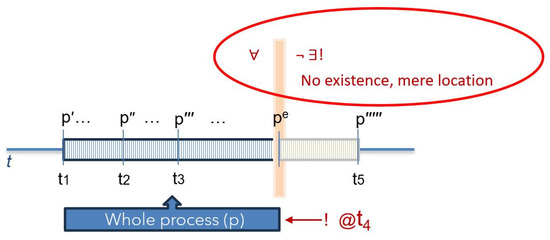
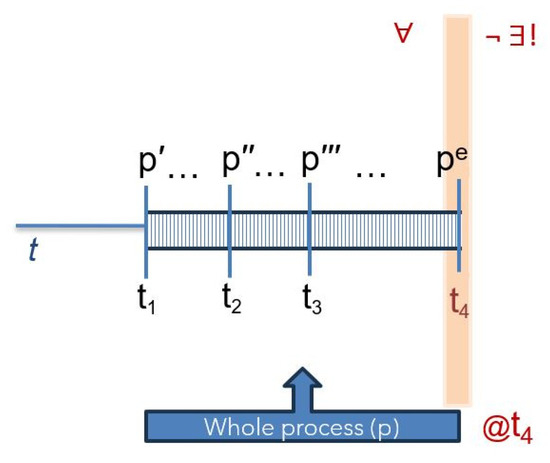
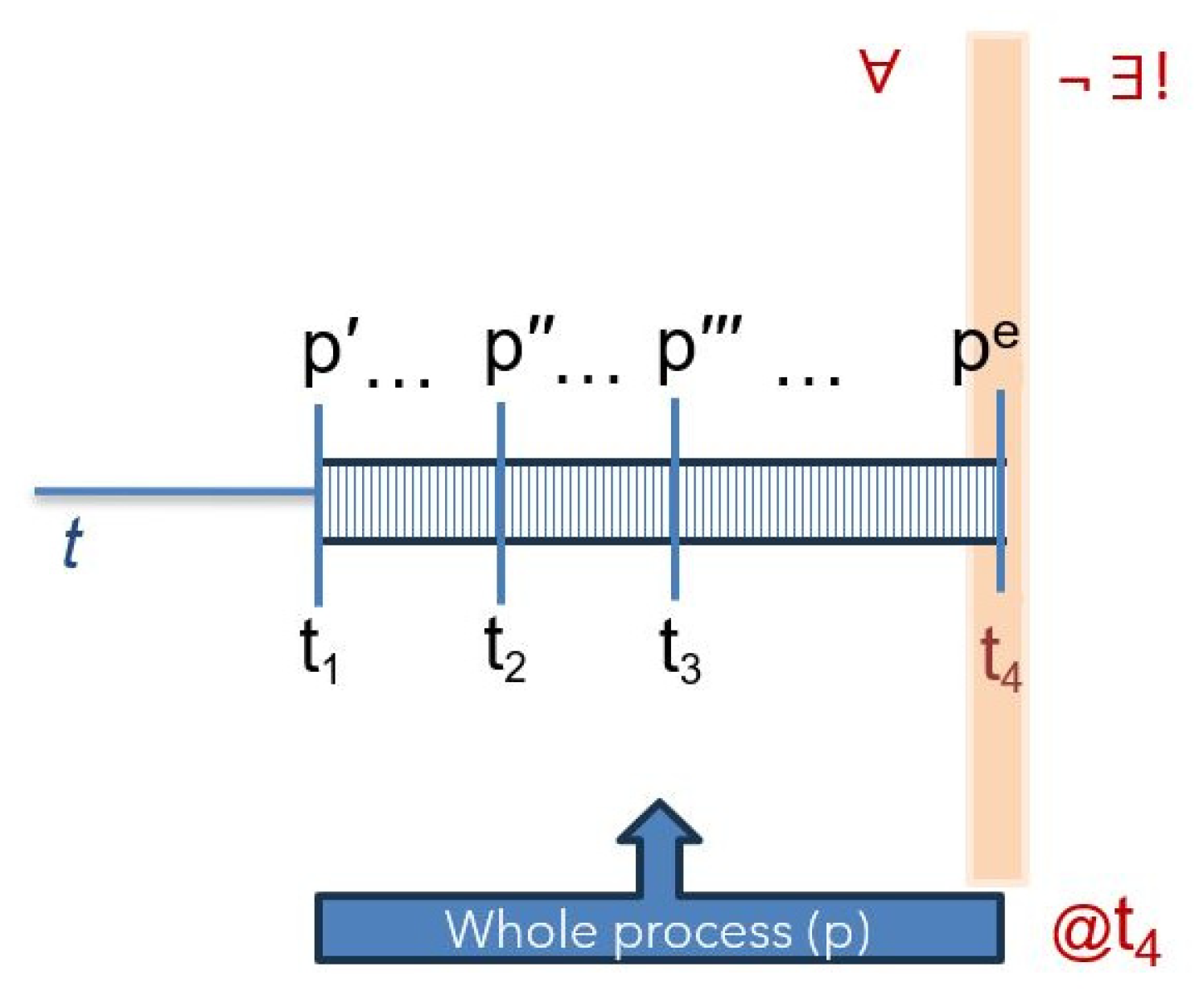
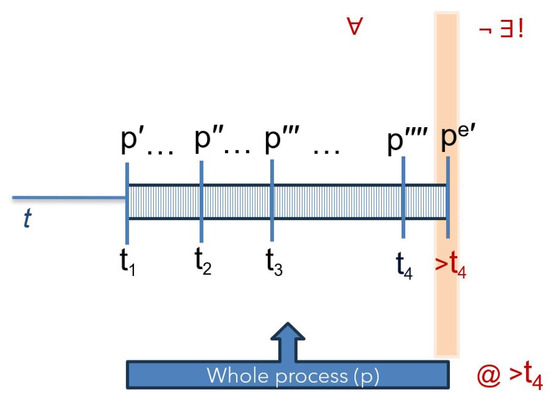
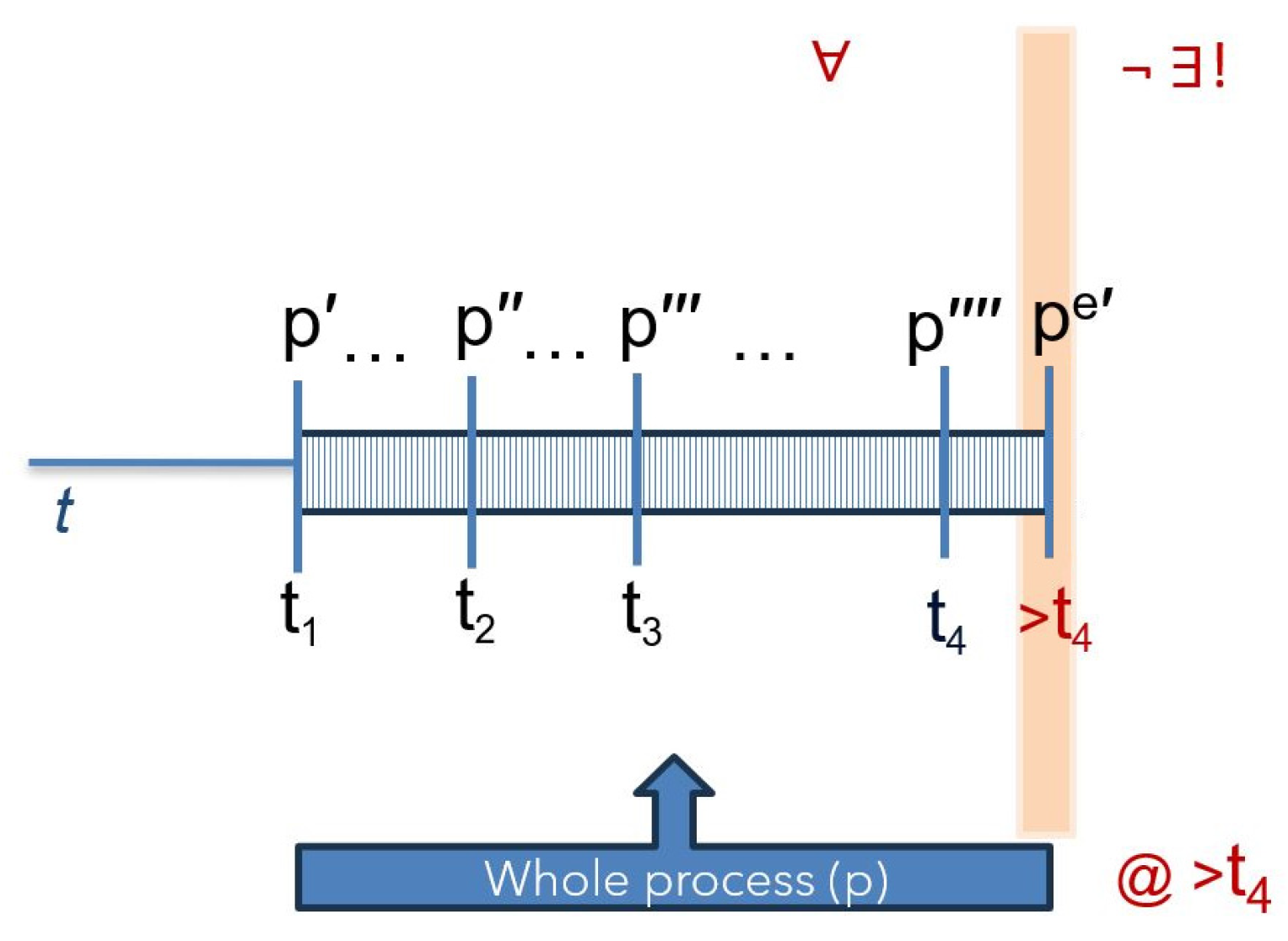
Figure 3 and Figure 4 include an element named “pe”, which corresponds to whatever element of the process is found at the edge of becoming. To some (like Zachrau) it may seem as if future parts of an ongoing process are missing @t4, as later @t5 they are in existence and they have not been before. However, if we respect the dynamicity of an existentially dynamic universe, it is important to reject incompleteness in Figure 3 and make the stronger claim of universes and perduring objects being complete at all times, once they came into existence but temporally expanding as wholes, as long as they are ongoing (e.g., between t4 and t5). Only through that, we claim that existence is truly NOT branching beyond the edge of becoming but the operator ∀ will encompass more as time goes on (see the red quantifiers in Figure 3, Figure 4 and Figure 5 as the corrected Figure 3). The Block universe grows. In the same way, four-dimensional entities within it grow. They will encompass more temporal parts over time. Such a temporal growth of the whole between t4 and t5 is clearly noticeable if one takes the meaning of the quantifiers seriously and therefore ignores the grey future temporal parts in the figures. Multiple different things can take the place of the represented temporally expanding whole occupying extended spacetime all the way up to the edge of becoming. A growth feature may therefore be found in anything we would understand as perduring, not merely those things we generally sum under ‘processes’. It is expectable that perdurance is favored over endurance with process fundamentality as occurences are standardly treated as perduring. However, in Persistenz im Growing-Block-Universum (Nußbaum 2025) [14], I examine several problems the endurance account of persistence faces in the GBT, and argue that perdurance may come out as the more favourable account for substance-ontologists or process-ontologists alike. The open-endedness of ongoing processes makes them particularly interesting, for which I am tailoring this paper around them.
Figure 3.
An ongoing process as potentially incomplete @ t4.
Figure 4.
The whole process @t5.
Figure 5.
The whole process @t4.
If the sum of things that exist grows and future parts of processes do not exist, one might wonder why there are future parts visible beyond the edge of becoming in Figure 3. If one was only portraying what exists, which is always tensed, one should make a clear cut at the edge of becoming, beyond which nothing exists. There is more visible in Figure 3 to address how we can speak about future parts. People who consider ongoing processes as incomplete do so, because it is true now (@t) that @t′ (t < t′) there will be new temporal parts of the same process in the case in which it continues. With Free Logic and C&R‘s distinction of temporal location and existence from their paper Temporal existence and temporal location (see C&R 2020, p. 2007) [13], one can better address the intuition that this corresponds to an incomplete process @t. Let us take Figure 5 as an example: it is correct in existential dynamism to claim that the process p is already a whole @t4. Still, we can allow for location judgements of future parts (p′′′′′Lt5) even if this judgement is tensed and expressed @t4 (cf. C&R 2020, p. 1999) [13]. A judgement like this will still respect that neither is there something like p′′′′′ nor t5, when it comes to existence: location is not existence-entailing. In Free Logic, to infer existence from a reference via a name like “ p′′′′” would require an additional existence predicate (E!) or an expression with which the relevant entity (like p′′′′′ or t5) are identified with a variable x in a statement like: [@t5: ∃x(x = p′′′′′)]. While the future does not exist and future temporal parts do not undermine the current processes completeness, referring to future parts with location claims is possible as location does not imply existence. The location claim [p′′′′′Lt5] is still related to existence in the following important sense: it expresses that @t5, p′′′′′ is coming into existence, which grounds it being located then tense-irrelevantly. While the actual coming into existence requires t5 to occur, the fact about the relation of p′′′′′ and t5 holds even when the edge of becoming is @t4 (t5 did not occur then). In the GBT, facts about location relations between times and objects in time are not affected by the moment of judgement. They merely state that at the future time (at t5) those things will be located that dynamically come into being then (@t5). What happens @t5 grounds any facts involving t5 and makes true the relevant location judgements. Of course, judgements about these facts would epistemically require a god’s perspective, but for this paper our actual epistemic restrictions when it comes to the future shall not be of relevance. It is only central to the argument to clarify how I can claim that future parts will be coming into existence from a current standpoint if I do not regard them as existent. The incompleteness rejection does not prohibit this.
5.2. Restricted Reference to Existing Parts and Time-Sensitive Unrestricted Reference
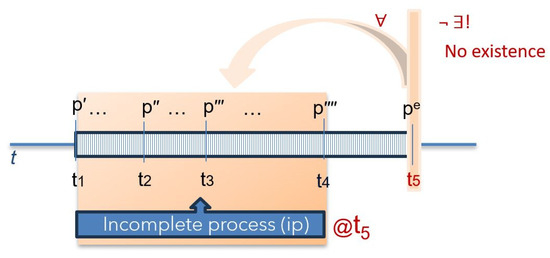
In this brief section I aim to address location claims further. So far, the relevant location claims have concerned only individual moments, sometimes even moments that do not yet exist (this corresponds to a restricted future-reference). Instead, I could also use a combination of location claims in a single statement to refer to all temporal parts of a completed process (as a reference to the past). The temporal reference would be the exact time interval over which we find the completed, i.e., terminated process. While we have located the entire process with this statement, it is still not an existence statement about the process. Existence statements are tensed in the GBT. The @-operator that must always accompany them. Still, in the semantic content of an existence statement no specific times are given. If the process (p) is completed and located entirely in the past @t5, then the statement [@t5: p exists.] does not claim anything about its location which could, e.g., be reaching from t1 to t3. It does not claim that p is located at t5. We must keep in mind that existence is concerned with unrestricted quantification. To refer to an incomplete process, we must then use location claims that specifically exclude temporal parts of a completed process or ongoing process as well as moments at which they are located. Figure 6 shows an example of such a reference.
Figure 6.
An incomplete process.
The @-operator introduced in Section 4 gives ontological force to the imperfective used by Crowther for focusing on an occurrence ‘from temporally inside or within’ it (2018 p. 59) [5]. In his eternalist framework, this ‘within’ is a matter of aspectual semantics—of how we describe an occurrence. The GBT provides something stronger. To evaluate a process @t is to be situated at the edge of becoming, because to be at the edge of becoming is to be within the occurrence in an ontologically substantive sense—it is the point at which the process is presently unfolding, where its ongoing aspect is located. This is not a perspective we adopt through language, but one that metaphysics provides. The ‘at t’ reference to an occurrence will not provide such a genuine metaphysical element to access an occurrence from within and is instead concerned with tenseless facts about occurrences. It is therefore the appropriate way to refer to an occurrence from temporally outside. Crowther’s account predates the formal tools developed by C&R and accordingly lacks this resource. Yet even the @-operator, taken on its own, risks reducing growing to mere growth: a static comparison between a smaller whole @t and a larger whole @t′ (Friebe 2020, p. 77) [15]. What is still needed is an account of what happens at the edge of becoming—of how the process genuinely unfolds rather than merely expands. This requires looking into the dynamicity of an ongoing process. How and where is it dynamic? To distinguish aspects within the whole occurrence and clarifying their persistence is therefore the following step.
6. The Tension of Openness and Completeness—An Aspect-Division
The rejection of ontological incompleteness is not grounded in how ongoing processes are experienced but follows from the notion of existence presupposed by the GBT itself, which does not admit partial, deficient, or incomplete existence. Choosing precise language may give us an advantage in differentiating ontologically complete ongoing processes from those that were never considered ontologically incomplete: those that came to an end or fulfilment. A distinction between being complete (being an ontological whole) and being completed (lacking dynamic, ongoing development through gaining of temporal parts) can be situated relative to the aspectological tradition introduced in Section 2. As noted there, Seibt’s completeness condition states that activities “are always already completed once going on” (2004, p. 31) [6]: any temporal part of a raining is itself a raining, and so the process is at no moment lacking anything it needs to count as a whole. Still, even an activity like raining, when ongoing at the edge of becoming, is directed at further raining that does not yet exist. It is complete—nothing that exists is absent from it—but it is not completed because its temporal boundary remains open. The completeness condition, as Seibt formulates it, is silent on this point, because it is an inferential thesis about modes of occurrence, not a metaphysical claim about existence at the edge of a GB universe. Regarding developments, the situation is more transparent. An ongoing occurence of housebuilding is clearly not completed while ongoing, since the house is not yet built. But on the account defended here, it is nonetheless complete—the process, as it exists @t, is a whole with an open boundary, not an ontological fragment awaiting future parts. I use “complete” in a mereological sense and “completed” in a temporal or processual sense. In this context, what distinguishes activities from developments is not whether they are complete (both are) but how surprising this completeness is, given the expectations of the aspectological tradition. An ongoing housebuilding is considered ontologically complete. The nature of this process (its being a housebuilding) requires reference to a future telos. So, what type of process we are dealing with might not just be determined by what exists but the future parts we can refer to as explored in Section 5.1. I consider developments and activities (i.e., ongoing processes) completed only once there is no open end of the process (Section 8 will elaborate on open ends in detail). It is then temporally spread out like any perduring object is considered to be spread across time, with a definite temporal boundary on both sides. No dynamic type of perdurance or persistence is required for this entity anymore. I would consider these static boundaries to be parts of the process in the same sense as other temporal parts are. The four-dimensional whole will have those as genuine parts when having gone on. There is no genuine ongoing to be found in such a process anymore. Some may call it an event, but as elaborated in Section 2. I will not use this term. Instead, I am basing myself on Zachrau here, who differentiated two aspects in processes.
A process that is complete yet not completed (so an ongoing process) will combine two aspects after the initiation phase and insofar it has an ongoing aspect as well as a having-gone-on aspect. Once completed only the latter aspect will remain. It is still a process but located in the past. Those entities will only possess static qualities, which is why many other philosophers will call it an event. As I take on the aspect approach, I find it more consistent to keep referring to it as a process. This is the terminology established in Section 2. What must be flagged is that it is a process in this account, but one that merely has-been-going-on. The temporality of such a process and therefore the aspects it ontologically lacks after completion must always be mentioned in cases like this. If they are not mentioned, it will be a two-aspectual process, therefore an ongoing process.
Ongoing processes give rise to a genuine tension: they are open-ended, yet mereologically complete as explored in Section 4. Understanding how their open-endedness or openness can be accounted for, may help fundamentally in exceeding from mere understandable growth (instead of growing) in the GB universe to an account that will give the happenings at the edge of becoming genuine dynamicity. Just as Figure 3 and Figure 4 (see page 10) only allow us to see a smaller and a bigger entity with a different number of temporal parts, the GB universe by C&R seemed to reduce growing to a comparison of a smaller and a larger block, eventually only explaining growth and lacking the genuinely dynamic component of growing, potentially even genuine continuance (see also Friebe 2020) [15].
Can open-endedness be understood in a way that is compatible with ontological completeness? Addressing this question requires a re-examination of how processes are ontologically categorised, and it is here that recent work on processes as occurrent continuants becomes crucial, as it may enforce an alternative to the perdurance account of a process’ persistence.
7. Ontological Category and Persistence of Ongoing Processes
7.1. Occurrent Continuants
A natural response to the tension between openness and completeness identified in the previous section is to reconsider the ontological category of processes themselves and reinvestigate how they persist. If ongoing processes have these two aspects of ongoing as well as having gone on, one might suspect that their peculiar status cannot be captured by a single persistence framework. This motivates what will be called “hybrid views” of processes. A natural starting point for this investigation is Stout’s account of ‘occurrent continuants’ (Stout 2016, p.13) [10]. Importantly, Stout does not introduce occurrent continuants in response to questions about dynamic time, existential growth, or ontological incompleteness. His motivation is independent of the Growing Block framework and concerns the adequacy of event-based ontologies of processes.
Stout’s central claim is that what is happening cannot be adequately understood as an event conceived as an atemporally extended whole. While events are typically taken to have their properties timelessly, ongoing processes behave differently. They are not substances; nevertheless, according to Stout, they behave like continuants in the following respects:
- They genuinely change.
- They can be tracked and reidentified.
- They are causally efficacious while ongoing.
- Predicates apply temporally (“is accelerating now”).
For these reasons, Stout argues that ongoing processes must be understood as continuants—entities that primarily have their properties at a time and persist through change (ibid.). As Stout notes, temporal extension is not a property that can be attributed to an entity at a time, and the same applies to the property of having temporal parts. Both are structural features of entities considered across time rather than properties they possess at any particular moment. This is relevant in the present context, since continuants, as Stout understands them, are precisely entities that primarily have their properties at a time. Treating ongoing processes as occurrent continuants therefore excludes temporal extension and temporal parthood from their primary characterisation, without denying that such features may become relevant when processes are considered retrospectively as having gone on. At the same time, because such entities are not substances but occurrences, he characterises them as occurrent continuants. This conception already places pressure on a purely perdurantist understanding of processes. If ongoing processes are occurrent continuants, then they are not merely temporal parts of four-dimensional wholes. Rather, while they are unfolding, they are entities in their own right.
7.2. A Hybrid View on Persistence of Processes
If we loosely apply his general ideas on the two-aspect view of processes, one may think that the aspects behave so differently from one another that they cannot be considered to persist in the same way. It might be the case that the ongoing aspect is enduring, and the having-gone-on-aspect is characterised by perdurance. Their persistence is then only adequately understood through a hybrid view of these persistence accounts.
A hybrid view on processes may be beneficial for accommodating the dynamic character of occurrent continuants without abandoning the structural commitments of the GBT, in which things that came into existence stay fixed as they are no longer located at the edge of becoming. Stout’s wish for reidentification of a process can be shared and may best be met through the multilocation of enduring things. Whether this can be achieved successfully is a question to be addressed soon. Hybrid views can also attempt to reconcile openness with completeness. It seems that the fact that a process is partially considered a continuant is supposed to account for its completeness, but in the GBT as presented in the earlier chapters, there is no need for a continuant, as intended by a hybrid view, to account for completeness. The gaining of temporal parts must account for their open-endedness. This is also the case for a mere perdurantist account, so regarding this problem it is unclear what the hybrid view could offer that we cannot achieve by perdurance. Yet, the main gain of a hybrid view seems to be that an ongoing process has properties restricted to the current unfolding present. Someone who opts for a hybrid view would have the general assumption that a temporal part can never have dynamic properties like “accelerating now” at the edge of becoming because they do not have them later, when one considers them to be located in the (ontological) past. Neither will the four-dimensional whole have this property. Under the assumption that the part of the ongoing process located at the edge of becoming is bound to be unchanging and must not behave differently from other temporal parts, a classical perdurantist account would face serious difficulties with dynamicity. These may be circumvented by the hybrid view.
In the following sections, I distinguish between two versions of the hybrid view. I begin with a simple, yet ultimately ‘faulty’ version, which helps to clarify the notion of an ongoing process and the important distinction between ‘at t’ and ‘@t’ (Hybrid view A). I then turn to Hybrid View B, a revised version. While this version is initially very attractive, I argue that neither version can ultimately be coherently integrated into the Growing Block Theory once the grounding relation between existence and temporal location is taken seriously.
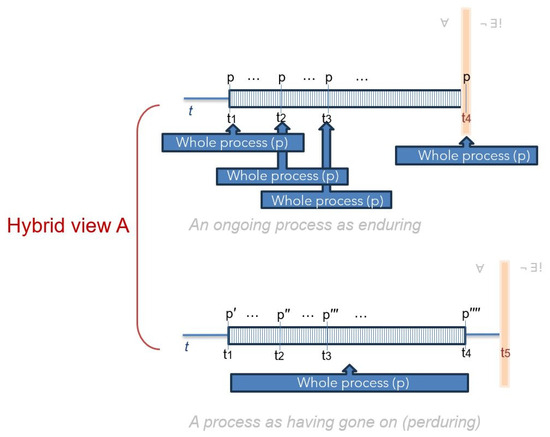
The first hybrid view understands the ongoing process as a continuant wholly present at any single time, while the completed process, retrospectively considered over its entire temporal span, is taken to be a perduring entity composed of temporal parts. This view aims to capture the intuition that at (‘@’) no moment the dynamic aspect of a process is anything like a perduring occurrence. What is currently happening, is not in itself characterised as a temporal slice of a larger four-dimensional whole (e.g., by having properties at a time).
If this means that, at any moment, the entire entity (p) is present in the locational sense, then Hybrid view A must be represented as follows (see Figure 7):
Figure 7.
Hybrid view A. Upper half @t4, lower half @t5.
The upper half of Figure 7 shows an ongoing process, according to Hybrid view A as the edge of becoming has not surpassed its four-dimensional extension. This ongoing process is considered to endure at any moment. Enduring things are wholly present at each time at which they exist. If the ongoing process endures at the edge of becoming, it must be wholly present then (at the edge). Wholly present means all parts are present at that moment. The location term is the only reasonable term to interpret this claim. It follows: all of its existing parts must be located at the edge of becoming. As this is a hybrid view, what must still hold, is that the parts of the whole that we aim to refer to from temporally outside as a four-dimensional whole, are located at distinct moments, not only at the edge of becoming. What follows from this is that the same entity p is located at all moments of its persistence, as shown in the upper half of Figure 7. The ongoing process (p) is thus multilocated (a classical positive characterisation for enduring entities). Only the upper half of Figure 7 is insufficient for the hybrid view, as it would merely claim that the ongoing process endures. In addition to being addressed as ongoing, the process is also addressed retrospectively, after its completion, in its having-gone-on aspect, so in retrospect. According to Hybrid view A, the process is also an occurrence consisting of phases or temporal parts after its completion so after the edge of becoming has surpassed it. This is visualised in the lower half of Figure 7.
However, this hybrid view is inconsistent. It leaves us with the pressing question of how something that was the whole process (pLt1) as it was ongoing, is later considered merely a part of the whole process (p′Lt1). That it is considered a numerically distinct one from those located at other moments (p′′Lt2) is inconsistent, since previously what was located at different moments was considered the same entity (multilocated). With its completion everything about the process seems to change suddenly, even what is already way back in time.
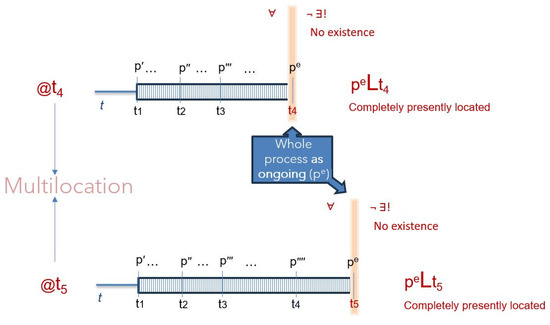
A second, more sophisticated hybrid view (Hybrid view B) attempts to avoid problematic multilocation by denying that the ongoing process is multilocated by its endurance @t (t being any single moment as the edge of becoming is always a single moment). In Figure 7 (Hybrid view A), multilocation was already realised @t4, so at a single moment, causing problems with the having-gone-on-aspect of a process @t5.
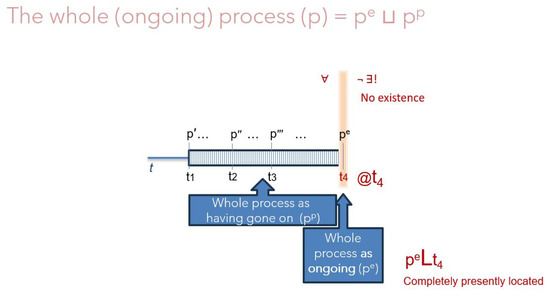
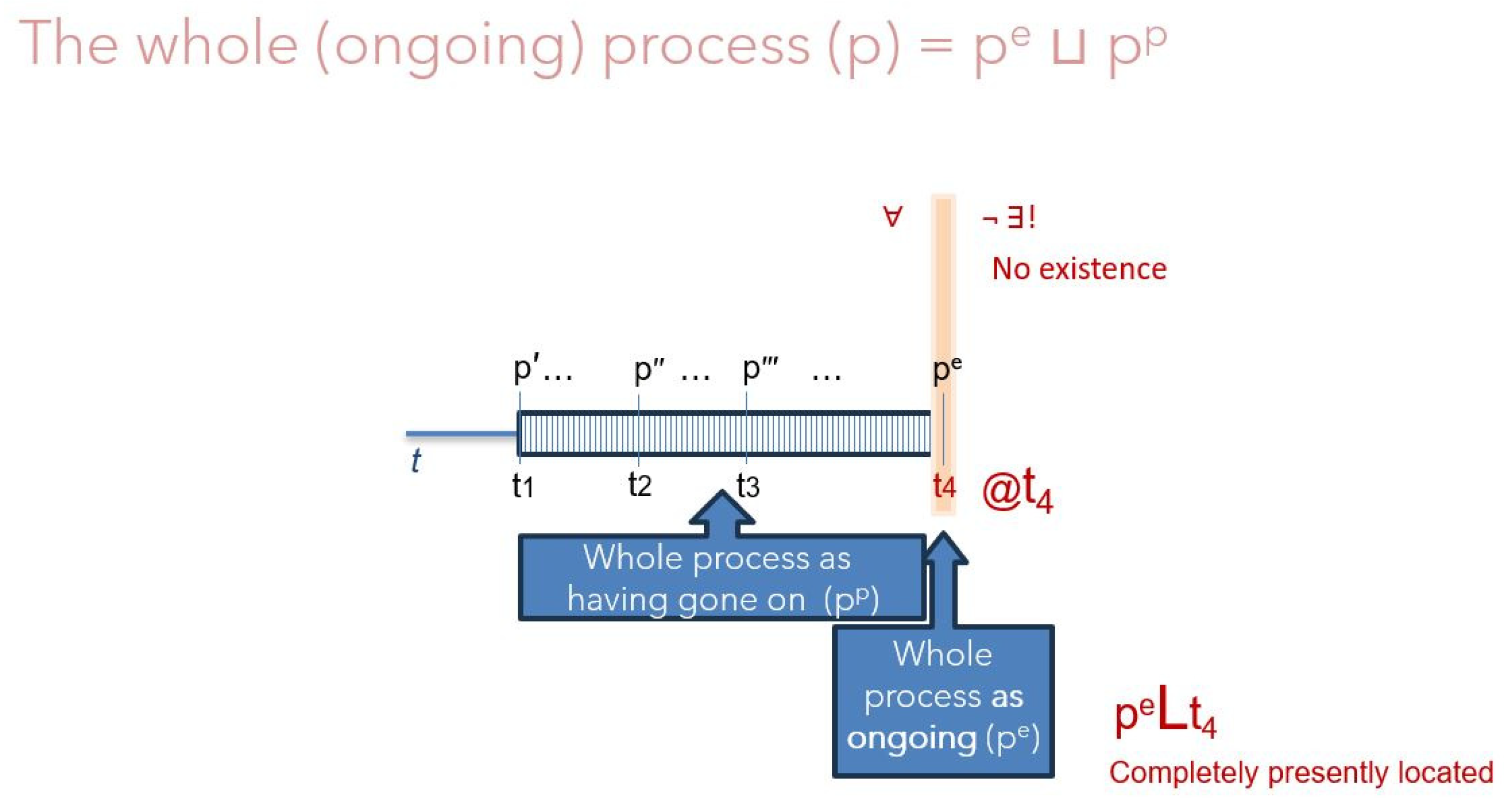
Hybrid view B takes the ongoing process to only ever be located only at the edge of becoming (under the name “pe”). It is therefore dynamically moving forward in the unfolding of the process and multilocated only from a meta-view (shown in Figure 8). @t, it is still wholly located at t, be it @t4 or @t5. Hybrid view B applies an aspectual view better, realising that it is not the entire ongoing process (p) that is enduring but the process as ongoing (only in its ongoing aspect ‘pe’). No ongoing process aspect is located anywhere else, making it wholly present/wholly presently located. At any other t, there are only temporal parts of an occurrence to be found. The two aspects are neatly separated @t (any t). There is no sudden global switch from one aspect to the other aspect after the process is completed.
Figure 8.
Hybrid view B. Upper half @t4, lower half @t5.
This version, presented in Figure 8, avoids the problematically enforced relocation of previous temporal parts of the process to the edge of becoming in order for the ongoing process to be wholly present. It is presently wholly existent and, considered as ongoing, even completely presently located. Thus, pe is multilocated from a meta-view and always (@t) wholly present, as endurantism claims. In this way, Hybrid View B rightfully places the whole process, as ongoing, at the edge. This term refers only to an aspect of the entire ongoing process, treated here as a mereological sum of its two aspects (see Figure 9). However, it introduces a different difficulty. If the ongoing process is numerically distinct from the temporal part that is left behind like a shadow as the ongoing process moves on, completed processes are eventually also entirely numerically distinct from anything that was ever dynamically ongoing, and it remains unclear how the dynamic existence of pe @t4 grounds the temporal part p′′′′Lt4. The following relation is to be read as the grounding relation that the hybrid view must address:
Figure 9.
Hybrid view B—the two process-aspects in one ongoing process.
Both versions of the Hybrid views share a common core, although they are very different. In both, ongoing processes are treated as one kind of entity, completed processes as another. The exact nature of their relation (how do pp and pe constitute p together?) may require further investigation, although mereology provides a good start. Hybrid view B may very well eventually provide an answer for the problematic grounding
relation, yet the possible failure of the hybrid views shows that a combination of persistence styles within a process might not offer us more options to address the tension of openness and completeness than an account of one unified persistence: the perdurance account. But how can the tension be addressed here?
8. Ongoing Processes as Temporally Expanding Wholes with Open Boundaries
The alternative I propose preserves the central motivations behind hybrid views while avoiding their ontological costs. Ongoing processes are neither incomplete nor entities that change their ontological category over time. Instead, they are best understood as temporally expanding wholes with open boundaries that change with respect to their portrayed dynamicity.
An ongoing process is (as argued before) always a whole: nothing that exists and belongs to the process is ever missing from it. Its completeness is secured by the Growing Block conception of existence, which does not admit partial or deficient being. At the same time, the process is not completed. To account for this, it is crucial that its boundary, which in an ongoing process would be located at the edge of becoming, is not a proper temporal part but an open boundary. This boundary marks where the process may continue or end in the dynamic sense. At the edge of becoming, the process is either continuing or coming to an end, so we are claiming here that the potential end (its final temporal boundary) or its next stage (its next open boundary) is not yet a temporal part of the four-dimensional whole process p.
Crucially, openness is a structural feature of the process’s temporal boundary. The process does not lack ontological completeness, yet it has no fixed boundary yet, making it not completed.
There is no last temporal part of an ongoing process to be found at the edge of becoming (similarly as in Hybrid view B (see Figure 10 and Figure 11)) but just afterwards, when we can just consider it past, and as merely having-gone on. An important difference to the Hybrid view B is that pe is not considered to move and be multilocated and therefore also not considered to leave behind a temporal part in a mysterious way. It is considered to turn from an open boundary into a temporal part of the whole process, which signifies an ontological becoming within the currently established GB universe. Ontological becoming follows existantial becoming. The complicated grounding relation GR might therefore be less problematic for the open-boundary view, as pe from @t4 and p′′′′ from @>t4 are at least considered to be numerically the same entity. It may remain formally challenging though. The dynamic aspect of pe has vanished, at t4—and turned into a fixed temporal part p′′′′—as the edge of becoming and the still unfolding process brought a different now dynamical aspect of the process p (pe′) into being (see Figure 11). The temporal part lies within the aspect of the process that merely has-been-going-on. As the universe grows, this boundary is continuously displaced. What comes into existence at later times does not complete what was previously incomplete; it extends an already existing whole. As an ever-new dynamic aspect of the continuing process arises, the moment of final completion need not introduce any retroactive ontological change in the process as it existed up to that point. Its four-dimensional aspect was already considered as merely having-gone-on right before completion. The last dynamic aspect of the process (the last time the process can be considered as ongoing) will turn into a temporal part that signifies a fixed boundary, and dynamicity does not reach any further for this individuated process.
Figure 10.
pe is not a temporal part yet.
Figure 11.
pe turned into a temporal part p′′′′.
This conception aims to allow us to make sense of future-directedness and, therefore, ontological openness without ontological commitment to non-existent entities.
Importantly, this account does justice to the intuitions that motivate both the perdurantist and continuant-based approaches. Like perdurantist accounts, it treats processes as temporally extended wholes. Similar to Stout’s conception of occurrent continuants, it allows ongoing processes to have their characteristic properties at a time and to be causally efficacious while unfolding. What it rejects, is the idea that temporal extension or the possession of temporal parts must be treated as properties had at a time, or that openness requires ontological incompleteness.
To consider only the ongoing aspect—pe—is now another way to address the ongoing process (p) as incomplete. It is a way to regard the process from within in its narrowest sense: attending solely to the dynamic edge where the process presently unfolds in its new dynamic aspect. To consider the whole ongoing process @t, including its aspect as having gone on, is equally a view from within as it is evaluated at the edge of becoming. Yet this view encompasses more than what is located at the edge of becoming, just as simpliciter existence always concerns the entire block up to and including its edge. Mere locational reference can consider the process as having gone on (reduced to the time span before the edge of becoming where this aspect is located). It may incorporate all temporal parts of the process, as at the excluded edge itself, we will not find a temporal part.
9. Conclusions
This paper set out to address a central tension concerning ongoing processes in the GB universe: how a process can be genuinely open-ended and future-directed in a universe in which the future does not exist, while remaining ontologically complete at every time at which it exists. Whereas recent work has argued that this tension should be resolved by treating ongoing processes as ontologically incomplete, I have argued that such a diagnosis is incompatible with the existence notion presupposed by the GBT itself. After motivating the distinction between being complete and being completed, I examined hybrid views that attempt to reconcile openness and completeness by combining different persistence categories in processes depending on whether they are considered as ongoing or as having gone on. Although these views capture important intuitions about dynamicity and ongoingness, both versions ultimately fail to provide a coherent grounding relation between dynamic existence at the edge of becoming and temporal location within the temporally extended whole. The difficulty does not lie in their acknowledgement of openness but in their attempt to accommodate it through a split in the ontological structure. As an alternative, I propose understanding ongoing processes as temporally expanding wholes with open boundaries. On this account, its openness does not consist of ontological incompleteness but rather the absence of a fixed future boundary. The edge of becoming marks a dynamically open boundary that may either extend or terminate as the universe grows. When the process comes to an end, or continues, this boundary turns into a proper temporal part through dynamic ontological becoming, and the process up to that moment can be redescribed as merely having-gone-on.
This conception preserves the motivations behind both perdurantist and continuant-based approaches. It allows processes to be temporally extended wholes while also accommodating the dynamic properties emphasised in accounts of occurrent continuants. Most importantly, it provides a way of understanding ongoing processes as paradigmatic entities at the edge of becoming: fully real, dynamically unfolding, and genuinely open-ended without appeal to ontological deficiency. In doing so, it clarifies how the GBT can accommodate genuine dynamicity not merely at the level of global growth but within the persistence of individual processes themselves.
Several questions remain unanswered. The present account has been formulated at a level of generality that abstracts from distinctions between types of processes. Yet, as the aspectological literature from Mourelatos (1978) [4], Comrie (1976) [7] to Seibt (2004) [6] has made clear, activities and developments exhibit importantly different temporal profiles, and the interaction of open boundaries with these profiles deserves further investigation. This is particularly pressing for complex processes, such as organisms, that simultaneously sustain activity-like self-maintenance and harbour development-like internal trajectories. Whether the open boundary functions differently for these two aspects of a single process, and what this would mean for the persistence of living beings in a growing universe, are questions that the present framework raises but does not yet answer.
Funding
This research received no external funding.
Institutional Review Board Statement
Not applicable.
Informed Consent Statement
Not applicable.
Data Availability Statement
No new data were created or analysed in this study. Data sharing is not applicable to this article.
Acknowledgments
Special thanks go to Florian Fischer who allowed me to present core ideas of this paper at a workshop he organised with Dirk Franken called “Powers, Processes and Persistence” (Siegen 2024) and has supported me philosophically while working on his original reinterpretation of the Growing Block as an open interval in itself since 2022. I would also like to thank all the participants and speakers of the workshop on ‘Process Metaphysics’ (Turin 2025) and the listeners to my talk at the GAP 12 (2025) whom I had fruitful discussions with. Parts of this paper originated in a reading group on Zachrau’s dissertation. I especially need to thank Cord Friebe, but also Bo Loxtermann and Max Zachrau himself for their philosophical input. Lastly, this text has greatly benefited from comments and suggestions by the anonymous reviewers of MDPI. I would like to thank them for their efforts. During the preparation of this manuscript, Claude Opus 4.6 by Anthropic and Paperpal by Cactus solely was used for the first step of language review. I have reviewed and edited all output and take full responsibility for the content of this publication.
Conflicts of Interest
The author declares no conflicts of interest.
Abbreviations
The following abbreviations are used in this manuscript:
| C&R | Correia and Rosenkranz |
| GBT | Growing Block Theory |
| GB universe | Growing Block universe |
| GR | Grounding Relation |
Notes
| 1 | As this paper is mostly concerned with time-variation rather than spatial variation, on most occasions the shorter term “located” is used instead of the term “temporally located” or “spatiotemporally located” (where the latter considers that entities are located in spacetime rather than mere time). |
| 2 | The abbreviation “C&R” is used in the following. |
| 3 | One can understand this moment as the metaphysical present if one were to adopt an A-theoretical view on time. C&R have created a tense-sensitive account that is b-theoretical as what I referred to as the ‘metaphysical present’ so far and they refer to as the edge of becoming is only defined as a moment that is last (a moment to which there is no later moment) as Zachrau (2024) [3] points out (154) and as is also implicit in C&R (2019, p. 39) [2]. This would be causing the relevant tense aspect of their theory to be relying on merely b-theoretical terms. I cannot address a-theoretical and b-theoretical accounts here, but I am using a-theoretical terms like “present”/”presently” “future”/”futurely” or “past”. They benefit general understanding and what I understand under the term “becoming”. C&R have been criticised for a lack of actual becoming in their theory. This will briefly be addressed in Section 6. I see this problem reflected in their b-theoretical terminology, for which I am diverging from it. |
| 4 | Aristotle’s distinction corresponds to what the aspectological tradition calls activities and developments (cf. Mourelatos, 1978, p. 423; Comrie 1976, p. 44) [4,7]. Activities (such as raining or running) are directed at themselves as, e.g., any phase of a raining is itself a raining. Developments (such as housebuilding) are directed at a telos beyond themselves as, e.g., a phase of house-building is not itself a completed housebuilding. Seibt (2015, p. 13) [8] similarly proposes to understand Aristotle’s energeia as ‘autotelic’ (directed at itself) and kinêsis as ‘allotelic’ (directed at something other than itself). Zachrau (2024, pp. 120–121) [3] adopts this reading. Autotelic and allotelic activities both are ongoing processes in the sense employed here; they differ in what they are directed at, not in whether they are ongoing and directed at all. Their differences are mainly important for the future research proposed in Section 9 but will briefly be mentioned in Section 6. |
| 5 | A similar characterisation can be found in Stout (1997, p. 20 and 2016, p. 42) [9,10]. |
| 6 | For readers familiar with C&R: The perspective taken here is the perspective @t, with t being a moment at which the process is not yet terminated. The operator “@” will be introduced in detail later for unfamiliar readers. |
| 7 | The consequences of the open-boundaries account may differ across process types. For activities, the claim that an ongoing process is always complete is less surprising, since the aspectological tradition already grants them a completeness condition (Seibt 2004, p.31; cf. Comrie 1976, p.44; Mourelatos 1978) [4,6,7]. For developments, it is more substantive, as these are standardly taken to be incomplete until their terminal point is reached. A full exploration of how open boundaries interact with the activity/development distinction is beyond the scope of this paper and is left for future work where organisms as fundamentally developmental shall be discussed on the basis of the work evolved here. |
| 8 | This is meant with the fist “Always” in “Always everything always exists”. |
| 9 | Let “t” be a variable of moments. “E(t)” denotes the domain of entities that exist simpliciter when the edge of becoming is at t. |
| 10 | This is expressed by the second “Always” in “Always everything always exists”. |
| 11 | Existence simpliciter refers to an absolute, non-relativised sense of existence. This meaning of existence what I intend when I speak about the domain E(t) or the quantifier ‘∀x’. Facts that something is spatiotemporally located somewhere (these are using a restricted sense of existence) are to be distinguished from what holds for existence simpliciter. C&R have argued for the necessity to distinguish both terms in Temporal existence and temporal location (Corria and Rosenkranz 2020) [13] and I addressed my understanding of the importance in Persistenz im Growing-Block-Universum (Nußbaum 2025) [14] for interested readers. The differences will be pointed out when relevant. |
| 12 | “<“ signifies the b-temporal order “earlier than” in the GBT. As E is constantly increasing with time. If t < t′, then E(t) ⊂ E(t′) |
References
- Broad, C.D. Scientific Thought; Kegan Paul, Trench, Trubner & Co.: London, UK, 1923. [Google Scholar]
- Correia, F.; Rosenkranz, S. Nothing to Come: A Defence of the Growing Block Theory of Time; Springer: Dordrecht, The Netherlands, 2019; p. 168. [Google Scholar]
- Zachrau, M. Fundamental Dynamicity—A Metaphysics of Time and Process; Acta Universitatis Gothoburgensis: Göteborg, Sweden, 2024; pp. 151–157. [Google Scholar]
- Mourelatos, A.P.D. Events, Processes, and States. Linguist. Philos. 1978, 2, 415–434. [Google Scholar] [CrossRef] [Scilit]
- Crowther, T. Processes as Continuants and Process as Stuff. In Process, Action, and Experience; Stout, R., Ed.; Oxford University Press: Oxford, UK, 2018; pp. 58–81. [Google Scholar]
- Seibt, J. Free Process Theory: Towards a Typology of Occurrings. Axiomathes 2004, 14, 23–55. [Google Scholar] [CrossRef] [Scilit]
- Comrie, B. Aspect: An Introduction to the Study of Verbal Aspect and Related Problems; Cambridge University Press: Cambridge, UK, 1976. [Google Scholar]
- Seibt, J. Aristotle’s ‘Completeness Test’ as Heuristics for an Account of Dynamicity. In Dynamic Being: Essays in Process-Relational Ontology; Petrov, V., Scarfe, A.C., Eds.; Cambridge Scholars Publishing: Newcastle upon Tyne, UK, 2015; pp. 2–28. [Google Scholar]
- Stout, R. Processes. Philosophy 1997, 72, 19–27. [Google Scholar] [CrossRef] [Scilit]
- Stout, R. The category of occurrent continuants. Mind 2016, 125, 41–62. [Google Scholar] [CrossRef] [Scilit]
- Galton, A.; Mizoguchi, R. The Water Falls but the Waterfall Does Not Fall: New Perspectives on Objects, Processes and Events. Appl. Ontol. 2009, 4, 71–107. [Google Scholar] [CrossRef] [Scilit]
- Merricks, T. On the Incompatibility of Enduring and Perduring Entities. Mind 1995, 104, 523–531. [Google Scholar] [CrossRef] [Scilit]
- Correia, F.; Rosenkranz, S. Temporal existence and temporal location. Philos. Stud. 2020, 177, 1999–2011. [Google Scholar] [CrossRef] [Scilit]
- Nußbaum, A.-L. Persistenz im Growing-Block-Universum. Master’s Thesis, University of Siegen, Siegen, Germany, 2025. Available online: https://dspace-backend.ub.uni-siegen.de/server/api/core/bitstreams/b5f30025-c053-48be-a0b1-69f58e19e7c4/content (accessed on 14 April 2026).
- Friebe, C. Nothing Comes Next. Philos. Kitchen 2020, 13, 73–84. [Google Scholar]
Disclaimer/Publisher’s Note: The statements, opinions and data contained in all publications are solely those of the individual author(s) and contributor(s) and not of MDPI and/or the editor(s). MDPI and/or the editor(s) disclaim responsibility for any injury to people or property resulting from any ideas, methods, instructions or products referred to in the content. |
© 2026 by the author. Licensee MDPI, Basel, Switzerland. This article is an open access article distributed under the terms and conditions of the Creative Commons Attribution (CC BY) license.