


Abstract
This article examines the failure of Song Taizong’s (r. 976–997) two northern campaigns, the Gaoliang River 高梁河 defeat of 979 and the Yongxi campaign (雍熙北伐) of 986, through two analytically distinct but historically inseparable factors. The first is structural and geopolitical: the Liao dynasty’s fortified defensive perimeter anchored in the Sixteen Prefectures (燕雲十六州), combined with cavalry supremacy on the open plain around Youzhou 幽州and a foraging-based logistical system, made fully recovering the Sixteen Prefectures extremely difficult under any Song command structure. The second is institutional: the concentration of strategic and operational authority in the emperor, systematized under Taizong into a rigid mode of execution that left field commanders formally liable for departing from pre-issued plans regardless of conditions on the ground, ensured that Song forces repeatedly operated below even the constrained limits structural factors imposed. Building on the existing scholarship on centralized control over the generals (將從中御), the article traces how this pattern worked at the level of individual command decisions: departure from a centrally fixed plan was treated as an offence in itself, so that sound field judgment prevailed where an officer was willing to answer for it personally and gave way where none was. This logic operated through the emperor’s presence in 979 and through pre-issued instructions and remote direction on the eastern front in 986; it is documented most fully in the western column in 986, where the Army Supervisor (監軍) overrode the terrain-sound plan of Yang Ye 楊業by turning a tactical disagreement into a question of loyalty. Integrating Liao-side military sources with Song materials, the article argues that this mechanism, operating within the broader constraints of geopolitics and centralized command, determined the particular manner and sequence of Song failure.
1. Introduction
Song Taizong’s failure to recover the Sixteen Prefectures (燕雲十六州) stands as one of the most consequential military outcomes in Chinese imperial history. The two northern campaigns (the Gaoliang River 高梁河 defeat of 979 and the catastrophic Yongxi campaign (雍熙北伐) failure of 986) not only foreclosed the immediate prospect of reunification but established the strategic parameters within which the Northern Song would operate for the following century and a half: a defensive posture toward the Liao dynasty, annual payments formalized at Chanyuan 澶淵 in 1005 (Twitchett and Smith 2009, pp. 260–78; Wright 2005, pp. 71–76)1, and the permanent loss of the territorial buffer that would have secured the North China Plain.
Existing scholarship offers three points of departure for the argument developed here, and this article’s relationship to each needs to be stated precisely rather than deferred to the conclusion.
The first is Zeng Ruilong’s analysis of the two campaigns themselves, which situates their failure within a broader misalignment between the strategic culture of the early Song and the grand-strategic demands of Song–Liao warfare, a mismatch between inherited military beliefs and changed conditions of engagement (Zeng 2003, p. 2). This framework operates primarily at the level of military belief and battlefield decision-making rather than institutional structure, and this article’s argument complements rather than duplicates it.
The second is the substantial existing literature on centralized control over the generals (將從中御), developed most systematically by Wang Zengyu (Wang 1983, pp. 327–30), extended to the analogous case of Shenzong’s remote command a century later by Fang Zhenhua (Fang 2020, pp. 155–85), and given a more precise periodization by Chen Feng, who locates the hardening of Song’s institutional checks on field autonomy specifically in the years following the Yongxi disaster (Chen 2018, vol. 48, p. 8). This literature supplies both the terminology and the broad institutional dynamic this article investigates, and its contribution to the present analysis is acknowledged throughout Section 3 below.
The third is Peter Lorge’s account of Song civil-military relations, which argues against reading the marginalization of military autonomy as a design feature of the dynasty’s founding, attributing it instead to the political needs Taizong faced in the aftermath of his own military failures in 979 and 986 (Lorge 2015, p. 28). Lorge’s narrative of 979 and 986, with its account of Taizong’s zhentu-based micromanagement at Mancheng and of the displacement of responsibility onto Cao Bin 曹彬 after Yongxi, independently corroborates, from outside the literature focusing on centralized control over the generals, the institutional dynamic this article investigates; the relationship between the two accounts is accordingly one of convergence2. Each of these three lines of scholarship identifies a real and well-documented dynamic. None, however, traces how the general pattern worked at the level of a single reconstructable decision: how liability for departing from a centrally fixed plan, enforced in 979 by the emperor’s own presence and in 986 by pre-issued instructions and by the Army Supervisor (監軍; Hucker 1985)3, interacted with the terrain-specific constraints reconstructed in Section 2 to produce the particular, datable sequence of failure visible at Gaoliang River, at Qigou Pass and, with greatest clarity, in the death of Yang Ye 楊業. Specifying that connection is this article’s contribution to a body of scholarship whose broader contours are already well established.
This article offers such an integration. It argues that the northern campaigns’ failure was produced by two analytically distinct but historically inseparable factors. The first is structural: the Liao dynasty’s geopolitical and military advantages, rooted in its possession of the Sixteen Prefectures, made the full recovery of the Sixteen Prefectures extremely difficult under any Song command structure. The second is institutional: the concentration of command authority in the emperor, systematized under Taizong into a mode of execution that left field commanders formally liable for departing from pre-issued plans regardless of conditions on the ground, ensured that Song forces operated consistently below even the constrained limits structural factors imposed.
The analysis rests on reading Liao- and Song-side sources against each other. The Liao Shi biographies of Yelü Xiuge 耶律休哥, Yelü Xiezhen 耶律斜軫, and Yelü Sha 耶律沙 record how Liao commanders used the openings that Song decisions created, and they are read throughout alongside the Xu Zizhi tongjian changbian 續資治通鑒長編 and the Song Shi 宋史, so that each engagement is reconstructed from the records of both sides.
The argument proceeds in four steps. Section 2 reconstructs the structural constraints that defined the military environment of the northern campaigns across three analytically distinct layers: the geopolitical asymmetry created by Liao’s fortified perimeter and interior lines; the cavalry-terrain asymmetry between the two states, with particular attention to the differential implications of the plain and mountain zones for Liao operational effectiveness; and the fiscal-logistical constraint that imposed a structural ceiling on Song campaign duration. Section 3 analyzes the institutional architecture of centralized command under Taizong: the concentration of command authority in the emperor, the compression of field commanders’ operational autonomy through the interaction of pre-issued instructions and Army Supervisors, and the distortion of information flows between the campaign theater and the capital. Section 4 applies this dual framework to the two campaigns—Gaoliang River (979) and Yongxi (986)—as case studies, tracing in each instance how the institutional mechanisms identified in Section 3 selected for engagement precisely where the structural constraints of Section 2 were most severe; the case of Yang Ye receives sustained attention as the clearest available instance of this mechanism in operation, and the judicial proceedings that followed the Yongxi defeat are examined as a coda to this section rather than as the basis for a separate discussion of the campaigns’ aftermath. Section 5 concludes by situating the argument within the broader historiography of Song civil-military relations and returning to the three lines of scholarship identified above.
2. Military Environment: Structural Constraints on Song Northern Strategy
2.1. Geopolitical Asymmetry and the Liao Advantage
The strategic geography confronting Song Taizong’s northern campaigns was defined by a single act of cession completed nearly half a century before his accession. In 936, Shi Jingtang 石敬瑭 (emperor of the Later Jin) ceded the Sixteen Prefectures to Liao in exchange for military assistance (Ouyang 1974, vol. 8, p. 79) in founding his dynasty. The transfer placed under Liao control a continuous arc of territories, from Youzhou 幽州 in the northeast through Weizhou 蔚州, Shuozhou 朔州, and Yunzhou 雲州 in the northwest, that had historically constituted the frontier between the North China Plain and the Inner Asian steppe. Liao’s Taizong elevated Youzhou to the status of Southern Capital4 (遼南京), developing it as the primary military-administrative hub of the dynasty’s southern frontier. The city’s fortifications reflected this strategic function: its walls measured thirty-six li in circumference, three zhang in height5, fully equipped with defensive towers and battle parapets. The surrounding passes of Juyong 居庸, Songting 松亭, Yulin 榆林, and Gubei 古北 commanded the mountain corridors linking the Yan–Yun prefectures to the steppe heartland, allowing Liao reinforcements to reach Youzhou along interior lines.
This fortified perimeter was not a single defensive line manned by a static garrison but the outer edge of a tiered mobilization structure with substantial depth behind it. Song Qi 宋琪, submitting his invasion memorandum in the first month of 986 on the strength of his own long residence in Liao territory, laid out this structure in detail: the Liao ruler’s household guard (皮室兵) numbered some thirty thousand cavalry; the Empress Dowager’s own command, the shushan 屬珊, a further twenty thousand; senior Khitan nobles each maintained private retinues ranging from several hundred to over a thousand horsemen; Bohai 渤海 forces alone contributed over ten thousand infantry and cavalry combined; Xi 奚 and other steppe-frontier peoples (Tatars, Yujueli 尉厥里, Shiwei 室韋, Jurchen 女真, and Dangxiang 黨項) each added roughly a thousand or more; and Tuyuhun 吐渾, Shatuo 沙陀, and Han Chinese garrison troops drawn from the more than ten military prefectures north of Yanmen 雁門 together totaled over twenty thousand.6 What Youzhou’s walls and the mountain passes protected, in other words, was not a thinly held frontier post but the forward position of a multi-tiered command structure capable of reinforcing the city from several directions along interior lines simultaneously.
The scale of what Liao held within this perimeter was not merely military but demographic and fiscal. The Southern Capital circuit’s militia registers recorded 566,000 adult males, with the census listing 247,000 households (Wittfogel and Fêng 1949, p. 53)—a demographic base far exceeding that of a typical frontier garrison zone. The Sixteen Prefectures were not a thinly held frontier zone but a densely populated and administratively integrated territory that provided Liao with both the revenue base and the local manpower to sustain prolonged frontier defence (Wittfogel and Fêng 1949, p. 53). Modern estimates of Liao’s frontier garrisons as a whole place their combined strength at seventy-five to one hundred thousand regular soldiers, further underscoring the depth of the defensive system any Song campaign had to overcome (Wittfogel and Fêng 1949, p. 522). Any Song campaign to recover the Sixteen Prefectures thus confronted not a vulnerable outpost but the southern anchor of a mature imperial system (Figure 1).
Figure 1.
The Sixteen Prefectures Strategic Theater during the reign of Song Taizong (976–997). Notes: The Sixteen Prefectures, ceded to the Liao dynasty in 936 by Shi Jingtang, formed a continuous defensive zone anchored on the Liao Southern Capital at Youzhou. The Baigou 白溝 line had functioned as the de facto Song–Liao boundary since 959, when Later Zhou recovered the ‘Three Passes’; it was formally codified as the treaty border only by the Chanyuan Treaty of 1005. This is shown here for geographic reference. The arrow indicates the Song 979 advance route from Zhending to Youzhou; ★ marks the Gaoliang River engagement.
The military consequence of this geography was an asymmetry of strategic depth that no Song campaign plan could easily overcome. The Song army took the direct road north from Xiongzhou—the road Song Qi would call the Xiong–Ba route and which Cao Bin’s column would follow in 986—crossed the Baigou 白溝 River (later formalized as the Song–Liao border by the Chanyuan Treaty of 1005 and, by 979, already functioning as the approximate edge of Song-controlled territory since 959), and then traversed for several days through open terrain, passing through Xincheng 新城, Zhuozhou 涿州, and Liangxiang 良鄉 before reaching the walls of Youzhou. Accordingly, the distances were roughly 95 li from Baigou to Xincheng, 60 li from Xincheng to Zhuozhou, 90 li from Zhuozhou to Liangxiang, and a further 80 li from Liangxiang to Youzhou itself; approximately 325 li in total by modern geographic reckoning7. Every kilometer of this advance extended Song supply lines across ground that offered no defensible anchor, while Liao relief columns could converge on Youzhou along interior routes without comparable exposure. The fortified prefectures of the Sixteen Prefectures perimeter functioned as interlocking defensive nodes: the investment of any single strongpoint required sustained siege operations under the simultaneous threat of relief from multiple directions.
2.2. Cavalry Asymmetry and the Terrain Problem
The structural military imbalance between Song and Liao was most acute in the realm of cavalry. The cession of the Sixteen Prefectures had transferred to Liao precisely those territories that controlled access to the northern horse-breeding regions; Song inherited from its Five Dynasties predecessors a chronic deficit (Wang 1983, pp. 266–67) in mounted forces that it never made good. This asymmetry was not uniform across the campaign theater, however. Within it, terrain was the variable that most shaped how the imbalance operated. On the open plain around Youzhou, the shanqian 山前 region “before the mountains”, Liao cavalry could maneuver freely, exploit flanks, and pursue routed forces with devastating effect. In the shanhou 山後 region to the west, the upland prefectures from Weizhou 蔚州 to Yunzhou 雲州, broken mountain terrain substantially degraded the operational effectiveness of massed cavalry8. Terrain is treated in this article as an enabling condition rather than a determinant. It fixed which modes of engagement were viable and at what cost; whether Song forces exploited broken ground or were exposed on open ground depended on command decisions taken within the institutional framework analyzed in Section 3.
The engagement at Mancheng 滿城 late in 979 shows both the weight of terrain and its dependence on command. The ground favored the Song: the Liao army stood with the ravines of the western hills at its back and the Xu River 徐河 to its front, which restricted the movement of its cavalry (Zeng 2003, p. 228). Yet the Song army won only after its commanders set aside the dispersed deployment prescribed by the imperial diagram, an episode examined in Section 3; the same ravines then turned the Liao retreat into a rout: “the enemy masses crumbled and fled into the western mountains, falling into ravines and gullies, the dead beyond counting”9. While terrain did shape the cost of each decision, it did not make the decision.
The Gaoliang River 高梁河 engagement earlier that year shows the same ground under the opposite conditions. Song forces, having come down from the Taihang 太行passes after the siege of Taiyuan and marched north across the plain to Youzhou, met Liao cavalry on ground that suited it. Yelü Xiuge and Yelü Xiezhen (d. 999) divided their forces into left and right wings and struck the exhausted Song army in envelopment10, “pursuing and killing for thirty-odd li, taking over ten thousand heads”11. Taizong himself was wounded and fled, changing at Zhuozhou to a donkey cart.12 The topographic exposure of Song forces at Gaoliang River did not arise from the choice of route alone. Song Qi’s memorial of 986, written with the defeat of 979 behind it, shows how far route could and could not help. He warned that an advance straight up the Xiong–Ba road, across the level marshland north of the border river, would end in “another encirclement like Yangcheng” and proposed to instead assemble at Yizhou and keep to the mountains, over the ground “not suited to the charge of enemy horse”, as far as a point “barely one stage” from Youzhou13. Yet his plan did not end there. At the city, he expected Liao relief cavalry, and proposed to dam the Sanggan and flood the Gaoliang River so that “when the enemy horse come to the rescue they will already be cut off by the water”14. Even the most terrain-conscious Song plan of these years assumed that a siege of Youzhou would have to be shielded from cavalry on the ground about the city. What exposed the army in 979 was therefore less the selection of one road over another than the decision to press on to Youzhou at once with an exhausted army, taken in the circumstances reconstructed in Section 3. Once that decision was made, the engagement would be fought where Liao held its greatest advantage. Figure 2 maps this analytical division; the battle sites of 979 and 986 are plotted against it to illustrate the terrain logic at work in each case.
Figure 2.
Demonstration of Terrain and Cavalry Advantage on the Hebei–Shanxi Frontier. Notes: The Taihang range separated a region in which open ground predominated, and Liao cavalry held a marked tactical advantage (the eastern plain) from one in which broken ground substantially diminished that advantage. Gaoliang River (979) was fought on the plain before Youzhou; Mancheng (979) was fought at the foot of the Taihang, on ground that restricted cavalry movement. In 986, the western column under Pan Mei and Yang Ye and the central column under Tian Chongjin both operated on the broken ground; the western column’s gains there ended when the Army Supervisor overrode Yang Ye’s plan for a withdrawal through a defended valley. Coordinates were verified against Tan Qixiang, Zhongguo lishi ditu ji, vol. 6 (Tan 1982).
2.3. Fiscal-Military Constraint
The two preceding constraints, Liao’s fortified perimeter and cavalry supremacy on open ground, defined the outer limits of Song military possibility in spatial and operational terms. A third constraint operated in the temporal dimension: the capacity of Song’s fiscal-logistical system to sustain a northern campaign at the distances involved. The 979 campaign was preceded by a mobilization of extraordinary geographical breadth. Between the first and sixth months, Taizong issued no fewer than six major requisition orders15 drawing supplies from prefectures across Hebei, Shandong, Henan, and Shanxi, assigning two Fiscal Commissioners (轉運使) to manage the eastern and western supply routes16 to Taiyuan alone. Yet by the time Taiyuan fell in the fifth month, months of siege had exhausted the army’s provisions and depleted its strength: “the siege of Taiyuan had dragged on for months; provisions were nearly exhausted, and the troops were spent”17. The decision to push immediately northward toward Youzhou was made without resolution of this logistical deficit, requiring a further emergency requisition from Jingdong and Hebei prefectures even as the army was already in the field.
The structural problem was not administrative capacity alone but the asymmetric nature of the two sides’ logistical systems at the most fundamental level. The capital itself, by the early years of Taizong’s reign, drew on an annual grain transport that had reached four million piculs once Liangzhe 兩浙 was incorporated18 merely to sustain normal operations. A northern campaign superimposed emergency wartime requisitions on top of this already strained baseline, at a cost contemporaries themselves described as disproportionate to any likely gain: Zhao Pu 趙普 estimated that provisioning the 986 campaign drew on “the livelihoods of a million households”, with agricultural production disrupted “across several dozen prefectures”19, while Song Qi observed that the mere mobilization of supplies routinely multiplied ordinary transport costs tenfold before troops even reached the front.20
Liao’s field logistics operated on a different principle, though its actual effectiveness was context-dependent rather than uniform.
Liao regulations allowed each regular soldier one dou of parched grain, which was about five days’ rations at Song rates (Wang 1983, p. 284); on Song Qi’s account, this was half the ten-day supply that a Song soldier could carry for himself21. Instead, sustained operations relied on foraging cavalry (dacaogu qi 打草谷騎) dispatched daily to supplement supplies from the surrounding territory22. This system made Liao field forces considerably less dependent on fixed supply chains than Song’s centralized transport apparatus. However, this was not unconditional, as Wang Zengyu observes, “when the enemy practiced scorched-earth defence, leaving nothing in the open fields to plunder, Liao forces likewise could not sustain operations”(Wang 1983, pp. 284–86). The system’s advantage over Song’s logistics was thus one of flexibility and reduced vulnerability to interdiction of any single route, not of unlimited operational endurance.
The practical consequence of Song’s own vulnerability appeared with direct clarity in 986. When Yelü Xiuge “set ambushes in the forests to sever the supply roads”23, Cao Bin (931–999)’s eastern column was forced to withdraw for want of provisions24. This was not because the supply system had failed administratively, but because the system’s structural vulnerability to interdiction had been built into it from the outset. A logistical apparatus designed to move grain from the Yangtze delta to the capital, and from the capital onward to a northern frontier that could not sustain itself fiscally, was exposed the moment an adversary with interior lines and foraging capability chose to target it.
The structural asymmetry between the two systems across these five dimensions is summarized in Table 1.
Table 1.
Comparative Logistical Profiles: Song and Liao Northern Operations (979–997).
The convergence of these three constraints (the fortified perimeter, the cavalry asymmetry in open terrain, and the supply line ceiling) defined the structural envelope within which Song military operations in the north had to be conducted. They did not make Song failure inevitable; they made success contingent on near-perfect execution, favourable timing, and rapid exploitation of any advantage gained before logistical limits became binding. Section 3 will show how three institutional mechanisms repeatedly committed Song forces to precisely the ground that this section has identified as the most exposed: the concentration of command authority in the emperor, the compression of field commanders’ operational autonomy through pre-issued instructions and the authority exercised by Army Supervisors, and the systematic distortion of information flows between campaign theater and capital.
3. Institutional Architecture of Centralized Command
The institutional architecture through which Song Taizong’s northern campaigns were conducted rested on a single organizing principle: the concentration of strategic and operational authority in the emperor’s person. This principle was articulated in similar terms on two later occasions recorded here: by Song Shenzong in 1081, and after the Northern Song’s fall, by Li Gang in the early twelfth century. This article does not treat these two statements as establishing a continuous institutional lineage stretching back to the dynasty’s founding; they are cited only to show that, on these two occasions, the concentration of military authority in the emperor was described by later officials as a general principle of governance rather than as an idiosyncrasy of Taizong’s personal rule.
Song Shenzong, explaining why the Bureau of Military Affairs should not be abolished and its business absorbed into the regular administration, made the underlying logic explicit: “the founding emperors did not entrust the reins of the military to any one office, but specifically appointed officials to administer it jointly, so that they would check one another; how could this be abolished?”25 Li Gang’s later formulation of the same principle, “the tally of dispatch originates in the Bureau of Military Affairs, yet it does not command the troops directly; the troops are attached to the Three Commands (三衙), yet the Three Commands cannot direct their own deployment”, describes a design intended, in Wang Zengyu’s summary, to achieve “decentralization at the local level and centralization at the center, distribution of authority among officials and concentration of authority in the emperor” (Wang 1983, p. 4). Neither statement describes Taizong’s reign specifically, and this article does not rely on them to establish when this principle originated.
What distinguished Taizong’s reign was its systematization, specifically under Taizong, into a rigid, non-negotiable mode of execution: one in which pre-issued instructions could not be adapted to field conditions without the responsible officer incurring formal liability for violating imperial command. Wang Zengyu’s characterization of Taizu supplies the standard against which Taizong’s practice can be set: Taizu ”was the only genuinely gifted military commander among the Song emperors… he issued only brief instructions and admonitions to his generals before their departure”, trusting them “exclusively and without suspicion”. Wang’s comparison stops at Taizu; this article reads Taizong’s conduct in 979 and 986, analyzed below, as a departure from that standard (Wang 1983, p. 327). Chen Feng’s more recent account offers a sharper periodization of when this trust broke down: the checks-and-balance design of the founding reigns hardened into inflexible enforcement specifically “after the failure of the second campaign against Liao”, when Taizong “abandoned the pursuit of territorial expansion in favor of internal stability and consolidation”, and it was within this altered political climate that “the pairing of civil and military personnel within the Bureau of Military Affairs, and the excessive latitude extended to Army Supervisors to constrain field commanders, became established practice as a matter of course” (Chen 2018, p. 8). This article accepts Chen Feng’s periodization with one qualification. The liability on which that enforcement rested was already at work during the campaigns themselves: at Mancheng in 979, where officers had to take personal responsibility for setting aside the imperial diagram, and at Chenjiagu in 986. What followed the Yongxi defeat was its consolidation into standing practice, of which the judicial proceedings of 986 and the issue of a new formation diagram in 987, examined in Section 4, are the first signs.
That contemporaries of the two campaigns themselves diagnosed this problem in comparable terms is worth stating plainly, since it bears directly on how this article positions itself relative to the existing scholarship on centralized control over the generals. Three years after the Yongxi disaster, Zhang Ji 張洎, who was a Director in the Ministry of Revenue (戶部郎中), reduced Song’s predicament to four causes in a single sentence: “loss of terrain advantage, division of forces, centralized control over the generals, and soldiers unwilling to fight to the death”26. The first of these names the geopolitical and terrain asymmetry developed in Section 2; the latter three are institutional. Zhang Ji applied the diagnosis directly to the campaign examined in Section 4 below: “I have heard that at the battle of Zhuozhou, the supreme commander did not know the competence of his officers, nor did the officers know the courage of the rank and file… when the order to deploy was given, some sought weapons, others shifted position, ten thousand voices clamored in confusion, until the ranks broke and dust rose in panic, with no one knowing where to go”27.
Wang Yucheng, another contemporary official, made a parallel diagnosis in narrower compass: “the army’s predicament lies in disunity; the generals’ predicament lies in the absence of authority”28.
Zhang Ji’s sentence is a diagnosis, not an account. It lists its four causes as parallel items; it does not say how they acted on one another, in what order, or through which office a general preference for control from the center became a particular decision on a particular day. Nor could a Song official writing in 989 know how those decisions looked from the other side. The reconstruction offered here supplies these things. It shows the first of Zhang Ji’s causes, the loss of advantageous ground, being realized through the third, control of the generals from the center, at identifiable moments, and it uses the Liao record to show how each such moment was exploited.
The purpose of citing this material is not to claim originality for the observation that Taizong’s command structure degraded battlefield performance. That argument is well established in the existing literature on centralized control over the generals, most systematically in Wang Zengyu’s foundational treatment and, for the analogous dynamic under Shenzong a century later, in Fang Zhenhua’s study of information transmission and remote command (Wang 1983, pp. 327–30; Fang 2020, ch. 5, pp. 166–68). The point, rather, is to establish that the diagnostic framework this article employs is not an anachronistic analytical imposition but one contemporaries themselves articulated within years of the events in question; it is also to specify what the existing literature has not done. It has not traced how this diagnosis operated at the level of a single, reconstructable command decision: how the institutional authority vested in an Army Supervisor could override a field commander’s tactically sound use of broken ground, forfeit the one terrain-based opportunity the structural environment offered, and, in doing so, convert a general vulnerability into a specific, datable military catastrophe. That connection, between the shanqian/shanhou distinction (contemporary in its terms, as noted in Section 2, and developed here as an analytical tool) and the institutional diagnosis of centralized control over the generals, is developed in the second subsection below through the case of Yang Ye.
3.1. Emperor as Commander-in-Chief
In 986, on the eve of the Yongxi campaign, Li Zhi submitted a memorial opposing the campaign outright, warning Taizong of its cost in men and matériel and the certainty of fierce Liao resistance in defense of such strategically vital territory.
If the emperor’s mind was nonetheless made up, Li Zhi urged that he at least not take the field in person: to remain in the capital and “guard the ancestral temples” was the best course; to halt for a time at Daming, “the throat of Hebei”, and give out that he was commanding in person, so as to display the army’s strength, was the next best; to lead the army himself to the frontier was the course against which Li Zhi declared he would remonstrate to the last29. In 979, Taizong had chosen a posture close to what Li Zhi’s memorial implicitly ranked worst, direct personal command in the field, and the campaign failed in a manner consistent with that choice. In 986, he adopted the posture Li Zhi identified as best, remaining in Kaifeng rather than in the field. Yet the campaign failed by a comparable institutional logic. Li Zhi’s memorial, framed around the emperor’s physical location, cannot by itself account for this outcome: if location were the operative variable, the 986 campaign should have fared materially better than it did. As the case studies in Section 4 demonstrate, it did not, because the compression of field commanders’ autonomy did not depend on where the emperor stood but on how commanders were held accountable for departing from a pre-issued plan. That is a variable Li Zhi’s memorial does not address, and one this article traces in detail below.
The 979 campaign was, from its inception, an exercise of imperial will against collective military judgment. When Taizong resolved to push immediately northward after Taiyuan’s fall, the Changbian records the consequences with unusual directness: ‘all the generals were unwilling to proceed; yet none dared to speak of it’30. The silence of an entire officer corps before a strategically questionable decision is better explained by the position its members were in than by any want of courage: the emperor was present, his mind was known, and the only voice recorded is one that agreed with him. Only the Inspector-in-chief of the Palace Command(殿前都虞候) Cui Han 崔翰broke the silence, urging that ‘this is a matter that admits no second attempt; seizing this momentum of breaking through, taking it will be easy; the moment must not be lost’31. The fact that Cui Han’s counsel happened to coincide with the emperor’s own intention, and that no dissenting voice could be heard, captures the condition precisely: the command environment did not aggregate military judgment but selected for deference.
The 986 campaign reproduced this logic in a different register. Dissuaded from personal leadership in the field, Taizong retained operational control through an exclusive channel of consultation confined to the Bureau of Military Affairs: “the emperor deliberated only with the Bureau of Military Affairs, receiving its officials as many as six times in a single day; the Secretariat-Chancellery was not informed”32. Writing in 989, Tian Xi named two of the figures responsible for keeping this channel closed to the Secretariat-Chancellery: “I have heard that in the northern expedition of the year before last, in which Cao Bin and others were sent to take Youzhou, it was Houmochen Liyong 侯莫陳利用 and He Lingtu 賀令圖‘s circle who beguiled the sagely hearing and devised the plan on their own, while the Grand Councilor Li Fang and his colleagues knew nothing of it”33. Military planning for an operation of three columns, with the eastern column alone possessing over a hundred thousand strong, was thus conducted within a channel explicitly excluding the deliberative apparatus of civilian governance. This was true regardless of whether the officials staffing the Bureau of Military Affairs at any given moment held civil or military credentials—this article treats this fact as evidence of centralized command rather than of civilianization as such.
3.2. Compression of Field Commanders’ Autonomy
If the emperor’s personal command authority defined the outer structure of Song military decision-making under Taizong, the compression of field commanders’ operational autonomy determined its internal logic. Two distinct mechanisms produced this compression in 986: a top-down constraint, in which pre-campaign imperial instructions established a fixed operational plan that commanders could not deviate from without incurring the charge of violating imperial decree; and a lateral constraint, in which competitive pressure among generals in the field drove decisions that contradicted both the imperial plan and sound military judgment. Taizong’s instructions to Cao Bin before the campaign’s departure were precise and strategically coherent: the eastern column was to advance while making a show of taking Youzhou, moving with deliberate restraint and not seeking engagement. However, when Cao Bin’s column halted at Zhuozhou 涿州 for want of provisions and then withdrew, competitive pressure from subordinates who had heard of Pan Mei 潘美and Tian Chongjin 田重進’s successive victories drove him to a second, catastrophic advance that violated the emperor’s own standing instruction to hold position. The eastern column thus shows the other face of the same system. A commander answerable to the court for every departure from the plan had, by the same token, little authority of his own over the officers under him. Wang Yucheng’s diagnosis, that “the generals’ predicament lies in the absence of authority”, describes exactly the position in which the Changbian leaves Cao Bin, who “could not control” his subordinates.
The case of Yang Ye demonstrates this compression operating in its sharpest form, and it is here that the present article’s contribution to the existing literature is most precisely located. Zeng Ruilong has analyzed the Chenjia Valley 陳家谷engagement in detail, assessing Yang Ye’s proposed route and Wang Shen 王侁’s insistence on a direct advance in terms of their relative combat risk and organizational risk—that is, at the operational art level (Zeng 2003, ch. 8, pp. 303–11). The analysis offered here operates at a different level: it asks not which plan carried the better risk profile, but how the institutional authority vested in the Army Supervisor, an office whose formal function was oversight rather than command, came to possess the practical power to override a field commander’s judgment on exactly the question of ground that Section 2 identifies as shaping the cost of any engagement with Liao cavalry.
When the western column under Pan Mei was ordered, after the eastern column’s defeat, to bring out the population of the four mountain prefectures, Yang Ye put forward a detailed plan: avoid battle with a Liao force at the height of its strength, move out by the Dashi road, bring the populations out in sequence, send the people of Shuozhou directly into the Shijie valley 石碣谷, and hold the valley mouth with three thousand crossbowmen supported by cavalry on the road.34 The plan applied the terrain logic set out in Section 2: it denied Liao cavalry an engagement on open ground and prepared to meet any pursuit from a defended valley mouth. The Army Supervisor Wang Shen blocked it: “To command tens of thousands of picked troops and be as timid as this!” Instead, he proposed that the column “simply make for the valley north of Yanmen and advance with drums beating” on Shuozhou; a second officer, Liu Wenyu, supported him35. When Yang Ye answered that this was “a sure path to defeat”, Wang Shen turned the disagreement into a question of loyalty: “You have long been called invincible, yet now you see the enemy and hang back from battle. Can it be that you harbor other intentions?”36 Yang Ye’s reply shows that he understood what had been done: “It is not that I shrink from death. The moment is unfavorable, and men would be killed and wounded to no purpose. Since you now reproach me for not dying, I shall die before the rest of you”. He told Pan Mei, weeping, that the expedition would certainly go badly, and asked that infantry and crossbowmen be posted at the mouth of the Chenjia Valley to cover his return. Pan Mei and Wang Shen took up the position. Then, Wang Shen—concluding from a lookout’s report that the enemy had been beaten and “wishing to share the credit”—led his troops away; Pan Mei “could not restrain him”, moved off in his turn, and withdrew on hearing of Yang Ye’s defeat. Yang Ye fought his way back to the valley mouth at dusk and found no one there37. The column’s own commander could not hold the supervisor: no passage in the record shows more plainly where practical authority lay.
A further point requires acknowledgment. Zeng Ruilong has argued, against an older historiographical tradition running through Wu Han’s 1959 essay, that zhentu (陣圖, pre-issued battle-formation diagrams) were not inherently a political instrument for constraining generals but a legitimate device for coordinating multi-arm forces in the field, citing precedents attributed to Zhuge Liang and Ma Long (Zeng 2003, pp. 169–70). This article does not dispute that characterization of zhentu as a technical military tool. Its argument concerns not the diagram itself but the institutional framework surrounding its use under Taizong: a framework in which departure from a pre-issued plan, however militarily necessary, required an officer to accept formal personal liability for violating imperial command before deviation could occur. At Mancheng, in 979, this liability fell on two named individuals, Zhao Yanjin and Li Jilong, the latter himself the Army Supervisor at Zhenzhou 鎮州, who volunteered to bear sole responsibility for violating the emperor’s prescribed eight-formation deployment before their fellow commanders would act on the field intelligence available to them. It is this liability structure, not the tactical merits of formation diagrams as such, that constitutes the mechanism of compression this article identifies.
A contemporary alternative account of Yang Ye’s death deserves acknowledgment rather than incorporation into the causal chain developed here. Tian Xi, writing in 989, offered a different explanation: “as for Yang Ye’s recent fall in battle, I have also heard it said that this was because he lacked a personal retinue of his own, and so was captured by the enemy”38. This account—emphasizing a commander’s lack of a personal retinue rather than the supervisor’s intervention of a specific tactical plan—identifies a different institutional mechanism operating alongside, rather than in place of, the one traced here. The two accounts are not mutually exclusive, and this article does not treat Tian Xi’s observation as counter-evidence to its own argument; it is noted to avoid implying that the Army Supervisor explanation was the only interpretation available to contemporaries.
3.3. Information Flows and Strategic Misjudgement
The failures of command analyzed in the preceding two subsections (the concentration of authority in the emperor’s person and the compression of field commanders’ operational autonomy) were both expressions of a deeper systemic condition: the systematic distortion of information flows between the campaign theater and the capital. Tian Xi’s memorial in 989 addressed this problem directly: “one must also discern the truth or falsehood of border reports, and examine whether those in attendance are concealing matters from the throne. A report of defeat will not necessarily tell the whole story; a report of great victory does not deserve full credence. Your Majesty ought not to believe what should not yet be believed, and fails to learn what Your Majesty most needs to know”39.
The Wujing Zongyao 武經總要’s chapter on campaign regulations establishes the normative standard against which the actual information system’s failures can be measured: commanding generals were required to submit reports daily via express courier, with victory announcements passing through the commanding general before transmission to the court. Compiled some sixty years after the campaigns examined here, and prescribing an idealized standard of practice rather than describing the conditions of any specific campaign, the text nonetheless encodes the institutional logic that Taizong’s actual command system departed from under pressure: regularized reporting through a fixed hierarchical channel, with commanders as the primary and, as events showed, self-interested conduit between field and centre (Zeng and Ding 2017, vol. 15, pp. 234–35). However, this article does not claim that the Bureau of Military Affairs was the sole or even primary source of delay; the Wujing Zongyao’s own emphasis on commanders as the reporting conduit suggests the more significant filter may often have operated at the field-commander level, a possibility this analysis does not exclude and does not need to exclude in order to sustain its claim that the reporting channel itself, regardless of where within it delay originated, left the emperor dependent on outcomes rather than operational conditions.
The Mancheng engagement of 979 demonstrates this information asymmetry with unusual clarity, because the distortion operated in both directions simultaneously. The field commanders could see what Taizong in Kaifeng could not: Liao cavalry deployed in an extended formation that rendered the prescribed dispersed array suicidal. Yet acting on this superior field intelligence required Zhao Yanjin and Li Jilong to accept personal liability for violating imperial orders before their colleagues would move.40 The 986 campaign widened this gap by adding the filter of remote direction. The Changbian marks the moment at which the eastern column’s destruction became known at court in a single phrase: “the emperor first learned that the armies of Cao Bin and the others had been defeated” (上始聞曹彬等軍敗).
Zhang Ji’s diagnosis, quoted at the opening of this section, named “centralized control over the generals” as one of four causes of Song’s predicament and applied it explicitly to the battle of Zhuozhou. The three mechanisms analyzed above (concentration of command authority, compression of field autonomy, and distortion of information flows) constitute the institutional content of that diagnosis as it operated across the specific campaigns of 979 and 986, rather than a general characterization of Song military governance extending beyond them. Section 4 now turns to how these mechanisms interacted with the structural constraints of Section 2 to produce the particular pattern of failure visible in each campaign.
4. Two Campaigns: Structural Constraint and Institutional Failure in Practice
The institutional mechanisms identified in Section 3 did not operate as abstract tendencies. In each campaign, they interacted with the specific structural constraints of Section 2 to select for a particular terrain, a particular sequence of decisions, and a particular manner of collapse. The two campaigns differ substantially in institutional form: 979 was a single-axis advance under direct imperial command; 986 was a three-column advance directed remotely through the Bureau of Military Affairs. However, both ended in the same condition: Song forces engaged on ground that favored Liao cavalry. This was the open plain before Youzhou in 979 and the plain again at Qigou Pass in 986; in Yang Ye’s case it was a frontal advance by the valley road north of Yanmen, away from the defended valley position his own plan had specified and into a Liao ambush. Tracing how two distinct institutional pathways converged on this outcome is the task of this section. Figure 3 schematizes this argument.
Figure 3.
Institutional Constraints and Campaign Collapse: Causal Pathways in 979 and 986. Notes: Both campaigns proceeded from the same institutional premise: the plan was fixed at court, and a commander who departed from it answered for disobedience. The premise was enforced through the emperor’s presence in 979 and, in 986, through pre-issued instructions, remote direction, and the Army Supervisor. Of the three columns deployed in 986, only Tian Chongjin’s central column, which fought from broken ground throughout and whose supervisor supported the commander’s judgment, avoided catastrophic defeat. The eastern column (Cao Bin) collapsed after advancing a second time across the plain toward Zhuozhou; in the west, Yang Ye’s force was destroyed after his plan for a withdrawal through a defended valley was overridden. Shading marks the ground on which battle was joined (ochre), defeat locations (red), and the one undefeated column (green).
4.1. Gaoliang River Campaign (979): From Institutional Silence to Structural Exposure
Section 3 has already traced the institutional condition that produced the decision to march on Youzhou immediately after Taiyuan’s fall, an environment that selected for deference over judgment, leaving Cui Han’s lone voice to prevail by default. What that account does not yet show is what this decision cost once translated into movement across the terrain Section 2 describes, and it is this translation, from institutional silence to battlefield defeat, that this subsection develops.
The fiscal-military ceiling identified in Section 2 was already pressing at the moment of decision. The siege of Taiyuan “had dragged on for months; provisions were nearly exhausted, and the troops were spent”41. The march north began, in other words, on an emergency extension of a supply system already at its limit, with no institutional mechanism available to register this condition as a constraint on strategic choice. The silence Section 3 describes was silence specifically about a fact the army’s own logistics made undeniable.
The route itself traversed the structural landscape of Section 2 in compressed sequence. Song forces came down from the Taihang passes to Zhenzhou and marched north across the plain, by Qigou Pass and Zhuozhou, to Youzhou42. Liao relief reached the city within two weeks of the siege being laid: the Liao Shi records that Yelü Xiuge was sent with the army of the Five Divisions to replace the defeated Yelü Xidi43. On the Song side, the emperor directed operations in person, as he had before Taiyuan, where the Changbian records that he “invariably donned armor himself, braving arrows and stones, directing the troops”44; at Youzhou, he again oversaw the assaults on the walls45. What this meant for field judgment can be stated only as far as the record goes. The decision to continue rested with the one man in the army whom no officer could contradict, and the one occasion on which the generals’ view is recorded is the silence before the march: “all the generals were unwilling to proceed; yet none dared to speak of it”. The sources do not show that an adjustment was proposed at Youzhou and refused. They show an army in which the channel through which one could have been proposed was already closed.
When the siege of Youzhou itself stalled after more than ten days, the Song Shi records the outcome in two characters: Taizong “supervised the armies in the great battle with Liao at Gaoliang River; defeat” (敗績)46. The engagement was fought where a campaign aimed at Youzhou itself had to culminate, on the open plain before the city, where Yelü Xiezhen and Yelü Xiuge divided into left and right wings and struck the exhausted Song army in envelopment, “pursuing and killing for thirty-odd li, taking over ten thousand heads”47. Taizong himself was wounded and fled, changing at Zhuozhou to a donkey cart. The wound goes unrecorded in the official histories; what the Changbian preserves is the army’s confusion: “there was an alarm in the camp at night, and no one knew where the emperor was”48.
This personal exposure had a direct institutional consequence the following campaign. It was not followed by a reconsideration of the command structure that had made it possible; it was followed by the emperor’s removal from the field while leaving the underlying structure (concentrated authority, compressed field autonomy, distorted information flows) intact. Section 3 has already shown why this substitution failed to solve the problem it was designed to address. What follows traces how it failed in practice.
Figure 4 plots both campaigns against the same geographical theater, making the convergence visible before the analysis turns to the institutional dynamics of 986.
Figure 4.
The 979 and 986 Northern Campaigns: Advance Routes and Points of Collapse. Notes: Both campaigns ended in the same condition. Song forces committed to engagement on ground that favored Liao cavalry, but through distinct institutional pathways. The 979 campaign was a single-axis advance under direct imperial command; the 986 campaign deployed three columns whose coordination the command structure could not sustain. × marks points of collapse: Gaoliang River (979), Qigou Pass (986 eastern route), and Chenjiagu (986 western route). Tian Chongjin’s central route (986), which kept to broken ground throughout, is shown without a collapse marker. Chinese labels in the figure: 979年5月 宋太宗親征, fifth month of 979, Taizong resolves to march north in person; 979年7月 高梁河敗, seventh month of 979, defeat at the Gaoliang River; 986年5月 岐溝關敗, fifth month of 986, defeat at Qigou Pass; 986年7月 楊業戰死, seventh month of 986, death of Yang Ye; 曹彬軍, 田重進軍, and 潘美軍, the columns of Cao Bin, Tian Chongjin, and Pan Mei; 岐溝關, Qigou Pass; 陳家谷, Chenjiagu. † The location of Chenjiagu is approximate.
4.2. Yongxi Campaign (986): Coordination Under Remote Command
Section 3 has established the institutional mechanism that compressed Cao Bin’s autonomy in outline (a top-down constraint from pre-issued instructions, a lateral constraint from competitive pressure among subordinates) and has traced in detail how an analogous mechanism, operating through the Army Supervisor, foreclosed Yang Ye’s plan for a withdrawal through the mountain valleys. What neither account has yet shown is how these mechanisms unfolded sequentially across the campaign as a whole, nor how the collapse of the eastern column directly produced the conditions under which Yang Ye’s plan was overridden. That sequence is this subsection’s subject.
The plan Taizong gave Cao Bin before departure was sound in its own terms. The eastern column, over one hundred thousand strong, was to advance while “making a show of taking Youzhou, moving with deliberate restraint, not seeking engagement”—drawing Liao strength to Youzhou so that, in Taizong’s own words, the enemy “will have no leisure to send aid to shanhou”, while the other columns moved first on the mountain prefectures of Yun and Ying.49 Only after the western column secured the mountain prefectures would the three columns converge. The design accounted for Section 2’s constraints directly. Its failure lay not in the plan itself, but in three institutional conditions its execution required and the command system could not supply: coordination between columns without real-time lateral communication, restraint from the eastern commander while his counterparts accumulated victories, and accurate transmission of field intelligence before it became operationally moot.
None of these conditions held. Cao Bin’s column reached Zhuozhou and halted for over ten days until provisions ran out; the Song Shi confirms the withdrawal to Xiongzhou was forced because the army “had nothing left to eat”50. Taizong’s reaction on learning of the retreat captures the cost of remote command precisely: “how can one withdraw the army to resupply provisions when the enemy is right in front?”51 He at once sent an order that the column advance no further but hold along the Baigou River beside Mi Xin’s force, resting its strength until the western columns had finished in shanhou52. The order did not hold: “the generals under Cao Bin’s command, hearing that Pan Mei and Tian Chongjin had gained successive advantages, considered it unacceptable that they, holding a heavy force, had achieved nothing; plans and schemes erupted from all sides, contradicting one another, and Bin could not control them”53. Loaded with fifty days’ provisions, the column advanced on Zhuozhou a second time, seeking on the plain the engagement the original plan had explicitly told it to avoid and doing so under the worst possible conditions of exhaustion and depleted supply—the command structure gave Cao Bin no tool to restrain his own subordinates and gave Taizong no mechanism to intervene before the damage was irreversible. The column collapsed at Qigou Pass; the Changbian records only that “the emperor first learned of the defeat of Cao Bin’s forces”54.
Tian Chongjin’s central column, advancing through Feihu Pass toward Weizhou, followed a markedly different trajectory, one that confirms, rather than falls outside, the institutional mechanism traced in Section 3. Before the engagement, Yuan Jizhong 袁繼忠, holding the same class of supervisory campaign appointment (都監) that Wang Shen held for the western column55, advised Tian Chongjin that “the enemy has many cavalry, which favor open terrain; better to strike first from a defensible position” (敵多騎兵,利於平地,不如乘險逆擊之), a direct application of the terrain logic Section 2 sets out56. Tan Yanmei separately proposed exploiting the enemy’s overconfidence through surprise, a distinct consideration Tian Chongjin combined with, rather than substituted for, Yuan Jizhong’s terrain-based advice57. Tian Chongjin’s subsequent deployment, sending Jing Si 荊嗣’s detachment to strike from the western cliffs, followed this recommendation rather than overriding it. Fighting from broken ground throughout, his forces repeatedly defeated Liao relief columns in the passes north of Feihu.58 When the campaign’s other columns had collapsed, the Changbian records the singular exception: “in the Youzhou campaign, only Tian Chongjin’s army was not defeated”. This was obviously a distinction significant enough that he received an appointment left vacant for twenty-five years59. The comparison with Chenjiagu is precise rather than general: the same class of supervisory authority that Wang Shen used to override a field commander’s terrain-sound judgment, Yuan Jizhong used to endorse one. The divergence in outcome tracks the direction in which that authority was exercised, not its presence or absence.
The comparison can be extended. At Mancheng, in 979, it was again an officer of this class, Li Jilong, then Army Supervisor at Zhenzhou, who declared that he alone would answer for “the crime of violating the decree” and so freed the commanders to abandon the diagram60. In three engagements the decisive voice belonged to the court’s own representative in the field. Twice it was lent to sound field judgment and the Song army prevailed; once it was turned against it. The institution did not make defeat certain. It made the outcome depend on whether that officer would take the risk of departing from the plan, and it gave him, in the charge of disloyalty, the means of silencing a commander who would.
The eastern column’s collapse left the western column exposed to the threat Yang Ye had prepared against. His plan, to bring the evacuated population out through the Shijie valley and hold the valley mouth with crossbow infantry so that broken ground would blunt any Liao pursuit, was a direct application of the terrain logic set out in Section 261. Section 3 has traced in full how the Army Supervisor Wang Shen blocked this plan and what followed. The account does not include the Liao side of the engagement: the Liao Shi biography of Yelü Xiezhen records that he “ordered Xiao Talin to set ambushes along the route”62, feigning retreat to draw Yang Ye’s column forward before closing in on it—a textbook example of exploiting an adversary already deprived of favorable ground by his own command structure, despite his plan’s correct identification of it. Xiezhen did not have to dislodge a force fighting from a prepared position. He closed on a force whose institutional environment had already dismantled the preconditions its own plan required: the correct ground had been identified and then given up, and the covering force Yang Ye had asked for at the valley mouth was withdrawn before he returned.
For the Liao court, as David Wright has stressed, these were wars for the survival of the state, which depended on the agricultural revenue of the Sixteen Prefectures (Wright 2005, pp. 39, 41, 82).63 Seen from that side, the same campaigns also show commanders who were left room to act. At Mancheng, in 979, Yelü Xiuge, against his commander’s judgment, distrusted a Song offer of surrender, drew his own troops up on high ground and, when the army broke, kept them in order and counterattacked64. At Gaoliang River, in 979, Yelü Xiuge and Yelü Xiezhen divided their forces into two wings and struck the Song army from both flanks (see note 10 above). In 986, Yelü Xiuge, too weak to give battle before the main Liao forces arrived,65 harried the Song column and “set ambushes in the forests to sever the supply roads” (see note 23 above), the measure that forced Cao Bin’s first withdrawal. Yelü Xiezhen, on learning that Yang Ye had marched, laid an ambush on his route and feigned retreat to draw him on (see note 62 above). The Liao Shi presents each of these as the commander’s own measure, fitted to the ground and the moment. Liao’s superiority in cavalry was real, but what gave it full play in these engagements was, on this record, the latitude its commanders had to choose where, when, and how to use it, a latitude the Song command system did not allow its own. A full account of Liao command lies beyond the scope of this article; the contrast is drawn here because it defines by opposition the constraint under which Song commanders worked.
4.3. Judicial Coda
The judicial proceedings that followed translated the interpretive logic Section 3 traced (that a correct imperial plan had existed and been violated by generals acting on their own judgment) into its most concentrated institutional form: a formal verdict. Table 2 records the outcome. The court’s own summary of the affair, as the Changbian gives it, is that “the generals had violated the imperial decree and lost discipline” (違詔失律)66, and Taizong’s rescript to Zhao Pu says the same in his own voice: the campaign had been carefully planned, but “the commanders did not keep to the settled plan, and each pursued his own view”, and so “the responsibility lies with the commanding generals”67. The individual charges are not uniform. The three ranking officers of the eastern column, its commander, its supervisor and its chief of infantry and cavalry, were charged in identical words with violating the decree and losing discipline; the others with departing from their assigned deployment, missing a rendezvous, disordering their formations, or flinching before the enemy. What the nine charges share is their form. Each names a departure from what had been ordered; none asks whether the order could have been carried out by a column that, on Song Shi’s own account, had run out of food. A command system premised on a single correct plan could distinguish kinds of disobedience, but it had no category for a defeat that was not disobedience at all.
Table 2.
Judicial Proceedings Against the Song Commanders Following the Yongxi Campaign (986).
The fact that the same instrument that had just produced this verdict was immediately redeployed is the clearest evidence that the judicial logic reflected standing institutional practice rather than a judgment specific to this campaign. The following year, Taizong “produced the imperially composed Pingrong Wanquan zhentu平戎萬全陣圖, summoned Pan Mei, Tian Chongjin, and Cui Han, and personally instructed them in the details of advance, retreat, and engagement”68. Two of the three men receiving this instruction had commanded columns in the campaign whose failures the court had just adjudicated. The institutional response to a campaign lost, in the court’s own view, through departure from a pre-issued plan was a more elaborate pre-issued plan, handed in person to two of the three column commanders of 986. This does not establish that no one registered the pattern; the memorials examined at the opening of Section 3 show that contemporaries did, within years of the event. It establishes only that the punitive and the administrative apparatus operated, in 987, on the same premise the judicial verdicts of 986 had just applied: that the plan was correct, and its violation was the sole variable requiring correction.
This analysis stops short of the Junziguan disaster at the end of 986, which Zeng Ruilong situates within the same broader transition to strategic defense as the campaigns examined here; the institutional mechanisms traced above nonetheless suggest one line of explanation for why that transition proved so halting.
5. Conclusions
This article has argued that the failure of Song Taizong’s northern campaigns was the product of two analytically distinct but historically inseparable factors: the structural constraints imposed by Liao’s geopolitical and military advantages, and the institutional limitations of the centralized command structure Taizong systematized concurrently with his campaigns. Structural constraints set the outer limits of Song military possibility; centralized command ensured that Song forces consistently operated below even those constrained limits.
Against the strand of historiography that attributes the campaign failures primarily to Taizong’s personal command decisions, the judicial coda to Section 4 offers an institutional corrective. The issue in 987 of an elaborate formation diagram to two of the three men who had commanded columns the year before indicates a pattern this analysis is positioned to describe: a command system that responded to its own failures by intensifying the mechanism that had produced them, rather than by revising it. This does not establish that no contemporary considered alternatives (the memorials examined in Section 3 show otherwise) nor does it permit confident claims about how the campaigns might have unfolded under a different command structure, a question this analysis has not attempted to answer.
The alternative explanation, that these were simply battles lost on contested ground, without the specific institutional mechanism this article identifies, cannot be excluded on the terrain evidence of Section 2 alone, since Song forces also defeated Liao armies in these years, at Mancheng in 979 and at Yanmen in 980 (Zeng 2003, p. 68). What distinguishes the two campaigns examined here is not the outcome but the documented mechanism of the outcome: Wang Shen’s overriding of a plan Yang Ye had correctly specified in advance, and a judicial record in which every charge names a departure from orders and none asks whether the orders could be carried out. An account resting on chance alone would not predict this pattern: field judgment that later proved correct set aside on the supervisor’s word, and a verdict process with no category for defeat other than disobedience. The institutional mechanism does not merely correlate with the outcome; it is documented, in the commanders’ own recorded words and the court’s own recorded verdicts, as the operative variable.
The same institutional premise that authorized Wang Shen to treat Yang Ye’s terrain-sound hesitation as grounds for suspicion (“can it be that you harbor other intentions?”) (see note 36 above) reappears in fully administrative form in the verdicts of Table 2. Both operate on the same premise: that a single correct course of conduct existed independently of field conditions, and that departure from it was itself the operative fault, prior to any inquiry into its cause. Wang Shen applied this premise at the moment of decision; the charge of “the generals had violated the imperial decree and lost discipline”, laid in identical words against the three ranking officers of a column that had run out of food, applied it after the fact. It is this shared premise, not a coincidental resemblance between two separate institutional pathologies, that the judicial record documents.
This account converges with Peter Lorge’s analysis of Song civil-military relations. Lorge’s narrative of 979 and 986, with its account of Taizong’s direction of his generals at Mancheng by a prescribed formation diagram and of the displacement of responsibility onto Cao Bin after Yongxi, independently traces the dynamic this article has developed in detail. The elements examined here are the working parts of that dynamic at the level of individual decisions: the pre-issued plan that stood in for information from the field, the supervisor whose word could outweigh a commander’s judgment, and a reporting channel that carried outcomes to the center without the conditions that produced them. Where Lorge situates this dynamic within Taizong’s broader political trajectory following 979 and 986, the present analysis specifies its operation at the level of individual command decisions across the two campaigns; the two accounts describe the same institutional logic from different vantage points.
The same repositioning applies to this article’s relationship to the existing literature on centralized control over the generals. Wang Zengyu’s foundational treatment of the concept, Fang Zhenhua’s extension of it to Shenzong’s remote command a century later, and Chen Feng’s periodization of when its rigid enforcement hardened all identify the broad institutional pattern this article has traced. What this article has added is not a new instance of the pattern but a reconstruction of its mechanism at the level of a single, datable command decision: how the authority vested in the Army Supervisor overrode Yang Ye’s tactically sound plan and turned a withdrawal he had prepared for into a documented catastrophe, and how the same concentration of authority, exercised in 979 by the emperor in person, shaped the outcome at Gaoliang River seven years earlier. Zhang Ji’s 989 diagnosis (loss of terrain advantage, division of forces, centralized control over the generals, unwillingness to fight to the death) supplied contemporaries with a four-part vocabulary for what this article has traced in the operational detail the vocabulary itself does not provide.
The term shanhou, which, with its counterpart shanqian, anchors Section 2’s terrain analysis, is attested in the military planning of the 980s, where it designates a region: Song Qi’s memorial of 986 uses it for the Yun and Shuo prefectures in the campaign under discussion. The development of the pair into a binary distinction between open and broken ground, used here as an analytical tool for the two campaigns examined, is this article’s own. Zeng Ruilong’s study of these same campaigns, operating through the categories of strategic culture and campaign-level risk, identifies the battlefield decisions this article treats as institutionally produced; the two accounts examine the same events at different analytical levels, and neither substitutes for the other. What the present analysis adds is the connection between the terrain distinction and the institutional mechanism: how centralized control over the generals, operating in 986 through the Army Supervisor‘s authority, repeatedly committed Song forces to ground that favored Liao cavalry and denied them the broken ground on which that advantage could be offset, converting a general vulnerability into the specific, datable sequence of failure this article has reconstructed.
The reading of Liao- and Song-side sources against each other, announced in the Introduction, is what makes this visible. The Liao Shi records what Song decisions made possible from the other side: the supply road cut behind Cao Bin, the ambush laid on the route Yang Ye was made to take, the envelopment of an exhausted army before Youzhou. Read with the Song materials, these passages turn a study of institutional dysfunction into a study of how that dysfunction met a capable adversary.
Funding
This research received no specific grants from any funding agency in the public, commercial, or not-for-profit sectors.
Institutional Review Board Statement
Not applicable.
Informed Consent Statement
Not applicable.
Data Availability Statement
No new data were created or analyzed in this study. Data sharing is not applicable to this article.
Acknowledgments
The author thanks Quansheng Ren (School of Electronics, Peking University) and Jiening Liu for their generous help and for many stimulating discussions, which were a constant source of inspiration.
Conflicts of Interest
The author declares no competing interests.
Notes
| 1 | For an overview of Zhenzong’s reign and the Chanyuan Covenant of 1005, see Lau Nap-yin and Huang K’uan-chung, “Founding and Consolidation of the Sung Dynasty under T’ai-tsu (960–976), T’ai-tsung (976–997), and Chen-tsung (997–1022)”, in (Twitchett and Smith 2009, pp. 260–78). See also (Wright 2005, pp. 71–76). |
| 2 | Peter Lorge, The Reunification of China, 196, 218–19. |
| 3 | Official titles are rendered after (Hucker 1985). Hucker has no Song-specific entry for jianjun 監軍, for which his general rendering “Army Supervisor” is used. Campaign appointments for which he gives no applicable Song entry, such as xingying dujian 行營都監 and yazhen bushu 押陣部署, are given descriptive renderings. |
| 4 | (Tuotuo et al. 2016), j.40, 562:「太宗升為南京,又曰燕京。」. Hereafter cited as LS. |
| 5 | LS j.40, 562:「城方三十六里,崇三丈,衡廣一丈五尺。」 |
| 6 | (Li 1979), j.27, 605: 「每契丹南侵,其眾不啻十萬。」. Hereafter cited as XZTJCB. |
| 7 | Distances are straight-line (great-circle) estimates calculated from modern geographic coordinates for Baigou, Zhuozhou, Liangxiang, and Youzhou (modern Beijing); the coordinates for Xincheng use the city-seat coordinates of modern Gaobeidian 高碑店市, the administrative center that today encompasses the former Xincheng county seat, and are therefore approximate rather than exact. No contemporary itinerary giving precise li figures for this route has been located in the sources consulted; the actual marching distance, following roads rather than a direct line, would have been somewhat greater than the straight-line figures given here. |
| 8 | The term shanhou 山後 is contemporary and designates a region, not a type of terrain. Song Qi’s memorial of 986 speaks of “the eight armies of shanhou” and of “the shanhou prefectures such as Yun and Shuo”, setting them beside the jurisdiction of Youzhou (XZTJCB j.27, 604), and Taizong’s instructions to Cao Bin in the same year speak of the enemy being unable “to send aid to shanhou” (XZTJCB j.27, 612). Its counterpart shanqian 山前, for the prefectures around Youzhou, belongs to the same Song usage (Zeng 2003, p. 90), although the two passages cited here name that region as Youzhou or Jimen. The use of the pair in this article as a binary distinction between open ground, which favored massed cavalry, and broken ground, which degraded it, is the present author’s analytical construct, adopted because open ground predominated in one region and broken ground in the other. Region and ground are therefore distinguished throughout: where an engagement is described below, the kind of ground on which it was fought is stated separately from the region in which it lay. |
| 9 | XZTJCB j.20, 463:「翰等意始決,於是分為二陣,前後相副,士眾皆喜。三戰,大破之,敵眾崩潰,悉走西山,投坑谷中,死者不可勝計。」 |
| 10 | LS j.83, 1431:「遇大敵於高梁河,與耶律斜軫分左右翼,擊敗之。」; LS j.83, 1434: 「及高梁之戰,與耶律休哥分左右翼夾擊,大敗宋軍。」 |
| 11 | LS j.83, 1431:「追殺三十餘里,斬首萬餘級,休哥被三創。」 |
| 12 | LS j.84, 1440:「宋主宵遁,至涿州,微服乘驢車,間道而走。」 On the wound, which the official histories do not record, see (Zeng 2003, pp. 207–8); (Wright 2005, p. 44). |
| 13 | XZTJCB j.27, 603:「必欲取雄、霸路直進,未免更有陽城之圍。蓋界河之北,陂淀坦平……挾山而行,援糧以進……出安祖寨,則東瞰燕城,裁及一舍……東則林麓平岡,非戎馬奔衝之地。」 |
| 14 | XZTJCB j.27, 604:「橫堰此水,灌入高梁河……戎騎來援,已隔水矣。」 |
| 15 | XZTJCB j.20, 446: 「詔發邢、貝、洺、澤等州軍儲赴太原。」 |
| 16 | XZTJCB j.20, 444:「命河北轉運使侯陟與陝西北路轉運使雷德驤分掌太原東、西路轉運事。」 |
| 17 | XZTJCB j.20, 453:「初,攻圍太原累月,饋餉且盡,軍士罷乏。」 |
| 18 | (Tuotuo et al. 1977), j.175, 4250:「至太平興國初,兩浙既獻地,歲運米四百萬石。」. Hereafter cited as SS. |
| 19 | XZTJCB j.27, 614:「伏自大發驍雄,往殲凶醜,百萬家之生聚,飛挽是供,數十州之土田,耕桑半失。茲所謂以明珠而彈雀,為鼷鼠而發機,所失者多,所得者少。」 |
| 20 | XZTJCB j.27, 607:「臣每見國朝發兵,未至屯戍之所,已於兩河諸郡調民運糧,遠近騷然,煩費十倍。」 |
| 21 | XZTJCB j.27, 607–8:「軍糧自賫,每人給粆二斗餘,盛之於囊以自隨。征馬每匹給生穀二斗,作口袋,飼秣日以二升為限。旬日之間,人馬俱無飢色。」 |
| 22 | LS j.34, 451:「人馬不給糧草,日遣打草谷騎四出抄掠以供之。」 |
| 23 | LS j.83, 1432:「又設伏林莽,絕其糧道。曹彬等以糧運不繼,退保白溝。」 |
| 24 | SS j.258, 8986:「及彬次涿州,旬日食盡,因退師雄州以援餉饋。」 |
| 25 | XZTJCB, j.320, 7720:「祖宗不以兵柄歸有司,故專命官統之,互相牽制,何可廢也。」 |
| 26 | XZTJCB, j.30, 666:「伏自北戎犯順,累載於茲,其故何哉?蓋中國失地利,分兵力,將從中御,士不用命也。」 |
| 27 | XZTJCB, j.30, 668–69:「臣頃聞涿州之戰,元戎不知將校之能否,將校不知三軍之勇怯,各不相管轄,以謙謹自任,未聞賞一効用,戮一叛命者。」 |
| 28 | (Huang and Yang 1989, vol. 322, pp. 4175–77):「兵勢患在不合,將臣患在無權。」 |
| 29 | (Zhao 1999, vol. 129, p. 1419):「必也聖心獨斷……願陛下不離輦轂,恭守宗廟……策之上也。……或暫駐鑾輿,揚聲自將,以張兵勢,壯軍威,策之中也。」 |
| 30 | XZTJCB j.20, 454:「諸將皆不願行,然無敢言者。」 |
| 31 | XZTJCB j.20, 454:「此一事不容再舉,乘此破竹之勢,取之甚易,時不可失也。」 |
| 32 | XZTJCB, j.27, 618: 「上以諸將違詔失律,作自勉詩賜近臣。初議興兵,上獨與樞密院計議,一日至六召,中書不預聞。」 |
| 33 | XZTJCB, j.30, 676:「臣聞前年出師向北,命曹彬以下欲取幽州,是侯利用、賀令圖之輩熒惑聖聰,陳謀畫策,而宰臣昉等不知。又去年招置義軍,劄配軍分,宰相普等亦不知之。豈有議邊陲,發師旅,而宰相不與聞!」 |
| 34 | XZTJCB j.27, 621–22:「業謂美等曰:『今寇鋒益盛,不可與戰。朝廷止令取數州之民,但領兵出大石路,先遣人密告雲、朔守將,俟大軍離代州日,令雲州之眾先出。我師次應州,契丹必悉兵來拒,即令朔州吏民出城,直入石碣谷,遣強弩三千列於谷口,以騎士援於中路,則三州之眾,保萬全矣。』」 |
| 35 | XZTJCB j.27, 621:「監軍、西上閤門使、蔚州刺史王侁沮其議,曰:『領數萬精兵而畏懦如此,但趨雁門北川中,鼓行而往馬邑。』軍器庫使、順州團練使劉文裕亦贊成之。業曰:『不可,必敗之勢也。』」 |
| 36 | XZTJCB j.27, 621–22:「君素號無敵,今見敵逗撓不戰,得非有他志乎?」 |
| 37 | XZTJCB j.27, 622:「業曰:『業非避死,蓋時有未利,徒殺傷士卒而功不立。今君責業以不死,當為諸公先死耳。』……因指陳家谷口曰:『諸君於此張步兵强弩,為左右翼以援,俟業轉戰至此,即以步兵夾擊救之,不然者,無遺類矣。』美即與侁領麾下兵陣於谷口。……侁欲爭其功,即領兵離谷口,美不能制……果至谷口,望見無人。」 |
| 38 | XZTJCB, j.30, 675–76:「昨楊業陷陣,訪聞亦是無自己腹心,以致為敵人所獲。」 |
| 39 | XZTJCB, j.30, 676:「又宜辨邊上奏報之虛實,察左右蒙蔽之有無。奏失利則未必盡言,報大捷則不足深信,陛下不當信而先信,陛下本欲知而未知。如此,何以料安危?如此,何以策成敗?安危成敗之理,乞陛下詳而察之。」 |
| 40 | XZTJCB j.20, 462:「大軍次滿城,敵騎坌至,右龍武將軍趙延進乘高望之,東西亙野,不見其尾,翰等方按圖布陣,陣相去百步,士眾疑懼,略無鬭志。延進謂翰等曰:『主上委吾等邊事,蓋期於克敵爾。今敵騎若此,而我師星布,其勢懸絕,彼若乘我,將何以濟?不如合而擊之,可以決勝。違令而獲利,不猶愈於辱國乎。』」 |
| 41 | XZTJCB j.20, 453: 「初,攻圍太原累月,饋餉且盡,軍士罷乏。」 |
| 42 | (Zeng 2003, pp. 190–92);XZTJCB j.20, 454–55:「庚申,車駕北征,發鎮州。辛酉,次定州。丙寅,次金臺頓……丁卯,上躬擐甲胄,率兵次岐溝關……戊辰,上次涿州……己巳,次鹽溝頓。庚午,遲明,次幽州城南,駐蹕於寶光寺。」 |
| 43 | LS j.83, 1431:「帝命休哥代奚底,將五院軍往救。」 |
| 44 | XZTJCB j.20, 450:「上每躬擐甲胄,蒙犯矢石,指揮戎旅,左右有諫者,上曰:『將士爭效命於鋒鏑之下,朕豈忍坐觀!』」 |
| 45 | XZTJCB j.20, 455–57:「丁卯,上躬擐甲胄,率兵次岐溝關。」;「丁丑,上乘步輦至城下,督諸將攻城。」;「辛巳,上復至城下,督諸將攻城。」 |
| 46 | SS j.4, 63: 「督諸軍與契丹大戰於高梁河,敗績。」 |
| 47 | LS j.83, 1431:「遇大敵於高梁河,與耶律斜軫分左右翼,擊敗之。追殺三十餘里,斬首萬餘級,休哥被三創。」 |
| 48 | XZTJCB j.20, 460:「初,武功郡王德昭從征幽州,軍中嘗夜驚,不知上所在。」 |
| 49 | XZTJCB j.27, 612:「上謂彬曰:『但令諸將先趨雲、應,卿以十餘萬眾聲言取幽州,且持重緩行,毋得貪利以要敵。敵聞之,必萃勁兵於幽州,兵既聚,則不暇為援於山後矣。』」 |
| 50 | SS j.258, 8986:「彬至涿州,食盡。」 |
| 51 | XZTJCB j.27, 612:「上聞之,大駭曰:『豈有敵人在前,而卻軍以援芻粟乎?何失策之甚也。』」 |
| 52 | XZTJCB j.27, 612–13:「亟遣使止之,令勿復前,引師緣白溝河與米信軍接,養兵畜銳以張西師之勢,待美盡略山後之地,會重進東下趣幽州與彬、信合,以全師制敵,必勝之道也。而彬所部諸將……謀畫蜂起,更相矛盾,彬不能制,乃裹五十日糧,再往攻涿州。」 |
| 53 | XZTJCB j.27, 612:「而彬所部諸將聞美及重進累戰獲利,自以握重兵不能有所攻取,謀畫蜂起,更相矛盾,彬不能製,乃裹五十日糧,再往攻涿州。」 |
| 54 | XZTJCB j.27, 613:「上始聞曹彬等軍敗,乃詔諸將領兵分屯於邊,召彬及崔彥進、米信入朝,田重進率全軍駐定州,潘美還代州。」 |
| 55 | SS j.259, 9004–5:「命繼忠為定州路行營馬步軍都監」. Wang Shen’s post in the western column is recorded in XZTJCB j.27, 621 under the functional term jianjun 監軍. This article treats jianjun and dujian, as applied to these campaign appointments, as denoting the same class of supervisory office attached to a column commander rather than two distinct offices. |
| 56 | XZTJCB j.27, 608–9:「行營西上閤門使袁繼忠謂重進曰:『敵多騎兵,利於平地,不如乘險逆擊之。』」 |
| 57 | XZTJCB j.27, 609: 「蘄州刺史朝城譚延美曰:『敵恃眾易我,若出其不意,可克也。』」 |
| 58 | XZTJCB j.27, 611:「田重進破敵援軍於飛狐北,斬首千級,俘四百餘人……田重進又破敵眾於飛狐北,殺酋長二人,斬首千級,獲馬三百匹。」 |
| 59 | XZTJCB j.27, 620:「自張令鐸罷馬步軍都虞候,凡二十五年不以除授,幽州之役,惟重進之師不敗,故特命之。」 |
| 60 | XZTJCB j.20, 462–63:「翰等猶以擅改詔旨為疑,鎮州監軍、六宅使李繼隆曰:『兵貴適變,安可以預料為定!違詔之罪,繼隆請獨當之。』翰等意始決,於是分為二陣。」 See also (Zeng 2003, pp. 233–34). |
| 61 | XZTJCB j.27, 621:「業謂美等曰:『今寇鋒益盛,不可與戰。朝廷止令取數州之民,但領兵出大石路,先遣人密告雲、朔守將,俟大軍離代州日,令雲州之眾先出。我師次應州,契丹必悉兵來拒,即令朔州吏民出城,直入石碣谷,遣強弩三千列於谷口,以騎士援於中路,則三州之眾,保萬全矣。』」 |
| 62 | LS j.83, 1435:「斜軫聞繼業出兵,令蕭撻凜伏兵於路。」 |
| 63 | (Wright 2005, pp. 39, 41, 82). On the Liao practice in 979 and 986 of letting fortified cities blunt the Song attack before striking the overextended army, see 86 n. 177, quoting Lorge. |
| 64 | LS j.83, 1431–32:「休哥率本部兵從匡嗣等戰於滿城。翌日將復戰,宋人請降,匡嗣信之。休哥曰:『彼眾整而銳,必不肯屈,乃誘我耳。宜嚴兵以待。』匡嗣不聽。休哥引兵憑高而視。須臾南兵大至,鼓噪疾馳。匡嗣倉卒不知所為,士卒棄旗鼓而走,遂敗績。休哥整兵進擊,敵乃卻。」 |
| 65 | LS j.83, 1432:「時北南院、奚部兵未至,休哥力寡,不敢出戰。」 |
| 66 | XZTJCB j.27, 618:「上以諸將違詔失律,作自勉詩賜近臣。初議興兵,上獨與樞密院計議,一日至六召,中書不預聞。」 |
| 67 | XZTJCB j.27, 617:「奈何將帥等不遵成算,各騁所見,領十萬甲士出塞遠鬭,速取其郡縣,更還師以援輜重,往復勞弊,為戎人所襲,此責在主將也。」 |
| 68 | XZTJCB j.28, 638:「先是,並州都部署潘美、定州都部署田重進皆承詔入朝。庚寅,出禦製平戎萬全陣圖,召美、重進及崔翰等,親授以進退攻擊之略,並書將有五才十過之說賜之。」 |
References
Primary Sources
Huang, Huai 黃淮, and Shiqi Yang 楊士奇, comps. 1989. Lidai mingchen zouyi 歷代名臣奏議. Shanghai: Shanghai guji chubanshe.Li, Tao 李燾. 1979. Xu Zizhi Tongjian Changbian 續資治通鑑長編. Beijing: Zhonghua Shuju.Ouyang, Xiu 歐陽修. 1974. Xin Wudai Shi 新五代史. Beijing: Zhonghua Shuju, vol. 8, p. 79.Tuotuo 脫脫, Tiemuer Tashi 鐵木兒塔識, Weiyi He 賀惟一, Qiyan Zhang 張起巖, Xuan Ouyang 歐陽玄, Haowen Li 李好文, Yi Wang 王沂, Zongrui Yang 楊宗瑞, Woyuluntu 斡玉倫徒, Taibuhua 泰不華, et al. 1977. Song Shi 宋史. Beijing: Zhonghua Shuju.Tuotuo 脫脫, Tiemuer Tashi 鐵木兒塔識, Weiyi He 賀惟一, Qiyan Zhang 張起巖, Xuan Ouyang 歐陽玄, Xisi Jie 揭傒斯, Sicheng Lü 呂思誠, Huishanhaiya Lian 廉惠山海牙, Yi Wang 王沂, Bing Xu 徐昺, et al. 2016. Liao Shi 遼史. Beijing: Zhonghua Shuju.Zeng, Gongliang 曾公亮, and Du Ding 丁度. 2017. Wujing Zongyao 武經總要. Beijing: Shangwu Yinshuguan, vol. 15, pp. 234–35.Zhao, Ruyu 趙汝愚, comp. 1999. Song chao zhuchen zouyi 宋朝諸臣奏議. Shanghai: Shanghai Ancient Books.Secondary Sources
- Chen, Feng 陳峰. 2018. Jianlun Songchao de zhijun tedian yu bianfang kunjing 簡論宋朝的治軍特點與邊防困境. Xibei daxue xuebao 48: 8. [Google Scholar]
- Fang, Zhenhua 方震華. 2020. 「將從中御的困境」. In Hezhan zhijian de liangnan: Beisong zhonghouqi de junzheng yu dui Liao-Xia guanxi 和戰之間的兩難:北宋中後期的軍政與對遼夏關係. Beijing: Shehui kexue wenxian chubanshe, pp. 155–85, 166–68. [Google Scholar]
- Hucker, Charles O. 1985. A Dictionary of Official Titles in Imperial China. Stanford: Stanford University Press. [Google Scholar]
- Lorge, Peter. 2015. The Reunification of China: Peace Through War under the Song Dynasty. Cambridge: Cambridge University Press, p. 28. [Google Scholar]
- Tan, Qixiang 譚其驤. 1982. Zhongguo lishi ditu ji 中國歷史地圖集. Shanghai: Ditu, vol. 6. [Google Scholar]
- Twitchett, Denis, and Paul Jakov Smith, eds. 2009. The Cambridge History of China: Vol 05, Part 01, The Sung Dynasty and Its Precursors, 907–1279. Cambridge: Cambridge University Press. [Google Scholar]
- Wang, Zengyu 王曾瑜. 1983. Songchao bingzhi chutan 宋朝兵制初探. Beijing: Zhonghua Shuju, pp. 4, 266–67, 284–86, 327–30. [Google Scholar]
- Wittfogel, Karl A., and Chia-shêng Fêng. 1949. History of Chinese Society: Liao (907–1125). Philadelphia: American Philosophical Society, pp. 53, 522. [Google Scholar]
- Wright, David Curtis. 2005. From War to Diplomatic Parity in Eleventh-Century China: Sung’s Foreign Relations with Kitan Liao. Leiden: Brill. [Google Scholar]
- Zeng, Ruilong 曾瑞龍. 2003. Jinglüe Youyan 經略幽燕. Hong Kong: Chinese University Press, pp. 1, 68, 169–70, 228, 303–11. [Google Scholar]
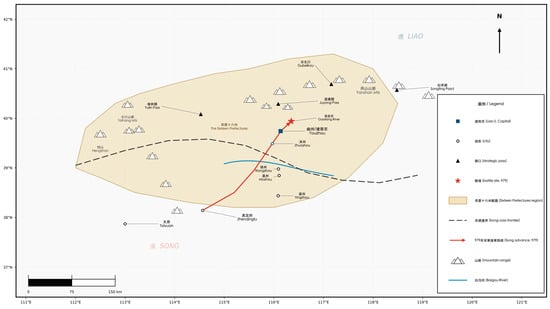
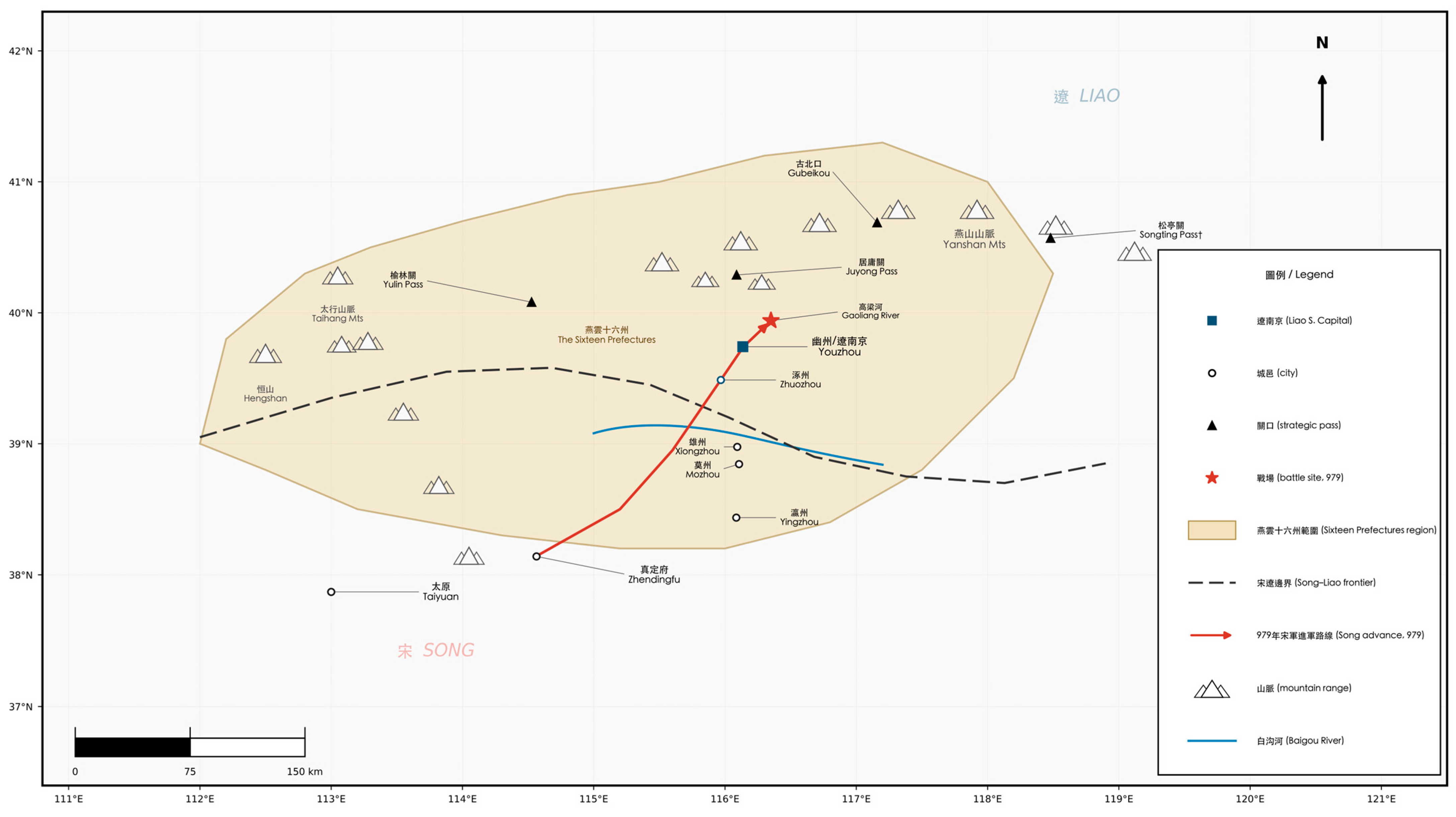
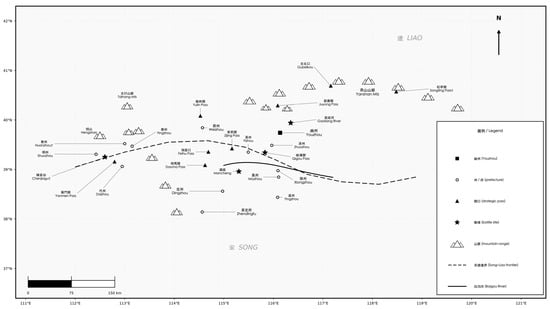
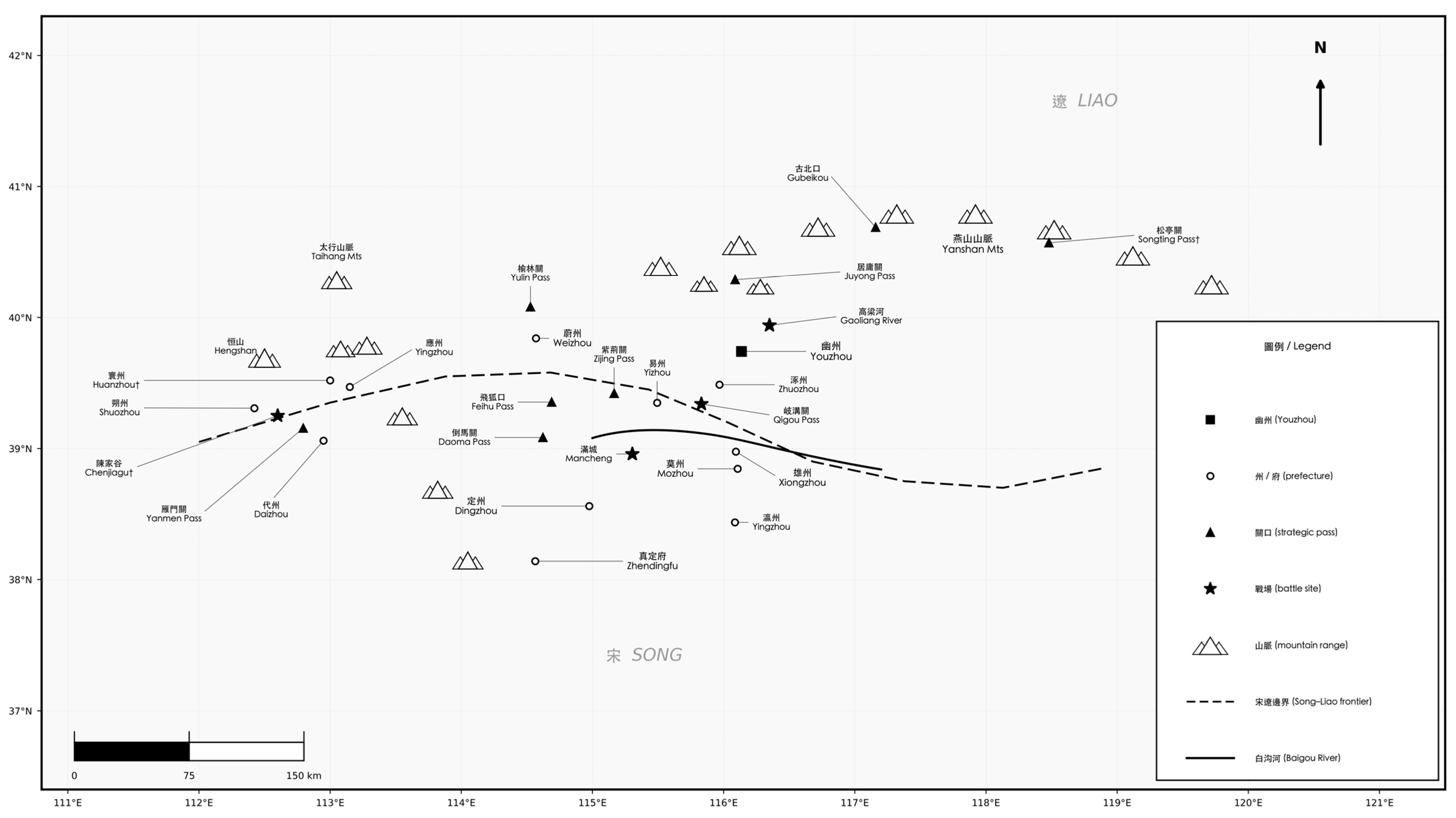
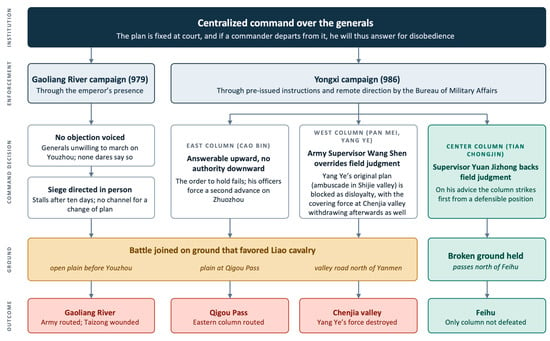
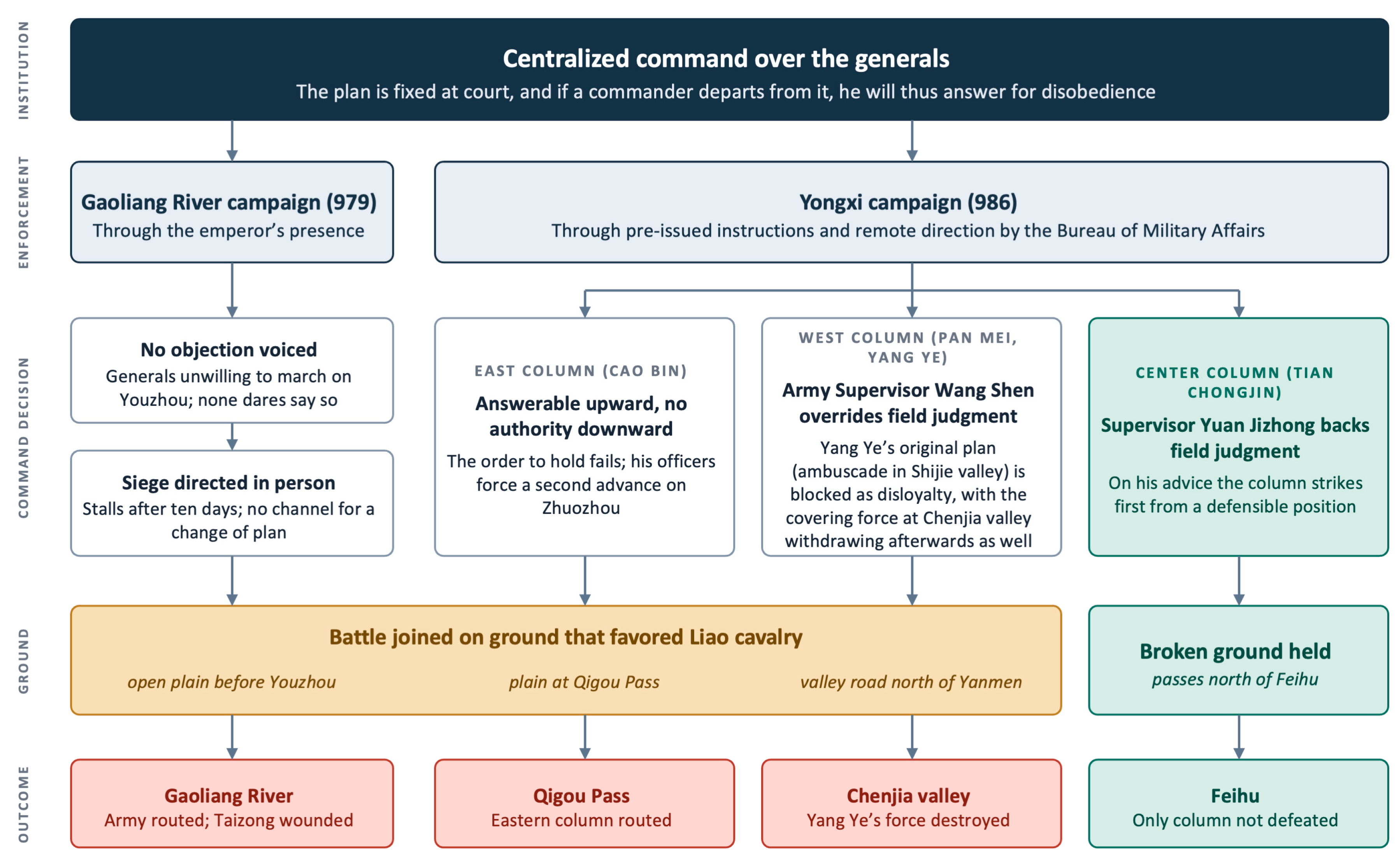
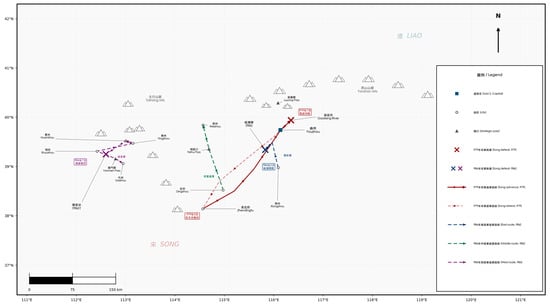
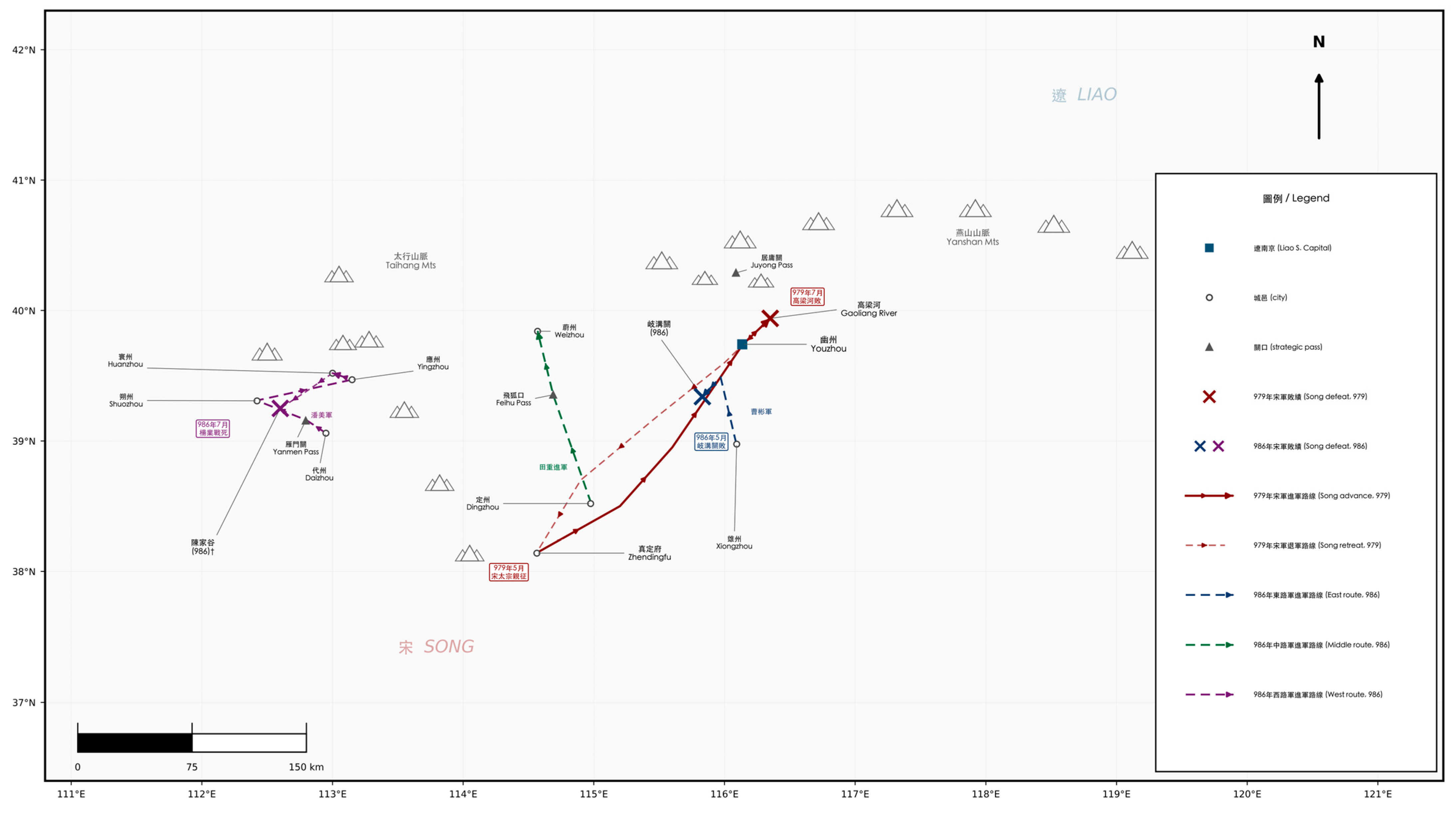

Disclaimer/Publisher’s Note: The statements, opinions and data contained in all publications are solely those of the individual author(s) and contributor(s) and not of MDPI and/or the editor(s). MDPI and/or the editor(s) disclaim responsibility for any injury to people or property resulting from any ideas, methods, instructions or products referred to in the content. |
© 2026 by the author. Licensee MDPI, Basel, Switzerland. This article is an open access article distributed under the terms and conditions of the Creative Commons Attribution (CC BY) license.