


Abstract
This article examines how “Blue Shirts” [藍衣社] was made and remade as a political label through press circulation in Republican China. Rather than assuming that each occurrence referred to a stable organisation, it analyses a recoverable inventory of 36 press records from the original research materials, supplemented by 36 records located through a separate public-source search, while distinguishing inspected pages, transcriptions, bibliographical records, and unresolved references. Close readings trace the label’s association with the Lixingshe [力行社] and its extension to other Nationalist actors during 1932–1936, followed by its reuse in Japanese and collaborationist reporting during 1938–1943. Comparisons of attributed news-agency reports in 1938 and 1939 show how shared dispatches acquired different headlines and political judgements, while a 1942 exposé documents the label’s movement between news and other print genres. In the passages analysed, “Blue Shirts” generally functions as an externally applied and often hostile designation whose referents shift across political and media settings. Uneven source coverage does not support claims about overall peaks in press reporting. The inspected occupation-era publications nevertheless continued to circulate the name after institutional reorganisation. The article therefore shifts attention from presumed organisational continuity to the ways circulation, attribution, and political accusation made shifting referents publicly intelligible.
1. Introduction
In the early 1930s, as European fascism and other authoritarian movements spread across borders, Chinese journalists and political commentators borrowed the “shirt” lexicon associated with Mussolini’s Blackshirts and Hitler’s Brownshirts to interpret domestic mobilisation.1 In the reports examined here, “Blue Shirts” [Lanyishe 藍衣社] designated actors associated with Chiang Kai-shek [蔣介石, 1887–1975], while also connecting Chinese political struggles with European fascist imagery.2 The term appeared to denote a concrete organisation and was widely taken as an alias for the Sanminist Lixing Society [Sanmin zhuyi Lixingshe 三民主義力行社], a clandestine fraternity of young Kuomintang (KMT, 中國國民黨) officers formed in 1932 under Chiang Kai-shek’s patronage (Deng 1984, pp. 24–25). Eastman’s account records comparisons with European fascist paramilitaries, including the Italian Fascists and their Blackshirt militia.3 Yet “Blue Shirts” was not an official designation: as Eastman notes, the organisation’s formal name was more complex, and “Blue Shirts” did not function as an official or legal title in KMT records (Eastman 1972, p. 1 n. 1).
From 1932 onward, newspapers and magazines in the Republic of China (ROC, 中華民國) used “Blue Shirts” as a loosely bounded label for clandestine political actors.4 In October 1932, Japanese reports, including those in the Asahi Shimbun 朝日新聞, associated the group with fascism. Chinese-language reporting also discussed these allegations: one surviving bulletin expressly identified the Shanghai Nichinichi 上海日日新聞 as its source.5 In the prewar examples examined here (1932–1936), journalists used “Blue Shirts” as a flexible press label applied to multiple KMT-adjacent formations. Depending on the context, the term could refer to Chiang Kai-shek’s political corps, but it was also extended to other military, youth, and policing/security units in reports that framed such actors as conspiratorial, ultranationalist, or “fascist-like”.6 Japanese diplomatic pressure—most notably the 1935 Ho–Umezu (He–Mei) Agreement (何梅協定)—pressed Nanjing to curb activities deemed “inimical to Sino–Japanese relations,” including calls to suppress Blue Shirt-linked mobilisation.7
The wartime materials examined here, especially those published between 1938 and 1943, reveal a further change in the label’s uses. The inspected Qingdao Xinmin Bao, Hebei Ribao, Guomin Xinwen, Taiwan Xinminbao, and Taiwan Shinbun items apply “Blue Shirts” to alleged factional conflict, changes in allegiance, intelligence work, or underground resistance. These reports do not consistently identify the organisation to which the named actors allegedly belonged. This article follows those changes through attributable publications and comparisons of shared dispatches. The prewar and wartime sections designate historical settings for close reading, not two demonstrated statistical peaks. A brief postwar coda considers the persistence of the name in retrospective print culture.8
2. Historiography and Research Question
Scholarship on the Blue Shirts has long been organised around two related questions: what organisation the name referred to, and whether that organisation should be classified as fascist. Eastman reconstructed the Blue Shirts as a secretive Nationalist formation whose ideology and practices could be examined within the history of fascism. Chang likewise treated the movement as a fascist-oriented expression of developmental nationalism, while Chung emphasised its elitist character and distinguished it from a mass fascist party (Eastman 1972; Chang 1985; Chung 2000). Wakeman complicated a simple equation between one organisation and one ideology. His reappraisal of the Nanjing Decade placed fascistic tendencies within a broader Nationalist political culture in which anti-communism, cultural conservatism, disciplinary mobilisation, and state-building overlapped (Wakeman 1997); his later work on Dai Li [戴笠, 1897–1946], the Nationalist intelligence chief who later directed the wartime security apparatus, also showed how the Blue Shirts name became entangled with changing security institutions (Wakeman 2003). Taken together, this literature makes “fascism” an important but unstable category for Republican China. Similar symbols, practices, and vocabularies could move across organisations without producing a single coherent Chinese fascist movement. The problem is therefore not resolved by assigning the Blue Shirts a firmer taxonomic label. It also requires examining how contemporaries themselves used “Blue Shirts” and “fascist” as categories of description, analogy, and political accusation.
The disagreement is partly one of scale. Eastman’s institutional reconstruction, Chang’s account of developmental nationalism, and Chung’s emphasis on elitist mobilisation do not necessarily describe the same analytical object as a newspaper accusation (Eastman 1972; Chang 1985; Chung 2000). One asks about political organisation and programme; another asks what a contemporary speaker made an adversary appear to be. Standard comparative accounts of fascism supply criteria for interpreting ideology, mobilisation, and political practice, but their classifications cannot settle the referent of each occurrence of a press label. The survey framework represented by World Fascism is useful at that comparative level (Blamires and Jackson 2006; Payne 1995; Paxton 2004). Here it provides context for the vocabulary, not a substitute for identifying the speaker and target in a particular report. This distinction preserves the substantive debate over Nationalist authoritarianism while opening a separate question about public categorisation.
This question also belongs to the broader revision of Guomindang history. Earlier narratives often approached the Nanjing government primarily through authoritarian failure, factionalism, and eventual defeat. More recent work has placed greater weight on Nationalist state-building, wartime mobilisation, political culture, and the effects of the Sino-Japanese War on institutions and society. The 2011 Modern Asian Studies Special Issue introduced by Rana Mitter and Aaron William Moore exemplified this shift by treating the war as a central setting for reassessing the Nationalist state and the political and social transformations of wartime China (Mitter and Moore 2011). Brian Tsui’s account of a “conservative revolution” similarly situates Guomindang nation-building within the global rise in radical right-wing politics while stressing the specifically Chinese combination of revolutionary nationalism, anti-communism, modernisation, cultural conservatism, and spiritual mobilisation (Tsui 2018). From this perspective, the Blue Shirts should not be isolated as an exotic fascist anomaly. They formed part of a contested Nationalist political order in which party discipline, youth mobilisation, security institutions, cultural projects, and rival claims to revolutionary legitimacy overlapped. A press history of the label can therefore complement organisational history by showing how these contests were named and understood in public.
Hirayama’s study of the Chinese Youth Party (中國青年黨) further widens this setting. His reconstruction follows a radical-right movement beyond the Guomindang and shows that the Chinese political right contained competing projects and changing strategies. The relevance here is comparative: the existence of a broader right-wing field makes it particularly hazardous to read one circulating designation as a transparent institutional classification. The Youth Party is not treated as another name for the Blue Shirts. Its history instead helps identify the plurality against which allegations of a unified clandestine enemy acquired their simplifying force (Hirayama 2022).
Clinton’s concept of “revolutionary nativism” provides an especially important bridge between these debates. Her analysis of the Blue Shirts and the CC Clique (CC 系) shows that radical-right politics in 1930s China worked through cultural claims, moral hierarchies, anti-left violence, and attempts to define an indigenous basis for national cohesion, not simply through institutional imitation of European fascism (Clinton 2017, pp. 20–21, 26). Yet most scholarship, including the most revisionist work, necessarily begins from historically reconstructed organisations, leaders, programmes, and networks. The present article starts from a different empirical problem: contemporary newspapers did not use “Blue Shirts” consistently as a synonym for the Lixingshe. It suggests that the Blue Shirts label itself helped organise political perception. It also helps explain the continued appearance of the name in the wartime sources analysed here, where publishers attached it to alleged Nationalist underground activity without establishing continuity with the Lixingshe of 1932.9
Recent research sharpens the distinction between political borrowing and retrospective classification. Zhou reconstructs Chiang Kai-shek’s changing engagements with fascism during 1927–1937, including missions to Italy and Germany and selective appropriation in the New Life Movement (新生活運動). This analysis shows why public disavowal and practical interest in fascist techniques need not be mutually exclusive. For the present article, this prevents a mistaken inference: exposing instability in the “Blue Shirts” label does not demonstrate the absence of ideological borrowing or authoritarian experimentation. Conversely, evidence of such borrowing does not validate every newspaper attribution of a Blue Shirts identity (Zhou 2026).
Hedinger’s study of fascist internationalism likewise places political projects in Europe and East Asia within a shared field while explaining the obstacles that imperial competition posed to durable international institutions. This supplies a useful distinction between the movement of analogies and the formation of organisational links. Similar shirt imagery or common political language is evidence of a repertoire available for appropriation; it is not by itself evidence of a coordinated fascist organisation. The article therefore investigates the routes by which reports moved rather than inferring those routes from resemblance (Hedinger 2025).
Press history adds an institutional dimension to this problem. MacKinnon, Narramore, and Wang show why party control, commercial readerships, censorship, and editorial practice must enter an account of Republican newspapers (MacKinnon 1997; Narramore 1989; Wang 1994). Chin’s work on Xinhua Ribao 新華日報 makes the point especially relevant to wartime political communication: an outlet’s ability to publish and its choice of vocabulary operated under constraints (Chin 2020). The sources used here consequently enter the analysis as situated acts of publication. A dispatch can retain its agency provenance while acquiring a new headline; a denial can reproduce the designation it challenges; a commercial paper’s ownership or political environment can change between the prewar and occupation periods. These operations make a history of circulation necessary alongside a history of authors and organisations.
The history of occupation propaganda further explains why reuse need not preserve meaning. Taylor’s study of visual culture under Wang Jingwei [汪精衛, 1883–1944], head of the Japanese-sponsored Nanjing regime, identifies a regime that borrowed prewar and Japanese representational forms while struggling to control its message (Taylor 2021). His later study of collaborationist theatre traces the adaptation of material across wartime political boundaries (Taylor 2025). Alongside Kushner’s history of imperial propaganda and Martin’s reconstruction of the Wang regime’s security service, these works direct attention to the institutions that made an enemy designation usable (Kushner 2006; Martin 2001). This article applies that question to news and exposé writing: how did a publisher make “Blue Shirts” stand for an enemy of its preferred political order?
A final distinction concerns anti-fascist language. Yoshida’s reconstruction of Chinese Communist Party (CCP, 中國共產黨) discourse in 1943–1947 shows how anti-fascism could be reworked as political alliances and conceptions of the enemy changed. It therefore warns against treating the apparent scarcity of one expression in a recovered selection as the disappearance of a broader polemical language. For this study, a shift away from the exact term “Blue Shirts”, if established through comparable coverage, would still require explanation alongside other terms for Nationalist opponents. The present inventory does not supply that comparative test (Yoshida 2024).
Against this background, this article asks how the label “Blue Shirts” acquired changing referents and political meanings in the press between 1932 and 1943, and what its circulation reveals about contemporary understandings of fascism and clandestine politics. Its contribution is an account of externally imposed naming and the transmission of that naming across differently situated publications. Organisational history supplies the necessary points of comparison, but the unit of analysis is a published act of attribution. The following sections examine who named whom, what judgement the designation carried, and how a report reached a new readership. These questions turn conceptual history into a set of procedures for reading sources rather than a claim that the article supplies a comprehensive history of the concept of fascism.10
Two existing conceptual distinctions guide these procedures. Brubaker and Cooper separate categories of practice from categories of analysis. Applied here, the distinction means that “Blue Shirts” is initially recorded as somebody’s attribution, whereas “Lixingshe”, “CC Clique”, or “Juntong 軍統” is assigned as a contextual identification only when other evidence supports it. The same actor can therefore have a source-attributed designation and a different reconstructed institutional affiliation without the two fields being silently harmonised (Brubaker and Cooper 2000).
Koselleck’s account of asymmetric counterconcepts makes the unequal relationship between self-naming and hostile designation analytically productive. The comparison is bounded: “Blue Shirts” is not assumed to reproduce the universal oppositions that organise his examples. Instead, the analysis asks whether a text reserves legitimacy for its own political side while assigning the named opponent an identity that the opponent has not accepted. References to “returning to the correct side” and “our military police” provide concrete occasions for testing that asymmetry. The layering of older associations with newer referents also helps explain how a name could remain recognisable after institutional reorganisation. These are interpretations to be demonstrated in passages, not properties inferred merely from the existence of a hostile word (Koselleck 2004, chap. 10, pp. 155–91).
3. Sources, Corpus Design, and Analytical Approach
The evidentiary base has two separately documented components. First, an audit of the original representative table and the review-only dossier produces 36 distinct, locatable press records, numbered R01–R36 in Supplementary Material S1. Of these, 27 have a reproduced target page or article and nine have bibliographical or catalogue support only; the legibility and contextual limitations of particular reproductions are stated individually. Seven additional references in the original 17-item selection remain insufficiently located and are retained as unresolved entries, outside the annual totals. Second, a supplementary public-source search on 3 October 2026 located 31 records in colonial Taiwan newspapers and five further English-language or Soviet-area periodical records. These 36 additions retain the separate identifiers TW001–TW031 and NEW01–NEW05. The combined 72-record inventory is an inspectable record of recovered materials, not a random sample or a reconstruction of every item originally consulted. The original claim of more than one hundred retrieved references cannot be independently reproduced from a complete surviving worksheet and is therefore not used as an evidentiary denominator or a basis for periodisation. Table 1 presents eight representative records and distinguishes corrected source locators from the evidence available for each entry.
Table 1.
Eight entries from the original representative selection with corrected locators and verification status.
Representative passages are selected for variation in date, language, location, political position, genre, and attributed actor, and for the possibility of comparing wording. A locatable publication is retained in the inventory even when its full text is unavailable, but only legible passages support detailed textual claims. R09, a contextual Asahi record on diplomatic demands, does not itself establish a keyword occurrence in the displayed heading; R29 preserves a dated page whose article is insufficiently legible for dependable close reading.
Outlets are not treated as interchangeable. Shenbao 申報 and Xinwen Bao 新聞報 entered the research as metropolitan commercial newspapers, but their political conditions changed under occupation; the wartime Xinwen Bao item is therefore classified by its publication date and setting rather than by an unchanging commercial identity. Asahi reports are read in relation to Japanese political and imperial concerns. Guangzhou Minguo Ribao 廣州民國日報 and Nanning Minguo Ribao 南寧民國日報 supplied Nationalist-associated perspectives that cannot be equated automatically with the central party line. Datong Bao 大同報, Qingdao Xinmin Bao 青島新民報, Hebei Ribao 河北日報, Guomin Xinwen 國民新聞, and the Nanjing periodical Xin Dongfang 新東方 require attention to their occupation-era settings. The Taiwan extension introduces a distinct colonial press environment and a substantial Japanese-language component; it does not increase the number of independently observed mainland Chinese political constituencies. Taiwan Xinminbao 臺灣新民報 and Kōnan Shinbun 興南新聞 are successive titles in a newspaper lineage and are not treated as independent political voices. Communist, overseas, and English-language material is similarly identified by publication and genre. The original references to Zhongyang Ribao 中央日報, Da Gong Bao 大公報, Hongse Zhonghua 紅色中華, and Xinhua Ribao 新華日報 are retained where relevant, but no complete series of those papers was searched in a way that permits cross-outlet prevalence estimates.11
The original dossier documents access routes through Asahi Cross-Search, the China Historical Documents Total Database (Modern Newspaper in China, 1840–1949), the National Index to Chinese Newspapers and Periodicals, the Shanghai Library Shenbao database, and the War of Resistance and Modern Sino-Japanese Relations documentation platform. These are identifiable routes for the reproduced records, not a reconstructed log of the original searches. The new search separately examined publicly listed monthly indexes at Academia Sinica’s Taiwan History Digital Library. Across the three newspaper entrances for 1932–1943, 156 listed newspaper-months yielded 738,294 original-language headline entries. Searches covered both traditional- and simplified-character forms of “Blue Shirts”, Japanese ブルー・シャツ variants, and English Blue Shirts variants, with manual source-directed searches for Lixingshe and Fuxingshe 復興社, particular people, titles, and dispatches. Modern translated headings and interface text were excluded. Eighteen Taiwan records matched original headlines, and 13 additional records matched the database’s selectively transcribed bodies. These body texts are not comprehensive OCR of all articles, and the 31 matches are not a full-text census. Supplementary Material S2 records the search scope, inclusion rules, annual and monthly coverage, and the distinction between the 2026 search record and the unavailable original research log.
Publication and transmission are recorded on separate levels. A publication record is one identifiable article or item in a particular issue, edition, and page. Duplicate images of that publication count once: for example, dossier B19/B40, B24/B54, and B29/B52 are duplicate evidence, not additional articles; original S01 and S02 refer to a single bulletin item, R04. A source family groups publications only when an explicit agency credit, reprint statement, or adequately matched text supports the relationship. Shared subject matter, similar headlines, or chronological proximity are insufficient. For the July 1938 and September 1939 Domei News Agency (Dōmei Tsūshinsha 同盟通信社) families, each of three downstream publications is retained for comparison of presentation, while the originating report is treated as one attributed source family. The dispatch manuscripts have not been recovered, and the dates of newspaper publication do not establish copying from one newspaper to another. Where the earliest surviving publication is known, it is called the earliest located witness, not automatically the original composition.
Figure 1 and Supplementary Material S2 disclose the annual composition of the recoverable inventory, including source background, evidence status, and attributed transmission. They describe the materials available for this study. The Taiwan indexes have no listed coverage for 1934 or 1937 and extremely small coverage for 1935 and 1936; missing months and selectively transcribed bodies make a general two-peak frequency claim untenable.
Figure 1.
Annual composition of two separately assembled inventories. Counts describe recovered publication records, including metadata-only and contextual records; they are not estimates of all newspaper coverage. The original panel includes R09, whose displayed heading does not verify the keyword, and R29, whose page is not sufficiently legible for close reading. The extension combines original-page, fragment, transcription and metadata evidence. A zero means no inventoried record, not proven historical silence. Source: Supplementary Material S1 and S2.
The descriptive fields in Supplementary Material S1 distinguish source language from contextual identification. “R” does not mean historically reliable, “A” (explicit source attribution) does not establish verbatim reproduction, and “U” (unknown transmission) does not mean original reporting. Quoted accusations establish what a publication represented, not membership, responsibility for violence, or the size of a clandestine network. Chinese names and terms are given in traditional characters; Japanese-language source wording is preserved in its original orthography. Phrases used for close reading are retained beside English translations, which are the authors’ unless stated otherwise. Brief biographical identifiers are added only when independently supported; source-attributed identities are not upgraded into reconstructed roles.
4. Formation and Expansion of the Label, 1932–1936
4.1. Emergence and Early Referential Instability, 1932–1934
The earliest inspected reports date from 1932 and frame “Blue Shirts” through comparisons with European fascism.12 Deng and Eastman reconstruct the Lixingshe as a clandestine corps established in Nanjing in March 1932 under Chiang Kai-shek’s patronage, with a core of young Whampoa Military Academy [Huangpu junxiao 黃埔軍校] graduates. Their accounts describe its ambition to act as a revolutionary vanguard implementing the principles of Sun Yat-sen [孫中山, 1866–1925], strengthening KMT discipline, and opposing Communism and Japanese expansion.13 Chang’s account links the group with blue-grey Zhongshan-style (中山裝) uniforms. This association provides context for the press comparisons, but does not by itself establish how the name first circulated.14 Eastman distinguishes the public designation “Blue Shirts” from the organisation’s formal title.15
For orientation, Table 2 separates a reconstructed organisational relationship from the shifting public designation. Its purpose is not to settle every institutional boundary, but to prevent recurrent names from doing the work of evidence. The Lizhishe is kept separate from the Lixingshe; the CC Clique is a rival formation, even when newspapers conflated its activities with those of “Blue Shirts”. The Special Services Department and its later incorporation into the wartime security apparatus likewise require a dated institutional account.
Table 2.
Organisational orientation and the press designation.
In the same season, Shanghai was engulfed in the January 28 Incident, a Japanese military attack that lasted from January to March 1932. Relief, service, and propaganda organisations became publicly visible during the crisis. The Lizhishe [勵志社], a Nationalist-affiliated service organisation, should be distinguished from the clandestine Lixingshe [力行社]. Accounts of shared premises, uniforms, or personnel help explain how observers could confuse the two names, but they do not establish organisational identity.16 The original research notes include an item in Jing Bao claiming that “Blue Shirts” was actually Lizhishe, as well as the separately dated Kankan discussion of Blue Shirts rumours and a Shenbao advertisement for a Lizhishe cadre school. These references are retained with their differing verification status in S1. They cannot be combined into a single verified origin story for the label. Comparisons with European shirt movements supplied journalists with an available language of militant mobilisation; the specific route by which a uniform colour became a political name still has to be demonstrated source by source.17
Deng’s later account reproduces a 1932 statement in which Chiang rejected the importation of foreign extremist models into China: “We cannot revive our revolutionary organization by imitating Italy’s Fascisti… forcing it upon China is no different than the Communists trying to Bolshevize China. The only organization for China’s revolution is the Kuomintang. If there are any other organizations, I cannot approve of them.”18 Chinese original: “吾人既不能恢復其固有唯一之革命組織,而又仿效意大利之所謂法西斯蒂的組織,來強行之於中國,是何異於共產黨欲以中國為共產化……只知中國革命的組織,惟有一個中國國民黨組織……如有其他的組織,中正惟不能贊同.” See also Da Gong Bao, 11 July 1932, for Chiang’s public letter of refutation (Eastman 1972, p. 1 n. 1; Da Gong Bao 1932, p. 14). Eastman reads Chiang’s public refutation as an affirmation of the Kuomintang’s exclusive revolutionary legitimacy, rather than a direct clarification of the “Blue Shirts Society” designation.19
The October 1932 material shows how an allegation could cross linguistic and institutional boundaries without yielding a settled definition. Asahi Shimbun published reports on 5 and 6 October associating a “Blue Shirts” formation with Chiang and with an alleged declaration abandoning Manchuria. The surviving Chinese bulletin item requires a correction to the presumed transmission route: Wailun Tongxingao, no. 186, p. 1, explicitly attributes its starting report to the Shanghai Nichinichi evening edition of 4 October. Its exact publication day is not established by the reproduced page, and it is not evidence of a direct translation from Asahi on 6 October.20 The bulletin combines fascist classification, an alleged policy declaration, and commentary on how foreign reports were relayed into Chinese political discussion. These witnesses belong to a related reporting controversy, but a direct chain from Asahi to the bulletin cannot be inferred from similarity alone. Central News Agency denials are more securely documented in Wuhan Ribao on 10 October and Shansheng Ribao on 12 October, the latter carrying an 8 October Nanjing dispatch. Their phrases of fabrication contest the allegation’s truth while repeating the disputed designation. Thus the denial itself could help circulate the name without acknowledging a legally constituted “Blue Shirts Society”.21
By late 1932, “Blue Shirts” was visible in several distinct publishing settings. Yet its predominantly external use should not be turned into an assertion that no Nationalist ever adopted it. Liu Jianqun [劉健群, 1902–1972], an important Lixingshe figure, used the name in a tract later appended to Fuxing Zhongguo geming zhi lu (1934). His usage is an exception that matters: an individual’s programmatic appropriation of a name is not equivalent to consistent institutional self-designation. Read beside Chiang’s public refutation and the hostile press descriptions, it shows a struggle over who could name the formation and what the name implied. This uneven relationship between self-description and external classification is more precise than either treating “Blue Shirts” as an official organisational title or declaring it an entirely invented expression with no connection to Nationalist actors.22
Other Shanghai references in the original research notes are less securely located. Two items attributed to the Fuermosi [Holmes] column describe Dai Li and Gu Shunzhang [顧順章, 1904–1935] as expanding Blue Shirts networks and senior officers as enjoying lavish lives. A Jing Bao reference identifies the group with Lizhishe. Their host issues or exact locators remain unresolved; S1 preserves all three rather than assigning them invented dates. These reports cannot demonstrate the scale of rumour circulation or prove the alleged affiliations. They do, however, identify specific questions that the more securely documented newspaper material can test: how broadly the name could travel, which kinds of secrecy it evoked, and when reporting displaced an identifiable organisation with a generic clandestine actor.23
A securely dated English-language example adds a distinct political viewpoint. Niel-Sih’s letter on the arrest of Chen Duxiu [陳獨秀, 1879–1942] appeared in The Militant on 26 November 1932, although the letter itself was dated 27 October. Its discussion of “Chiang’s Blue Shirts” placed the designation within Trotskyist criticism of Nationalist repression. The item demonstrates circulation outside the Chinese–Japanese reporting controversy, without establishing an independent source for every allegation it repeated. It also illustrates why dates must be separated: a letter’s composition date cannot be counted as the newspaper’s publication date. These distinct publishing settings demonstrate the label’s availability across political languages, while the incomplete retrieval record prevents a reliable estimate of its overall frequency.24
The 1933–1934 materials connect the label with coercion and factional mobilisation, although their evidentiary strength varies. The original Hongse Zhonghua reference describes military political instructors as “Blue Shirts”, and Xiangdao is cited for an alleged assassination list. The former remains unlocated and the latter has a locator without the target page; neither independently supports a broad claim about Communist usage.25 More securely, the reproduced page of Zhongguo Luntan asks how students should organise against the Blue Shirts. The printed page is 7, while the catalogue supplies a different pagination, 26–27; both are retained in R18. Its mobilisation language presents “Blue Shirts” as an adversary rather than furnishing a membership register. The Jinan University conflict of 1933–1934 provides an institutional setting for that reading.26 University proclamations and Chen Ling’s later reconstruction distinguish campus disputes and factional intervention from the press label attached to them. They permit discussion of CC- and Whampoa-linked mobilisation without treating every actor called “Blue Shirts” as a Lixingshe member. The article therefore separates the contemporary act of accusation from a later reconstruction of the people involved. Xu and Billingsley’s account of the limits of knowledge about clandestine networks helps explain why the two need not coincide (Xu and Billingsley 1998, pp. 284–87, 295, n. 37).
The two language sections of Taiwan Xinminbao on 20 June 1933 provide an unusually close comparison. The Chinese headline presents the assassination of Yang Xingfo [楊杏佛, 1893–1933] as apparently the work of the Blue Shirts, using the qualification 似為. The Japanese headline connects the assassination with Blue Shirts indignation, while the body also frames the interpretation as something regarded as probable. The two items occur in the same issue on different pages; they are distinct publications, but neither independence of reporting nor verbatim translation has been established. Their importance lies in how readers encounter an apparently named agent before any organisational verification is supplied. The Chinese uncertainty marker is therefore retained in the English interpretation rather than converted into an unqualified assignment of responsibility (Taiwan Xinminbao 1933, morning pp. 1 and 4; Supplementary Material S1, TW001–TW002).
The inspected Central News Agency responses of October 1932 deny particular allegations and warn against the circulation of rumours; they do not supply a stable organisational definition of “Blue Shirts”. Ferlanti’s account of the New Life Movement provides a separate institutional context for Lixingshe-linked mobilisation within wider KMT programmes.27 Eastman and Chang describe Nationalist concern about the name’s unwanted publicity and political implications.28 These accounts help explain the contested designation, but the observed result in the press material is narrower: published accusations and denials did not consistently identify the same organisation.29
The inspected 1932–1934 examples associate “Blue Shirts” with fascist analogies and alleged clandestine activity, while published denials leave its referent unsettled. These findings concern the selected texts rather than all press usage. They provide a basis for examining how particular reports used the name during the North China crisis of 1935–1936.30
4.2. North China Crisis and Referential Expansion, 1935–1936
The North China crisis of 1935–1936 changed the political work that the label could perform. Alongside intra-KMT accusation, reports linked it to anti-Japanese mobilisation and demands for suppression.31 The verified examples include a September 1935 Central News Agency denial carried by Shenbao, Japanese suspicions reported by Xin Tianjin, and hostile characterisations in Datong Bao. Reading the named speaker and the report’s qualifying language makes it possible to distinguish a newspaper’s reproduction of an allegation from its own assertion of fact.32
Wakeman’s reconstruction places these competing attributions within rivalry between the Lixingshe and the CC Clique, the Nationalist faction associated with brothers Chen Guofu [陳果夫, 1892–1951] and Chen Lifu [陳立夫, 1900–2001] (Wakeman 2003, pp. 98–109; Eastman 1972). Chen Ling’s later study interprets the Jinan University conflict of 1933–1934 as factional mobilisation involving Whampoa- and CC-linked actors. This interpretation supplies institutional context; the contemporary Zhongguo Luntan passage itself does not verify every participant’s affiliation or establish that CC operatives deliberately impersonated Lixingshe members.33
Ferlanti records a rumour that Deng Wenyi [鄧文儀, 1905–1998] was removed from his Nanchang post in 1934 (Ferlanti 2010, esp. n. 23; Eastman 1972). Wakeman’s account of factional rivalry likewise supplies retrospective context rather than independent proof of how each newspaper used the designation (Wakeman 2003, pp. 98–109). Gan Guoxun [干國勳, 1907–1983] offered a further retrospective intervention in 1972. In “Interpreting the ‘Blue Shirts’ and Remembering Liu Jianqun”, he presented “Blue Shirts” as an external label, downplayed Liu’s role, and maintained that the founders had not intended to adopt that name. Gan’s argument is evidence of later contestation over naming, not a contemporaneous institutional record of the founders’ intentions (Gan 1972, p. 18).
The original Shanghai references retain evidence of the research’s wider questions but require differentiated treatment. The Shenbao item describing Yuan Shu [袁殊, 1911–1987] as a Blue Shirt remains unlocated. Xinwen Bao of 21 October 1935 and Shenbao of 29 November 1935 supply locators for reports of personnel sent north and disruption of Hebei construction, but their pages have not been rechecked. They remain in the reference list and in S1 with reduced evidentiary weight.34 By contrast, the supplied reproduction of Shenbao, 3 September 1935, can be read directly: it carries a Central News Agency dispatch denying Japanese reports of Blue Shirts disturbances in Hebei. The database page is 3. Shenbao of 4 November 1935, p. 7, likewise reports Japanese arrests in Tianjin; it does not verify the separately cited 15 December item. The available wording thus permits a comparison of official denial and reported arrest without attributing the same evidentiary status to every related reference.35
The contrast is clearest where source language marks uncertainty. Xin Tianjin’s 12 August 1935 report attributes suspicion in the Liu Zuozhou [劉佐周, 1907–1935] case to the Japanese side; the article’s alleged perpetrator is therefore not an independently identified Blue Shirts member (Xin Tianjin 1935, p. 2; Supplementary Material S1, R22). Datong Bao on 9 June 1935 instead represents the Blue Shirts as the “root” of anti-Japanese activity and advocates their elimination. The transition from attributed suspicion to an encompassing hostile category makes the label politically useful even without a precise membership list.36 The earlier catalogue references and the inspected passages should not be collapsed into one level of evidence. Taken together, the inspected examples establish variation in attribution and judgement, while the unresolved entries remain a record of what still needs verification.37
The diplomatic records give the name a specific role in the North China crisis of 1935. Zhang and Pu and Dryburgh situate Japanese demands within the negotiations leading to the Ho–Umezu (He–Mei) Agreement in June–July and the Qin–Doihara Agreement [Qin–Tu xieding 秦土協定] of 27 June. The cited U.S. diplomatic reports record pressure to withdraw Nationalist party organisations and suppress activities characterised by Japanese representatives as anti-Japanese (Zhang and Pu 2018, p. 119; Dryburgh 2000, p. 6; U.S. Department of State 1953, doc. 238, p. 278, and doc. 240, p. 281; Eastman 1974). In those reports, Japanese representatives singled out the “Blue Shirts”, sometimes alongside the Fuxingshe, as agencies allegedly harmful to Sino-Japanese relations. These designations identify the targets of diplomatic demands; they do not independently verify the targets’ membership or responsibility for particular disturbances (Zhang and Pu 2018, pp. 113, 119; Qin 1981, pp. 682–83; U.S. Department of State 1953, doc. 238, p. 278). The inspected Xin Tianjin and Datong Bao items similarly attach the name to alleged anti-Japanese activity. The wartime examples require separate, dated analysis rather than extension of this diplomatic usage to all occupation-era reporting.38
Reports produced under Japanese influence gave the designation a further political function. Datong Bao’s 1936 description of “Communist-affiliated Blue Shirts” is especially revealing because it cuts across the anti-communist identity normally associated with the Lixingshe. The phrase is preserved as an accusation in that newspaper, not resolved by inventing a corresponding Communist organisation. Its analytical importance lies in the mismatch: a familiar enemy name could gather together actors whom organisational history would distinguish. The Japanese and occupation-era materials thus require comparison of words of attribution, named institutional authority, and proposed response, rather than reconstruction of a uniform organisation from the name alone.39
The political force of the label did not depend on every text explicitly using the word “fascist”. European shirt analogies could establish an initial association, after which reports of secrecy, coercion, and armed organisation made the name intelligible without repeating the comparison. The North China Herald and missionary commentary cited in the original article remain relevant to this broader interpretive setting, rather than supplying an independent count of Blue Shirts organisations.40 Nor does a fascist analogy by itself identify an ideological programme. The distinction matters for the occupation-era arrest narratives examined in Section 5.2: those sources apply a name previously associated with anti-left politics to alleged opponents of Japanese or collaborationist power (Chung 2000; Eastman 1974, chap. 2; North China Herald 1934; Paton 1937, p. 57; Ferlanti 2010, n. 44).
The continued use of the term outside those institutions is visible in V. R.’s “How Shall We Support China” in Socialist Appeal on 13 November 1937. The article identifies Chen Lifu with the organisation of the Blue Shirts. Read against the institutional distinction between the CC Clique and the Lixingshe, that statement is evidence of the author’s categorisation rather than proof that the two were identical. Its wartime date also cautions against treating 1937 as a year in which the name simply disappeared. The English-language addition broadens the comparison of political naming, but is kept separate from the Chinese and Japanese press inventory’s original retrieval history (V. R. 1937; Supplementary Material S1, NEW02).
The selected prewar polemics associate “Blue Shirts” with clandestine coercion or fascist politics. The cited Japanese demands, as recorded in U.S. diplomatic reports, invoke the “Blue Shirt Society” alongside Kuomintang party headquarters (rendered “Tangpu” in those records; dangbu 黨部) in allegations of anti-Japanese and anti-“Manchukuo” activity in the Peiping–Tientsin region (Chang 1979; Chung 2000; Zhang and Pu 2018, pp. 113, 119; U.S. Department of State 1953, docs. 331 and 337). The organisational core associated with the Lixingshe/Fuxingshe was formally reorganised during 1938 rather than simply disappearing. Wakeman notes that the “Blue Shirts Society” was formally disbanded after the Wuchang conference in March 1938, with local offices and budgets folded into the Three People’s Principles Youth Corps (三民主義青年團; Sanmin zhuyi qingnian tuan, “Sanqingtuan”) in July 1938 (Wakeman 2003, pp. 83, 130–31). In parallel, Dai Li’s Special Services Department (the Fuxingshe’s “second department”) was reorganised within the Military Affairs Commission as the Bureau of Investigation and Statistics (Juntong 軍統), under Dai’s effective direction (Wakeman 2003, pp. 81–83, 130–31). Later scholarship has traced some personnel and functions associated in public discourse with the “Blue Shirts” into official Nationalist security and youth-mobilisation structures (Wakeman 2003, pp. 81–83, 130–31). In the inspected Guomin Xinwen and Taiwan Shinbun examples discussed in Section 5.2, the designation is attached to alleged Chongqing-linked personnel or underground networks targeted for arrest.41 The wartime continuity examined below therefore concerns the continued use of the name, not proof that the Lixingshe of 1932 survived unchanged.
The item-level examples in Supplementary Material S1 should therefore be read by source background rather than simply counted. Japanese colonial and collaborationist publications are prominent in this wartime selection; that composition reflects the recovered evidence, not their share of all wartime reporting.42
The July 1938 reports compared below also show that factional meanings persisted alongside occupation-era security language.43
The recovered inventory cannot establish a general post-1937 decline in KMT or CCP use of the name. Its wartime selection favours Japanese and occupation-era sources, and the original searches of party-aligned papers are not reproducible as comparable series. Yoshida’s study of CCP anti-fascist discourse in 1943–1947 demonstrates that anti-fascist argument persisted and changed its targets and political logic (Yoshida 2024). The two Xinhua Ribao pieces of August 1945 cited in the original manuscript remain contextual references to that wider vocabulary, not proof of the frequency or disappearance of “Blue Shirts”.44
Within these limits, the available wartime witnesses document use of the name in the specified Japanese colonial and collaborationist publications. Their significance lies in demonstrable acts of circulation and reinterpretation, particularly when the same attributed dispatch can be followed across publications. The comparison below consequently asks how a shared report framed its named actors and how an occupation-era publication made that framing serve its political perspective.45
5. Wartime Reuse in Japanese and Collaborationist Reporting, 1938–1943
The wartime publications examined here attach different meanings to the name. Reports of alleged intra-Nationalist conflict appear alongside accounts of reported defection, arrests, intelligence work, and resistance. This section begins with two source families whose newspaper witnesses survive and then considers the movement of an arrest narrative between newspaper and exposé book. The comparisons distinguish a stable printed designation from changing predicates: what the named “Blue Shirts” allegedly did, whom they obeyed, and why readers were invited to regard them as dangerous or defeated.
5.1. Shared Dispatches and Different Political Emphases
Three publications on 23 July 1938 carry a common attributed origin: a Domei report from Hong Kong dated 21 July. Qingdao Xinmin Bao calls the alleged Blue Shirts an organisation directly associated with Chiang and makes “intense internal struggle” its dominant headline. Taiwan Xinminbao stresses two contending currents (藍衣社に二派の暗流), whereas Taiwan Shinbun 臺灣新聞 foregrounds a hidden struggle (藍衣社の暗鬪) and Chiang’s reported alarm. The surviving texts connect the story with the alleged detention or questioning of Chen Yi [陳儀, 1883–1950]. That allegation is not independently verified here. What the source comparison does establish is that three newspapers presented a report carrying the same agency and dateline, with different headline emphases. Accordingly, they supply three publication witnesses but one attributed source family for this event (Qingdao Xinmin Bao 1938, p. 1; Taiwan Xinminbao 1938, evening p. 1; Taiwan Shinbun 1938, daily p. 2; S2, F02).
This family is also a check on an overly linear wartime interpretation. Its main frame remains conflict within Nationalist politics rather than a newly bounded anti-occupation resistance organisation. “Blue Shirts” gives unity to the adversary whose internal disunity the report then celebrates. That tension helps explain the label’s usefulness: it makes a changing set of alleged factions recognisable as a single political object. Because the Domei manuscript is missing, the differences cannot all be assigned confidently to local editors, but the resulting presentations in the printed newspapers can be compared directly.
The September 1939 family makes the evaluative shift more explicit. Taiwan Xinminbao on 20 September, Hebei Ribao on 21 September, and Taiwan Shinbun on 22 September credit a Domei dispatch from Beiping dated 19 September about Jiang Zhengyuan [江正源] and 48 associates. The Taiwan Xinminbao headline announces withdrawal from the Blue Shirts (藍衣社を離脫) and participation in building a “new order” (新秩序建設參加を宣言). Hebei Ribao uses 反正 (“return to the correct side”) and 歸誠 (“pledge allegiance”), while Taiwan Shinbun foregrounds departure from Chiang’s government. These differences preserve an overlapping attributed referent but vary the political predicate attached to it. The common agency credit does not demonstrate that one newspaper copied the next, and the reported affiliation or defection remains an allegation in the source family (Taiwan Xinminbao 1939, morning p. 1; Hebei Ribao 1939, p. 4; Taiwan Shinbun 1939, evening p. 1; S2, F03).
The language of return is asymmetric because the publication supplies both the condemned identity and the terms of release from it. In the surviving passages, the alleged Blue Shirts are not given an equivalent opportunity to define their own position. “Correctness”, allegiance, and the “new order” locate the judgement within the publishers’ political horizon. This is the mechanism of labelling that the conceptual discussion anticipates: a name does more than identify an actor when the surrounding predicates organise the distinction between illegitimate opposition and acceptable conversion.
5.2. Arrest Narratives and Movement Between Print Genres
Occupation-era constructions of the “Blue Shirts” also circulated beyond newspapers. The exposé Lanyishe neimu [藍衣社內幕], attributed to Chen Gongshu [陳恭澍], is particularly useful because its appendix preserves a stated newspaper source. The consulted scan’s imprint gives April 1942 printing and first-edition information; the scan identifies its publisher as Guomin Xinwen Tushu Yinshua Gongsi 國民新聞圖書印刷公司 (G. Chen 1942, imprint and appendix p. 109). Jeremy E. Taylor’s account of the transformation of Captain of the Roving Bandits from anti-traitor drama into collaborationist anti-resistance theatre places such reuse within a broader history of wartime cultural borrowing (Taylor 2025).
On printed page 109, the appendix to Lanyishe neimu announces a major roundup of the Shanghai Blue Shirts and explicitly states that it reprints Guomin Xinwen of 28 November 1941. This establishes a declared newspaper-to-book relationship. The Guomin Xinwen page itself has not been recovered, so the book cannot establish verbatim fidelity or every feature of the original layout. Its political rhetoric is nevertheless inspectable: the account casts the alleged network as an enemy of the collaborationist “peace movement”, and interprets arrests as the defeat of Chongqing’s clandestine opposition. The source’s claims about numbers captured and material seized remain claims by the publishing authorities. The passage shows how a security narrative could be incorporated into a longer account of a recognisable political enemy.46
A related but distinct witness appeared in Taiwan Shinbun on 29 November 1941. Its headline announced the arrest of a large part of the “Shanghai Blue Shirts organisation” and celebrated the effectiveness of “our military police” (我憲兵隊の活動奏功); the report explicitly credits a Shanghai dispatch from Domei dated the previous day. The shared event and adjacent dates permit comparison with the Guomin Xinwen-derived book appendix, but they do not establish that either outlet copied the other. In one witness the publication speaks for Japanese military success; in the other, the arrest narrative supports the collaborationist peace programme. Their convergence demonstrates political framing of an alleged resistance network, while their uncertain relationship remains visible in the source register.47
The supplied Guomin Xinwen reproduction of 13 January 1942 provides a further, directly readable example. A portrait caption identifies Gu Wei [顧偉] as Chongqing’s “Blue Shirts” station chief in Suzhou, alongside a brief biography. The printed coupling of a named person, a local station, and the Chongqing designation gives the hostile category an apparently concrete institutional form. It is evidence that the newspaper attributed this identity to Gu Wei; the caption alone does not independently establish membership or every activity alleged in the accompanying account.48 Wakeman’s reconstruction of Dai Li’s intelligence apparatus supplies institutional context for such reports without converting their wording into a reliable organisational map.49 The previously cited Mao Wanli [毛萬里, 1903–1982] passage has a different status: its precise newspaper or magazine source has not been verified. The original wording and claimed citation are preserved in S1’s unresolved quotation register, but the passage no longer carries this section’s substantive argument.
The pattern remains visible in an inspected 1943 newspaper witness. Taiwan Shinbun of 13 May reports the destruction of a Hangzhou Blue Shirts organisation, credits a Domei dispatch of 12 May, and describes the capture of a named leader and his associates. Its language presents the rounding up of alleged anti-Japanese personnel as a completed security success. This is evidence of the continued usability of the designation in 1943, not proof that the reported cell had a direct institutional identity with the 1932 Lixingshe. A contemporary contents listing confirms that the January 1942 Xin Dongfang issue carried an item titled “滬藍衣社全部破獲”; its full target page remains uninspected. The alleged Zhongyang Tongxunshe/Xinwen Bao reproduction of 12 May 1943 remains only a provisional bibliographical record in Supplementary Material S1. The inspected Domei report does not verify that collaborationist agency attribution or turn those different records into a single established reprint chain.50
6. A Brief Postwar Coda
Postwar print culture preserved the name, but the recoverable evidence warrants a short coda rather than a continuous 1945–1949 press history. A digitised copy of Yixun’s Jiangdang zhenxiang 蔣黨真相, issued by Dongbei Shudian in December 1948, lists a chapter headed “Blue Shirts” (藍衣社). A different reproduced page in the original review-only dossier is catalogued as a 1949 printing and likewise discusses the designation; its edition-specific publisher and imprint have not been authenticated. These are retrospective witnesses to the recognisability of the label, not proof that a single 1932 clandestine organisation persisted after the war or that a particular postwar security network used the name as its official title.51
The postwar witnesses therefore identify a possible afterlife of the designation rather than extend the press inventory. Unlike a wartime dispatch, a later exposé organises memories and accusations retrospectively; the scale and reception of that afterlife require a separate study.
7. Conclusions
In the press passages examined here, “Blue Shirts” is generally a designation applied to others, with referents that cannot be reduced to a single institutional identity. Liu Jianqun’s programmatic use qualifies this finding: external naming predominates in these sources, but was not exclusive. The distinction between published attribution and reconstructed affiliation is therefore essential to interpreting the label.
The wartime comparisons show how a familiar name could be reused after institutional reorganisation without demonstrating the survival of the same organisation. Shared agency credits identify related publication witnesses, while differences in headlines expose distinct political emphases. They document circulation and framing, rather than independent corroboration of the reported events or proof of readers’ acceptance.
This press history complements the debate on Chinese fascism developed by Eastman, Chang, Chung, Wakeman, Clinton, and later scholarship (Eastman 1972; Chang 1985; Chung 2000; Wakeman 1997; Clinton 2017; see also Zhou 2026). It shows how fascist associations entered political accusation even where an organisational referent remained uncertain. A label’s contemporary force must consequently be examined alongside, rather than substituted for, evidence of ideology, membership, and institutional practice.
The uneven inventory does not establish overall wartime prevalence, a decline in KMT or CCP use, or two peaks in press coverage. Continuous newspaper series, combined with institutional and personal archives, would be needed to test when a published designation tracked a particular organisation and when it grouped different opponents under one accusation.
Supplementary Materials
The following supporting information can be downloaded at: https://www.mdpi.com/article/10.3390/histories6040064/s1. Supplementary Material S1 contains the corrected original 17-item selection, the 36-record original inventory, the 36-record supplementary-search inventory, contextual references and unresolved quotations, and an audit trail of corrected dossier captions. Supplementary Material S2 supplies annual distributions, source-background and transmission tables, source-family comparisons, coverage limitations, and the documented 2026 search procedure.
Author Contributions
Investigation, L.T.; data curation, L.Y.; formal analysis, L.Y.; writing—original draft preparation, L.Y.; writing—review and editing, L.Y. and L.T.; validation, L.T.; resources, L.T.; project administration, L.Y. All authors have read and agreed to the published version of the manuscript.
Funding
This research was funded by the European Union’s Horizon Europe research and innovation programme through the ReConnect China project (Grant Agreement No. 101061483).
Institutional Review Board Statement
Not applicable.
Informed Consent Statement
Not applicable.
Data Availability Statement
The recoverable item-level metadata and source locators are provided in Supplementary Materials S1 and S2. The complete original retrieval worksheet and search log are unavailable; the recoverable inventory does not reconstruct either record. Supplementary Material S2 documents the 3 October 2026 public-source search, including indexed coverage, search terms, inclusion and exclusion rules, publication-unit and source-family criteria, and the limits of the available evidence. The source-verification dossier is supplied for peer review and is not part of the published Supplementary Materials. Public source links are provided where available. Reuse of repository images remains subject to the relevant repositories’ terms; no separate repository deposit is claimed.
Acknowledgments
The authors thank colleagues and discussants at several workshops in 2024–2025 for their thoughtful comments on earlier drafts. The authors are also grateful to the librarians and archivists who facilitated access to historical press materials. During the preparation of this manuscript, the authors used ChatGPT (GPT-5.4, OpenAI) for English-language polishing, grammar, clarity, and editorial consistency. The authors reviewed and edited the output and take full responsibility for the content of this publication. The historical sources, references, evidence, and interpretations remain the responsibility of the authors.
Conflicts of Interest
The authors declare no conflicts of interest.
Notes
| 1 | For European “shirt” movements as a repertoire of fascist-style mobilisation and paramilitary symbolism, see (Payne 1995, p. 92; Paxton 2004, pp. 47, 89–90). |
| 2 | For directly inspectable press attributions, see Supplementary Material S1, R04–R05, R07–R08, R28 and R30; original S14 and S16 are retained with their limited verification status. See also note 5. |
| 3 | On early descriptions of the “Blue Shirts” and the ambiguity of the label, see (Eastman 1972, pp. 3–6). On European shirt movements as a repertoire, see (Paxton 2004, pp. 47, 89–90). |
| 4 | |
| 5 | (Asahi Shimbun 1932), 5–6 October, pp. 2–3. A separate bulletin witness, Wailun Tongxingao 外論通信稿, no. 186, p. 1, attributes the upstream report to Shanghai Nichinichi, 4 October evening edition; its own publication day is unresolved (Supplementary Material S1, R04; review-only dossier B22). |
| 6 | |
| 7 | For institutional reconstructions and Japanese concern surrounding the 1935 Ho–Umezu (He–Mei) Agreement, see (Eastman 1972, pp. 3–6; Bisson 1938, p. 55). These are retrospective analyses, not independent authentication of each newspaper allegation. |
| 8 | Supplementary Material S1, R28–R30 and TW010–TW011, TW020–TW021, TW029–TW030. The originally cited Tianjin Jingchaju (1937) proclamation is preserved as an unverified contextual reference in Supplementary Material S1, Q01. |
| 9 | See Supplementary Material S1, especially items S01–S14 and R28–R30, TW010–TW011, TW020–TW021, TW029–TW030. |
| 10 | (Koselleck 2004, chap. 10, pp. 155–91). The procedures and limits of the comparison are set out below; (Brubaker and Cooper 2000) distinguish categories of practice and analysis. |
| 11 | (MacKinnon 1997; Narramore 1989; Wang 1994; Chin 2020). Publication settings in Supplementary Material S1 are administrative provenance descriptions, not assertions of independent editorial authorship. |
| 12 | See Supplementary Material S1, items S01–S04; for historical background, see (Eastman 1972, pp. 3–6; Chang 1979; Clinton 2017, pp. 20–21, 26). |
| 13 | On the Lixingshe’s founding, elite-vanguard conception, and nationalist/anti-Communist orientation, see (Deng 1984, pp. 24–25; Eastman 1972, pp. 3–6; Chang 1985, pp. 3–6; Clinton 2017, pp. 20–21, 26). |
| 14 | (Chang 1985, pp. 3, 54; Eastman 1972, p. 1 n. 1). For representative early press usage, see Supplementary Material S1, items S01–S02. |
| 15 | (Eastman 1972, p. 1 n. 1); see also Supplementary Material S1, items S01–S04. |
| 16 | Supplementary Material S1, S06 and contextual references C04–C05: Jing Bao (1932), (Kankan 1932) and (Shenbao 1932) are retained as distinct records, with verification limitations stated. The original working-list citation does not supply a complete searchable corpus. |
| 17 | (Chung 2000; Chang 1979). Claims about the initial spread of particular shirt analogies are confined to inspectable passages rather than inferred from the unavailable working source list. |
| 18 | Chiang Kai-shek’s 1932 statement, as cited in (Deng 1984, p. 21). |
| 19 | (Da Gong Bao 1932, p. 14; Eastman 1972, p. 1, n. 1); see also Supplementary Material S1, items S01–S04. |
| 20 | (Asahi Shimbun 1932), 5 October, p. 2, article 3; 6 October, p. 2, article 2 and p. 3, article 1. The Wailun Tongxingao clipping, no. 186, p. 1 (Supplementary Material S1, R04; dossier B22), explicitly attributes its upstream story to Shanghai Nichinichi, 4 October evening edition. Neither a direct Asahi translation nor the bulletin’s exact publication date is established. |
| 21 | The contemporary denial reports are preserved as (Wuhan Ribao 1932, 10 October, p. 3; Shansheng Ribao 1932, 12 October, p. 2). The latter credits a Central News Agency dispatch dated 8 October; the original Shishi Xinwen Bao reference (Supplementary Material S1, S04) remains unresolved. |
| 22 | (Liu 1934, pp. 150–51, 154–55); supplied dossier B15 reproduces p. 151. The distinction here is between an individual programmatic use and an official institutional designation. |
| 23 | The original unresolved Fuermosi and Jing Bao references are preserved in Supplementary Material S1, S03, S05–S06. Their host issues have not been securely located and they are not used as independently verified evidence. |
| 24 | (Niel-Sih 1932, pp. 1, 3; Supplementary Material S1, NEW01). The original “at least two dozen” estimate depended on the unavailable complete Authors’ Press Source List and is not retained as a count. |
| 25 | The Hongse Zhonghua 1933 reference remains unresolved (Supplementary Material S1, S07). The Xiangdao (1933, p. 2) item has a bibliographical locator but no inspected target page (Supplementary Material S1, S08/R31). Neither entry independently establishes the accusation as historical fact. |
| 26 | For the inspected student-mobilisation text see (Zhongguo Luntan 1934, printed p. 7; catalogue pp. 26–27). See Supplementary Material S1, R18; contextual institutional materials include (Jinan Xiaokan 1933, 1934a, 1934b; L. Chen 2017). |
| 27 | The denial witnesses are (Wuhan Ribao 1932, 10 October, p. 3; Shansheng Ribao 1932, 12 October, p. 2). See also (Eastman 1972, pp. 3–6; Ferlanti 2010). |
| 28 | |
| 29 | (Chang 1985, pp. 4–6; Eastman 1972, pp. 1–2, esp. n. 1). For contemporaneous press constructions of “Blue Shirts” as a shifting menace, see Supplementary Material S1, items S01–S09. |
| 30 | |
| 31 | Supplementary Material S1, R07–R08, R22 and R24, with the original S12–S14 locator limitations preserved. |
| 32 | (Xu and Billingsley 1998, pp. 284–87, 295 n. 37). No annual prevalence claim is inferred from the selected North China items. |
| 33 | For the contemporary article see (Zhongguo Luntan 1934, p. 7). For the university context see (Jinan Xiaokan 1933, 1934a, 1934b; L. Chen 2017, pp. 20–42). The retrospective institutional reconstruction does not verify every source-attributed Blue Shirts identity. |
| 34 | For locatable 1935 publications see (Shenbao 1935a, 1935c; Xinwen Bao 1935). The separate Yuan Shu attribution has no recovered issue/date/page and is retained solely as unresolved entry S11 in Supplementary Material S1, not as a verified 1935 Shenbao publication. |
| 35 | The corrected page for the agency denial is (Shenbao 1935b, p. 3), while the November arrest report is (Shenbao 1935d, p. 7); see Supplementary Material S1, R07–R08. They are distinct from (Shenbao 1935c, 15 December, p. 2, R34). |
| 36 | (Datong Bao 1935, p. 2; Supplementary Material S1, R24). “Root” renders the report’s 根源, not an independently established causal relationship. |
| 37 | (Chang 1979; Chung 2000; Eastman 1972). The comparison concerns the different political uses of the name in these inspected passages. |
| 38 | See Supplementary Material S1, especially R22, R24, R28–R30; (Wakeman 2003, pp. 245–47, 483). |
| 39 | For the inspected item see (Datong Bao 1936, p. 5) and Supplementary Material S1, R26. The separate contextual compilation Shanghai zujie de heimu (1943; Supplementary Material S1, C06) is not counted as an additional newspaper occurrence. |
| 40 | For contextual discussions see (North China Herald 1934; Paton 1937, p. 57). The January 1942 contents listing in Xin Dongfang 5(1) confirms a titled item but not its full wording; see (Xin Dongfang 1942) and Supplementary Material S1, R35. No prevalence inference is drawn from this bibliographical lead. |
| 41 | For specific reported uses see (Guomin Xinwen 1942, p. 2; Taiwan Shinbun 1941, 29 November, daily p. 1; Taiwan Shinbun 1943, 13 May, daily p. 1) and Supplementary Material S1, R10, TW029–TW030. The items do not measure wartime prevalence. For institutional context see (Wakeman 2003, pp. 245–47, 483). |
| 42 | See Supplementary Material S1 for representative examples. |
| 43 | (Wakeman 2003, pp. 106–7; Wakeman 1996, pp. 17–26; Supplementary Material S1, R28). See the shared July 1938 dispatch comparison in Section 5.1. |
| 44 | |
| 45 | See Supplementary Material S1, R28, R30 and TW029–TW030; for context see (Wakeman 1996, pp. 17–26; Wakeman 2003, pp. 245–47, 483; Kushner 2006). The original Xin Dongfang and Shanghai zujie de heimu references retain their verification limits. |
| 46 | The 1942 volume credited to Chen Gongshu reproduces the Guomin Xinwen report of 28 November 1941 (G. Chen 1942, printed p. 109; digitised PDF p. 116). This verifies the reprinting within that book, not the original newspaper page or the credited author’s actual composition. See Supplementary Material S1, BK001 and Supplementary Material S2, F01. |
| 47 | For the 1941 published witness see (Taiwan Shinbun 1941, daily p. 1) and Supplementary Material S1, TW029; compare (G. Chen 1942, printed p. 109) and Supplementary Material S1, BK001. A direct transmission link has not been established. |
| 48 | For the inspected contextual item see (Guomin Xinwen 1942, p. 2), Supplementary Material S1, R10. The Mao Wanli quotation attributed to Xin Dongfang remains unverified (Supplementary Material S1, Q02). The alleged 1943 Zhongyang Tongxunshe/Xinwen Bao attribution is provisional (Supplementary Material S1, R36). |
| 49 | (Wakeman 2003, pp. 75–76, 4–6, 220). Institutional context is distinguished from the newspaper’s attribution. |
| 50 | The inspected publication is (Taiwan Shinbun 1943, 13 May, daily p. 1), credited to a Domei dispatch from Hangzhou on 12 May; see Supplementary Material S1, TW030. The January 1942 Xin Dongfang listing (R35) and alleged May 1943 Xinwen Bao item (R36) remain separate records and do not establish a shared report. |
| 51 | The December 1948 Dongbei Shudian edition is independently available as a digitised facsimile (Yixun 1948). The distinct 1949-catalogued reproduction remains in Supplementary Material S1, C03 and review-only dossier B63. Their pages and editions are not conflated, and neither is counted among the 1932–1943 press records. |
References
- Asahi Shimbun 朝日新聞. 1932. Articles on “Blue Shirts”. Asahi Shimbun (Tokyo edition), October 5, p. 2, 6 October, pp. 2–3.
- Bisson, Thomas Arthur. 1938. Japan in China. New York: Macmillan. [Google Scholar]
- Blamires, Cyprian P., and Paul Jackson, eds. 2006. World Fascism: A Historical Encyclopedia. 2 vols. Santa Barbara: ABC-CLIO. [Google Scholar]
- Brubaker, Rogers, and Frederick Cooper. 2000. Beyond ‘Identity’. Theory and Society 29: 1–47. [Google Scholar] [CrossRef] [Scilit]
- Chang, Maria Hsia. 1979. ‘Fascism’ and Modern China. The China Quarterly 79: 553–67. [Google Scholar] [CrossRef] [Scilit]
- Chang, Maria Hsia. 1985. The Chinese Blue Shirt Society: Fascism and Developmental Nationalism in Nationalist China. Berkeley: Institute of East Asian Studies, University of California. [Google Scholar]
- Chen, Gongshu 陳恭澍, credited author. 1942. Lanyishe neimu 藍衣社內幕 [Inside the Blue Shirts Society]. Shanghai: Guomin Xinwen Tushu Yinshua Gongsi 國民新聞圖書印刷公司, April, first edition. Appendix. pp. 109–112. Contemporary-edition Catalogue. Available online: https://ci.nii.ac.jp/ncid/BA91501432 (accessed on 13 October 2026).
- Chen, Ling 陳嶺. 2017. Paixi silie xiaoyuan: Jinan daxue quzhang fengchao yanjiu (1933–1934) 派系撕裂校園:暨南大學驅長風潮研究 (1933—1934) [Factional Rupture on Campus: The Jinan University Campaign to Remove the President, 1933–1934]. Jindai Shixuekan 近代史學刊 2: 20–42. [Google Scholar]
- Chin, Sei Jeong. 2020. The Nationalist Government’s Censorship over the Communist Newspaper, Xinhua ribao in Wartime Chongqing. Chung Kuk Hak Po 94: 329–51. [Google Scholar] [CrossRef] [Scilit]
- Chung, Dooeum. 2000. Elitist Fascism: Chiang Kaishek’s Blueshirts in 1930s China. Aldershot and Burlington: Ashgate. [Google Scholar]
- Clinton, Maggie. 2017. Revolutionary Nativism: Fascism and Culture in China, 1925–1937. Durham: Duke University Press. [Google Scholar]
- Da Gong Bao 大公報. 1932. Chiang Kai-shek Letter Denying a Fascist-type Organisation. Da Gong Bao, (Tianjin ed.). July 11, p. 14.
- Datong Bao 大同報. 1935. Fan Ri genyuan zhi Lanyishe 反日根源之藍衣社 [The Blue Shirts as the Root of Anti-Japanese Activity]. Datong Bao, June 9, p. 2.
- Datong Bao 大同報. 1936. Gongchandang xi Lanyishe yuan 共產黨系藍衣社員 [Communist-Affiliated Blue Shirts]. Datong Bao, February 26, p. 5.
- Deng, Yuanzhong 鄧元忠. 1984. Sanmin zhuyi Lixingshe shi 三民主義力行社史 [A History of the Lixingshe Under the Three Principles of the People]. Taipei: Shijian chubanshe 實踐出版社. [Google Scholar]
- Dryburgh, Marjorie. 2000. North China and Japanese Expansion, 1933–1937: Regional Power and the National Interest. Richmond: Curzon Press. [Google Scholar]
- Eastman, Lloyd E. 1972. Fascism in Kuomintang China: The Blue Shirts. The China Quarterly 49: 1–31. [Google Scholar] [CrossRef] [Scilit]
- Eastman, Lloyd E. 1974. The Abortive Revolution: China Under Nationalist Rule, 1927–1937. Cambridge, MA: Harvard University Press. [Google Scholar]
- Ferlanti, Federica. 2010. The New Life Movement in Jiangxi Province, 1934–1938. Modern Asian Studies 44: 961–1000. [Google Scholar] [CrossRef] [Scilit]
- Gan, Guoxun 干國勳. 1972. Shi ‘Lanyishe’ bing huai Liu Jianqun 釋‘藍衣社’並懷劉健群 [Interpreting the ‘Blue Shirts’ and Remembering Liu Jianqun]. Zhuanji Wenxue 傳記文學 21: 18. [Google Scholar]
- Guomin Xinwen 國民新聞. 1942. “Gu Wei lüeli 顧偉略歷 [Brief Biography of Gu Wei],” with portrait caption identifying him as Chongqing’s Blue Shirts station chief in Suzhou. Guomin Xinwen, January 13, p. 2.
- Hebei Ribao 河北日報. 1939. Lanyishe ganbu fenzi Jiang Zhengyuan deng fanzheng 藍衣社幹部分子江正源等反正 [Blue Shirts Cadres Jiang Zhengyuan and Others Reportedly Return to the Correct Side]. Hebei Ribao, September 21, p. 4, Domei, Beiping, 19 September.
- Hedinger, Daniel. 2025. Fascist Internationalism: From a Vanished Institution to a Failed Concept? Journal of Modern European History 23: 147–66. [Google Scholar] [CrossRef] [Scilit]
- Hirayama, Nagatomi. 2022. The Making and Unmaking of the Chinese Radical Right, 1918–1951. Cambridge: Cambridge University Press. [Google Scholar] [CrossRef] [Scilit]
- Jinan Xiaokan 暨南校刊 (Jinan University Bulletin). 1933. Xiaozhang bugao: di 130 hao 校長布告:第一三○號 [President’s Proclamation No. 130]. Jinan Xiaokan, December 4, no. 84. p. 2.
- Jinan Xiaokan 暨南校刊 (Jinan University Bulletin). 1934a. Jiaoyubu xunling: di 790 hao 教育部訓令:第七九○號 [Ministry of Education Directive No. 790]. Jinan Xiaokan, February 26, no. 88. p. 4.
- Jinan Xiaokan 暨南校刊 (Jinan University Bulletin). 1934b. Xiaozhang bugao 1–18 校長布告 1–18 [President’s Proclamations 1–18]. Jinan Xiaokan, February 26, no. 88. pp. 5–7.
- Kankan 侃侃. 1932. Lanyishe yaoyan laiyuan 藍衣社謠言來源 [The Source of ‘Blue Shirts’ Rumours]. Jing Bao 晶報, December 22, p. 2.
- Koselleck, Reinhart. 2004. Futures Past: On the Semantics of Historical Time. New York: Columbia University Press. [Google Scholar]
- Kushner, Barak. 2006. The Thought War: Japanese Imperial Propaganda. Honolulu: University of Hawai‘i Press. [Google Scholar]
- Liu, Jianqun 劉健群. 1934. Fuxing Zhongguo geming zhi lu 復興中國革命之路 [The Road to Reviving China’s Revolution]. Nanjing: Zhongguo Wenhua Xuehui 中國文化學會. [Google Scholar]
- MacKinnon, Stephen R. 1997. Toward a History of the Chinese Press in the Republican Period. Modern China 23: 3–32. [Google Scholar] [CrossRef] [Scilit]
- Martin, Brian G. 2001. Shield of Collaboration: The Wang Jingwei Regime’s Security Service, 1939–1945. Intelligence and National Security 16: 89–148. [Google Scholar] [CrossRef] [Scilit]
- Mitter, Rana, and Aaron William Moore. 2011. China in World War II, 1937–1945: Experience, Memory, and Legacy. Modern Asian Studies 45: 225–40. [Google Scholar] [CrossRef] [Scilit]
- Narramore, Terry. 1989. The Nationalists and the Daily Press: The Case of the Shen Bao, 1927–1934. In The Nationalists and Chinese Society, 1923–1937. Edited by John Fitzgerald. Melbourne: University of Melbourne Press, pp. 106–32. [Google Scholar]
- Niel-Sih. 1932. A Shanghai Report of Com. Chen’s Arrest. The Militant, November 26, 5 (48), whole no. 144, pp. 1, 3. Letter dated 27 October.
- North China Herald. 1934. Fascist Methods of Salvation. North China Herald, April 18.
- Paton, William. 1937. Christianity in the Eastern Conflicts: A Study of Christianity, Nationalism and Communism in Asia. London: Edinburgh House Press. [Google Scholar]
- Paxton, Robert O. 2004. The Anatomy of Fascism. New York: Alfred A. Knopf. [Google Scholar]
- Payne, Stanley G. 1995. A History of Fascism, 1914–1945. Madison: University of Wisconsin Press. [Google Scholar]
- Qin, Xiaoyi 秦孝儀, ed. 1981. Zhonghua Minguo zhongyao shiliao chubian: Dui Ri kangzhan shiqi, Xu bian, vol. 1 中華民國重要史料初編——對日抗戰時期,緒編(一) [A Preliminary Compilation of Important Historical Materials of the Republic of China: The War of Resistance Against Japan, Introductory Series, Volume 1]. Taipei: Zhongguo Guomindang Zhongyang Weiyuanhui Dangshi Weiyuanhui 中國國民黨中央委員會黨史委員會. [Google Scholar]
- Qingdao Xinmin Bao 青島新民報. 1938. Jiang zhixi jiguan Lanyishe neibu kangzheng jilie 蔣直系機關藍衣社內部抗爭激烈 [Intense Internal Struggle in Chiang’s Direct Organisation, the Blue Shirts]. Qingdao Xinmin Bao, July 23, p. 1, Domei, Hong Kong, 21 July.
- Shanghai zujie de heimu 上海租界的黑幕 [The Dark Side of the Shanghai International Settlement]. 1943. Shanghai: Xuanchuan bianji bu 宣傳編輯部.
- Shansheng Ribao 剡聲日報. 1932. Jiang fouren Ribao yaoyan 蔣否認日報謠言 [Chiang Denies a Japanese Newspaper Rumour]. Shansheng Ribao, October 12, p. 2, Central News Agency, Nanjing, 8 October.
- Shenbao 申報 (Shanghai). 1932. Lizhishe ganbu xuexiao zhaomu guanggao 勵志社幹部學校招募廣告 [Recruitment Advertisement for the Lizhishe Cadre School]. Shenbao, March 19, p. 4.
- Shenbao 申報 (Shanghai). 1935a. Lanyishe raoluan Ji jianshe 藍衣社擾亂冀建設 [Blue Shirts Disrupt Hebei Construction]. Shenbao, November 29, p. 1.
- Shenbao 申報 (Shanghai). 1935b. Ri chuan Lanyishe yuan rao Ji xiaoxi buque 日傳藍衣社員擾冀消息不確 [Japanese Reports of Blue Shirts Disturbing Hebei Are Inaccurate]. Shenbao, September 3, p. 3, no. 22399. Central News Agency dispatch, 2 September.
- Shenbao 申報 (Shanghai). 1935c. Rijun daibu Lanyishe yuan … 日軍逮捕藍衣社員… [Japanese Troops Arrest Blue Shirts Members …]. Shenbao, December 15, p. 2.
- Shenbao 申報 (Shanghai). 1935d. Zhu Jin Rijun dieci yuejie buren 駐津日軍迭次越界捕人 [Japanese Troops in Tianjin Repeatedly Cross Boundaries to Make Arrests]. Shenbao, November 4, p. 7, no. 22460.
- Taiwan Shinbun 臺灣新聞. 1938. 藍衣社の暗鬪 [Hidden Struggle within the Blue Shirts]. Taiwan Shinbun, July 23, no. 12725, daily p. 2. Domei, Hong Kong, July 21.
- Taiwan Shinbun 臺灣新聞. 1939. 藍衣社幹部蔣政權から離脫 [Blue Shirts Cadres Leave Chiang’s Government]. Taiwan Shinbun, September 22, no. 13149, evening p. 1. Domei, Beiping, September 19.
- Taiwan Shinbun 臺灣新聞. 1941. 藍衣社上海機關大部分檢擧さる [Most of the Shanghai Blue Shirts Organisation Arrested]. Taiwan Shinbun, November 29, no. 13942, daily p. 1. Domei, Shanghai, November 28.
- Taiwan Shinbun 臺灣新聞. 1943. 杭州藍衣社覆滅 [Hangzhou Blue Shirts Destroyed]. Taiwan Shinbun, May 13, no. 14467, daily p. 1. Domei, Hangzhou, May 12.
- Taiwan Xinminbao 臺灣新民報. 1933. “反對國府用強力策 楊杏佛被暗殺 似為藍衣社之所為” [Yang Xingfo Assassinated, Apparently by the Blue Shirts], morning p. 1; and “楊杏佛暗殺は 藍衣社の憤慨” [The Assassination of Yang Xingfo Linked to Blue Shirts Indignation], morning p. 4. Taiwan Xinminbao, June 20, no. 837.
- Taiwan Xinminbao 臺灣新民報. 1938. 藍衣社に二派の暗流 [Two Contending Currents in the Blue Shirts]. Taiwan Xinminbao, July 23, no. 2682, evening p. 1. Domei, Hong Kong, July 21.
- Taiwan Xinminbao 臺灣新民報. 1939. 江正源一派(四十八名)藍衣社を離脫 [Jiang Zhengyuan’s Group of 48 Leaves the Blue Shirts]. Taiwan Xinminbao, September 20, no. 3104, morning p. 1. Domei, Beiping, 19 September.
- Taylor, Jeremy E. 2021. Iconographies of Occupation: Visual Cultures in Wang Jingwei’s China, 1939–1945. Honolulu: University of Hawai‘i Press. [Google Scholar]
- Taylor, Jeremy E. 2025. Captain of the Roving Bandits: ‘Collaborationist’ Theatre and the Pacification of ‘Red Drama’ in Japanese-Occupied China. Modern Chinese Literature and Culture 37: 333–67. [Google Scholar] [CrossRef] [Scilit]
- Tsui, Brian. 2018. China’s Conservative Revolution: The Quest for a New Order, 1927–1949. Cambridge and New York: Cambridge University Press. [Google Scholar]
- U.S. Department of State. 1953. Foreign Relations of the United States, Diplomatic Papers, 1935: The Far East; Washington, DC: United States Government Printing Office, vol. III.
- V. R. 1937. How Shall We Support China. Socialist Appeal, November 13, p. 5.
- Wakeman, Frederic E. 1996. The Shanghai Badlands: Wartime Terrorism and Urban Crime, 1937–1941. Cambridge: Cambridge University Press. [Google Scholar]
- Wakeman, Frederic E. 1997. A Revisionist View of the Nanjing Decade: Confucian Fascism. The China Quarterly 150: 395–432. [Google Scholar] [CrossRef] [Scilit]
- Wakeman, Frederic E. 2003. Spymaster: Dai Li and the Chinese Secret Service. Berkeley: University of California Press. [Google Scholar]
- Wang, L. Sophia. 1994. The Independent Press and Authoritarian Regimes: The Case of the Da Gong Bao in Republican China. Pacific Affairs 67: 216–41. [Google Scholar] [CrossRef] [Scilit]
- Wuhan Ribao 武漢日報. 1932. Riren zaoyao shouduan bibei 日人造謠手段卑鄙 [Japanese Methods of Fabricating Rumours Are Despicable]. Wuhan Ribao, October 10, p. 3, Central News Agency attribution.
- Xiangdao 先導 (Guide). 1933. Lanyishe ansha mingdan baoguang 藍衣社暗殺名單曝光 [Blue Shirts Assassination List Exposed]. Xiangdao, April 18, p. 2.
- Xin Dongfang 新東方 (Nanjing). 1942. Hu Lanyishe quanbu pohuo 滬藍衣社全部破獲 [The Shanghai Blue Shirts Reportedly Broken Up]. Xin Dongfang. vol. 5, no. 1 (January). p. 6. (original bibliographical locator). Available online: https://jiuwenku.com/detail/6144bfab6b3db436/ (accessed on 13 October 2026).
- Xinhua Ribao 新華日報. 1945a. Fandui neizhan, zhizhi neizhan!!! 反對內戰,制止內戰!!! [Oppose Civil War, Stop Civil War!!!]. Xinhua Ribao, August 2, p. 3.
- Xinhua Ribao 新華日報. 1945b. Siwu jidan de fandongpai 肆無忌憚的反動派 [The Unscrupulous Reactionaries]. Xinhua Ribao, August 25, p. 3.
- Xin Tianjin 新天津. 1935. Liu Zuozhou an yanzhonghua, Rifang yi wei Lanyishe suo wei 劉佐周案嚴重化,日方疑為藍衣社所為 [The Liu Zuozhou Case Becomes Serious; the Japanese Side Suspects the Blue Shirts]. Xin Tianjin, August 12, p. 2.
- Xinwen Bao 新聞報 (Shanghai). 1935. Lanyishe erbai sheyuan fu Huabei 藍衣社二百社員赴華北 [Two Hundred Blue Shirts Members Go to North China]. Xinwen Bao, October 21, p. 4.
- Xu, Youwei, and Philip Billingsley. 1998. Behind the Scenes of the Xi’an Incident: The Case of the Lixingshe. The China Quarterly 154: 283–307. [Google Scholar] [CrossRef] [Scilit]
- Yixun 翊勳. 1948. Jiangdang zhenxiang 蔣黨真相 [The Truth about Chiang’s Party]. Dongbei Shudian 東北書店, December. Original edition digitised by the National Library of China. Available online: https://commons.wikimedia.org/wiki/File:NLC511-03004479-62683_蔣黨真相.pdf (accessed on 13 October 2026).
- Yoshida, Kazuki 吉田和樹. 2024. Chūgoku Kyōsantō no “han fashizumu” gensetsu: 1943–1947 中国共産党の「反ファシズム」言説:一九四三―一九四七 [The Anti-fascist Discourse of the Chinese Communist Party, 1943–1947]. Tōyō Gakuhō 東洋學報 105: 337–64. [Google Scholar] [CrossRef]
- Zhang, Hao 張皓, and Hongyan Pu 樸泓燕. 2018. Cong Hubai shijian dao ‘He-Mei xieding’: Jiang Jieshi dui Huabei shibian de chuzhi 從胡白事件到《何梅協定》:蔣介石對華北事變的處置 [From the Hu–Bai Incident to the He–Mei Agreement: Chiang Kai-shek’s Handling of the North China Crisis]. Kangri Zhanzheng Yanjiu 抗日戰爭研究 2: 107–24. [Google Scholar]
- Zhongguo Luntan 中國論壇 (China Forum). 1934. Xuesheng zenyang zuzhi qilai fankang Lanyishe 學生怎樣組織起來反抗藍衣社 [How Should Students Organise to Resist the Blue Shirts]. Zhongguo Luntan 3: 7, (reproduced printed page; catalogue pp. 26–27). [Google Scholar]
- Zhou, Xinyi. 2026. Which Fascism? Historicizing Chiang Kai-shek’s Engagements with the Idea during the Nanjing Decade, 1927–37. Modern Asian Studies 60: 139–68. [Google Scholar] [CrossRef] [Scilit]
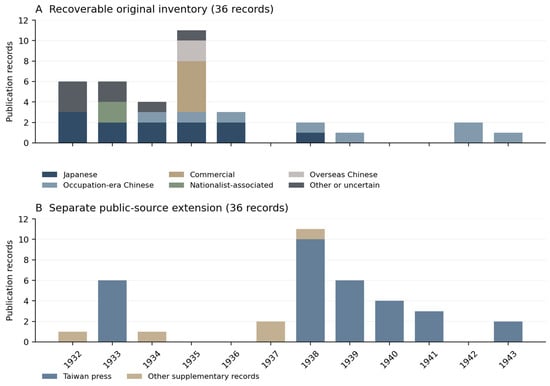
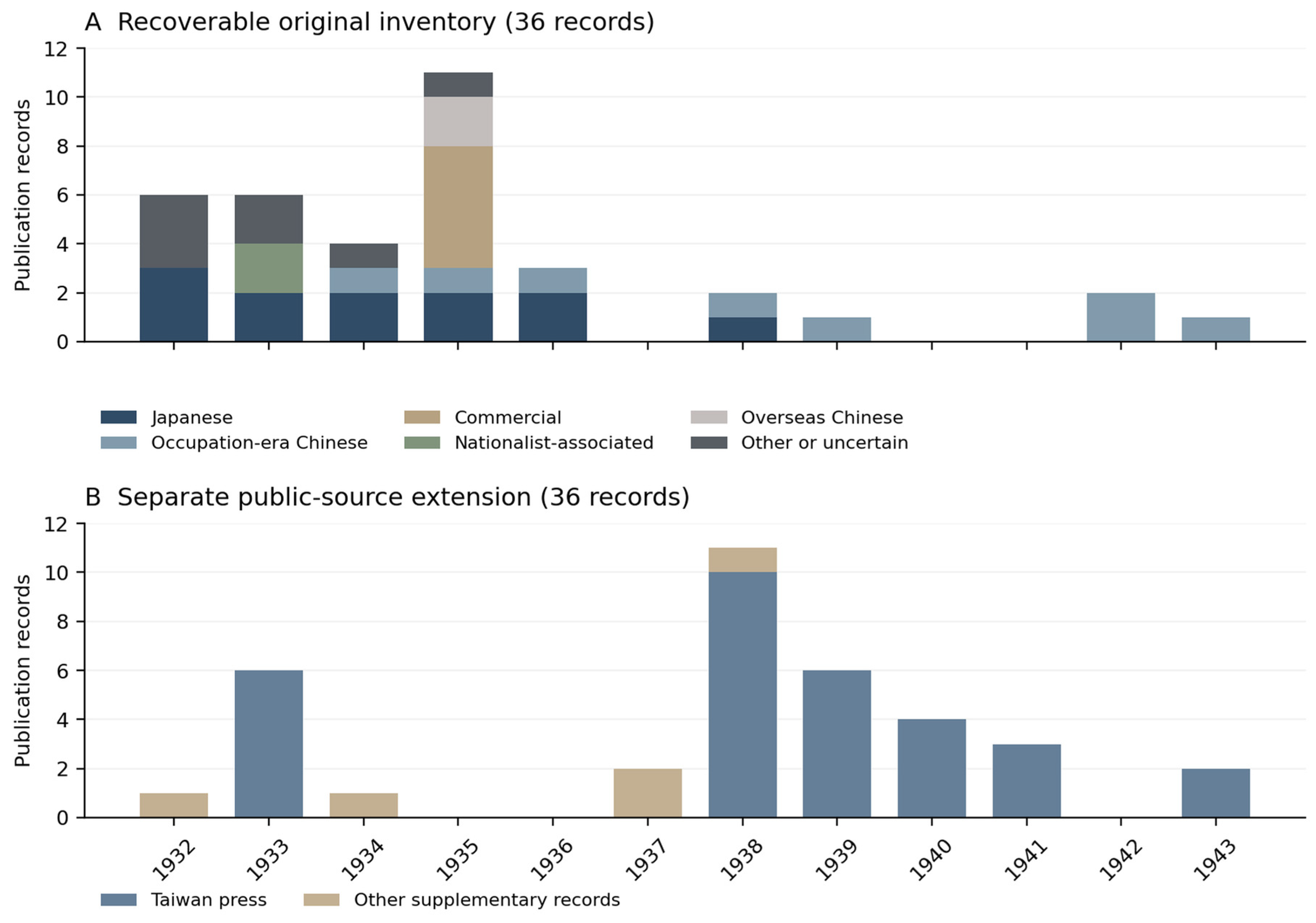

Disclaimer/Publisher’s Note: The statements, opinions and data contained in all publications are solely those of the individual author(s) and contributor(s) and not of MDPI and/or the editor(s). MDPI and/or the editor(s) disclaim responsibility for any injury to people or property resulting from any ideas, methods, instructions or products referred to in the content. |
© 2026 by the authors. Licensee MDPI, Basel, Switzerland. This article is an open access article distributed under the terms and conditions of the Creative Commons Attribution (CC BY) license.