


Abstract
In this work, we take the historical accounts on the discovery of quasicrystals as a starting point to reflect on important elements in the development of science: experimental evidence, reproducibility, theory changes, resistance to change, and correct attribution. In 1982, Dan Shechtman discovered quasicrystalline structures that would lead to a change in the very definition of a crystal. Linus Pauling was a fierce force of opposition to change, despite the new evidence found. Alan Mackay, on the other hand, had already predicted such structures when talking about generalized crystallography, but his contribution was not correctly attributed. We elaborate on the contrast between the two and how the history of the discovery of quasicrystals gives us an opportunity to reflect on the basic principles of well-practiced science.
1. Introduction
Not long ago, a text about quasicrystals came into my hands. It was quite short (two pages, including references)—a historical review showcasing general features about quasicrystals and how they got discovered. I suspected that the text had been generated by an AI chatbot, based partly on its style and, more importantly, on the presence of several fabricated references. The first of them was: Shechtman, D. (1984). The discovery of quasicrystals: A personal account. Annual Review of Materials Research, 23(1), 1–29.
The issue of fabricated references, but also the fabrication of complete manuscripts—experimental data included—produced by generative artificial intelligence (genAI) has sadly become quite common in Academia, and the debates about the social, ethical, and environmental implications of its use are abundant (Resnik and Hosseini 2025; Xiao et al. 2025; Crabapple 2026; Privette et al. 2026). However, discovering that those references were fabricated also ignited my curiosity on the topic, which ultimately ended in the writing of this text.
The discovery of quasicrystals can be considered as a paradigm shift (Kuhn 1994), as it prompted an updating of the very definition of what is considered as a crystal. As an example of anomalous evidence, an initial resistance to change was expected (Hemmerich et al. 2016), and even desired (Johansson 2016) as part of what a “careful, fully informed scientist” (in words of A. Lugg) is expected to do. In such cases, Johansson points out that “one must make a comprehensive comparison on the probability that something is wrong with the hypothesis and the probability that something is wrong with the observations, and then conclude which seems the most reasonable” (Johansson 2016).
However, as the new experimental evidence is successfully reproduced by different people around the world over long periods of time, a failure to accept the corresponding theory changes could appropriately be considered as being caused by extra-scientific and subjective influences (Lugg 1980).
In this manuscript, I will review the story of the discovery of quasicrystals by materials scientist Dan Shechtman, as an opportunity to reflect on the role of experimental evidence, reproducibility and the resistance to change that appears in this type of events. Two characters on opposite sides of Shechtman’s discovery immediately stand out in this chronicle: Linus Pauling on the one hand, and the not-so-famous crystallographer Alan L. Mackay. Pauling’s resistance to theory change persisted despite accumulating experimental evidence, while the lack of recognition of the contributions of Alan Mackay in the discovery of quasicrystals serves also as a point of reflection about the importance of correct attribution in science. Reflecting on the contrast between Pauling and Mackay could spark necessary discussions about how to identify good and bad practices in science.
2. Shechtman and the Discovery of Quasicrystals
The history of the discovery of quasicrystals is quite straightforward: Dan Shechtman found structures with pentagonal symmetry that crystallography previously considered impossible. Very soon after their appearance, they were called quasicrystals, and this new experimental evidence caused the definition of a crystal to change so these new structures could be included. Since then, its physicochemical and geometric properties, in addition to its possible applications, have motivated a good number of studies focused on different disciplines. See for instance: (Cahn 2001; Sosa et al. 2023; Baek et al. 2025; Li et al. 2026; Xu et al. 2026). But let us start from the beginning.
In 1982, Dan Shechtman discovered by chance the existence of quasicrystals, something that, according to the crystallographic theory of the time, he should not have been able to discover. Shechtman was in the middle of a sabbatical stay at the National Bureau of Standards in Maryland, United States—now known as the National Institute of Standards and Technology (NIST)—where he was collaborating on a project as an electron microscopist (Gratias and Quiquandon 2019).
That project sought to study the rapid solidification of aluminum-based (Al) binary alloys, cataloged as (Al, X), where the X could be chromium (Cr), manganese (Mn), iron (Fe), cobalt (Co) or nickel (Ni) in small proportions up to 10%. Shechtman came up with the idea of increasing the range to Al6X (i.e., an atom of the metal X for every six aluminum atoms), consequently increasing the X proportions to 17% and beyond, not knowing that it was one of those ideas that would end up being worth a Nobel Prize.
Following his idea, Shechtman was studying Al6Mn samples when he discovered something out of the ordinary in one of them. Examining the sample in different orientations, he obtained a series of diffraction patterns showing pentagonal symmetry, which corresponded to a three-dimensional icosahedral symmetry. Considering a crystal as a solid material whose atoms are orderly placed in periodic patterns, their structures could only have certain symmetries if the atoms were to completely cover the space occupied by the material, with no gaps or overlaps (Ashcroft and Mermin 1976). The icosahedral symmetry was not one of them.
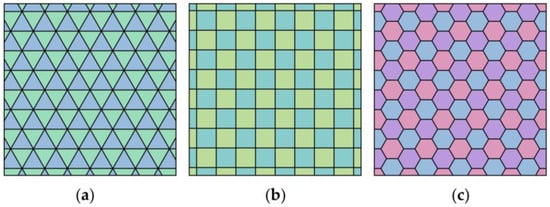
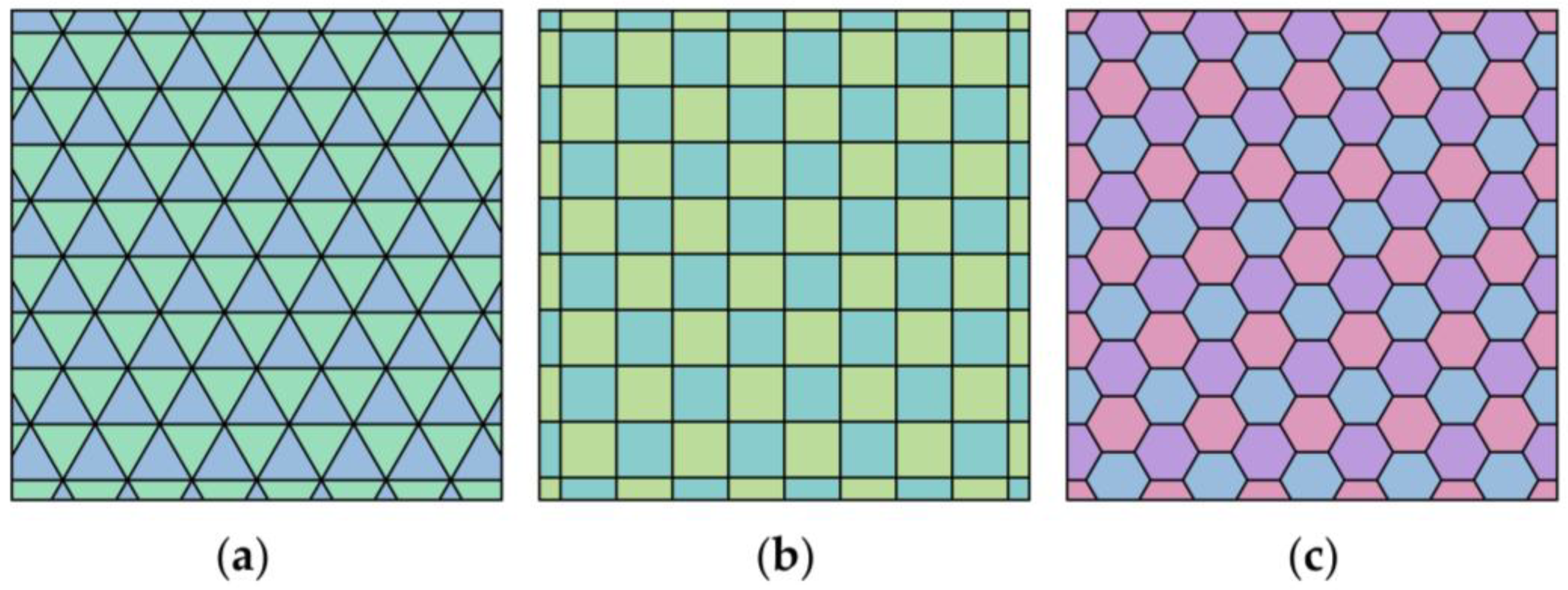
This is best visualized if we consider two dimensions first. Say we want to cover a plane using tiles, and for this example let us think of a table. If the tiles are triangular, we easily cover the table without leaving gaps. The result is known as a periodic and orderly arrangement of triangular tiles, with rotation symmetry 3. If we use square tiles, we will also cover the table without problems and in this case the arrangement will have what is known as rotation symmetry of order 4. We can also completely cover the table with hexagonal tiles, and the periodic arrangement has rotation symmetry of order 6 (see Figure 1).
Figure 1.
Three examples of tessellation or tiling, which is the covering of a plane with tiles, so that there are no overlaps: (a) Triangular tiles with a rotational symmetry of order 3; (b) square tiles with a rotational symmetry of order 4; (c) hexagonal tiles with a rotational symmetry of order 6 (Tessellation 2026; Nonenmacher 2008a, 2008b, 2008c).
But if we use pentagonal tiles—with rotation axes of order 5—we will simply fail, because in that case it is impossible to cover the table without leaving gaps. When the case of pentagonal symmetry is extended to three dimensions, we are talking about icosahedral symmetry, with which three-dimensional space cannot be filled periodically either. That is why in crystallography, crystals with such symmetry could not exist.
Up to that point, all the scientific evidence supported this idea, and Shechtman, recognizing the oddity of what he had obtained, carefully confirmed his results with the electron transmission microscope. This showed a sharpness of the diffraction spots as good as was only found in the best silicon crystals (Shechtman et al. 1984).
The new structure was paradoxical because it showed a long-range order as observed in regular crystals due to the high sharpness of its diffraction pattern, but on the other hand it should not be crystalline due to its pentagonal symmetry. At that time, it was considered that crystals could only have axes of rotation of order 1, 2, 3, 4 and 6. And there was Shechtman, in front of something that looked like a crystal but had an axis of rotation of order 5. It was the exception that broke the rule.
3. Pauling and the Quasi-Scientists
What came next was a difficult period for Shechtman, who suffered the ridicule of his colleagues due to the radicalism of his results. He himself took two years to publish them, overcoming opposition from members of his own team, who thought that perhaps he had made a mistake and who did not want to be involved in what they already saw as ridicule in the eyes of the scientific community (Bedolla 2012; Jha 2013).
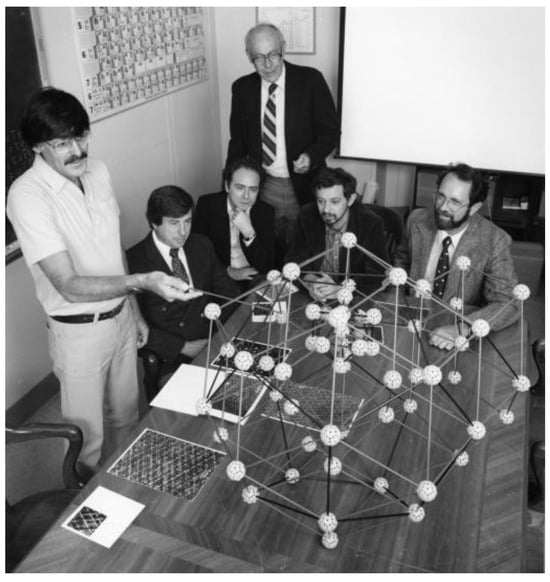
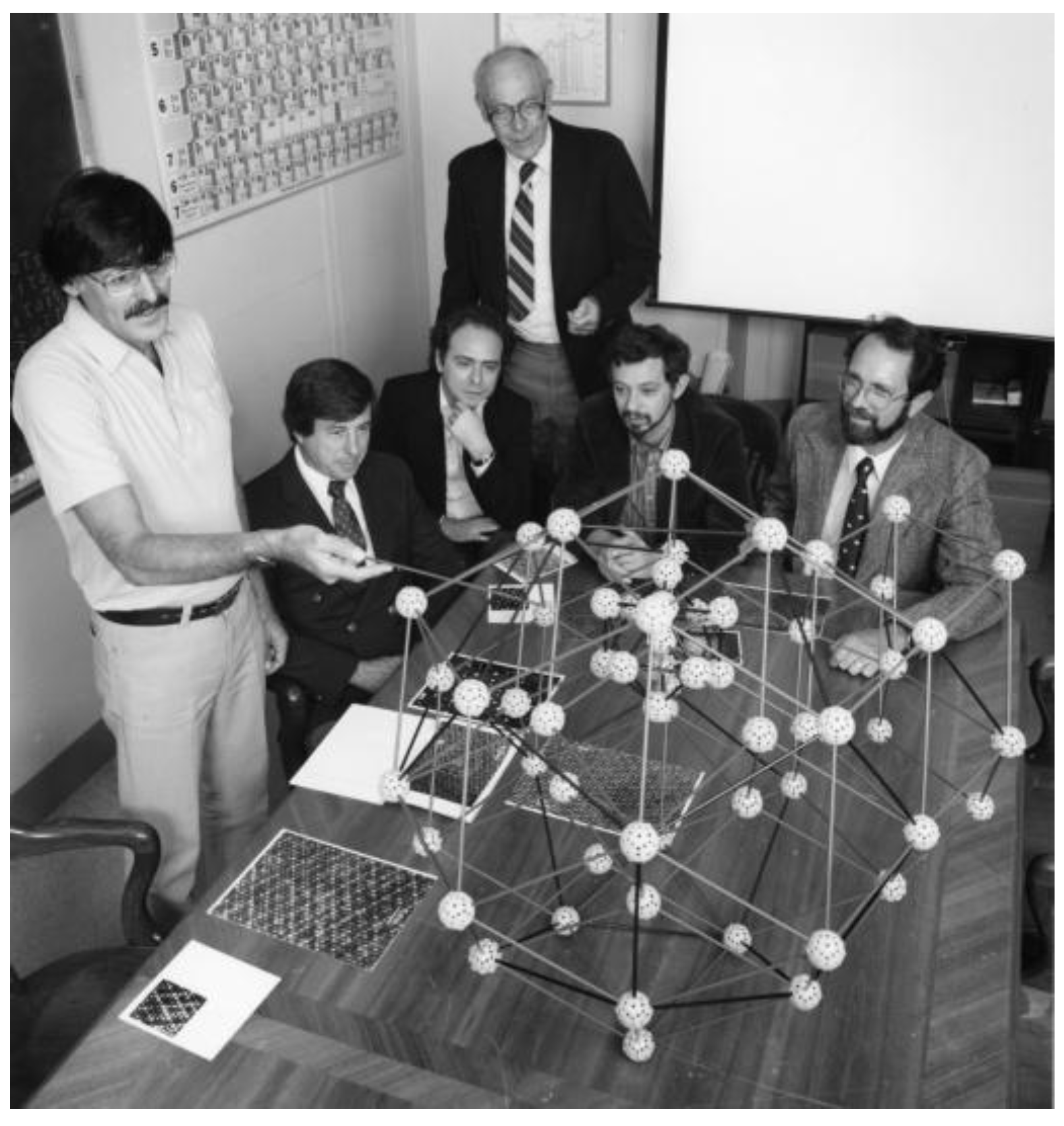
Shechtman decided to go to Ilan Blech, his former professor at Technion, to discuss his results. They were later joined by John-Werner Cahn, a renowned scientist at NIST (see Figure 2), and with him the crystallographer Denis Gratias, who worked at the Centre d’Etudes de Chimie Métallurgique in Vitry-sur-Seine, near Paris. After thoroughly reviewing the results, they were convinced that they were indeed dealing with icosahedral symmetry and submitted a paper to Physical Review Letters.
Figure 2.
In this picture from 1985, we see Dan Shechtman in a meeting at the NIST, discussing the atomic structure of quasicrystals with collaborators. From left to right are Shechtman; Frank Biancaniello, Denis Gratias, John Cahn, Leonid Bendersky, and Robert Schaefer (Westcott 1985; H. Mark Helfer/NIST 2016). Credit: H. Mark Helfer/NIST https://www.nist.gov/nist-and-nobel/dan-shechtman/nobel-moment-dan-shechtman accessed on 26 May 2026.
Shechtman’s results on quasicrystals were published in 1984 (Shechtman et al. 1984) and countries like France were quite receptive to them, so much so that studies and work teams on the subject soon appeared (Cahn 2013; Gratias and Quiquandon 2019). The interest on quasicrystals was also evident in the USA, with already 13 abstracts on the topic submitted to the APS meeting of 1985, a number that would rapidly grow. But there was also opposition to the discovery, mainly coming from the formidable chemist Linus Pauling.
By that time, Pauling had already won two Nobel Prizes (one in chemistry and one in peace) and among many other honors he had an institute named after him, the Linus Pauling Institute of Science and Medicine in California. With all the weight of his prestige, Pauling claimed that the sight of such quasicrystals must have been related to some mistake in the experimental method, and that the diffraction pattern observed by Shechman was surely due to twin formations of ordinary crystals, known as twinning. The different chronicles of the discovery of quasicrystals point out how Pauling took every opportunity to tell anyone who would listen that Shechtman was wrong (Mihai 2022).
Many of these chronicles repeat a phrase attributed to Linus Pauling: “There is no such thing as quasicrystals, there are only quasi-scientists.” Some sources (Gratias and Quiquandon 2019) attribute it to Pauling’s 1985 letter to Nature (Pauling 1985), the title of which is quite explicit: “The apparent icosahedral symmetry is due to directed multiple twins of cubic crystals.” No quasicrystals. But the famous phrase about quasi-scientists is nowhere to be found in that article.
All the indirect sources that cite it refer to other indirect sources or simply attribute it to Pauling without further ado. A sentence that does appear in his aforementioned letter to Nature, and which already gives us a good idea of Pauling’s position, is the following (emphasis mine): “I have found it hard to believe that any single crystal with 5-fold axes could give reasonably sharp diffraction patterns, resembling those given by crystals.”
The “quasi-scientists” remark is apparently a reported oral statement rather than a textual source. Indeed, interviewed in 2013, Shechtman reported that Linus Pauling said it out loud during a conference, in front of hundreds of attendees. Pauling’s full sentence according to this source is: “Danny Shechtman is talking nonsense, there are no quasi-crystals, just quasi-scientists.” (Jha 2013)
Pauling’s alternative explanation to quasicrystals was experimentally verifiable. When a crystal is grown, it usually happens that the direction of growth changes suddenly, generating a grouping of twin crystals, oriented symmetrically with respect to an axis or a plane. These groups of crystals are called twinning. For Shechtman to have observed a twinning of crystals instead of a new structure, this sudden change in growth would have had to happen five times, in succession.
To experimentally rule out this possibility, the diffraction beam can be focused on progressively smaller regions of the sample, until obtaining a volume so small that it could not enclose the five twins. At that point, the pentagonal symmetry should disappear. But the experiment showed that the pentagonal symmetry of the structures discovered by Shechtman did not disappear, even for the smallest dimensions analyzed in this way. The experimental evidence ruled out a possible twinning (Munro et al. 2001). By 1989, it was clear that Pauling’s model was not consistent with the experimental data (Bancel et al. 1989). However, Pauling would continue defending his multiple-twinning theory until his death in 1994 (Provo 2022).
4. Quasicrystals, Those Old Acquaintances
Some authors (Gratias and Quiquandon 2019) consider that Pauling’s influence may have been responsible for the delay shown within the USA crystallographic community to accept the existence of quasicrystal structures. It was not until 1992 that the International Union of Crystallography (IUCr) changed its definition of a crystal to accommodate the new evidence. Previously, the IUCr definition of a crystal focused on the regular ordering and repetition of a three-dimensional pattern.
Now, the IUCr defines a crystal as a material that essentially has a sharp diffraction pattern. This broader definition allows us to include not only quasicrystals but also possible future discoveries of other types of materials that could be considered crystalline. The new scientific evidence had managed to be established, after many difficulties of the scientific community accepting Shechtman’s discoveries.
It has been discussed that this resistance to the idea of quasicrystals can be considered surprising for two reasons: on the one hand, the arguments for banning structures with pentagonal symmetry were based on a logical fallacy; on the other hand, there was a lack of knowledge of various previous theoretical works.
The fallacy refers to the following: since the beginning of the twentieth century, crystallographers have known that the diffraction of periodic objects generates a pattern with sharp dots placed at the nodes of a reciprocal lattice. The fallacy, erroneously accepted for a long time, consists of assuming that the reverse is always true and that a sharp diffraction pattern could only come from a periodic object (Gratias and Quiquandon 2019).
It is also somewhat surprising how difficult it was to accept the idea of quasicrystals when we consider that the basic concepts related to these structures had already been studied long before Shechtman’s discovery. There are many examples of works that in one way or another served as a basis for understanding the properties of quasicrystals, starting with the Islamic mosaics of the Alhambra in Granada, Spain, and many other similar architectural monuments.
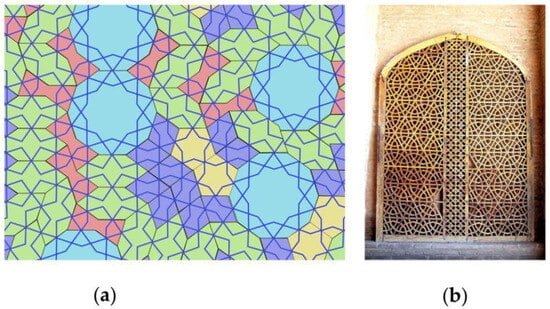
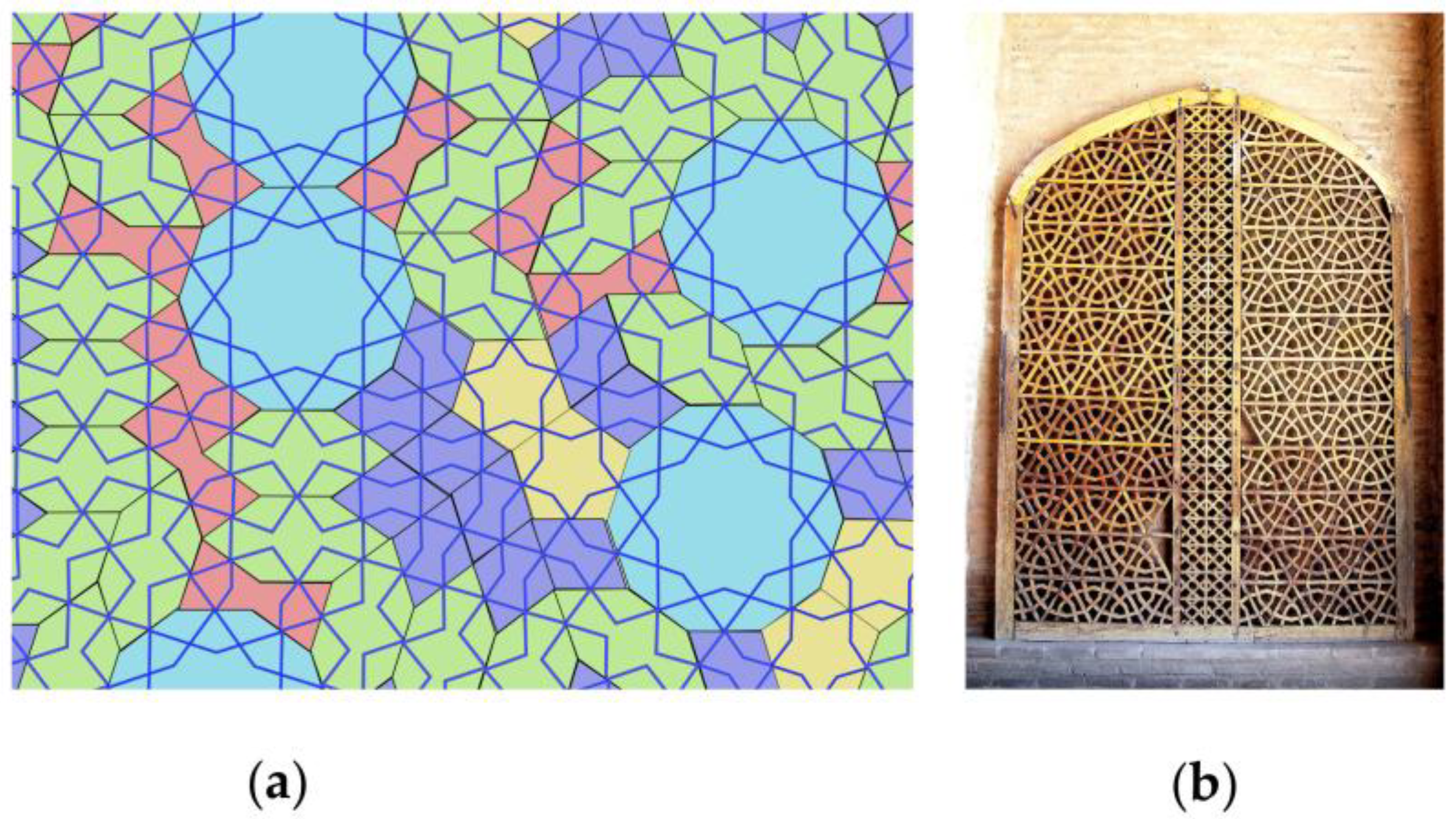
These Islamic mosaics and quasicrystals share geometric principles: in both cases they are aperiodic patterns that can cover a plane or space without ever repeating themselves exactly. Not long ago, Peter Lu and Paul Steindhardt—researchers at Harvard and Princeton, respectively—studied the geometry of a particular type of mosaics formed by polygons and stars with symmetry 5, called “girih tiles”, which were already used in Islamic architecture since the fifteenth century (see Figure 3). One of the most impressive innovations of Islamic architects and mathematicians at the time was the use of self-similarity transformation. This means subdividing large girih tiles into smaller ones, to create overlapping patterns at two different scales. The geometries generated in such a way certainly did not anticipate quasicrystallography in a straightforward sense, but would later become intelligible as being practically quasicrystalline in a contemporary scientific context (Garritze 2012).
Figure 3.
Islamic girih tiles have been used for decoration of buildings in Islamic architecture since about the year 1200. (a). Patterned girih tiles. The shapes in colors indicate the geometric tiles, while the construction lines in blue form the girih pattern. (b) As an example, a wooden screen from the Nishapur caravanserai, in Iran (Girih tile 2025; VATHLU 2008; Cronholm144 2007).
The Dutch painter M.C. Escher can be considered one of the first meeting points between the West and those Islamic mosaics, as shown by the influence that the Alhambra had on his work. Escher visited the Alhambra only twice during his lifetime—in 1922 and 1936—but the impact it had on his work was profound and led him to study in detail the patterns of those tiles and the ways in which they covered a surface. Even so, it is not until 1965 that we can find in the West a more concrete beginning of the formal mathematical study of quasicrystalline structures.
It was in that year and the following that the Chinese–American mathematician from Harvard Hao Wang and his student Robert Berger, interested in the properties of the Turing machine, focused on the ways in which a plane of periodic and nonperiodic shapes could be tessellated—that is, covered with a pattern. Their work is known as the Domino problem (Wang 1965).
By 1974, the British mathematical physicist Robert Penrose had built a nonperiodic pattern that covered the plane and was composed of only two types of tiles or tesserae, and with a pentagonal symmetry, the famous Penrose tessellation or pattern. It was later recognized that those girih mosaics of the medieval Islamic world already included near-perfect examples of Penrose patterns. Finally, it would be unfair to ignore the important theoretical work of U.S. scientists Don Levine and the aforementioned Paul Steinhardt, who coined the term quasicrystal in a paper published just weeks after Shechtman released his results in 1984 (Gratias and Quiquandon 2019; Levine and Steinhardt 1984).
5. Mackay and the Pentagonal Snowflake
However, it was the British crystallographer Alan L. Mackay who caught my attention the most because of the contrast between his and Pauling’s roles in this story. In 1981, Mackay made the connection between the Penrose pattern and crystalline materials. In his 1981 paper De nive quinquancula: On the pentagonal snowflake, Mackay creates a graphic representation of a pentagonally symmetrical snowflake and concludes that it was an example of a pattern of the kind that might well be found but might go unnoticed if not expected (A. L. Mackay 1981; Hargittai 2017, 2022). It almost seems like he was prophetically talking about Shechtman a year before things happened, but it was the result of a lot of theoretical work behind it.
Perhaps because it had been published in a Soviet journal (A. L. Mackay 1981), Mackay’s work was not well known, and Shechtman was certainly not aware of it at the time of its experimental discovery, a year later. But Mackay had been talking about nonperiodic structures since 1975, introducing what he called “generalized crystallography.” In 1982, Mackay wrote another paper where he computationally demonstrated that a Penrose tiling could produce a diffraction pattern with tenfold symmetry, a crucial step in establishing that aperiodic structures could be considered crystals (A. L. Mackay 1982). Being open-minded to the possibility of new crystallographic structures allowed him to anticipate the existence of order 5 symmetry in extended structures (Hargittai 2022).
If Mackay’s contribution to the understanding of quasicrystals is now better known than before, it is largely due to the Hungarian physicist-chemist Istvan Hargittai, a colleague and friend of his. With the dedication that comes from friendship and admiration, Hargittai has published several works to ensure that Mackay has the attribution he deserves in this story.
At different times, Hargittai veiledly reproaches the attitudes of Levine and Steinhardt, who in his view minimized the work of Mackay and even that of Shechtman himself (Hargittai 2022). Reading Levine and Steinhardt’s paper, published weeks after Shechtman’s experimental results became known, one can be inclined to think that Hargittai is right, for they barely mention in passing, and almost at the end, the experimental result that constituted the entire justification for their work.
Through the very pleasant monograph that Hargittai dedicates to Mackay to celebrate his ninetieth birthday, Mackay is presented to us as a person very interested in art, geometry, literature, or the different cultures of the world. A generalist very aptly nicknamed “the well-known eclectic” (Hargittai 2017).
6. Conclusions: Quasicrystals and Quasi-Scientists
The AI-fabricated text I first mentioned at the beginning of this manuscript correctly identified Dan Shechtman as a main character in the story of quasicrystals discovery, but other equally important characters were ignored, particularly Alan Mackay. It has become increasingly common not only for students but also established scientists to produce—not write—articles, grant proposals, or even entire books using genAI, ignoring a correct attribution in most cases (Aksenfeld 2025). The number of retracted manuscripts due to unethical uses of genAI has increased in recent years, prompting reflection and debates focused on scientific integrity (Kocyigit et al. 2025; Joelving 2024; Nguyen and Vuong 2025; Thelwall et al. 2025; Feldman et al. 2026)
In the case of Mackay, correct attribution has progressively reached him. Besides the work of Prof. Hargittai, Mackay is now formally recognized for predicting the occurrence of quasicrystals (Finney 2026) and several researchers consider that both Mackay and Penrose should have also been awarded with the 2011 Nobel prize in chemistry for quasicrystals (Cartwright and González 2025). The different tributes dedicated to Mackay after his passing in February 2025 stand as a testament to the growing admiration and recognition of his work by the Crystallography community (B. Mackay 2025; Finney 2025, 2026; Hargittai 2025; Cartwright and González 2025).
The story of the discovery of quasicrystals is a good reminder of the foundations that define science and that should guide those of us who work in it. Faced with scientific evidence that contradicted the theory of the time, and after thoroughly verifying his results, Dan Shechtman decided to go ahead. In denying the existence of quasicrystals, Linus Pauling seemed to ignore the fact that different scientific teams had been able to reproduce Shechtman’s findings successfully. At the other extreme, Alan Mackay’s rigorous approach to science allowed him to be aware of dogmas and scientific taboos, which helped him predict the existence of quasicrystals.
Shechtman is certainly not a quasi-scientist, but ironically the term might be useful after all, as a warning to bad practices in science. A failure to follow the basic principles of well-practiced science—a good assessment of scientific evidence, reproducibility, and correct attribution—can be labelled as characteristic of a quasi-scientist.
Funding
This research received no external funding.
Data Availability Statement
No new data were created or analyzed in this study. Data sharing is not applicable to this article.
Acknowledgments
The author wishes to thank Santa Elena Tellez Flores, Trevor Hirst, and Pedro Miramontes for their valuable suggestions and feedback.
Conflicts of Interest
The author declares no conflicts of interest.
References
- Aksenfeld, Rita. 2025. Springer Nature to Retract Machine Learning Book Following Retraction Watch Coverage. Retraction Watch, July 16. Available online: https://retractionwatch.com/2025/07/16/springer-nature-to-retract-machine-learning-book-following-retraction-watch-coverage/ (accessed on 20 July 2025).
- Ashcroft, Neil W., and Nathaniel David Mermin. 1976. Solid State Physics. New York: Holt, Rinehart and Winston. [Google Scholar]
- Baek, Woohyeon, Sambit Das, Shibo Tan, Vikram Gavini, and Wenhao Sun. 2025. Quasicrystal stability and nucleation kinetics from density functional theory. Nature Physics 21: 980–87. [Google Scholar] [CrossRef] [Scilit]
- Bancel, Peter A., Paul A. Heiney, Paul M. Horn, and Paul J. Steinhardt. 1989. Comment on a paper by Linus Pauling. Proceedings of the National Academy of Sciences 86: 8600–01. [Google Scholar] [CrossRef] [Scilit] [PubMed]
- Bedolla, Carlos Amador. 2012. Cuasicristales. Educación Química 23: 69–70. [Google Scholar] [CrossRef] [Scilit]
- Cahn, John Werner. 2001. Quasicrystals. Journal of Research of the National Institute of Standards and Technology 106: 975. [Google Scholar] [CrossRef] [Scilit] [PubMed]
- Cahn, John Werner. 2013. A celebration of the pioneering work on quasicrystals in France and the expansion of crystallography. Comptes Rendus Physique 15: e1–e5. [Google Scholar] [CrossRef] [Scilit]
- Cartwright, Julyan H. E., and Diego L. González. 2025. De tessere quinquangula: Five hundred years of pentagonal tilings from Dürer to Mackay via Kepler, Escher, and Penrose. Structural Chemistry 36: 1953–58. [Google Scholar] [CrossRef] [Scilit]
- Crabapple, Molly. 2026. Is AI the Greatest Art Heist in History? The Guardian, April 12. Available online: https://www.theguardian.com/books/2026/apr/12/is-ai-the-greatest-art-heist-in-history (accessed on 13 April 2026).
- Cronholm144. 2007. Girih Tiles. Available online: https://commons.wikimedia.org/wiki/File:Girih_tiles2.svg (accessed on 27 May 2026).
- Feldman, Hannah R., Fabien Medvecky, and Michelle Riedlinger. 2026. Ethics, Generative AI and Science Communication. Public Understanding of Science 35: 388–98. [Google Scholar] [CrossRef] [Scilit] [PubMed]
- Finney, John L. 2025. Alan Mackay, J.D. Bernal, and the Rewriting of the Book of Crystallography. Structural Chemistry 36: 1939–46. [Google Scholar] [CrossRef] [Scilit]
- Finney, John L. 2026. Alan Lindsay Mackay. Biographical Memoirs of Fellows of the Royal Society, 20260006. [Google Scholar] [CrossRef] [Scilit]
- Garritze, Andoni. 2012. Cuasicristales y arte islámico. Educación Química 23: 2–5. [Google Scholar] [CrossRef] [Scilit]
- Girih tile. 2025. Wikipedia. Page Version ID: 1329856820. Available online: https://en.wikipedia.org/w/index.php?title=Girih_tile&oldid=1329856820 (accessed on 27 May 2026).
- Gratias, Denis, and Marianne Quiquandon. 2019. Discovery of quasicrystals: The early days. Comptes Rendus Physique 20: 803–16. [Google Scholar] [CrossRef] [Scilit]
- Hargittai, Istvan. 2017. Generalizing crystallography: A tribute to Alan L. Mackay at 90. Structural Chemistry 28: 1–16. [Google Scholar] [CrossRef] [Scilit]
- Hargittai, Istvan. 2022. Forty years of quasicrystals: A bumpy road to triumph. Structural Chemistry 33: 311–14. [Google Scholar] [CrossRef] [Scilit]
- Hargittai, Istvan. 2025. Remembering Alan L. Mackay (1926–2025)—A scientists’ scientist in the footsteps of Lucretius. Structural Chemistry 36: 1933–38. [Google Scholar] [CrossRef] [Scilit]
- Hemmerich, Joshua A., Kellie Van Voorhis, and Jennifer Wiley. 2016. Anomalous Evidence, Confidence Change, and Theory Change. Cognitive Science 40: 1534–60. [Google Scholar] [CrossRef] [Scilit] [PubMed]
- H. Mark Helfer/NIST. 2016. Available online: https://www.nist.gov/nist-and-nobel/dan-shechtman/nobel-moment-dan-shechtman (accessed on 26 May 2026).
- Jha, Alok. 2013. Dan Shechtman: ‘Linus Pauling Said I Was Talking Nonsense’. The Guardian, January 6. Available online: https://www.theguardian.com/science/2013/jan/06/dan-shechtman-nobel-prize-chemistry-interview (accessed on 14 January 2025).
- Joelving, Frederik. 2024. AI-generated commentaries flood journals, distort metrics. Science 386: 1331–32. [Google Scholar] [CrossRef] [Scilit] [PubMed]
- Johansson, Lars-Göran. 2016. Philosophy of Science for Scientists. Cham: Springer International Publishing. [Google Scholar]
- Kocyigit, Burhan Fatih, Ramazan Azim Okyay, Birzhan Seiil, Ainur B. Qumar, and Hilmi Erdem Sumbul. 2025. Analysis of Retracted Publications on Artificial Intelligence: Trends, Ethical Concerns, and Scientific Integrity. Journal of Korean Medical Science 40: e280. [Google Scholar] [CrossRef] [Scilit] [PubMed]
- Kuhn, Thomas S. 1994. The Structure of Scientific Revolutions, 2nd ed. Chicago: University of Chicago Press. [Google Scholar]
- Levine, Dov, and Paul Joseph Steinhardt. 1984. Quasicrystals: A New Class of Ordered Structures. Physical Review Letters 53: 2477–80. [Google Scholar] [CrossRef] [Scilit]
- Li, Zhanfan, Meng Liu, Shuo Guan, Keke Cheng, Jiaxing Shi, Xianrui Jiang, Haiping Wu, Hongyue Gao, Dehua Li, Wei Yan, and et al. 2026. Polarization Multiplexing Terahertz Quasicrystal Meta-Platform. Materials 19: 3162. [Google Scholar] [CrossRef] [Scilit] [PubMed]
- Lugg, Andrew. 1980. Theory Choice and Resistance to Change. Philosophy of Science 47: 227–43. [Google Scholar] [CrossRef] [Scilit]
- Mackay, Alan L. 1981. De nive quinquangula: On the pentagon snowflake. Soviet Physics, Crystallography 26: 517–22. [Google Scholar]
- Mackay, Alan L. 1982. Crystallography and the penrose pattern. Physica A: Statistical Mechanics and Its Applications 114: 609–13. [Google Scholar] [CrossRef] [Scilit]
- Mackay, Bob. 2025. Quasi-crystals—The early years. Structural Chemistry 36: 1947–52. [Google Scholar] [CrossRef] [Scilit]
- Mihai, Andrei. 2022. Adversity, Quasicrystals and a Nobel—The Forbidden Fivefold Symmetry that Was. Lindau Nobel Laureate Meetings, June 28. Available online: https://www.lindau-nobel.org/blog-adversity-quasicrystals-and-a-nobel-the-forbidden-fivefold-symmetry-that-was/ (accessed on 16 May 2024).
- Munro, Ronald G., Frank Gayle, and Carol Handwerker. 2001. Quasicrystals. In A Century of Excellence in Measurements, Standards, and Technology; Washington, DC: NIST Special Publication, pp. 300–2. Available online: https://nvlpubs.nist.gov/nistpubs/sp958-lide/cntsp958.htm (accessed on 24 May 2026).
- Nguyen, Minh-Hoang, and Quan-Hoang Vuong. 2025. Artificial intelligence and retracted science. AI & Society 40: 2345–46. [Google Scholar] [CrossRef] [Scilit]
- Nonenmacher, R. A. 2008a. Regular Tiling 3-6 (Triangular). Available online: https://commons.wikimedia.org/wiki/File:Tiling_Regular_3-6_Triangular.svg (accessed on 26 May 2026).
- Nonenmacher, R. A. 2008b. Regular Tiling 4-4 (Square). Available online: https://commons.wikimedia.org/wiki/File:Tiling_Regular_4-4_Square.svg (accessed on 26 May 2026).
- Nonenmacher, R. A. 2008c. Regular Tiling 6-3 (Hexagonal). Available online: https://commons.wikimedia.org/wiki/File:Tiling_Regular_6-3_Hexagonal.svg (accessed on 26 May 2026).
- Pauling, Linus. 1985. Apparent icosahedral symmetry is due to directed multiple twinning of cubic crystals. Nature 317: 512–14. [Google Scholar] [CrossRef] [Scilit]
- Privette, Ana Pinheiro, Ana Barros, and Ximing Cai. 2026. Data Centers Water Footprint: The Need for More Transparency. AGU Advances 7: e2025AV002140. [Google Scholar] [CrossRef] [Scilit]
- Provo, Jaren. 2022. Quasicrystals. In Visions of Linus Pauling. Hackensack: WORLD SCIENTIFIC, pp. 317–33. [Google Scholar] [CrossRef] [Scilit]
- Resnik, David B., and Mohammad Hosseini. 2025. The ethics of using artificial intelligence in scientific research: New guidance needed for a new tool. AI and Ethics 5: 1499–521. [Google Scholar] [CrossRef] [Scilit] [PubMed]
- Shechtman, Dan, Ilan Blech, Denis Gratias, and John W. Cahn. 1984. Metallic Phase with Long-Range Orientational Order and No Translational Symmetry. Physical Review Letters 53: 1951–53. [Google Scholar] [CrossRef] [Scilit]
- Sosa, Alan Rodrigo Mendoza, Atahualpa S. Kraemer, Erdal C. Oğuz, and Michael Schmiedeberg. 2023. Structural studies of local environments in high-symmetry quasicrystals. Scientific Reports 13: 16696. [Google Scholar] [CrossRef] [Scilit] [PubMed]
- Tessellation. 2026. Wikipedia. Page Version ID: 1354443750. Available online: https://en.wikipedia.org/w/index.php?title=Tessellation&oldid=1354443750 (accessed on 26 May 2026).
- Thelwall, Mike, Marianna Lehtisaari, Irini Katsirea, Kim Holmberg, and Er-Te Zheng. 2025. Does ChatGPT Ignore Article Retractions and Other Reliability Concerns? Learned Publishing 38: e2018. [Google Scholar] [CrossRef] [Scilit]
- VATHLU. 2008. Grechchini or Girih (Persian: Knotting), a Branch of Traditional Architecture and Tiling. Available online: https://commons.wikimedia.org/wiki/File:Girih_tiles.jpg (accessed on 27 May 2026).
- Wang, Hao. 1965. Games, Logic and Computers. Scientific American 213: 98–107. [Google Scholar] [CrossRef] [Scilit]
- Westcott, Phillip. 1985. Dan Shechtman in 1985. Available online: https://commons.wikimedia.org/wiki/File:Dan_Shechtman_in_1985.jpg (accessed on 26 May 2026).
- Xiao, Tianqi, Francesco Fuso Nerini, H. Damon Matthews, Massimo Tavoni, and Fengqi You. 2025. Environmental impact and net-zero pathways for sustainable artificial intelligence servers in the USA. Nature Sustainability 8: 1541–53. [Google Scholar] [CrossRef] [Scilit]
- Xu, Tong, Siyang Gao, Deli Duan, Bowen Zheng, and Yongchao Fang. 2026. The Effect of Heat Treatment on the Phase Composition and Tribological Behavior of Thermally Sprayed Al-Based Quasicrystalline Coatings. Lubricants 14: 57. [Google Scholar] [CrossRef] [Scilit]
Disclaimer/Publisher’s Note: The statements, opinions and data contained in all publications are solely those of the individual author(s) and contributor(s) and not of MDPI and/or the editor(s). MDPI and/or the editor(s) disclaim responsibility for any injury to people or property resulting from any ideas, methods, instructions or products referred to in the content. |
© 2026 by the author. Licensee MDPI, Basel, Switzerland. This article is an open access article distributed under the terms and conditions of the Creative Commons Attribution (CC BY) license.