1. Introduction
A Jewish merchant looking for new sources of a precious commodity. A New England captain forced to change the planned route. A Portuguese viceroy seeking to exploit a profitable marine resource off the coast of Brazil. A sperm whale in the South Atlantic avoiding, if only for a time, the dangers of the northern seas. Linking the destinies of all these actors is a ship named after a sea monster, the Leviathan. Setting sail from Newport, Rhode Island, in 1773, it was designed to explore new sperm whale grounds in the South Atlantic, but its journey ended off the coast of Brazil, where its crew were arrested and persuaded to teach new hunting methods to local whalers. The journey of the Leviathan marked the beginning of sperm whale hunting in the southern grounds. But beyond this, it was a journey that involved the overcoming of various frontiers, whether between early modern empires and geographies, social and ethno-religious groups, ocean basins and continents, and human and nonhuman worlds. The Leviathan set out in search of the real leviathan, the sperm whale, the animal that was at the heart of an extractive and highly lucrative whaling enterprise.
Our argument is that the ship
Leviathan drives the plot—it plays a central role as a material node (
Latour 1996,
2005) connecting a heterogeneous network of human and non-human actors. More than a mere background, the vessel can be understood as a form of “storied matter” (
Oppermann 2013), whose properties shaped the possibilities for encounters among otherwise disparate actors across different imperial and ecological worlds. In this respect, Katherine McKittrick’s interpretation of the slave ship as “a location through which a moving technology can create differential and contextual histories” (
McKittrick 2006, p. xii) can be extended to the
Leviathan, whose movement from the North to the South Atlantic generated new relationships among people, animals, oceanic environments and political projects.
Anna Tsing argues that human societies cannot be understood in isolation from their ecological interconnections (
Tsing et al. 2021). In this sense, our approach extends beyond the people involved and their motivations to include the vessel that made the journey, the ocean through which it travelled and which was home to the sperm whale, and the sperm whale itself—simultaneously an animal, a resource and a historical actor. We address these actors as provisional and mutable constellations of species, technologies, economies and ecologies, challenging linear or progressive views of the relationships between humans and the environment. This perspective shifts the focus from a human-centred narrative towards an oceanic one, in which winds and currents, marine animals and their ecologies are imbued with historical significance. It furthermore resonates with reflections on the materiality of ships as dynamic and generative entities (
Blackmore 2002;
Mentz 2015) by envisioning the
Leviathan as a living assemblage (
Deleuze and Guattari 1987), navigating by human power, through the action of winds and currents, crossing the seas and chasing marine animals. Like these authors, we address the tensions, vulnerabilities, and material and ecological realities underpinning mercantile, imperial and colonial projects, conceiving early modern globalisation not as a story of hegemonic human expansion, but as a fragmented, vulnerable, and ecologically entangled process.
Within this assemblage, sperm whales and the men involved in this story are cosmopolitan travellers looking for the ultimate treasure—for the whales, seasonal grounds and perfect abiotic factors; for the sailors, blubber, oil, spermaceti, ambergris, meat, teeth, candles and lighting. The
Leviathan is, on the one hand, a dynamic extension of the land border into the ocean, and a borderscape in itself.
1 On the other hand, it acted as a driving force for crisscrossing different boundaries. Thus, the ship was both an interface of contact (
Langer and Fernández-Götz 2020, p. 37) and a boundary-crossing device.
Envisioning the
Leviathan along these two dimensions—both as a border and a means of traversing borders—demands the deconstruction of disciplinary boundaries to achieve new and refreshing ways of writing history. Considering the multiple actors involved as co-constructors of historical events allows us to fully address the development of sperm whaling in southern grounds, blurring borders and making the vessel itself a contact zone, or a place of encounter. Moreover, assuming a plurality of agencies is a way of advocating for the historicization of the ocean (
Gillis 2013), hydro-criticism, or critical ocean studies, as the Blue Humanities are also known.
2 This transdisciplinary approach means placing the ocean and ocean-related events at the centre of history and, even if building on empirical historical evidence, committing to a certain degree of flexibility in our reading and analysis of sources. It assumes a poetics of ocean water—the salted water that provides buoyancy to the boat, that allows a sperm whale to surface, deep dive and resurface, and to men permits the dream of faraway cartographies and riches—enabling us to clarify the relationships between humans and water in all its forms and phases (
Mentz 2023,
2024;
Oppermann 2023).
For this purpose, we will employ the voices of agents involved in the many different aspects of the
Leviathan voyage—a pioneering Jewish merchant attempting to inaugurate a whaling enterprise in a new hunting ground; an experienced ship captain embarking on his final and most significant voyage; a Brazilian viceroy taking a serendipitous opportunity to explore a new and long-sought resource; and sperm whales coming to the end of their peaceful existence in southern waters. We will tell a (micro) history that runs through space and aims to give a connected vision of the early modern world or an entangled view of a single ocean.
3 2. The Merchant and His Trade
“But should you be disappointed, & find a scarcity of whales round those islands [Canary], & that by what observations you can make, they are to be met with in any other part of the ocean, you are then to pursue their tract”.
Aaron Lopez. Newport, 12 April 1773 (ProvLib, Nicholson Whaling, 013/08/8-0/01)
The
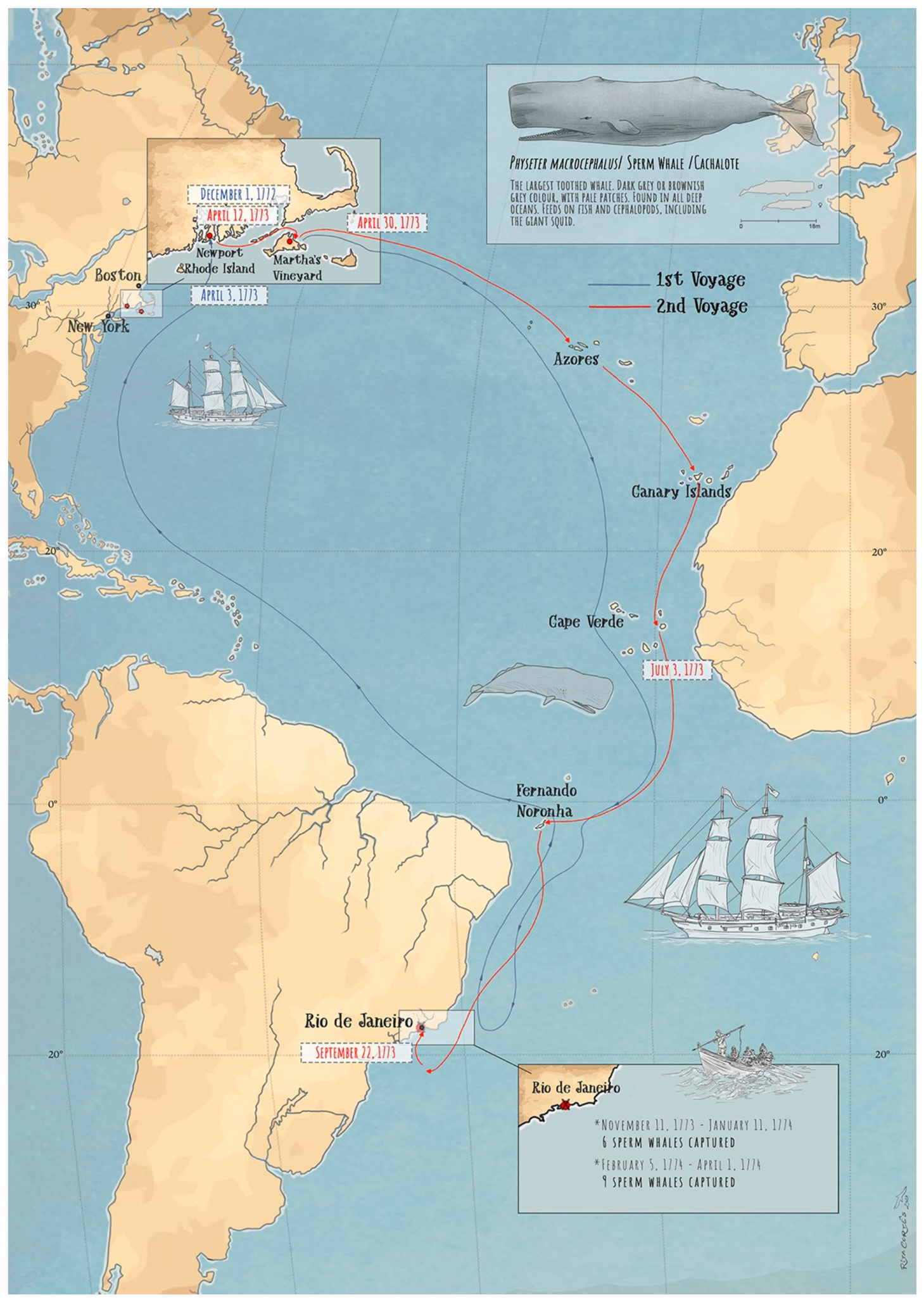
Leviathan journey started on 12 April 1773, when Thomas Lothrop and a crew of thirteen men departed from Newport with instructions to proceed to the Canary Islands and “to Cruize as long as you may see a prospect of success in the Whale Fishery” (ProvLib, Nicholson Whaling, 013/08/8-0/01). These instructions were given by Aaron Lopez, a Portuguese-born merchant and owner of the
Leviathan. This was not the first voyage of the brigantine in southern waters. About five months earlier, in November–December 1772, Lopez had equipped the
Leviathan to proceed on a whaling voyage towards the coast of Africa and look for sperm whales there. The ship continued her journey south as far as 22 degrees, where, due to damage, she was forced to return (TNA, SP 89/90, f. 14).
4 Although interrupted, this voyage provided “great knowledge of a prosperous fishery in this ocean”, something that encouraged Aaron Lopez to invest in a new venture (TNA, SP 89/90, f. 20v).
In 1773, Lopez had around 20 years of experience in investing in the sperm whale business. He knew well the main whaling grounds off the North American coast and the difficulty of exploiting them due to growing political tensions with London, tensions that a few years later would lead to the outbreak of the American Revolution. Rumours of sperm whale sightings south of the equator reached Newport and other whaling ports in British America, raising expectations of new and profitable areas for exploration. Lopez, not for the first time, smelled an opportunity and took his chance. His decision to explore southern waters was therefore embedded within an assemblage of human and non-human actors, emerging from the convergence of political instability in the North Atlantic, the empirical knowledge accumulated during previous voyages and the migratory behaviour of sperm whales themselves.
Aaron Lopez had built his career by crossing borders and chasing opportunities as uncertain as open-sea sperm-whale hunting.
5 In 1752, at 22, he left Portugal for the British colony of Rhode Island. At the time, he was known as Duarte Lopes, a Setúbal-born New Christian whose father had been arrested by the Inquisition some years before his birth. In Portugal, Lopes/Lopez was more likely to become a prey of ethno-religious harassment than the hunter—of business opportunities, money, and social recognition—he would later become. Lopes’s crossing of the Atlantic to a safer haven was not just a geopolitical journey. On arrival, he bridged the religious boundaries imposed by the Portuguese Catholic orthodoxy and, following the example of his relatives and many other New Christians who had settled in British America, converted to Judaism, becoming part of the flourishing Jewish merchant community of Newport. There, Duarte (Aaron after the conversion) found his older half-brother, Moses Lopez, already a well-established merchant of whale products, and his relative Jacob Rodriguez Rivera, who had established the first spermaceti candle factory in Newport in 1748, becoming one of the pioneers of this industry in British America.
6 Although the history of sperm whale fishery in North America had begun earlier, in the early 1710s,
7 the spermaceti candle industry was to become a central element in its remarkable development in the 1760s–1770s. Aaron Lopez’s trajectory was therefore determined by a wider network that connected Atlantic trade, Sephardic diaspora, imperial politics and sperm whale ecology.
Lopez arrived in America on the verge of the heyday of Newport’s sperm whale industry. He began building his commercial empire by leveraging his family network and the opportunities offered by this emerging business. Sperm whales followed Aaron Lopez from the earliest stage. Less than a year after his arrival, he was selling spermaceti candles for New York (AJA, SC-4114). In 1761, he was among the eight largest candle manufacturers who founded the United Company of Spermaceti Candlers, a trust aimed at controlling prices and competition (
Massachusetts Historical Society 1941, vol. 1, pp. 88–92).
The same ocean that took him on the road to freedom became his route to fortune, as it provided him with resources that filled his coffers and allowed his ships to transport candles, rum, molasses, wood, and commodities of the most diverse kinds. More than a channel for commerce, the Atlantic, through its currents, routes and living resources, created the conditions that made Lopez’s commercial success possible, allowing him to overcome the social boundaries imposed on a foreigner and a Jew. Therefore, the ocean was an active actor to make him “a Merchant of the first Eminence; for Honor & Extent of Commerce probably surpassed by no Merchant in America”, as he would be recalled by his friend Ezra Stiles, the president of Yale College (
Stiles 1901, vol. 3, p. 24).
Thus, in the early 1770s, Lopez was ready to cross the boundaries of the traditional whaling grounds of the New England whalers in search of abundant and high-quality spermaceti. The instructions given to Lothrop for both voyages of the Leviathan were very similar (AJHS, P-11, box 2, folder 8, doc. 3) and reveal an acute awareness that the voyage’s success depended on encounters with a constellation of actors. The voyage was conceived to be continuously reshaped by these interactions, with Lopez relying on his captain’s experience to respond to changing circumstances.
On the second trip, for example, Lothrop was instructed to continue south if the fishery off the Canary Islands did not meet the expectations and follow sperm whales in other parts of the ocean for eight months after he departed from Martha’s Vineyard. Lopez considered it likely that the Leviathan would meet The Royal Charlotte, captained by Cornelius Buttler, during its trip—this brig had been prepared for a whaling voyage at the time of the Leviathan’s first journey. In this case, Lothrop was to deliver to Butler the spermaceti oil obtained during the voyage in exchange for the “head matter” (raw spermaceti) on board The Royal Charlotte. Then, Buttler was to return to Newport with the head matter, while Lothrop would proceed to London and deliver the oil to Lopez’s agents, Hayley & Hopkins. Lopez was confident of the success of this voyage and that Lothrop and his men would be able to make a second cruise from London (ProvLib, Nicholson Whaling, 013/08/8-0/01). But these expectations were to be dashed.
The journey ended in Rio de Janeiro—tragically for some, fortunately for others, as shown below. In the case of Aaron Lopez, the results were ambiguous. On the one hand, his ship and crew were irretrievably lost, and no spermaceti or oil reached him. In practice, the profits were nil. On the other hand, the Leviathan’s voyages gave him precious new knowledge regarding the existence of large numbers of sperm whales in the South Atlantic and the dangers of approaching the Brazilian coast. This knowledge was applied in a more elaborate venture in 1775, when Lopez and some partners sent a whaling fleet of 13 vessels towards the South Atlantic. In the instructions he gave to Thomas Folger, the captain of the ship Lydia, Lopez advised against going “within four leagues of the Brazil Coast” and identified whaling grounds to be explored: “we have certain and very late information that between the latitudes of 45 & 48 South near soundings there is a greater plenty of spermaceti whales than at any other spot we have yet heard of; althou’ by many other reports it’s agreed that from 26 to 36, & 40 they are found in great numbers” (UPennLib, Arc.MS.56). Some of this information was provided by Thomas Lothrop in letters he addressed to Lopez and his agents from a Rio de Janeiro prison, where he was struggling for both the return of his vessel and for his freedom. Therefore, although Lopez lost his vessel, crew, and cargo, the Leviathan’s journey and the many interactions that shaped its fate generated new ecological and geographical knowledge about sperm whale distribution and the political risks of operating in the South Atlantic, knowledge that became foundational for the organisation of subsequent expeditions to southern whaling grounds.
3. The Captain and His Vessel
“I am the first man that ever came into this Part of the Ocean to seek after Sperma Ceti”.
Thomas Lothrop. Rio de Janeiro, December 1774 (TNA, SP 89/80, f. 20)
When Thomas Lothrop was assigned to command the
Leviathan in the South Seas, he was already an experienced captain. In his instructions, Lopez said that he relied on Lothrop’s “experience & knowledge of the fishery” and was “confident nothing on your side will be wanting to render this voyage successful, and that good harmony may subsist as well on board your brig as with Captain Buttler tripulation” (AJHS, P-11, box 2, folder 8, doc. 3). In fact, Lothrop had been charged with a series of tasks that depended directly on his good judgement and experience, namely choosing new destinations if he found a scarcity of sperm whales off the coast of Africa, managing the oil and spermaceti obtained during the voyage, and maintaining “good harmony” on board. As Daniel Vickers concludes, Lothrop “was at once navigator, harpooner, businessman, and disciplinarian—in sum, the manager of a small industrial operation” (
Vickers 1985, p. 283). However, besides Lopez’s instructions, evidence of Lothrop’s experience as a captain and a whaler is scant. Records of the captain’s voyages start in 1771, when the
New-Hampshire gazette and historical chronicle (
1771) from August indicates the captain returned aboard Captain Dixey’s ship from Lisbon to Marblehead in June with a cargo of 60 barrels of oil from a very large sperm whale estimated to be worth 600 dollars.
8 Another voyage is recorded in the American offshore whaling voyages database, which began in November 1771, but no further information is given.
The relationship between Lothrop and
Leviathan started before the 1773 voyage. The captain and his ship had already set out in search of whales in 1772.
9 The American offshore whaling voyages database refers to a previous voyage in September–November 1772 of unknown destination (
https://whalinghistory.org/wri/AV17165, accessed on 5 January 2026). Unfortunately, we have no further information on this journey. We have more detailed information on
Leviathan’s two voyages to the South Atlantic: the first from December 1772 to April 1773 (mentioned above) and the second that left Martha’s Vineyard on 30 April 1773, never to return.
We know little about the
Leviathan herself. She was recorded in the documentation as a brigantine or a brig whaler
10 and had at least two whaleboats to pursue the whales. She was the base ship for whaling, carrying the logistics for the hunt and equipped to process the blubber and extract the oil. Aboard the vessel, the whaling process consisted of looking out for the animal, and once the whale was spotted, putting the whaleboats into the water in pursuit. Rowers would take the boats out and, on reaching the whale, the harpooners, one from each vessel, would cast their harpoons, tethering the animal. The whale would try to escape, but, tied to the boat, would exhaust itself as the harpooners repeatedly speared it to death. At this point, one of the boats would return to the main vessel to announce the successful hunt and lead it to the animal. This was the case in the voyage in 1772–1773, when, after hunting a whale, Captain Lothrop and his boat turned back to the brig, while Brotherton Dagget, who mastered the other boat, and five more crew members stayed alongside the whale (
The New-Hampshire gazette, 9 April 1773).
After the hunt, the whale was towed to the main vessel and placed alongside it for processing. The head was separated from the body and lifted aboard using a block and tackle to recover the spermaceti. Flensing, the process of slicing and stripping the skin and blubber from the whale, would then be carried out. The long strips of blubber obtained were called
blankets and were cut aboard into smaller pieces, first into
horse pieces, and then into
Bible leaves, before being sent to the tryworks. The tryworks were the structures where oil was rendered from blubber. They were placed on deck, between the main and the foremasts, and consisted of a camboose where the tryworks, composed of two or three large cast iron pots (trypots), were placed. This structure was built with layers of bricks that housed the trypots and, below them, a combustion structure. Underneath was a compartment filled with salt water to prevent contact between the fire and the deck, preventing the ship from catching alight. This equipment was a major innovation in whaling vessels. Before the tryworks, whalers travelling south had a limited hunting period, as the blubber inside the casks could not last in warm weather, and the ships had to return ashore to unload their cargoes so as to prevent the blubber from decomposing, which could lead to a darker oil of lower quality. With the tryworks aboard, ships no longer needed to land, which increased the duration of the whaling voyages and opened new grounds for exploitation. This was the so-called offshore whaling. In fact, the earliest records of installing tryworks on board vessels date to around 1750, and the first voyages in the South Atlantic are reported to have occurred off the coast of Guinea in 1763 (
Macy 1835, p. 54). Besides extending the voyage duration, the oil aboard also increased the ship’s storage capacity.
Hunting whales and rendering their carcasses aboard a vessel was a hard and dangerous task. It was necessary to manoeuvre the whaleboats up and down the whaler, chase the whales in open waters, escape the strikes of the hurt animal, and be aware of the sharks attracted by the whale’s blood as she was towed back to the whaler and flensed. Aboard the ship, the crew had to be careful with the large, heavy blankets as they were placed on deck amid the fire of the tryworks and the boiling oil, all on a greasy, slippery ship. It was a complex operation that required tight coordination between the captain and the crew.
When the
Leviathan left Newport on April 1773 for her second voyage to the South Atlantic, it transported a crew of 13 men: Thomas Lothrop, captain; Brotherton Dagget, mate; William Pike, harpooner; Stephen Skiff, endsman (the man who steered the boat and launched the harpoon); James Presell, carpenter; William Hollon, boy; Joseph Cook; Aaron Cook; James Spanyard; Samuel Philip, Banyman Daniel and James Eshmil, rowers, identified as “Indians”; and Cambridge (or Cambrys Cook), an enslaved man (TNA, 89/86/121; ANRJ, Lavradio, RD.0.FSV.59.2-6). The
Leviathan was a scenario of social and professional interrelations that crossed racial, ethnic, religious and cultural borders. According to crew lists extracted from the financial journals of the Nantucket’s whaling entrepreneur William Rotch from 1769 to 1776, analysed by Daniel Vickers, Native Americans accounted for more than 12% and African Americans about 8% of whaling crews (
Vickers 1985, p. 289).
11 In fact, the whaling ports of New Bedford, New London and Sag Harbor were all established near Native American communities with experience in hunting whales from shore since the seventeenth century.
As can be seen from the
Leviathan’s crew list, a strict hierarchy was in place to distinguish the officers from the ordinary crew. The ranking was reflected in the positions each member occupied aboard the whaleboats during the hunt, with the officers in command and the ordinary crew as rowers. The captain was the senior officer in command and was responsible for all the decisions. He was also the commander of one of the whaleboats. The second officer commanded the other whaleboat. Other officers included the harpooner, who would harpoon the whale; the endsman, who steered the boat and launched the harpoon; and the carpenter, who would perform work and repairs either on the ship or the wood containers (
Carroll 2012). The remaining ordinary crew included the boy, the youngest and least experienced crew member, and the rowers, who provided the muscle power to chase the whales.
The itinerary set for Leviathan’s second journey included the Azores, the Canary Islands and, finally, the Falklands. However, plans changed during the voyage. The crew found no sperm whales in the Azores or off the Canary Islands. Thus, they proceeded to Cape Verde, where they finally hunted one sperm whale. After what endsman Skiff described as “an unsuccessful and tedious cruise”, the Leviathan arrived off Fernando de Noronha, anchoring on 15 or 18 July. Afterwards, it left the island in the direction of Abrolhos. On 10 September 1773, the brig was at latitude 21° S and longitude 41° W heading in the direction of the Falklands when Lothrop decided to approach the coast due to the poor state of the vessel and the lack of provisions for the crew (TNA, 89/86/121). This decision determined not only the fate of Lothrop and his ship, but also that of Brazilian whaling as a whole.
4. The Viceroy and His Interests
“In view of the great benefit that the discovery of this fishery, and the fact that our fishermen are aware of it, will bring to the Royal Contract, and the fact that the applicant is obliged to bring back to this port the English fishermen who have voluntarily agreed to do this business with the applicant, I hereby grant him the licence he requests”.
D. Luís de Almeida Mascarenhas, Viceroy of Brazil. 1773/1774 (AHU_ACL_CU_017, Cx. 96, D. 8312).
12
When the
Leviathan reached the coast of Rio de Janeiro in September 1773, Luís de Almeida Mascarenhas, the second Marquis of Lavradio, was the Viceroy of Brazil, a position he had held since 1769. At this time, whaling was one of the royal monopolies that supported the colony of Brazil both economically and politically. Under a monopoly regime that lasted from 1614 to 1801, whaling contracts were established with the Portuguese crown, granting exclusive rights to kill whales. In 1765, the whaling contract was commissioned to the
Companhia da Pescaria das Baleias (also named
Companhia de Pesca de Baleias das Costas do Brasil) of Inácio Pedro Quintela & c., and managed
in loco by the administrator Francisco José da Fonseca. The target species for hunting in the coastal waters of Brazil were baleen whales, namely the southern right whale (
Eubalaena australis) and the humpback whale (
Megaptera novaeangliae) (
N. Vieira 2023). Neither of these provided the much sought-after and highly valuable commodities of spermaceti and ambergris. The Portuguese Crown and whaling contractors in Brazil were clearly interested in obtaining the latter, but they did not know which species produced them or how to extract them. The 1765 contract is part of a clear effort to boost whaling and presented a fourfold increase in the number of clauses compared to previous contracts. Among them, the sixth condition of the contract introduced spermaceti into the business jargon for the first time, obligating contractors to seek out masters knowledgeable and experienced in its preparation and extraction (AHU, COD. 412). Thus, in 1767, a French Basque expert in refining spermaceti was contracted to search for sperm whales and their “drugs” in Brazilian
armações (coastal whaling stations), without success (
Vieira and Vieira 2026).
Therefore, despite this interest in spermaceti and ambergris, when Lavradio took over the viceroyalty, sperm whales were still a species local whalers were unable to hunt, and refining spermaceti was still an unknown technique in Brazil. Although it was already a well-established and highly profitable business in the whaling ports of New England, the techniques of sperm whaling, refining spermaceti and candlemaking were still shrouded in secrecy. After all, secrecy was a central feature of technical knowledge in this period and an obstacle to technological dissemination in the Early Modern world (
Hilaire-Pérez and Verna 2006, p. 540). But beyond Lavradio’s economic interest in new, highly profitable products such as spermaceti and ambergris, his preoccupation with the sperm whale also reflected a fondness for natural history. In 1772, he founded the Academy of Sciences of Rio de Janeiro, a gesture in line with the Marques de Pombal’s aims of encouraging the study of natural history, a field he believed could yield economic wealth (
Marques 2005). During his term (1769–1778), Lavradio sent hundreds of specimens to Portugal, namely to the third Marquês de Angeja, Pedro José de Noronha, filling his cabinet of curiosities directly from South America. Among the wide range of plants and animals, specifically marine animals, it seems that a manatee (
Trichechus sp.) was included in at least one of the shipments (
Lavradio 1978, No. 400).
Thus, the arrival of the Leviathan and her expert whalers was seen by Lavradio and Francisco José da Fonseca, the administrator of the whaling contract in Rio de Janeiro, as an exceptional opportunity to finally explore a new and valuable marine resource. This would eventually come to pass, but not without the brig and her crew going through severe hardship.
After five months at sea, Lothrop tried to find a safe harbour on the Brazilian coast. Following an unsuccessful attempt to enter Guanabara Bay, a boat with six crew members was sent ashore (ANRJ, Lavradio, RD 59.2–59.7).
13 As soon as the boat reached the shore, it was seized, and the crew were taken to Rio de Janeiro. The
Leviathan docked the following day, already under Portuguese surveillance, and Captain Lothrop was instructed to remain confined to the ship (
Starbuck 1878, p. 56;
Alden 1964, pp. 277–78). The boat crew left Rio shortly afterwards and were imprisoned in the military prison of Cobras Island (Fortaleza de São José da Ilha das Cobras, Guanabara Bay) for over a month. There, they were persuaded to teach the Portuguese whalers their techniques and to accompany them on a first experimental voyage to hunt and capture sperm whales (ANRJ, Lavradio, RD 59.7). A large area off the coast of Rio de Janeiro was covered between 11 October 1773 and 11 January 1774, resulting in the killing of six animals (AHU, ACL_CU_017, Cx. 103, D. 8770; AHU_ACL_CU_017, Cx. 96, D. 8312).
Due to the success of this first voyage, Fonseca wished to “repeat the same endeavour, in order to be fully instructed in the said fishing, which can be of such great use to the same Contract”. Lavradio gave permission for this second voyage. In his positive reply, the same ideas about knowledge transfer can be found: the aim was to “make our fishermen aware” of sperm whale-hunting techniques (AHU_ACL_CU_017, Cx. 96, D. 8312).
For this second voyage, Fonseca approached the
Leviathan’s captain and suggested that he command a Portuguese ship, accompanied by two of his men and a Brazilian crew. Lothrop ultimately accepted the proposal in exchange for £50 and a sixth share of all oil and spermaceti obtained during the voyage (
Chyet 1979, p. 575). An agreement was thus formalised, in which Lothrop undertook to teach the Brazilian whalers the techniques for hunting the animals and separating the ambergris and spermaceti (AHU_ACL_CU_017, Cx. 96, D. 8312;
Vieira and Vieira 2026).
For this voyage, a contract vessel was prepared and adapted, possibly the corvette
Nossa Senhora da Conceição do Porto Salvo, equipped with harpoons and other whaling tools based on English models (
Starbuck 1878, 57;
Alden 1964, p. 280). During the expedition, the geographical position where the sperm whales were captured was recorded (
Vieira et al. 2019)—a common practice and characteristic of “American” whaling, mainly because it made it possible to map the areas where whales were most likely to occur and, in this way, define the hunting areas that sustained the great whaling voyages (
Figure 1). This was absolutely new for the whalers of Brazil. Used to performing a coastal whaling style, in which they rarely lost sight of land, the whalers were now sailing around 647 nautical miles off the coast with bathymetries between 4900 and 5200 m (based on the hunting positions recorded). At this offshore distance, they reached an area with completely different oceanographic and topographic characteristics from those they would have previously known, and, what is more, they were hunting a species with very different characteristics and behaviour from the baleen whales they knew, and from which new commodities would be produced. It is from this point that we can say that the hunting of sperm whales in the waters of the south-west Atlantic began.
Under the Portuguese whaling monopoly, 30 voyages were conducted from October 1773 to June 1777 in the pelagic waters of Brazil. Over these four years, 186 sperm whales were captured, yielding approximately 177
arrobas and 13
arráteis (equivalent to approximately 125,300 kg) of spermaceti candles. Additionally, 3559
arrobas (approximately 836,800 kg) of “head matter or oil”, most likely spermaceti, and 452 barrels of oil were dispatched to Lisbon, along with other provisions (AHU_ACL_CU_017, Cx. 103, D. 8770). Despite the absence of further records of animal capture, there are cargo records from Rio de Janeiro to Lisbon for shipments of sperm whale oil in 1779, 1782, and 1785 (
N. Vieira 2024).
At the same time, the presence of North American and British whalers in the South Atlantic increased, and whaling grounds were explored further offshore, along the entire Atlantic coast of South America and beyond. Portuguese involvement in sperm whale hunting ended in 1777, as the whaling contractors had amassed unsustainable debts, and the industry was taken over by larger vessels from other nations. But at the start of this story is the fortuitous arrival of the Leviathan in Rio de Janeiro in 1773, an event that sparked a new industry in Brazil and contributed to the inexorable decline of the other leviathans in this story, the sperm whales.
The Leviathan’s voyage represented different fates for Lavradio and Captain Lothrop. For the former, it was the beginning of a potentially very profitable business venture that ultimately failed to yield the expected results. For the latter, it was his last voyage and the final chapter of his life. On 2 March 1775, Lavradio informed Martinho de Melo e Castro, the Portuguese Secretary of State, that Lothrop and Brotherton Dagget (the Leviathan’s mate) had died of smallpox in prison (BNP, COL-Brasil/Cx. 02-67-01). Some of the crew stayed in Rio, while Stephen Skiff and William Pike managed to get Lavradio’s permission to leave Brazil in 1778—in the following year, Skiff was in Lisbon, telling his version of the Leviathan’s story to the British vice-consul (TNA, 89/86/121). The Leviathan’s fate is unknown, but it is very likely that her ventures, like those of her captain, came to an end in Rio de Janeiro. The last documentary evidence of her activity was the voyage she undertook with Lothrop in command, followed by the Nossa Senhora da Conceição do Porto Salvo in February–March 1774. We can only wonder whether this was the last time the Leviathan’s hull was stained by sperm whale blood.
5. The Sperm Whale and Its Ocean
“After diving and surfacing several times a short distance from them, I decided that I had to know how they acted to kill us, to know their manoeuvres, their strength and weakness. To do this, after surfacing for the last time, I remained still on the surface.”
Sperm whales are the largest toothed whales (superfamily Odontoceti), a pelagic deep-diving cetacean found across the planet’s oceans. With marked sexual dimorphism (males are significantly larger than females), they also show differentiated patterns of behaviour, movement, and migration (
Whitehead 2002, pp. 295–304). They are, in many ways, unique (
Whitehead 2006, pp. 324–34).
Physeter macrocephalus is their scientific name, but they have been called the
cachalot,
trumpo,
spermaceti, or the
ballena sperma.
15They typically live close to shorelines or around islands with deep nearshore topography, where groups of females, calves, and youngsters tend to stay year-round, while males roam the oceans between the high and lower latitudes in solitary or small groups; only males are found in circumpolar waters. The foundation of sperm whale society is the matrilineally based social unit of ten or so females and their offspring, which are almost always seen close to one another, often gathering and rolling around each other for minutes to hours at the surface and forming important life-long bonds.
16 They communicate with one another at close range through sight and touch, but can also communicate at long distances through sound. They also use sound—their powerful sonar, or echolocation abilities—to scan their surroundings and learn about prey and predators (orcas, sharks, pilot whales, and, of course, humans), to interact with their kin and to recognise and avoid different types of danger and threats. Besides communicating, they share knowledge and experience, and different clans have distinct cultural traits. They have been said to fight back or to flee when harpooned and, on some occasions, to strike small open-boat whaling vessels. This means that sperm whales have learned behavioural changes to reduce strike rates or even avoid encounters on specific oceanic grounds (which later became the fishing grounds for sperm whaling). As new evidence shows, experienced groups of the species can learn defensive measures to counteract whalers and either escape or move from one ground to another (
Whitehead et al. 2021).
They do show site fidelity, however, and are easily found on certain grounds, although they can also be found in the open seas during their oceanic movements and migrations. In fact, with the exception of humans and orcas, few animals on the planet are as widely distributed as the sperm whale (
Whitehead 2009, pp. 1091–97). For these reasons, their distribution range and daily lives typically overlap with the lives and journeys of humans. At different points in time and in various regions, they have been frequent sights for sailors and ocean passengers, and their oceanic paths have been trails for mariners, merchants, and whalers to follow, the currents simultaneously supporting the movement of the sperm whales, as well as the ships and the men that followed them. From sightings to strandings to active hunting, whales have provoked curiosity, engagement and appropriation throughout human history. Sperm whales are animals, but also a resource, providing, among other commodities, spermaceti, oil, blubber, and ambergris. They are, then, the most atypical of large whale species (
Whitehead 2006).
In historical written records, sperm whales are usually described as valuable, exploitable, abundant, and large, a move away from their previous descriptions as dangerous, monstrous and marvellous. This change probably reflects a new perception of these animals as valuable marine resources, much as had already occurred with baleen whales (
Brito 2018). Increasingly, whales were seen not as prey but as natural resources to be mined, with whalers referring to migrating sperm whales as mineral veins running through the ocean like gold (
Srinivasan 2020). As a consequence of being the main targets of “American-style” whaling, sperm whales were heavily hunted. Their populations worldwide dropped significantly during the middle 20th century and are today considered globally “Vulnerable” to extinction, with some subpopulations considered “Endangered” by the International Union for Conservation of Nature (
Notarbartolo di Sciara et al. 2012).
Symbols of extinction and endangerment today, sperm whales were once symbols of power, wealth and abundance. They were a spectacle, a highly valued resource, and their chase was an adventure to be remembered and retold. They were given agency as well; as highly mobile and cognitively developed animals, they could flee or fight in response to being hunted. It is no surprise, then, that they, and the stories surrounding them, abound in historical and literary sources through the eyes of men:
“The course was slightly altered, so that we headed direct for the whale, and in less than a minute afterwards we saw distinctly the great black column of a sperm whale’s head rise well above the sea, scattering a circuit of foam before it, and emitting a bushy, tufted burst of vapour into the clear air. “There she white-waters! Ah bl-o-o-o-o-o-w, blow, blow!” sang Louis; and then, in another tone, “Sperm whale, sir; big, ‘lone fish, headin’ ‘beout east-by-nothe”.
The human perspective on the whale hunt has been recounted by many authors and scholars, Herman Melville being the epitome of all. However, some contemporary writers grant voice to the animals, a case in point being the work of Frank Bullen. He describes a story similar to the one above, but this time from the viewpoint of the sperm whale, in his “An Autobiography of the Sperm Whale”:
17“Full of curiosity to see what this wonderful surface-monster might be, I rose behind it, and putting forth all my vigour swam after it to get-a good view of it, when suddenly I heard a curious noise almost like the sound we make on a calm day when, lying upon the surface, we strike the water with our tails, and immediately I felt a burning, stinging pain run through me. I swerved in my course, and sought my companions, all of whom as I joined them put on their utmost speed in our original direction. […] Later, as we slowed down, our great chief deigned to halt near me and tell me what had really happened. He said that idle men and women (how I wondered what they were!) on board of these land-monsters or ships, possessing deadly things able to kill a long way off, did not hesitate to try and deprive of life, just for amusement, any of the sea-folk they saw.”
The descriptions are vivid and close to the lives of sperm whales. We are invited to imagine, from their sensory and cognitive impressions, what the noisy and dangerous world of the above-the-surface hunters might look and sound like to their prey. We can try to inhabit another “whale-eye view” in Patrick O’Brien’s Skogula.
18 Skogula is a young sperm whale who travels with his family group through the unidentified South Seas and offers his visions of the world around him, both underwater and on land. From his standpoint, it is possible to see, hear, and feel the threatening world of the whalers. Literature offers critical opportunities for combining with our reading of historical sources, aiming to attend to radical alterity (
Brito 2019). Here we are not trying to ventriloquise the sperm whales, nor to speak for them, but rather to speak with them.
Numerous sperm whales—travelling solo or living in family groups—might have crossed paths with the Leviathan in their pelagic and coastal, short or long-distance journeys. Crews, departing from the northern shores and crossing the Atlantic, would have come across large bulls or small groups of younger males in open waters. While in the islands of Cabo Verde, or closer to the Brazilian shores, they would have been sighted and seen by matrilinear groups of mothers, aunts and their calves, the typical pods on those grounds. Whales and men cohabit on the same maritime routes and share not just oceanic gyres but the same historical plots.
6. Conclusions: The Interconnectedness of Agencies and Actors
This text attempted to move away from an overly restrictive definition of history as a “science of humans in time” and the culturally constructed Western notion of animals as passive beings. It aimed to expand the definition to the “science of living beings in time”, considering their evolution as recorded in diverse historical documents, and to see non-human animals as feeling, reacting, adapting, and suffering actors with their specific characteristics, behaviours, and histories (
Baratay 2017).
Increasingly seen as an essential transdisciplinary and cross-cultural umbrella for thought and research on the state of the global environment, studies on animals and natural populations, and human relations to the non-human world, the Environmental and Blue Humanities constitutes a strategic, critical area of inquiry, investigation and art production. Carrying out research in a collaborative, inter- and transdisciplinary approach, and beyond academia and the centralised systems of knowledge production, is a way to blur frontiers and address gaps, even if we do so from the margins, whether these are disciplinary, institutional, thematic or geographic.
As shown above, whales are the main focus of our research. They play not only a vital role in oceanic ecosystems and planetary dynamics but also a central role in the history of the entanglements humans and non-humans establish across time and space. But even when aiming to produce an oceanic, interspecific and interconnected history, we need to place ourselves in a specific context and place. In this case, it is the line between the northern and southern hemispheres, on the edge of continental shelves, the line that separates but maintains contact between two elements. In this narrative, humans are in control, but only apparently. Other beings, objects, and elements of nature are also active agents of history, actors on this stage. In our work, we aim to consider all the elements that make up the mesh, the ecological and the cultural network, and that is the object of our study—the merchant-prince for whom sperm whales were just a repository of spermaceti destined to be transformed into candles in his manufactures and become light in his saloons; the captain, who was fulfilling a mission that ended up costing him his life; the viceroy, hoping to find new products that would liven up the colonial economy; and the sperm whale that, besides yielding richness and abundance through its flesh and oil, lived a life of intra- and inter-species interactions.
Leviathan drove the plot.
She was the means through which the journey took place, both a living assemblage and the device for crossing multiple borders—environmental (land/sea), geographical (North/South Atlantic), political (British/Portuguese empires), and technological (coastal/offshore whaling). She was a borderscape in herself, a place where ethno-social limits were crossed, where White, Indigenous and enslaved Black people were all working under the command of a Protestant captain towards a single goal defined by a Jewish merchant—the capture of the mighty leviathan, the amazing and terrifying sperm whale.