


Abstract
Newborn screening (NBS) is an effective public health intervention for the early detection of treatable congenital disorders, which may reduce the long-term healthcare burden and yield potential cost for families. Despite its proven benefits, NBS uptake remains limited in Pakistan, and little is known about the factors influencing parental acceptance in secondary care settings. This study aimed primarily to determine parental acceptance and refusal rates for newborn screening, and secondarily to explore parental perceptions, facilitators, and barriers to its uptake. A prospective cross-sectional observational study was conducted at the Aga Khan University Hospital secondary care facilities in Karachi, Pakistan. Data was collected using a structured, expert-reviewed, 5-point Likert response scale questionnaire. Descriptive statistics were used to summarize participant characteristics and responses. Of 179 enrolled parents, 147 (82.1%) accepted newborn screening, while 32 (17.9%) refused. Over a period of 6 months following pediatric counseling for all refusing parents, screening was successfully completed in 154 newborns (86.0%). Healthcare provider counseling, physician recommendation, and improved parental knowledge were the most commonly reported facilitators of acceptance, whereas cost, travel distance, waiting times, and concerns regarding screening outcomes were the most commonly reported barriers. Parental acceptance of newborn screening is influenced by awareness, education, and effective counseling. Strengthening parental education, improving communication by healthcare providers, and ensuring equitable access by addressing financial and policy barriers can support the expansion of sustainable national screening programs in low- and middle-income countries.
1. Introduction
Newborn screening (NBS) has long been recognized as a key public health intervention that promotes early identification of treatable congenital disorders before the onset of clinical manifestation. The benefits of NBS extend beyond clinical outcomes. Early diagnosis and treatment may reduce the long-term healthcare burden and generate potential cost savings for families and healthcare systems [1]. Since the introduction of the Guthrie paper in the 1960s, NBS has evolved into one of the most effective strategies for preventing long-term morbidity, mortality, and disability in children. However, the current coverage of newborn screening is approximately 30–32% [1,2].
A recent review by Therrel BL et al., on the current status of NBS globally highlights persistent disparities in program implementation, screening panels, and coverage across regions [3]. While developed countries achieve optimal coverage, developing countries continue to face significant challenges. A study reports that screening coverage exceeds 90% in Europe and North America, while a declining trend is noted in Latin America and extremely low levels in parts of Africa [3].
The global burden of congenital disorders further underscores the importance of NBS. According to the World Health Organization (WHO), approximately eight million babies are born each year with congenital disorders, contributing to nearly 8% of under-five mortality globally, the majority of which are in developing countries [4,5]. As infectious causes of child mortality are declining, congenital disorders (including endocrine, metabolic, and genetic conditions) are on the rise, making early detection through NBS a global health priority [4,6].
Congenital hypothyroidism (CH) is one of the most commonly screened neonatal disorders, as timely diagnosis and treatment can prevent neurodevelopmental impairment. The condition is more prevalent in the Eastern Mediterranean; global estimates mention it as 1 in 2000–4000 live births [2,7]. It is estimated that more than two-thirds of newborns worldwide are not screened for CH, resulting in missed opportunities for early diagnosis and treatment [8].
In Pakistan, NBS remains limited and mainly confined to selected private sector institutions, with no nationwide program currently in place. Recent national data indicate that although over 90% of healthcare providers recognize the importance of CH screening, only approximately 40% of centers offer screening in practice, primarily due to cost constraints, lack of infrastructure, and absence of national policy [9]. Hospital-based studies further suggest variable incidence rates ranging from 1:1600 to 1:2000 live births, which are higher than global averages, highlighting the need for systematic screening interventions [10,11]. Notably, parents’ awareness remains suboptimal due to low baseline knowledge, which significantly influences the decision to opt for screening [7]. Conversely, effective counseling and education by healthcare providers have been shown to significantly improve acceptance and participation rates [11].
In private-sector hospitals, newborn screening using dried blood spot testing for thyroid-stimulating hormone (TSH) and congenital adrenal hyperplasia 17 OHP (CAH 17 OHP) has been implemented, with recent expansion to include additional conditions. However, despite the availability of screening services, a proportion of parents continue to decline screening. In this context, understanding the facilitators and barriers influencing parental choice is essential for improving neonatal health outcomes.
There is limited data from Pakistan, particularly from secondary care settings. This study aimed primarily to determine parental acceptance and refusal rates for newborn screening, and secondarily to explore parental perceptions, facilitators, and barriers to its uptake. These findings will provide valuable insights for designing targeted interventions, strengthening counseling strategies, and improving the sustainability of NBS programs.
2. Materials and Methods
2.1. Study Design and Setting
This was a multicenter cross-sectional study conducted prospectively from October 2025 to March 2026, at two secondary care facilities affiliated with Aga Khan University Hospital, Karachi, Pakistan. On average, approximately 300–350 deliveries occur monthly at the Karimabad campus and 160–250 deliveries at the Kharadar campus.
2.2. Study Population
Parents (mother, father, or both) of live-born neonates delivered at the study hospital during the study period and eligible for newborn screening were invited to participate. Those who provided informed consent and completed the study questionnaire were included in the analysis. Parents of neonates who were critically ill, deceased, or transferred before newborn screening could be offered were excluded. Additionally, parents unable to provide informed consent, those with significant communication barriers, and participants with incomplete questionnaire responses were excluded from this study.
2.3. Sample Size
The minimum required sample size was calculated using OpenEpi version 3.01. Assuming an expected newborn screening refusal rate of 7.6% [7] based on previously published local data, a confidence level of 95%, and a precision of 5%, the estimated sample size was 106 participants. To improve the precision of estimates and account for potential non-response, all eligible parents during the study period were approached. A total of 179 participants were ultimately enrolled and included in the final analysis.
2.4. Data Collection
The structured questionnaire was developed following a review of the published literature on parental awareness, acceptance, and barriers related to newborn screening [7,12,13]. The barriers section included both negatively and positively worded statements. The item “Transport to take me to the screening center was available” was included as a positively framed measure of accessibility and was reverse coded during analysis so that higher scores consistently reflected greater perceived barriers. To establish content validity, the draft questionnaire was reviewed by five experts (one neonatologist, two pediatricians, one nursing educator, and one research methodologist). Internal consistency reliability of the overall questionnaire was assessed using Cronbach’s alpha. The overall questionnaire demonstrated excellent reliability (α = 0.947). A pilot test was conducted among 30 parents who met the eligibility criteria but were excluded from the final analysis. Feedback obtained during the pilot phase was used to improve the clarity, comprehensibility, and wording of the questionnaire items. The finalized questionnaire was then administered to study participants.
Data was collected using a structured questionnaire by an interviewer during the postnatal hospital stay. The questionnaire was developed to assess parental knowledge, perceptions, and acceptance of dried blood spot newborn screening (DBS-NBS), as well as factors influencing their decision regarding participation in the screening program.
The survey consisted of four sections. The first section included an informed consent statement explaining the purpose and objectives of this study. The second section collected demographic and socioeconomic information, including parental age, educational level, occupation, monthly household income, and previous childbirth history. The third section assessed parents’ knowledge and awareness regarding newborn screening, including the purpose, benefits, timing, and conditions detected through DBS-NBS. The fourth section explored parental attitudes, perceived barriers, concerns, and willingness to participate in newborn screening. The questionnaire required approximately 5–10 min to complete.
Responses were recorded electronically using Google Forms, which facilitated secure digital data capture and storage. Responses were recorded on a 5-point Likert response scale. Data was exported to Microsoft Excel before being transferred to IBM SPSS Statistics version 27.0 (IBM Corp., Armonk, NY, USA) for analysis. Duplicate or incomplete entries were identified and removed during data cleaning. Responses to open-ended questions were reviewed independently and grouped into common themes based on similarities in semantic content. All participant responses were anonymized before analysis to ensure confidentiality.
2.5. Ethical Considerations
Ethical approval for this study was obtained from the Aga Khan University Ethical Review Committee prior to commencement of data collection. Written informed consent was obtained from all participants before enrollment. Participation was entirely voluntary, and respondents were assured that refusal to participate would not affect the care provided to them or their newborn. All collected data were kept confidential and analyzed anonymously.
2.6. Statistical Analysis
Data analysis was performed using IBM SPSS Statistics version 27.0 (IBM Corp., Armonk, NY, USA). Categorical variables were summarized using frequencies and percentages, while ordinal variables were summarized using frequencies, percentages, medians, and interquartile ranges (IQRs), as appropriate. Normality of data was assessed using Shapiro–Wilk test and is reported as the median (IQR).
3. Results
The internal consistency of the multi-item questionnaire domains was assessed using Cronbach’s alpha. The overall Cronbach’s alpha was 0.947, with a standardized alpha of 0.940, indicating high internal consistency among the items. The Shapiro–Wilk test indicated that the continuous variables significantly deviated from a normal distribution (p < 0.01). Therefore, the results are presented as medians (IQRs).
Among the 179 newborns of the participating parents, 111 (62.0%) were female and 68 (38.0%) were male. The majority of the participants resided in urban areas (n = 176, 98.3%), with only a small proportion living in rural settings (n = 3, 1.7%). The majority of mothers had secondary-level education (n = 105, 58.7%), followed by 54 (30.2%) who had attained graduation degrees. A smaller proportion had completed primary school (n = 16, 8.9%), while only a few had postgraduate qualifications (n = 4, 2.2%). A similar pattern was observed among fathers. Half of the fathers had completed secondary school (n = 90, 50.3%), 63 (35.2%) had attained a college or university education, 14 (7.8%) had completed primary school, and 12 (6.7%) had postgraduate qualifications. Overall, 20% of participating mothers were primigravida. The vast majority of families (n = 177, 98.9%) had an unremarkable history of congenital anomalies, whereas a confirmed family history was present in only 1.1% (n = 2). Both cases were of congenital heart defect, identified previously on antenatal follow-ups (Table 1).
Table 1.
Sociodemographic characteristics.
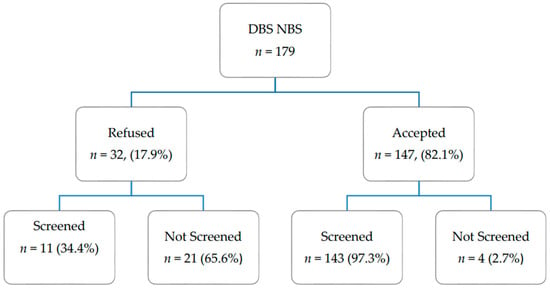
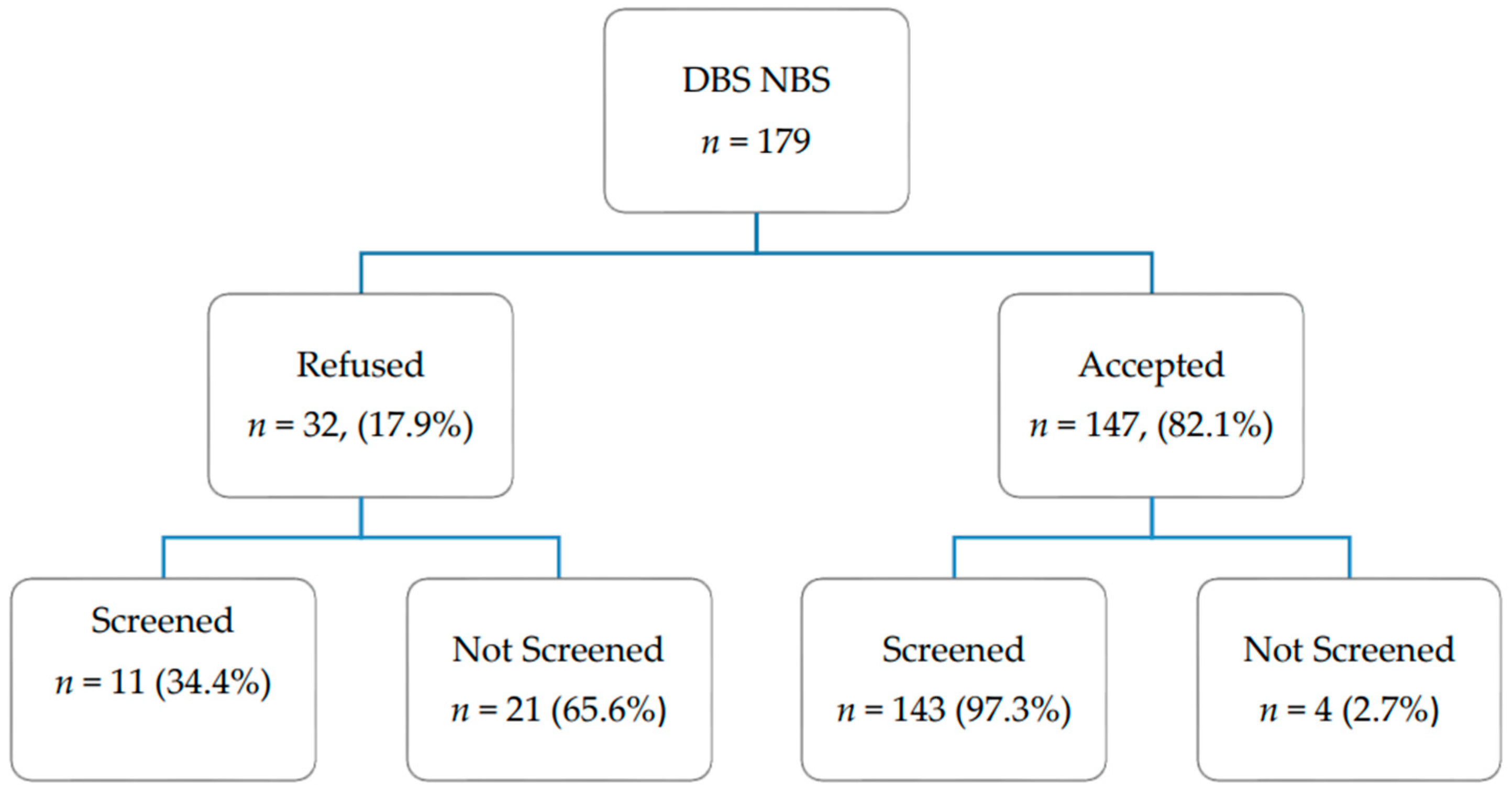
Out of 179 parents enrolled in this study, it was observed that 147 cases (82.1%) accepted the DBS-NBS, while 32 parents (17.9%) refused screening (Figure 1). Of those who accepted, 143 newborns (97.3%) underwent DBS-NBS, and only 4 (2.7%) did not undergo the procedure. Of the parents who initially refused screening, among them 11 newborns (34.4%) were eventually screened following pediatric counseling, whereas 21 (65.6%) did not undergo screening. Overall, DBS-NBS was performed for 154 newborns (86.0%), while 25 newborns (14.0%) did not receive screening (Figure 1).
Figure 1.
Acceptance and refusal of dried blood spot newborn screening (DBS-NBS) and completion of screening. Note: Completion percentages are calculated within the accepted (n 147) and refused groups (n 32).
3.1. Awareness, Knowledge and Perception Regarding Newborn Screening
Overall, 142 (79.3%) parents reported being aware of newborn screening, and 139 (77.7%) demonstrated knowledge regarding the conditions included in NBS. Participants also recognized the recommended timing of screening, indicating awareness that NBS should be performed as early as the second or third day of life (76.5%). Furthermore, 138 (77.1%) respondents agreed that healthcare providers had provided adequate information regarding newborn screening, and 134 (74.9%) reported understanding the purpose of the screening test. Notably, 148 mothers (82.7%) believed that newborn screening was necessary for their child, suggesting a generally positive perception of NBS even though many also reported practical barriers (Table 2 and Table S1).
Table 2.
Parental awareness, knowledge and perception regarding newborn screening.
3.2. Barriers to Newborn Screening
Several potential barriers to newborn screening were explored. Most barrier-related items demonstrated a median score of 4 (IQR 3–5), indicating moderate agreement that these factors could influence participation in NBS programs.
Financial considerations emerged as an important concern. The majority of parents agreed that the cost of newborn screening could represent a challenge (132; 73.7%), Accessibility-related factors were similarly important; a total of 66.5% of families reported that the physical distance to the screening location was too far from their primary residence. Meanwhile, lack of transportation was reported by 34 (19.0%) parents. Transportation availability was reverse coded for analysis to maintain consistency in barrier score interpretation.
Logistical barriers were also identified. Excessive waiting times at testing sites were cited as a significant barrier by 116 (64.8%) of participants, suggesting that operational factors may affect the timely uptake of newborn screening services. A total of 114 (63.7%) respondents had competing personal or family responsibilities. In addition, concerns regarding potential test results and associated health implications were reported by 121 (67.6%). Cultural and religious beliefs were raised by 69.8%, suggesting that sociocultural considerations may influence screening decisions in some families (Table 3 and Table S2).
Table 3.
Perceived barriers to acceptance of newborn screening.
3.3. Facilitators of Newborn Screening Acceptance
Several factors were identified as facilitators that could enhance parental acceptance of newborn screening. Most facilitator items demonstrated a median score of 5 (IQR 4–5), reflecting strong agreement among participants (Table 4).
Table 4.
Facilitating factors influencing acceptance of newborn screening.
The most frequently endorsed facilitators included postnatal counseling by healthcare professionals, such as physicians, nurses, and consultants. In total, 153 (85.5%) of respondents reported that counseling directly encouraged screening acceptance, as well as adequate knowledge regarding diseases detected through newborn screening, whereas 139 (77.7%) noted that recommendations from obstetricians were also perceived as influential in promoting acceptance of NBS.
Accessibility and affordability were important enabling factors. Participants agreed that the availability of screening services close to their residence and knowledge that screening was free or low-cost would increase acceptance (81.6%), although the availability of financial assistance was also acknowledged (133; 74.3%). Furthermore, parents reported that receiving information in simple and understandable language would facilitate decision-making regarding newborn screening (142; 79.3%).
Community-based awareness strategies were also viewed positively. Positive testimonials from other parents, promotion through social media and mass-media campaigns and the provision of brochures or printed educational materials, indicating strong support for educational interventions aimed at improving NBS uptake, saw positive agreement, with over 80% of respondents agreeing.
4. Discussion
The present study investigated parental acceptance and refusal of dried blood spot newborn screening (DBS-NBS) and explored the awareness, barriers, and facilitators influencing screening uptake at secondary hospitals of Aga Khan Hospital Karachi.
A key finding of this study was the relatively high acceptance rate of DBS-NBS, with 82.1% of parents initially consenting to screening. Following additional counseling and engagement, some parents who had initially refused subsequently accepted screening, resulting in an overall screening completion rate of 86.0%. Although the acceptance rate observed in this study is encouraging, the refusal rate (17.9%) was higher than that reported in earlier studies conducted within the healthcare system, where the refusal rate for CH screening was approximately 7.6% [7] This difference may reflect variations in study populations, changing socioeconomic circumstances, expansion of screening panels, or differences in parental perceptions regarding newborn screening over time. The higher refusal rate observed in the present study suggests that barriers to screening persist despite increasing awareness and service availability. These findings highlight the need for continuous evaluation of parental concerns and targeted interventions to address factors contributing to refusal.
The relatively high acceptance observed in our study is consistent with previous reports indicating that parents generally recognize the benefits of newborn screening when adequate information and professional guidance are provided [14,15]. Nicholls and Southern et al. reported that parental acceptance of newborn bloodspot screening is strongly influenced by perceived benefits for the child’s health, trust in healthcare professionals, and confidence in the healthcare system [16]. Similarly, a recent study from India found that parents were generally supportive of newborn screening programs when they understood the purpose and benefits of screening [17].
Parental awareness regarding newborn screening was notably high in the present study. More than half of the participants reported awareness of newborn screening, knowledge regarding screened conditions, understanding of the appropriate timing of testing, and recognition of the purpose of screening. Most awareness items demonstrated a median score of 5 (IQR 4–5), indicating strong agreement. These findings differ from previous studies conducted in low- and middle-income countries where awareness levels were substantially lower. In a large Pakistani study conducted by Majid et al., only 43% of mothers demonstrated awareness of newborn screening programs, despite the study including literate participants [18]. The higher awareness observed in our population may reflect the influence of the hospital’s educational practices, providing NBS awareness during the antenatal visits of parents, urban residence of most participants, and greater exposure to healthcare information. Although a considerable proportion of parents demonstrated awareness of newborn screening and acknowledged its importance, an appreciable refusal rate was still observed. This finding suggests that awareness alone may not be sufficient to ensure screening uptake. Knowledge alone may not translate into healthcare behavior when financial and logistical barriers remain substantial. The educational background of parents was used as an important indicator of socioeconomic status. Fear and uncertainty regarding screening outcomes constituted another important barrier. Nearly half of participants expressed concerns regarding possible test results and associated health implications. Similar concerns have been documented internationally, where anxiety related to false-positive results, uncertainty about diagnosis, and fear of discovering serious conditions may influence parental attitudes toward screening [19]. These findings underscore the importance of clear communication regarding the purpose, limitations, and benefits of newborn screening.
The present study also identified several facilitators that may improve screening uptake. Strong recommendations from the obstetrician, healthcare provider counseling, improved parental knowledge, affordability of services, and proximity to screening centers all received high levels of agreement.
Educational interventions were also viewed favorably by participants. The majority reported that brochures, printed educational materials, social media campaigns, community awareness programs, and testimonials from other parents would increase their likelihood of accepting screening. Similar observations have been reported internationally, where educational materials and public awareness campaigns have been shown to improve parental understanding and informed decision-making regarding newborn screening. Franková et al. reported that parental awareness of newborn screening was significantly improved when information was provided by healthcare professionals, particularly during the prenatal period. Their findings further emphasized that both the timing and source of information influence parental understanding of newborn screening. Therefore, incorporating standardized antenatal counseling into routine maternity care may improve screening uptake [12].
The demographic profile of the study population may also partially explain the high awareness and acceptance rates observed. Nearly all participants resided in urban areas, and most parents had completed at least secondary education. Previous studies have demonstrated positive associations between parental education, health literacy, and awareness of newborn screening [18]. Better educational attainment may enhance comprehension of health information and facilitate informed healthcare decisions.
Healthcare professionals emerged as a critical source of information in the current study. More than half of participants agreed that healthcare providers had adequately informed them about newborn screening, and postnatal counseling by doctors, nurses, and consultants was identified as one of the strongest facilitators of screening acceptance. This finding aligns closely with previous literature demonstrating the central role of healthcare professionals in parental decision-making. Franková et al. found that parental awareness significantly improved when information was provided by obstetricians and healthcare professionals, emphasizing the importance of structured prenatal and postnatal education [12] Similarly, Nicholls and Southern highlighted that relationships with trusted healthcare providers are among the most influential factors affecting parental decisions regarding newborn screening [16].
Despite high levels of awareness and acceptance, several barriers to newborn screening were identified. Financial concerns represented one of the most commonly reported barriers, with approximately half of participants agreeing that the cost of screening could affect uptake. These findings are comparable to those reported by Majid et al., who identified healthcare costs as one of the major obstacles to implementing newborn screening services in Pakistan [18]. International experience demonstrates that sustainable newborn screening (NBS) is most effective when it is integrated into routine public health services and supported through stable financing. Australia and New Zealand established universally adopted, government-funded NBS programs, while more recent evidence shows that financing models vary internationally, with governments fully or partially covering screening costs in several countries [3,20]. Evidence from African programs further highlights that although external funding can help establish NBS, long-term sustainability is better supported by domestic government financing and integration into routine health services [21]. Consistent with these experiences, in the Philippines, the WHO reports that NBS is covered by national health insurance and mandated by law, and recommends integrating NBS with diagnosis, treatment, follow-up and long-term care within national health systems and universal health coverage, with sustainable financing to ensure equitable access [4,5]. In many low- and middle-income countries, out-of-pocket healthcare expenditures continue to influence healthcare-seeking behavior, particularly for preventive services that may not be perceived as immediately necessary [22]. Notably, more than half of participants strongly agreed that screening acceptance would increase if NBS was offered free of cost or at low cost. These findings support the growing body of evidence suggesting that reducing financial and logistical barriers can substantially improve participation in preventive healthcare programs.
Accessibility-related barriers also emerged prominently in this study. Although many participants reported that screening facilities were located near their homes, a substantial proportion still perceived the distance to healthcare facilities as a challenge. Furthermore, transportation difficulties, prolonged waiting times, and competing family responsibilities were frequently cited barriers. These findings are consistent with qualitative evidence reported by Conway et al., who demonstrated that logistical difficulties and challenges navigating healthcare systems negatively influence parental experiences with newborn screening programs [19]. Such barriers may be particularly relevant in resource-constrained settings where transportation infrastructure and healthcare accessibility remain uneven.
This study should be interpreted in light of several limitations. The majority of participants were recruited from urban settings, which may limit the generalizability of findings to rural populations. In addition, parental responses were self-reported and therefore subject to recall and social desirability biases. Nevertheless, this study provides valuable insights into the factors influencing newborn screening acceptance in a low- and middle-income country setting and contributes evidence that may guide future program implementation and policy development.
5. Recommendations
This study has several important implications for newborn screening policy and practice in Pakistan. First, strengthening prenatal and postnatal counseling by healthcare professionals may further improve screening uptake. Second, reducing financial barriers through subsidized or publicly funded screening programs could increase participation among families with limited resources. Third, targeted awareness campaigns utilizing social media, printed educational materials, and community outreach programs may further improve parental understanding and acceptance of newborn screening. Finally, efforts to improve accessibility and reduce waiting times may help overcome logistical barriers identified by participants.
Pakistan currently lacks a comprehensive national newborn screening program, despite evidence demonstrating the burden of congenital disorders and the benefits of early detection. The barriers identified in this study, including financial constraints, logistical difficulties, and limited awareness among some families, provide important information for policymakers planning the future expansion of newborn screening services. Incorporating newborn screening into national maternal and child health policies, subsidizing screening costs, and improving accessibility through decentralized screening services may enhance program coverage and reduce preventable disability and long-term healthcare costs.
6. Conclusions
Parental acceptance of newborn screening was high in this multicenter study; however, financial, logistical, and psychosocial barriers continued to influence uptake. While awareness and perceptions regarding newborn screening were generally favorable, improving affordability, accessibility, and healthcare-provider counseling may further increase participation and support expansion of newborn screening services in Pakistan.
Supplementary Materials
The following supporting information can be downloaded at https://www.mdpi.com/article/10.3390/ijns12040089/s1, Table S1: Parental Awareness, Knowledge and Perception Regarding Newborn Screening. Combined response of Agree and Strongly agree; Table S2: Perceived Barriers to Acceptance of Newborn Screening. With combined response of agree and strongly agree; Table S3: Perceived Barriers to Acceptance of Newborn Screening. With combined response of agree and strongly agree; Table S4: Accepted vs. refusal screened vs. not screened.
Author Contributions
Conceptualization, N.S. and F.S.A. (Farah Shams Abbasi); methodology, F.S.A. (Farah Shams Abbasi) and F.S.A. (Farhana Shams Abbasi); data collection F.S.A. (Farah Shams Abbasi), H.Z., N.S., S.N. and W.K.; validation and formal analysis F.S.A. (Farhana Shams Abbasi); writing—original draft preparation F.S.A. (Farah Shams Abbasi); writing—review and editing F.S.A. (Farah Shams Abbasi), H.Z. and F.S.A. (Farhana Shams Abbasi); supervision, H.M.; F.S.A. (Farah Shams Abbasi) was the principal investigator. All authors have read and agreed to the published version of the manuscript.
Funding
This research received no external funding.
Institutional Review Board Statement
This study was conducted in accordance with the Declaration of Helsinki and approved by the Ethics Committee of Aga Khan Hospital with protocol code 2025-11643-35927 on 6 August 2025.
Informed Consent Statement
Informed consent was obtained from all subjects involved in this study. Written informed consent has been obtained from the patients to publish this paper.
Data Availability Statement
Data are contained within the article.
Acknowledgments
We would like to acknowledge the efforts of doctors of the study hospital for their support and commitment. The authors used an artificial intelligence (AI)-assisted language tool to refine the language, correct grammar, and improve readability during the preparation of this manuscript. The authors reviewed, edited, and verified all content and take full responsibility for the accuracy, integrity, and originality of the manuscript.
Conflicts of Interest
The authors declare no conflicts of interest.
References
- Bonham, J.R.; Webster, D.; Gaviglio, A.; Khan, A.H.; Howell, R.R.; Schielen, P.C.J.I. Newborn Screening—A Worldwide Endeavour to Protect. Int. J. Neonatal Screen. 2025, 11, 80. [Google Scholar] [CrossRef] [Scilit] [PubMed]
- Liu, L.; He, W.; Zhu, J.; Deng, K.; Tan, H.; Xiang, L.; Yuan, X.; Li, Q.; Huang, M.; Guo, Y.; et al. Global Prevalence of Congenital Hypothyroidism among Neonates from 1969 to 2020: A Systematic Review and Meta-Analysis. Eur. J. Pediatr. 2023, 182, 2957–2965. [Google Scholar] [CrossRef] [Scilit] [PubMed]
- Therrell, B.L.; Padilla, C.D.; Borrajo, G.J.C.; Khneisser, I.; Schielen, P.C.J.I.; Knight-Madden, J.; Malherbe, H.L.; Kase, M. Current Status of Newborn Bloodspot Screening Worldwide 2024: A Comprehensive Review of Recent Activities (2020–2023). Int. J. Neonatal Screen. 2024, 10, 38. [Google Scholar] [CrossRef] [Scilit] [PubMed]
- WHO Urges Scale up of Newborn Screening to Improve Early Detection and Care of Birth Defects. Available online: https://www.who.int/news/item/23-06-2026-who-urges-scale-up-of-newborn-screening-to-improve-early-detection-and-care-of-birth-defects (accessed on 25 June 2026).
- Strengthening Capacity for Newborn Screening, Diagnosis and Management of Birth Defects: WHO Technical Consultation on Planning and Implementing Services Integrated into National Health Systems in Low- and Middle-Income Countries. Available online: https://www.who.int/publications/i/item/9789240122086 (accessed on 24 June 2026).
- Iroh Tam, P.-Y.; Padilla, C.D.; Zlotkin, S.; Ayede, A.I.; Banu, T.; Kayita, J.; Khanna, R.; Rao, S.P.; Siddeeg, K.; Walani, S.; et al. The 77th World Health Assembly Resolution Calling for Newborn Screening, Diagnosis, and Management of Birth Defects: Moving towards Action in Low-Income and Middle-Income Countries. Lancet Glob. Health 2024, 12, e1754–e1755. [Google Scholar] [CrossRef] [Scilit] [PubMed]
- Tariq, B.; Ahmed, A.; Habib, A.; Turab, A.; Ali, N.; Soofi, S.B.; Nooruddin, S.; Kumar, R.J.; Tariq, A.; Shaheen, F.; et al. Assessment of Knowledge, Attitudes and Practices towards Newborn Screening for Congenital Hypothyroidism before and after a Health Education Intervention in Pregnant Women in a Hospital Setting in Pakistan. Int. Health 2018, 10, 100–107. [Google Scholar] [CrossRef] [Scilit] [PubMed]
- Rose, S.R.; Wassner, A.J.; Wintergerst, K.A.; Yayah-Jones, N.-H.; Hopkin, R.J.; Chuang, J.; Smith, J.R.; Abell, K.; LaFranchi, S.H.; Section On Endocrinology Executive Committee; et al. Congenital Hypothyroidism: Screening and Management. Pediatrics 2022, 151, e2022060419. [Google Scholar] [CrossRef] [PubMed]
- Khan, S.A.; Aftab, S.; Khan, Y.N.; Yasir, M.; Arshad, K.; Mehak, N.U.A.; Rehman, S.K.U.; Faiztalpur, A.; Bahar, S.; Abdul Razzaq, A.; et al. A National Survey on Congenital Hypothyroidism Newborn Screening in Pakistan. Glob. Pediatr. Health 2024, 11, 2333794X241293526. [Google Scholar] [CrossRef] [Scilit] [PubMed]
- Majid, H.; Jafri, L.; Khan, N.; Khan, A.H. Establishing a nationwide newborn screening program for congenital hypothyroidism: A systematic review. Pak. J. Pathol. 2022, 33, 104–108. [Google Scholar] [CrossRef] [Scilit]
- Majid, H.; Jafri, L.; Ahmed, S.; Humayun, K.N.; Kirmani, S.; Khan, A.H. Establishing a Newborn Screening Programme: A Success Story from a Low-Resource Setting. J. Coll. Physicians Surg. Pak. 2025, 35, 387–389. [Google Scholar] [CrossRef] [Scilit] [PubMed]
- Franková, V.; Dohnalová, A.; Pešková, K.; Hermánková, R.; O’Driscoll, R.; Ješina, P.; Kožich, V. Factors Influencing Parental Awareness about Newborn Screening. Int. J. Neonatal Screen. 2019, 5, 35. [Google Scholar] [CrossRef] [Scilit] [PubMed]
- Pulungan, A.B.; Puteri, H.A.; Faizi, M.; Hofman, P.L.; Utari, A.; Chanoine, J.-P. Experiences and Challenges with Congenital Hypothyroidism Newborn Screening in Indonesia: A National Cross-Sectional Survey. Int. J. Neonatal Screen. 2024, 10, 8. [Google Scholar] [CrossRef] [Scilit] [PubMed]
- Van Der Pal, S.M.; Wins, S.; Klapwijk, J.E.; Van Dijk, T.; Kater-Kuipers, A.; Van Der Ploeg, C.P.B.; Jans, S.M.P.J.; Kemp, S.; Verschoof-Puite, R.K.; Van Den Bosch, L.J.M.; et al. Parents’ Views on Accepting, Declining, and Expanding Newborn Bloodspot Screening. PLoS ONE 2022, 17, e0272585. [Google Scholar] [CrossRef] [Scilit] [PubMed]
- Nicholls, S.G. Proceduralisation, Choice and Parental Reflections on Decisions to Accept Newborn Bloodspot Screening. J. Med. Ethics 2012, 38, 299–303. [Google Scholar] [CrossRef] [Scilit] [PubMed]
- Nicholls, S.G.; Southern, K.W. Parental Decision-Making and Acceptance of Newborn Bloodspot Screening: An Exploratory Study. PLoS ONE 2013, 8, e79441. [Google Scholar] [CrossRef] [Scilit] [PubMed]
- Eiango, A.; Jose, P.; Kandasamy, R.; Kommu, P.P.K. Parental Perspectives and Experiences of Newborn Screening Program in a Tertiary Care Teaching Hospital: A Cross-Sectional Study. J. Neonatol. 2025, 39, 78. [Google Scholar] [CrossRef] [Scilit]
- Majid, H.; Jafri, L.; Farooqui, A.J.; Ahmed, S.; Nisa Khan, Z.U.; Khan, A.H. Factors Associated with Awareness Of Literate Mothers About Newborn Screening: A Cross-Sectional Study From A Low-Middle-Income Country. J. Pak. Med. Assoc. 2023, 73, 1805–1810. [Google Scholar] [CrossRef] [Scilit] [PubMed]
- Conway, M.; Vuong, T.T.; Hart, K.; Rohrwasser, A.; Eilbeck, K. Pain Points in Parents’ Interactions with Newborn Screening Systems: A Qualitative Study. BMC Pediatr. 2022, 22, 167. [Google Scholar] [CrossRef] [Scilit] [PubMed]
- Webster, D. Newborn Screening in Australia and New Zealand. Southeast Asian J. Trop. Med. Public Health 2003, 34, 69–70. [Google Scholar] [PubMed]
- Archer, N.M.; Inusa, B.; Makani, J.; Nkya, S.; Tshilolo, L.; Tubman, V.N.; McGann, P.T.; Ambrose, E.E.; Henrich, N.; Spector, J.; et al. Enablers and Barriers to Newborn Screening for Sickle Cell Disease in Africa: Results from a Qualitative Study Involving Programmes in Six Countries. BMJ Open 2022, 12, e057623. [Google Scholar] [CrossRef] [Scilit] [PubMed]
- Francis, I. Newborn Screening in Australia and New Zealand 1984–1990. Med. J. Aust. 1991, 155, 821–823. [Google Scholar] [CrossRef] [Scilit]

Disclaimer/Publisher’s Note: The statements, opinions and data contained in all publications are solely those of the individual author(s) and contributor(s) and not of MDPI and/or the editor(s). MDPI and/or the editor(s) disclaim responsibility for any injury to people or property resulting from any ideas, methods, instructions or products referred to in the content. |
© 2026 by the authors. Published by MDPI on behalf of the International Society for Neonatal Screening. Licensee MDPI, Basel, Switzerland. This article is an open access article distributed under the terms and conditions of the Creative Commons Attribution (CC BY) license.