


Abstract
Women’s access to entrepreneurial resources and decision-making authority varies based on institutional support. This paper examines institutional support among female entrepreneurs through genealogical and purposive document searches related to resources in Gauteng, Western Cape, and KwaZulu-Natal provinces. The study’s 31 documents were analysed using a five-domain (5M) framework and other guidelines to establish and compare ownership of resources. A directory developed as part of the study includes 515 listings for Gauteng Province and 164 and 95 listings linked to the Western Cape and KwaZulu-Natal provinces, respectively. A focused history of the Isivande Women’s Fund examines eligibility rules and delivery arrangements. Business relationship information in an application helped trace an applicant’s reported use and transfer of other services and assistance to others. Business information in the application was insufficient to determine other business ownership and control information, including the timing of exercise of control rights. Methods proposed in this study to assess ecosystem conversion can help other researchers to understand an individual’s access to and other rights and control over resources at key points in the resource chain. Case examples and four hypotheses offer other researchers useful information but are not tests of causal hypotheses. Historical information from this study can serve as a basis for other research on the benefits of institutional recognition to promote innovation.
1. Introduction
The presence of finance, training, or market support does not ascertain a female entrepreneur’s ability to implement a particular business development: a supplier may receive an order on credit, a physical training opportunity may arise at times that conflict with paid work or family responsibilities, and an asset may contribute to household income while the entrepreneur’s authority to use it remains tentative. These are different problems, with different documentary traces; understanding them entails attention to the conditions connecting support offers to operational resources and to the entrepreneur’s own objectives.
In South Africa, factors related to these issues have a historical dimension. Laws governing residence, land ownership, and other family-related matters have restricted the ability of certain groups to own property and to engage economically, while also limiting institutional recognition of their interests. Litigation and other actions by women and others have led to reforms in the law. A historical analysis of these issues must be conducted for each case, examining historical trends in resource ownership and control. Conclusions about historical factors cannot be drawn from general statements about inequality or from the date on which a legal reform was enacted.
Entrepreneurship ecosystem research examines relationships related to financial and other resources and institutions (Stam and van de Ven 2021; Wurth et al. 2022). Research on gender issues in entrepreneurship explores variations in entrepreneurial experiences and outcomes for entrepreneurs at different stages in unequal systems (Motoyama et al. 2021; Lois et al. 2026). The entrepreneurship ecosystem concept helps explain variations in entrepreneurial experiences and outcomes. The entrepreneurship ecosystem is not an organisation or resource with its own goals or rules. Awareness of these distinctions can be useful in conversations about particular companies listed in a province’s directory.
The five-domain (5M) framework is a useful tool for exploring these issues; it connects financial and market topics with motherhood topics and meso-/macroenvironment topics (Brush et al. 2009). Motherhood in this framework focuses on issues related to home and family care, including care for adults and other dependents. Women and men both assume roles involving care, and both face costs and benefits. Gender-related issues include questions about who provides care and power associated with caregiving roles in specific institutional settings. The experiences of female business owners as mothers may differ from other business experiences.
This article discusses the usefulness of historical and other legal and current provincial records for research on female entrepreneurs and innovators in Gauteng, the Western Cape, and KwaZulu-Natal. Three subsidiary questions guide this study: First, how have past and current land and inheritance laws influenced women’s access to resources? What information on female entrepreneurs’ innovations and other activities is available in current provincial records, and how might differences between the three provinces affect this information? What other relationships between variables in current provincial records could be studied using an ecosystem convertibility framework?
This article reports on the history and comparative analysis of provincial documentary evidence. The settings of this research include documentary evidence from multiple provinces. Cases for analysis include specific rules, observations, and other documentary evidence. An innovation episode is a case or unit of analysis that may be helpful for additional research; it is not a reconstructed case study of an innovation episode drawn from multiple sources of evidence. Section 5 of this article discusses research methods, Section 6 provides a comparative analysis and categorisation of evidence of innovation episodes, and Section 7 gives examples of how to evaluate the transferability of evidence across ecosystems. Findings from this article may be used to make inferences about documentary evidence and gaps in evidence; they cannot be used to compare levels of innovation in women-owned businesses across provinces, or to evaluate the impact of an ecosystem on innovation.
Conceptually, this study examines ecosystem convertibility as an event-specific assessment of market and other resources and permissions available to a new business concept at the time of implementation.
2. Institutional Genealogy and the South African Case
2.1. Genealogy as an Analytical Approach
Inspired by Foucault’s (1977) genealogy, this paper’s approach focuses on the legitimation of norms and behaviours. A genealogical approach is used in this paper to explore the legitimation of private ownership and other family/economic rights, including the right to occupy a business location. Intergenerational family issues are a focus of this paper. Issues related to marriage and inheritance are explored in terms of competing claims to rights, rather than in terms of family history.
The analysis presented here examines the connections between antislavery laws and other aspects of social and spatial history related to race and gender inequality. The connections suggest that research on these other topics can complement research on antislavery laws because structural inequalities shape interpretations of those laws, and primary documents can provide clues as to how they were interpreted and challenged. The author discusses three primary documents on race and space, marital property, and inheritance law. Most commercial uses of primary documents are of secondary importance unless the primary document specifically mentions a modern commercial transaction or use related to antislavery law. Litigation and legislation affecting legal recognition do not provide information about modern commercial uses.
2.2. Economic Space and Changing Classification of Place
The Constitution establishes equality and economic rights, as well as land and property rights (Constitution of the Republic of South Africa 1996, sct. 9, 22, 25). These and other aspects of the Constitution represent legal discontinuities. Former land and other transportation/economic rights were not necessarily invalidated. The relationship between newly granted legal rights and former property rights is an empirical question and a potential source of other inequalities identified by the World Bank (2022).
Gauteng’s Township Economic Development Act includes provisions for revising place classifications. One purpose of the act is to foster economic development and trade links, including procurement, in townships (Gauteng Township Economic Development Act 2 of 2022 2022, sct. 3). Existing place classifications are applied under the act to benefit township residents and businesses. The available evidence suggests that the purposes of place classification in the area have changed from exclusionary to inclusionary uses. Further research on businesses and innovations benefiting from these policies is needed.
This sequence offers information on business registration procedures and practices, such as mailing addresses and customer service areas. Other potential connections between past and present land uses may exist. The inclusion of this information in a research plan is not meant to suggest the relevance of past and present land uses to particular businesses or states.
2.3. Marital Property and the Distinction Between Contribution and Control
The Recognition of Customary Marriages Act gives spouses in customary marriages equal rights and responsibilities, except in property matters for some types of customary marriages (Recognition of Customary Marriages Act 120 of 1998 1998, sct. 6–7). The 2021 amendment to the Recognition of Customary Marriages Act amended Section 7 to adjust the rights and responsibilities of parties to customary marriages entered into before the principal act commenced, as well as other property-related aspects of various types of marriages (Recognition of Customary Marriages Amendment Act 1 of 2021 2021, sct. 2). This description of the 2021 amendment does not suggest that women gained sole ownership of property.
Sithole and Another v. Sithole and Another is a useful case about sharing a household. The explanatory summary of an order from the Constitutional Court describes a clothing business in Mrs. Sithole’s home and other family members’ reliance on her income. Ownership of the family home was in the husband’s name, according to the explanatory summary of the order. The Constitutional Court affirmed an order invalidating a statute discriminating against certain marriages between Black people that took place before 1988 (Sithole and Another v. Sithole and Another 2021). The explanatory summary cited is a separate source from the case opinion cited.
This case provides information about differences between employment and other activities that involve the creation of positive property interests, and it includes information about a woman’s efforts to overcome economic barriers. Considerations for entrepreneurs include formal and informal property rights of the applicant, which allow participation in the proposed activity. The information in this case does not suggest that the woman applied for a loan or participated in other business activities, so assumptions should not be made about her business activities.
The issues related to woman-owned businesses are the same: data on whether the business owner is a woman do not provide information about her property rights in marital property or her rights to pledge other family assets. Information about a female business owner’s property rights depends on the nature of her marital and other family relationships and contracts, as well as the nature of other assets. Such information must be obtained directly if it is important to a transaction with the business owner.
2.4. Succession and Intergenerational Transfer of Resources
The statutory and customary regime of intestate succession, including the rule of male primogeniture, was challenged in Bhe and Others v. Khayelitsha Magistrate and Others. The court’s account notes the exclusion of women and young children from inheritance under that framework and its constitutional invalidity, along with arrangements for applying the rules of intestate succession (Bhe and Others v. Khayelitsha Magistrate and Others 2004). This case is about the rules of who inherits when someone dies without a valid will.
The Reform of Customary Law of Succession and Regulation of Related Matters Act subsequently regulated intestate succession for estates within its purview, including the treatment of spouses and descendants (Reform of Customary Law of Succession and Regulation of Related Matters Act 11 of 2009 2009, sct. 1–4). These documents together bring about changes to who can be recognised as a claimant on family resources; they also illustrate how family relations and authoritative classifications are challenged and reordered.
Inheritance can be important for entrepreneurship in the form of premises, equipment, savings, or other resources. The relation to credit is conditional and possible. Not all the inherited assets are transferable, acceptable as collateral, or controlled by the entrepreneur. The retained succession material does not track assets into business use. The genealogy therefore establishes a traceable sequence from title through to transfer, control, and use; it does not show that inheritance reforms spurred innovation, or that their effects varied between the three provinces.
3. Literature Review
3.1. Ecosystem and Other Collaborative Relationships at Different Levels of Participation
The present literature review summarises ecosystem linkages along with gender and innovation research from various fields, discussing the recent and classic literature on subjects including the 5M framework, genealogy, and measurement of capabilities and innovation. Details about the subjects and populations studied, as well as findings in the recent works reviewed here, have been retained to help users of this review learn about other subjects, including aspirations, social networks, entrepreneurship, and innovation adoption.
Stam and van de Ven (2021) described interdependent relationships within ecosystems. Wurth et al. (2022) described a research agenda for studying ecosystem processes and mechanisms. Bouncken and Kraus (2022) described emergence, governance, and digitalisation. Fernandes and Ferreira (2022) reviewed ecosystem networks. The cited research provides reasons to study specific ecosystem support functions alongside other support functions, while also providing other theories on coordination and resource mobilisation, as well as background knowledge to help develop or refine new theories.
Motoyama et al. (2021) examined women’s involvement in the entrepreneurship ecosystem in St. Louis, U. S. Welsh et al. (2023) examined the relationship between ecosystem conditions and women’s entrepreneurship outcomes. Findings from the study of Welsh et al. (2023) about women’s entrepreneurship outcomes apply only in the study’s own setting, not to outcomes in South African provinces. Lois et al. (2026) developed an intersectional framework in which the entrepreneur has memberships in other groups based on additional identities. Research by Motoyama et al. (2021), Welsh et al. (2023), and Lois et al. (2026) supports the need for studies focused specifically on women’s entrepreneurship and shows that women’s entrepreneurship experiences and goals may differ.
Agency is evident in low-resource environments. The findings of Mamabolo and Lekoko (2021) about women entrepreneurs in Botswana show that they established social ties to access knowledge, capital, marketing resources, and IT services. The results of this study challenge assumptions about female entrepreneurs’ lack of skills and their dependence on existing entrepreneurial support services, while also providing new information on formal and informal resources that female entrepreneurs can develop over time. Additional research is needed to learn more about the availability of resources when needed for innovation activities.
3.2. Finance, Markets, and the Limits of Network Indicators
Innovation involves costs and delayed payoffs, among other factors, but the types and levels of costs vary. Benefits to innovators include revenue and information from customers; benefits to firms include access to credit and other advantages of loan approval from sales. Relationships between innovation and benefits are not rigid, and some lower-cost innovations do not need external financing.
Ebewo et al. (2025) analysed barriers and facilitators for female entrepreneurs at an entrepreneurship centre in one South African province. Other barriers and facilitators discussed included mentoring and other assistance programmes, as well as economic and policy issues. The selected qualitative sample of nine female entrepreneurs shared accounts of their own experiences with institutions in the province; no information was provided about the number of female entrepreneurs in the province. Information on female entrepreneurs throughout the country is available in the annual GEM reports on female entrepreneurs (Meyer et al. 2024).
Crowdfunding is the process of raising money from multiple people online. Crowdfunding platforms help people donate money, purchase products and services, and lend and invest money. Urban and Moetse (2024) studied crowdfunding among female South African entrepreneurs. The published abstract of their study reported statistically significant relationships between the use of online crowdfunding platforms and bonding/bridging social capital, but no statistically significant relationship was observed between bonding and bridging social capital and financial capital in the published model. The results indicate that bonding and bridging social capital and financial capital are different constructs; they do not indicate that there is never a causal relationship between bonding and bridging social capital and financial capital.
3.3. Skills, Household Relations, and Institutional Recognition
Management skills include an ability to identify business opportunities and assess options; they can be learned through formal training, informal self-employment efforts at home or elsewhere, and other informal means. Management skills are different from formal training and other credentials; neither provides automatic access to tools or other resources or customers.
Tselepis and Nieuwenhuizen (2023) studied frugal innovation by South African female social entrepreneurs. A summary of their published research indicates purposeful selection of 11 out of 45 female entrepreneur case studies, with examples of innovation and growth in addressing difficult challenges. Lessons from these case studies may be useful to other researchers studying innovation in non-academic business settings. Limitations noted by the study’s authors included the inability to generalise from this study sample about overall rates of innovation or whether ecosystem support makes innovation more likely because of the authors’ prior selection of innovative and growing businesses. Our knowledge of the case-study results is limited to the authors’ summary in the abstract; we did not code specific business improvements reported in the study. Shoko and Ngulube (2026) studied entrepreneurial attitudes and learning among students; outcomes reported by the authors included student aspirations but not new products or other innovations.
Household networks provide social and economic benefits, including labour and other financial benefits. Potential conflicts include competition for time and other household resources, as well as control over the household (Brush et al. 2009). Men and women are influenced by issues within the household. Programmes should be planned to address gender issues related to caregiving and asset ownership in the household, along with their impact on programme participation. Not all mothers are necessarily constrained, and women without children are not exempt from caregiving responsibilities.
The Statistics South Africa report on care work includes official statistics and proxy data because time-use data are unavailable (Statistics South Africa 2026). The Statistics South Africa report does not provide information on possible care time for entrepreneurs or provincial barriers to innovation. National expert assessments provide views from experts on innovation but no information on innovation activity among specific businesses (Meyer et al. 2026a). The Statistics South Africa and national expert survey reports may identify topics for future study, but they do not address questions about specific instances of care and innovation.
3.4. The Analytical Gap
Related work already differentiates between resources and capabilities, as well as studying unequal opportunities to apply them. In the capability approach, capabilities are about substantive opportunities to perform valued activities, functionings are achievements, and conversion factors mediate the relationship between resources and opportunities (Robeyns 2017). These concepts are not reducible to a firm’s managerial skills, nor should they be treated as a previously unrecognised theory of resource conversion.
The narrower gap addressed here is about the documentary connections between recognition, resources, and time at the particular transitions between support channels. The proposed contribution is a theory-informed and context-sensitive operational framework. The utility of this approach depends on whether observing these transitions provides explanatory or diagnostic value beyond that of resource endowments, mobilisation, and coordination. The present corpus does not independently verify that possibility; it elaborates it.
4. Definitions and Analytical Tools
4.1. Woman-Owned Enterprises and Heterogeneous Objectives
For the purpose of this study, a woman-owned enterprise is defined as one at least 51% owned by women who are also responsible for strategic management decisions. An informal sole proprietorship qualifies if a woman owns the business and controls the principal decisions and returns. Mixed ownership means equal male and female ownership. Cooperatives need to show women’s ownership interests and authority to make decisions, not only the number of female members. This is an analytical definition rather than a statement that all sources use the same legal or administrative criteria. Source terms such as female entrepreneurs, female owner–managers, woman-owned suppliers, and early-stage entrepreneurs are retained. If there is no ownership threshold or control measure, it is not known whether it is compatible with the working definition. The gender distribution in an aggregate adult survey cannot resolve that uncertainty.
Shared ownership classification does not mean shared goals. Entrepreneurs may seek income stability, work compatible with caring responsibilities, social value, autonomy, expansion, or technology development. Things can change; opportunities can also be differentiated by race, age, disability, class, sector, location, and household arrangements. The proposed innovation should be evaluated within the framework of the stated purpose of the entrepreneur. The mere fact of not adopting a change, or of considering an available programme as unsuitable, does not in itself amount to exclusion or deficient convertibility (Lois et al. 2026).
4.2. Innovation and Its Observable Boundary
The working definition follows the Oslo Manual: an innovation occurs when an enterprise adopts a product or business-process change that is significantly different from the enterprise’s previous practice (OECD and Eurostat 2018, chap. 3). These changes include products, goods, and services. Benchmarks are the implementation and the past practice of the enterprise. Another result is commercial success: innovation is not a function of attending a training class, owning equipment, winning a contract, or surviving in business.
Picture a snack shop extending its opening hours. Existing arrangements would be used to keep the same service open an hour later, and an operating adjustment would normally be recorded. If the evidence shows that difference, then a new ordering or delivery system that makes a significant difference in how the shop serves its customers could be considered a business-process innovation. Innovation does not stop being innovation just because it responds to customer demand. Demand and availability of staff are reasons or enabling conditions. The classification is about what changed and whether it was implemented.
In documentary coding, the record should include what the previous practice was, what change was introduced, the date or period of implementation, and the reasons why the difference is considered to be significant. If these are missing, innovation is coded as not verified, not absent. Incremental and frugal innovations may be eligible, but not routine replacement, minor adjustments, or unimplemented intentions, just because a programme describes them as innovative. Source-reported survey novelty measures are maintained here in their original form and are not recoded retroactively as verified Oslo-compatible observations.
4.3. Resource Domains and Units of Analysis
The 5M domains organise relevant passages: money accounts for financial and material resources; market accounts for customers and trading relationships; management accounts for knowledge and organising capacity; household and care accounts for time, support, and authority in domestic relations; meso/macro accounts for institutions, intermediaries, and wider rules. Passages may be in more than one domain; for example, marital property can involve money, household relations, and institutional recognition simultaneously.
The current empirical unit is a documentary passage, a rule, or a reported observation; it is suggested that the unit of analysis for future explanatory research should be an innovation episode, an attempt to introduce a specified change, traced from an initial decision through implementation, abandonment, or revision. We have to define the episode before we know the result. The inclusion of abandoned attempts prevents the assumption that successful implementation implies the availability of all necessary conditions. The corpus does not provide a representative sample of such episodes.
5. Materials and Methods
5.1. Research Orientation and Scope of Inference
This study adopts an interpretivist documentary design based on abductive reasoning from the work of Morgan (2022). Documents are read as located accounts produced for legal, administrative, research, or advocacy purposes. The analysis assesses what these accounts achieve, how they classify actors and resources, and which relationships are unresolved; the 5M framework provides sensitising domains. Institutional genealogy analyses how recognition rules became authoritative and were contested. No framework prescribes the findings beforehand, and no new interviews, enterprise surveys, or experiments were performed.
The design has two connected tasks: historical analysis finds shifts in spatial, marital-property, and succession categories, while current analysis explores the degree to which provincial records link ownership, support, and implemented innovation. The framework that emerged was obtained from the synthesis.
5.2. Case Selection and Units of Analysis
Gauteng, the Western Cape, and KwaZulu-Natal were selected for documentary work within a shared national legal framework. The retained records provide contrasting administrative and measurement perspectives, township policy and procurement, entrepreneurial survey reporting, and an innovation-system diagnostic. The choice is justified by the different documentary windows that these records open on the research question; it is not based on a supposed ranking of ecosystem strength, women’s innovativeness, or programme effectiveness. The design does not show that these perspectives are unique to the selected provinces.
The case is the provincial documentary setting; the source is an identifiable publication or legal record; the coding unit is the smallest passage, rule, or reported observation that maintains the claim’s relevant context. Thus, a quoted legal rule, a table row, and a survey percentage are different units of coding. The innovation episode proposed is the attempt of a particular enterprise to change over time, and no collection of unrelated aggregate observations is treated as a substitute for such an episode. National legal documents provide a common institutional context and are not coded as evidence of provincial variation in implementation.
5.3. Corpus Construction and Access Boundaries
The analytical corpus consists of 31 documents: eight academic articles, ten reports or statistical publications, and thirteen legal or administrative records, including an institutional presentation. The prospective governance discussion is underpinned by the Protection of Personal Information Act. All analytical sources and their access boundaries are presented in Table A1. The legal materials span 1950–2022, while recent academic and administrative materials are mostly dated 2021–2026. The dates of publication and the periods described are kept distinct.
Sources are provided for a definable contribution to one or more of four questions: historical recognition of economic claims, gendered resource relationships, institutional support in the chosen provincial settings, or definition and measurement of innovation. The analytical mechanisms are driven by academic evidence from outside South Africa rather than by local prevalence. A document must have an identifiable origin and a passage, abstract, synopsis, or table accessible and adequate for the specific claim assigned to it. Information and assertions not referenced within the assessed material are not used as substantive evidence here. A report and the brief drawn from it are different documents, but they form one family of evidence.
The corpus was intentionally constructed from the sources listed in Table A1. For this trajectory, records were not used that were not connected to an identifiable enterprise or that only described a planned programme. The reference list specifies the public routes to the actual material used. P07 uses the synopsis of the Constitutional Court repository, while P08 uses the court’s post-judgment media summary; these are distinct from binding judgements. R08 is page 35 of the printed annual report (page 37 of the PDF version), while P10 and P11 are unpaginated official notices identified by date and title. Academic sources based on abstracts are limited to information explicitly found in their abstracts. The additional documents do not create source saturation, but they extend a selected illustration.
The concentrated history of the IWF used a contemporary government news report, a departmental annual report, an IDC presentation to Parliament and a published oversight review. They were chosen to set conditions for launch, delivery, eligibility, and institutional change. Printed page 58: R09 consulted Slides 3–4, 8, 10 and 18–19; P13 consulted Printed pages 40–45 (PDF pages 45–50): R10 consulted Launch year is based on 2008 launch account; retrospective IDC slide 3 shows 2007, an unresolved source discrepancy. The CGE review is used as a published account, without the advantage of the underlying interviews or portfolio files. These national sources provide institutional background, not more provincial cases.
5.4. Source Appraisal and Extraction
Appraisal is not a single quality score that applies to all document types but, rather, is determined based on suitability for a specified claim. The appraisal is based on five questions: Do you know where it originated? What determined the account’s purpose and audience? What population, place, and time period does it cover? How was the information sourced? What details are available to examine the proposed inference? A statute may create an enacted category but not an implementation effect. A procurement total can be reported by a government statement without independent audit. The abstract of such a study may describe a reported association but not give its coefficients or allow reanalysis.
Extraction retains the source identifier and locator, document type, publication date and observation period, geographic scope, population and denominator, ownership terminology, resource domain, outcome definition, reported observation, and inferential limit; anything not reported is coded as missing information. The full source inventory is given in Table A1; the main observation–claim links are made inspectable in Table A2, including the enterprise trajectory and programme history.
5.5. Coding Rules for Ownership, Innovation, and Explanation
The 5M domains are money, market, management, household and care, and meso-/macro-institutions; one document may be related to more than one domain. Evidence of ownership was coded as consistent with the study’s definition of ownership and control, a source-reported female category without sufficient detail on ownership, an aggregate or mixed population, or not reported. For example, female-owned suppliers in P06 are a source-reported category because the threshold for ownership is unspecified. This keeps all evidence about women from being evidence about the narrowly defined WOE population.
There are four descriptive categories of innovation evidence: documentation of implementation requires sufficient information on prior practice, significant product or process change, and actual introduction; in cases where the underlying change cannot be independently assessed, the study’s innovation or novelty category is determined by what is reported by the source; enabling activity includes finance, training, network contact, and participation in procurement without evidence of a qualifying implemented change; an unobserved outcome pertains to where the material accessed cannot classify implementation. These are categories of evidence, not a numerical scale of innovativeness; they are specifically differentiated from the idea that a document that does not state a change is a finding that there is no change.
The level of evidence for each statement is noted in the review: D means documented findings or source-reported evidence, I means an interpretation in this review article, and H means a hypothesis. Outcomes reported in source documents are noted with D in the review; other interpretations of outcomes in source documents are not supported by evidence. The procedures and quality-control measures used to prepare this review are described in Table 1.
Table 1.
Analytical procedure and coding decisions.
5.6. Common Comparison Schedule and Non-Equivalent Measure
Each provincial setting is considered using the same five questions: What types of population and ownership are represented? What support/resource relationship is perceived? What evidence exists of implemented innovation? Can timing and decision authority be tied to the same enterprise and change? What is the scope or boundary of coverage that affects interpretation? The answers are presented in Table 3 (including not-reported cells). Even if documents may not provide comparable outcome measures, this gives a common analytical structure.
To compare these documents numerically, they must have a common construct, a population definition, a unit, a denominator, a period, and a basis of observation. The R04 directory also satisfies the narrower requirement of a common source classification and update for the counts of recorded entries; these are not population-adjusted densities of support services or other services. Services provided in the Western Cape and purchases and services provided in Gauteng and KwaZulu-Natal cannot be compared across provinces and are not aggregated into other measures, such as an innovation index. Provincial data are not used when national data are unavailable, and percentage figures from different bases are not aggregated.
5.7. Abductive Synthesis and Checks on Interpretation
The analytical sequence proceeds from contextual reading to source-bound extraction, 5M and outcome classification, within-case summaries, common comparison schedule, and framework development; interpretive links follow the description of the documented observation and its population boundary. Event years and reported publication years are separated. Table 6 and Table A2 distinguish between observed sequence and unresolved transaction timing, control, and alternative explanations.
The synthesis is limited by counter-evidence. A06 separates network connection and finance, R03 avoids attributing the total innovation to WOEs, and R04 avoids considering missing informal activity as non-existent. Other explanations include demand, initial resources, sector, firm size and experience, provider quality, and entrepreneurs’ preferences. Missing reporting, non-use of resources, and legal reform are not in themselves evidence for convertibility, and there is no claim of an independent coding-agreement statistic, new theme-frequency analysis, member checking, or causal effect.
5.8. Credibility, Reflexivity, and Research Ethics
Credibility rests on source-to-claim traceability, explicit access restrictions, stable classification rules, and attention to observations that resist the preferred explanation. The analysis relies on published documents and does not add any new participant-level interview or survey data. Accounts have been presented in a public domain context; commercially sensitive or private household details have not been recreated. Linked administrative records are a possible avenue for future research but would necessitate the appropriate permissions and data governance. The method therefore includes the limitations of the corpus under investigation, not resolving them in a more elaborate framework.
6. Comparative Documentary Findings
6.1. A Shared Inventory Records Different Numbers of Entries
The common directory table reported by Martel and Gengayah (2026, pp. 122–23) records 515 provincially anchored entries in Gauteng, 164 in the Western Cape, and 95 in KwaZulu-Natal; Table 2 retains these as source-reported inventory observations. The unit is an entry under the source’s classification—not necessarily a distinct provider, a separate programme, or an active government funding scheme.
Table 2.
Source-reported provincially anchored directory entries.
The counts describe recorded institutional presence; they do not establish current opening status, service capacity, quality, usefulness, eligibility, or women’s actual access. A directory entry can be inactive, overlap with another service, or refer to support available beyond the provider’s location. Conversely, nationally available and unlisted assistance may reach firms in a province. This study does not perform a new deduplication exercise; even a perfectly deduplicated count would not establish practical availability or usefulness. The comparison concerns listings within a shared source, not the relative adequacy of provincial support.
6.2. Gauteng Documents Procurement Participation
The Township Economic Development Act describes a policy architecture for township enterprise support and trading relationships. A separate official statement reports that Gauteng spent R4.31 billion on female-owned enterprises out of R33.16 billion in procurement spending in 2021/22; it also reports 1013 woman-owned suppliers among 17,763 enterprises receiving procurement spending (Gauteng Office of the Premier 2022, Women in Business Section). Calculated from those totals, the respective shares are approximately 13.0% of reported spending and 5.7% of reported suppliers.
These figures document reported participation in a specified procurement channel; they do not estimate the share of all Gauteng enterprises owned by women, the value of women’s total market activity, or the proportion innovating. The official statement does not supply the ownership threshold, application pool, rejected bids, or firm-level innovation records; its reporting period precedes the 2022 Township Act and cannot establish the act’s effects.
The procurement record nevertheless identifies a useful starting point for further analysis. Award dates, production requirements, financing decisions, payment dates, and implemented changes could be connected for particular suppliers. This would distinguish receiving an order from securing resources to fulfil it, as well as from introducing a qualifying product or process change. The present aggregate statement establishes the procurement observation, not that subsequent sequence.
6.3. The Western Cape Reports Aggregate Early-State Innovation
According to the GEM report, in the Western Cape, 47.36% of early-stage entrepreneurs had product or service novelty, and 45.50% had process innovation, while the national figures were 34.37% and 32.60%, respectively (Meyer et al. 2026b, pp. 91–92). These are the report’s measures for its survey population. “Early-stage” refers not to the age of the entrepreneur but to business development. The product measure is about novelty to customers and market offerings; it is not the same as the working enterprise-level definition used here for documentary classification.
The report describes 423 adults in the Western Cape in the national survey, along with a separate online booster of 302 adults in the city of Cape Town (Meyer et al. 2026b, pp. 16–17). Not all early innovation indicators use adult sample totals as denominators. The booster has separate geographic and collection boundaries, and it is not pooled with the provincial sample for this article. These reported numbers do not lead to a new significance test or population estimate.
Innovation percentages represent source-reported aggregate novelty and not the rate among firms meeting the study’s majority-ownership-and-control definition, which cannot be obtained from separate gender-composition statistics without joint tabulations. This result is therefore a measurement limit and not an inference that women innovate less or are excluded. A proper extension would link ownership, innovation classification, and support-use information within the same observed population.
6.4. KwaZulu-Natal Documents Support Composition and Measurement Scope
The KwaZulu-Natal technical report is a diagnosis of the relationship between innovation inputs and outputs. A provincial diagnosis was carried out by Martel and Gengayah (2026), and the companion brief provides a summary of the same publication family (Innovate Durban 2026). The contribution of the present article is on differentiated recognition and resource transitions, not on the origin of the general observation that innovation inputs may fail to translate into outputs.
In total, 52 advisory, 32 capital, and 11 other entries make up the composition reported within the 95 provincially anchored directory entries. The report finds that 78 of the 95 are situated in the Durban metro area, accounting for roughly 82.1% (Martel and Gengayah 2026, pp. 122–23). This provides a description of the classification and anchoring of the inventory; it does not measure loans disbursed, women served, effectiveness of service, or travel distances. Furthermore, metropolitan anchoring does not show that clients outside the metropolitan area are unserved; it also points to another limitation: its formal-system indicators do not capture innovation in the informal sector (Martel and Gengayah 2026, sct. 9.6, pp. 177–78). This limits the visibility in the diagnosis, but it does not state that informal innovation is not present. For documentary studies of informal enterprises, evidence appropriate to their activities would be needed, including implemented product or process changes, without making registration a proxy for innovativeness.
6.5. Cross-Case Synthesis
Table 3 applies the common comparison schedule to the three provincial documentary settings; its rows concern the same analytical questions, while the cells preserve differences in population, measurement, and period. The comparison establishes what can be said about institutional conditions and how far each documentary trail extends; it does not treat procurement, survey novelty, and support composition as interchangeable indicators of a single outcome.
Table 3.
Common-question comparison of provincial documentary settings.
The shared national legal context informs the same questions in every provincial setting; it cannot supply missing provincial enterprise observations. The cross-case result concerns the scope of the retained records; it is not a claim that equivalent data do not exist elsewhere.
6.6. What the Innovation Evidence Can Establish
The main innovation-related observations are presented in Table 4. The provincial material as a whole does not result in a common ownership-compatible innovation outcome, and the innovation index is not constructed by combining procurement totals, programme counts, and percentage of survey novelty.
Table 4.
Classification of the principal innovation evidence.
6.7. A Source-Linked Innovation Trajectory
Three official records provide more than a support listing for the Memeza Initiative. In a notice dated 28 March 2014, Gauteng stated that the Innovation Hub has provided two years of development assistance for personal and community alarms (Gauteng Department of Economic Development 2014). A later government statement identifies a pilot in Diepsloot in 2015 involving the Centre for Public Service Innovation and the Innovation Hub, followed by installation in schools and vulnerable households (Centre for Public Service Innovation 2018).
The Technology Innovation Agency’s annual report records the deployment of community alarms in Ugu District, KwaZulu-Natal, and lists Memeza Shout (Pty) Ltd. as a Black-woman-owned social enterprise (Technology Innovation Agency 2023, p. 35). These records show evidence of a named product that was developed, tested, and then deployed. The location of deployment is not considered the place of ownership of the enterprise, and the records do not set an innovation rate for Gauteng or KwaZulu-Natal.
Analytically, the documents indicate joint action by innovators and implementers. The notices contain information about specific projects and companies but do not contain information about long-term financial or other relationships, control over other entities, funding, or other implementation schedules. The trajectory documented in the notices could be useful as a case study of implementation that preserves information about the project for other research on the factors that contributed to the project’s success; it cannot be considered definitive proof of a WOE event or other convertibility.
7. Discussion and the Proposed Ecosystem Convertibility Framework
7.1. A Construct Located in an Episode
Here, ecosystem convertibility is defined as the observable fit of recognised access, complementary resources, timing, and decision authority at a specified transition in an entrepreneur’s intended innovation episode. This term refers to the entrepreneur’s relationship with specific resource channels; it is not an inherent characteristic of a province, a psychological characteristic, or the number of programmes listed in an inventory.
Access concerns the relevant institution’s acceptance of the applicant’s status and claim under the channel’s requirements. Additional inputs required for the next task are complementary resources. Timing concerns whether those inputs can be applied in the relevant window of the task; decision authority refers to who can authorise and execute their deployment. These dimensions must be recorded separately before the outcome is known; it does not add an additive score and does not assume that each episode requires the same inputs.
Convertibility is also different from implementation. There may be favourable conditions when the entrepreneur decides not to go ahead, the demand falls, or technical trials fail. Alternatively, if one support channel failed, implementation could take place via some other path. The framework may include agency by logging the intended route, alternatives, and the reasons for closure; this stops the outcome from defining the construct.
Suppose that a hypothetical supplier is about to start a major revision of its production process. Even with the loan, credit approval after the production deadline might not be usable for that episode, but approval can indicate what is possible and what is not. Where finance is needed and no substitute exists, its absence may rule out the intended route. Approval alone does not establish implementation, as technical capacity, authorisation, and demand are relevant. This is an example to demonstrate the distinction, not an instance that we observed in the corpus.
Table 5. Operational evidence requirements for ecosystem convertibility. A positive observation implies a positive record of the enterprise and task specified. An explicit refusal, incompatibility, or missed deadline can support a negative observation. “Not reported” means that the material is inconclusive on the issue, whilst “not applicable” means that a reason associated with that episode is needed. If the value is unknown, it is not coded as a barrier or a successful conversion. The general rule of eligibility is contextual evidence, not proof that a specific applicant obtained recognised access. These statuses are nominal, and no composite score is computed.
Table 5.
Operational evidence requirements for ecosystem convertibility.
7.2. Relationship to Established Approaches
Resource endowments determine what is owned or provided; mobilisation is about the ways in which actors obtain and combine resources; coordination is the organisation of relationships between actors. The capability approach takes into account substantive opportunities and conditions for their conversion (Robeyns 2017). Ecosystem convertibility uses these approaches to define an observation point: the dated transition between a recognised claim or support interaction and resources usable for the next task.
The proposed novelty is operational: the institutional genealogy identifies the recognition categories at issue, the 5M domains organise relevant resources, and the transition structure specifies what has to be observed for a given task. An inventory can monitor an offer, while the diagnostic determines whether the applicant’s claim was accepted, the required inputs could be combined, their availability overlapped the task window, and deployment could be authorised. The problems are generally already covered by existing theories. The present paper is an explicit scheme for documentary observation; in its explanatory benefit, it may be compared with those approaches.
Figure 1 distinguishes between the context of the documentary and the proposed episode-specific diagnosis. Dashed relationships represent questions for investigation, not estimated causal effects. Table 5 details the evidence requirements, Section 7.3 applies the diagnostic to real documentary claims, and Section 7.4 provides hypotheses for testing the explanatory power of the diagnostic.
Figure 1.
Proposed framework of gendered ecosystem convertibility. Note: D denotes documented rules or source-reported observations; I denotes interpretation; H1–H4 are untested hypotheses. The solid box identifies documentary context. Dashed boxes and arrows organise proposed observations and relationships; they represent no estimated effect. The 5M domains are money, market, management, household and care, and meso/macro institutions. Source: authors’ synthesis informed by Brush et al. (2009), Robeyns (2017), OECD and Eurostat (2018), and the evidence in Table 3, Table 4, Table 5 and Table 6.
Table 6.
Worked applications of the convertibility diagnostic.
7.3. Worked Applications and Boundary of Demonstration
Six applications distinguish the use of the diagnostic from validating its mechanism: P08 distinguishes household contribution from recognised entitlement, P06 records procurement participation without a linked implementation sequence, and A06 distinguishes social capital associations from financial outcomes, while P10, P11, and R08 add an implementation trajectory linked to the source, allowing the analysis to move beyond unlinked aggregate observations. Table 6 sets out what each application establishes and what additional evidence would be required.
The applications collectively differentiate entitlement, participation, resource relationships, and implementation. The complete explanatory test would contain episode-specific decisions, task deadlines, receipt dates, and deployment authority, including unsuccessful and alternative routes; recognition feedback is a further theoretical extension. Here, therefore, we achieve operationalisation and illustration, but causal validation and explanatory superiority are questions for subsequent research.
7.4. Four Hypotheses for Future Documentary Testing
The hypotheses below are proposals for analysis. The present corpus does not make any estimates or confirmations. These are efforts in specific channels of support, not all women-owned businesses regardless of need or preference. A meaningful test would pre-specify the episode, relevant resources, observation window, and outcome, keeping track of attempts that are implemented, abandoned, and redirected.
H1—Ownership/authority conflict: Among otherwise comparable applicants with documented ownership claims, a mismatch between recorded ownership and effective authority to deploy the relevant asset will be related to longer time to usable finance. We expect this association to be stronger for collateral-dependent channels than for otherwise comparable unsecured channels. This is more than the definitional claim that permission is required: it predicts a conditional difference between routes and observable delay. A test could be backed by asset and authority records, application decisions, and receipt dates. This hypothesis is weakened if mismatch adds nothing explanatory after credit risk, cash flow, and channel requirements are taken into account.
H2—Timing and complementarity of resources: For episodes with similar intended changes and total resource commitments, we will find that financial, technical, and market inputs that are available within overlapping task-relevant windows are more likely to be implemented within a defined period than comparable inputs delivered in a sequence that leaves essential gaps. A test should measure resource requirements and delivery dates, irrespective of implementation. If we control for volume of resources, sector, initial capability, and demand, the equivalent results will decrease the additional value of the proposed timing relationship.
H3—Household time and arrangements of programmes: Flexible participation arrangements will be associated with a larger increase in programme completion among applicants with more independently recorded care or other household time commitments, compared with applicants with fewer such time commitments. This is a comparison of circumstances and delivery arrangements, not an assumed disadvantage of being a woman or a mother. Flexible arrangements may include alternative attendance times or remote participation, as appropriate. Similar differences in level of responsibility in completion or selection effects that explain the association would undermine the hypothesis.
H4—Institutional recognition feedback: Where a provider has explicitly accepted verified prior implementation as evidence in subsequent applications, recognition of that record will be associated with a shorter subsequent assessment period than for comparable applicants whose equivalent record is not accepted or recognised. Previous accomplishment, recognition by the institution, and later access must be observed separately. If the difference can be explained by firm size, performance, prior relationships, or other selection factors, the recognition explanation is weakened. This is a theoretical extension, not a feedback mechanism that is attested in the provincial corpus.
These hypotheses permit empirical testing of potential effects, but not as a causal test of the current synthesis. Documentary records can establish sequences in time and test competing explanations over time. Credible causal estimates would also require an appropriate comparison design, such as a phased change in delivery arrangements with appropriate pre- and post-change observations and scrutiny of confounding. We make no such claim for design or result.
8. Policy and Practice Implications
The immediate benefit includes better coordination of services provided by other organisations. In a registry or other database, information should be provided about listings, services, and referrals, as well as interventions that qualify participants for services. Measures to collect data for the registry should include a denominator and other information to help other users understand different types of service providers and other issues. Entrepreneurs providing services should document the reasons why participants are not served or referred to other services.
Existing data sources can offer data on start times; in Gauteng, these sources include procurement and budget data. Existing ownership and technology data from the same or similar surveys or other administrative data sources for the Western Cape can be used to measure project start times. A directory survey of clients and service providers in major metropolitan areas of KwaZulu-Natal, along with other key financial services stakeholders, can be used to measure project start times. These are examples of uses of existing data; they are not recommendations for data collection priorities in the three provinces.
Access to provider information cannot be assumed. Challenges to accessing provider information include legal and other roadblocks to provider information sharing, inconsistent information technology systems, provider charges, and provider incentives to provide favourable information about clients. Consider a pilot project with participating providers; required provider information could include pseudonymised case identifiers and details about referral and service decisions, services delivered, service receipt, and reasons for service termination. Provider information about individual clients and households, as well as commercial relationships, should be shared only as permitted by law. Policies and practices for the use and storage of information should be developed in compliance with the Protection of Personal Information Act 4 of 2013. Pseudonymisation is not adequate legal protection for information.
Reciprocal feedback and other summary data related to the recruitment process may provide insights into the recruitment of providers and entrepreneurs. The acceptability of this type of information by providers and entrepreneurs has not been evaluated. Other options for programme staff without data-sharing agreements include collecting and maintaining identifiable data locally and sharing de-identified summary- and individual-level data with other programmes. Limitations of data use should be described, and broad data-sharing systems are neither assumed nor recommended by these findings.
Innovation-tracking programmes should include informal and home-based businesses. Possible evidence of innovation for these businesses could include documentation about a new service that the business offers, adoption or modification of a new production process, and other changes to service delivery. Other business successes, such as stable income, should be documented even in the absence of innovation. Documentation of other business successes can help prevent other factors, such as formal business registration and technological innovation, from affecting assessments of a business.
9. Contributions, Limitations, and Future Research
9.1. Contribution to Theory and Documentary Research
The historical contribution is to turn recognition itself into an object for ecosystem analysis. The construction and contestation of categories of access are shown in spatial classifications, matrimonial property arrangements, and rules of succession. Women’s litigation is evidence of that history, not of a fixed patriarchal order. The Isivande history extends this analysis to published support requirements and changes in delivery arrangements, while leaving their interaction with household property and care insufficiently observed.
The comparative contribution is to preserve incompatible evidence at its own level. The same classification of inventory allows for a limited comparison, while other provincial records show different aspects of participation and measurement. This resists a provincial ranking put together from unrelated indicators, while also converting missing links into precise questions, without presuming that missing reporting is a sign of institutional failure.
The conceptual contribution is an episode-specific diagnosis with explicit evidence requirements, three worked source applications, and four refutable hypotheses. The applications demonstrate how to identify entitlement, participation, and resource receipt, and they reveal the absence of linked innovation records; they define diagnostic clarity, not the framework’s superiority in explaining resource mobilisation, coordination, or capability accounts. Whether that benefit exists is an empirical question.
9.2. Limitations
The documents vary in date, population, and purpose. Provincial results do not differ after national legal changes, and procurement totals do not establish innovation. The aggregate novelty of the survey cannot be attributed to majority woman-owned firms. Provider anchoring does not establish customer reach, and dates of publication should not be taken as dates of the reported experiences. The Isivande history is bounded by selected institutional accounts and their reporting periods; the underlying application files and policy amendment decisions were not accessed.
The lack of linked observations especially limits household mechanisms and recognition feedback. The provincial records do not directly disclose the entrepreneurs’ own goals. Household mechanisms and recognition feedback are still particularly weakly observed, the provincial records do not record entrepreneurs’ own objectives directly, and there was no independent double-coding of the interpretation. These constraints necessitate a clear distinction between reported implementation pathways, diagnostic illustrations, and explanatory tests.
9.3. A Focused History of the Isivande Women’s Fund
The Isivande Women’s Fund (IWF) provides a clear context in which to explore the history of enterprise support. A BuaNews account of the time says it was launched by the Department of Trade and Industry (DTI) and Old Mutual in February 2008. The launch account announced debt finance of R30,000–R2 million for women entrepreneurs. The published criteria for qualification included a requirement for 60% female ownership, a minimum of two years in business and a sustainable business plan (SAPA 2008). Help was therefore organised around a business that was administratively recognisable and with a verifiable history of operation. This is an interpretation of the published criteria and is not proof of how individual applications were assessed.
The early delivery record shows problems in putting that offer into operation. The DTI’s 2010/11 annual report had set a target of assisting 40 projects but reported assistance to six women-owned enterprises to the value of R5 million. The variation was blamed on problems in appointing a fund manager (Department of Trade and Industry 2011, p. 58). The Industrial Development Corporation’s later financial statements mention an agreement in May 2010 to take on responsibility for the fund and then contract out its management to IDF Managers (Industrial Development Corporation 2015, slides 3–4). These records demonstrate a problem of implementation within the organization providing assistance. They do not show that a particular entrepreneur lost out on an investment because of that problem.
By March 2015, the IDC’s published criteria required that women held 50% plus one of the ordinary shares and that women occupied at least 30% of management positions. Commercial viability was also a prerequisite (Industrial Development Corporation 2015, slide 8). These thresholds differ from the ones reported at launch, but the retained sources do not establish the date or decision by which the criteria changed. And the distinction between ownership and management is also important, as these requirements alone do not show the primary female decision-making authority required by the WOE definition in this article. The same presentation also separately reported on an R65 million fund, with R35.05 million committed and R28.85 million disbursed to clients as at 31 March 2015 (slide 10). These figures differentiate the financing envelope, the investments authorised and the transfers reported.
The Commission for Gender Equality’s follow-up oversight review mentions the appointment of IDF in 2011 and the shifting of departmental responsibility to the Department of Small Business Development in 2014. It reports on new lending during 2012–2017 and managing existing investments toward a scheduled divestment date of 31 July 2019. At the time of that review, a recommended transfer to the Small Enterprise Finance Agency had not been completed (Commission for Gender Equality 2020, pp. 41–45). This account relates to the period under review and does not reflect the current availability of the fund.
This history is genealogically valuable in that a commitment to women’s economic empowerment came to have specific tests of ownership, business requirements and delivery arrangements. The proposed diagnostics have a concrete administrative setting: recognised access appears in qualification rules, resources in commitments and disbursements and timing in the organization of delivery and portfolio exit. The effective authority is still not taken into account enough. The sources that have been retained do not indicate how the arrangements of household property, caring commitments or informal business histories influenced individual decisions. They do not find an effect on innovation either. To examine those relationships, and whose claims were left out of official reporting, one would need to look at archived applications, eligibility manuals, appeals and entrepreneurs’ accounts.
10. Conclusions
This study investigated the role of historical recognition rules and provincial records in the analysis of innovation among woman-owned businesses in Gauteng, the Western Cape and KwaZulu-Natal; it adds value by combining institutional genealogy, the 5M framework, and a diagnosis of ecosystem convertibility. The article differentiates documented observations from interpretations and hypotheses.
The 31-document corpus reveals how spatial, marital property, and succession categories have been constituted, contested, and revised. These changes set up changes in entitlement, not changes in subsequent enterprise effects. Provinces differ in recorded support and measurement. Directory entries, procurement participation, and aggregate early-stage novelty and service composition describe different objects; they are unable to provide provincial rankings of innovative firms, as defined by this study’s ownership-and-control definition. The Isivande history further distinguishes published eligibility, financing commitment and disbursed assistance.
The implementation dimension is strengthened by connecting reported development assistance, the pilot, and later deployment, which establishes a source-linked enterprise trajectory. This shows that public records can document more than just institutional presence, but source-labelled ownership and incomplete transaction records leave important conditions unaddressed. The example illustrates a pathway but does not say what resources, deadlines, or authority arrangements made it happen.
Ecosystem convertibility identifies four dimensions for this kind of investigation: recognised access, complementary resources, timing, and decision authority. The novelty is an explicit observation scheme for transitions in an intended innovation episode. Entitlement, participation, resource relationships, and implementation distinguish four worked applications, and four hypotheses specify conditional relationships and possible counterevidence. The framework’s explanatory advantage over resource mobilisation, coordination, and capability accounts is yet to be tested.
Research and policy should link dated applications, referrals, financing decisions, and implementation records, provided access is lawful and confidentiality is maintained. Studies should include failed and redirected efforts, informal activity, and entrepreneurs’ objectives. Such steps would allow an assessment of resource transitions without considering programme participation as innovation, missing reporting as failure, or formal recognition as usable support. The present study provides a historically grounded and inspectable basis for that work and further evaluation.
Author Contributions
Conceptualization, O.W. and E.G.C.; methodology, O.W.; formal analysis, O.W.; investigation, O.W.; data curation, O.W. writing—original draft preparation, O.W.; writing—review and editing, E.G.C.; supervision, E.G.C. All authors have read and agreed to the published version of the manuscript.
Funding
This research received no external funding.
Institutional Review Board Statement
The study was conducted according to the guidelines of the Declaration of Helsinki, and approved the University of South Africa, College of Economics and Management Sciences, College Research Ethics Review Committee (CEMS-CRERC) (protocol code No. 16803 and date of approval: 2 September 2026).
Informed Consent Statement
This research study is exclusively a documentary study of publicly available published materials, government and other agency documents and legal and secondary data. No human research subjects were recruited or interviewed during this research study, and no identifying information about human research subjects was collected. No participant consent form was administered for this research study, thus, informed consent is not applicable.
Data Availability Statement
No new data were created or analyzed in this study. Data sharing is not applicable to this article.
Acknowledgments
ChatGPT (OpenAI, GPT-5.6 Sol) provided structural and language feedback. This study included no AI-participant or enterprise data or analysis. The author validated all information in the article and assumes all responsibility for the article’s content.
Conflicts of Interest
The authors declare no conflict of interest.
Appendix A. Documentary Corpus and Analytical Trail
Table A1 identifies all 31analytical documents and their material-access boundaries. R04 and R05 form one publication family; P10, P11 and R08 supply the targeted enterprise trajectory. R09–R10 and P12–13 supply the IWF history in Section 9.3. Exact routes to official court summaries and supplementary records appear in the references.
Table A1.
Analytical corpus and source access.
Table A2 illustrates the source-to-claim distinction. D means a documented rule or source-reported observation; I means an interpretation in this article; H means an untested hypothesis. The examples show the basis and boundary of interpretation, rather than validating causal mechanisms.
Table A2.
Worked source-to-claim examples.
References
- Bhe and Others v. Khayelitsha Magistrate and Others. 2004. [2004] ZACC 17; 2005 (1) SA 580 (CC). Constitutional Court, Case Metadata and Synopsis. Available online: https://collections.concourt.org.za/items/510dae51-090b-4fb2-8cfb-269bfa261f5e/full (accessed on 1 November 2026).
- Bouncken, Ricarda B., and Sascha Kraus. 2022. Entrepreneurial ecosystems in an interconnected world: Emergence, governance and digitalization. Review of Managerial Science 16: 1–14. [Google Scholar] [CrossRef] [Scilit]
- Brush, Candida G., Anne de Bruin, and Friederike Welter. 2009. A gender-aware framework for women’s entrepreneurship. International Journal of Gender and Entrepreneurship 1: 8–24. [Google Scholar] [CrossRef] [Scilit]
- Centre for Public Service Innovation. 2018. Government Congratulates Memeza Shout PTY Ltd. Winner of SA Premier Business SMME Award 2018. February 1. South African Government. Available online: https://www.gov.za/news/media-statements/government-congratulates-memeza-shout-pty-ltd-winner-sa-premier-business-smme (accessed on 1 November 2026).
- Commission for Gender Equality. 2020. Sink or Swim: The Challenges of Implementing Government’s Women Economic Empowerment Programmes in South Africa. Johannesburg: Commission for Gender Equality. Available online: https://cge.org.za/wp-content/uploads/2021/01/sink-or-swim-report-2020.pdf (accessed on 1 November 2026).
- Constitution of the Republic of South Africa. 1996. Chapter 2, Bill of Rights. Available online: https://www.gov.za/documents/constitution/chapter-2-bill-rights (accessed on 1 November 2026).
- Department of Trade and Industry. 2011. Annual Report 2010–2011; Pretoria: Department of Trade and Industry. Available online: https://www.gov.za/sites/default/files/gcis_document/201409/annualreport2011-all.pdf (accessed on 1 November 2026).
- Ebewo, Patrick Ebong, Cecile Schultz, and Mphoreng Magdeline Mmako. 2025. Towards inclusive entrepreneurship: Addressing constraining and contributing factors for women entrepreneurs in South Africa. Administrative Sciences 15: 14. [Google Scholar] [CrossRef] [Scilit]
- Fernandes, Ana Joana, and Joao J. Ferreira. 2022. Entrepreneurial ecosystems and networks: A literature review and research agenda. Review of Managerial Science 16: 189–247. [Google Scholar] [CrossRef] [Scilit]
- Foucault, Michel. 1977. Nietzsche, genealogy, history. In Language, Counter-Memory, Practice: Selected Essays and Interviews. Edited by Donald F. Bouchard. Translated by Donald F. Bouchard, and Sherry Simon. Ithaca: Cornell University Press, pp. 139–64. [Google Scholar]
- Gauteng Department of Economic Development. 2014. Gauteng Launches the Socially Responsive Memeza Safety Alarm; Pretoria: South African Government. Available online: https://www.gov.za/news/media-advisories/government-activities/gauteng-launches-socially-responsive-memeza-safety (accessed on 1 November 2026).
- Gauteng Office of the Premier. 2022. Premier David Makhura on Progress on Gender Equality; Pretoria: South African Government. Available online: https://www.gov.za/news/media-statements/premier-david-makhura-progress-gender-equality-30-aug-2022 (accessed on 1 November 2026).
- Gauteng Township Economic Development Act 2 of 2022. 2022. South Africa. Available online: https://www.gep.co.za/wp-content/uploads/2022/05/Gauteng-Township-Economic-Development-Act.pdf (accessed on 1 November 2026).
- Group Areas Act 41 of 1950. 1950. South Africa. Archived Statutory Extracts, Amendments and Related Regulatory Material. Available online: https://sahistory.org.za/sites/default/files/group_areas_act.pdf (accessed on 1 November 2026).
- Industrial Development Corporation. 2015. Presentation to Portfolio Committee on Small Business Development: Status of Isivande Women’s Fund (IWF) as at 31 March 2015. Presentation, May 12. Available online: https://static.pmg.org.za/150512idc.pptx (accessed on 1 November 2026).
- Innovate Durban. 2026. State of Innovation in KwaZulu-Natal 2025/26: Diagnostic Brief. Available online: https://innovate.durban/wp-content/uploads/2026/05/Diagnostic-Brief-2025_26-SOI-in-KZN.pdf?utm_source=chatgpt.com (accessed on 1 November 2026).
- Lois, Micaela, Isabella Stingl, Heike Mayer, and Susann Schäfer. 2026. Exploring social difference among entrepreneurs in entrepreneurial ecosystems: A systematic review and intersectional framework. Small Business Economics 67: 1073–92. [Google Scholar] [CrossRef] [Scilit] [PubMed]
- Mamabolo, Anastacia, and Reitumetse Lekoko. 2021. Entrepreneurial ecosystems created by woman entrepreneurs in Botswana. South African Journal of Business Management 52: a2228. [Google Scholar] [CrossRef] [Scilit]
- Martel, Patrick, and Tamisha Gengayah. 2026. Technical Report: The State of Innovation in KwaZulu-Natal Publication Series, 2025/26 ed. Durban: Innovate Durban. [Google Scholar] [CrossRef]
- Meyer, Natanya, Angus Bowmaker-Falconer, and Mahsa Samsami. 2026a. Bridging the Gap: Realising South Africa’s Entrepreneurial Potential. Cape Town: Stellenbosch University and Global Entrepreneurship Monitor South Africa. Available online: https://www.gemconsortium.org/report/bridging-the-gap (accessed on 1 November 2026).
- Meyer, Natanya, Daniel Meyer, Angus Bowmaker-Falconer, Mahsa Samsami, and Vusi Matsebula. 2026b. A Western Cape View on Entrepreneurial Activity and Local Economic Development, 2026; Cape Town: Western Cape Government and Stellenbosch University. Available online: https://www.westerncape.gov.za/edat/files/wcg-blob-files?file=2026-08/gem-wc-report-2026.pdf&type=file (accessed on 1 November 2026).
- Meyer, Natanya, Mahsa Samsami, and Angus Bowmaker-Falconer. 2024. Women Entrepreneurship in South Africa: What Does the Future Hold? Cape Town: Stellenbosch University and Global Entrepreneurship Monitor South Africa. Available online: https://www.gemconsortium.org/report/women-entrepreneurship-in-south-africa-what-does-the-future-hold (accessed on 1 November 2026).
- Morgan, Hani. 2022. Conducting a qualitative document analysis. The Qualitative Report 27: 64–77. [Google Scholar] [CrossRef] [Scilit]
- Motoyama, Yasuyuki, Susan Clark Muntean, Karren Knowlton, and Banu Ozkazanc-Pan. 2021. Causes of the gender divide within entrepreneurship ecosystems. Local Economy 36: 187–204. [Google Scholar] [CrossRef] [Scilit]
- OECD, and Eurostat. 2018. Oslo Manual 2018: Guidelines for Collecting, Reporting and Using Data on Innovation, 4th ed. The Measurement of Scientific, Technological and Innovation Activities. Paris: OECD Publishing. Luxembourg: Eurostat. [Google Scholar] [CrossRef] [Scilit]
- Protection of Personal Information Act 4 of 2013. 2013, South Africa. Available online: https://www.justice.gov.za/legislation/acts/2013-004.pdf (accessed on 1 November 2026).
- Recognition of Customary Marriages Act 120 of 1998. 1998, South Africa. Available online: https://www.gov.za/documents/recognition-customary-marriages-act (accessed on 1 November 2026).
- Recognition of Customary Marriages Amendment Act 1 of 2021. 2021, South Africa. Available online: https://www.justice.gov.za/legislation/acts/2021-001.pdf (accessed on 1 November 2026).
- Reform of Customary Law of Succession and Regulation of Related Matters Act 11 of 2009. 2009, South Africa. Available online: https://www.gov.za/sites/default/files/gcis_document/201409/32147433.pdf (accessed on 1 November 2026).
- Robeyns, Ingrid. 2017. Wellbeing, Freedom and Social Justice: The Capability Approach Re-Examined. Cambridge, MA: Open Book Publishers. [Google Scholar] [CrossRef] [Scilit]
- Shoko, Ratidzai, and Beatrice Ngulube. 2026. Gender dynamics and entrepreneurial visions in South Africa: Insights beyond formal education. Genealogy 10: 108. [Google Scholar] [CrossRef] [Scilit]
- Sithole and Another v. Sithole and Another. 2021. [2021] ZACC 7; 2021 (5) SA 34 (CC); 2021 (6) BCLR 597 (CC). Constitutional Court, Post-Judgment Media Summary. April 14. Available online: https://collections.concourt.org.za/bitstreams/641f7674-2eb8-4f8c-813f-9dc19394f34c/download (accessed on 1 November 2026).
- South African Press Association. 2008. South Africa. “Women can access loans through new fund.”. IOL. February 19. Available online: https://iol.co.za/news/politics/2008-02-19-women-can-access-loans-through-new-fund/ (accessed on 1 November 2026).
- Stam, Erik, and Andrew van de Ven. 2021. Entrepreneurial ecosystem elements. Small Business Economics 56: 809–32. [Google Scholar] [CrossRef] [Scilit]
- Statistics South Africa. 2026. Gender Series Volume XIII: Gender Disparities in Care Work in South Africa. Report 03-10-32. Available online: https://www.statssa.gov.za/?PPN=Report-03-10-32&SCH=74593&page_id=1861 (accessed on 1 November 2026).
- Technology Innovation Agency. 2023. Annual Report 2022/2023. Pretoria: Technology Innovation Agency. Available online: https://www.tia.org.za/core/uploads/2023/12/Annual-Report-2022-2023.pdf (accessed on 1 November 2026).
- Tselepis, Thea, and Cecile Nieuwenhuizen. 2023. Frugal innovations of South African female social entrepreneurs. African Journal of Science, Technology, Innovation and Development 15: 678–89. [Google Scholar] [CrossRef] [Scilit]
- Urban, Boris, and Phumzile Moetse. 2024. Social capital in a digital age: A focus on bridging and bonding social capital of women entrepreneurs in South Africa. International Journal of Entrepreneurship and Small Business 52: 67–85. [Google Scholar] [CrossRef] [Scilit]
- Welsh, Dianne H.B., Eugene Kaciak, Muriel Fadairo, Vijayta Doshi, and Cintya Lanchimba. 2023. How to erase gender differences in entrepreneurial success? Look at the ecosystem. Journal of Business Research 154: 113320. [Google Scholar] [CrossRef] [Scilit]
- World Bank. 2022. Inequality in Southern Africa: An Assessment of the Southern African Customs Union. Available online: https://documents1.worldbank.org/curated/en/099125303072236903/pdf/P1649270c02a1f06b0a3ae02e57eadd7a82.pdf (accessed on 1 November 2026).
- Wurth, Bernd, Erik Stam, and Ben Spigel. 2022. Toward an entrepreneurial ecosystem research program. Entrepreneurship Theory and Practice 46: 729–78. [Google Scholar] [CrossRef] [Scilit]
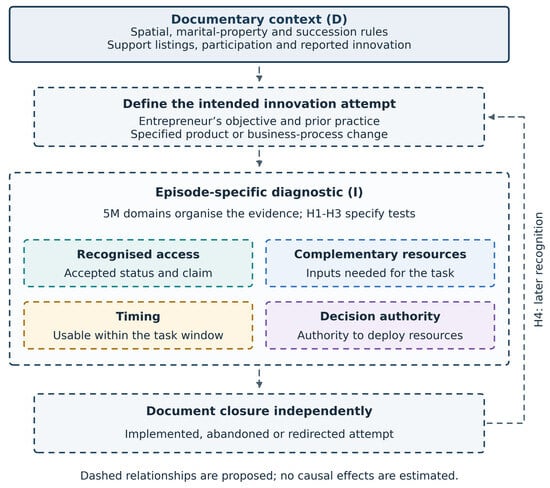
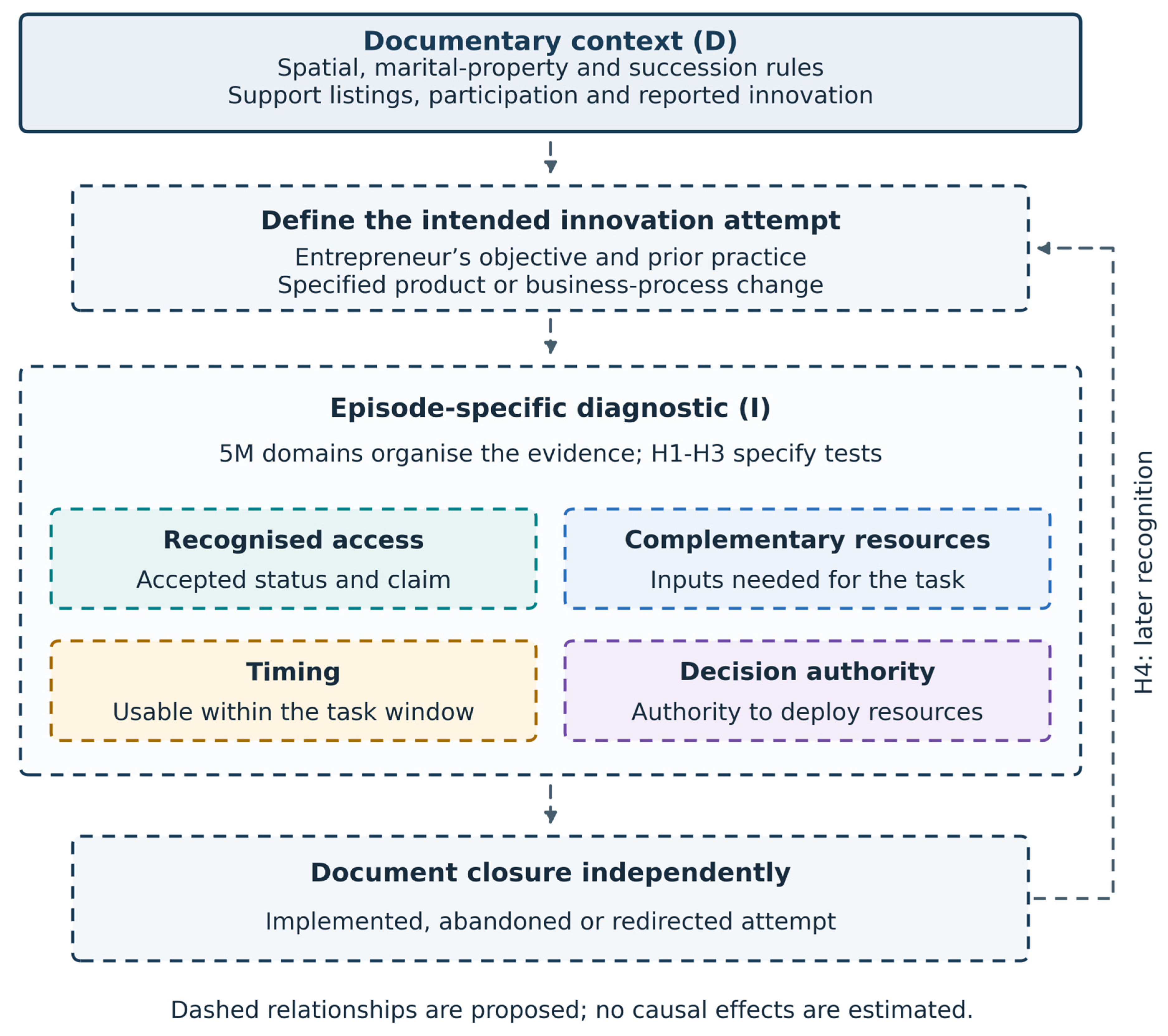

Disclaimer/Publisher’s Note: The statements, opinions and data contained in all publications are solely those of the individual author(s) and contributor(s) and not of MDPI and/or the editor(s). MDPI and/or the editor(s) disclaim responsibility for any injury to people or property resulting from any ideas, methods, instructions or products referred to in the content. |
© 2026 by the authors. Licensee MDPI, Basel, Switzerland. This article is an open access article distributed under the terms and conditions of the Creative Commons Attribution (CC BY) license.