


Abstract
Place names function both as spatial identifiers and as condensed repositories of urban history, local memory, and social relations. Using Shanghai as a case study, this article examines how multiple strata of place names—including old-city lane names, Jiangnan water-town toponyms, concession-era road names, province-named streets, revolutionary commemorative names, names associated with the development of Pudong New Area, and commercial place names—have accumulated and continue to coexist within the urban fabric. Their coexistence provides a particularly revealing case of the transition from cultural claims to institutionalized toponymic heritage governance in China. Together, road names, signage, spatial distribution, and everyday usage constitute a visible and lived toponymic landscape. Toponymic heritage protection therefore unfolds not only through archives and regulatory frameworks but also through street-level representation and everyday systems of spatial orientation. Drawing on published literature and policy documents, this article traces the historical layering of Shanghai’s place names, the recognition of their heritage value, and their incorporation into institutional governance, with particular attention to how established local governance mechanisms have interacted with increasingly formalized national regulations and how this interaction has been translated into planning, heritage inventories, archival systems, digitization, and urban regeneration. The study identifies an institutional trajectory of “local institutional accumulation—national regulatory reinforcement—institutional re-embedding.” Through the interaction of expert knowledge, public memory, and planning practices, historically significant place names are progressively recognized as heritage and incorporated into spatial governance; however, this process remains constrained by tensions surrounding spatial continuity, the interpretation of contested histories, and institutional implementation. The article makes two principal contributions. First, it advances an integrated analytical framework of “historical layering—value recognition—institutionalized governance—spatial enactment and feedback,” which links critical toponymy, linguistic landscape research, and critical heritage studies to explain how place names become institutionalized objects of heritage governance. Second, it demonstrates empirically how Shanghai’s early accumulation of routine place-name administration provided the institutional foundation into which strengthened national requirements for toponymic heritage protection were subsequently re-embedded, thereby offering a mechanism-based account of toponymic heritage-making that is transferable beyond the Shanghai case.
1. Introduction
Place names designate geographic entities such as mountains, rivers, lanes, settlements, roads, districts, and public facilities. They facilitate spatial orientation and social communication while also preserving traces of environmental change, local industries, religious practices, migration, political transformation, and urban development. Toponymic scholarship no longer treats names merely as etymological or directional markers, but situates them within broader relations of language, space, power, and memory. Research on linguistic and semiotic landscapes emphasizes that written texts, images, signage, and the built environment in public space are not neutral features of the streetscape; rather, they are semiotic resources through which place meanings, identities, and power relations are produced (Gorter 2006; Backhaus 2007; Jaworski and Thurlow 2010). Research in critical toponymy further shows that naming and renaming are never neutral acts of spatial labeling, but may participate in the construction and contestation of colonial memory, state power, ethnic identity, and local belonging (Bishi et al. 2022; Erőss et al. 2022; Masalha 2015). Place names are thus simultaneously cultural texts and objects of governance. Toponymic heritage is not confined to names as abstract linguistic forms; it is materialized and reproduced through road signs, maps, addresses, Romanized or translated forms, wayfinding systems, and everyday usage.
China’s urbanization and urban regeneration have intensified the practical urgency of toponymic protection. Old-town redevelopment, road widening, new-district development, and commercial real-estate naming may remove or transform the physical referents to which established names of lanes, creeks, ferries, villages, and districts were historically attached. Chinese scholarship has examined toponymic culture, place-name landscapes, naming planning, and heritage protection from the perspectives of historical continuity, cultural linguistics, and legal protection (Hua 2022; Liu and Li 2023; Sa 2023). Collectively, these studies advocate a reorientation of toponymic protection from documentation and cultural interpretation toward institution-building and coordinated governance. How national and local policy frameworks interact, and how heritage protection is integrated into existing systems of planning, administrative approval, archival management, and urban regeneration, remain insufficiently examined.
Shanghai provides a particularly revealing case for examining this process of institutionalization. Its toponymic system encompasses old-town lanes, Jiangnan water-town names, concession-era roads, province-named streets, revolutionary commemorative names, names generated through the development of Pudong and new towns, and commercial and community naming. Shanghai has also long been at the forefront of municipal modernization, contemporary urban governance, and market-driven spatial development. Its changing toponymic landscape therefore provides a concentrated view of the tensions among historical preservation, political memory, commercial interests, and administrative governance. Existing studies have examined migration and toponymic change, Buddhist place-name culture, maritime culture and street naming, the evolution of concession road names, and the social and cultural history of street naming in the French Concession (Cai 1989; H. Zhang 1995; Deng and Li 2012; Chen 2018; Luo 2018). Yet these historical strands of scholarship have rarely been integrated with analyses of contemporary heritage governance.
Accordingly, this article addresses three questions. First, what historical layers and naming mechanisms have shaped Shanghai’s place names, and what heritage-protection challenges have they produced? Second, how have culturally valued place names been incorporated into institutionalized heritage governance in Shanghai, and what configuration of local–national relations has shaped this process? Third, what governance tensions persist with respect to spatial continuity, historical interpretation, and institutional implementation? The study combines documentary analysis, historical reconstruction, and institutional analysis, drawing on existing scholarship and policy materials.
2. Literature Review and Analytical Framework
2.1. Critical Toponymy, Linguistic Landscapes, and Heritage-Making
Traditional toponymy concentrated on the origins, meanings, pronunciation, and historical evolution of place names. Critical toponymy broadened the field by treating naming as a political and spatial practice. Commemorative street names, for example, can naturalize official narratives by embedding them in everyday urban settings and practices (Azaryahu 1996; Rose-Redwood et al. 2010). Later work emphasized political semiotics, governmentality, social justice, and symbolic resistance as complementary dimensions of toponymic inscription (Rose-Redwood et al. 2010). The edited volume Critical Toponymies consolidated this shift by showing that place naming is contested because the authority to name space is also an authority to define legitimate histories, identities, and territorial meanings (Berg and Vuolteenaho 2009). Studies of colonial and postcolonial naming further demonstrate that renaming can become a struggle over belonging, memory, and the public interpretation of difficult pasts, for instance, in Southern Rhodesia (Bishi et al. 2022), Berlin’s colonial heritage (Förster et al. 2016), and the Palestinian/Israeli case (Masalha 2015). A broader synthesis of urban street-naming scholarship shows that the field has developed well beyond individual commemorative disputes. Rusu’s (2021) systematic review of 121 Scopus-indexed, English-language, peer-reviewed journal articles identifies clusters involving colonial/postcolonial nationalism, authoritarianism, democratization and multicultural/neoliberal naming politics as major contexts of research, while also calling for longitudinal analyses of urban namescapes. Rose-Redwood et al. (2018) likewise conceptualize the urban streetscape as a politically charged arena in which governing authorities inscribe ideological visions and historical narratives into everyday space, but where such inscriptions are never complete or uncontested.
Longitudinal research further demonstrates that urban nomenclatures should be understood as historically layered systems rather than as collections of isolated names. Rusu (2019), reconstructing Sibiu’s historical street nomenclature for 1829–2018 using maps and city guides from a series of documented time points, develops a form of ‘toponymic stratigraphy’ that traces successive layers of naming, renaming, retention, and ideological reinscription across changing political orders. This perspective offers a useful heuristic for examining how successive naming layers persist and are reinterpreted as potential heritage resources.
Linguistic landscape research adds a crucial material dimension. Public road signs, street names, place names, shop signs, and governmental signage constitute visible linguistic resources through which social identities and spatial orders are produced (Backhaus 2007; Jaworski and Thurlow 2010). For toponymic heritage, this means that legal recognition alone is insufficient. The heritage significance of a historical name also depends on where and how it remains publicly visible—on street signs, maps, addresses, wayfinding systems, local narratives, and residents’ everyday speech. A name that survives only in an archive retains documentary value but loses part of its function as a lived component of place. A Shanghai-focused study of road-name linguistic landscapes further illustrates this material and spatial dimension. By examining the historical evolution of street-name signs and their spatial and semiotic characteristics, the study demonstrates how road names are publicly represented through the design, placement, and linguistic forms of signage. Such signs serve not only as instruments of spatial orientation but also as visible components of the urban linguistic landscape through which place-related meanings are communicated (Wu 2025).
Recent linguistic landscape scholarship has further deepened this material and temporal dimension by examining how historical meanings are sustained, layered, and negotiated in the contemporary semiotic landscape. An and Shang’s chronotopic analysis of a former concession area in Wuhan demonstrates that language items in the linguistic landscape are “deeply embedded in history, often bearing varied time references and indexical loads,” and that the interplay of multi-layered historical meanings in public space can be understood through the theoretical constructs of chronotope and polyphony (An and Shang 2026). Their study shows how preserved linguistic traces from different historical periods intersect and converge, producing a public space in which past and present communicate across time. An’s (2026) study of Hankow Concession in Wuhan further demonstrates that multilingual signs in a former semi-colonial area operate as “symbolic and cultural amenities” that mediate interactions between people, place, and culture, transforming consumption from a purely economic activity into a symbolic and affective practice. Zhao’s (2022) case study of Xintiandi in Shanghai shows how commercial redevelopment and the renovation of shikumen buildings reconfigure the shikumen chronotope, creating a cosmopolitan place where local past and global vision intertwine through a deliberately staged authenticity, reminding us that such renewal entails commercial reconstruction as much as heritage preservation. Gu et al.’s (2026) study of Harbin’s Saint Sophia Cathedral and Central Street areas traces the shifting semiotic landscape from a highly Russified configuration through de-Russification to the contemporary strategic foregrounding of Russian linguistic and semiotic elements for tourism and commerce, revealing how such multimodal ensembles construct a sense of authenticity and contribute to the commodification of the city. These studies collectively demonstrate that the linguistic landscape is not merely a surface on which historical place names are displayed, but an active semiotic domain in which historical meanings are produced, contested, and renegotiated. For toponymic heritage governance, this implies that the survival of a historical name depends not only on its archival documentation or legal recognition but also on its continued semiotic presence—its visibility on signage, its legibility in wayfinding systems, and its circulation in everyday speech and commercial practice.
Scholarship in critical heritage studies similarly challenges the assumption that heritage is an intrinsic quality of old objects. Smith (2006) treats heritage as a cultural process structured by authorized discourses, while Winter (2013) calls for post-Western and globally attentive approaches to heritage. For place names, this processual perspective is particularly productive. Fuchs (2015) shows that names interact with streets, parks, buildings, and monuments in the production of commemorative landscapes, and Hakala et al. (2015) demonstrate that toponyms can carry local history, heritage, identity, and belonging. Capra and Ganga (2019) explicitly conceptualize place names as intangible heritage whose loss can accompany urbanization and socioeconomic change. Taken together, these approaches imply that toponymic heritage is made through recognition, institutional authorization, material display, and social use rather than through age alone.
2.2. Toponymic Heritage Governance in China and the Global East
China’s contemporary heritage field has expanded substantially alongside urban development and state-led cultural policy. Heritage scholarship on China has emphasized the power of policy and institutional discourse to transform narratives and practices of the past for present purposes (Zhu and Maags 2020). In the field of geographical names, Chinese scholarship has increasingly moved from cultural interpretation toward questions of planning, legal protection, inventories, and administrative governance. Studies have addressed historical continuity and protection pathways, cultural-linguistic approaches to toponymic heritage, legal protection, and the development of national heritage-protection institutions for geographical names (Hua 2022; Liu and Li 2023; Sa 2023; Zhang et al. 2017). Planning research has also stressed the need to coordinate naming with urban structure, cultural character, and public recognition at an early stage of development rather than treating naming as a late administrative correction (Yu 2008; Liang 2008; Wu and Lin 2017).
The Global East perspective helps situate this institutional transformation comparatively. Comparative scholarship on post-socialist Eastern Europe provides an important point of reference, since much of the critical-toponymy literature has examined how major political transitions are translated into changes in urban street nomenclature. Azaryahu’s (1997) study of East Berlin shows how reunification and democratization were accompanied by decommemoration and recommemoration: street renaming functioned as a symbolic declaration of political change, while the outcome was shaped by ideological disagreement and by contested political and administrative processes. Rusu’s (2021) systematic review confirms the centrality of Central and Eastern Europe to the development of street-renaming scholarship, particularly after the regime changes of 1989.
At the same time, post-socialist transformation should not be reduced to a simple model of total symbolic rupture. Light and Young (2014) demonstrate that a socialist-era toponym in Bucharest continued to circulate in everyday speech more than two decades after its official replacement, not primarily because of conscious political resistance but because of habit, memory, and routinized spatial practice. At a broader scale, Rusu’s (2024) national analysis of 37,076 Romanian urban street names finds that only 12.35% were renamed during the post-socialist period (4578 of 37,076 streets) and that change was spatially uneven and associated with street- and locality-level factors. Together, these studies show that regime-driven renaming coexists with toponymic persistence, administrative inertia, selective preservation, and differentiated local trajectories.
A longitudinal perspective further complicates a rupture-centered reading. As noted above, Rusu’s (2019) reconstruction of Sibiu’s complete historical nomenclature reveals repeated waves of renaming across imperial, national, socialist, and post-socialist periods, producing a stratified urban namescape in which some central streets accumulated multiple historical inscriptions. Such findings suggest that the analytically relevant contrast is not between ‘change’ in Eastern Europe and ‘continuity’ in China, but between different configurations of rupture, persistence, historical layering, and institutional mediation.
Whereas many Eastern European cases were strongly structured by post-1989 efforts to redefine political memory, China’s reform trajectory has combined socialist institutional continuity with market reform and intensified urban redevelopment. This does not make naming politically neutral; rather, the political work of place names is mediated through a different temporal and institutional configuration. Tian’s (2026) study of Changchun, published in this special issue, identifies selective heritage-making across colonial, socialist, and post-socialist layers and characterizes Chinese urban memory governance in terms of pragmatic curation and continuity. The Shanghai case extends this comparative discussion by examining a related but distinct mechanism: the institutionalization of protection through the cumulative interaction of local administration, national norms, planning systems, documentary infrastructures, and regeneration practice. In this sense, Shanghai offers a case for examining how a historically layered urban namescape is governed not mainly through a singular post-regime renaming campaign, but through incremental institutionalization, selective retention, standardization, and heritage protection.
It is important to recognize, however, that Shanghai is not unique in exhibiting the coexistence of colonial, local, and postcolonial toponymic layers. Several other Chinese cities share comparable configurations of historical layering, hybrid naming systems, and contemporary heritage-governance challenges. Wuhan’s former concession area, for instance, has been analyzed as a chronotopic space in which preserved linguistic traces from different historical periods produce a layered public semiotic landscape (An and Shang 2026), and, based on selected multilingual signage and interviews in Hankow’s former concession area, as a consumption space in which linguistic displays participate in the production of tourism- and consumption-oriented space (An 2026). Harbin, known as “the Moscow of the East,” exhibits a similarly hybridized linguistic and semiotic landscape in which Russian/European architectural and linguistic elements have been reconfigured from a marker of colonial presence into a resource for tourism and urban branding (Gu et al. 2026). Macao’s urbanonyms reflect centuries of Chinese–Portuguese bilingual naming, producing a place-name system in which two languages and two cultural traditions are institutionally co-present, alongside the more limited emergence of English names (Xie et al. 2023), while Hong Kong’s street nomenclature embeds British colonial commemoration alongside local Chinese toponyms and semantically divergent Chinese–English street-name forms, creating a commemorative landscape whose naming types and spatial distribution have been examined through spatial analysis of street names (Chen and Duh 2025). At a broader scale, the ways in which foreign-origin place names are used and regulated across Chinese cities reveal, for foreign-origin names used primarily in residential compounds and commercial buildings, tensions between the symbolic capital attached to Western naming and governmental efforts to protect traditional Chinese cultural identity, campaigns that also generated public contestation (Shang and Yang 2023). Taken together, these studies illustrate different but partly comparable issues, including historical layering in some former colonial settings, bilingual naming, commercial place-name branding, and contemporary regulation. Against these heterogeneous comparative cases, this article focuses on the specific institutional processes through which Shanghai’s historically layered toponyms have been recognized and managed.
Shanghai scholarship provides an unusually rich empirical base for such an analysis. Yao and Cai (2012) identify linguistic motivations associated with administrative place names, physical geography, commerce, historical commemoration, and social aspirations; other historical studies examine migration, religion, maritime exchange, concession-era naming politics, and subsequent political restructuring (Cai 1989; H. Zhang 1995; Deng and Li 2012; Chen 2018; Luo 2018). Spatial studies use GIS to identify the distribution and cultural patterning of place names (Kang and Jia 2016). Planning and management studies document the integration of naming into regulatory planning, new-area development, industrial-park planning, and district-level management (Guo and Zhang 1996; T. Zhang 1996; Gu and Wang 2007; Bai 2011; Xu and Xia 2012; Li 2021). Heritage-oriented work on Shanghai’s Old City and Shihudang further shows how age, continuity of use, and cultural distinctiveness can inform heritage valuation, while documentary evidence, public memory, and community participation can support protection practices (C. Zhang 2017; Kou et al. 2024). The multi-city perspective outlined above suggests that the analytical framework developed in this article—historical layering, value recognition, institutionalized governance, and spatial enactment—may be applicable beyond Shanghai, though the specific institutional configurations and governance mechanisms will differ across cities. What remains underdeveloped is an integrated account of how these elements form an institutionalized heritage regime. Read against the international literature, this gap is not simply empirical: it concerns how long-term toponymic continuity and historical layering become administratively recognized, stabilized, and re-embedded in planning and regeneration, thereby linking the study of urban namescape transformation to the institutional production of heritage.
2.3. Analytical Framework: Historical Layering, Value Recognition, Institutionalized Governance, and Spatial Enactment
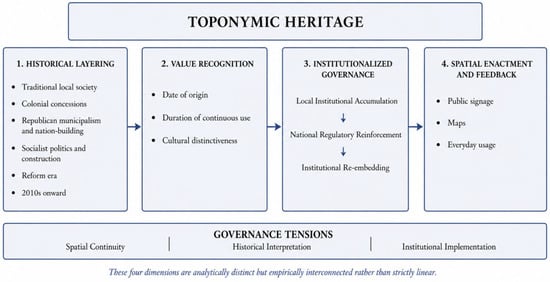
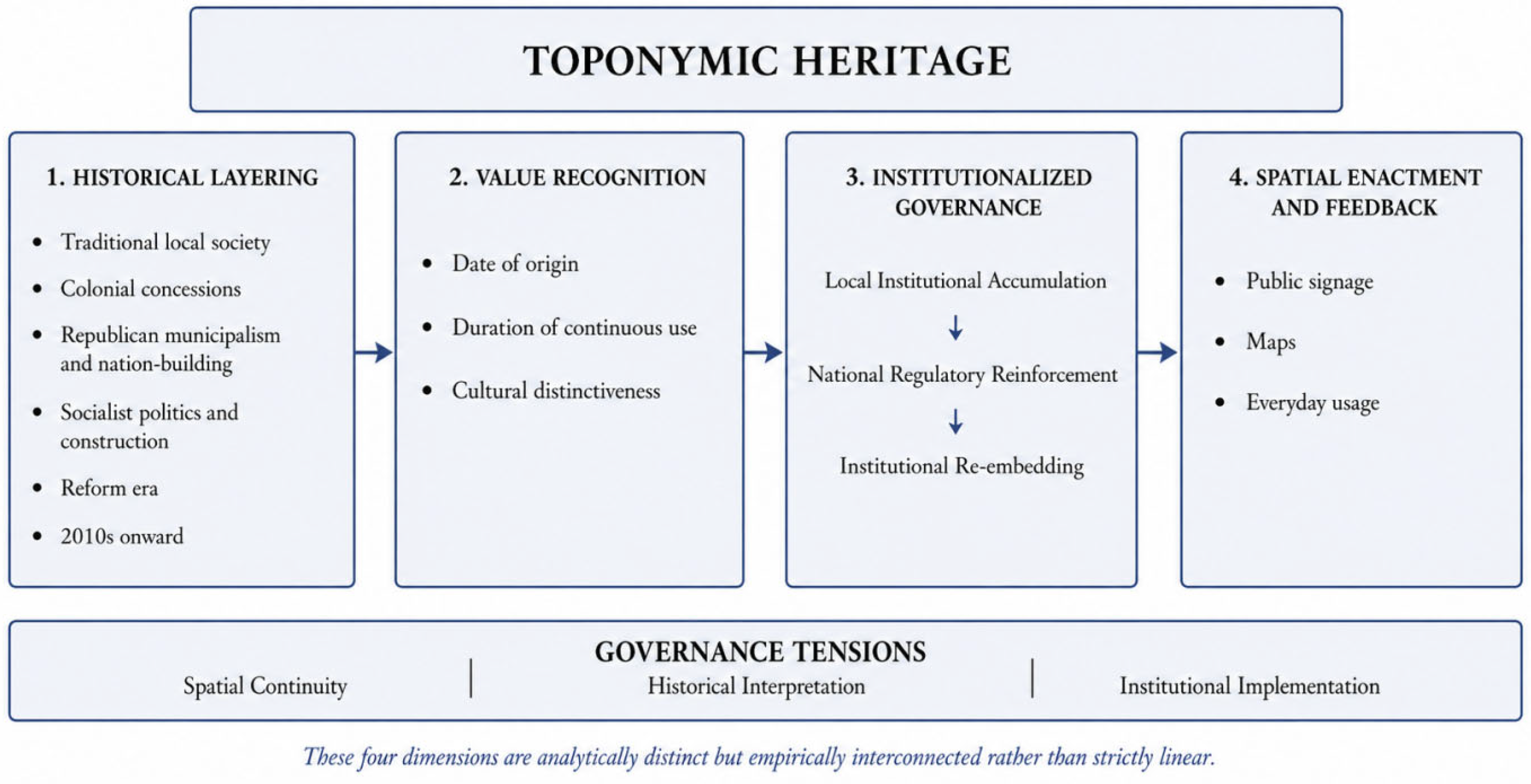
This article employs “toponymic heritage” as an analytic concept, referring to place names of historical and cultural significance that retain durable connections to particular spaces, social memories, and practices of everyday use. Existing research shows that place names preserve local knowledge of environments and human–space relations, carry historical memory, heritage value, identity, and senses of belonging, and participate in place-based heritage construction through their association with material settings such as roads, buildings, and memorials (Boillat et al. 2013; Hakala et al. 2015; Capra and Ganga 2019; Fuchs 2015). On this basis, the article constructs an integrated framework of “historical layering—value recognition—institutionalized governance—spatial enactment and feedback.” These four dimensions are analytically distinct but empirically interconnected rather than strictly linear.
First, historical layering. Naming, renaming, and spatial change in different periods produce overlapping toponymic layers within the city; such processes are closely tied to public memory, power relations, and group identity (Bishi et al. 2022; Förster et al. 2016). The article accordingly reads Shanghai’s place names—generated by traditional local society, colonial concessions, Republican municipalism and nation-building, socialist politics and construction, and the reform era—as distinct historical layers that survive together. Historical layering means that Shanghai’s toponymic heritage simultaneously confronts changing physical referents, contested historical interpretations, and tensions in the relationship between old and new names.
Second, value recognition. Historically formed names do not automatically become objects of protection; their heritage value must be confirmed through investigation and multiple forms of evidence. Research on Shanghai’s Old City has evaluated traditional lane names along dimensions of date of origin, duration of continuous use, and cultural distinctiveness, proposing a database of documentary materials and a protection inventory (C. Zhang 2017); the Shihudang case shows that community surveys, interviews, and residents’ oral accounts can supplement records of toponymic evolution and provide social-memory evidence for historical place-name protection (Kou et al. 2024). Value recognition thus constitutes the crucial moment in which names are transformed from general cultural resources into defined objects of protection.
Third, institutionalized governance. Toponymic heritage protection must also be incorporated into regulatory, planning, and administrative systems. Existing research has discussed institutional development in terms of approval systems, standardized usage, archive management, and protection inventories (Zhang et al. 2017), while also noting significant gaps in the heritage-specific legal and protection framework at the time. Shanghai’s place-name planning practices have integrated heritage considerations at an earlier stage of the planning process (Bai 2011; Xu and Xia 2012). Drawing on the Shanghai case, this article characterizes this institutional evolution as “local institutional accumulation—national regulatory reinforcement—institutional re-embedding”: locally developed mechanisms of approval, planning, and records management constitute the institutional foundation into which later national requirements concerning historical place names, protection inventories, and archives have been progressively incorporated.
Fourth, spatial enactment and feedback. Institutional recognition becomes effective only when it is translated into public space and everyday use. Linguistic landscape research demonstrates that the semiotic landscape of a city is an active domain in which historical meanings are produced and contested, not merely reflected. Road signs, street names, shop signs, and place names as public writing are key means by which names retain spatial visibility (Backhaus 2007), while chronotopic analyses show that linguistic items in public space carry varied time references and indexical loads that enable past and present to communicate across time (An and Shang 2026). For toponymic heritage, this means that the survival of a historical name in public space is a semiotic achievement rather than a passive outcome of administrative recognition. Toponymic heritage protection therefore depends not only on statutes, inventories, and archives, but also on whether historical names remain present in public signage, maps, and everyday usage; residents’ memories and patterns of everyday use can, in turn, supplement documentary records and inform protection practices. On this basis, the article examines the principal tensions confronting Shanghai’s toponymic heritage governance along three dimensions: spatial continuity, historical interpretation, and institutional implementation. The framework can be illustrated as follows (Figure 1).
Figure 1.
Analytical framework for toponymic heritage-making.
3. Materials and Methods
3.1. Case Selection and Source Corpus
The study adopts a qualitative historical-institutional case-study design. Shanghai was selected because it combines unusually dense historical layering with long-term administrative continuity and intense redevelopment pressure. It is therefore well suited to examining not only episodes of naming and renaming but also the institutional processes through which older names are recognized, documented, planned, and reinserted into urban space. The analysis does not claim that Shanghai is representative of all Chinese cities. Rather, it treats the city as an analytically revealing case through which mechanisms of toponymic heritage-making can be identified and assessed for broader comparative relevance.
The documentary corpus consists of three source groups (State Council of the People’s Republic of China 2022). The first comprises national and Shanghai-level policy and regulatory documents, including the 1998 Regulations of Shanghai Municipality on the Administration of Geographical Names, the 2021 national policy on strengthening historical and cultural protection in urban and rural construction, the 2022 revised Regulations on the Administration of Geographical Names, the 2024 Implementing Measures for the Regulations on the Administration of Geographical Names, and 2023–2025 Shanghai Urban Renewal Action Plan. The second group comprises historical and thematic scholarship on Shanghai place names, including studies of migration, religion, maritime culture, concession expansion, street naming, socialist-era renaming, and reform-era urban development. The third group comprises planning, GIS, legal, and heritage studies addressing place-name planning, inventories, archives, public memory, and urban heritage protection. Most Shanghai-specific academic materials used here were published between the late 1980s and 2026. Table 1 summarises the three source groups and their analytical roles.
Table 1.
Source groups and their analytical roles.
3.2. Analytical Procedure
The analysis proceeded in three steps. First, the study reconstructed Shanghai’s historical naming formations and treated them as overlapping layers rather than mutually exclusive chronological periods. This was necessary because concession-era naming, Republican municipal naming, vernacular use, and later political renaming often overlapped in time and space. Second, the policy and planning materials were comparatively analyzed and organized around four institutional domains: legal-administrative regulation, planning, inventories and archives (including digital systems), and spatial implementation. Particular attention was paid to whether later national rules introduced genuinely new mechanisms or reinforced functions that already existed locally. Third, published case studies were used to illustrate how these mechanisms operate in different spatial and social settings. The Old City and Shihudang cases illuminate value recognition and public memory; Pudong and Baoshan Industrial Park illuminate planning and naming in newly developing spaces.
This approach is interpretive. It triangulates policy texts, historical scholarship, and documented planning cases to identify institutional sequences and recurring governance tensions. No new interviews, surveys, or personal data were collected for this study.
4. Results
4.1. Historical Place Genealogies and Heritage Pressures
4.1.1. Traditional Local Society: Naming from Physical Geography, the Creek-and-Water Network, and Everyday Life
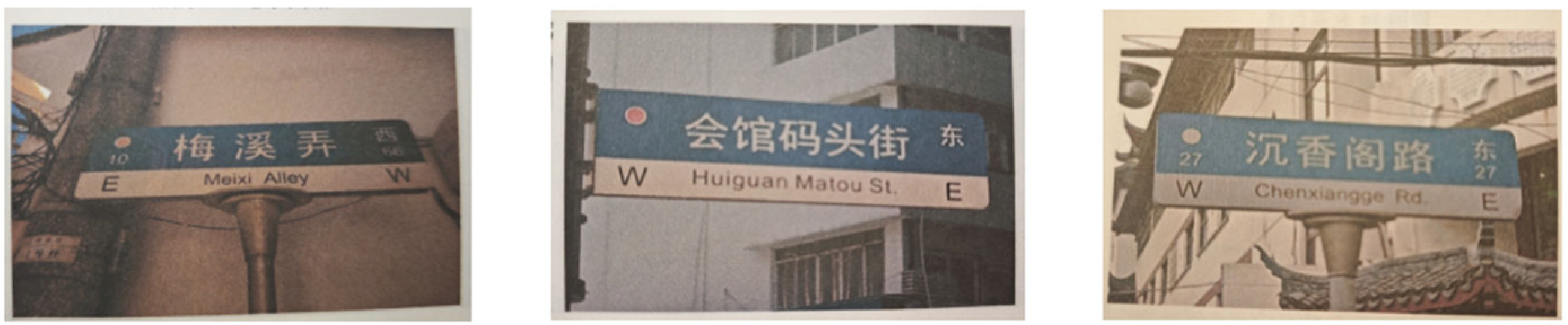
Before Shanghai was opened as a treaty port in 1843, its place names emerged largely from the Jiangnan water-town environment and the everyday practices of local communities. Creeks, ferries, bridges, temples, markets, villages, and lanes were key sites of livelihood and social life, and they also served as major sources of early toponyms. In-migration and settlement persistently shaped name formation and distribution; temples and other religious sites also served as important sources of place names, and after some of these sites disappeared, their names endured as street or road names (H. Zhang 1995; Deng and Li 2012; see Figure 2). Shanghai’s long-standing maritime orientation was likewise inscribed into its road-name system: the spatial and temporal distribution of road names containing the character hai (“sea”) offers one indication of changes in Shanghai’s maritime culture and urban development (Chen 2018).
Figure 2.
Pre-treaty-port toponymic strata in the Old City (Wu 2025).
The principal protection pressure on this layer lies in the weakening of the bond between names and their original physical referents. The infilling of creeks, the merger and demolition of lanes, old-town redevelopment, and functional conversion may deprive traditional names of their original referents and everyday contexts of use, so that names once embedded in local life gradually survive only as historical records in archives.
4.1.2. The Concession Era: Colonial Space, Municipal Roads, and Modern Urban Names
After 1843, the formation and expansion of the concessions introduced new logics of road construction and naming. The building, naming, and renaming of concession roads not only served traffic and municipal administration but were also closely tied to concession expansion and colonial governance. Cai’s (1989) study of old Shanghai street names shows a direct connection between concession spatial expansion and road construction and naming. Luo (2018) further demonstrates that street naming in the French Concession embodied competition among colonialism, nationalism, political power, and popular everyday usage, while the popular practice of “folk-naming” (rendering official names into vernacular forms) demonstrated bottom-up agency in everyday naming practices.
Concession-era toponyms therefore constitute a form of contested heritage. They document Shanghai’s modern municipal development while simultaneously indexing the unequal power relations of colonial rule. Their heritage treatment cannot be reduced to a binary choice between preservation and erasure. A more analytically productive approach is to contextualize these names through archival research, interpretive signage, and public history, presenting them as historically situated traces of both urban modernization and colonial domination.
4.1.3. Republican Municipalism and Nation-Building: Municipal Modernization and the Adjustment of Road Naming
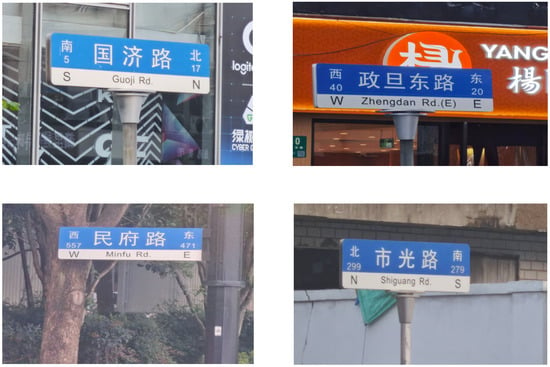
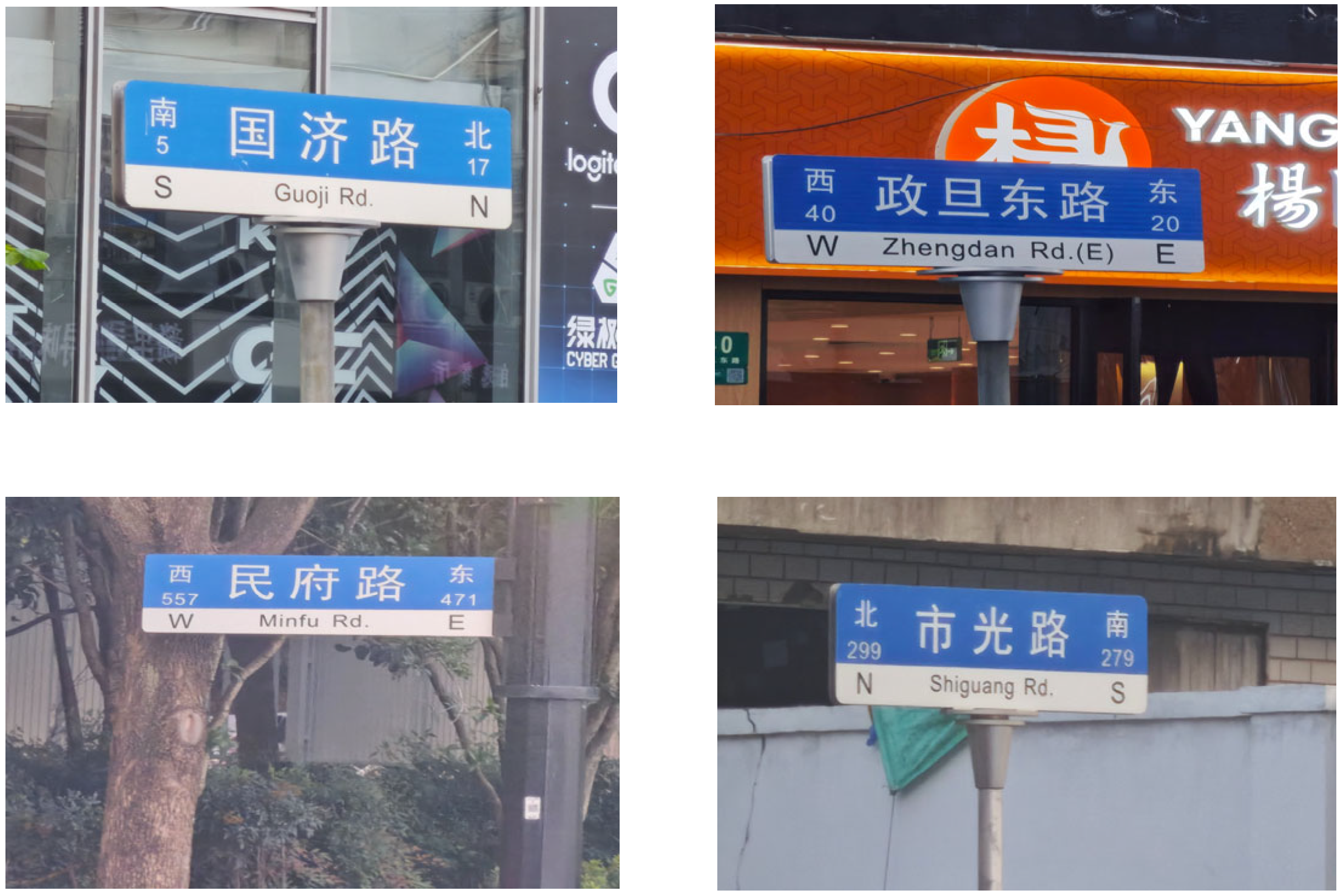
Alongside concession-era naming, Republican-era Shanghai saw the formation of road-name groups associated with political and civic aspirations. Some roads were named after administrative divisions, historical figures and events, or broader social and political aspirations; the series of roads beginning with guo (“state”), zheng (“governance”), min (“people”), and shi (“city”) embodied the political conceptions and naming practices of particular periods (Yao and Cai 2012; Wu 2025; see Figure 3). At the same time, competition between Chinese-administered areas and the concessions over road naming brought nationalist and anti-colonial claims into indirect competition with colonial naming authority (Luo 2018).
Figure 3.
Street signs bearing guo (“state”), zheng (“governance”), min (“people”), and shi (“city”).
The heritage value of this layer lies less in the antiquity of individual names than in the integral relations among serial naming, the road system, and modern municipal planning. Because many serially named roads still function as ordinary street names today, their historical mechanisms of formation are easily obscured by their everyday addressing function.
4.1.4. Socialist Politics and Construction: Socialist Building, Rectification of Colonial-Era Nomenclature, and Revolutionary-Commemorative Naming
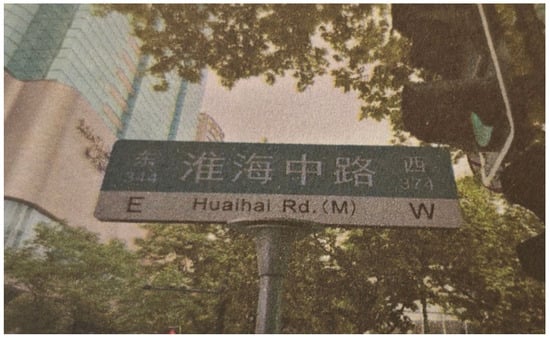
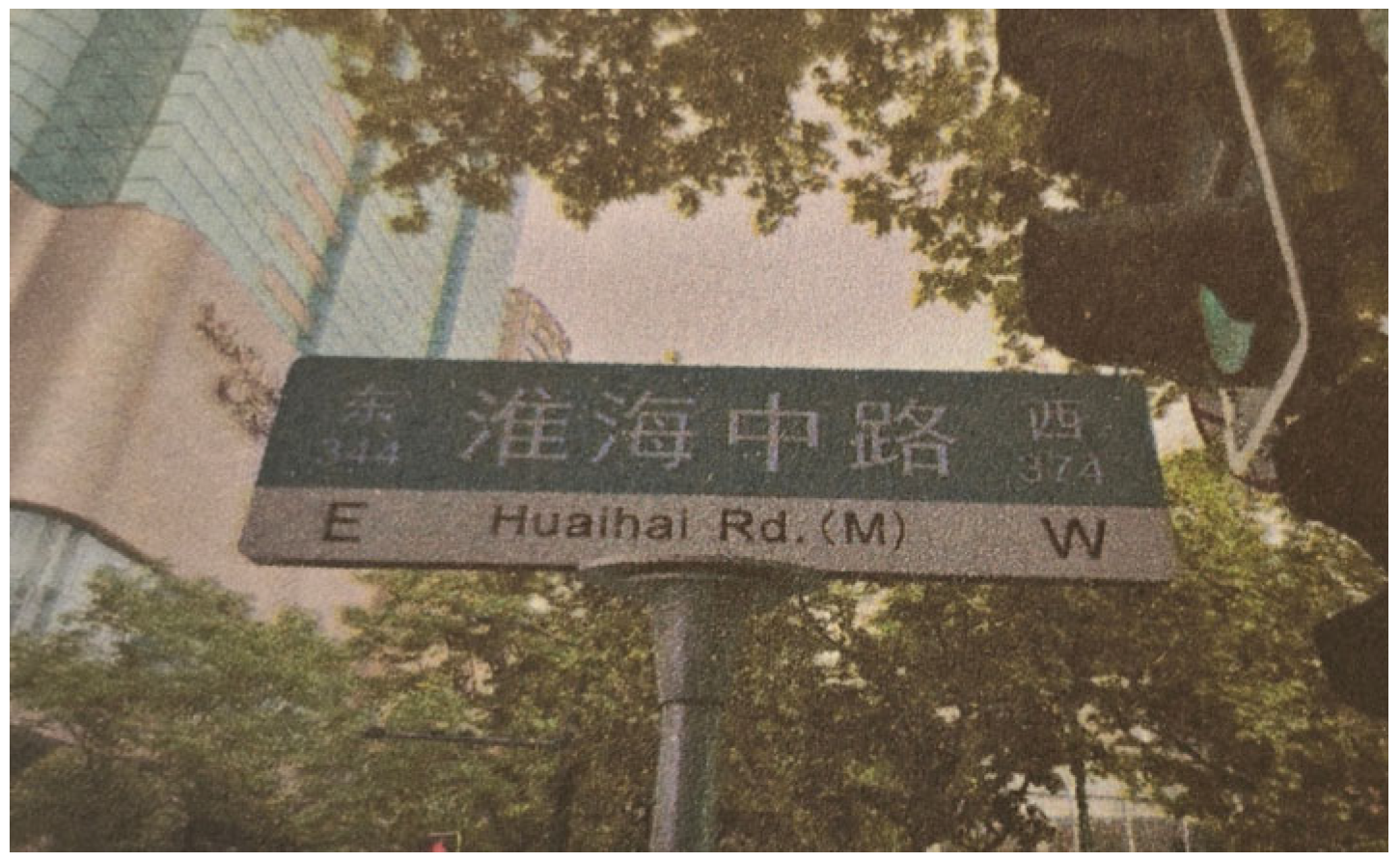
After 1949, some Shanghai road names bearing colonial and pre-1949 connotations were adjusted, while the political narratives and commemorative memory of the newly established People’s Republic entered the toponymic system. Cai (1989) documents the successive renaming of what is now Huaihai Road: it was first known as Baochang Road, was later renamed Xiafei Road (Avenue Joffre), then Taishan Road, Linsen Road, and finally Huaihai Road (see Figure 4). This illustrates both the extensive renaming and the survival of many older names documented by Cai (1989), rather than a wholesale erasure.
Figure 4.
Street sign on Huaihai Road (Wu 2025).
This indicates that political renaming was not a wholesale replacement of the existing toponymic system, but emerged through the interaction of political reordering, inherited naming conventions, and established patterns of everyday use. The contemporary difficulty in protecting such names lies chiefly in interpretation: their historically specific political meanings must be acknowledged while the names are situated within their particular historical contexts and trajectories of social use. These renaming practices illustrate how post-1949 toponymic governance became part of a broader reconfiguration of political symbolism and collective memory in urban space.
4.1.5. Reform and Opening-Up and Spatial Development: Market-Driven Urban Expansion, Commercial Naming, and the Dilution of Historical Names
Following the launch of reform and opening-up in the late 1970s, Shanghai’s urban space expanded rapidly. New-district roads, residential compounds, high-rises, commercial buildings, and mixed-use complexes multiplied, while the range of actors involved in naming and the types of urban entities being named expanded markedly. Real-estate development, new-district construction, and the production of commercial space meant that names, beyond their spatial-identifying function, increasingly served functions of place marketing, commercial branding, and city-image construction. Research on Shanghai’s place names in the 1990s already recorded new naming demand generated by the rapid increase in commercial housing and large buildings (Guo and Zhang 1996).
The core question of this period is not whether new place names should appear, but whether the naming of new spaces can maintain continuity with existing local cultural contexts. If development-generated names wholly replace pre-existing village, lane, and local designations, traditional names—even if still preserved in gazetteers or archives—may gradually disappear from maps, public signage, and residents’ everyday use. The pressure of market-driven development on toponymic heritage is thus manifested chiefly in competition between new and old names and the erosion of local cultural continuity.
From the 2010s onward, changes in Shanghai’s toponymic governance were manifested less as a new phase of name generation than as a shift in governance emphasis. Building on established systems of naming approval, planning management, and standardized usage, historical and cultural value recognition, historical place-name protection, and public memory progressively entered planning and protection agendas (Bai 2011; C. Zhang 2017; Kou et al. 2024). The 2010s therefore marked a shift from general regulatory management toward a more explicitly heritage-oriented governance framework, in which problems of spatial continuity, historical interpretation, and the relationship between old and new names were increasingly addressed through planning, heritage inventories, archives, and public use.
4.2. The Institutionalization of Toponymic Heritage Protection
4.2.1. Local Institutional Accumulation and National Regulatory Reinforcement: Vertical Articulation in Toponymic Governance
The institutionalization of toponymic heritage protection in Shanghai did not begin with the local implementation of recent national policies; rather, it developed gradually out of long-standing place-name administration and deepened as national regulations were strengthened. By the 1990s, Shanghai had already developed institutional practices in naming approval for newly built urban entities, coordination between planning and construction, and road-name planning for Pudong New Area. Research shows that place-name administration had become linked to administrative processes such as urban planning, construction management, business registration, and transport planning, and was implemented through the coordination of planning, urban construction, public security, civil affairs, posts and telecommunications, and place-name administration authorities (T. Zhang 1996). The 1998 Regulations of Shanghai Municipality on the Administration of Geographical Names further incorporated naming, usage, signage management, records management, and departmental responsibilities into a local legislative framework, forming a general toponymic governance structure in which naming approval, standardized usage, sign management, and interdepartmental coordination were interconnected (Shanghai Municipal People’s Congress Standing Committee 1998). Thereafter, toponymic governance was progressively integrated earlier into the urban planning process, with place-name content progressively entering urban plan formulation and approval.
Building on these local institutional foundations, national regulatory frameworks for historical and cultural protection and toponymic heritage were strengthened in the 2020s. The 2021 Opinions on Strengthening the Protection and Inheritance of Historical Culture in Urban and Rural Construction (General Office of the CPC Central Committee and General Office of the State Council 2021) stressed the systematic and complete protection of urban-rural historical and cultural heritage and proposed full spatial coverage and full inclusion of elements, providing a higher-level policy framework for place names to enter the urban-rural historical and cultural protection and inheritance system as constitutive elements of urban history and culture. The 2022 revised Regulations on the Administration of Geographical Names (State Council) incorporated protection of toponymic heritage into a unified national framework of place-name administration, making institutional provisions for the protection of place names of important historical and cultural significance, protection inventories, archive management, standardized use of official names, and toponymic information services. The 2024 Implementing Measures for the Regulations on the Administration of Geographical Names (Ministry of Civil Affairs of the People’s Republic of China 2024) further specified the content of protection inventories and the mechanisms for protection and continued use, including cultural signage, derivative naming, and forms of active use. The significance of this national regulatory reinforcement was not that it initiated the institutionalization of toponymic protection, but that it incorporated historical place-name protection into a more unified, standardized, and operational framework built on existing administrative and cultural-protection practices.
The institutional relationship between Shanghai and the national level is thus best characterized as “local institutional accumulation—national regulatory reinforcement—institutional re-embedding.” Shanghai’s early mechanisms of naming approval, planning coordination, standardized usage, sign-setting, and records management provided the administrative foundation for toponymic heritage protection; the national-level clarification of responsibilities for protection inventories, archive management, cultural transmission, and public services gave these existing Shanghai governance mechanisms, which had developed locally before the national requirements were specified, a more explicit heritage-protection mandate. As legal codification and procedural standardization have increased, historical place-name protection has expanded from academic research, local practice, and special protection work into a matter of governance with explicit administrative responsibilities, procedural norms, and public service requirements.
4.2.2. Digitization, Heritage Listing, and Archival Documentation: From Value Recognition to Evidence-Building
For toponymic heritage to enter institutional governance, it must first be identified as a describable, locatable, comparable, and traceable object of protection. Digitization, heritage listing, and archival documentation are key mechanisms through which culturally remembered names become documentable objects of heritage protection. Existing GIS-based toponymic research shows that spatial databases and spatial analysis can reveal toponymic types, distributions, and cultural characteristics, providing a technical basis for the spatial identification and display of historical place names (Wang and Situ 2007; Li et al. 2011; Chen et al. 2014; Kang and Jia 2016). Such spatialized data can also support the compilation of heritage inventories and the spatial visualization of historical place names; their institutional application in planning review and public services, however, must be assessed in relation to relevant regulations and local practice.
Heritage listing and archival documentation transform dispersed old, historical, and culturally significant names into clearly defined objects of protection. C. Zhang (2017) assessed traditional road and lane names in Shanghai’s Old City along three dimensions—date of origin, duration of continuous use, and cultural distinctiveness—and proposed a protection framework comprising investigation and verification, a heritage information database, nomination for inclusion in a heritage protection inventory, and enhanced public interpretation and display. The Shihudang case demonstrates that historical place-name planning can elicit and document public memory through online surveys, community research, interviews, and residents’ oral histories, thereby supplementing information on toponymic evolution not fully recorded in official documents (Kou et al. 2024). Archival documentation should therefore extend beyond name origins, locations, and dates to include historical maps, gazetteers, old photographs, oral histories, road changes, and on-site signage within a shared evidentiary framework. The institutional significance of digitization and heritage listing lies not only in formally recognizing objects of protection but also in creating an evidence base that can be updated over time and made publicly accessible. Without on-site interpretation and everyday use, however, inventories and databases may remain static repositories.
4.2.3. Planning Governance and Urban Regeneration: From Ex Post Approval to Early-Stage Planning Integration
Planning is the key mechanism through which place-name administration moves from ex post approval toward earlier integration into urban development processes. Conventional administration tends to address naming only after roads, buildings, or projects have largely taken shape and therefore focuses mainly on correction, registration, and standardization. Toponymic heritage protection, by contrast, requires historical names, local cultural contexts, road hierarchies, and public wayfinding systems to be incorporated into planning before spatial development is complete. Place-name planning research emphasizes that naming should be coordinated with urban cultural character and spatial structure (Yu 2008; Liang 2008; Wu and Lin 2017). Bai’s (2011) study of place-name planning within Shanghai’s regulatory plans shows that incorporating place-name content into planning can make place-name administration more proactive and culturally informed. Xu and Xia (2012) propose integrating cultural considerations into Shanghai’s place-name planning system across different types of places and spatial scales.
Published planning studies document proposed naming approaches for newly developed areas. In Pudong, road-name planning was linked to regional development objectives, the road network, and local historical and cultural resources (Li 2021). The Baoshan Industrial Park place-name plan proposed retaining some existing names and forming others by combining or deriving from them (Gu and Wang 2007). Together, these studies show how historical and cultural references entered planning proposals.
Urban renewal may provide a relevant context for considering toponymic heritage. The 2023 Shanghai Urban Renewal Action Plan (2023–2025) incorporated historical landscape protection and the active use of cultural heritage into its key actions, stressing the combination of protection and inheritance with renewal and development (Shanghai Municipal People’s Government Office 2023). Research on Shanghai’s historical landscape protection shows that urban heritage protection has expanded from individual buildings to the integrated protection of landscape areas, spatial fabric, and historical settings (Dai 2010; Shao 2016); Shanghai’s trajectory from old-district redevelopment to urban renewal shows that renewal governance must continuously balance improvements in residents’ living conditions with the protection of historic buildings and landscapes (Dong 2025). For toponymic heritage, this further implies that urban renewal can become a significant setting in which historical names and local memory re-enter public space. Conversely, if renewal projects retain only building façades while neglecting lane names and residents’ designations, historical continuity will still be eroded in everyday use. Toponymic landscapes should therefore be incorporated into urban-renewal assessment, because urban cultural continuity resides not only in built form but also in road names, lane designations, interpretive signage, and district wayfinding. When these elements are absent, cultural continuity can still be disrupted at the level of everyday urban experience.
4.2.4. Governance Tensions: Spatial Continuity, Historical Interpretation, and Institutional Implementation
Institutionalization does not eliminate governance tensions. Shanghai’s toponymic heritage protection faces three interrelated pressures. The first concerns spatial continuity: high-intensity urban development, old-district redevelopment, new-district construction, and commercial real-estate naming continuously alter the physical referents to which names are attached. The challenge in the Old City is not simply whether historical lane names are valued, but how those names can retain legible connections to physical places while lane fabric, residential conditions, commercial functions, and public space are simultaneously reorganized. In Pudong and newly developed industrial parks, the problem is reversed: new spaces are produced rapidly, and without early-stage planning, commercialized and homogenized names can quickly dominate public wayfinding systems.
The second concerns historical interpretation: the significance of different historical names is rarely singular, rarely unequivocally positive, and rarely uncontested. Concession-era road names record Shanghai’s modern municipal development and international trade networks while also bearing traces of colonial power; revolutionary commemorative names are both forms of political memory and spatial records of urban governance in specific historical periods. For such names, institutionalized protection can mean neither unconditional preservation nor simple deletion. Instead, archives, exhibitions, interpretive signage, public-history narratives about place names, and education can situate names within the historical contexts in which they were produced, changed, and remembered.
The third concerns institutional implementation: whether the institutional chain can extend from approval, planning, inventories, and archives into everyday use. Administrative approval can effectively regulate new names but does not necessarily revive historical names that have fallen out of use; heritage inventories can formally recognize names as objects of protection but do not automatically generate on-site signage, map representation, community use, or public recognition. Weak linkages between administrative procedures and public participation can therefore widen the gap between formal listing and everyday use. Shanghai’s governance challenges are thus not a set of parallel contradictions but interrelated pressures spanning spatial development, historical interpretation, and institutional implementation; effective heritage governance depends on whether these elements can form a closed governance loop with meaningful mechanisms for feedback.
5. Discussion
The significance of the Shanghai case lies not principally in the sheer number of toponymic heritage types, but in how historically complex place names have progressively entered the modern urban governance system. The foregoing discussion of the Old City, concession road names, Shihudang, Pudong New Area, and related planning practices indicates three interrelated characteristics of Shanghai’s toponymic heritage protection.
First, the density of Shanghai’s historical toponymic layers creates a particularly complex environment for heritage governance. Place names generated by traditional local society, the concessions, Republican municipalism, socialist construction, and the reform era have long coexisted, but their cultural values and protection challenges differ. Traditional names chiefly face the disappearance of physical referents and the erosion of local memory; colonial and political names require careful historical interpretation; and new-district development raises questions about cultural continuity between old and new names. Shanghai’s toponymic heritage governance is therefore not simply an exercise in preserving old names, but a process of negotiating spatial continuity, historical interpretation, and public use.
Second, relatively early forms of routine place-name governance provided an institutional foundation for heritage protection. Since the 1990s, Shanghai has developed practices of naming approval for newly built urban entities, planning coordination, records management, and interdepartmental collaboration, progressively integrating place-name governance earlier into the planning process. More recently, stronger national regulations on historical place-name protection, heritage inventories, archive management, and cultural transmission have enabled new heritage requirements to be embedded within the existing local governance system. Shanghai’s trajectory is therefore not a unidirectional process of “national policy—local implementation,” but one of “local institutional accumulation—national regulatory reinforcement—institutional re-embedding.” Routine place-name administration has, in this process, gradually acquired a more explicit heritage-protection mandate. The linguistic landscape perspective further illuminates why the institutionalization of toponymic heritage protection cannot be reduced to legal and administrative recognition alone. As the Wuhan and Harbin cases demonstrate, historical place names in Shanghai also function within a broader semiotic ecology in which signage, translation practices, commercial branding, and architectural styles collectively produce meanings that exceed the individual name. The heritage value of a concession-era road name, for instance, is not fully captured by its archival documentation or formal listing; it is also produced through its co-presence with other signs, its translation or Romanized form, its placement in the streetscape, and its circulation in residents’ everyday speech. Institutionalized governance must therefore attend not only to the legal status of historical names but also to the conditions under which they remain semiotically legible and socially meaningful in public space.
Third, place-name protection has progressively extended from name administration into planning and spatial governance. Shanghai’s place-name planning and new-district development show that toponymic governance can move from post-completion approval toward earlier integration into the planning process. Historical investigation, the identification of local cultural resources, the retention of old names, and derivative naming can help maintain toponymic continuity during the production of new urban space. The Old City and Shihudang cases further show that heritage valuation relies not only on official archives and expert knowledge; residents’ memories and everyday local usage can also supplement evidence of toponymic evolution. A governance model is thus emerging in which institutional norms, professional expertise, public memory, and spatial planning interact. More broadly, the Shanghai case suggests the need for continuous governance capacity linking evidence-based identification, institutional recognition, spatial enactment, and social feedback.
Yet the Shanghai experience does not constitute a uniformly replicable model. Megacities possess substantial planning capacity, institutional resources, and digital infrastructure, whereas small and medium-sized cities differ markedly in the scale of their historical resources, administrative capacity, and renewal pressure. The transferability of the Shanghai experience therefore lies principally in governance mechanisms rather than specific institutional forms. Its broader significance lies in linking value recognition, institutional recognition, spatial enactment, and social feedback rather than in reproducing particular administrative techniques. The comparative cases discussed above indicate that different Chinese cities have developed markedly different institutional responses to comparable conditions of historical layering. Future research could productively apply the analytical framework developed here to systematically compare the governance mechanisms through which Chinese cities with different colonial histories and administrative capacities have addressed the challenges of toponymic heritage protection.
6. Conclusions
Shanghai’s toponymic landscape has been shaped by historical spatial transformation, political ordering, market-driven urban development, and local identity formation. Vernacular names rooted in natural features and everyday life, colonial names, nation-building names, political names, and market-oriented names have accumulated in overlapping layers, creating interrelated governance challenges involving spatial continuity, historical interpretation, and institutional implementation. The institutionalization of toponymic heritage protection therefore entails more than retaining old names: it incorporates place names into a governance process spanning national law, local institutions, planning, public services, heritage inventories, digital archives, and urban regeneration. The Shanghai case shows that toponymic heritage governance in China has developed through the interaction of accumulated local administrative practices, strengthened national regulatory frameworks, expert knowledge, and expanding forms of public participation. Its effectiveness depends on institutional articulation: legal requirements must be operationalized through approval procedures; planning provisions must shape naming decisions; heritage inventories must be linked to public interpretation and everyday use; digital archives must integrate historical maps, gazetteers, and residents’ memories; and urban-regeneration projects must incorporate place-name protection into concrete planning and design requirements. The ultimate effectiveness of toponymic heritage protection depends not only on the existence of statutes, inventories, and archives, but also on whether institutional recognition is materialized through street signage, maps, neighborhood wayfinding, community usage, and public interpretation. Only when place names are recorded, interpreted, publicly marked, and continuously used can they function as living urban heritage.
Author Contributions
Conceptualization, B.Z.; Software, X.L.; Investigation, X.L.; Data curation, X.L.; Writing—original draft, X.L. and B.Z.; Visualization, X.L.; Supervision, B.Z.; Funding acquisition, X.L. All authors have read and agreed to the published version of the manuscript.
Funding
This research received no external funding.
Institutional Review Board Statement
Not applicable.
Informed Consent Statement
Not applicable.
Data Availability Statement
The original contributions presented in this study are included in the article. Further inquiries can be directed to the corresponding author.
Acknowledgments
Figure 2 and Figure 4 in this paper are from Wu Jianfeng’s A Study of Shanghai Road Names from the Perspective of Linguistic Landscape, pages 210, 220, 221, and 229 of the appendix. Our thanks are extended to him. During the preparation of this manuscript, the authors used ChatGPT 5.6 Luna, DeepSeek V4.1 Flash, MetaSo for the purposes of generating graphics, study design, analysis, or interpretation of data. The authors have reviewed and edited the output and take full responsibility for the content of this publication.
Conflicts of Interest
The authors declare no conflict of interest.
References
- An, Ran. 2026. Staging the Urban as a Space of Consumption through Language: Multilingual Landscape in Hankow Concession. International Journal of Multilingualism, 1–25. [Google Scholar] [CrossRef] [Scilit]
- An, Ran, and Guowen Shang. 2026. Communication across Time and Space: Chronotope in the Linguistic Landscape of a Concession Area. Journal of Multilingual and Multicultural Development 47: 1892–910. [Google Scholar] [CrossRef] [Scilit]
- Azaryahu, Maoz. 1996. The Power of Commemorative Street Names. Environment and Planning D: Society and Space 14: 311–30. [Google Scholar] [CrossRef] [Scilit]
- Azaryahu, Maoz. 1997. German Reunification and the Politics of Street Names: The Case of East Berlin. Political Geography 16: 479–93. [Google Scholar] [CrossRef] [Scilit]
- Backhaus, Peter. 2007. Linguistic Landscapes: A Comparative Study of Urban Multilingualism in Tokyo. Clevedon: Multilingual Matters. [Google Scholar]
- Bai, Xueru. 2011. Strengthen the Culture Guiding in Regulatory Planning, Enhance the Cultural Quality of Cities. Shanghai Urban Planning Review 6: 90–95. [Google Scholar]
- Berg, Lawrence D., and Jani Vuolteenaho, eds. 2009. Critical Toponymies: The Contested Politics of Place Naming. Farnham: Ashgate. [Google Scholar]
- Bishi, George, Joseph Mujere, and Zvinashe Mamvura. 2022. Renaming Enkeldoorn: Whiteness, Place, and the Politics of Belonging in Southern Rhodesia. Journal of Historical Geography 77: 55–64. [Google Scholar] [CrossRef] [Scilit]
- Boillat, Sébastien, Elvira Serrano, Stephan Rist, and Fikret Berkes. 2013. The Importance of Place Names in the Search for Ecosystem-Like Concepts in Indigenous Societies: An Example from the Bolivian Andes. Environmental Management 51: 663–78. [Google Scholar] [CrossRef] [Scilit] [PubMed]
- Cai, Jifu. 1989. The Evolution of Street Names in Old Shanghai and the Rise and Decline of the Foreign Concessions. Journal of Shanghai University (Social Science Edition) 2: 90–94. [Google Scholar]
- Capra, Gian Franco, and Antonio Ganga. 2019. The Intangible Heritage of the Anthropocene: The Toponymic Revolution in the Human Age. Names 67: 125–35. [Google Scholar] [CrossRef] [Scilit]
- Chen, Chen, Chunliang Xiu, Wei Chen, and Chengyang Li. 2014. Spatial Distribution Characteristics of Place-name Landscape Based on GIS Approach in Beijing and Its Reasons for the Formation. Scientia Geographica Sinica 34: 420–29. [Google Scholar]
- Chen, Yao, and Henry Duh. 2025. Exploring the Cultural Landscape of Hong Kong through Spatial Analysis of Street Names. npj Heritage Science 13: 518. [Google Scholar] [CrossRef] [Scilit]
- Chen, Ye. 2018. The Street Name and the Marine Culture in Shanghai. Regional Culture Study 4: 89–95. [Google Scholar]
- Dai, Ming. 2010. Research on Heritage Protection Management in Shanghai. Shanghai Urban Planning Review 5: 52–56. [Google Scholar]
- Deng, Jun, and Ping Li. 2012. Buddhism and Shanghai Toponymic Culture. China Place Name 12: 48–49. [Google Scholar]
- Dong, Jing. 2025. Shanghai’s Practices and Reflections: From Old-District Redevelopment to Urban Renewal. Shanghai Party History and Party Building 2: 44–50. [Google Scholar] [CrossRef]
- Erőss, Ágnes, Ákos Holányi, and Patrik Tátrai. 2022. Toponymic Politics and the Role of Heritagisation in Multiethnic Cities in Romania. International Journal of Heritage Studies 28: 763–77. [Google Scholar] [CrossRef] [Scilit]
- Förster, Susanne, Sybille Frank, Georg Krajewsky, and Jona Schwerer. 2016. Negotiating German Colonial Heritage in Berlin’s Afrikanisches Viertel. International Journal of Heritage Studies 22: 515–29. [Google Scholar] [CrossRef] [Scilit]
- Fuchs, Stephan. 2015. History and Heritage of Two Midwestern Towns: A Toponymic-Material Approach. Journal of Historical Geography 48: 11–25. [Google Scholar] [CrossRef] [Scilit]
- General Office of the CPC Central Committee and General Office of the State Council. 2021. Opinions on Strengthening the Protection and Inheritance of Historical Culture in Urban and Rural Construction. Beijing: General Office of the CPC Central Committee and General Office of the State Council. [Google Scholar]
- Gorter, Durk, ed. 2006. Linguistic Landscape: A New Approach to Multilingualism. Clevedon: Multilingual Matters. [Google Scholar]
- Gu, Aiyi, and Lei Wang. 2007. An Analysis of the “Place-Name Planning Scheme for Shanghai Baoshan Industrial Park”. China Place Name 6: 54–55. [Google Scholar]
- Gu, Chonglong, Zhi Li, Ge Song, and Guangwei Hu. 2026. “Chinese City with Russian Characteristics”: A Linguistic and Semiotic Landscape Account of Harbin’s Saint Sophia Cathedral and Central Street Areas. Semiotica 2026: 305–44. [Google Scholar] [CrossRef] [Scilit]
- Guo, Weiwu, and Shoulin Zhang. 1996. Shanghai Strengthens the Management of Place Names for Newly Constructed Urban Entities. China Place Name 5: 15–16. [Google Scholar]
- Hakala, Ulla, Paula Sjöblom, and Satu-Päivi Kantola. 2015. Toponyms as Carriers of Heritage: Implications for Place Branding. Journal of Product & Brand Management 24: 263–75. [Google Scholar] [CrossRef] [Scilit]
- Hua, Linfu. 2022. The Historical Context of Place Names and Pathways for Their Protection. People’s Tribune 5: 120–22. [Google Scholar]
- Jaworski, Adam, and Crispin Thurlow, eds. 2010. Semiotic Landscapes: Language, Image, Space. London: Continuum. [Google Scholar]
- Kang, Na, and Wenyu Jia. 2016. An Analysis for the Characteristics and Causes of the Toponym Cultural Landscape in Shanghai Based on GIS. Journal of Shanxi Normal University (Natural Science Edition) 30: 123–28. [Google Scholar] [CrossRef]
- Kou, Huaiyun, Xuanyuan Gu, and Xiaohua Zhong. 2024. Preserving Historical Toponymy through the Lens of Collective Memory—A Case Study of Shihudang Town, Songjiang District, Shanghai. Housing Science 44: 47–52. [Google Scholar] [CrossRef]
- Li, Jianhua, Wenbao Mi, Cuiyue Feng, and Xianming Yang. 2011. An Analysis on Toponym Cultural Landscape Based on GIS Application in Zhongwei County, Ningxia Municipality. Human Geography 26: 100–4. [Google Scholar] [CrossRef]
- Li, Zhen. 2021. Exploration on the Compilation Method and Practice of Road Name Planning in Pudong New Area, Shanghai. Shanghai Urban Planning Review 2: 57–62. [Google Scholar] [CrossRef]
- Liang, Yumei. 2008. On the Significance and Principles of Place-Name Planning. China Place Name 12: 13–15. [Google Scholar]
- Light, Duncan, and Craig Young. 2014. Habit, Memory, and the Persistence of Socialist-Era Street Names in Postsocialist Bucharest, Romania. Annals of the Association of American Geographers 104: 668–85. [Google Scholar] [CrossRef] [Scilit]
- Liu, Yutang, and Yanqiong Li. 2023. Research, Protection, and Development of Toponymic Cultural Heritage from the Perspective of Cultural Linguistics. Theory Monthly 1: 90–102. [Google Scholar] [CrossRef]
- Luo, Guilin. 2018. Warfare of Toponym: The Social-Cultural History of Naming the Street in Shanghai French Concession. Urban History Research 2: 259–81. [Google Scholar]
- Masalha, Nur. 2015. Settler-Colonialism, Memoricide and Indigenous Toponymic Memory: The Appropriation of Palestinian Place Names by the Israeli State. Journal of Holy Land and Palestine Studies 14: 3–57. [Google Scholar] [CrossRef] [Scilit]
- Ministry of Civil Affairs of the People’s Republic of China. 2024. Implementing Measures for the Regulations on the Administration of Geographical Names. Available online: https://www.mca.gov.cn/n2623/n2687/n2696/n2743/c1662004999979998197/content.html (accessed on 26 October 2026).
- Rose-Redwood, Reuben, Derek Alderman, and Maoz Azaryahu. 2010. Geographies of Toponymic Inscription: New Directions in Critical Place-Name Studies. Progress in Human Geography 34: 453–70. [Google Scholar] [CrossRef] [Scilit]
- Rose-Redwood, Reuben, Derek Alderman, and Maoz Azaryahu, eds. 2018. The Political Life of Urban Streetscapes: Naming, Politics, and Place. Abingdon, Oxon and New York: Routledge. [Google Scholar] [CrossRef] [Scilit]
- Rusu, Mihai Stelian. 2019. Shifting Urban Namescapes: Street Name Politics and Toponymic Change in a Romanian(ised) City. Journal of Historical Geography 65: 48–58. [Google Scholar] [CrossRef] [Scilit]
- Rusu, Mihai Stelian. 2021. Street Naming Practices: A Systematic Review of Urban Toponymic Scholarship. Onoma 56: 269–92. [Google Scholar] [CrossRef] [Scilit]
- Rusu, Mihai Stelian. 2024. Modeling Toponymic Change: A Multilevel Analysis of Street Renaming in Postsocialist Romania. Annals of the American Association of Geographers 114: 591–609. [Google Scholar] [CrossRef] [Scilit]
- Sa, Churonggui. 2023. Legal Protection of Toponymic Cultural Heritage in China and Related Policy Measures. Cultural Heritage Bimonthly 3: 34–41. [Google Scholar]
- Shang, Guowen, and Lili Yang. 2023. Practicing and Managing Foreign Toponyms in China: Cultural Politics and Ideologies. Names: A Journal of Onomastics 71: 1–11. [Google Scholar] [CrossRef] [Scilit]
- Shanghai Municipal People’s Congress Standing Committee. 1998. Regulations of Shanghai Municipality on the Administration of Geographical Names; (Adopted 22 September 1998, Effective 1 January 1999; Amended in 2010, 2011, and 2015). Available online: https://flk.npc.gov.cn/detail?id=4028abcc61277793016128534c6c12ea (accessed on 26 October 2026).
- Shanghai Municipal People’s Government Office. 2023. Shanghai Urban Renewal Action Plan (2023–2025). Available online: https://www.shanghai.gov.cn/nw12344/20230419/0525317031c54e86bde6fdf0cabbe1f4.html (accessed on 21 August 2026).
- Shao, Yong. 2016. From Historic Townscape Conservation to Urban Heritage Conservation: Discussion on Conservation of National Historic City of Shanghai. Shanghai Urban Planning Review 5: 1–8. [Google Scholar]
- Smith, Laurajane. 2006. Uses of Heritage. Abingdon: Routledge. [Google Scholar]
- State Council of the People’s Republic of China. 2022. Regulations on the Administration of Geographical Names. Available online: https://www.gov.cn/zhengce/content/2022-04/21/content_5686491.htm (accessed on 21 August 2026).
- Tian, Ye. 2026. The Functional Priority of Memory: Critical Toponymy and Selective Heritage-Making in Postsocialist Changchun. Genealogy 10: 89. [Google Scholar] [CrossRef] [Scilit]
- Wang, Bin, and Shangji Situ. 2007. Analysis of Spatial Characteristics of Place Names Landscape Based on GIS Technology in Guangdong Province. Geographical Research 26: 238–48. [Google Scholar]
- Winter, Tim. 2013. Clarifying the Critical in Critical Heritage Studies. International Journal of Heritage Studies 19: 532–45. [Google Scholar] [CrossRef] [Scilit]
- Wu, Jianfeng. 2025. A Study of Shanghai Road Names from the Perspective of Linguistic Landscape. Shanghai: Shanghai Jiao Tong University Press. [Google Scholar]
- Wu, Tonghu, and Yue Lin. 2017. Research on Place-Name Planning and Design Methods Based on Urban Cultural Characteristics: The Case of Zhejiang. Educational Modernization 9: 163–65. [Google Scholar] [CrossRef]
- Xie, Qin, Francesco-Alessio Ursini, and Giuseppe Samo. 2023. Urbanonyms in Macao. Names: A Journal of Onomastics 71: 29–43. [Google Scholar] [CrossRef] [Scilit]
- Xu, Jingyun, and Liping Xia. 2012. Cultural Meanings, Inheritance of Toponymy—A Study on Shanghai Toponymy Planning System. Shanghai Urban Planning Review 3: 55–58. [Google Scholar]
- Yao, Xiaoying, and Junmei Cai. 2012. The Study of Linguistic Motivation for Naming Shanghai Streets and Roads. Journal of Hebei University (Philosophy and Social Science) 37: 150–53. [Google Scholar]
- Yu, Fachen. 2008. On the Principles and Methods of Urban Place-Name Planning. China Place Name 12: 12. [Google Scholar]
- Zhang, Chenjie. 2017. Research on the Conservation of Historic-Cultural Heritage of Geographical Names: Taking Streets’ Historic Names of Shanghai Old Town as an Example. Urban Development Studies 24: 20–24. [Google Scholar]
- Zhang, Fuwen, Changyu Ning, and Chunliu Lan. 2017. A Study of the Institutional System for the Protection of Toponymic Cultural Heritage in China. China Place Name 8: 16–19. [Google Scholar]
- Zhang, Hongkui. 1995. Migration and the Transformation of Place Names in Shanghai. Historical Review 3: 86–92. [Google Scholar]
- Zhang, Tailin. 1996. Basic Approaches to Urban Place-Name Management in Pudong New Area. China Place Name 2: 52–53. [Google Scholar]
- Zhao, Fengzhi. 2022. Managing the Shikumen Chronotope, Constructing a Cosmopolitan Place: A Case Study of Xintiandi in Global Shanghai. In The Sociolinguistics of Global Asias. Edited by Jerry Won Lee. New York: Routledge, pp. 42–54. [Google Scholar] [CrossRef] [Scilit]
- Zhu, Yujie, and Christina Maags. 2020. Heritage Politics in China: The Power of the Past. Abingdon: Routledge. [Google Scholar] [CrossRef] [Scilit]


Disclaimer/Publisher’s Note: The statements, opinions and data contained in all publications are solely those of the individual author(s) and contributor(s) and not of MDPI and/or the editor(s). MDPI and/or the editor(s) disclaim responsibility for any injury to people or property resulting from any ideas, methods, instructions or products referred to in the content. |
© 2026 by the authors. Licensee MDPI, Basel, Switzerland. This article is an open access article distributed under the terms and conditions of the Creative Commons Attribution (CC BY) license.