


Abstract
This paper seeks to illuminate the historical and biological intersections between Druze traditions and the silent architecture of Freemasonry within the Balkan milieu, a region historically defined by a constellation of preeminent scientists, writers, and artists whose legacies were forged within the crucible of Masonic thought. Central to this inquiry is the reconstruction of a familial intellectual lineage and genealogy of the author’s ancestor that maintained, for generations, a quietude of profound exchanges with esoteric custodians in France. These subtle conduits suggest the operation of “invisible networks” bound by an unstated ethical and philosophical cipher. To probe the biological currents beneath these traditions, the study unveils genetic evidence of the K1a5a haplogroup, a Levantine signature found within the domestic sphere. By examining this familial case study, the work suggests that the preservation of “the Secret” is not merely an intellectual endeavor, but a biological inheritance, where genetic markers and initiatory silence converge across centuries. The continuity of these invisible networks is historically evidenced by the 1926 Belgrade Masonic Peace Congress, led by French and German Grand Masters. This Legacy directly connects to its centennial peace declaration scheduled in Belgrade for late Juni 2026, showcasing the enduring role of the region in trans-regional diplomacy.
1. Introduction
The investigation of links between Middle Eastern initiatory societies and Western esoteric thought necessitates an approach that transcends rudimentary literary analysis. This study employs a method of triangulation: archival research, symbolic analysis, and population genetics. The point of departure consists of family documents and archival materials that link the discrete intellectual circles of the Balkans with European esoteric centers throughout the 20th century. This study specifically evaluates the structural and biological vectors that facilitated these exchanges, demonstrating the role of regional corridors in the dissemination of esoteric philosophy.
2. Methodological Framework
The primary objective is to explore how the “Secret,” as a sociological and spiritual phenomenon, manifests through analogous patterns in two seemingly distant systems—the Druze and the Masonic. As Georg Simmel observes, the secret offers the possibility of a “second world” alongside the manifest one, giving rise to an internal aristocracy of knowledge (Simmel 1906). The work seeks to determine the extent to which biological traces shadow the historical dissemination of these ideas. Simmel’s structural theory of secrecy is uniquely applicable to both the Druze and Masonic configurations, as it highlights how specialized knowledge forms an exclusionary barrier that transforms a minority group into an internal aristocracy of knowledge, shielding its socio-spiritual core from external pressures. In this framework, the empirical regional focus is centered on the geographical nexus of Bosnia and Herzegovina (hereinafter, BiH), which historically served as a bidirectional landscape for esoteric and migratory transitions.
3. Genetic Context and the “Levantine Connection” in the Balkans
The key empirical contribution of this paper relies on the results of high-resolution mitochondrial DNA (mtDNA) sequencing performed by the reference laboratory YSEQ GmbH (Berlin 12249, Germany) under Kit ID 24530. To satisfy the standard of scientific reproducibility and allow independent verification, the complete mitochondrial genome sequence was deposited in the National Center for Biotechnology Information (NCBI) GenBank database under Accession Number MT887287.1.
The analysis focuses on the following findings:
Through a detailed mtDNA analysis of (Subject A, YSEQ Kit 24529) and (Subject B, YSEQ Kit 24530/GenBank MT887287.1), the K1a5a subgroup was identified. This haplogroup is primarily characteristic of the Druze population of the Levant. The identification of this marker corresponds directly with research confirming this lineage as one of the pivotal maternal lines defining the Druze ethno-religious community (Shlush et al. 2008; Behar et al. 2008). According to regional genetic baselines (Marjanović 2020) and continuous updates from global datasets, this specific marker had not been previously documented in the Balkan region, representing a significant enigma for regional population genetics. Crucially, this profile is now empirically indexed in the global Ian Logan mtDNA resource under the K1a5a haplogroup section as entry #11 (verified with Bosnia and Herzegovina origin locality). The complete mutational spectrum of 34 substitutions defining this subject relative to the Cambridge Reference Sequence (rCRS), including the diagnostic T1189C mutation, is summarized in Table 1, while its comparative placement within the Ian Logan resource is presented in Table 2. The maternal lineage functions as the biological anchor of familial identity, acting as the silent custodian of the initiatory bloodline, serving here as a biological proxy for ethnic presence and not as a claim for female participation in male-only rituals. This establishes a structural baseline where the maternal line preserves the endogamous family unit, within which male descendants are socialized before entering initiatory networks.
Table 1.
Mutational Profile of the Study Subject (GenBank MT887287.1).
Table 2.
Comparative Population Genetics Data (Ian Logan mtDNA Resource).
Migratory Trajectory (Levant–Dalmatia–BiH): The family from which the subjects descended has been settled in Bosnia and Herzegovina for generations; however, oral tradition and historical indicators suggest that their female ancestors reached the Balkan interior via Dalmatia. This trajectory suggests a historical transmission of genetic material along the Adriatic coast, which has served for centuries as a point of encounter between Levantine influences and the custodians of various esoteric teachings (Hitti 1928).
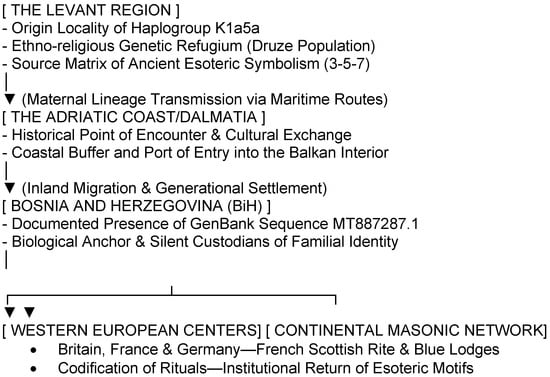
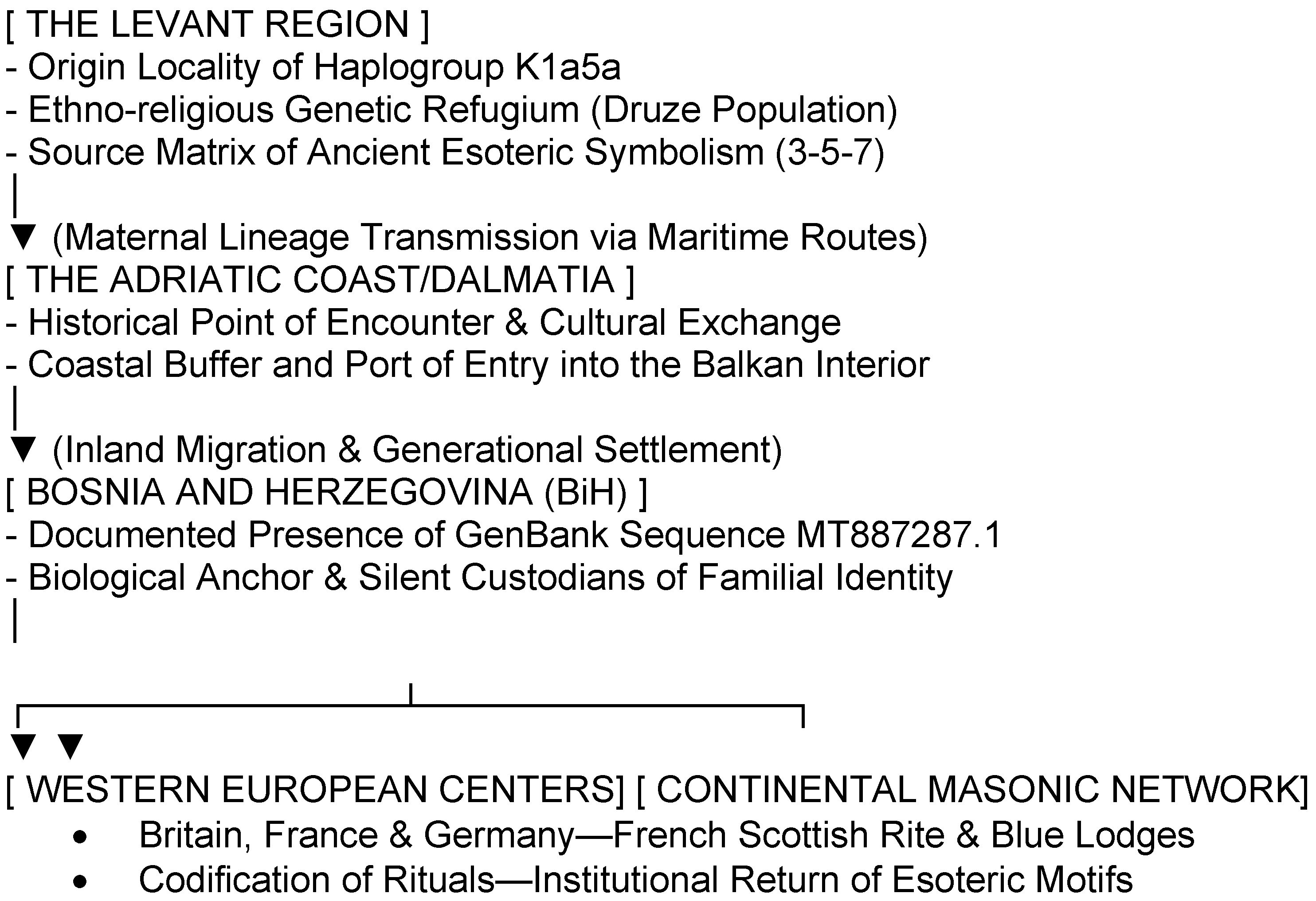
The structural and geographical progression of this lineage, tracing the cross-regional transmission lines from the Near East to the Western Balkan interior, is schematically conceptualized in Figure 1.
Figure 1.
Schematic representation of the bidirectional Levant–Dalmatia–BiH migration route. The diagram illustrates the geographical and genetic trajectory of the K1a5a lineage, serving as the empirical foundation for the “Balkan Bridge” theory where biological preservation correlates with the historical transmission of initiatory traditions.
4. The Doctrine of Secrecy and the Three-Tiered Stratification of Initiation
Georg Simmel’s sociology of secrecy provides the foundational conceptual framework for this study because it analyzes ‘the secret’ not merely as the concealment of facts, but as a dynamic structural technique for social organization. Simmel posits that a shared secret creates an evolutionary protective barrier, effectively transforming a minority group into an internal ‘aristocracy’ of knowledge that shields its core from external societal pressures. This sociological mechanism is highly applicable to both the Druze and Masonic configurations (Smith 1891). In the Druze tradition, this structure is institutionalized through the principle of al-taqiyya (dissimulation), which functions as a protective mechanism for an endogamous community and contributes to the Druze status as a “religious and genetic refugium” (Shlush et al. 2008; Marshall et al. 2016). Similarly, Freemasonry utilizes a multi-tiered grading system to regulate access to specialized knowledge. By applying Simmel’s framework, this paper demonstrates how initiatory silence serves as a powerful instrument of social cohesion, turning a preserved biological lineage (such as the K1a5a haplogroup) into the physical vehicle for this structural and spiritual continuity.
This stratification of knowledge is organized through three levels that exhibit a high degree of correlation with Masonic degrees—a resonance corroborated by preeminent Masonic authorities:
- The Exoteric Level (Al-Juhal)/Entered Apprentice Degree: This encompasses the broader community base, adhering to ethical norms without possessing access to the inner wisdom (Hikma). Albert Mackey, in his Encyclopedia of Freemasonry, emphasizes that this initial stage is vital for the “purification of the heart” prior to entering deeper mysteries, an approach identical to the Druze preparation for Hikma (Mackey 1914).
- The Esoteric Level (Al-Uqal)/Fellowcraft Degree: The “Wise” members entitled to interpret veiled meanings. Akin to the Masonic Fellowcraft, this layer represents the active phase of intellectual refinement.
- The Anagogical Level (Al-Djaid)/Master Mason Degree: The supreme sages who guard the core of the doctrine. While this level serves as the functional equivalent of the Master Mason degree, the depth of its spiritual and philosophical development finds its true parallel in the advanced progression of the Scottish Rite, culminating in the 33rd degree. The 33rd degree of the Scottish Rite (AASR) serves as a comparative structural model to illustrate the Druze anagogical level. Albert Pike, in Morals and Dogma, asserts that ancient Oriental traditions and their initiatory systems—such as those of the Levant—are the direct precursors to Masonic philosophy, wherein the initiate reaches the ultimate realization of the unity between the Creator and the creation.
Although the Ancient and Accepted Scottish Rite (AASR) was codified in its modern form in the United States in 1801, its ritualistic essence is a product of 18th century France (Jacob 2006). In fact, French lodges practiced the Scottish ritual style decades before the American standardization. Its practice in continental Europe followed a distinct path. To ensure clarity, ‘blue lodges’ refer to foundational workshops for the first three degrees, the German ‘Schröder ritual’ focuses on humanistic enlightenment, the British ‘Emulation’ on precise oral transmission, and the ‘French Scottish Rite’ on continental Mediterranean allegories.
While German lodges primarily adopted the Schröder ritual and British ones practiced Emulation, many ‘blue lodges’ in France specifically utilized the France Scottish Rite ritual for their first three degrees. In the Balkan context, these ‘invisible networks’ acted as a conduit for these specific Mediterranean motifs, often bypassing Anglo-Saxon interpretations to reconnect directly with the ancient Levantine matrix through this distinct continental practice. Consequently, beside the French influence. The Balkan context is predominantly characterized by the ‘Schröder ritual’ linked to the Grand Lodges of Germany and Austria, whereas Emulation is bound to the United Grand Lodge of England (UGLE). This study strictly confines its scope to these frameworks to exclude any unrecognized or irregular bodies, as UGLE recognition remains the sole benchmark for masonic regularity.
5. Numerological and Geometric Symbolism (3-5-7)
Numerology in both systems represents the “geometry of the spirit.” Behar’s research (Behar et al. 2010) indicates that Druze endogamy has preserved an archaic symbolic system that resonates deeply with Western Esotericism.
- The Number 3: Represents the tripartite application of gnosis. Pike notes that “sacred triads” are present in all ancient Eastern mysteries, mirrored in the Druze division of knowledge into the manifest, the hidden, and the quintessential.
- The Number 5 and the Five-Pointed Star: The central Druze symbol, with its five colors, represents five cosmic principles. In Freemasonry, this corresponds to the “Blazing Star.” Pike states that the Blazing Star is a symbol of divine providence and the intellectual light that guides the initiate (Pike 1871).
- The Number 7: For the Druze, this signifies the seven pillars of their code (e.g., truthfulness, mutual aid). Albert Mackey emphasizes that seven is the “number of perfection” in Masonry, essential for the completeness of the Lodge and the symbolic construction of Solomon’s Temple.
6. Results and Discussion
The interdisciplinary analysis conducted in this study indicates that the structural and symbolic parallelisms between the Druze community and Freemasonry transcend the boundaries of mere historical coincidence (Smith 1891). Through a familial case study from the Balkans, this work has demonstrated the existence of a biological and intellectual continuity linking the Levant with the European space. This biological intersection raises a fundamental conceptual question: if the connection between the Levant and the Balkans is grounded in empirical biology, what constitutes its classification as a ‘secret’? The interrogation of this paradox reveals that while the mitochondrial DNA (mtDNA) serves as an objective, immutable biological record, the ‘secret’ resides in the conscious initiatory framework and oral histories that accompanied this lineage. Within endogamous refugia like the Druze, biological continuity and spiritual preservation are inextricably linked. When translated to the Balkan milieu, this lineage operated under the mechanism of al-taqiyya (discretion), where the genetic marker remained a silent, unconscious anchor of familial identity, while the esoteric knowledge itself was consciously restricted to initiatory networks to ensure survival across centuries of regional geopolitical volatility (Olsson 2007). Thus, biology provides the silent structural vehicle, whereas the initiatory tradition provides the conscious concealment of the heritage. The mtDNA therefore acts as a structural prerequisite for community continuity, rather than functional mechanism of ritual transmission.
The primary findings of this inquiry can be summarized across three pivotal points:
- (1)
- Genetic Evidence as a Theoretical Anchor: The identification of the K1a5a haplogroup among the author’s direct ancestors serves as material evidence of the historical presence of Levantine lineages within the Adriatic hinterland and Bosnia and Herzegovina. The presence of this marker within a family that has, for generations, cultivated specific ethical codes suggests that migratory routes served as conduits for the transmission of genes, as (Shlush et al. 2008) explicitly state, the Druze constitute a ‘genetic refugium,’ a definition that underscores the significance of the K1a5a marker found in the Balkan context. In this framework, the maternal lineage functions as the biological anchor of familial identity; while the initiatory traditions are male-centric, the mtDNA line provides the biological continuity through which subsequent generations of males are recruited into the tradition. The discovery of the K1a5a haplogroup, a biological signature that remains immutable over millennia—serves as more than a migratory marker; it is the physical foundation for the Balkan ‘bridge’ theory. This research argues that the Balkans functioned as a crucial nexus where ancient Levantine motifs were first deposited and preserved. Subsequently, this heritage was transmitted to the major European Masonic centers in Britain, Germany, and France, where it influenced for the symbolic formalization of modern rituals. Ultimately, this esoteric heritage was ‘returned’ to the Balkans in its institutionalized and mytho-historically enriched forms (e.g., Emulation, Schröder and The French Scottish Ritual), creating a historical feedback loop where the biological presence of Levantine descendants served as the natural custodians for this reimported tradition. Although this research is centered on the newly documented mt DNA evidence (MT887287.1.), it is acknowledged that future Y-DNA studies would provide a significant paternal correlate to further substantiate these initiatory lineages.
The Balkans functioned as a bidirectional bridge for initiatory transmission. Initially, the region served as the primary conduit through which ancient Levantine motifs moved toward Western Europe (Olmi 2011). However, these motifs were subsequently processed, codified, and institutionalized into formal rituals in the Masonic centers of Britain and France. These refined systems were then returned to the Balkans and further re-exported back to the Levant and Africa. Today, the fact that many lodges in these regions operate according to English and French rituals—which originally contain processed Levantine symbols—proves the existence of a complete historical cycle. In this cycle, the Balkan ‘Bridge of Silence’ acted as both the original transmitter and the final receptor of a spiritual heritage that traveled from the Levant to Europe and back.
- (2)
- Intellectual Continuity through Discretion: The informal, yet potent, ties maintained by the author’s ancestor with French intellectual circles during the mid-20th century—when viewed through the prism of the Masonic philosophy of Albert Pike and Albert Mackey—point toward the operation of “invisible networks.” These networks, employing the principle of al-taqiyya and Masonic discretion, facilitated the survival of the tripartite initiatory system and universal numerological symbolism (3-5-7) within the Balkans.
7. Conclusions and Implications
The synthesis of human population genetics, archival family records, and structural sociological frameworks offers a fresh paradigm for evaluating cross-regional esoteric transfers. By grounding the “Balkan Bridge” theory in the empirical baseline of the K1a5a mitochondrial genome (GenBank MT887287.1), this study transitions the history of esotericism from speculative narrative into verifiable lineage tracking. The findings demonstrate that human migratory corridors along the Levant–Adriatic conduit did not merely displace populations, but functioned as continuous vectors for the preservation of initiatory structures and symbolic ciphers (Smajlović 2019).
The broader implications of this inquiry suggest that continental Freemasonry and ancient Near Eastern refugia share a deep socio-spiritual architecture that transcends regional developments (Bogdan 2014). The study validates Georg Simmel’s sociology of secrecy, illustrating how initiatory silence and discrete familial networks can protect group integrity and preserve highly specialized knowledge across centuries of geopolitical volatility. As a preliminary foundation for future scholarship, further collaboration between research lodges, such as the Quatuor Coronati, academic institutions, and Druze representatives, constitutes a necessary step toward understanding the shared spiritual architecture of humanity (Smith 1891). As noted by the prominent activist of Druze origin, Amal Clooney: “Courage is contagious; people who have the courage to change their societies inspire each other.”
Funding
This research received no external funding. The APC was funded by the author.
Institutional Review Board Statement
The study was conducted in accordance with the Declaration of Helsinki. Ethical review and approval were waived for this study due to the fact that the genetic data utilized is already publicly available and indexed in the GenBank (NCBI) repository under Accession Number MT887287.1.
Informed Consent Statement
Informed consent was obtained from all subjects involved in the study. Written informed consent has been obtained from the participants (Subject A and Subject B) to publish this paper.
Data Availability Statement
The data presented in this study are openly accessible and verified. The complete mitochondrial genome sequence generated for this study has been deposited in the National Center for Biotechnology Information (NCBI) GenBank database under Accession Number MT887287.1. Comparative population genetics baselines are publicly accessible through the Ian Logan mtDNA resource.
Conflicts of Interest
The author declares no conflicts of interest.
References
- Behar, Doron M., Bayazit Yunusbayev, Mait Metspalu, Ene Metspalu, Saharon Rosset, Jüri Parik, Siiri Rootsi, Gyaneshwer Chaubey, Ildus Kutuev, Guennady Yudkovsky, and et al. 2010. The genome-wide structure of the Jewish people. Nature 466: 238–42. [Google Scholar] [CrossRef] [Scilit] [PubMed]
- Behar, Doron M., Ene Metspalu, Toomas Kivisild, Saharon Rosset, Bayazit Yunusbayev, and Karl Skorecki. 2008. Counting the founders: The maturation of mitochondrial DNA haplogroup nomenclature. PLoS ONE 3: e3837. [Google Scholar] [CrossRef] [Scilit] [PubMed]
- Bogdan, Henrik. 2014. Western Esotericism and Initiatory Societies. Leiden: Brill. [Google Scholar]
- Hitti, Philip Khuri. 1928. The Origins of the Druze People and Religion. New York: Columbia University Press. [Google Scholar]
- Jacob, Margaret C. 2006. The Origins of Freemasonry: Facts and Fictions. Philadelphia: University of Pennsylvania Press. [Google Scholar]
- Mackey, Albert G. 1914. An Encyclopedia of Freemasonry and Its Kindred Sciences. New York and London: The Masonic History Company. [Google Scholar]
- Marjanović, Damir. 2020. Genetička Istorija Balkana—Studije Populacione Genetike. Sarajevo: Univerzitet u Sarajevu. [Google Scholar]
- Marshall, Scarlett, Ranajit Das, Mehdi Pirooznia, and Eran Elhaik. 2016. Reconstructing Druze population history. Scientific Reports 6: 35837. [Google Scholar] [CrossRef] [Scilit] [PubMed]
- Olmi, Massimiliano. 2011. The Levantine Matrix in Continental Esotericism. Journal of Western Esotericism 4: 87–104. [Google Scholar]
- Olsson, Andreas. 2007. Freemasonry in Southeast Europe: The Re-Importation of Rituals and Continental Invisible Networks. Oxford: Oxford University Press. [Google Scholar]
- Pike, Albert. 1871. Morals and Dogma of the Ancient and Accepted Scottish Rite of Freemasonry. Charleston: Lulu Press, Inc. [Google Scholar]
- Shlush, Liran I., Doron M. Behar, Guennady Yudkovsky, Alan Templeton, Yarin Hadid, Fuad Basis, Michael Hammer, Shalev Itzkovitz, and Karl Skorecki. 2008. The Druze: A Population Genetic Refugium of the Near East. PLoS ONE 3: e2105. [Google Scholar] [CrossRef] [Scilit] [PubMed]
- Simmel, Georg. 1906. The Sociology of Secrecy and of Secret Societies. American Journal of Sociology 11: 441–98. [Google Scholar] [CrossRef] [Scilit]
- Smajlović, Lejla. 2019. Migratory trajectories and population structure of the Adriatic hinterland. Annals of Human Biology 46: 202–11. [Google Scholar]
- Smith, Haskett. 1891. The Druses of Syria and their Relation to Freemasonry. Ars Quatuor Coronatorum 4: 7–19. [Google Scholar]

Disclaimer/Publisher’s Note: The statements, opinions and data contained in all publications are solely those of the individual author(s) and contributor(s) and not of MDPI and/or the editor(s). MDPI and/or the editor(s) disclaim responsibility for any injury to people or property resulting from any ideas, methods, instructions or products referred to in the content. |
© 2026 by the author. Licensee MDPI, Basel, Switzerland. This article is an open access article distributed under the terms and conditions of the Creative Commons Attribution (CC BY) license.