


Abstract
Healthcare safety is frequently managed through separate programs for patient harm, workforce injury, employee health, security, and organizational risk, although these domains share hazards, work systems, and governance dependencies. This conceptual article proposes an Enterprise Safety Management System (ESMS) comprising four interdependent management functions: Integrated Safety Systems, Leadership and Governance, Learning and Capability Systems, and Culture and Workforce Support. The preliminary architecture was derived from safety-management experience in high-risk industries and healthcare systems-engineering, integrated worker-safety, high-reliability, resilience, and safety-culture traditions. It was subsequently mapped to the revised July 2026 Baldrige Excellence Framework for Business, Nonprofit, and Government. The mapping examines the framework’s six categories, embedded category-level results, three maturity pathways, Approach–Deployment–Learning–Integration and Levels–Trends–Comparisons–Integration evaluation logic, Organizational Intelligence, and emphasis on agility, resilience, and artificial intelligence. Workplace violence prevention illustrates cross-domain reporting, governance, operational control, learning, workforce participation, support, and recovery. The ESMS and its Baldrige mapping are conceptual proposals, not validated constructs or interventions. Their principal implication is that healthcare organizations can examine safety as an integrated management system while preserving specialized expertise and regulatory responsibilities.
1. Introduction
Patient safety has traditionally focused on preventable harm arising from care delivery, while occupational safety, employee health, security, emergency management, and enterprise risk have often developed through separate professional and regulatory pathways. The Institute of Medicine’s landmark account of preventable medical harm accelerated system-oriented patient-safety work [1], yet healthcare organizations are simultaneously care systems and workplaces. Staffing conditions, technologies, physical environments, information flows, leadership decisions, and cultural norms can influence both patient and worker outcomes. Empirical work has identified common antecedents for nurse and patient injuries, although it does not establish that integrated management of the two domains improves outcomes [2].
Human-factor and systems-engineering models make these interdependencies explicit. The Systems Engineering Initiative for Patient Safety (SEIPS) links people, tasks, tools and technologies, organization, and environment to care processes and outcomes [3]; SEIPS 2.0 extends this logic to multiple interacting work systems and the experiences of professionals and patients [4]. The National Institute for Occupational Safety and Health (NIOSH) Total Worker Health® approach similarly integrates protection from work-related hazards with efforts to advance worker well-being and gives priority to hazard-free work [5]. Together, these traditions suggest that safety domains cannot be optimized independently without risking trade-offs, duplicated infrastructure, or gaps at their interfaces.
National guidance increasingly emphasizes coordinated leadership, culture, learning systems, and workforce safety [6]. Even so, healthcare organizations commonly retain separate reporting systems, taxonomies, committees, dashboards, escalation routes, and improvement priorities for different categories of harm. Fragmentation can obscure common causal conditions and delay enterprise action. Workplace violence is a visible example because its prevention requires clinical care, security, human resources, employee health, facilities, legal, and leadership functions to act coherently [7,8].
This article proposes an Enterprise Safety Management System (ESMS) because existing healthcare safety programs commonly address important domains separately but do not consistently provide a shared architecture for governing their interfaces. The proposed ESMS is not a new safety discipline and does not merge every specialist function into one department. It organizes shared governance, risk intelligence, learning, and accountability while preserving domain expertise and statutory responsibilities. Four foundational, interdependent management functions—called pillars for architectural clarity—organize the model: Integrated Safety Systems; Leadership and Governance; Learning and Capability Systems; and Culture and Workforce Support. The term pillar does not imply that these are empirically validated dimensions of a latent construct.
An integrated safety system must distinguish objective safety from perceived safety. Being safe concerns exposure, harm, event frequency and severity, and the reliability of preventive and response controls. Feeling safe concerns whether patients and workers perceive their environment as safe, trust available protections and response systems, and know how to report concerns and obtain help. Psychological safety is different again: it is a shared belief that interpersonal risk-taking, such as asking questions or speaking up, is safe [9]. These constructs may influence one another but should not be treated as substitutes. Workplace violence guidance and research assess safety perceptions alongside injuries or reported exposure, and reporting may rise when trust improves [8,10,11,12]. ESMS evaluation should therefore pair objective outcomes and control measures with segmented measures of psychological safety, perceived safety, and experience.
The four-pillar ESMS was developed before publication of the July 2026 Baldrige Excellence Framework. The framework was then used as a nonprescriptive organizational lens for examining the architecture. This article has three aims: (1) define the four-pillar ESMS and its relationship to established safety-science traditions; (2) describe and map it to the July 2026 Baldrige structure and maturity logic; and (3) illustrate the model through workplace violence prevention without presenting the illustration as empirical validation.
2. Methods
2.1. Conceptual Framework Analysis
We conducted a conceptual framework analysis rather than a systematic review, intervention study, or construct-validation study. The analytic object was a preliminary ESMS architecture developed from safety-management practices in aviation and other high-risk industries and from healthcare systems-engineering, integrated worker health and safety, safety climate, high-reliability, and resilience traditions [3,4,5,10,13,14,15,16]. The analysis asked whether the proposed functions formed a coherent management architecture, whether important responsibilities or interfaces were missing, and whether the architecture could be translated into observable organizational capabilities and evidence.
The process proceeded in five stages. First, the authors specified the model’s purpose, boundaries, and principal propositions: patient, workforce, and organizational safety share work-system determinants; specialist expertise must be preserved; and shared governance, risk intelligence, learning, and accountability can connect otherwise parallel programs. Second, recurrent functions were grouped into four functional domains: risk recognition and control; direction and accountability; learning and capability; and culture and workforce support. These domains were termed pillars because each represents a necessary supporting management function, not because they were derived through factor analysis. Third, candidate capabilities and anticipated mechanisms were compared with the source traditions summarized in Section 3. Fourth, the authors examined internal coherence by testing interfaces, overlaps, and foreseeable failure modes, including consolidation into a larger silo, unclear ownership, underreporting, and overreliance on training or culture campaigns. Fifth, workplace violence prevention was used as a boundary-spanning illustration because it requires coordinated clinical, workforce, security, environmental, legal, and governance action.
D.R.H. developed the initial architecture and draft mapping. D.A.C. and H.S. reviewed the model, terminology, capabilities, and examples; H.S., as the Baldrige subject-matter expert, provided most framework-specific review. Differences were resolved through discussion and manuscript revision. The process did not use independent blinded coding, formal consensus methods, interrater-reliability testing, or empirical validation. These limitations are reported explicitly because the resulting mappings remain interpretive proposals.
2.2. Baldrige Mapping and Sector Boundary
After the ESMS architecture had been specified, the revised July 2026 Baldrige Excellence Framework for Business, Nonprofit, and Government was examined across seven prespecified dimensions: category structure and numbering; treatment of results; maturity pathways; Approach, Deployment, Learning, and Integration (ADLI); Levels, Trends, Comparisons, and Integration (LeTCI); organizational intelligence and artificial intelligence (AI); and agility and resilience [17]. Each ESMS pillar was mapped to the six categories and to examples of organizational evidence that could support self-assessment. Primary assignments were selected according to the category that most directly owns the relevant management question; secondary connections were retained to avoid implying exclusive ownership.
The 2023–2024 Baldrige Excellence Framework (Health Care) is a distinct, earlier healthcare-sector publication and was used to inform healthcare-specific language and interpretation [18]. Although revisions encompassing the healthcare sector had been announced, the healthcare-specific framework available at manuscript finalization remained the 2023–2024 edition. Accordingly, the revised July 2026 Business, Nonprofit, and Government framework was selected to examine the updated category structure, maturity pathways, and integration of processes and results [17]. This choice permits analysis of the revised framework without presenting it as healthcare-specific criteria. General-sector terms such as customers, markets, products, and services were translated cautiously to patients, families, communities, populations, care services, and partners, with attention to clinical ethics, professional obligations, accreditation, public-health responsibilities, and regulation.
The term ESMS is descriptive, not a certification standard or a Baldrige self-assessment instrument. Safety management systems in aviation commonly organize safety policy, risk management, assurance, and promotion as a coordinated system [14]. International Organization for Standardization (ISO) 45001 specifies requirements for occupational health and safety management systems, whereas ISO 14001 concerns environmental management systems [15,19]. The proposed healthcare ESMS borrows management-system logic but does not claim conformity with either standard and should not be confused with environmental management or with the Baldrige framework itself.
Generative AI was used during manuscript preparation for structural organization, comparison with the source framework, table development, and language revision. The authors reviewed the cited sources and determined all interpretations, mappings, and final text. AI output was not treated as evidence.
3. Results of the Conceptual Analysis
3.1. Theoretical Foundations and Evidence Boundaries
The analysis supported four interdependent management functions, while also identifying uneven evidence across mechanisms (Table 1). Systems engineering, formal safety-management systems, safety climate, high-reliability organizing, resilience engineering, and integrated worker-health approaches contribute complementary ideas rather than a single derivation pathway [3,4,5,10,13,14,15,16,20]. The proposed architecture synthesizes these traditions at the enterprise-management level. It does not establish that combining patient and worker safety governance improves either outcome; that proposition remains to be tested.
Table 1.
Theoretical foundations, proposed mechanisms, and evidence boundaries for the ESMS pillars.
An important measurement distinction concerns psychological safety, which can be assessed using Edmondson’s seven-item Team Psychological Safety Scale [9]. The construct represents a shared belief among team members that interpersonal risk-taking is safe. Although responses are collected from individuals, team-level interpretation requires evidence that aggregation is appropriate. Psychological safety should therefore be evaluated separately from individual perceptions of physical safety, organizational safety climate, and workforce well-being.
3.2. Four-Pillar Enterprise Safety Management System
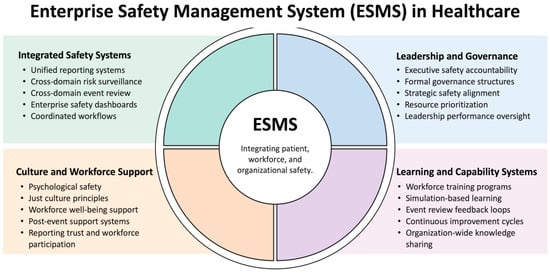
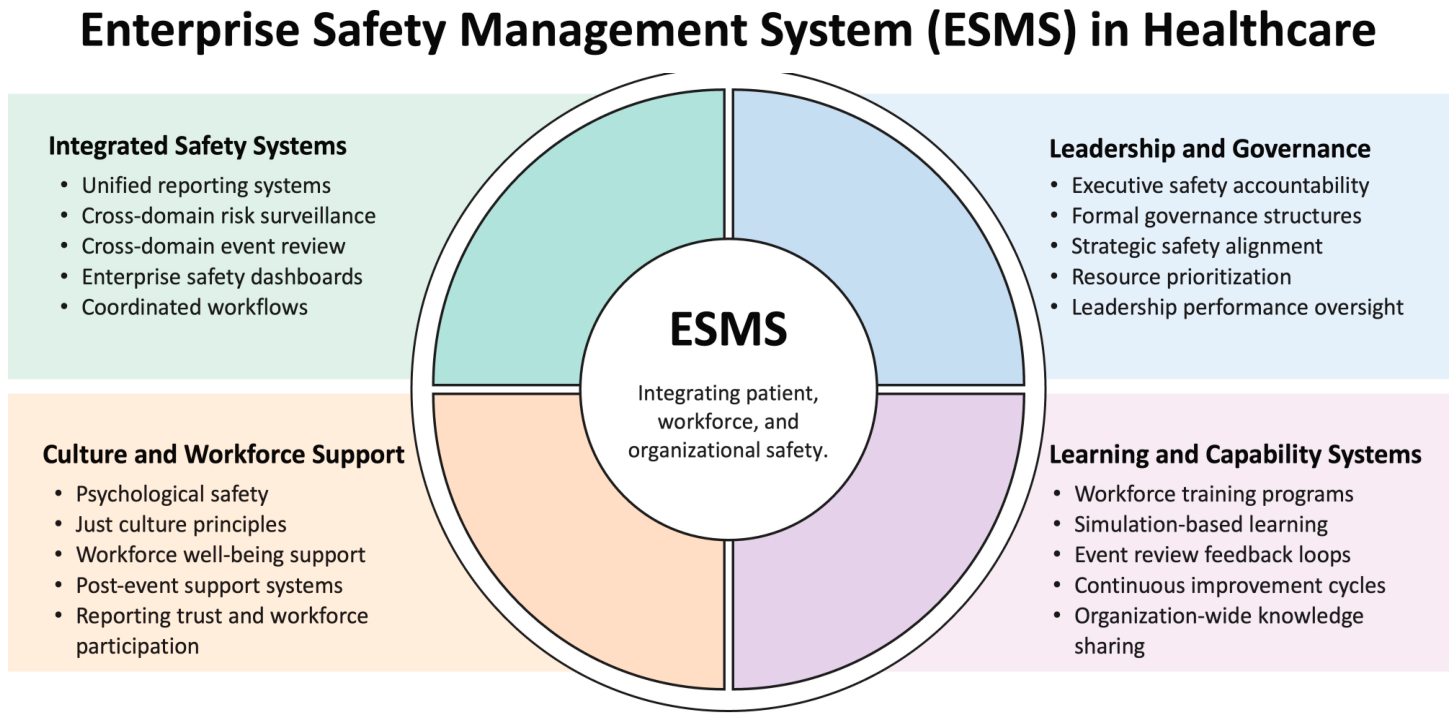
The proposed ESMS comprises four mutually reinforcing pillars (Figure 1). Integrated Safety Systems link reporting, risk classification, surveillance, investigation, controls, assurance, response, and recovery across domains. Leadership and Governance establish strategic priorities, oversight, resources, ethical expectations, decision rights, workforce participation, and accountability. Learning and Capability Systems build individual, team, and organizational capability through role-based education, simulation, debriefing, improvement methods, competency assessment, and knowledge transfer. Culture and Workforce Support foster psychological safety, reporting trust, perceived safety, fair accountability, well-being, participatory work design, post-event support, and recovery. No pillar is sufficient alone; the central construct is coordinated management of patient, workforce, and organizational safety while domain-specific expertise remains intact.
Figure 1.
Conceptual model of the Enterprise Safety Management System (ESMS). The four pillars are Integrated Safety Systems, Leadership and Governance, Learning and Capability Systems, and Culture and Workforce Support; the center represents coordinated patient, workforce, and organizational safety.
Influencing conditions include staffing, workload, environmental design, technology usability, leadership behavior, regulatory obligations, resource availability, reporting burden, labor–management relationships, and prior experience with organizational response. Anticipated proximal outcomes include clearer ownership, more complete risk intelligence, more reliable controls, stronger capability, improved follow-through, and better support after harm. Patient or worker outcome improvements are plausible downstream effects, not demonstrated consequences of the framework.
Culture is not an explanation for every failure. Safety culture can be assessed through multiple dimensions and methods [11,22,23], but reporting and trust are also shaped by ease of reporting, response quality, leadership follow-through, staffing, work design, and perceived fairness. Psychological safety refers to interpersonal risk-taking [9], while perceived safety concerns whether people feel protected from a specified hazard. Patient and family perceptions can be assessed through safety-specific questions in experience surveys, structured interviews, focus groups, or post-event feedback. Culture and Workforce Support is the conceptual home for these perceptions, but patient-experience functions and operational leaders retain responsibility for measurement and action.
Table 2 summarizes the four ESMS pillars, their representative capabilities, and their primary connections to the six categories of the revised July 2026 Baldrige Excellence Framework: Leadership, Strategy, Customers, Organizational Intelligence, Workforce, and Operations [17]. These connections are illustrative and nonexclusive; each pillar may contribute to processes and results across multiple categories.
Table 2.
Four-pillar Enterprise Safety Management System and its primary Baldrige connections.
4. Alignment with the July 2026 Baldrige Excellence Framework
Baldrige was selected as an organizational alignment and assessment framework because its six-category structure, maturity pathways, and explicit process and results evaluation dimensions provide a practical means of examining how leadership, strategy, customers, organizational intelligence, workforce, and operations function as an integrated management system. ISO 45001 provides certifiable occupational health and safety management-system requirements [15]; Joint Commission standards specify healthcare accreditation requirements; and the Institute for Healthcare Improvement (IHI) Framework for Safe, Reliable, and Effective Care focuses more directly on healthcare culture and learning systems [16]. The European Foundation for Quality Management (EFQM) model, like Baldrige, supports organizational assessment and improvement. Selecting Baldrige for this conceptual mapping reflects its suitability for examining the deployment, integration, learning, and performance of the proposed ESMS, rather than evidence of superiority over EFQM or other frameworks. The proposed mapping complements, rather than replaces, established safety standards and organizational improvement approaches.
The mapping is many-to-many. Integrated Safety Systems primarily connects Organizational Intelligence and Operations but depends on Leadership and Strategy. Leadership and Governance has primary ownership in Leadership and Strategy but must be visible in Workforce and Operations results. Learning and Capability Systems connects Workforce, Organizational Intelligence, and Operations. Culture and Workforce Support connects Workforce and Leadership and includes relevant Customer experience. The categories therefore assess how the pillars are deployed and integrated across the enterprise rather than assigning each pillar to a single organizational location.
4.1. Six Categories and Embedded Results
The 2026 framework comprises Leadership, Strategy, Customers, Organizational Intelligence, Workforce, and Operations [17]. Results are no longer presented as a separate Category 7; instead, the Developing and Maturing pathways incorporate results as a third item within each of the six categories [17] (pp. 13–53). For the ESMS, this reinforces the connection between safety processes and their corresponding evidence. Leadership results can include accountability and compliance; Strategy results can show progress on risk objectives; Customer results can include patient and family perceptions of safe care; Organizational Intelligence results can address data quality and knowledge transfer; Workforce results can include health, psychological safety, perceived safety, engagement, readiness, and retention; and Operations results can include harm rates, control performance, response timeliness, continuity, and recovery.
Importantly, perceived safety is not explicitly identified as a separate requirement within Category 5 (Workforce). Safety and security are addressed within the organization’s safety system in Operations, workforce experience is addressed in Workforce, and patient and family experience is addressed in Customers [17]. The distinction between being safe and feeling safe is therefore an analytic feature of the ESMS, not a verbatim Baldrige requirement. Patient and family safety perceptions can be obtained through existing experience mechanisms with safety-specific questions or qualitative follow-up; Culture and Workforce Support provides the conceptual home, while Customers and Operations provide category-level ownership and action.
4.2. Maturity Pathways for Enterprise Safety
The framework’s three maturity pathways clarify development. Establishing corresponds to Operational Awareness: current processes, responsibilities, and basic measures are described. Developing corresponds to Process Discipline: approaches are systematic, consistently deployed, reviewed, and supported by levels, trends, and selected comparisons. Maturing corresponds to Systems Thinking: processes and results are aligned and integrated, risks and opportunities are anticipated, comparative evidence supports decisions, and learning is transferred across the system [17] (pp. xii–xiii). The publication’s pathway label is Systems Thinking; system integration is a defining characteristic of that pathway, not its replacement name. Table 3 illustrates how the 2026 Baldrige maturity pathways can be interpreted in the context of an Enterprise Safety Management System (ESMS).
Table 3.
Interpreting the 2026 Baldrige maturity pathways for an Enterprise Safety Management System.
Comparisons require more than locating a benchmark. Violence data, for example, may count threats, assaults, security responses, recordable injuries, or lost-work cases and may use encounters, occupied bed-days, worked hours, or full-time-equivalent workers as denominators [8,24]. A maturing ESMS should document comparator relevance; align definitions, severity categories, denominators, settings, populations, and periods; use multiple comparators when one is incomplete; and interpret external benchmarks alongside internal trends and reporting maturity.
4.3. ADLI, LeTCI, and a Worked Example
Baldrige evaluates processes through ADLI and results through LeTCI [17]. A written policy is only an Approach; it must be deployed wherever the risk exists, refined through learning, and integrated with strategy, workforce systems, information, customers, and operations. A current injury rate is a Level, not a Trend; a favorable trend still requires relevant Comparisons and Integration with key requirements. These logics make the mapping actionable rather than a statement of fit.
Consider a controlled-access intervention for a high-risk emergency department. Under ADLI, the approach specifies risk-based access rules, patient and visitor needs, staffing, escalation, and privacy; deployment is verified across entrances, shifts, contract personnel, and downtime conditions; learning uses incidents, near misses, worker and patient feedback, and simulation to refine the control; and integration connects the intervention with strategy, security, clinical operations, workforce training, and governance. Under LeTCI, results include exposure-adjusted events and severity, response time, control reliability and bypasses, worker injuries, patient or family access problems, and perceived safety; trends are examined over sufficient time; comparisons use suitably matched units or external sources; and the result set is linked to strategic risk and resource decisions. Improvement in perceived safety without improved control reliability or exposure-adjusted harm would prompt further inquiry rather than a claim of success.
4.4. Organizational Intelligence, AI, and Cybersecurity
Category 4, Organizational Intelligence, includes performance review, comparative information, timely modification of measures, data availability and security, organizational knowledge, best-practice sharing, daily learning, and innovation decisions [17]. A central dashboard is not organizational intelligence if taxonomies remain incompatible, data quality is unknown, weak signals are ignored, or learning cannot move between units.
AI may support event classification, narrative synthesis, hazard surveillance, risk forecasting, workforce planning, or detection of recurrent contributing factors. It can also introduce bias, automation error, poor generalization, privacy failure, cybersecurity exposure, and work redesign. The National Institute of Standards and Technology (NIST) AI Risk Management Framework provides complementary governance through Govern, Map, Measure, and Manage functions [25]. Human accountability, intended-use boundaries, validation, subgroup performance, secure data handling, override processes, and post-deployment monitoring should be explicit.
4.5. Agility and Resilience
The 2026 framework pairs agility and resilience as a core value [17]. Agility concerns rapid, flexible response; resilience includes anticipating, preparing for, responding to, and recovering from disruption while sustaining essential functions. An ESMS should therefore examine staffing shortages, cyber incidents, infrastructure failures, supply interruptions, surges, violence, and regulatory change across Strategy, Organizational Intelligence, Workforce, and Operations rather than treating resilience as an emergency-management responsibility alone [13].
5. Workplace Violence Prevention as an Illustrative Application
5.1. Why Workplace Violence Tests System Integration
Workplace violence exposes interfaces among patient care, workforce safety, security, facilities, human resources, employee health, behavioral health, legal services, and leadership. NIOSH describes violence as an occupational hazard in hospitals [26], and reviews document substantial consequences for healthcare workers and organizations [7,27]. Joint Commission hospital standards effective 1 January 2022 require leadership oversight, worksite analysis, reporting and data review, policies, education, and annual evaluation of workplace-violence prevention programs [24]. The ESMS is not a substitute for these requirements; its proposed added value is to connect compliance activities with strategy, cross-domain risk intelligence, worker and patient experience, capability, resource decisions, learning, and enterprise results.
5.2. Applying the Four Pillars
Integrated Safety Systems would create coherent interfaces among clinical reports, occupational injury data, security records, near misses, threat assessments, environmental risk, and post-incident response. A common minimum dataset could distinguish source, setting, exposure, severity, injury, precipitating conditions, and controls while preserving specialized information. The purpose is a more complete risk picture, not one undifferentiated database.
Leadership and Governance would define accountable executives, interdisciplinary oversight, escalation thresholds, board visibility, regulatory responsibility, and resource allocation. Workers and their representatives should participate in worksite analysis, governance, control design, event review, and evaluation—not only receive training or submit reports. Joint labor–management or equivalent participatory structures can provide a durable route for frontline expertise and follow-through [8]. Governance should balance patient needs with the obligation to protect workers and should prevent violence from being normalized as part of care.
Learning and Capability Systems would distinguish attendance from demonstrated capability. Role-based preparation can include recognition of escalation, trauma-informed communication, de-escalation, personal safety, team response, reporting, and recovery. Simulation and debriefing can reveal communication, technology, environmental, and coordination failures that classroom education misses. A randomized unit-level intervention using local violence data and action planning reduced violent events at six months and violence-related injury at 24 months, illustrating the value of data-informed participatory prevention while not validating the ESMS as a whole [21].
Culture and Workforce Support would address psychological and perceived safety, fear of retaliation, normalization of violence, reporting burden, unclear reportability, inconsistent response, post-incident care, peer and supervisory support, and cumulative exposure. Feedback to reporters and visible corrective action are concrete culture interventions. Fair accountability requires attention to system conditions and individual choices; neither automatic blame nor automatic exoneration supports learning.
Section 5.2 illustrates how each of the four ESMS pillars contributes to workplace violence prevention. Table 4 provides a complementary organizational perspective by mapping the same application across the six Baldrige categories and their embedded results. This distinction is intentional: the pillars describe the safety-management functions involved, while the Baldrige categories provide a structure for examining their deployment, coordination, and performance across the healthcare enterprise. The table therefore illustrates cross-category integration rather than assigning workplace violence prevention to a single pillar or organizational function.
Table 4.
Six-category Baldrige integration map using workplace violence prevention as an illustrative application.
5.3. Results and Boundary Conditions
A workplace-violence ESMS should not define success solely as fewer reported events. Occupational Safety and Health Administration (OSHA) and NIOSH guidance identify reporting barriers and the need for worker participation [8,26]. Underreporting can arise from fear of retaliation, normalization of violence, unclear reportability, reporting burden, and low confidence in response. Counts may rise because exposure increased or because access and trust improved. A balanced result set can include severity, injury and lost time, exposure-adjusted rates, near misses, response time, control reliability, training transfer, post-incident follow-up, corrective-action completion, recurrence, retention, and workforce and patient perceptions. Measures should be segmented by setting, role, shift, event type, and relevant risk factors while protecting confidentiality.
Mohammad, Burnie, and Johnson separately measured reported violence exposure and perceived safety among 134 emergency-department nurses recruited through nonprobability methods, with respondents concentrated in Ohio [12]. Security presence, controlled access, and lighting were associated with perceived safety, but the cross-sectional design, self-report, sampling, and geographic concentration limit generalizability and preclude causal inference or conclusions about reduced violence. A published corrigendum corrected the institutional-review-board identification and did not change the reported analyses [12]. The study therefore supports measuring perceived safety separately; it does not validate the ESMS or establish intervention effectiveness.
The application remains hypothetical. This article reports no ESMS implementation, sample, intervention, or observed outcome, and Table 4 is not a validated instrument. Its purpose is to show why workplace violence cannot be managed through training or security response alone and how an enterprise architecture could connect compliance, governance, risk intelligence, workforce participation and support, operational controls, learning, and balanced results.
6. Discussion
6.1. Conceptual Contribution
The proposed ESMS contributes a cross-domain management architecture to healthcare safety. It integrates patient safety, workforce safety, and organizational risk without erasing their distinct purposes. The four pillars translate concepts from several traditions into enterprise functions, while Baldrige supplies a nonprescriptive structure for asking whether those functions are aligned and deployed, support learning, and connect processes with results. This is an integration proposal, not evidence that one consolidated structure is superior.
The July 2026 revisions make several elements useful for this purpose: results are embedded within categories; maturity pathways distinguish operational awareness, process discipline, and systems thinking; Organizational Intelligence emphasizes knowledge transfer and comparative information; agility and resilience connect adaptation with continuity and recovery; and AI is treated as a cross-cutting governance concern [17]. These features help articulate testable management questions. They do not themselves strengthen or validate the ESMS.
6.2. Implementation Implications
Healthcare leaders can begin without reorganizing every function. A practical starting point is one cross-domain hazard: map ownership and information flows, assess relevant categories using the maturity pathways, and define a common aim, decision rights, minimum data set, balanced measures, participation mechanisms, and review cadence. Implementation should preserve subject-matter expertise and statutory reporting while removing avoidable duplication and interface failures.
Governance should address trade-offs. A patient-centered intervention can increase worker exposure; a security control can impede access or trust; a productivity target can increase fatigue; and an AI alert can add workload or bias. Cross-category review makes these consequences visible before local optimization becomes enterprise risk. Whole-system quality approaches similarly emphasize coordinated planning, control, and improvement across organizational levels [28].
6.3. Limitations and Research Agenda
The ESMS has not been validated as a construct or evaluated against safety outcomes. The source literature was selected to develop and challenge the framework rather than identified through a systematic review protocol. Mapping involved author interpretation without independent coding or interrater-reliability testing. The workplace-violence example is illustrative. The July 2026 source is a general-sector framework, not a healthcare-specific edition.
Two claims must remain separate. Patient and worker safety can share hazards, work-system determinants, and antecedents [2,3,4,5]; whether managing them through an integrated enterprise architecture improves outcomes is largely untested. Integration could also add bureaucracy, blur responsibility, redistribute risk, or privilege measures that are easiest to aggregate. Evaluation should therefore test benefits, burden, equity, unintended effects, and preservation of specialist accountability.
Empirical literature on Baldrige in healthcare is suggestive but does not validate this mapping. Comparisons of Baldrige award recipients with competitors and analyses of recipient performance report favorable results in selected domains, but recipients are highly selected, designs are observational, and worker-safety outcomes are rarely central [29,30]. The ESMS–Baldrige alignment should therefore be treated as a proposal to test, not evidence of effectiveness.
Future work should obtain multidisciplinary, patient, workforce, and labor-representative input; refine operational definitions and maturity indicators; and test content validity and interrater reliability. Comparative and longitudinal studies should examine hazard visibility, control reliability, corrective-action completion, knowledge transfer, resilience, patient and worker outcomes, reporting burden, and unintended consequences. AI studies should assess data provenance, validity, cybersecurity, subgroup performance, human oversight, work redesign, and post-deployment drift.
7. Conclusions
Healthcare organizations need a management architecture capable of examining safety across patients, the workforce, operations, and organizational risk. The proposed ESMS combines Integrated Safety Systems, Leadership and Governance, Learning and Capability Systems, and Culture and Workforce Support. The July 2026 Baldrige framework provides a systems lens for mapping those functions to strategy, performance evidence, learning, accountability, agility, and resilience; it does not validate the model.
The central proposition is that safety may become more governable when specialized programs share direction, risk intelligence, learning, performance evidence, workforce participation and support, and accountability while retaining domain expertise. Objective safety, perceived safety, and psychological safety should be measured as distinct but related constructs. The framework now requires empirical and practical testing before claims of effectiveness can be made.
Author Contributions
Conceptualization, D.R.H.; methodology, D.R.H., D.A.C. and H.S.; formal analysis, D.R.H.; writing—original draft preparation, D.R.H.; writing—review and editing, D.R.H., D.A.C. and H.S. All authors have read and agreed to the published version of the manuscript.
Funding
This research received no external funding.
Institutional Review Board Statement
Not applicable.
Informed Consent Statement
Not applicable.
Data Availability Statement
No new data were created or analyzed in this study. Data sharing is not applicable to this article.
Acknowledgments
During preparation of this manuscript, D.R.H. used OpenAI ChatGPT (GPT-6) for structural organization, framework comparison, table development, and language revision. The authors reviewed and edited the output and take full responsibility for the content.
Conflicts of Interest
The authors declare no conflicts of interest.
Abbreviations
| Abbreviation | Definition |
| ADLI | Approach, Deployment, Learning, and Integration |
| AI | Artificial intelligence |
| EFQM | European Foundation for Quality Management |
| ESMS | Enterprise Safety Management System |
| IHI | Institute for Healthcare Improvement |
| ISO | International Organization for Standardization |
| LeTCI | Levels, Trends, Comparisons, and Integration |
| NIOSH | National Institute for Occupational Safety and Health |
| NIST | National Institute of Standards and Technology |
| OSHA | Occupational Safety and Health Administration |
| SEIPS | Systems Engineering Initiative for Patient Safety |
| SMS | Safety management system |
References
- Institute of Medicine. To Err Is Human: Building a Safer Health System; National Academies Press: Washington, DC, USA, 2000. [Google Scholar] [CrossRef] [Scilit] [PubMed]
- Taylor, J.A.; Dominici, F.; Agnew, J.; Gerwin, D.; Morlock, L.; Miller, M.R. Do Nurse and Patient Injuries Share Common Antecedents? An Analysis of Associations with Safety Climate and Working Conditions. BMJ Qual. Saf. 2012, 21, 101–111. [Google Scholar] [CrossRef] [Scilit] [PubMed]
- Carayon, P.; Schoofs Hundt, A.; Karsh, B.-T.; Gurses, A.P.; Alvarado, C.J.; Smith, M.; Flatley Brennan, P. Work System Design for Patient Safety: The SEIPS Model. Qual. Saf. Health Care 2006, 15, i50–i58. [Google Scholar] [CrossRef] [Scilit] [PubMed]
- Holden, R.J.; Carayon, P.; Gurses, A.P.; Hoonakker, P.; Schoofs Hundt, A.; Ozok, A.A.; Rivera-Rodriguez, A.J. SEIPS 2.0: A Human Factors Framework for Studying and Improving the Work of Healthcare Professionals and Patients. Ergonomics 2013, 56, 1669–1686. [Google Scholar] [CrossRef] [Scilit] [PubMed]
- National Institute for Occupational Safety and Health. Fundamentals of Total Worker Health® Approaches: Essential Elements for Advancing Worker Safety, Health, and Well-Being; DHHS (NIOSH) Publication No. 2017-112; CDC: Cincinnati, OH, USA, 2016. Available online: https://www.cdc.gov/niosh/docs/2017-112/ (accessed on 3 November 2026).
- National Steering Committee for Patient Safety. Safer Together: A National Action Plan to Advance Patient Safety; Institute for Healthcare Improvement: Boston, MA, USA, 2020; Available online: https://www.ihi.org/partner/initiatives/national-steering-committee-patient-safety/national-action-plan-advance-patient-safety (accessed on 3 November 2026).
- O’Brien, C.J.; van Zundert, A.A.J.; Barach, P.R. The Growing Burden of Workplace Violence against Healthcare Workers: Trends in Prevalence, Risk Factors, Consequences, and Prevention: A Narrative Review. EClinicalMedicine 2024, 72, 102641. [Google Scholar] [CrossRef] [Scilit] [PubMed]
- Occupational Safety and Health Administration. Guidelines for Preventing Workplace Violence for Healthcare and Social Service Workers; OSHA 3148-06R; U.S. Department of Labor: Washington, DC, USA, 2016. Available online: https://www.osha.gov/sites/default/files/publications/osha3148.pdf (accessed on 3 November 2026).
- Edmondson, A. Psychological Safety and Learning Behavior in Work Teams. Adm. Sci. Q. 1999, 44, 350–383. [Google Scholar] [CrossRef] [Scilit]
- Zohar, D. Thirty Years of Safety Climate Research: Reflections and Future Directions. Accid. Anal. Prev. 2010, 42, 1517–1522. [Google Scholar] [CrossRef] [Scilit] [PubMed]
- Churruca, K.; Ellis, L.A.; Pomare, C.; Hogden, A.; Bierbaum, M.; Long, J.C.; Olekalns, A.; Braithwaite, J. Dimensions of Safety Culture: A Systematic Review of Quantitative, Qualitative and Mixed Methods for Assessing Safety Culture in Hospitals. BMJ Open 2021, 11, e043982. [Google Scholar] [CrossRef] [Scilit] [PubMed]
- Mohammad, H.; Burnie, J.; Johnson, K.D. Safety Precautions and Perceived Safety: A Cross-Sectional Study of Emergency Department Nurses. Int. Emerg. Nurs. 2026, 86, 101815, Corrigendum in Int. Emerg. Nurs. 2026, 86, 101831. https://doi.org/10.1016/j.ienj.2026.101831. [Google Scholar] [CrossRef] [Scilit] [PubMed]
- Witter, S.; Thomas, S.; Topp, S.M.; Barasa, E.; Chopra, M.; Cobos, D.; Blanchet, K.; Teddy, G.; Atun, R.; Ager, A. Health System Resilience: A Critical Review and Reconceptualisation. Lancet Glob. Health 2023, 11, e1454–e1458. [Google Scholar] [CrossRef] [Scilit] [PubMed]
- Federal Aviation Administration. Safety Management System (SMS). Available online: https://www.faa.gov/faa-aviation-safety-outreach/safety-management-system (accessed on 3 November 2026).
- ISO 45001:2018; Occupational Health and Safety Management Systems—Requirements with Guidance for Use. ISO: Geneva, Switzerland, 2018.
- Frankel, A.; Haraden, C.; Federico, F.; Lenoci-Edwards, J. A Framework for Safe, Reliable, and Effective Care; Institute for Healthcare Improvement and Safe & Reliable Healthcare: Cambridge, MA, USA, 2017; Available online: https://www.ihi.org/library/white-papers/framework-safe-reliable-and-effective-care (accessed on 3 November 2026).
- Baldrige Performance Excellence Program. Baldrige Excellence Framework®: Proven Leadership and Management Practices for High Performance; U.S. Department of Commerce, National Institute of Standards and Technology: Gaithersburg, MD, USA, 2026; (Revised July 2026). Available online: https://www.nist.gov/baldrige/products-services/baldrige-excellence-framework (accessed on 3 November 2026).
- National Institute of Standards and Technology. Baldrige Excellence Framework® (Health Care): Proven Leadership and Management Practices for High Performance, 2023–2024; U.S. Department of Commerce: Gaithersburg, MD, USA, 2023. Available online: https://www.nist.gov/baldrige/publications/baldrige-excellence-framework/health-care (accessed on 3 November 2026).
- ISO 14001:2026; Environmental Management Systems—Requirements with Guidance for Use. ISO: Geneva, Switzerland, 2026.
- Weick, K.E.; Sutcliffe, K.M. Managing the Unexpected: Resilient Performance in an Age of Uncertainty, 2nd ed.; Jossey-Bass: San Francisco, CA, USA, 2007. [Google Scholar]
- Arnetz, J.E.; Hamblin, L.; Russell, J.; Upfal, M.J.; Luborsky, M.; Janisse, J.; Essenmacher, L. Preventing Patient-to-Worker Violence in Hospitals: Outcome of a Randomized Controlled Intervention. J. Occup. Environ. Med. 2017, 59, 18–27. [Google Scholar] [CrossRef] [Scilit] [PubMed]
- Finn, M.; Walsh, A.; Rafter, N.; Mellon, L.; Chong, H.Y.; Naji, A.; O’Brien, N.; Williams, D.J.; McCarthy, S.E. Effect of Interventions to Improve Safety Culture on Healthcare Workers in Hospital Settings: A Systematic Review of the International Literature. BMJ Open Qual. 2024, 13, e002506. [Google Scholar] [CrossRef] [Scilit] [PubMed]
- Agency for Healthcare Research and Quality. Culture of Safety. PSNet. Available online: https://psnet.ahrq.gov/primer/culture-safety (accessed on 3 November 2026).
- The Joint Commission. R3 Report Issue 30: Workplace Violence Prevention Standards; The Joint Commission: Oakbrook Terrace, IL, USA, 2021; Available online: https://digitalassets.jointcommission.org/api/public/content/0c8d9cd5ed3145b6bc9369920b69ca21 (accessed on 23 November 2026).
- National Institute of Standards and Technology. Artificial Intelligence Risk Management Framework (AI RMF 1.0); NIST AI 100-1; U.S. Department of Commerce: Gaithersburg, MD, USA, 2023. [Google Scholar] [CrossRef] [Scilit]
- National Institute for Occupational Safety and Health. Violence: Occupational Hazards in Hospitals; DHHS Publication No. 2002-101; CDC: Cincinnati, OH, USA, 2002. Available online: https://www.cdc.gov/niosh/docs/2002-101/ (accessed on 3 November 2026).
- National Institute for Occupational Safety and Health. Prioritizing Our Healthcare Workers: The Importance of Addressing the Intersection of Workplace Violence and Mental Health and Wellbeing; National Institute for Occupational Safety and Health: Washington, DC, USA, 2024. Available online: https://www.cdc.gov/niosh/bulletin/2024/prioritizing-healthcare-workers.html (accessed on 3 November 2026).
- Sampath, B.; Rakover, J.; Baldoza, K.; Mate, K.; Lenoci-Edwards, J.; Barker, P. Whole System Quality: A Unified Approach to Building Responsive, Resilient Health Care Systems; Institute for Healthcare Improvement: Boston, MA, USA, 2021; Available online: https://www.ihi.org/library/white-papers/whole-system-quality (accessed on 3 November 2026).
- Schulingkamp, R.C.; Latham, J.R. Healthcare Performance Excellence: A Comparison of Baldrige Award Recipients and Competitors. Qual. Manag. J. 2015, 22, 6–22. [Google Scholar] [CrossRef] [Scilit]
- Griffith, J.R. Understanding High-Reliability Organizations: Are Baldrige Recipients Models? J. Healthc. Manag. 2015, 60, 44–61. [Google Scholar] [CrossRef] [Scilit]

Disclaimer/Publisher’s Note: The statements, opinions and data contained in all publications are solely those of the individual author(s) and contributor(s) and not of MDPI and/or the editor(s). MDPI and/or the editor(s) disclaim responsibility for any injury to people or property resulting from any ideas, methods, instructions or products referred to in the content. |
© 2026 by the authors. Licensee MDPI, Basel, Switzerland. This article is an open access article distributed under the terms and conditions of the Creative Commons Attribution (CC BY) license.