


Abstract
Musculoskeletal disorders represent one of the most frequent occupational health problems in labour-intensive industries, particularly in fish processing, where repetitive tasks and prolonged postures are common. The objective was to determine the level of ergonomic risk by applying the Rapid Entire Body Assessment (REBA) method and based on the results, to formulate recommendations aimed at preventing musculoskeletal disorders and improving preventive management within the organization. The assessment included 30 workers distributed across three operational workstations, where the overall average REBA score was 8.60 ± 1.65 (range: 6–12), indicating a predominantly high level of ergonomic risk. In categorical terms, 60.0% of the workers were classified as high risk, 13.3% as very high risk, and 26.7% as medium risk, while none reached negligible or low risk levels. Significant differences were observed between workstations (Kruskal–Wallis H = 16.72, p < 0.001, ε2 = 0.545), with the nobbing stage exhibiting the highest biomechanical load (mean REBA = 10.38 ± 1.06). It is concluded that ergonomic risk is structurally integrated into the operational design of the evaluated production system; therefore, ergonomic interventions focused on redesigning workstations, adjusting height, and configuring tasks are recommended to reduce biomechanical exposure and strengthen the organization’s preventive occupational safety framework.
1. Introduction
The fishing industry is a labour-intensive sector characterized by manual processing tasks that impose sustained biomechanical demands on workers. Activities such as filleting, nobbing, and rolling require prolonged trunk flexion, non-neutral neck postures, and repetitive upper limb movements performed under constrained visual conditions, increasing exposure to postural ergonomic risk factors [1,2,3,4]. These conditions are strongly associated with musculoskeletal disorders (MSDs), which account for approximately 59% of all occupational diseases worldwide according to the International Labour Organization [5,6]. In fish processing environments, these risks are intensified by workstation configurations that limit postural variability and recovery, making biomechanical load an inherent characteristic of the production system [2,3,7].
Empirical evidence across industrial sectors has demonstrated a consistent relationship between awkward postures and MSD prevalence, particularly in the lumbar region, neck, and upper extremities [8,9,10,11,12]. Studies conducted in agricultural and industrial settings report that exposure to sustained trunk flexion and constrained postures can lead to musculoskeletal involvement exceeding 60% in specific body regions [13,14,15]. Although repetitive movements are frequently cited as contributing factors, recent research suggests that postural constraints derived from workstation design are more determinant in defining overall biomechanical load [16,17,18]. This distinction is especially relevant in fish processing, where tasks are performed under static or semi-static conditions that reduce opportunities for postural variation [19,20].
To objectively assess these conditions, standardized ergonomic evaluation methods have been widely implemented. Among them, the Rapid Entire Body Assessment (REBA) method enables a comprehensive analysis of whole-body posture by integrating trunk, neck, upper and lower limb positions, load handling, and coupling conditions into a unified risk score [21,22]. Previous applications of REBA in industrial environments have consistently identified medium to high levels of ergonomic risk requiring corrective action, supporting its validity as a decision-making tool for workplace redesign and risk management [13,14,15]. However, most studies remain limited to descriptive classifications, without exploring the underlying biomechanical structure that explains variability in postural exposure across different workstations [23,24].
In this context, the integration of REBA with non-parametric and multivariate statistical approaches provides a more robust analytical framework to identify structural determinants of ergonomic risk. These methods allow not only the comparison of risk levels between operational units but also the identification of latent biomechanical dimensions associated with task-specific demands [25,26]. This approach is particularly relevant in fish processing systems, where multiple body segments interact simultaneously under constrained ergonomic conditions.
Accordingly, this study addressed two gaps frequently observed in ergonomic assessments of fish processing systems: the limited evidence on the reliability of REBA scoring under real production conditions, and the scarce comparative analysis of workstation-specific biomechanical demands. While previous studies have reported medium or high ergonomic risk, few have examined whether such classifications are consistently reproducible between evaluators or whether risk is primarily explained by structural workstation constraints rather than worker-level variability.
Therefore, the aim of this study was to assess postural ergonomic risk across three fish-processing workstations using the REBA method, while simultaneously evaluating inter-rater reliability of the scoring procedure and identifying task-specific determinants of postural load. It was hypothesized that ergonomic risk would be predominantly associated with fixed workstation geometry and repetitive operational demands, and that REBA would provide consistent ratings when applied under standardized observational conditions. Findings were intended to support evidence-based workstation redesign and occupational risk prevention in labour-intensive seafood processing environments. In addition, limited evidence is available on whether some REBA body segments behave as workstation-specific factors or as universal structural constraints across fish-processing tasks, particularly cervical posture.
2. Materials and Methods
2.1. Study Design, Setting, and Participants
This study was conducted within the occupational health surveillance framework established by Peruvian Ministerial Resolution R.M. No. 375-2008-TR [27], whose technical criteria are aligned with ISO 11228-3:2007 [28] for repetitive task assessment [29]. A cross-sectional observational design was used to evaluate postural ergonomic risk in anchovy-processing activities. Because the objective was to characterize biomechanical exposure in the most demanding production tasks rather than estimate population prevalence, a census-based intentional sampling strategy was adopted, including all workers assigned to the three principal high-demand workstations on the evaluation date (22 November 2025).
The final sample consisted of 30 workers distributed in filleting (n = 18), nobbing (n = 8), and rolling (n = 4). Women represented 76.7% of participants (23/30) and men 23.3% (7/30), reflecting the workforce composition commonly observed in artisanal or semi-industrial anchovy plants. Mean age was 36.5 ± 10.5 years, mean stature was 164.0 ± 3.2 cm, mean body mass was 66.0 ± 1.7 kg, and mean job tenure was 660 ± 501 days. Inclusion criteria were active assignment to one of the evaluated stations during data collection and provision of written informed consent. Exclusion criteria included administrative duties, temporary reassignment, sick leave, or inability to provide consent. No eligible worker was excluded. Detailed sociodemographic and occupational characteristics are presented in Table 1.
Table 1.
Sociodemographic and occupational characteristics by workstation (n = 30).
The study protocol was approved by the Institutional Ethics Committee of Universidad Nacional del Santa (CEI-UNS; Certificate No. CEI-UNS-FI-0001-2026; Project code PIC. FF. II. 012-2025), which classified the study as minimal-risk observational research in accordance with the Declaration of Helsinki (Fortaleza revision, 2013).
2.2. Task Characterization and Ergonomic Context
Three production stations with different biomechanical demands were selected for evaluation: filleting, nobbing, and rolling. A complementary observational assessment of workstation ergonomics was also conducted to characterize the relationship between work surface height and postural configuration during task execution. Given the relatively homogeneous anthropometric profile of the sample (mean stature 164.0 ± 3.2 cm; Table 1), standing elbow height was used as a reference for estimating a neutral working level.
Field observations and photographic records showed that the working surfaces of all stations were generally located below elbow height during routine activities. Although the facility was equipped with height-adjustable tables, workstation height was not systematically standardized according to individual anthropometric characteristics during daily operations. As a result, the functional configuration of the workstations reflected a consistent spatial arrangement that did not explicitly account for variability in worker body dimensions. This contextual condition was considered when interpreting postural exposure patterns, particularly the reduced variability observed in trunk and cervical angles across tasks. However, the evaluation of workstation–worker fit was based on observational criteria and did not include formal anthropometric matching procedures or percentile-based ergonomic design analysis.
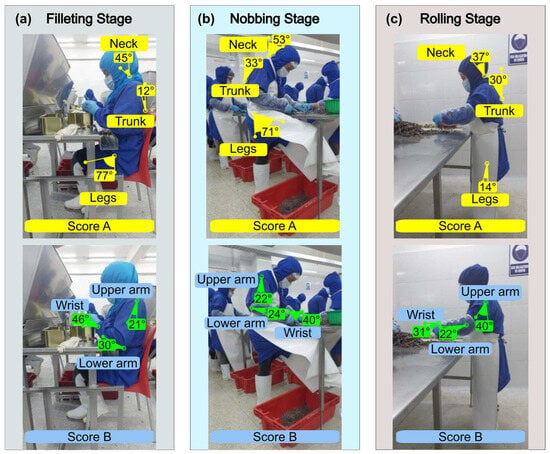
Filleting involved bilateral trimming and packaging of cured anchovies on fixed-height tables, requiring repetitive hand activity, sustained visual focus, trunk inclination, and frequent wrist deviation. During routine cycles, trunk flexion was commonly observed between 20° and 40°, whereas cervical flexion frequently exceeded 60°.
Nobbing consisted of tail removal and surface cleaning through repetitive bilateral cutting tasks performed in standing posture at waist-height tables. This station presented the highest forward trunk demand, with observed inclinations between 40° and 70°, arm reaches of approximately 30–45 cm, and partial knee flexion during repetitive cutting cycles. Rolling involved placement and rolling of anchovy fillets on flat work surfaces, requiring lateral trunk displacement, bilateral reach up to 60 cm from the body midline, and repetitive wrist deviation.
Representative postural configurations recorded during normal production are presented in Figure 1. These tasks were prioritized because they combine trunk loading, prolonged standing, neck flexion, repetitive upper-limb movements, and asymmetric reach patterns, all of which are recognized determinants of musculoskeletal risk in food-processing environments. The Rapid Entire Body Assessment (REBA) method was selected because it permits integrated whole-body assessment rather than focusing only on isolated upper-limb exposure [25].
Figure 1.
Critical postural configurations at the three evaluated workstations. (a) Filleting: mixed sitting-standing at fixed bench, trunk 20–40°, cervical flexion > 60°, wrist deviation > 15° during small-object manipulation. (b) Nobbing: sustained bilateral trunk inclination 40–70° with partial knee flexion during cutting operations. (c) Rolling: lateral trunk displacement with bilateral arm extension up to 60 cm from the body midline. The annotations indicate task-imposed postural constraints structurally independent of worker behaviour.
2.3. Data Acquisition and REBA Procedure
Biomechanical data were recorded using continuous video capture of full work cycles at each workstation in order to ensure dynamic observation of task execution under real operational conditions. From these recordings, representative postural configurations were systematically identified and extracted as still frames corresponding to moments of maximum biomechanical demand, operationally defined as sustained postures maintained for at least 4 s within a minimum observation period of 5 min. This procedure allowed the integration of dynamic task observation with static postural quantification, ensuring methodological consistency in subsequent ergonomic evaluation.
Postural assessment was then performed using a structured photographic goniometry protocol applied to the extracted frames. A trained evaluator analyzed lateral (90° to the sagittal plane) and anterior views obtained from the video-derived images using a calibrated digital camera perspective framework, with a fixed reference distance of 3.5 m to minimize distortion. Angular measurements of neck, trunk, upper limbs, and lower limbs were estimated through anatomical landmark identification, and these values were subsequently used for REBA scoring according to standardized criteria.
Angular estimates were subsequently obtained from photographic records through identification of anatomical reference points and segment inclinations for the neck, trunk, upper limbs, and lower limbs. These values were converted into REBA segment scores according to the original worksheet criteria. Group A included neck, trunk, and legs, whereas Group B included upper arm, forearm, and wrist. Partial scores were then integrated through the standard REBA scoring matrix, and activity modifiers were added when static postures or repetitive movements were identified.
Additional technical specifications regarding exposure metrics, camera positioning, and detailed measurement criteria are summarized in Supplementary Material S1 in order to maintain conciseness in the main manuscript while preserving methodological transparency.
2.4. Data Quality Control and Reliability
To strengthen scoring consistency, a randomly selected subsample of 10 postural records (33.3% of the total sample) was independently evaluated by a second ergonomist who was blinded to the primary ratings. Exact inter-rater agreement ranged from 80% for lower-limb scoring to 100% for neck and forearm items. The mean absolute difference in final REBA score between raters was 0.40 ± 0.52 points, which remained within commonly accepted tolerance limits for observational ergonomic instruments [30].
Before inferential analyses, all records were reviewed for completeness and internal consistency. Item values were verified against normative REBA limits, and the algebraic identity Final REBA Score = Score C + Activity Score was confirmed for all observations. No out-of-range values were detected. Two items, neck and forearm, showed zero variance across the sample, indicating homogeneous exposure patterns rather than recording errors. Detailed agreement statistics for each REBA segment are reported in Table S1 of the Supplementary Materials.
2.5. Ergonomic Risk Classification
Final REBA scores were interpreted according to the standard action levels proposed in the original instrument. Scores range from 1 to 15, where higher values indicate greater biomechanical exposure and higher urgency of ergonomic intervention. This classification allows prioritization of corrective actions according to the magnitude of postural risk identified at each workstation.
The interpretation criteria applied in the present study are summarized in Table 2. Negligible scores indicate that no immediate intervention is required, whereas high and very high scores indicate the need for prompt or immediate ergonomic redesign, administrative control measures, or task modification.
Table 2.
REBA final score, risk stratification, and intervention urgency.
2.6. Statistical Analysis
All statistical analyses were performed in R software (v4.5.1; R Core Team, Vienna, Austria) using the RStudio integrated development environment (v2026.01.1+403; Posit Software, Boston, MA, USA), with a reproducible workflow with seed = 2025. The principal objective of the analytical stage was to describe ergonomic risk distribution across workstations and compare REBA scores among tasks using procedures appropriate for the ordinal and bounded nature of the scale. A summary of the complete analytical workflow is presented in Figure S1 of the Supplementary Materials.
Continuous variables were summarized using means, standard deviations, medians, and interquartile ranges, whereas categorical variables were expressed as frequencies and percentages. Differences in REBA scores among workstations were evaluated using the Kruskal–Wallis test. When global significance was identified, Dunn post hoc comparisons with Bonferroni adjustment were applied to determine pairwise differences between stations.
Associations between workstation and categorical REBA risk level were examined using Fisher’s exact test because of reduced expected frequencies in some contingency cells. Effect sizes were additionally reported to facilitate the practical interpretation of statistically significant findings. More technical computational details, including exploratory validation procedures retained for reproducibility purposes, are summarized in Supplementary Material S1.
3. Results
3.1. Biomechanical Profile: Central Tendency and Resampling Robustness
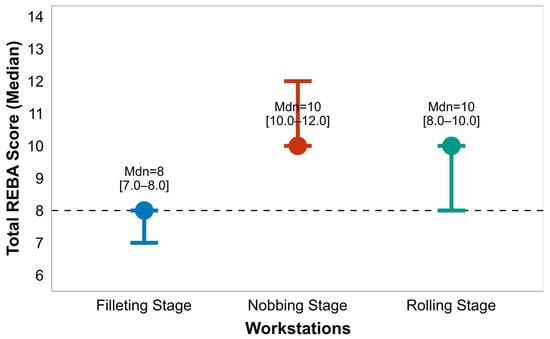
The descriptive statistics of REBA scores are presented in Table 3 for the total sample (n = 30) and by workstation. Across all observations, scores ranged from 6 to 12, with a mean of 8.60 ± 1.65 and a median of 8.0. No observations were classified within the negligible or low-risk categories, with all values distributed across medium, high, and very high-risk levels according to the REBA classification system. By workstation, filleting presented a median of 8.0, nobbing a median of 10.0, and rolling a median of 10.0. The interquartile range was 1.0 for all stations. Bootstrap resampling (B = 1000) produced 95% confidence intervals of [7.0–8.0] for filleting, [10.0–11.0] for nobbing, and [8.0–10.0] for rolling, using percentile estimation with replacement sampling.
Table 3.
Descriptive statistics and bootstrapped 95% CI for REBA scores by workstation (n = 30).
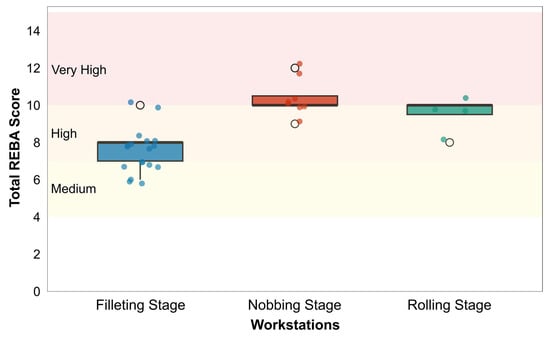
The distribution of REBA scores by workstation (filleting, nobbing, and rolling) is shown in Figure 2 based on individual observations. The graphical representation includes boxplots displaying the median, interquartile range, and whiskers defined at 1.5 × IQR, with individual data points overlaid as jittered observations. REBA scores are distributed across the medium (4–7), high (8–10), and very high (11–15) risk categories as indicated by the shaded bands in the figure. Across the three workstations, observed values range from 6 to 12, with no observations below REBA = 6. Figure 3 provides a descriptive visualization of the dispersion and central tendency of REBA scores by workstation using standard graphical elements.
Figure 2.
Distribution of REBA scores by workstation (n = 30). Boxes represent IQR; Centerline = median; whiskers = 1.5 × IQR; individual observations overlaid (jitter). Shaded bands: yellow = Medium risk (4–7); orange = High (8–10); red = Very High (11–15). No observation falls below the medium threshold across any workstation. Black open circles represent outliers.
Figure 3.
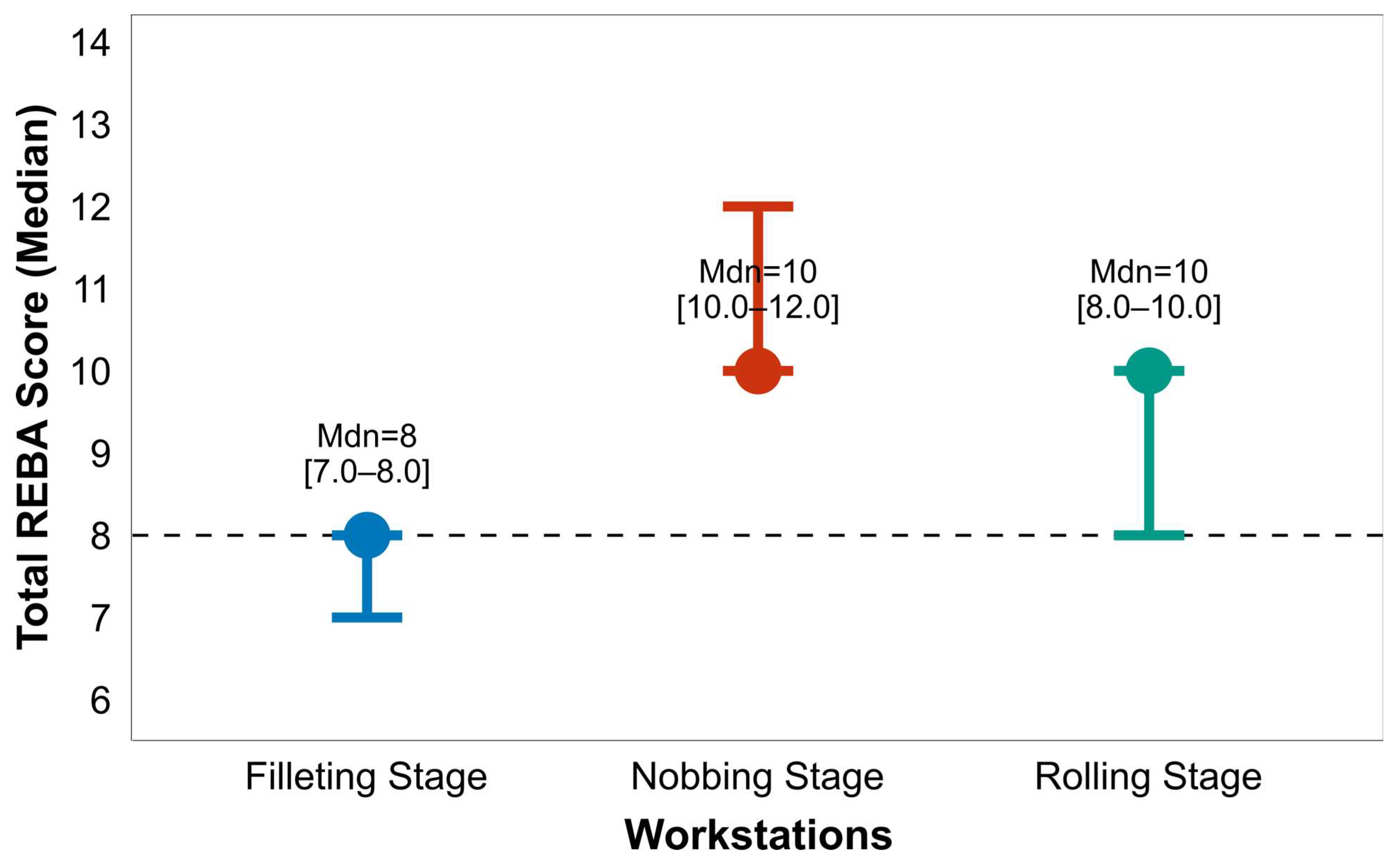
Bootstrapped 95% confidence intervals for REBA score medians by workstation. Percentile bootstrap, B = 1000 resamples, seed = 2025. Error bars = 95% CI. Dashed line = global median (8.0). All lower bounds ≥ 7, confirming High-range exposure under maximum uncertainty scenarios. The rolling workstation interval is reported for descriptive purposes only due to the limited sample size (n = 4).
The bootstrapped 95% confidence intervals for median REBA scores by workstation are presented in Figure 3 using percentile resampling (B = 1000). The figure displays interval estimates for filleting, nobbing, and rolling workstations, with each interval representing the variability of the median under repeated sampling with replacement. The filleting workstation shows an interval of [7.0–8.0], the nobbing workstation shows [10.0–11.0], and the rolling workstation shows [8.0–10.0]. A reference line indicating the global median (8.0) is included in the figure for comparative purposes. Figure 4 summarizes the uncertainty associated with the median REBA estimates across workstations based on the observed sample structure.
Figure 4.
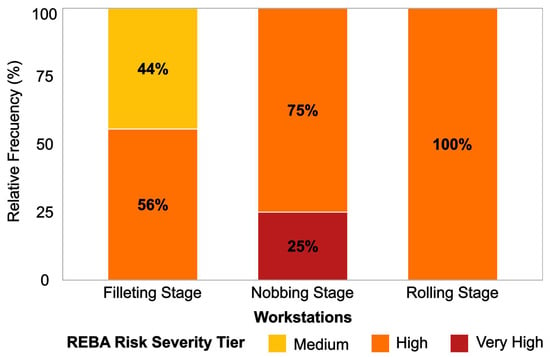
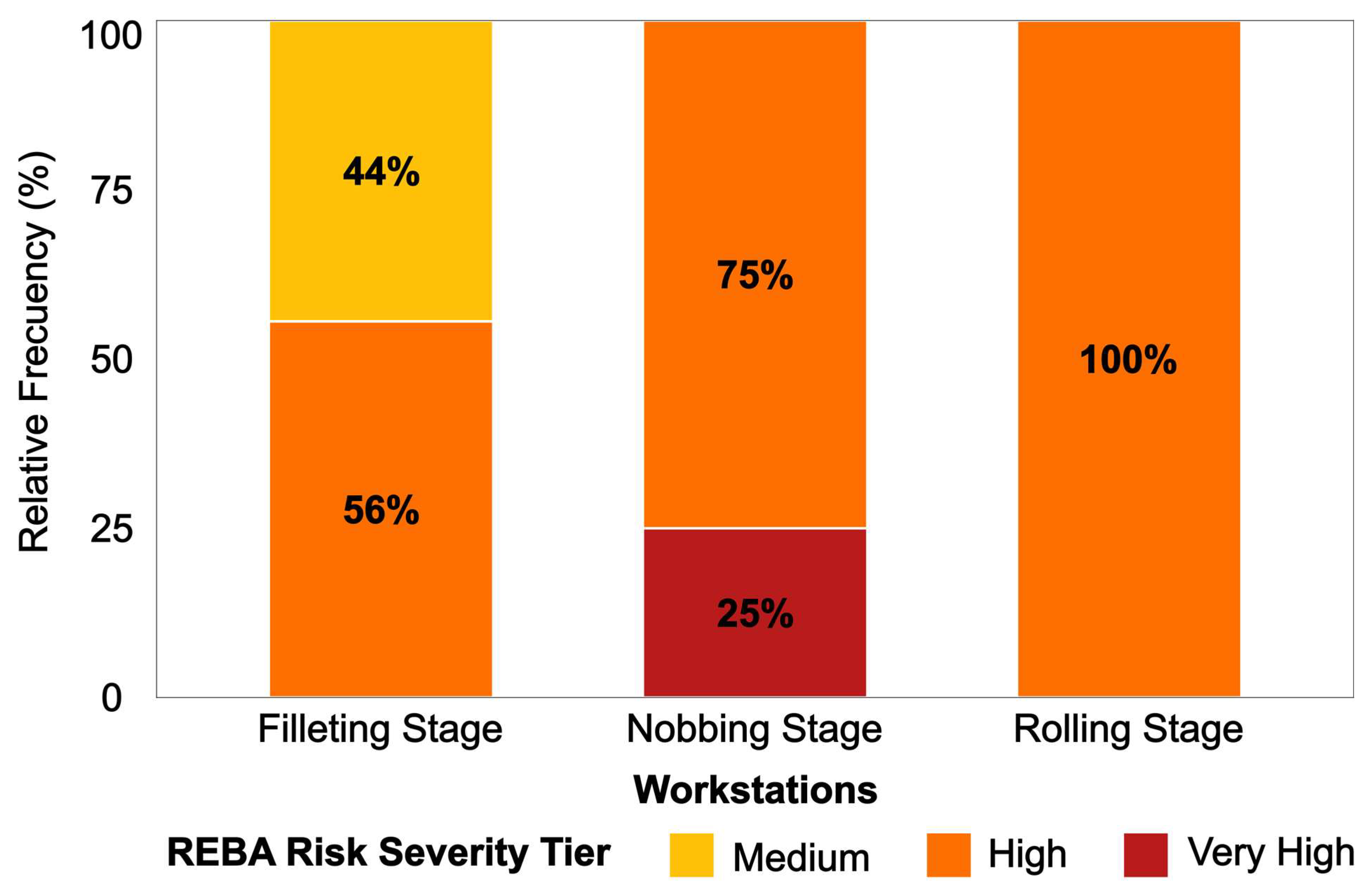
Percentage distribution of REBA risk categories by workstation. Yellow = Medium (4–7); orange = High (8–10); red = Very High (11–15). Fisher’s exact test (Monte Carlo, B = 2000): p = 0.020. Filleting is the only station presenting medium risk workers, rolling shows uniform High risk.
3.2. Categorical Risk Thresholds and Inferential Disparities
The decomposition of the aggregated REBA distribution (Table 4) into ordinal risk categories shows that, at the overall level, eight workers (26.7%) were classified as medium risk, 18 (60.0%) as high risk, and four (13.3%) as very high risk. No observations were recorded in the negligible or low-risk categories. At the workstation level, the filleting stage (n = 18) presented eight cases in the medium-risk category (44.4%), 8 in the high-risk category (44.4%), and two in the very high-risk category (11.1%). In the nobbing stage (n = 8), six workers (75.0%) were classified as high risk and 2 (25.0%) as very high risk, with no medium-risk observations. In the rolling stage (n = 4), all observations (100%) were classified within the high-risk category. These distributions are reported in Table 4, which details frequencies and percentages by workstation and risk level.
Table 4.
REBA risk category distribution by workstation with segment-level profile (n = 30).
The association between workstation and risk category distribution was assessed using Fisher’s exact test with Monte Carlo simulation (B = 2000, seed = 2025), which indicated statistical significance (p = 0.020). Pearson’s chi-square test was not applied due to violation of expected frequency assumptions, as seven out of nine cells in the contingency table presented expected counts below five (range: 0.27–4.8). The observed and expected distributions are summarized in Table 4.
Figure 4 presents the percentage distribution of REBA risk categories across workstations. The filleting stage shows a mixed distribution across medium, high, and very high categories. The nobbing stage is concentrated in high and very high-risk categories, while the rolling stage displays a homogeneous distribution with all observations classified as high risk. Across all workstations, no observations were recorded in the negligible or low-risk categories, with observed values distributed only across medium, high, and very high levels.
3.3. Postural Variability Across Operational Units: Non-Parametric Inference
The Kruskal–Wallis test (with tie correction) detected highly significant differences between workstations in the REBA score distributions [H (2, n = 30) = 16.72, p < 0.001, ε2 = 0.545]. The (large) effect size indicates that workstation membership explains 54.5% of the rank-order variance in postural risk scores, a finding of direct operational relevance: the task assigned to a worker is a stronger predictor of biomechanical risk than any individual characteristic measured (age, height, seniority).
The post hoc paired structure (Table 5) accurately delineates the biomechanical stratification, where the Filleting-Nobbing contrast produced the greatest separation (mean rank difference = 13.92, Z = 3.86, p-adj = 0.001), consistent with the 2.39 point difference in the means (10.38 vs. 7.61) and the non-overlapping bootstrap CIs. The Filleting–Rolling contrast reached trend-level significance after Bonferroni correction (Z = 2.23, p-adj = 0.077), with a mean rank difference of 10.49, a magnitude that is substantially relevant from a clinical point of view (Mdn difference = 2.0 REBA points), equivalent to a risk stratum transition from the lower REBA limit (8–10 to its upper limit) but with little power given the denominator Rolling n = 4. The Nobbing–Rolling comparison was null (Z = −0.66, p-adj = 1.000): this is not a failure of discrimination, but a detection of a genuine biomechanical equivalence: two structurally distinct standing operations that impose an indistinguishable added postural load on the REBA scale.
Table 5.
Kruskal–Wallis test results and post hoc Dunn-Bonferroni pairwise comparisons (n = 30).
3.4. Latent Structure of Ergonomic Risk: A Bayesian PCA Approach
To address the inherent instability of frequentist covariance estimation in small sample sizes (n = 30), the dimensional structure of postural risk was explored using Bayesian Principal Component Analysis (BPCA). Unlike standard PCA, the Bayesian framework employs a probabilistic estimation (Expectation-Maximization algorithm) that is significantly more robust against sampling variability and provides more stable factor loadings in small-scale ergonomic studies.
Prior to analysis, variables with zero variance were identified and handled as structural constants: the Neck (universally scored 3; flexion > 60°) and Forearm (universally scored 1). Consequently, the BPCA was restricted to the active biomechanical segments: Trunk, Legs, Upper arm, and Wrist. Full component loading matrices are presented in Table S2, whereas eigenvalues and variance decomposition results are reported in Table S3 of the Supplementary Materials. Additional computational specifications are provided in Supplementary Material S1.
The Structural Postural Blockade: Constant Risk Factors
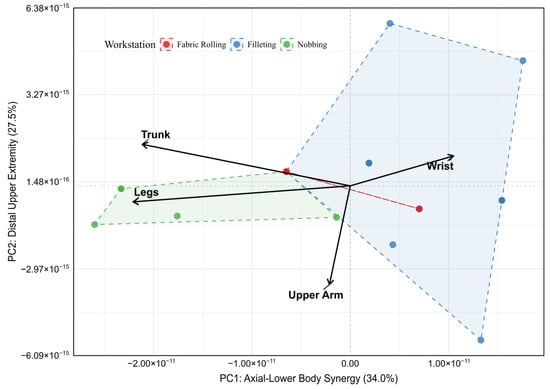
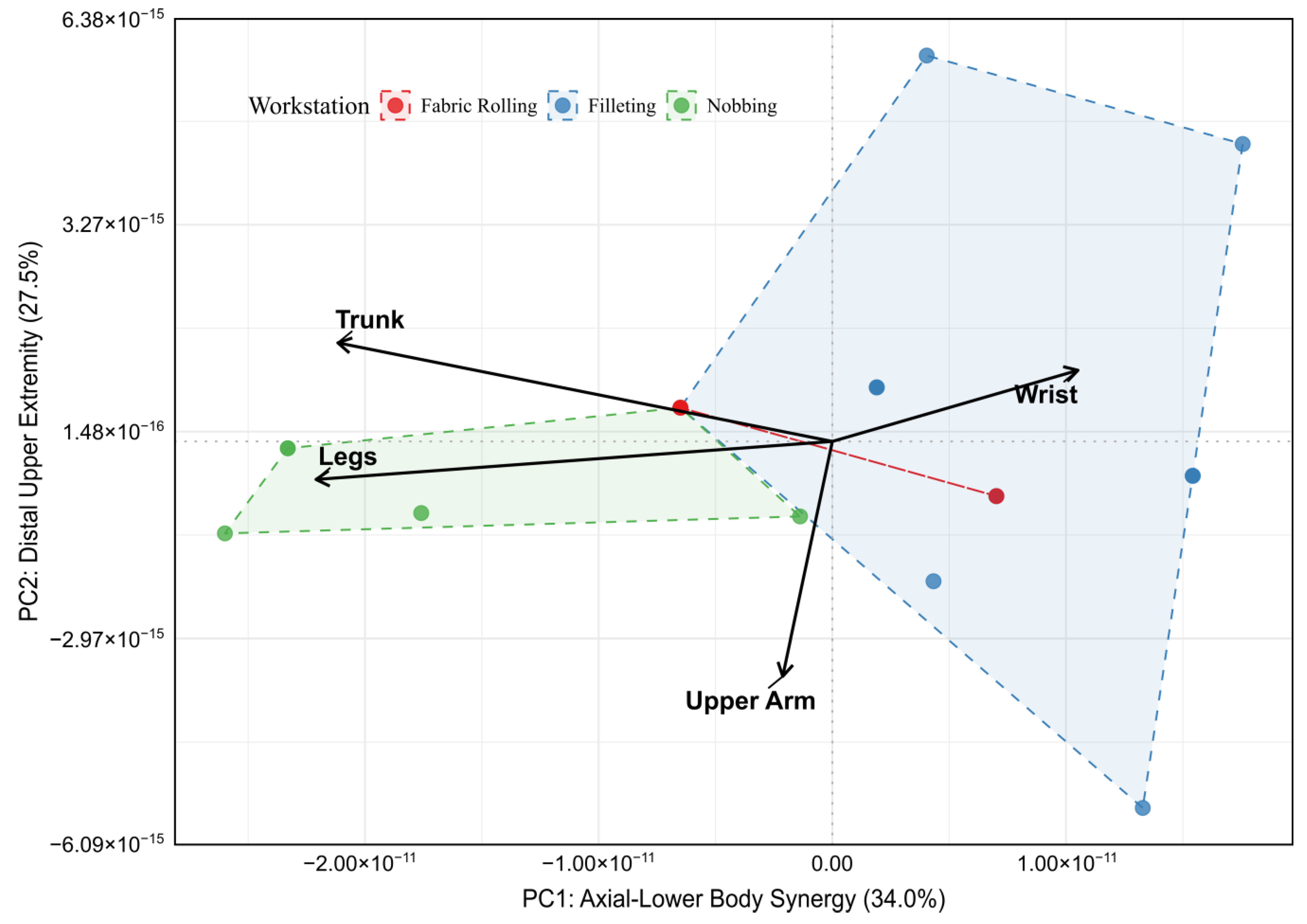
The BPCA biplot (Figure 5) projects the workers’ scores onto the latent space, revealing distinct biomechanical “signatures” by workstation. Nobbing workers cluster significantly in the high-PC1 region, indicating that trunk flexion and lower limb strain are the primary risk determinants. Conversely, the Fabric Rolling stage shows a shift toward PC2, reflecting the predominance of repetitive upper limb elevation. Filleting workers span both dimensions, suggesting a more heterogeneous postural architecture.
Figure 5.
Bayesian Probabilistic PCA Biplot of Postural Risk Dimensions. Spatial distribution of joint loading patterns (n = 30) and associated factor loadings for active Rapid Entire Body Assessment (REBA) items in artisanal anchovy processing. Factor estimation reveals two primary orthogonal components explaining 61.5% of the total postural variance. PC1 (34.0%), representing an axial-lower body synergy, is driven by coupled loading of the Trunk and Legs. PC2 (27.5%), representing distal upper extremity loading, is dominated exclusively by Upper Arm elevation. Postural clustering via Convex Hulls shows distinct ergonomic signatures: Nobbing workers are restricted to axial-dominant high-risk zones, while Filleting exhibits higher upper limb dependency. Methodological note: A Bayesian approach (BPCA) was implemented via the EM algorithm to ensure stable component extraction despite the N-to-p constraint. Items with zero variance (Neck and Forearm) were handled as structural constants and excluded from the latent space to prevent covariance matrix singularity.
The exclusion of the Neck and Forearm from the BPCA due to zero variance constitutes a critical ergonomic finding rather than a limitation. The universality of maximum cervical flexion (Score 3) across all 30 participants represents a task-imposed biomechanical constraint. This “postural blockade” is structurally determined by the geometry of the visual target (3–8 cm fillets) located at or below chest height. This configuration forces a sustained cervical flexion > 60° regardless of individual anthropometry, experience, or postural awareness. Consequently, training-based interventions are structurally insufficient; the only viable preventive strategy is a workstation redesign to elevate the visual target to the neutral gaze range (10–15° below the horizontal).
The exclusion of the Neck variable from PCA due to zero variance (all 30 workers scored three, corresponding to cervical flexion > 60°) should not be interpreted as statistical irrelevance, but as the strongest evidence of a universal structural exposure across the production system. Unlike variables that differed between stations, cervical load remained constant in filleting, nobbing, and rolling, indicating that workstation geometry systematically positioned the visual target below the neutral gaze zone. Therefore, neck flexion was not task-specific variability, but an invariant biomechanical constraint shared by all workers.
4. Discussion
4.1. Systemic Ergonomic Risk in Fish Processing Tasks
The results demonstrate that postural ergonomic exposure is a structural characteristic of the evaluated fish processing system, as the overall mean REBA score reached 8.60 ± 1.65, with scores ranging from 6 to 12 and no worker was classified in the negligible or low risk categories. This distribution indicates that biomechanical stress is inherent in the operational design of the production process. Similar findings have been reported in labour-intensive industries where repetitive tasks and prolonged trunk flexion significantly increase the prevalence of musculoskeletal disorders among workers [8,12,14,15]. Furthermore, studies conducted in fish processing environments have documented high frequencies of work-related musculoskeletal symptoms associated with repetitive manual operations and sustained postures, including upper quadrant dysfunction that improves with structured exercise interventions and prevalent musculoskeletal complaints among female workers performing repetitive and prolonged tasks, with statistically significant differences (p < 0.0001) in the different neck, arm, hand, and shoulder disabilities [2,3,7,30]. The stability of these patterns under Bootstrap resampling confirms that the observed exposure represents a robust occupational condition rather than a sampling artifact.
4.2. Workstation-Specific Biomechanical Demands
Comparative analysis between workstations reveals substantial biomechanical disparities associated with task characteristics. Workers in the nobbing stage exhibited the highest ergonomic load, with a mean REBA score of 10.38 ± 1.06 and a median of 10, while filleting operations showed lower central tendency (mean = 7.61). The categorical risk distribution reinforces this pattern, as all nobbing workers were classified within high or very high-risk levels. Statistical inference confirmed that workstation assignment significantly influences ergonomic exposure, as demonstrated by Fisher’s exact test (p = 0.020) and the Kruskal–Wallis analysis (H = 16.72, p < 0.001; ε2 = 0.545). These results indicate that ergonomic risk is primarily structured by workstation conditions rather than individual variability. In this sense, the analytical contribution of this study lies not in the application of REBA itself—which is a validated and widely used tool—but in the integration of non-parametric statistics and multivariate interpretation to explain the distribution of biomechanical load across operational stages. This approach allows a more rigorous characterization of risk heterogeneity in fish processing systems, where conventional descriptive REBA classifications alone are insufficient to capture structural differences between workstations [13,17,18,30].
In comparison with other fish processing lines and manual production systems reported in the literature, the observed ergonomic risk appears to be less dependent on task type per se and more strongly associated with workstation design characteristics [30]. Although different processing activities such as cutting, handling, and filleting may vary in manual requirements, similar biomechanical exposure patterns have been reported when workstation geometry is not adapted to anthropometric conditions, particularly regarding working height and reach distance [18,25]. Ergonomic redesign studies further confirm that modifications in workstation configuration, rather than task changes alone, are the main determinant in reducing postural risk levels [25]. Accordingly, the present findings suggest that ergonomic risk in fish processing systems is primarily driven by structural design constraints rather than task-specific demands.
4.3. Multidimensional Structure of Postural Ergonomic Risk
Principal component analysis revealed that ergonomic exposure in fish processing activities is multidimensional, with the first principal component (PC1) dominated by trunk and leg variables, explaining 34.0% of the variance and representing the axial postural configuration associated with sustained forward flexion during manual operations. The second component (PC2), largely defined by upper arm activity, accounted for 27.5% of the variance and reflects the repetitive upper limb movements characteristic of product handling tasks. The PCA biplot illustrates this structural separation, with nobbing workers clustered in the high PC1 region and rolling workers associated with upper limb loading, providing results that fit previous research, which has highlighted that musculoskeletal risk results from complex biomechanical interactions involving posture, repetition, and physical workload in multiple body segments [23,24,30].
4.4. Ergonomic Implications, Limitations, and Future Research
Although REBA-based assessments are widely used in ergonomic studies, the contribution of this study extends beyond conventional postural scoring by incorporating field observations of workstation configuration, particularly working height and visual alignment. This approach allows REBA scores to be interpreted not only as indicators of postural load but also as indirect expressions of structural design constraints. Field observations indicated that working heights across the evaluated stations were generally below elbow height and eye level, particularly during nobbing and filleting operations, despite the presence of adjustable table structures. This suggests a potential mismatch between workstation configuration and the anthropometric characteristics of the workforce, which is relatively homogeneous in body dimensions. From an ergonomic perspective, inadequate adjustment of work surface height relative to worker anthropometry may contribute to the observed low variability in joint angles, especially in cervical flexion and trunk inclination, reinforcing sustained static postures. Similar evidence has shown that workstation height relative to anthropometric fit is a key determinant of biomechanical load distribution and musculoskeletal stress [17,18,31,32].
Beyond the differences observed between workstations, the most critical common finding was the constant maximum REBA neck score across all evaluated workers. This indicates that cervical loading was structurally imposed by workstation geometry rather than by individual behaviour. In the three tasks analyzed, workers were required to maintain continuous visual inspection of small anchovy segments positioned below the neutral line of sight, which forced sustained cervical flexion throughout the work cycle. Similar evidence has shown that workstation height, visual target position, and constrained postures are major determinants of neck and upper-quarter biomechanical stress in occupational settings [17,18,31,32]. Because the exposure source appears structural, interventions based only on training or postural reminders would likely have limited effectiveness.
From an applied prevention perspective, priority should therefore be given to engineering and organizational controls. Height-adjustable tables, inclined work surfaces, improved product positioning, ergonomic seat-stand configurations, anti-fatigue flooring, scheduled micro-breaks, and task rotation may reduce static cervical demand while also decreasing trunk and lower-limb loading. Previous ergonomic redesign studies using REBA-guided approaches have demonstrated measurable improvements in workstation safety and biomechanical performance after modifications in task layout and work methods [11,25,30]. In repetitive upper-limb tasks, assistive devices or passive support systems may also contribute to reducing cumulative shoulder demand when operationally feasible [10,20].
The present findings should also be interpreted considering several limitations that affect external generalization. The sample size was modest (n = 30), particularly in the rolling stage (n = 4), which restricts statistical precision for subgroup comparisons. The cross-sectional observational design captures exposure at a single time point and does not permit causal inference regarding future musculoskeletal disorders or long-term health outcomes. Although inter-rater agreement procedures were incorporated, REBA scoring still depends on observational judgement and simplified categorical posture coding, which may introduce measurement bias when compared with continuous motion-capture systems or sensor-based biomechanics [1,4,19,33].
Additional contextual variables not available in the present dataset may also influence ergonomic risk and symptom development. Information on previous musculoskeletal disorders, cumulative employment history beyond the current workstation, physical capacity, prior ergonomic training, seasonal production peaks, and sex-related differences could modify both exposure tolerance and recovery patterns [34]. This is particularly relevant because the workforce distribution was predominantly female, while task allocation was unequal across stations. Contemporary occupational health research indicates that sex, environmental conditions, psychosocial context, and cumulative workload can interact with biomechanical exposures and influence outcomes such as fatigue, pain, and job satisfaction [3,15,26,29,35].
Future research should therefore move from descriptive screening toward integrated ergonomic surveillance systems. Longitudinal studies are needed to determine whether the structural cervical and trunk loads identified here predict incident musculoskeletal disorders, absenteeism, or reduced productivity over time [33]. Likewise, intervention trials evaluating workstation redesign, rotation schedules, structured exercise programmes, or technology-assisted monitoring would provide stronger evidence for prevention strategies in fish processing environments. Emerging tools based on computer vision, motion capture, and artificial intelligence offer promising opportunities for real-time ergonomic assessment under real industrial conditions [1,4,9,23]. Such approaches could transform REBA from a static audit instrument into a continuous decision-support system for occupational safety management.
The practical relevance of these findings lies in the fact that many identified risk factors can be modified through relatively feasible workstation redesign measures rather than costly technological replacement. In labour-intensive fish processing systems, even modest adjustments in table height, reach distance, seating support, and visual alignment may substantially reduce cumulative biomechanical exposure while preserving productivity.
5. Conclusions
This study demonstrated that postural ergonomic risk in anchovy-processing operations is predominantly determined by workstation configuration and repetitive task architecture rather than by individual worker variability. All evaluated stations presented REBA scores within the medium-to-very-high risk range, confirming that biomechanical exposure is structurally embedded in the production system. Nobbing exhibited the highest postural demand, while filleting showed comparatively lower but still clinically significant exposure. Non-parametric analyses confirmed that workstation assignment was the principal determinant of risk distribution, and Bayesian PCA identified two dominant biomechanical dimensions associated with axial trunk–lower limb loading and repetitive upper-extremity activity. The absence of variability in neck scores across all workers further demonstrated that sustained cervical flexion constituted a universal structural exposure imposed by workstation geometry and visual task requirements.
From an occupational ergonomics perspective, the findings indicate that musculoskeletal risk in fish-processing environments should be interpreted as a systemic design-related condition rather than as an isolated behavioural problem. Consequently, interventions focused exclusively on worker training or postural awareness are unlikely to achieve substantial reductions in biomechanical exposure. Instead, preventive strategies should prioritize engineering and organizational controls, including workstation redesign, optimization of working height and visual alignment, reduction in excessive reach distances, and implementation of ergonomic seat–stand configurations and task rotation schemes. Because many of these risk factors are modifiable through feasible ergonomic adjustments, the application of redesign-based interventions may substantially improve long-term occupational health conditions and reduce cumulative musculoskeletal loading in labour-intensive seafood processing systems.
Supplementary Materials
The following supporting information can be downloaded at: https://www.mdpi.com/article/10.3390/safety12030074/s1. Document S1: Photographic Goniometry, R Software Specifications, and Extended Technical Material; Table S1: Inter-rater agreement statistics by REBA segment (n = 10 records); Table S2: Full BPCA component loadings, , and proportional contributions by REBA segment; Table S3: Eigenvalues and variance distribution for REBA postural components (n = 30); Figure S1: Analytical workflow diagram for the ergonomic risk assessment study.
Author Contributions
Conceptualization, R.A.R.-O., C.M.-R. and A.J.R.-Y.; methodology, R.A.R.-O., A.J.R.-Y., C.D.R.-Y., C.M.-R. and R.A.F.-L.; software, R.A.R.-O. and S.R.C.-D.; validation, J.C.P.-R., A.G.V.-H., J.V.S.-V. and L.A.S.-T.; formal analysis, R.A.R.-O., S.R.C.-D. and R.A.F.-L.; investigation, R.A.R.-O., C.M.-R., S.J.P.-G., E.V.B.-J. and A.G.V.-H.; resources, C.D.R.-Y., E.V.B.-J. and S.J.P.-G.; data curation, R.A.R.-O., A.J.R.-Y. and J.V.S.-V.; writing—original draft preparation, R.A.R.-O. and R.A.F.-L.; writing—review and editing, A.J.R.-Y., C.D.R.-Y., C.M.-R., J.C.P.-R., A.G.V.-H., J.V.S.-V., L.A.S.-T., S.J.P.-G., E.V.B.-J. and S.R.C.-D.; visualization, J.C.P.-R. and L.A.S.-T.; supervision, A.J.R.-Y., C.D.R.-Y. and E.V.B.-J.; project administration, R.A.R.-O. and C.M.-R. All authors have read and agreed to the published version of the manuscript.
Funding
This research was internally supported by the Universidad Nacional del Santa (UNS) under the annual research project grant, Project Identification Code: PIC. FF. II. 012-2025. The institution had no involvement in the payment of the Article Processing Charges (APC).
Institutional Review Board Statement
The study was conducted in accordance with the Declaration of Helsinki and approved by the Institutional Ethics Committee of Universidad Nacional del Santa (Institutional Committee on Ethics in Research—CEI-UNS) (Certificate N°: CEI-UNS-FI-0001-2026; Project identification code: PIC. FF. II. 012-2025; Approval date: 20 March 2026).
Informed Consent Statement
Informed consent was obtained from all subjects involved in the study. Written informed consent has been obtained from the participants to publish this paper.
Data Availability Statement
The data presented in this study are available on request from the corresponding author. The data are not publicly available due to the sensitive nature of the occupational health records and the confidentiality agreements established with the participating fish processing facility.
Acknowledgments
The authors express their gratitude to the Universidad Nacional del Santa for providing the institutional facilities and resources necessary to carry out this study. We also thank the representatives, technical management, and workers of the fish processing facility for their valuable cooperation and for facilitating access to the production areas during the data collection phase.
Conflicts of Interest
The authors declare no conflicts of interest.
References
- Butlewski, M.; Czernecka, W.; Zembik, M. Integrating Motion Capture Technology into Ergonomics Design: Managerial Implications for Systemic Safety Management. Teh. Glas. 2025, 19, 49–54. [Google Scholar] [CrossRef] [Scilit]
- Gundmi, V.R.N.; Gangahanumaiah, S.; Maiya, A.G.; Guddattu, V. Effect of Structured Exercise-Based Intervention on Upper Quadrant Dysfunction among Fish Processing Workers with Work-Related Musculoskeletal Disorders. Indian J. Community Med. 2024, 49, 489–495. [Google Scholar] [CrossRef] [Scilit]
- Patel, J.; Ghosh, T. Prevalence of Musculoskeletal Disorders among Female Workers in the Fish Processing Industry in Odisha, India. Int. J. Occup. Saf. Health 2025, 15, 239–249. [Google Scholar] [CrossRef] [Scilit]
- Agostinelli, T.; Generosi, A.; Ceccacci, S.; Mengoni, M. Validation of Computer Vision-Based Ergonomic Risk Assessment Tools for Real Manufacturing Environments. Sci. Rep. 2024, 14, 27785. [Google Scholar] [CrossRef] [Scilit]
- Amanzadeh, P.; Dekamini, F.; Birǎu, R.; Pourmansouri, R. Investigating Basics and Principles of Ergonomics in the Sheet. Multidiscip. Sci. J. 2025, 7, 2025081. [Google Scholar] [CrossRef] [Scilit]
- Zubair, M.U.; Khan, H.; Ahmed, K.; Hassan, M.U.; Manu, P.; Ahmad, J. Occupational Postural Hazards in Digital Construction Management: An Integrated Ergonomic Assessment with Human Factors Engineering and Digital Human Modelling. Appl. Sci. 2025, 15, 12840. [Google Scholar] [CrossRef] [Scilit]
- Ghosh, T.; Patel, J. Prevalence of Respiratory Symptoms among Female Workers in the Fish Processing Industry in Odisha. Int. J. Occup. Saf. Health 2024, 14, 467–474. [Google Scholar] [CrossRef] [Scilit]
- Mazloumi, A.; Khosravi Danesh, M.K.; Shamsipour, M.; Kohnavard, B. Validation of a Comprehensive Ergonomic Risk Assessment Technique for Tea Harvesting Farmers and Comparison with Some Techniques. Iran. J. Public Health 2025, 54, 1300. [Google Scholar] [CrossRef] [Scilit] [PubMed]
- Shaikh, A.M.; Mandal, B.B. Predictive Modeling of Work-Related Musculoskeletal Disorders among Shuttle Car Operators Using Artificial Neural Network. J. Mines Met. Fuels 2025, 73, 65–74. [Google Scholar] [CrossRef] [Scilit]
- Pentenga, H.M.; Coenen, P.; Huysmans, M.A.; Speklé, E.M. The Effects of Working with a Passive Arm-Support Exoskeleton on Objective and Self-Reported Measures during Field Tasks—A Randomised Cross-over Study. Ergonomics 2025, 68, 1094–1112. [Google Scholar] [CrossRef] [Scilit] [PubMed]
- Bangkadanara, G.; Nakpan, W.; Arporn, S.; Thanachoksawang, C. Enhancing Workplace Safety for Disabled Farmers in Thailand: A Quasi-Experimental Study of Ergonomic Interventions in Vermicompost Production. Curr. Appl. Sci. Technol. 2025, 25, e0259553. [Google Scholar] [CrossRef] [Scilit]
- Kowe, P.; Nyamuziwa, R.S.; Chireshe, A.; Poshai, L.; Jerie, S.; Matsa, M.M.; Matindike, S.; Shabani, T.; Shabani, T.; Hove, J. An Examination of the Occurance of Work-Related Musculoskeletal Disorders (WMSDS) and Symptoms among Small Scale Construction Workers in WINDHOEK, Namibia. Soc. Sci. Humanit. Open 2025, 12, 101651. [Google Scholar] [CrossRef] [Scilit]
- Suhaimi, S.N.A.; Zainal Abidin, E.Z.; Malik Malek, M.H.; Syed Ismail, S.N.S.; Rasdi, I.; Karuppiah, K.; Dolah, M.S.; Ismail, N.H. Testing and Evaluation of Newly Developed Harvesting Basket Among Male Pineapple Harvesters in Johor, Malaysia. Pertanika J. Sci. Technol. 2025, 33, 23–41. [Google Scholar] [CrossRef] [Scilit]
- Tandazo, O.; Jaramillo-Carrión, V.; Valarezo, E.; Sanchis-Almenara, M.; Montalbán-Domingo, L.; Catalá-Alís, J. Ergonomic Risk Assessment in Construction: Case Study Ecuador. Heliyon 2025, 11, e42751. [Google Scholar] [CrossRef] [Scilit]
- Dev, A.; Ganaie, M.I.; Mayer, I.A.; Singh, H. Risk of Musculoskeletal Disorders in Female Farmers and Its Socioeconomic Determinants in Kashmir Valley. Clin. Epidemiol. Glob. Health 2025, 31, 101871. [Google Scholar] [CrossRef] [Scilit]
- Özder, E.H. A Holistic Model for Ergonomic and Sustainable Personnel Scheduling in Urban Transportation. Processes 2025, 13, 814. [Google Scholar] [CrossRef] [Scilit]
- Chaiklieng, S.; Suggaravetsiri, P.; Pruktharathikul, V. Risk Factors for Developing Occupational Back Pain in Electronics Industry Workers: A Cross-Sectional Study. Safety 2024, 10, 90. [Google Scholar] [CrossRef] [Scilit]
- Brandt, M.; Bláfoss, R.; Jakobsen, M.D.; Samani, A.; Zielinski Nguyen Ajslev, J.Z.N.; Madeleine, P.; Andersen, L.L. Influence of Brick Laying Height on Biomechanical Load in Masons: Cross-Sectional Field Study with Technical Measurements. Work 2024, 79, 459–470. [Google Scholar] [CrossRef] [Scilit]
- Manohar, B.A.; Devaraj, J.; Chellapandian, C.; Pugalenthi, S. Performance Evaluation of Rapid Entire Body Assessment Using AI-Assisted Ergonomic Analysis in Dentistry. Biomimetics 2025, 10, 239. [Google Scholar] [CrossRef] [Scilit]
- Wong, Y.J.; Razali, M.F.; Tan, A.W.T.; Yeo, Y.H.; Aziz, M.S.A. COBOT—Assisted rehabilitation: Reducing work-related musculoskeletal disorder (WMSD) risk on physiotherapists. J. Teknol. 2026, 88, 155–164. [Google Scholar] [CrossRef] [Scilit]
- Akhtar, S.M.F.; Mumtaz, N.; Khan, A.R. Prevalence and Nature of Ergonomic Hazards Among Construction Workers in India: A Cross-Sectional Study. Safety 2025, 11, 62. [Google Scholar] [CrossRef] [Scilit]
- Harahap, R.; Setiawan, M.R.; Fatharani, L.F.; Putri, H.A.A. Occupational Risk of Knee Osteoarthritis Among Pedicab Operators: A CrossSectional Study in Indonesia. J. Public Health Pharm. 2025, 5, 522–531. [Google Scholar] [CrossRef] [Scilit]
- Chen, W.; Wang, X.; Gu, D.; Xu, L. Advancing Real-Time Assessment for Work-Related Musculoskeletal Disorders in Construction Using Large Foundation Models. Results Eng. 2026, 29, 109224. [Google Scholar] [CrossRef] [Scilit]
- Jeanson, A.L.; Morales, M.R.; Luna, R.I.F. Assessing Musculoskeletal Injury Risk and Skeletal Changes from Backstrap Loom Weaving and Traditional Embroidery in Chiapas, Mexico. PLoS Glob. Public Health 2025, 5, e0004574. [Google Scholar] [CrossRef] [Scilit]
- Bora, M.A.; Hardi, Y.; Dermawan, A.A.; Cundara, N.; Hanafie, A.; Haslindah, A.; Permatasari, R.D.; Hernando, L.; Candra, J.E.; Leman, A.M.; et al. Application of REBA and QEC Methods in Redesigning Clamping Workstations to Enhance Ergonomic Performance. J. Eur. Des. Syst. Autom. 2025, 58, 1275–1284. [Google Scholar] [CrossRef] [Scilit]
- Paskarini, I.; Dwiyanti, E.; Mahmudah, M.; Widarjanto, W.; Nugroho, S.A.; Syaiful, D.A. The Interplay of Ergonomic Risk Factor and Lifestyle Factors on Potter’s Well-Being and Work Fatigue in Magelang’s Tourism Village. BMC Public Health 2025, 25, 1550. [Google Scholar] [CrossRef] [Scilit]
- R.M. No. 375-2008-TR; Basic Ergonomics Standard and Procedure for the Evaluation of Disergonomic Risk. Ministry of Labor and Employment Promotion: Lima, Peru, 2008.
- ISO 11228-3:2007; Ergonomics—Manual Handling—Part 3: Handling of Low Loads at High Frequency. International Organization for Standardization: Geneva, Switzerland, 2007.
- Cretskens, I.; Ramaekers, K.; Van Laer, K.; Caris, A. Towards an Increase in Employee Well-Being in Warehouses: Insights from a Qualitative Study. Int. J. Prod. Res. 2026, 64, 1709–1730. [Google Scholar] [CrossRef] [Scilit]
- Fehringer, V.; Maurer-Grubinger, C.; Holzgreve, F.; Ohlendorf, D.; Wanke, E.M. Ergonomic Risk Assessment of Professional Dance Using Motion Capture with Ergonomic Evaluation by the Rapid Entire Body Assessment (REBA). Sensors 2026, 26, 70. [Google Scholar] [CrossRef] [Scilit]
- Abdol Rahman, M.N.A.; Yek, L.Z.; Ho, H.F.; Masood, I.; Abdullah, H.; Hassan, M.F.; Abdul Haq, R.H.A.; Arifin, A.M.T.; Azmir, S.A.; Md Taib, I.; et al. Relationship between Improper Working Posture among Maintenance Workers Using Different Assessment Methods. J. Adv. Res. Appl. Sci. Eng. Technol. 2025, 49, 15–25. [Google Scholar] [CrossRef] [Scilit]
- Leder Horina, J.; Blašković-Zavada, J.; Slavulj, M.; Budimir, D. Ergonomics Study of Musculoskeletal Disorders Among Tram Drivers. Appl. Sci. 2025, 15, 8348. [Google Scholar] [CrossRef] [Scilit]
- Canever, J.B.; Nonnenmacher, C.H.; Lima, K.M.M. Reliability of Range of Motion Measurements Obtained by Goniometry, Photogrammetry and Smartphone Applications in Lower Limb: A Systematic Review. J. Bodyw. Mov. Ther. 2025, 42, 793–802. [Google Scholar] [CrossRef] [Scilit]
- Fattah, N.A. Prevalence of Lower Back Pain among Dentists in Kurdistan Region-Iraq. Erbil Dent. J. 2025, 8, 63–72. [Google Scholar] [CrossRef] [Scilit]
- Pereira, D.; Leitão, J.; Soares, S. Environmental Workplace Conditions, Occupational Safety, Social Areas, and Gender: Key Drivers of Job Satisfaction in Europe. J. Manag. Organ. 2026, 32, 157–188. [Google Scholar] [CrossRef] [Scilit]

Disclaimer/Publisher’s Note: The statements, opinions and data contained in all publications are solely those of the individual author(s) and contributor(s) and not of MDPI and/or the editor(s). MDPI and/or the editor(s) disclaim responsibility for any injury to people or property resulting from any ideas, methods, instructions or products referred to in the content. |
© 2026 by the authors. Licensee MDPI, Basel, Switzerland. This article is an open access article distributed under the terms and conditions of the Creative Commons Attribution (CC BY) license.