


Abstract
Safety culture, psychosocial safety, work design and worker well-being are increasingly considered together, although they describe different organisational conditions, processes and outcomes. We conducted a safety-culture-anchored conceptual review informed by structured bibliographic searching and purposive source selection to examine these boundaries. Searches of Scopus and Web of Science on 29 June 2026 identified 3129 records. A dated duplicate audit reconciled 2500 report records; 28 verified complete texts from a 44-source conceptual set supported detailed synthesis. Recurrent organisational practices concerned management commitment, enacted priorities, resources, communication, participation, justice and feedback for improvement. Their recurrence did not establish a single higher-order construct. The synthesis compares referents, levels, mechanisms, measurement and outcomes across safety, psychosocial-health and well-being approaches. It provides explicit rules for connecting these entities without treating their measures or outcomes as interchangeable. Three conditional propositions specify future tests of construct discrimination, cross-domain pathways and diagnostic usefulness. Purposive selection, incomplete records of later selection decisions, unequal coverage of adjacent fields and the absence of documented independent duplicate screening limit coverage and reproducibility. The proposed framework is a conceptual interpretation, not a validated causal model.
1. Introduction
Safety culture concerns the assumptions, values, practices and organisational conditions through which safety is understood and managed [1]. Safety climate concerns employees’ perceptions of the priority assigned to safety through policies, procedures and supervisory practices [2,3,4]. These related concepts direct attention to organisational conditions alongside individual behaviour and technical hazard controls. They remain essential for understanding safety motivation, participation, reporting, incidents and injuries; they do not imply that accident prevention was previously concerned only with workers’ compliance [4,5,6,7].
Occupational-health frameworks also address psychosocial working conditions, psychological health and positive well-being [8,9,10,11]. Organisational decisions about staffing, workload, autonomy, support and consultation can matter for both physical safety and psychological health. However, shared management practices do not make physical safety climate, psychosocial safety climate (PSC), psychological safety, Job Demands–Resources (JD–R) theory, healthy-workplace approaches, Total Worker Health® (TWH) and worker well-being equivalent concepts [8,9,11,12,13,14,15,16]. Their referents, analytical levels and outcomes require explicit definition.
A boundary problem arises when every favourable organisational practice or health outcome is classified as safety culture. Such an interpretation makes it difficult to identify which condition should change and how improvement should be evaluated. Conversely, measuring physical safety climate alone does not assess the full range of psychosocial exposures or worker well-being. PSC, interpersonal psychological safety, working conditions and health outcomes should therefore be connected theoretically while retaining their different meanings [8,9,12,14].
Existing reviews examine PSC and psychological safety, and others synthesise safety climate, leadership or interventions [12,17,18,19,20,21]. The physical and psychosocial workplace-safety model already connects safety with JD–R and self-regulation [22]. The National Institute for Occupational Safety and Health (NIOSH) framework and TWH already extend occupational safety and health to multidimensional worker well-being [9,10,13,23]. This review provides an explicit comparison of how shared management practices can connect different concepts while preserving differences in referent, level, mechanism, measurement and outcome.
The review starts from safety-culture and safety-climate literature and examines its connections with these adjacent occupational-health approaches. It does not provide equally comprehensive reviews of all of them or propose that well-being replaces safety culture. This narrower scope guides the questions, interpretation of the selected sources and limits placed on generalisation.
Accordingly, the review addresses four questions:
- How do the concepts and frameworks represented in the safety-anchored literature differ in referent, level of analysis, mechanism, measurement and outcome?
- Which organisational management practices recur across the selected sources?
- Where do apparently shared practices retain different meanings across physical safety, psychosocial health and interpersonal psychological safety?
- How can these distinctions inform an integrated occupational-health framework and propositions for future testing?
The intended contribution is a comparison of construct boundaries and conditional research propositions, not validation of a new overall culture scale.
2. The Construct-Boundary Problem in Occupational Health
2.1. Culture, Climate, and the Importance of a Specified Referent
Safety culture is a broader account of assumptions, values, behaviours and organisational conditions, whereas safety climate captures perceptions of safety-related priorities and practices [1,4]. A climate measure requires an explicit referent: physical or operational safety climate concerns how hazard control and safe operation are prioritised, including when they compete with production, time or cost [2,3,4].
Management commitment, communication and participation acquire their meaning from what management commits to, communicates about or invites participation in. A physical-safety-climate item concerns safe operation; a PSC item concerns protecting psychological health. Interpersonal psychological safety concerns the perceived consequences of speaking up or admitting error. Similar vocabulary, therefore, does not establish equivalent constructs [8,12,14,24].
Individual perceptions should also be distinguished from collective properties. Treating questionnaire responses as a team or organisational climate requires a collective referent and appropriate evidence for aggregation, rather than merely collecting responses from several workers [3,4,24]. In this review, organisation denotes the employing organisation or organisational unit; management system denotes coordinated policies and processes within it, not an additional statistical level above the organisation.
2.2. PSC and Psychological Safety: Similar Language, Different Objects
PSC transfers climate logic to the organisational protection of psychological health. It concerns shared perceptions of policies, practices, and procedures for psychological health and safety, commonly expressed through management commitment, management priority, organisational communication, and participation [8,24]. PSC is theorised as an upstream organisational condition that shapes demands, resources, and psychological-health outcomes. Its form resembles safety climate, but its focal object differs.
Psychological safety concerns perceived interpersonal risk when asking questions, expressing disagreement or admitting error. The team-level formulation describes a shared belief about these consequences [14]. Individual-level perceptions and formulations referring to relationships, teams or organisations are also studied [25,26]. The present framework uses the team formulation when explaining collective voice and learning, while recognising individual perceptions as a distinct level of measurement. Neither formulation is equivalent to PSC, whose referent is organisational protection of psychological health [8,12,24].
Psychological safety may function as a proximal social resource within a JD–R explanation of voice or work engagement, depending on the research question. That is a theoretical positioning rather than a reason to subsume it within PSC or to assume that it always mediates organisational priorities. Measures should specify the interpersonal referent, level and proposed mechanism before testing relationships with reporting, learning or health [12,14,15,25,26].
2.3. JD–R, Well-Being, Healthy Workplaces, and TWH as Pathway and System Frameworks
JD–R is a work-design theory. Its health-impairment process links excessive demands and insufficient resources with strain and burnout; its motivational process connects resources with work engagement and performance [15,16]. Safety climate and PSC can be examined as contextual conditions affecting, or interacting with, job demands and resources. Psychological safety can be modelled as a particular interpersonal resource when its mechanism and level are specified. These alternatives require testing rather than a fixed ordering of every variable.
Worker well-being requires clarity about outcomes. Mental health and mental illness are related but distinct [27], and work engagement should not be defined simply as the inverse of burnout [28]. A meta-analysis maps associations between work engagement, job and personal resources, and work and health outcomes [29]. The NIOSH Worker Well-Being Questionnaire (WellBQ) covers work experience, workplace policy and culture, physical environment and safety climate, health status, and home, community and society [10]. Its breadth supports multidimensional monitoring without making these domains one occupational climate.
Healthy-workplace approaches and TWH are frameworks for coordinated action rather than climate measures. TWH combines protection from work-related hazards with promotion of worker health and well-being [13,23,30]. The World Health Organization (WHO) healthy-workplace model addresses physical and psychosocial work environments, personal health resources and enterprise community involvement [11]. Community involvement concerns organisational action extending into workers’ families or surrounding communities; it is not assumed to be an additional level in every study. The integrated healthy-workplace model illustrates coordinated organisational arrangements and separate health and performance criteria [31].
These distinctions provide the comparison framework used in the review. Shared management arrangements and construct-specific measures may be compatible, but their usefulness and the relationships between them are questions for the synthesis and future testing.
3. Methods
3.1. Review Design and Reporting
We conducted a safety-culture-anchored conceptual review informed by structured bibliographic searching and purposive source selection. The bibliographic record map classified search-derived records by occupational and conceptual relevance. Within that record pool, the conceptual synthesis selected sources to compare definitions, measures, levels and explanatory relationships. This component was selective rather than an exhaustive synthesis of every potentially relevant full text. PRISMA-ScR informed the reporting of search and selection information [32], and JBI guidance informed the description of evidence selection and charting [33]. These resources were used as reporting and descriptive guidance; their use does not imply full PRISMA-ScR reporting compliance or conformity with the JBI scoping-review methodology.
The rationale for purposive conceptual sampling is depth of comparison rather than estimation of prevalence or pooled effects. Qualitative evidence-synthesis methods provide examples of selecting relevant, information-rich sources, but they do not by themselves validate this review’s selection decisions [34]. Here, “nested” means that the analytical sources were drawn from the larger search-derived candidate pool. We describe the documented rules and remaining gaps below; no prospective protocol or registration is claimed.
3.2. Question, Scope, and Eligibility Framework
Eligibility followed Population–Concept–Context: workers, work groups, supervisors and organisations; safety culture or climate and connected occupational-health concepts; and paid work across sectors and countries. Table 1 summarises the eligibility framework. A transferable conceptual contribution meant an explicit definition, dimension, theoretical relationship, measurement property or implementation principle that could inform comparison beyond a purely descriptive sector example.
Table 1.
Eligibility framework and operational boundaries.
Retrieval prioritisation used six documented criteria: seminal or strategically influential work; reviews; models or frameworks; instruments; explicit links between safety and psychosocial health or well-being; and recent strategic contributions. Information richness meant substantive material for the comparison fields. Historical citation counts and priority scores also informed retrieval, but their complete scoring algorithm is unavailable. No reproducible richness threshold or conceptual saturation is claimed.
Sources without occupational or organisational relevance, purely technical or patient-safety reports without a worker-health connection, and excluded document types were outside scope. English- and Spanish-language material could be considered. Search limits differed between strategies: only the complementary Scopus strategy applied the combined 2020–2026, article and English restrictions. Framework references used to interpret concepts were identified separately from the search-derived analytical corpus.
3.3. Information Sources and Search Strategies
Scopus and Web of Science Core Collection were searched on 29 June 2026 using four strategies. The principal Scopus and paired Web of Science strategies combined safety culture/climate with worker health and well-being terms. Broader measurement-orientated strategies included a complementary Scopus search refined by “ISO 45001” [35] and a Web of Science search covering occupational safety, leadership and models.
The principal and complementary Scopus exports contained 648 and 13 records; the paired and broader Web of Science exports contained 549 and 1919 (3129 in total). Supplementary File S1 reproduces the exact search fields, term blocks, refinements and limits. Only the complementary Scopus strategy combined 2020–2026, article and English restrictions. We use “strategy” consistently for a search and its refinements.
Because each strategy used safety-related terminology, the map addresses connections around safety culture rather than the complete literature of TWH, healthy workplaces or well-being. Additional framework references and reviewer-suggested sources are identified as interpretive context, not added retrospectively to the historical corpus. During revision, a directed check of selected non-retained candidates examined possible challenges to the proposed interpretation; its selection, source depth and findings are reported separately in Supplementary Files S1 and S2. This check was not an updated database search or an exhaustive sensitivity analysis.
3.4. Record Management and Reconciliation
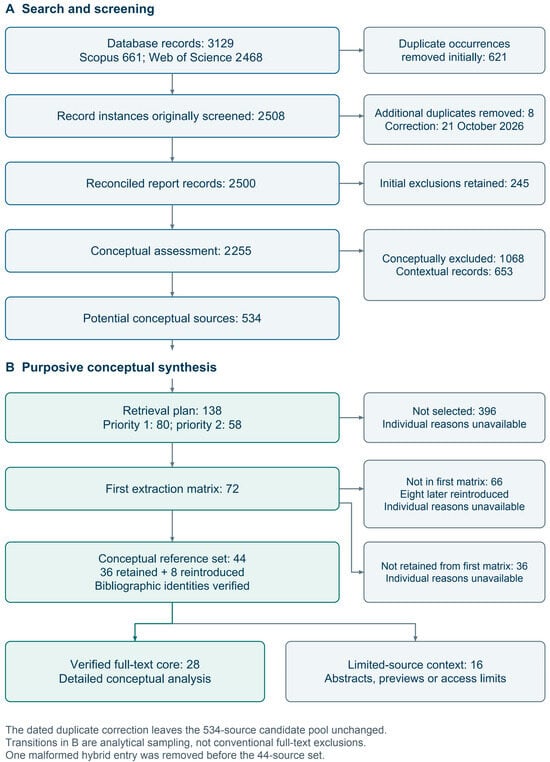
Original deduplication removed 621 occurrences, leaving 2508 screened record instances. A metadata audit on 21 October 2026 resolved 13 residual title groups and removed eight further same-report duplicates, leaving 2500 reconciled report records. Distinct reports and linked versions remain separate reports, not independent studies. Supplementary Files S1 and S2 document the identity checks and dated corrections.
The reconciled classification comprises 245 initial exclusions and 2255 conceptual assessments: 1068 further exclusions, 653 contextual records and 534 conceptual candidates. No duplicate was removed belonging to the candidate pool or later analytical sets. Historical counts and decisions remain available alongside the reconciliation.
The retrieval plan purposively selected 138 of the 534 candidates (80 priority-1; 58 priority-2), each with a positive rationale and criterion. The first matrix charted 72. Individual negative reasons are missing for 396 unselected candidates and 66 records absent from that matrix. These are analytical-sampling transitions, not conventional full-text exclusions.
3.5. Analytical Sources and Document Depth
The valid second-matrix set comprised 36 retained charted sources and eight identifiable retrieval-plan sources reintroduced, yielding 44 references. One additional row combining incompatible bibliographic identities was omitted. Reasons for later non-retention and reintroduction are incompletely documented. Identity verification does not establish methodological quality.
The pre-submission source-depth audit verified 28 complete articles or accepted manuscripts for detailed analysis. Sixteen references with abstract, preview, incomplete or conditional-access verification were restricted to high-level context. Supplementary File S2 records documentary depth and evidential use. Framework references outside the 44-source set and revision checks are labelled separately.
The preserved record lacks reviewer-specific screening decisions, independent duplicate screening and disagreement logs, and inter-rater data. Collaborative review of priority literature differs from independent screening. No independent human recoding is claimed; this limits confidence in selection and interpretation despite bibliographic traceability.
3.6. Data Charting and Conceptual Synthesis
Charting recorded bibliographic identity, source type, conceptual focus, definitions or models, dimensions, instruments, analytical level, relationship with classical safety, mental health or well-being, and intended synthesis role. The comparison then used a common set of fields: referent, level, organisational practice, proposed pathway, worker or team process, criterion, instrument and study design. Supplementary File S2 provides the original source-level charting and the revised comparison fields.
The 28 verified complete texts were the basis for detailed source-specific interpretation; limited-source records were not treated as equivalent evidence. We compared similarities and differences across the recorded classical, bridging, broader-health and integrative groups. These groups organise the selected sources and do not represent successive historical stages or mutually exclusive scientific paradigms.
A recurrent practice was coded when sources described a comparable organisational function, such as allocating resources or enabling participation. A boundary was identified when similar words concerned a different referent, analytical level or outcome. Tensions included mixed predictor/outcome items, unsupported aggregation, causal interpretation beyond the design, and integrated frameworks that already addressed several domains. The seven organisational practices are not assumed to be equivalent upstream causes in every source.
The synthesis distinguishes source findings from the authors’ interpretation. In particular, “learning” at the governance level means arrangements for feedback, review and corrective action; team learning and reporting remain processes or outcomes. The propositions extend this comparison into conditional research hypotheses. Supplementary File S1 supplies an evidence-to-interpretation crosswalk, including source-depth restrictions and a directed check of potentially challenging references identified during revision.
3.7. Evidence Appraisal and Transparency Safeguards
No formal study-level risk-of-bias appraisal was undertaken. The review maps concepts and measurement boundaries rather than estimating intervention effectiveness. Interpretation distinguishes cross-sectional associations, longitudinal evidence, theoretical proposals, instruments and reviews. It does not establish causal magnitude, comparative intervention effectiveness or the empirical superiority of a proposed measurement system.
4. Results
4.1. Selection Flow and Profile of the Analytical Evidence
Figure 1 presents the flow diagram of the structured bibliographic search, screening, eligibility assessment, and purposive source-selection process. The dated audit reconciled 2500 report records without changing the 28-source full-text analytical core. Supplementary Files S1 and S2 document the selection stages and source depth.
Figure 1.
Flow diagram of the structured bibliographic search, screening, eligibility assessment, and purposive source-selection process. The eight additional duplicates were corrected after the original screening on 21 October 2026; 2500 is the reconciled report-record count, not the number prospectively screened. Analytical sampling after the 534-candidate stage is distinct from full-text eligibility exclusion. Historical decisions and correction details remain available in Supplementary Files S1 and S2.
The 28-source analytical core contains nine classical safety sources, eight bridging sources, eight broader occupational-health or well-being sources and three integrative sources. By mutually exclusive document type, it contains 11 reviews or syntheses, seven measurement or methodological papers, six empirical studies and four conceptual or theoretical papers. Table 2 identifies the references in each group, making the composition of the detailed synthesis explicit.
Table 2.
Composition and reference numbers of the verified full-text analytical core (n = 28).
Sources span manufacturing, construction, offshore work, healthcare, human services and mixed occupational settings. Analytical levels include workers, teams, organisational units and organisations. This heterogeneity supports comparison of concepts, but the selected distribution cannot estimate the prevalence of concepts across sectors, countries or the wider literature.
4.2. Classical Safety Culture and Climate: A Specific Preventive Referent
Classical safety climate retained a recognisable object: the priority assigned to physical and operational safety. Full-text sources repeatedly addressed management commitment, supervisory practice, communication, worker involvement, learning, and the relation between organisational conditions and safe operation [1,4,5]. The broader map also contained foundational records by Zohar [3], Flin et al. [49], and Mearns et al. [50], but the current archive did not provide complete texts for detailed re-extraction. At either depth, the construct retained a physical or operational safety referent rather than measuring well-being in general.
The evidence also preserved the distinction between culture and climate. Cooper’s [1] reciprocal model connected psychological, behavioural, and situational elements of safety culture. Climate studies operationalised more proximal perceptions and examined how they related to safety knowledge, motivation, compliance, participation, accidents, and injuries. Longitudinal and meta-analytic work was consistent with mediated and bidirectional possibilities but did not establish a deterministic or fully reciprocal causal climate–injury model [5,6,7]. Injury experience may influence later climate perceptions, while criterion choice and study design affect observed associations. A further safety climate–performance meta-analysis was retained only as limited-source context [51].
Measurement evidence reinforced both utility and boundary. NOSACQ-50 is a physical-safety-climate instrument rather than a measure of general worker well-being [52]. Cross-trade equivalence analysis demonstrated that comparative interpretation requires measurement checks [36]. A Persian adaptation retained 48 items in six factors and reported one subscale below the commonly used 0.70 reliability threshold, underscoring that translated structures should not be assumed equivalent [37]. A cross-sectional construction application illustrated sector-specific use of NOSACQ-50 but did not establish temporal or causal relationships with injuries [38]. Construction-review and questionnaire-critique records in the broader map were used only at the level supported by their available abstracts or previews [53,54].
Safety leadership emerged as a persistent governance mechanism. The full-text systematic review showed that definitions span influence processes at multiple organisational levels rather than one leadership style [17]. Meta-analytic and intervention-review records were retained as limited-source context because complete texts were not verified in the current audit [20,55]. A full-text hospital review found heterogeneous intervention designs and worker outcomes, while its healthcare context limits transferability to occupational safety [40]. The defensible conclusion is consequently bounded: leadership can bridge domains only when its object and active ingredients are specified.
4.3. PSC, Psychological Safety, and Cross-Domain Pathways
Within the selected sources, PSC applies climate logic to the protection of psychological health. Its commitment, priority, communication and participation dimensions resemble physical-safety-climate dimensions in form but specify a different object [8,24]. The resulting comparison supports retaining the referent in both theory and measurement; it does not demonstrate that the measures are interchangeable.
The complete-text sources modelled PSC in relation to work characteristics and psychological-health outcomes [8,24,41]. Other records concerned demands, resources, strain, distress, bullying, depression, engagement and coping [56,57,58,59,60,61]. Because their complete texts were not verified in the source-depth audit, they provide limited-source context. Observational associations do not by themselves establish causal effects.
The analytical core already contains cross-domain evidence. In healthcare, PSC and emotional exhaustion were associated with work injuries and underreporting in a model that retained a separate physical-safety-climate pathway [41]. The reviewer-suggested contextual studies further illustrate this connection: Bronkhorst linked demands, resources and physical/psychosocial safety climates with safety behaviours [62], while Pienkowski et al. reported associations of PSC and occupational-safety vulnerability with physical and psychological injury in a cross-sectional survey [63]. These observational associations motivate cross-domain hypotheses but do not establish their temporal order or causality.
The evidence also supplied boundary conditions. The construct-development literature defined PSC with a psychological-health referent distinct from physical safety climate [8,24]. Records on conceptual distinctiveness and climate strength were retained as limited-source evidence because complete texts were not verified [59,64]. Recent full-text reviews mapped associations across demands, resources, safety, and health outcomes, while also documenting sector and country concentration, variation in PSC operationalisation and level of analysis, and a predominance of observational designs [18,19].
Psychological safety is used here as an explicit boundary comparator, not as a member of the historical 44-source set. The team formulation concerns shared interpersonal expectations about voice and error [14]; newer measurement studies also assess individual perceptions with team, relational or organisational referents [25,26]. A team construct is therefore not inferred simply from individual questionnaire responses. The proposed framework represents psychological safety at the level justified by a study and treats its possible JD–R resource role as a model choice requiring specification.
4.4. JD–R, Positive Well-Being, TWH, and Healthy-Workplace Frameworks
JD–R provides a work-design account of health impairment and motivation [15,16]. The selected offshore study placed risk perception, safety climate and job satisfaction within this account [42]. Daniels et al. examined coping processes connecting demands, control, support, affect and risky decisions [39]. These sources support specifying work characteristics and worker processes separately from climate; they do not justify relabelling all of them as safety culture.
Work engagement extends the outcome domain beyond absence of harm. Bailey et al. identified heterogeneous definitions and measurement questions [28], and Mazzetti et al. mapped associations with job and personal resources and distinct work and health outcomes [29]. These findings support explicit criteria and measures; they do not make work engagement a dimension of safety climate. A recent theoretical account of teamwork engagement illustrates the need to specify how individual states become collective properties but is used only as an indirect multilevel comparator [65].
Integrated worker-well-being instruments broadened level and context. The NIOSH WellBQ is a multidimensional questionnaire that covers work evaluation and experience, workplace policy and culture, the physical environment and safety climate, health status, and home, community, and society; its development paper does not define one overall composite score [10]. The Healthy Work Survey assesses schedule, control, support, reward, demands, safety, and justice, including emerging work-organisation hazards [43]. These tools make the wider worker system visible while showing why domain-level interpretation should be preserved.
The selected integrated healthy-workplace study represented leadership, safety climate, justice, support, hazard control and training alongside distinct burnout, depression, satisfaction and performance criteria; its cross-sectional associations do not establish causal effects [31]. TWH and WHO healthy-workplace frameworks are contextual comparators for coordinated protection and health promotion [11,13,23]. They provide a broader scope of action rather than interchangeable climate constructs. Their role as framework context is kept separate from the 28-source analysis.
Integrative sources added justice, ethics, and cross-industry learning. The Safer Culture Framework separates enabling factors, safety-related values, norms and assumptions, enacting behaviours, and outcomes across leader commitment, policies, resources, cohesion, psychological safety, safety competence, perceived control, and individual safety commitment [46]. A heterogeneous healthcare review of Just Culture and Restorative Just Culture adds fairness, accountability, trust, dialogue, and relational restoration to learning, while limited longitudinal follow-up constrains causal claims [47]. The construction-specific PAW-CON connects role overload, role ambiguity and conflict, control, support, recognition, procedural justice, and change consultation to supervisor–worker relationships; validation was cross-sectional and Australian [44]. A small regional cross-sectional construction survey framed OHS through ethical leadership, training, and well-being programmes, but did not provide longitudinal evidence for sustainability outcomes [45].
4.5. Comparison Across Referents, Levels and Outcomes
The synthesis identified seven recurring organisational practices or enabling arrangements: commitment, enacted priorities, resources, communication, participation, justice, and feedback with corrective action. Commitment, priority, communication and participation are explicit PSC dimensions [8,24]; safety-culture intervention evidence also addresses leadership, reporting, openness and learning arrangements [40]. The healthy-workplace and work-organisation sources extend attention to support, resources and justice [31,43,44]. These are overlapping functions with different theoretical positions, not seven uniformly measured causes. The source-to-interpretation crosswalk is provided in Supplementary File S1.
A shared organisational practice does not establish a shared latent construct. Staffing or resource allocation can affect hazard control and workload, while communication can concern operational hazards, psychological-health protection or interpersonal consequences of speaking up. The framework therefore separates the organisational action, the domain-specific perception or exposure, and the criterion. It allows cross-domain relationships rather than isolated parallel systems.
Level is a further boundary. Collective safety climate and PSC require justified aggregation. Psychological safety can refer to individual perceptions or a shared team belief, and the selected formulation must be explicit [14,25,26]. JD–R can connect individual work characteristics with team or organisational conditions [15,16]. References to an organisational management system describe coordinated action and do not automatically define a statistical level above the organisation.
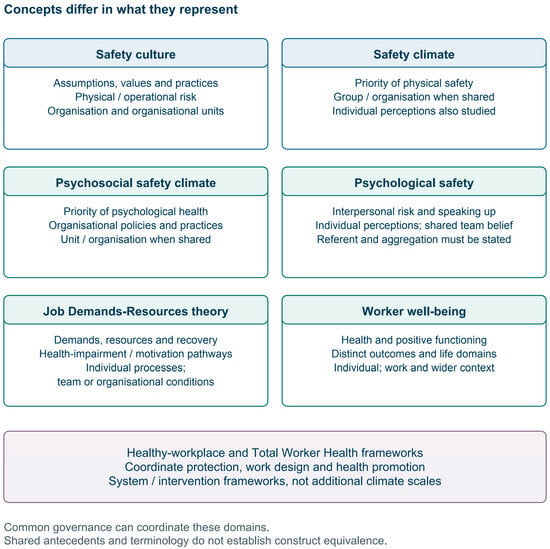
Physical-safety behaviour, incidents and injuries remain distinct from distress, burnout, work engagement, satisfaction or sustainable working capacity. These criterion families can share antecedents and influence one another. Table 3 locates their conceptual differences; Figure 2 displays the same comparison without implying chronological replacement. Neither display establishes discriminant validity or temporal order.
Table 3.
Boundary matrix across occupational-health constructs and frameworks.
Figure 2.
Conceptual comparison of referent and analytical level. Similar organisational practices can support different constructs; proximity in the display does not establish equivalence or a historical sequence.
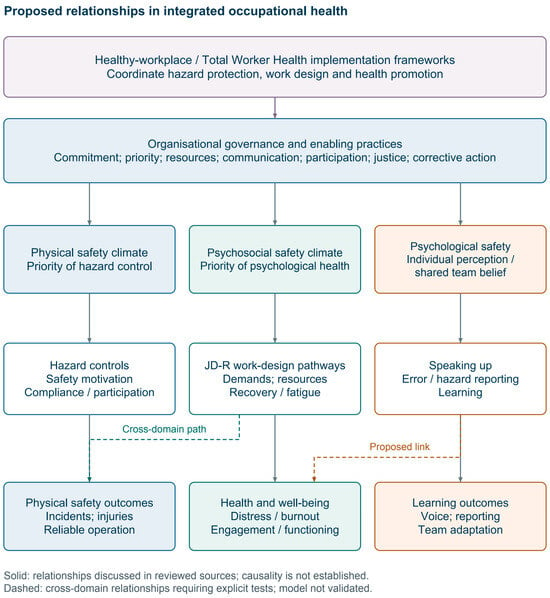
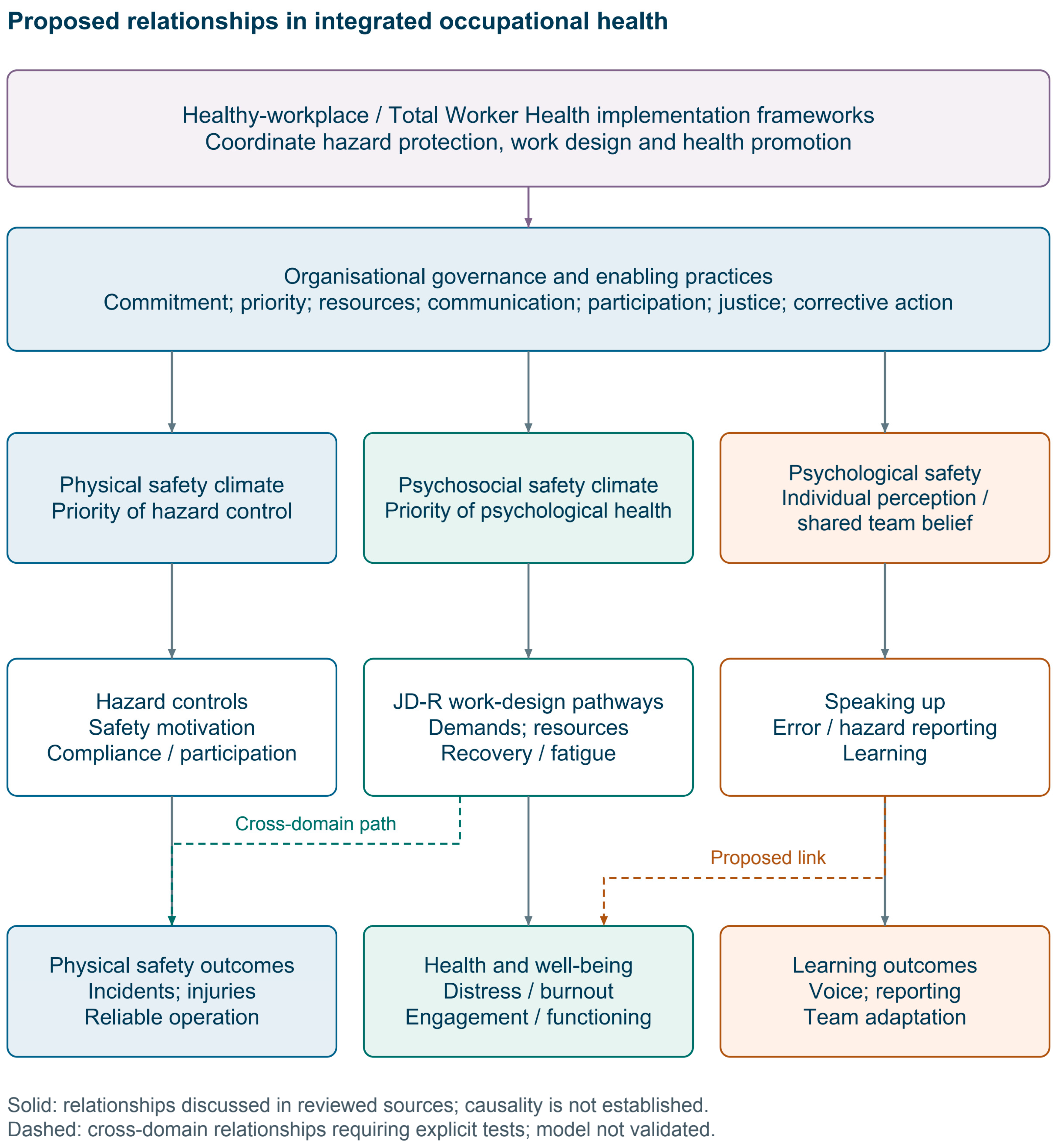
Figure 3 connects organisational governance and enabling practices with domain-specific climates, work design and interpersonal processes. Solid paths summarise relationships considered within particular bodies of theory and evidence; dashed paths identify cross-domain hypotheses requiring further tests. The location of TWH and healthy-workplace frameworks outside the climate constructs indicates their coordinating implementation role.
Figure 3.
Proposed framework connecting governance, domain-specific processes and outcomes. Psychological safety may be measured at individual or team level, with aggregation justified where applicable. Dashed cross-domain links are hypotheses; diagram arrows do not establish causality. TWH and healthy-workplace approaches coordinate action rather than constitute additional climate measures. Voice, reporting and learning may be studied as processes or outcomes; their role and timing must be specified in each empirical model.
Table 4 compares the focal questions of physical/operational safety with additional domains represented in broader occupational-health approaches. The columns describe differences of emphasis; they are not exclusive categories of organisations or successive paradigms.
Table 4.
Complementary emphases in safety-focused and broader occupational-health approaches.
4.6. Measurement Implications, Gaps, and Theoretical Propositions
Table 5 summarises representative measures and their interpretation limits. NOSACQ-50 concerns physical safety climate; PSC-12 concerns organisational protection of psychological health; work-organisation instruments assess exposures; and work-engagement and burnout measures assess states. WellBQ covers several domains without specifying a single overall composite score. No instrument represented in this selected analytical core was identified as simultaneously resolving domain breadth, level alignment and diagnostic specificity; this observation cannot establish that no such instrument exists elsewhere.
Table 5.
Representative measurement approaches and their boundaries.
Within the selected core, evidence was limited on joint measurement of several climates, work design and multiple outcome families; intervention tests of shared versus distinct mechanisms; cross-group measurement invariance; and temporal discriminant tests of integrated frameworks. These are limitations of the charted corpus, not prevalence estimates for the wider literature. Table 6 links them to possible research designs.
Table 6.
Evidence gaps and research designs for testing the proposed framework.
The following propositions are author-derived hypotheses. Their premises draw on the selected climate, measurement and work-design literature; their joint empirical implications remain untested in this review. Supplementary File S1 identifies the evidence and the extension in each case.
Proposition 1 (distinct but related climates).
In organisational units with theoretically justified collective measures, physical safety climate and PSC are expected to correlate while remaining distinguishable. After accounting for their shared variance and relevant work conditions, physical safety climate is expected to add prediction of physical-safety behaviour or harm, and PSC to add prediction of psychosocial exposures or psychological-health criteria. This requires comparison of competing measurement models and incremental prediction; covariance alone would not establish shared governance as its cause.
Proposition 2 (specified and cross-domain pathways).
Stronger enacted preventive priorities and adequately allocated resources are hypothesised to predict lower subsequent harm through improved hazard controls and more favourable psychosocial work design. One cross-domain hypothesis is that higher PSC predicts lower subsequent exhaustion, which in turn predicts fewer physical injuries after accounting for physical safety climate and prior injury. Tests should specify the exposure, mediator, analytical level, outcome and time interval, and compare direct, indirect and reverse paths. These are conditional hypotheses, not effects established by this review.
Proposition 3 (diagnostic usefulness of differentiated indicators).
For distinguishing predefined physical-hazard, psychosocial-work-design and speaking-up problems, a profile of referent-specific exposure, process and outcome indicators is hypothesised to provide greater diagnostic accuracy than a single aggregate score derived from the same indicators. A test should define the external diagnostic criterion, scoring rules and comparison in advance. This is a proposed comparative test, not evidence that all composite scores are inferior or that integrated programmes are necessarily more effective.
Support for these propositions would require new discriminant, temporal or comparative evidence. Their purpose is to make the synthesis open to refutation, not to present the proposed framework as an empirically validated higher-order model.
5. Discussion
5.1. Principal Contribution
The principal contribution is a rule for organising a safety-anchored comparison: identify what an entity represents, at which level, through which proposed mechanism, and against which outcome before combining it with others. This rule connects organisational action across domains while retaining the distinctions needed for measurement and intervention.
The selected sources provide a basis for distinguishing coordinated organisational management from an assumed common construct. A single organisation can share responsibilities, consultation and resources across physical safety and psychological health without demonstrating one latent climate or one interchangeable outcome. This interpretation is consistent with integration but leaves higher-order measurement claims open to empirical testing.
The distinction has a practical use. If a survey improves after a communication initiative, separate measures can help determine whether employees perceive greater physical-safety priority, greater psychological-health protection or a safer interpersonal voice. A broad favourable score alone may not identify which working condition changed. This is an illustration of the framework’s intended diagnostic purpose, not an intervention effect established by the review.
5.2. What the Framework Adds to Existing Reviews and Models
Table 3 makes the contribution explicit. Existing PSC reviews map relationships around a focal organisational climate [18,19], and the PSC/psychological-safety review directly addresses two constructs [12]. The present comparison additionally distinguishes physical-safety climate, work-design theory, criterion measures and organisational implementation frameworks. It does not claim these areas have never been connected; it makes their different theoretical roles visible before combining them.
Yaris et al. already integrated physical and psychosocial workplace safety through JD–R and self-regulation [22], and the NIOSH framework already broadened worker well-being beyond injury [9]. Earlier work identified during the directed revision check also proposed integrated policies and working-condition pathways [66] or jointly examined physical exposures and burnout [67]. The contribution here is therefore not a priority in integration but an explicit cross-framework comparison of referent, level, pathway, measurement and outcome. These contextual comparisons also demonstrate why the selected core cannot represent the complete history of integration.
The framework can guide study design by requiring researchers to decide whether they are combining management arrangements, testing relations between distinct constructs or proposing a higher-order measure. These are different claims with different evidence requirements. A common factor would require appropriate measurement and predictive tests; this review supplies a conceptual comparison rather than those tests.
Three additional Safety papers are used as illustrative context outside the analytical corpus: Pillay and Morel on resilience engineering [68], Halliday et al. on work-health, safety and well-being strategy [69], and Seo et al. on JD–R and safety performance [70]. They illustrate applications to organisational safety management without providing independent corroboration or changing the historical analytical counts.
5.3. Implications for Research
Future research should assess physical safety climate, PSC, psychological safety and relevant work-design conditions in the same settings, specifying person, team and organisational referents and testing aggregation where needed. Competing measurement models and incremental prediction can distinguish genuine overlap from common wording or shared measurement methods. Table 6 summarises these designs. The broader occupational-safety research framework also calls for adaptation to changing work [48].
Temporal studies should match measurement intervals to the proposed process and distinguish priorities, working conditions, worker states and outcomes. Designs separating exposure, mediator and outcome in time are needed for mediation claims; feedback from incidents or poor health to climate perceptions should also be considered. Cross-sectional correlations cannot establish this order.
The third priority is intervention evidence with paired criterion families. An intervention might improve communication while leaving workload unchanged or redesign workload while leaving physical controls untouched. Evaluations should specify active ingredients, implementation fidelity, target level, and separate physical-safety, psychological-health, and positive well-being outcomes. Shared governance does not guarantee identical pathways or effect timing.
The fourth priority concerns heterogeneity and equity. Organisational signals may be experienced differently by occupation, employment contract, gender, migration status, work location, or exposure profile. Measurement invariance, within-unit dispersion, and subgroup effects should precede claims that an average climate represents a shared experience. Sector-specific replication is particularly important where operational reliability, emotional labour, remote work, or precarious employment create distinct risk configurations.
Finally, positive well-being should be theorised rather than used as a residual category. Protection from harm, recovery, positive functioning, and long-term sustainable capacity are different criteria. Studies that combine them should specify whether the intervention changes exposure, restores depleted resources, builds engagement, or supports continued healthy participation in work.
5.4. Implications for Occupational-Health Practice
For practice, the framework supports coordinated responsibilities and consultation alongside referent-specific indicators. Managers can examine physical hazards and controls, psychosocial working conditions, PSC, interpersonal voice and worker outcomes within one management process, while retaining a clear response to each type of problem. The review does not establish the comparative effectiveness of this arrangement or require organisations to abandon every composite indicator.
Primary prevention should take precedence over substituting individual remediation for organisational control. Individual resilience training should not be assumed to address low PSC, excessive workload, poor role clarity or punitive reporting. Work design, staffing, supervisor capability, consultation, just response, and learning should be examined together. Individual supports can complement, but not replace, action on upstream conditions.
Participation is a practical hinge. Workers need credible channels to report physical hazards, fatigue, workload, bullying, and deteriorating work conditions without retaliation. Psychological safety can enable voice; PSC can signal that psychological health will be protected; and a just culture can shape the organisational response. These related mechanisms should be managed together but evaluated separately.
TWH and healthy-workplace frameworks can supply the system boundary for coordinated action. Their use should preserve the hierarchy of controls and should not turn health promotion into a substitute for safe work. A broad dashboard is useful only if it can trace stated priority through resources, participation, corrective action, and domain-specific outcomes.
5.5. Strengths and Limitations
Strengths include the comparison of referent, level, mechanism, measurement and outcome; the separation of complete-text analysis from limited-source context; and source-level traceability of the 44-reference set to the retrieval plan. The dated duplicate correction improves the record map without changing the analytical core. These safeguards make the evidence base inspectable, while they do not eliminate selection bias.
Important limitations remain. The searches cover Scopus and Web of Science using safety-related terms and cannot represent the full TWH, healthy-workplace or well-being literatures. Historical search restrictions differ by strategy. Purposive selection reduced 534 candidates to 138 retrieval-plan sources, 72 charted sources and a 44-reference conceptual set; individual reasons for several non-selections and reintroductions are missing. Only 28 references had verified complete-text depth for detailed analysis. Reviewer-specific decisions, independent duplicate screening, a disagreement log and inter-rater statistics are unavailable. No prospective protocol or formal risk-of-bias appraisal was completed. Because later purposive decisions were incompletely documented, the emerging interpretation may have influenced which sources were retained or emphasised, creating selection and confirmation bias.
Consequently, the results should be interpreted as a safety-anchored conceptual synthesis informed by a bibliographic record map, not an exhaustive account of each compared field. The directed revision check can reveal omitted perspectives but cannot establish the stability of the model across all unselected sources. Independent human rechecking, fuller retrieval and documented selection decisions would strengthen a future update. The present limitations constrain generalisation and causal interpretation; they are not resolved by reporting transparency alone.
6. Conclusions
Within the selected safety-anchored literature, organisational commitment, priorities, resources, communication, participation, justice and feedback recur alongside distinct physical-safety, psychosocial-health and interpersonal processes. Their overlap supports examining coordinated management arrangements; it does not establish one safety–health–well-being construct.
The proposed framework contributes explicit comparisons of referent, level, mechanism, measurement and outcome. It preserves accident and injury prevention while connecting it with psychological health protection and positive well-being. Its three propositions require independent empirical testing. Applications should therefore retain distinct indicators and interpret the synthesis within the documented selection and coverage limits.
Supplementary Materials
The following supporting information can be downloaded at: https://www.mdpi.com/article/10.3390/safety12060151/s1, Supplementary File S1 provides search strategies, selection criteria, dated numerical reconciliation, source-to-interpretation crosswalk, directed checks conducted during revision and remaining limitations. The sources cited in Supplementary File S1 are listed in the main bibliography [8,24,31,32,33,34,37,40,43,44,66,67,71,72,73]. Supplementary File S2 provides the original selection log, the reconciled report-record log, the duplicate correction register, the retrieval plan, conceptual set, source-depth classifications and revision-check records. The 44 sources in the conceptual set [1,3,4,5,6,7,8,10,16,17,18,19,20,21,24,27,28,29,31,36,37,38,39,40,41,42,43,44,45,46,47,48,50,51,52,53,55,56,57,58,59,60,61,64] and the five sources checked during revision [66,67,71,72,73] are identified in Supplementary File S2. Supplementary File S1 also documents the abstract-level contextual checks of Clarke, Gray et al. and Guthier et al. [71,72,73], which remain outside the analytical core.
Author Contributions
N.O.M., T.C.C. and A.S.-T.L. contributed to reviewing the priority literature, interpreting the conceptual relationships and preparing the manuscript. This collaborative contribution is distinct from independent duplicate screening, which is not documented in the preserved record. All authors have read and agreed to the published version of the manuscript.
Funding
This research received no external funding.
Institutional Review Board Statement
Not applicable. This study reviewed published and publicly available documentary sources and did not involve human participants or identifiable personal data.
Informed Consent Statement
Not applicable.
Data Availability Statement
The original contributions presented in this study are included in the article and its Supplementary Materials. The supplementary files contain the search strategies, bibliographic selection records, charting fields, source-depth classifications and dated correction log. Further inquiries can be directed to the corresponding author. Copyrighted source full texts are not redistributed.
Acknowledgments
During the preparation of this manuscript, the authors used ChatGPT (OpenAI, https://www.chatgpt.com web version accessed on 10 November 2026) to translate selected passages from Spanish into English, improve linguistic clarity and methodological wording. The tool was not used to generate original scientific content, design the review, perform the literature search, screen records, extract data, assess risk of bias, conduct statistical analyses, interpret findings, or formulate conclusions. The authors have reviewed and edited the output and take full responsibility for the content of this publication.
Conflicts of Interest
The authors declare no conflicts of interest.
References
- Cooper, M.D. Towards a model of safety culture. Saf. Sci. 2000, 36, 111–136. [Google Scholar] [CrossRef] [Scilit]
- Zohar, D. Safety climate in industrial organizations: Theoretical and applied implications. J. Appl. Psychol. 1980, 65, 96–102. [Google Scholar] [CrossRef]
- Zohar, D. A group-level model of safety climate: Testing the effect of group climate on microaccidents in manufacturing jobs. J. Appl. Psychol. 2000, 85, 587–596. [Google Scholar] [CrossRef] [Scilit]
- Griffin, M.A.; Curcuruto, M. Safety climate in organizations. Annu. Rev. Organ. Psychol. Organ. Behav. 2016, 3, 191–212. [Google Scholar] [CrossRef] [Scilit]
- Neal, A.; Griffin, M.A. A study of the lagged relationships among safety climate, safety motivation, safety behavior, and accidents at the individual and group levels. J. Appl. Psychol. 2006, 91, 946–953. [Google Scholar] [CrossRef] [Scilit]
- Beus, J.M.; Payne, S.C.; Bergman, M.E.; Arthur, W., Jr. Safety climate and injuries: An examination of theoretical and empirical relationships. J. Appl. Psychol. 2010, 95, 713–727. [Google Scholar] [CrossRef] [Scilit]
- Christian, M.S.; Bradley, J.C.; Wallace, J.C.; Burke, M.J. Workplace safety: A meta-analysis of the roles of person and situation factors. J. Appl. Psychol. 2009, 94, 1103–1127. [Google Scholar] [CrossRef] [Scilit]
- Dollard, M.F.; Bakker, A.B. Psychosocial safety climate as a precursor to conducive work environments, psychological health problems, and employee engagement. J. Occup. Organ. Psychol. 2010, 83, 579–599. [Google Scholar] [CrossRef] [Scilit]
- Chari, R.; Chang, C.-C.; Sauter, S.L.; Petrun Sayers, E.L.; Cerully, J.L.; Schulte, P.; Schill, A.L.; Uscher-Pines, L. Expanding the paradigm of occupational safety and health: A new framework for worker well-being. J. Occup. Environ. Med. 2018, 60, 589–593. [Google Scholar] [CrossRef] [Scilit]
- Chari, R.; Sauter, S.L.; Petrun Sayers, E.L.; Huang, W.; Fisher, G.G.; Chang, C.-C. Development of the National Institute for Occupational Safety and Health Worker Well-Being Questionnaire. J. Occup. Environ. Med. 2022, 64, 707–717. [Google Scholar] [CrossRef] [Scilit]
- World Health Organization. Healthy Workplaces: A Model for Action; World Health Organization: Geneva, Switzerland, 2010; Available online: https://www.who.int/publications/i/item/9789241599313 (accessed on 13 November 2026).
- Dong, R.K.; Li, X.; Hernan, B.R. Psychological safety and psychosocial safety climate in workplace: A bibliometric analysis and systematic review towards a research agenda. J. Saf. Res. 2024, 91, 1–19. [Google Scholar] [CrossRef] [Scilit]
- Schill, A.L.; Chosewood, L.C. The NIOSH Total Worker Health™ program: An overview. J. Occup. Environ. Med. 2013, 55, S8–S11. [Google Scholar] [CrossRef] [Scilit]
- Edmondson, A. Psychological safety and learning behavior in work teams. Adm. Sci. Q. 1999, 44, 350–383. [Google Scholar] [CrossRef] [Scilit]
- Bakker, A.B.; Demerouti, E. Job Demands–Resources theory: Taking stock and looking forward. J. Occup. Health Psychol. 2017, 22, 273–285. [Google Scholar] [CrossRef] [Scilit]
- Demerouti, E.; Bakker, A.B. The Job Demands–Resources model: Challenges for future research. SA J. Ind. Psychol. 2011, 37, 1–9. [Google Scholar] [CrossRef] [Scilit]
- Adra, I.; Giga, S.; Hardy, C.; Leka, S. What is safety leadership? A systematic review of definitions. J. Saf. Res. 2024, 90, 181–191. [Google Scholar] [CrossRef] [Scilit]
- Amoadu, M.; Ansah, E.W.; Sarfo, J.O. Influence of psychosocial safety climate on occupational health and safety: A scoping review. BMC Public Health 2023, 23, 1344. [Google Scholar] [CrossRef] [Scilit]
- Karatuna, I.; Jönsson, S.; Dollard, M.F.; Muhonen, T. The associations of the psychosocial safety climate with human service workers’ job demands, resources, and work- and health-related outcomes: A scoping review. Saf. Sci. 2025, 191, 106949. [Google Scholar] [CrossRef] [Scilit]
- Lee, J.; Huang, Y.-H.; Cheung, J.H.; Chen, Z.; Shaw, W.S. A systematic review of the safety climate intervention literature: Past trends and future directions. J. Occup. Health Psychol. 2019, 24, 66–91. [Google Scholar] [CrossRef] [Scilit]
- Syed-Yahya, S.N.N.; Idris, M.A.; Noblet, A.J. The relationship between safety climate and safety performance: A review. J. Saf. Res. 2022, 83, 105–118. [Google Scholar] [CrossRef] [Scilit]
- Yaris, C.; Ditchburn, G.; Curtis, G.J.; Brook, L. Combining physical and psychosocial safety: A comprehensive workplace safety model. Saf. Sci. 2020, 132, 104949. [Google Scholar] [CrossRef] [Scilit]
- Tamers, S.L.; Chosewood, L.C.; Childress, A.; Hudson, H.; Nigam, J.; Chang, C.-C. Total Worker Health® 2014–2018: The novel approach to worker safety, health, and well-being evolves. Int. J. Environ. Res. Public Health 2019, 16, 321. [Google Scholar] [CrossRef] [Scilit]
- Hall, G.B.; Dollard, M.F.; Coward, J. Psychosocial safety climate: Development of the PSC-12. Int. J. Stress Manag. 2010, 17, 353–383. [Google Scholar] [CrossRef] [Scilit]
- Plouffe, R.A.; Ein, N.; Liu, J.J.W.; St. Cyr, K.; Baker, C.; Nazarov, A.; Don Richardson, J. Feeling safe at work: Development and validation of the Psychological Safety Inventory. Int. J. Sel. Assess. 2023, 31, 443–455. [Google Scholar] [CrossRef] [Scilit]
- Wang, C.; Ning, Y. The employee’s perception of psychological safety: Construct dimensions, scale development and validation. BMC Psychol. 2024, 12, 770. [Google Scholar] [CrossRef] [Scilit]
- Rosado-Solomon, E.H.; Koopmann, J.; Lee, W.; Cronin, M.A. Mental health and mental illness in organizations: A review, comparison, and extension. Acad. Manag. Ann. 2023, 17, 751–797. [Google Scholar] [CrossRef] [Scilit]
- Bailey, C.; Madden, A.; Alfes, K.; Fletcher, L. The meaning, antecedents and outcomes of employee engagement: A narrative synthesis. Int. J. Manag. Rev. 2017, 19, 31–53. [Google Scholar] [CrossRef] [Scilit]
- Mazzetti, G.; Robledo, E.; Vignoli, M.; Topa, G.; Guglielmi, D.; Schaufeli, W.B. Work engagement: A meta-analysis using the Job Demands–Resources model. Psychol. Rep. 2023, 126, 1069–1107. [Google Scholar] [CrossRef] [Scilit]
- Chosewood, L.C.; Schill, A.L.; Chang, C.-C.; Childress, A.M.; Hudson, H.L.; Tamers, S.L.; Howard, J. The National Institute for Occupational Safety and Health Total Worker Health® Program: The third decade. J. Occup. Environ. Med. 2024, 66, 6–8. [Google Scholar] [CrossRef] [Scilit]
- Chen, F.-L.; Chen, P.Y.; Chen, C.-C.; Tung, T.-H. Development and validation of an integrated healthy workplace management model in Taiwan. Saf. Health Work 2022, 13, 394–400. [Google Scholar] [CrossRef] [Scilit]
- Tricco, A.C.; Lillie, E.; Zarin, W.; O’Brien, K.K.; Colquhoun, H.; Levac, D.; Moher, D.; Peters, M.D.J.; Horsley, T.; Weeks, L.; et al. PRISMA extension for scoping reviews (PRISMA-ScR): Checklist and explanation. Ann. Intern. Med. 2018, 169, 467–473. [Google Scholar] [CrossRef] [Scilit]
- Aromataris, E.; Lockwood, C.; Porritt, K.; Pilla, B.; Jordan, Z. (Eds.) JBI Manual for Evidence Synthesis; JBI: North Adelaide, Australia, 2024; Available online: https://synthesismanual.jbi.global/ (accessed on 13 November 2026).
- Ames, H.; Glenton, C.; Lewin, S. Purposive sampling in a qualitative evidence synthesis: A worked example from a synthesis on parental perceptions of vaccination communication. BMC Med. Res. Methodol. 2019, 19, 26. [Google Scholar] [CrossRef] [Scilit]
- ISO 45001:2018; Occupational Health and Safety Management Systems—Requirements with Guidance for Use. International Organization for Standardization: Geneva, Switzerland, 2018.
- Cigularov, K.P.; Adams, S.; Gittleman, J.L.; Haile, E.; Chen, P.Y. Measurement equivalence and mean comparisons of a safety climate measure across construction trades. Accid. Anal. Prev. 2013, 51, 68–77. [Google Scholar] [CrossRef] [Scilit]
- Yousefi, Y.; Jahangiri, M.; Choobineh, A.; Tabatabaei, H.; Keshavarzi, S.; Shams, A.; Mohammadi, Y. Validity assessment of the Persian version of the Nordic Safety Climate Questionnaire (NOSACQ-50): A case study in a steel company. Saf. Health Work 2016, 7, 326–330. [Google Scholar] [CrossRef] [Scilit]
- Abegaz, T.; Deressa, W.; Moen, B.E. The relationship between safety climate and safety performance in the large-scale building construction industry in Ethiopia: A structural equation model using the NOSACQ-50 tool. Safety 2025, 11, 28. [Google Scholar] [CrossRef] [Scilit]
- Daniels, K.; Beesley, N.; Cheyne, A.; Wimalasiri, V. Coping processes linking the demands–control–support model, affect and risky decisions at work. Hum. Relat. 2008, 61, 845–874. [Google Scholar] [CrossRef] [Scilit]
- Finn, M.; Walsh, A.; Rafter, N.; Mellon, L.; Chong, H.Y.; Naji, A.; O’Brien, N.; Williams, D.J.; McCarthy, S.E. Effect of interventions to improve safety culture on healthcare workers in hospital settings: A systematic review of the international literature. BMJ Open Qual. 2024, 13, e002506. [Google Scholar] [CrossRef] [Scilit]
- Zadow, A.J.; Dollard, M.F.; McLinton, S.S.; Lawrence, P.; Tuckey, M.R. Psychosocial safety climate, emotional exhaustion, and work injuries in healthcare workplaces. Stress Health 2017, 33, 558–569. [Google Scholar] [CrossRef] [Scilit]
- Nielsen, M.B.; Mearns, K.; Matthiesen, S.B.; Eid, J. Using the Job Demands–Resources model to investigate risk perception, safety climate and job satisfaction in safety critical organizations. Scand. J. Psychol. 2011, 52, 465–475. [Google Scholar] [CrossRef] [Scilit]
- Choi, B.; Seo, Y. Developing a short standard questionnaire for assessing work organization hazards: The Healthy Work Survey (HWS). Ann. Occup. Environ. Med. 2023, 35, e7. [Google Scholar] [CrossRef] [Scilit]
- Loudoun, R.; Biggs, A.; Robertson, A.; Townsend, K.; Troth, A. Supervisor–worker relationships and the work environment: Development and validation of a construction-specific measure. Saf. Sci. 2024, 177, 106587. [Google Scholar] [CrossRef] [Scilit]
- Mixafenti, S.; Karagkouni, A.; Dimitriou, D. Integrating business ethics into occupational health and safety: An evaluation framework for sustainable risk management. Sustainability 2025, 17, 4370. [Google Scholar] [CrossRef] [Scilit]
- Kilcullen, M.P.; Bisbey, T.M.; Ottosen, M.J.; Tsao, K.; Salas, E.; Thomas, E.J. The Safer Culture Framework: An application to healthcare based on a multi-industry review of safety culture literature. Hum. Factors 2022, 64, 207–227. [Google Scholar] [CrossRef] [Scilit]
- McKay, C.; Innes, S.; Hope, J. Just culture in healthcare settings: A narrative review of implementation practices and outcomes. Australas. Psychiatry 2025, 33, 941–948. [Google Scholar] [CrossRef] [Scilit]
- Granger, S.; Turner, N. Adapting, adopting, and advancing change: A framework for future research in the psychology of occupational safety. J. Saf. Res. 2022, 82, 38–47. [Google Scholar] [CrossRef] [Scilit]
- Flin, R.; Mearns, K.; O’Connor, P.; Bryden, R. Measuring safety climate: Identifying the common features. Saf. Sci. 2000, 34, 177–192. [Google Scholar] [CrossRef] [Scilit]
- Mearns, K.; Whitaker, S.M.; Flin, R. Safety climate, safety management practice and safety performance in offshore environments. Saf. Sci. 2003, 41, 641–680. [Google Scholar] [CrossRef] [Scilit]
- Clarke, S. The relationship between safety climate and safety performance: A meta-analytic review. J. Occup. Health Psychol. 2006, 11, 315–327. [Google Scholar] [CrossRef] [Scilit]
- Kines, P.; Lappalainen, J.; Mikkelsen, K.L.; Olsen, E.; Pousette, A.; Tharaldsen, J.; Tómasson, K.; Törner, M. Nordic Safety Climate Questionnaire (NOSACQ-50): A new tool for diagnosing occupational safety climate. Int. J. Ind. Ergon. 2011, 41, 634–646. [Google Scholar] [CrossRef] [Scilit]
- Chen, H.; Li, H.; Goh, Y.M. A review of construction safety climate: Definitions, factors, relationship with safety behavior and research agenda. Saf. Sci. 2021, 142, 105391. [Google Scholar] [CrossRef] [Scilit]
- Guldenmund, F.W. The use of questionnaires in safety culture research—An evaluation. Saf. Sci. 2007, 45, 723–743. [Google Scholar] [CrossRef] [Scilit]
- Clarke, S. Safety leadership: A meta-analytic review of transformational and transactional leadership styles as antecedents of safety behaviours. J. Occup. Organ. Psychol. 2013, 86, 22–49. [Google Scholar] [CrossRef] [Scilit]
- Dollard, M.F.; Opie, T.; Lenthall, S.; Wakerman, J.; Knight, S.; Dunn, S.; Rickard, G.; MacLeod, M. Psychosocial safety climate as an antecedent of work characteristics and psychological strain: A multilevel model. Work Stress 2012, 26, 385–404. [Google Scholar] [CrossRef] [Scilit]
- Dollard, M.F.; Tuckey, M.R.; Dormann, C. Psychosocial safety climate moderates the job demand–resource interaction in predicting workgroup distress. Accid. Anal. Prev. 2012, 45, 694–704. [Google Scholar] [CrossRef] [Scilit]
- Hall, G.B.; Dollard, M.F.; Winefield, A.H.; Dormann, C.; Bakker, A.B. Psychosocial safety climate buffers effects of job demands on depression and positive organizational behaviors. Anxiety Stress Coping 2013, 26, 355–377. [Google Scholar] [CrossRef] [Scilit]
- Idris, M.A.; Dollard, M.F.; Coward, J.; Dormann, C. Psychosocial safety climate: Conceptual distinctiveness and effect on job demands and worker psychological health. Saf. Sci. 2012, 50, 19–28. [Google Scholar] [CrossRef] [Scilit]
- Law, R.; Dollard, M.F.; Tuckey, M.R.; Dormann, C. Psychosocial safety climate as a lead indicator of workplace bullying and harassment, job resources, psychological health and employee engagement. Accid. Anal. Prev. 2011, 43, 1782–1793. [Google Scholar] [CrossRef] [Scilit]
- Kwan, S.S.M.; Tuckey, M.R.; Dollard, M.F. The role of the psychosocial safety climate in coping with workplace bullying: A grounded theory and sequential tree analysis. Eur. J. Work Organ. Psychol. 2016, 25, 133–148. [Google Scholar] [CrossRef] [Scilit]
- Bronkhorst, B. Behaving safely under pressure: The effects of job demands, resources, and safety climate on employee physical and psychosocial safety behavior. J. Saf. Res. 2015, 55, 63–72. [Google Scholar] [CrossRef] [Scilit]
- Pienkowski, M.; Dollard, M.; Smith, P. The combined effect of psychosocial safety climate and OHS vulnerabilities on workplace injury risks. Am. J. Ind. Med. 2026, 69, 155–162. [Google Scholar] [CrossRef] [Scilit]
- Afsharian, A.; Zadow, A.; Dollard, M.F.; Dormann, C.; Ziaian, T. Should psychosocial safety climate theory be extended to include climate strength? J. Occup. Health Psychol. 2018, 23, 496–507. [Google Scholar] [CrossRef] [Scilit]
- Urien, B.; Rico, R.; Demerouti, E.; Bakker, A.B. A multilevel model of team-level work engagement emergence. Organ. Psychol. Rev. 2026, 16, 207–234. [Google Scholar] [CrossRef] [Scilit]
- Sorensen, G.; McLellan, D.L.; Sabbath, E.L.; Dennerlein, J.T.; Nagler, E.M.; Hurtado, D.A.; Pronk, N.P.; Wagner, G.R. Integrating worksite health protection and health promotion: A conceptual model for intervention and research. Prev. Med. 2016, 91, 188–196. [Google Scholar] [CrossRef] [Scilit]
- Gershon, R.R.M.; Stone, P.W.; Zeltser, M.; Faucett, J.; MacDavitt, K.; Chou, S.-S. Organizational climate and nurse health outcomes in the United States: A systematic review. Ind. Health 2007, 45, 622–636. [Google Scholar] [CrossRef] [Scilit]
- Pillay, M.; Morel, G. Measuring resilience engineering: An integrative review and framework for bench-marking organisational safety. Safety 2020, 6, 37. [Google Scholar] [CrossRef] [Scilit]
- Halliday, B.; van der Laan, L.; Raineri, A. Prioritizing work health, safety, and wellbeing in corporate strategies: An indicative framework. Safety 2024, 10, 18. [Google Scholar] [CrossRef] [Scilit]
- Seo, H.J.; Rhee, S.-Y.; Kim, N.K. A study on the factors affecting safety behaviors and safety performance in the manufacturing sector: Job Demands–Resources approach. Safety 2025, 11, 29. [Google Scholar] [CrossRef] [Scilit]
- Clarke, S. An integrative model of safety climate: Linking psychological climate and work attitudes to individual safety outcomes using meta-analysis. J. Occup. Organ. Psychol. 2010, 83, 553–578. [Google Scholar] [CrossRef] [Scilit]
- Gray, P.; Senabe, S.; Naicker, N.; Kgalamono, S.; Yassi, A.; Spiegel, J.M. Workplace-Based Organizational Interventions Promoting Mental Health and Happiness among Healthcare Workers: A Realist Review. Int. J. Environ. Res. Public Health 2019, 16, 4396. [Google Scholar] [CrossRef] [Scilit]
- Guthier, C.; Dormann, C.; Voelkle, M.C. Reciprocal effects between job stressors and burnout: A continuous time meta-analysis of longitudinal studies. Psychol. Bull. 2020, 146, 1146–1173. [Google Scholar] [CrossRef] [Scilit]

Disclaimer/Publisher’s Note: The statements, opinions and data contained in all publications are solely those of the individual author(s) and contributor(s) and not of MDPI and/or the editor(s). MDPI and/or the editor(s) disclaim responsibility for any injury to people or property resulting from any ideas, methods, instructions or products referred to in the content. |
© 2026 by the authors. Licensee MDPI, Basel, Switzerland. This article is an open access article distributed under the terms and conditions of the Creative Commons Attribution (CC BY) license.