


Abstract
Manual stair transport of bariatric patients imposes substantial physical demands on firefighters. This study evaluated the effects of manikin weight and transport direction on physiological responses during simulated stair transport. Twelve male professional firefighters, organised into three four-person teams, transported a bariatric (215.5 kg) and a standard-weight (85 kg) manikin up and down a staircase. Pulse rate and respiratory rate were measured before and immediately after transport, with pulse rate reassessed after one minute of recovery. Perceived exertion was assessed using the Borg scale. Data were analysed using two-way repeated-measures analysis of variance (ANOVA) and paired comparisons. Manikin type significantly affected changes in pulse rate and respiratory rate and short-term pulse rate recovery. Transport direction significantly affected pulse rate change and recovery, but not respiratory rate change. The mean increase in pulse rate was greater during upward than downward bariatric transport (48.17 ± 16.94 versus 25.83 ± 22.96 beats/min; p = 0.044). Borg scores indicated high perceived exertion in both directions, without a statistically significant difference between them. These findings support combined physiological and perceived-exertion monitoring in firefighter training and the development of safer bariatric transport procedures.
1. Introduction
Obesity represents a complex medical and social problem with a multifactorial nature. Its development is determined by the interaction of genetic predisposition, lifestyle, psychosocial factors, and the environment. According to the World Health Organization (WHO), overweight is defined as a body mass index (BMI) of ≥25 kg/m2, whereas obesity is defined as a BMI of ≥30 kg/m2 [1,2]. Obesity may complicate the provision of first aid, prolong the response time of emergency services, and require specialised technical equipment and personnel [3].
The transport of patients with obesity presents significant challenges in both prehospital and hospital care due to increased physical, anatomical, and logistical demands. In patients with severe obesity, standard transport equipment and procedures may be inadequate, potentially compromising the safety of both patients and rescue personnel [4,5,6].
The transport of patients with obesity may involve various technical, personnel-related, and logistical challenges that can prolong patient evacuation and transfer to a healthcare facility. Technical barriers include limitations in the load capacity and dimensions of transport equipment, restricted access to elevators, narrow doorways, and insufficient staircase width. Personnel-related challenges include the need for additional responders, increased physical workload, a higher risk of musculoskeletal injuries, and insufficient specialised training. Logistical challenges involve the availability of appropriate transport equipment, the costs associated with specialised stretchers and lifting devices, and the need for coordinated transport procedures. These factors may compromise transport efficiency and increase the physical demands placed on emergency responders [7,8,9].
In Slovakia, when Emergency Medical Services are unable to transport a patient with obesity independently, and the patient’s life or health is at risk, assistance may be requested from the Fire and Rescue Service in accordance with the applicable legal framework [10,11].
Technical rescue operations involving the transport of obese patients may lead to a significant prolongation of intervention time, particularly when specialised equipment or a larger number of responders is required. For firefighters and emergency medical personnel, these incidents represent a high physical and psychological workload and are associated with an increased risk of musculoskeletal injuries during manual patient handling [12,13,14].
During firefighting operations, manual handling represents an important occupational safety concern, particularly during rescue activities involving heavy loads. In Slovakia, manual handling is regulated by Government Regulation No. 281/2006 Coll. on the minimum safety and health requirements for manual handling of loads. Annex 2 specifies maximum permissible load weights according to workers’ age, sex, and handling conditions. For men aged 18–29 years, these limits are 50 kg under favourable conditions and 40 kg under unfavourable conditions for the specified manual handling tasks, with lower limits applying to older age groups [15]. However, these values cannot be directly interpreted as permissible patient weights during coordinated multi-person transport, where load distribution, working posture, environmental conditions, and task duration must also be considered.
At the European Union level, Council Directive 90/269/EEC establishes minimum requirements for the prevention and assessment of risks associated with manual handling but does not specify a uniform maximum permissible load weight [16]. In Germany, manual handling risks are assessed using task-specific methods that consider load weight, working posture, handling frequency, and other relevant factors [17]. Similarly, in the United Kingdom, the Manual Handling Operations Regulations 1992 do not prescribe a fixed maximum weight but require employers to assess and reduce the risk of injury [18].
In the United States, the Occupational Safety and Health Administration (OSHA) does not establish a general maximum permissible lifting weight [19]. However, the National Institute for Occupational Safety and Health (NIOSH) provides the Revised NIOSH Lifting Equation, which estimates recommended weight limits based on factors such as lifting frequency, load position, asymmetry, and handling conditions. Its reference load constant of 23 kg (51 lb) is used for ergonomic risk assessment and does not represent a legally binding lifting limit [20]. These international approaches highlight the importance of evaluating the physical demands of bariatric patient transport, particularly when heavy loads must be handled in confined spaces or on staircases.
The transport of a bariatric patient is not only a logistical and organisational challenge but also represents a significant physical workload for members of the transport team. Increased patient body weight leads to increased physical load, higher muscular demands, and the need for greater cooperation among responding personnel. The physical demands of transport increase further when handling patients in confined spaces and when using staircases, where the cardiovascular and respiratory systems are subjected to greater strain [4,13]. Horn et al. [21] investigated core temperature and pulse rate responses during repeated firefighting activities, highlighting the physiological demands associated with physically strenuous firefighting tasks.
Manual handling of bariatric patients presents significant ergonomic and occupational safety challenges. Cowley and Leggett [7] examined manual handling risks associated with bariatric patient care and transport, highlighting the importance of appropriate handling procedures and equipment. Similarly, Sinden et al. [22], in a qualitative study of female firefighters, identified physical demands and occupational challenges associated with firefighting activities. These findings emphasise the importance of considering not only patient body weight but also handling techniques, transport duration, the number of personnel involved, the availability of technical equipment, and environmental conditions when planning rescue operations.
Cienki [23] highlighted the importance of material and technical resources during incidents involving bariatric patients and emphasised that the lack of specialised transport devices, lifting equipment, and appropriate logistical procedures increases the risk of injuries among rescuers. Similar conclusions were reported by Cowley and Leggett [7], who emphasised the importance of ergonomic procedures, the availability of appropriate equipment, and professional training for personnel involved in handling bariatric patients. The importance of simulation-based training in improving emergency personnel preparedness was demonstrated by Gable et al. [13], who reported significant improvements in participants’ knowledge and self-reported confidence following an educational programme focused on bariatric patient care and transport. Gable and Duncan [24] subsequently described the use of simulation to identify operational challenges and improve fire department standard operating procedures for bariatric patient extrication. These studies highlight the potential of simulation as a tool for improving preparedness and refining operational procedures, although they did not directly quantify firefighters’ physiological responses during manual stair transport.
The transport of patients with extreme obesity in emergency medical services was examined by Wissuwa and Puchstein [8], who emphasised the importance of specialised transport equipment, adequate infrastructure, and early operational planning. Their findings highlight the need for coordinated preparation, appropriate technical resources, and cooperation among emergency responders to ensure safe patient transport.
During firefighting operations, the rescue of bariatric patients represents a particular challenge due to limited working space, the need for technical extrication, and the high physical demands placed on the responding team. Hunt [25] described tactical procedures for rescuing bariatric fire victims, including the use of specialised harnesses, winches, pulley systems, and alternative evacuation routes. The findings of available studies indicate the need for a multidisciplinary approach combining technical preparedness, simulation-based training, organisational planning, and protection of responders’ health.
Objective assessment of the physiological response of emergency responders makes it possible to better characterise the actual physical demands of these activities. Relevant indicators include changes in pulse rate, blood pressure, peripheral oxygen saturation, respiratory rate, and subjective assessment of perceived exertion using the Borg Rating of Perceived Exertion (RPE) scale. The combination of objective and subjective parameters provides a more comprehensive picture of the physical workload experienced by rescue personnel and enables the identification of high-risk situations from the perspective of responder safety [21,26,27].
Previous research has highlighted the importance of evaluating physiological and biomechanical demands during rescue operations involving stair evacuation. Lavender et al. [28] investigated the physical demands placed on firefighters using hand-carried stair descent devices, assessing pulse rate, muscle activity, and perceived exertion. Their findings demonstrated that the characteristics of evacuation equipment and the positioning of rescuers can influence physical workload during stair transport. Furthermore, recent developments in wearable and wireless physiological monitoring technologies offer opportunities for continuous assessment of physical strain in occupational settings. Bustos et al. [29], in a systematic review, highlighted the potential of physiological monitoring systems for assessing occupational workload, including physically demanding activities performed by firefighters. Such technologies may support the identification of excessive physiological strain; however, their reliability and practical applicability under real emergency conditions require further evaluation.
Statistical and Practical Background of the Issue
Obesity remains a significant public health concern in both the European Union and Slovakia. According to Eurostat, 16.3% of adults in the European Union were classified as obese in 2025 [30]. In Slovakia, an obesity prevalence of 16.8% was reported for 2022 based on Eurostat data, while a separate national healthcare report indicated a prevalence of 19.4% among adults [31]. These figures originate from different reporting periods and sources and should therefore not be interpreted as directly comparable estimates.
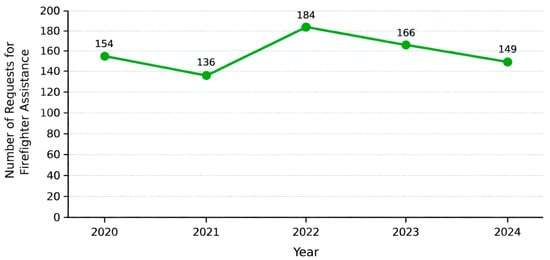
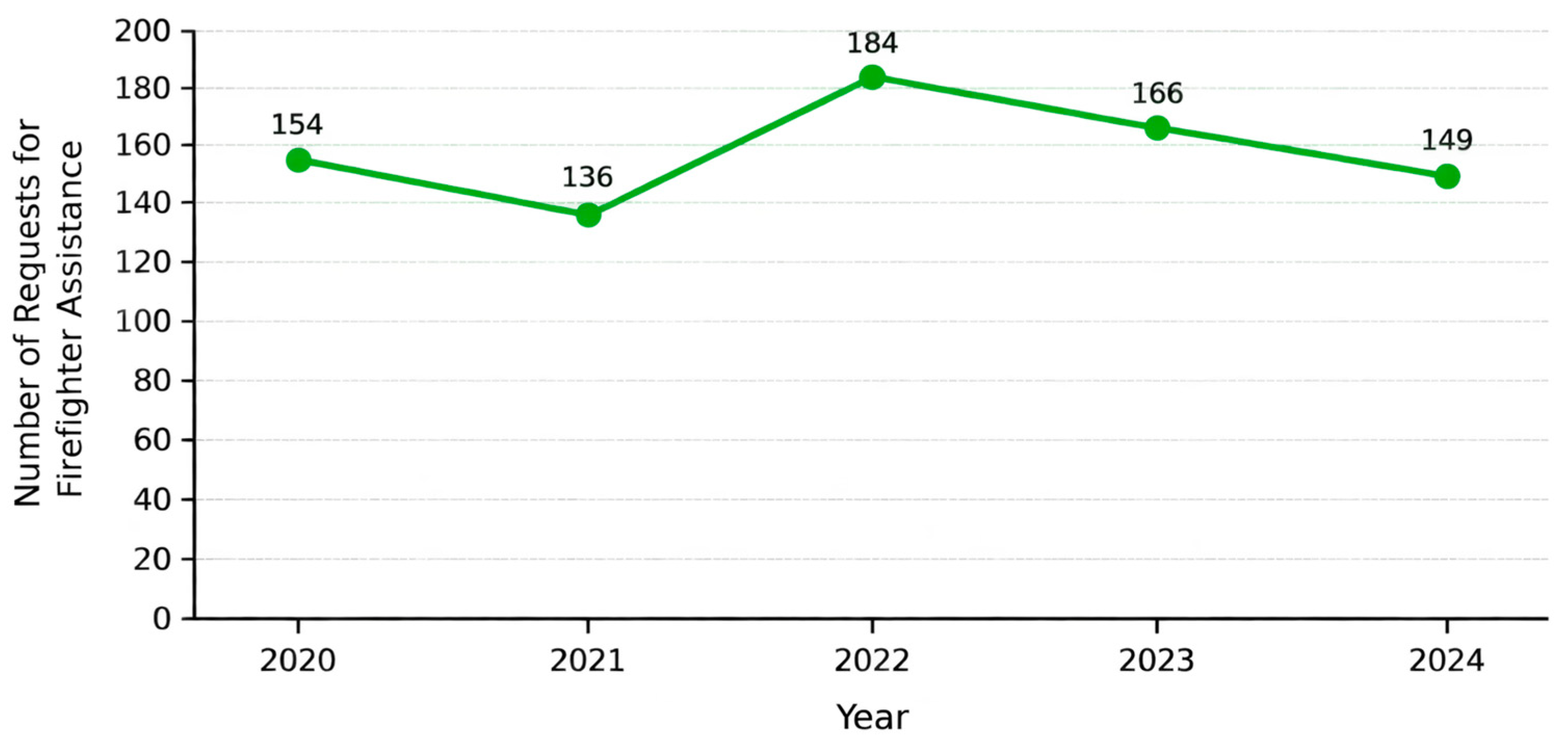
The transport of patients with extreme obesity may exceed the personnel and technical capabilities of standard prehospital care, requiring cooperation between Emergency Medical Services and the Fire and Rescue Service. In such cases, firefighters may be requested to provide assistance with patient transport, particularly when additional personnel or specialised equipment are needed. Figure 1 presents the annual number of requests from Emergency Medical Services for firefighter assistance with the transport of obese patients in Slovakia between 2020 and 2024.
Figure 1.
Number of cases requiring firefighter assistance with the transport of obese patients in Slovakia between 2020 and 2024 [32].
Figure 1 illustrates the annual number of requests from Emergency Medical Services for firefighter assistance with the transport of obese patients in Slovakia between 2020 and 2024. The highest number of requests was recorded in 2022 (184), followed by a decrease to 166 in 2023 and 149 in 2024. These data indicate a declining trend in the number of requests for firefighter assistance between 2022 and 2024.
The Slovak Fire and Rescue Service has established general tactical and methodological procedures addressing the rescue of persons (Methodological Sheet No. 7), the risk of physical exhaustion (Methodological Sheet No. 120), and joint operations with Emergency Medical Services (Methodological Sheet No. 150). However, the examined publicly available collection of tactical and methodological procedures does not include a dedicated document specifically addressing the transport of patients with obesity. This indicates a gap in the publicly accessible methodological guidance and supports the need for experimental evidence to inform the development of more specific recommendations for safe bariatric patient transport [33].
Despite the recognised physical demands of bariatric patient transport, experimental evidence on the physiological responses of firefighters during manual stair transport remains limited [13,24,28]. In particular, the combined effects of transported load weight and transport direction on cardiovascular and respiratory responses under realistic spatial conditions have not been sufficiently investigated. The scientific contribution of this study lies in comparing the physiological responses of the same firefighters during the simulated transport of a bariatric manikin weighing 215.5 kg and a standard-weight manikin weighing approximately 85 kg, both upstairs and downstairs. The study integrates cardiovascular and respiratory measurements, perceived exertion, and short-term post-transport recovery, providing a comprehensive assessment of the physiological workload associated with different transport conditions.
Therefore, the aim of this study was to evaluate the physiological responses of firefighters according to manikin type and transport direction under controlled experimental conditions. The findings may provide a scientific basis for developing more specific recommendations concerning occupational safety, personnel requirements, transport planning, and practical training for the transport of bariatric patients.
2. Methods
An experimental repeated-measures study was conducted in a building of the University of Žilina, Slovakia, to evaluate firefighters’ physiological responses during the simulated stair transport of standard-weight and bariatric manikins. The experiment was performed under standardized conditions and involved transporting the manikins both upstairs and downstairs over five floors. The transport route followed the main staircase between the ground floor (1st floor) and the sixth above-ground floor. The staircase consisted of six floors with intermediate landings. Each flight of stairs comprised ten steps. The dimensions of each step were: width 106 cm, depth 30 cm, and height 15 cm. The length of one flight of stairs was 354 cm. The dimensions of each landing were 150 × 267 cm. The total staircase width was 106 cm, and the distance from the handrail to the opposite wall was 125 cm.
The transport tasks were performed under normal indoor conditions during regular building operation. The staircase contained furnishings typical of the building’s everyday use, reflecting the actual operating conditions of the facility. The total transport route measured approximately 65.4 m and included 100 stair steps with a total vertical elevation of approximately 15.0 m. The technical parameters and dimensions of the staircase and transport route are presented in Table 1.
Table 1.
Basic technical parameters of the transport route.
The experiment involved 12 members of the Slovak Fire and Rescue Corps (professional firefighters) who were attending periodic professional training as part of their occupational duties at the time of the study. All participants were actively performing their occupational duties and were not on medical leave at the time of the experiment. Their ability to participate in physically demanding activities was therefore assumed based on their active professional status. No additional medical examinations were performed specifically for this study, and no additional inclusion or exclusion criteria related to age, body mass index (BMI), or physical fitness were established. They were divided into four-member groups according to their physical fitness and body mass index (BMI). Before inclusion in the study, all participants signed an informed consent form for the processing of personal data and consented to participation in the experiment, including photographic and video recording. Each group completed a series of transport tasks in both directions. Physiological parameters were recorded before transport (M1), immediately after transport (M2), and one minute after completion of transport (M3). Transport time and subjective perception of exertion using the Borg Rating of Perceived Exertion scale were also recorded. The Borg scale ranges from 6 (no exertion) to 20 (maximal exertion) and allows participants to subjectively assess the intensity of physical exertion. Higher scores indicate greater perceived physical exertion [34]. Recovery breaks were provided between individual transport tasks to allow participants to recover from the preceding physical exertion. These recovery periods were distinct from spontaneous rest breaks taken during the transport of both the bariatric and standard-weight manikins in both directions. Participants independently decided when to take these breaks based on their perceived physical exertion and fatigue. The duration of spontaneous breaks was not recorded separately. Physiological changes in the participants were recorded by healthcare professionals (registered nurses and paramedics).
The experiment was designed as a multifactorial repeated-measures study. The influence of two experimental factors on the physiological response of the participants was evaluated: (1) the type of transported manikin (standard-weight or bariatric) and (2) the transport direction (upstairs or downstairs). The dependent variables were pulse rate, systolic and diastolic blood pressure, peripheral oxygen saturation, respiratory rate, body temperature, and subjective perception of exertion assessed using the Borg Rating of Perceived Exertion scale.
2.1. Standardization of Experimental Conditions
All transport tasks were performed according to a predefined protocol under controlled and comparable experimental conditions. Standardization included the use of the same staircase and transport route, consistent manikin weights for the corresponding transport conditions, four-member transport teams, and a uniform physiological measurement procedure. The manikins were transported in a lying position throughout the experiment, ensuring comparable positioning during individual transport tasks. Physiological parameters were recorded at three predefined measurement points: before transport (M1), immediately after transport (M2), and one minute after completion of transport (M3).
The experiment was conducted in an indoor environment under comparable ambient temperature conditions and normal visibility. The transported manikins simulated patients of different body weights but did not fully reproduce the anatomical, physiological, or behavioural characteristics of living patients. The experiment did not simulate a life-threatening situation, fire, or other emergency incident. Consequently, the transport tasks were performed without the additional operational and psychological demands associated with actual emergency interventions.
Participants wore standardized working clothing (duty uniforms) and performed all tasks without helmets while wearing protective work gloves. During the testing day, the consumption of alcohol, caffeinated beverages, and other psychoactive substances was prohibited. Drinking water and refreshments were available throughout the experiment. Before testing, all participants received instructions regarding the experimental procedure, safety rules, and the method used for subjective assessment of perceived exertion.
2.2. Characteristics of the Transported Manikins
Two types of manikins representing different patient weight categories were used in the experiment. The standard-weight manikin (Ruth Lee Duty Training Manikin, model RLN80, Ruth Lee Ltd., Corwen, UK) had a nominal weight of 80 kg, which increased to approximately 85 kg with the addition of firefighting protective clothing and equipment [35]. The bariatric manikin was custom-built and simulated a patient weighing 215.5 kg. The manikins were maintained in an identical position during all transport tasks to ensure standardized loading conditions. The characteristics of the transported manikins are presented in Table 2.
Table 2.
Characteristics of the transported manikins.
2.3. Technical Equipment
Standardized measuring instruments and equipment were used to collect anthropometric and physiological data. Arterial blood pressure was measured using an automatic blood pressure monitor (Veroval Compact BPU22, HARTMANN, Heidenheim, Germany). Peripheral oxygen saturation (SpO2) and pulse rate were recorded using a pulse oximeter (Contec CMS50D, Contec Medical Systems Co., Ltd., Qinhuangdao, China). Body temperature was measured using a non-contact infrared forehead thermometer (LIVSANE FDIR-V22, PXG Pharma GmbH, Heidenheim, Germany) [36].
2.4. Termination of the Experiment
The experiment was terminated after approximately 4 h of transport tasks due to cumulative physical fatigue of the participants.
The decision to terminate the experiment was made jointly by the organizing team and the healthcare personnel. The primary reason was the marked increase in physical fatigue among the participants and the need to ensure their safety while minimizing the risk of health complications.
2.5. Statistical Analysis
The collected data were processed using Statistica 10.0 software (TIBCO Software, Palo Alto, CA, USA) and JASP version 0.96.0.0 (University of Amsterdam, The Netherlands). Descriptive statistics were used to summarize the basic characteristics of the evaluated variables, including calculation of the arithmetic mean, standard deviation, median, and range.
Repeated-measures analysis of variance (ANOVA) was used to assess the effects of manikin type and transport direction on the measured physiological parameters. The F-statistic was used to evaluate the effects of the experimental factors, while effect sizes were expressed using partial eta-squared (ηp2). Values of approximately 0.01, 0.06, and 0.14 were interpreted as small, medium, and large effects, respectively, serving as general guidelines rather than strict classification criteria [37].
Spearman’s rank correlation analysis was used to examine relationships between participants’ individual characteristics and physiological responses during bariatric manikin transport. Correlations were assessed separately for upward and downward transport and for differences between the two directions. The strength of correlations was interpreted using the absolute value of Spearman’s rho: 0.00–0.19 (very weak), 0.20–0.39 (weak), 0.40–0.59 (moderate), 0.60–0.79 (strong), and 0.80–1.00 (very strong).
Paired Student’s t-tests and Wilcoxon signed-rank tests were used to compare changes in pulse rate, respiratory rate, and Borg scores between transport directions. Normality of paired differences was assessed using the Shapiro–Wilk test. Cohen’s d was used to quantify the effect size of paired comparisons, with absolute values of approximately 0.20, 0.50, and 0.80 indicating small, medium, and large effects, respectively.
Statistical significance was evaluated at α = 0.05. Correlation analyses were considered exploratory, and their p-values were not adjusted for multiple comparisons.
3. Results
All participants were male and underwent baseline anthropometric and physiological measurements before the beginning of the experiment.
Table 3 presents the basic characteristics of the study population, including age, body height, body weight, body mass index (BMI), A Body Shape Index (ABSI), waist circumference, and baseline physiological parameters. The obtained data represent the baseline values of the individual participants before the experimental transport tasks and serve as a reference for the subsequent evaluation of changes in physiological parameters during the experiment.
Table 3.
Baseline anthropometric and physiological characteristics of the participants (n = 12).
3.1. Changes in Physiological Parameters According to Manikin Type and Transport Direction
Descriptive analysis was performed to evaluate physiological responses during the simulated transport of bariatric and standard-weight manikins in both directions. Systolic and diastolic blood pressure, pulse rate, peripheral oxygen saturation (SpO2), respiratory rate, and body temperature were assessed before transport (M1), immediately after transport (M2), and one minute after transport (M3). The descriptive statistics for all four experimental conditions are presented in Table 4.
Table 4.
Descriptive statistics of physiological parameters according to manikin type, transport direction, and measurement time (n = 12).
The most pronounced physiological changes were observed in pulse rate and respiratory rate. During upward transport of the bariatric manikin, mean pulse rate increased from 82.17 ± 9.07 bpm before transport to 130.33 ± 15.50 bpm immediately after transport. After one minute of recovery, it decreased to 100.25 ± 11.83 bpm but remained above the baseline value. This condition was associated with the greatest mean pulse rate increase among the four experimental conditions.
Respiratory rate increased following transport under all experimental conditions. The highest mean respiratory rate after transport was observed during downward transport of the bariatric manikin, increasing from 15.58 ± 3.34 to 28.08 ± 5.35 breaths/min. After one minute, respiratory rate decreased to 23.08 ± 3.85 breaths/min but remained elevated compared with baseline. These findings demonstrate that the greatest cardiovascular and respiratory responses were not observed under the same transport condition.
Systolic blood pressure increased following transport under all experimental conditions. The highest mean post-transport value was recorded during downward transport of the bariatric manikin (153.58 ± 19.79 mmHg). Changes in diastolic blood pressure were less pronounced and varied across transport conditions. Peripheral oxygen saturation generally remained within a relatively narrow range, although the greatest mean decrease was recorded during downward transport of the bariatric manikin (from 97.00 ± 0.85% to 95.42 ± 1.93%). Body temperature showed relatively small changes across the experimental conditions.
During upward transport of the bariatric manikin, all three four-member teams took spontaneous short rest breaks on the staircase landings. These breaks were not predefined in the experimental protocol but were initiated by participants in response to perceived physical exertion and fatigue. Their occurrence demonstrates that continuous manual transport was not maintained throughout this demanding task and represents an important consideration when interpreting the physiological measurements.
Overall, the descriptive results indicate that the physiological response varied according to manikin type, transport direction, and the parameter assessed. Upward transport of the bariatric manikin was associated with the greatest increase in pulse rate, whereas downward transport of the same manikin produced the greatest increase in respiratory rate. These observations provide a basis for the subsequent analysis of physiological changes and the statistical evaluation of the effects of manikin type and transport direction.
3.2. Subjective Assessment of Physical Exertion Using the Borg Rating of Perceived Exertion Scale
The Borg Rating of Perceived Exertion (RPE) scale was used to assess participants’ subjective perception of physical exertion immediately after each transport task. This assessment complemented the objectively measured physiological parameters and provided additional information on perceived physical workload according to manikin type and transport direction. The descriptive results are presented in Table 5.
Table 5.
Subjective assessment of physical exertion using the Borg Rating of Perceived Exertion (RPE) scale.
The results demonstrated substantially higher perceived exertion during transport of the bariatric manikin than during transport of the standard-weight manikin in both directions. The highest mean Borg score was recorded during upward transport of the bariatric manikin (17.17 ± 1.85), followed by downward transport (16.42 ± 2.43). In contrast, considerably lower scores were recorded during transport of the standard-weight manikin, with mean values of 8.00 and 8.58 for downward and upward transport, respectively.
Although mean Borg scores were slightly higher during upward transport for both manikin types, the differences between transport directions were relatively small compared with those observed between manikin types. These descriptive findings indicate that participants consistently perceived the transport of the heavier manikin as more physically demanding, regardless of transport direction.
From a scientific perspective, the subjective assessment provides complementary information to the objective physiological measurements and demonstrates differences in perceived exertion associated with the two transport loads. The combined evaluation of subjective and physiological responses may contribute to a more comprehensive assessment of physical workload during simulated bariatric patient transport. From an operational perspective, the Borg scale may serve as a simple supplementary tool during firefighter training to support the recognition of perceived physical strain and fatigue. Its use alongside objective physiological indicators may help inform decisions regarding rest periods and personnel rotation during physically demanding transport operations.
3.3. Physiological Response to Transport-Related Workload
To evaluate the physiological response to transport-related workload, changes in the monitored parameters were calculated from measurements obtained before transport (M1), immediately after transport (M2), and one minute after transport (M3). While Table 4 presents the absolute physiological values, Table 6 summarizes the calculated changes according to manikin type and transport direction. Changes in pulse rate, respiratory rate, blood pressure, peripheral oxygen saturation, and body temperature were calculated as M2 − M1. Pulse rate recovery was expressed as M3−M2, while residual pulse rate change was calculated as M3−M1.
Table 6.
Changes in physiological parameters following transport-related workload according to manikin type and transport direction.
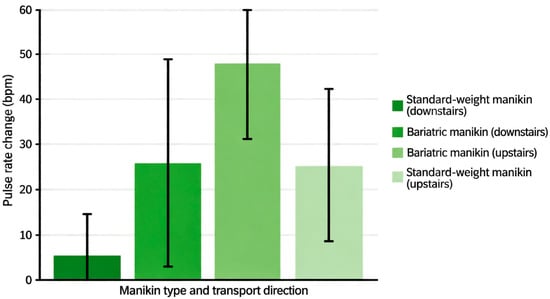
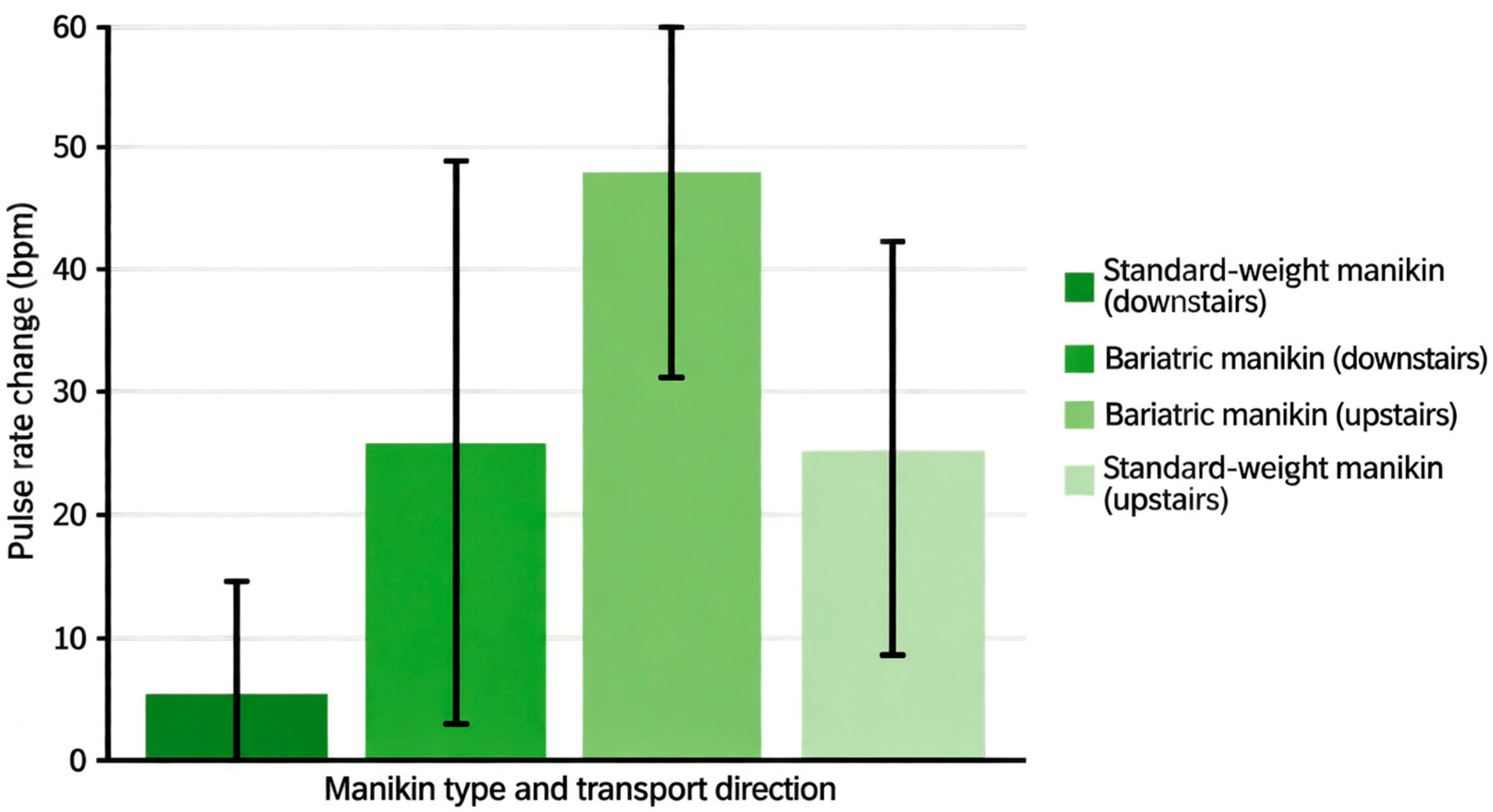
The greatest mean increase in pulse rate was observed during upward transport of the bariatric manikin (48.17 ± 16.94 bpm), whereas the smallest increase occurred during downward transport of the standard-weight manikin (5.42 ± 9.10 bpm). Pulse rate increases were greater during transport of the bariatric manikin than during transport of the standard-weight manikin in both directions. These descriptive findings indicate greater cardiovascular demands associated with the heavier transported load, particularly during upward stair transport.
In contrast, the greatest mean increase in respiratory rate was recorded during downward transport of the bariatric manikin (12.50 ± 6.22 breaths/min). This difference between the conditions producing the greatest pulse rate and respiratory rate changes indicates that the two physiological responses did not follow identical patterns. Changes in blood pressure, peripheral oxygen saturation, and body temperature also varied across transport conditions, although the most pronounced relative differences were observed in the cardiovascular and respiratory responses.
Figure 2 illustrates the mean changes in pulse rate according to manikin type and transport direction, highlighting the greater cardiovascular response associated with upward transport of the bariatric manikin.
Figure 2.
Changes in participants’ pulse rate following transport according to manikin type and transport direction.
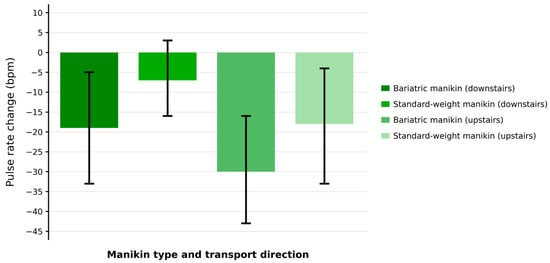
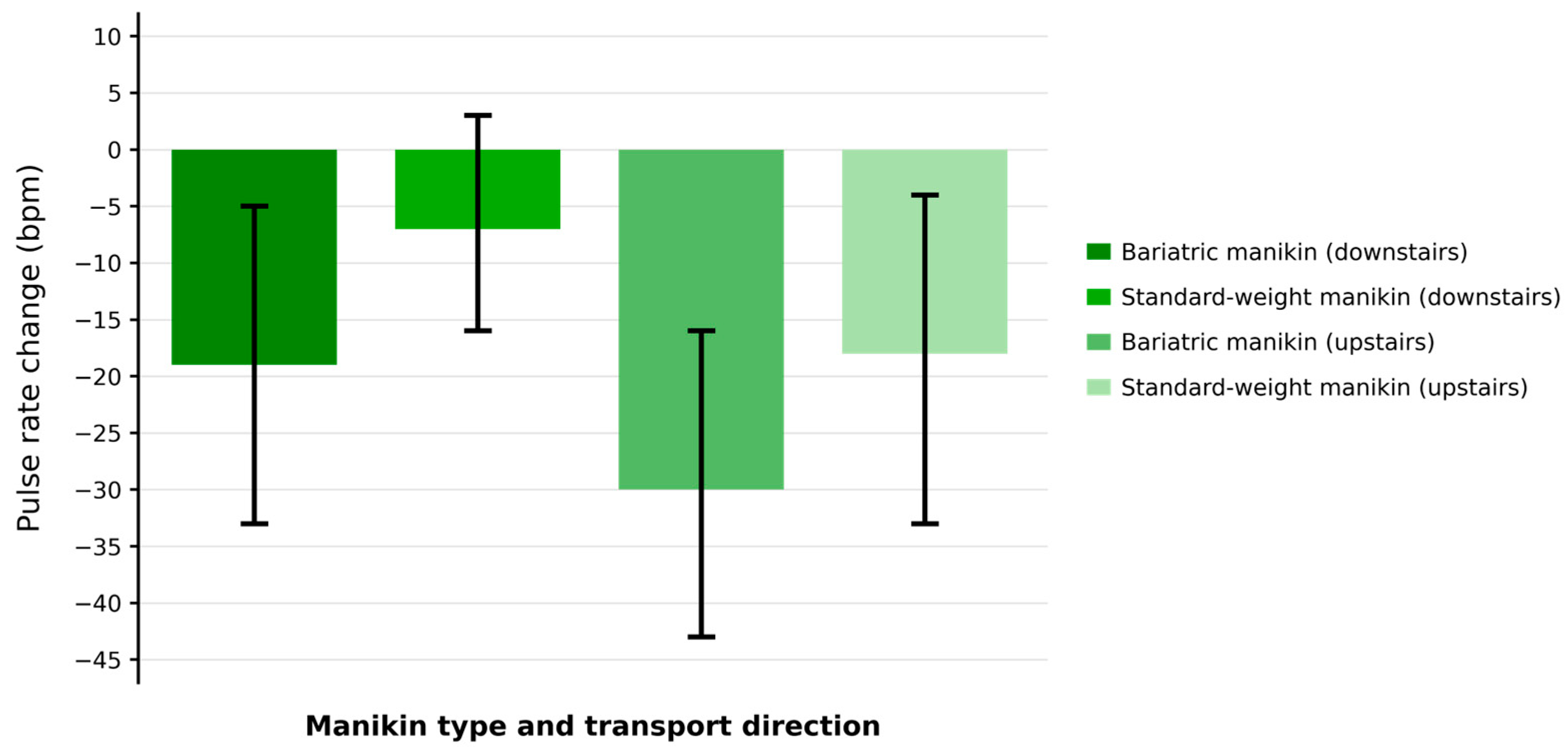
During the first minute after transport, mean pulse rate decreased under all four experimental conditions. The greatest decrease was observed following upward transport of the bariatric manikin (−30.08 ± 13.63 bpm). Nevertheless, pulse rate remained elevated relative to baseline, with a mean residual increase of 18.08 bpm. Figure 3 illustrates differences in short-term pulse rate recovery according to manikin type and transport direction.
Figure 3.
Pulse rate recovery during the one-minute recovery period following transport-related workload according to manikin type and transport direction.
The scientific contribution of these findings lies in quantifying both the immediate physiological response to transport and the remaining pulse rate elevation after a defined recovery period. The results demonstrate that a pronounced decrease in pulse rate during recovery does not necessarily indicate a return to baseline. From an operational perspective, these findings highlight the importance of considering residual physiological strain when assessing fatigue and planning rest periods or personnel rotation during physically demanding bariatric patient transport. However, the present measurements do not establish an optimal recovery duration or specific physiological thresholds for safe continuation of transport.
3.4. Effect of Manikin Type and Transport Direction on the Physiological Response
Two-way repeated-measures analysis of variance (ANOVA) was performed to evaluate the effects of manikin type and transport direction on pulse rate change, respiratory rate change, and pulse rate recovery. The analysis demonstrated statistically significant effects of both experimental factors on pulse rate change and pulse rate recovery, whereas respiratory rate change was significantly influenced only by manikin type. No statistically significant interactions between manikin type and transport direction were identified for any of the evaluated parameters (Table 7).
Table 7.
Results of the two-way repeated-measures ANOVA for the monitored physiological parameters.
The greatest mean increase in pulse rate was recorded during upward transport of the bariatric manikin (48.17 ± 16.94 bpm), compared with 25.83 ± 22.96 bpm during downward transport. In contrast, the greatest mean increase in respiratory rate was observed during downward transport of the bariatric manikin (12.50 ± 6.22 breaths/min). Although respiratory rate changes differed descriptively between transport directions, the direction effect was not statistically significant. These findings indicate that cardiovascular and respiratory responses did not exhibit identical patterns across the experimental conditions.
During the first minute following transport, the greatest decrease in pulse rate was observed after upward transport of the bariatric manikin (−30.08 ± 13.63 bpm). However, the residual pulse rate remained elevated relative to baseline, with a mean difference of 18.08 bpm. Thus, the greater reduction during recovery should not be interpreted as complete physiological recovery, but rather in the context of the substantial preceding increase in pulse rate.
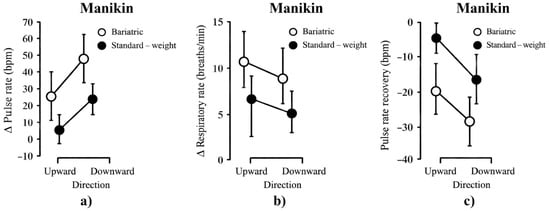
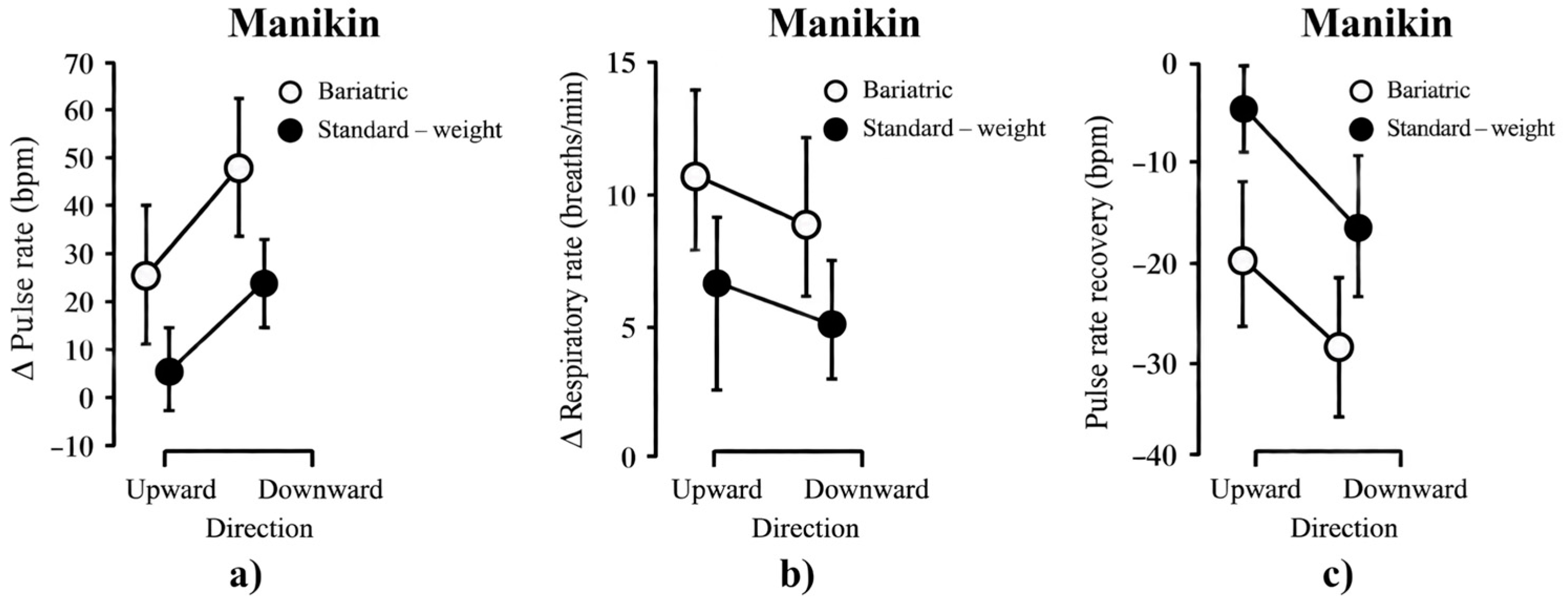
Figure 4a illustrates changes in pulse rate according to manikin type and transport direction, demonstrating a greater response during transport of the bariatric manikin. Figure 4b presents respiratory rate changes, with higher mean increases during transport of the bariatric manikin in both directions. Figure 4c shows pulse rate recovery, with the greatest decrease observed following upward transport of the bariatric manikin.
Figure 4.
Mean changes according to manikin type and transport direction: (a) pulse rate (ΔPR), (b) respiratory rate (ΔRR), and (c) pulse rate recovery after 1 min.
The scientific contribution of these findings lies in the experimental differentiation of the effects of transported load and transport direction on firefighters’ physiological responses during manual stair transport. The results demonstrate that the influence of these factors varies according to the physiological parameter assessed. While both manikin type and transport direction significantly influenced pulse rate change and recovery, respiratory rate change was significantly affected only by manikin type. This finding highlights the importance of assessing multiple physiological indicators to characterize the physical demands of bariatric patient transport more comprehensively.
From an operational perspective, the pronounced pulse rate increase during upward transport and the incomplete return toward baseline after one minute of recovery highlight the need to consider cumulative physical workload during rescue operations. Monitoring signs of fatigue, coordinating transport teams, allowing rest periods, and rotating personnel when necessary may help manage physical demands during bariatric patient transport. The findings provide an experimental basis for further research aimed at establishing evidence-based recommendations for workload assessment and safer transport procedures.
3.5. Correlation Analysis of Individual Characteristics
Spearman’s rank correlation analysis was performed to examine relationships between firefighters’ individual characteristics, baseline physiological parameters, and responses during bariatric manikin transport. The analysis included age, body mass index (BMI), A Body Shape Index (ABSI), baseline pulse rate, and baseline respiratory rate. Relationships were evaluated separately for upward and downward transport among all 12 participants from the three four-person teams (Table 8).
Table 8.
Spearman’s correlations between individual characteristics, baseline physiological parameters, and responses during bariatric manikin transport (n = 12).
During downward transport of the bariatric manikin, statistically significant negative correlations were identified between baseline pulse rate and subsequent pulse rate change and between baseline respiratory rate and subsequent respiratory rate change. Participants with higher pre-transport physiological values tended to exhibit smaller increases in the corresponding parameters.
During upward transport, a positive correlation was identified between baseline respiratory rate and perceived exertion assessed using the Borg scale. Participants with higher respiratory rates before transport tended to report greater perceived physical exertion after completing the task. No statistically significant correlations were identified between age, BMI, or ABSI and changes in pulse rate, respiratory rate, or Borg scores.
From a scientific perspective, these findings contribute to understanding individual differences in physiological responses during bariatric manikin transport. The results demonstrate that the relationships between pre-transport physiological parameters and subsequent responses differ according to transport direction and the physiological indicator assessed. They also highlight the complementary value of subjective exertion assessment in characterising transport-related workload.
From an operational perspective, the findings support the inclusion of individual physiological measurements and perceived exertion assessments in firefighter training. Monitoring pulse rate, respiratory rate, and subjective workload may contribute to identifying physically demanding transport conditions and improving decisions regarding task organisation, rest periods, and personnel rotation.
An additional Spearman correlation analysis examined relationships between individual characteristics and direction-dependent differences in physiological responses during bariatric manikin transport. Differences were calculated as the response during upward transport minus the corresponding response during downward transport (Table 9).
Table 9.
Spearman’s correlations between individual characteristics and differences in physiological responses between bariatric manikin transport upstairs and downstairs (Bariatric Up–Bariatric Down; n = 12).
A statistically significant positive correlation was identified between direction-dependent differences in pulse rate and respiratory rate changes (Spearman’s rho = 0.610; p = 0.035). Participants exhibiting greater differences in pulse rate responses between upward and downward transport also tended to demonstrate greater differences in respiratory rate responses. No statistically significant correlations were identified between age, BMI, ABSI, or the selected baseline physiological parameters and direction-dependent differences in pulse rate, respiratory rate, or Borg scores. Furthermore, differences in perceived exertion assessed using the Borg scale were not significantly associated with differences in pulse rate or respiratory rate responses.
From a scientific perspective, these analyses extend the assessment of physiological workload by examining relationships between individual responses to upward and downward bariatric manikin transport. The observed positive correlation between direction-dependent changes in pulse rate and respiratory rate provides additional evidence of an association between cardiovascular and respiratory responses. The absence of statistically significant correlations involving Borg score differences indicates that changes in subjective perceived exertion did not demonstrate corresponding associations with the measured physiological differences in this experiment.
From an operational perspective, the results highlight the value of combining objective physiological measurements with subjective assessments of physical exertion when evaluating firefighters’ workload. Monitoring pulse rate, respiratory rate, and Borg scores during practical training may provide complementary information for assessing transport demands and supporting decisions concerning team organisation, rest periods, and personnel rotation.
3.6. Paired Comparison of Physiological Responses Between Transport Directions
Paired comparisons were performed to evaluate differences in pulse rate change, respiratory rate change, and perceived exertion between upward and downward transport of the bariatric manikin. The paired Student’s t-test and Wilcoxon signed-rank test were used to assess direction-dependent differences within the same participants. The results are presented in Table 10.
Table 10.
Paired comparison of physiological responses during upward and downward bariatric manikin transport (n = 12).
A statistically significant difference in pulse rate change was identified between transport directions. The mean increase in pulse rate was greater during upward transport than during downward transport. This finding provides additional evidence of the greater cardiovascular demands associated with transporting the bariatric manikin upstairs.
Respiratory rate change was descriptively higher during downward transport than during upward transport; however, the available paired comparison did not demonstrate a statistically significant difference between directions. Perceived exertion assessed using the Borg scale was also descriptively higher during upward transport than during downward transport. Nevertheless, this difference was not statistically significant according to the paired Student’s t-test or the Wilcoxon signed-rank test.
From a scientific perspective, these paired analyses complement the repeated-measures ANOVA by providing a focused comparison of physiological responses between transport directions under the bariatric loading condition. The findings indicate that the statistically significant difference in pulse rate change was not accompanied by corresponding statistically significant differences in respiratory rate change or perceived exertion. This highlights the importance of combining objective physiological measurements with subjective assessments to obtain a more comprehensive understanding of transport-related workload.
From an operational perspective, the greater increase in pulse rate during upward transport highlights the importance of considering transport direction when assessing firefighters’ physical workload. At the same time, the relatively high Borg scores recorded during both transport directions indicate substantial perceived exertion regardless of direction. Monitoring physiological responses together with perceived fatigue may therefore provide useful supplementary information when planning rest periods, coordinating transport teams, and considering personnel rotation during physically demanding bariatric patient transport.
4. Discussion
Transport of bariatric patients represents a major physical, logistical, and organizational challenge for fire and rescue services. The present study evaluated the physiological response of firefighters during the simulated stair transport of a bariatric and a standard-weight manikin. The results demonstrated that transport of the bariatric manikin imposed a significantly greater physiological workload, as evidenced by larger increases in pulse rate and respiratory rate, as well as more pronounced pulse rate recovery. Furthermore, two-way repeated-measures ANOVA confirmed significant effects of manikin type on pulse rate change, respiratory rate change, and pulse rate recovery, while transport direction significantly affected pulse rate change and pulse rate recovery.
The greatest increase in pulse rate was observed during upward transport of the bariatric manikin, reflecting the cardiovascular demands associated with moving a heavy load against gravity. However, the increase in respiratory rate was greater during downward transport, indicating that the physiological responses differed according to the parameter assessed. Both directions were also associated with high perceived exertion, as demonstrated by the mean Borg scores of 17.17 during upward transport and 16.42 during downward transport. These findings highlight the multidimensional nature of physical workload during bariatric patient transport. Cienki [23] described challenges reported by emergency medical service providers when managing patients with severe obesity, while Wißuwa and Puchstein [8] highlighted the logistical and physical demands associated with transporting patients with extreme body weight.
The ANOVA results indicated that manikin type was a major determinant of physiological workload. The interaction between manikin type and transport direction was not statistically significant, suggesting that the effect of manikin weight on the measured physiological responses did not differ significantly between upward and downward transport.
The paired analysis confirmed a significantly greater increase in pulse rate during upward than downward transport of the bariatric manikin. In contrast, the directional differences in respiratory rate change and Borg scores were not statistically significant. These findings indicate that the cardiovascular response was more sensitive to transport direction than the other two indicators in the present experiment. Velasco et al. [38] reported increased physiological demands during stair ascent while carrying an additional load, whereas Smith et al. [39] examined cardiac strain during simulated high-rise firefighting. Although the loading conditions differed from the present experiment, both studies provide relevant context for understanding the cardiovascular demands of upward movement.
The correlation analyses identified a positive association between direction-dependent differences in pulse rate and respiratory rate changes. Furthermore, baseline respiratory rate was positively correlated with perceived exertion during upward transport of the bariatric manikin. No statistically significant associations were identified between age, BMI, or ABSI and the investigated physiological changes or Borg scores. These findings demonstrate the value of assessing physiological responses and perceived exertion alongside individual characteristics. From an operational perspective, combining pulse rate, respiratory rate, and subjective workload assessments may support the evaluation of physical demands during firefighter training and inform the organisation of physically demanding transport tasks.
An important observation was the occurrence of spontaneous rest breaks during transport tasks, particularly during the upward transport of the bariatric manikin. Although these pauses were not predefined in the experimental protocol, participants initiated them based on their perceived physical exertion and fatigue. This finding highlights the physical demands and practical limitations associated with the manual handling of patients with high body weight. It is also consistent with the recommendations of Gable and Duncan [24] and Hunt [25], who emphasised the importance of careful operational planning, appropriate technical equipment, and coordinated rescue procedures during bariatric patient extrication.
In addition to physiological workload, the manual transport of bariatric patients may impose considerable biomechanical demands on firefighters. Carrying heavy loads on staircases requires sustained muscular effort, postural stability, and coordinated movement among team members. Restricted space, changes in direction on landings, and uneven load distribution may increase mechanical loading on the lower back, shoulders, and upper limbs. Lavender et al. [40] investigated the biomechanical demands associated with strenuous patient-handling tasks performed by paramedics. Subsequent studies by Lavender et al. [28] and Mehta et al. [41] examined the physical demands of stair-descent devices, highlighting the importance of evacuation equipment and task-specific handling conditions. Furthermore, Galinsky et al. [42] investigated musculoskeletal health in relation to bariatric patient handling among healthcare workers, emphasizing the relevance of appropriate handling practices and equipment.
The biomechanical risks associated with bariatric patient transport should also be considered in relation to established ergonomic assessment methods. The Revised National Institute for Occupational Safety and Health (NIOSH) Lifting Equation (RNLE) provides a framework for evaluating risks associated with manual lifting [20]. However, its direct application to the present experiment is limited because transporting a 215.5 kg bariatric manikin by four firefighters involved prolonged carrying, stair climbing and descending, restricted spaces, and coordinated team handling. McClean et al. [43] highlighted musculoskeletal risks associated with bariatric patient handling, while ISO/TR 12296:2012 provides relevant ergonomic guidance for manual patient handling [44]. The NIOSH Applications Manual also recognizes the need to consider metabolic demands during activities involving substantial carrying, walking, and climbing [20].
In the present experiment, the transport of the 215.5 kg bariatric manikin imposed substantial physiological demands on the participants. However, biomechanical parameters such as trunk posture, joint loading, and muscle activation were not directly measured. Consequently, the results do not allow the quantification of musculoskeletal injury risk. Future research incorporating electromyography and motion analysis could provide a more comprehensive understanding of biomechanical loading during bariatric patient transport.
An additional limitation of the study is that all 12 participants were male firefighters. Therefore, the findings cannot be directly generalized to female firefighters or to more diverse firefighter populations. Differences in individual physical characteristics and fitness levels may influence physiological responses during physically demanding transport tasks. Future studies should include both male and female firefighters and larger, more diverse samples to improve the generalizability of the findings.
An additional limitation of the present study is that the experiment was conducted under normal visibility conditions without smoke exposure or the use of self-contained breathing apparatus (SCBA). During actual fire emergencies, smoke and reduced visibility may complicate spatial orientation, communication, and coordination among members of the transport team, potentially prolonging rescue operations and increasing physical and psychological demands. Furthermore, the use of SCBA may impose additional physiological strain due to the weight of the equipment and the increased demands associated with movement while wearing respiratory protection. Transporting a bariatric patient under such conditions may also present technical and organisational challenges related to providing appropriate respiratory protection for the patient, particularly in confined spaces and during rescue operations on staircases. These factors were not evaluated in the present experiment and should be addressed in future studies conducted under appropriately controlled and safe conditions.
Recent advances in wireless sensor technologies offer additional opportunities for monitoring firefighters’ physiological parameters during physically demanding rescue operations. Continuous monitoring of heart rate and respiratory rate could provide real-time information on physiological strain during bariatric patient transport, including periods of peak exertion and recovery. Unlike the measurements obtained before and after transport in the present study, such systems could support decisions regarding rest breaks, personnel rotation, and the early identification of excessive physiological strain. Pinnelli et al. [45] demonstrated the feasibility of monitoring firefighters’ heart rate and respiratory rate using wearable sensors during simulated firefighting activities, while Appelle et al. [46] investigated the integration of wireless physiological and environmental monitoring to assess firefighters’ physical strain and wellbeing. Future studies should therefore investigate the applicability and reliability of these technologies during bariatric patient transport, particularly in restricted spaces and during intensive physical movement.
From an operational perspective, the findings support the importance of regular simulation-based training, ergonomic transport procedures, and the availability of suitable technical equipment. Particular attention should be given to coordinated teamwork, appropriate distribution of physical demands among responders, and the organisation of transport tasks according to the available personnel and environmental conditions. These measures may contribute to reducing excessive physical strain and improving occupational safety during the transport of patients with high body weight.
5. Conclusions
The present study demonstrated that simulated stair transport of a bariatric manikin weighing 215.5 kg imposed greater physiological demands on firefighters than transport of a standard-weight manikin. Two-way repeated-measures ANOVA identified significant effects of manikin type on pulse rate change, respiratory rate change, and pulse rate recovery. Transport direction significantly affected pulse rate change and recovery, whereas its effect on respiratory rate change was not statistically significant.
The greatest mean increase in pulse rate was recorded during upward transport of the bariatric manikin (48.17 ± 16.94 beats/min), compared with downward transport (25.83 ± 22.96 beats/min). This difference was statistically significant (paired Student’s t-test, p = 0.044). In contrast, respiratory rate increased more during downward transport of the bariatric manikin. Perceived exertion assessed using the Borg scale was high in both directions, with mean scores of 17.17 during upward transport and 16.42 during downward transport, although the difference was not statistically significant (p = 0.433). These findings demonstrate that cardiovascular, respiratory, and subjective responses did not follow identical patterns across transport conditions.
The correlation analyses identified a positive association between direction-dependent differences in pulse rate and respiratory rate changes (Spearman’s rho = 0.610; p = 0.035). A positive correlation was also identified between baseline respiratory rate and Borg scores during upward transport (rho = 0.580; p = 0.048). No statistically significant associations were identified between age, BMI, or ABSI and the investigated physiological changes or perceived exertion. These results provide additional information about the relationships between physiological responses and subjective workload during bariatric manikin transport.
The main scientific contribution of this study lies in the experimental quantification of physiological responses associated with transported manikin weight and transport direction during manual stair transport. The combined assessment of immediate pulse rate and respiratory rate changes, short-term pulse rate recovery, and perceived exertion provides a comprehensive characterization of the physical demands associated with this activity. Although pulse rate decreased during the first minute following upward transport of the bariatric manikin, it remained elevated relative to pre-transport values, indicating incomplete short-term recovery.
From an operational perspective, the findings support the importance of considering transported weight, transport direction, and physiological responses when organising physically demanding rescue operations. Appropriate transport equipment, coordinated teamwork, adequate personnel availability, and monitoring of physical strain and perceived exertion may contribute to safer bariatric patient transport. The results also support the inclusion of realistic bariatric transport scenarios in firefighter training, with particular emphasis on recognising fatigue and coordinating physically demanding tasks.
The study involved 12 male participants organised into three four-person teams. Spontaneous rest breaks occurred during transport, particularly during upward transport of the bariatric manikin, and the experiment was terminated after approximately four hours because of cumulative fatigue. Biomechanical loading was not directly measured, and non-contact body temperature measurements may have been influenced by perspiration. The correlation analyses were exploratory and did not include adjustments for multiple comparisons. Furthermore, the experiment was conducted under normal visibility conditions without smoke exposure or self-contained breathing apparatus (SCBA). Future research should investigate larger and more diverse samples, different transport team sizes and devices, biomechanical responses, and reduced-visibility conditions with appropriate respiratory protection. Given the limitations of the Revised NIOSH Lifting Equation (RNLE) for stair transport, future research should include task-specific biomechanical assessments. Wearable wireless sensors could also support real-time physiological monitoring and safer organisation of bariatric patient transport. Such research may contribute to the development of evidence-based procedures for improving firefighter safety during bariatric patient transport.
Author Contributions
Conceptualization, T.V., J.S., M.K. and J.J.; methodology, T.V., J.S. and M.K.; software, J.J.; validation, T.V. and J.J.; formal analysis, T.V., J.S. and J.J.; investigation, T.V. and M.K.; resources, T.V., J.S., M.K. and J.J.; data curation, T.V. and J.J.; writing—original draft preparation, T.V., J.S. and J.J.; writing—review and editing, T.V., J.S. and J.J.; visualization, T.V.; supervision, J.S. and M.K.; project administration, J.S.; funding acquisition, J.S. All authors have read and agreed to the published version of the manuscript.
Funding
This research received no external funding.
Institutional Review Board Statement
The study was conducted in accordance with the Declaration of Helsinki and approved by the Ethics Committee of the University of Žilina (protocol code EK 9/2026 and date of approval 26 August 2026).
Informed Consent Statement
Informed consent was obtained from all subjects involved in the study.
Data Availability Statement
The datasets used and/or analyzed during the current study are available from the corresponding author on reasonable request.
Acknowledgments
This work was supported by the KEGA project No. 048ŽU-4/2025, Centre for Practical Education in the Emergency Medical Services Study Programme.
Conflicts of Interest
The authors declare no conflicts of interest. The funders had no role in the design of the study; in the collection, analyses, or interpretation of data; in the writing of the manuscript; or in the decision to publish the results.
References
- World Health Organization (WHO). Obesity and Overweight. 7 October 2026. Available online: https://www.who.int/news-room/fact-sheets/detail/obesity-and-overweight (accessed on 14 October 2026).
- World Health Organization (WHO). Obesity. Available online: https://www.who.int/health-topics/obesity#tab=tab_1 (accessed on 14 October 2026).
- Di Giacinto, I.; Guarnera, M.; Esposito, C.; Falcetta, S.; Cortese, G.; Pascarella, G.; Sorbello, M.; Cataldo, R. Emergencies in obese patients: A narrative review. J. Anesth. Analg. Crit. Care 2021, 1, 13. [Google Scholar] [CrossRef] [Scilit] [PubMed]
- Hignett, S.; Griffiths, P. Manual handling risks in the bariatric (obese) patient pathway in acute sector, community and ambulance care and treatment. Work 2009, 33, 175–180. [Google Scholar] [CrossRef] [Scilit] [PubMed]
- Roland, D.; Howes, C.; Stickles, M.; Johnson, K. Safe intrahospital transport of critically ill obese patients. Bariatr. Nurs. Surg. Patient Care 2010, 5, 65–70. [Google Scholar] [CrossRef] [Scilit]
- Collopy, K.T. How Obesity Impacts Patient Health and EMS. EMS World. April 2012. Available online: https://www.hmpgloballearningnetwork.com/site/emsworld/article/10654895/how-obesity-impacts-patient-health-and-ems (accessed on 14 October 2026).
- Cowley, S.P.; Leggett, S. Manual handling risks associated with the care, treatment and transportation of bariatric (severely obese) clients in Australia. Work 2011, 39, 477–483. [Google Scholar] [CrossRef] [Scilit] [PubMed]
- Wißuwa, H.; Puchstein, C. Notfallrettung XXL: Adipositas-permagna-Patient im Rettungsdienst. Anaesthesist 2011, 60, 63–70. [Google Scholar] [CrossRef] [Scilit] [PubMed]
- Hales, C.; Coombs, M.; de Vries, K. The challenges in caring for morbidly obese patients in intensive care: A focused ethnographic study. Aust. Crit. Care 2018, 31, 37–41. [Google Scholar] [CrossRef] [Scilit] [PubMed]
- Slovak Republic. Act No. 579/2004 Coll. on Emergency Medical Services and on Amendments to Certain Acts, as Amended. Available online: https://www.slov-lex.sk/ezbierky/pravne-predpisy/SK/ZZ/2004/579/ (accessed on 14 October 2026).
- Slovak Republic. Act No. 315/2001 Coll. on the Fire and Rescue Service, as Amended. Available online: https://www.slov-lex.sk/ezbierky/pravne-predpisy/SK/ZZ/2001/315/ (accessed on 14 October 2026).
- Cowley, S.P.; Leggett, S. Manual handling risks associated with the transportation of bariatric patients in Australia. Australas. J. Paramed. 2010, 8, 1–9. [Google Scholar] [CrossRef] [Scilit]
- Gable, B.D.; Gardner, A.K.; Celik, D.H.; Bhalla, M.C.; Ahmed, R.A. Improving Bariatric Patient Transport and Care with Simulation. West. J. Emerg. Med. 2014, 15, 199–204. [Google Scholar] [CrossRef] [Scilit] [PubMed]
- Czapla, M.; Juárez-Vela, R.; Mickiewicz, A.; Raczyński, A.; Griesmann, K.; Kędzierski, K.; Wojciechowski, J.; Burzński, M.; Fedorowicz, O.; Koral, M.; et al. Obesity: A Challenge for Emergency Medical Teams—A Narrative Review. Front. Public Health 2025, 13, 1659924. [Google Scholar] [CrossRef] [Scilit] [PubMed]
- Slovak Republic. Government Regulation No. 281/2006 Coll. on Minimum Safety and Health Requirements for Manual Handling of Loads. Available online: https://www.slov-lex.sk/ezbierky/pravne-predpisy/SK/ZZ/2006/281/ (accessed on 14 October 2026).
- Council of the European Communities. Council Directive 90/269/EEC of 29 May 1990 on the Minimum Health and Safety Requirements for the Manual Handling of Loads Where There Is a Risk Particularly of Back Injury to Workers. (ourth Individual Directive within the Meaning of Article 16(1) of Directive 89/391/EEC). Off. J. Eur. Communities 1990, L156, 9–13. Available online: https://eur-lex.europa.eu/legal-content/EN/TXT/?uri=CELEX:31990L0269 (accessed on 14 October 2026).
- Serafin, P.; Schäfer, A.; Klußmann, A.; Lang, K.-H.; Liebers, F. Manuelles Heben, Halten und Tragen: Gefährdungsbeurteilung mit der Leitmerkmalmethode, 1st ed.; Bundesanstalt für Arbeitsschutz und Arbeitsmedizin (BAuA): Dortmund, Germany, 2022. [Google Scholar] [CrossRef]
- United Kingdom. The Manual Handling Operations Regulations 1992, Statutory Instrument 1992 No. 2793, as Amended. Available online: https://www.legislation.gov.uk/uksi/1992/2793/contents (accessed on 14 October 2026).
- Occupational Safety and Health Administration (OSHA). OSHA Does Not Have Standards Limiting Maximum Weight Employees Can Lift/Carry. Standard Interpretation Letter, 29 March 2004. Available online: https://www.osha.gov/laws-regs/standardinterpretations/2004-03-29-1 (accessed on 14 October 2026).
- Waters, T.R.; Putz-Anderson, V.; Garg, A. Applications Manual for the Revised NIOSH Lifting Equation; DHHS (NIOSH) Publication No. 94-110, revised September 2021; National Institute for Occupational Safety and Health: Cincinnati, OH, USA, 1994. [Google Scholar] [CrossRef] [Scilit]
- Horn, G.P.; Blevins, S.; Fernhall, B.; Smith, D.L. Core temperature and heart rate response to repeated bouts of firefighting activities. Ergonomics 2013, 56, 1465–1473. [Google Scholar] [CrossRef] [Scilit] [PubMed]
- Sinden, K.; MacDermid, J.C.; Buckman, S.; Davis, B.; Matthews, T.; Viola, C. A qualitative study on the experiences of female firefighters. Work 2013, 45, 97–105. [Google Scholar] [CrossRef] [Scilit] [PubMed]
- Cienki, J.J. Emergency Medical Service Providers’ Perspectives towards Management of the Morbidly Obese. Prehosp. Disaster Med. 2016, 31, 471–474. [Google Scholar] [CrossRef] [Scilit] [PubMed]
- Gable, B.; Duncan, M. Use of simulation to improve fire department standard operating procedure for bariatric patient extrication. BMJ Simul. Technol. Enhanc. Learn. 2020, 6, 123–124. [Google Scholar] [CrossRef] [Scilit] [PubMed]
- Hunt, D. Rescuing a Bariatric Fire Victim. Fire Engineering, 1 June 2018. Available online: https://www.fireengineering.com/firefighting/rescuing-a-bariatric-fire-victim/ (accessed on 14 October 2026).
- Borg, G. Borg’s Perceived Exertion and Pain Scales; Human Kinetics: Champaign, IL, USA, 1998. [Google Scholar]
- Achten, J.; Jeukendrup, A.E. Heart rate monitoring: Applications and limitations. Sports Med. 2003, 33, 517–538. [Google Scholar] [CrossRef] [Scilit] [PubMed]
- Lavender, S.A.; Hedman, G.E.; Mehta, J.P.; Reichelt, P.A.; Conrad, K.M.; Park, S. Evaluating the physical demands on firefighters using hand-carried stair descent devices to evacuate mobility-limited occupants from high-rise buildings. Appl. Ergon. 2014, 45, 389–397. [Google Scholar] [CrossRef] [Scilit] [PubMed]
- Bustos, D.; Guedes, J.C.; Baptista, J.S.; Vaz, M.P.; Costa, J.T.; Fernandes, R.J. Applicability of Physiological Monitoring Systems within Occupational Groups: A Systematic Review. Sensors 2021, 21, 7249. [Google Scholar] [CrossRef] [Scilit] [PubMed]
- Eurostat. Obesity Rate in the EU: 16.3% in 2025. 4 September 2026. Available online: https://ec.europa.eu/eurostat/en/web/products-eurostat-news/w/ddn-20260904-1 (accessed on 14 October 2026).
- Slovak Television and Radio (STVR). Slovakia Failing to Cut Obesity Rate, Adult Obesity Continues to Rise. 22 January 2026. Available online: https://enrsi.stvr.sk/articles/news/429850/slovakia-failing-to-cut-obesity-rate-adult-obesity-continues-to-rise (accessed on 14 October 2026).
- Vojtašová, M. (Operational Centre of the Emergency Medical Service of the Slovak Republic, Bratislava, Slovakia). Unpublished statistical data on requests for firefighter assistance with the transport of obese patients, 2020–2024. Personal communication, 2025. [Google Scholar]
- Fire and Rescue Service of the Slovak Republic. Tactical and Methodological Procedures for Conducting Emergency Interventions (Takticko-Metodické Postupy Vykonávania Zásahov). Order of the President of the Fire and Rescue Service. 30 July 2007. Available online: https://elearnhazz-sk.webnode.sk/subory-na-stiahnutie/metodicke-listy/ (accessed on 14 October 2026).
- Borg, G.A.V. Psychophysical bases of perceived exertion. Med. Sci. Sports Exerc. 1982, 14, 377–381. [Google Scholar] [CrossRef] [Scilit]
- Ruth Lee Ltd. Duty Range Training Manikin: Technical Datasheet; Ruth Lee Ltd.: Corwen, UK, 2025; Available online: https://www.ruthlee.com/wp-content/uploads/2017/02/RuthLeeDutyRangeDatasheet2026.pdf (accessed on 11 October 2026).
- PXG Pharma GmbH. LIVSANE FDIR-V22: Non-Contact Infrared Thermometer—Instruction Leaflet; PXG Pharma GmbH: Mannheim, Germany, 2020; Available online: https://www.manualslib.com/manual/3134070/Livsane-Fdir-V22.html (accessed on 11 October 2026).
- Lakens, D. Calculating and reporting effect sizes to facilitate cumulative science: A practical primer for t-tests and ANOVAs. Front. Psychol. 2013, 4, 863. [Google Scholar] [CrossRef] [Scilit] [PubMed]
- Velasco, A.; Halder, A.; Kuklane, K.; Ronchi, E. The impact of carrying load on physical performance during ascending evacuation movement. Fire Mater. 2021, 45, 488–497. [Google Scholar] [CrossRef] [Scilit]
- Smith, D.L.; Haller, J.M.; Benedict, R.; Moore-Merrell, L. Cardiac strain associated with high-rise firefighting. J. Occup. Environ. Hyg. 2015, 12, 213–221. [Google Scholar] [CrossRef] [Scilit] [PubMed]
- Lavender, S.A.; Conrad, K.M.; Reichelt, P.A.; Johnson, P.W.; Meyer, F.T. Biomechanical analyses of paramedics simulating frequently performed strenuous work tasks. Appl. Ergon. 2000, 31, 167–177. [Google Scholar] [CrossRef] [Scilit] [PubMed]
- Mehta, J.P.; Lavender, S.A.; Hedman, G.E.; Reichelt, P.A.; Park, S.; Conrad, K.M. Evaluating the physical demands on firefighters using track-type stair descent devices to evacuate mobility-limited occupants from high-rise buildings. Appl. Ergon. 2015, 46, 96–106. [Google Scholar] [CrossRef] [Scilit] [PubMed]
- Galinsky, T.; Deter, L.; Krieg, E.; Feng, H.A.; Battaglia, C.; Bell, R.; Haddock, K.S.; Hilton, T.; Lynch, C.; Matz, M.; et al. Safe patient handling and mobility (SPHM) for increasingly bariatric patient populations: Factors related to caregivers’ self-reported pain and injury. Appl. Ergon. 2021, 91, 103300. [Google Scholar] [CrossRef] [Scilit] [PubMed]
- McClean, K.; Cross, M.; Reed, S. Risks to healthcare organizations and staff who manage obese (bariatric) patients and use of obesity data to mitigate risks: A literature review. J. Multidiscip. Healthc. 2021, 14, 577–588. [Google Scholar] [CrossRef] [Scilit] [PubMed]
- ISO/TR 12296:2012; Ergonomics—Manual Handling of People in the Healthcare Sector. International Organization for Standardization: Geneva, Switzerland, 2012. Available online: https://www.iso.org/standard/51310.html (accessed on 25 October 2026).
- Pinnelli, M.; Marsella, S.; Tossut, F.; Schena, E.; Setola, R.; Massaroni, C. Field Testing Multi-Parametric Wearable Technologies for Wildfire Firefighting Applications. Sensors 2025, 25, 3066. [Google Scholar] [CrossRef] [Scilit] [PubMed]
- Appelle, A.; Stach, E.; Boyd, B.; Salvino, L.; Lynch, J.P. Fusing Wearable and Environmental Sensors for Context-Aware Firefighter Wellbeing Monitoring. Sensors 2026, 26, 5924. [Google Scholar] [CrossRef] [Scilit] [PubMed]

Disclaimer/Publisher’s Note: The statements, opinions and data contained in all publications are solely those of the individual author(s) and contributor(s) and not of MDPI and/or the editor(s). MDPI and/or the editor(s) disclaim responsibility for any injury to people or property resulting from any ideas, methods, instructions or products referred to in the content. |
© 2026 by the authors. Licensee MDPI, Basel, Switzerland. This article is an open access article distributed under the terms and conditions of the Creative Commons Attribution (CC BY) license.