


Abstract
This study examines organisational and ergonomic predictors of safety compliance in automotive just-in-time (JIT) production environments. Drawing on the theory of safety climate and the literature on organisational control, we developed a multivariate regression model to analyse how managerial commitment, production pressure, technological safeguards, training quality, severity of sanctions, and ergonomic prevention relate to employee safety compliance. A cross-sectional survey was conducted among the employees of five Central European Tier 1 and Tier 2 automotive suppliers (n = 221). The results show that organisational factors play a central role in explaining compliance behaviour. Management commitment and training quality emerged as the strongest positive predictors of safety compliance, while production pressure showed a significant negative association. Ergonomic prevention was also positively related to compliance, suggesting that workplace design and physical risk reduction contribute to safer behaviour. The severity of sanctions showed only a weak relationship with compliance. In general, the findings indicate that supportive organisational practices and preventive safety management are more strongly associated with compliance than sanctions-based control mechanisms alone. The results highlight the importance of integrating management commitment, training systems, and ergonomic design into safety strategies in high-pressure manufacturing environments.
1. Introduction
The operation of automotive manufacturing in the 21st century is defined by the Just-In-Time (JIT) production philosophy and the integration of Industry 4.0 technologies [1]. The tight scheduling of supply chains, the optimisation of cycle time, and the cost-efficiency expectations create an organisational environment in which performance and safety requirements coexist. In this environment, compliance with safety is a fundamental prerequisite for the reliability of organisational operations.
Empirical research has consistently shown that safety performance is closely related to organisational culture, management commitment, and the quality of training systems [2]. The safety environment and visible management support appear to be particularly important factors in explaining compliance behaviour [3,4].
However, the characteristics of JIT-based manufacturing systems—in particular, tight scheduling and production pressure—can create a potential conflict between production targets and safety requirements. The potential conflict between efficiency expectations and safety protocols is particularly relevant in the automotive supply environment, where the failure of a single work process can affect the entire supply chain.
Recent empirical research (2023–2025) indicates that there is still tension between production expectations and safety compliance in modern manufacturing systems (lean, JIT, Industry 4.0). The results show that high production pressure can weaken compliance and participation in safety, while the organisational safety environment and management priorities can moderate this relationship [5,6,7].
Previous research has typically examined the impact of individual factors, such as management attitude, safety climate, or sanctioning practices, in isolation. However, fewer empirical analyses have examined multiple organisational and contextual variables simultaneously in a JIT automotive environment [8,9]. In particular, there is a lack of models that examine the combined effects of management practices, production pressure, technological safety solutions, training systems, sanctioning policies, and ergonomic support.
Despite the growing body of research on safety climate and organisational safety factors, the existing literature exhibits several notable limitations. First, most empirical studies tend to examine safety-related predictors in isolation: for instance, Zhang et al. [5] focused primarily on supply chain safety management practices, while Kabiesz and Tutak [6] concentrated on safety culture at the organisational level, and Pedrosa et al. [7] examined near-miss reporting systems as a single intervention. Although these studies provide valuable insights, they do not address the combined influence of multiple organisational, technological, and ergonomic factors on individual compliance behaviour.
Second, studies in JIT and lean contexts have tended to prioritise operational resilience and sustainability dimensions [8,9], rather than directly examining the behavioural determinants of safety rule compliance among frontline workers. As a result, there is limited empirical evidence on how production system-specific pressures interact with organisational safety mechanisms in shaping compliance behaviour.
Third, ergonomic prevention is seldom incorporated into multivariate safety compliance frameworks. While its importance for occupational health is widely recognized, there has been limited empirical research on how it influences cognitive resources and behavioral consistency in high-pressure settings.
This study fills these gaps by creating and testing a multivariate model that concurrently explores six organizational, technological, and ergonomic factors influencing safety compliance within a real-world automotive JIT supplier setting—offering a more comprehensive empirical perspective than earlier single-factor research.
The purpose of this study is to empirically examine these factors together in a JIT automotive environment. The study uses a multivariate model that tests six organisational, technological, and ergonomic predictors—including ergonomic prevention (X6), which is rarely included in such combined models—in an automotive JIT environment, using a sample of Central European suppliers. The purpose of the study is to empirically examine the relative contributions of these predictors to safety compliance, thereby advancing the scientific basis for safety management strategies applicable to high-pressure production systems.
2. Review of the Literature
Existing reviews of the safety compliance literature reveal a consistent methodological pattern: predictors such as management commitment [3,4], production pressure [10,11], and training quality [12] are typically studied as independent variables in separate research designs, rather than as components of an integrated model. This fragmentation hampers the assessment of each factor’s relative importance while controlling for others and may lead to overestimating predictors’ impact when studied separately. The current study addresses this gap by analysing all six predictors together in a single regression, allowing direct comparison of their effects on compliance behaviour.
2.1. Commitment to the Safety Climate and Management
The concept of a safe environment refers to employees’ shared perceptions of organisational priorities, practices, and safety norms. Reflects on how safety is valued and implemented within the organisation, particularly in relation to competing production goals [3].
Within this framework, management’s commitment is a central component of the safety climate. It captures the extent to which employees perceive that management consistently prioritises safety through decision-making, communication, and resource allocation [3,4,13]. Thus, while the safety climate is a broader organisational construct, management commitment can be interpreted as one of its most influential dimensions.
Meta-analytical findings indicate that the safety climate is one of the strongest organisational predictors of employee safety behaviour [3,4]. Modelling the manager’s role and consistent safety expectations creates a normative framework in which compliance becomes a natural part of the organisation’s functioning.
In a technology-intensive manufacturing environment, managerial commitment can play a particularly critical role, as high levels of automation and the operation of complex systems require greater attention and precision. In this context, the safety climate is not just a matter of communication but a structural expression of organisational priorities.
In this study, management commitment is operationalised as employees’ perceptions of the extent to which management prioritises safety considerations over production goals in daily organisational practice.
2.2. Production Pressure and Compliance Conflict
One of the basic principles of Just-In-Time (JIT) systems is to minimise inventories and ensure continuous flow. However, cycle-time-optimised production creates constant time pressure, leading to competing priorities in employee decision-making. In the literature, this phenomenon is often described as the “safety–productivity trade-off” dilemma [10,11].
Studies by Hofmann and Stetzer [10] suggest that increased time pressure and performance expectations may be associated with a more flexible interpretation of safety rules. When employees perceive an implicit conflict between production targets and safety regulations, they may adopt adaptive behaviour strategies that increase efficiency in the short term, but may increase risk in the long term.
The neuroendocrine and psychophysiological effects of uncontrolled stress—particularly impaired decision-making capacity—can be interpreted as a possible mechanism of this process [14].
In a JIT environment, the system’s sensitivity is high: failure of a single workstation can affect the entire supply chain [1]. This structural vulnerability may further increase the weight of performance-oriented decisions in everyday work; in complex industrial systems, risk-chain analysis shows that individual decision errors can lead to system-level accident consequences [15,16]. Production pressure can therefore be interpreted theoretically as a contextual factor that can influence the practical enforcement of safety regulations.
2.3. Sanction-Based Control vs. Supportive Models
Safety management systems are generally based on formal control mechanisms. Traditional approaches often rely on sanctions, assuming that the threat of punishment deters.
In contrast, modern safety models—especially the concept of “Just Culture”—emphasise differentiated handling of errors and a learning-oriented approach. Research shows that an overly repressive environment can reduce the willingness to report incidents, thereby weakening organisational learning [17].
Supportive models focus on developing trust in management, transparency, and feedback systems. From a theoretical point of view, sanction-based control and a supportive safety climate are not necessarily mutually exclusive; rather, they are regulatory mechanisms with different weights that can contribute to rule-following behaviour to varying degrees.
At the same time, some research suggests that the presence of sanctions—especially when perceived by employees as fair and consistent—can also serve as a symbolic reinforcement of organisational norms and show a marginal positive relationship with rule-following [11,18].
This dual theoretical framework justifies treating the severity of sanctions (X5) in the present study not as an a priori negative variable, but as an uncontrolled test variable—or a predictor with a limited positive effect.
In addition to traditional and supportive safety management approaches, several structured methods have been developed to assess the effectiveness of safety systems. For example, the Global Safety Improvement Risk Assessment (G-SIRA) method provides a systematic framework for evaluating safety performance and the effectiveness of risk controls [19]. Similarly, Makin and Winder [20] propose a conceptual framework that integrates organisational, behavioural, and system-level factors in the management of occupational health and safety. These approaches highlight the importance of combining formal control mechanisms with organisational and cultural dimensions of safety.
2.4. Ergonomic and Health Factors
The role of ergonomic and occupational health factors in safety performance has received increasing attention in recent years. Repetitive movements, shift work, and physical stress not only pose health risks but can also affect work quality and attention span [21,22].
Empirical studies suggest that organised ergonomic interventions—such as adapting workstations or organising work to reduce strain—may be associated with stability in employee safety behaviour [23,24]. The relationship between workload and resilience also appears in an organisational context [25]. According to cognitive resource theory, reducing physical strain can free up attentional capacity, thereby facilitating consistent adherence to safety protocols [26].
The neuroergonomic literature [27,28] provides a theoretical framework for interpreting the relationship between ergonomic factors and decision-making. Since the present study operationalises ergonomic prevention as an organisational-level perception rather than a direct physiological measurement, neuroergonomic explanations should be treated as theoretical interpretations that can be empirically tested in future studies.
In the present study, ergonomic prevention is defined as employees’ perception of organisational measures aimed at reducing physical strain and improving working conditions, such as workstation adaptation, task rotation, and workload optimisation. This construct captures organisational-level preventive actions rather than individual physical conditions, thereby linking ergonomic design to organisational safety management practices.
2.5. Research Question and Hypotheses
Based on the literature reviewed in the previous sections, the present study aims to examine how organisational, technological, and ergonomic factors are associated with safety compliance in a Just-in-Time (JIT) automotive manufacturing environment.
The research question is: Which organisational, technological, and health-related factors are significantly associated with self-reported safety compliance in an automotive JIT production context?
The hypotheses are grounded in established theoretical and empirical findings, linking each predictor variable to safety-related behaviour.
Management commitment has been consistently identified as a key determinant of safety compliance, as employees tend to align their behaviour with perceived organisational priorities and leadership signals [3,4]. When safety is visibly prioritised over production goals, rule-following becomes normatively reinforced. Therefore, the following hypothesis is proposed: H1: Management commitment is positively correlated with safety compliance.
The safety–productivity trade-off literature suggests that high production pressure may lead employees to prioritise efficiency over safety, resulting in adaptive behaviours that may be unsafe [10,11]. Therefore, the following hypothesis is proposed: H2: Production pressure is negatively correlated with safety compliance.
Technological safeguards—such as engineering controls, automated safety systems, and physical barriers—reduce workers’ direct exposure to hazards and structure the work environment to limit unsafe behaviour options [11,16]. In manufacturing contexts, the perceived effectiveness of technical protection systems has been associated with greater confidence in the safety of work processes and, consequently, with more consistent rule-following behaviour [13]. In Industry 4.0 environments, in particular, the integration of sensor-based monitoring, machine protection, and real-time safety feedback systems has been identified as a key organisational determinant of employee safety [29,30]. When employees perceive that the technological infrastructure actively supports safe work execution, compliance becomes structurally reinforced rather than dependent solely on individual motivation. Therefore, the following hypothesis is proposed: H3: The level of technological safety is positively correlated with safety compliance.
Safety training improves knowledge, risk perception, and behavioural routines, thereby increasing the likelihood of consistent rule-following [12]. Therefore, the following hypothesis is proposed: H4: Training quality is positively correlated with safety compliance.
Although excessive sanctions may undermine reporting behaviour, moderate and consistent sanction systems can reinforce organisational norms and expectations [11,18]. Therefore, the following hypothesis is proposed: H5: The severity of sanctions is positively correlated with compliance with safety.
According to cognitive resource theory, reducing physical strain can free up cognitive capacity, thereby improving attention and adherence to safety procedures [26]. Therefore, the following hypothesis is proposed: H6: Ergonomic prevention is positively correlated with safety compliance.
The hypotheses are associative; therefore, the analysis does not aim to establish causal relationships. In statistical testing, the null hypothesis for each predictor assumes no statistically significant linear relationship with safety compliance (β = 0), whereas the alternative hypotheses (H1–H6) assume a directed relationship. The significance level was set at α = 0.05.
3. Materials and Methods
3.1. Research Design
A cross-sectional, quantitative research design was used to test the hypotheses empirically. Data collection was carried out using a structured questionnaire containing adapted items from internationally validated instruments to measure the safety climate and rule-following behaviour.
3.2. Sampling and Participants
Empirical data collection took place in one of the key hubs of the Central European automotive cluster, the industrial zone of Győr–Moson–Sopron County. The five manufacturing units involved in the study operate as Tier 1 and Tier 2 suppliers in the global automotive value chain. The environment studied, therefore, represents well the quality management and occupational safety requirements typically observed in automotive supplier manufacturing systems. During the sampling process, stratified random sampling was used, with stratification criteria of job groups and technological complexity [31].
Data collection was conducted on-site during regular working hours with the cooperation of the participating companies. The research team distributed the questionnaires directly to the employees at their workstations during designated breaks, without the presence of direct supervisors, to minimise potential response bias. Participants were informed about the purpose of the study, ensured full anonymity, and participation was entirely voluntary. Of the 250 questionnaires distributed, 221 were retained for analysis after data cleaning, yielding a response rate of 88.4%.
Data cleaning consisted of two steps:
- Missing data: questionnaires with more than 10% of responses missing were excluded (n = 14).
- Extreme values: univariate outliers were identified using a threshold of ±3.0 SD, and multivariate outliers were identified using the Mahalanobis distance (p < 0.001 threshold, df = 6) [32]; cases identified this way were also excluded (n = 15).
The subsequent analysis was based on n = 221 cases. The distribution of participants by job title was as follows: assembly operator (n = 144, 65.1%), maintenance worker (n = 33, 14.9%), quality control inspector (n = 22, 10.0%), logistics worker (n = 22, 10.0%).
The gender ratio is 72% male and 28% female, which is in line with the sectoral statistics in Hungary [33]. The average industry experience was 6.4 years (SD = 2.1), indicating a predominantly experienced workforce familiar with the operational demands of JIT production environments.
Educational background and detailed tenure distributions were not collected in the survey instrument, as the study focused on perceptual variables at the individual level rather than sociodemographic predictors. This represents a limitation acknowledged in Section 6.
The required sample size was determined using a priori power analysis [34]. Assuming a medium effect size (f2 = 0.15), a significance level of α = 0.05 and a statistical power of 1 − β = 0.80, the minimum sample size required for six predictors is n = 98. The sample of n = 221 individuals in the present study exceeds this threshold; therefore, statistical power can be considered adequate.
3.3. Measurement Instruments and Operationalisation of Variables
All constructs were measured as perceptual variables, reflecting employees’ subjective evaluations of organisational practices and working conditions.
The data collection tool was an 18-item questionnaire on a 5-point Likert scale (1 = strongly disagree; 5 = strongly agree). The number of items assigned to each construct: Y = 3 items, X1 = 4 items, X2 = 3 items, X3 = 2 items, X4 = 2 items, X5 = 2 items, X6 = 2 items. The elements were based on the adaptation of the NOSACQ-50 (Nordic Occupational Safety Climate Questionnaire) [35] to the relevant dimensions. The model contains one dependent variable (rule-following index) and six independent variables (predictors).
Dependent variable:
- Safety compliance (Y): Self-reported index of individual rule-following behaviour.
Independent variables:
- Management commitment (X1): Employee perception of the extent to which management prioritises safety considerations over production goals.
- Production pressure (X2): The degree of time pressure and performance expectations perceived by employees in their daily work.
- Technological safety level (X3): perceived effectiveness of technical protection systems and technological safeguards in work processes.
- Training quality (X4): the perceived level of practical usefulness and applicability of occupational safety training.
- Severity of sanctions (X5): the perceived severity of organisational consequences for rule violations.
- Ergonomic prevention (X6): perceived presence of organisational measures aimed at reducing physical strain (e.g., adaptation to the workstation, rotation).
Due to confidentiality agreements with participating companies, the complete questionnaire cannot be disclosed. However, all measurement elements were based on the adaptation of the validated NOSACQ-50 instrument and were aligned with the established safety climate dimensions. Each construct was measured using multiple elements (2–4 per variable), ensuring adequate content validity and internal consistency of the scales.
3.4. Reliability and Validity
The internal consistency of the scales was assessed using Cronbach’s alpha. The values ranged from 0.78 to 0.89, exceeding the 0.70 threshold recommended in the literature [36]. To reduce the risk of bias and social desirability in the common-methods data collection, data were collected anonymously and independently of managers’ direct presence [37,38]. We used Harman’s one-factor test to check for common method bias. The first factor explained 32.4% of the variance, which does not exceed the 40% threshold often used in the literature, so the distorting effect of CMB cannot be considered significant.
3.5. Statistical Analysis
The regression model was specified according to the theoretical framework presented in Section 2.5, in which each independent variable represents a distinct organisational, technological, or ergonomic predictor of safety compliance.
Data were analysed using IBM SPSS Statistics for Windows, Version 27.0 (IBM Corp., Armonk, NY, USA) software [39]. Descriptive statistics, Pearson’s correlation, and multiple linear regression (OLS) were used in the analysis. The general form of the regression model is as follows:
Y = β0 + β1X1 + β2X2 + β3X3 + β4X4 + β5X5 + β6X6 + ε.
The following model conditions were checked [40]:
- Multicollinearity: Variance Inflation Factor (VIF < 5) [41].
- Autocorrelation: Durbin–Watson index.
- Homoscedasticity: residual diagnostics.
We examined the conditions of homoscedasticity and autocorrelation using the Breusch–Pagan test and the Durbin–Watson statistic, respectively; we adopted the econometric framework of Sun and Wang [42] for treating the joint presence of heteroscedasticity and autocorrelation. The statistical significance level was set at α = 0.05.
3.6. Ethical Considerations
During the investigation, we ensured participants’ anonymity and voluntary participation. The responses were obtained with informed consent, and data processing was carried out in accordance with European data protection regulations (GDPR).
4. Results
4.1. Descriptive Statistics
Descriptive statistics were calculated to provide an overview of the variables’ central tendencies and dispersion in the regression model. The sample size included in the analysis was n = 221. The mean values, standard deviations, and reliability coefficients of the variables examined are presented in Table 1.
Table 1.
Descriptive statistics of the variables examined.
The reliability of the scales was satisfactory, with Cronbach’s alpha values ranging between 0.78 and 0.89. The normality of the regression residuals was examined using the Shapiro–Wilk test. The result (W = 0.987, p = 0.14) did not indicate a violation of the normality assumption.
4.2. Correlation Analysis
A Pearson correlation analysis was conducted to examine the bivariate relationships among the study variables before regression analysis. The correlation matrix is presented in Table 2.
Table 2.
Pearson correlation matrix (n = 221).
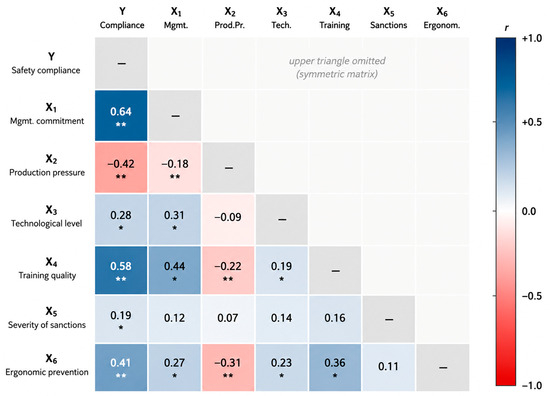
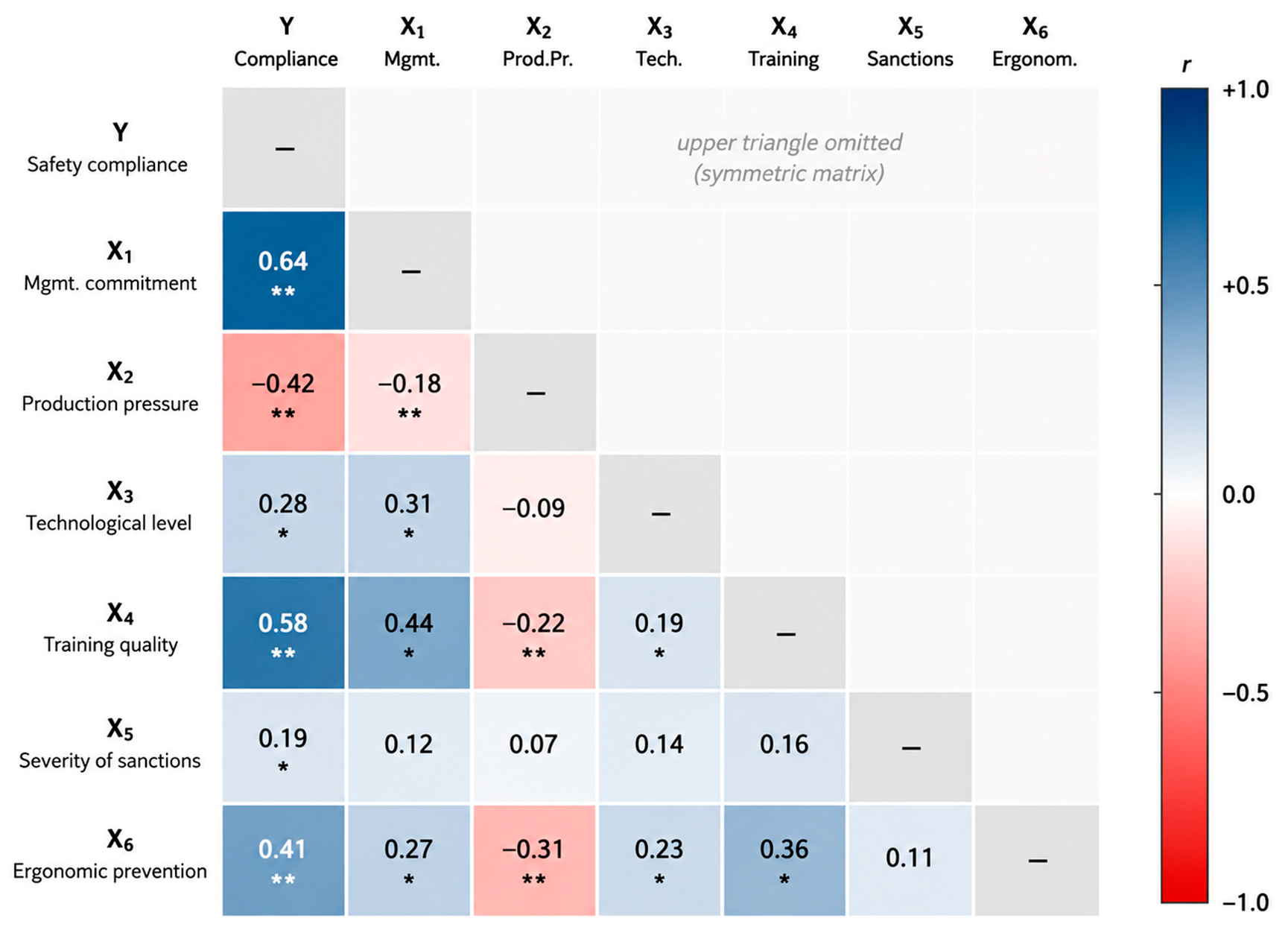
Safety compliance (Y) showed significant associations with all predictors examined (p < 0.05 or p < 0.01). The correlations among the predictors remained within a moderate range (|r| < 0.60), suggesting no severe multicollinearity. The pattern of bivariate associations is visualised in Figure 1, which presents the full lower-triangular correlation heatmap across all study variables.
Figure 1.
Pearson correlation heatmap of all study variables (n = 221). Only the lower triangle is shown; the upper triangle is omitted because the correlation matrix is symmetric (rij = rji). The intensity of the cell colour reflects the magnitude of the bivariate correlation coefficient (r): dark blue indicates strong positive correlations; dark red indicates strong negative correlations; near-white cells indicate weak or negligible associations. Diagonal cells (—) represent each variable’s self-correlation and are not informative. Significance markers are displayed within each cell. Note. * p < 0.05; ** p < 0.01. Cells without significance markers indicate p > 0.05 (not statistically significant). Y = Safety compliance; X1 = Management commitment; X2 = Production pressure; X3 = Technological safety level; X4 = Training quality; X5 = Severity of sanctions; X6 = Ergonomic prevention.
4.3. Multiple Linear Regression
Multiple linear regression analysis (OLS) was used to examine the predictors of safety compliance (Y). The general regression model was statistically significant (F(6, 214) = 59.01, p < 0.001) and explained 62.3% of the variance in safety compliance (R2 = 0.623; adjusted R2 = 0.612).
Diagnostic tests indicated that the regression model’s assumptions were satisfied. Multicollinearity was not a concern, as the VIF values ranged from 1.12 to 1.42. The Durbin–Watson statistic (1.98) did not indicate evidence of autocorrelation. Furthermore, the Breusch–Pagan test did not indicate heteroskedasticity (χ2 = 8.41, df = 6, p = 0.21).
4.4. Regression Coefficients
The estimated regression coefficients for the predictors of safety compliance are presented in Table 3.
Table 3.
Multiple regression results.
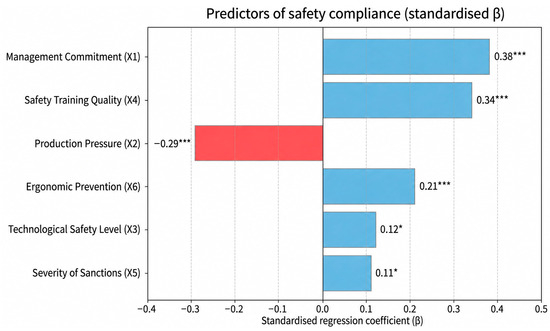
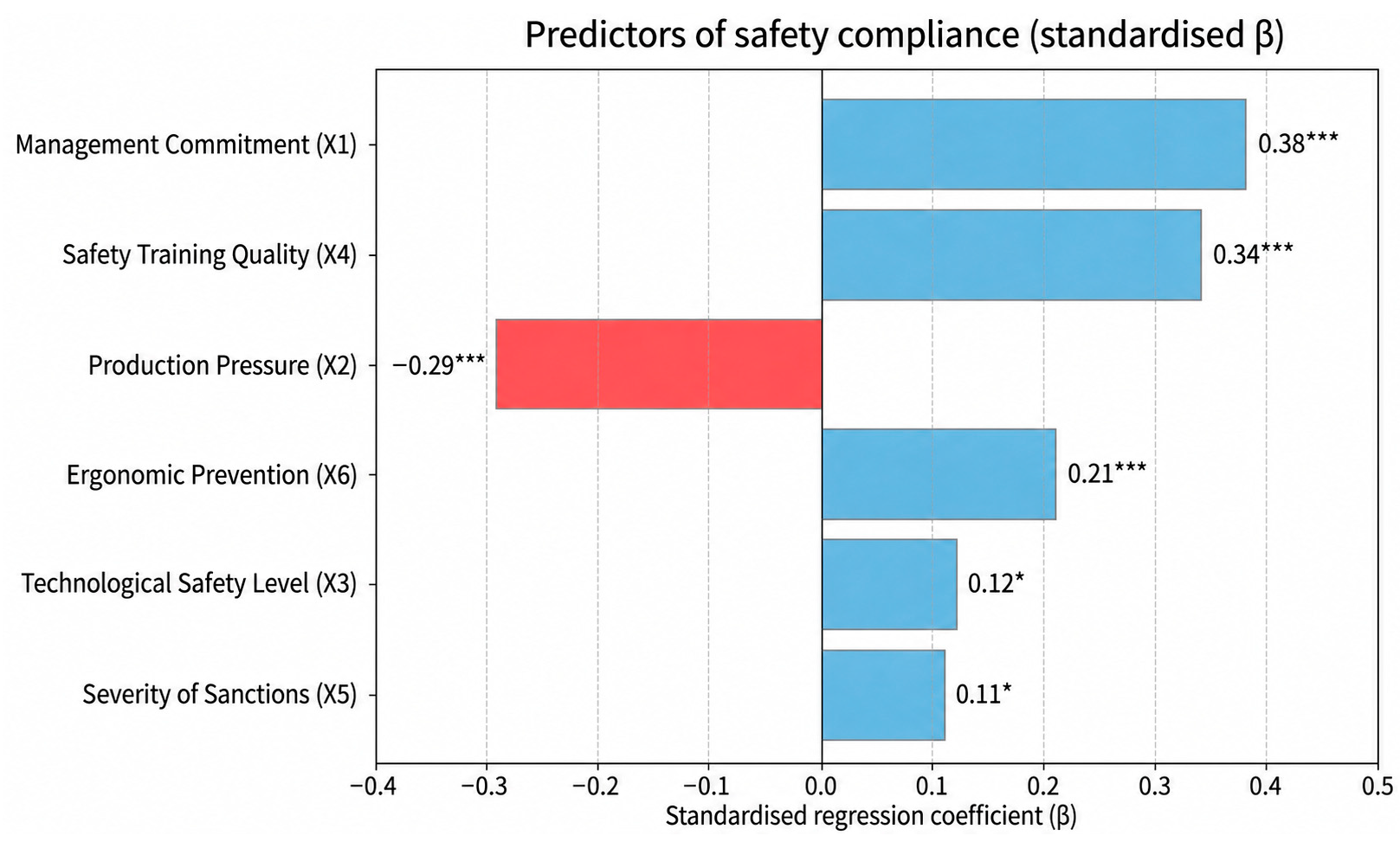
Management commitment (β = 0.38, p < 0.001) and training quality (β = 0.34, p < 0.001) emerged as the strongest positive predictors of safety compliance. In contrast, production pressure showed a significant negative relationship with safety compliance (β = −0.29, p < 0.001). The level of technological safety, the severity of sanctions and ergonomic prevention also showed statistically significant positive effects.
The relative magnitude of the standardised regression coefficients is illustrated in Figure 2.
Figure 2.
Standardised regression coefficients (β) for predictors of self-reported safety compliance in automotive JIT environments. * p < 0.05; *** p < 0.001.
According to the regression results, commitment to management (β = 0.38, p < 0.001) and training quality (β = 0.34, p < 0.001) were the strongest positive predictors. Production pressure showed a significant negative relationship with safety compliance (β = −0.29, p < 0.001). The level of technological safety (β = 0.12, p = 0.033), the severity of sanctions (β = 0.11, p = 0.049) and ergonomic prevention (β = 0.21, p < 0.001) also showed significant positive correlations (Table 3).
5. Discussion
5.1. Interpretation of Results
The results of the multivariate regression analysis show that a combination of organisational priorities and operating conditions shapes safety compliance in JIT-based automotive manufacturing environments. A single dominant factor does not determine safety behaviour; rather, it results from the interaction among management commitment, workplace organisation, and preventive workplace measures.
Among the predictors examined, management commitment and safety training showed the strongest positive correlations with safety compliance, whereas production pressure was negatively associated with rule-following behaviour. This pattern suggests that in high-paced production systems, safety behaviour is influenced not only by formal safety procedures but also by employees’ perceptions of productivity expectations and organisational safety priorities.
These findings can be interpreted in the broader literature on safety climate and organisational safety culture. Previous studies consistently emphasise that employees’ perceptions of management priorities play a central role in shaping safety-related behaviour [3,4]. In particular, safety climate research suggests that employees tend to align their behaviour with the priorities they perceive in managerial decision-making and daily supervisory practices.
The strong positive relationship between managerial commitment and safety compliance observed in the current study aligns with research on the safety climate [3,4]. When employees perceive that management actively supports safety goals, safety rules become an integral part of the job rather than an external constraint. Visible management support and consistent communication of safety priorities can therefore be key predictors of rule compliance in industrial settings.
The negative correlation between production pressure and safety compliance (β = −0.29) is consistent with the literature on the safety–productivity trade-off [10]. The results suggest that the time pressure in JIT systems may be a contextual factor that reinforces production priorities over safety protocols in employee decisions. This may be particularly relevant in a supplier environment where the failure of a single work process can affect the entire supply chain.
5.2. Theoretical Contribution
This study contributes to the literature on occupational safety and climate in several ways.
First, while previous research has typically examined safety-related factors in isolation, the present study integrates organisational, technological, and ergonomic predictors into a single multivariate model. The results demonstrate that safety compliance in high-pressure manufacturing environments is shaped by the combined effects of these factors rather than by any single dominant variable.
Second, the findings provide empirical support for the relative importance of supportive organisational mechanisms over purely control-based approaches. In particular, management commitment and training quality showed substantially stronger effects than sanction severity, suggesting that perceived organisational priorities more strongly influence safety compliance than formal enforcement mechanisms alone.
Third, including ergonomic prevention as a predictor extends existing safety compliance models. The results indicate that ergonomic conditions are not only relevant for occupational health outcomes but also shape behavioural compliance, thereby linking physical work environment factors with organisational safety behaviour.
In general, the study contributes to a more comprehensive understanding of safety compliance by demonstrating that the organisational, technological, and ergonomic dimensions jointly influence employees’ behaviour in JIT-based manufacturing systems.
5.3. Organisational Mechanisms of Safety Compliance
The positive correlation with technological safety levels may suggest that the presence of technical safeguards and protection systems may be associated with higher levels of compliance behaviour. This finding may be consistent with approaches that suggest that technological controls and organisational safety culture may be complementary factors in risk reduction [11,16].
The positive correlation with training quality may suggest that relevant, practice-oriented occupational safety training is associated with greater consistency in compliance with safety regulations [12].
The severity of sanctions showed a small but statistically significant positive correlation with safety compliance (β = 0.11; 95% CI [0.001; 0.22]). However, the lower limit of the confidence interval is close to zero, indicating limited stability of the effect. This is consistent with the approach of McCall and Pruchnicki [17], which highlights the difference between repressive and learning-oriented safety models.
All this suggests that sanctions cannot be the sole motivating factor, but rather a means of symbolically strengthening organisational norms [18].
5.4. Ergonomic Factors and Safety Compliance
The positive effect of ergonomic prevention is one of the study’s important findings. The results suggest that the physical stability of the work environment—for example, adapted workstations or load-reducing work organisation—can be interpreted not only as a health protection measure but also as an organisational condition for safety compliance. This is consistent with approaches suggesting that reducing physical strain can help maintain attention capacity and consistent adherence to safety protocols [26].
The significant positive effect of ergonomic prevention (X6) (β = 0.21) supports the neuroergonomic approach: reducing physical stressors not only prevents musculoskeletal disorders, but also frees up the employee’s cognitive resources (attention capacity). This allows mental representation and adherence to safety protocols to be maintained even under the critical pressure of a JIT environment.
Our findings, indicating that ergonomic prevention (X6) significantly improves rule compliance, are consistent with Industry 4.0 research, which views ergonomics as a key determinant of employee safety [29,30]. This complements the logic of Punnett and Wegman [43]: managing physical strain may be linked to rule compliance not for its own sake, but through the protection of attention capacity. If this correlation is also evident in longitudinal studies, ergonomic prevention could become an integrated, rather than peripheral, element of JIT safety management.
5.5. Ergonomics and Employee Sustainability in Industry 4.0
From a broader perspective, these results can also be interpreted in light of the growing attention to employee sustainability in Industry 4.0 and advanced manufacturing systems.
In the Industry 4.0 environment, technological developments often focus on automation, digital monitoring, and data-driven optimisation. However, recent research shows that the sustainability of production systems also depends on the physical and cognitive stability of the workforce [44,45].
From this perspective, ergonomic design and preventive interventions can be considered components of sustainable work systems, rather than as merely occupational health measures. Adapted workstations, task rotation, and workload management can help maintain workers’ physical capacity and attention in fast-paced production environments. In JIT-based manufacturing systems, where production interruptions can have a cascading effect on the supply chain, this stability indirectly supports both safety compliance and operational reliability.
As a result, ergonomic prevention can serve as an important bridge between traditional workplace safety management and the emerging concept of Industry 4.0 systems centred on humans [46].
In general, the results suggest that a combination of organisational and work-organisation factors primarily drives safety compliance in JIT-based manufacturing systems. Managerial commitment and training quality showed a strong positive relationship with compliance. At the same time, the negative effect of production pressure suggests that the balance between performance expectations and safety goals plays a decisive role in shaping safety behaviour [47].
The results also indicate that control mechanisms based solely on sanctions are not sufficient on their own in complex manufacturing environments. In contrast, the integrated application of managerial support, practice-oriented training, and ergonomic prevention can contribute to the development of more stable safety behaviour in high-pressure production systems [48].
The results are consistent with the prevention-oriented frameworks of ISO 45001:2018 [49] and ILO C155 [50], which emphasise the primacy of organisational and managerial factors; the data also indicate that approaches based solely on sanctions are not sufficient on their own to manage safety risks in JIT-based production environments.
6. Limitations and Future Research Directions
6.1. Methodological Limitations
The research has several methodological limitations. The cross-sectional design does not allow clear identification of causal relationships, so the directionality of the observed correlations requires further investigation. In addition, data collection used a self-reported questionnaire, which carries the potential for bias arising from subjective perceptions. The sample was limited to the automotive supplier environment of a specific geographical region, so the generalisability of the results to other industries or different organisational contexts requires further empirical investigation.
6.2. Limitations of Neuroergonomic Explanations
The neuroergonomic approach—in particular, the presumed role of mental workload, attentional capacity, and stress responses—serves primarily as a theoretical interpretative framework in this study.
The study did not include neurophysiological or biomarker-based measurements, such as cortisol levels and working memory performance [51] or stress and prefrontal cortex dysfunction [52]. Therefore, the presumed cognitive mechanisms linking physical exertion and decision-making cannot be directly examined based on the database.
Consequently, neuroergonomic explanations are hypothetical, and their empirical testing—using objective physiological and cognitive indicators—is a task for future research.
6.3. Future Research Directions
More research is needed to explore whether these relationships also exist in other industries or organisational contexts.
Longitudinal studies would allow analysis of the temporal dynamics of relationships between safety compliance and organisational factors. Inclusion of actual violation data, incident reports, or occupational safety audits could reduce the bias inherent in self-reported data.
Further research could examine the relationship between mental workload and safety decisions by incorporating physiological or cognitive indicators to test the predictions of neuroergonomic theories [27]. In addition, multilevel analysis models could allow for the separation of individual and organisational level effects in explaining safety behaviour [53].
Despite these limitations, the study provides empirical insights into the combined roles of organisational and ergonomic factors in influencing safety compliance in JIT-based manufacturing systems.
7. Conclusions
This study examined organisational and contextual predictors of safety compliance in automotive just-in-time (JIT) manufacturing environments. Using a multivariate regression model, the analysis revealed that management commitment and the quality of safety training are the strongest positive predictors of safety compliance. In contrast, production pressure is negatively associated with rule-following behaviour.
The results indicate that safety behaviour in high-pressure manufacturing environments is not determined by a single factor, but rather by the interaction of organisational priorities, work organisation, and preventive measures. In particular, the positive relationship between ergonomic prevention and safety compliance suggests that physical working conditions can play an important supporting role in maintaining safe behaviour in demanding production environments.
In conclusion, the findings suggest that safety compliance in JIT-based manufacturing environments is primarily driven by organisational priorities and working conditions rather than by control mechanisms alone. The results highlight that supportive management practices, effective training systems, and ergonomic work design play a central role in shaping safe behaviour, while excessive production pressure may undermine compliance.
These insights reinforce the need for integrated safety management approaches that align organisational culture, operational practices, and human factors to ensure both safety and performance in complex industrial systems.
Author Contributions
Conceptualisation, Z.N., K.H. and K.N.; methodology, Z.N., K.H. and K.N.; software, Z.N., K.H. and K.N.; validation, Z.N., K.H. and K.N.; formal analysis, Z.N., K.H. and K.N.; investigation, Z.N., K.H. and K.N.; resources, Z.N., K.H. and K.N.; data curation, Z.N., K.H. and K.N.; writing—original draft preparation, K.H., Z.N. and K.N.; writing—review and editing, K.H. and K.N.; visualisation, K.H. and K.N.; supervision, Z.N., K.H. and K.N.; project administration, Z.N., K.H. and K.N.; funding acquisition, Z.N. All authors have read and agreed to the published version of the manuscript.
Funding
This research received no external funding. The APC was funded by Széchenyi István University.
Institutional Review Board Statement
The study was conducted in accordance with the Declaration of Helsinki (1975, revised in 2013). The ethical aspects of the research were reviewed by the Science Ethics Committee of the Scientific Advisory Board at Széchenyi István University (Decision No. SZE/ETT-40/2026, 17 March 2026). The Committee confirmed that the study complied with applicable ethical standards and authorised the publication of the research.
Informed Consent Statement
Informed consent was obtained from all participants involved in the study. Participation was voluntary, and the questionnaire was completed anonymously.
Data Availability Statement
The aggregated dataset supporting the findings of this study is not publicly available due to confidentiality agreements with the participating companies, which prohibit the disclosure of identifiable organisational data. The anonymised item-level summary statistics and correlation matrix are presented in the manuscript (Table 1 and Table 2). Further inquiries regarding the data may be directed to the corresponding author.
Conflicts of Interest
The authors declare no conflicts of interest.
Abbreviations
The following abbreviations are used in this manuscript:
| JIT | Just-in-Time |
| OLS | Ordinary Least Squares |
| CMB | Common Method Bias |
| VIF | Variance Inflation Factor |
| NOSACQ | Nordic Occupational Safety Climate Questionnaire |
| IATF | International Automotive Task Force |
| GDPR | General Data Protection Regulation |
| SD | Standard Deviation |
| CI | Confidence Interval |
References
- Jum’a, L.; Qamardin, S.; Ikram, M. Developing Resilience Strategies amid Supply Chain Risks in the Automotive Industry: A Stakeholder Theory Perspective. Bus. Strategy Environ. 2024, 33, 9197–9213. [Google Scholar] [CrossRef] [Scilit]
- Sutherland, J.W.; Richter, J.S.; Hutchins, M.J.; Dornfeld, D.; Dzombak, R.; Mangold, J.; Robinson, S.; Hauschild, M.Z.; Bonou, A.; Schönsleben, P.; et al. The Role of Manufacturing in Affecting the Social Dimension of Sustainability. CIRP Ann. 2016, 65, 689–712. [Google Scholar] [CrossRef] [Scilit]
- Zohar, D. Thirty Years of Safety Climate Research: Reflections and Future Directions. Accid. Anal. Prev. 2010, 42, 1517–1522. [Google Scholar] [CrossRef] [Scilit]
- Christian, M.S.; Bradley, J.C.; Wallace, J.C.; Burke, M.J. Workplace Safety: A Meta-Analysis of the Roles of Person and Situation Factors. J. Appl. Psychol. 2009, 94, 1103–1127. [Google Scholar] [CrossRef] [Scilit]
- Zhang, J.; Zhang, F.; Liu, S.; Zhou, Q. Enhancing Work Safety Behavior through Supply Chain Safety Management in Small and Medium Sized Manufacturing Suppliers. Sci. Rep. 2024, 14, 22667. [Google Scholar] [CrossRef] [Scilit] [PubMed]
- Kabiesz, P.; Tutak, M. Developing a Culture of Safety for Sustainable Development and Public Health in Manufacturing Companies—A Case Study. Sustainability 2024, 16, 7557. [Google Scholar] [CrossRef] [Scilit]
- Pedrosa, M.H.; Salazar, A.K.; Cardoso, C.; Guedes, J.C. Study on Safety Culture Following the Implementation of a Near-Miss Management System in the Traditional Manufacturing Industry. Safety 2025, 11, 23. [Google Scholar] [CrossRef] [Scilit]
- Chari, A.; Niedenzu, D.; Despeisse, M.; Machado, C.G.; Azevedo, J.D.; Boavida-Dias, R.; Johansson, B. Dynamic Capabilities for Circular Manufacturing Supply Chains—Exploring the Role of Industry 4.0 and Resilience. Bus. Strategy Environ. 2022, 31, 2500–2517. [Google Scholar] [CrossRef] [Scilit]
- Fonseca, L.; Carvalho, F. The Reporting of SDGs by Quality, Environmental, and Occupational Health and Safety-Certified Organizations. Sustainability 2019, 11, 5797. [Google Scholar] [CrossRef] [Scilit]
- Hofmann, D.A.; Stetzer, A. A cross-level investigation of factors influencing unsafe behaviors and accidents. Pers. Psychol. 1996, 49, 307–339. [Google Scholar] [CrossRef] [Scilit]
- Reason, J. Managing the Risks of Organizational Accidents, 1st ed.; Routledge: Milton Park, UK, 2016. [Google Scholar]
- Burke, M.J.; Sarpy, S.A.; Smith-Crowe, K.; Chan-Serafin, S.; Salvador, R.O.; Islam, G. Relative Effectiveness of Worker Safety and Health Training Methods. Am. J. Public Health 2006, 96, 315–324. [Google Scholar] [CrossRef] [Scilit]
- Demir, P.; Gul, M.; Guneri, A.F. Evaluating Occupational Health and Safety Service Quality by SERVQUAL: A Field Survey Study. Total Qual. Manag. Bus. Excell. 2020, 31, 524–541. [Google Scholar] [CrossRef] [Scilit]
- Breier, A.; Pickar, D.; Zahn, T.; Albus, M.; Wolkowitz, O.; Paul, S. Controllable and Uncontrollable Stress in Humans: Alterations in Mood and Neuroendocrine and Psychophysiological Function. Am. J. Psychiatry 1987, 144, 1419–1425. [Google Scholar] [CrossRef] [Scilit] [PubMed]
- Li, J.; Yang, Z.; He, H.; Guo, C.; Chen, Y.; Zhang, Y. Risk Causation Analysis and Prevention Strategy of Working Fluid Systems Based on Accident Data and Complex Network Theory. Reliab. Eng. Syst. Saf. 2024, 252, 110445. [Google Scholar] [CrossRef] [Scilit]
- Shrivastava, P. Technological and Organizational Roots of Industrial Crises: Lessons from Exxon Valdez and Bhopal. Technol. Forecast. Soc. Change 1994, 45, 237–253. [Google Scholar] [CrossRef] [Scilit]
- McCall, J.R.; Pruchnicki, S. Just Culture: A Case Study of Accountability Relationship Boundaries Influence on Safety in HIGH-Consequence Industries. Saf. Sci. 2017, 94, 143–151. [Google Scholar] [CrossRef] [Scilit]
- Hale, A.; Borys, D. Working to Rule or Working Safely? Part 2: The Management of Safety Rules and Procedures. Saf. Sci. 2013, 55, 222–231. [Google Scholar] [CrossRef] [Scilit]
- Di Bona, G.; Silvestri, A.; De Felice, F.; Forcina, A.; Petrillo, A. An Analytical Model to Measure the Effectiveness of Safety Management Systems: Global Safety Improve Risk Assessment (G-SIRA) Method. J. Fail. Anal. Prev. 2016, 16, 1024–1037. [Google Scholar] [CrossRef] [Scilit]
- Makin, A.-M.; Winder, C. A New Conceptual Framework to Improve the Application of Occupational Health and Safety Management Systems. Saf. Sci. 2008, 46, 935–948. [Google Scholar] [CrossRef] [Scilit]
- Sivakumaran, K.; Ritonja, J.A.; Waseem, H.; AlShenaiber, L.; Morgan, E.; Ahmadi, S.A.; Denning, A.; Michaud, D.; Morgan, R.L. Impact of Noise Exposure on Risk of Developing Stress-Related Metabolic Effects: A Systematic Review and Meta-Analysis. Noise Health 2022, 24, 215–230. [Google Scholar] [CrossRef] [Scilit]
- Lipat, A.L.; Peterson, J.A.; Clark, D.J.; Cruz-Almeida, Y. Decreased Cognitive Function Is Associated with Impaired Spatiotemporal Gait Performance in Community Dwelling Older Adults with Chronic Musculoskeletal Pain. Brain Cogn. 2022, 159, 105862. [Google Scholar] [CrossRef] [Scilit] [PubMed]
- Salminen, S. Have Young Workers More Injuries than Older Ones? An International Literature Review. J. Saf. Res. 2004, 35, 513–521. [Google Scholar] [CrossRef] [Scilit]
- Pousette, A.; Larsson, S.; Törner, M. Safety Climate Cross-Validation, Strength and Prediction of Safety Behaviour. Saf. Sci. 2008, 46, 398–404. [Google Scholar] [CrossRef] [Scilit]
- Nagy, Z.; Hokstok, K. The Challenges of Dual Education and the Role of Resilience in the Balance Between Learning and Work. Soc. Sci. 2025, 15, 15. [Google Scholar] [CrossRef] [Scilit]
- Wickens, C.D. Multiple Resources and Performance Prediction. Theor. Issues Ergon. Sci. 2002, 3, 159–177. [Google Scholar] [CrossRef] [Scilit]
- Parasuraman, R.; Christensen, J.; Grafton, S. Neuroergonomics: The Brain in Action and at Work. NeuroImage 2012, 59, 1–3. [Google Scholar] [CrossRef] [Scilit]
- Alyan, E.; Saad, N.M.; Kamel, N.; Rahman, M.A. Workplace Design-Related Stress Effects on Prefrontal Cortex Connectivity and Neurovascular Coupling. Appl. Ergon. 2021, 96, 103497. [Google Scholar] [CrossRef] [Scilit]
- Poot, L.P.; Scurati, G.W. Extended Reality-Assisted Risk Assessment in Conceptual Product Development. In Proceedings of the Collaborative Networks in Digitalization and Society 5.0; Camarinha-Matos, L.M., Boucher, X., Ortiz, A., Eds.; Springer Nature: Cham, Switzerland, 2023; pp. 269–281. [Google Scholar]
- Giussani, R.; Scurati, G.W.; Frank, B.; Ferrise, F.; Bertoni, M. Decision-Making with eXtended Reality and Artificial Intelligence: Practitioner-Informed Design Guidelines for Decision Support Systems. J. Eng. Des. 2026, 1–17, ahead of print. [Google Scholar] [CrossRef] [Scilit]
- Deshpande, B.; Girme, A. Sampling Techniques. Adv. Appl. Math. Sci. 2019, 18, 1055–1062. [Google Scholar]
- Tabachnick, B.G.; Fidell, L.S. Using Multivariate Statistics, 7th ed.; Always Learning; Pearson: New York, NY, USA, 2019. [Google Scholar]
- Központi Statisztikai Hivatal (KSH). 20.1.1.8. A Foglalkoztatottak Száma Nemzetgazdasági Ágak Szerint, Nemenként 2024. Available online: https://www.ksh.hu/stadat_files/mun/hu/mun0009.html (accessed on 20 February 2026).
- Faul, F.; Erdfelder, E.; Lang, A.-G.; Buchner, A. G*Power 3: A Flexible Statistical Power Analysis Program for the Social, Behavioral, and Biomedical Sciences. Behav. Res. Methods 2007, 39, 175–191. [Google Scholar] [CrossRef] [Scilit]
- Kines, P.; Lappalainen, J.; Mikkelsen, K.L.; Olsen, E.; Pousette, A.; Tharaldsen, J.; Tómasson, K.; Törner, M. Nordic Safety Climate Questionnaire (NOSACQ-50): A New Tool for Diagnosing Occupational Safety Climate. Int. J. Ind. Ergon. 2011, 41, 634–646. [Google Scholar] [CrossRef] [Scilit]
- Agbo, A.A. Cronbach’s Alpha: Review of Limitations and Associated Recommendations. J. Psychol. Afr. 2010, 20, 233–239. [Google Scholar] [CrossRef] [Scilit]
- Podsakoff, P.M.; MacKenzie, S.B.; Lee, J.-Y.; Podsakoff, N.P. Common Method Biases in Behavioral Research: A Critical Review of the Literature and Recommended Remedies. J. Appl. Psychol. 2003, 88, 879–903. [Google Scholar] [CrossRef] [Scilit] [PubMed]
- Spector, P.E. Method Variance in Organizational Research: Truth or Urban Legend? Organ. Res. Methods 2006, 9, 221–232. [Google Scholar] [CrossRef] [Scilit]
- Field, A. Discovering Statistics Using IBM SPSS Statistics: And Sex and Drugs and Rock “n” Roll, 4th ed.; MobileStudy; Sage: Los Angeles, CA, USA; London, UK; New Delhi, India; Singapore; Washington DC, USA, 2013. [Google Scholar]
- Greene, W. Econometric Analysis, 8th ed.; Pearson: New York, NY, USA, 2018. [Google Scholar]
- Hair, J.F.; Risher, J.J.; Sarstedt, M.; Ringle, C.M. When to Use and How to Report the Results of PLS-SEM. Eur. Bus. Rev. 2019, 31, 2–24. [Google Scholar] [CrossRef] [Scilit]
- Sun, Y.; Wang, X. An Asymptotically F-Distributed Chow Test in the Presence of Heteroscedasticity and Autocorrelation. Econom. Rev. 2022, 41, 177–206. [Google Scholar] [CrossRef] [Scilit]
- Punnett, L.; Wegman, D.H. Work-Related Musculoskeletal Disorders: The Epidemiologic Evidence and the Debate. J. Electromyogr. Kinesiol. 2004, 14, 13–23. [Google Scholar] [CrossRef] [Scilit]
- Bucci, I.; Fani, V.; Bandinelli, R. Towards Human-Centric Manufacturing: Exploring the Role of Human Digital Twins in Industry 5.0. Sustainability 2024, 17, 129. [Google Scholar] [CrossRef] [Scilit]
- Hammad, M.Y.; Rahamaddulla, S.R.; Muhamad Tamyez, P.F.; Fauzi, M.A. From Industry 4.0 to 5.0: Leveraging AI and IoT for Sustainable and Human-Centric Operations. Int. J. Ind. Eng. Oper. Manag. 2025, 1–19, ahead of print. [Google Scholar] [CrossRef] [Scilit]
- Firescu, V.; Filip, D. Human Factors and Ergonomics in Sustainable Manufacturing Systems: A Pathway to Enhanced Performance and Wellbeing. Machines 2025, 13, 595. [Google Scholar] [CrossRef] [Scilit]
- Płaza, G.; Kabiesz, P.; Thatcher, A.; Jamil, T. Ergonomics/Human Factors in the Era of Smart and Sustainable Industry: Industry 4.0/5.0. Manag. Syst. Prod. Eng. 2025, 33, 229–238. [Google Scholar] [CrossRef] [Scilit]
- Ruiz-de-la-Torre-Acha, A.; Borregan-Alvarado, J.; Guevara-Ramirez, W.; Pikatza-Gorrotxategi, N. Human-Centered Simulation in Educational Production Line for Industry 5.0 Ergonomics Application. In Proceedings of the 17th International Conference on Industrial Engineering and Industrial Management (ICIEIM)—XXVII Congreso de Ingeniería de Organización (CIO2023); Bautista-Valhondo, J., Mateo-Doll, M., Lusa, A., Pastor-Moreno, R., Eds.; Springer Nature: Cham, Switzerland, 2024; Volume 206, pp. 427–431. [Google Scholar]
- ISO 45001:2018; Occupational Health and Safety Management Systems—Requirements with Guidance for Use. International Organization for Standardization: Geneva, Switzerland, 2018.
- ILO C155; Convention Concerning Occupational Safety and Health and the Working Environment. International Labour Organization: Geneva, Switzerland, 1981.
- Al’Absi, M.; Hugdahl, K.; Lovallo, W.R. Adrenocortical Stress Responses and Altered Working Memory Performance. Psychophysiology 2002, 39, 95–99. [Google Scholar] [CrossRef]
- Arnsten, A.F.T. Stress Signalling Pathways That Impair Prefrontal Cortex Structure and Function. Nat. Rev. Neurosci. 2009, 10, 410–422. [Google Scholar] [CrossRef] [Scilit]
- Hox, J.J.; Moerbeek, M.; Van De Schoot, R. Multilevel Analysis: Techniques and Applications, 3rd ed.; Routledge: New York, NY, USA, 2017. [Google Scholar]

Disclaimer/Publisher’s Note: The statements, opinions and data contained in all publications are solely those of the individual author(s) and contributor(s) and not of MDPI and/or the editor(s). MDPI and/or the editor(s) disclaim responsibility for any injury to people or property resulting from any ideas, methods, instructions or products referred to in the content. |
© 2026 by the authors. Licensee MDPI, Basel, Switzerland. This article is an open access article distributed under the terms and conditions of the Creative Commons Attribution (CC BY) license.