
This is an early access version, the complete PDF, HTML, and XML versions will be available soon.
Article

Large Language Models Meet Gynecologic Ultrasound: Advancing the Characterization of ADNEXal Masses

1
Department of Interdisciplinary Medicine (DIM), University of Bari “Aldo Moro”, 70124 Bari, Italy
2
Gynecologic Oncology Unit, IRCCS Istituto Tumori “Giovanni Paolo II”, 70124 Bari, Italy
3
Translational Biomedicine and Neuroscience Department (DiBraIn), University of Bari “Aldo Moro”, Polyclinic of Bari, 70124 Bari, Italy
4
SSD Radiologia Senologia, IRCCS Istituto Tumori “Giovanni Paolo II”, 70124 Bari, Italy
5
Unit of Obstetrics and Gynecology, Department of Interdisciplinary Medicine (DIM), University of Bari “Aldo Moro”, Polyclinic of Bari, 70124 Bari, Italy
*
Author to whom correspondence should be addressed.
J. Imaging 2026, 12(9), 462; https://doi.org/10.3390/jimaging12090462 (registering DOI)

Submission received: 25 July 2026 / Revised: 14 September 2026 / Accepted: 15 September 2026 / Published: 21 September 2026

Abstract

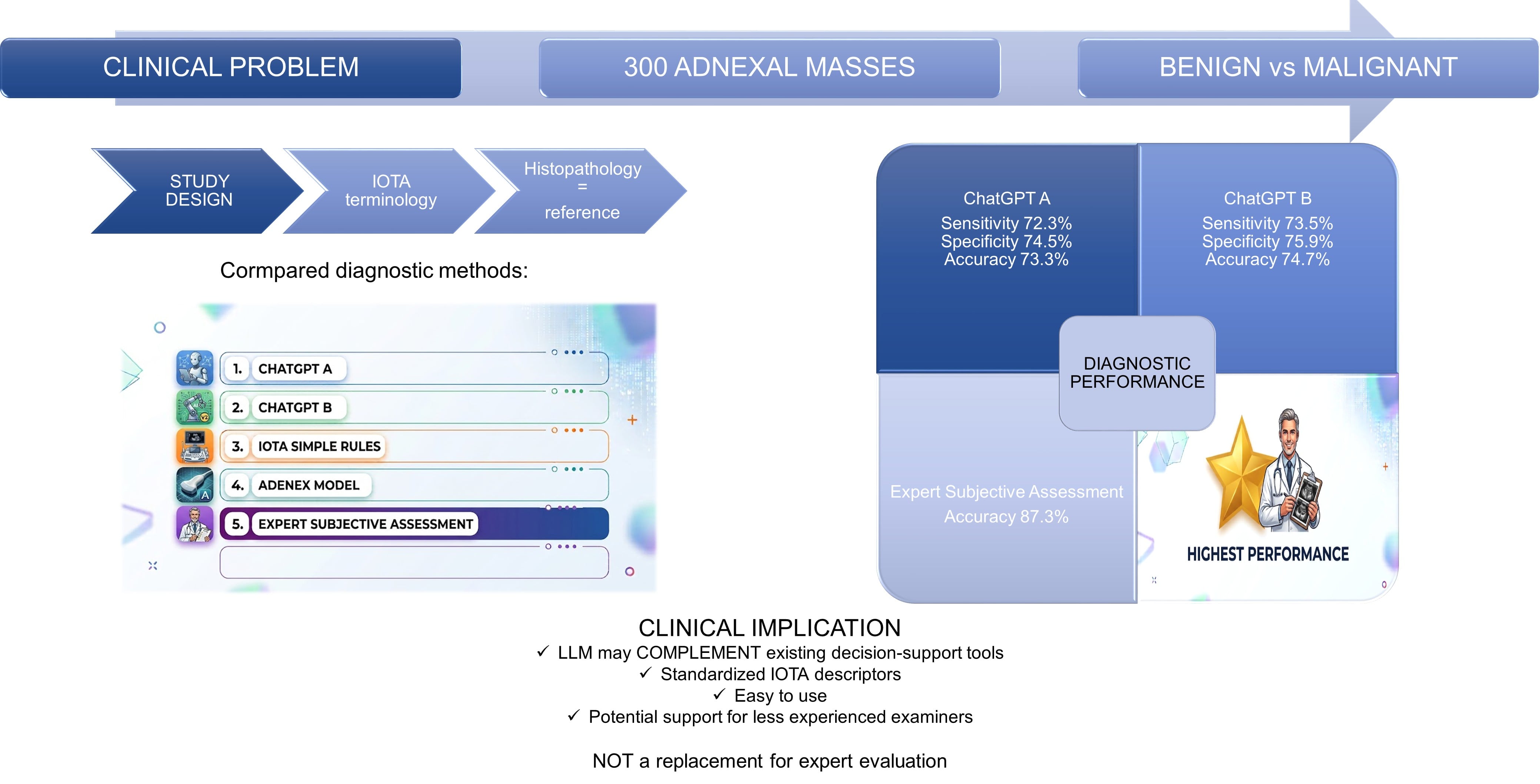
Ovarian cancer (OC) is the second most common gynecological malignancy and remains one of the leading causes of gynecological cancer-related mortality worldwide. A major clinical challenge is the lack of an accurate and widely applicable strategy for identifying patients at high risk of malignancy at an early stage. In this context, artificial intelligence (AI) has emerged as a promising tool to improve diagnostic performance. Among AI technologies, large language models (LLMs) have recently shown considerable potential in healthcare applications. In this study, we evaluated the diagnostic performance of ChatGPT (GPT-5) in classifying 300 adnexal masses as benign or malignant and compared its performance with that of the IOTA Simple Rules, the ADNEX model, and expert subjective assessment. We also assessed ChatGPT’s ability to predict the most likely histological diagnosis for each lesion. All adnexal masses were described using the International Ovarian Tumor Analysis (IOTA) terminology, and histopathological examination served as the reference standard. Our findings showed that expert subjective assessment achieved the highest overall diagnostic performance for both benign/malignant classification (accuracy 87.3%; 95% CI, 83.0–90.9%) and prediction of the presumed histological diagnosis. ChatGPT A and ChatGPT B reached a sensitivity of 72.3% and 73.5%, a specificity of 74.5% and 75.9%, a positive predictive value of 75.2% and 76.5%, and a negative predictive value of 71.5% and 72.8%, respectively (inconclusive responses counted as misclassifications), with an overall accuracy of 73.3% and 74.7%. After adequate validation, large language models might complement existing decision-support tools for less experienced examiners, without replacing expert evaluation. Their ease of use and reliance on standardized ultrasound descriptors make them accessible to ultrasonographers with varying levels of expertise.
Keywords: ultrasound; ovarian cancer; artificial intelligence; large language models; ChatGPT ultrasound; ovarian cancer; artificial intelligence; large language models; ChatGPT
Graphical Abstract