


Abstract
Segment Anything Model (SAM)-based few-shot segmentation models traditionally rely solely on annotated reference images as prompts, which inherently limits their accuracy due to an over-reliance on visual cues and a lack of semantic context. This reliance leads to incorrect segmentation, where visually similar objects from different categories are incorrectly identified as the target object. We propose Vision and Language Reference Prompt into SAM (VLP-SAM), a novel few-shot segmentation model that integrates both visual information of reference images and semantic information of text labels into SAM. VLP-SAM introduces a vision-language model (VLM) with pixel–text matching into the prompt encoder for SAM, effectively leveraging textual semantic consistency while preserving SAM’s extensive segmentation knowledge. By incorporating task-specific structures such as an attention mask, our model achieves superior few-shot segmentation performance with only 1.4 M learnable parameters. Evaluations on PASCAL-5i and COCO-20i datasets demonstrate that VLP-SAM significantly outperforms previous methods by 6.8% and 9.3% in mIoU, respectively. Furthermore, VLP-SAM exhibits strong generalization across unseen objects and cross-domain scenarios, highlighting the robustness provided by textual semantic guidance. This study offers an effective and scalable framework for few-shot segmentation with multimodal prompts.
1. Introduction
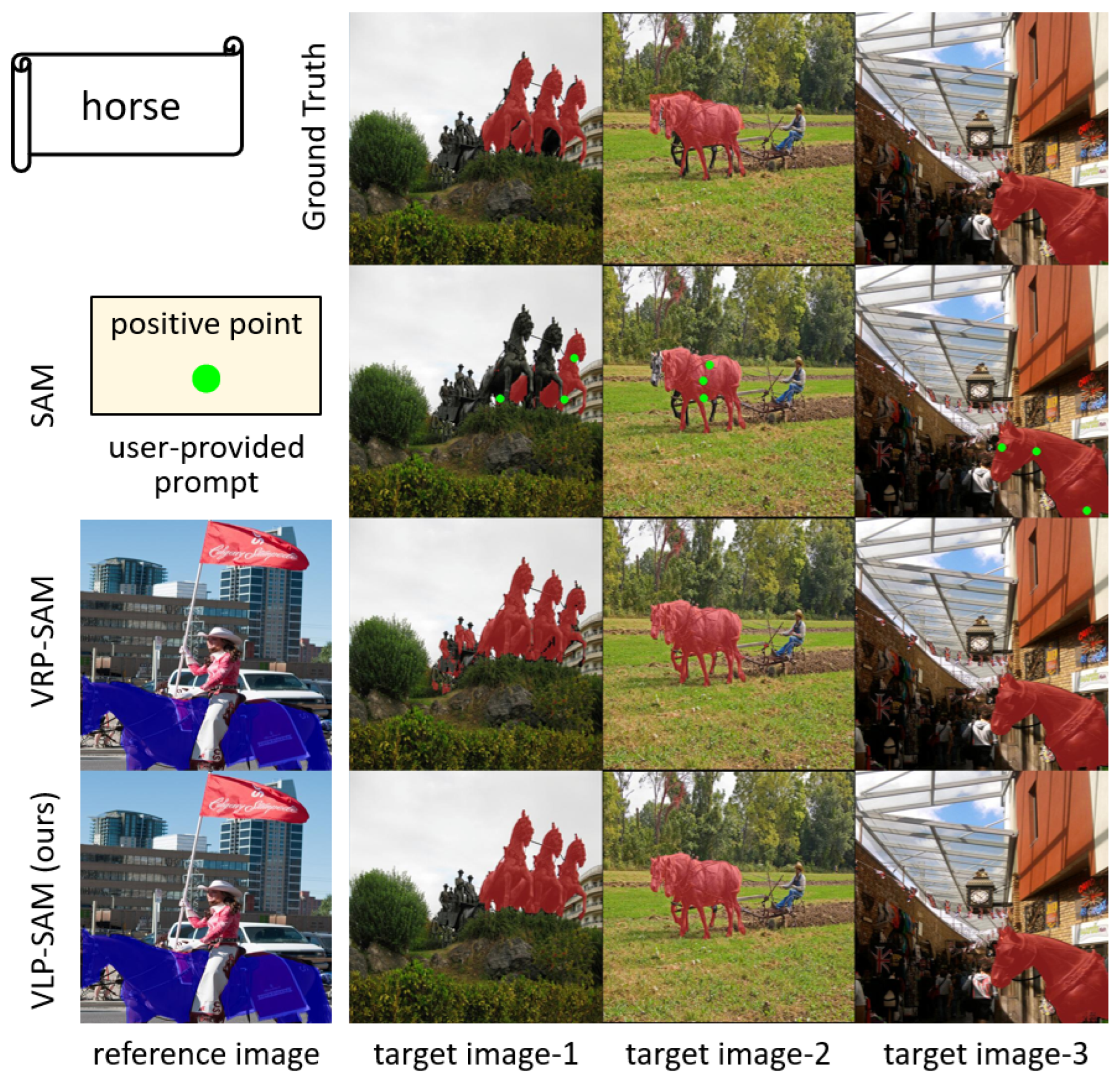
In recent years, the Segment Anything Model (SAM) [1] has emerged as a foundational image segmentation model trained on a large dataset with a billion mask labels. SAM has powerful zero-shot capabilities that can segment any object in a target image by taking user-provided prompts consisting of points, bounding boxes, or coarse masks. However, as shown in Figure 1, user-provided prompts require the user’s comprehensive understanding of the target objects, and different customized prompts are needed for each target image. Furthermore, SAM outputs category-agnostic masks, limiting its usability in real-world applications.
Figure 1.
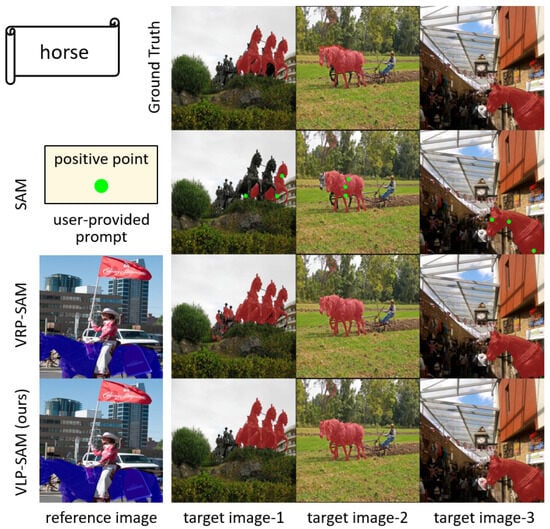
Visualization results of our proposed method VLP-SAM compared to SAM [1] and VRP-SAM [2]. VLP-SAM segments target objects by inputting a reference image and a text label (e.g., “horse”) instead of user-provided prompts.
Few-shot segmentation models [2,3,4,5] addressed these issues by inputting a few annotated reference images as prompts to SAM and can segment specific objects in target images without user-provided prompts. Based on the pixel-level similarity between annotated reference images and target images, few-shot segmentation models segment target objects of the same category as the reference images. On the other hand, previous SAM-based few-shot segmentation models only use annotated reference images as prompts and lack semantic information. Importantly, relying purely on visual similarity causes a “semantic gap,” where the model fails when segmenting objects that are visually similar but semantically different.
In this work, we propose a novel few-shot segmentation model, Vision and Language Reference Prompt into SAM (VLP-SAM), that inputs not only reference images but also text labels as prompts to SAM. By using text information, VLP-SAM can leverage not only the visual similarity between annotated reference images and target images but also the semantic similarity between text labels and target objects. For example, as shown in Figure 1, the previous few-shot segmentation model VRP-SAM [2] segments the different objects, such as a human figure visually similar to the horse in target image-1, because it relies solely on the visual similarity of the reference image. On the other hand, VLP-SAM captures the semantic similarity by inputting the text label, and accurately segments only “horse”.
In particular, VLP-SAM introduces an efficient and scalable architecture that trains a new prompt encoder for SAM, termed the VLP encoder, with only 1.4 M learnable parameters. This encoder integrates a multimodal vision-language model (VLM) to generate prompt embeddings from a target image, an annotated reference image, and a text label. Specifically, we employ a VLM with pixel–text matching, such as CLIP Surgery [6], rather than standard CLIP [7], which is trained solely on global CLS tokens. This approach facilitates the fine-grained, pixel-level localization required for precise segmentation. To further refine the semantic information of target objects, the VLP encoder incorporates two novel components: the textual prototype and the attention mask. Specifically, the textual prototype provides global semantic guidance by injecting class-specific features to identify what the target object is, while the attention mask acts as a semantic spatial mask providing local guidance to highlight where class-relevant regions are located. These components extract high-level semantic guidance from the text label, thereby significantly boosting accuracy even with minimal learnable parameters. Finally, the prompt embeddings created by the VLP encoder are input to the SAM’s mask decoder, allowing the VLP-SAM to segment target objects without user-provided prompts.
To demonstrate the effectiveness of VLP-SAM, we conducted experiments on the PASCAL- [8] and COCO- [9] datasets. Our experimental results show that VLP-SAM significantly outperforms the previous model by a large margin ( and in mIoU, respectively) in a few-shot segmentation task. Furthermore, VLP-SAM exhibits superior generalization capability across unseen objects and cross-domain scenarios, and its effectiveness is further validated through qualitative visualizations and extensive ablation studies.
The main contributions are summarized as follows:
- We propose Vision and Language Reference Prompt into SAM (VLP-SAM), which is the first SAM-based few-shot segmentation model to integrate both textual labels and visual reference images.
- We design an innovative prompt encoder, VLP encoder, that integrates a pixel–text matching VLM to incorporate textual prototypes and attention masks with minimal learnable parameters.
- We demonstrate that VLP-SAM outperforms previous models by a large margin in unseen objects and cross-domain scenarios. Furthermore, we validate the effectiveness of our approach through qualitative visualizations and extensive ablation studies.
2. Related Work
This paper proposes a new few-shot segmentation model, VLP-SAM, which inputs not only reference images but also text labels as prompts to SAM. First, this section summarizes the relevant research on SAM and its extended models. Next, regarding SAM-based few-shot segmentation models, since various studies have already been reported, an overview of the entire body of prior studies in this field is described. Finally, we provide an overview of the multimodal visual-language models (VLMs) introduced in this research and summarize related studies.
2.1. Segment Anything Model
The Segment Anything Model (SAM) [1] is a category-agnostic interactive segmentation model trained on a large-scale SA-1B dataset containing over 1 billion masks. SAM shows powerful zero-shot capabilities for new objects without additional training by taking user-provided prompts consisting of points, bounding boxes, or coarse masks. Due to its generality, SAM has been applied in diverse research areas [10,11,12,13,14,15,16,17]. In particular, recent segmentation models [18,19,20,21] have also advanced the general-purpose segmentation field and further broadened the context of our work.
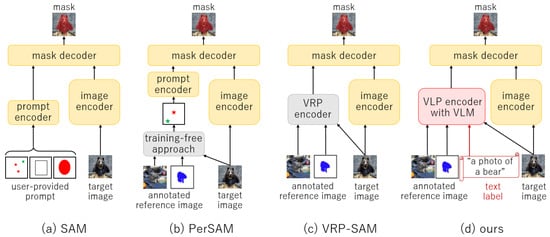
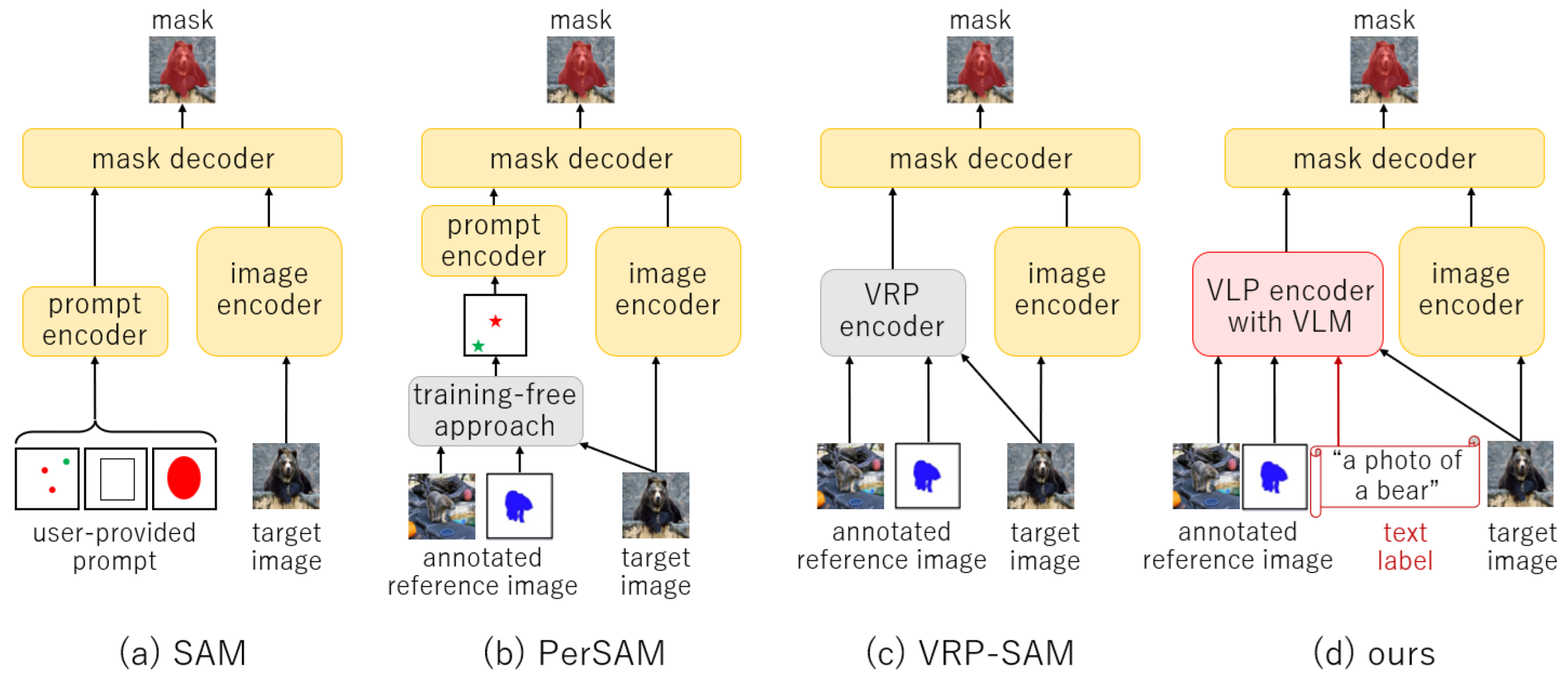
As depicted in Figure 2a, SAM comprises three modules: an image encoder, a prompt encoder, and a mask decoder. The image encoder is a Vision Transformer [22] backbone to extract image embeddings. The prompt encoder generates prompt embeddings from geometric prompts such as points and boxes. The mask decoder is a Transformer-based decoder [23] that outputs a class-agnostic mask from image embeddings and prompt embeddings. While SAM can segment any object in zero-shot, it requires user-provided prompts for each target image, meaning human interaction and knowledge of the target image are needed. Furthermore, SAM does not output the class labels for each mask, limiting its usability in real-world applications.
Figure 2.
Comparison of our proposed method, VLP-SAM, and three previous models. (a) SAM [1] is a category-agnostic interactive zero-shot segmentation model that inputs user-provided prompts for each target image. (b) PerSAM [3] is a training-free SAM-based few-shot segmentation model that inputs positive and negative points on the target image into SAM, without requiring user-provided prompts. (c) VRP-SAM [2] is a SAM-based few-shot segmentation model incorporating a VRP encoder to generate prompt embeddings for SAM from an annotated reference image. (d) Our proposed method, VLP-SAM, introduces a novel prompt encoder for SAM, called the VLP encoder, which accepts both reference images and text labels as input via a vision-language model.
2.2. Few-Shot Segmentation Model with SAM
Few-shot segmentation models [24,25,26,27,28,29,30,31,32] aim to segment objects in target images belonging to the same category as annotated reference images. Specifically, SAM-based few-shot segmentation models [2,3,4,5,33,34,35,36,37,38] only take a few reference image–mask pairs as prompts, instead of user-provided prompts for each target image. This allows leveraging the richness of a large-scale foundational model, SAM, while addressing SAM’s weaknesses: user interaction and class-agnostic masks.
SAM-based few-shot segmentation models can be mainly classified into two types: training-free models [3,4,35,36,37,39] that input geometric prompts derived from annotated reference images into SAM’s prompt encoder, and meta-learning models [2,5,38] that introduce the new SAM’s prompt encoder and input prompt embeddings into SAM’s mask decoder. Training-free models generate geometric prompts of target objects from pixel-level correlations between annotated reference images and target images without user interaction. For example, as shown in Figure 2b, PerSAM [3] selects the most positive and negative points from pixel-level correlations to input into SAM as prompts, and segments target objects without training. However, the performance of training-free models heavily depends on the quality of pseudo masks generated from pixel-level correlations, leading to incorrect prompts and reduced accuracy. Additionally, training-free models limit their scalability because SAM only accepts points, boxes, and masks as prompts.
Meta-learning models generate prompt embeddings for SAM derived from annotated reference images instead of geometric prompts via a meta-learning procedure. As depicted in Figure 2c, VRP-SAM [2] introduces a novel prompt encoder, the VRP encoder, which outputs prompt embeddings from annotated reference and target images. These prompt embeddings are then input into SAM’s mask decoder, creating a scalable few-shot segmentation model capable of predicting unseen classes not included in the training data. In this study, as shown in Figure 2d, we introduce a novel SAM’s prompt encoder (VLP encoder) that leverages a vision-language model (VLM) to capture both visual and semantic information for higher segmentation accuracy.
2.3. Multimodal Vision-Language Model
Multimodal vision-language models (VLM) embed images and text in a unified embedding space, and various VLMs have been released [7,40,41,42,43]. A representative model, CLIP [7], is a foundational model learned through contrastive learning [44,45] on 400 million image–text pairs. Its zero-shot capability has been widely utilized in various computer vision tasks [46,47,48,49,50,51,52]. However, for object detection and image segmentation tasks, pixel–text matching rather than CLS token-text matching, as seen in CLIP, is required to capture object-level features. VLM with pixel–text matching [6,53,54,55] can capture spatial and semantic information of objects from each patch–text relationship. Notably, CLIP Surgery [6] enhances the class attention map (CAM) [56,57,58,59] of CLIP to create high-performance pixel–text correlations (attention maps) without additional training. This model retains the benefits of CLIP’s large-scale foundational model while providing image–text embeddings that capture object-level semantic features. Therefore, in this study, we employ CLIP Surgery as VLM and CLIP as a comparison.
3. Methodology: VLP-SAM
In this paper, we propose Vision and Language Reference Prompt into SAM (VLP-SAM), a novel few-shot segmentation model that integrates both visual reference images and text labels as prompts for SAM. By leveraging text labels with VLM, VLP-SAM can utilize both the visual information of reference images and the semantic information of text labels.
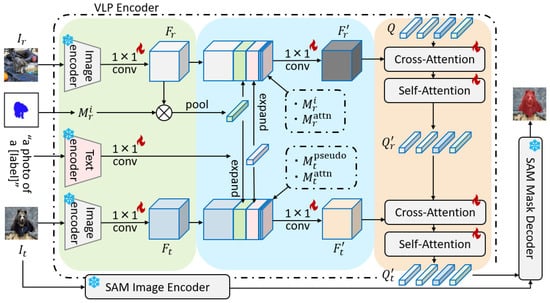
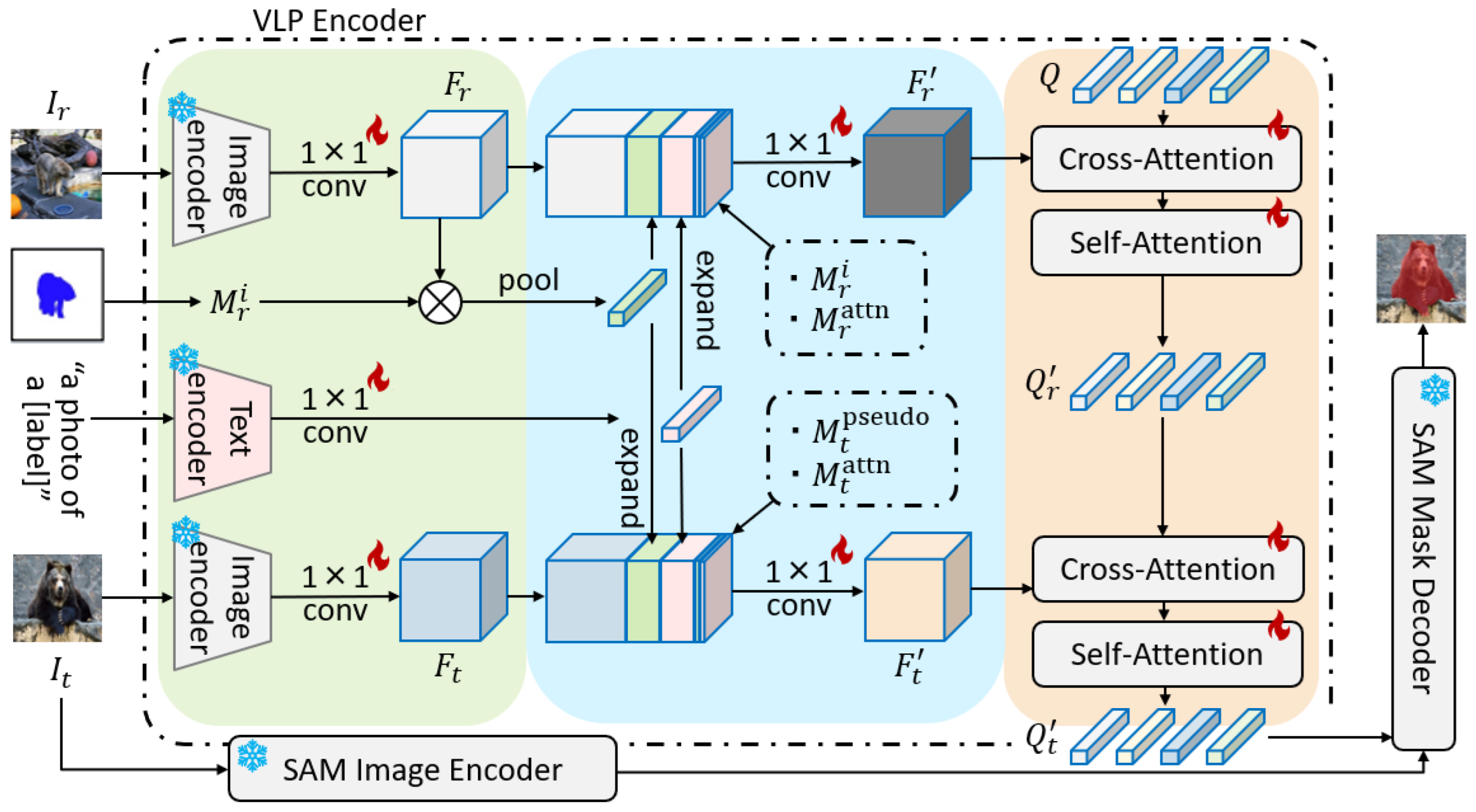
An overview of VLP-SAM is shown in Figure 3. A newly designed SAM’s prompt encoder, VLP encoder, generates prompt embeddings from the target image, the annotated reference image, and the text label with minimal learnable parameters. By inputting these prompt embeddings with vision-language information into SAM’s mask decoder, VLP-SAM outputs the mask of the target object. The details of the VLP encoder and the training process are described below.
Figure 3.
Overview of our proposed method, VLP-SAM. VLP-SAM introduces a novel prompt encoder for SAM, called the VLP encoder, which generates the prompt embedding with vision-language information. In particular, the VLP encoder first embeds the target image , the annotated reference image , and the text label (“a photo of a [label]”) into the unified embedding space using the VLM encoder. These embeddings are then concatenated with prototypes and masks that aggregate information about the target object and the text label. Finally, the prompt embedding , refined through Transformer-based attention, is fed into SAM’s mask decoder, enabling VLP-SAM to produce a more accurate mask of the target object.
3.1. VLP Encoder
In the few-shot segmentation task, the reference image , its annotation mask , where i denotes the category of the annotated object, and the target image , are given. Additionally, this study prepares the class label of the annotated object i and uses it as a text , such as “a photo of a [i]”. By utilizing the information from the annotated reference image and the text label , VLP-SAM can accurately predict the mask of the category i in the target image.
First, using a multimodal VLM, , , and are embedded into the same latent space, and image embeddings , , text embedding are obtained via a convolution layer [60]. Since image embeddings require patch-level detail, CLIP Surgery [6], which facilitates pixel–text matching, is used instead of standard CLIP [7]. To prevent overfitting of the VLP encoder, the VLM is frozen during the training phase. Next, the visual prototype that aggregates the features of the target object i from and and the textual prototype that aggregates the semantic information of category i are extracted. The visual prototype is the average embedding of the target object from the reference image , and it is formulated as follows:
Furthermore, the masks of the reference and target images are utilized to enhance the task-specific information. The mask of the reference image uses the annotation mask , while the mask of the target image uses a pseudo mask , which is obtained through a common training-free approach. The pseudo mask is created by the cosine similarity correlations between the target image and the annotated reference image. Additionally, the attention masks of the reference and target images are utilized. The attention masks are derived from the cosine similarity between the image and text embeddings, effectively capturing semantic and spatial guidance from the text label. Enhanced image embeddings , are obtained by concatenating the visual prototype , textual prototype , pseudo mask , , and attention mask , with and through a convolution layer to reduce the dimension. These enhanced embeddings , are formulated as follows:
Finally, the VLP encoder generates prompt embeddings for SAM using enhanced image embeddings , and learnable queries , where N denotes the number of tokens in the prompt embeddings. The learnable queries initially interact with the reference features through cross-attention and self-attention layers to acquire category-specific information. Subsequently, these queries interact with the target features to acquire foreground information in the target image. These processes are formulated as follows:
The final represents the prompt embeddings for SAM, which effectively integrate both visual and semantic information. In this process, the textual prototype provides global semantic context, while the attention mask serves as a semantic spatial mask to localize target objects, thereby bridging the semantic and spatial gap for precise segmentation.
3.2. Training
The prompt embeddings obtained from the VLP encoder are input to SAM’s mask decoder instead of geometric prompts. VLP-SAM can predict the mask for the category i of the target image from the mask decoder by utilizing reference images and text labels. We employ Binary Cross-Entropy (BCE) loss and Dice loss to train the VLP encoder. The loss of VLP-SAM is formulated as follows:
where n represents the total number of pixels, denotes the pixel j of the ground truth mask , and denotes the pixel j of the predicted mask . During training, the parameters of SAM’s image encoder, mask encoder, and VLM encoder are frozen to prevent overfitting. By leveraging the weights of pretrained foundational models, VLP-SAM enables few-shot segmentation into any classes not included in the training data.
4. Experiment
4.1. Settings
To demonstrate the effectiveness of VLP-SAM, we conducted experiments on the PASCAL- [8] and COCO- [9] datasets following the few-shot setting [2,27,61]. We validate the generalization capability of VLP-SAM by dividing both datasets into four quarters: three quarters are used for training, and the remaining quarter is used for testing. PASCAL- consists of 20 classes (15 for training and 5 for testing), while COCO- consists of 80 classes (60 for training and 20 for testing), with no class overlap between training and testing. Detailed breakdowns of the testing categories for each fold are provided in Appendix A. In each fold, 1000 reference-target pairs are randomly sampled for testing.
In the VLP encoder, we use CLIP [7] (ViT-B/16 [22]) and CLIP Surgery [6] (ViT-B/16) as the pretrained VLM backbone. For the image encoder of SAM, we use ViT-H. We used the AdamW optimizer [62] with an initial learning rate of 1, a batch size of 8 and 100 epochs for PASCAL-, 50 epochs for COCO-, and 50 learnable queries. In addition, VLP-SAM sets the input text to the VLM as “a photo of a [label]”. Following previous work [2,4,63], the evaluation metric is the mean intersection over union (mIoU).
4.2. Results
4.2.1. Comparison with VRP-SAM
We compare VLP-SAM with the previous baseline, VRP-SAM [2]. VRP-SAM is a SAM-based few-shot segmentation model that introduces a novel prompt encoder (VRP encoder) without inputting text labels. In our experiments, we use ResNet-50 [64] pretrained on ImageNet [65], CLIP (ViT-B/16, ResNet-50), and CLIP Surgery (ViT-B/16) as backbones in the VRP encoder. For a fair comparison, all settings are kept identical to those used in VLP-SAM.
Table 1 and Table 2 show the performance of one-shot segmentation on PASCAL- and COCO-. Our proposed VLP-SAM (CLIP Surgery) achieves mIoU scores of 77.0 on PASCAL- and 60.3 on COCO-, outperforming the previous model, VRP-SAM (ResNet-50), by a large margin ( and , respectively). Compared with the text-free VRP-SAM (CLIP Surgery) with the same backbone, VLP-SAM (CLIP Surgery) achieved significant performance improvements (8.6% and 11.4%, respectively) by incorporating text information and task-specific structures.
Table 1.
Performance of one-shot segmentation on PASCAL-. Backbone indicates the image encoder within the novel SAM’s prompt encoder (VRP and VLP encoders). VLP-SAM outperforms the previous baseline VRP-SAM (ResNet-50) by a large margin ( in mIoU). Bold font in the tables has been maintained to highlight the best performance for better readability.
Table 2.
Performance of one-shot segmentation on COCO-. VLP-SAM outperforms the previous baseline VRP-SAM (ResNet-50) by a large margin ( in mIoU). Bold font in the tables has been maintained to highlight the best performance for better readability.
Notably, VLP-SAM (CLIP), which excludes the attention mask, slightly underperforms VRP-SAM (ResNet-50) across both datasets, indicating that the simple integration of textual information via a general VLM is insufficient for performance enhancement. Instead, the superior accuracy of our model is driven by a strategic design that couples pixel–text matching VLM with task-specific structures like textual prototype and attention mask. This design effectively bridges the semantic and spatial gap, providing the fine-grained guidance required for accurate few-shot segmentation. In summary, these results demonstrate the high accuracy of VLP-SAM and its superior generalization capability to unseen classes with only 1.4 M learnable parameters. For a rigorous empirical evaluation, we provide a detailed statistical analysis, including standard deviations in Appendix B.
4.2.2. Comparison with Other Few-Shot Methods
We further evaluate the effectiveness of VLP-SAM by comparing it with various few-shot segmentation models on COCO- dataset. These include CNN-based models such as CyCTR [61], BAM [27], and HDMNet [63], as well as SAM-driven frameworks such as PerSAM [3], Matcher [4] with DINOv2 [66], VRP-SAM, FCP [38], CMaP-SAM [39], and SAM2-based FS-SAM2 [67]. As shown in Table 3, VLP-SAM (CLIP Surgery) achieves 60.3 mIoU on COCO- without training on novel test classes, outperforming all methods. These results demonstrate that VLP-SAM achieves strong performance compared to recent representative few-shot segmentation models, underscoring the superior effectiveness of our multimodal guidance.
Table 3.
Comparison with other few-shot segmentation models on COCO-. These results are for one-shot segmentation. Backbone means the type of image encoder, and † denotes the reproduced version. VLP-SAM outperforms all previous models. Bold font in the tables has been maintained to highlight the best performance for better readability.
4.2.3. Evaluation in Cross-Domain Scenarios
We evaluate the effectiveness of VLP-SAM in a cross-domain scenario, where a significant domain gap exists between the training and testing datasets. This gap stems from fundamental differences in image distributions: while PASCAL-5i generally features large, centered objects in iconic views with relatively simple backgrounds, COCO-20i presents a more challenging distribution characterized by cluttered backgrounds, varying object scales (including many small instances), and non-iconic shooting perspectives. Following prior work [2], we train the model on COCO- and test it on PASCAL- to assess the robustness of VLP-SAM under domain shift. To ensure no class overlap between training and testing, we construct a novel class split for PASCAL-, as detailed in Appendix A.
The experimental results summarized in Table 4 show that VLP-SAM (CLIP Surgery) demonstrates superior performance in cross-domain settings, achieving an mIoU of 79.3 and outperforming the previous model. These results clearly demonstrate the strong generalization capability and effectiveness of VLP-SAM in cross-domain scenarios, highlighting the importance of textual guidance for robust performance.
Table 4.
Performance of one-shot segmentation under the cross-domain scenario from COCO- to PASCAL-. VLP-SAM (CLIP Surgery) outperforms the previous text-free model, VRP-SAM (ResNet-50). Bold font in the tables has been maintained to highlight the best performance for better readability.
4.2.4. Ablation Study
Robustness to Textual Prompt Variations
Since VLP-SAM introduces a textual modality to guide the segmentation process, evaluating its robustness across diverse linguistic formulations is essential. Table 5 summarizes the performance of VLP-SAM (CLIP Surgery) in the 1-shot setting on PASCAL- using various prompt types. To explore the boundaries of semantic generalization, we defined eight variations: (b) synonyms, replacing the label with semantically equivalent terms (e.g., “shuttle” for “bus”); (c) hypernyms, using broader category labels (e.g., “large vehicle” for “bus”); (d) disambiguation, providing multiple candidate labels in a “a photo of a [Target] or a [Non-target]” format; (e) descriptive phrases, utilizing natural language descriptions (e.g., “a large road vehicle for carrying many passengers” for “bus”); (f) simple label, using only the category name as a prompt without the standard “a photo of a [label]” template (e.g., “[label]”); (g) label description, appending a descriptive phrase to the standard template (e.g., “a photo of a [label], [description]”); (h) typos, introducing character-level perturbations (e.g., “buss” for “bus”); and (i) incorrect label, which provides intentionally misleading categorical noise by replacing the label with an unrelated class (e.g., “cat” for “bus”).
Table 5.
Robustness analysis of VLP-SAM (CLIP Surgery) across diverse textual prompt variations on PASCAL- in the 1-shot setting. Configuration (a) is the original template used in other experiments.
The experimental results reveal that VLP-SAM maintains a high level of performance across most semantic variations. Notably, configurations (b) through (g) all yield competitive results. High accuracy is maintained, even with ambiguous prompts such as “Hypernyms” and “Disambiguation,” demonstrating the model’s ability to handle broad semantic categories and multi-candidate scenarios. Furthermore, the strong performance achieved with “Descriptive Phrases” confirms that VLP-SAM captures the underlying semantic meaning of the text rather than merely memorizing fixed category names. The model also shows significant robustness to prompt formatting; for instance, the “Simple Label” (configuration (f)) achieves 75.7 mIoU, indicating that the segmentation accuracy remains stable regardless of the presence of the standard template. In contrast, performance significantly degrades when strong textual noise is introduced, such as in “Typos” (63.6 mIoU) and “Incorrect Label” (40.9 mIoU), where the linguistic structure is severely corrupted or misleading. These quantitative findings suggest that while VLP-SAM is highly robust to semantic shifts in language, it is sensitive to perturbations that disrupt the core linguistic structure. Overall, these results confirm that VLP-SAM is highly robust to a wide variety of textual formulations and formats while maintaining strong semantic generalization capability.
5-Shot Testing
To further analyze the architecture, we evaluated VLP-SAM in a five-shot setting to examine the impact of increased reference information. We utilized five reference images as input to the VLP encode and averaged the resulting five prompt embeddings to generate a refined final prompt.
The results of the five-shot experiment are presented in Table 6 and Table 7, which show the performance on PASCAL- and COCO-, respectively. VLP-SAM (CLIP Surgery) achieves higher performance than VRP-SAM (ResNet-50), outperforming it by on PASCAL- and on COCO-.
Table 6.
Performance of 5-shot segmentation on PASCAL-. The values of (+x.x) in Mean indicate the performance gain compared to the one-shot setting. Bold font in the tables has been maintained to highlight the best performance for better readability.
Table 7.
Performance of 5-shot segmentation on COCO-. The values of (+x.x) in Mean indicate the performance gain compared to the one-shot setting. Bold font in the tables has been maintained to highlight the best performance for better readability.
However, when compared to the corresponding one-shot mIoU scores, the performance gain for VLP-SAM (CLIP Surgery) is only on PASCAL- and on COCO. This observation suggests that the high-quality semantic information provided by the text label effectively saturates the required context at one-shot, leaving little room for further improvement through additional reference images. As analyzed in the following section, this saturation effect is primarily attributed to the efficiency of textual guidance, which effectively compensates for the incremental information gain typically provided by multiple reference images.
Impact of Prompt Quality on 5-Shot Performance
To further explore the information saturation effect of textual guidance and evaluate the model’s fusion capability, we conducted additional 5-shot experiments across various prompt qualities. Table 8 and Table 9 summarize the mIoU performance of VLP-SAM (CLIP Surgery) on PASCAL- and COCO- datasets under three prompt conditions: (1) “Incorrect” prompts, where the target category label is replaced by a completely unrelated class (e.g., replacing “horse” with “airplane”); (2) “Hypernym” prompts, which use a broad category label (e.g., “fruit” instead of “orange”); and (3) “Disambiguation” prompts, which provide multiple candidate labels (e.g., “[Target] or [Non-target]”).
Table 8.
Performance of 5-shot segmentation using VLP-SAM (CLIP Surgery) with varying textual prompt quality on PASCAL-. The values of (+x.x) in Mean indicate the performance gain compared to the one-shot setting.
Table 9.
Performance of 5-shot segmentation using VLP-SAM (CLIP Surgery) with varying textual prompt quality on COCO-. The values of (+x.x) in Mean indicate the performance gain compared to the one-shot setting.
In the “Incorrect” prompt setting, where the model must rely more on visual cues due to misleading textual noise, we observed a measurable gain from one-shot to five-shot (up to mIoU on COCO-). While this improvement is modest compared to visual-only models, it confirms that VLP-SAM possesses an inherent ability to fuse multiple reference images to compensate for unreliable textual guidance when necessary. Regarding vague descriptions such as “Hypernym” and “Disambiguation,” we observed that increasing the number of reference images to a 5-shot setting resulted in little to no performance improvement. However, it is important to note that even with these vague prompts, VLP-SAM achieves competitive accuracy at 1-shot that rivals the 5-shot performance of visual-only models like VRP-SAM. This indicates that the introduction of textual information effectively saturates the required semantic context at 1-shot, leaving little room for further improvement through additional reference images. In other words, the textual guidance is powerful enough to fully compensate for visual deficiencies, demonstrating high practical utility in real-world scenarios involving the collection of multiple annotated reference images is difficult.
Component Ablation
We evaluated the effectiveness of the main components in VLP-SAM through w/o experiments conducted on both PASCAL- and COCO- datasets. In this analysis, we investigated the contributions of the visual pseudo mask as well as the newly introduced textual prototype and attention mask. These components are designed to provide complementary spatial and semantic guidance to SAM for the few-shot segmentation task.
Table 10 and Table 11 present the results of these w/o experiments for PASCAL- and COCO-, respectively. Configuration (a) represents the baseline without any prompt guidance, yielding 65.0 mIoU on PASCAL and 43.6 mIoU on COCO. Configuration (b) introduces the visual pseudo mask only, which provides a foundational performance gain of +3.4% and +5.3% over the baseline for PASCAL and COCO, respectively. Configuration (c) builds upon (b) by adding the textual prototype, resulting in further mIoU improvements to +4.7% and +10.0%. Finally, configuration (d), the full VLP-SAM model incorporating the attention mask, achieves the highest precision, with significant gains of +12.0% and +16.7% over the baseline.
Table 10.
Ablation study for different components of VLP-SAM (CLIP Surgery) on PASCAL-. Configuration (a) represents the baseline without any prompt guidance, and the values of indicate the performance gain compared to configuration (a).
Table 11.
Ablation study for different components of VLP-SAM (CLIP Surgery) on COCO-. Configuration (a) represents the baseline without any prompt guidance, and the values of indicate the performance gain compared to configuration (a).
Overall, these results clarify the distinct roles of each component: the visual pseudo mask establishes a spatial foundation, bringing the few-shot segmentation performance to a functional baseline level. The textual prototype then injects high-level semantic context to stabilize category identification. Most significantly, the attention mask acts as a semantic spatial mask that bridges the gap between conceptual and spatial information, leading to a substantial leap in precision. While the visual pseudo mask provides the necessary spatial grounding, the textual prototype and attention mask are the primary contributors to the model’s high accuracy, as they effectively resolve semantic ambiguities that visual initialization alone cannot address.
5. Discussion
In this section, we provide a detailed analysis of the effectiveness of VLP-SAM. The discussion is divided into two parts: (1) a qualitative analysis of visual segmentation results, and (2) a summary of the key architectural contributions and practical benefits of our proposed approach. This analysis aims to provide a clearer and more focused understanding of how VLP-SAM achieves its strong performance.
5.1. Qualitative Analysis of Visual Results
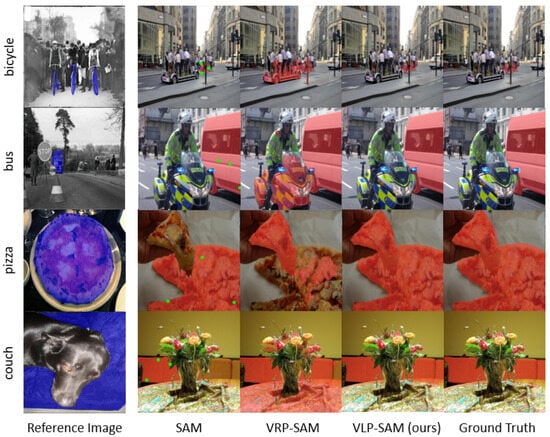
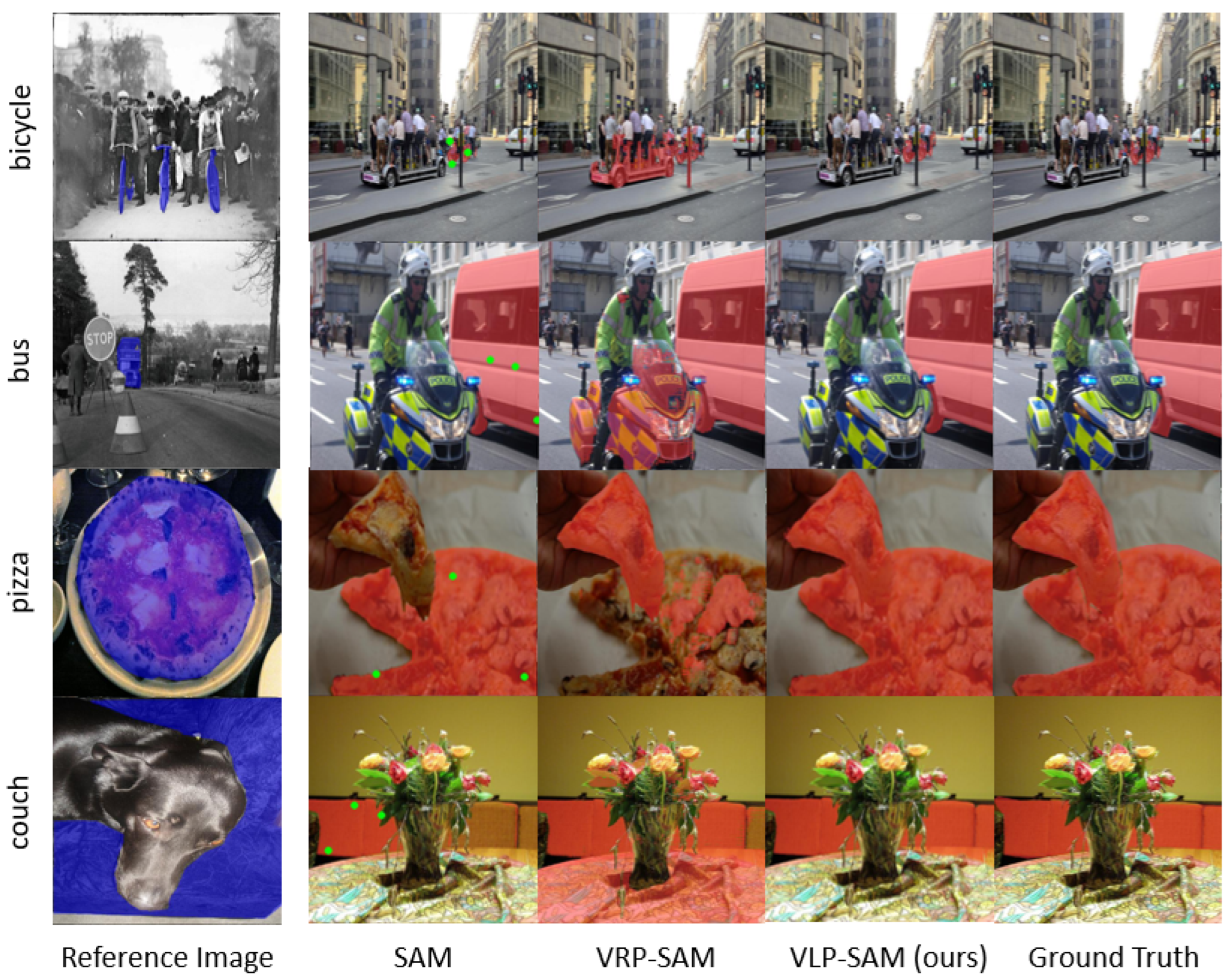
The proposed method exhibits a marked improvement over existing baselines by utilizing both reference images and text labels. This improvement is attributed to the integration of textual semantics, which facilitates the segmentation of complex objects such as “fully clothed people” or “visually similar but semantically distinct objects”. The qualitative improvements are highlighted in Figure 4, which demonstrate VLP-SAM’s ability to effectively distinguish semantically relevant objects.
Figure 4.
Visualization results of VLP-SAM compared to SAM and VRP-SAM on COCO- dataset for the bicycle, bus, pizza, and couch categories. VLP-SAM accurately predicts the target object by incorporating both a reference image and text label.
Figure 4 illustrates comparative visualization results on the COCO- dataset for the categories bicycle, bus, pizza, and couch, none of which were seen during training. For baseline SAM, prompts are simulated by randomly sampling three positive points within the ground-truth mask. However, such prompts typically require per-image manual customization in real-world settings, significantly limiting the method’s usability. VRP-SAM, an existing few-shot method, uses ResNet-50 and only visual reference images. In contrast, our VLP-SAM is built upon CLIP Surgery and leverages both visual and textual information as multimodal prompts.
The visual comparisons reveal that VLP-SAM consistently achieves sharper and more semantically accurate segmentation compared to SAM and VRP-SAM. For example, in the category of bicycle, VRP-SAM segments the wrong objects based solely on the visual similarity of the reference image (e.g., the “tire” in the bicycle). VLP-SAM, on the other hand, accurately segments only the bicycle, guided by the semantic meaning conveyed by the text prompt “bicycle”. Similarly, in the category of bus, VRP-SAM segments a motorbike instead of a bus based solely on visual similarity, while VLP-SAM correctly segments the bus by leveraging textual semantics.
In the category of pizza, SAM and VRP-SAM partially fail to segment all pizza slices, while VLP-SAM successfully segments the full object set with high precision. The category of couch presents a challenging case where the reference image is ambiguous. VLP-SAM leverages the text prompt to segment the target region with improved accuracy. These examples collectively demonstrate VLP-SAM’s ability to incorporate semantic guidance via text in few-shot settings, enabling more accurate and context-aware segmentation compared to models relying solely on visual cues.
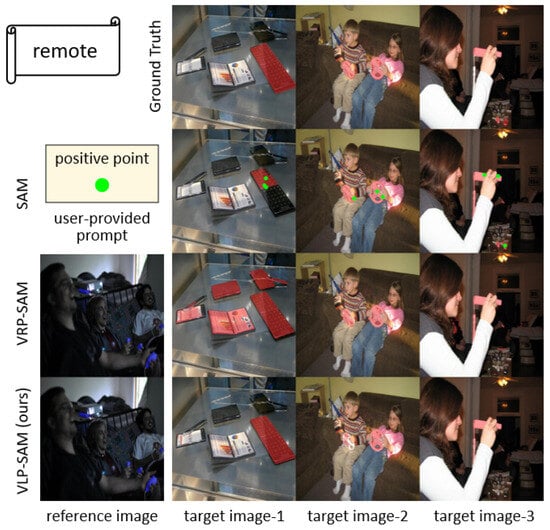
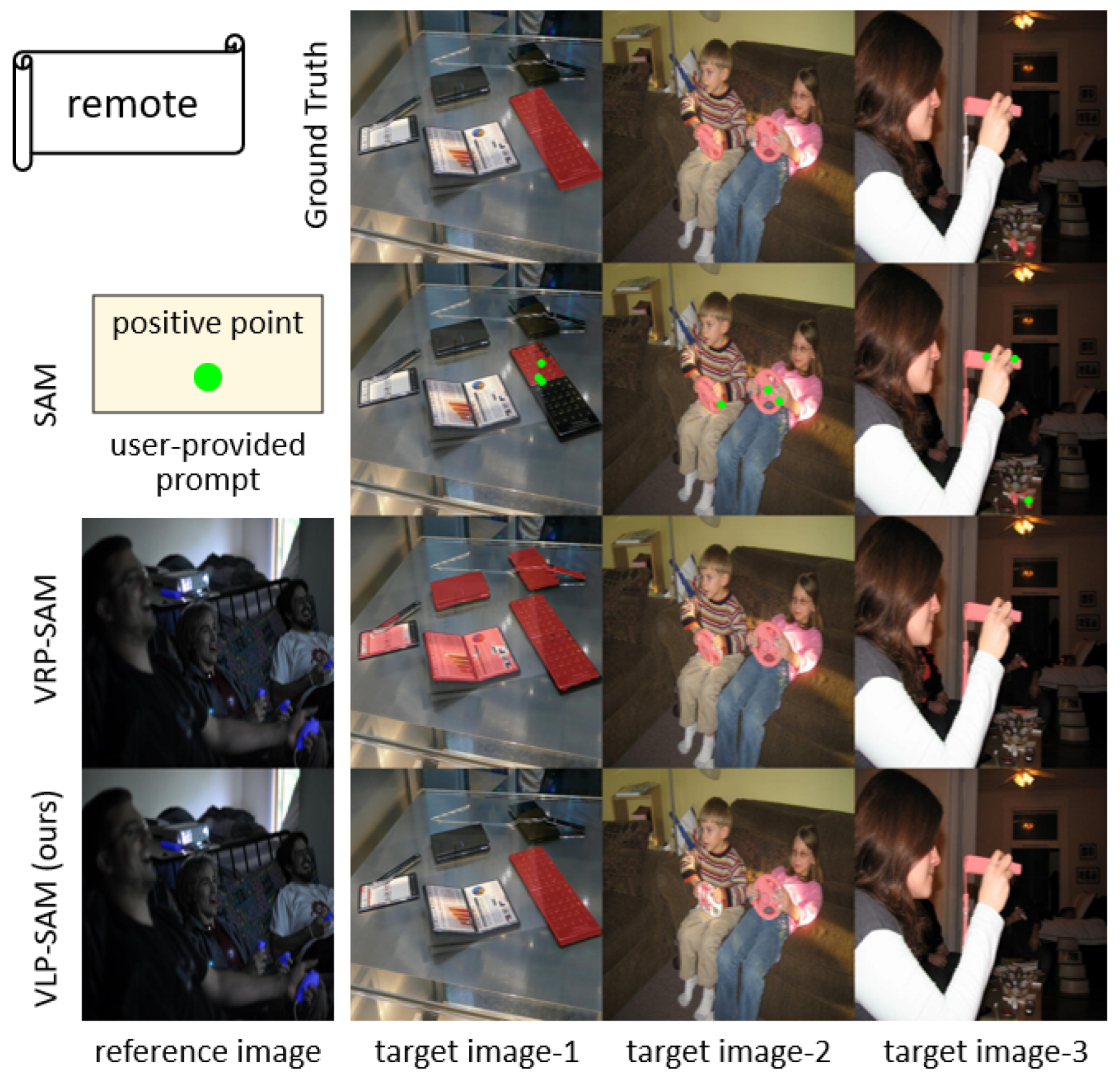
Furthermore, we examined cases where VLP-SAM faces challenges due to semantic misalignment between the target object and the textual label. As shown in Figure 5, target image-2 includes a Wii steering controller, which is a visually unique object that differs substantially from the generic concept of a “remote”. In this case, the text prompt fails to provide helpful semantic guidance, resulting in VLP-SAM misidentifying the object. Conversely, in target image-1, the same text prompt “remote” helps the model correctly segment a visually ambiguous object that reference images alone cannot resolve. These contrasting examples highlight that while VLP-SAM may underperform when the textual input does not adequately capture the semantics of the target object, the integration of textual modalities predominantly enhances segmentation quality in most scenarios. Additional visualization results across various scenarios, including a detailed analysis of failure cases under vague textual guidance, are provided in Appendix C to further validate the robustness and clarify the limitations of VLP-SAM.
Figure 5.
Visualization results of VLP-SAM compared to SAM and VRP-SAM on COCO- dataset for the “remote” category.
5.2. Contribution of the Proposed Architecture
Beyond qualitative improvements, the design of VLP-SAM reflects a principled integration of multimodal components. Unlike SAM, which depends on carefully designed prompts such as points, boxes, or masks tailored to each individual image, and unlike VRP-SAM, which introduces reference images as a new input modality, VLP-SAM further extends the prompting space by integrating reference images with textual labels. This new framework not only enhances segmentation performance but also expands the potential of SAM-based architectures to support more flexible and multimodal prompting. The unified prompt embedding derived from visual and textual inputs enables robust performance without requiring manual, image-specific prompt engineering.
The scalability of VLP-SAM is further supported by its lightweight architecture, which introduces minimal learnable parameters while enabling strong generalization capabilities across diverse categories. Specifically, VLP-SAM contains only 1.4 M learnable parameters, significantly fewer than existing few-shot segmentation models such as CyCTR [61] (15.4 M), BAM [27] (4.9 M), and HDMNet [63] (4.2 M). Despite this efficiency, as shown in Table 3, VLP-SAM achieves superior performance on unseen classes in the COCO- dataset. Moreover, as shown in Table 6 and Table 7, the use of text information allows VLP-SAM to maintain high accuracy even with a single reference image. These results demonstrate that VLP-SAM offers both computational efficiency and practical effectiveness, making it well-suited for real-world few-shot segmentation tasks where annotated reference images are scarce.
Furthermore, the selection of CLIP Surgery as the backbone is motivated by its pixel–text matching capability, which is essential for segmentation tasks. Unlike standard CLIP, which focuses on global CLS tokens, CLIP Surgery captures local spatial semantics without requiring additional training. Notably, CLIP and CLIP Surgery are identical in terms of architecture, pretraining data, and model scale. Therefore, our method’s performance improvements are not due to increased model capacity, but rather to the careful integration of compatible architectures as shown in Table 1 and Table 2. Specifically, the introduction of the attention mask alongside the textual prototype yielded significant mIoU gains, as detailed in Table 10 and Table 11, which underscores the effectiveness of our proposed architectural components.
6. Conclusions and Future Work
In this paper, we proposed VLP-SAM, a novel SAM-based few-shot segmentation model that integrates both visual reference images and textual labels as prompts. VLP-SAM has a scalable and efficient architecture with only 1.4 M learnable parameters, utilizing a multimodal vision-language model to generate enriched prompt embeddings for SAM. By incorporating a newly designed prompt encoder, VLP-SAM achieves high accuracy and robust generalization. Comprehensive experiments on two benchmark datasets demonstrate that VLP-SAM significantly surpasses previous models by a large margin. Furthermore, VLP-SAM exhibits strong performance across unseen objects and cross-domain scenarios, highlighting its versatility for diverse real-world applications.
Future research will focus on further exploring the advantages of text-based prompting by evaluating performance across various text formats and under conditions involving noisy or imprecise textual inputs. We also intend to investigate the potential of integrating additional reference modalities, such as 3D data and depth maps, into the VLP encoder to leverage its simplicity and scalability. Conversely, by capitalizing on the extensive knowledge embedded within large-scale foundational models, we aim to reduce the reliance on annotated reference masks. This research direction holds the potential to enable segmentation with minimal supervision, eventually paving the way toward more flexible and open-vocabulary segmentation systems.
Author Contributions
Conceptualization, K.S.; methodology, K.S. and R.S.; software, K.S. and R.S.; validation, K.S.; formal analysis, K.S.; investigation, K.S.; writing—original draft, K.S.; writing—review and editing, R.S. and M.G.; visualization, K.S.; supervision, M.G.; project administration, R.S.; funding acquisition, M.G. All authors have read and agreed to the published version of the manuscript.
Funding
This research is partly supported by JSPS KAKENHI, grant numbers 21H04600 and 24H00370.
Institutional Review Board Statement
Not applicable.
Informed Consent Statement
Not applicable.
Data Availability Statement
The data presented in this study are openly available in the public domain. The PASCAL-5i dataset was derived from the PASCAL VOC 2012 repository (http://host.robots.ox.ac.uk/pascal/VOC/voc2012/), accessed on 20 March 2026. The COCO-20i dataset was derived from the MS COCO 2014 repository (https://cocodataset.org/), accessed on 20 March 2026. The code developed in this study are available at https://github.com/kosukesakurai1/VLP-SAM, accessed on 20 March 2026.
Conflicts of Interest
The authors declare no conflicts of interest.
Appendix A. Detailed Data Splits for Evaluation
This section provides the comprehensive classification of object categories used within the respective test subsets. Table A1 and Table A2 detail the testing classes for PASCAL- and COCO-, respectively. Additionally, Table A3 specifies the class alignment used for the cross-domain scenario between PASCAL- and COCO-.
Table A1.
Details of the data split for PASCAL- [8]. Each row consists of 5 classes designated for testing, with the remaining 15 classes utilized for training.
Table A2.
Details of the data split for COCO- [9]. Each row consists of 20 classes designated for testing, with the remaining 60 classes utilized for training.
Table A3.
Details of the data split for PASCAL- in cross-domain scenario. Each line represents non-overlapping classes in the training set corresponding to the respective fold of COCO-.
Appendix B. Detailed Statistical Analysis
To evaluate the empirical validity and stability of VLP-SAM, we conducted a rigorous statistical analysis across five random seeds by varying the selection of reference images for each run. While the main manuscript reports the mean mIoU values, Table A4 provides the detailed performance, including standard deviations (SD) for both PASCAL- and COCO- datasets.
Table A4.
Detailed statistical performance comparison (mean mIoU ± SD) on PASCAL- and COCO- across 5 random seeds in the 1-shot setting. Bold font in the tables has been maintained to highlight the best performance for better readability.
We compared our VLP-SAM (CLIP Surgery) with the previous visual-only model, VRP-SAM (ResNet-50). The results confirm that VLP-SAM consistently outperforms the baseline across all folds with narrow standard deviations. Specifically, in the challenging COCO- dataset, where background clutter often increases variability, VLP-SAM maintains a stable performance lead. These performance gains are statistically significant, as the margins of improvement consistently exceed the standard deviations. This confirms that the results achieved by incorporating textual guidance are statistically robust and not a result of random initialization.
Appendix C. Additional Qualitative Results
Figure A1–Figure A6 provide a comprehensive set of comparative visualization results on the COCO- dataset for categories including bicycle, bus, pizza, kite, couch, and orange. Notably, all these categories were unseen during the training phase. These results further validate that VLP-SAM consistently achieves more precise and semantically accurate segmentation than SAM and VRP-SAM across a wide range of object scales and complexities.
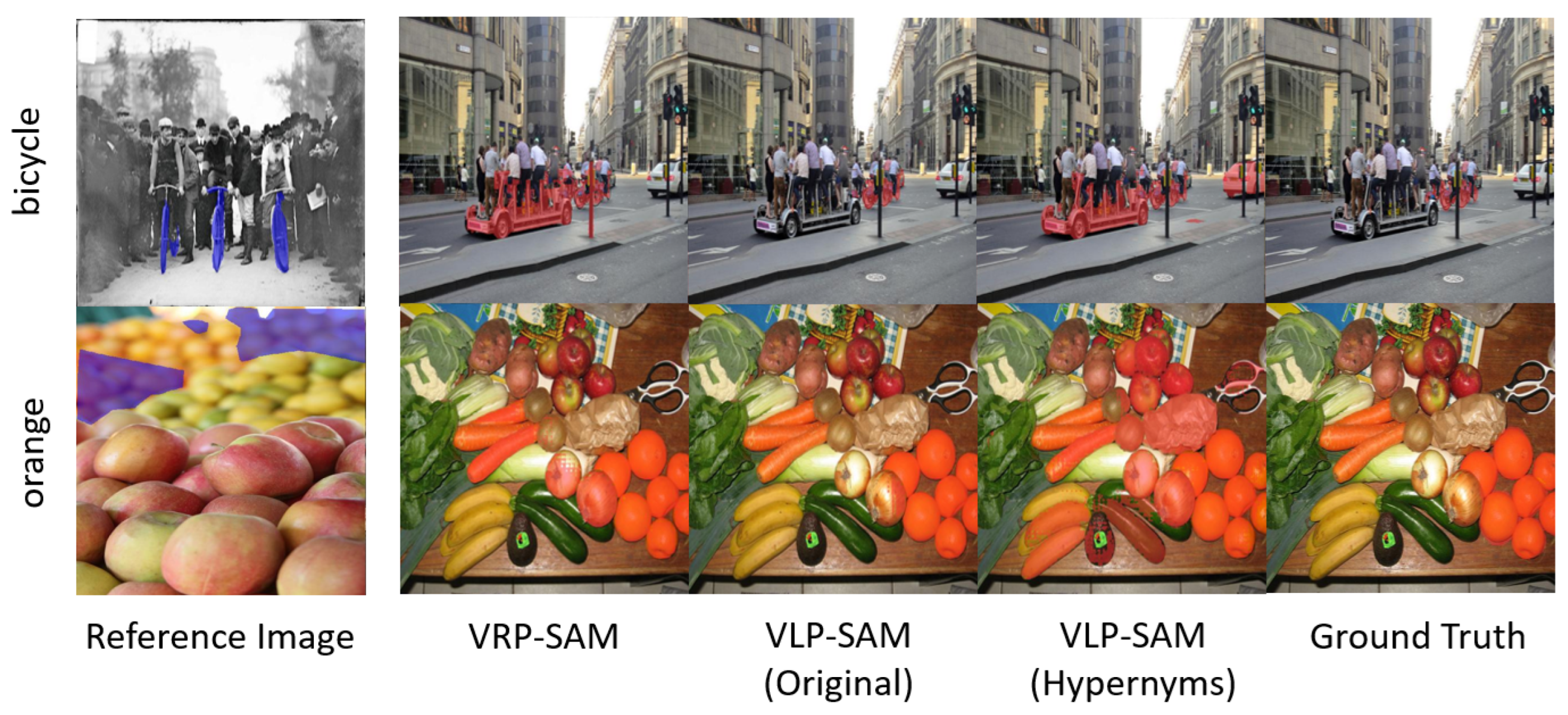
Furthermore, Figure A7 illustrates specific failure cases when utilizing extremely vague textual prompts (Hypernyms) to explore the model’s limitations. For the bicycle category, when provided with the hypernym “non-motorized vehicle,” VLP-SAM (Hypernyms) fails to maintain class specificity and erroneously segments other nearby vehicles that belong to the same broad category, whereas VLP-SAM (Original) correctly identifies only the target bicycles. Similarly, for the orange category, using the hypernym “fruit” leads the model to over-segment other fruit instances, such as bananas and apples, present in the background. These cases indicate that while VLP-SAM possesses strong semantic understanding, its precision is inherently tied to the specificity of the textual guidance; overly broad descriptions can lead to semantic expansion beyond the intended target.
Figure A1.
Visualization results for the bicycle category. VLP-SAM utilizes both the annotated reference image and text label to effectively localize the target object without manual prompt engineering.
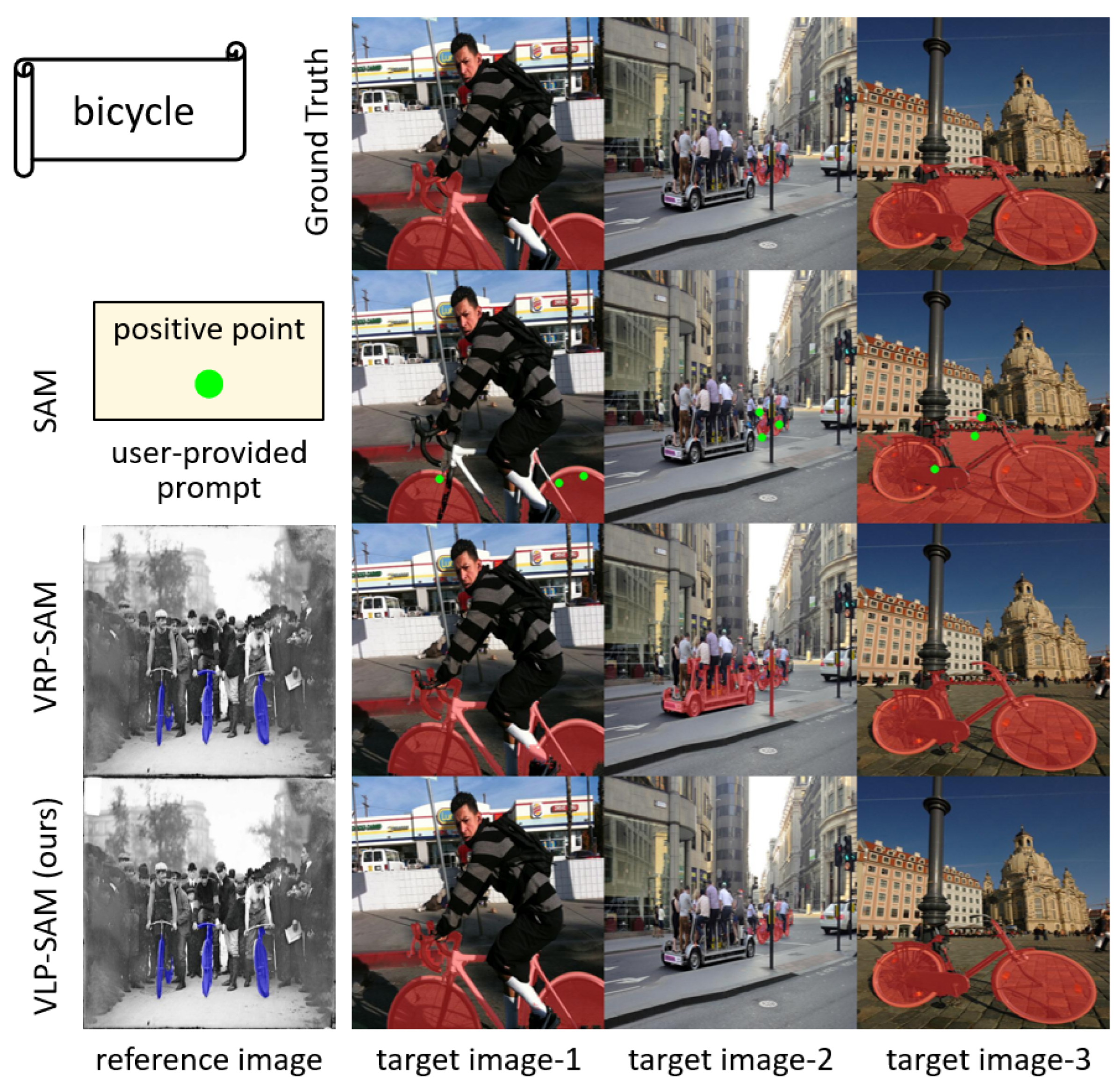
Figure A2.
Visualization results for the bus category. By incorporating multimodal prompts, VLP-SAM accurately distinguishes the bus from visually similar vehicles.
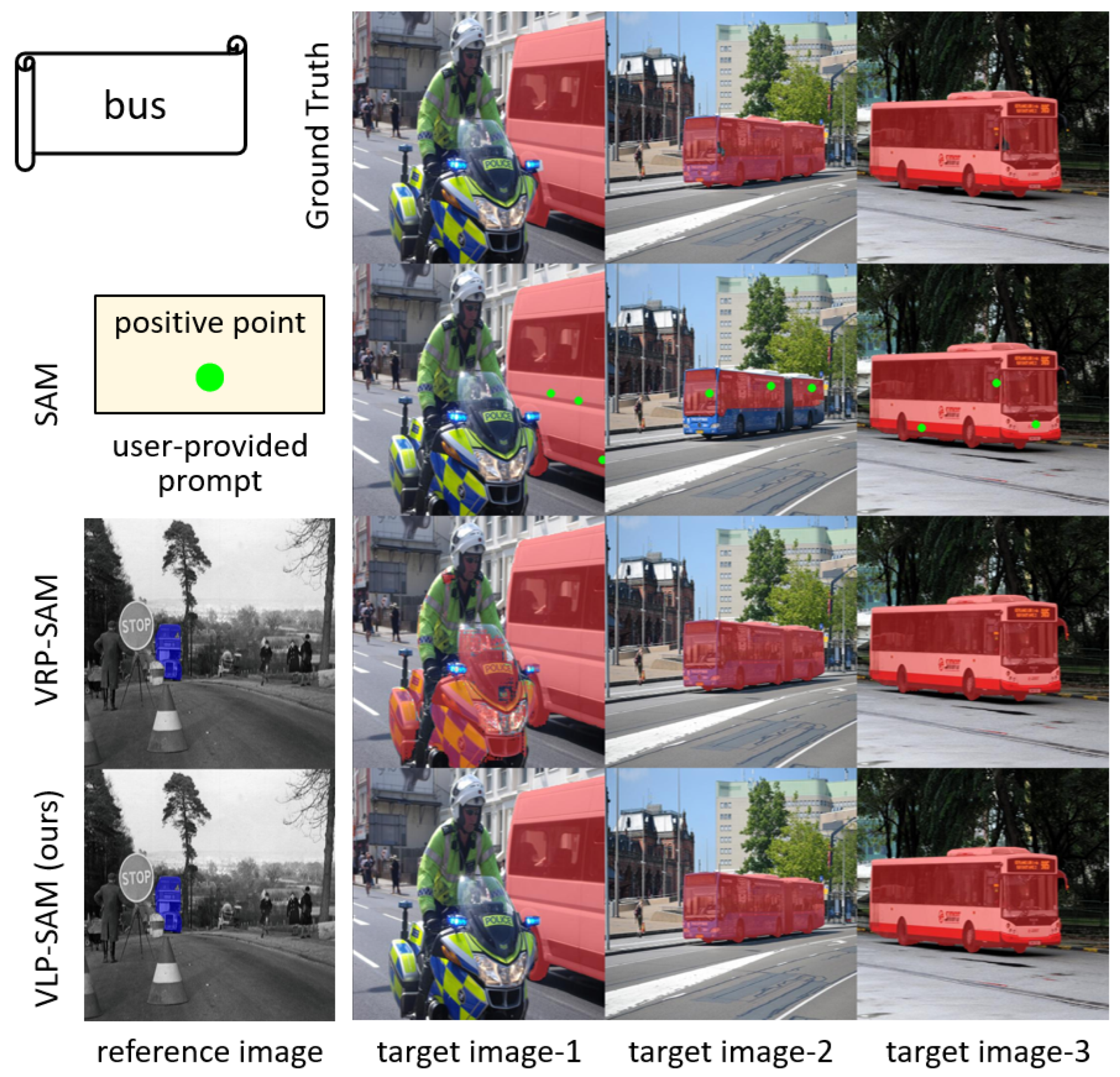
Figure A3.
Visualization results for the pizza category. VLP-SAM demonstrates superior part-to-whole understanding, successfully segmenting all slices with high precision.
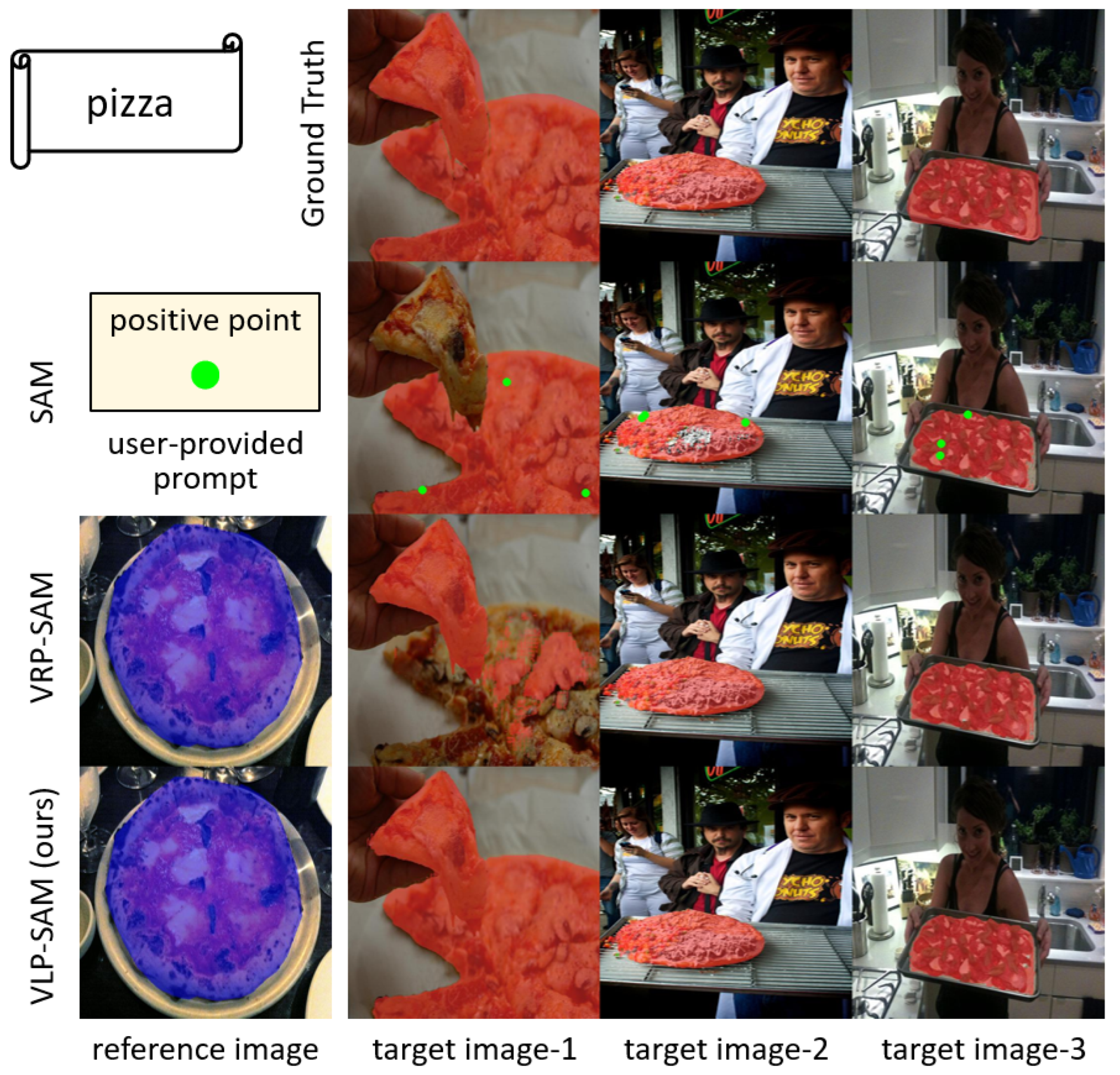
Figure A4.
Visualization results for the kite category. The semantic guidance provided by the text label enables accurate segmentation of thin structures and complex patterns.
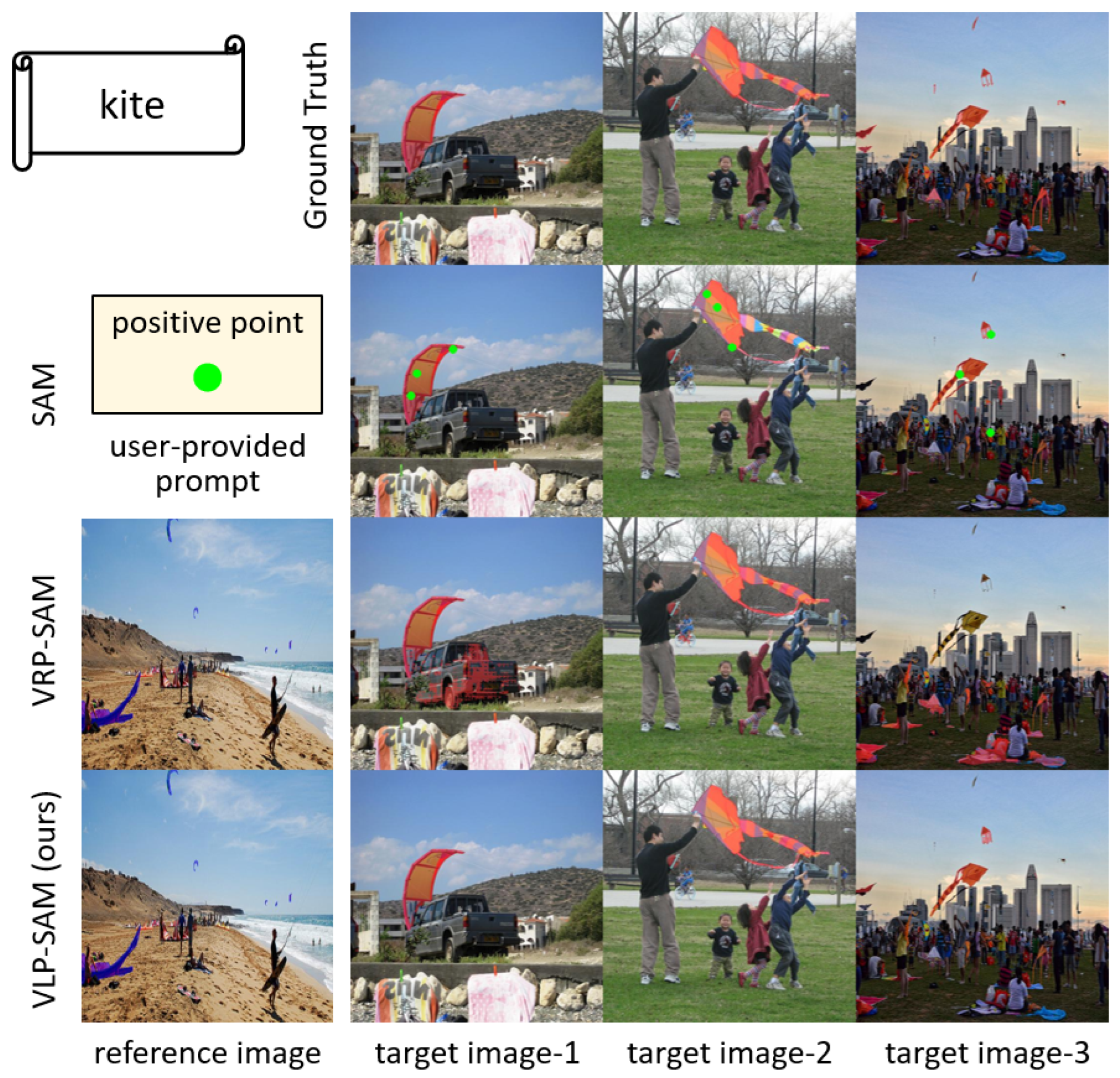
Figure A5.
Visualization results for the couch category. VLP-SAM effectively leverages textual semantics to resolve ambiguities when the reference visual features are insufficient.
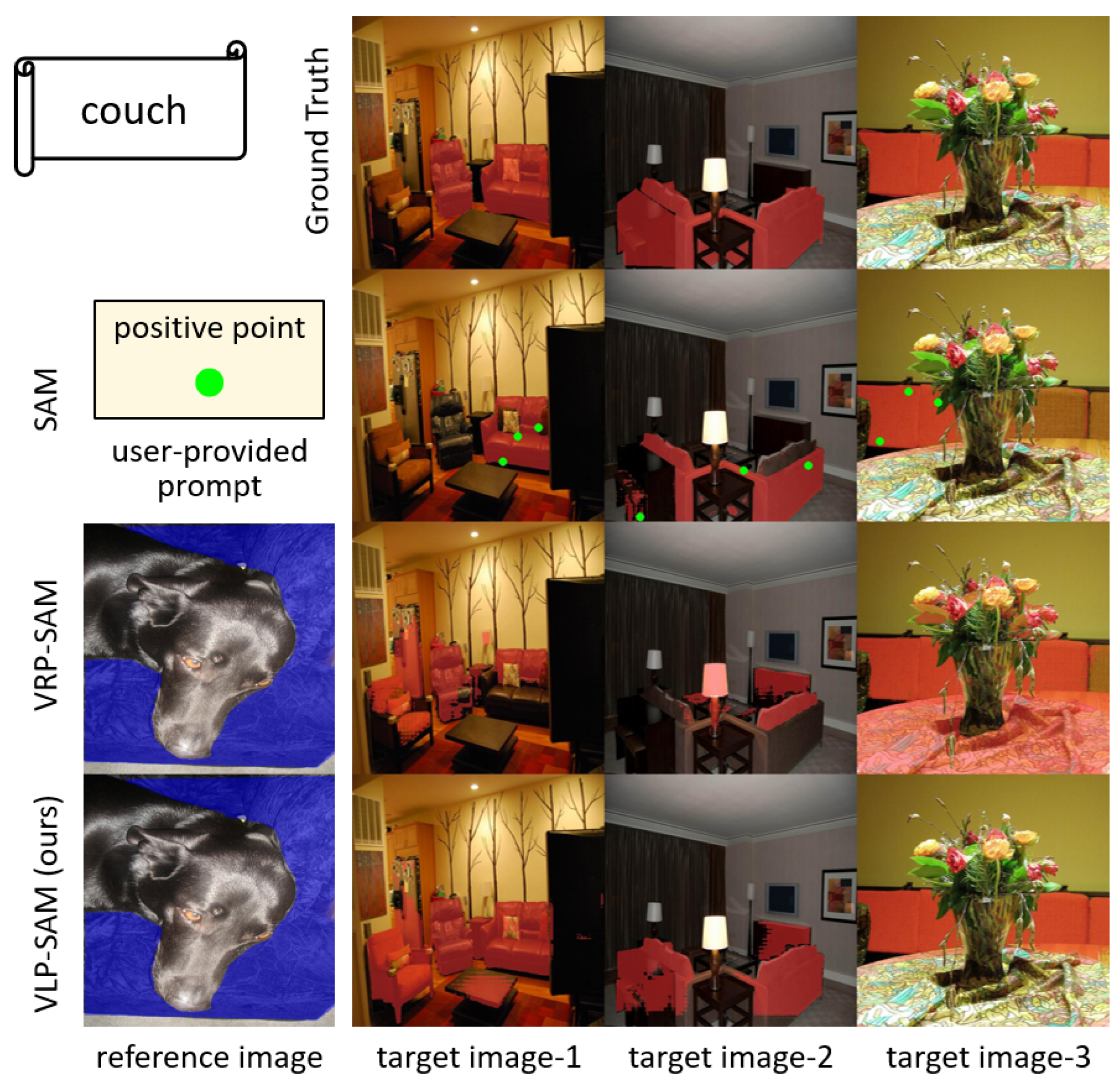
Figure A6.
Visualization results for the orange category. The model successfully segments the target objects in a cluttered environment by aligning visual features with the category label.
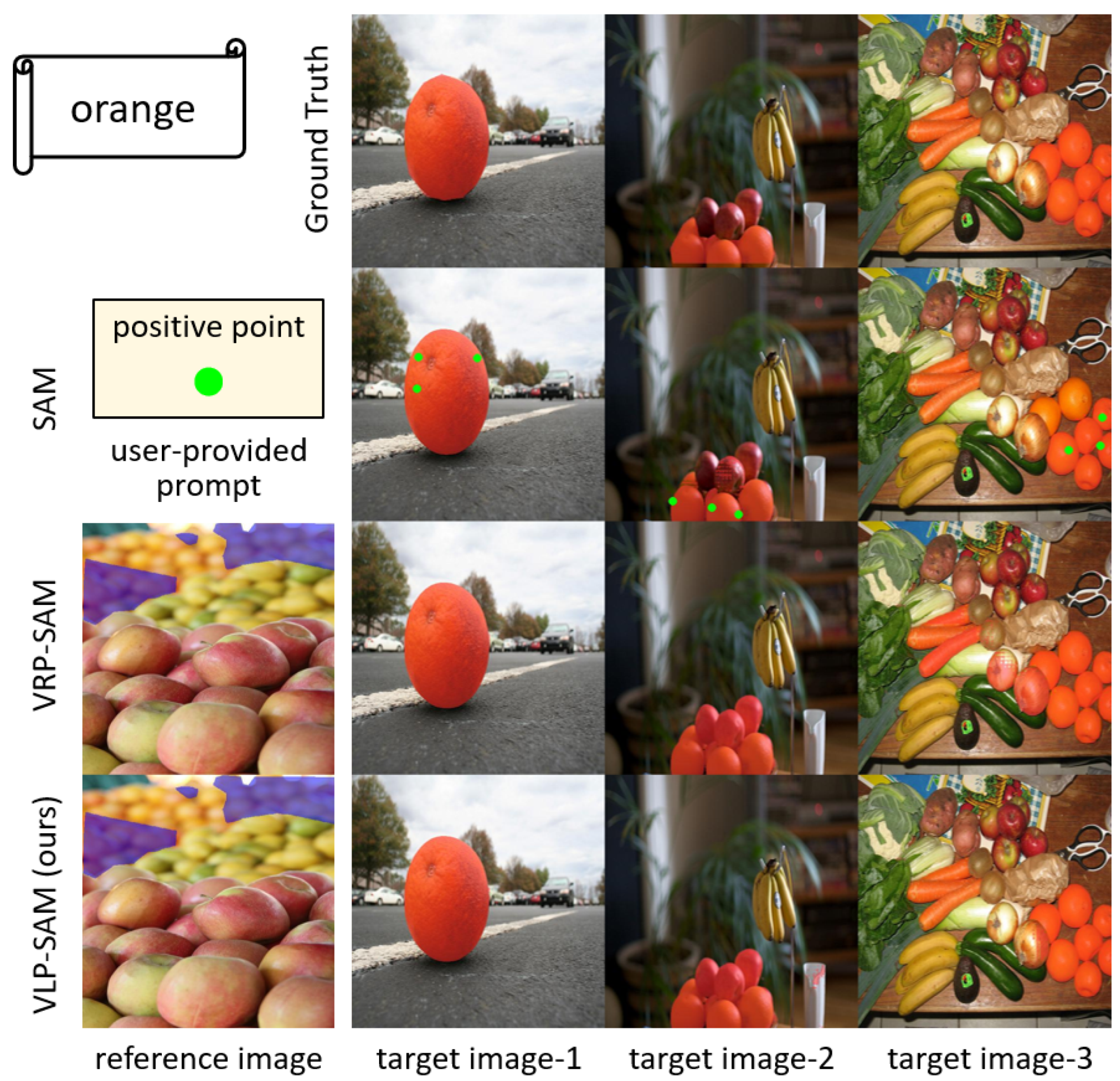
Figure A7.
Failure case analysis with hypernym prompts on COCO-. From left to right: reference image, VRP-SAM, VLP-SAM (original), VLP-SAM (hypernyms), and ground truth. In the first line (bicycle), the hypernym “non-motorized vehicle” causes over-segmentation of non-target vehicles. In the second line (orange), the hypernym “fruit” leads to the erroneous segmentation of other fruit types.
References
- Kirillov, A.; Mintun, E.; Ravi, N.; Mao, H.; Rolland, C.; Gustafson, L.; Xiao, T.; Whitehead, S.; Berg, A.C.; Lo, W.Y.; et al. Segment Anything. In Proceedings of the IEEE/CVF International Conference on Computer Vision; IEEE: New York, NY, USA, 2023; pp. 3992–4003. [Google Scholar] [CrossRef] [Scilit]
- Sun, Y.; Chen, J.; Zhang, S.; Zhang, X.; Chen, Q.; Zhang, G.; Ding, E.; Wang, J.; Li, Z. VRP-SAM: SAM with visual reference prompt. In Proceedings of the IEEE/CVF Conference on Computer Vision and Pattern Recognition; IEEE: New York, NY, USA, 2024; pp. 23565–23574. [Google Scholar] [CrossRef] [Scilit]
- Zhang, R.; Jiang, Z.; Guo, Z.; Yan, S.; Pan, J.; Ma, X.; Dong, H.; Gao, P.; Li, H. Personalize segment anything model with one shot. arXiv 2023, arXiv:2305.03048. [Google Scholar] [CrossRef] [Scilit]
- Liu, Y.; Zhu, M.; Li, H.; Chen, H.; Wang, X.; Shen, C. Matcher: Segment anything with one shot using all-purpose feature matching. arXiv 2023, arXiv:2305.13310. [Google Scholar] [CrossRef] [Scilit]
- He, W.; Zhang, Y.; Zhuo, W.; Shen, L.; Yang, J.; Deng, S.; Sun, L. APSeg: Auto-Prompt Network for Cross-Domain Few-Shot Semantic Segmentation. In Proceedings of the IEEE/CVF Conference on Computer Vision and Pattern Recognition; IEEE: New York, NY, USA, 2024; pp. 23762–23772. [Google Scholar] [CrossRef] [Scilit]
- Li, Y.; Wang, H.; Duan, Y.; Li, X. A Closer Look at the Explainability of Contrastive Language-Image Pre-training. arXiv 2023, arXiv:2304.05653. [Google Scholar] [CrossRef] [Scilit]
- Radford, A.; Kim, J.W.; Hallacy, C.; Ramesh, A.; Goh, G.; Agarwal, S.; Sastry, G.; Askell, A.; Mishkin, P.; Clark, J.; et al. Learning transferable visual models from natural language supervision. In Proceedings of the International Conference on Machine Learning; PMLR: London, UK, 2021; pp. 8748–8763. [Google Scholar]
- Shaban, A.; Bansal, S.; Liu, Z.; Essa, I.; Boots, B. One-shot learning for semantic segmentation. arXiv 2017, arXiv:1709.03410. [Google Scholar] [CrossRef] [Scilit]
- Lin, T.Y.; Maire, M.; Belongie, S.; Hays, J.; Perona, P.; Ramanan, D.; Dollár, P.; Zitnick, C.L. Microsoft coco: Common objects in context. In Proceedings of the European Conference on Computer Vision; Springer: Berlin/Heidelberg, Germany, 2014; pp. 740–755. [Google Scholar] [CrossRef] [Scilit]
- Ke, L.; Ye, M.; Danelljan, M.; Tai, Y.W.; Tang, C.K.; Yu, F. Segment Anything in High Quality. In Proceedings of the Advances in Neural Information Processing Systems; Curran Associates Inc.: New York, NY, USA, 2023; Volume 36, pp. 29914–29934. [Google Scholar]
- Ma, J.; He, Y.; Li, F.; Han, L.; You, C.; Wang, B. Segment anything in medical images. Nat. Commun. 2024, 15, 654. [Google Scholar] [CrossRef] [Scilit]
- Zhao, X.; Ding, W.; An, Y.; Du, Y.; Yu, T.; Li, M.; Tang, M.; Wang, J. Fast segment anything. arXiv 2023, arXiv:2306.12156. [Google Scholar] [CrossRef] [Scilit]
- Li, F.; Zhang, H.; Sun, P.; Zou, X.; Liu, S.; Li, C.; Yang, J.; Zhang, L.; Gao, J. Segment and Recognize Anything at Any Granularity. In Proceedings of the European Conference on Computer Vision; Springer: Berlin/Heidelberg, Germany, 2024; pp. 467–484. [Google Scholar] [CrossRef] [Scilit]
- Ren, T.; Liu, S.; Zeng, A.; Lin, J.; Li, K.; Cao, H.; Chen, J.; Huang, X.; Chen, Y.; Yan, F.; et al. Grounded sam: Assembling open-world models for diverse visual tasks. arXiv 2024, arXiv:2401.14159. [Google Scholar] [CrossRef] [Scilit]
- Yang, L.; Kang, B.; Huang, Z.; Xu, X.; Feng, J.; Zhao, H. Depth Anything: Unleashing the Power of Large-Scale Unlabeled Data. In Proceedings of the IEEE/CVF Conference on Computer Vision and Pattern Recognition; IEEE: New York, NY, USA, 2024; pp. 10371–10381. [Google Scholar] [CrossRef] [Scilit]
- Wang, D.; Zhang, J.; Du, B.; Xu, M.; Liu, L.; Tao, D.; Zhang, L. Samrs: Scaling-up remote sensing segmentation dataset with segment anything model. In Proceedings of the Advances in Neural Information Processing Systems; Curran Associates Inc.: New York, NY, USA, 2023; Volume 36, pp. 8815–8827. [Google Scholar]
- Zhang, C.; Puspitasari, F.D.; Zheng, S.; Li, C.; Qiao, Y.; Kang, T.; Shan, X.; Zhang, C.; Qin, C.; Rameau, F.; et al. A survey on segment anything model (sam): Vision foundation model meets prompt engineering. arXiv 2023, arXiv:2306.06211. [Google Scholar] [CrossRef] [Scilit]
- Zhang, M.; Wang, Y.; Guo, J.; Li, Y.; Gao, X.; Zhang, J. IRSAM: Advancing segment anything model for infrared small target detection. In Proceedings of the European Conference on Computer Vision; Springer: Berlin/Heidelberg, Germany, 2024; pp. 233–249. [Google Scholar] [CrossRef] [Scilit]
- Jin, Z.; Liu, B.; Chu, Q.; Yu, N. ISNet: Integrate Image-Level and Semantic-Level Context for Semantic Segmentation. In Proceedings of the IEEE/CVF International Conference on Computer Vision; IEEE: New York, NY, USA, 2021; pp. 7169–7178. [Google Scholar] [CrossRef] [Scilit]
- Zhang, M.; Bai, H.; Zhang, J.; Zhang, R.; Wang, C.; Guo, J.; Gao, X. Rkformer: Runge-kutta transformer with random-connection attention for infrared small target detection. In Proceedings of the ACM International Conference on Multimedia; Association for Computing Machinery: New York, NY, USA, 2022; pp. 1730–1738. [Google Scholar] [CrossRef] [Scilit]
- Zhang, M.; Zhang, C.; Zhang, Q.; Li, Y.; Gao, X.; Zhang, J. Unleashing the Power of Generic Segmentation Model: A Simple Baseline for Infrared Small Target Detection. In Proceedings of the ACM International Conference on Multimedia; Association for Computing Machinery: New York, NY, USA, 2024; pp. 10392–10401. [Google Scholar] [CrossRef] [Scilit]
- Dosovitskiy, A.; Beyer, L.; Kolesnikov, A.; Weissenborn, D.; Zhai, X.; Unterthiner, T.; Dehghani, M.; Minderer, M.; Heigold, G.; Gelly, S.; et al. An image is worth 16x16 words: Transformers for image recognition at scale. arXiv 2020, arXiv:2010.11929. [Google Scholar] [CrossRef] [Scilit]
- Vaswani, A.; Shazeer, N.; Parmar, N.; Uszkoreit, J.; Jones, L.; Gomez, A.N.; Kaiser, L.; Polosukhin, I. Attention is all you need. In Proceedings of the Advances in Neural Information Processing Systems; Curran Associates Inc.: New York, NY, USA, 2017; Volume 30. [Google Scholar]
- Wang, K.; Liew, J.H.; Zou, Y.; Zhou, D.; Feng, J. PANet: Few-Shot Image Semantic Segmentation With Prototype Alignment. In Proceedings of the IEEE/CVF International Conference on Computer Vision; IEEE: New York, NY, USA, 2019; pp. 9196–9205. [Google Scholar] [CrossRef] [Scilit]
- Chen, S.; Meng, F.; Zhang, R.; Qiu, H.; Li, H.; Wu, Q.; Xu, L. Visual and Textual Prior Guided Mask Assemble for Few-Shot Segmentation and Beyond. IEEE Trans. Multimed. 2024, 26, 7197–7209. [Google Scholar] [CrossRef] [Scilit]
- Wang, X.; Zhang, X.; Cao, Y.; Wang, W.; Shen, C.; Huang, T. SegGPT: Towards Segmenting Everything In Context. In Proceedings of the IEEE/CVF International Conference on Computer Vision; IEEE: New York, NY, USA, 2023; pp. 1130–1140. [Google Scholar] [CrossRef] [Scilit]
- Lang, C.; Cheng, G.; Tu, B.; Han, J. Learning What Not to Segment: A New Perspective on Few-Shot Segmentation. In Proceedings of the IEEE/CVF Conference on Computer Vision and Pattern Recognition; IEEE: New York, NY, USA, 2022; pp. 8047–8057. [Google Scholar] [CrossRef] [Scilit]
- Wang, C.; Li, X.; Ding, H.; Qi, L.; Zhang, J.; Tong, Y.; Loy, C.C.; Yan, S. Explore in-context segmentation via latent diffusion models. arXiv 2024, arXiv:2403.09616. [Google Scholar] [CrossRef] [Scilit]
- Meng, L.; Lan, S.; Li, H.; Alvarez, J.M.; Wu, Z.; Jiang, Y.G. Segic: Unleashing the emergent correspondence for in-context segmentation. In Proceedings of the European Conference on Computer Vision; Springer: Berlin/Heidelberg, Germany, 2024; pp. 203–220. [Google Scholar] [CrossRef] [Scilit]
- Wang, J.; Zhang, B.; Pang, J.; Chen, H.; Liu, W. Rethinking Prior Information Generation with CLIP for Few-Shot Segmentation. In Proceedings of the IEEE/CVF Conference on Computer Vision and Pattern Recognition; IEEE: New York, NY, USA, 2024; pp. 3941–3951. [Google Scholar] [CrossRef] [Scilit]
- Liu, Y.; Jing, C.; Li, H.; Zhu, M.; Chen, H.; Wang, X.; Shen, C. A simple image segmentation framework via in-context examples. arXiv 2024, arXiv:2410.04842. [Google Scholar] [CrossRef] [Scilit]
- Zhou, T.; Zhang, F.; Chang, B.; Wang, W.; Yuan, Y.; Konukoglu, E.; Cremers, D. Image segmentation in foundation model era: A survey. arXiv 2024, arXiv:2408.12957. [Google Scholar] [CrossRef] [Scilit]
- Nagendra, S.; Rashid, K.; Shen, C.; Kifer, D. SAMIC: Segment Anything with In-Context Spatial Prompt Engineering. arXiv 2024, arXiv:2412.11998. [Google Scholar] [CrossRef] [Scilit]
- Huang, D.; Xiong, X.; Ma, J.; Li, J.; Jie, Z.; Ma, L.; Li, G. AlignSAM: Aligning Segment Anything Model to Open Context via Reinforcement Learning. In Proceedings of the IEEE/CVF Conference on Computer Vision and Pattern Recognition; IEEE: New York, NY, USA, 2024; pp. 3205–3215. [Google Scholar] [CrossRef] [Scilit]
- Samuel, D.; Ben-Ari, R.; Levy, M.; Darshan, N.; Chechik, G. Where’s Waldo: Diffusion Features For Personalized Segmentation and Retrieval. In Proceedings of the Advances in Neural Information Processing Systems; Curran Associates Inc.: New York, NY, USA, 2024; Volume 37, pp. 128160–128181. [Google Scholar]
- Xu, Z.; Chen, Q. NubbleDrop: A Simple Way to Improve Matching Strategy for Prompted One-Shot Segmentation. arXiv 2024, arXiv:2405.11476. [Google Scholar] [CrossRef] [Scilit]
- Zhang, A.; Gao, G.; Jiao, J.; Liu, C.H.; Wei, Y. Bridge the Points: Graph-based Few-shot Segment Anything Semantically. arXiv 2024, arXiv:2410.06964. [Google Scholar] [CrossRef] [Scilit]
- Park, S.; Lee, S.; Seong, H.S.; Yoo, J.; Heo, J.P. Foreground-Covering Prototype Generation and Matching for SAM-Aided Few-Shot Segmentation. arXiv 2025, arXiv:2501.00752. [Google Scholar] [CrossRef] [Scilit]
- Chen, S.; Meng, F.; Lei, L.; Wei, H.; Wu, C.; Wu, Q.; Xu, L.; Li, H. CMaP-SAM: Contraction mapping prior for SAM-driven few-shot segmentation. Neurocomputing 2025, 660, 131816. [Google Scholar] [CrossRef] [Scilit]
- Yu, J.; Wang, Z.; Vasudevan, V.; Yeung, L.; Seyedhosseini, M.; Wu, Y. Coca: Contrastive captioners are image-text foundation models. arXiv 2022, arXiv:2205.01917. [Google Scholar] [CrossRef] [Scilit]
- Jia, C.; Yang, Y.; Xia, Y.; Chen, Y.T.; Parekh, Z.; Pham, H.; Le, Q.; Sung, Y.H.; Li, Z.; Duerig, T. Scaling up visual and vision-language representation learning with noisy text supervision. In Proceedings of the International Conference on Machine Learning; PMLR: London, UK, 2021; pp. 4904–4916. [Google Scholar] [CrossRef] [Scilit]
- Li, J.; Li, D.; Xiong, C.; Hoi, S. Blip: Bootstrapping language-image pre-training for unified vision-language understanding and generation. In Proceedings of the International Conference on Machine Learning; PMLR: London, UK, 2022; pp. 12888–12900. [Google Scholar] [CrossRef] [Scilit]
- Liu, S.; Zeng, Z.; Ren, T.; Li, F.; Zhang, H.; Yang, J.; Jiang, Q.; Li, C.; Yang, J.; Su, H.; et al. Grounding dino: Marrying dino with grounded pre-training for open-set object detection. In Proceedings of the European Conference on Computer Vision; Springer: Berlin/Heidelberg, Germany, 2024; pp. 38–55. [Google Scholar] [CrossRef] [Scilit]
- Jaiswal, A.; Babu, A.R.; Zadeh, M.Z.; Banerjee, D.; Makedon, F. A survey on contrastive self-supervised learning. Technologies 2021, 9, 2. [Google Scholar] [CrossRef] [Scilit]
- Lu, J.; Batra, D.; Parikh, D.; Lee, S. Vilbert: Pretraining task-agnostic visiolinguistic representations for vision-and-language tasks. In Proceedings of the Advances in Neural Information Processing Systems; Curran Associates Inc.: New York, NY, USA, 2019; Volume 32. [Google Scholar]
- Rombach, R.; Blattmann, A.; Lorenz, D.; Esser, P.; Ommer, B. High-Resolution Image Synthesis with Latent Diffusion Models. In Proceedings of the IEEE/CVF Conference on Computer Vision and Pattern Recognition; IEEE: New York, NY, USA, 2022; pp. 10674–10685. [Google Scholar] [CrossRef] [Scilit]
- Zhou, K.; Yang, J.; Loy, C.C.; Liu, Z. Learning to prompt for vision-language models. Int. J. Comput. Vis. 2022, 130, 2337–2348. [Google Scholar] [CrossRef] [Scilit]
- Li, L.H.; Zhang, P.; Zhang, H.; Yang, J.; Li, C.; Zhong, Y.; Wang, L.; Yuan, L.; Zhang, L.; Hwang, J.N.; et al. Grounded Language-Image Pre-training. In Proceedings of the IEEE/CVF Conference on Computer Vision and Pattern Recognition; IEEE: New York, NY, USA, 2022; pp. 10955–10965. [Google Scholar] [CrossRef] [Scilit]
- Luo, H.; Ji, L.; Zhong, M.; Chen, Y.; Lei, W.; Duan, N.; Li, T. Clip4clip: An empirical study of clip for end to end video clip retrieval and captioning. Neurocomputing 2022, 508, 293–304. [Google Scholar] [CrossRef] [Scilit]
- Wu, H.H.; Seetharaman, P.; Kumar, K.; Bello, J.P. Wav2CLIP: Learning Robust Audio Representations from Clip. In Proceedings of the IEEE International Conference on Acoustics, Speech and Signal Processing; IEEE: New York, NY, USA, 2022; pp. 4563–4567. [Google Scholar] [CrossRef] [Scilit]
- Sakurai, K.; Ishii, T.; Shimizu, R.; Song, L.; Goto, M. Lare: Latent augmentation using regional embedding with vision-language model. Mach. Learn. Appl. 2025, 20, 100671. [Google Scholar] [CrossRef] [Scilit]
- Sakurai, K.; Shimizu, R.; Goto, M. Priority data augmentation based on regional embedding with vision-language model. In Proceedings of the International Conference on Computers and Industrial Engineering, Computers and Industrial Engineering; Waseda University: Tokyo, Japan, 2024; Volume 2024, pp. 626–635. [Google Scholar]
- Minderer, M.; Gritsenko, A.; Stone, A.; Neumann, M.; Weissenborn, D.; Dosovitskiy, A.; Mahendran, A.; Arnab, A.; Dehghani, M.; Shen, Z.; et al. Simple open-vocabulary object detection. In Proceedings of the European Conference on Computer Vision; Springer: Berlin/Heidelberg, Germany, 2022; pp. 728–755. [Google Scholar] [CrossRef] [Scilit]
- Rao, Y.; Zhao, W.; Chen, G.; Tang, Y.; Zhu, Z.; Huang, G.; Zhou, J.; Lu, J. DenseCLIP: Language-Guided Dense Prediction with Context-Aware Prompting. In Proceedings of the IEEE/CVF Conference on Computer Vision and Pattern Recognition; IEEE: New York, NY, USA, 2022; pp. 18061–18070. [Google Scholar] [CrossRef] [Scilit]
- Zhou, Z.; Lei, Y.; Zhang, B.; Liu, L.; Liu, Y. ZegCLIP: Towards Adapting CLIP for Zero-shot Semantic Segmentation. In Proceedings of the IEEE/CVF Conference on Computer Vision and Pattern Recognition; IEEE: New York, NY, USA, 2023; pp. 11175–11185. [Google Scholar] [CrossRef] [Scilit]
- Zhou, B.; Khosla, A.; Lapedriza, A.; Oliva, A.; Torralba, A. Learning Deep Features for Discriminative Localization. In Proceedings of the IEEE Conference on Computer Vision and Pattern Recognition; IEEE: New York, NY, USA, 2016; pp. 2921–2929. [Google Scholar] [CrossRef] [Scilit]
- Selvaraju, R.R.; Cogswell, M.; Das, A.; Vedantam, R.; Parikh, D.; Batra, D. Grad-CAM: Visual Explanations from Deep Networks via Gradient-Based Localization. In Proceedings of the IEEE International Conference on Computer Vision; IEEE: New York, NY, USA, 2017; pp. 618–626. [Google Scholar] [CrossRef] [Scilit]
- Xie, J.; Hou, X.; Ye, K.; Shen, L. CLIMS: Cross Language Image Matching for Weakly Supervised Semantic Segmentation. In Proceedings of the IEEE/CVF Conference on Computer Vision and Pattern Recognition; IEEE: New York, NY, USA, 2022; pp. 4473–4482. [Google Scholar] [CrossRef] [Scilit]
- Lin, Y.; Chen, M.; Wang, W.; Wu, B.; Li, K.; Lin, B.; Liu, H.; He, X. CLIP is Also an Efficient Segmenter: A Text-Driven Approach for Weakly Supervised Semantic Segmentation. In Proceedings of the IEEE/CVF Conference on Computer Vision and Pattern Recognition; IEEE: New York, NY, USA, 2023; pp. 15305–15314. [Google Scholar] [CrossRef] [Scilit]
- LeCun, Y.; Boser, B.; Denker, J.S.; Henderson, D.; Howard, R.E.; Hubbard, W.; Jackel, L.D. Backpropagation Applied to Handwritten Zip Code Recognition. Neural Comput. 1989, 1, 541–551. [Google Scholar] [CrossRef] [Scilit]
- Zhang, G.; Kang, G.; Yang, Y.; Wei, Y. Few-shot segmentation via cycle-consistent transformer. In Proceedings of the Advances in Neural Information Processing Systems; Curran Associates Inc.: New York, NY, USA, 2021; Volume 34, pp. 21984–21996. [Google Scholar]
- Loshchilov, I.; Hutter, F. Decoupled weight decay regularization. arXiv 2017, arXiv:1711.05101. [Google Scholar] [CrossRef] [Scilit]
- Peng, B.; Tian, Z.; Wu, X.; Wang, C.; Liu, S.; Su, J.; Jia, J. Hierarchical Dense Correlation Distillation for Few-Shot Segmentation. In Proceedings of the IEEE/CVF Conference on Computer Vision and Pattern Recognition; IEEE: New York, NY, USA, 2023; pp. 23641–23651. [Google Scholar] [CrossRef] [Scilit]
- He, K.; Zhang, X.; Ren, S.; Sun, J. Deep Residual Learning for Image Recognition. In Proceedings of the IEEE Conference on Computer Vision and Pattern Recognition; IEEE: New York, NY, USA, 2016; pp. 770–778. [Google Scholar] [CrossRef] [Scilit]
- Deng, J.; Dong, W.; Socher, R.; Li, L.J.; Li, K.; Fei-Fei, L. ImageNet: A large-scale hierarchical image database. In Proceedings of the IEEE Conference on Computer Vision and Pattern Recognition; IEEE: New York, NY, USA, 2009; pp. 248–255. [Google Scholar] [CrossRef] [Scilit]
- Oquab, M.; Darcet, T.; Moutakanni, T.; Vo, H.; Szafraniec, M.; Khalidov, V.; Fernandez, P.; Haziza, D.; Massa, F.; El-Nouby, A.; et al. Dinov2: Learning robust visual features without supervision. arXiv 2023, arXiv:2304.07193. [Google Scholar] [CrossRef] [Scilit]
- Forni, B.; Lombardi, G.; Pozzi, F.; Planamente, M. FS-SAM2: Adapting Segment Anything Model 2 for Few-Shot Semantic Segmentation via Low-Rank Adaptation. In Proceedings of the International Conference on Image Analysis and Processing; Springer: Berlin/Heidelberg, Germany, 2025; pp. 67–78. [Google Scholar] [CrossRef] [Scilit]

Disclaimer/Publisher’s Note: The statements, opinions and data contained in all publications are solely those of the individual author(s) and contributor(s) and not of MDPI and/or the editor(s). MDPI and/or the editor(s) disclaim responsibility for any injury to people or property resulting from any ideas, methods, instructions or products referred to in the content. |
© 2026 by the authors. Licensee MDPI, Basel, Switzerland. This article is an open access article distributed under the terms and conditions of the Creative Commons Attribution (CC BY) license.