


Abstract
Historical photographs and films provide valuable visual records of the past, yet their quality is frequently compromised by limited imaging capabilities and complex acquisition-related distortions. Recovering high-resolution details from these materials remains difficult because conventional super-resolution (SR) approaches typically rely on simplified degradation assumptions and paired low-resolution (LR) and high-resolution (HR) training samples, which are generally unavailable for historical imagery. To address these limitations, we develop HistoSR, a two-stage restoration framework that combines unpaired degradation correction with pseudo-paired SR reconstruction. In the first stage, Transformer-based generators are incorporated into a CycleGAN architecture to learn the translation between degraded historical LR images and clean LR images without requiring aligned samples. The second stage learns the LR-to-HR reconstruction mapping using paired training samples derived from modern HR images. This design enables the restoration of historical imagery without relying on corresponding historical HR ground truth. We construct a dataset comprising 20,000 historical face images collected from World War II documentary films to evaluate the proposed approach. On the historical face dataset, HistoSR obtains a Neural Side-by-Side predicted preference score of 0.27 and a NIQE value of 5.43. When trained on DIV2K and evaluated on Set14 at a ×4 scaling factor, the framework achieves 29.78 dB PSNR and 0.8103 SSIM, outperforming the evaluated competing methods. These findings demonstrate the effectiveness of HistoSR for historical face restoration and its potential applicability to general image super-resolution.
1. Introduction
Historical photographs and documentary films preserve valuable visual records of past events and societal developments. However, the imaging technologies available during earlier periods often produced images with limited spatial resolution and substantial visual degradation, including blur, noise, and reduced clarity. Unlike the relatively controlled degradation processes commonly considered in conventional super-resolution studies, historical imagery may contain complex and unpredictable distortions arising from diverse acquisition conditions. Recovering fine visual details from such degraded images therefore presents significant challenges for image SR.
Image SR seeks to recover HR visual information from LR observations, despite the loss of spatial details during image acquisition. Advances in deep learning have substantially improved SR performance, particularly through convolutional neural network (CNN)-based approaches. Many conventional non-blind SR methods [1,2,3,4] are developed under predefined degradation assumptions, where the characteristics of the LR formation process are specified during training. These approaches generally achieve satisfactory reconstruction when the degradation encountered during inference is consistent with the assumed model. However, their performance may deteriorate when applied to images affected by unknown or mismatched degradations [1].
Blind SR approaches have been investigated to address image reconstruction under unknown degradation conditions. Rather than requiring explicit knowledge of degradation parameters, these approaches aim to recover HR images from LR observations affected by different degradation processes. Nevertheless, many existing approaches are developed using synthetic degradation models, including Gaussian blur, motion blur, and additive noise, which may not adequately represent the characteristics of historical image acquisition. Furthermore, deep learning-based restoration models, such as SwinIR [5], Restormer [6], and Uformer-B [7], commonly rely on supervised training with synthetically generated LR–HR pairs. Although these approaches have demonstrated strong reconstruction performance on established benchmarks, their application to historical imagery remains challenging because corresponding HR reference images are generally unavailable.
To reduce the dependence on aligned LR–HR training samples, researchers have explored generative adversarial network (GAN)-based restoration frameworks that learn image translation from unpaired data [8,9]. These approaches provide an alternative when obtaining corresponding high-quality reference images is impractical. However, conventional GAN-based restoration networks often rely heavily on convolutional operations to extract image features and characterize degradation patterns. Although convolutions are effective at modeling local structures, capturing dependencies across distant spatial regions generally requires deeper architectures or additional mechanisms. Moreover, conventional convolutional filters apply fixed learned weights across spatial locations, which may limit their flexibility in adapting to spatially varying image content [5,6].
The preceding discussion highlights three challenges in historical image super-resolution. First, the absence of corresponding HR ground truth limits the direct application of conventional supervised SR training strategies. Second, historical images contain varied and unpredictable degradations, demanding restoration models that capture fine details and global spatial relationships. Third, the limited availability of suitable historical image datasets presents additional difficulties for developing and evaluating restoration methods under realistic degradation conditions.
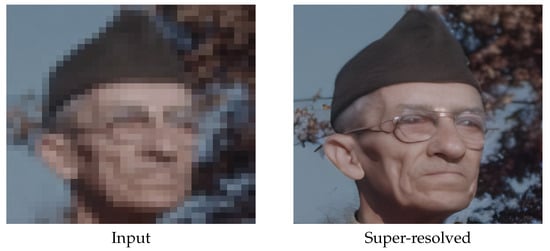
To overcome these limitations, we develop HistoSR, a historical image super-resolution framework that combines unpaired degradation correction with pseudo-paired SR reconstruction. Figure 1 provides an example of a historical image restored by HistoSR. The proposed framework is designed to learn complex degradation characteristics from historical imagery while supporting reconstruction under different degradation conditions. HistoSR adopts a CycleGAN-based architecture with Transformer-based generators for degradation correction.
Figure 1.
The visual reconstruction of a historical image by the proposed HistoSR (×4).
Specifically, the framework consists of two stages. The first stage employs an unpaired degradation correction network to learn a translation between degraded historical LR images and clean LR images without requiring aligned training samples. The second stage performs SR reconstruction using paired clean LR and HR images, where the clean LR images are obtained by downsampling modern HR source images. By incorporating Transformer-based generators into the degradation correction stage, HistoSR can model long-range spatial dependencies through self-attention mechanisms. This design facilitates the extraction of degradation-related features across different image regions and supports the reconstruction of finer visual details and textures.
To support the development and evaluation of HistoSR, we construct an LR historical face image dataset containing 20,000 images collected from World War II documentary films. These images exhibit naturally occurring degradations associated with historical filming conditions, including variations in illumination, blur, noise, and image clarity. Unlike synthetic LR images generated using predefined degradation operators, the collected historical images provide examples of complex degradation patterns encountered in real historical visual materials.
The key contributions of this study are outlined as follows:
- We propose HistoSR, a historical image super-resolution framework that integrates unpaired degradation correction with pseudo-paired SR reconstruction. The framework enables historical image restoration without requiring paired historical LR images and their corresponding HR ground truth.
- We incorporate Transformer-based generators into the unpaired degradation correction network to model spatial relationships across image regions and adapt to diverse degradation patterns in historical image.
- We construct a dataset of 20,000 historical face images collected from World War II documentary films, providing realistic degradation examples for developing and evaluating historical image restoration methods.
2. Related Work
Paired Single Image Super-Resolution: Single-image super-resolution (SISR) seeks to reconstruct HR images from LR inputs despite the ambiguity inherent in this inverse problem [10]. Advances in deep learning have expanded SISR from early CNN approaches, including SRCNN, to more advanced convolutional and Transformer-based models. Supervised methods commonly train on LR–HR pairs created through synthetic degradation, such as downsampling, blurring, or noise injection. SwinIR [5], for example, has been assessed using bicubic downsampling, whereas other approaches employ more varied degradation settings. However, models optimized for simulated distortions may generalize poorly to images affected by unfamiliar degradation processes. This gap is especially pronounced in historical photographs, whose degradation characteristics are often unpredictable and difficult to simulate.
Unpaired Single-Image Super-Resolution: To overcome the limited availability of matched LR–HR training data, several studies have explored SR learning without direct image correspondence [8,9,11,12,13]. Building on CycleGAN [14], CinCGAN [11] progressively restores degraded LR inputs to a cleaner domain before upscaling. Bulat et al. [12] instead learn an HR-to-LR degradation process and use its outputs to train an SR model. DNSR [13] similarly introduces a trainable degradation component to represent real-image distortions. In contrast, Maeda [8] integrates unpaired LR domain correction with an SR network trained on clean LR–HR pairs, establishing a pseudo-supervised reconstruction pipeline.
These approaches reduce the dependence on paired real-world training samples and improve the handling of unknown degradations. However, many rely primarily on convolutional feature extraction, which may be less effective at modeling long-range spatial relationships without additional mechanisms. This motivates the exploration of more flexible feature representations for historical imagery with complex and spatially varying degradations.
Vision Transformers: Transformers have demonstrated strong representation learning capabilities in computer vision, as illustrated by ViT [15]. Their application to image super-resolution, including TTSR [16] and SwinIR [5], has further demonstrated the potential of attention-based architectures for image reconstruction. Unlike conventional convolutions, self-attention enables interactions across spatial regions and supports content-dependent feature modeling, making it suitable for capturing complex image structures.
Nevertheless, many Transformer-based SR approaches are trained using paired images with predefined degradation models, limiting their direct applicability to historical imagery without corresponding HR references. To address this challenge, HistoSR integrates Transformer-based generators into a CycleGAN-based degradation correction framework. The correction stage learns from unpaired historical and clean LR images, while the subsequent SR stage uses paired clean LR–HR samples derived from modern images. This combination leverages attention-based feature modeling while avoiding the need for historical HR ground truth.
3. Methodology
This section presents the HistoSR architecture and its two-stage restoration process, followed by the design of the Transformer blocks used to model degradation-related features in historical imagery.
3.1. Overall Pipeline
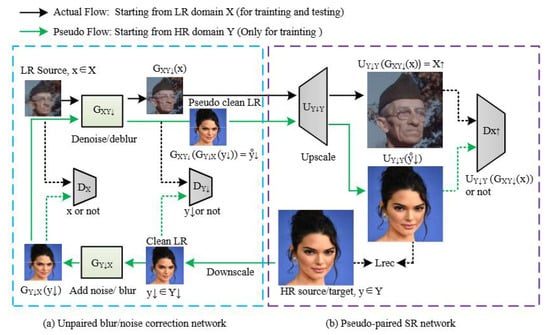
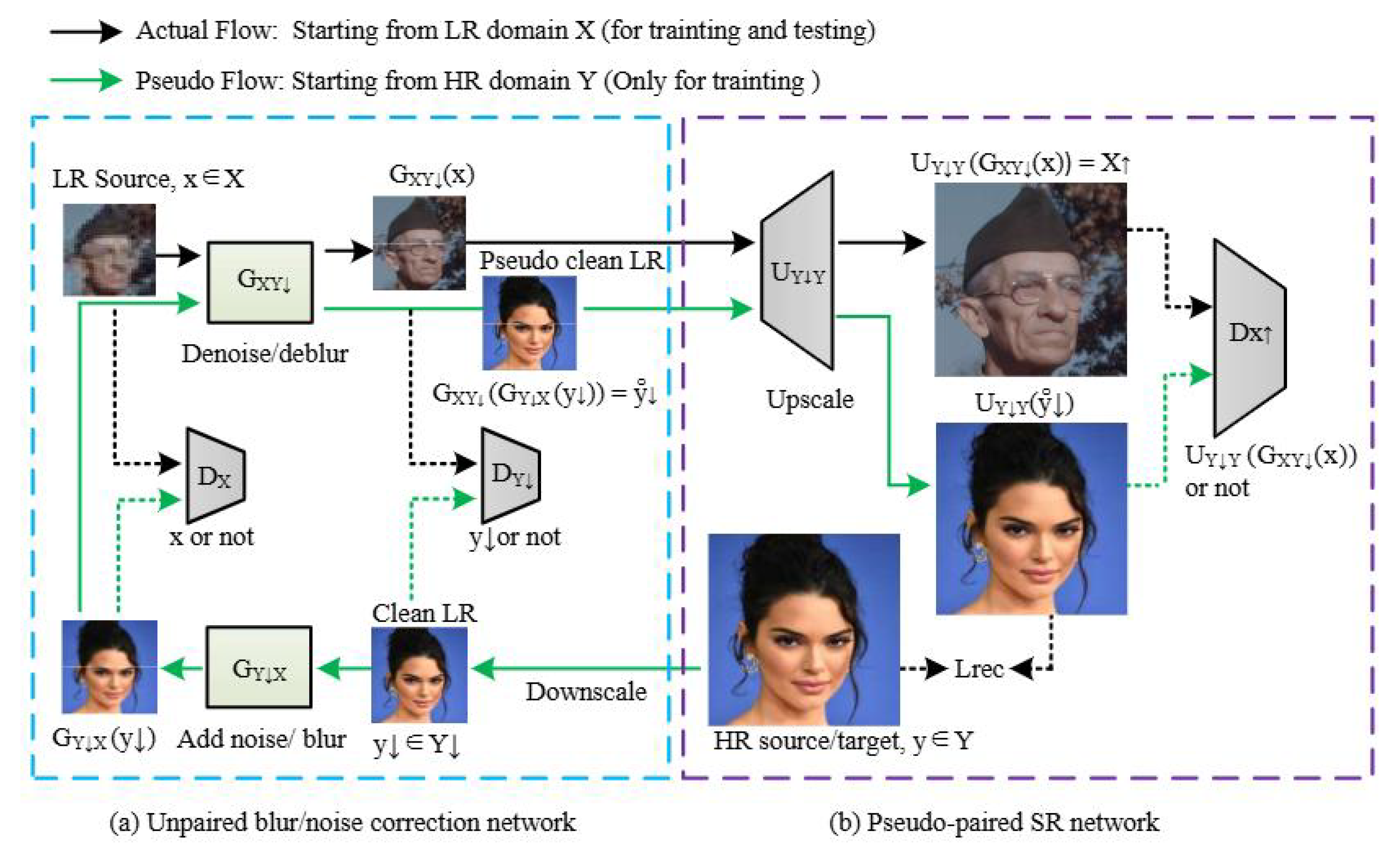
HistoSR integrates a CycleGAN-based degradation correction module with a super-resolution (SR) reconstruction module, as illustrated in Figure 2. The correction module employs Transformer-based generators to learn transformations between degraded historical low-resolution (LR) images and clean LR images from unaligned training sets. The subsequent SR module learns to recover high-resolution (HR) details using paired samples constructed from modern HR face images. To establish the clean LR domain , images from the HR domain Y are bicubically downsampled, yielding , where .
Figure 2.
Overview of the proposed HistoSR framework. The architecture comprises two stages: (a) degradation correction, which learns bidirectional transformations between historical LR and clean LR image domains using unpaired data; and (b) super-resolution reconstruction, which generates HR images from corrected LR inputs through a network trained on paired clean LR–HR samples.
Let X represent the historical LR image domain and Y denote the target HR domain. The restoration process is formulated as a composite mapping , consisting of a degradation correction function and an upsampling function . The former transforms historical LR observations into the clean LR domain, whereas the latter produces HR reconstructions from the corrected LR representations. Accordingly, the overall mapping can be expressed as . This formulation does not require HR ground-truth images corresponding to the historical LR inputs.
Domain transfer in LR: For degradation correction, we build upon the pseudo-supervised framework of Maeda et al. [8] and incorporate Transformer-based generators into the CycleGAN structure. Two generators are optimized to establish transformations in opposite directions between the historical LR domain X and the clean LR domain . Specifically, models the transformation from clean LR images to historical-style degraded observations, while performs the reverse operation to recover clean LR representations. Cycle consistency encourages the reconstructed image to retain the content of its original input:
The discriminators and evaluate whether generated samples resemble real images from their corresponding domains. This adversarial training process enables the correction module to learn from unpaired historical and clean LR image collections.
Mapping from LR to HR: The SR module is optimized using pseudo-paired examples obtained from modern HR images. Each HR training image y is bicubically downsampled to produce , which is subsequently processed by the two correction generators. The resulting LR representation, serves as the input to the upsampling network , with the original HR image y serving as its reconstruction target. Because both images originate from the same HR sample, the SR module can be trained using pixel-wise reconstruction losses. During inference, a historical LR image is first processed by and then upscaled by to obtain the final HR output.
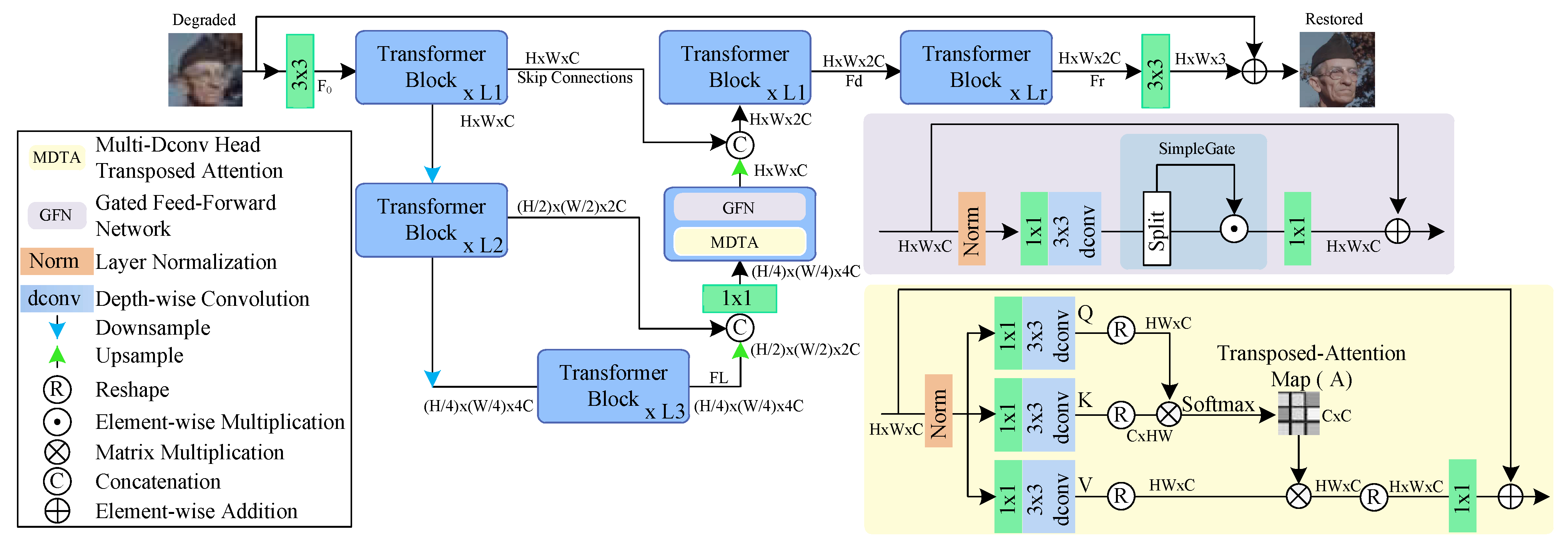
3.2. Generative Network Architecture
To model the diverse degradation patterns observed in historical imagery, we incorporate lightweight multi-scale Transformer blocks into the generators. As illustrated in Figure 3, the two generators follow a hierarchical encoder–decoder architecture with skip connections, extending the CycleGAN framework through attention-based feature extraction. The generator transforms degraded historical LR images into clean LR representations, whereas learns the reverse transformation to simulate historical degradation. Both networks employ Transformer blocks at multiple feature scales to capture local image structures and broader spatial relationships.
Figure 3.
Architecture of the generative network, integrating an encoder–decoder-based Transformer with multi-scale local–global representation learning. Zoom in for a better view; the camera-ready version will allow a wider figure.
Generator Pipeline: Consider the degradation correction generator with an input image , where H and W denote the spatial dimensions. A convolution, denoted by , first projects the input into an initial feature representation:
where and C represents the feature channel dimension.
The resulting features are then refined by the deep feature extraction module :
The module uses a three-level encoder–decoder structure containing multiple Transformer blocks at each level. During encoding, the network builds multi-scale representations by reducing spatial dimensions and increasing feature channels. The decoder gradually restores the spatial dimensions from the latent representation . Pixel-unshuffle and pixel-shuffle [17] handle spatial downscaling and upscaling, respectively.
Skip connections transfer encoder features to their corresponding decoder levels. The concatenated features are processed by a convolution to compresses the channel dimension of the merged features. At the highest spatial resolution, additional Transformer blocks refine the combined features to recover structural information and image textures. After refinement, a convolutional layer generates residual features that are combined with the degraded input to produce the restored image.
Lightweight Transposed Attention (LTA): Conventional spatial self-attention computes relationships among all image positions, resulting in computational complexity proportional to . To reduce this cost, we employ lightweight transposed attention (LTA), which models feature interactions along the channel dimension rather than constructing a spatial attention matrix.
The attention operation is expressed as
where , , and . The parameter is learned during training.
Given a normalized feature tensor, point-wise convolutions generate the initial query, key, and value projections. Depth-wise convolutions then incorporate neighboring spatial information into these representations. After reshaping, the interaction between K and Q produces a channel attention matrix of size , avoiding the substantially larger matrix associated with conventional spatial attention.
The attention output is projected back into the feature space and combined with the input through a residual connection:
where X and denote the input and output feature maps, respectively, and represents the output projection.
Gating Feed-Forward Network (GFN): The feed-forward component employs depth-wise convolutions to incorporate spatial information from neighboring pixels. A gating operation is then applied to regulate feature interactions without introducing an additional activation function at the gating step. Specifically, the feature tensor is divided into two channel-wise components, X and Y, whose element-wise product forms the gated output:
where ⊙ denotes element-wise multiplication. This operation enables multiplicative feature interactions within the feed-forward network while maintaining a relatively simple computational structure.
3.3. Discriminators
Two discriminators, and , are used to evaluate generated images in the historical LR and clean LR domains, respectively. Each uses an identical five-layer convolutional architecture, with LeakyReLU activation after the first four layers and no batch normalization.
3.4. Loss Functions
The degradation correction network is optimized using adversarial, cycle-consistency, identity-mapping, and geometry-consistency objectives. These losses jointly encourage realistic domain translation while constraining changes to image content and structure.
Adversarial Loss: Adversarial learning [18] encourages each generator to produce images consistent with the distribution of its target domain. For the historical-to-clean LR mapping, the generator is trained against the discriminator using
Here, and represent the image distributions of the historical and clean LR domains. The generator attempts to produce outputs that the discriminator cannot distinguish from real clean LR images, while the discriminator learns to separate generated samples from genuine observations. The reverse mapping is optimized analogously using , allowing both translation directions to learn their respective target-domain characteristics.
Cycle-Consistency Loss: Following the one-sided cycle-consistency strategy used in pseudo-supervised restoration [8], we constrain clean LR images to remain recoverable after translation into the historical domain and back:
Unlike a bidirectional cycle constraint, this formulation does not explicitly require historical LR images to be reconstructed after both transformations. It therefore provides greater flexibility for the clean-to-historical generator to represent different degradation patterns while preserving the recoverability of clean LR content.
Identity-Mapping Loss: An identity constraint is applied to discourage unnecessary modifications when the degradation correction generator receives an image from the clean LR domain. This regularization follows the identity-preservation principle introduced in CycleGAN [19].
By encouraging the generator to preserve already-clean inputs, this objective helps limit unwanted changes to image appearance. This formulation represents the conventional identity-mapping constraint. However, for historical images with realistic degradations, we adopt a modified identity-mapping loss using historical LR images as inputs, following the observation of Maeda et al. [8]. The modified formulation is described in the implementation details Section 4.1.
Geometry-Consistency Loss: To reduce geometric distortions during domain translation, we incorporate a consistency constraint inspired by GcGAN [20]. The constraint encourages the degradation correction generator to produce compatible outputs under image flipping and rotation.
where denotes eight geometric transformations involving image flips and rotations, and represents the corresponding inverse transformation.
Full Objective: The overall objective for degradation correction combines the two adversarial terms with the three regularization losses:
The coefficients , , and control the relative contributions of the cycle-consistency, identity, and geometry-consistency terms. The SR reconstruction network is trained to recover an HR image from its corresponding pseudo-clean LR representation . Reconstruction accuracy is encouraged through an L1 objective:
Here, y denotes the HR training image, and is obtained through the degradation correction network. Because the LR input and HR target originate from the same modern HR image, the reconstruction network can be optimized using paired supervision without requiring historical HR ground truth.
4. Experiments
4.1. Datasets and Implementation Details
LR Historical Face Image Dataset: We assemble a collection of historical face images extracted from World War II documentary footage obtained from the United States Marine Corps Film Repository, Moving Image Research Collections, at the University of South Carolina. After identifying and cropping facial regions, each image is resized to pixels using bicubic interpolation to establish a consistent input resolution. Although this preprocessing may suppress certain high-frequency artifacts, the resulting samples preserve degradation characteristics inherited from the original footage, including blur and noise. The dataset contains 20,000 LR face images, with 16,000 allocated for training and the remaining 4000 reserved for testing. Representative examples are provided in Figure 4.
Figure 4.
Samples from our LR dataset collected from a large set of historical films that are diverse in degradation types.
HR Face Image Dataset: For the HR image domain, we adopt the face dataset prepared by Bulat et al. [12], comprising 182,866 images at a resolution of pixels. The dataset combines facial images from VGGFace2 [21], AFLW [22], CelebA [23], and LS3D-W [24], with face regions extracted using the detector [25]. Bicubic downsampling produces corresponding clean LR images, which are used for domain translation and pseudo-paired SR reconstruction.
HistoSR Implementation Details: Although the conventional identity-mapping loss in Equation (9) uses clean LR images as inputs, we adopt a modified formulation for experiments involving realistic historical degradations. Following the observation of Maeda et al., we use historical LR samples (x) instead of clean LR samples () in the identity-mapping constraint. This modification is intended to better accommodate the degradation characteristics of historical imagery. Accordingly, the identity-mapping loss used in our experiments is defined as follows:
The loss coefficients are configured as , , , and . Training uses LR inputs and HR targets, corresponding to a enlargement factor.
Optimization is performed with Adam using an initial learning rate of , a mini-batch size of 4, and 200,000 iterations on an NVIDIA A100 GPU. Each Transformer generator adopts a three-level encoder–decoder structure with 48 initial feature channels. The Transformer block configuration is , and the attention head counts across the three levels are . No explicit image patch partitioning is used. The two discriminators share a five-layer convolutional architecture, with LeakyReLU applied after the first four layers and batch normalization omitted.
Baseline Implementation Details: HistoSR is evaluated against six established SR approaches. SRGAN [26], EDSR [27], RCAN [28], SwinIR [5], and HAT-L [29] are tested using pretrained weights without adaptation to historical images. In contrast, Pseudo-CycleGAN [8] and HistoSR are trained with the historical LR dataset and modern HR face images described above. All methods are assessed using the same 4000 historical test images at a scaling factor. Because the historical images have no paired HR references, evaluation relies on no-reference perceptual metrics. The resulting comparison therefore reflects the performance of pretrained models under domain shift relative to methods trained for historical image restoration, rather than a controlled comparison under identical training conditions.
Evaluation Metrics: We assess reconstruction quality using metrics appropriate to the availability of reference images. For historical faces without HR ground truth, three complementary no-reference image quality assessment metrics are employed: Neural Side-by-Side [30], the Natural Image Quality Evaluator (NIQE) [31], and Multi-Scale Image Quality Transformer (MUSIQ) [32]. Neural Side-by-Side provides model-predicted perceptual preference scores, while NIQE measures deviations from natural-image statistical characteristics. MUSIQ employs a multi-scale Transformer-based architecture to predict perceptual image quality without requiring reference images. By considering image content at multiple spatial scales, MUSIQ provides an additional learning-based assessment of perceptual quality. Higher Neural Side-by-Side and MUSIQ scores indicate better predicted perceptual quality, whereas lower NIQE values indicate better image quality according to natural-image statistics. These metrics provide complementary assessments, although their predictions may be affected by domain differences between historical film imagery and contemporary images. For datasets containing HR reference images, reconstruction accuracy is assessed using PSNR and SSIM, where higher scores reflect greater fidelity to the reference images.
4.2. Effectiveness of the Proposed HistoSR
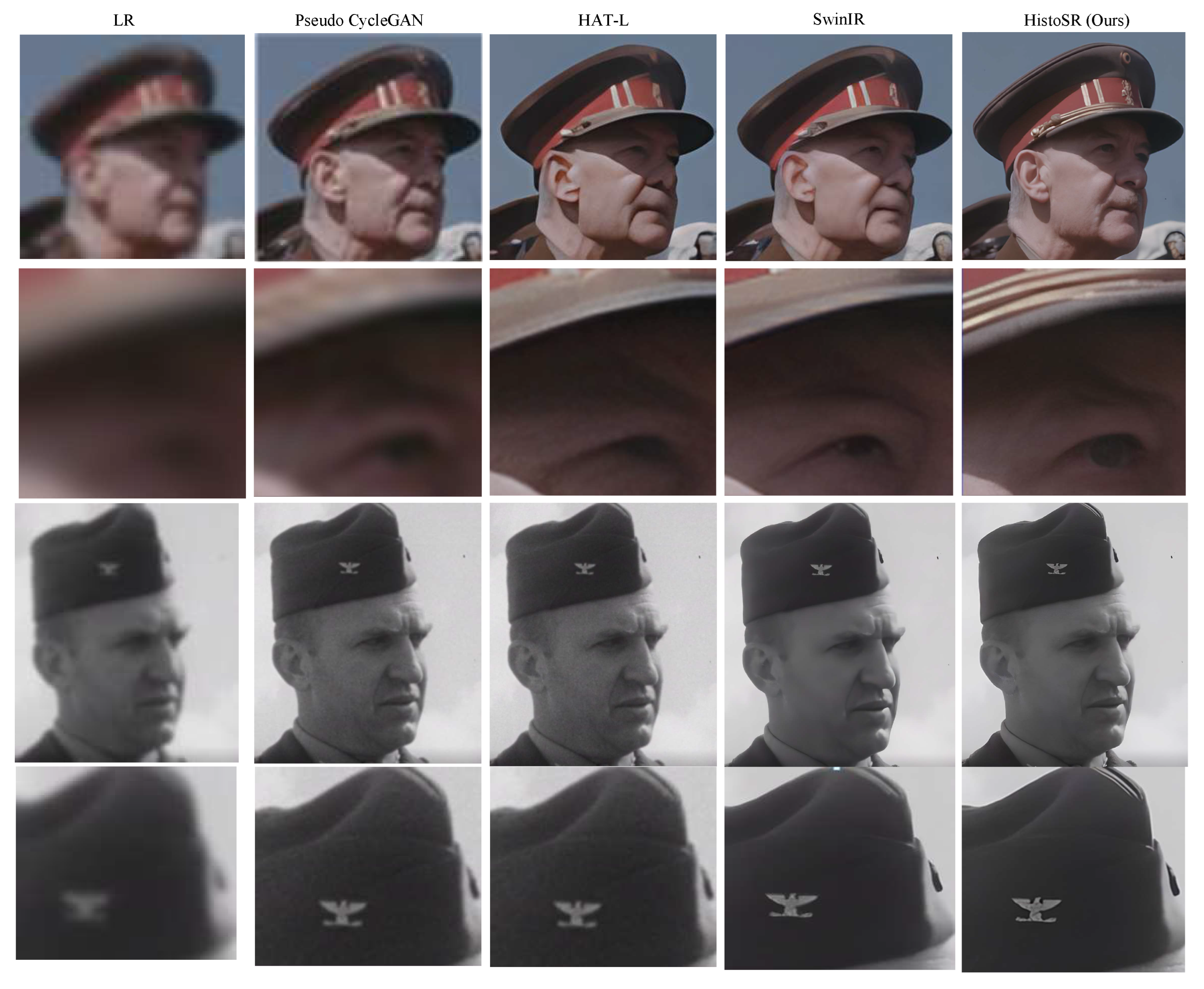
Evaluation of SR Performance on Historical Images: We examine the restoration performance of HistoSR using the collected historical face images. Figure 5 illustrates representative outputs alongside those of Pseudo-CycleGAN [8], SwinIR [5], and HAT-L [29]. In the displayed examples, HistoSR produces clearer facial structures and more visually coherent details.
Figure 5.
Visual comparison of historical face reconstructions produced by HistoSR and representative super-resolution methods.
Quantitative results are summarized in Table 1. HistoSR achieves the highest Neural Side-by-Side predicted preference score of 0.27 and the lowest NIQE value of 5.43 among all evaluated methods. Furthermore, to provide a more comprehensive assessment of perceptual quality, we incorporate the Multi-Scale Image Quality Transformer (MUSIQ), a learning-based no-reference image quality assessment metric. HistoSR achieves the highest MUSIQ score of 59.28, further supporting its effectiveness in restoring historical face images. The consistent improvements across all three metrics demonstrate the effectiveness of HistoSR under different perceptual quality assessment approaches. Nevertheless, these results should be interpreted as evidence of improved predicted perceptual quality, given the inherent limitations of no-reference evaluation and the domain-specific characteristics of historical imagery.
Table 1.
Perceptual quality comparison of different super-resolution methods on the historical face dataset using Neural Side-by-Side, NIQE, MUSIQ, and MOS. Higher scores indicate better quality, except for NIQE, where lower values are preferred.
To further assess perceptual quality, we conducted a Mean Opinion Score (MOS) evaluation with five participants from different academic and professional backgrounds. A total of 200 randomly selected historical face images were evaluated on a scale from 0 (very poor) to 5 (excellent), considering visual clarity, facial details, and naturalness. The MOS for each super-resolution method was calculated by averaging participants’ ratings. Table 1 presents the score distributions and mean MOS values, complementing the NIQE and MUSIQ evaluations with human perceptual judgments.
We also examine reconstruction performance under controlled Gaussian degradation conditions. The experiments consider additive white Gaussian noise with standard deviations and Gaussian blur with . Separate models are trained on DIV2K for each degradation setting. As reported in Table 2, HistoSR achieves the highest scores in the evaluated configurations except for Gaussian blur at . These findings indicate that the framework can be adapted to multiple synthetic degradation settings through task-specific training.
Table 2.
PSNR (dB) comparison of super-resolution methods under synthetic degradations, including additive white Gaussian noise and Gaussian blur.
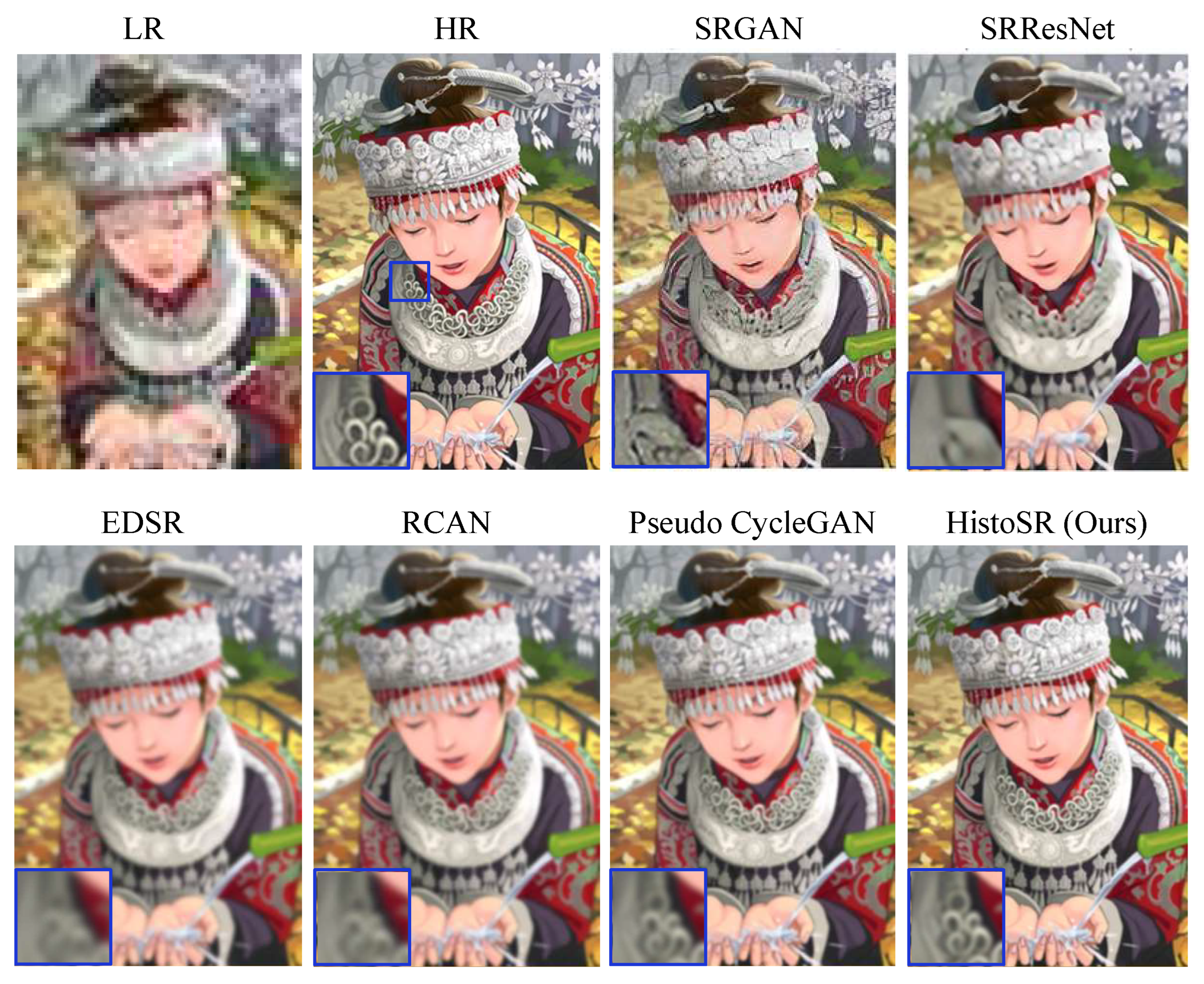
Generalization to Different Datasets: We further investigate whether the proposed framework can be applied to conventional SR benchmarks. For this experiment, HistoSR is retrained on DIV2K and evaluated on Set14 [33]. Table 3 presents the PSNR and SSIM results. Under this training and evaluation configuration, HistoSR achieves higher reconstruction scores than the methods included in the comparison.
Table 3.
Performance comparison on Set14 ×4.
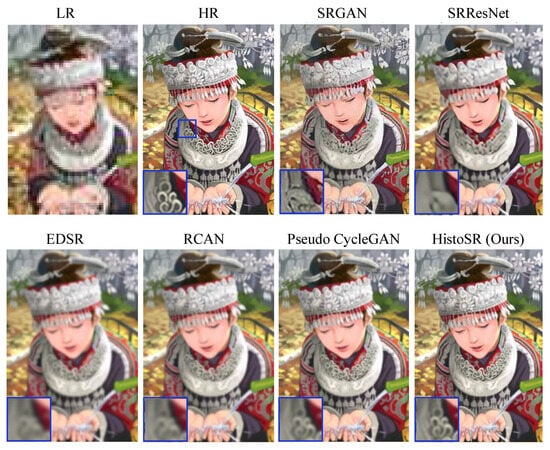
Generalization Beyond Face Images: Although HistoSR is primarily developed for historical face restoration, its reconstruction framework can also be trained on non-face image content. Figure 6 and Table 3 present the results obtained on Set14 after retraining with DIV2K. The findings support the applicability of the architecture to general image SR under the evaluated conditions. However, further experiments on historical non-face imagery would be needed to establish its effectiveness across other historical image categories.
Figure 6.
Qualitative comparison of super-resolution results from leading SR methods on the Set14 dataset. the blue boxes indicate regions magnified for better visualization of local image details.
Experimental Result Analysis: The experimental comparisons reveal differences in how existing SR approaches handle historical image degradations. SRGAN [26] employs adversarial and perceptual objectives to encourage visually plausible reconstructions, while EDSR [27] improves feature learning through a residual architecture without batch normalization. RCAN [28] further enhances feature representations using channel attention. Unlike these supervised approaches, Pseudo-CycleGAN [8] addresses the lack of aligned training samples through pseudo-supervised reconstruction. More recent Transformer-based methods, including SwinIR [5] and HAT-L [29], incorporate attention mechanisms to capture richer spatial relationships.
Despite their effectiveness on conventional SR benchmarks, the pretrained supervised models exhibit limitations when applied directly to historical images with unfamiliar degradation characteristics. As illustrated in Figure 5, some reconstructed faces retain blur or lack fine structural details. In comparison, HistoSR produces visually clearer results in the displayed examples. Its degradation correction stage learns from historical LR images, while Transformer-based generators support feature interactions across image regions. The quantitative results in Table 1 further indicate improved model-predicted perceptual quality. However, because the pretrained baselines and HistoSR use different training strategies, these results should be interpreted as a comparison under different degrees of adaptation to historical imagery.
Domain Gap Discussion: Historical and modern face images differ in visual characteristics arising from acquisition technology, lighting, and image quality. HistoSR addresses part of this discrepancy by learning a transformation from degraded historical LR images to the clean LR domain used for SR reconstruction. This intermediate representation enables the model to exploit modern HR face images for supervised upscaling without requiring corresponding HR references for historical inputs. Although this strategy helps bridge the degradation-related domain gap, differences in facial content and other image characteristics may remain.
4.3. Ablation Study
We investigate the contribution of the generator architecture by comparing three configurations under the same DIV2K training and Set14 evaluation setting. As reported in Table 4, the Pseudo-CycleGAN and RCAN baseline [8,28] achieves 28.96 dB PSNR with 16.0 million parameters. Replacing the generator architecture with MDTA and GDFN [6] increases PSNR to 29.63 dB and the parameter count rises to 25.31 million.
Table 4.
Effect of generator configurations on super-resolution, with training on DIV2K and evaluation on Set14.
Substituting GDFN with the Gating Feed-Forward Network (GFN) further improves PSNR to 29.78 dB while reducing the parameter count to 23.90 million. This represents a 0.15 dB improvement and approximately 5.6% fewer parameters compared with the MDTA–GDFN configuration. These findings suggest that the attention-based generator architecture substantially improves reconstruction accuracy under the evaluated conditions, while GFN provides a more parameter-efficient alternative to GDFN.
5. Conclusions
This study investigated historical image super-resolution under complex degradation conditions and limited availability of paired training data. We developed HistoSR, a two-stage framework that combines unpaired degradation correction with pseudo-paired SR reconstruction. Transformer-based generators were incorporated into the correction stage to model spatial relationships and degradation characteristics in historical imagery. We also constructed a dataset of 20,000 historical face images extracted from World War II documentary films to support model development and evaluation. Experiments on historical face images indicate that HistoSR achieves improved model-predicted perceptual quality compared with the evaluated SR approaches. Additional experiments on Set14, following retraining on DIV2K, demonstrate the applicability of the framework to general image reconstruction. The ablation results further support the effectiveness of the attention-based generator and the parameter efficiency of GFN. Nevertheless, the historical image evaluation is limited by the absence of HR ground truth and relies on no-reference quality assessment. Future work will investigate additional perceptual evaluation methods, human subjective assessments, and restoration performance on historical imagery beyond facial content. Overall, the findings suggest that combining unpaired degradation modeling with attention-based reconstruction offers a promising direction for historical image restoration.
Author Contributions
Conceptualization, L.Z., Y.W. and S.C.; methodology, L.Z. and Y.W.; software, L.Z.; validation, L.Z. and Y.W.; formal analysis, L.Z., Y.W. and S.C.; investigation, L.Z. and Y.W.; resources, S.C., J.Z. and G.W.; data curation, L.Z., J.Z. and G.W.; writing—original draft preparation, L.Z.; writing—review and editing, L.Z., Y.W., S.C., J.Z. and G.W.; visualization, L.Z.; supervision, Y.W. and S.C.; project administration, S.C.; funding acquisition, S.C. All authors have read and agreed to the published version of the manuscript.
Funding
This research was funded by the National Science Foundation (NSF) under Grants EES-2436203, CNS-2411979, and OAC-2321111.
Institutional Review Board Statement
Not applicable.
Informed Consent Statement
Not applicable.
Data Availability Statement
The data presented in this study are available on request from the corresponding author.
Conflicts of Interest
The authors declare no conflict of interest.
References
- Zhang, K.; Zuo, W.; Zhang, L. Learning a single convolutional super-resolution network for multiple degradations. In Proceedings of the IEEE Conference on Computer Vision and Pattern Recognition, Salt Lake City, UT, USA, 18–23 June 2018; pp. 3262–3271. [Google Scholar]
- Shocher, A.; Cohen, N.; Irani, M. “Zero-Shot” Super-Resolution Using Deep Internal Learning. In Proceedings of the IEEE Conference on Computer Vision and Pattern Recognition (CVPR), Salt Lake City, UT, USA, 18–23 June 2018; pp. 3118–3126. [Google Scholar]
- Soh, J.W.; Cho, S.; Cho, N.I. Meta-transfer learning for zero-shot super-resolution. In Proceedings of the IEEE/CVF Conference on Computer Vision and Pattern Recognition, Virtual, 14–19 June 2020; pp. 3516–3525. [Google Scholar]
- Zhang, K.; Van Gool, L.; Timofte, R. Deep unfolding network for image super-resolution. In Proceedings of the IEEE/CVF Conference on Computer Vision and Pattern Recognition, Virtual, 14–19 June 2020; pp. 3217–3226. [Google Scholar]
- Liang, J.; Cao, J.; Sun, G.; Zhang, K.; Van Gool, L.; Timofte, R. Swinir: Image restoration using swin transformer. In Proceedings of the IEEE/CVF International Conference on Computer Vision, Virtual, 11–17 October 2021; pp. 1833–1844. [Google Scholar]
- Zamir, S.W.; Arora, A.; Khan, S.; Hayat, M.; Khan, F.S.; Yang, M.H. Restormer: Efficient transformer for high-resolution image restoration. In Proceedings of the IEEE/CVF Conference on Computer Vision and Pattern Recognition, New Orleans, LA, USA, 19–24 June 2022; pp. 5728–5739. [Google Scholar]
- Wang, Z.; Cun, X.; Bao, J.; Zhou, W.; Liu, J.; Li, H. Uformer: A general u-shaped transformer for image restoration. In Proceedings of the IEEE/CVF Conference on Computer Vision and Pattern Recognition, New Orleans, LA, USA, 19–24 June 2022; pp. 17683–17693. [Google Scholar]
- Maeda, S. Unpaired image super-resolution using pseudo-supervision. In Proceedings of the IEEE/CVF Conference on Computer Vision and Pattern Recognition, Virtual, 14–19 June 2020; pp. 291–300. [Google Scholar]
- Lugmayr, A.; Danelljan, M.; Timofte, R. Unsupervised learning for real-world super-resolution. In Proceedings of the 2019 IEEE/CVF International Conference on Computer Vision Workshop (ICCVW), Seoul, Republic of Korea, 27–28 October 2019; pp. 3408–3416. [Google Scholar]
- Xiao, J.; Yong, H.; Zhang, L. Degradation Model Learning for Real-World Single Image Super-resolution. In Proceedings of the Asian Conference on Computer Vision (ACCV), Virtual, 30 November–4 December 2020. [Google Scholar]
- Yuan, Y.; Liu, S.; Zhang, J.; Zhang, Y.; Dong, C.; Lin, L. Unsupervised Image Super-Resolution using Cycle-in-Cycle Generative Adversarial Networks. arXiv 2018, arXiv:1809.00437. [Google Scholar]
- Bulat, A.; Yang, J.; Tzimiropoulos, G. To learn image super-resolution, use a GAN to learn how to do image degradation first. arXiv 2018, arXiv:1807.11458. [Google Scholar]
- Zhao, T.; Ren, W.; Zhang, C.; Ren, D.; Hu, Q. Unsupervised Degradation Learning for Single Image Super-Resolution. arXiv 2018, arXiv:1812.04240. [Google Scholar]
- Zhu, J.Y.; Park, T.; Isola, P.; Efros, A.A. Unpaired image-to-image translation using cycle-consistent adversarial networks. In Proceedings of the IEEE International Conference on Computer Vision, lVenice, Italy, 22–29 October 2017; pp. 2223–2232. [Google Scholar]
- Dosovitskiy, A.; Beyer, L.; Kolesnikov, A.; Weissenborn, D.; Zhai, X.; Unterthiner, T.; Dehghani, M.; Minderer, M.; Heigold, G.; Gelly, S.; et al. An image is worth 16x16 words: Transformers for image recognition at scale. arXiv 2020, arXiv:2010.11929. [Google Scholar]
- Yang, F.; Yang, H.; Fu, J.; Lu, H.; Guo, B. Learning texture transformer network for image super-resolution. In Proceedings of the IEEE/CVF Conference on Computer Vision and Pattern Recognition, Virtual, 14–19 June 2020; pp. 5791–5800. [Google Scholar]
- Shi, W.; Caballero, J.; Huszár, F.; Totz, J.; Aitken, A.P.; Bishop, R.; Rueckert, D.; Wang, Z. Real-time single image and video super-resolution using an efficient sub-pixel convolutional neural network. In Proceedings of the IEEE Conference on Computer Vision and Pattern Recognition, Las Vegas, NV, USA, 26 June–1 July 2016; pp. 1874–1883. [Google Scholar]
- Goodfellow, I.J.; Pouget-Abadie, J.; Mirza, M.; Xu, B.; Warde-Farley, D.; Ozair, S.; Courville, A.; Bengio, Y. Generative Adversarial Networks. arXiv 2014, arXiv:1406.2661. [Google Scholar]
- Zhu, J.; Park, T.; Isola, P.; Efros, A.A. Unpaired Image-to-Image Translation using Cycle-Consistent Adversarial Networks. arXiv 2020, arXiv:1703.10593. [Google Scholar]
- Fu, H.; Gong, M.; Wang, C.; Batmanghelich, K.; Zhang, K.; Tao, D. Geometry-Consistent Generative Adversarial Networks for One-Sided Unsupervised Domain Mapping. arXiv 2018, arXiv:1809.05852. [Google Scholar]
- Cao, Q.; Shen, L.; Xie, W.; Parkhi, O.M.; Zisserman, A. VGGFace2: A Dataset for Recognising Faces across Pose and Age. In Proceedings of the 2018 13th IEEE International Conference on Automatic Face Gesture Recognition (FG 2018), Xi’an, China, 15–19 May 2018; pp. 67–74. [Google Scholar] [CrossRef] [Scilit]
- Köstinger, M.; Wohlhart, P.; Roth, P.M.; Bischof, H. Annotated Facial Landmarks in the Wild: A large-scale, real-world database for facial landmark localization. In Proceedings of the 2011 IEEE International Conference on Computer Vision Workshops (ICCV Workshops), Barcelona, Spain, 6–13 November 2011; pp. 2144–2151. [Google Scholar] [CrossRef] [Scilit]
- Liu, Z.; Luo, P.; Wang, X.; Tang, X. Deep Learning Face Attributes in the Wild. arXiv 2015, arXiv:1411.7766. [Google Scholar]
- Bulat, A.; Tzimiropoulos, G. How Far are We from Solving the 2D & 3D Face Alignment Problem? (and a Dataset of 230,000 3D Facial Landmarks). In Proceedings of the 2017 IEEE International Conference on Computer Vision (ICCV), Venice, Italy, 22–29 October 2017. [Google Scholar] [CrossRef] [Scilit]
- Zhang, S.; Zhu, X.; Lei, Z.; Shi, H.; Wang, X.; Li, S.Z. S3FD: Single Shot Scale-invariant Face Detector. arXiv 2017, arXiv:1708.05237. [Google Scholar]
- Ledig, C.; Theis, L.; Huszar, F.; Caballero, J.; Cunningham, A.; Acosta, A.; Aitken, A.; Tejani, A.; Totz, J.; Wang, Z.; et al. Photo-Realistic Single Image Super-Resolution Using a Generative Adversarial Network. arXiv 2017, arXiv:1609.04802. [Google Scholar]
- Lim, B.; Son, S.; Kim, H.; Nah, S.; Lee, K.M. Enhanced Deep Residual Networks for Single Image Super-Resolution. arXiv 2017, arXiv:1707.02921. [Google Scholar]
- Zhang, Y.; Li, K.; Li, K.; Wang, L.; Zhong, B.; Fu, Y. Image Super-Resolution Using Very Deep Residual Channel Attention Networks. arXiv 2018, arXiv:1807.02758. [Google Scholar]
- Chen, X.; Wang, X.; Zhou, J.; Dong, C. Activating More Pixels in Image Super-Resolution Transformer. arXiv 2022, arXiv:2205.04437. [Google Scholar]
- Khrulkov, V.; Babenko, A. Neural Side-by-Side: Predicting Human Preferences for No-Reference Super-Resolution Evaluation. In Proceedings of the IEEE/CVF Conference on Computer Vision and Pattern Recognition (CVPR), Nashville, TN, USA, 20–25 June 2021; pp. 4988–4997. [Google Scholar]
- Mittal, A.; Soundararajan, R.; Bovik, A.C. Making a ‘Completely Blind’ Image Quality Analyzer. IEEE Signal Process. Lett. 2013, 20, 209–212. [Google Scholar] [CrossRef] [Scilit]
- Ke, J.; Wang, Q.; Wang, Y.; Milanfar, P.; Yang, F. MUSIQ: Multi-scale Image Quality Transformer. In Proceedings of the IEEE/CVF International Conference on Computer Vision (ICCV), Montreal, QC, Canada, 10–17 October 2021; pp. 5148–5157. [Google Scholar]
- Zeyde, R.; Elad, M.; Protter, M. On Single Image Scale-Up Using Sparse-Representations. In Curves and Surfaces; Springer: Berlin/Heidelberg, Germany, 2012; pp. 711–730. [Google Scholar]



Disclaimer/Publisher’s Note: The statements, opinions and data contained in all publications are solely those of the individual author(s) and contributor(s) and not of MDPI and/or the editor(s). MDPI and/or the editor(s) disclaim responsibility for any injury to people or property resulting from any ideas, methods, instructions or products referred to in the content. |
© 2026 by the authors. Licensee MDPI, Basel, Switzerland. This article is an open access article distributed under the terms and conditions of the Creative Commons Attribution (CC BY) license.