


Abstract
Food waste digestate is a high-moisture organic residue that requires effective stabilization before resource recovery or land application. This engineering-scale study compared high aeration (HA, 0.30 L·min−1·kg−1 dry matter), low aeration (LA, 0.15 L·min−1·kg−1 dry matter), and turning without forced bottom aeration (TG) during a 30-day food waste digestate–corn straw co-composting experiment. One engineering-scale pile was operated for each treatment. Physicochemical trajectories, bacterial succession, predicted functional potential, and microbial co-occurrence patterns were evaluated. All treatments rapidly entered the thermophilic phase. HA reached the highest temperature (63.70 °C) and remained above 55 °C for 340.8 h, but it also had the lowest final moisture reading (18.62%). LA achieved the greatest organic matter (OM) reduction (17.47%), compared with 13.47% in HA and 7.44% in TG, while retaining more moisture than HA at day 30. Bacillota became dominant in all treatments, although the intensity of thermophilic filtering and the pattern of late-stage succession differed among treatments. Functional predictions indicated the highest late-stage ureolysis potential in LA, whereas TG showed greater predicted representation of several nitrogen-transformation-related groups and the densest co-occurrence network. These findings suggest that engineering-scale composting performance depends on the balance among oxygen supply, heat accumulation, moisture conservation, and microbial organization rather than on thermophilic intensity alone. Under the tested conditions, LA provided the most favorable balance, particularly in terms of OM reduction and moisture retention.
1. Introduction
Food waste management remains a major environmental and resource-recovery challenge. The United Nations Environment Programme estimated that 1.05 billion tonnes of food waste were generated in 2022, equivalent to 132 kg per capita and approximately 19% of the food available to consumers [1]. A recent national-scale analysis further estimated that urban China generates approximately 137 million tonnes of food waste annually [2]. Anaerobic digestion (AD) is increasingly used to recover renewable energy from source-separated food waste and other organic residues. Reflecting this expansion, European biomethane production increased by 0.8 billion m3 in 2023, representing 21% growth across the European Union [3]. The associated digestate stream is also substantial: the European Biogas Association estimated that Europe produced 31 million tonnes of digestate dry matter in 2022 and projected that this amount could reach 75 million tonnes by 2030 [4]. At the process level, digestate can account for approximately 90–95% of the wet mass entering an AD system because most water and mineral nutrients remain in the residue after biogas recovery [5]. Digestate management is therefore a major material-flow requirement rather than a minor by-product issue.
The physical form and post-treatment requirements of digestate depend strongly on the solids regime of the digester. Wet AD generally operates at total-solids concentrations below approximately 10–20%, whereas dry AD commonly treats feedstocks containing approximately 20–40% total solids [6]. The high water content and large volume of wet food waste digestate increase the burdens associated with storage, transportation, and field application [7]. Dry AD produces a more concentrated, lower-moisture residue that is generally easier to handle, although high-solids operation can impose mass-transfer limitations [8]. Digestates from wet and dry AD therefore differ primarily in solids content, handling characteristics, logistics, and post-treatment requirements rather than being intrinsically stable or unstable. Depending on residual biodegradability and the intended end use, separation, aerobic curing, or composting may still be required to improve stability and reduce transport volume [4,9,10]. Food waste digestate may also retain readily degradable organic matter, variable salinity, and potential phytotoxicity; consequently, inappropriate storage or land application can promote odor generation, leachate production, nutrient loss, and operational difficulties [5,7,9,10].
Co-composting digestate with dry lignocellulosic bulking agents is an established approach for improving porosity, adjusting moisture content and the carbon-to-nitrogen (C/N) ratio, and promoting biological stabilization [10,11,12]. At the industrial scale, composting is a mature engineered bioprocess implemented in windrow, aerated static-pile, and enclosed-reactor systems. Aeration and turning are routinely used as operational controls, and more intensively managed facilities can regulate airflow through feedback based on pile temperature, exhaust-gas oxygen concentration, and moisture content [13,14]. Process performance is also influenced by pH, feedstock properties, and microbial respiration, which affect biological activity and suitable control set points. These established engineering principles make aeration intensity and turning frequency practical operating variables rather than novel technologies. The central scientific question is therefore not whether digestate can be composted with straw, but how operating conditions regulate the coupled evolution of pile habitat, organic matter (OM) transformation, and microbial ecology at a practically relevant scale. In high-moisture systems, oxygen supply mode is especially important because aeration and turning simultaneously affect oxygen transfer, metabolic heat release, evaporation, soluble-ion migration, and the spatial distribution of aerobic and oxygen-limited microsites [15,16,17].
Continuous aeration can promote rapid early-stage heating and OM mineralization, whereas turning periodically restores porosity and redistributes oxygen and moisture [15,16,17]. However, increasing aeration intensity does not necessarily improve overall process performance. Excessive airflow may accelerate water loss and nutrient volatilization, whereas insufficient or intermittent oxygen delivery may constrain sustained aerobic degradation. Previous studies have therefore examined aeration rate, aeration pattern, turning frequency, gaseous emissions, and humification during composting [15,18,19,20,21]. Nevertheless, how contrasting oxygen supply modes reshape microbial succession and predicted functional organization under engineering-scale digestate composting conditions remains insufficiently resolved.
Composting microorganisms mediate the transformation of carbohydrates, proteins, lignocellulosic fractions, and nitrogen-containing compounds, and their succession is strongly filtered by temperature, oxygen availability, moisture, and salinity [22,23,24,25]. High-throughput 16S rRNA gene sequencing can characterize taxonomic succession and community turnover, whereas Phylogenetic Investigation of Communities by Reconstruction of Unobserved States 2 (PICRUSt2) and Functional Annotation of Prokaryotic Taxa (FAPROTAX) provide complementary predictions of functional potential [26,27,28]. These predictions should not be interpreted as direct measurements of gene expression, enzyme activity, or process rates. Similarly, co-occurrence networks describe statistical associations among taxa rather than direct ecological interactions, although they can provide a useful perspective on community organization [29].
Accordingly, this study compared three oxygen supply modes—high aeration (HA), low aeration (LA), and turning (TG)—in an engineering-scale food waste digestate–corn straw co-composting system. Rather than presenting digestate–straw co-composting as a new treatment route, the study evaluated how operating mode was associated with physicochemical trajectories, within-pile bacterial succession, predicted functional potential, and co-occurrence organization. The resulting framework was used to interpret the pathway linking treatment mode, pile habitat, microbial response, and composting performance while explicitly acknowledging the limitations of an engineering-scale design without independently replicated piles. We hypothesized that LA would provide a more favorable balance among oxygen supply, heat accumulation, moisture retention, and microbial organization than HA or TG, as evaluated using the physicochemical, bacterial community, predicted function, and co-occurrence indicators reported in this study.
2. Results
2.1. Physicochemical Trajectories and Composting Performance
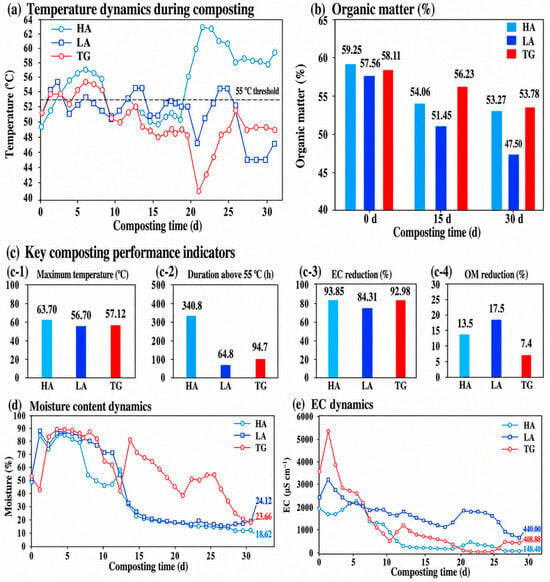
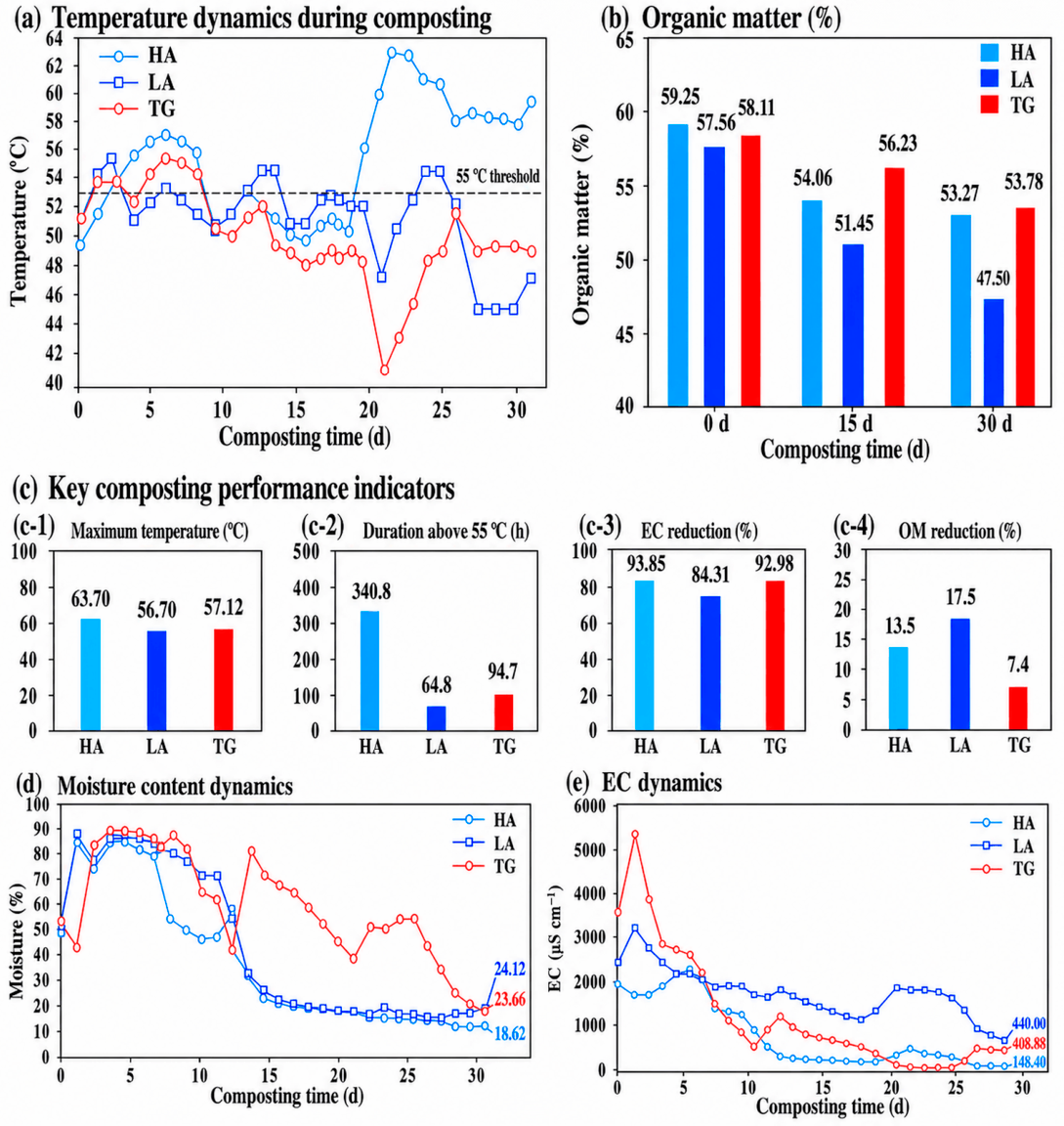
All three treatments entered the thermophilic phase within 2 days, but their temperature trajectories differed (Figure 1a–c). The maximum temperatures of HA, LA, and TG were 63.70, 56.70, and 57.12 °C, respectively, and the corresponding cumulative durations above 55 °C were 340.8, 64.8, and 94.7 h. OM decreased from 59.25%, 57.56%, and 58.11% at day 0 to 51.27%, 47.50%, and 53.78% at day 30 in HA, LA, and TG, respectively. These changes corresponded to OM reductions of 13.47%, 17.47%, and 7.44%, with LA showing the greatest reduction under the tested conditions.
Figure 1.
Physicochemical trajectories and key process indicators under the three treatments: (a) temperature; (b) organic matter (OM) content; (c) maximum temperature, cumulative duration above 55 °C, electrical conductivity (EC) reduction, and OM reduction; (d) local moisture status; and (e) electrical conductivity. Because one engineering-scale pile was operated per treatment, the data are presented as treatment-specific process trajectories without treatment-level inferential testing.
Local moisture readings initially increased and then declined in all treatments (Figure 1d), reaching peak values of 86.93%, 88.43%, and 88.37% in HA, LA, and TG, respectively. At day 30, the corresponding readings were 18.62%, 24.12%, and 23.66%. Electrical conductivity (EC) also generally decreased during composting, reaching 148.40, 440.00, and 408.88 μS·cm−1 at day 30 (Figure 1e). Thus, HA combined the strongest heat accumulation with the greatest moisture decline and the lowest endpoint EC near the sensor, whereas LA retained more moisture and achieved the greatest OM reduction. These trajectories indicate that thermophilic intensity alone did not determine OM transformation; the balance between oxygen supply and moisture conservation was also important. This pattern agrees with controlled food waste digestate studies showing that higher aeration can increase temperature and accelerate early organic consumption but may restrain humification or maturity when oxygen supply exceeds stage-specific demand [20,21]. A recent multi-stage experiment further showed that progressively reducing the aeration rate from 0.30 to 0.20 and then 0.10 L·min−1·kg−1 DM improved humification and reduced gaseous losses relative to constant high aeration [30]. The present engineering-scale results extend this pattern: HA maximized heat accumulation, whereas LA achieved greater OM reduction while retaining more local moisture, suggesting that the principal constraint shifted from oxygen delivery during early heating to moisture availability during later transformation.
2.2. Bacterial Community Composition and Succession
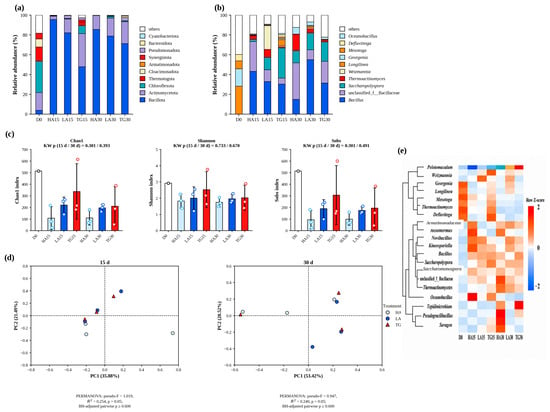
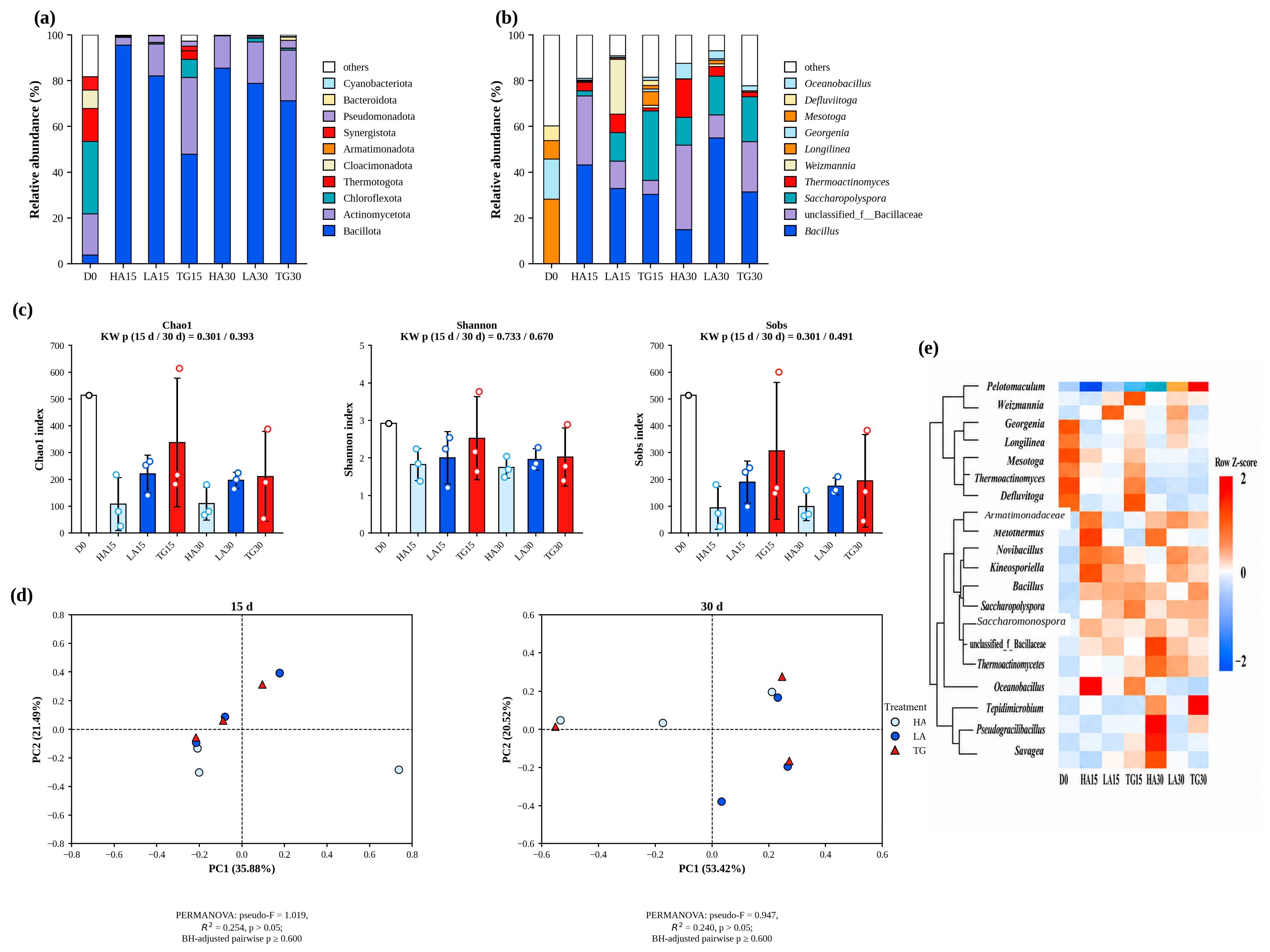
Bacterial communities exhibited pronounced stage-dependent succession under all treatment modes (Figure 2a). The initial community consisted mainly of Chloroflexota (31.56%), Actinomycetota (18.10%), and Thermotogota (14.47%). At day 15, Bacillota accounted for 95.61%, 82.09%, and 47.89% of the communities in HA, LA, and TG, respectively. From days 15 to 30, Bacillota decreased by 10.07 and 3.26 percentage points in HA and LA, respectively, but increased by 23.38 percentage points in TG. Actinomycetota showed the opposite late-stage pattern, increasing by 10.77 and 4.17 percentage points in HA and LA, respectively, but decreasing by 11.42 percentage points in TG. These results indicate a common shift toward Bacillota dominance, accompanied by treatment-associated differences in the timing and intensity of late-stage succession.
Figure 2.
Bacterial community composition and succession under the different treatments: (a) phylum-level composition; (b) genus-level composition; (c) alpha-diversity indices, with Kruskal–Wallis p values for days 15 and 30; (d) Bray–Curtis principal coordinates analysis (PCoA), with overall permutational multivariate analysis of variance (PERMANOVA) statistics and Benjamini–Hochberg-adjusted pairwise p values; and (e) heatmap of selected dominant taxa. Bars in panel (c) represent mean ± standard deviation (SD) across the three spatial samples, and the overlaid circles indicate the individual spatial samples, with marker colors corresponding to the treatments. These samples characterize within-pile heterogeneity and do not constitute independent composting pile replicates.
At the genus level, the initial sample was dominated by Longilinea (28.26%) and Georgenia (17.50%) (Figure 2b). The heatmap of selected dominant taxa is shown in Figure 2e. At day 15, HA was dominated by Bacillus (43.18%) and unclassified_f__Bacillaceae (30.17%); LA by Bacillus (32.93%), Weizmannia (24.05%), and Saccharopolyspora (12.50%); and TG by Saccharopolyspora (30.42%) and Bacillus (30.35%). At day 30, unclassified_f__Bacillaceae, Thermoactinomyces, Bacillus, and Saccharopolyspora jointly dominated HA, whereas Bacillus increased to 55.07% in LA. TG retained co-dominance by Bacillus, unclassified_f__Bacillaceae, and Saccharopolyspora. The rapid concentration of the HA community into thermotolerant taxa was consistent with its stronger and more prolonged thermophilic conditions, whereas TG retained a broader assemblage of co-dominant genera. The dominance of Bacillota and enrichment of Bacillus under the more thermophilic HA regime agree with reports that elevated composting temperatures select thermotolerant, spore-forming, and extracellular-enzyme-producing lineages [23,24,31]. Industrial-scale food waste composting has likewise shown that aeration frequency alters oxygen distribution, enzyme activity, and bacterial succession [32]. The broader set of co-dominant genera in TG also accords with pile-scale evidence that intervals between turning events can maintain spatial gradients in temperature, pH, mineral nitrogen, and bacterial community structure [33]. The TG pattern may therefore reflect the coexistence of taxa adapted to different microhabitats rather than simply weaker succession; however, this interpretation remains descriptive because the diversity and PERMANOVA tests were not significant.
Alpha-diversity indices differed numerically among treatments but showed substantial spatial variability (Figure 2c). At day 15, mean Sobs values were 93.33, 189.67, and 306.33 for HA, LA, and TG, respectively; mean Chao1 values were 107.95, 220.39, and 337.62; and mean Shannon indices were 1.825, 2.000, and 2.525. At day 30, the corresponding Sobs values were 98.67, 174.33, and 194.33; Chao1 values were 109.61, 196.49, and 210.65; and Shannon indices were 1.744, 1.960, and 2.024. Kruskal–Wallis tests did not identify significant treatment differences at either day 15 (Sobs, p = 0.301; Chao1, p = 0.301; Shannon, p = 0.733) or day 30 (Sobs, p = 0.491; Chao1, p = 0.393; Shannon, p = 0.670); therefore, no post hoc comparisons were performed. Principal coordinate 1 (PC1) and principal coordinate 2 (PC2) explained 35.88% and 21.49% of the variation at day 15 and 53.42% and 20.52% at day 30, respectively (Figure 2d). Permutational multivariate analysis of variance (PERMANOVA) likewise did not detect a treatment effect at day 15 (pseudo-F = 1.019, R2 = 0.254, p > 0.05) or day 30 (pseudo-F = 0.947, R2 = 0.240, p > 0.05), and all Benjamini–Hochberg-adjusted pairwise PERMANOVA p values were ≥0.600. The diversity and ordination results should therefore be interpreted as spatially variable patterns rather than definitive treatment effects.
2.3. Predicted Microbial Functions and Co-Occurrence Patterns
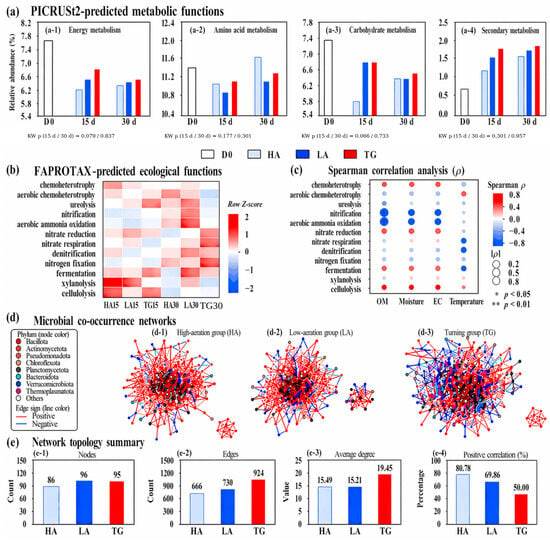
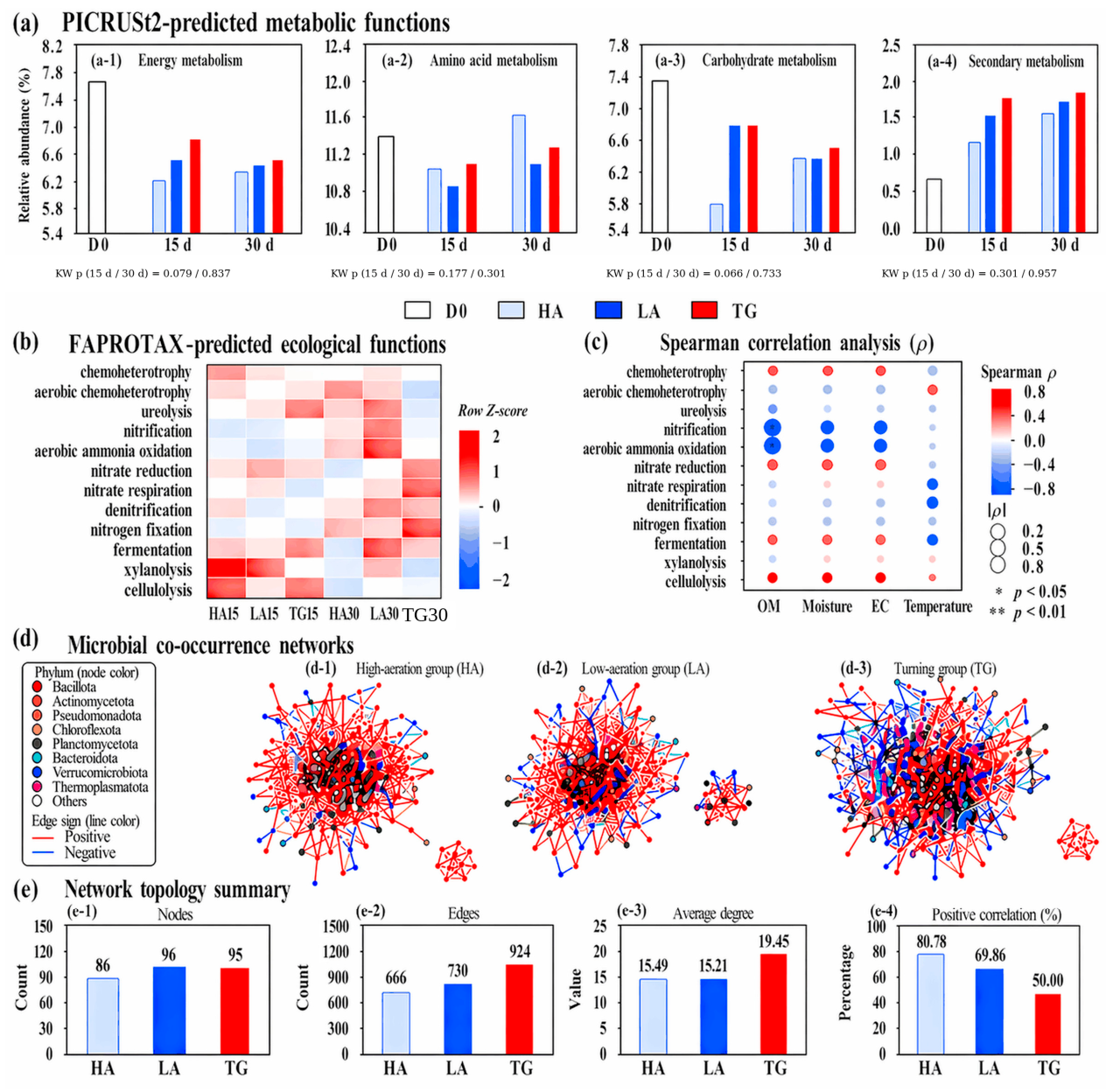
PICRUSt2-predicted profiles retained a broadly similar high-level functional structure across treatments, with differences occurring mainly in relative representation (Figure 3a). The predicted relative representation of secondary metabolism increased from 0.707 in D0 to 1.303, 1.682, and 2.075 at day 15 and to 1.806, 1.940, and 2.087 at day 30 in HA, LA, and TG, respectively. These results indicate shifts within a shared predicted functional framework rather than the emergence of entirely distinct metabolic systems. Exploratory Kruskal–Wallis tests did not detect treatment differences for energy metabolism (day 15/day 30: p = 0.079/0.837), amino acid metabolism (p = 0.177/0.301), carbohydrate metabolism (p = 0.066/0.733), or secondary metabolism (p = 0.301/0.957); therefore, no post hoc comparisons were performed.
Figure 3.
Predicted microbial functions and co-occurrence patterns: (a) Phylogenetic Investigation of Communities by Reconstruction of Unobserved States 2 (PICRUSt2)-predicted functions with exploratory Kruskal–Wallis p values; (b) Functional Annotation of Prokaryotic Taxa (FAPROTAX)-predicted functions; (c) Spearman correlations; (d) operational taxonomic unit (OTU) networks; and (e) network topology. Stars in panel (c) denote nominal raw p < 0.05; none remained significant after Benjamini–Hochberg correction (minimum adjusted p = 0.401). Panel (a) uses spatial samples and is not pile-level replication; panels (b,d,e) are descriptive. Results of the stricter network sensitivity analysis (|ρ| > 0.90 and p < 0.01) are provided in Supplementary Data.
FAPROTAX predictions were dominated by chemoheterotrophy and aerobic chemoheterotrophy at both days 15 and 30 (Figure 3b). At day 30, predicted ureolysis accounted for 28.07%, 29.83%, and 18.60% in HA, LA, and TG, respectively. TG showed greater predicted representation of nitrate reduction (1.35%), nitrate respiration (1.30%), denitrification (1.29%), and nitrogen fixation (1.09%) than HA and LA. These values describe potential ecological functions inferred from taxonomic composition and do not demonstrate actual pathway activity or nitrogen-transformation rates.
Spearman rank-correlation analysis based on six treatment–stage observations showed that predicted nitrification and aerobic ammonia oxidation had the strongest nominal negative associations with OM (ρ = −0.845, raw p = 0.034) (Figure 3c). Their associations with local moisture and EC were also negative (ρ = −0.778, raw p = 0.069). Nitrate respiration and denitrification showed nominal negative trends with temperature (ρ = −0.771, raw p = 0.072), whereas cellulolysis showed nominal positive trends with local moisture and EC (ρ = 0.754, raw p = 0.084). After Benjamini–Hochberg correction across all 48 function–environment tests, no association remained statistically significant; the smallest adjusted p value was 0.401. Accordingly, these correlations were used only to identify exploratory ecological patterns.
Network topology differed among treatments (Figure 3d,e). HA, LA, and TG contained 86, 96, and 95 nodes, respectively; the corresponding numbers of edges were 666, 730, and 924, and the average degrees were 15.49, 15.21, and 19.45. TG therefore displayed the densest co-occurrence network. The proportions of positive associations were 80.78%, 69.86%, and 50.00% in HA, LA, and TG, respectively. HA showed the strongest positive-link dominance, whereas TG combined high connectivity with equal proportions of positive and negative links. Under the stricter sensitivity criteria (|ρ| > 0.90 and p < 0.01), HA, LA, and TG retained 75, 86, and 85 nodes and 212, 243, and 324 edges, respectively. The corresponding average degrees were 5.65, 5.65, and 7.62, and the proportions of positive associations were 95.28%, 79.84%, and 64.51%. Thus, TG remained the most connected network and HA retained the highest positive-link proportion under the stricter threshold. These networks describe potential patterns of taxon co-occurrence and should not be interpreted as direct evidence of cooperation, competition, or causal interaction.
3. Discussion
The engineering-scale process trajectories show that aeration influenced composting through the coupled transport of oxygen, heat, water, and soluble ions rather than through oxygen supply alone. HA produced the fastest heating and longest thermophilic period, consistent with enhanced oxygen transfer and aerobic metabolic heat release under stronger continuous aeration [15,16,34]. The same airflow, however, promoted evaporation and moisture migration, leaving HA with the lowest endpoint moisture near the sensor. Because water supports substrate diffusion, extracellular enzyme activity, and microbial metabolism, sustained decomposition can decline when water becomes limiting even if oxygen remains abundant [18,35]. LA followed a less intense thermophilic trajectory but retained more moisture and achieved the greatest OM reduction, supporting the view that an intermediate balance between oxygen delivery and water conservation can favor sustained transformation more than maximizing thermophilic duration [20,21,36]. TG periodically restored pore space and redistributed oxygen, but intermittent turning did not sustain the same heat accumulation as continuous aeration. Endpoint EC should be interpreted cautiously because probe-based EC is sensitive to local water content and ion redistribution; a lower local EC does not, by itself, demonstrate greater maturity or lower total salt content. The present pattern agrees with Zhang et al. [20], who found that increasing aeration from 0.10 to 0.40 L·min−1·kg−1 DM increased oxygen availability and temperature but slightly restrained humification and maturity, and with Cheng et al. [30], who reported that stage-wise aeration reduction improved humification relative to constant 0.30 L·min−1·kg−1 DM aeration. The magnitude of the response differed from these controlled-reactor studies: the present 3.75 m3 piles contained approximately 1900 kg of material, and HA received continuous 24-h aeration. Comparable commercial-scale work also shows that forced aeration can simultaneously alter heat retention and process energy flows [37]. These scale and operating differences may explain both the unusually long thermophilic period and the severe endpoint drying in HA. The engineering contribution is therefore not merely to reconfirm that high airflow dries compost, but to show that the thermal benefit and moisture penalty can become temporally decoupled; maximum thermophilic intensity is not a reliable proxy for sustained OM transformation.
Temperature-driven ecological filtering provides a plausible explanation for the observed bacterial succession. Bacillota rapidly dominated HA, and the early enrichment of Bacillus and unclassified Bacillaceae is consistent with the thermotolerance, rapid growth, and extracellular-enzyme production of many compost-associated members of this lineage [23,24,31]. The numerically lower richness and diversity in HA suggest stronger habitat filtering, whereas TG retained more co-dominant taxa, potentially because turning generated temporally and spatially heterogeneous microhabitats. Similar patterns have been reported when high temperatures select a restricted set of thermotolerant taxa and subsequent cooling permits partial community re-differentiation [25,31]. Nevertheless, the alpha-diversity differences were not statistically significant, and the PCoA comparisons did not remain significant after adjustment. The sequencing results therefore support a mechanistically coherent pattern of differential selection, but not definitive treatment effects independent of within-pile spatial variability. The taxonomic response both agrees with and differs from previous studies. Agreement lies in the rapid selection of Bacillota and Bacillus-related taxa under sustained thermophilic conditions [24,31]; divergence lies in the delayed increase in Bacillota in TG and the persistence of several co-dominant genera rather than a simple monotonic thermophilic succession. This difference is plausibly associated with the absence of bottom aeration, periodic mixing, and the larger spatial gradients of an engineering-scale pile. Hu et al. [33] showed that bacterial diversity, network structure, and assembly processes vary among positions within compost piles, whereas Zhang et al. [32] demonstrated at industrial scale that aeration frequency alters oxygen distribution and bacterial succession. By retaining surface, middle, and core samples separately, the present study captured an engineering-relevant feature often obscured by homogenized reactor samples: operating mode may change not only average community composition but also the breadth of microhabitats maintained within a pile.
The predicted functional profiles provide additional ecological context but require conservative interpretation. The shared dominance of chemoheterotrophy and aerobic chemoheterotrophy indicates that organic carbon utilization remained the central predicted function across treatments. The greater predicted representation of ureolysis in LA may reflect the persistence of taxa associated with the turnover of nitrogen-containing organic matter under its comparatively stable moisture–temperature trajectory. The greater predicted representation of nitrate reduction, nitrate respiration, denitrification, and nitrogen fixation in TG is consistent with a more heterogeneous pile in which aerobic and relatively oxygen-limited microsites may coexist. However, PICRUSt2 and FAPROTAX infer functions from taxonomic composition and cannot establish whether the corresponding genes were expressed or whether process rates increased [26,27,28]. The nominal negative associations of predicted nitrification and aerobic ammonia oxidation with OM may indicate a transition from readily degradable carbon consumption toward later-stage nitrogen oxidation as the substrate stabilized, but these associations did not remain significant after multiplicity correction. Given the six-observation correlation dataset and the absence of independent pile replication, no single environmental variable should be treated as a confirmed causal driver. Direct comparison with studies that measured humic substances and gaseous nitrogen losses [20,21,30] clarifies this evidential boundary: those studies linked aeration regimes to measured humification and emission outcomes, whereas the present PICRUSt2 and FAPROTAX results provide community-derived hypotheses about potential pathway allocation. The greater predicted representation of several nitrogen-related functions in TG is compatible with spatial variation in nitrogen conversion reported across compost-pile positions [33], but differences in feedstock, scale, and the absence of direct nitrogen speciation or gas flux measurements preclude one-to-one functional validation.
Co-occurrence topology further illustrates why network complexity should not be equated with composting efficiency. TG had the most edges and the highest average degree, indicating a greater number of potential statistical associations among dominant operational taxonomic units (OTUs). The same comparative ordering was retained under the stricter sensitivity criteria, indicating that the principal network patterns were robust to a more stringent construction threshold. TG’s balance of positive and negative links may reflect a combination of shared environmental responses, niche differentiation, and resource competition. HA had fewer edges but the highest proportion of positive links, which may be associated with a strongly filtered community responding similarly to the same thermophilic environment; LA occupied an intermediate position. Comparable composting studies have shown that network density and the proportion of positive links can vary independently and that highly connected networks do not necessarily yield the greatest OM degradation [29,38,39]. Because correlation networks cannot resolve direct interactions or causal direction, the present networks are best regarded as ecological hypotheses that complement, rather than prove, the physicochemical and functional interpretations. This result differs from amendment-based composting studies in which denser microbial networks coincided with improved lignocellulose degradation [38,39]. Here, TG had the densest network but the lowest OM reduction, indicating that network density is context-dependent and may reflect habitat heterogeneity or a wider range of shared environmental responses rather than greater conversion efficiency. This contrast is especially relevant at engineering scale, where spatial gradients can generate many co-occurrence relationships without ensuring that the pile as a whole maintains the moisture, oxygen, and substrate conditions required for sustained degradation.
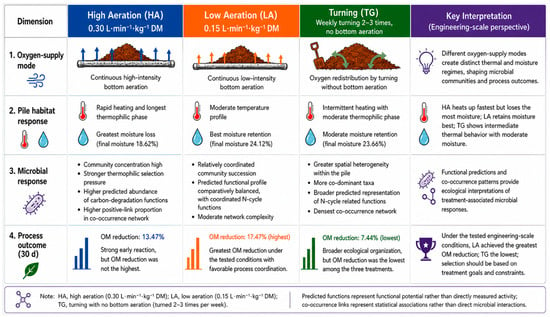
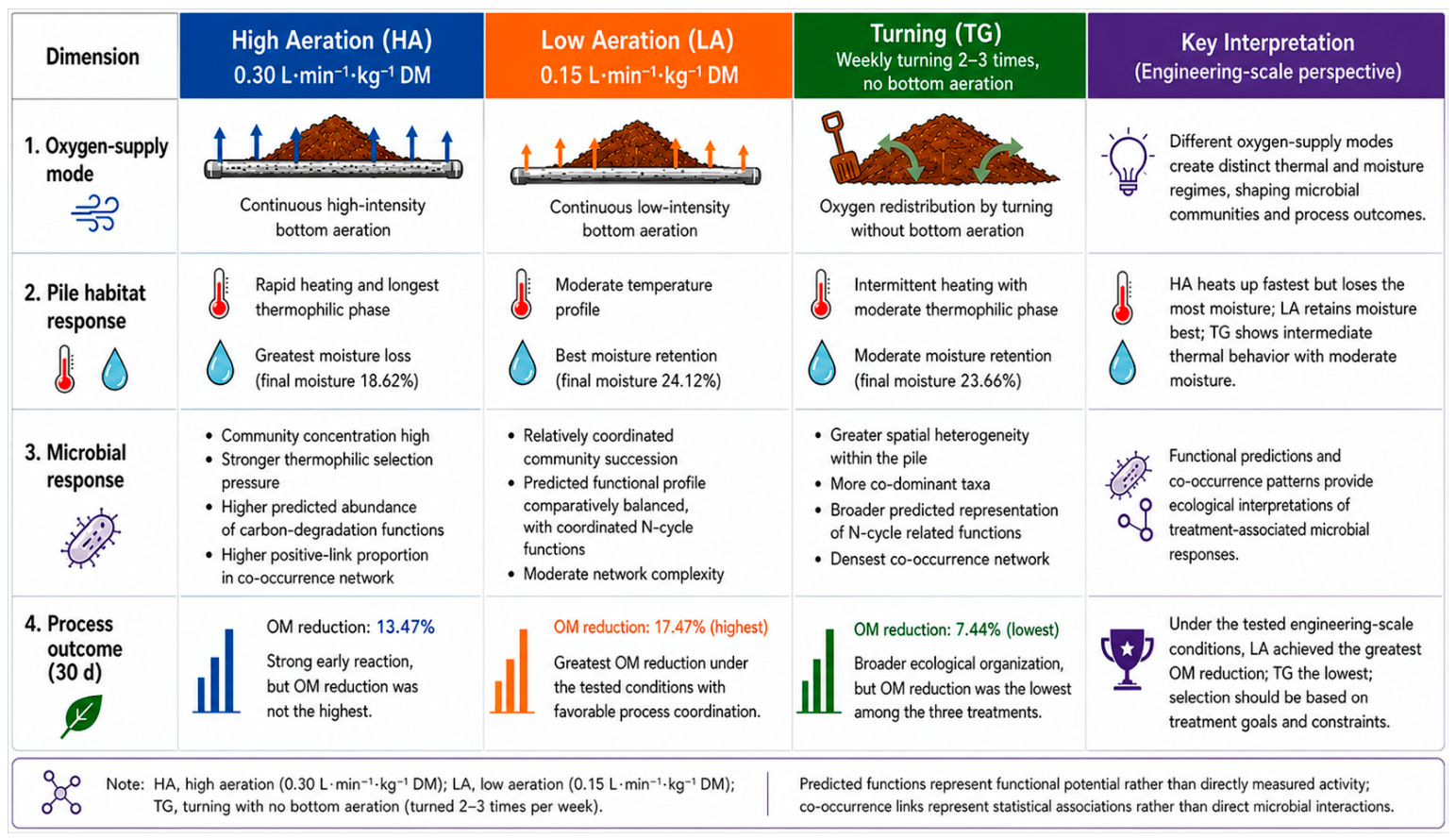
Taken together, the results support a conceptual pathway in which oxygen supply mode first modifies heat generation, moisture movement, EC, and within-pile spatial heterogeneity. These habitat changes are associated with microbial filtering and succession and are subsequently reflected in predicted functional allocation and co-occurrence organization. The combined responses correspond to contrasting OM-transformation trajectories. This framework explains why HA achieved the strongest thermophilic performance but not the greatest OM reduction and why the denser TG network did not translate into greater OM removal. Under the tested conditions, LA provided the most favorable balance among oxygen supply, moisture retention, and sustained OM transformation. This conclusion is limited to the indicators measured here and should not be interpreted as a comprehensive assessment of compost maturity because germination index, C/N evolution, and inorganic nitrogen species were not measured. Only one engineering-scale pile was operated per treatment; the three spatial samples improved representation of within-pile heterogeneity but did not constitute independent treatment replicates. In addition, pH was not monitored continuously, so its temporal contribution to microbial succession and predicted nitrogen-transformation profiles could not be separated from the effects of aeration, turning, temperature, and moisture. Future studies should validate these patterns using replicated piles, additional maturity indicators, and direct functional measurements such as metagenomics, transcriptomics, enzyme activities, and nitrogen-speciation analyses. Relative to controlled studies that optimized a single aeration parameter or emphasized maturity and gaseous-emission endpoints [20,21,30], this study adds a process–ecology comparison under tonne-scale conditions while preserving within-pile spatial information. The principal added insight is that oxygen supply strategy acts through two partially independent dimensions: mean process intensity and within-pile habitat heterogeneity. In the present system, HA maximized mean thermal intensity, TG maintained the broadest and most connected spatially structured community pattern, and LA provided the most favorable balance between OM reduction and moisture retention. This does not establish a universal optimum, but it helps explain why the thermally strongest or ecologically most complex operating mode may not deliver the most coordinated engineering-scale transformation. These treatment-associated relationships are summarized conceptually in Figure 4.
Figure 4.
Conceptual summary of the treatment-associated relationships among oxygen supply mode, pile habitat, microbial response, and composting outcome under engineering-scale conditions. Predicted functions represent functional potential rather than directly measured microbial activity, and co-occurrence links indicate statistical associations rather than direct microbial interactions.
4. Materials and Methods
4.1. Aerated Composting Experimental System
Food waste digestate was obtained from Tianjin Binhai New Area Defeng Lisheng Solid Waste Treatment Co., Ltd., located at No. 33 Ruitong Road, Gaozhuang Village, Yangjiabo Town, Binhai New Area, Tianjin, China (39.269704° N, 118.021767° E). The engineering-scale composting experiment was conducted at the same site. Corn straw was transported to the facility, cut into 2–3 cm pieces, and used as a bulking material. The feedstock consisted of food waste digestate and corn straw, with an initial moisture content of approximately 62% and an initial C/N ratio of 25:1. The principal initial physicochemical properties of the digestate are listed in Table 1.
Table 1.
Measured initial physicochemical properties of the food waste digestate.
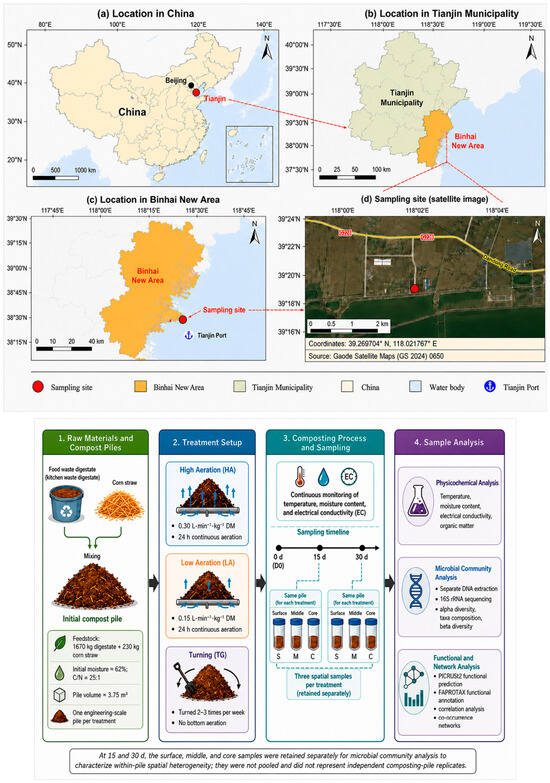
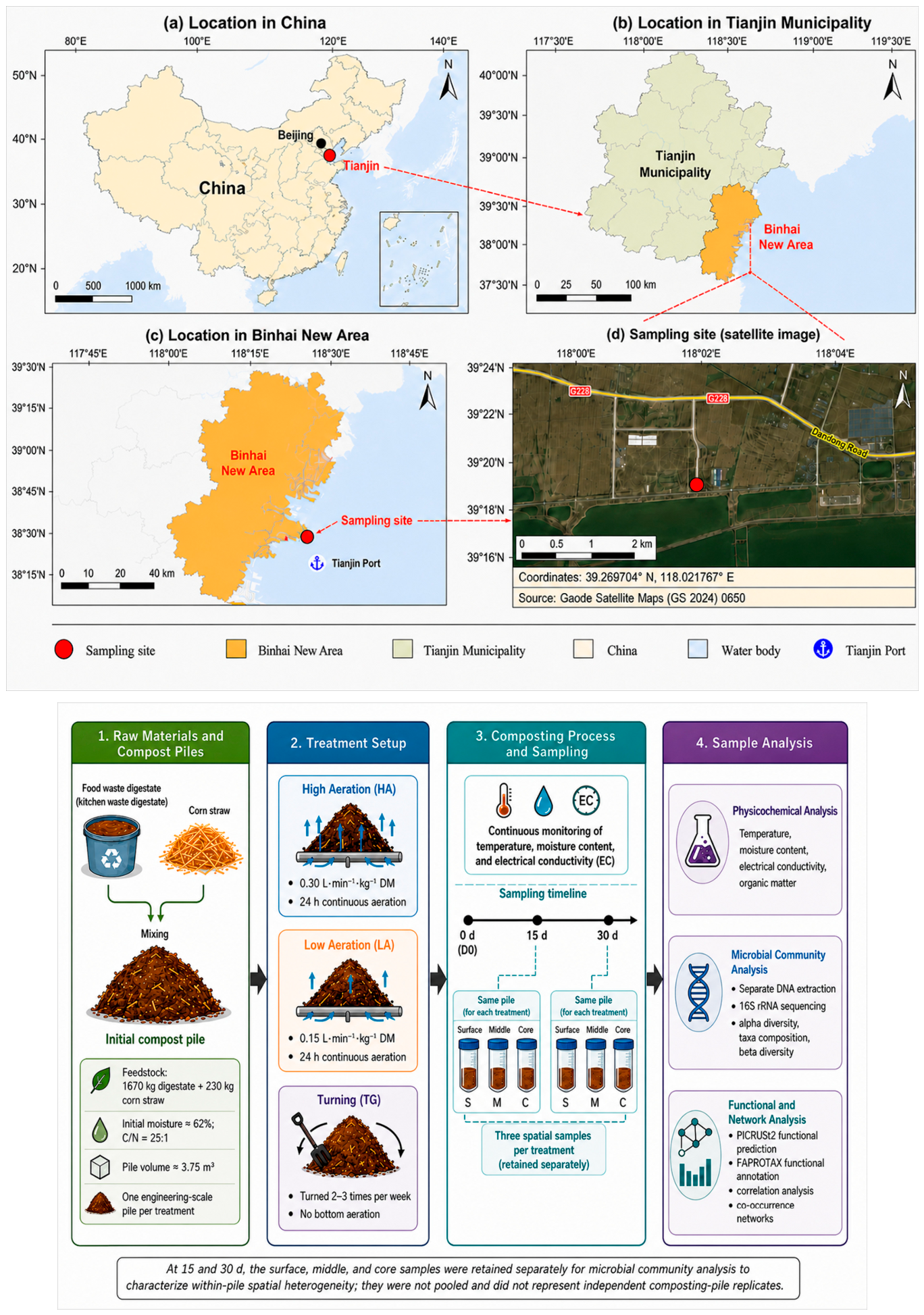
One large conical composting pile was established for each treatment to represent practical operating conditions. Each pile had a bottom radius of approximately 1.6 m, a height of approximately 1.4 m, and a volume of approximately 3.75 m3 and contained 1670 kg of food waste digestate and 230 kg of corn straw. The HA and LA piles received continuous aeration (24 h d−1) at rates of 0.30 and 0.15 L·min−1·kg−1 initial dry matter (DM), respectively. The TG pile received no forced bottom aeration and was turned two to three times per week. One custom-made tubular three-layer soil temperature, moisture, and electrical conductivity sensor (RS485; Beijing Chenxin Equipment Technology Co., Ltd., Beijing, China) was installed in the central core of each pile, with the sensing section positioned near the central axis at approximately mid-height (about 0.7 m below the pile surface). Before deployment, each sensor was checked according to the manufacturer’s instructions, and the temperature, moisture, and EC channels were verified for stable responses. Temperature, local moisture status, and EC were automatically recorded at 10-min intervals throughout the composting period. The location of the composting facility, experimental design, operating conditions, and spatial sampling strategy are summarized in Figure 5.
Figure 5.
Location of the engineering-scale composting facility in Binhai New Area, Tianjin, China, shown from the national to municipal, district, and site scales (top), and schematic overview of the composting experiment, including feedstock preparation, treatment settings, continuous physicochemical monitoring, spatial sampling, and subsequent analyses (bottom). Food waste digestate was obtained from Defeng Lisheng Solid Waste Treatment Co., Ltd. (Tianjin, China; 39.269704° N, 118.021767° E), where the composting experiment was conducted.
4.2. Sampling and Indicator Determination
An initial sample was collected immediately after feedstock mixing (day 0, D0), and subsequent samples were collected on days 15 and 30. At each sampling event, material was collected separately from the surface, middle, and core regions of each engineering-scale pile. Aliquots from these three positions were retained as separate spatial samples for DNA extraction and 16S rRNA gene sequencing to characterize within-pile heterogeneity; they were not pooled before microbial community analysis. Approximately 2–3 g of material from each position was retained for microbial analysis. In the figures, the three spatial samples for each treatment–time combination were collectively designated HA15, LA15, TG15, HA30, LA30, or TG30. Immediately after collection, samples for microbial analysis were frozen in liquid nitrogen and stored at −80 °C. Because the three samples originated from different positions within the same pile, they were treated as spatially distinct samples rather than independent composting-reactor replicates.
Organic matter (OM) was determined on a dry-matter basis by the potassium dichromate oxidation method using representative material collected at each treatment–time point. Each collected sample was analyzed in triplicate, and the mean of the three analytical determinations was used for data presentation. These analytical triplicates were measurements of the same collected sample and did not constitute independent composting-pile replicates. The sensor-derived moisture and EC measurements represented conditions near the monitoring locations and were therefore used to compare process trajectories and local migration patterns rather than whole-pile gravimetric averages. Maximum temperature, cumulative duration above 55 °C, final local moisture reading, EC trajectory, and OM reduction were used to characterize the physicochemical response of each treatment.
4.3. Bacterial Community Sequencing, Functional Prediction, and Network Analysis
Bacterial community sequencing was performed by Shanghai Majorbio Bio-pharm Technology Co., Ltd., Shanghai, China. Genomic DNA was extracted independently from each spatial sample using a YH-soil FastPure Soil DNA Isolation Kit (Magnetic Bead; MJYH, Shanghai, China), and DNA integrity was evaluated by electrophoresis on a 1% agarose gel (catalog no. 75510019; Thermo Fisher Scientific, Waltham, MA, USA) at 5 V·cm−1 for 20 min. The V4 hypervariable region of the bacterial 16S rRNA gene was amplified using barcoded primers 515F (5′-GTGCCAGCMGCCGCGG-3′) and 806R (5′-GGACTACHVGGGTWTCTAAT-3′). PCR was performed on a T100 Thermal Cycler (Bio-Rad Laboratories, Inc., Hercules, CA, USA) in a 20 μL reaction mixture containing 10 μL of 2× Pro Taq HS PCR Master Mix Ver. 2 (AG11307; Accurate Biotechnology (Hunan) Co., Ltd., Changsha, China), 0.8 μL of each primer (5 μM), template DNA at 10 ng·μL−1, and double-distilled water to a final volume of 20 μL. The thermal program comprised initial denaturation at 95 °C for 3 min; repeated cycles of denaturation at 95 °C for 30 s, annealing for 30 s, and extension at 72 °C for 45 s; final extension at 72 °C for 10 min; and a hold at 10 °C. Batch-specific PCR conditions were optimized before full-sample amplification: D0 and day-15 samples were amplified for 27 cycles at an annealing temperature of 55 °C, whereas day-30 samples were amplified for 29 cycles at 53 °C. Three parallel PCR reactions were conducted for each DNA sample, and the resulting amplicons were pooled by sample. PCR products were examined by 2% agarose gel electrophoresis using a 3 μL loading volume, purified using a PCR Clean-Up Kit (C01-10000; Yuhua Biotechnology Co., Ltd., Shanghai, China), eluted with Tris-HCl buffer, and quantified using a Qubit 4.0 Fluorometer (Thermo Fisher Scientific, Waltham, MA, USA). Sequencing libraries were prepared using a TruSeq™ DNA Sample Prep Kit (Illumina, Inc., San Diego, CA, USA). Libraries from the three submission batches were subjected to paired-end sequencing in PE300 mode on a NextSeq 2000 system (Illumina, Inc., San Diego, CA, USA).
Raw paired-end reads were quality-filtered using fastp v0.23.4 and merged using FLASH v1.2.11. Low-quality read tails were trimmed using a 50-bp sliding window, with truncation initiated when the mean quality score within the window fell below 20. Reads shorter than 50 bp after quality control or containing ambiguous bases were discarded. Paired reads were merged using a minimum overlap of 10 bp and a maximum mismatch ratio of 0.2 within the overlapping region. Barcode mismatches were not permitted, and no more than two primer mismatches were allowed.
After sequence dereplication and singleton removal, operational taxonomic units (OTUs) were clustered at 97% sequence similarity using the UPARSE algorithm implemented in USEARCH v11; chimeric sequences were removed during clustering. Quality-controlled sequences were mapped to representative OTU sequences at ≥97% similarity to generate the OTU abundance table. Taxonomic assignment was performed using RDP Classifier v2.11 against the SILVA release 138.2 16S rRNA gene database, with a confidence threshold of 0.7. Taxonomic abundance tables were generated using QIIME v1.9.1, and the Sobs, Chao1, and Shannon alpha-diversity indices were calculated using mothur v1.30.2. Community composition was summarized at the phylum and genus levels. Beta diversity was assessed by principal coordinates analysis (PCoA) based on Bray–Curtis dissimilarities, as described in Section 4.4. Across the 19 samples, raw sequencing depth ranged from 47,821 to 94,551 paired reads per sample (1,329,354 paired reads in total), and the rarefaction curves approached plateaus.
PICRUSt2 v2.2.0 and FAPROTAX v1.2.1 were used to infer potential metabolic and ecological functions, respectively, from the 16S rRNA gene profiles. These outputs were interpreted as predicted functional potential rather than measured microbial activity. For co-occurrence analysis, the 100 most abundant OTUs in samples collected on days 15 and 30 were retained, and Spearman correlation networks were generated using Network module v1.11 on the Majorbio Cloud Platform. Screening criteria for the primary networks were |ρ| > 0.6 and p < 0.05. A sensitivity analysis was additionally conducted using more stringent criteria of |ρ| > 0.90 and p < 0.01. The numbers of nodes and edges, average degree, and proportion of positive associations were used to compare potential patterns of community organization. Network edges were interpreted as statistical co-occurrence relationships rather than evidence of direct microbial interactions.
4.4. Data Processing and Statistical Analysis
Data processing was performed using IBM SPSS Statistics v22.0 and R v4.3.2. Community analyses in R used vegan v2.6-4, ape v5.7-1, and the base stats package v4.3.2. The Shapiro–Wilk and Levene tests were used only as preliminary diagnostics of distributional form and variance homogeneity when replicated observations were available. Because independent treatment replicates were not available for the physicochemical endpoints, one-way ANOVA and Tukey’s HSD test were not applied. Temperature, local moisture status, EC, and OM were obtained from one engineering-scale pile per treatment and were therefore summarized as treatment-specific process trajectories, maxima, endpoint values, and percentage changes; no treatment-level inferential tests were applied to these variables. The Sobs, Chao1, and Shannon indices were calculated for the three spatial samples within each pile, summarized as mean ± standard deviation, and compared among HA, LA, and TG separately at days 15 and 30 using two-sided Kruskal–Wallis tests. Because none of the omnibus tests was significant, no post hoc pairwise tests were performed. The four PICRUSt2 category abundances displayed in Figure 3a were evaluated exploratorily among HA, LA, and TG separately at days 15 and 30 using two-sided Kruskal–Wallis tests based on the three spatial samples per treatment. All eight omnibus tests were non-significant, so no post hoc comparisons were conducted. These tests characterize within-pile spatial variation and do not constitute independent composting-pile replication; FAPROTAX heatmap and network-topology comparisons remained descriptive.
For beta diversity, OTU tables were converted to relative abundances, Bray–Curtis dissimilarities were calculated using vegan::vegdist, and PCoA was performed using ape::pcoa. Overall treatment differences were evaluated separately at days 15 and 30 by one-way permutational multivariate analysis of variance (PERMANOVA; vegan::adonis2) with 9999 unrestricted permutations. Exploratory pairwise PERMANOVA tests were then conducted for HA–LA, HA–TG, and LA–TG, and the three pairwise p values within each sampling time were adjusted using the Benjamini–Hochberg false-discovery-rate procedure. Spearman rank correlations between four environmental variables (OM, EC, local moisture, and temperature) and 12 FAPROTAX-predicted functions were based on six treatment–stage observations (HA15, LA15, TG15, HA30, LA30, and TG30), yielding 48 tests. Raw two-sided p values and Benjamini–Hochberg-adjusted p values were calculated across all 48 tests. A raw p value < 0.05 was described as nominal evidence, and 0.05 ≤ raw p < 0.10 was described as a nominal trend; only an adjusted p value < 0.05 was regarded as statistically significant after multiplicity control. Network nodes, edges, average degree, and positive-link proportion were compared descriptively without inferential testing. Because the three microbial samples represented spatial positions within one pile rather than independently replicated piles, all microbial treatment comparisons were interpreted as exploratory engineering-scale patterns.
5. Conclusions
- (1)
- In this engineering-scale comparison, the three oxygen supply modes showed different physicochemical trajectories. HA produced the strongest thermophilic profile but the greatest local moisture decline, whereas LA showed the largest observed OM reduction and retained more moisture than HA. Within the measured indicators, these observations favor a balance between aeration and moisture conservation rather than thermophilic intensity alone.
- (2)
- Bacterial communities shifted toward Bacillota dominance, while taxonomic succession varied among treatments and pile positions. Because alpha-diversity and adjusted beta-diversity tests were non-significant and the spatial samples were not independent pile replicates, these microbial differences should be regarded as exploratory treatment-associated patterns. PICRUSt2 and FAPROTAX outputs represent predicted functional potential rather than measured microbial activity.
- (3)
- TG retained the densest network and HA the highest positive-link proportion under both the primary and stricter sensitivity criteria, but these associations do not demonstrate direct microbial interactions. Under the tested conditions, LA showed the most favorable observed balance for OM reduction and moisture retention. This indicator-specific finding is not a universal optimum or a comprehensive assessment of compost maturity and requires confirmation with independently replicated piles and direct measurements of compost maturity and microbial activity.
Supplementary Materials
The supporting information can be downloaded at https://www.mdpi.com/article/10.3390/recycling11080151/s1. The supporting information includes the raw physicochemical dataset, analytical method metadata, microbial abundance matrices, and network sensitivity analysis outputs.
Author Contributions
Conceptualization, T.W. and Z.L.; methodology, T.D., T.W. and Z.L.; software, T.D.; validation, T.D., Y.Z. and C.Z.; formal analysis, T.D.; investigation, T.D., Y.Z. and C.Z.; resources, T.W., Z.L., Y.Z. and C.Z.; data curation, T.D.; writing—original draft preparation, T.D.; writing—review and editing, T.W. and Z.L.; visualization, T.D.; supervision, T.W. and Z.L.; project administration, T.W. and Z.L.; funding acquisition, T.W. and Z.L. All authors have read and agreed to the published version of the manuscript.
Funding
This research was supported by the Jing–Jin–Ji Regional Integrated Environmental Improvement—National Science and Technology Major Project (grant no. 2026ZD1208904).
Data Availability Statement
The raw paired-end 16S rRNA gene amplicon sequencing data generated in this study have been deposited in the National Center for Biotechnology Information (NCBI) Sequence Read Archive (SRA) under BioProject accession PRJNA1495176 and SRA study accession SRP717890. The processed physicochemical data and microbial abundance matrices are provided in the Supplementary Materials.
Conflicts of Interest
The authors declare no conflict of interest.
References
- United Nations Environment Programme. Food Waste Index Report 2024; UNEP: Nairobi, Kenya, 2024. [Google Scholar]
- Song, Y.; Liu, D.; Zhu, F.; Zhang, C.; Zhang, S.; Li, T.; Ji, Y.; Dong, Y.; Qi, W.; Xu, X.; et al. Urban food waste and socioeconomic drivers in China. Earth Crit. Zone 2024, 1, 100015. [Google Scholar] [CrossRef] [Scilit]
- European Biogas Association. EBA Statistical Report 2024: Tracking Biogas and Biomethane Deployment across Europe; European Biogas Association: Brussels, Belgium, 2024; Available online: https://www.europeanbiogas.eu/publication/eba-statistical-report-2024/ (accessed on 12 July 2026).
- European Biogas Association. Exploring Digestate’s Contribution to Healthy Soils; European Biogas Association: Brussels, Belgium, 2024; Available online: https://www.europeanbiogas.eu/wp-content/uploads/2024/03/Exploring-digestate-contribution-to-health-soils_EBA-Report.pdf (accessed on 11 July 2026).
- Lamolinara, B.; Pérez-Martínez, A.; Guardado-Yordi, E.; Guillén Fiallos, C.; Diéguez-Santana, K.; Ruiz-Mercado, G.J. Anaerobic digestate management, environmental impacts, and techno-economic challenges. Waste Manag. 2022, 140, 14–30. [Google Scholar] [CrossRef] [Scilit] [PubMed]
- Angelonidi, E.; Smith, S.R. A comparison of wet and dry anaerobic digestion processes for the treatment of municipal solid waste and food waste. Water Environ. J. 2015, 29, 549–557. [Google Scholar] [CrossRef] [Scilit]
- Song, S.; Lim, J.W.; Lee, J.T.E.; Cheong, J.C.; Hoy, S.H.; Hu, Q.; Tan, J.K.; Chiam, Z.; Arora, S.; Lum, T.Q.; et al. Food-waste anaerobic digestate as a fertilizer: The agronomic properties of untreated digestate and biochar-filtered digestate residue. Waste Manag. 2021, 136, 143–152. [Google Scholar] [CrossRef] [Scilit] [PubMed]
- Wang, Z.; Hu, Y.; Wang, S.; Wu, G.; Zhan, X. A critical review on dry anaerobic digestion of organic waste: Characteristics, operational conditions, and improvement strategies. Renew. Sustain. Energy Rev. 2023, 176, 113208. [Google Scholar] [CrossRef] [Scilit]
- Le Pera, A.; Sellaro, M.; Bencivenni, E. Composting food waste or digestate? Characteristics, statistical and life cycle assessment study based on an Italian composting plant. J. Clean. Prod. 2022, 350, 131552. [Google Scholar] [CrossRef] [Scilit]
- Czekała, W.; Nowak, M.; Piechota, G. Sustainable management and recycling of anaerobic digestate solid fraction by composting: A review. Bioresour. Technol. 2023, 375, 128813. [Google Scholar] [CrossRef] [Scilit] [PubMed]
- Bernal, M.P.; Alburquerque, J.A.; Moral, R. Composting of animal manures and chemical criteria for compost maturity assessment: A review. Bioresour. Technol. 2009, 100, 5444–5453. [Google Scholar] [CrossRef] [Scilit] [PubMed]
- Onwosi, C.O.; Igbokwe, V.C.; Odimba, J.N.; Eke, I.E.; Nwankwoala, M.O.; Iroh, I.N.; Ezeogu, L.I. Composting technology in waste stabilization: On the methods, challenges and future prospects. J. Environ. Manag. 2017, 190, 140–157. [Google Scholar] [CrossRef] [Scilit] [PubMed]
- Haug, R.T. The Practical Handbook of Compost Engineering; CRC Press: Boca Raton, FL, USA, 1993. [Google Scholar]
- Puyuelo, B.; Gea, T.; Sánchez, A. A new control strategy for the composting process based on the oxygen uptake rate. Chem. Eng. J. 2010, 165, 161–169. [Google Scholar] [CrossRef] [Scilit]
- Peng, L.; Tang, R.; Wang, G.; Ma, R.; Li, Y.; Li, G.; Yuan, J. Effect of aeration rate, aeration pattern, and turning frequency on maturity and gaseous emissions during kitchen waste composting. Environ. Technol. Innov. 2023, 29, 102997. [Google Scholar] [CrossRef] [Scilit]
- Gao, M.; Li, B.; Yu, A.; Liang, F.; Yang, L.; Sun, Y. The effect of aeration rate on forced-aeration composting of chicken manure and sawdust. Bioresour. Technol. 2010, 101, 1899–1903. [Google Scholar] [CrossRef] [Scilit] [PubMed]
- Cayuela, M.L.; Sánchez-Monedero, M.A.; Roig, A. Evaluation of two different aeration systems for composting two-phase olive mill wastes. Process Biochem. 2006, 41, 616–623. [Google Scholar] [CrossRef] [Scilit]
- Tang, R.; Liu, Y.; Ma, R.; Zhang, L.; Li, Y.; Li, G.; Wang, D.; Lin, J.; Li, Q.; Yuan, J. Effect of moisture content, aeration rate, and C/N on maturity and gaseous emissions during kitchen waste rapid composting. J. Environ. Manag. 2023, 326, 116662. [Google Scholar] [CrossRef] [Scilit] [PubMed]
- Manu, M.K.; Li, D.; Luo, L.; Zhao, J.; Varjani, S.; Wong, J.W.C. A review on nitrogen dynamics and mitigation strategies of food waste digestate composting. Bioresour. Technol. 2021, 334, 125032. [Google Scholar] [CrossRef] [Scilit] [PubMed]
- Zhang, L.; Gao, X.; Shi, T.; Xu, Z.; Li, G.; Luo, W. Regulating aeration intensity to simultaneously improve humification and mitigate gaseous emissions in food waste digestate composting: Performance and bacterial dynamics. Sci. Total Environ. 2023, 889, 164239. [Google Scholar] [CrossRef] [Scilit] [PubMed]
- Cheng, J.; Gao, X.; Yan, Z.; Li, G.; Luo, W.; Xu, Z. Intermittent aeration to reduce gaseous emission and advance humification in food waste digestate composting: Performance and mechanisms. Bioresour. Technol. 2023, 371, 128644. [Google Scholar] [CrossRef] [Scilit] [PubMed]
- Aguilar-Paredes, A.; Valdés, G.; Araneda, N.; Valdebenito, E.; Hansen, F.; Nuti, M. Microbial community in the composting process and its positive impact on the soil biota in sustainable agriculture. Agronomy 2023, 13, 542. [Google Scholar] [CrossRef] [Scilit]
- Meng, Q.; Yang, W.; Men, M.; Bello, A.; Xu, X.; Xu, B.; Deng, L.; Jiang, X.; Sheng, S.; Wu, X.; et al. Microbial community succession and response to environmental variables during cow manure and corn straw composting. Front. Microbiol. 2019, 10, 529. [Google Scholar] [CrossRef] [Scilit] [PubMed]
- Ge, M.; Zhou, H.; Shen, Y.; Meng, H.; Li, R.; Zhou, J.; Cheng, H.; Zhang, X.; Ding, J.; Wang, J.; et al. Effect of aeration rates on enzymatic activity and bacterial community succession during cattle manure composting. Bioresour. Technol. 2020, 304, 122928. [Google Scholar] [CrossRef] [Scilit] [PubMed]
- Partanen, P.; Hultman, J.; Paulin, L.; Auvinen, P.; Romantschuk, M. Bacterial diversity at different stages of the composting process. BMC Microbiol. 2010, 10, 94. [Google Scholar] [CrossRef] [Scilit] [PubMed]
- Djemiel, C.; Maron, P.-A.; Terrat, S.; Dequiedt, S.; Cottin, A.; Ranjard, L. Inferring microbiota functions from taxonomic genes: A review. GigaScience 2022, 11, giab090. [Google Scholar] [CrossRef] [Scilit] [PubMed]
- Douglas, G.M.; Maffei, V.J.; Zaneveld, J.R.; Yurgel, S.N.; Brown, J.R.; Taylor, C.M.; Huttenhower, C.; Langille, M.G.I. PICRUSt2 for prediction of metagenome functions. Nat. Biotechnol. 2020, 38, 685–688. [Google Scholar] [CrossRef] [Scilit] [PubMed]
- Louca, S.; Parfrey, L.W.; Doebeli, M. Decoupling function and taxonomy in the global ocean microbiome. Science 2016, 353, 1272–1277. [Google Scholar] [CrossRef] [Scilit] [PubMed]
- Siles, J.A.; García-Sánchez, M.; Gómez-Brandón, M. Studying microbial communities through co-occurrence network analyses during processes of waste treatment and in organically amended soils: A review. Microorganisms 2021, 9, 1165. [Google Scholar] [CrossRef] [Scilit] [PubMed]
- Cheng, J.; Zhang, L.; Gao, X.; Shi, T.; Li, G.; Luo, W.; Qi, C.; Xu, Z. Multi-stage aeration regime to regulate organic conversion toward gas alleviation and humification in food waste digestate composting. J. Environ. Manag. 2024, 357, 120809. [Google Scholar] [CrossRef] [Scilit] [PubMed]
- Moreno, J.; López-González, J.A.; Arcos-Nievas, M.A.; Suárez-Estrella, F.; Jurado, M.; Estrella-González, M.; López, M. Revisiting the succession of microbial populations throughout composting: A matter of thermotolerance. Sci. Total Environ. 2021, 773, 145587. [Google Scholar] [CrossRef] [Scilit] [PubMed]
- Zhang, S.; Wang, J.; Chen, X.; Gui, J.; Sun, Y.; Wu, D. Industrial-scale food waste composting: Effects of aeration frequencies on oxygen consumption, enzymatic activities and bacterial community succession. Bioresour. Technol. 2021, 320, 124357. [Google Scholar] [CrossRef] [Scilit] [PubMed]
- Hu, X.; Jing, Y.; Fu, N.; Wang, Y.; Qin, D.; Guo, X.; Wang, Y.; Wan, J. New insight into bacterial communities of chicken manure composting under increased carbon to nitrogen ratios: Spatial heterogeneity in diversity, networks, and assembly processes. J. Environ. Chem. Eng. 2024, 12, 113624. [Google Scholar] [CrossRef] [Scilit]
- Xu, Z.; Qi, C.; Zhang, L.; Ma, Y.; Li, J.; Li, G.; Luo, W. Bacterial dynamics and functions for gaseous emissions and humification in response to aeration intensities during kitchen waste composting. Bioresour. Technol. 2021, 337, 125369. [Google Scholar] [CrossRef] [Scilit] [PubMed]
- de Guardia, A.; Petiot, C.; Rogeau, D.; Druilhe, C. Influence of aeration rate on nitrogen dynamics during composting. Waste Manag. 2008, 28, 575–587. [Google Scholar] [CrossRef] [Scilit] [PubMed]
- Zhao, Y.; Lou, Y.; Qin, W.; Cai, J.; Zhang, P.; Hu, B. Interval aeration improves degradation and humification by enhancing microbial interactions in the composting process. Bioresour. Technol. 2022, 358, 127296. [Google Scholar] [CrossRef] [Scilit] [PubMed]
- Bondeson, F.A.; Faulkner, J.W.; Roy, E.D. Performance of a compost aeration and heat recovery system at a commercial composting facility. J. Ecol. Eng. Des. 2023, 1, 1–17. [Google Scholar] [CrossRef] [Scilit]
- Duan, Y.; Awasthi, M.K.; Yang, J.; Tian, Y.; Li, H.; Cao, S.; Syed, A.; Verma, M.; Ravindran, B. Bacterial community dynamics and co-occurrence network patterns during different stages of biochar-driven composting. Bioresour. Technol. 2023, 384, 129358. [Google Scholar] [CrossRef] [Scilit] [PubMed]
- Meng, L.; Xu, C.; Wu, F.; Huhe. Microbial co-occurrence networks driven by low-abundance microbial taxa during composting dominate lignocellulose degradation. Sci. Total Environ. 2022, 845, 157197. [Google Scholar] [CrossRef] [Scilit] [PubMed]

Disclaimer/Publisher’s Note: The statements, opinions and data contained in all publications are solely those of the individual author(s) and contributor(s) and not of MDPI and/or the editor(s). MDPI and/or the editor(s) disclaim responsibility for any injury to people or property resulting from any ideas, methods, instructions or products referred to in the content. |
© 2026 by the authors. Licensee MDPI, Basel, Switzerland. This article is an open access article distributed under the terms and conditions of the Creative Commons Attribution (CC BY) license.