


Abstract
Seven bio-based solvents ((-)-β-pinene, α-phellandrene, α-terpinene, p-cymene, DL-limonene, γ-terpinene and terpinolene) are tested as environmentally friendly alternatives for use in a plastic recycling process based on dissolution–precipitation of post-consumer high-density polyethylene (PC-HDPE). In addition to evaluating cleaning performance, this work aims to develop and validate a new analytical method for the determination of residual bio-based solvents in the treated polymer, a critical aspect for evaluating the safety and quality of recycled materials. The suitability of the solvents for contaminant removal was assessed via challenge test, showing high cleaning efficiencies (>93.3%) for volatile, non-volatile, polar and non-polar compounds in most cases. To monitor residual solvent levels, a pressurized liquid extraction and gas chromatography–mass spectrometry (PLE-GC/MS) method was developed, optimized and validated. The method demonstrated adequate sensitivity (with LODs ranging between 2 and 4 mg kg−1), accuracy and precision (with intra- and inter-day relative standard deviations of less than 11 and 31%, respectively) for the simultaneous determination of the seven bio-based solvents in recycled HDPE. Overall, results demonstrate both the potential of bio-based solvents in polymer recycling and the importance of robust analytical tools to assess residual contamination, supporting the development of safer and more sustainable recycling processes.
1. Introduction
World plastic production reached 435.0 million tons in 2020 and is expected to grow to 736.0 million tons by 2040 [1]. The packaging industry is the main plastic sector, accounting for approximately 32% of the total plastic production. Polyolefins represent the largest group of plastics (~40% of total production). In Europe, plastic production rates have decreased in recent years while the share of circular plastic manufacturing grows every year [2]; this fact is partly driven by European environmental policies. This reflects the importance of the circular economy and the development of new recycling methods to comply with European policy objectives, such as those outlined in the 2030 Agenda (https://sdgs.un.org/2030agenda, accessed on 16 September 2025).
The European regulatory landscape on packaging and recycled plastics is undergoing a major transformation. From the first recycling goals set in 1994 [3], newer regulations and directives aim for more ambitious targets for recyclability, recycled content in new products and waste reductions, with full circularity as the end goal. These include the past Directive (EU) 2018/852 [4] and the recently adopted Regulation (EU) 2025/40 [5], in which the Packaging and Packaging Waste Regulation (PPWR) is laid out. Moreover, the European Food Safety Authority (EFSA) adopted Regulation (EU) 2022/1616 [6], enforcing the requirements for recycling plastics intended for food contact, as well as case-specific authorization for new recycling technologies and rigorous decontamination standards. Together, these frameworks set a new benchmark for sustainability and safety in packaging across the EU.
Polyolefins, and in particular high-density polyethylene (HDPE), pose significant challenges in recycling for food-contact applications due to their non-polar structure and high chemical resistance, which hinder effective decontamination by simple and well-established processes, unlike poly(ethylene terephthalate) (PET) [7]. During use and disposal, HDPE can absorb contaminants into its polymer matrix, requiring advanced recycling technologies or multilayer barrier solutions to meet safety requirements [8]. In contrast, PET, the most widely recycled plastic for food-contact applications, exhibits lower sorption and diffusivity of contaminants, allowing mechanical recycling processes to achieve the decontamination efficiencies required for food-grade applications [9]. Conversely, the higher affinity of polyolefins for non-polar organic compounds promotes the retention of contaminants, making conventional mechanical recycling insufficient and limiting the use of recycled HDPE in sensitive applications.
In this context, HDPE can be recycled through several technological routes, typically classified as mechanical, chemical and solvent-based recycling. Mechanical recycling remains the most established approach due to its economic viability, but its effectiveness is restricted by the accumulation of contaminants, additives and degradation products. Chemical recycling methods, such as pyrolysis or depolymerization, enable the recovery of monomers or fuels, although they often involve high energy demand and complex infrastructure. While some debate exists on the classification of recycling processes [10], solvent-based recycling approaches have emerged as a promising alternative. Among them, dissolution–precipitation methods, where the polymer is dissolved in a suitable solvent and subsequently precipitated, allow both polymer recovery and removal of additives and contaminants [11]. This approach is especially promising for post-consumer HDPE used in food packaging, where strict regulatory requirements demand efficient decontamination. However, challenges remain related to solvent selection, process optimization and the control of residual solvents, which are key aspects for ensuring the safe reuse of recycled materials in food-contact applications. Moreover, the scalability of this process represents a key challenge for the industrial implementation of dissolution–precipitation technologies. Aparício et al., [12] studied the viability of scaling up HDPE recovery using α-pinene by increasing the initial amount of polymer to be dissolved by 5 times, demonstrating the technical feasibility of these methods at laboratory scale. However, their translation to pilot and industrial scales requires further investigation. A thorough understanding of the influence of process variables under controlled laboratory conditions is a prerequisite for successful scale-up. Advancing an insufficiently optimized or validated process to larger scales may result in reduced process efficiency, operational difficulties, and considerable economic losses. Therefore, it is essential to thoroughly investigate and optimize these methods at the laboratory scale before proceeding to pilot-scale implementation.
Dissolution–precipitation methods have been applied with a wide range of solvents [13]. Petroleum-based solvents such as toluene or xylene have been proposed, but their toxic and environmentally harmful character have led to introducing alternative greener solvents, reducing environmental impact and health risks. In particular, multiple studies [12,14,15,16,17,18,19,20,21] have proposed the use of bio-based cyclic monoterpenes such as limonene, p-cymene, phellandrene or pinene to recover polymers or to eliminate dyes or contaminants from the matrix. For instance, Aparício et al. [12] tested limonene, α-pinene, and p-cymene for dissolving HDPE and the best results were obtained for α-pinene as the solvent and ethanol as the antisolvent. However, these authors did not perform a challenge test to evaluate the decontamination efficiency of the solvents, nor did they assess the residual solvent content remaining in the recycled polymer. The high number of publications that study dissolution–precipitation methods using cyclic monoterpenes show their growing importance in the field of plastic recycling, particularly regarding polymer recovery yields. Nonetheless, further research could also assess their potential to purify and decontaminate post-consumer plastics.
High polymer recoveries might be achieved with dissolution–precipitation methods [12], meaning that the amount of polymer loss during treatment is low, but solvent residues might be present in the polymer matrix after treatment [13] which must be determined since their presence might cause the modification of organoleptic properties of the contained product if they migrate from the packaging to the foodstuffs due to their odorous nature [22] or affect the mechanical properties of the polymer [11]. Furthermore, some of the solvents, as well as degradation products, might be harmful to human health [23].
Different approaches have been applied to determine the content of monoterpenes in plastic materials. Soxhlet extraction and GC-FID or GC/MS determination was proposed to identify unknown migrant compounds in HDPE [24], among which limonene, α-pinene and p-cymene were found. In a similar study, limonene and β-pinene migrated from different packaging materials to food simulants, which were analyzed by GC-Olfactometry-MS [22]. Dynamic thermal stripping–thermal desorption and solid–liquid extraction were applied to evaluate limonene sorption into plastic films [25]. Microwave-assisted extraction on recycled packaging waste and GC/MS analysis also detected the presence of limonene and terpinolene [26]. Moreover, limonene has been found by direct analysis on recycled plastics by HS-SPME-GC/MS [27].
Monoterpenes have been extracted from natural products by different techniques [28], among them pressurized liquid extraction (PLE), also known as accelerated solvent extraction (ASE). PLE has also been applied to extraction of different compound families from polymers, such as slip agents [29,30], antioxidants [31,32,33,34,35], UV filters [31] or contaminants [15,36].
This work is structured in two complementary sections and introduces a comprehensive analytical framework for the evaluation of dissolution–precipitation recycling of post-consumer HDPE. The novelty of this work lies in the comprehensive and systematic evaluation of both the contaminant removal efficiency of several bio-based solvents and the residual solvent content remaining in the recycled polymer. To the best of our knowledge, this is the first study to address these two critical aspects within a unified methodological framework applied to HDPE recycling.
First, the cleaning efficiencies of seven bio-based solvents are determined through a seven-model contaminant challenge test, using a previously developed PLE-GC/MS method [15]. This represents, to the best of our knowledge, the first systematic and comparative evaluation of a broad set of bio-based solvents under identical conditions for HDPE dissolution–precipitation recycling, providing a consistent basis for ranking their decontamination performance.
Secondly, a new PLE-GC/MS method is developed, optimized, and validated for the simultaneous determination of residual bio-based solvents in recycled HDPE. This development is directly motivated by the recycling process itself, as dissolution–precipitation approaches may lead to solvent retention in the polymer. Therefore, the evaluation of cleaning efficiency and the determination of residual solvent content are inherently connected and must be addressed jointly.
By integrating these two analytical dimensions, decontamination efficiency and residual solvent quantification, the study establishes, for the first time in this context, a unified analytical strategy for the evaluation of bio-based solvents in HDPE recycling. While broader aspects such as solvent reuse and overall process sustainability require further investigation, the present work provides the necessary analytical foundation for their future assessment and the implementation in a recycling plant.
2. Results and Discussion
2.1. Comparison of Bio-Based Solvent Cleaning Efficiencies
This work is based on a dissolution–precipitation recycling process applied to post-consumer HDPE flakes fortified with seven model contaminants. The procedure involved dissolution of the contaminated flakes in each bio-based solvent at 160 °C, followed by precipitation upon cooling at room temperature and a subsequent drying step at 80 °C for 2 days (described in Section 3.2). Under these conditions, polymer recovery was close to 99% (apparent gravimetric recovery); approximately 1% of bio-based solvent remained retained in the polymer after oven drying. After dissolution and reflux, the mixture was filtered and the bio-based solvent was recovered with a yield of around 50% (measurements were conducted in triplicate). This relatively low recovery is mainly attributed to the retention of approximately 18% of the solvent within the polymer matrix after filtration, which is subsequently removed during the drying step, as well as minor losses during transfers and routine laboratory handling. The separation of the bio-based solvent from the recycled HDPE should be improved, for instance by centrifugation or alternative solid–liquid separation techniques if solvent reuse is intended. The purity and reuse of the recovered solvent are currently under investigation in ongoing work.
The physicochemical and mechanical properties of the recovered HDPE were not evaluated in the present study, as the work was focused on assessing the cleaning efficiency of bio-based solvents and developing an analytical methodology for residual solvent determination. A comprehensive characterization of the recycled polymer is important for assessing the overall performance of the process and will be addressed in future studies. Previous reports [12] have shown that HDPE recovered through similar dissolution–precipitation processes can retain properties comparable to those of virgin polymer.
In this study, we focus on the comparative evaluation of the cleaning efficiency of seven bio-based solvents, assessed through a challenge test previously used for limonene [15]. HDPE samples fortified with the seven model contaminants were analyzed before and after the recycling process using a PLE-GC/MS method specifically developed and validated for this purpose [15] (briefly summarized in Section 3.5). This approach enables a consistent comparison of the performance of the different bio-solvents in terms of contaminant removal, while a broader assessment of process sustainability falls beyond the scope of the present work.
The cleaning efficiency values for each bio-based solvent are listed in Table 1, together with a desirability value calculated using the Excel function GEOMEAN, i.e., the seventh root of the product of the cleaning efficiencies obtained for the seven contaminants. This parameter provides an overall performance index in which all contaminants are equally weighted. The use of the geometric mean, rather than the arithmetic mean, is intentional, as it penalizes uneven performance: solvents showing low efficiency for any individual contaminant yield a reduced overall value, whereas the arithmetic mean could mask such deficiencies through compensation by higher efficiencies in other cases.
Table 1.
Results for the ultra-cleaning process ± 2s 1.
Promising results have been observed, with cleaning efficiencies higher than 99% in many cases, (in line with or even improving previously reported results at laboratory [15] or industrial scale [8]). Regarding each solvent individually, the best results were obtained with (-)-β-pinene and γ-terpinene (desirability of 99.2), but all solvents showed similar results for each contaminant. Overall, only moderate differences in cleaning efficiency were observed among the seven bio-based solvents studied, consistent with their similar chemical nature as cyclic monoterpenes. Instead, the main variations were associated with the type of contaminant. In general, higher cleaning efficiencies were obtained for volatile and non-polar compounds, whereas lower removal was observed for non-volatile and more polar contaminants. This behavior can be explained by two main factors: the non-polar character of the solvents, which enhances the solubilization of hydrophobic compounds, and the relatively high operating temperature of the process (160 °C), which promotes the desorption and removal of more volatile species. These results indicated that process efficiency was mainly governed by contaminant properties rather than by differences among the cleaning bio-based solvents, with α-phellandrene representing the main exception, as discussed below.
Among the bio-based solvents studied, α-phellandrene showed markedly different behavior, with lower cleaning efficiencies and higher variability compared to the rest of the bio-based solvents. This deviation did not appear to be related to its fundamental chemical structure, which is comparable to the other monoterpenes evaluated, but rather to its lower purity (≥75%) and the presence of additives such as α-tocopherol, as indicated in the certificate of analysis. These factors likely have affected both the dissolution capacity of the solvent and the mass transfer processes involved in contaminant removal, leading to less efficient and less reproducible results. This observation highlights the importance of solvent purity and composition, in addition to intrinsic physicochemical properties, when assessing the performance of bio-based solvents in dissolution–precipitation recycling processes.
2.2. Development of a PLE-GC/MS Method for Residual Content of Bio-Based Solvent Determination
2.2.1. PLE Solvent Selection
Prior to the development of the full method to determine the residual content of the bio-based solvents, preliminary extraction and analysis tests were performed to evaluate which solvent (acetone or isopropanol) allows better performance in terms of extraction efficiency and detection and quantification limits.
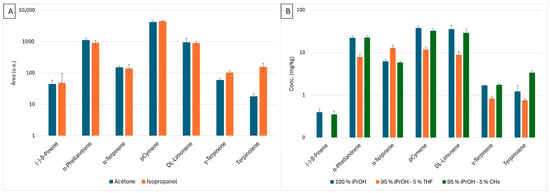
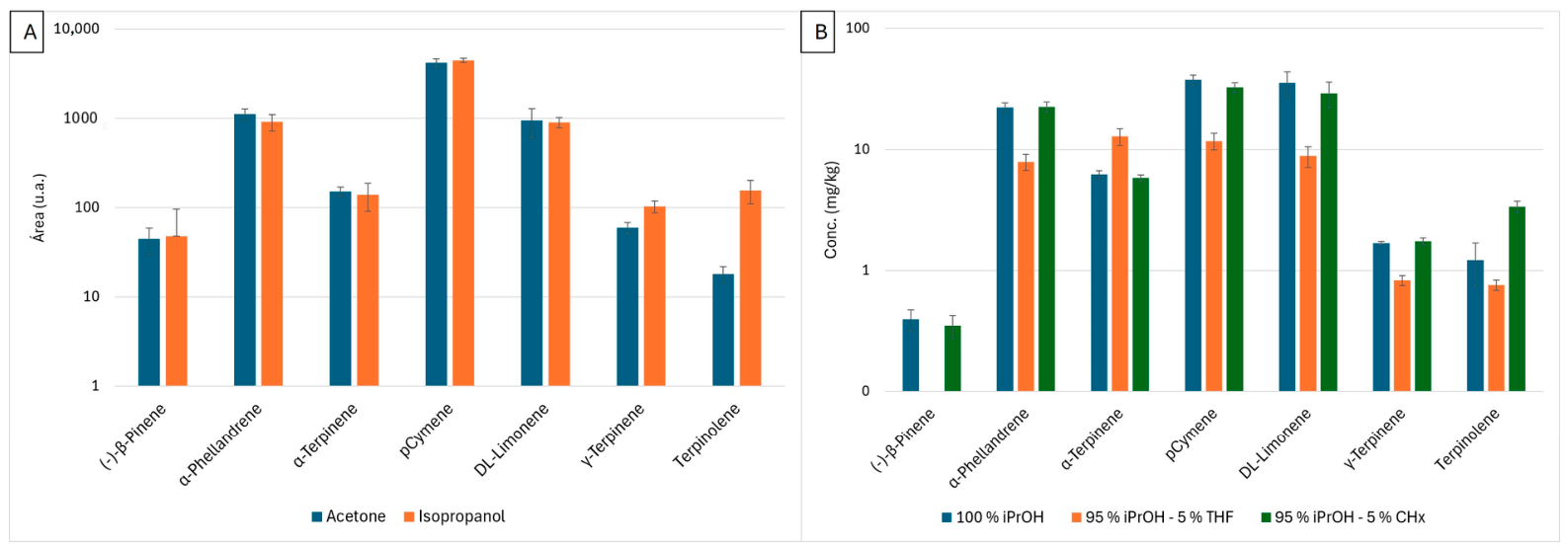
Initial results (Figure 1A) showed that, while extraction with both solvents was similar for most compounds, γ-terpinene and terpinolene were better extracted using isopropanol. Moreover, the extractions using isopropanol present cleaner chromatograms. Hence, acetone was discarded, and isopropanol was chosen as the extraction solvent. These results also helped to adjust the sample amount put into the cells, raising the sample size from 0.1 to 0.3 g.
Figure 1.
Study of solvents for PLE. (A): Performance of acetone and isopropanol as extraction solvents. (B): Influence of the use of co-solvents (N = 3. Error bars represent ± 2s.).
The larger peak area observed for p-cymene in Figure 1A is primarily explained by its higher initial concentration in the analyzed sample, which was not equivalent to that of the other bio-solvents. As it will be discussed later, p-cymene is retained to a greater extent within the HDPE matrix during the dissolution–precipitation and drying process, leading to its relative enrichment. Additionally, its aromatic nature further contributes to the observed signal intensity. The presence of an aromatic ring enhances ionization efficiency under EI conditions and favors the formation of more stable, high-abundance fragment ions. Consequently, fragmentation is less dispersed, and the signal is concentrated into fewer, more intense ions (notably m/z 119.1), resulting in a higher overall peak area compared to non-aromatic monoterpenes.
2.2.2. GC/MS Determination of Bio-Based Solvents
Stock solutions of the seven bio-based solvents at different concentrations with 50 µg L−1 of limonene-d5 as internal standard were prepared in isopropanol. The solvent’s boiling point (82.3 °C) is much lower than that of the compounds of interest and did not interfere with their determination.
The bio-based solvents presented similar boiling points, ranging from 166 to 185 °C, and their molecular weight was the same for all compounds (136.23 g mol−1) except for p-cymene (134.21 g mol−1). These characteristics prompted a low temperature increase rate. Therefore, the temperature program for the oven could start at a normal temperature (45 °C) but the initial increase was slow (5 °C min−1), allowing the separation of the seven compounds. Figure S1 of the Supplementary Material shows the chromatogram of a solution that contained 200 µg L−1 of each solvent and 50 µg L−1 of internal standard. The physical properties, retention times and target and qualifier ions can be found in Table 2.
Table 2.
Physical properties and chromatographic parameters of the bio-based solvents.
A linearity study was performed to establish the features of the GC/MS method (Table 3). Eight solutions were prepared in isopropanol with bio-based solvent concentrations ranging from 1 to 1000 µg L−1 and 50 µg L−1 of internal standard. All correlation coefficients (R) were above 0.99. The ratio between the analyte and the internal standard areas was used as analytical signal. The limits of detection (LOD) and quantification (LOQ) were calculated as 3.3 and 10 times the ratio of the intercept standard deviation and the slope of the linear regression. LODs ranged from 13 to 25 µg L−1 and LOQs from 55 to 75 µg L−1.
Table 3.
GC/MS and PLE-GC/MS methods’ features.
Repeatability and intermediate precision were established as well, analyzing a total of nine replicates of a 100 µg L−1 solution injected over three days and using ANOVA. Repeatability and intermediate precision were calculated as the intra-days and inter-days relative standard deviation (% RSD). All values were under 20%, except for the inter-days RSD for γ-terpinene and terpinolene, with values of 24 and 26%, respectively.
2.2.3. Optimization of PLE Conditions
In order to select the best extraction conditions for all bio-based solvents, three optimization steps were planned: (1) univariate analysis to study the addition of a swelling agent as co-solvent, (2) a design of experiment analysis based on response surface modeling and a desirability function to choose the optimal extraction temperature, time and co-solvent percentage and (3) univariate analysis to select the number of extraction cycles.
Addition of a Swelling Agent
The addition of a co-solvent as a swelling agent such as tetrahydrofuran or cyclohexane for extraction of compounds in plastics has been reported before [31]. The co-solvent swells the polymer matrix and improves solvent penetration and overall extraction. Three different extractions with 100% isopropanol, 95% isopropanol/5% cyclohexane and 95% isopropanol/5% tetrahydrofuran were performed to study how the addition of a co-solvent improves compound extraction. Results are shown in Figure 1B. The observed pattern regarding the influence of the swelling agent on the extraction efficiency of the various analytes does not appear to be readily explained by their structural or chemical properties, as these are largely comparable (with the exception of p-cymene). The use of tetrahydrofuran only improved α-terpinene extraction, while for the other compounds concentrations were lower. The addition of 5% of cyclohexane achieved similar results as without a co-solvent for all compounds except for terpinolene, which performed particularly well with cyclohexane. Hence, the addition of cyclohexane was further studied along with temperature and extraction time.
Selection of Co-Solvent Content, Extraction Temperature and Time
A central composite design (CCD) was employed to evaluate the influence of co-solvent percentage, temperature, and extraction time on the extraction of bio-based solvents. The experimental ranges for each factor were defined based on technical constraints of the pressurized liquid extraction (PLE) system, preliminary experiments, and established operational practice. The temperature range (60–100 °C) was selected to ensure efficient extraction while preventing HDPE softening or melting, which could lead to polymer blockage within the extraction system under pressurized conditions. The extraction time (2–10 min) was chosen according to standard PLE operation, where short extraction steps are preferred to enable multiple successive cycles; equilibrium partitioning is typically reached within this period, although complete extraction may require several cycles. The cyclohexane percentage (0–10%) was selected because it acts as a swelling modifier for HDPE rather than a true co-solvent, and higher proportions are avoided to prevent partial polymer dissolution and to maintain controlled swelling behavior.
A total of 18 experiments were conducted in random order, following a factorial design with three variables at two levels (23), four replicates at the central point, and six axial (“star”) points located at ±α from the center. The value of α was set to 1.685 to ensure rotatability of the design. Table S1 in the Supplementary Materials contains the complete experimental matrix, including factor levels, responses, and desirability values.
The software Chemoface v1.71 was used to build the models, evaluate the main effects and interactions of the three variables, calculate the individual desirability of each bio-solvent and build the global desirability surface plot.
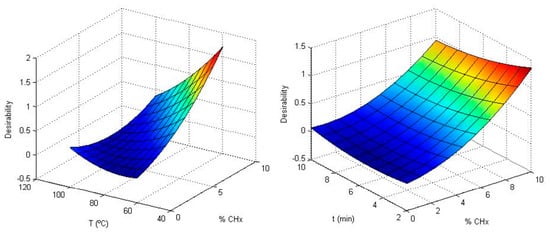
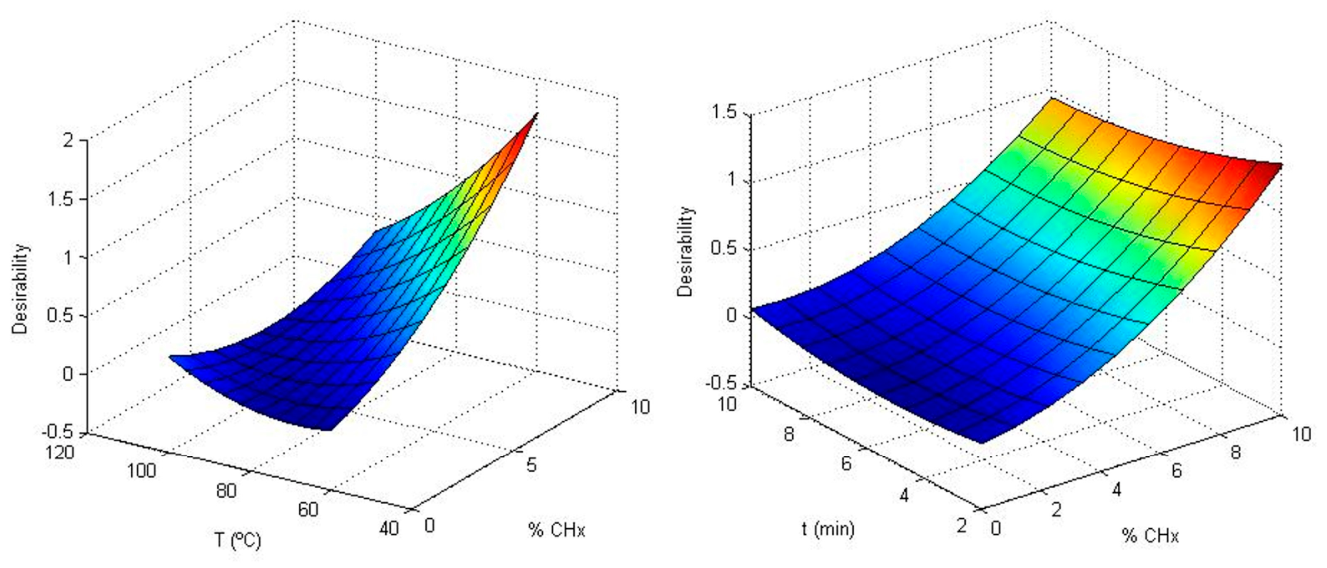
Pareto charts (Figure S2) and response surface plots (Figure S3) can be found in the Supplementary Materials. They show that extraction was favored with a high cyclohexane percentage, as well as low extraction temperature and time, but influence was not equal for all compounds, as only (-)-β-pinene, DL-limonene, γ-terpinene and terpinolene presented significant coefficients in their respective models. The desirability function was built using only significant coefficients, excluding the non-significant ones, as well as those of γ-terpinene for presenting values under the LODs. The response surfaces for the desirability function are shown in Figure 2, while the comparison of predicted versus measured values for the desirability function can be found in Figure S4 of the Supplementary Material. Only the main and quadratic effect of cyclohexane percentage in addition to its interaction with the extraction temperature were significant for the desirability model.
Figure 2.
Desirability function plots for the extraction of the seven compounds.
The compromise conditions chosen were 8% cyclohexane, 4 min and 68 °C, which showed the highest desirability of all the CCD points, but increasing the cyclohexane percentage to 10%, since its influence clearly showed that a higher percentage improved extraction.
Number of Cycles
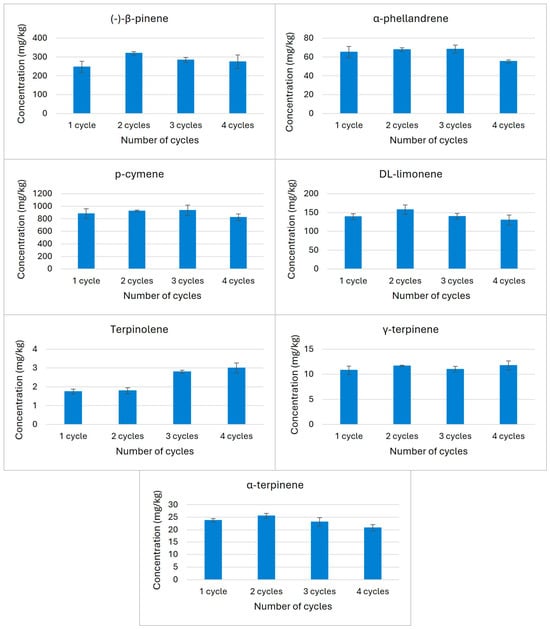
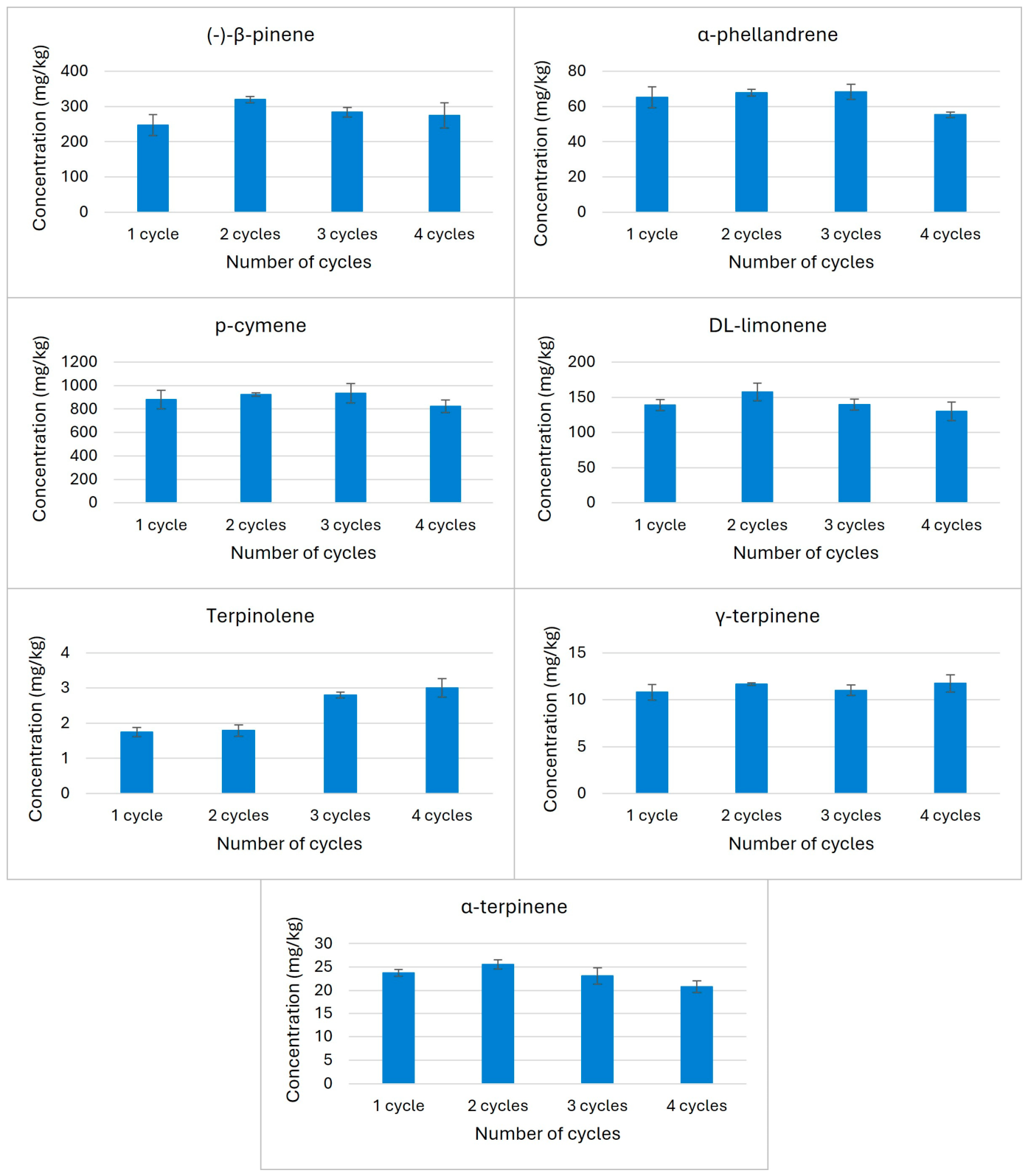
Once the extraction conditions were set, the optimal number of extraction cycles was studied to determine whether one, two, three or four consecutive extraction cycles were optimal. Extractions under the compromise conditions were conducted in triplicate for each number of cycles, and the mean concentration extracted for each case was calculated. Results can be found in Figure 3. Moreover, homoscedasticity test, ANOVA and least significant difference analysis were carried out (Table S2).
Figure 3.
Influence of the number of extraction cycles on the amount of compound extracted. N = 3. Error bars represent ± s.
For p-cymene and γ-terpinene, no significant differences were found, meaning that extraction is not dependent on the number of cycles. For (-)-β-pinene, α-terpinene and DL-limonene, the highest mean extraction was observed with two cycles; however, no significant differences were found between two and three extraction cycles. For α-phellandrene, the highest mean extraction was achieved with three cycles, but it did not present significant differences with one or two cycles and was lower for four cycles. Finally, four extraction cycles provided the highest mean extraction efficiency for terpinolene; however, no significant differences were observed compared with three cycles.
No clear correlation was observed between the optimal number of extraction cycles and the molecular size or general physicochemical properties of the studied compounds, as all analytes are structurally similar monoterpenes. However, p-cymene, the only aromatic compound in the series, showed slightly different behavior, which may be attributed to its planar structure and higher stability, potentially leading to stronger interactions with the polymer matrix and lower removal efficiency during drying. Overall, the differences observed are subtle and likely arise from a combination of matrix effects rather than a single dominant molecular parameter.
Given the results, three cycles were chosen as the optimal condition. It must be noted that, in certain cases, lower concentrations were achieved with a higher number of cycles, which could be attributed to possible losses due to degradation.
2.3. Features of the PLE-GC/MS Method for Bio-Based Solvents
The analytical performance of the complete PLE-GC/MS method is summarized in Table 3. Method accuracy was evaluated to verify that no analyte losses occurred during the pressurized liquid extraction (PLE) process as a result of volatilization or thermal degradation under the selected extraction conditions. Recovery experiments were performed by spiking 100 µL of a solution containing 100 mg L−1 of each bio-based solvent into extraction cells filled with sea sand prior to sealing and extraction. In addition, the previous study on the influence of the number of extraction cycles demonstrated that the higher extraction efficiency under the mixed-solvent condition evaluated was achieved after three extraction cycles, confirming the exhaustiveness of the PLE procedure. Procedural recoveries ranged from 80 to 117% for all analytes, except for p-cymene, which showed a recovery of 129%.
The procedural recovery obtained for p-cymene exceeded the generally accepted range for quantitative methods. This positive bias may be attributed to experimental variability associated with instrumental determination. Since the recovery remained close to the acceptance limit and no evidence of analyte degradation or loss was observed, the result was considered acceptable for the purposes of method validation.
The repeatability and intermediate precision of the whole PLE-GC/MS method was established by extracting and analyzing artificially spiked samples four times for three days (twelve aliquots total). Repeatability and intermediate precision are calculated as the intra-day and inter-day relative standard deviations, respectively, using ANOVA. Acceptable values lower than 20% were obtained in most cases, but inter-day RSD for terpinolene was 31%, which could be explained by the degree of heterogeneity of the recycled HDPE. Finally, the limits of detection and quantification were recalculated to account for the amount of sample extracted.
2.4. Residual Content Determination
The PLE-GC/MS method developed for the determination of residual bio-based solvent content was subsequently applied to the analysis of three samples of PC-HDPE. The dissolution–precipitation process was performed in triplicate. Results are shown in Table 4. Concentrations were moderate in most cases. Replicate 1 had concentrations ranging from under LOD values up to 280 mg kg−1, and replicate 2 from under LOD values up to 690 mg kg−1. Replicate 3 had concentrations from under LOD values up to 530 mg kg−1, except for p-cymene, which had a concentration of 16 g kg−1, clearly showing that this sample was not correctly dried.
Table 4.
Bio-based solvent content determination (in mg kg−1) 1.
Regardless of the fact that replicate 1 appeared to be the best dried sample, γ-terpinene and (-)-β-pinene presented the lowest residual content in the three samples (replicates of the cleaning process), with concentrations lower than 15 and 18 mg kg−1. On the contrary, p-cymene showed the highest residual retention under the mixed-solvent conditions evaluated in this study for all three samples.
Regarding D-limonene, it has been previously quantified in recycled HDPE [37], with concentrations ranging from 0.22 to 114.52 mg kg−1, in line with the obtained residual contents for (-)-β-pinene, α-phellandrene, DL-limonene and γ-terpinene. Pin et al. [20] reported that up to 1077 mg kg−1 (ppm) of p-cymene could be found in polystyrene treated with p-cymene. The bio-solvent p-cymene appeared to be more difficult to remove from the HDPE due to stronger interactions with the polymer matrix. The aromatic ring in its structure (more planar) resulted in greater retention of p-cymene, thereby slowing its removal during drying.
In any case, these concentrations are much higher than the modeled maximum concentration of 0.09 mg kg−1 of plastic for limonene [38] that would comply with the migration limits. Due to same or similar molecular weights, the same or similar modeled maximum concentrations would apply for the other bio-based solvents [39]. These results showed that a drying step at 80 °C for 2 days is likely insufficient to remove volatile monoterpenes. While the recycled plastic would need upcycling to be transformed into plastic products, in which further solvent elimination could happen during the extrusion process (by degasification, for example), it is necessary to select an optimal solvent for both cleaning efficiency and residue elimination and, above all, to improve the drying step of the method in order to lower or even eliminate any residues of bio-based solvents (for instance, applying vacuum) and, overall, to improve the whole recycling method.
It should be noted that the PLE-GC/MS method developed in this work is primarily intended as a process monitoring tool for the evaluation and optimization of the dissolution–precipitation recycling process. While the achieved limits of detection (2–4 mg kg−1) are suitable for assessing residual solvent levels typically obtained after treatment, they are not sufficient to directly verify compliance with the much lower concentration thresholds required for food-contact applications. Therefore, additional methodological improvements or more sensitive analytical techniques would be required for regulatory compliance assessment.
2.5. Safety Assessment of Bio-Based Solvents
Regarding the toxicity and safety of the selected bio-based solvents, it is necessary to address the health risks that their use poses and compare them with the risks associated with the use of toluene and xylene, some of the solvents previously proposed. Cramer classification [40] shows that all compounds are considered as low risk, category 1, but ECHA registration dossiers for each solvent show clear differences [41,42,43,44,45,46,47,48,49,50].
The main concern arising from the use of bio-based solvents would relate to their skin or eye irritation or sensitizer properties (limonene, α-terpinene, α-phellandrene, terpinolene and (-)-β-pinene).
In contrast, toluene is known to cause a range of adverse health effects, including neurotoxicity, dizziness, drowsiness, headache, intoxication-like symptoms, and irritation, even at low exposure concentrations. And xylene may cause neurotoxicity, irritation, skin dryness and scaling, dermal vasodilation, ototoxicity, adaptive changes in the liver and body and organ weight changes.
Considering this information, bio-based solvents cannot be regarded as completely harmless; however, they are generally significantly less toxic than the conventional solvents they are intended to replace.
3. Materials and Methods
3.1. Reagents and Materials
To perform the challenge test, the polymer sample was contaminated first with a mixture that simulates the contaminants that could be found in real samples. And subsequently, the cleaning process employing the bio-based solvents was evaluated. The contamination mixture was prepared in n-hexane (purchased from Scharlab (Barcelona, Spain)) with chloroform (≥99%), toluene (≥99.5%), chlorobenzene (≥99.5%), methyl salicylate (≥99%), phenyl cyclohexane (analytical standard), benzophenone (99%) and methyl stearate (≥96%) (all purchased from Sigma-Aldrich (St. Louis, MO, USA)), at a concentration of 1% (V/V) or (m/V), following FDA and EFSA recommendations [51,52].
Quantification was done using analytical-grade standards of the same set of contaminants, along with toluene-d8 (99.96 atom % D), chlorobenzene-d5 (99 atom % D) and benzophenone-d10 (99 atom % D) (purchased from Sigma-Aldrich (St. Louis, MO, USA)) as internal standards (the internal standard used for each analyte is available elsewhere [15]).
The bio-based solvents evaluated for the HDPE cleaning process were: p-Cymene (≥99%) (purchased from Thermo Fisher (Waltham, MA, USA)), (-)-β-pinene (≥97%), α-phellandrene (≥75%), α-terpinene (89%), DL-limonene (≥99%), γ-terpinene (≥95%) and terpinolene (≥95%) (purchased from Sigma Aldrich (St. Louis, MO, USA)). Further information about their physical properties can be found in Table 2.
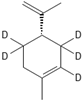
Again, analytical-grade versions of each bio-based solvent were used for their residual GC-MS quantification, with (+)-limonene-d2,3,3,5,5-d5 (>95%), purchased from LGC Standards (Teddington, Middlesex, UK) as internal standard for all compounds.
Isopropanol (LC-MS grade), acetone (HPLC grade), ethanol (HPLC grade), sea sand and cyclohexane (HPLC grade) were acquired from Scharlab (Barcelona, Spain). Tetrahydrofuran (HPLC grade) was supplied by Panreac (Barcelona, Spain).
3.2. Samples and Sample Treatment
The Spanish National Center for Packaging Technologies—CENTIDE (La Rioja, Spain) provided PC-HDPE milk bottles already cut into flakes (around 0.05 g of mass).
For the cleaning efficiency comparison, a batch of HDPE flakes was contaminated with seven model contaminants according to the Use of Recycled Plastics in Food Packaging (Chemistry Considerations): Guidance for Industry [51]. This guidance for industry says: “FDA recommends simulating consumer misuse by exposing virgin polymer (either in container form or as flake) to selected surrogate contaminants and then running the exposed or “challenged” polymer through the recycling process. Subsequent analysis of the processed polymer for the surrogate contaminants would provide a means to evaluate the efficacy of the recycling process.” The FDA recommends that the surrogate contaminants represent common materials accessible to the consumer and include a volatile polar organic substance (chloroform, chlorobenzene, 1,1,1-trichloroethane, diethyl ketone), a volatile non-polar organic substance (toluene), a non-volatile polar organic substance (benzophenone, methyl salicylate), and a non-volatile non-polar organic substance (tetracosane, lindane, methyl stearate, phenylcyclohexane). Among the examples recommended by the FDA as model contaminants, the following were selected in this work: chloroform, toluene, chlorobenzene, methyl salicylate, phenyl cyclohexane, benzophenone and methyl stearate.
To contaminate the batch, the protocol of a previous study was followed [15]. Briefly, 30 g of PC-HDPE flakes were macerated in 150 mL of the spiking mixture for seven days at room temperature with sporadic agitation. After spiking, the flakes were rinsed with equal volumes of ethanol and water to ensure the cleaning of the flakes’ surfaces. Finally, the flakes were dried under vacuum and stored in glass containers at room temperature until the decontamination process.
The decontamination process or cleaning process consists of using each bio-solvent individually, to study the cleaning efficiencies of each solvent and compare them. A total of 2.5 g of HDPE contaminated flakes and 65 mL of a bio-based solvent were put into a round bottom flask (HDPE–liquid ratio of 0.04 g mL−1). Then, the mixture was heated and refluxed at 160 °C in a hot plate with magnetic stirring to dissolve the polymer. Once the polymer was dissolved, the mixture was stirred for 30 min under reflux. After that, the dissolution was poured into a beaker, left to cool down and precipitate, and finally filtered with a porous plate. The solid obtained was rinsed with 20 mL of ethanol, vacuum filtered and dried at 80 °C for 2 days in an oven. The dried precipitated polymer was stored at 4 °C in closed vials until PLE and chromatographic analysis.
On the other hand, to study the residual amount of the bio-solvent in the recycled polymer after the cleaning process, a clean sample of the PC-HDPE (non-contaminated with the seven model contaminants according to the FDA) was subjected to the dissolution–precipitation process to be cleaned using a mixture of the seven bio-based solvents. This sample spiked with the bio-based solvents was used to carry out the development, optimization and validation of the PLE-GC/MS method to determine their residual content in the treated HDPE. For this, 2.5 g of HDPE flakes and 65 mL of a mixture of the seven bio-based solvents, at equal parts, were put into a round-bottom flask (HDPE–liquid ratio of 0.04 g mL−1). Then, the mixture was heated and refluxed at 160 °C in a hot plate with magnetic stirring to dissolve the polymer, using a Julabo CORIO CD-200 F refrigerated/heating circulator (JULABO GmbH, Seelbach, Germany) to pump water through the condenser and an IR FLUKE 62 max+ infrared thermometer (Fluke Corporation, Everett, WA, USA) to monitor the temperature.
Once dissolved, the mixture was stirred for 30 min under reflux. After that, the dissolved polymer and solvent mixture was poured into a beaker, left to cool down and precipitate, and finally filtered with a porous plate. The solid obtained was rinsed with 20 mL of ethanol, vacuum filtered and dried at 80 °C for 2 days in an oven. The dried precipitated polymer was stored at 4 °C in closed bottles. This process was repeated several times to obtain enough recycled polymer for the whole study.
3.3. Pressurized Liquid Extraction—Residual Solvents
Residual solvent extractions were conducted by a Dionex ASE 200 pressurized liquid extractor (Dionex, Sunnyvale, CA, USA) equipped with a solvent controller. A total of 11 mL extraction cells were filled with 0.3 g of recycled HDPE and topped up with sea sand. The fixed variables of the extraction were pressure (1500 psi or 10.3 MPa), the pre-heating step (5 min), flush volume (60%) and purge time (60 s).
The extraction solvent (acetone or isopropanol), a co-solvent (cyclohexane or tetrahydrofuran), extraction temperature (from 60 to 100 °C), extraction time (from 2 to 10 min) and number of cycles (from one to four) were optimized by univariate analysis, design of experiments, response surface modeling and desirability function, in order to select the compromise conditions and optimize a method for the extraction of the residual content of the bio-based solvents.
The extracts were brought to a final volume of 50 mL after addition of 200 µL of a 12.5 mg L−1 limonene-d5 internal standard solution. Subsequently, the obtained dissolution was filtered through a 0.22 µm nylon syringe filter and stored at 4 °C until chromatographic analysis.
Prior to GC-MS analysis, the extracts were diluted, when necessary, to ensure that the concentrations of the target analytes were within the validated linear calibration range. Appropriate dilution factors were applied according to the analyte levels in each sample, and all reported concentrations were corrected accordingly. For example, samples containing high levels of p-cymene were diluted 1:100 before analysis.
3.4. Chromatographic Conditions—Residual Solvents
Gas chromatography analyses were performed using an Agilent 8890 system equipped with a 5977B mass selective detector and an Agilent 7693AA autosampler (Agilent Technologies, Santa Clara, CA, USA). An Agilent HP-5ms column (30 m × 250 µm × 0.25 µm) (Agilent Technologies, Santa Clara, CA, USA), featuring a stationary phase composed of 5% phenyl and 95% dimethylpolysiloxane, was used. The oven temperature program was initiated at 45 °C and held for 0.5 min, followed by an increase to 60 °C at a ramp rate of 5 °C min−1. The temperature was then raised to 250 °C at 60 °C min−1 and held for 2 min.
The sample injection temperature was 250 °C, and a 4 mm I.D. liner (Agilent 5190-2293 (Agilent Technologies, Santa Clara, CA, USA)) was used in splitless mode for 0.05 min before switching to split mode. Helium served as the carrier gas, at a constant flow of 1.0 mL min−1. Mass spectrometric detection was performed via electron impact ionization at 70 eV, with the ion source maintained at 250 °C and the quadrupole at 150 °C. Data acquisition was conducted in selected ion monitoring (SIM) mode. Detailed chromatographic conditions for individual analytes are provided in Table 2.
3.5. Determination of Cleaning Efficiency—Model Contaminants
The cleaning efficiencies of the bio-based solvents were obtained by applying a PLE-GC/MS method (developed and optimized previously [15]) and a challenge test. Briefly, the PLE method for model contaminants was optimized at 3 cycles, 6 min each cycle, 100 °C and acetone as extraction solvent. Moreover, the chromatographic method for the model contaminants is also described in detail in a previous work [15]; briefly, the oven program started at 35 °C, holding for 0.5 min before raising the temperature to 60 °C at a rate of 10 °C min−1. Temperature was raised again to 280 °C at a rate of 70 °C min−1 and maintained for 1.8 min. Injection was done at 380 °C in splitless–split mode (0.05 min in splitless mode). MS detection was carried out by electronic impact, with an ionization source heated at 230 °C with a voltage of 70 eV. The quadrupole temperature was 150 °C. Chromatograms were registered in SIM mode.
In summary, the concentrations of seven model contaminants were determined before and after treating spiked PC-HDPE with the ultra-cleaning method and later compared to calculate the cleaning efficiency of each bio-based solvent for each contaminant. The cleaning efficiency was calculated following Equation (1), where C0 is the mean concentration for each contaminant before treatment, and Cf the concentration of each contaminant after treatment for each replicate.
3.6. Data Processing
Chemoface software v1.71 [53] was used to obtain the experiment matrix for the CCD, the response surfaces, Pareto charts and desirability function. The online Toxtree application (based on the 3.1.0 Toxtree version) [40] was used as part of the safety evaluation of the bio-based solvents.
4. Conclusions
The cleaning efficiencies of seven bio-based solvents were evaluated to compare their ability to remove contaminants from PC-HDPE using a challenge test and a previously developed PLE-GC/MS method. High cleaning efficiencies (93–100%) were obtained for all solvents except α-phellandrene, which showed lower removal efficiencies (50–73%) for non-volatile and polar contaminants. These results demonstrate the feasibility of using bio-based solvents for contaminant removal.
On the other hand, a new PLE–GC/MS method was developed, optimized, and validated to assess the presence of residual solvents remaining after the cleaning process. The method showed suitable analytical performance, enabling the determination of residual solvents in three samples. In particular, it provided adequate sensitivity, with limits of detection in the range of 2–4 mg kg−1, as well as satisfactory accuracy and precision, with intra- and inter-day relative standard deviations below 11% and 31%, respectively.
The lowest residual concentrations in recycled HDPE were observed for γ-terpinene (<LOD–15 mg kg−1) and (-)-β-pinene (<LOD–18 mg kg−1), which also showed the highest cleaning efficiencies across all types of contaminants. In contrast, p-cymene exhibited the highest residual levels (up to 16 g kg−1), confirming its poor removal. In general, under the mixed-solvent conditions evaluated in this study, p-cymene showed the highest residual retention, while α-phellandrene exhibited the lowest cleaning efficiency. Finally, the safety of the solvents used for the recycling process was assessed. Using bio-based solvents greatly reduces the toxicity of the process when compared to classical solvents such as toluene and xylene, which aligns with safer and cleaner waste management.
Overall, while the drying step needs improvement, it has been shown that the dissolution–precipitation method using bio-based solvents offers promising results for their application in the field of post-consumer plastic recycling.
Supplementary Materials
The following supporting information can be downloaded at: https://www.mdpi.com/article/10.3390/recycling11080135/s1, Table S1. CCD matrix, cyclohexane percentage (% CHx), temperature (T) and extraction time (t) values, responses for the optimization of PLE variables and global desirability for each experiment; Table S2. ANOVA for the effect of the number of cycles in the residual concentration; Figure S1. GC/MS SIM chromatogram of a standard solution containing 200 µg L−1 of each bio-based solvent and 50 µg L−1 of the internal standard. 1: (-)-β-pinene. 2: α-phellandrene. 3: α-terpinene. 4: p-cymene. 5: limonene-d5. 6: limonene. 7: γ-terpinene. 8: terpinolene; Figure S2. Pareto charts for (-)-β-pinene (A), α-phellandrene (B), α-terpinene (C), p-cymene (D), DL-limonene (E), γ-terpinene (F) and terpinolene (G); Figure S3. Response surfaces for (A) (-)-β-pinene (R2 = 0.7308), (B) DL-limonene (R2 = 0.8274), (C) γ-terpinene (R2 = 0.6624) and (D) terpinolene (R2 = 0.5672). % CHx: cyclohexane percentage in the extraction solvent. T: extraction temperature (°C). t: extraction time (min). Vertical axis: extracted concentration (mg/kg). Figure S4. Predicted vs. measured comparison for the desirability function (R2 = 0.6099).
Author Contributions
Conceptualization, M.T.T. and J.G.-B.; methodology, M.T.T.; validation, M.T.T.; investigation, J.B.-M. and M.J.-S.; writing—original draft preparation, J.B.-M.; writing—review and editing, M.T.T., M.J.-S. and J.G.-B.; supervision, M.T.T. and M.J.-S.; project administration, M.T.T.; funding acquisition, M.T.T. and J.G.-B. All authors have read and agreed to the published version of the manuscript.
Funding
This research was funded by Universidad de La Rioja (Ayudas Grupos de Investigación, grant numbers REGI 22/64 and REGI 25/62), Gobierno de La Rioja (Ayudas para la realización del doctorado industrial en el sector del envase y embalaje), National Center for Packaging Technologies—CENTIDE and ADER—Agencia de Desarrollo Económico de La Rioja (grant number ADER—2022-I-IDI-00050).
Data Availability Statement
The original contributions presented in this study are included in the article and Supplementary Materials. Further inquiries can be directed to the corresponding author.
Acknowledgments
J.B.-M. would like to thank the National Center for Packaging Technologies—CENTIDE, Gobierno de La Rioja and Universidad de La Rioja for his pre-doctoral grant.
Conflicts of Interest
The authors declare no conflicts of interest. The funders had no role in the design of the study; in the collection, analyses, or interpretation of data; in the writing of the manuscript; or in the decision to publish the results.
Abbreviations
The following abbreviations are used in this manuscript:
| C0 | Concentration of each contaminant before treatment |
| Cf | Concentration of each contaminant after treatment |
| CCD | Central composite design |
| Eff | Cleaning efficiency |
| GC-FID | Gas chromatography–flame ionization detector |
| GC/MS | Gas chromatography/mass spectrometry |
| HDPE | High-density polyethylene |
| HS-SPME | Headspace solid-phase microextraction |
| LOD | Limit of detection |
| LOQ | Limit of quantification |
| PC-HDPE | Post-consumer high-density polyethylene |
| PLE | Pressurized liquid extraction |
| RSD | Relative standard deviation |
References
- OECD. Policy Scenarios for Eliminating Plastic Pollution by 2040; OECD Publishing: Paris, France, 2024. [Google Scholar] [CrossRef] [Scilit]
- Plastics Europe. The Circular Economy for Plastics—A European Analysis. 2024. Available online: https://plasticseurope.org/knowledge-hub/the-circular-economy-for-plastics-a-european-analysis-2024/ (accessed on 23 June 2025).
- European Parliament and Council. Directive 94/62/EC of 20 December 1994 on packaging and packaging waste. Off. J. Eur. Communities 1994, L 365, 10–23. Available online: https://eur-lex.europa.eu/eli/dir/1994/62/oj/eng (accessed on 1 June 2026).
- European Parliament and Council. Directive (EU) 2018/852 of 30 May 2018 amending Directive 94/62/EC on packaging and packaging waste. Off. J. Eur. Communities 2018, L 150, 141–154. Available online: https://eur-lex.europa.eu/eli/dir/2018/852/oj/eng (accessed on 1 June 2026).
- European Parliament and Council. Regulation (EU) 2025/40 of 19 December 2024, on packaging and packaging waste, amending regulation (EU) 2019/1020 and Directive (EU) 2019/904, and repealing Directive 94/62/EC. Off. J. Eur. Union 2024, 1–124. Available online: https://eur-lex.europa.eu/legal-content/EN/ALL/?uri=CELEX:32025R0040 (accessed on 1 June 2026).
- European Commission. Commission Regulation (EU) 2022/1616 of 15 September 2011, on recycled plastic materials and articles to come into contact with foods, and repealing Regulation (EC) 282/2008. Off. J. Eur. Union 2022, L 243, 3–46. Available online: http://data.europa.eu/eli/reg/2022/1616/oj (accessed on 1 June 2026).
- Sepúlveda-Carter, J.; Moreno de Castro, J.L.; Marín, L.; Baños, P.; Sánchez Rodríguez, M.; Arrieta, M.P. Regulatory Frameworks and State-of-the-Art Decontamination Technologies for Recycled Polystyrene for Food Contact Applications. Polymers 2025, 17, 658. [Google Scholar] [CrossRef] [Scilit] [PubMed]
- EFSA CEF Panel (EFSA Panel on Food Contact Materials, Flavourings and Processing Aids). Scientific Opinion on the safety assessment of the processes ‘Biffa Polymers’ and ‘CLRrHDPE’ used to recycle high-density polyethylene bottles for use as food contact material. EFSA J. 2015, 13, 4016. [Google Scholar] [CrossRef] [Scilit]
- EFSA CEP Panel (EFSA Panel on Food Contact Materials, Enzymes and Processing Aids); Lambré, C.; Barat Baviera, J.M.; Bolognesi, C.; Chesson, A.; Cocconcelli, P.S.; Crebelli, R.; Gott, D.M.; Grob, K.; Mengelers, M.; et al. Scientific Guidance on the criteria for the evaluation and on the preparation of applications for the safety assessment of post-consumer mechanical PET recycling processes intended to be used for manufacture of materials and articles in contact with food. EFSA J. 2024, 22, e8879. [Google Scholar] [CrossRef] [Scilit] [PubMed]
- Cook, E.; Velis, C.A.; Cottom, J.W. Scaling up resource recovery of plastics in the emergent circular economy to prevent plastic pollution: Assessment of risks to health and safety in the Global South. Waste Manag. Res. 2022, 40, 1680–1707. [Google Scholar] [CrossRef] [Scilit] [PubMed]
- Vollmer, I.; Jenks, M.J.F.; Roelands, M.C.P.; White, R.J.; van Harmelen, T.; de Wild, P.; van der Laan, G.P.; Meirer, F.; Keurentjes, J.T.F.; Weckhuysen, B.M. Beyond mechanical recycling: Giving new life to plastic waste. Angew. Chem. Int. Ed. 2020, 59, 15402–15423. [Google Scholar] [CrossRef] [Scilit] [PubMed]
- Aparício, S.C.; Castro, P.M.; Ribeiro, B.D.; Marrucho, I.M. Greening the physical recycling of HDPE: Dissolution precipitation with natural solvents. Green Chem. 2024, 26, 6799. [Google Scholar] [CrossRef] [Scilit]
- Zhao, Y.B.; Lv, X.D.; Ni, H.G. Solvent-based separation and recycling of waste plastics: A review. Chemosphere 2018, 209, 707–720. [Google Scholar] [CrossRef] [Scilit] [PubMed]
- Ferreira, A.M.; Sucena, I.; Otero, V.; Angelin, E.M.; Melo, M.J.; Coutinho, J.A.P. Pretreatment of plastic waste: Removal of colorants from HDPE using biosolvents. Molecules 2021, 27, 98. [Google Scholar] [CrossRef] [Scilit] [PubMed]
- Blázquez-Martín, J.; García-Barrasa, J.; Tena, M.T. Pressurized liquid extraction and GC/MS determination of model contaminants in HDPE—Application to recycling of post-consumer polyolefins using limonene. J. Chromatogr. A 2025, 1745, 465749. [Google Scholar] [CrossRef] [Scilit] [PubMed]
- García, M.T.; Duque, G.; Gracia, I.; de Lucas, A.; Rodríguez, J.F. Recycling extruded polystyrene by dissolution with suitable solvents. J. Mater. Cycles Waste Manag. 2009, 11, 2–5. [Google Scholar] [CrossRef] [Scilit]
- García, M.T.; Gracia, I.; Duque, G.; de Lucas, A.; Rodríguez, J.F. Study of the solubility and stability of polystyrene wastes in a dissolution recycling process. Waste Manag. 2009, 29, 1814–1818. [Google Scholar] [CrossRef] [Scilit] [PubMed]
- Noguchi, T.; Miyashita, M.; Inagaki, Y.; Watanabe, H. A New Recycling System for Expanded Polystyrene using a Natural Solvent. Part 1. A New Recycling Technique. Packag. Technol. Sci. 1998, 11, 19–27. [Google Scholar] [CrossRef]
- Shikata, S.; Watanabe, T.; Hattori, K.; Aoyama, M.; Miyakoshi, T. Dissolution of polystyrene into cyclic monoterpenes present in three essential oils. J. Mater. Cycles Waste Manag. 2011, 13, 127–130. [Google Scholar] [CrossRef] [Scilit]
- Pin, J.-M.; Soltani, I.; Negrier, K.; Lee, P.C. Recyclability of Post-Consumer Polystyrene at Pilot Scale: Comparison of Mechanical and Solvent-Based Recycling Approaches. Polymers 2023, 15, 4714. [Google Scholar] [CrossRef] [Scilit] [PubMed]
- Hanschmann, B. Precipitation of Polypropylene and Polyethylene Terephthalate Powders Using Green Solvents via Temperature and Antisolvent-Induced Phase Separation. Adv. Polym. Technol. 2023, 2023, 7651796. [Google Scholar] [CrossRef] [Scilit]
- Vera, P.; Canellas, E.; Nerín, C. Migration of odorous compounds from adhesives used in market samples of food packaging materials by chromatography olfactometry and mass spectrometry (GC-O-MS). Food Chem. 2014, 145, 237–244. [Google Scholar] [CrossRef] [Scilit] [PubMed]
- Kim, Y.W.; Kim, M.J.; Chung, B.Y.; Bang, D.Y.; Lim, S.K.; Choi, S.M.; Lim, D.S.; Cho, M.C.; Yoon, K.; Kim, H.S.; et al. Safety Evaluation and Risk Assessment of d-Limonene. J. Toxicol. Environ. Health Part B 2013, 16, 17–38. [Google Scholar] [CrossRef] [Scilit] [PubMed]
- Huber, M.; Franz, R. Identification of Migratable Substances in Recycled High Density Polyethylene Collected from Household Waste. J. High Resolut. Chromatogr. 1997, 20, 427–430. [Google Scholar] [CrossRef] [Scilit]
- Caner, C. Development of a Liquid Extraction Method and Comparison with Dynamic Thermal Stripping-Thermal Desorption (DTS-TD) Method: Sorption of D-Limonene by Flexible Packaging Films. Packag. Technol. Sci. 2004, 17, 105–111. [Google Scholar] [CrossRef] [Scilit]
- Camacho, W.; Karlsson, S. Quality-determination of recycled plastic packaging waste by identification of contaminants by GCMS– after microwave assisted extraction (MAE). Polym. Degrad. Stab. 2000, 71, 123–134. [Google Scholar] [CrossRef] [Scilit]
- Hochegger, A.; Pantò, S.; Jones, N.; Leitner, E. One-dimensional and comprehensive two-dimensional gas chromatographic approaches for the characterization of post-consumer recycled plastic materials. Anal. Bioanal. Chem. 2023, 415, 2447–2457. [Google Scholar] [CrossRef] [Scilit] [PubMed]
- González-Hernández, R.A.; Valdez-Cruz, N.A.; Trujillo-Roldán, M.A. Factors that influence the extraction methods of terpenes from natural sources. Chem. Pap. 2024, 78, 2783–2810. [Google Scholar] [CrossRef] [Scilit]
- Garrido-López, Á.; Esquiu, V.; Tena, M.T. Determination of oleamide and erucamide in polyethylene films by pressurized fluid extraction and gas chromatography. J. Chromatogr. A 2006, 1124, 51–56. [Google Scholar] [CrossRef] [Scilit] [PubMed]
- Garrido-López, Á.; Esquiu, V.; Tena, M.T. Comparison of three gas chromatography methods for the determination of slip agents in polyethylene films. J. Chromatogr. A 2007, 1150, 178–182. [Google Scholar] [CrossRef] [Scilit] [PubMed]
- Garrido-López, Á.; Tena, M.T. Experimental design approach for the optimisation of pressurized fluid extraction of additives from polyethylene films. J. Chromatogr. A 2005, 1099, 75–83. [Google Scholar] [CrossRef] [Scilit] [PubMed]
- Waldebáck, M.; Jansson, C.; Señoráns, F.J.; Markides, K.E. Accelerated solvent extraction of the antioxidant Irganox 1076 in linear low density polyethylene (LLDPE) granules before and after γ-irradiation. Analyst 1998, 123, 1205–1207. [Google Scholar] [CrossRef] [Scilit]
- Vandenburg, H.J.; Clifford, A.A.; Bartle, K.D.; Carlson, R.E.; Carroll, J.; Newton, I.D. A simple solvent selection method for accelerated solvent extraction of additives from polymers. Analyst 1999, 124, 1707–1710. [Google Scholar] [CrossRef] [Scilit]
- Vandenburg, H.J.; Clifford, A.A.; Bartle, K.D.; Zhu, S.A.; Carroll, J.; Newton, I.D.; Garden, L.M. Factors Affecting High-Pressure Solvent Extraction (Accelerated Solvent Extraction) of Additives from Polymers. Anal. Chem. 1998, 70, 1943–1948. [Google Scholar] [CrossRef] [Scilit] [PubMed]
- Carrero, J.; Oliva, V.; Navascués, B.; Borrull, F.; Galià, M. Determination of antioxidants in polyolefins by pressurized liquid extraction prior to high performance liquid chromatography. Polym. Test. 2015, 46, 21–25. [Google Scholar] [CrossRef] [Scilit]
- Helias, E.; Escudero Sanz, F.J.; Grouset, D. Extraction of contaminants from HDPE wastes: Is a rinse sufficient? In Proceedings of the WASTEENG 18—7th International Conference on Engineering for Waste and Biomass Valorisation, Pague, Czech Republic, 2–5 July 2018. [Google Scholar]
- Zhang, M.-Y.; Shu, Q.-Z.; Lin, Q.-B.; Zhong, H.-N.; Chen, S.; Li, D.; Dong, B.; Xu, M.-Q.; Li, W.-L. Identification and quantitation of volatile organic compounds in Chinese recycled HDPE: Consequences for its applicability. Food Packag. Shelf Life 2025, 47, 101424. [Google Scholar] [CrossRef] [Scilit]
- EFSA Panel on Food Contact Materials, Enzymes, Flavourings and Processing Aids (CEP). Safety assessment of the process Starlinger recoSTAR HDPE FC 1—PET2PET used to recycle post-consumer HDPE closures into food contact closures. EFSA J. 2022, 20, 7001. [Google Scholar] [CrossRef] [Scilit] [PubMed]
- Institute for Health and Consumer Protection (Joint Research Centre). Practical Guidelines on the Application of Migration Modelling for the Estimation of Specific Migration; Publications Office of the European Union: Luxembourg, 2015. [Google Scholar] [CrossRef]
- JRC Computational Toxicology. Toxtree Online. 2025. Available online: http://toxtree.sf.net/predict (accessed on 4 June 2025).
- ECHA CHEM. (-)-β-pinene ((-)-pin-2(10)-ene) REACH Registration Dossier. 3 November 2010. Available online: https://chem.echa.europa.eu/100.038.222/dossier-view/253d754d-7123-4ca6-b939-63b5ffb0e21e (accessed on 6 October 2025).
- ECHA CHEM. α-Phellandrene ((R)-5-Isopropyl-2-methylcyclohexa-1,3-diene) REACH Registration Dossier. 7 May 2018. Available online: https://chem.echa.europa.eu/100.021.971/dossier-view/77315a00-1053-429f-b460-3d0ee6869100 (accessed on 6 October 2025).
- ECHA CHEM. α-Terpinene (p-Mentha-1,3-diene) REACH Registration Dossier. 30 May 2018. Available online: https://chem.echa.europa.eu/100.002.541/dossier-view/b93491ac-e53e-427d-affb-03abb899171c (accessed on 6 October 2025).
- ECHA CHEM. p-Cymene REACH Registration Dossier. 17 April 2018. Available online: https://chem.echa.europa.eu/100.002.542/dossier-view/0b747e25-52b0-433c-84de-5c35f57dbc89 (accessed on 6 October 2025).
- ECHA CHEM. L-Limonene ((S)-p-Mentha-1,8-diene) REACH Registration Dossier. 25 February 2013. Available online: https://chem.echa.europa.eu/100.025.286/dossier-view/463ce750-8d68-4b45-88dd-a49a6e745fbc (accessed on 6 October 2025).
- ECHA CHEM. D-Limonene ((R)-p-Mentha-1,8-diene) REACH Registration Dossier. 9 November 2010. Available online: https://chem.echa.europa.eu/100.025.284/dossier-view/490ebcb8-215c-4c1e-964d-0180cddf7e2c (accessed on 6 October 2025).
- ECHA CHEM. γ-Terpinene (p-Mentha-1,4-diene) REACH Registration Dossier. 31 March 2018. Available online: https://chem.echa.europa.eu/100.002.540/dossier-view/27532f0f-a664-41c1-af94-e2bec3d539c0 (accessed on 6 October 2025).
- ECHA CHEM. Terpinolene (p-Mentha-1,4(8)-diene) REACH Registration Dossier. 16 November 2021. Available online: https://chem.echa.europa.eu/100.008.709/dossier-view/307872cf-2a33-4fa8-b873-11a01317a46d (accessed on 6 October 2025).
- ECHA CHEM. Toluene REACH Registration Dossier. 23 August 2010. Available online: https://chem.echa.europa.eu/100.003.297/dossier-view/89f31bda-0e16-488b-a598-6b719c64dbb3 (accessed on 6 October 2025).
- ECHA CHEM. Xylene REACH Registration Dossier. 16 January 2024. Available online: https://chem.echa.europa.eu/100.014.124/dossier-view/2fbb5256-8fb7-4ae9-b5ca-23e149387dba (accessed on 6 October 2025).
- FDA CFSAN, U.S.; Department of Health and Human Services, Food and Drug Administration. Use of Recycled Plastics in Food Packaging (Chemistry Considerations): Guidance for Industry. 2021. Available online: https://www.fda.gov/regulatory-information/search-fda-guidance-documents/guidance-industry-use-recycled-plastics-food-packaging-chemistry-considerations (accessed on 19 September 2025).
- EFSA Panel on Food Contact Materials, Enzymes, Flavourings and Processing Aids (CEF). Scientific opinion on the criteria to be used for safety evaluation of a mechanical recycling process to produce recycled PET intended to be used for manufacture of materials and articles in contact with food. EFSA J. 2011, 9, 7. [Google Scholar] [CrossRef] [Scilit]
- Nunes, C.A.; Freitas, M.P.; Pinheiro, A.C.M.; Bastos, S.C. Chemoface: A novel free user-friendly interface for chemometrics. J. Braz. Chem. Soc. 2012, 23, 2003–2010. [Google Scholar] [CrossRef] [Scilit]




Disclaimer/Publisher’s Note: The statements, opinions and data contained in all publications are solely those of the individual author(s) and contributor(s) and not of MDPI and/or the editor(s). MDPI and/or the editor(s) disclaim responsibility for any injury to people or property resulting from any ideas, methods, instructions or products referred to in the content. |
© 2026 by the authors. Licensee MDPI, Basel, Switzerland. This article is an open access article distributed under the terms and conditions of the Creative Commons Attribution (CC BY) license.