


Abstract
Urban plastic waste management in large metropolitan regions remains constrained by low recovery rates despite growing policy attention. This study adopts a sustainability-oriented innovation (SOI) perspective to examine how policy–technology integration reshapes system-level performance in urban plastic waste systems. Using Bangkok as a representative case, a system-level model integrates plastic waste generation growth, time-dependent behavioural adoption of separation at source, contamination-sensitive sorting efficiency, and mass-balance material flows. Three scenarios are assessed: Business-as-Usual, separation-at-source policy only, and an integrated policy–technology system with advanced sorting. Results show that the baseline system remains stagnant at approximately 3.1% recovery. Policy intervention alone increases recovery gradually, reaching around 20% by 2045 despite participation approaching an 85% ceiling. In contrast, integrating policy with advanced sorting generates non-linear gains, surpassing 20% recovery within two years and reaching approximately 47% by 2045, driven by substantial contamination reduction. A Monte Carlo sensitivity analysis extends the integrated pathway to 2060. The median recovery trajectory stabilises at 68%, while the probability of achieving more than 70% recovery rises to 28% by 2040 and plateaus at 33% thereafter. The findings demonstrate that circular economy performance is probabilistic and depends on system-level alignment between behavioural participation, material quality, and technological capability.
1. Introduction
Plastic pollution has become a defining challenge of urban sustainability, driven by rising consumption, complex material compositions, and fragmented waste management systems [1]. In large metropolitan regions, plastic waste frequently exceeds infrastructure capacity, resulting in high landfill dependence and environmental leakage into terrestrial and aquatic ecosystems. While conventional waste management has prioritised downstream treatment technologies such as mechanical sorting and energy recovery, these approaches have delivered limited environmental gains when upstream behavioural and institutional conditions remain misaligned [2]. Addressing urban plastic pollution therefore requires systemic interventions that integrate policy, technology, and human behaviour across the waste life cycle.
SOI offers a framework for understanding how such system-level transformations can be achieved [3]. Unlike incremental technological improvement, SOI embeds environmental objectives within innovation processes and emphasises upstream intervention, life-cycle thinking, and the reconfiguration of socio-technical systems [4]. From this perspective, sustainable plastic waste management depends not only on improving recycling technologies, but on redesigning interactions among households, collection systems, sorting facilities, and end-of-life pathways [5]. Public policy plays a central role in shaping these interactions by influencing material flows, behavioural norms, and economic incentives [6].
Bangkok’s Mai Tae Ruam policy literally translated as “do not mix waste” has emerged as a key upstream intervention in the city’s plastic waste management system by mandating waste segregation at the point of generation [7]. The policy is explicitly designed to improve the quality of recyclable materials entering the municipal waste stream by reducing cross-contamination between plastics, organic waste, and residual fractions. In contrast to technology-centric approaches that prioritise downstream treatment, Mai Tae Ruam operates primarily through behavioural and institutional mechanisms, seeking to reconfigure household and organisational disposal practices in order to influence material flows at their origin. At present, however, Bangkok has not widely implemented advanced sorting technologies such as near-infrared (NIR), hyperspectral imaging (HSI), or AI-assisted classification within municipal material recovery facilities [8]. As a result, sorting operations remain largely manual or semi-mechanised, and improvements in environmental performance depend predominantly on the effectiveness of policy design and the level of public compliance with source separation requirements [9]. This creates a structural dependency in which the potential gains from improved recycling are constrained by behavioural consistency rather than technological capability. Consequently, while Mai Tae Ruam represents a critical first step toward improving recyclability and reducing plastic leakage, its environmental effectiveness remains inherently limited in the absence of complementary technological upgrading. This highlights the need to conceptualise source separation policy not as a standalone solution, but as an enabling condition for subsequent integration with advanced sorting technologies within a broader SOI pathway.
Research on plastic waste pollution policy in Thailand and Southeast Asia has expanded significantly over the past decade, reflecting growing regional concern over marine litter, landfill dependence, and the limits of recycling-led approaches [9,10,11]. The literature documents a shift from downstream waste management toward circular economy-oriented governance, including single-use plastic restrictions, separation-at-source initiatives, and emerging Extended Producer Responsibility (EPR) frameworks [12,13,14]. In Thailand, national roadmaps and policy instruments increasingly emphasise upstream behavioural change and product responsibility as prerequisites for improving recyclability and reducing environmental leakage [15]. Similar trajectories are observed across Southeast Asia, although policy maturity, enforcement capacity, and institutional arrangements vary widely.
Despite these advances, empirical studies consistently report that policy effectiveness remains constrained by implementation gaps, limited sorting infrastructure, high contamination rates, and weak end-markets for recycled plastics [16]. Behavioural interventions such as source separation are widely recognised as necessary for improving material quality, yet the literature shows that they are insufficient to deliver high recovery rates when downstream technological capacity and system coordination remain underdeveloped [17]. Moreover, regional analyses highlight the critical but often under-integrated role of informal recycling actors, whose exclusion from formal policy design can undermine both efficiency and equity outcomes [2,18]. Overall, while existing studies provide rich descriptive and institutional insights, there remains a clear lack of quantitative, system-level analysis linking policy-induced behavioural change to contamination dynamics, sorting performance, and material recovery outcomes. This gap is particularly salient in urban Southeast Asian contexts, motivating the need for integrated modelling approaches that conceptualise policy–technology coupling as an SOI in plastic waste system design.
Against this backdrop, the present study advances SOI literature in three key respects that extend beyond a single urban application. First, it formalises the conditional nature of technological effectiveness, demonstrating that sorting performance is not an intrinsic system property but a participation-dependent variable mediated through contamination dynamics, and derives the conditions under which this dependency produces non-linear system responses. Second, it identifies a participation threshold that acts as a system bifurcation point: below a critical level, contamination suppresses technological performance irrespective of infrastructure quality, whereas above this threshold the system transitions rapidly to a higher-efficiency regime. Third, it shows, through probabilistic analysis, that circular economy outcomes in coupled policy–technology systems are inherently probabilistic rather than deterministically attainable, and identifies the parameter domains governing the likelihood of threshold attainment. Collectively, these contributions reconceptualise SOI as a system dynamic characterised by identifiable mechanisms, thresholds, and probabilistic performance boundaries, with relevance beyond the case context to broader socio-technical transitions.
Building on these contributions, this study examines how coordinated policy–technology interventions, as an operationalisation of SOI, shape system dynamics and enable circular economy outcomes in urban plastic waste systems. To this end, three scenarios are evaluated, representing progressive stages of system development: (i) a baseline stage characterised by low participation in separation-at-source and reliance on conventional sorting; (ii) a transition stage with increasing behavioural participation and partial adoption of advanced sorting technologies; and (iii) a mature stage combining high participation with technology-intensive sorting systems. The analysis further quantifies the timing, likelihood, and system conditions under which circular-economy-level recovery can be achieved by modelling the coupled effects of behavioural participation, contamination dynamics, and technological capability within an integrated policy–technology framework.
2. Results
This section evaluates the system performance of three evolutionary scenarios of urban plastic waste management. The first scenario represents an initial stage characterised by low participation in separation at source and a continued reliance on conventional, predominantly manual sorting practices. The second scenario reflects an intermediate transition phase in which increasing behavioural participation is accompanied by the partial deployment of advanced sorting technologies. The third scenario represents a mature system in which high levels of source-separation compliance are fully integrated with technology-intensive, automated sorting infrastructure. Together, these scenarios conceptualise the progressive coupling of source-separation policy and advanced sorting technology as a strategic form of SOI in urban waste system design. Rather than pursuing incremental efficiency improvements within existing structures, the SOI approach examined here entails a systemic reconfiguration of material flows, technological capabilities, and behavioural norms to generate deliberate positive impacts on resource circularity and long-term system resilience. Building on this framework, a long-term circular economy pathway is projected to 2060 to evaluate the conditions and performance thresholds required for the system to converge toward internationally recognised sustainability benchmarks. In this study, these benchmarks are defined based on established policy targets, particularly the European Union’s municipal waste recycling targets of 55%, 60%, and 65% by 2025, 2030, and 2035, respectively, as set out by the European Commission [19]. The extended time horizon to 2060 enables the assessment of long-term system convergence, capturing the delayed and path-dependent effects of behavioural adoption, contamination reduction, and technological upgrading under different policy–technology scenarios.
2.1. Comparative Analysis of System Recovery Efficiency
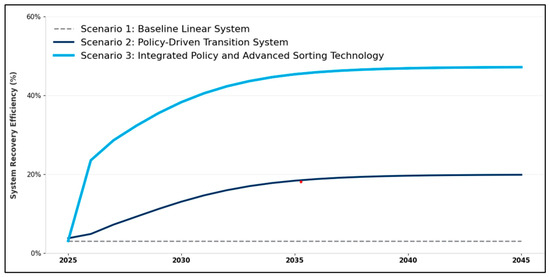
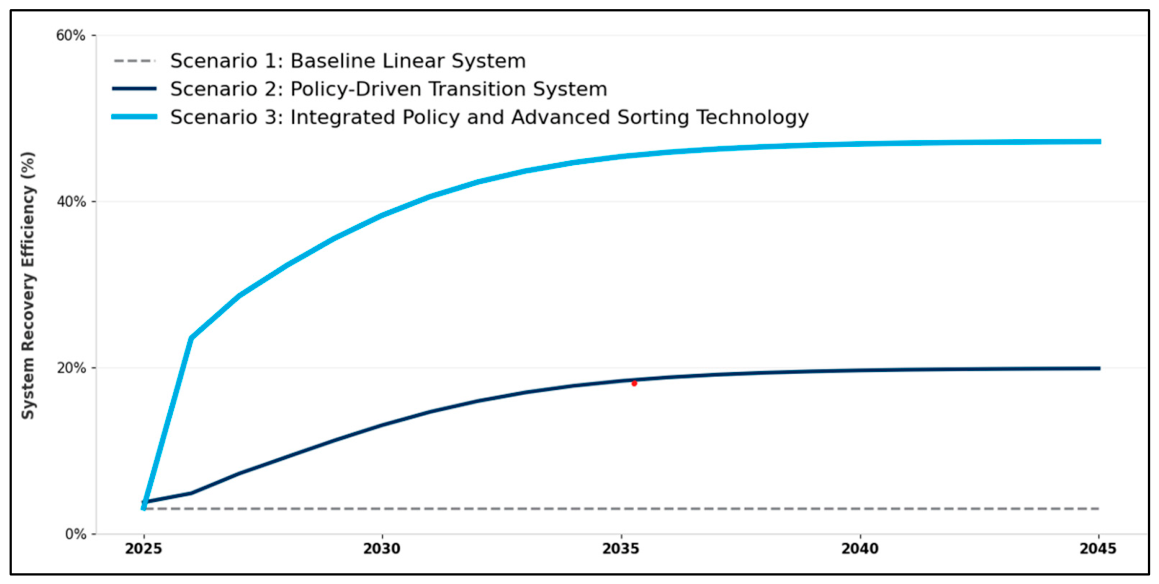
To examine how different configurations of policy and technology influence system-level performance over time, system recovery efficiency is used as the primary outcome indicator. This indicator reflects the proportion of generated plastic waste that is effectively recovered for recycling after accounting for behavioural participation in separation at source, contamination effects, and sorting performance within downstream infrastructure. The analysis compares three scenarios representing distinct stages in the evolution of urban plastic waste management systems, ranging from a baseline linear configuration to a fully integrated policy–technology circular system. A dynamic simulation framework is applied over the period 2025–2045 to capture the temporal effects of behavioural maturation and technological upgrading on recovery performance. Figure 1 presents the resulting trajectories of system recovery efficiency across the three scenarios.
Figure 1.
System Recovery Efficiency Trajectories under Alternative Urban Plastic Waste Management Scenarios (2025–2045).
The simulation begins with a uniform baseline in 2025, where all scenarios originate at a system efficiency of 3.14%, reflecting the current operational state in Bangkok. Under Scenario 1 (Baseline linear system), the model projects a stagnant trajectory, where the absence of policy or technical intervention results in no measurable efficiency gains over the twenty-year horizon. In contrast, the implementation of the separate-at-source policy in Scenario 2 facilitates a steady but limited upward trend, eventually reaching an efficiency of 20% by 2045. The simulation identifies 2026 as a pivotal transition year, marked by a systemic price shock through the enforcement of waste separation fees. This intervention triggers a sharp inflection in the participation rate, which accelerates from a negligible 5.7% in 2025 toward a long-term behavioural ceiling of 85% [20,21]. This result underscores that while source separation is a fundamental prerequisite for recovery, behavioural change alone is insufficient to achieve high-performance benchmarks.
The most significant divergence in system performance is observed in Scenario 3, where advanced sorting technology is integrated with policy enforcement. This scenario exhibits a rapid non-linear escalation in recovery, surpassing the 20% efficiency mark by 2027, attaining in two years what Scenario 2 requires two decades to achieve. By the 2045 milestone, Scenario 3 reaches a system efficiency of approximately 48%. The widening gap between Scenarios 2 and 3 illustrates a technology multiplier effect, where the purity of the waste stream provided by policy compliance allows automated sorting systems to operate at their optimal precision.
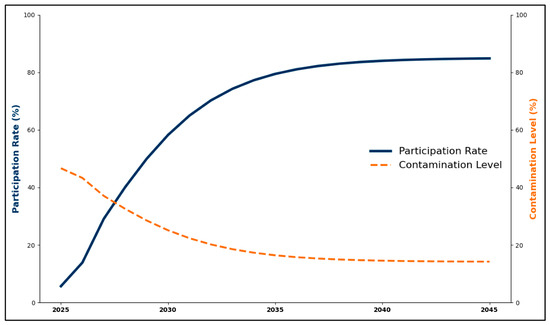
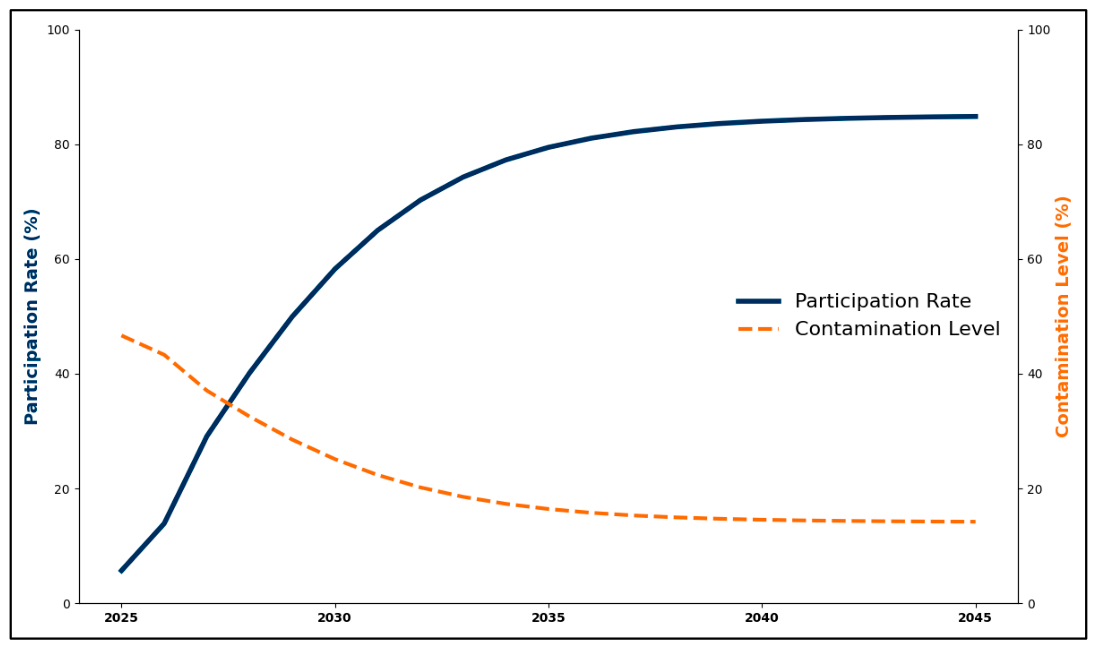
The underlying driver for these efficiency gains is the behavioural shift modelled in Figure 2. The participation rate follows a logistic growth curve, accelerating sharply between 2026 and 2035 before stabilizing at a ceiling of 85% by 2045. This increased participation directly correlates with a systemic reduction in the contamination level, which drops from an initial 49% in 2025 to approximately 15% by the end of the projection period. This reduction in contamination is critical, as it provides the high-purity input required for advanced sorting technologies to reach their optimal performance thresholds.
Figure 2.
Behavioural Participation and Waste Stream Contamination Dynamics (2025–2045).
2.2. Comparative Plastic Waste Fate Under Alternative Policy–Technology Scenarios (2025–2045)
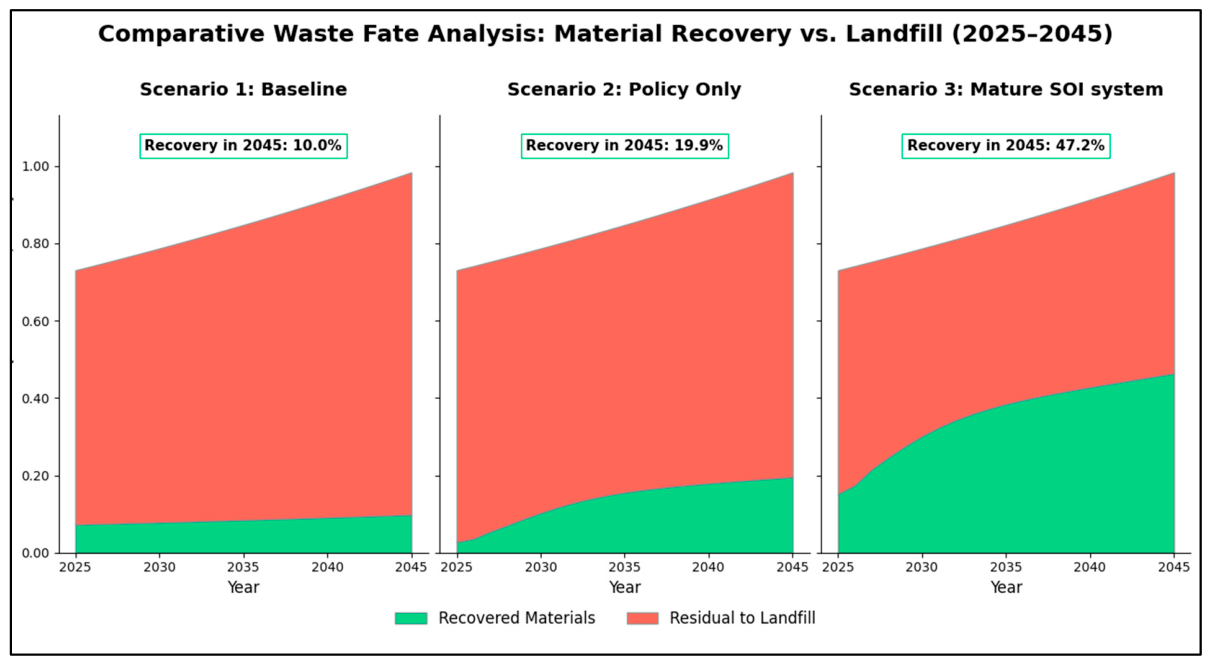
Figure 3 illustrates the projected fate of plastic waste under three alternative management scenarios from 2025 to 2045, distinguishing between recovered plastics and plastics disposed of in landfills. In all scenarios, total plastic waste generation increases over time, reflecting continued growth in plastic consumption. However, the allocation of plastic waste between recovery and landfill pathways varies markedly across scenarios.
Figure 3.
Comparative Analysis of Waste Fate Across Scenarios.
Under Scenario 1, plastic recovery remains limited throughout the analysis period. Recovery improves only marginally, reaching approximately 10.0% of total plastic waste by 2045, while the overwhelming majority of plastics continue to be landfilled. This trajectory indicates that without additional interventions, existing plastic waste management practices are unable to offset rising plastic waste generation or significantly improve material circularity.
In Scenario 2, the introduction of separation-at-source policies for plastics leads to a gradual increase in recovered plastic materials. Recovery reaches 19.9% by 2045, nearly doubling the status quo outcome. Nevertheless, landfill disposal remains the dominant fate of plastic waste, suggesting that behavioral and regulatory interventions alone are constrained by downstream inefficiencies, particularly contamination and limited sorting performance.
Scenario 3 shows a substantially different evolution of plastic waste flows. When separation-at-source policies are combined with advanced plastic sorting and recovery technologies, recovered plastics increase rapidly and consistently, reaching 47.2% by 2045. This integrated approach significantly reduces plastic landfill dependency despite ongoing growth in plastic waste generation, indicating a structural reconfiguration of the plastic waste management system.
Overall, the results demonstrate that plastic waste recovery is highly sensitive to the degree of policy–technology integration. While policy-only interventions yield moderate improvements, transformative gains in plastic circularity are achieved only when policy-driven behavioral change is reinforced by technological innovation across collection and sorting stages.
2.3. Uncertainty and Probabilistic Assessment of the Circular-Economy Transition
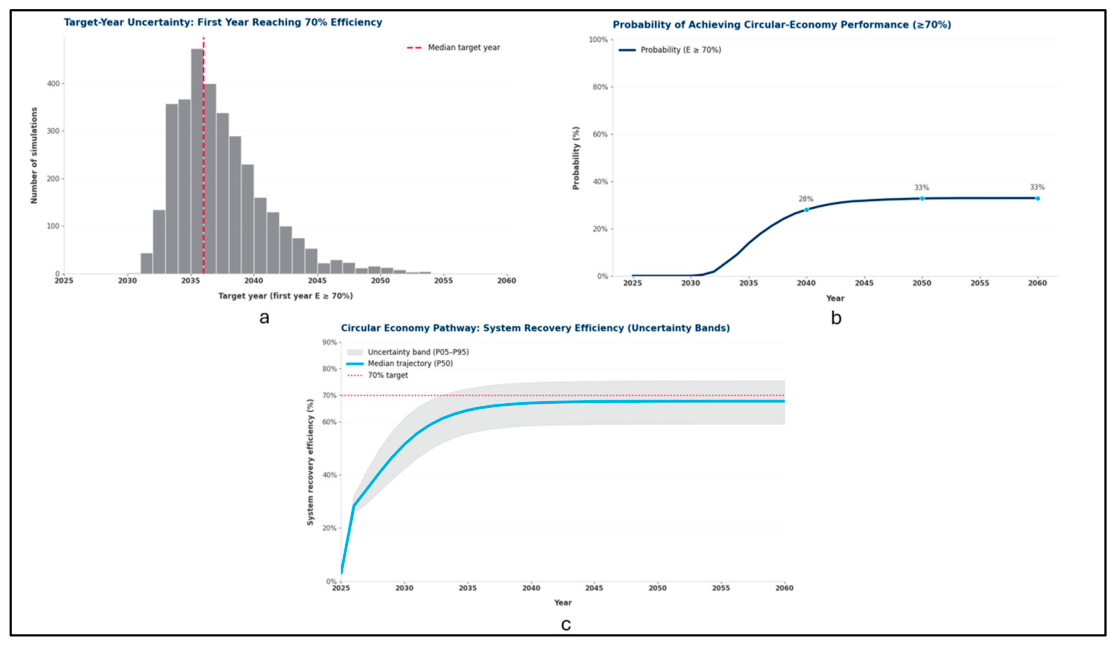
Figure 4a illustrates the distribution of the target year, defined as the first year in which system recovery efficiency reaches or exceeds 70% across Monte Carlo simulations. The distribution is concentrated primarily between the mid-2030s and early-2040s, with a median target year of approximately 2036, indicating that, conditional on eventual success, most system realisations achieve circular-economy-level performance within a relatively narrow temporal window following the maturation of behavioural participation.
Figure 4.
Uncertainty and Probabilistic Dynamics of Circular Economy Transition: (a) Target-Year Distribution for Achieving 70% Efficiency, (b) Probability of Reaching Circular Economy Threshold Over Time, and (c) System Recovery Efficiency Pathway with Uncertainty Bands.
Nevertheless, the distribution exhibits a pronounced right-hand tail extending into the 2040s and early 2050s, reflecting scenarios characterised by slower behavioural adoption, higher residual contamination, or weaker system performance. The presence of this tail underscores the sensitivity of transition timing to system parameters, particularly during the intermediate phase of policy rollout. Importantly, a non-trivial share of simulations does not reach the 70% threshold by 2060, reinforcing the probabilistic nature of the transition and the absence of deterministic convergence to circular-economy outcomes.
Figure 4b presents the year-wise probability that the urban plastic waste system attains circular-economy-level performance (≥70% recovery efficiency). The probability remains effectively zero throughout the early years of the analysis period, indicating that under no plausible combination of behavioural and technological conditions does the system reach the target prior to the early 2030s. From approximately 2033 onward, the probability increases rapidly, reflecting the accelerating effects of behavioural adoption and declining contamination embedded in the system dynamics.
By 2040, the probability of achieving the 70% threshold rises to approximately 28%, suggesting that fewer than one-third of simulated futures reach circular-economy performance within this timeframe. Thereafter, probability gains are modest, reaching around 33% by 2050 and remaining essentially unchanged through 2060. This plateau indicates that even under sustained policy implementation and advanced sorting assumptions, a substantial proportion of plausible futures fail to cross the 70% threshold within the analysis horizon. Achieving circular-economy performance therefore emerges not as an inevitable outcome, but as one contingent on favourable alignment between behavioural participation, contamination reduction, and system design.
Figure 4c shows the temporal evolution of system recovery efficiency under uncertainty, summarised using the 5th–95th percentile band and the median (50th percentile) trajectory. The median trajectory exhibits rapid early gains following policy implementation, with efficiency increasing sharply from the baseline level in the late 2020s and approaching a plateau by the mid-2030s. Despite this improvement, the median trajectory stabilises below the 70% target, reaching approximately 67–68% and remaining relatively flat thereafter.
The uncertainty band reveals substantial dispersion around the median, particularly during the transition phase between 2030 and 2040, when behavioural adoption and contamination reduction exert the strongest influence on system performance. While the upper bound of the uncertainty band exceeds the 70% threshold from the mid-2030s onward—indicating that circular-economy performance is achievable under favourable conditions—the lower bound remains well below the target throughout the period, highlighting the persistence of underperforming system configurations even in the long run.
Taken together, Figure 4a–c demonstrate that the transition to circular-economy-level recovery is fundamentally probabilistic rather than deterministic. Although policy implementation and advanced sorting technologies substantially improve system performance, they do not ensure convergence to recovery efficiencies above 70% across all plausible futures. Instead, the results point to a structurally constrained system in which behavioural ceilings and residual contamination constitute critical bottlenecks. These findings underscore that technological improvements alone are insufficient to guarantee circular-economy outcomes, and that system-level alignment between policy design, behavioural participation, and material quality is essential for achieving and sustaining high recovery performance.
2.4. Sensitivity Analysis
2.4.1. Sensitivity Attribution of System Uncertainty
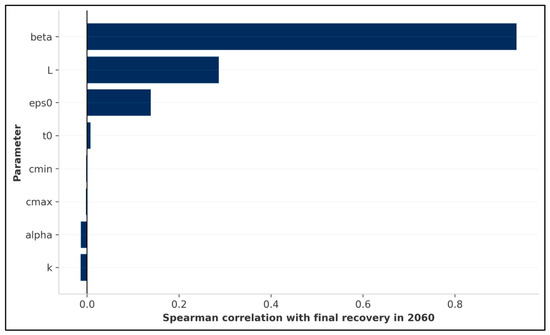
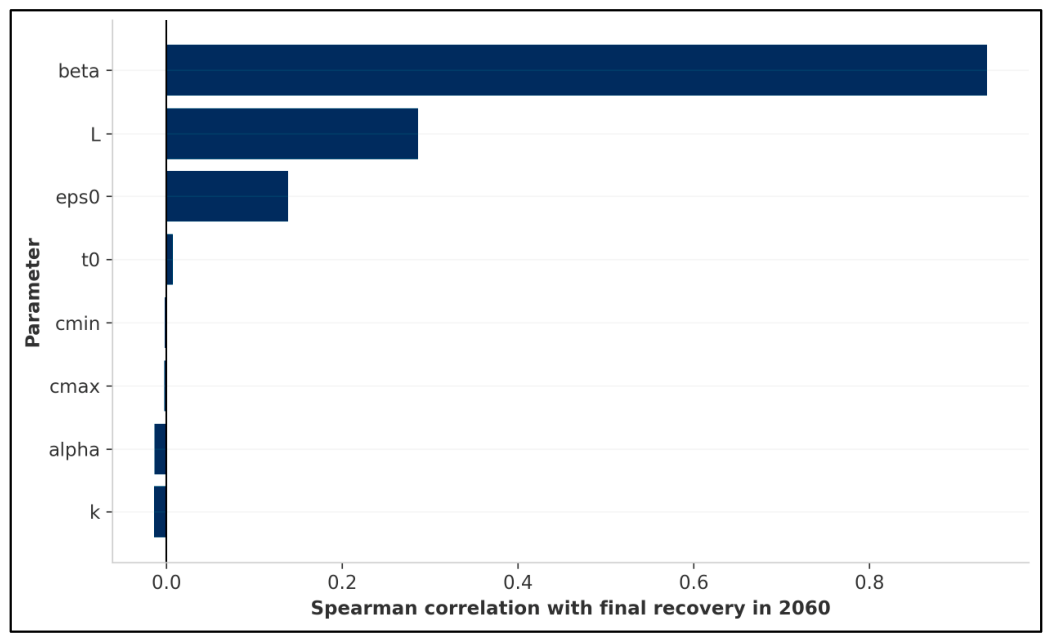
To identify the structural sources of system uncertainty and their relative contributions to final recovery performance, a Spearman rank correlation sensitivity attribution analysis was conducted across the 10,000 Monte Carlo simulations, relating each sampled parameter to system recovery efficiency in 2060. The resulting tornado diagram (Figure 5) reveals a clear hierarchy of parameter influence that carries direct implications for policy design.
Figure 5.
Spearman rank correlation sensitivity attribution of model parameters to system recovery efficiency in 2060.
The Spearman rank correlation analysis reveals a highly concentrated distribution of influence across model parameters, with system-level recovery potential emerging as the dominant determinant of final performance.
The maximum achievable recovery under circular-economy conditions (β, = 0.9) exerts by far the strongest positive influence on system recovery efficiency in 2060. This indicates that long-run system performance is fundamentally constrained by the upper bound of achievable recovery, confirming that structural system capacity is the primary determinant of outcomes rather than incremental improvements in individual subsystems.
Among the remaining parameters, the maximum participation ceiling (L, = 0.28) is the second most influential factor. This highlights the importance of sustained behavioural engagement, as higher long-run participation directly increases the proportion of material entering the recoverable stream. The maximum sorting efficiency of advanced technologies (ε0, = 0.14) contributes a positive but comparatively modest effect, indicating that technological improvements enhance system performance but do not dominate outcome variability.
Other parameters exhibit negligible or weak influence on final recovery efficiency. The adoption timing parameter (t0) shows near-zero correlation, suggesting that the specific timing of behavioural inflection has a limited impact on long-run outcomes. Similarly, contamination-related parameters ( contribute minimal explanatory power, while the contamination sensitivity of sorting technology (α, = −0.01) and the adoption speed parameter (, = −0.01) display small negative correlations, indicating marginal effects that slightly constrain system performance under certain parameter combinations.
Overall, the sensitivity structure demonstrates that final recovery efficiency is primarily governed by system-level capacity (β), followed by behavioural participation (), with technological performance playing a secondary role. These findings reinforce the interpretation that while advanced sorting technologies are necessary to enable high recovery rates, the realisation of system-wide performance gains depends more critically on achieving high participation levels and ensuring that the system is capable of operating near its theoretical recovery limits.
2.4.2. Sensitivity Analysis: Attribution of Transition Timing
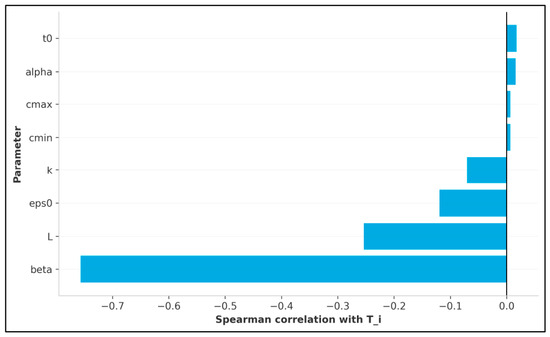
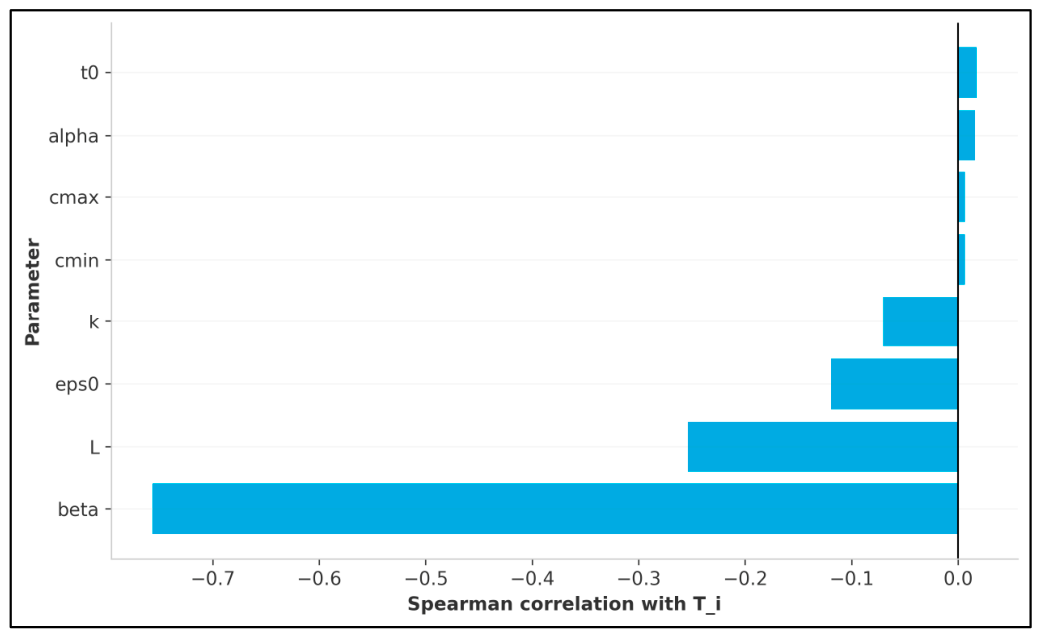
The sensitivity analysis of transition timing ( reveals a highly asymmetric distribution of parameter influence, with a small subset of variables dominating the timing of circular economy attainment; see Figure 6.
Figure 6.
Sensitivity Attribution of Model Parameters to Circular Economy Transition Timing.
The system-level recovery potential (β, ≈ −0.70) emerges as the overwhelmingly dominant determinant of transition timing. The strong negative correlation indicates that higher achievable recovery levels substantially accelerate the year in which the system first reaches the 70% threshold. This result highlights that the feasibility of achieving high recovery performance is a prerequisite for timely system transition, effectively acting as a structural boundary condition rather than a marginal driver.
Among behavioural parameters, the maximum participation ceiling (, ≈ −0.27) is the second most influential factor. Higher long-run participation enables earlier attainment of the threshold, confirming that sustained behavioural engagement is critical for accelerating system transition. The adoption speed parameter (, ≈ −0.08) and the maximum sorting efficiency (ε0, ≈ −0.12) exert comparatively modest but directionally consistent effects, indicating that faster behavioural uptake and improved technological performance can contribute to earlier transition, albeit to a lesser extent.
In contrast, the remaining parameters—including contamination bounds (, contamination sensitivity (α), and adoption timing midpoint (t0)—exhibit near-zero correlations with transition timing. This suggests that variations in these parameters do not materially influence when the system crosses the circular economy threshold, even though they may affect intermediate system dynamics.
Taken together, these findings indicate that transition timing is governed primarily by structural system capacity (β) and long-run behavioural participation (), while technological efficiency and adoption dynamics play secondary roles. From a policy perspective, this implies that accelerating the transition to a circular economy requires not only improving technological capabilities, but more critically, ensuring that the system is capable of reaching sufficiently high recovery levels and that behavioural participation can be sustained at scale.
2.5. Model Validation
To strengthen the internal validity of the modelling framework, extreme-scenario consistency testing was conducted to examine model behaviour under boundary parameter conditions, see Table 1. Given that the model is developed as a mechanistic, system-level representation rather than a predictive forecasting tool, validation focuses on whether the model produces logically consistent and physically meaningful outcomes when key parameters approach their limiting values. This approach is widely used in system modelling to verify structural correctness in the absence of fully calibrated empirical datasets.
Table 1.
Extreme-scenario consistency tests under boundary parameter conditions.
In this study, a set of boundary conditions was defined to verify the sensitivity of the system to extreme values of behavioural participation and contamination levels. These tests assess whether the model reproduces expected system responses, such as reversion to business-as-usual conditions under zero participation, performance improvement under high participation and degradation of sorting efficiency under high contamination. Together, these checks provide a transparent and systematic verification of the model’s internal logic and reinforce its credibility as a representation of coupled policy–technology dynamics in urban plastic waste systems.
3. Discussion
The modelling results support three theoretical propositions that extend the existing SOI framework. The first proposition that technological effectiveness is participation-conditional is demonstrated by the quantitative divergence between Scenarios 2 and 3, which shows that identical sorting infrastructure generates markedly different outcomes depending on the behavioural state of the upstream system. The second proposition—that coupled policy–technology systems exhibit threshold-dependent dynamics—is evidenced by the non-linear efficiency gains that emerge only after participation crosses the logistic inflection point, consistent with bifurcation behaviour in complex socio-technical systems. The third proposition that circular economy transitions are probabilistically bounded rather than deterministically convergent is demonstrated by the Monte Carlo results, which show that even under sustained policy and technology assumptions, only approximately 33% of simulated futures achieve circular-economy-level performance by 2060. Each of these propositions is discussed below in terms of its theoretical implications and its relationship to prior SOI and circular economy literature.
3.1. Policy–Technology Coupling as System-Level SOI
The comparative scenario analysis shows that separation-at-source policy alone delivers only incremental improvements, while the integration of policy with advanced sorting technology produces non-linear and accelerating system-level gains. This finding aligns with the core premise of SOI: sustainability outcomes emerge not from optimising individual components, but from reconfiguring interactions across socio-technical subsystems [3].
In Scenario 2, behavioural participation increases steadily following the introduction of the separate-at-source policy, yet recovery efficiency remains capped below 20% even after two decades. This outcome reflects a well-documented limitation of policy-only approaches, where improvements in material quality at the source are constrained by legacy downstream infrastructure [22]. In contrast, Scenario 3 demonstrates a technology multiplier effect, whereby improvements in waste stream purity unlock the latent performance potential of advanced sorting systems [5]. The rapid divergence between Scenarios 2 and 3 highlights that technology effectiveness is conditional, not absolute, and depends critically on upstream behavioural compliance.
3.2. Behavioural Dynamics and Participation Thresholds
A key contribution of this study is the explicit modelling of time-dependent behavioural adoption and its implications for system performance. The logistic participation trajectory (Equation (2)) shows that early-stage policy impacts are inherently limited, with substantial efficiency gains emerging only after a critical mass of participation is reached. This dynamic helps explain why separation-at-source policies often appear ineffective in their initial years [23]. The results further indicate that minimum participation thresholds are required before advanced sorting technologies can operate near their design efficiency. Below this threshold, contamination levels (Equation (4)) remain sufficiently high to suppress sorting performance, even under advanced technological conditions (Equation (5)) [6].
More specifically, the model identifies an inflection region at approximately 40–50% participation, beyond which system efficiency improves rapidly and non-linearly. Below this range, improvements in recovery remain modest because input material quality has not yet reached the purity level required for automated systems to function effectively. This inflection point therefore acts as a system-level leverage point, where small increases in participation yield disproportionately large improvements in overall performance.
While the model does not explicitly represent policy instruments, these dynamics imply that maintaining participation growth through the low-gain phase is critical. This phase is characterised by limited visible returns despite increasing effort, creating a risk of stagnation before the threshold is reached. In this context, policy instruments such as enforcement, economic incentives, or sustained information provision can be interpreted as mechanisms that support continued progression along the adoption trajectory. Weak or inconsistent policy implementation risks locking the system into a suboptimal equilibrium, not because of technological limitations, but due to insufficient behavioural adoption.
A further implication concerns the sequencing and synchronisation of interventions. The model shows that deploying advanced sorting infrastructure before participation surpasses the inflection threshold would expose the system to persistently high contamination levels (Equation (4)), thereby constraining achievable sorting efficiency (Equation (5)) and reducing the effectiveness of capital investment. Conversely, sustained behavioural policies that drive participation beyond this threshold create the input conditions necessary for advanced technologies to operate at their intended performance levels, producing the technology multiplier effect observed in Scenario 3. These findings indicate that behavioural and technological interventions are not substitutes but sequentially interdependent, and the model provides a quantitative basis for identifying when infrastructure deployment becomes strategically effective.
It is important to note that the logistic participation function captures aggregate behavioural diffusion across a uniform population, necessarily abstracting from heterogeneity in compliance behaviour across income groups, residential densities, and information environments. In practice, participation trajectories may vary significantly across urban subpopulations, and the aggregate ceiling of L = 0.85 may mask substantial variation at the neighbourhood or household level. The implications of this abstraction for the threshold mechanism are discussed further in Section 6, and future work incorporating spatially disaggregated or agent-based behavioural representations would enrich the analytical framework developed here.
3.3. Contamination as a Coupling Variable Between Policy and Technology
The identification of contamination as the critical coupling variable between upstream behavioural policy and downstream sorting performance is not solely a product of the model’s internal logic—it is consistent with a substantial body of empirical evidence from operational waste management systems across multiple urban contexts. At the facility level, studies of material recovery facilities in both single-stream and source-separated collection systems have consistently demonstrated that inbound contamination rates exert a direct and measurable effect on sorting efficiency and recovered material quality. Eriksen and Astrup [24] showed empirically that source-separated collection systems achieve inbound contamination rates in the low single-digit range, substantially below those of mixed-stream systems, and that this difference translates directly into improved downstream recovery performance—a relationship that the contamination function in Equation (4) is explicitly calibrated to reflect. Similarly, Damgacioglu et al. [25] documented the outbound contamination dynamics of a large-scale material recovery facility in Florida, providing facility-level evidence that input stream purity is a primary determinant of recovery yield. Across a different urban context, Gadaleta et al. [26] assessed sorting efficiency in an Italian facility and reported that performance degradation under high-contamination conditions is consistent across both conventional and upgraded sorting configurations—a finding directly analogous to the differential sensitivity parameters (α = 0.6 versus α = 0.35) used to distinguish conventional and advanced sorting in Equation (5) of the present study. The empirical basis for contamination as a coupling mechanism therefore extends beyond any single system or modelling framework, and the present study’s formalisation of this relationship can be understood as a quantitative abstraction of a consistently observed real-world dynamic rather than a model-dependent assumption.
The dependency of sorting performance on input material quality is explicitly represented in the model structure through the contamination–efficiency relationship (Equation (5)). Substituting the BAU contamination level ( = 0.49) into the advanced sorting configuration (ε0 = 0.93, α = 0.35) yields a sorting efficiency of approximately 0.758, representing an 18.5 percentage point reduction from the theoretical maximum attributable solely to feedstock quality rather than intrinsic technological limitations.
This result can be interpreted in relation to the ~47% system recovery achieved under Scenario 3 by 2045. The improvement does not arise from the advanced sorting parameters in isolation, but from their interaction with progressively reduced contamination levels (approximately 15%) driven by behavioural participation. Under identical technological conditions but with BAU contamination, the model produces substantially lower recovery outcomes, indicating that system performance is constrained by upstream material quality rather than processing capacity.
This comparison demonstrates that, within the model, sorting technology and input material quality operate as complementary system components. Technological upgrading alone cannot offset high contamination levels, while behavioural improvements alone remain bounded by the efficiency limits of conventional sorting systems. High recovery performance is achieved only when both conditions improve concurrently. The model therefore provides a mechanistic basis for prioritising coordinated policy–technology deployment, as the misalignment between upstream participation and downstream capability leads to measurable losses in system efficiency.
3.4. Temporal Dynamics and Feasibility of Circular Economy Targets
The median recovery trajectory stabilising at approximately 67–68% (Figure 4c) reveals a structural ceiling inherent to the modelled system, arising from two compounding constraints that persist across the Monte Carlo parameter space. The first is the behavioural saturation limit embedded in the logistic participation function (L = 0.85, Equation (2)), which caps the proportion of waste generators that can realistically be brought into compliance under sustained policy enforcement. The second is the residual contamination floor that remains even at maximum participation, which continues to exert a modest but non-negligible drag on sorting efficiency through Equation (5). Together, these constraints define an upper performance boundary that cannot be breached through incremental improvements to either behavioural policy or sorting technology within the current system configuration.
The probabilistic analysis reinforces this interpretation. Crossing the 70% recovery threshold emerges not as an inevitable consequence of sustained policy implementation and technological upgrading, but as a contingent outcome dependent on the simultaneous and favourable alignment of participation, contamination, and sorting performance dynamics. The Monte Carlo results show that only approximately 33% of simulated futures achieve circular-economy-level performance by 2060, with the remaining trajectories constrained by plausible but unfavourable parameter combinations that prevent the system from escaping its structural ceiling. Bangkok’s transition to a circular economy for plastic waste must therefore be understood as a probabilistic evolution rather than a deterministic progression—one whose success depends not on any single intervention but on the sustained co-evolution of the three coupled variables that jointly govern system recovery efficiency in the framework developed here.
4. Materials and Methods
4.1. System Description and Integration of SOI in the Bangkok Metropolitan Area
The current plastic waste management system in Bangkok operates predominantly as a linear system, reflecting a throwaway consumption pattern in which plastic materials move from production and use to disposal, collection, and final treatment, with limited material recovery or reintegration into productive use [27]. To enable a circular economy for plastic waste, SOI must be applied to reconfigure the existing linear waste management system rather than merely optimise individual stages.
In this study, SOI is operationalised through the strategic coupling of policy and technology at critical points of the waste management chain, thereby transforming the system’s structure and function. Specifically, the separation-at-source policy is introduced at the disposal stage, where waste is generated and initially discarded by households. By intervening at this upstream stage, the policy alters disposal behaviour, increasing participation in source separation and reducing the degree of material mixing. This behavioural intervention is essential for improving the quality of plastic waste streams before they enter downstream processes.
At the downstream end of the system, advanced sorting technologies are applied at the final treatment stage, where collected waste is processed for recycling or disposal. These technologies including automated, sensor-based, or AI-assisted sorting systems exhibit higher recovery potential than conventional manual sorting but are highly sensitive to input material quality. Their effective operation therefore depends on the success of upstream separation at source. In this configuration, technology does not act as a standalone solution but as a complementary innovation whose performance is enabled by policy-driven behavioural change.
4.2. Scenario Design
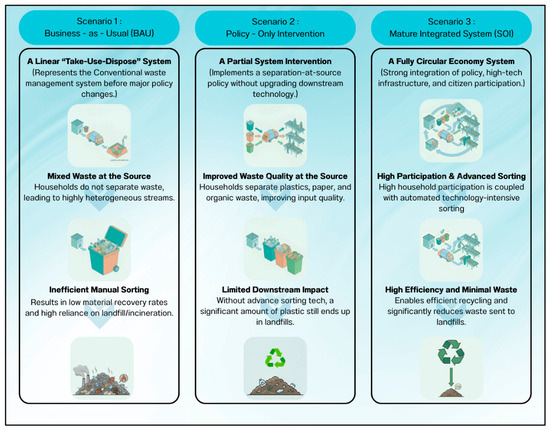
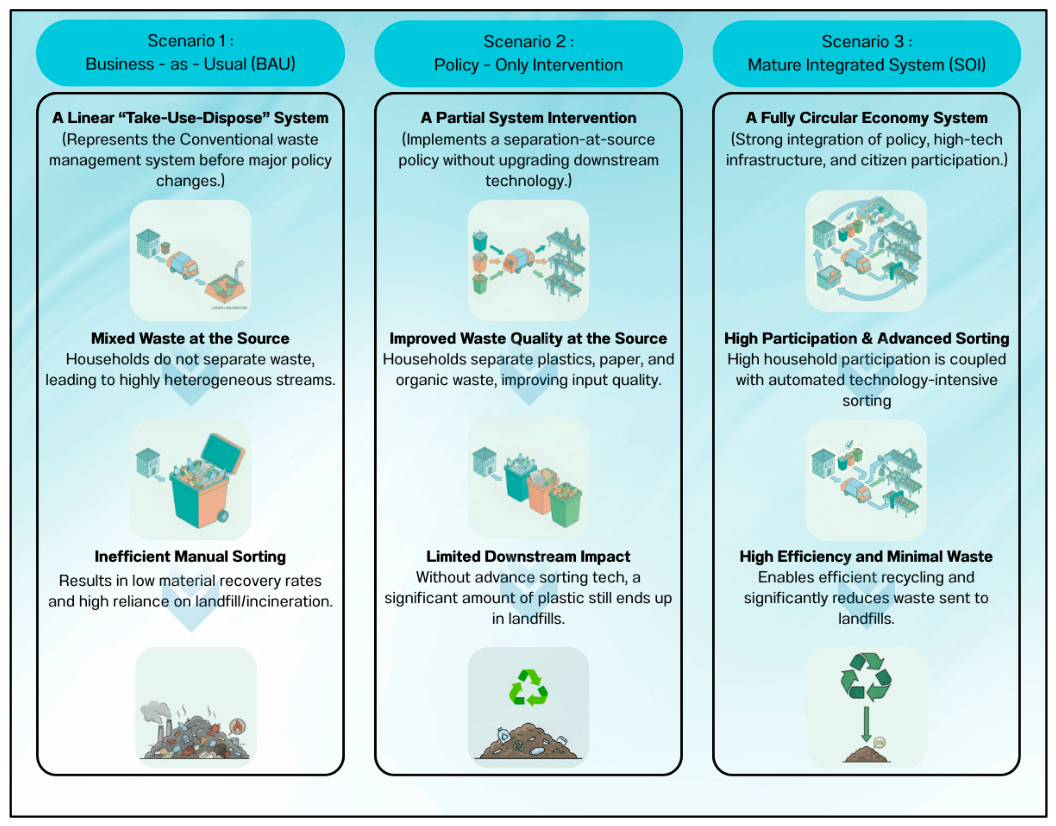
Since 2025, Bangkok has introduced the separation-at-source policy as an upstream intervention in plastic waste management [7]. However, policy implementation in isolation is unlikely to achieve substantial improvements in system recovery efficiency, as downstream processing remains constrained by contamination and limited sorting capability. Effective system transformation requires the integration of policy instruments with innovations in sorting technologies and operational system design. In this study, such a system-level configuration is conceptualised as SOI, as illustrated in Figure 7. Accordingly, three development scenarios are defined to represent the evolution of Bangkok’s plastic waste management system under different levels of SOI integration.
Figure 7.
Comparative Analysis of Plastic Waste Management Pathways: Transitioning from Linear Systems to Mature SOI.
- Scenario 1: Business-as-Usual (BAU)—Linear Waste Management System
This scenario represents Bangkok’s conventional plastic waste management system prior to the implementation of separation-at-source policy. Plastic waste flows through a largely linear pathway from consumption to disposal, where household waste is predominantly mixed at the point of disposal [27]. As a result, downstream collection and treatment systems receive highly heterogeneous waste streams. Sorting is primarily manual and limited in effectiveness, leading to low material recovery rates and a high reliance on landfill and incineration [2]. In this configuration, system performance is constrained by poor input quality, fragmented operations, and minimal feedback between stages, reflecting a linear take–use–dispose model with limited circularity.
- Scenario 2: Separation-at-Source Policy Only—Partial System Intervention
This scenario reflects the implementation of the separation-at-source policy without complementary technological upgrading in downstream treatment facilities. Households are required to separate waste into basic categories (e.g., plastics, paper, organic waste), improving source-level sorting and reducing material mixing relative to the BAU scenario. The policy intervention is operationalised through a systemic price signal, specifically the introduction of a waste separation fee applied to mixed waste disposal. This economic instrument increases the relative cost of non-separated waste, creating a behavioural incentive for households to adopt and sustain source separation practices. As a result, participation rates increase over time, accompanied by a reduction in contamination levels in the collected waste stream. However, downstream processing remains largely unchanged, relying on conventional collection logistics and manual or semi-mechanical sorting. Although the quality of incoming plastic waste improves, the absence of advanced sorting technologies limits recovery efficiency and system scalability [28]. Consequently, a significant proportion of separated plastics still leaks into landfill or incineration, indicating that policy intervention alone is insufficient to fully reconfigure the system.
- Scenario 3: Mature SOI Scenario—High Participation with Technology-Intensive Sorting System
This scenario represents a mature SOI configuration, characterised by strong coupling between policy instruments, technological infrastructure, and system design. Household participation in source separation is high, driven by consistent policy enforcement, behavioural incentives, and supporting information systems.
The waste management system operates with technology-intensive sorting processes, including advanced automated sorting, digital monitoring, and optimised material flow management. Manual sorting plays a complementary role, focusing on quality control rather than primary separation. High-quality separated plastic streams enable efficient downstream recycling and significantly reduce residual waste sent to landfill or energy recovery. This scenario reflects a circular economy-oriented system and provides the upper-bound performance benchmark for system-level evaluation.
4.3. Model Development and Assumption
After defining the three evolutionary scenarios of plastic waste management, a suite of interconnected system models was developed to quantify system dynamics and performance. The modelling framework comprises a waste generation model to estimate plastic waste flows, a behavioural model to represent household participation in separation-at-source, and process models describing effective recycling rates as a function of contamination and sorting efficiency. These components are integrated to simulate how upstream behavioural change and downstream technological capability jointly determine material recovery and system-level outcomes. In addition, the models were developed to find the minimum participation threshold and the time required for the coupled policy–technology system to achieve a circular-economy-relevant level of performance, defined in terms of system-level plastic recovery efficiency. The key model parameters and the values adopted in this study are presented in Table 2.
4.3.1. Waste Generation Model
Annual plastic waste generation is modelled using an exponential growth function, which captures the cumulative effects of population growth, consumption patterns, and urbanisation over time:
where denotes the quantity of plastic waste generated in year represents the baseline plastic waste generation at the start of the analysis period. is the annual growth rate.
In this study, = 2025, and the baseline waste generation is set to = 730,000 tons per year [29], reflecting current urban plastic waste levels. The growth rate is assumed to be = 0.02, consistent with observed trends in plastic consumption and waste generation in rapidly urbanising metropolitan areas [30].
4.3.2. Behavioural Adoption and System Performance Formulation
The impact of the separation-at-source policy is represented using a behavioural adoption model that captures gradual uptake over time rather than instantaneous compliance. Participation in source separation is modelled using a shifted logistic function, which allows participation to evolve from an initial level toward an upper saturation limit.
where denotes the proportion of households (or waste generators) participating in separation at source in year . The initial condition is defined at the beginning of the analysis period = 2025 and is set to 6% [31,32]. The upper limit represents the maximum participation level achievable under sustained policy enforcement and supporting infrastructure, set to 85% [20,21]. This value is not derived from a single source but from a synthesis of empirical behavioural evidence and modelling considerations. Existing studies indicate that household waste separation participation typically ranges between 70% and 90% under favourable conditions [21], with levels approaching 85% when systems are perceived as highly convenient [20]. Accordingly, 85% is adopted as an optimistic yet plausible upper bound within this range. This parameter reflects behavioural saturation rather than full compliance, recognising persistent behavioural heterogeneity and system constraints. The parameter determines the adoption speed, governing how quickly approaches over time; is set to 0.35 [33]. The logistic term ensures a gradual transition from the initial participation level toward the saturation level, with the fastest adoption occurring around the mid-point of the implementation period. This shifted logistic formulation captures empirically observed behavioural diffusion patterns in environmental policy adoption, characterised by slow initial uptake, accelerated growth during the implementation phase, and eventual saturation. This representation is supported by Tews et al. (2003), who observed that environmental policy instruments often exhibit such non-linear patterns, where a pioneer phase of low adoption is followed by rapid expansion as the policy matures and institutional barriers are overcome [23]. By explicitly representing partial and time-dependent compliance, the model avoids assuming immediate or universal participation and provides a realistic representation of behavioural dynamics in urban waste systems.
The key performance variable is the effective recycling rate, which increases as participation in separation at source rises. The effective recycling rate is defined as
where denotes the effective recycling rate in year; is the baseline recycling rate under business-as-usual conditions, set to 0.2. This value is consistent with the World Bank material flow analysis for Thailand, which estimates the national plastic recycling rate at approximately 19–22% under current collection and sorting conditions [34]; represents the achievable recycling rate under full policy compliance and system readiness, set to 0.5. This value reflects the achievable recycling rate reported under well-functioning source separation systems in comparable middle-income urban contexts, consistent with recovery rates documented in regional circular economy assessments [35]; and is the participation share in separation at source, as defined in Equation (2).
4.3.3. Material Quality and Technology Coupling
Separation at source influences not only the quantity of plastic recovered for recycling, but also the quality of plastic waste streams entering sorting facilities. Input material quality is represented through a contamination parameter, which is modelled as a function of behavioural participation:
where denotes the contamination level of plastic waste in year ; = 0.49 represents contamination under mixed-waste, business-as-usual conditions [36]. This value is drawn from waste composition analyses of Bangkok’s municipal solid waste stream, in which plastic fractions are predominantly collected in mixed household waste with organic and residual fractions, producing inbound contamination rates in the range of 40–60% at sorting facilities; and represents contamination achievable under effective separation at source and is set to 0.08 [25,37]. This value is consistent with empirical evidence from source-separated or dual-stream recycling systems, which typically report inbound contamination rates in the low single-digit range (≈3–6%), substantially lower than mixed or single-stream systems [38]. The participation level is defined as in Equation (2).
Sorting performance is modelled as a function of input material contamination from Equation (3), reflecting the dependence of recovery efficiency on waste quality entering sorting facilities. Sorting efficiency in year is defined as:
where denotes the sorting efficiency; represents the maximum achievable sorting efficiency under ideal (low-contamination) conditions; captures the sensitivity of sorting performance to contamination; is the contamination level of the incoming plastic waste stream as defined in Equation (4).
Two sorting technology configurations are represented to reflect different stages of system development. Conventional sorting is characterised by predominantly manual or low-automation processes, with = 0.8 and = 0.6 [5]. These values reflect the performance characteristics of predominantly manual or semi-mechanised sorting operations, where higher sensitivity to contamination results in substantially greater efficiency loss as input stream purity declines. Advanced sorting represents sensor-based, automated, or AI-assisted systems characterised by a higher maximum efficiency ( = 0.93) and lower sensitivity to contamination ( = 0.35) [26]. The maximum efficiency parameter is consistent with sorting performance reported for near-infrared and AI-assisted systems under low-contamination conditions in operational facilities, while the contamination sensitivity parameter reflects the empirically observed reduction in performance degradation relative to manual sorting systems [6,26].
These parameterisations reflect the empirical observation that advanced sorting technologies achieve higher baseline recovery rates and exhibit lower sensitivity to contamination than conventional manual sorting. By explicitly modelling this dependence, the framework captures how improvements in upstream waste quality condition the effectiveness of downstream technological interventions.
4.3.4. Mass Balance and System Performance
System-level plastic recovery is calculated using a mass-balance formulation that integrates waste generation, behavioural participation, and sorting performance. The quantity of plastic recovered for recycling in year t.
where denotes the recovered plastic (tons/year), represents sorting efficiency, is effective recycling rate and is the total plastic waste generated in year .
Residual plastic waste not recovered for recycling is calculated as:
To facilitate comparison across scenarios and time, system efficiency is defined as the fraction of generated plastic effectively recovered for recycling:
Table 2.
The key model parameters and the values adopted in this study.
4.4. Model Verification and Validation
Model verification and validation were conducted using a structured approach to ensure the internal consistency, logical coherence, and robustness of the modelling framework. Given that the model is developed as a mechanistic, system-level representation rather than a predictive forecasting tool, validation focuses on structural correctness and consistency with established relationships in the literature, rather than empirical calibration against observed data.
First, structural verification was performed to confirm that the model formulation is internally consistent. All key variables were verified to remain within physically meaningful bounds (i.e., participation, contamination, sorting efficiency, and recovery constrained between 0 and 1) across the full simulation horizon.
Second, conceptual validity was established through the use of parameter values and functional relationships derived from the literature. The model integrates well-established formulations, including logistic behavioural adoption, contamination-dependent sorting efficiency, and recovery performance relationships, ensuring that each component reflects empirically supported system behaviour.
Third, sensitivity and uncertainty analyses were conducted to evaluate the robustness of model outcomes under parameter variability. Monte Carlo simulation was employed to explore a wide range of plausible parameter combinations, and Spearman rank correlation sensitivity attribution was used to decompose output variance by parameter and system domain, as described in Section 4.5.3.
Finally, extreme-scenario consistency testing was conducted under boundary parameter conditions to verify model behaviour when key variables approach their limiting values. The results confirm that the model reproduces expected system responses and remains stable across all tested conditions, demonstrating that outputs are driven by structurally consistent relationships rather than arbitrary numerical behaviour.
Collectively, these validation steps establish the credibility of the model as a mechanistic analytical framework for analysing coupled policy–technology dynamics in urban plastic waste systems.
4.5. Monte Carlo Sensitivity Analysis
To evaluate the robustness of the circular-economy recovery pathway under deep uncertainty in behavioural and technological conditions, a Monte Carlo sensitivity analysis was performed over the period 2025–2060. The analysis propagates uncertainty in behavioural participation, contamination dynamics, and advanced sorting performance through the system recovery efficiency model, generating probabilistic rather than deterministic estimates of the timing of achieving a circular-economy performance threshold and the range of feasible efficiency trajectories.
4.5.1. Uncertainty Specification and Sampling Design
Uncertainty in key behavioural and technological parameters was represented using triangular distributions characterised by a lower bound, most-likely (mode) value, and upper bound. This choice is appropriate when parameter values are bounded or policy targets are available, but long-term empirical data are limited. In each Monte Carlo run , a parameter vector was sampled from the specified distributions and used to simulate the complete efficiency trajectory .
A total of 10,000 simulations were executed, which provides stable estimates of percentile bands and probability metrics for long-horizon system trajectories. A fixed random seed was applied to ensure full reproducibility of the stochastic analysis.
4.5.2. Performance Threshold Metrics
A circular-economy performance threshold was operationalised as achieving system recovery efficiency [39]. This threshold was supported by material flow modelling studies suggesting that recovery rates approaching approximately 70% were technically achievable under optimised circular systems [40,41]. Moreover, empirical evidence from advanced waste management systems and policy benchmarks demonstrated that recovery levels around this range are attainable, making it a realistic yet ambitious proxy for high circular performance [39]. For each simulation, the target year was defined as the first year in which the efficiency trajectory crosses the threshold
If the threshold was not reached by 2060, the run was classified as not achieved within the horizon. This permits direct estimation of the probability of reaching circular-economy performance by specific milestone years.
4.5.3. Sensitivity Attribution Analysis
To identify the relative contributions of individual parameters to system outcome variance and to decompose uncertainty into behavioural, system-level, and technological sources, a Spearman rank correlation sensitivity attribution analysis was conducted across the full set of Monte Carlo simulations. For each parameter, Spearman’s rank correlation coefficient () was computed against two output metrics: final system recovery efficiency in 2060 and the target year. Spearman’s rank correlation was selected over Pearson’s correlation because it is robust to non-linear relationships between inputs and outputs, which are expected given the logistic and multiplicative structure of the model equations.
The analysis was performed across all 10,000 Monte Carlo simulations, providing stable and statistically reliable sensitivity estimates. Parameters were subsequently classified into three analytically distinct groups to enable decomposition of uncertainty contributions by system domain: system-level structural parameters (), behavioural parameters (, , t0), and technological parameters (ε0, α, , Results are presented as tornado diagrams showing parameters ranked by absolute correlation magnitude against each output metric, enabling direct identification of the dominant sources of outcome uncertainty and the leverage points of greatest relevance for policy intervention.
5. Conclusions
This study advances operational understanding in urban plastic waste management systems by employing SOI and demonstrating that circular economy transitions are not achieved through policy or technology in isolation, but through their deliberate coupling within a system-level socio-technical framework. Using Bangkok as a representative large metropolitan case, the modelling results show that a separation-at-source policy alone produces only modest and slow improvements, as behavioural gains remain constrained by downstream technological capacity. In contrast, integrating behavioural policy with advanced sorting technologies generates non-linear system responses, accelerating recovery performance and enabling a functional shift away from linear, end-of-pipe waste management.
By explicitly modelling behavioural adoption dynamics, contamination effects, and sorting efficiency within a mass-balance framework, the study reveals that technological performance is conditional on upstream compliance and material quality. Contamination reduction emerges as the critical mechanism through which policy influences technological effectiveness, highlighting that improvements in waste quality are as important as infrastructure investment in achieving circularity. The results further demonstrate that participation thresholds and temporal persistence are central to system transformation, explaining why many urban waste policies appear ineffective in their early years and emphasising the risks of unsynchronised policy and infrastructure deployment.
The findings also underscore the value of system-level modelling for evaluating sustainability transitions in complex urban systems. The framework captures feedback loops, non-linearities, and sequencing effects that are invisible in single-stage or technology-centric analyses, providing a structured basis for designing coordinated intervention pathways. While the model is based on stylised assumptions and abstracted from economic and institutional constraints, it offers a robust analytical foundation for understanding how policy–technology coupling functions as SOI in practice.
Beyond the Bangkok context, the analytical framework developed here yields three transferable theoretical propositions for the study of SOI in coupled socio-technical systems. First, technological effectiveness is conditional on upstream behavioural compliance mediated through material quality. Second, system dynamics exhibit participation-dependent bifurcation thresholds, beyond which rapid performance gains emerge. Third, system-level transitions toward circular economy outcomes are probabilistically bounded rather than deterministically achieved. These properties are not specific to the Bangkok case but reflect structural characteristics of systems in which downstream technological performance depends on upstream behavioural inputs. As such, the framework provides a basis for extending SOI analysis beyond waste management to other domains—including water treatment, energy transitions, and sustainable agriculture—where similar policy–behaviour–technology interdependencies shape system outcomes.
Overall, the study reinforces a central implication for urban waste governance: Achieving high plastic recovery rates requires sustained integration of behavioural policy, technological capability, and system design over time. The modelling framework demonstrates that these elements are not independently effective but mutually conditioning—behavioural participation determines contamination, contamination conditions sorting performance, and sorting performance determines whether infrastructure investment generates returns commensurate with its cost. Rather than pursuing isolated solutions, cities seeking circular economy outcomes should adopt an SOI approach that aligns upstream behavioural policy with downstream sorting infrastructure, and that sequences these investments in accordance with the participation and contamination thresholds identified in this analysis.
6. Limitations and Future Research Directions
While the modelling framework provides valuable insights, several limitations should be acknowledged. First, the analysis relies on parameter values drawn from literature and policy reports rather than city-specific empirical datasets, which may affect quantitative precision. Second, the model abstracts from economic costs, institutional capacity constraints, and informal sector dynamics, all of which play important roles in Bangkok’s waste system. Third, the study does not explicitly include a technology-only scenario. While such a scenario could isolate the effects of downstream technological upgrading, its omission reflects the study’s focus on SOI, which emphasises the integration of behavioural and technological interventions.
Furthermore, the representation of behavioural dynamics in this study relies on a single aggregate logistic function, which abstracts from spatial heterogeneity, socio-economic differences, and policy feedback mechanisms observed in real-world systems. In practice, participation rates may vary significantly across income groups, neighbourhood characteristics, and information environments. As such, the model may overestimate the uniformity and speed of behavioural adoption under policy interventions. However, this simplification is intentional, as it enables a clear examination of system-level interactions between behavioural participation, contamination dynamics, and technological performance.
Future research could extend this work by incorporating cost–benefit analysis, spatial heterogeneity, and agent-based representations of household behaviour to better capture system complexity. Empirical calibration using operational data from Bangkok’s sorting facilities would further enhance the validity and contextual relevance of the model.
In addition, the framework could be extended to evaluate the independent contribution of technological interventions under varying contamination conditions. As more detailed operational data become available, future studies will enable empirical calibration and support further refinement and validation of the model.
Despite these limitations, the present study provides a robust conceptual and analytical foundation for understanding how policy–technology coupling functions SOI in urban plastic waste management.
Funding
This research received no external funding.
Data Availability Statement
The raw data supporting the conclusions of this article will be made available by the author, without undue reservation.
Acknowledgments
The author acknowledges the use of an AI-based language tool (ChatGPT 5.2, OpenAI) for improving the clarity and readability of the manuscript.
Conflicts of Interest
The author declares no conflicts of interest.
References
- Akenji, L.; Bengtsson, M.; Hotta, Y.; Kato, M.; Hengesbaugh, M. Policy responses to plastic pollution in Asia: Summary of a regional gap analysis. Plast. Waste Recycl. 2020, 2, 531–567. [Google Scholar] [CrossRef] [Scilit]
- Nurhanifah, A.; Hotimah, O.; Agustine, E.A.; Febianto, B. THE PLASTIC WASTE CRISIS IN INDONESIA AND THAILAND: CHALLENGES, ENVIRONMENTAL IMPACTS, AND SUSTAINABLE SOLUTIONS. Multidiscip. Indones. Cent. J. (MICJO) 2025, 2, 2836–2843. [Google Scholar] [CrossRef] [Scilit]
- Adams, R.; Jeanrenaud, S.; Bessant, J.; Denyer, D.; Overy, P. Sustainability-oriented innovation: A systematic review. Int. J. Manag. Rev. 2016, 18, 180–205. [Google Scholar] [CrossRef] [Scilit]
- Klewitz, J.; Hansen, E.G. Sustainability-oriented innovation of SMEs: A systematic review. J. Clean. Prod. 2014, 65, 57–75. [Google Scholar] [CrossRef] [Scilit]
- Taneepanichskul, N.; Purkiss, D.; Miodownik, M. A review of sorting and separating technologies suitable for compostable and biodegradable plastic packaging. Front. Sustain. 2022, 3, 901885. [Google Scholar] [CrossRef] [Scilit]
- Taneepanichskul, N.; Miodownik, M.; Hailes, H.C. Using hyperspectral imaging and machine learning to identify food-contaminated compostable and recyclable plastics. UCL Open Environ. 2025, 7, e3237. [Google Scholar] [CrossRef] [Scilit]
- BMA. No-Mix Waste at Home Campaign Separate Your Waste, Pay Less Fees. 2025. Available online: https://greener.bangkok.go.th/en/the-house-is-not-yours/ (accessed on 2 December 2025).
- Taneepanichskul, N.; Hailes, H.C.; Miodownik, M. Automatic identification and classification of compostable and biodegradable plastics using hyperspectral imaging. Front. Sustain. 2023, 4, 1125954. [Google Scholar] [CrossRef] [Scilit]
- Poyai, T.; Pongpunpurt, P.; Leknoi, U.; Painmanakul, P.; Chawaloesphonsiya, N. Plastic waste management in urban areas: Key takeaways from the “Send Plastic Home” project in Bangkok, Thailand. Process Saf. Environ. Prot. 2024, 190, 1222–1232. [Google Scholar] [CrossRef] [Scilit]
- Shamsuddin, A.S.; Zulkifli, A.; Abidin, N.Z.; Alias, A.N.; Naim, R.M.; Mutalib, M.A.; Zakaria, N.H.; Othman, N.M.I.; Udin, N.M.; Nata, D.H.M.S.; et al. Plastic Waste Management in Developing Countries: Challenges, Strategies, and Opportunities, in A Vision for Environmental Sustainability: Overcoming Waste Management Challenges in Developing Countries; Springer: Berlin/Heidelberg, Germany, 2025; pp. 115–166. [Google Scholar]
- Ambrosi, G.; Swierczek, F.W. Plastic Waste Management in Thailand. Ph.D. Thesis, Thammasat University, Bangkok, Thailand, 2021. [Google Scholar]
- Das, B.; Veettil, B.K.; Khan, F.; Puri, V. Plastic Pollution in South and Southeast Asia: Challenges and Sustainable Solutions. Land Degrad. Dev. 2025, 36, 5505–5526. [Google Scholar] [CrossRef] [Scilit]
- Panyagometh, A. Readiness to Reduce Plastic Waste in Food Delivery and E-Commerce in Bangkok, Thailand. J. Environ. Dev. 2026, 35, 204–231. [Google Scholar] [CrossRef] [Scilit]
- Manomaivibool, P.; Vassanadumrongdee, S. Extended producer responsibility in Thailand: Prospects for policies on waste electrical and electronic equipment. J. Ind. Ecol. 2011, 15, 185–205. [Google Scholar] [CrossRef] [Scilit]
- Wichai-Utcha, N.; Chavalparit, O. 3Rs Policy and plastic waste management in Thailand. J. Mater. Cycles Waste Manag. 2019, 21, 10–22. [Google Scholar] [CrossRef] [Scilit]
- Chowdhury, A.J.K.; Waleed, M.; John, A. Current Status of Plastic Pollution in Thailand: Challenges and Prospects. In Sustainable Management of Urban Plastic Waste Through Circular Economic Approaches; CRC Press: Boca Raton, FL, USA, 2024; pp. 1–11. [Google Scholar]
- Jirapornvaree, I.; Kreeratiratanalak, A.; Mangmeechai, A. Assessing the economic and environmental effects of plastic bag management in Thailand: Bangkok and Phuket provinces. J. Clean. Prod. 2023, 428, 139565. [Google Scholar] [CrossRef] [Scilit]
- Hongsathavij, V. Who Governs the Wasteland? Bangkok s Informal Recycling Sector in Urban Waste Management. Maste’s Thesis, Chulalongkorn University, Bangkok, Thailand, 2017. [Google Scholar]
- EuropeanUnion. EU Waste Management Law. 2025. Available online: https://eur-lex.europa.eu/EN/legal-content/summary/eu-waste-management-law.html (accessed on 4 April 2026).
- Cheng, X.; Long, R.; Yang, J. Interactive effects of two-way information and perceived convenience on waste separation behavior: Evidence from residents in eastern China. J. Clean. Prod. 2022, 374, 134032. [Google Scholar] [CrossRef] [Scilit]
- Gu, B.; Yao, Y.; Hang, H.; Wang, Y.; Jia, R.; Liu, L.; Ling, H.; Tang, X.; Zhang, H.; Wu, Z.; et al. Promoting Chinese urban residents’ participation in source separation and recycling. Waste Manag. 2022, 139, 290–299. [Google Scholar] [CrossRef] [Scilit]
- Browning, S.; Beymer-Farris, B.; Seay, J.R. Addressing the challenges associated with plastic waste disposal and management in developing countries. Curr. Opin. Chem. Eng. 2021, 32, 100682. [Google Scholar] [CrossRef] [Scilit]
- Tews, K.; Busch, P.; Jörgens, H. The diffusion of new environmental policy instruments. Eur. J. Political Res. 2003, 42, 569–600. [Google Scholar] [CrossRef] [Scilit]
- Eriksen, M.; Pivnenko, K.; Olsson, M.; Astrup, T. Contamination in plastic recycling: Influence of metals on the quality of reprocessed plastic. Waste Manag. 2018, 79, 595–606. [Google Scholar] [CrossRef] [Scilit]
- Damgacioglu, H.; Hornilla, M.; Bafail, O.; Celik, N. Recovering value from single stream material recovery facilities–An outbound contamination analysis in Florida. Waste Manag. 2020, 102, 804–814. [Google Scholar] [CrossRef] [Scilit]
- Gadaleta, G.; De Gisi, S.; Todaro, F.; D’alessandro, G.; Binetti, S.; Notarnicola, M. Assessing the sorting efficiency of plastic packaging waste in an Italian material recovery facility: Current and upgraded configuration. Recycling 2023, 8, 25. [Google Scholar] [CrossRef] [Scilit]
- Kamsook, S.; Phongphiphat, A.; Towprayoon, S.; Vinitnantharat, S. Investigation of plastic waste management in Thailand using material flow analysis. Waste Manag. Res. 2023, 41, 924–935. [Google Scholar] [CrossRef] [Scilit]
- Pongpunpurt, P.; Chawaloesphonsiya, N.; Poyai, T.; Guiraud, P.; Tiruta-Barna, L.; Rungsithong, R.; Leknoi, U.; Janjaroen, D.; Painmanakul, P. Exploring the circular business model for sustainable plastic waste management in shopping malls: Challenges, opportunities, and impacts in Thailand. Case Stud. Chem. Environ. Eng. 2024, 10, 100872. [Google Scholar] [CrossRef] [Scilit]
- GreenerBangkok. Bangkok Reduces 1 Million Plastic Bottles in 1 Year! The First Step to Stop Plastic Pollution. 2024. Available online: https://greener.bangkok.go.th/en/bottle-free-seas/ (accessed on 15 April 2026).
- PCD. Thailand State of Pollution Report 2023. Available online: https://www.pcd.go.th/wp-content/uploads/2024/06/pcdnew-2024-06-21_06-42-54_474054.pdf?lang=en (accessed on 10 December 2025).
- BMA. Bangkok Waste Pay. 2025. Available online: https://pr-bangkok.com/?p=560995 (accessed on 20 March 2026).
- National Statistical Office. 2023 Statistical Year Book. 2023. Available online: https://www.stats.gov.cn/sj/ndsj/2023/indexeh.htm (accessed on 20 March 2026).
- Rogers, E.M.; Singhal, A.; Quinlan, M.M. Diffusion of innovations. In An Integrated Approach to Communication Theory and Research; Routledge: London, UK, 2014; pp. 432–448. [Google Scholar]
- Worldbank. Plastic Waste Material Flow Analysis for Thailand. 2022. Available online: https://www.worldbank.org/en/country/thailand/publication/plastic-waste-material-flow-analysis-for-thailand (accessed on 15 December 2025).
- BOT. Waste Management Sector; Bank of Thailand, Ed.; Bank of Thailand: Bangkok, Thailand, 2025; p. 66. [Google Scholar]
- Areeprasert, C.; Kaharn, J.; Inseemeesak, B.; Phasee, P.; Khaobang, C.; Kuhavichanun, A.; Theerarojprateep, P.; Siwakosit, W. A comparative study on characteristic of locally source-separated and mixed MSW in Bangkok with possibility of material recycling. J. Mater. Cycles Waste Manag. 2018, 20, 302–313. [Google Scholar] [CrossRef] [Scilit]
- The Recycling Partnership. 2019 West Coast Contamination Initiative Research Report. 2019. Available online: https://recyclingpartnership.org/wp-content/uploads/dlm_uploads/2020/04/West-Coast-Contamination-Initiative-Report-6.22.20.pdf (accessed on 20 March 2025).
- Eriksen, M.; Astrup, T. Characterisation of source-separated, rigid plastic waste and evaluation of recycling initiatives: Effects of product design and source-separation system. Waste Manag. 2019, 87, 161–172. [Google Scholar] [CrossRef] [Scilit] [PubMed]
- EEAS. Circular Economy in Singapore Comparative Policy Study, EU-Singapore. 2020. Available online: https://www.eeas.europa.eu/sites/default/files/_circular_economy_in_singapore_-policy_brief_september_2020_execsum.pdf (accessed on 4 April 2026).
- Brouwer, M.T.; Thoden van Velzen, E.U.; Ragaert, K.; ten Klooster, R. Technical limits in circularity for plastic packages. Sustainability 2020, 12, 10021. [Google Scholar] [CrossRef] [Scilit]
- Cimpan, C.; Bjelle, E.L.; Budzinski, M.; Wood, R.; Strømman, A.H. Effects of circularity interventions in the European plastic packaging sector. Environ. Sci. Technol. 2023, 57, 9984–9995. [Google Scholar] [CrossRef] [Scilit] [PubMed]

Disclaimer/Publisher’s Note: The statements, opinions and data contained in all publications are solely those of the individual author(s) and contributor(s) and not of MDPI and/or the editor(s). MDPI and/or the editor(s) disclaim responsibility for any injury to people or property resulting from any ideas, methods, instructions or products referred to in the content. |
© 2026 by the author. Licensee MDPI, Basel, Switzerland. This article is an open access article distributed under the terms and conditions of the Creative Commons Attribution (CC BY) license.