


Abstract
The European woodworking and furniture sector faces increasing sustainability challenges, including dependence on virgin raw materials and low recycling rates of furniture waste, highlighting the need for integrated environmental and economic assessments to support circular solutions. The purpose of this study is to evaluate and compare the environmental and economic performance of boards produced with different proportions of Polyethylene Recycling Waste (PRW) sourced from a Portuguese plastic recycling company, using an integrated Life Cycle Assessment and Life Cycle Costing approach. The environmental performance was assessed following ISO standards using the ReCiPe 2016 Midpoint (H) method, while the economic analysis included internal and external costs. First, the environmental and economic performance of PRW was assessed per 1 kg of material. Subsequently, four board formulations produced at pre-industrial scale, in a Portuguese company, were compared per 1 m3 of board: 100PRW; 80PRW20FW (with 20% furniture waste, FW); 80PRW20PE (with 20% virgin polyethylene, PE); and 80PRW20PU (with 20% virgin polyurethane, PU). Results show that waste-based boards (100PRW and 80PRW20FW) consistently present lower environmental impacts and improved cost-efficiency compared to formulations incorporating virgin polymers, particularly PU. Global warming and terrestrial ozone formation were the main contributing impact categories, largely driven by energy consumption. The dominant impact stage varied by formulation, with pressing prevailing in waste-based options and raw material production in virgin-polymer-based boards. These findings demonstrate that increasing the share of waste materials can significantly improve both environmental and economic performance, supporting the transition towards circular material solutions in the furniture sector. This study provides a novel contribution by integrating LCA and LCC in the assessment of pre-industrial PRW boards, offering practical insights for industry decision-making and sustainable material design.
1. Introduction
The woodworking industry is a key economic sector within the European Union (EU), generating a gross value added of €136 billion in 2020 [1]. Furniture manufacturing represents the largest share of this value (48%), followed by the production of wood-based construction products (37%) and sawmilling (15%) [2]. The EU is also a major furniture consumer, with annual consumption of approximately €68 billion [3].
This industry typically uses four primary raw materials, namely solid wood, veneer, particles, and fibres, used in particleboards (PB), medium-density fibreboards (MDF), oriented strand boards, hardboards, softboards, plywood, and other wood-based panels [4]. However, approximately 30% of the wood used in the EU comes from countries where illegal logging and partial deforestation are usual [2]. At the same time, the recycling potential of furniture waste remains low, estimated at around 10% in 2017, and end-of-life furniture waste accounts for more than 4% of total municipal waste in the EU [3].
In light of these challenges, research into more sustainable furniture alternatives is essential. However, several barriers hinder this transition, such as the high quality and aesthetic requirements that are difficult to meet using lower-quality or recycled materials, the complexity of disassembly and limited recyclability at end-of-life, and/or the insufficient availability of recycled raw materials [3,5,6].
Several authors have proposed different strategies to achieve more sustainable furniture products [6,7,8,9,10,11,12,13,14], including the use of alternative raw materials. The most common practice appears to be the use of old furniture or wood-based residues to produce new items [6,7,8,9,10,11,12,15]. However, more recent approaches have proposed using co-materials or industrial waste streams from non-furniture industries, which would otherwise be treated as waste. For example, in 2023, an Italian furniture brand, together with an Italian coffee company, used the defective coffee capsules to produce a new chair concept [6], and in 2024, Okeke et al. [16] explored the potential of agro-industrial wastes as alternative raw materials for PB production [16]. Similar approaches were also proposed by Santos et al. and Ramos et al. [17,18], who used agro-industrial materials to improve the sustainability of PB.
Wood-based panels and boards play a crucial role in the global economy, as they are widely used in structural and furniture applications due to their engineered properties, including low thermal conductivity and enhanced durability.
Life Cycle Assessment (LCA) has emerged as the most widely used methodology for assessing environmental impacts throughout the entire life cycle of a product or service. It not only provides a comprehensive environmental profile but also identifies critical stages in the value chain where improvements can reduce associated impacts. LCA has been extensively applied across diverse sectors, including furniture [7,9,11,12,14,15,18,19,20,21,22,23,24,25,26,27,28,29,30,31,32]. Alongside LCA, Life Cycle Costing (LCC) is gaining recognition as a complementary methodology that provides a full economic perspective by accounting for all costs incurred throughout the life cycle of a product, process, or activity. The integration of LCA and LCC enables a more holistic evaluation by simultaneously addressing environmental and economic dimensions, thus supporting the selection of solutions that are both sustainable and cost-efficient [33,34,35]. Despite the clear advantages, studies combining LCA and LCC for wood-based products remain limited. Among the few available, Santos et al. [17] conducted a comparative analysis of the environmental and economic performance of various wood products, focusing particularly on PB. Meanwhile, Lao & Chang [32] developed a study introducing the eco-efficiency indicator to evaluate the economic value and environmental impact of MDF and PB. At the policy level, projects like WoodLCC [36] demonstrate the increasing emphasis on integrated environmental–economic assessment in line with European sustainability frameworks, including the EU Taxonomy and Corporate Sustainability Reporting Directive (CSRD).
Despite the growing body of literature on sustainable furniture materials and the increasing application of LCA in this sector, several important gaps remain. Most existing studies focus primarily on environmental performance, with limited integration of economic aspects, hindering a comprehensive evaluation of eco-efficiency. Furthermore, research on wood-based panels has largely focused on bio-based or wood-derived residues [17,32,36], while the use of industrial recycling plastic waste as a primary raw material remains insufficiently explored. In particular, the potential of incorporating real post-industrial recycling plastic waste streams into board production has received limited attention, especially under conditions representative of pre-industrial scale. Therefore, there is a need for integrated environmental and economic assessments of innovative materials based on industrial recycling plastic waste to support their practical implementation in the furniture sector.
Thus, the present study aims to assess the environmental and economic performance of producing PB with different proportions of polyethylene recycling waste (PRW) sourced from a Portuguese plastic recycling company. By integrating LCA and LCC, this work contributes to understanding the potential benefits and trade-offs of incorporating recycled plastic waste into wood-based panels. This approach supports the development of circular, resource-efficient solutions and aligns with current industrial and policy-driven sustainability goals within the furniture sector.
The remainder of this paper is organised as follows. Section 2 presents the results of the integrated environmental and economic assessment, encompassing both the production of PRW and the comparative evaluation of board formulations at a pre-industrial scale. Section 3 provides a critical discussion of the findings, contextualising the results within the existing body of literature and highlighting key insights, limitations, and implications for sustainable material design. Section 4 details the methodological framework adopted, including the goal and scope definition, life cycle inventory, impact assessment, and cost modelling procedures. Finally, Section 5 concludes the paper by synthesising the main findings and outlining their relevance for both research and industrial applications.
2. Results
This section corresponds to the third stage of the LCA methodology, more specifically life cycle impact assessment.
2.1. Production of Polyethylene Recycling Waste (PRW)
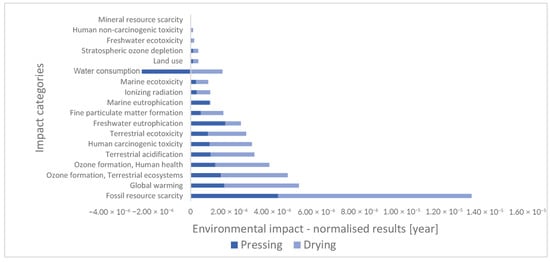
Figure 1 illustrates the normalized environmental impact results for the production of 1 kg of PRW. This visualization facilitates a comparative analysis across different impact categories and explicitly quantifies the relative contributions of the pressing and drying stages to the total environmental burden.
Figure 1.
Normalised results per impact category for the production of 1 kg of PRW.
The impact categories with the highest contributions are fossil resource scarcity and global warming, followed by ozone formation (human health and terrestrial ecosystems), terrestrial acidification and human toxicity (carcinogenic). The remaining categories show significantly lower normalised values.
The high contribution of fossil resource scarcity and global warming is directly linked to energy use throughout the process, particularly during the drying stage. This operation requires thermal energy to remove moisture from PRW, leading to associated indirect emissions from electricity and heat generation from fossil sources in the national energy mix.
Consistently, the drying stage accounts for the largest share of impacts across almost all categories, whereas the pressing stage shows lowest contributions. This result is explained by the predominantly mechanical nature of pressing and its comparatively low energy requirements relative to the thermal demands of drying.
Impact categories related to ozone formation, human toxicity and acidification also reflect the effects of atmospheric emissions and energy production, although with lower absolute magnitude. These findings confirm that the system’s environmental profile is primarily driven by energy consumption, with drying identified as the main environmental hotspot.
In contrast, the water use category shows a net environmental benefit. This positive effect arises from the reuse of treated water for non-potable applications, such as irrigation, industrial processes, and street cleaning, thereby alleviating pressure on freshwater resources and offsetting the volume of water that would otherwise need to be withdrawn.
Table 1 presents the characterised environmental impacts per impact category for the production of 1 kg of PRW, together with their monetisation using environmental prices per impact indicator, resulting in external costs by category.
Table 1.
Characterized environmental impacts and external costs by impact category for the production of 1 kg of PRW.
Among the analysed categories, the highest external costs are associated with ozone formation for terrestrial ecosystems (8.22 × 10⁻³ €) and global warming (5.41 × 10⁻³ €), reflecting the relevance of atmospheric emissions linked to the energy consumption of the process. These are followed by terrestrial acidification, non-carcinogenic human toxicity, and particulate matter formation, although with lower absolute contributions.
Categories related to eutrophication, aquatic ecotoxicity, mineral resource scarcity, and ionising radiation exhibit low external costs, indicating a minor relative importance in the system’s environmental profile. In contrast, the water consumption category shows a negative value, indicating a net environmental benefit from the reuse of treated water for non-potable applications, partially offsetting the overall environmental impacts.
The total external cost associated with the production of 1 kg of PRW, obtained by summing all impact category contributions, amounts to 1.55 × 10⁻² € per kg.
Table 2 presents the integration of internal process costs (pressing and drying) and external environmental impact costs.
Table 2.
Internal, external, and total costs associated with the production of 1 kg of PRW.
Internal costs are dominated by the drying stage, which accounts for approximately 67% of the total. In comparison, the pressing stage accounts for approximately 33%, in line with its lower energy requirements compared to drying. The total internal cost for the production of 1 kg of PRW is 1.46 × 10⁻² €, which, when combined with the external cost of 1.55 × 10⁻² €, results in a total cost of 3.00 × 10⁻² € per kg of PRW.
These results demonstrate that the external costs associated with environmental impacts are of the same order of magnitude as the internal production costs, highlighting the relevance of internalising environmental externalities in the economic assessment of the process.
2.2. Production of a Board on a Pre-Industrial Scale
The results presented in Table 3 show a clear distinction between the four board formulations in terms of environmental and economic performance.
Table 3.
Characterized environmental impacts and external costs by impact category for the production of 1 m3 of board.
The 80PRW20FW option consistently exhibits the lowest environmental impacts across all evaluated categories, followed closely by the 100PRW option, which shows very similar impact values. In contrast, the 80PRW20PE and 80PRW20PU options present markedly higher impacts, reflecting the additional environmental burden associated with the inclusion of virgin polymeric materials. Among these, the PU-containing formulation exhibits the worst environmental profile in the majority of impact categories, except for freshwater ecotoxicity and fossil resource scarcity, for which the PE-containing formulation shows the highest impacts. After monetisation, the results follow the same pattern, with the 80PRW20FW option performing best, followed by the 100PRW option, the 80PRW20PE option showing intermediate performance, and the 80PRW20PU option performing the worst.
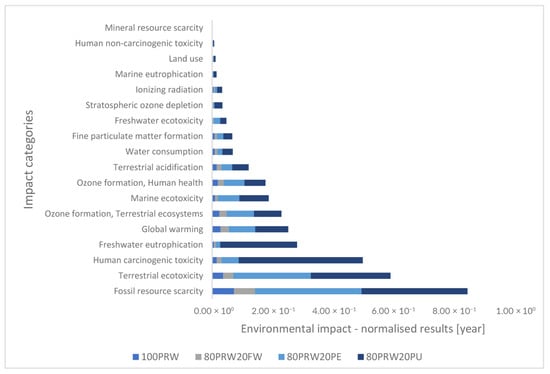
After normalisation, the fossil resource scarcity and terrestrial ecotoxicity categories emerge as the main contributors to the total environmental impacts, as detailed in Figure 2.
Figure 2.
Normalised results per impact category for the production of 1 kg of PRW.
Regarding the economic performance, internal costs account for between 55% and 67% of the total costs, depending on the formulation considered. The 100PRW and 80PRW20FW options exhibit identical internal cost (129 € per 1 m3 of boards), representing the lowest production costs and highlighting the economic advantage of using secondary resources. Incorporating virgin polymers into the 80PRW20PE and 80PRW20PU options results in substantial cost increases of 343 € and 677 € per 1 m3 of board, respectively. External costs account for 33–45% of total costs, with the lowest contribution observed for the 80PRW20PU option and the highest for the 80PRW20PE option. Overall, the most cost-effective option is 80PRW20FW (209 € m3), followed by 100PRW (212 € m3) and 80PRW20PE (628 € m3), while 80PRW20PU is the most expensive (1010 € m3), as shown in Table 4.
Table 4.
Total costs for the production of 1 m3 of board.
The production stage with higher contribution to the impacts varies across the options studied, but remains consistent for both environmental and economic performance. For the waste-based options, namely 80PRW20FW and 100PRW, the pressing stage is the primary contributor. In contrast, for formulations incorporating virgin polymers, such as 80PRW20PE and 80PRW20PU, raw material production represents the dominant source of impacts. For all options, the raw material reception stage has the lowest contribution to total impacts.
3. Discussion
This section covers the interpretation phase, which is the fourth step of the LCA methodology.
The PRW costs approximately 0.030 € per kg, of which around 50% correspond to internal costs, mainly associated with energy consumption during the drying stage. This also explains why the main contributors to environmental impacts are energy-related categories, particularly global warming potential and ozone formation in the terrestrial environment. While these results are consistent with expectations for PRW production, this is, to the authors’ knowledge, the first study addressing this specific issue; therefore, no direct comparison with the existing literature is possible.
In general, the literature reports that CO2 emissions associated with the production of wood-based boards under cradle-to-gate system boundaries range from 0.076 to 1.181 kg CO2 eq. per kg of product, as summarised in Table 5.
Table 5.
Relevant literature on CO2 eq. emissions for producing 1 m3 of wood-based boards (DU) under cradle-to-gate system boundaries.
Within this range, waste-based boards consistently exhibit a more sustainable profile [15,22,24,25,27,28,29,32,37]. These findings align with the results of the present study, in which waste-based boards—namely the 80PRW20FW and 100PRW options—demonstrate clear environmental and economic advantages over formulations incorporating virgin polymers (PE or PU).
In contrast, the incorporation of virgin plastics in the 80PRW20PE and 80PRW20PU options results in environmental impacts five to seven times higher than those of waste-based alternatives, with substantial increases in fossil resource use, water consumption, and eutrophication categories. This outcome is consistent with the findings of Kouchaki-Penchah et al. [27], who highlighted the significant environmental impacts associated with polymer resins in wood-based composites. The economic results further reinforce this conclusion, as the use of virgin polymers increases total costs by several-fold relative to waste-based boards, rising from 209 € m3 for the 80PRW20FW option to 1010 € m3 for the 80PRW20PU option.
Regarding impact categories, the fossil resource scarcity and terrestrial ecotoxicity are the main contributors to total environmental impacts, primarily driven by energy and resource consumption. A similar trend was reported by Santos et al. [17]. Moreover, this study observes lower climate change impacts for the 80PRW20FW and 100PRW options compared with the 80PRW20PE and 80PRW20PU options, which can be mainly attributed to the avoidance of emissions associated with the extraction and processing of virgin plastics. Comparable findings were reported in an LCA of wood–plastic composites, where the use of recycled plastics instead of virgin feedstocks led to significantly lower environmental impacts [38]. Similarly, another LCA study comparing wooden, plastic, and wood–polymer composite pallets found that virgin plastic pallets had higher environmental burdens, particularly in terms of global warming potential, than pallets made from waste-based materials [39]. However, it is important to note that comparisons across studies should be interpreted with caution, as variations in software tools and/or impact assessment methods can yield substantially different results. As highlighted by Garcia and Freire [25], applying different assessment methodologies to the same product can yield climate change impact values ranging from −1.467 to 0.294 kg CO2 eq.
Finally, regarding the production stages with the highest environmental or economic contribution, the dominant stage varies across the options analysed in this study. Still, it remains consistent for both environmental and economic performance. For the waste-based options, namely 80PRW20FW and 100PRW, the pressing stage is the main contributor. In contrast, for formulations incorporating virgin polymers, such as 80PRW20PE and 80PRW20PU, raw material production represents the dominant source of impacts. These results are consistent with previous studies [19,25,26,29] and can be explained by the relatively low environmental burden associated with raw material derived from waste streams, as these materials originate from other processes or activities and therefore carry minimal upstream impacts. Also, it is important to note that, in the present study, the boards were produced under pre-industrial conditions, and therefore the associated impacts may be overestimated when compared to boards manufactured at an industrial scale.
In future, it could also be important to extend the system boundary to cradle-to-grave scenarios, including end-of-life management and long-term reuse, as suggested by other studies [29,40]. Further studies could also explore alternative waste streams and bio-based or recycled polymer resins to further reduce the impact associated with producing virgin polymeric resins. Finally, scaling the analysis to full industrial production would provide a more comprehensive understanding of the environmental and economic implications of mass production compared to pre-industrial conditions.
In summary, the integration of LCA and LCC proved fundamental for revealing trade-offs that would remain hidden under a single-perspective analysis [33,35]. While the environmental advantages of waste-based formulations are evident, the LCC results also demonstrated their economic superiority, particularly when external costs are included. This dual benefit highlights the importance of embedding both environmental and economic indicators into decision-making processes, in line with emerging policy frameworks such as the EU Taxonomy and CSRD.
4. Materials and Methods
The environmental impact assessment of producing boards with PRW was conducted in accordance with the International Standards for LCA, ISO 14040:2006, and ISO 14044:2006 [41,42]. These standards ensure a consistent, transparent, and scientifically robust framework for evaluating environmental performance. The LCA followed the four phases defined by the ISO framework: (i) goal and scope definition, (ii) life cycle inventory (LCI), (iii) life cycle impact assessment, and (iv) interpretation. The environmental impact assessment was performed using the SimaPro software (version 9.6.0.1, PRé Sustainability, Amersfoort, The Netherlands) and the ReCiPe Midpoint Hierarchist (H) perspective.
The LCC analysis was conducted, considering both internal and external costs. Internal costs were calculated as the sum of expenses across the defined production process flow, excluding initial development and maintenance costs. External costs were quantified by monetising the environmental impacts identified in the LCA, using the conversion factors provided in the CE Delft European Environmental Prices Handbook 2024 [43]. These external cost factors are based on a cause-and-effect relationship between emissions, environmental effects, and subsequent damages, and are indexed to the reference year 2021.
4.1. Goal and Scope Definition
This study aims to assess the environmental and economic performance of boards produced with different proportions of PRW sourced from a Portuguese plastic recycling company. To achieve this, the present study first evaluates the environmental and economic performance of the waste material identified as PRW. Subsequently, it compares the environmental and economic performance of boards produced at a pre-industrial scale with different material compositions incorporating varying proportions of PRW, as described below. An attributional LCA approach was adopted, using mass allocation to remain consistent with most studies in the literature [25,28,37,44,45].
4.1.1. Production of PRW
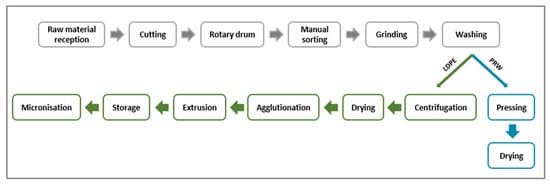
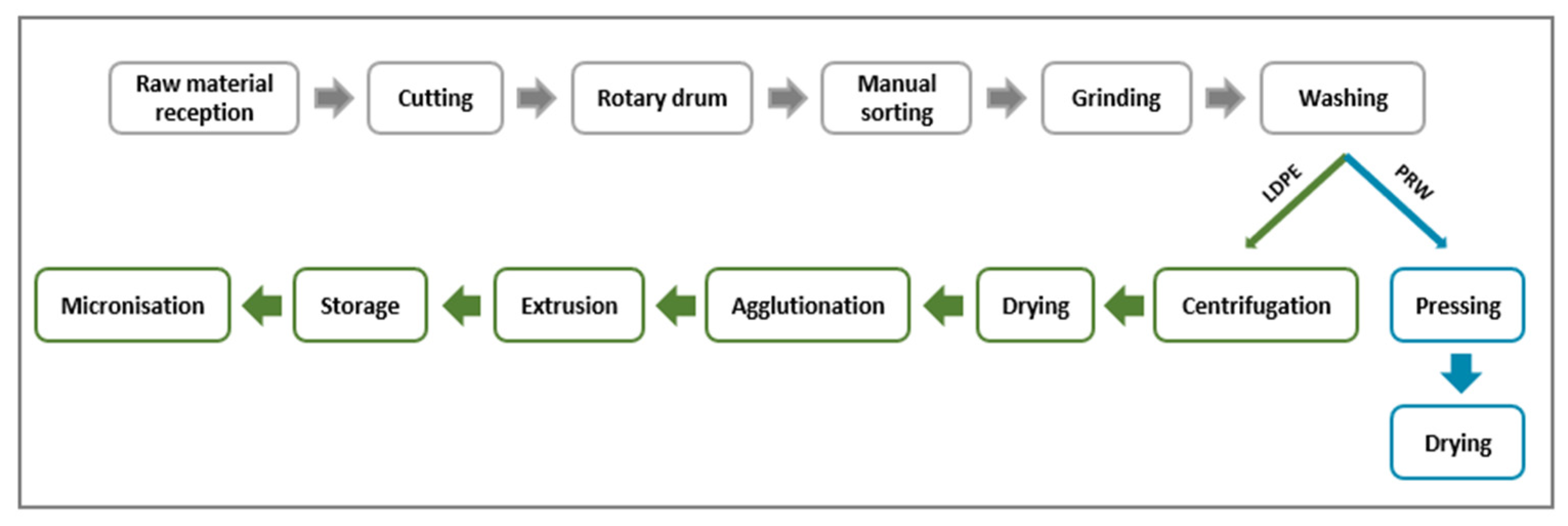
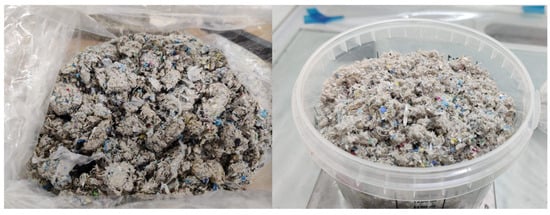
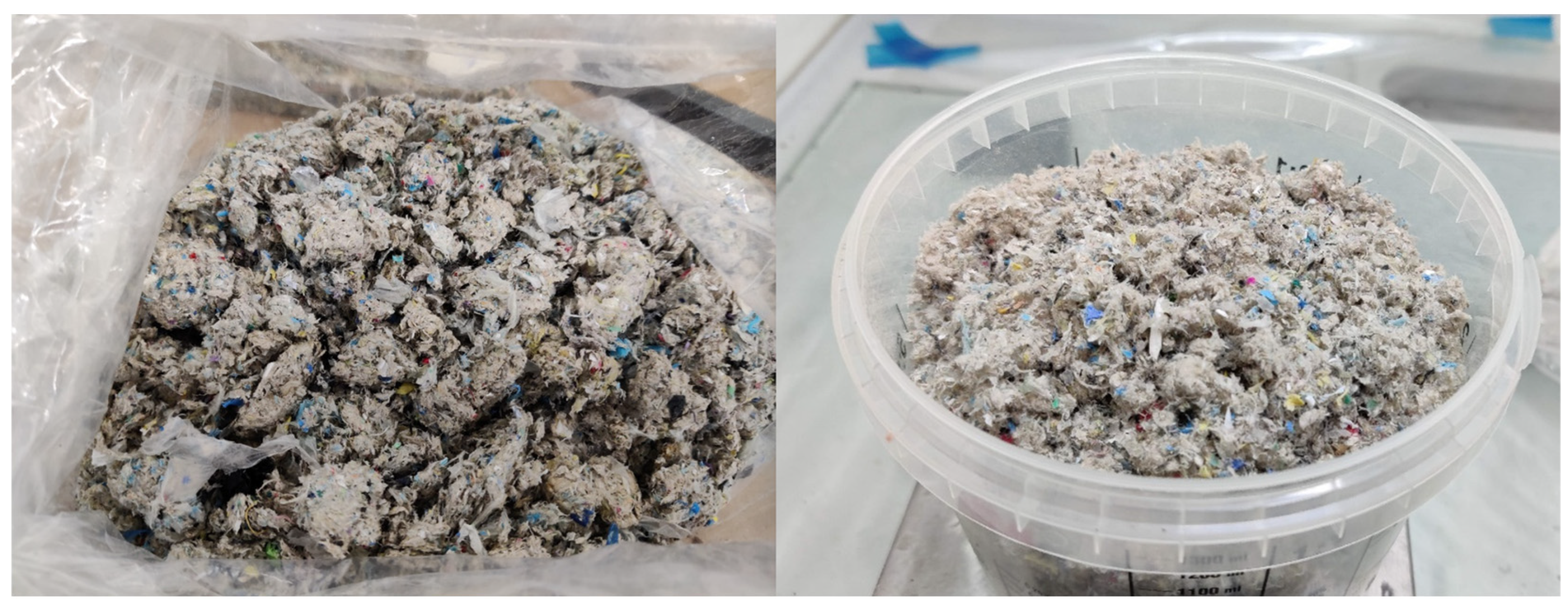
PRW is a waste from the LDPE recycling process, as illustrated in Figure 3 and Figure 4. For every metric ton of LDPE recycled and converted into pellets, approximately 80 kg of PRW is generated. PRW is composed of approximately 71% paper and 29% plastics (of which 93% polyethylene (PE) and 7% mixed plastics).
Figure 3.
LDPE recycling process and PRW production process.
Figure 4.
Representative images of the PRW used in the present study.
The LDPE recycling process comprises a sequence of mechanical operations to recover polymer from post-consumer waste. Initially, incoming waste is received and size-reduced by cutting. The material is then passed through a rotary drum for preliminary cleaning and removal of coarse contaminants, followed by manual sorting to separate non-polymeric fractions. Subsequently, the LDPE fraction is ground and washed to remove remaining impurities. After washing, the material is dewatered by centrifugation and dried to reduce its moisture content. The dried LDPE is then agglomerated, promoting partial melting and densification of the flakes. The agglutinated material is extruded to obtain recycled LDPE granules, which are finally stored in silos and may undergo micronisation depending on the intended application.
Specifically, PRW is originated during the washing stage, where contaminants and non-target materials are separated from the LDPE stream. After generation, PRW undergoes pressing and drying operations to reduce its volume and moisture content, enabling subsequent handling and economic valorisation.
An economic allocation was performed to determine the share of environmental impacts from the LDPE recycling process attributable to PRW. The results indicated that only 1% of the impacts of the LDPE recycling process are allocated to PRW. Given this negligible contribution, the upstream LDPE recycling process was excluded from the system boundaries of the present study.
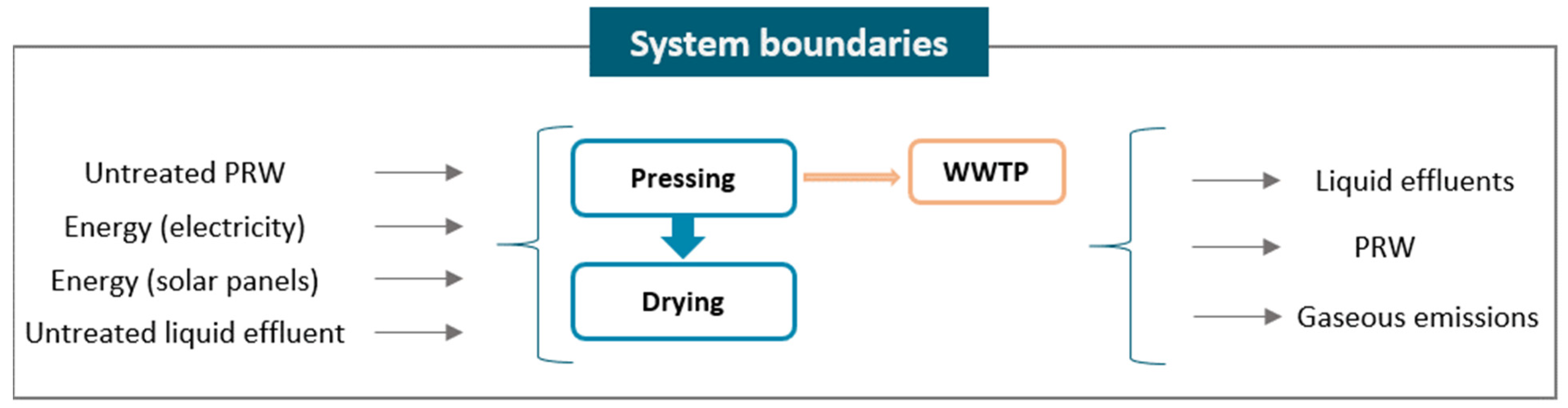
Accordingly, PRW production was modelled using a gate-to-gate approach, considering only the impacts associated with its treatment, namely the pressing and drying stages (Figure 5). The pressing stage consists of mechanical compaction of PRW to reduce its volume and facilitate storage and transport. The drying stage aims to decrease the material’s moisture content through thermal treatment, thereby improving its stability and suitability for further processing. As PRW treatment is not the primary focus of this study, detailed technical specifications of these operations were not available.
Figure 5.
System boundaries considered for PRW production.
The DU for this assessment is the production of 1 kg of PRW intended for subsequent board manufacturing.
4.1.2. Production of a Board on a Pre-Industrial Scale
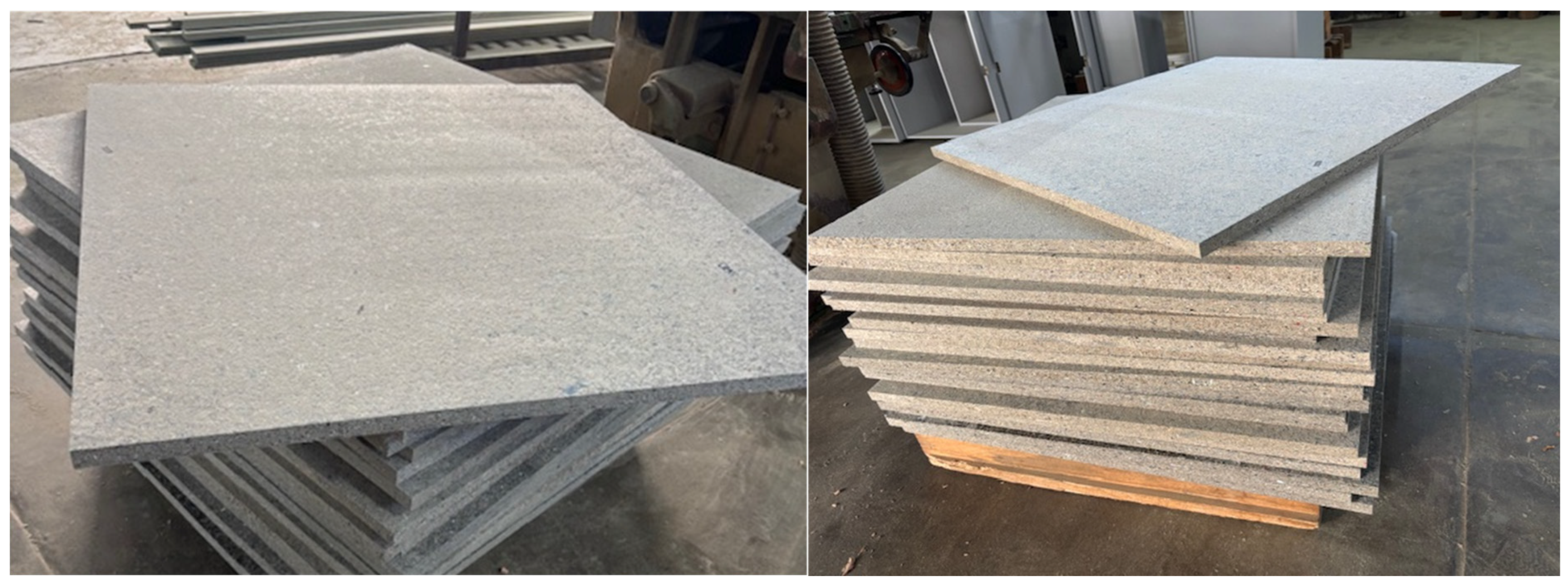
This study evaluates four distinct boards produced in a Portuguese company, at a pre-industrial scale, as described in Table 6 and illustrated in Figure 6. In all cases, PRW is used as the primary material. In contrast, the secondary material varies between furniture, after-industrial waste (FW), PE, and PU, all of which are among the most commonly used resins in the sector. The FW is mainly composed of Acrylonitrile Butadiene Styrene (ABS) with a small fraction of sawdust. The mechanical properties, presented in Table 6, namely the modulus of elasticity, flexural strength, and flexural strain, were assessed based on Method A of ISO 178:2019 [46], for the three PBs, and no significant differences were found.
Table 6.
Description of the boards evaluated in this study at a pre-industrial scale, including their material compositions, weights and mechanical properties.
Figure 6.
Representative images of PB produced in the present study.
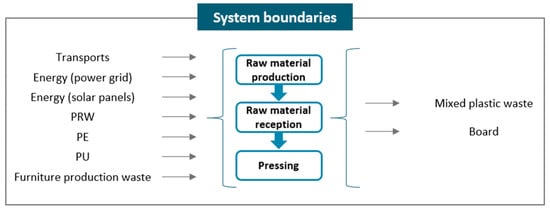
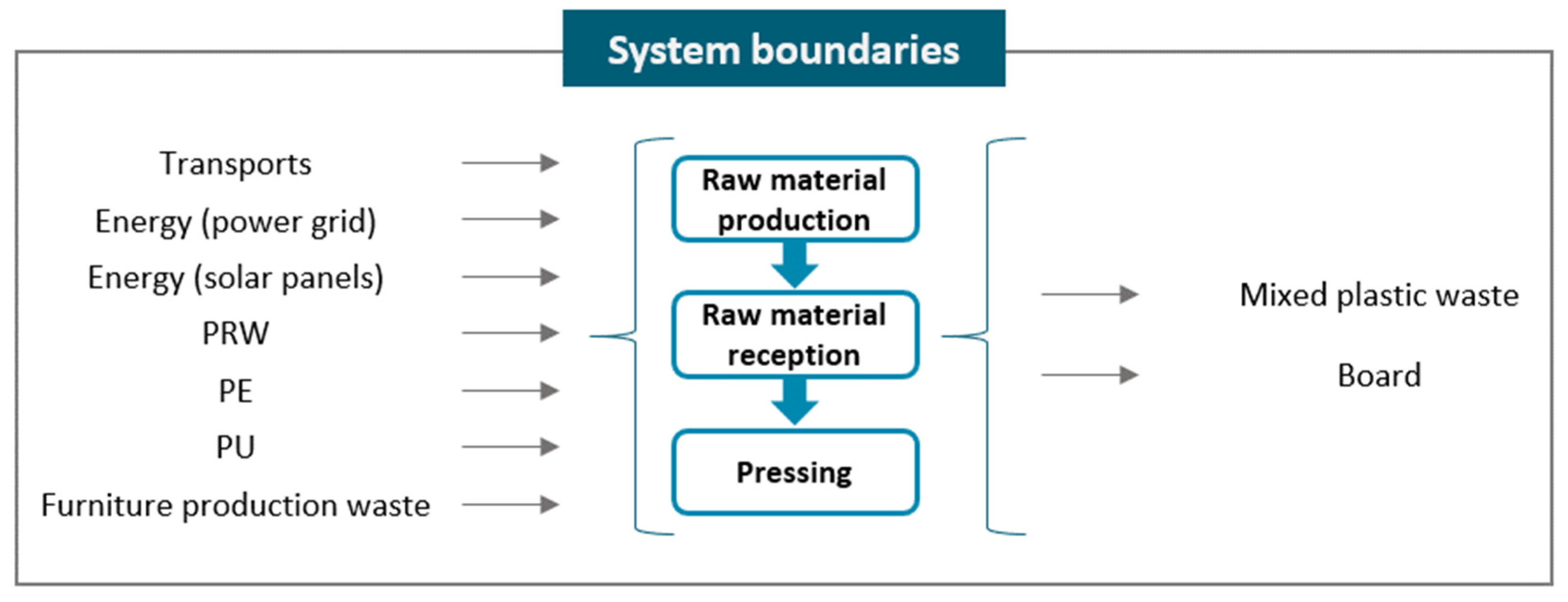
A “cradle-to-gate” system boundary was defined, covering raw material production, raw material reception, and pressing, as illustrated in Figure 7. The pressing stage was carried out at a Portuguese board manufacturing facility. It involved the mechanical compaction of the material using heated plates operating for about 25 min at approximately 180 °C, equipped with electrical resistances (upper plate: three resistances of 1240 W each; lower plate: six resistances of 1500 W each) to produce a board with 20 × 600 × 600 mm. The construction and maintenance of infrastructure and equipment, the end-of-life of capital goods, and waste associated with administrative, laboratory, or office functions were excluded from the system boundaries.
Figure 7.
System boundaries considered for the board’s production.
The DU was defined as the production of 1 m3 of board.
4.2. Life Cycle Inventory (LCI)
The Life Cycle Inventory (LCI) phase involved compiling and categorising all relevant data per DU. Primary data served as the main data source, while background data were sourced from the EcoInvent database (version 3.10) whenever primary data were unavailable. The EcoInvent data followed the “cut-off by classification” system model, using mass allocation. European data (“RER”) were used wherever applicable and available. It is important to note that all data refer specifically to the years 2023/2024 and are therefore only valid for that period.
4.2.1. Production of PRW
Table 7 presents the LCI for PRW produced at a specific Portuguese plastic recycling company in Leiria. The energy consumption comprised 5% from photovoltaic panels, with the remainder sourced from Portugal’s national power grid, modelled using EcoInvent secondary data. For raw material transport, routes were determined using Google Maps (version 2026) and the online tool Sea route & distance—ports.com when exact routes were unavailable. Inland transport was modelled using EURO6-compliant trucks with a capacity of 16–32 tonnes [47]. For each entry in the table, the corresponding EcoInvent dataset is indicated in italics. No dataset is assigned to Wet PRW, as it is considered burden-free. Furthermore, effluent treatment was modelled based on company-specific primary data and is treated as confidential information.
Table 7.
Inventory data for the production of 1 kg of PRW.
For the economic evaluation, the price fluctuations were not considered. Unit prices were obtained directly from the Portuguese plastic recycling company.
This section compiles the key inventory data underpinning the robustness of the subsequent analysis.
4.2.2. Production of a Particleboard on a Pre-Industrial Scale
Table 8 provides the inventory data for producing 1 m3 of the different boards evaluated in this study. FW was assumed to be composed of approximately 76% ABS and 24% sawdust. For energy consumption, it was estimated that 10% originated from photovoltaic panels, with the remaining electricity reflecting Portugal’s national energy mix, using the EcoInvent database. Transport modelling and price fluctuations followed the same assumptions as in Section 4.2.1. The corresponding EcoInvent dataset is reported in italics for each table entry. PRW is modelled according to Table 7. No dataset is assigned to FW, as it is considered a burden-free waste.
Table 8.
Inventory data for the production of 1 m3 of board with different formulations.
Unit prices were obtained from a Portuguese board manufacturing company.
The inventory data summarized in this section serve as the basis for the LCA results.
4.3. Data Quality Analysis
The assessment of data quality enhances the reliability of the study’s findings and was performed in accordance with the International Reference Life Cycle Data System (ILCD), established by the European Commission [48]. This evaluation comprises six criteria: precision, completeness, temporal representativeness, geographical representativeness, and technological representativeness. Each criterion was rated on a scale from 1 to 5, where 1 denotes the highest data quality and 5 the lowest. Beyond evaluating individual indicator scores, the overall dataset quality is summarised through the Data Quality Rating (DQR).
The results of the data quality assessment are presented in Table 9, revealing a DQR of 1.36, indicating a high level of data quality. This value represents the average quality score of the datasets used in this study.
Table 9.
Data quality of the present study using the Pedigree Matrix.
4.4. Life Cycle Impact Analysis (LCIA)
The impact assessment method applied in this study was the ReCiPe 2016 Midpoint (H) method, version 1.09. This method is widely used in LCA [17,32,45,49] due to its scientific robustness and comprehensive coverage of environmental impact categories. The Hierarchist (H) perspective represents a consensus-based, balanced approach that reflects commonly accepted assumptions about environmental mechanisms and timeframes. ReCiPe includes a broad set of midpoint indicators—such as climate change, human toxicity, acidification, eutrophication, and resource scarcity—whose characterisation factors are representative at a global scale, ensuring the consistency and comparability of results across different studies [50]. Subsequently, the results were normalised to better assess the relative contribution of each impact category to the overall environmental performance. Normalization factors for the reference year 2010 were applied, as described by [50].
In parallel with the environmental assessment, an LCC analysis was carried out to evaluate the economic performance of the systems under study. In this study, both internal and external costs were considered. Internal costs were calculated by aggregating the monetary expenditures for each stage of the production process within the system boundaries. These include material procurement, energy use, and transportation. Environmental costs were estimated using the SimaPro software and the CE Delft European Environmental Prices Handbook 2024, which applies conversion factors derived from the ReCiPe Midpoint H method. This method, developed by a SETAC working group, monetises environmental impacts by applying damage cost factors to the LCA results. For the monetisation process, each characterised environmental impact result is multiplied by a specific cost factor (expressed in €/unit of emission or resource use), reflecting the estimated damage to ecosystems, human health, and resource availability. These shadow prices are standardised to the reference year 2021 and are based on a robust cause-and-effect chain linking environmental emissions to their associated societal costs.
The integration of LCA and LCC within a single analytical framework enables a more holistic understanding of the sustainability performance of the systems under evaluation. By combining environmental and economic indicators, this approach supports informed decision-making, enabling the identification of trade-offs and the selection of solutions that offer both lower environmental burdens and greater cost-effectiveness over the life cycle [33,34,35].
5. Conclusions
This study assessed the environmental and economic performance of boards produced with different proportions of PRW using an integrated LCA-LCC approach. To achieve this, it first evaluated the environmental and economic performance of the waste material identified as PRW and subsequently compared the environmental and economic performance of PB produced at a pre-industrial scale.
The results demonstrated that waste-based boards, such as the 80PRW20FW and 100PRW options, consistently exhibited the lowest environmental impacts and the best cost-efficiency. While incorporating virgin polymers significantly increased environmental burdens and total costs, with PU-based boards showing the highest impacts, this confirms that the choice of material composition strongly influences overall environmental and cost performance.
Across all options, the fossil resource scarcity and terrestrial ecotoxicity emerge as the main contributors to the total environmental impacts, primarily driven by energy and resource consumption.
The dominant production stage contributing to environmental or economic impacts varies by the option analysed: pressing is the primary contributor for waste-based options, namely 80PRW20FW and 100PRW, whereas raw material production dominates for board formulations incorporating virgin polymers, such as 80PRW20PE and 80PRW20PU.
Overall, the findings confirm the advantages of waste-based material strategies and demonstrate the value of integrating LCA and LCC to support environmentally and economically informed decision-making, in line with current EU sustainability policy frameworks such as the EU Taxonomy and the CSRD.
Future research could extend the system boundary to cradle-to-grave scenarios, including end-of-life management and long-term reuse, as suggested by other studies [29,40]. Further studies could also explore alternative waste streams and bio-based or recycled polymer resins to further reduce the impact associated with producing virgin polymeric resins. Finally, scaling the analysis to full industrial production would provide a more comprehensive understanding of the environmental and economic implications of mass production compared to pre-industrial conditions.
Author Contributions
Conceptualization, I.C. (Inês Costa), B.M. and C.B.-S.; methodology, I.C. (Inês Costa); validation, I.C. (Inês Costa), B.M. and C.B.-S.; formal analysis, I.C. (Inês Costa); investigation, I.C. (Inês Costa); data curation, I.C. (Inês Costa); resources, C.D., L.S., I.C. (Isabel Carvalho), V.S. and A.P.; writing—original draft preparation, I.C. (Inês Costa); writing—review and editing, B.M. and C.B.-S.; visualization, I.C. (Inês Costa); supervision, C.B.-S.; project administration, B.M. and C.B.-S.; funding acquisition, B.S. and C.B.-S. All authors have read and agreed to the published version of the manuscript.
Funding
This research was funded by two projects: the SUSTAINABLE PLASTICS Project, a Green Agenda for Business Innovation, financed under the Recovery and Resilience Plan (RRP) through the European Union’s NextGenerationEU initiative, with support from the European Regional Development Fund, with the funding number: 02/C05-i01.01/2022.PC644912598-00000021, and the GreenHUB project, funded by the Interreg Programme, which promotes cross-border cooperation also with the support of the European Union, with the number: 0152_GREEN_HUB_1_P.
Data Availability Statement
The data supporting the findings of this study are not publicly available due to privacy and ethical restrictions.
Conflicts of Interest
Catarina Dias and Luís Silva are employees of Sirplaste—Sociedade Industrial de Recuperados de Plásticos S.A.; Isabel Carvalho and Vera Sá are employees of Sedacor—Sociedade Exportadora de Artigos de Cortiça Lda. Alexandre Pereira is an employee of JAP—Consulting U. Lda. The other authors declare no conflicts of interest. Sirplaste—Sociedade Industrial de Recuperados de Plásticos S.A., Sedacor—Sociedade Exportadora de Artigos de Cortiça Lda., and AP—Consulting U. Lda. had no role in the design of the study; in the collection, analyses, or interpretation of data; in the writing of the manuscript; or in the decision to publish the results.
Abbreviations
The following abbreviations are used in this manuscript:
| ABS | Acrylonitrile Butadiene Styrene |
| CSDR | Corporate Sustainability Reporting Directive |
| DQR | Data Quality Rating |
| DU | Declared Unit |
| EU | European Union |
| FW | Furniture Waste |
| ILCD | International Reference Life Cycle Data System |
| ISO | International Organization for Standardization |
| LCA | Life Cycle Assessment |
| LCC | Life Cycle Costing |
| LCI | Life Cycle Inventory |
| LDPE | Low-Density Polyethylene |
| MDF | Medium-Density Fibreboard |
| ODP | Ozone Depletion Potential |
| PB | Particleboard |
| PE | Polyethylene |
| PIEP | Centre for Innovation in Polymer Engineering |
| PRW | Polyethylene Recycling Waste |
| PU | Polyurethane |
References
- Wood Products—Production and Trade. Available online: https://ec.europa.eu/eurostat/statistics-explained/index.php?title=Wood_products_-_production_and_trade (accessed on 19 February 2026).
- INTRuST Consortium. Twin Transition in the Wood-Furniture Value Chain: State-of-the-Art on Environmental Certifications Practices and Industry 4.0 in the Wood and Furniture Sector; European Union: Brussels, Belgium, 2022; p. 86. [Google Scholar]
- Forrest, A.; Hilton, M.; Ballinger, A.; Whittaker, D. Report on the Circular Economy in the Furniture Sector; European Environmental Bureau: Brussels, Belgium, 2017. [Google Scholar]
- Stubdrup, K.R.; Karlis, P.; Roudier, S.; Delgado Sancho, L. Best Available Techniques (BAT) Reference Document for the Production of Wood-Based Panels: Industrial Emissions Directive 2010/75/EU: Integrated Pollution Prevention and Control; Publications Office of the European Union: Luxembourg, 2016; ISBN 978-92-79-54949-6.
- European Circular Economy Stakeholder Platform. Circular Economy in the Furniture Industry. 2018. Available online: https://circulareconomy.europa.eu/platform/sites/default/files/circular-economy-in-the-furniture-industry.pdf (accessed on 19 January 2026).
- Pei, X.; Italia, M.; Melazzini, M. Enhancing Circular Economy Practices in the Furniture Industry through Circular Design Strategies. Sustainability 2024, 16, 6544. [Google Scholar] [CrossRef] [Scilit]
- Rivela, B.; Hospido, A.; Moreira, T.; Feijoo, G. Life Cycle Inventory of Particleboard: A Case Study in the Wood Sector (8 pp). Int. J. Life Cycle Assess. 2006, 11, 106–113. [Google Scholar] [CrossRef] [Scilit]
- González-García, S.; Gasol, C.M.; Lozano, R.G.; Moreira, M.T.; Gabarrell, X.; Rieradevall, I.; Pons, J.; Feijoo, G. Assessing the Global Warming Potential of Wooden Products from the Furniture Sector to Improve Their Ecodesign. Sci. Total Environ. 2011, 410–411, 16–25. [Google Scholar] [CrossRef] [Scilit] [PubMed]
- González-García, S.; García Lozano, R.; Moreira, M.T.; Gabarrell, X.; Rieradevall I Pons, J.; Feijoo, G.; Murphy, R.J. Eco-Innovation of a Wooden Childhood Furniture Set: An Example of Environmental Solutions in the Wood Sector. Sci. Total Environ. 2012, 426, 318–326. [Google Scholar] [CrossRef] [Scilit] [PubMed]
- Iritani, D.R.; Silva, D.A.L.; Saavedra, Y.M.B.; Grael, P.F.F.; Ometto, A.R. Sustainable Strategies Analysis through Life Cycle Assessment: A Case Study in a Furniture Industry. J. Clean. Prod. 2015, 96, 308–318. [Google Scholar] [CrossRef] [Scilit]
- Krystofik, M.; Luccitti, A.; Parnell, K.; Thurston, M. Adaptive Remanufacturing for Multiple Lifecycles: A Case Study in Office Furniture. Resour. Conserv. Recycl. 2018, 135, 14–23. [Google Scholar] [CrossRef] [Scilit]
- Casas-Ledón, Y.; Daza Salgado, K.; Cea, J.; Arteaga-Pérez, L.E.; Fuentealba, C. Life Cycle Assessment of Innovative Insulation Panels Based on Eucalyptus Bark Fibers. J. Clean. Prod. 2020, 249, 119356. [Google Scholar] [CrossRef] [Scilit]
- Susanty, A.; Tjahjono, B.; Sulistyani, R.E. An Investigation into Circular Economy Practices in the Traditional Wooden Furniture Industry. Prod. Plan. Control 2020, 31, 1336–1348. [Google Scholar] [CrossRef] [Scilit]
- Sakib, M.N.; Kabir, G.; Ali, S.M. A Life Cycle Analysis Approach to Evaluate Sustainable Strategies in the Furniture Manufacturing Industry. Sci. Total Environ. 2024, 907, 167611. [Google Scholar] [CrossRef] [Scilit]
- Mohd Azman, M.A.H.; Ahmad Sobri, S.; Norizan, M.N.; Ahmad, M.N.; Wan Ismail, W.O.A.S.; Hambali, K.A.; Hairi, M.H.; Hermawan, A.; Mohamed, M.; Teo, P.T.; et al. Life Cycle Assessment (LCA) of Particleboard: Investigation of the Environmental Parameters. Polymers 2021, 13, 2043. [Google Scholar] [CrossRef] [Scilit]
- Okeke, F.O.; Ahmed, A.; Imam, A.; Hassanin, H. Study on Agricultural Waste Utilization in Sustainable Particleboard Production. E3S Web Conf. 2024, 563, 02007. [Google Scholar] [CrossRef] [Scilit]
- Santos, A.; Carvalho, A.; Barbosa-Póvoa, A. An Economic and Environmental Comparison between Forest Wood Products—Uncoated Woodfree Paper, Natural Cork Stoppers and Particle Boards. J. Clean. Prod. 2021, 296, 126469. [Google Scholar] [CrossRef] [Scilit]
- Ramos, A.; Briga-Sá, A.; Pereira, S.; Correia, M.; Pinto, J.; Bentes, I.; Teixeira, C.A. Thermal Performance and Life Cycle Assessment of Corn Cob Particleboards. J. Build. Eng. 2021, 44, 102998. [Google Scholar] [CrossRef] [Scilit]
- Bovea, M.D.; Vidal, R. Materials Selection for Sustainable Product Design: A Case Study of Wood Based Furniture Eco-Design. Mater. Des. 2004, 25, 111–116. [Google Scholar] [CrossRef] [Scilit]
- Bowers, T.; Puettmann, M.; Ganguly, I.; Eastin, I. CORRIM Report: Life Cycle Assessment for the Production of Pacific Northwest Glued Laminated Timbers. 2017. Available online: https://corrim.org/wp-content/uploads/2020/06/CORRIM-AWC-PNW-Glulam-v2.pdf (accessed on 19 February 2026).
- Spitzley, D.V.; Dietz, B.A.; Keoleian, G.A. Life-Cycle Assessment of Office Furniture Products; University of Michigan: Ann Arbor, MI, USA, 2006. [Google Scholar]
- González-García, S.; Feijoo, G.; Widsten, P.; Kandelbauer, A.; Zikulnig-Rusch, E.; Moreira, M.T. Environmental Performance Assessment of Hardboard Manufacture. Int. J. Life Cycle Assess. 2009, 14, 456–466. [Google Scholar] [CrossRef] [Scilit]
- Askham, C.; Hanssen, O.J.; Gade, A.L.; Nereng, G.; Aaser, C.P.; Christensen, P. Strategy Tool Trial for Office Furniture. Int. J. Life Cycle Assess. 2012, 17, 666–677. [Google Scholar] [CrossRef] [Scilit]
- Silva, D.A.L.; Lahr, F.A.R.; Garcia, R.P.; Freire, F.M.C.S.; Ometto, A.R. Life Cycle Assessment of Medium Density Particleboard (MDP) Produced in Brazil. Int. J. Life Cycle Assess. 2013, 18, 1404–1411. [Google Scholar] [CrossRef] [Scilit]
- Garcia, R.; Freire, F. Carbon Footprint of Particleboard: A Comparison between ISO/TS 14067, GHG Protocol, PAS 2050 and Climate Declaration. J. Clean. Prod. 2014, 66, 199–209. [Google Scholar] [CrossRef] [Scilit]
- Dos Santos, M.F.N.; Battistelle, R.A.G.; Bezerra, B.S.; Varum, H.S.A. Comparative Study of the Life Cycle Assessment of Particleboards Made of Residues from Sugarcane Bagasse (Saccharum spp.) and Pine Wood Shavings (Pinus Elliottii). J. Clean. Prod. 2014, 64, 345–355. [Google Scholar] [CrossRef] [Scilit]
- Kouchaki-Penchah, H.; Sharifi, M.; Mousazadeh, H.; Zarea-Hosseinabadi, H. Life Cycle Assessment of Medium-Density Fiberboard Manufacturing Process in Islamic Republic of Iran. J. Clean. Prod. 2016, 112, 351–358. [Google Scholar] [CrossRef] [Scilit]
- Piekarski, C.M.; De Francisco, A.C.; Da Luz, L.M.; Kovaleski, J.L.; Silva, D.A.L. Life Cycle Assessment of Medium-Density Fiberboard (MDF) Manufacturing Process in Brazil. Sci. Total Environ. 2017, 575, 103–111. [Google Scholar] [CrossRef] [Scilit]
- Nakano, K.; Ando, K.; Takigawa, M.; Hattori, N. Life Cycle Assessment of Wood-Based Boards Produced in Japan and Impact of Formaldehyde Emissions during the Use Stage. Int. J. Life Cycle Assess. 2018, 23, 957–969. [Google Scholar] [CrossRef] [Scilit]
- Wenker, J.L.; Richter, K.; Rüter, S. A Methodical Approach for Systematic Life Cycle Assessment of Wood-Based Furniture. J. Ind. Ecol. 2018, 22, 671–685. [Google Scholar] [CrossRef] [Scilit]
- Deng, N.; Wang, J.; Sun, J.; Cao, N. Life Cycle Assessment and Optimization Scenario of Solid Wood Composite Doors: A Case Study in the East of China. Sci. Total Environ. 2023, 868, 161494. [Google Scholar] [CrossRef] [Scilit]
- Lao, W.-L.; Chang, L. Comparative Life Cycle Assessment of Medium Density Fiberboard and Particleboard: A Case Study in China. Ind. Crops Prod. 2023, 205, 117443. [Google Scholar] [CrossRef] [Scilit]
- Alshamrani, O.S. Integrated LCA-LCC Assessment Model of Offsite, Onsite, and Conventional Construction Systems. J. Asian Archit. Build. Eng. 2022, 21, 2058–2080. [Google Scholar] [CrossRef] [Scilit]
- Calado, E.A.; Leite, M.; Silva, A. Integrating Life Cycle Assessment (LCA) and Life Cycle Costing (LCC) in the Early Phases of Aircraft Structural Design: An Elevator Case Study. Int. J. Life Cycle Assess. 2019, 24, 2091–2110. [Google Scholar] [CrossRef] [Scilit]
- França, W.T.; Barros, M.V.; Salvador, R.; De Francisco, A.C.; Moreira, M.T.; Piekarski, C.M. Integrating Life Cycle Assessment and Life Cycle Cost: A Review of Environmental-Economic Studies. Int. J. Life Cycle Assess. 2021, 26, 244–274. [Google Scholar] [CrossRef] [Scilit]
- Forest Value. Enhanced Life-Cycle-Costing in Wood Construction by Novel Methods for Service Life Planning. 2021. Available online: https://forestvalue.org/wp-content/uploads/2022/10/forestvalue_FINAL_CONFERENCE-Gry-Alfredsen-WoodLCC-session-VI.pdf (accessed on 19 February 2026).
- Sahoo, K.; Bergman, R.; Khatri, P. Cradle-to-Grave Life-Cycle Assessment of Cellulosic Fiberboard. Recent Prog. Mater. 2021, 3, 1–28. [Google Scholar] [CrossRef] [Scilit]
- Khan, M.M.H.; Deviatkin, I.; Havukainen, J.; Horttanainen, M. Environmental Impacts of Wooden, Plastic, and Wood-Polymer Composite Pallet: A Life Cycle Assessment Approach. Int. J. Life Cycle Assess. 2021, 26, 1607–1622. [Google Scholar] [CrossRef] [Scilit]
- Sommerhuber, P.F.; Wenker, J.L.; Rüter, S.; Krause, A. Life Cycle Assessment of Wood-Plastic Composites: Analysing Alternative Materials and Identifying an Environmental Sound End-of-Life Option. Resour. Conserv. Recycl. 2017, 117, 235–248. [Google Scholar] [CrossRef] [Scilit]
- Chaudhary, A.; Hellweg, S. Including Indoor Offgassed Emissions in the Life Cycle Inventories of Wood Products. Environ. Sci. Technol. 2014, 48, 14607–14614. [Google Scholar] [CrossRef] [Scilit]
- ISO 14040:2006; Environmental Management—Life Cycle Assessment—Principles and Framework. International Organization for Standardization: Geneva, Switzerland, 2006.
- ISO 14044:2006; Environmental Management—Life Cycle Assessment—Requirements and Guidelines. International Organization for Standardization: Geneva, Switzerland, 2006.
- CE Delft. Environmental Prices Handbook 2024: EU27 Version; CE Delft: Delft, The Netherlands, 2024. [Google Scholar]
- Freire, A.L.F.; Araújo Júnior, C.P.D.; Rosa, M.D.F.; Almeida Neto, J.A.D.; Figueirêdo, M.C.B.D. Environmental Assessment of Bioproducts in Development Stage: The Case of Fiberboards Made from Coconut Residues. J. Clean. Prod. 2017, 153, 230–241. [Google Scholar] [CrossRef] [Scilit]
- Costa, D.; Serra, J.; Quinteiro, P.; Dias, A.C. Life Cycle Assessment of Wood-Based Panels: A Review. J. Clean. Prod. 2024, 444, 140955. [Google Scholar] [CrossRef] [Scilit]
- ISO 178:2019; Plastics—Determination of Flexural Properties. International Organization for Standardization: Geneva, Switzerland, 2019.
- Eurostat Road Freight Transport by Type of Goods and Type of Transport (t, Tkm)—Annual Data. Available online: https://ec.europa.eu/eurostat/databrowser/view/road_go_ta_tg/default/table (accessed on 20 February 2026).
- European Commission; Joint Research Centre; Institute for Environment and Sustainability. International Reference Life Cycle Data System (ILCD) Handbook: General Guide for Life Cycle Assessment: Detailed Guidance; Publications Office of the European Union: Luxembourg, 2010.
- Cespi, D.; Ciacci, L.; Chiarini, A.; Trova, E.; Acciai, C.; Ciabatti, I.; Tirinnanzi, M.; Passarini, F. LCA of Precious Metals Recovery: Modelling the Secondary Supply of Gold, Silver, Platinum, Palladium and Rhodium from an Integrated Refining Plant. Clean. Environ. Syst. 2025, 19, 100310. [Google Scholar] [CrossRef] [Scilit]
- PRé Sustainability. SimaPro Database Manual—Methods Library; PRé Sustainability: Amersfoort, The Netherlands, 2026. [Google Scholar]

Disclaimer/Publisher’s Note: The statements, opinions and data contained in all publications are solely those of the individual author(s) and contributor(s) and not of MDPI and/or the editor(s). MDPI and/or the editor(s) disclaim responsibility for any injury to people or property resulting from any ideas, methods, instructions or products referred to in the content. |
© 2026 by the authors. Licensee MDPI, Basel, Switzerland. This article is an open access article distributed under the terms and conditions of the Creative Commons Attribution (CC BY) license.