


Abstract
Developing practical low-cost adsorbents for dye-contaminated wastewater remains a critical challenge, especially for persistent cationic dyes such as crystal violet (CV). Here, raw rockmelon skin (RMS), an abundant fruit-processing residue, and its NaOH-modified derivative (NaOH-RMS) were investigated as adsorbents for CV adsorption. Alkaline treatment altered the biomass’s characteristics and affected its adsorption behaviour. Equilibrium was reached within 120 min, and the kinetic data were best fit by the pseudo-second-order model. Equilibrium analysis showed that the Freundlich model best described RMS. In contrast, NaOH-RMS was better represented by the Langmuir model, indicating that alkaline treatment altered the adsorption behaviour of the biomass surface. The Langmuir-derived maximum adsorption capacities were 343.7 mg g−1 for RMS and 295.2 mg g−1 for NaOH-RMS, indicating that NaOH modification did not increase the maximum adsorption capacity. Adsorption was spontaneous across 298–343 K, and both materials retained satisfactory removal performance over five regeneration cycles, particularly under basic desorption conditions. Overall, NaOH treatment altered the adsorption behaviour from heterogeneous adsorption on RMS to a more Langmuir-type adsorption pattern on NaOH-RMS, despite not increasing the maximum adsorption capacity. These findings support the valorisation of fruit-processing residues as practical adsorbents for dye-contaminated wastewater.
1. Introduction
Synthetic dyes released into water bodies continue to pose environmental concerns, particularly triphenylmethane dyes, which are structurally stable and resist both light-driven and biological degradation [1]. Crystal Violet (CV), also known as Gentian Violet (C25H30N3Cl, 407.98 g mol−1) and Methyl Violet 10B, is frequently detected in wastewater streams from textile finishing, laboratory staining, pharmaceutical processing, and printing industries [2,3,4,5]. Beyond industrial applications, CV has also been widely used in aquaculture as a low-cost antifungal and antibacterial agent for the treatment of parasitic infections. Due to its strong chromophoric structure, even trace concentrations can impart intense colouration to receiving waters, reducing light penetration and adversely affecting aquatic ecosystems [6]. Prolonged exposure has also been associated with mutagenic and cytotoxic effects, underscoring the need for practical yet economically viable removal technologies, particularly those suitable for low-cost, decentralised treatment systems [7].
Of the treatment methods available, adsorption is still widely used for dye removal because it is simple to operate, adaptable, and effective for a wide range of pollutants. Commercial activated carbon (AC), while highly effective, is often cost-prohibitive for large-scale wastewater applications due to its production, which involves high-temperature carbonisation and activation processes that are both energy-intensive and costly, limiting its widespread use in cost-sensitive wastewater treatment applications [8,9]. These constraints have encouraged exploration into alternative, low-cost adsorbents derived from lignocellulosic biomass.
Agricultural and food-processing wastes are increasingly explored as low-cost adsorbent precursors because they combine pollutant removal with value-added use of discarded biomass. Fruit residues are especially attractive because they are produced in large amounts and contain lignocellulosic components bearing hydroxyl, carboxyl, and phenolic groups that can interact with both metal ions and dyes [10,11,12]. Fruit peels, seeds, and rinds have been widely investigated for adsorption applications [13,14,15].
Rockmelon (Cucumis melo L.) skin or rind is an example of a fruit-processing waste produced in large quantities by fresh-cut vendors and juice preparation activities. Its structure is fibrous and lignocellulosic, being rich in cellulose, hemicellulose, and pectin, and therefore offers multiple surface functionalities that may participate in pollutant binding [16,17]. Earlier work has shown that this biomass can remove selected heavy metals, such as Pb, Cu, and Cd [18,19], as well as dyes such as Brilliant Green and Methyl Violet 2B [20,21], suggesting that it is a viable low-cost adsorbent. Nevertheless, the adsorption performance of chemically modified RMS, particularly for the removal of persistent cationic dyes such as CV, has not been comprehensively evaluated. Alkaline treatment with NaOH is commonly used to alter lignocellulosic adsorbents through fibre swelling, partial removal of non-cellulosic components, and greater exposure of hydroxyl- and carboxyl-containing surface groups, all of which may favour uptake of cationic dyes [21,22,23].
From a practical standpoint, RMS enables the conversion of discarded fruit residue into a usable adsorbent, reducing reliance on more energy-intensive commercial materials. Its regenerability also supports repeated use, although the broader value of this route still depends on factors such as processing scale, material flow, and the handling of spent adsorbent, none of which were quantified here. In this study, valorisation is therefore discussed in terms of converting waste biomass into a functional adsorbent through a relatively simple preparation route, rather than through a full techno-economic or life-cycle assessment.
In this work, rockmelon skin (RMS) and NaOH-modified rockmelon skin (NaOH-RMS) are investigated as low-cost adsorbents for the removal of CV from aqueous solutions. The materials were characterised to evaluate structural and surface chemical changes induced by alkaline treatment, followed by batch adsorption experiments examining the effects of pH, adsorbent dosage, initial dye concentration, and contact time. Adsorption kinetics, equilibrium behaviour, and regeneration performance were further assessed to elucidate the removal mechanisms and practical applicability of the developed adsorbent. Particular emphasis is placed on comparing the adsorption behaviour of RMS and NaOH-RMS to determine whether alkaline treatment modifies surface heterogeneity, adsorption-site uniformity, and active-site accessibility, even when the overall adsorption capacity is not substantially increased.
By providing a low-energy pathway for converting fruit-processing residues into functional adsorbents for wastewater treatment, this study supports broader sustainability goals, particularly those related to clean water and more responsible use of resources (SDGs 6 and 12). These sustainability and circular-economy implications are discussed qualitatively in the present work, whereas quantitative assessment of energy demand, environmental burden, and economic feasibility remains for future study.
2. Results and Discussion
2.1. Characterisations of the Adsorbents
2.1.1. SEM
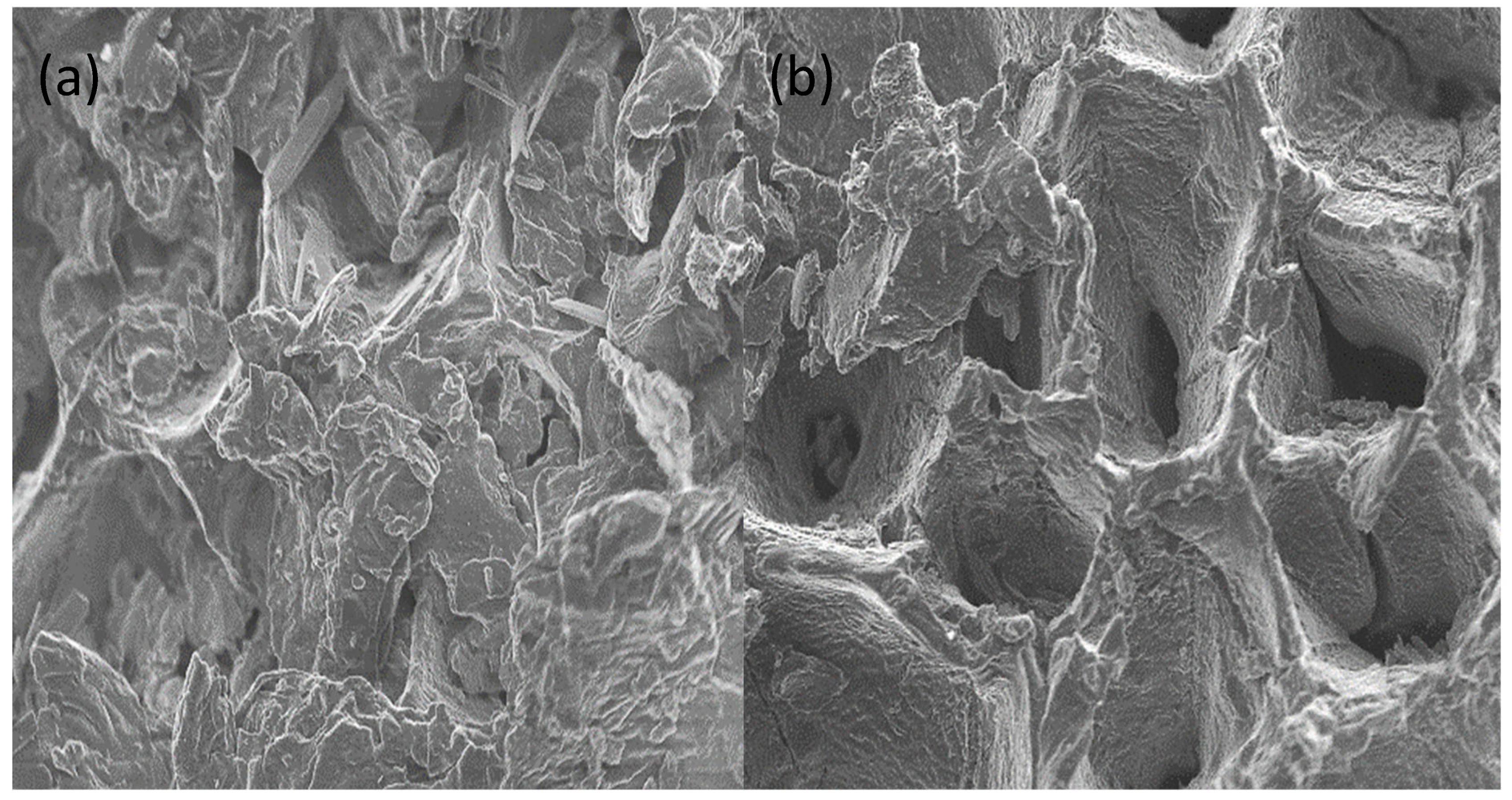
As depicted in Figure 1, the raw RMS exhibited a relatively rough surface with irregular pockets and fissures characteristic of lignocellulosic biomass. Following alkaline treatment, the NaOH-RMS exhibited a notable transformation, evident in a more heterogeneous, undulating morphology, with the formation of pronounced cavities and surface openings. A similar observation was reported for NaOH-treated lupine peels [24]. This structural transformation is attributed to the partial delignification induced by NaOH treatment [24]. Alkaline conditions promote the cleavage of ester and ether linkages between lignin and hemicellulosic components, leading to the removal of lignin that functions as a binding matrix within the plant cell walls [25,26,27,28]. The extraction of these structural components increases surface roughness and creates visible cavities and surface openings. These morphological changes are qualitatively consistent with a less compact surface after alkaline treatment; however, without quantitative pore-structure analysis, any implication of increased surface area or enhanced accessibility should be regarded as inferential.
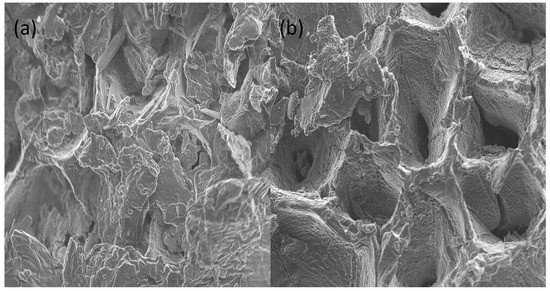
Figure 1.
SEM images of the (a) RMS and (b) NaOH-modified RMS at a magnification of ×2000.
2.1.2. FTIR
FTIR analysis was used to examine the surface functional groups of the adsorbents. Figure S1a shows the FTIR spectrum of raw RMS, which exhibited characteristic lignocellulosic features including C-H at 779 cm−1, 818 cm−1 (aromatic out-of-plane bend), 1059 cm−1 and 1103 cm−1 (aromatic in-plane bend). The presence of O–H is evident with a broad peak at 3000–3600 cm−1, while C=O is indicated by a peak at 1737 cm−1, and C=C is observed at 1626 cm−1.
During CV dye adsorption (Figure S1b), shifts are noticeable in the C–H peaks around 670 to 1225 cm−1. The O–H peak at 3362 cm−1 shifts to 3414 cm−1, with a narrower shape compared to the peak in RMS. The involvement of C=O in dye adsorption is shown by the shift from 1737 cm−1 to 1744 cm−1, and the C=C peak at 1626 cm−1 shifts to 1589 cm−1. Peaks at 1238 cm−1 and 1165 cm−1 indicate aromatic and aliphatic C–N stretching adsorptions of CV dye, confirming its adsorption onto RMS [29,30]. Figure S1c displays the FTIR spectrum of NaOH-RMS. The peaks at 714 cm−1 and 891 cm−1 are attributed to the aromatic C–H out-of-plane, while the 1022 cm−1 and 1099 cm−1 are attributed to aromatic C–H in-plane bending. Notably, a shift was observed for the C=C (1612 cm−1) and OH (3267 cm−1) peaks. In Figure S1d, the NaOH-RMS loaded with CV shows the presence of aromatic C–H out-of-plane bending peaks at 721 cm−1 and 833 cm−1. Peaks at 953, 1022, 1056, and 1165 cm−1 may indicate aromatic C–H in-plane bending. Additionally, a broad peak at 3395 cm−1 suggests the presence of an O–H bond [23,30].
Overall, the FTIR results indicate that hydroxyl, carbonyl, and aromatic functional groups present on both RMS and NaOH-RMS participate in the adsorption of CV. At the same time, alkaline treatment enhances surface functionality and the accessibility of active binding sites, thereby improving adsorption behaviour.
2.2. Effects of pH and Ionic Strength
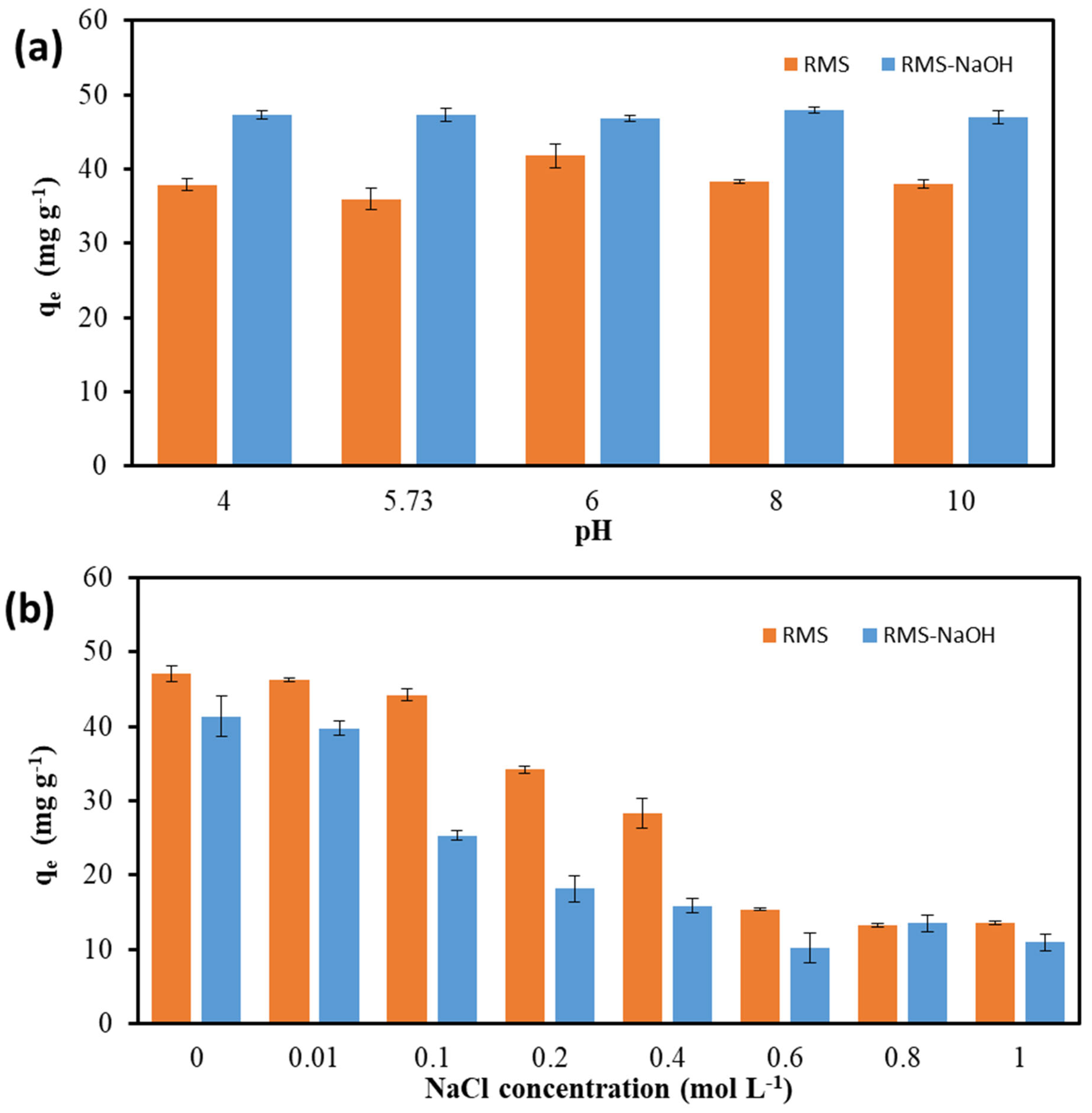
Solution pH significantly influences adsorption because it governs both the protonation or deprotonation of functional groups on the adsorbent’s surface and the adsorbate’s ionisation state [31]. Figure 2a shows the influence of solution pH on CV adsorption by RMS and NaOH-RMS. For RMS, the adsorption capacity at the unadjusted pH of 5.73 was 36.0 mg g−1, increasing to 41.8 mg g−1 at pH 6. NaOH-RMS exhibited higher adsorption throughout, reaching 47.3 mg g−1 at pH 5.73 and a maximum of 48.0 mg g−1 at pH 8. As only marginal improvements were observed relative to the unadjusted solution pH, subsequent adsorption experiments were conducted without further pH adjustment.
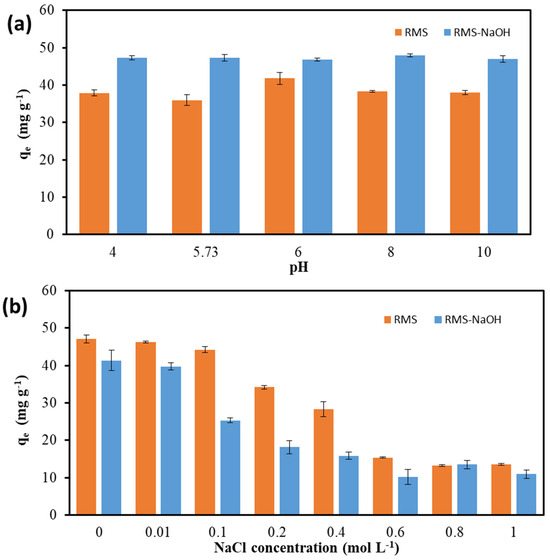
Figure 2.
Plots showing (a) the effect of pH on RMS and NaOH-RMS, and (b) the effect of ionic strength using NaCl on the adsorption of 100 mg L−1 CV dye onto RMS at room temperature.
The effect of pH on dye adsorption is commonly interpreted using the pHpzc, defined as the pH at which the adsorbent surface carries no net charge [32]. When the solution pH is higher than the pHpzc, deprotonation of surface functional groups produces negatively charged sites that favour electrostatic attraction toward cationic CV molecules. In contrast, at pH values below the pHpzc, protonation of these groups reduces the extent of electrostatic attraction [33,34]. In Figure S2a,b, the pHpzc values for RMS and NaOH-RMS were found to be pH 5.41 and 6.23, respectively. The observed enhancement of adsorption at pH values exceeding the respective pHpzc supports the dominant contribution of electrostatic interactions in the adsorption mechanism.
The effect of ionic strength on CV adsorption is illustrated in Figure 2b. Increasing NaCl concentration resulted in a gradual decrease in adsorption capacity for both adsorbents, with capacities declining to 13.6 mg g−1 for RMS and 10.9 mg g−1 for NaOH-RMS at the highest salt concentration investigated. The reduction is attributed to competitive interactions between electrolyte ions (Na+ and Cl−) and CV molecules for available adsorption sites. At sufficiently high NaCl concentrations, the electrostatic interaction can be suppressed. The sensitivity of adsorption performance to electrolyte concentration further indicates that electrostatic interactions play a significant role in CV uptake by both RMS and NaOH-RMS, although contributions from hydrogen bonding and hydrophobic interactions may also be present [35]. Similar ionic strength effects have been reported for other lignocellulosic biosorbents in the adsorption of cationic dyes [36].
The pHpzc results, together with the pH-dependent adsorption trend and sensitivity to ionic strength, support the contribution of electrostatic interactions; however, direct confirmation of surface charge behaviour would require zeta potential analysis.
2.3. The Effect of Contact Time and Kinetics Modelling
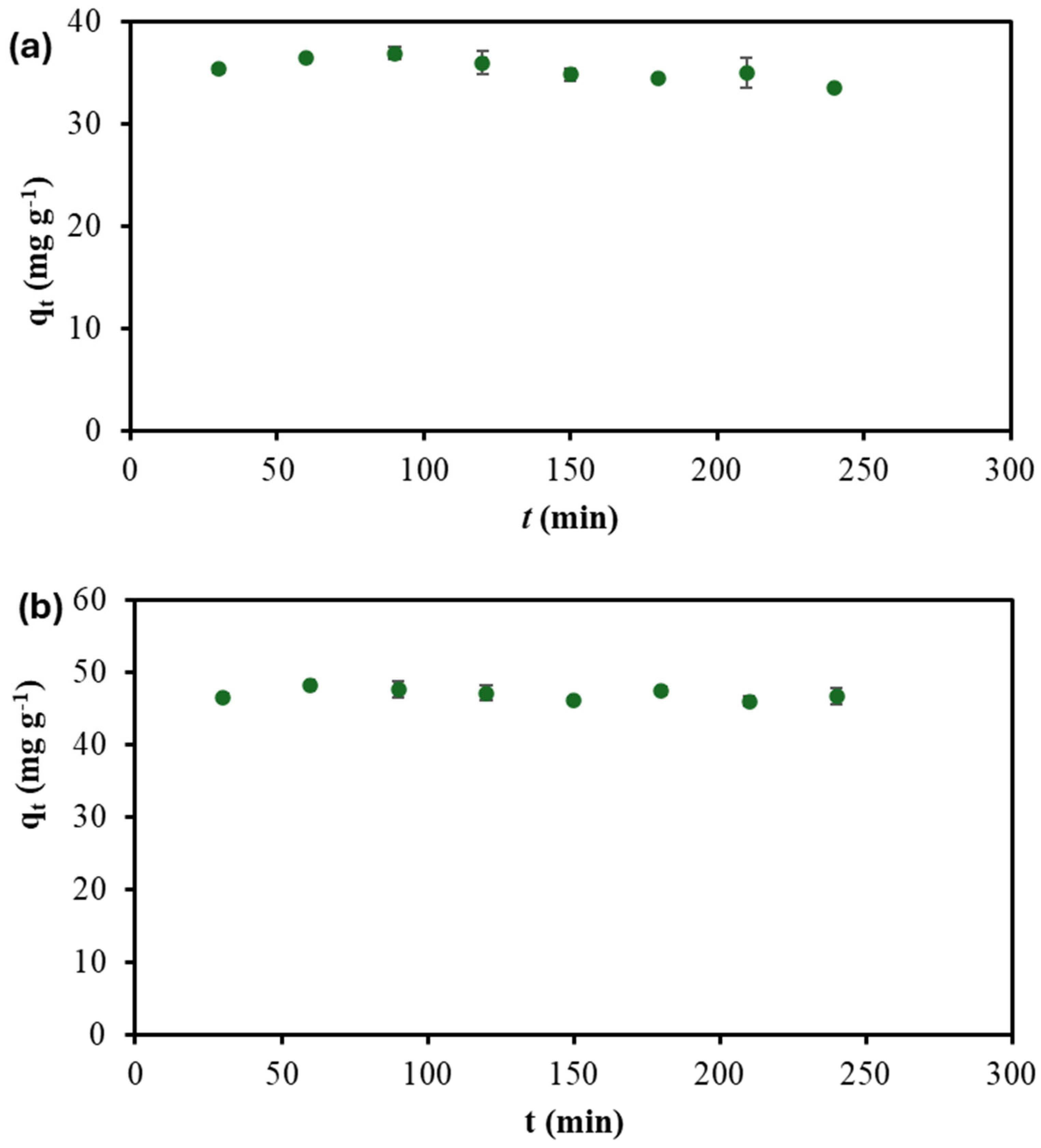
Contact time is an important operational parameter in adsorption because it determines how long the adsorbate–adsorbent system requires to reach equilibrium. This information is relevant to the design and operation of wastewater treatment processes. The adsorption behaviour of CV onto RMS and NaOH-RMS at different contact times is shown in Figure 3. For both adsorbents, adsorption proceeded rapidly during the first 30 min, after which the rate slowed gradually as equilibrium was approached. For RMS, adsorption capacity increased sharply to 35.4 mg g−1 within 30 min and gradually reached equilibrium at 37.0 mg g−1 after 120 min. A similar kinetic trend was observed for NaOH-RMS, albeit with consistently higher adsorption capacities across all time intervals.
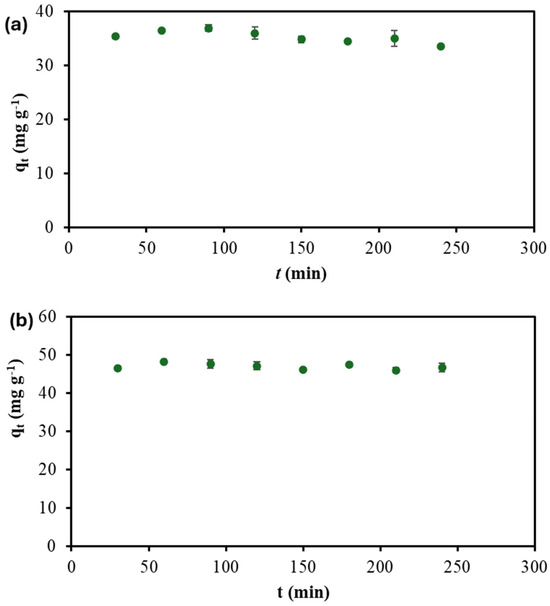
Figure 3.
The effect of contact time on the removal of 100 mg L−1 CV dye at unadjusted pH by (a) RMS and (b) NaOH-RMS.
The initial rapid uptake is attributed to the availability of abundant, energetically favourable active sites on the adsorbent’s external surface. As these sites become progressively occupied, adsorption transitions to a slower regime governed by site saturation and diffusion limitations. The attainment of equilibrium at 120 min indicates that mass-transfer resistance becomes minimal beyond this point.
From a process engineering perspective, equilibrium time is a critical parameter governing reactor sizing and operational efficiency. The 120 min equilibrium time observed in this study is comparable to or shorter than those reported for many biomass-derived adsorbents. For example, equilibrium times of 60 min have been reported for biopolymer composites derived from peanut hull biomass [37] and NaOH-modified rice husk [26]. Surface-modified chitosan beads required 120 min [38], while more structurally complex materials such as chitosan–graphite oxide modified polyurethane [39] and cellulose-based citrus peel/calcium alginate composites [40] required 180 and 240 min, respectively [39]. Inorganic systems such as surfactant-modified bentonite [41] have shown even longer equilibrium times of 200–240 min.
To elucidate the adsorption mechanism, the experimental data were fitted to PFO and PSO kinetic models, as shown in Figures S3 and S4. Model performance was evaluated using (i) correlation coefficients (R2), (ii) error function analysis (ARE, EERSQ, HYBRID, EABS, MPSD, χ2), and (iii) agreement between experimental (qexp) and calculated (qcal) adsorption capacities (Table 1).

Table 1.
Kinetics parameters and error values of PFO and PSO models of the removal of CV by RMS and NaOH-RMS.
For both RMS and NaOH-RMS, the PSO model provided an excellent fit to the experimental data, with R2 values of 0.9991 and 0.9993, respectively, substantially exceeding those of the PFO model (≈0.05). Moreover, the PSO model exhibited markedly lower errors and close agreement between qexp and qcal, confirming its superior predictive capability.
The predominance of the PSO model indicates that the adsorption rate is governed by the availability and accessibility of active sites on the adsorbent surface rather than by simple diffusion alone [42]. For NaOH-RMS, alkaline treatment likely increases fibre swelling and exposes additional deprotonated hydroxyl and carboxyl groups, thereby enhancing the effectiveness of surface sites involved in CV uptake [43]. The faster adsorption behaviour observed for NaOH-RMS is therefore attributed to increased active-site availability and stronger surface–dye interactions, dominated by electrostatic attraction, with possible contributions from hydrogen bonding and π–π interactions [44].
To evaluate whether intraparticle diffusion governs the rate of CV adsorption onto RMS and NaOH-RMS, the WMID model was applied. As depicted in Figures S3c and S4c, the plots exhibit multilinearity, indicating that CV adsorption proceeds via multiple sequential stages. The initial stage, typically associated with external surface adsorption, occurs rapidly within the first few minutes and is not observed in the WMID plots. This is followed by gradual intraparticle diffusion (the first linear portion of the curve) and eventual equilibrium (the second portion of the curve). Similar behaviours are observed in many of our previous works [36,45]. The non-zero intercepts obtained for both adsorbents suggested that intraparticle diffusion was not the only rate-controlling step, and that film diffusion or boundary-layer effects may also contribute to the overall adsorption process.
2.4. Effect of Initial Concentration and Isotherm Modelling
The adsorption behaviour of CV onto RMS and NaOH-RMS was evaluated over an initial concentration range of 10–1000 mg L−1. For both adsorbents, the qe increased progressively with increasing initial concentration. This trend reflects the increasing concentration gradient between the bulk solution and the adsorbent surface, which enhances the mass transfer driving force.
At lower concentrations, adsorption sites are in excess relative to dye molecules, resulting in high percentage removal but comparatively lower qe values. As concentration increases, more dye molecules are available to occupy active sites, leading to higher dye loading per unit mass of adsorbent. At the highest concentrations studied, the gradual approach toward saturation indicates finite site availability rather than diffusion limitation.
NaOH-RMS exhibited strong adsorption across the concentration range studied, but the equilibrium modelling indicates that the effect of alkaline treatment is better understood in terms of altered adsorption behaviour rather than a simple increase in adsorption capacity. This behaviour suggests that alkaline treatment alters the accessibility and distribution of active binding sites, thereby altering the material’s adsorption equilibrium response.
The concentration-dependent behaviour observed here forms the basis for equilibrium isotherm modelling. Equilibrium data were fitted to the Langmuir, Freundlich, and Temkin models to better understand the adsorption behaviour (Table 2 and Table 3, and Figures S5 and S6). Model suitability was evaluated based on correlation coefficients (R2), error analysis (ARE, EERSQ, EABS, HYBRID, MPSD, and χ2), and agreement between experimental and simulated adsorption curves. Adsorption isotherm modelling provides insight into surface heterogeneity, qe, and interaction energetics.
Table 2.
Parameter and error values of the adsorption isotherm models for RMS-CV.
Table 3.
Parameter and error values of the adsorption isotherm models for NaOH-RMS-CV.
For RMS, the Freundlich model provided the best overall description of the experimental equilibrium data. It yielded a higher R2 value (0.972) than the Langmuir (0.916) and Temkin (0.898) models and consistently lower errors across all statistical functions. The improved fit indicates that adsorption occurs on a heterogeneous surface with a non-uniform distribution of adsorption energies. The Freundlich constant n (>1) indicates favourable adsorption of CV onto RMS, while the superior fit of this model suggests that RMS contains adsorption sites with non-uniform energies, which is consistent with the chemically diverse lignocellulosic structure of the raw biomass. The Langmuir model predicted a qmax of 343.7 mg g−1 for RMS. However, the comparatively lower R2 value and greater error in the error analysis indicate that the assumption of ideal monolayer adsorption on a homogeneous surface does not fully capture the adsorption behaviour. The Temkin model showed reasonable agreement (R2 = 0.898), suggesting that adsorbate–adsorbent interactions contribute to a gradual decrease in adsorption energy as surface coverage increases. The high R2, error analysis indicated superior predictive consistency for the Freundlich model; therefore, the Freundlich model most accurately represents the RMS–CV equilibrium system.
For NaOH-RMS, the Langmuir model provided the best overall description of the equilibrium data. It showed the highest R2 value (0.987) and the lowest error values among the tested models (ARE = 9.4%, EERSQ = 2773, HYBRID = 221, EABS = 132, MPSD = 13.0, and χ2 = 15.5), indicating the most consistent agreement between experimental and calculated values. The superior Langmuir fit suggests that CV adsorption onto NaOH-RMS is better represented by monolayer adsorption on a relatively more uniform surface compared with untreated RMS. This change in adsorption behaviour is consistent with alkaline treatment, which can alter the surface structure through fibre swelling and partial removal of non-cellulosic components, thereby creating a more uniform distribution of accessible adsorption sites. The Langmuir model estimated a qmax of 295.2 mg g−1 for NaOH-RMS. Although this value is lower than that obtained for RMS, the improved model fit suggests that the significance of NaOH modification lies not in increasing the theoretical maximum capacity, but in modifying the adsorption behaviour and surface-site distribution of the adsorbent. In contrast, the Freundlich and Temkin models showed poorer agreement, with lower R2 values and higher error terms, indicating that NaOH-RMS is less well described by strongly heterogeneous or interaction-energy-dependent adsorption behaviour under the present conditions.
Overall, alkaline modification did not increase adsorption capacity (343.7 vs. 295.2 mg g−1), but it altered the material’s equilibrium adsorption behaviour. While RMS was better described by the Freundlich model, indicating a heterogeneous adsorption surface, NaOH-RMS was better represented by the Langmuir model, suggesting a more uniform distribution of adsorption sites after modification.
These qmax are compared to those in the literature, where it outperformed peanut hull (33.2 mg g−1) [37], NaOH-modified rice husk (44.9 mg g−1) [26], chitosan–graphite oxide modified polyurethane (64.9 mg g−1) [39], surface-modified chitosan beads required 120 min (97.1 mg g−1) [38] and surfactant-modified bentonite clay (148.9 mg g−1) [41]. The performance of both RMS and NaOH-RMS is comparable to activated carbon derived from spent coffee grounds (352.1 mg g−1) [46].
2.5. Thermodynamics Data
The thermodynamic parameters for CV adsorption onto RMS and NaOH-RMS were determined over 298–343 K (Table 4). For both adsorbents, the negative ΔG° values at all temperatures confirm that the adsorption process is spontaneous. RMS-CV exhibited ΔG° values ranging from −18.55 to −20.54 kJ mol−1, while NaOH-RMS-CV showed more negative values (−21.87 to −26.14 kJ mol−1), indicating stronger spontaneity after alkaline modification [47].
Table 4.
Thermodynamics data of RMS-CV and NaOH-RMS-CV.
The ΔH° value for RMS-CV was −6.35 kJ mol−1, indicating an exothermic process [48]. In contrast, NaOH-RMS-CV showed a positive ΔH° of 10.86 kJ mol−1, suggesting that adsorption becomes more favourable at elevated temperatures after surface modification.
Positive ΔS° values (41.4 and 107.3 J mol−1 K−1 for RMS and NaOH-RMS, respectively) indicate increased randomness at the solid–solution interface during adsorption, likely associated with surface functional group interaction [47]. The higher ΔS° for NaOH-RMS indicates a larger entropic contribution, which increases the thermodynamic driving force, consistent with the altered adsorption behaviour observed after alkaline modification [49].
Overall, CV adsorption onto both materials is spontaneous, and alkaline modification improves the thermodynamic favourability.
2.6. Proposed Mechanisms
The adsorption of CV onto RMS and NaOH-RMS is proposed to be governed primarily by electrostatic attraction between negatively charged surface sites and the cationic dye molecules. More generally, the mechanistic interpretation of modified biomass-derived adsorbents should be linked to structure–function relationships and supported by multiple lines of evidence rather than by adsorption model fitting alone [50]. At solution pH above the respective pHpzc values, deprotonation of surface hydroxyl and carboxyl groups increases surface negativity, promoting strong interaction with CV. The adsorption’s sensitivity to ionic strength supports this interpretation, as charge screening reduces dye uptake. The proposed role of electrostatic attraction is therefore supported by the pHpzc behaviour and the observed pH- and ionic strength-dependent adsorption trends, although direct confirmation of surface charge behaviour would require complementary analysis, such as zeta potential measurements.
Beyond electrostatic forces, FTIR shifts in the O–H and C=O bands suggest the participation of surface functional groups, indicating that hydrogen bonding may also contribute to the stabilisation of the adsorbed dye. The lignocellulosic matrix, which retains aromatic domains, may further enable π–π interactions with the aromatic rings of CV. These combined interactions may explain the strong yet reversible binding observed in regeneration experiments. Taken together, these interactions provide a plausible explanation for the adsorption behaviour observed in the present study, although they should be regarded as proposed rather than definitively confirmed pathways.
Kinetic and thermodynamic analyses are also consistent with this surface-controlled mechanism. The PSO behaviour indicates that the adsorption rate depends on the availability of active sites rather than solely on diffusion. The relatively low enthalpy changes (<20 kJ mol−1) suggest that adsorption is dominated by relatively weak surface interactions, particularly electrostatic attraction and hydrogen bonding, rather than strong covalent bond formation [51].
NaOH modification appears to alter adsorption behaviour by increasing the density and accessibility of functional groups through fibre swelling and partial delignification. Importantly, the modification does not introduce a fundamentally different adsorption pathway, but instead strengthens the same proposed interaction routes by improving the effectiveness of the available surface sites.
Overall, CV adsorption onto both materials proceeds via multiple interactions with the lignocellulosic matrix. For RMS, the Freundlich behaviour is consistent with a heterogeneous surface containing adsorption sites of non-uniform energy, whereas the Langmuir behaviour of NaOH-RMS suggests that alkaline treatment produces a more uniform distribution of accessible sites without substantially increasing the total adsorption capacity.
2.7. Regeneration Study
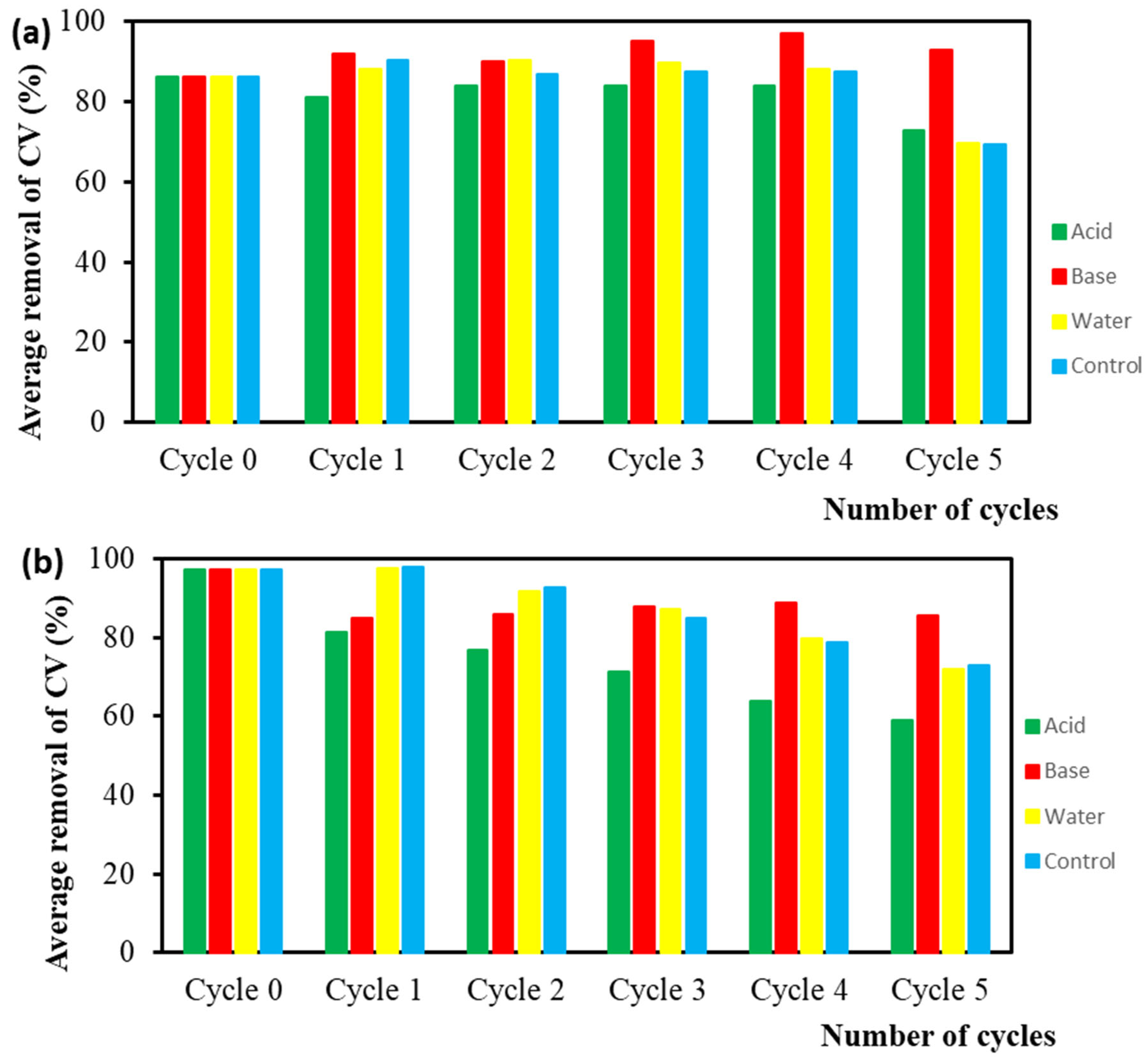
The reusability of RMS and NaOH-RMS was evaluated over five consecutive adsorption–desorption cycles, and the results are shown in Figure 4a,b. The regeneration behaviour depends on how effectively the desorption medium disrupts the interactions between CV molecules and the adsorbent surface, thereby restoring the active sites for subsequent adsorption cycles. For RMS, the initial removal efficiency at Cycle 0 was approximately 86%, and the material maintained relatively stable performance throughout the regeneration study. Base-treated samples consistently exhibited the highest stability, with removal efficiencies remaining above 90% through Cycle 4 and declining only slightly by Cycle 5. In comparison, acid-, water-, and control-treated samples showed a modest decline after repeated cycles, with a more noticeable reduction at the fifth cycle. The overall stability of RMS suggests that the adsorption sites remain largely accessible after desorption and that irreversible blockage or structural degradation is minimal. Base treatment likely promotes desorption by increasing surface deprotonation and weakening electrostatic retention of the cationic dye, whereas acid treatment alters surface protonation and may affect adsorption reversibility differently.
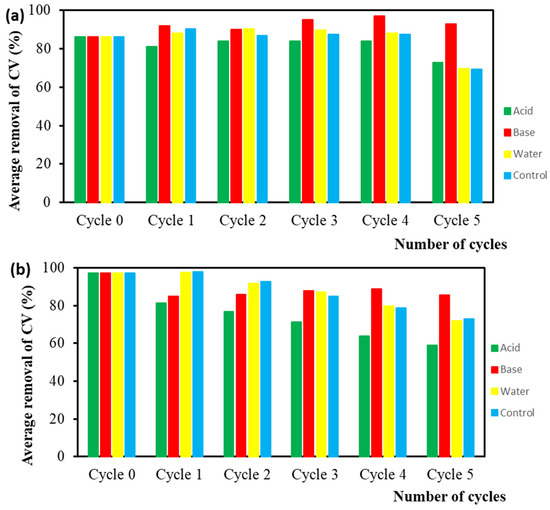
Figure 4.
Regeneration of spent (a) RMS and (b) NaOH-RMS for the adsorption of CV in five consecutive cycles.
For NaOH-RMS, the initial removal efficiency was higher (97%), consistent with its stronger initial adsorption under the selected batch conditions. However, a gradual decline in performance was observed over successive cycles, particularly for samples regenerated using acid. By Cycle 5, acid-treated NaOH-RMS showed a more pronounced reduction in removal efficiency, whereas base-treated samples maintained comparatively higher stability, retaining removal efficiencies above 85%. Water and control treatments resulted in intermediate behaviour, with moderate decreases over the five cycles. The greater sensitivity of NaOH-RMS to regeneration conditions may be associated with the higher density of surface functional groups introduced during alkaline modification, which could be more susceptible to alteration under repeated chemical treatment. The improved stability under basic regeneration conditions further supports the role of electrostatic interactions in the adsorption mechanism, as alkaline treatment promotes surface deprotonation and facilitates desorption of positively charged CV molecules, thereby restoring adsorption sites more effectively for subsequent cycles.
Overall, both RMS and NaOH-RMS demonstrated satisfactory regeneration performance across five cycles, with base treatment providing the most consistent recovery of adsorption capacity. While a gradual decrease in efficiency was observed, particularly for NaOH-RMS under acidic conditions, the retention of substantial removal efficiency after repeated use indicates that the adsorption process is largely reversible and that the structural integrity of the biomass-derived adsorbents is maintained. These findings support the practical applicability of RMS and NaOH-RMS as reusable adsorbents for CV removal.
Although both RMS and NaOH-RMS retained substantial removal efficiency over five cycles, a more rigorous assessment of practical reusability would benefit from direct determination of desorption efficiency and post-regeneration structural characterisation. These aspects were not included in the present study and should be addressed in future work.
2.8. Limitations and Future Work
This study is limited to batch adsorption experiments and does not include additional surface characterisation such as BET surface area, pore size distribution, zeta potential analysis, or XPS, which would provide stronger quantitative support for the proposed changes in surface accessibility, surface charge behaviour, and adsorption mechanism after alkaline treatment. In addition, the performance of the adsorbents was not evaluated under continuous-flow conditions, in multi-component systems, or in real wastewater matrices, all of which are important for assessing practical application. From a valorisation perspective, no techno-economic analysis, life-cycle assessment, or quantitative material flow analysis was conducted in the present study.
Future work should therefore focus on column adsorption behaviour, breakthrough analysis, and longer-term regeneration studies, together with post-regeneration structural characterisation to assess adsorbent stability more rigorously. Additional investigation using real wastewater and more complex contaminant mixtures would also help to establish the practical applicability of RMS and NaOH-RMS. From a circular valorisation perspective, further studies should evaluate the energy demand, environmental burden, scale-up feasibility, and end-of-life management of spent adsorbents to better determine the practical sustainability of this waste-to-material approach.
3. Materials and Methods
3.1. Reagents
Crystal violet (C25H30N3Cl, 90% dye purity, certified by the Biological Stain Commission) was purchased from Sigma-Aldrich (St. Louis, MO, USA), and its structure is shown in Figure S7. Sodium chloride, sodium hydroxide, and hydrochloric acid were purchased from Merck (Darmstadt, Germany, analytical grade) and used as received. A 1000 mg L−1 dye stock solution was prepared by dissolving the required amount in distilled water in a 1.0 L volumetric flask. A serial dilution of the stock solution was performed to obtain other concentrations.
3.2. Preparation of Adsorbents
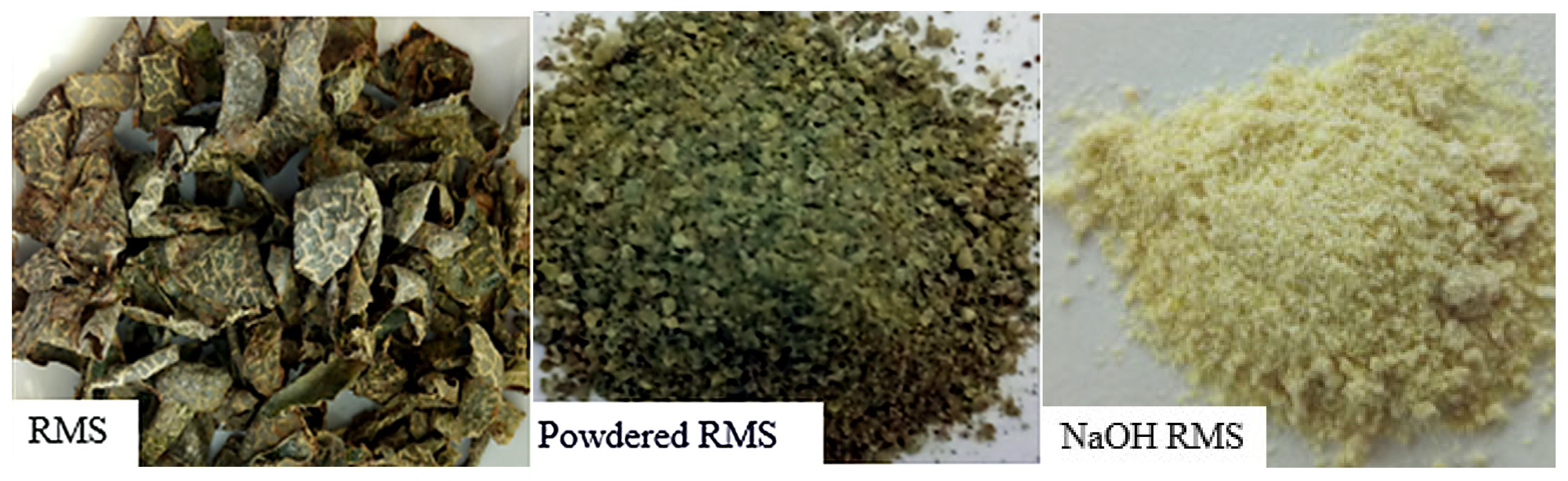
The rockmelons were purchased locally and washed with distilled water to remove surface dirt. The skin was separated from the flesh, cut into small pieces, and first dried in sunlight as a preliminary moisture-reduction step, followed by oven drying at 60 °C until constant mass was reached. The dried samples were then ground and sieved to obtain particles below 355 µm (Figure 5). The prepared RMS was kept in airtight zip-lock bags in a desiccator prior to use.
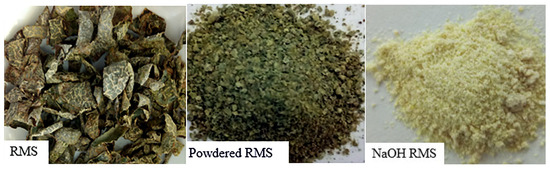
Figure 5.
Photographs showing the RMS in raw, powdered and NaOH-modified forms.
The NaOH-modified RMS (NaOH-RMS) was prepared by treating 50.0 g of dried RMS powder with 1000 mL of 1.0 mol L−1 of NaOH in a 2000 mL beaker, corresponding to a solid-to-liquid ratio of 50 g L−1, following our previous method [23]. The mixture was stirred magnetically for 2 h at ambient laboratory temperature. No external heating was applied during the modification step. The treated solid was then filtered and washed repeatedly with distilled water until the pH was neutral, then oven-dried at 65 °C until constant mass was achieved.
3.3. Instrumentation
Scanning electron microscopy (SEM; JSM-7610F JEOL, Tokyo, Japan) was used to examine the surface morphology of the adsorbents before and after CV adsorption. The samples were sputter-coated with gold prior to imaging. The SEM micrographs were obtained as secondary electron images (SEI) at an accelerating voltage of 2.00 kV and a magnification of ×2000. A Fourier transform Infrared Spectroscopy (FTIR; Shimadzu IRPrestige-21, Kyoto, Japan) was used to acquire the spectra of the adsorbents before and after dye adsorption (KBr pellet-pressed method). The FTIR spectra were collected over the range of 4500–500 cm−1. KBr salt (Sigma-Aldrich, St. Louis, MO, USA, spectroscopic grade) was heated in an oven at 110 °C before use.
3.4. Batch Adsorption Experiment
Batch adsorption tests were typically carried out by contacting 10 mL of CV dye with 0.02 g of adsorbent in a 150 mL conical flask. The mixture was then agitated at 250 rpm at room temperature using a Stuart orbital shaker, Bibby Scientific Ltd., Stone, UK. The mixture was filtered through a Whatman No. 1 filter, and the filtrate was measured at 580 nm using a Shimadzu UV-1601 spectrophotometer, Kyoto, Japan. The study investigated the effects of contact time (0–120 min), pH (2–12), ionic strength (0–1.0 mol L−1 NaCl), and initial dye concentration (0–1000 mg L−1). Each adsorption parameter was investigated independently. When one variable was changed, the other experimental conditions, including adsorbent dosage, solution volume, agitation speed, and temperature, were kept constant unless otherwise stated. For the pH study, the initial pH of the dye solution was adjusted to the desired value using dilute HCl or NaOH before adding the adsorbent. No buffer solution was used. All adsorption experiments were performed in duplicate, and the average values are reported. The variability between replicates is presented as error bars in the relevant figures.
The performance of the adsorption [52] was determined by the following equations:
where Ci is the initial dye concentration (mg L−1), Ce is the dye concentration at equilibrium (mg L−1), m is the mass of adsorbent (g), and V is the volume of adsorbate (L). The adsorption capacity at any time t (qt) was calculated using the same expression as in Equation (1), with Ce replaced by Ct, which represents the concentration of the adsorbate at time t.
Kinetic models, including pseudo-first-order (PFO), pseudo-second-order (PSO), and Weber-Morris intraparticle diffusion (WMID), were employed to characterise adsorption kinetics. The equations and descriptions of the kinetic models are listed in Table S1. The adsorption data were also fitted into various isotherm models (Langmuir, Freundlich and Temkin) to characterise the adsorption process. The equations and description of the isotherm models are listed in Table S2. The best-fitting isotherm models were determined by the coefficient of determination (R2), with values closer to 1.0 indicating a better fit. In addition to the R2, six error functions: average relative error (ARE), sum square error (SSE), hybrid fractional error function (HYBRID), sum of absolute error (EABS), Marquardt’s percent standard deviation (MPSD) and Chi-square test (χ2) were used to determine the best fitting isotherm models. The lower the error values, the closer the fit to the model. The equations are shown in the Supplementary Table S3.
3.5. Thermodynamics Analysis
Thermodynamic parameters were determined by conducting adsorption experiments at different temperatures (298–343 K). The thermodynamic equilibrium constant (Kc) was calculated from the ratio of dye concentration adsorbed onto the solid phase to that remaining in solution at equilibrium. The standard Gibbs free energy change (ΔG°), the enthalpy change (ΔH°), and the entropy change (ΔS°) were calculated using the following equations:
where ΔG° is the Gibbs free energy change (kJ mol−1), ΔH° is the change in enthalpy (kJ mol−1), T is the temperature in Kelvin (K), ΔS° is the change in entropy (J mol−1 K−1), R is the universal gas constant (J K−1 mol−1), Kc is the adsorption coefficient distribution, Cs is the concentration of adsorbate on adsorbent (mg L−1) and Ce is the concentration of adsorbate at equilibrium (mg L−1).
3.6. Regeneration Experiment
Regeneration studies were conducted over five consecutive cycles, using a 1.0 g of adsorbent to 500 mL of dye solution ratio. Initially, the adsorbents were saturated with CV (Cycle 0). The spent adsorbents were then divided and desorbed with acid (1.0 mol L−1 HCl), base (1.0 mol L−1 NaOH), and distilled water. After desorption, the adsorbents were collected and dried overnight at 60 °C in an oven before being reused in the subsequent adsorption cycle. In addition, a control experiment was conducted in which the spent adsorbent was reused without any desorption treatment to evaluate the effect of regeneration. The adsorption–desorption procedure was repeated five times to assess the reusability and stability of the adsorbents.
4. Conclusions
In conclusion, RMS and NaOH-RMS demonstrated effective removal of CV from aqueous solution. The adsorption performance remained stable across the investigated pH range, while increased ionic strength reduced uptake due to charge screening effects, supporting the dominant role of electrostatic interactions. Adsorption for both materials followed the PSO kinetic model, indicating that surface interactions govern dye uptake. Equilibrium analysis revealed that RMS is best described by the Freundlich model, indicating heterogeneous adsorption, whereas NaOH-RMS is better represented by the Langmuir model, suggesting that alkaline modification produced a more uniform distribution of accessible adsorption sites. The Langmuir-derived qmax values were 343.7 mg g−1 for RMS and 295.2 mg g−1 for NaOH-RMS, indicating that alkaline modification did not increase the maximum adsorption capacity but altered the adsorption behaviour of the biomass surface. Thermodynamic analysis showed negative ΔG° values at all temperatures, confirming spontaneous adsorption, with NaOH-RMS exhibiting greater thermodynamic favourability. The improved performance of NaOH-RMS is therefore attributed to enhanced accessibility and interaction efficiency of active sites rather than an increase in total adsorption capacity. Regeneration studies further demonstrated that both materials retained substantial removal efficiency over five consecutive cycles, particularly under basic regeneration conditions.
Overall, the results support the valorisation of rockmelon skin as a low-cost adsorbent for dye-contaminated wastewater. Although NaOH treatment did not increase the maximum adsorption capacity, it altered the adsorption behaviour from heterogeneous Freundlich-type adsorption to a more Langmuir-type pattern, indicating a more uniform distribution of accessible adsorption sites after modification. Combined with satisfactory regeneration performance, these findings highlight the potential of both RMS and NaOH-RMS for resource-efficient and decentralised water treatment applications.
Supplementary Materials
The following supporting information can be downloaded at: https://www.mdpi.com/article/10.3390/recycling11050080/s1, Figure S1: FTIR spectra of (a,b) RMS before and after CV adsorption, and (c,d) NaOH-RMS before and after adsorption; Figure S2: The pHpzc of (a) RMS and (b) NaOH-RMS; Figure S3: The (a) pseudo first order, (b) pseudo second order, and (c) Weber-Morris intraparticle diffusion plots of CV adsorption using RMS; Figure S4: The (a) pseudo-first order, (b) pseudo-second order, and (c) Weber-Morris intraparticle diffusion plots of CV adsorption using NaOH-RMS; Figure S5: The plots of (a) Langmuir, (b) Freundlich, and (c) Temkin isotherm models for the removal of CV using RMS; Figure S6: The plots of (a) Langmuir, (b) Freundlich, and (c) Temkin isotherm models for the removal of CV using NaOH-RMS; Figure S7: The chemical structure of crystal violet dye; Table S1: Kinetic models and their parameters; Table S2: Isotherm models and their parameters; Table S3: The error functions and their equations.
Author Contributions
Supervision, C.M.C. and L.L.B.L.; methodology, L.L.B.L.; Conceptualization, C.M.C. and L.L.B.L., Project administration, C.M.C. and L.L.B.L.; Investigation, A.A.R.; Data curation, A.A.R. and M.R.R.K.; Formal analysis, A.A.R. and M.R.R.K.; Writing—original draft, A.A.R., Validation, M.R.R.K.; Writing—review and editing, C.M.C., L.L.B.L., A.A.R. and M.R.R.K. All authors have read and agreed to the published version of the manuscript.
Funding
This research received no external funding.
Data Availability Statement
The original contributions presented in this study are included in the article and Supplementary Materials. Further inquiries can be directed to the corresponding authors.
Acknowledgments
The authors acknowledge the support of Universiti Brunei Darussalam for facilitating this research. During the preparation of this manuscript, the authors used artificial intelligence tools, including ChatGPT version 5.4 and Grammarly version 6.8.263, solely to improve the clarity, readability, and language of the text. All scientific content, data analysis, interpretation, and conclusions were developed and verified by the authors. The authors take full responsibility for the content of this publication.
Conflicts of Interest
The authors declare no conflict of interest.
References
- Denman, S.; Jameel, S.; Hay, J.; Sugden, J. Photostability of crystal violet (CI 42555). Dyes Pigm. 1996, 30, 67–72. [Google Scholar] [CrossRef]
- Pei, L.; Wu, J.; Wang, Q.; Wang, J. Study of crystal violet hueing dye deposition on fabrics during home laundry. J. Surfactants Deterg. 2016, 19, 795–801. [Google Scholar] [CrossRef]
- Schuetze, A.; Heberer, T.; Juergensen, S. Occurrence of residues of the veterinary drug crystal (gentian) violet in wild eels caught downstream from municipal sewage treatment plants. Environ. Chem. 2008, 5, 194–199. [Google Scholar] [CrossRef]
- Kamimura, R.; Kanematsu, H.; Ogawa, A.; Kogo, T.; Miura, H.; Kawai, R.; Hirai, N.; Kato, T.; Yoshitake, M.; Barry, D.M. Quantitative analyses of biofilm by using crystal violet staining and optical reflection. Materials 2022, 15, 6727. [Google Scholar] [CrossRef]
- Ashraf, M.W.; Collins, M.P.; Mir, M.A.; Salam, A.; Ul-Hamid, A. Separation of crystal violet dye from wastewaters by using supported liquid membrane technology. J. Chem. 2022, 2022, 8143981. [Google Scholar] [CrossRef]
- Šafařík, I.; Šafařı, M. Detection of low concentrations of malachite green and crystal violet in water. Water Res. 2002, 36, 196–200. [Google Scholar] [CrossRef]
- Mani, S.; Bharagava, R.N. Exposure to crystal violet, its toxic, genotoxic and carcinogenic effects on environment and its degradation and detoxification for environmental safety. Rev. Environ. Contam. Toxicol. 2016, 237, 71–104. [Google Scholar]
- Vilén, A.; Laurell, P.; Vahala, R. Comparative life cycle assessment of activated carbon production from various raw materials. J. Environ. Manag. 2022, 324, 116356. [Google Scholar] [CrossRef]
- Lima, I.M.; McAloon, A.; Boateng, A.A. Activated carbon from broiler litter: Process description and cost of production. Biomass Bioenergy 2008, 32, 568–572. [Google Scholar] [CrossRef]
- Shrestha, S.; Kognou, A.L.M.; Zhang, J.; Qin, W. Different facets of lignocellulosic biomass including pectin and its perspectives. Waste Biomass Valorization 2021, 12, 4805–4823. [Google Scholar] [CrossRef]
- Li, W.; Cao, J.; Yang, J.; Wang, Z.; Yang, Y. Production and characterization of lignocellulosic fractions from sisal waste. Ind. Crops Prod. 2021, 160, 113109. [Google Scholar] [CrossRef]
- Abd-Talib, N.; Chuong, C.S.; Mohd-Setapar, S.H.; Asli, U.A.; Pa’ee, K.F.; Len, K.Y.T. Trends in adsorption mechanisms of fruit peel adsorbents to remove wastewater pollutants (Cu (II), Cd (II) and Pb (II)). J. Water Environ. Technol. 2020, 18, 290–313. [Google Scholar] [CrossRef]
- Samet, C.; Valiyaveettil, S. Fruit and vegetable peels as efficient renewable adsorbents for removal of pollutants from water: A research experience for general chemistry students. J. Chem. Educ. 2018, 95, 1354–1358. [Google Scholar] [CrossRef]
- Hashem, A.; Aniagor, C.O.; Farag, S.; Aly, A.A. Adsorption of acid violet 90 dye onto activated carbon and guava seed powder adsorbents. Biomass Convers. Biorefinery 2025, 15, 25825–25839. [Google Scholar] [CrossRef]
- Tolkou, A.K.; Tsoutsa, E.K.; Kyzas, G.Z.; Katsoyiannis, I.A. Sustainable use of low-cost adsorbents prepared from waste fruit peels for the removal of selected reactive and basic dyes found in wastewaters. Environ. Sci. Pollut. Res. 2024, 31, 14662–14689. [Google Scholar] [CrossRef]
- Saleh, A.K.; El-Gendi, H.; El-Fakharany, E.M.; Owda, M.E.; Awad, M.A.; Kamoun, E.A. Exploitation of cantaloupe peels for bacterial cellulose production and functionalization with green synthesized Copper oxide nanoparticles for diverse biological applications. Sci. Rep. 2022, 12, 19241. [Google Scholar] [CrossRef]
- Mohamed, S.A.; Al-Malki, A.L.; Khan, J.A.; Kabli, S.A.; Al-Garni, S.M. Solid state production of polygalacturonase and xylanase by Trichoderma species using cantaloupe and watermelon rinds. J. Microbiol. 2013, 51, 605–611. [Google Scholar] [CrossRef] [PubMed]
- El-Refaey, A.A.; Mohammad, S.G. Removal of lead from aqueous solutions using cantaloupe peels as a biosorbent vs. cement kiln dust as an industrial by-product. Desalination Water Treat. 2019, 166, 62–71. [Google Scholar] [CrossRef]
- Tran, H.N.; Chao, H.-P. Adsorption and desorption of potentially toxic metals on modified biosorbents through new green grafting process. Environ. Sci. Pollut. Res. 2018, 25, 12808–12820. [Google Scholar] [CrossRef]
- Romzi, A.A.; Kooh, M.R.R.; Lim, L.B.L.; Priyantha, N.; Chan, C.M. Environmentally friendly adsorbent derived from rock melon skin for effective removal of toxic brilliant green dye: Linear versus non-linear analyses. Int. J. Environ. Anal. Chem. 2023, 103, 4904–4923. [Google Scholar] [CrossRef]
- Lim, L.B.L.; Priyantha, N.; Bong, X.H.; Zaidi, N.A.H.M. Enhancement of adsorption characteristics of Methyl violet 2B dye through NaOH treatment of Cucumis melo var. cantalupensis (rock melon) skin. Desalination Water Treat. 2020, 180, 336–348. [Google Scholar] [CrossRef]
- Shah, I.; Jing, L.; Fei, Z.M.; Yuan, Y.S.; Farooq, M.U.; Kanjana, N. A review on chemical modification by using sodium hydroxide (NaOH) to investigate the mechanical properties of sisal, coir and hemp fiber reinforced concrete composites. J. Nat. Fibers 2022, 19, 5133–5151. [Google Scholar] [CrossRef]
- Lu, Y.C.; Kooh, M.R.R.; Lim, L.B.L.; Priyantha, N. Effective and Simple NaOH-Modification Method to Remove Methyl Violet Dye via Ipomoea aquatica Roots. Adsorpt. Sci. Technol. 2021, 2021, 5932222. [Google Scholar] [CrossRef]
- Sabry, N.W.; Naeem, I.; Hassanien, S.A.; Abuzalat, O.; Baraka, A. Alkali-treatment of Lupine peels for valorizing adsorption of organic cationic pollutants from wastewater: Kinetics, isotherm, thermodynamic, regeneration, and mechanism. Next Mater. 2025, 8, 100568. [Google Scholar] [CrossRef]
- Li, J.; Chen, C.; Zhu, J.Y.; Ragauskas, A.J.; Hu, L. In situ wood delignification toward sustainable applications. Acc. Mater. Res. 2021, 2, 606–620. [Google Scholar] [CrossRef]
- Chakraborty, S.; Chowdhury, S.; Saha, P.D. Adsorption of Crystal Violet from aqueous solution onto NaOH-modified rice husk. Carbohydr. Polym. 2011, 86, 1533–1541. [Google Scholar] [CrossRef]
- Geng, W.; Narron, R.; Jiang, X.; Pawlak, J.J.; Chang, H.-M.; Park, S.; Jameel, H.; Venditti, R.A. The influence of lignin content and structure on hemicellulose alkaline extraction for non-wood and hardwood lignocellulosic biomass. Cellulose 2019, 26, 3219–3230. [Google Scholar] [CrossRef]
- Xiao, B.; Sun, X.; Sun, R. Chemical, structural, and thermal characterizations of alkali-soluble lignins and hemicelluloses, and cellulose from maize stems, rye straw, and rice straw. Polym. Degrad. Stab. 2001, 74, 307–319. [Google Scholar] [CrossRef]
- Cai, Y.; Lv, J.; Feng, J. Spectral characterization of four kinds of biodegradable plastics: Poly (lactic acid), poly (butylenes adipate-co-terephthalate), poly (hydroxybutyrate-co-hydroxyvalerate) and poly (butylenes succinate) with FTIR and raman spectroscopy. J. Polym. Environ. 2013, 21, 108–114. [Google Scholar] [CrossRef]
- Abu Elella, M.H.; Sabaa, M.W.; ElHafeez, E.A.; Mohamed, R.R. Crystal violet dye removal using crosslinked grafted xanthan gum. Int. J. Biol. Macromol. 2019, 137, 1086–1101. [Google Scholar] [CrossRef]
- Sahoo, S.D. Tunable pH-Responsive Hydrogels for Targeted Dye Adsorption: Advances and Mechanistic Insights. ChemistrySelect 2025, 10, e02294. [Google Scholar] [CrossRef]
- Lyklema, J. Points of zero charge in the presence of specific adsorption. J. Colloid Interface Sci. 1984, 99, 109–117. [Google Scholar] [CrossRef]
- Kosmulski, M. The pH dependent surface charging and points of zero charge. VI. Update. J. Colloid Interface Sci. 2014, 426, 209–212. [Google Scholar] [CrossRef]
- Salehi, M. Surface Complexation at Charged Organic Surfaces. Rev. Mineral. Geochem. 2025, 91, 149–173. [Google Scholar] [CrossRef]
- Hu, Y.; Guo, T.; Ye, X.; Li, Q.; Guo, M.; Liu, H.; Wu, Z. Dye adsorption by resins: Effect of ionic strength on hydrophobic and electrostatic interactions. Chem. Eng. J. 2013, 228, 392–397. [Google Scholar] [CrossRef]
- Kooh, M.R.R.; Dahri, M.K.; Lim, L.B.L. Removal of the methyl violet 2B dye from aqueous solution using sustainable adsorbent Artocarpus odoratissimus stem axis. Appl. Water Sci. 2017, 7, 3573–3581. [Google Scholar] [CrossRef]
- Tahir, N.; Bhatti, H.N.; Iqbal, M.; Noreen, S. Biopolymers composites with peanut hull waste biomass and application for Crystal Violet adsorption. Int. J. Biol. Macromol. 2017, 94, 210–220. [Google Scholar] [CrossRef]
- Pal, P.; Pal, A. Dye removal using waste beads: Efficient utilization of surface-modified chitosan beads generated after lead adsorption process. J. Water Process Eng. 2019, 31, 100882. [Google Scholar] [CrossRef]
- Qin, J.; Qiu, F.; Rong, X.; Yan, J.; Zhao, H.; Yang, D. Adsorption behavior of crystal violet from aqueous solutions with chitosan–graphite oxide modified polyurethane as an adsorbent. J. Appl. Polym. Sci. 2015, 132, 41828. [Google Scholar] [CrossRef]
- Aichour, A.; Zaghouane-Boudiaf, H. Single and competitive adsorption studies of two cationic dyes from aqueous mediums onto cellulose-based modified citrus peels/calcium alginate composite. Int. J. Biol. Macromol. 2020, 154, 1227–1236. [Google Scholar] [CrossRef]
- Anirudhan, T.S.; Ramachandran, M. Adsorptive removal of basic dyes from aqueous solutions by surfactant modified bentonite clay (organoclay): Kinetic and competitive adsorption isotherm. Process Saf. Environ. Prot. 2015, 95, 215–225. [Google Scholar] [CrossRef]
- Ho, Y.-S.; McKay, G. Pseudo-second order model for sorption processes. Process Biochem. 1999, 34, 451–465. [Google Scholar] [CrossRef]
- Chandrasekar, M.; Ishak, M.R.; Sapuan, S.M.; Leman, Z.; Jawaid, M. A review on the characterisation of natural fibres and their composites after alkali treatment and water absorption. Plast. Rubber Compos. 2017, 46, 119–136. [Google Scholar] [CrossRef]
- Guo, S.; Zou, Z.; Chen, Y.; Long, X.; Liu, M.; Li, X.; Tan, J.; Chen, R. Synergistic effect of hydrogen bonding and π-π interaction for enhanced adsorption of rhodamine B from water using corn straw biochar. Environ. Pollut. 2023, 320, 121060. [Google Scholar] [CrossRef] [PubMed]
- Elhassan, M.; Kooh, M.R.R.; Chau, Y.-F.C.; Abdullah, R. Hydrochar from Shorea spp.: A dual-purpose approach for sustainable biofuel and efficient methylene blue adsorbent. Biomass Convers. Biorefinery 2025, 15, 5779–5793. [Google Scholar] [CrossRef]
- Loulidi, I.; Jabri, M.; Amar, A.; Kali, A.; Alrashdi, A.A.; Hadey, C.; Ouchabi, M.; Abdullah, P.S.; Lgaz, H.; Cho, Y.; et al. Comparative study on adsorption of crystal violet and chromium (VI) by activated carbon derived from spent coffee grounds. Appl. Sci. 2023, 13, 985. [Google Scholar] [CrossRef]
- Tang, L.; Yu, J.; Pang, Y.; Zeng, G.; Deng, Y.; Wang, J.; Ren, X.; Ye, S.; Peng, B.; Feng, H. Sustainable efficient adsorbent: Alkali-acid modified magnetic biochar derived from sewage sludge for aqueous organic contaminant removal. Chem. Eng. J. 2018, 336, 160–169. [Google Scholar] [CrossRef]
- Hisarli, G. The effects of acid and alkali modification on the adsorption performance of fuller’s earth for basic dye. J. Colloid Interface Sci. 2005, 281, 18–26. [Google Scholar] [CrossRef] [PubMed]
- Lombardo, S.; Thielemans, W. Thermodynamics of adsorption on nanocellulose surfaces. Cellulose 2019, 26, 249–279. [Google Scholar] [CrossRef]
- Kandel, D.R.; Gaudel, P.; Poudel, M.B.; Yun, W.; Lee, J. Single- and multi-metal engineered, functionalized hybrid biochars for heavy metal adsorption: Synthesis, structure-function relationships, and coordination mechanisms. Coord. Chem. Rev. 2026, 555, 217521. [Google Scholar] [CrossRef]
- Alsharif, M.A. Understanding Adsorption: Theories, Techniques, and Applications. In Adsorption—Fundamental Mechanisms and Applications; Shabatina, T.I., Gromova, Y.A., Eds.; IntechOpen: London, UK, 2025. [Google Scholar]
- Sia, C.J.; Lim, L.H.; Chau, Y.F.C.; Thotagamuge, R.; Lim, C.M.; Kooh, M.R.R. Spent tyre-derived carbon black for Acid Blue 29 adsorption. Mater. Chem. Phys. 2026, 358, 132451. [Google Scholar] [CrossRef]
Disclaimer/Publisher’s Note: The statements, opinions and data contained in all publications are solely those of the individual author(s) and contributor(s) and not of MDPI and/or the editor(s). MDPI and/or the editor(s) disclaim responsibility for any injury to people or property resulting from any ideas, methods, instructions or products referred to in the content. |
© 2026 by the authors. Licensee MDPI, Basel, Switzerland. This article is an open access article distributed under the terms and conditions of the Creative Commons Attribution (CC BY) license.