


Abstract
Injection-molding purges are heterogeneous, bulky residues whose uncertain composition and irregular geometry hinder direct reinsertion, making cold shredding costly and maintenance-intensive. This work develops a low-infrastructure solar-assisted pre-processing route using a PMMA Fresnel lens to induce controlled sub-onset softening and enable clean shear cutting without destructive thermal histories. The sub-onset softening is here defined into a viscoelastically active range (at or above Tg for the amorphous phase) while remaining below the melting onset (Tm, onset) and below the onset of thermal degradation (Td, onset). The station was engineered via QFD and risk-oriented design tools, while a weighted Pugh matrix selected shear cutting over saw-based alternatives. A screening factorial DOE showed that lens height, angle, and their interaction significantly govern focal-spot diameter and receiver temperature, yielding linear relations for conservative set-point selection. Receiver benchmarking further indicated that copper reaches substantially higher temperatures than graphite under identical exposure conditions, supporting copper as the simplest, rapid-heating receiver. Under DOE-calibrated operation, tear-free shear cutting was achieved across representative purge families (PP–ABS, PC–ABS–PP, PA66, PA66-filler, and POM) without forced convection. From a recycling and waste-management perspective, the approach converts bulky purge scrap into mill-compatible feedstock with reduced mechanical resistance, lowering tool wear and fines generation, accelerating downsizing, and limiting stockpiling that elevates combustible-inventory fire risk. Overall, the proposed DOE-calibrated, operator-friendly framework improves recycling feasibility by enabling safer handling, more stable preprocessing throughput, and reduced reliance on disposal or long-term storage for heterogeneous industrial purges.
1. Introduction
Global plastic production has grown into a dominant pillar of modern manufacturing, yet end-of-life management remains structurally weak. A landmark material-flow analysis showed that only a small fraction of all plastics ever produced had been recycled, with most accumulating in landfills or the environment [1]. This imbalance is not merely a consumer-waste issue; it extends to post-industrial streams that are often overlooked despite their volume and relative proximity to controlled supply chains. The literature is clear that increasing circularity requires complementary strategies spanning mechanical recycling of cleaner fractions and more advanced routes for complex and mixed waste [2,3,4].
Policy shifts have further accelerated the need for localized, plant-level solutions. China’s import restrictions reshaped global plastic-waste trade networks. They exposed the environmental costs of export-dependent management, as shown by multi-scale economic and systems assessments of the policy shock and its immediate global ripple effects [5,6,7]. Subsequent regional and applied analyses confirm persistent redistribution of waste flows, mounting pressure on domestic infrastructures, and the emergence of new receiving and processing dynamics, further reinforcing the need for plant-level and local valorization strategies [8,9,10]. These macro trends matter at the micro scale: when heterogeneous streams exceed the economic or technical comfort zone of conventional recycling, industry needs low-infrastructure pre-processing options that can stabilize quality and reduce handling risk. Distributed recycling systems often rely on shear-based granulation, where energy consumption and particle-size distributions can be quantified as operational metrics [11].
Injection-molding purges are a heterogeneous and often neglected solid waste stream composed of irregular, bulky residues generated during machine cleaning to remove residual melt from prior production runs. Because purges combine multiple polymers, additives, and sometimes fillers in nonuniform geometries, their properties can vary within the same piece and across batches, which compromises confidence in downstream performance and limits direct reinsertion into production. The most common families typically include PE, PP, PC, HIPS, ABS, PA (PA6/PA66), and POM, as well as filled or composite variants and multi-polymer mixtures, which are frequently present in mixed or blended forms.
This complexity raises practical barriers: their size and heterogeneity increase shredding costs, accelerate tool wear, and can push the material toward disposal even though timely reduction and reuse would offer clear environmental and safety benefits. In addition to neat polymers and multiphase blends, industrial purges frequently include filler- or reinforcement-containing variants, effectively behaving as composite-like scrap whose downsizing is complicated by anisotropic stiffness, heterogeneous heat conduction, and morphology-dependent cutting resistance. From a composites-processing perspective, aggressive cold shredding can induce excessive tool wear and uncontrolled fracture paths, while thermal overshoot may compromise additive or interphase stability. However, cold shredding and grinding can generate airborne microplastic and nanoplastic particles during size reduction, which strengthens the case for a controlled softening-and-shear preconditioning step that reduces brittleness-driven fines and operator exposure [12]. Therefore, a localized, mechanically controllable solar-softening pre-step is not only a convenience for mixed polymer waste but also a potentially enabling approach for filler-bearing purge families, where conservative thermal exposure and controlled shear initiation are essential for subsequent re-compounding and property management.
Mechanical recycling remains the preferred route when polymer identity and quality can be preserved. Recent studies show that properly managed post-industrial or sector-specific blends (e.g., automotive PC/ABS) can be recycled using mixture-design approaches that control formulation and property trade-offs [13]. Similarly, mechanical recycling routes for ABS/HIPS from WEEE can meet circular-economy criteria when sorting and processing are properly controlled [14]. In parallel, solvent-based separation can upgrade certain ABS-rich streams, but its benefits must be weighed against solvent recovery, emissions control, and operational complexity [15].
In this context, purges represent a boundary case: they are valuable yet awkward, physically challenging to downsize, and often too heterogeneous to justify aggressive or energy-intensive processing without a prior enabling step.
The environmental and operational motivation is twofold. First, recycling plastics can reduce ecological burdens relative to manufacturing with virgin feedstocks, provided that the required properties are maintained. This rationale is reinforced by carbon-footprint analyses of mechanical recycling of post-industrial regrinds (e.g., ABS, PA66GF30, PC, and POM) [16], which show that when processing is kept simple and straightforward, integrity is retained and meaningful reductions compared with virgin production are achievable. Second, broader macro-drivers continue to narrow the easy disposal space for industrial plastics. Climate-change mitigation and the prospect of energy-supply stress underscore the need for low-energy, renewable-assisted valorization routes for hydrocarbon-derived materials. In parallel, the disruption of international plastic-waste trade after China’s import restrictions and subsequent tightening of plastic-waste controls has increased pressure to develop domestic, localized processing options rather than relying on export or landfill as default endpoints. In this setting, the plant-floor bottleneck for purges is often not chemistry but geometry: large, irregular pieces that are costly to shred and risky to stockpile, particularly when inventories elevate fire-risk classifications. Preprocessing particle size is a critical lever for downstream plastics recovery and recycling performance across multiple comminution technologies [17]. Low-cost, distributed recycling strategies frequently rely on shear-based granulation as a front-end size-reduction step, where energy consumption and particle-size outputs can be quantified as operational indicators relevant to process feasibility [11].
From a waste-management standpoint, the principal barrier is not the existence of recycling routes, but the inability to physically condition purge scrap into a form that can enter standard grinding, washing, and re-compounding lines at an acceptable risk and cost. In the local recycler workflow, large pieces are manually reduced before milling. However, purge waste is frequently only received, classified, temporarily stored, and resold, with limited domestic demand and reduced export capacity, which promotes on-site accumulation and associated logistics and fire-risk burdens. In Mexico, inventories of solid combustibles at or above 15,000 kg are classified as high fire risk (NOM-002-STPS-2010 [18]), so any process that accelerates safe downsizing directly contributes to safer storage, faster turnover, and reduced disposal pressure. Therefore, the contribution of the present work is framed as an enabling pre-processing step that improves the operability of mechanical recycling for heterogeneous industrial scrap by reducing the time, maintenance burden, and risk associated with transforming bulky purges into mill-compatible feedstock.
Despite the importance of size reduction for reinsertion, the standard fallback of cold shredding is often economically marginal for purges due to additional infrastructure requirements and accelerated tool wear compared to conventional post-consumer plastics. Moreover, purge morphology and hardness can make conventional grinding ineffective, and manual or industrial cutting approaches can be labor intensive and costly across multiple tool classes. These limitations were documented in our earlier purge-focused study and serve as the operational baseline for searching for safer, lower-maintenance alternatives [19].
Against this background, solar thermal approaches have gained relevance as decentralized, low-operational-cost options for low- and medium-temperature applications. Reviews of solar-heating integration in industry highlight the suitability of many processes for solar-supplied heat [20]. At the same time, broader syntheses of collectors and thermal storage define the engineering basis for such deployments [21]. Fresnel lens concentrators offer a lightweight, cost-effective optical pathway for localized, high-flux delivery, with foundational and modern reviews documenting their performance, logic, and design evolution [22,23]. At a larger scale, demonstration of a Fresnel lens collector field for district heating confirms that these systems can provide stable thermal output under real outdoor variability [24].
Why use solar heat in this context? The aim is not to claim superiority over industrial electric heaters in all settings, but rather to offer a grid-independent, low-operating-cost thermal conditioning option for small recyclers and plants where electrical infrastructure, operating costs, or electrical safety limitations restrict the use of kilowatt-scale heaters. A PMMA Fresnel lens provides high flux with minimal active components, and the necessary mechanical adjustments (height/angle) can be implemented using standard rails and hinge joints, with maintenance comparable to typical workshop fixtures (cleaning, lubrication, and checking fixings). Importantly, the workflow is controlled by the measured receiver temperature rather than a fixed heating time, ensuring robust operation despite natural variations in irradiance.
A recent study directly connected this solar-thermal niche to purge management, proposing that softening-driven cutting using a Fresnel solar collector could overcome shape-driven limitations of purge milling while avoiding high-temperature histories [19].
This concept is scientifically attractive because it reframes purge downsizing as a controlled thermomechanical operation rather than a purely mechanical one. In this work, sub-onset softening is used as an operational definition: the polymer is heated to the minimum temperature range that enables mechanically useful viscoelastic deformation for shear cutting, while remaining below the bulk melting onset (Tm, onset) and the onset of irreversible thermal degradation (Td, onset). For semi-crystalline polymers (e.g., PA66 and POM), this range is governed by activation of the amorphous phase (near/above Tg) and interlamellar shear before melting. Accordingly, exposure time at temperature is kept short to minimize annealing/crystallinity drift. By targeting this constrained range, cutting resistance can be reduced without pushing the material into melt-flow regimes or chemically damaging conditions. This promise is relevant for elastomer-modified blends (PP–ABS), stabilized engineering blends (PC–ABS–PP), semi-crystalline nylons with and without fillers (PA66 variants), and oxidation-sensitive acetals (POM).
Accordingly, this work advances a solar-assisted, Fresnel lens-based softening-and-shear/cutting strategy tailored to the irregular geometry and compositional uncertainty of injection-molding purges, with the explicit objective of enabling safe, reliable size reduction while operating below thermal degradation onsets. Rather than treating purge downsizing as a purely mechanical challenge, the proposed approach reframes it as a controlled thermomechanical pre-processing step: concentrated solar heating is used to induce a sub-onset softening state that reduces cutting resistance and improves shear stability without pushing the material into melting or chemically damaging regimes. To transform this concept into a reproducible pathway suitable for industrial decision-making, the study refines the process into a DOE-calibrated operational framework in which lens height and angle are systematically correlated with spot diameter and receiver temperature, producing quantifiable control maps that can guide real-world settings.
The objective of this work is to design and calibrate a solar thermal conditioning station with a Fresnel lens for heterogeneous purge residues. This station reduces shear resistance due to its geometry and allows for clean shearing under a non-destructive thermal range. Specifically, this quantifies how the controllable characteristics (e.g., lens height and tilt/angle) relate to operational responses (focal spot diameter and receiver temperature), and defines an operating protocol that uses receiver temperature as the primary feedback variable under daily irradiance variability.
This work, therefore, targets the practical bottleneck that keeps purge waste underutilized: large, irregular pieces that are difficult to feed and that trigger manual intervention, stoppages, and stockpiling. A sub-onset softening range of localized heating into a viscoelastically active regime (at/above the Tg of the amorphous fraction) while remaining below the onset of melting (Tm, onset) and below the onset of thermal degradation (Td, onset) is defined and operationalized here, so that the material becomes cuttable without entering destructive thermal histories. Critically, the station is operated by receiver temperature feedback (not by exposure time), which makes the approach robust to daily irradiance variability, such as if the target receiver temperature range is not reached under current conditions, the protocol requires adjusting the optical/geometric controllers or pausing, rather than blindly extending the exposure.
The companion study [19] introduced the concept of Fresnel-softening for purge management and reported on reinsertion-oriented pre/post polymer characterization. The present work does not duplicate such reinsertion datasets. Instead, it provides the engineering pathway necessary for reproducible plant-floor use: (i) QFD translation of recycler requirements into prioritized station features, (ii) selection of the cut mode using a weighted Pugh matrix, (iii) DOE-based calibration maps linking controllable station handles (height and tilt/lens angle) to measurable operational responses (focal spot diameter and receiver temperature), (iv) benchmarking of the receiver framed as time to temperature at the station level, and (v) an operator protocol that treats receiver temperature as the primary feedback variable under irradiance and environmental fluctuations. Together, these elements transform an otherwise trial-and-error concept into a risk-aware, operator-friendly preprocessing station that complements, rather than replaces, conventional downsizing equipment by reducing interventions on large purge pieces.
2. Materials and Methods
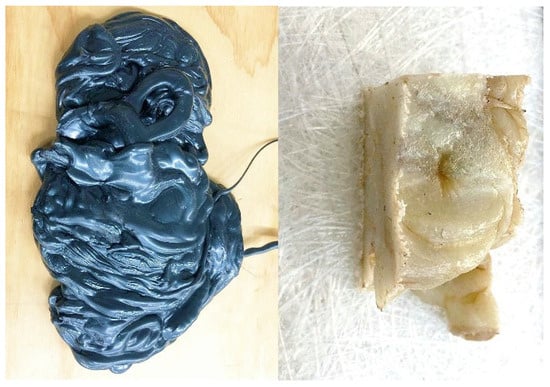
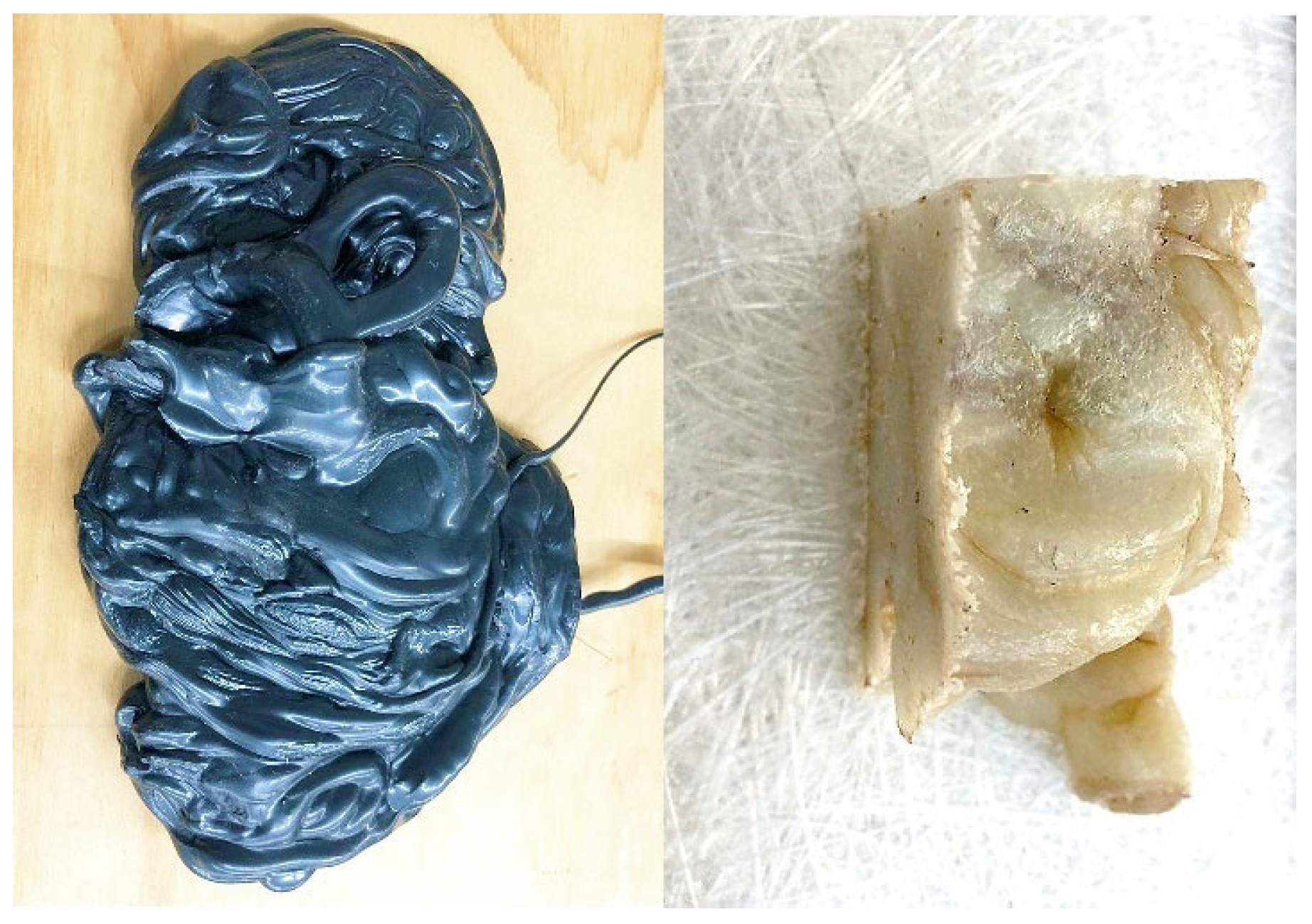
Purges were obtained from an industrial recycler (Reciclajes Victoria, Querétaro, México) and selected to represent the most abundant families in the local injection-molding waste stream: PP–ABS, PC–ABS–PP, PA66 (yellow), PA66 with filler (black), and polyoxymethylene (POM, also known as acetal). Each purge comprised irregular, bulky pieces (Figure 1). These families span multiphase blends with stabilizer packages (PP–ABS and PC–ABS–PP), semi-crystalline systems for which fillers modulate matrix interactions (PA66 and PA66-filler), and POM, which is noted for its relatively high stiffness and oxidative sensitivity. Representative subsamples were selected from each family for paired before/after measurements, enabling within-material comparisons across the workflow.
Figure 1.
Representative injection-molding purge families from the local industrial stream.
2.1. Strategic Design Approach
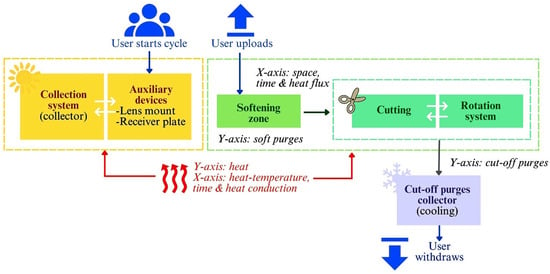
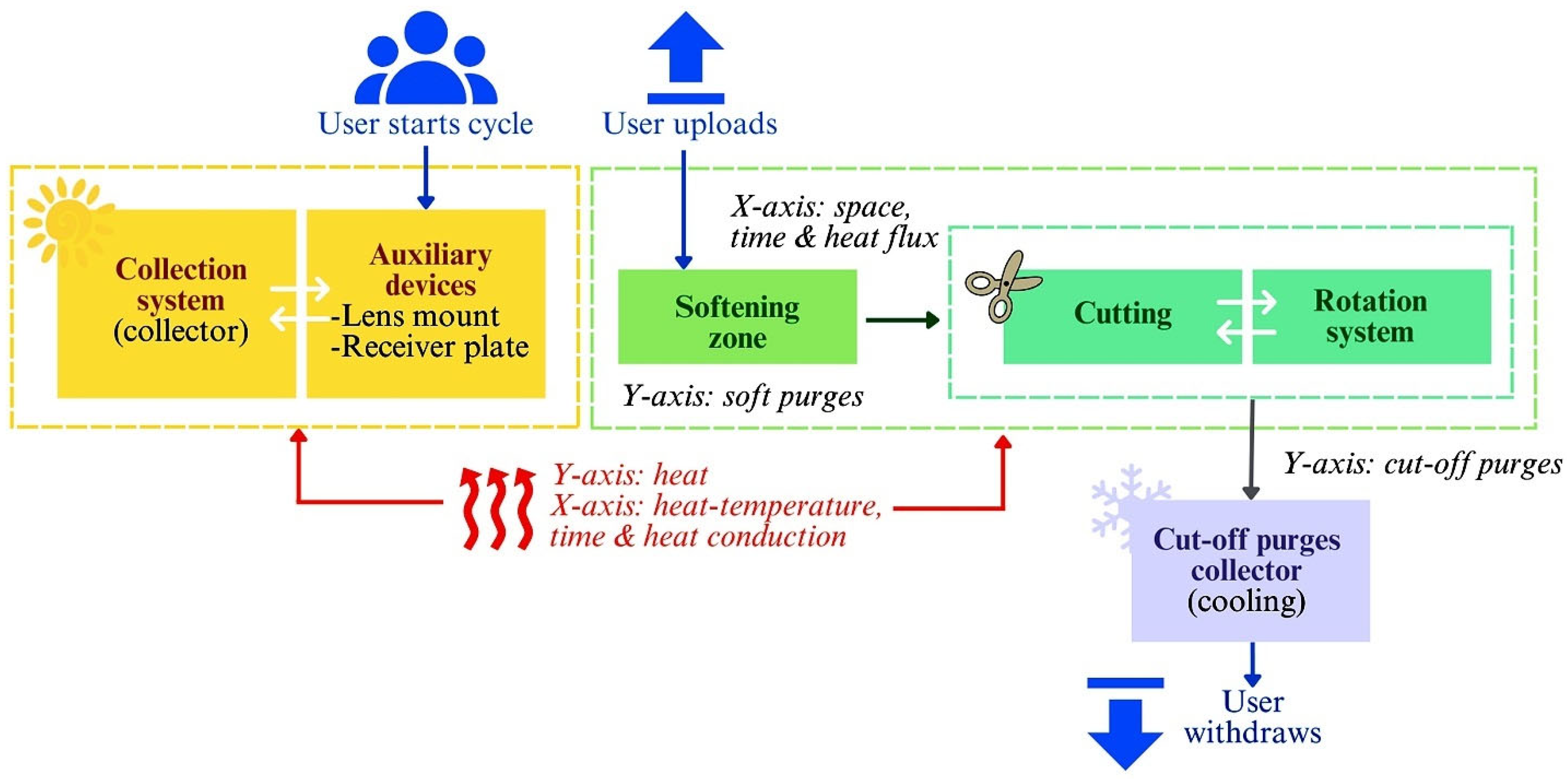
Figure 2 shows the strategic workflow for translating industrial requirements into a range of solar softening and shear-cutting processes. The solar softening station and its cutting integration were substantiated with structured engineering tools. A quality function deployment (QFD) matrix links user needs to measurable design targets [25]. A parameter diagram (P-diagram) and a functional block diagram (FBD) captured energy, control factors, disturbances, and expected responses. A failure-modes-and-effects analysis (FMEA) enumerated risks and prevention/detection actions for the mount, thermal exposure, and handling operations. The structure was modeled in SolidWorks 2018 and analyzed for static stiffness in ANSYS 2019. Granta/ANSYS EduPack 2019 was used for a preliminary screening of receiver and structural materials to balance conductivity, mass, and cost.
Figure 2.
Strategic workflow used to translate industrial requirements into a solar softening and shear cutting process range.
2.2. Solar-Assisted Softening and Selection of the Cutting Mode
Solar-assisted softening used a PMMA Fresnel lens concentrator (Shenzhen Haiwang Sensor Co., Ltd., Xi’an, China) mounted on a mechanically adjustable frame that allowed rotation about the X and Y axes (lens angle) and vertical translation along the Z axis (height). Height and angle served as operative levers to control focal-spot diameter and the temperature achieved at a copper receiver. For the receiver reference test, the copper plate thickness was 1.3 mm and the graphite plate thickness was 8 mm (same footprint and location). Since thickness influences thermal inertia, this comparison is presented solely as a reference parameter for receiver selection at the station level (time to reach temperature) in the tested configuration, not as an intrinsic ranking of copper vs. graphite materials. For context, the surface thermal inertia metric (ρ·cp·t) is necessarily higher for the thicker graphite plate, so slower heating is expected even without considering differences in intrinsic conductivity.
For context, Santiago de Querétaro, México typically receives ~6.4 kWh·m−2·day−1 of global horizontal solar irradiation in June–July (i.e., clear-sky midday irradiance on the order of ~0.8–1.0 kW·m−2), with mid-year ambient temperatures in the ~15–30 °C day–night envelope. The outdoor evaluation was an ambient temperature of 22 °C, relative humidity of 25%, wind speed of 11.9 km·h−1, and a daily solar irradiance of 5.4 kWh·m−2·day−1 (≈5.4 peak-sun-hours), consistent with clear-sky-like midday irradiance on the order of 0.8–1.0 kW·m−2 (not a measured trace, an operational regime statement). These values contextualize the reported warm-up times. Since instantaneous irradiance was not logged as a time series during each test, the operating adjustment values are expressed in terms of receiver temperature feedback rather than a fixed exposure time. The time-to-temperature results should be interpreted within these environmental conditions.
The purge pieces rested on the receiver until they reached a softening state suitable for shear cutting. Receiver temperature was monitored at multiple points to verify spatial uniformity. The objective throughout was thermal softening, not melting or pyrolysis, so that cutting proceeded below degradation thresholds while preserving mechanical integrity within acceptable drift for reinsertion.
Candidate cutting methods (knife-type shears, manual saw, and electric saw) were compared using a Pugh matrix with criteria including cut quality, cost, maintenance burden, ease of use, and installability within the solar station [26]. Shear cutting was selected because it produced homogeneous edges at the lowest equipment and maintenance costs, while avoiding the fine particulate generation typical of saws. Cutting commenced only after the purge piece exhibited localized clean-edge initiation without tearing under modest shear, confirming attainment of the desired softening state.
The selection of the cutting mode was formalized with a weighted Pugh decision matrix to prevent an anecdotal choice (Table 1). Three alternatives were screened: shear/knife cutting, electric saw, and manual saw. Four criteria were used: (i) feasibility of performing the cut, (ii) edge homogeneity, (iii) installation difficulty, and (iv) cost. A fifth criterion, the maintenance requirements, was included but did not differentiate among options in this screening. Each alternative was scored comparatively per criterion (+1 best, 0 intermediate, −1 least favorable) and multiplied by the assigned weight to obtain a weighted sum. The ranking favored shear cutting (weighted sum 17, rank 1) over manual sawing (2, rank 2), while electric sawing ranked last (−17, rank 3). In practical terms, the saw-based options tended to produce irregular cuts and introduce handling uncertainty because fragments can deviate from the intended collection path, motivating the preference for a shear mechanism integrated into the station.
Table 1.
Weighted Pugh matrix for selecting the cutting mode.
2.3. DOE for Focal-Spot and Temperature Control
A factorial design of experiments (DOE) quantified the effects of lens height and lens angle on focal-spot diameter and receiver temperature. A two-factor design with interaction screening and ANOVA was used to build the operational control surfaces following standard DOE practice [27]. The resulting response surfaces support operational prediction and conservative set-point selection intended to remain below material-specific thermal-degradation onsets established in the companion characterization work [19] and defined via thermal-stability screening metrics [28]. The structural model applied the lens self-weight and receiver assembly weight, plus an equivalent lateral load at the lens plane representing wind action, with base constraints at the stand anchors. Reported stresses and deflections correspond to this conservative load case.
3. Results
3.1. Solar Softening Station: Architecture, Control Levers, and Mechanical Feasibility
3.1.1. Station Layout and Control Degrees of Freedom
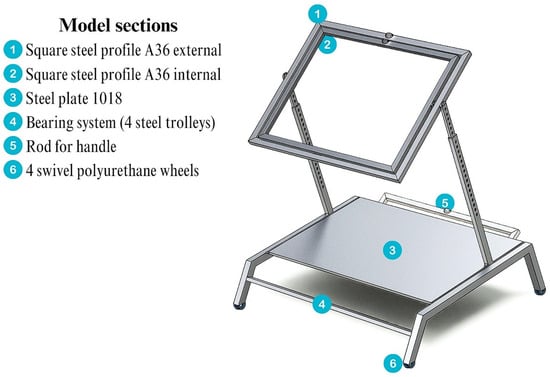
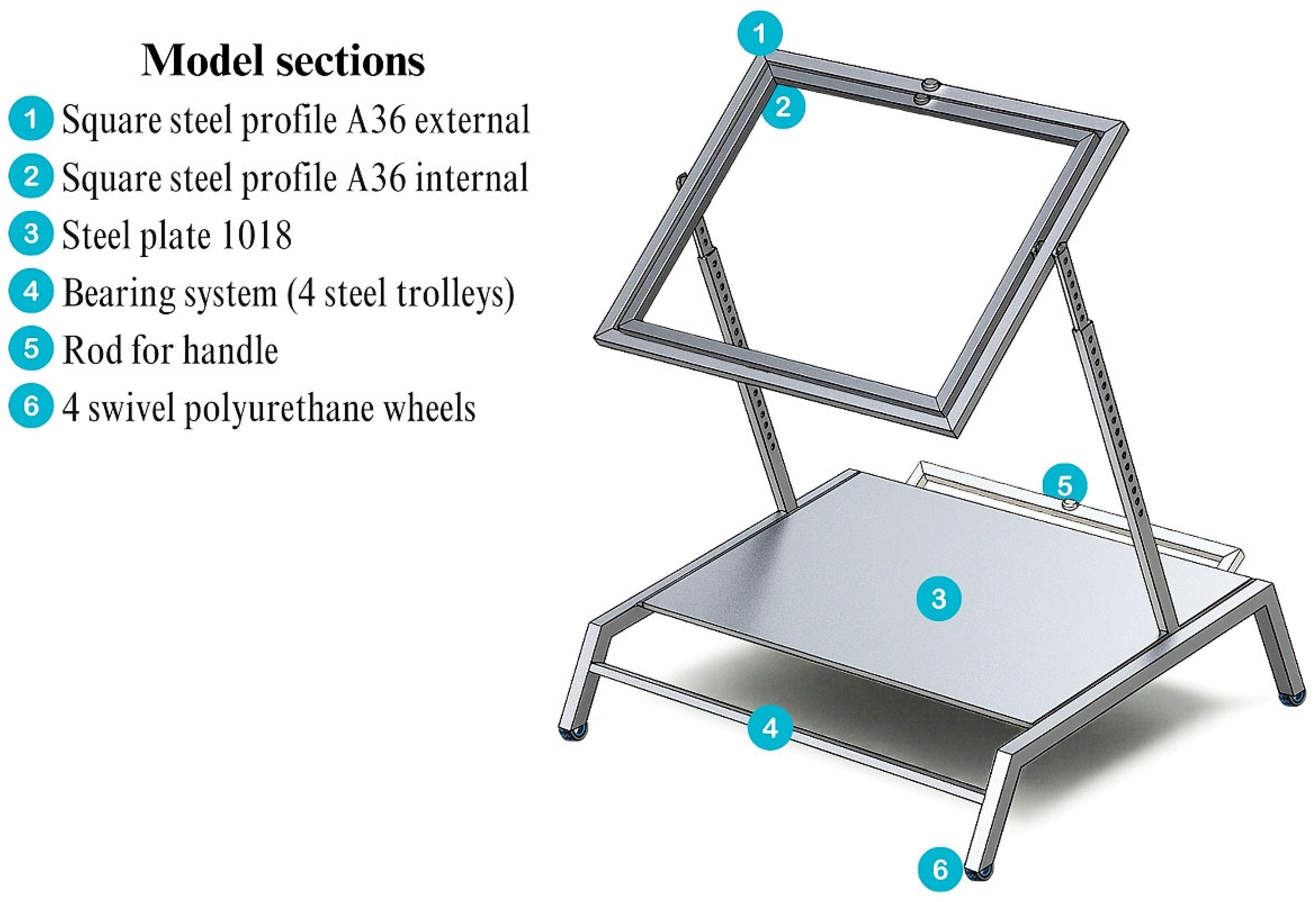
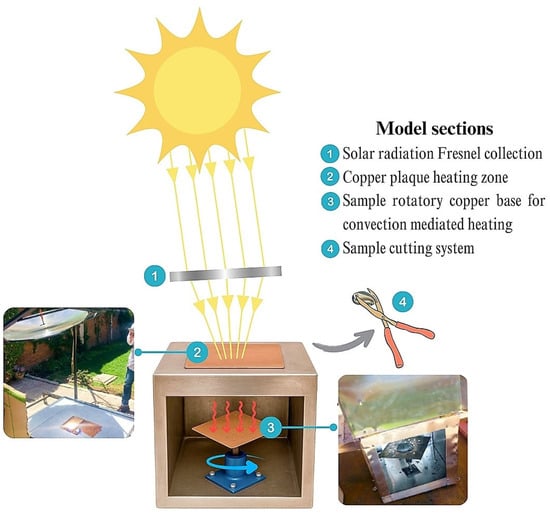
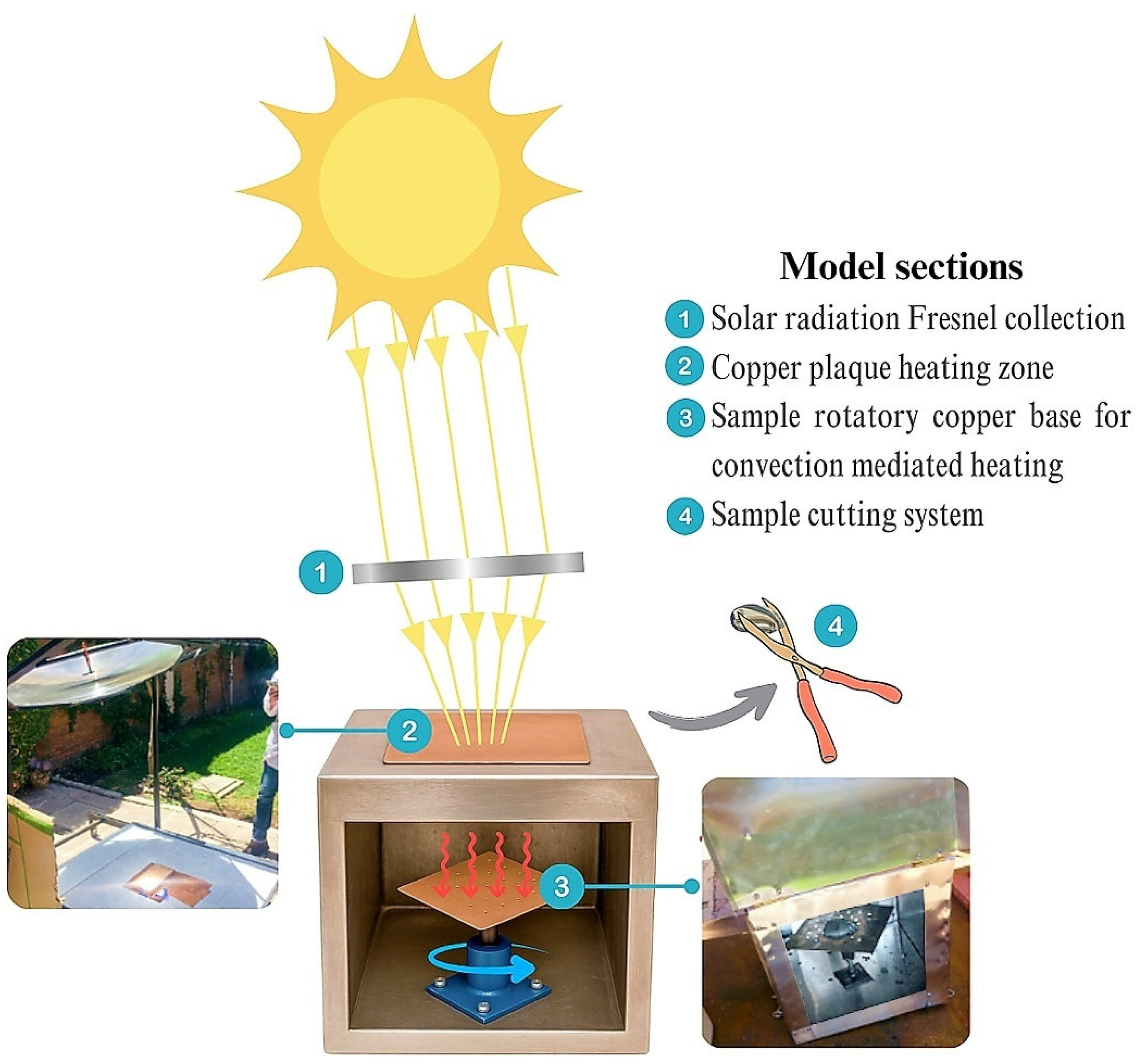
The solar softening station employs a PMMA Fresnel lens (clear aperture 0.98 m, thickness 4 mm, focal length 1.2 m) mounted on a mechanically adjustable frame that provides rotation about the X and Y axes (lens angle) and vertical translation along the Z axis (height). These adjustments control the focal-plane position and focal-spot size on a copper receiver plate (Figure 3). Purge pieces were placed on the receiver and exposed until a softening state suitable for shear cutting was observed. Receiver temperatures were monitored at multiple points using contact thermometry to record the thermal response at inner and outer positions during exposure.
Figure 3.
Solar softening station with Fresnel lens and metallic receiver for sub-onset conditioning.
Figure 3 presents a CAD schematic of the station, including the lens, X–Y angle joints, Z-height rail, receiver, thermometry points, safety shield, and cutting tool. The labeled components, such as lens, X–Y angle joints, Z-height rail, copper receiver, thermometry points, safety shield, and cutting tool, illustrate how the mount was engineered for stable alignment and safe operator handling during outdoor operation.
3.1.2. Mechanical Readiness and Safety Margin
Static stiffness of the frame was evaluated in SolidWorks 2018 and ANSYS 2019 under the modeled loading condition. The predicted maximum deformation was ~10.049 mm, the peak von Mises stress was ~58.662 MPa, and the safety factor was ~4.26.
3.2. Design Translation and DOE-Based Process Calibration
This section reports two output layers produced during station development. First, QFD results (Table 2 and Table 3) translate operational requirements into prioritized technical characteristics of the station. Second, a screening factorial DOE (Table 4) quantifies how lens geometry (height and angle) governs two measurable operational responses: focal-spot diameter and receiver temperature.
Table 2.
QFD matrix for the Fresnel lens solar softening station. Legend: ● strong, 〇 moderate, and ▽ weak.
Table 3.
Technical priority of the station features derived from QFD.
Table 4.
Screening factorial DOE summary for optical–thermal control.
3.2.1. QFD Matrix: Linking Operational Requirements with Technical Features
Table 2 presents the QFD matrix linking operational requirements (WHATs) to station technical characteristics (HOWs) using the strong/moderate/weak coding. Strong relationships are observed in the height and angle adjustment mechanisms for requirements related to focal-spot control, solar alignment, and lens stability. The sample holder tray shows strong relationships with safe placement and retrieval of purge pieces at the focal region. Mobility and clamping elements contribute primarily to usability, stability, and safe handling.
3.2.2. Technical Priority Ranking Derived from QFD
Table 3 reports the normalized technical priorities derived from the QFD weighting. The highest-ranked characteristics correspond to the height adjustment mechanism (1), angle adjustment mechanism (2), and sample holder tray (3), followed by the slider/rail (4) and mobility/clamping elements.
3.2.3. Screening Factorial DOE and Empirical Calibration
A screening factorial DOE was performed to quantify the effects of lens height (Z) and lens angle (X–Y adjustment) on focal-spot diameter and receiver temperature. Here, Z is defined as the lens-to-receiver distance. The reported linear relations are valid only within the tested Z-range for this station configuration. Within that range, the focal-spot diameter decreased monotonically with increasing Z, consistent with operating on one side of the effective focal plane. ANOVA indicated that height, angle, and their interaction were significant (α = 0.05), supporting the use of a two-factor control map (Table 4) for operational set-point selection within the tested range.
For practical one-dimensional estimation during operation, height-based linear relations are reported as empirical calibrations for the specific station configuration and tested range: Diameter (cm) = 98.28 − 0.6429·Height (cm) and Temperature (°C) = −249.6 + 3.836·Height (cm).
The height-only diameter regression shows a strong linear fit (R2 ≈ 0.99, ANOVA p < 0.001), while the height-only temperature regression is moderate but acceptable for screening-level calibration within the tested range (R2 ≈ 0.82, ANOVA p ≈ 0.02).
Table 4 summarizes the DOE outputs and the reported empirical calibrations.
First-principles consistency checks and operational interpretation. Although DOE relationships are empirical and station-specific, their trends are consistent with basic optical and energy balance expectations. Using the clear aperture area of the lens (Alens) and the measured focal spot diameter (dspot), the geometric concentration ratio can be estimated as C = Alens/Aspot, where Aspot = π(dspot/2)2. For an incident solar irradiance G (W/m2), the incident optical power is Pin = G·Alens, and the local flux at the receiver can be approximated as q″ ≈ ηopt·Pin/Aspot, where ηopt pools the lens transmittance, alignment losses, and receiver absorbance. Therefore, the recommended way to operate the station under variable weather conditions is to use height/angle as conservative set points from the DOE map and then confirm that the receiver reaches the target temperature range. Otherwise, the operator adjusts the height/angle (or pauses) instead of relying on a fixed warm-up time.
3.2.4. Independent Thermal-Response Validation Using Metallic and Carbon Receivers
Copper and graphite receiver plates were tested at the same inner and outer positions used in the station to compare heating dynamics under the same station settings and exposure interval. The copper plate thickness was 1.3 mm, while the graphite plate thickness was 8 mm (same footprint and placement). Because thickness dominates thermal inertia, the surface area heat capacity metric (ρ·cp·t) is higher for the 8 mm graphite plate than for the 1.3 mm copper plate, so slower heating is expected. Consequently, the comparison is interpreted as a comparative assessment of time to station-level temperature rather than an intrinsic ranking of material properties.
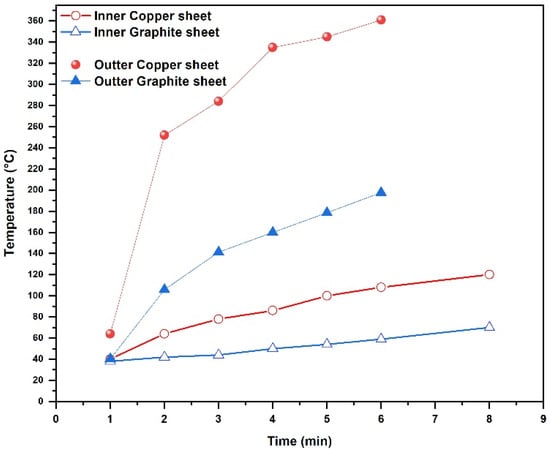
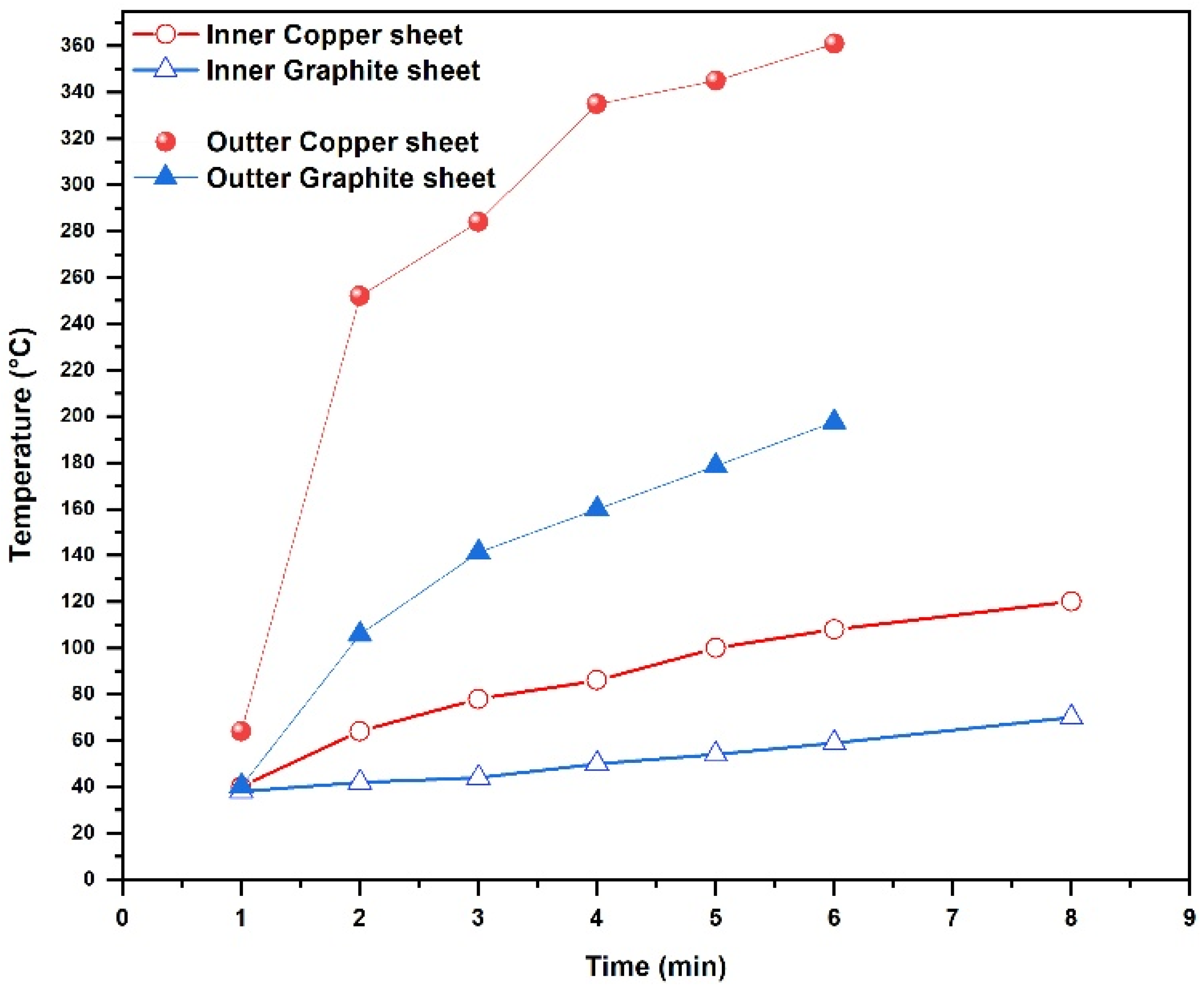
Temperatures were recorded at the inner and outer locations during an 8 min exposure interval using the same contact measurement approach described for the main receiver mapping. Because plate thicknesses varied, the comparison is interpreted as a practical receiver-selection benchmark rather than a thickness-normalized comparison of intrinsic materials. Copper showed the fastest temperature increase, particularly at the outer position, reaching ~360 °C within 6–7 min, whereas graphite stabilized near ~190–200 °C over the same range. The resulting temperature–time profiles are reported in Figure 4.
Figure 4.
Temperature–time profiles for inner and outer positions of copper (1.3 mm) and graphite (8 mm) receiver plates under concentrated solar exposure.
3.3. Practical Demonstration of the Sub-Onset Concept
3.3.1. Sub-Onset Softening Evidence and Operating Range
Operational safety and convenience also motivate temperature feedback for reliable field use. In mid-year outdoor tests in Santiago de Querétaro, México, the copper receiver reached approximately 180 °C in about 15 min and approached 200 °C in about 20 min in the focal region. Since outdoor irradiance and wind speed were not instrumented and can vary considerably, these times should be interpreted as test-specific results. In practice, the receiver temperature (not time) is the operational control variable, and the operator adjusts the height/angle until the target temperature range is achieved. These values are consistent with the requirement that softening occur below the degradation onset for each family [29], while still achieving a processing pace realistic for low-infrastructure industrial handling. Fan-assisted convection did not measurably affect softening duration under the tested conditions. The DOE-driven optical–thermal control map used to select operating settings is shown in Figure 5.
Figure 5.
DOE-driven optical–thermal control of focal-spot diameter and receiver temperature.
The station is designed to operate below the onset of polymer degradation (sub-onset), preventing pyrolysis. However, heterogeneous waste streams may still release odors/VOCs at elevated temperatures. Therefore, operations must be carried out outdoors or with local exhaust ventilation, using PPE (heat-resistant gloves and eye protection), and with conservative set-point temperatures. Halogenated materials (e.g., PVC) and unknown streams containing potential halogenated additives must be excluded due to the risk of decomposition at low temperatures and the potential for corrosive/toxic emissions.
3.3.2. Integrated Softening and Shear Cutting Workflow
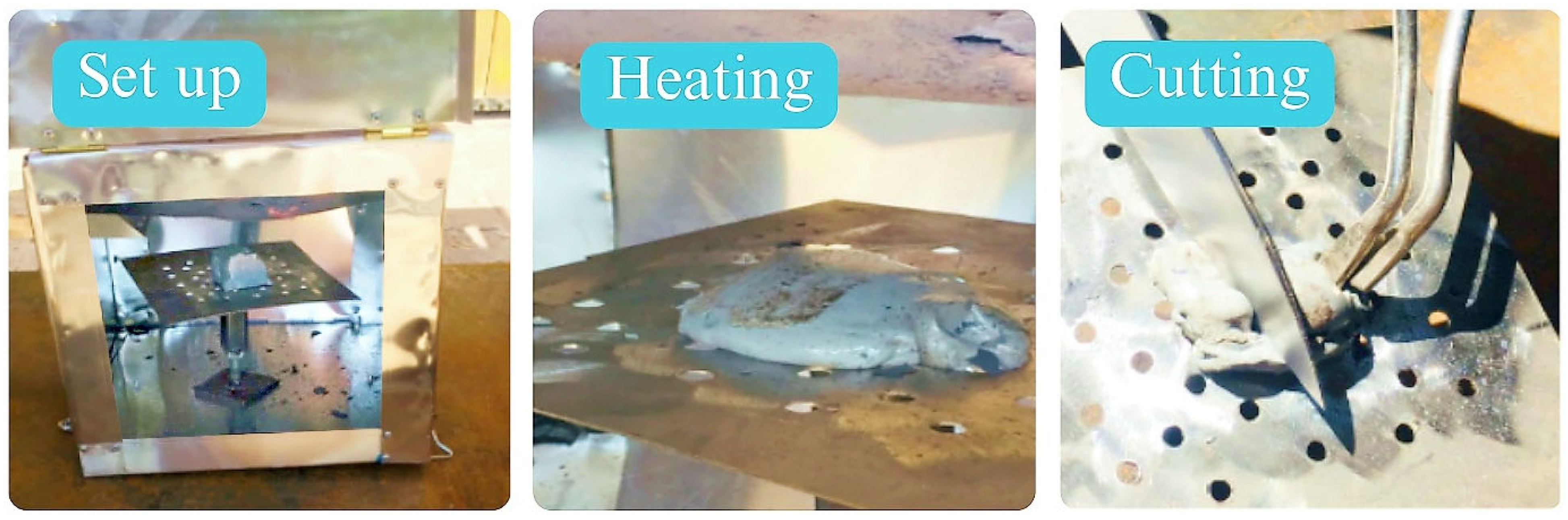
After localized heating, shear cutting produced clean cut edges without visible tearing in the tested purge families (PP–ABS, PC–ABS–PP, PA66, PA66-filler, and POM). The integrated softening-and-shear workflow is illustrated in Figure 6 along with representative cut outcomes.
Figure 6.
Complete configuration for purge softening and shear cutting.
Table 5 summarizes a qualitative flame test analysis performed as an independent identification and coding tool on representative purge samples. It reports on ignition response and combustion behavior under direct flame exposure (not during the solar softening process) and is used only for the preliminary coding of purge families.
Table 5.
Preliminary flame-test observations used for coding of injection-molding purge families *.
The operational implications of the DOE-calibrated softening-and-shear workflow for recycling performance indicators are addressed in Section 3.3, where the technical outputs are mapped to recycler-facing KPIs.
Reinsertion-oriented before/after characterization for the same purge families and Fresnel-softening approach (including mechanical, spectroscopic, and thermal data) is reported in the companion study [19] and is not duplicated here. This work reports station design outputs, DOE calibration, receiver benchmarking, and the demonstrated softening-plus-shear workflow.
4. Discussion
4.1. Design-to-Control Contribution and Robustness of the Control Handles
The central contribution of this work is not simply that concentrated solar energy can soften injection-molding purges, but that the process is framed as a repeatable, operator-controlled pre-processing step. The key shift is conceptual: purge downsizing is treated as a geometry-dominated bottleneck that can be addressed by localized thermomechanical conditioning, rather than as a purely mechanical comminution problem that must be solved by more aggressive shredding.
In that context, the station architecture matters because it defines whether softening is an empirical outdoor trial or a controllable operation. The station’s two mechanical degrees of freedom, lens height and lens angle, are practical control handles that link the focal-spot footprint to the thermal field applied to the purge (Figure 3) [22,23]. The stiffness analysis supports operational robustness under expected outdoor loads (Section 2.1), consistent with treating height and angle as stable control knobs rather than variables susceptible to structural drift. The design-to-control sequence is summarized in Figure 2.
A structured design-to-control sequence was used to move from plant-floor constraints to measurable process settings. QFD and risk-oriented design tools prioritize station features that support safe handling and stable optical alignment, cutting-mode selection is justified through a weighted comparison, and a screening DOE converts the prioritized station levers into empirical operating rules. Together, these elements support a reproducible control framework based on adjustable geometry and calibration rather than operator intuition.
4.2. Optical–Thermal Interpretation: Receiver Choice, Gradients, and the Sub-Onset Range
The practical barrier for recyclers is visible in the purge families themselves: these are not uniform regrind streams, but irregular, heterogeneous pieces whose size and shape obstruct conventional milling and safe handling (Figure 1). This geometry-driven constraint motivates localized heating and controlled shear initiation as the minimum-complexity targets for a feasible pre-processing station.
The optical–thermal results show that station behavior is governed by predictable relationships rather than uncontrolled outdoor variability. The DOE establishes that height, angle, and their interaction govern focal-spot diameter and receiver temperature (Table 4), prerequisites for a controllable operating range. Receiver benchmarking further shows that receiver selection materially affects heating dynamics under the same exposure timing (Figure 4): in the tested configuration, a 1.3 mm copper plate reached higher temperatures faster than an 8 mm graphite plate at both inner and outer positions. Because thickness dominates thermal inertia (ρ·cp·t), this result is reported strictly as a time reference at station-specific temperature for receiver selection under the tested configuration, not as a thickness-normalized intrinsic material comparison.
The sub-onset range demonstrated under representative outdoor conditions is operationally relevant because it couples feasibility and restraint: temperatures on the order of ~180 °C in ~15 min and thorough softening near ~200 °C within ~20 min are fast enough to be practical while still intended to remain below material-specific thermal-degradation onsets established in the companion characterization work [19] and consistent with standard thermal-stability screening practice [30].
The meaning of softening differs among the purge families studied, so the sub-onset range is framed in thermomechanical terms rather than as a single temperature threshold. In multiphase blends (e.g., PP–ABS and PC–ABS–PP), the practical reduction in shear strength relies on the activation of the amorphous/rubber fractions (above the Tg of the relevant phase), while remaining below the melt onset. This preserves shape stability and prevents dripping or uncontrolled flow. In semi-crystalline systems (PA66 variants and POM), the desired effect is also achieved primarily through increased mobility of the amorphous fraction and interlamellar accommodation to shear, which reduces localized shear/cut strength without requiring crystalline melting. Since semi-crystalline polymers can undergo secondary crystallization/annealing at temperatures well below their melting point (Tm), the protocol intentionally relies on temperature feedback and minimizes time: the receiver is brought into the adjustment range, the shearing operation is performed promptly, and prolonged dwell time near the upper limit of the range is avoided. This operational logic preserves the conditioning function of heating (facilitating shearing) while minimizing the risk of increased stiffness or microstructural changes that would counteract the downsizing.
The observation that fan-assisted convection did not measurably affect softening is operationally useful, suggesting that a minimum viable configuration can be simplified without losing core functionality provided operation remains within the DOE-calibrated set-point logic.
Finally, the qualitative flame-test coding is explicitly treated as a rapid internal screening tool to contextualize purge heterogeneity, rather than as a standardized identification or safety certification; it does not replace chemical and thermal boundary-definition methods [19].
4.3. Operational Meaning for Recycling: Why Sub-Onset and Shear Matters
This work provides an operational bridge that maps technical outputs, such as sub-onset softening, shear cutting, and height/angle control, into recycler-facing performance indicators. The proposed pre-processing step targets the dominant bottleneck for purges—geometry-driven resistance to safe and economical downsizing—by reducing cutting demand and enabling clean-edge shear initiation.
The station is not intended to replace the consistent throughput of continuous-feed industrial granulators. Its target bottleneck is the oversized, irregular purge blocks that would otherwise require manual pre-cutting or clog the crushers, increasing downtime and blade wear. In this extreme case, the relevant KPI is the labor and interventions required to make the material feedable, not the nominal consumption in kg/h under ideal continuous conditions. In practice, softening can occur while the operator prepares the next piece and capacity can be increased by connecting stations in parallel or scaling the optical aperture.
The expected facility-level consequences are straightforward: reduced tool wear and maintenance burden compared with aggressive cold shredding, reduced fines/dust generation and operator exposure compared with brittle comminution-dominated routes, shortened time-to-downsize for bulky pieces, and a considerable reduction in prolonged storage of irregular purge inventory. Because comminution behavior and wear contribute to variability in shredding performance, preprocessing routes that reduce mechanical aggressiveness are mechanistically justified interventions rather than convenience features [12,31]. Table 6 summarizes the KPI mapping and indicates expected directions of change at the facility level.
Table 6.
Translation of DOE-calibrated softening and shear cutting into recycling-efficiency and waste-management performance indicators.
4.4. Scope, Limitations, and Reinsertion-Oriented Evidence
This work shows station feasibility, controllability, and an operator-friendly calibration pathway for sub-onset softening followed by shear cutting. Full reinsertion-oriented before/after characterization for the same purge families and solar-softening logic is reported in the companion study [19] and is not duplicated here.
For successful operation, sufficient solar irradiance is required to reach the receiver’s target temperature range within a short verification interval. Therefore, irradiance (W/m2) and ambient temperature are relevant for all outdoor tests. If the receiver does not approach the target temperature range under the current conditions, the operator should adjust the geometry or pause the process rather than prolong the exposure. The maximum size of the processable part is limited by the receiver’s footprint and safe handling geometry. Purge parts must fit entirely within the receiver area and be handled safely without coming into contact with the hot zone. Finally, PVC/halogenated or unknown streams are excluded due to the risks of decomposition and emissions.
Future strengthening would come from directly quantifying (i) cutting-force reduction (or a shear-load proxy) before/after softening, (ii) fines mass fraction generated during downsizing, and (iii) throughput metrics (kg/h) with reported irradiance. Receiver benchmarking could also be extended using thickness-matched plates or heat-capacity-normalized comparisons if the goal shifts from station-relevant benchmarking to intrinsic materials interpretation.
5. Conclusions
This work shows that a mechanically adjustable Fresnel lens station can convert purge downsizing from a purely mechanical bottleneck into a controllable thermomechanical pre-processing step suitable for low-infrastructure deployment. By using two operator-controlled degrees of freedom (lens height and angle), the system provides predictable control over focal-spot diameter and receiver temperature, enabling sub-onset softening without melting or degradation-oriented thermal histories.
A structured engineering pathway was validated: QFD and risk screening guided practical station design, a weighted Pugh matrix selected shear cutting over saw-based alternatives, and a screening factorial DOE confirmed that height, angle, and their interaction significantly govern optical footprint and thermal response, yielding conservative linear relations for set-point selection. Receiver choice was benchmarked as a practical design variable. Under the same exposure interval, a 1.3 mm copper receiver reached markedly higher temperatures compared to an 8 mm graphite receiver at both inner and outer locations, and because thickness dominates thermal inertia (ρ·cp·t), this outcome is interpreted as a station-relevant receiver-selection result rather than a thickness-normalized material-property comparison.
Across representative purge families (PP–ABS, PC–ABS–PP, PA66, PA66-filler, and POM), the DOE-calibrated protocol enabled clean, tear-free shear cutting without forced convection, supporting a simplified minimum viable configuration.
In practical recycling operations, the benefit of the proposed Fresnel lens softening station is not only the attainment of sub-onset conditioning, but also the conversion of geometry-dominated purge waste into a form that can reliably enter conventional size-reduction and reprocessing workflows. This enables measurable improvements in waste-management outcomes, including reduced preprocessing maintenance burden (tool wear), reduced fines and dust generation during downsizing, improved handling safety, and shorter storage times, and reduced inventory accumulation for combustible polymer scrap. Consequently, the proposed DOE-guided softening-and-shear strategy strengthens plant-level decision-making by providing an accessible route to increase the feasibility of recycling heterogeneous purge streams that would otherwise be stockpiled or diverted to disposal pathways.
Author Contributions
Conceptualization, M.L.M.L.; methodology, M.G.P., M.L.M.L., J.d.J.P.B., E.B.P.M. and M.E.P.R.; validation, M.G.P. and M.L.M.L.; formal analysis, M.G.P., M.L.M.L. and J.d.J.P.B.; investigation, M.G.P., M.L.M.L., J.d.J.P.B., E.B.P.M. and M.E.P.R.; resources, M.G.P., M.L.M.L., J.d.J.P.B., E.B.P.M. and M.E.P.R.; data curation, M.G.P., M.L.M.L. and J.d.J.P.B.; writing—original draft preparation, M.G.P., M.L.M.L. and J.d.J.P.B.; writing—review and editing, M.G.P., M.L.M.L., J.d.J.P.B. and M.E.P.R.; visualization, M.G.P., M.L.M.L., J.d.J.P.B. and E.B.P.M.; supervision, M.G.P. and M.L.M.L.; project administration, M.G.P., M.L.M.L. and J.d.J.P.B.; funding acquisition, M.L.M.L. and J.d.J.P.B. All authors have read and agreed to the published version of the manuscript.
Funding
The research was funded by the Tecnológico Nacional de México through projects “Aplicación de aleaciones ternarias en aislamiento acústico”, grant number 8096.20-P, and “Diseño y construcción de dispositivo empleando lentes Fresnel para la concentración de energía solar”, grant number 9274.20-P.
Data Availability Statement
The original contributions presented in this study are included in the article. Further inquiries can be directed to the corresponding authors.
Acknowledgments
The authors express gratitude to Guillermo Eduardo Mejía Hernández, Juan Carlos Méndez Méndez, and Jesús Guerrero Orduna for their technical assistance.
Conflicts of Interest
The authors declare no conflicts of interest.
References
- Geyer, R.; Jambeck, J.R.; Law, K.L. Production, use, and fate of all plastics ever made. Sci. Adv. 2017, 3, e1700782. [Google Scholar] [CrossRef] [Scilit]
- Vollmer, I.; Jenks, M.J.F.; Roelands, M.C.P.; White, R.J.; Harmelen, T.; Wild, P.; Laan, G.P.; Meirer, F.; Keurentjes, J.T.F.; Weckhuysen, B.M.; et al. Beyond Mechanical Recycling: Giving New Life to Plastic Waste. Angew. Chem. Int. Ed. 2020, 59, 15402–15423. [Google Scholar] [CrossRef] [Scilit]
- Ragaert, K.; Delva, L.; Van Geem, K. Mechanical and chemical recycling of solid plastic waste. Waste Manag. 2017, 69, 24–58. [Google Scholar] [CrossRef] [Scilit]
- Gao, T.; Jin, P.; Song, D.; Chen, B. Tracking the carbon footprint of China’s coal-fired power system. Resour. Conserv. Recycl. 2022, 177, 105964. [Google Scholar] [CrossRef] [Scilit]
- Unfried, K.; Wang, F. Importing air pollution? Evidence from China’s plastic waste imports. J. Environ. Econ. Manag. 2024, 125, 102996. [Google Scholar] [CrossRef] [Scilit]
- Wen, Z.; Xie, Y.; Chen, M.; Dinga, C.D. China’s plastic import ban increases prospects of environmental impact mitigation of plastic waste trade flow worldwide. Nat. Commun. 2021, 12, 425. [Google Scholar] [CrossRef] [Scilit]
- Shi, J.; Zhang, C.; Chen, W.-Q. The expansion and shrinkage of the international trade network of plastic wastes affected by China’s waste management policies. Sustain. Prod. Consum. 2021, 25, 187–197. [Google Scholar] [CrossRef] [Scilit]
- Sun, Y.; Liu, S.; Wang, P.; Jian, X.; Liao, X.; Chen, W.-Q. China’s roadmap to plastic waste management and associated economic costs. J. Environ. Manag. 2022, 309, 114686. [Google Scholar] [CrossRef] [Scilit] [PubMed]
- Bourtsalas, A.C.T.; Yepes, I.M.; Tian, Y. U.S. plastic waste exports: A state-by-state analysis pre- and post-China import ban. J. Environ. Manag. 2023, 344, 118604. [Google Scholar] [CrossRef] [Scilit]
- Ošlovnika, T.; Vujanovića, A.; Denacb, M.; Urbancla, D.; Čučeka, L. Assessment of European Union Export Patterns for Plastic Waste before and after China’s Waste Import Ban. Chem. Eng. Trans. 2024, 114, 517–522. [Google Scholar] [CrossRef]
- Ravindran, A.; Scsavnicki, S.; Nelson, W.; Gorecki, P.; Franz, J.; Oberloier, S.; Meyer, T.K.; Barnard, A.R.; Pearce, J.M. Open Source Waste Plastic Granulator. Technologies 2019, 7, 74. [Google Scholar] [CrossRef] [Scilit]
- Swinnerton, S.; Su, J.; Tsai, C.S.J. The emission and physicochemical properties of airborne microplastics and nanoplastics generated during the mechanical recycling of plastic via shredding. Sci. Rep. 2024, 14, 24755. [Google Scholar] [CrossRef] [Scilit] [PubMed]
- Zanatta, S.; Boaretti, C.; Dal Lago, E.; Scopel, L.; Penzo, D.; Modesti, M. Mechanical Recycling of Post-Industrial PC/ABS Blends from the Automotive Sector by Mixture Design. Processes 2024, 12, 349. [Google Scholar] [CrossRef] [Scilit]
- da Silva Müller Teixeira, F.; de Carvalho Peres, A.C.; Pacheco, E.B.A.V. Mechanical recycling of acrylonitrile-butadiene-styrene copolymer and high impact polystyrene from waste electrical and electronic equipment to comply with the circular economy. Front. Sustain. 2023, 4, 1203457. [Google Scholar] [CrossRef] [Scilit]
- Zhao, Y.-B.; Lv, X.-D.; Ni, H.-G. Solvent-based separation and recycling of waste plastics: A review. Chemosphere 2018, 209, 707–720. [Google Scholar] [CrossRef] [Scilit]
- Tinz, J.; de Ancos, T.; Rohn, H. Carbon Footprint of Mechanical Recycling of Post-Industrial Plastic Waste: Study of ABS, PA66GF30, PC and POM Regrinds. Waste 2022, 1, 127–139. [Google Scholar] [CrossRef] [Scilit]
- Fidelis, R.; Marco-Ferreira, A.; Antunes, L.C.; Komatsu, A.K. Socio-productive inclusion of scavengers in municipal solid waste management in Brazil: Practices, paradigms and future prospects. Resour. Conserv. Recycl. 2020, 154, 104594. [Google Scholar] [CrossRef] [Scilit]
- Norma Oficial Mexicana NOM-002-STPS-2010; Condiciones de Seguridad—Prevención y Protección Contra Incendios en los Centros de Trabajo. Diario Oficial de la Federación (DOF): Ciudad de México, Mexico, 2010.
- Plaza, M.G.; Mendoza López, M.L.; Pérez Bueno, J.d.J.; Pérez Meneses, J.; Maldonado Pérez, A.X. Polymer Waste Recycling of Injection Molding Purges with Softening for Cutting with Fresnel Solar Collector—A Real Problem Linked to Sustainability and the Circular Economy. Polymers 2024, 16, 1012. [Google Scholar] [CrossRef] [Scilit]
- Ismail, M.I.; Yunus, N.A.; Hashim, H. Integration of solar heating systems for low-temperature heat demand in food processing industry—A review. Renew. Sustain. Energy Rev. 2021, 147, 111192. [Google Scholar] [CrossRef] [Scilit]
- Tian, Y.; Zhao, C.Y. A review of solar collectors and thermal energy storage in solar thermal applications. Appl. Energy 2013, 104, 538–553. [Google Scholar] [CrossRef] [Scilit]
- Xie, W.T.; Dai, Y.J.; Wang, R.Z.; Sumathy, K. Concentrated solar energy applications using Fresnel lenses: A review. Renew. Sustain. Energy Rev. 2011, 15, 2588–2606. [Google Scholar] [CrossRef] [Scilit]
- Rashid, F.L.; Al-Obaidi, M.A.; Mahdi, A.J.; Ameen, A. Advancements in Fresnel Lens Technology across Diverse Solar Energy Applications: A Comprehensive Review. Energies 2024, 17, 569. [Google Scholar] [CrossRef] [Scilit]
- Jensen, A.R.; Sifnaios, I.; Caringal, G.P.; Furbo, S.; Dragsted, J. Thermal performance assessment of the world’s first solar thermal Fresnel lens collector field. Sol. Energy 2022, 237, 447–455. [Google Scholar] [CrossRef] [Scilit]
- de Oliveira, L.M.V.; Santos, H.F.D.; de Almeida, M.R.; Costa, J.A.F. Quality Function Deployment and Analytic Hierarchy Process: A literature review of their joint application. Concurr. Eng. 2020, 28, 239–251. [Google Scholar] [CrossRef] [Scilit]
- Guler, K.; Petrisor, D.M. A Pugh Matrix based product development model for increased small design team efficiency. Cogent Eng. 2021, 8, 1923383. [Google Scholar] [CrossRef] [Scilit]
- Montgomery, D.C. Design and Analysis of Experiments, 10th ed.; John Wiley & Sons: Hoboken, NJ, USA, 2020. [Google Scholar]
- ASTM International E2550-21; Standard Test Method for Thermal Stability by Thermogravimetry 2021. ASTM International: West Conshohocken, PA, USA, 2021.
- Vyazovkin, S.; Burnham, A.K.; Criado, J.M.; Pérez-Maqueda, L.A.; Popescu, C.; Sbirrazzuoli, N. ICTAC Kinetics Committee recommendations for performing kinetic computations on thermal analysis data. Thermochim. Acta 2011, 520, 1–19. [Google Scholar] [CrossRef] [Scilit]
- Ito, M.; Nagai, K. Analysis of degradation mechanism of plasticized PVC under artificial aging conditions. Polym. Degrad. Stab. 2007, 92, 260–270. [Google Scholar] [CrossRef] [Scilit]
- Lasch, T.; Khodier, K.; Feyerer, C.; Lehner, M.; Sarc, R. Influence of material–material interactions and wear on coarse waste shredders. Waste Manag. Res. 2025, 43, 1234–1244. [Google Scholar] [CrossRef] [Scilit]


Disclaimer/Publisher’s Note: The statements, opinions and data contained in all publications are solely those of the individual author(s) and contributor(s) and not of MDPI and/or the editor(s). MDPI and/or the editor(s) disclaim responsibility for any injury to people or property resulting from any ideas, methods, instructions or products referred to in the content. |
© 2026 by the authors. Licensee MDPI, Basel, Switzerland. This article is an open access article distributed under the terms and conditions of the Creative Commons Attribution (CC BY) license.