


Abstract
Recovered fibres support packaging circularity but may carry contaminants from previous uses, printing, converting, and recycling. Their safety assessment is complicated by the absence of a harmonised European Union material-specific measure for food-contact paper and board. The objective of this study was to characterise selected chemical contaminants and transfer behaviour in three commercial paperboards differing in fibre composition and converting history, and to determine which regulatory conclusions could be supported when the resulting analytical endpoints were evaluated under current European reference frameworks. Predominantly virgin-fibre Kraftliner, mixed-fibre Brown Testliner, and a printed French fries box containing deinked and mechanically recycled fibres were examined. Selected metals and organic contaminants were determined using applicable standardised or laboratory procedures, while bleeding of colourants and fluorescent whitening agents and transfer of antimicrobial constituents were assessed according to relevant European standards. Most targeted contaminants were below method-specific reporting limits or the applied reference criteria. Lead was quantified only in the Brown Testliner (0.327 mg kg−1 paperboard). This value was below the mass- and surface-based criteria compiled in the Food Contact Guidelines for the Compliance of Paper and Board Materials and Articles but, when calculated using the extraction ratio specified in EN 645, corresponded to approximately 13.1 µg L−1 of cold-water extract, slightly above the criterion of 10 µg L−1 specified in Recommendation XXXVI of the German Federal Institute for Risk Assessment. The Brown Testliner also had the highest diisopropylnaphthalene and total phthalate contents (14.7 and 19.6 mg kg−1, respectively). Because individual primary aromatic amines and phthalates were not identified or quantified, the applicable substance-specific criteria could not be fully evaluated. The Brown Testliner showed colour transfer with polar test fluids, whereas the printed box showed fluorescent whitening agent transfer grades of 3–4 under aqueous conditions and grade 5 with olive oil. No inhibition zones were observed in the antimicrobial-transfer assays. Although limited to three individual materials, the findings show that interpretation depends on the finished article, intended contact conditions, analytical endpoint, and applied reference framework. Harmonised, endpoint-specific criteria would support more consistent assessment of recycled-fibre paperboard for food-contact use.
1. Introduction
Paper and board are central materials in the transition towards a circular packaging economy. Under the European Declaration on Paper Recycling 2021–2030, the European paper value chain committed to reach a paper recycling rate of 76% by 2030. This target was already exceeded in 2025, when 76.4% of the paper and board consumed in Europe was recycled. The recycling rate is calculated as the ratio of the amount of used paper recycled, including net trade in paper for recycling, to the consumption of new paper and board [1]. The continued use of recovered fibres reduces demand for primary raw materials and supports resource efficiency. However, increasing material circularity may also prolong the presence of chemicals introduced during previous production, converting, printing, use, and disposal cycles.
Recovered paper may contain residues of printing inks, adhesives, coatings, biocides, plasticisers, mineral oils, and other substances originating from both food-contact and non-food-contact applications. Contaminants frequently reported in recycled paper and board include phthalates, mineral oil hydrocarbons, diisopropylnaphthalenes (DIPNs), bisphenols, primary aromatic amines (PAAs), polychlorinated biphenyls (PCBs), formaldehyde, and fluorescent whitening agents (FWAs) [2,3,4,5,6,7]. Some of these substances may migrate into food, particularly during prolonged contact or under conditions involving moisture, acidity, elevated temperature, or fatty foods. Their transfer depends on the origin and quality of the recovered fibres, the physicochemical properties of the substances, the effectiveness of cleaning and deinking operations, the structure of the final material, and the presence of functional barriers. Experimental studies on recycled linerboard and commercially produced recovered-fibre papers have shown that flotation deinking can reduce the concentrations of selected chemical contaminants [8,9], while reductions in mineral oil hydrocarbons have also been demonstrated for other recovered paper grades [10]. However, removal efficiency varies among substances and process conditions, and the complete elimination of contaminants cannot be assumed [2,5].
Food-contact materials (FCMs) comprise materials and articles intended to come into contact with food, those already in contact with food, and those that can reasonably be expected to come into contact with food or transfer their constituents into food under normal or foreseeable conditions of use. Within the European Union, all FCMs are subject to Regulation (EC) No. 1935/2004, which requires that materials and articles do not transfer constituents to food in quantities that could endanger human health, cause an unacceptable change in food composition, or impair its organoleptic properties [11]. Regulation (EC) No. 2023/2006 additionally establishes requirements for good manufacturing practice [12].
The general requirements of the Framework Regulation may be supplemented by material-specific EU measures. Such measures translate the general safety obligation into more detailed and uniformly applicable provisions for a particular material or group of materials. The most comprehensive example is Regulation (EU) No. 10/2011 on plastic materials and articles intended to come into contact with food [13]. It establishes a Union list of substances authorised for the manufacture of plastics, compositional requirements, specific and overall migration limits, food simulants, standardised testing conditions, and requirements for declarations of compliance. These provisions allow plastic FCMs to be assessed according to a common set of rules throughout the EU [11,13,14].
No comparable harmonised EU material-specific measure has been adopted for paper and board. Similarly, there is no comprehensive EU-specific measure for printing inks and several other components widely used in packaging. In the absence of harmonised provisions, Article 6 of Regulation (EC) No. 1935/2004 allows Member States to maintain or adopt national rules. Consequently, the assessment of paper and board relies on a fragmented combination of national legislation, national recommendations, Council of Europe guidance, and voluntary industry documents. These frameworks differ in their legal status, scope, authorised or recommended substances, restrictions, testing approaches, and documentation requirements [11,14].
Outside Europe, paper and board intended for food contact are also addressed through national or regional material-specific provisions in several jurisdictions. In the United States, the U.S. Food and Drug Administration’s indirect food additive provisions include 21 CFR Part 176, which specifically addresses paper and paperboard components [15]. MERCOSUR has adopted a regional technical regulation for cellulosic materials, packaging, and equipment intended for food contact (MERCOSUR/GMC Resolution No. 40/15) [16]. In Asia, China applies the national food safety standard GB 4806.8-2022 to food-contact paper and board materials and articles [17]. These examples illustrate different jurisdiction-specific approaches to the regulation of paper and board. A detailed comparison of their coverage, implementation, and legal status is beyond the scope of this study, which focuses on regulatory fragmentation within the European Union and on the wider European technical frameworks relevant to materials obtained from the Croatian market.
The regulatory fragmentation affecting non-plastic food-contact materials is not a recent concern. An EFSA Scientific Cooperation (ESCO) Working Group reported in 2011 that thousands of substances used in paper and board, printing inks, coatings, and other non-plastic food-contact materials were not covered by harmonised EU-level safety assessment, while the available national evaluations differed in scope, recency, underlying data, and traceability [18]. A subsequent Joint Research Centre baseline study documented continuing disparities among national measures, including differences in the substances covered, the types and numerical values of restrictions, compliance documentation, and available testing methods [19]. These longstanding limitations were formally confirmed by the European Commission’s 2022 evaluation, which concluded that the existing FCM regulatory system was only partly effective and suboptimal, particularly for materials without harmonised specific measures, non-intentionally added substances (NIAS), supply-chain information, enforcement, and emerging recycling technologies [20]. The Commission is therefore working towards revised EU legislation on food-contact materials, but a harmonised material-specific measure for paper and board has not yet been adopted [21].
At the broader European level, Resolution CM/Res(2020)9 of the Council of Europe establishes general principles for the safety and quality of food-contact materials, while the 2021 Technical Guide issued by the European Directorate for the Quality of Medicines & HealthCare (EDQM) provides more detailed recommendations concerning raw materials, recycled fibres, compliance testing, supporting documentation, and declarations of compliance [22,23].
Several additional reference frameworks are used to support the safety assessment of paper and board and the demonstration of compliance with applicable requirements. Recommendations of the German Federal Institute for Risk Assessment (BfR), particularly Recommendation XXXVI on paper and board, and the Food Contact Guidelines issued by the Confederation of European Paper Industries and the International Confederation of Paper and Board Converters in Europe (CEPI/CITPA) are among the most widely used technical references in European practice [24,25]. Although the BfR Recommendations are not legally binding, they provide scientifically evaluated criteria and are widely used as a technical benchmark both within and outside Germany. The CEPI/CITPA Industry Guideline was first published in 2010 and revised in 2012. Its completely rewritten successor, the Food Contact Guidelines issued in 2019 and amended in 2021, provides a voluntary industry methodology for assessing the suitability of paper and board for their intended food-contact applications, including guidance on testing, supply-chain information exchange, and compliance documentation [25].
A draft second edition of the EDQM Technical Guide was released for stakeholder consultation in 2026 and proposes updated provisions for substances including phthalates, PAAs, mineral oil aromatic hydrocarbons, formaldehyde, chloropropanols, bisphenols, and per- and polyfluoroalkyl substances (PFAS). At the time of manuscript preparation, however, this document remained a consultation draft and should not be treated as an adopted requirement [26].
Interpretation of analytical data is complicated primarily by the absence of a harmonised EU assessment framework and by differences among the national requirements and recommendations used in individual Member States. The CEPI/CITPA Guidelines compile criteria derived principally from these national sources. Consequently, in the absence of an EU-specific measure, the applicable legal requirement or the technical benchmark used to assess paper and board may depend on the Member State in which the material is placed on the market. The criteria applied to lead, a potential contaminant in recycled paper and board, clearly illustrate this fragmentation. BfR Recommendation XXXVI specifies 10 µg L−1 in a cold-water extract, the Italian national measure sets a limit of 3 µg dm−2 of paper or board, and guidance of the French Directorate-General for Competition, Consumer Affairs and Fraud Control (DGCCRF) specifies 3 mg kg−1 of paper or board [25]. These values are not alternative EU-specific migration limits, but national extract- or material-based criteria expressed on different analytical bases and having different legal or advisory status.
The distinction between these types of criteria is important. A specific migration limit (SML) defines the maximum amount of a substance permitted to transfer into food or a food simulant and is usually expressed in mg kg−1 food. Material-content criteria may instead be expressed per unit mass or surface area of the finished paper or board, while some national criteria refer to the concentration measured in a specified extract. Conversions between reporting bases can be made using the measured grammage and, where appropriate, the CEPI/CITPA full-transfer calculation. Such calculations facilitate comparison with the relevant criterion but do not constitute experimentally measured migration. The calculation procedures applied in this study are described in Section 4.7.
A more fundamental problem arises when the analytical endpoint does not correspond to the regulatory endpoint. For example, a result reported as total phthalate content cannot demonstrate compliance with limits established for individual phthalates or specified groups unless the individual substances are identified and quantified. For DIPNs, the available guidance applies an as-low-as-technically-achievable approach rather than a harmonised numerical EU limit. Differences in legal status, material scope, substance definition, test basis, and assessment approach—not reporting units alone—can therefore lead to different interpretations of the same analytical dataset [23,24,25,26].
The regulatory context has become increasingly relevant following the adoption of Regulation (EU) 2025/40 on packaging and packaging waste (PPWR) [27]. The PPWR establishes requirements relating to packaging minimisation, recyclability, design for recycling, and high-quality recycling and has applied generally since 12 August 2026. Its mandatory minimum recycled-content percentages are directed primarily at plastic packaging and do not impose corresponding recycled-fibre percentages for paper and board. Nevertheless, the Regulation is relevant to fibre-based food packaging because it increases the emphasis on recyclable packaging systems and chemically safe secondary raw-material streams. It also introduces PFAS concentration limits applicable to food-contact packaging. The PPWR therefore complements food-contact legislation but does not resolve the absence of harmonised compositional, testing, and migration requirements for paper and board.
Although numerous studies have reported individual contaminants or migration phenomena in paper and board, relatively few studies combine measurements of chemical content and extractable substances with standardised transfer tests and explicitly examine how the resulting data can be interpreted under different European reference frameworks [2,3,4,5,6,7,23,24,25]. This distinction is important because a result can be compared directly with a reference criterion only when the substance definition, analytical endpoint, test conditions, and reporting basis correspond to those specified by that criterion. If they do not correspond, numerical comparison alone cannot establish compliance or non-compliance.
Against this background, this study was designed as a comparative case study of three commercial paperboard materials differing in fibre composition and converting history: a predominantly virgin-fibre Kraftliner, a mixed-fibre Brown Testliner, and a printed food box containing deinked and mechanically recycled fibres. One commercial batch represented each material type, and the investigation was therefore not intended as a market-representative survey. The Kraftliner was included for comparison and not as a formal experimental control. Metals, pentachlorophenol, formaldehyde, PCBs, and DIPNs were determined using applicable EN/ISO methods, whereas PAAs and total phthalate content were determined using the laboratory procedures described in Section 4. Bleeding of colourants and FWAs and the transfer of antimicrobial constituents were additionally assessed using relevant EN methods. The objectives were (i) to compare the chemical and transfer behaviour of the three materials, (ii) to identify findings of potential concern, and (iii) to determine which regulatory conclusions can and cannot be supported when the results are interpreted using the European reference frameworks currently applied in the absence of a harmonised EU-specific measure. A subset of the transfer-test results was previously reported [28]. The current article extends that work by integrating the complete transfer-test dataset with broader chemical characterisation and an updated regulatory interpretation.
2. Results
The results are presented according to the investigated analytical endpoints. Detailed descriptions of the samples, analytical procedures, and applicable standards are provided in Section 4.
2.1. Characteristics of the Investigated Paperboard Materials
Three commercial paperboard materials were investigated, with one batch representing each material type. Representative test specimens and test portions were taken from each batch as required for the individual analyses. The materials differed in fibre composition and converting history and were designated as Kraftliner (KL), Brown Testliner (BTL), and printed French fries box (FFB). Their principal structural and converting characteristics, together with the measured grammage and moisture content, are summarised in Table 1. These samples provide a case-study comparison and are not intended to represent the wider market for virgin- or recycled-fibre paperboard. Detailed information concerning sample selection, conditioning, and determination of the basic properties is provided in Section 4.1.
Table 1.
Composition, converting characteristics, and measured basic properties of the investigated paperboard samples.
The printed food box had the highest grammage, whereas the Brown Testliner had the lowest measured moisture content. The compositional and converting differences shown in Table 1 provide the basis for comparison of the analytical results in the following subsections.
2.2. Metals, Pentachlorophenol, and Formaldehyde
Cold-water-extractable mercury, cadmium, lead, pentachlorophenol (PCP), and formaldehyde were determined in all three materials using the procedures described in Section 4.2. The quantitative results are summarised in Table 2.
Table 2.
Cold-water-extractable metals and PCP (reported per mass of paperboard) and formaldehyde (reported per surface area) in the investigated paperboard materials.
Mercury and cadmium were below the respective reporting limits of 0.050 and 0.025 mg kg−1 in every sample. Lead was quantified only in the Brown Testliner, at 0.327 mg kg−1 paperboard; the results for Kraftliner and the printed French fries box were below 0.025 mg kg−1 paperboard. The value of 0.327 mg kg−1 is the measured cold-water-extractable lead result reported on a paperboard-mass basis; its calculated expression on the original extract basis is presented in Section 3.2. PCP was measurable in all three materials and was highest in the Brown Testliner (0.031 mg kg−1), followed by Kraftliner (0.014 mg kg−1) and the printed box (0.006 mg kg−1). Formaldehyde ranged from 0.003 to 0.008 mg dm−2, with the highest value measured in the printed box.
2.3. Primary Aromatic Amines and Polychlorinated Biphenyls
The PAA screening results, expressed as aniline equivalents, were below the method-specific reporting limit in all three materials. Each of the seven specified PCB congeners was likewise below its respective reporting limit (Table 3). The applied PAA procedure did not provide substance-specific concentrations or analyte-specific reporting limits for individual amines. Consequently, these results do not establish the identity, concentration, or safety of any individual PAA. The analytical procedures are described in Section 4.3.
Table 3.
PAA and PCB results for the investigated paperboard materials.
2.4. Diisopropylnaphthalenes and Total Phthalates
DIPNs and total phthalates were quantified in the Kraftliner and Brown Testliner, whereas both results were below the corresponding reporting limits in the printed French fries box (Table 4). DIPN concentrations represent the sum of the detected isomers. The phthalate endpoint represents total extractable phthalates and does not identify or quantify individual compounds; it therefore cannot be used to assess conformity with substance-specific phthalate restrictions.
Table 4.
DIPN and total phthalate contents expressed on mass and calculated surface bases.
The Brown Testliner had the highest measured concentrations of both DIPNs (14.70 mg kg−1) and total phthalates (19.60 mg kg−1). Kraftliner contained 0.81 mg kg−1 DIPNs and 9.39 mg kg−1 total phthalates. In the printed box, the respective results were <0.50 and <1.00 mg kg−1. The same sample ranking was retained after conversion to a surface basis; the converted values reflect the measured grammage and remain content-based rather than migration results.
2.5. Colour and Fluorescent Whitening Agent Transfer
Colour and fluorescent whitening agent (FWA) transfer was assessed on both sides of each material, as described in Section 4.5. These results were previously reported in [28] and are reorganised here to permit integrated comparison with the chemical-characterisation results. Table 5 reports each colour-transfer result as ΔYtristim/staining grade. Grade 5 denotes the absence of detectable transfer under the applied test conditions. The reported grades are the intended endpoints of the EN 646 [29] and EN 648 [30] transfer tests.
Table 5.
Colour-transfer results for both sides of the investigated paperboard materials.
The most pronounced colour transfer was observed from the Brown Testliner with the three polar test fluids. Water and 3% acetic acid produced grade 3 on both sides, while the saliva simulant produced grades 2–3 and 3 on sides A and B, respectively. Both sides of this material gave grade 5 with isooctane. Kraftliner and the printed box gave grade 5 with water, acetic acid, saliva simulant, and isooctane. With olive oil, all three materials showed the same side-dependent pattern: grade 4–5 on side A and grade 5 on side B.
The FWA-transfer grades obtained for both sides of each material with the four test fluids are summarised in Table 6.
Table 6.
FWA-transfer grades for both sides of the investigated paperboard materials.
No FWA transfer was detected from the Kraftliner or Brown Testliner with any of the four test fluids. Transfer was detected only from the printed French fries box. The most pronounced transfer was observed from its inner food-contact surface with water (grade 3). Grade 4 was obtained with acetic acid and saliva simulant on both sides and with water on the outer surface. Both sides achieved grade 5 with olive oil.
2.6. Transfer of Antimicrobial Constituents
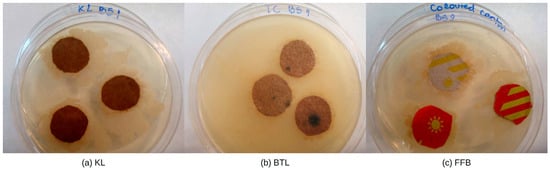
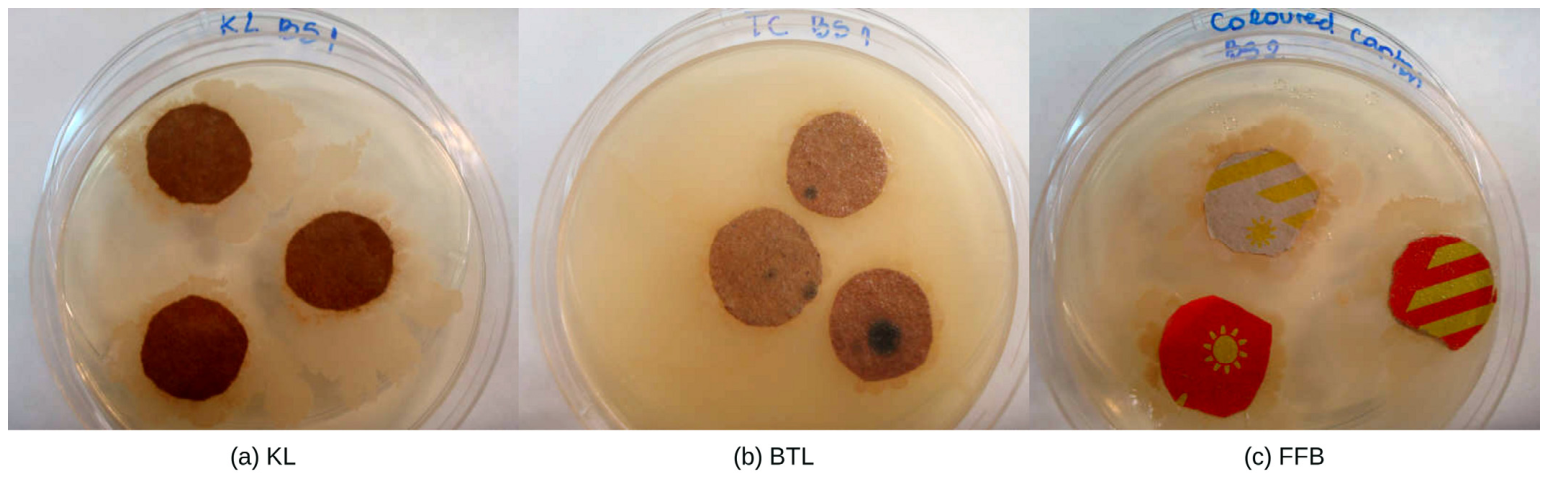
No growth-inhibition zones were observed around any Kraftliner, Brown Testliner, or printed-box specimen in either the Bacillus subtilis or Aspergillus niger assay. Growth of both microorganisms reached the margins of the test specimens. Each material–organism combination was tested on three separate Petri plates, with three specimens per plate (nine specimens per material and organism). The tests therefore provided no evidence of transferable antimicrobial constituents at concentrations sufficient to inhibit either organism under the applied EN 1104 [31] conditions. The B. subtilis results were previously reported in [28]. Representative B. subtilis assay plates are shown in Figure 1.
Figure 1.
Representative EN 1104 assay plates inoculated with Bacillus subtilis after incubation: (a) Kraftliner (KL), (b) Brown Testliner (BTL), and (c) printed French fries box (FFB). No inhibition zones were observed around the test specimens. The complementary Aspergillus niger assays likewise showed no inhibition zones.
3. Discussion
The findings are discussed by analytical endpoint, followed by consideration of the limitations affecting their regulatory interpretation and the broader implications for recycled-fibre packaging.
3.1. Characteristics of the Investigated Paperboard Materials
Among the three materials, the mixed-fibre Brown Testliner showed the highest measured contents of several of the investigated chemical contaminants. It had the highest DIPN and total phthalate contents, at 14.70 and 19.60 mg kg−1, respectively. It was also the only material with a quantifiable lead concentration (0.327 mg kg−1 paperboard), whereas lead concentrations in the Kraftliner and printed box were below the analytical reporting limit (<0.025 mg kg−1 paperboard). The Brown Testliner also had the highest PCP content. This pattern is consistent with the possible carry-over of substances from heterogeneous recovered-paper streams reported in previous studies [2,3,4,5,6]. However, this pattern cannot be attributed specifically to the recycled-fibre component. Only one commercial batch represented each material type; the proportions and detailed composition of the input fibres were not known; and information on the papermaking chemicals, additives, and converting materials used was unavailable. The source of individual contaminants therefore could not be determined.
The results obtained for the Kraftliner also show that the detected contaminants cannot be attributed only to recycled fibres. Although this material was identified as predominantly virgin-fibre based and was unprinted, it contained 0.81 mg kg−1 DIPNs and 9.39 mg kg−1 total phthalates. Their presence may be related to a minor recovered-fibre fraction, shared process streams, additives, storage, or cross-contamination, but the present data do not allow these possibilities to be distinguished. Fibre composition may therefore help to define an initial testing strategy, but it cannot by itself predict the contaminant content of a finished article.
By contrast, DIPNs and total phthalates were below their respective reporting limits in the printed French fries box, even though this material contained deinked and mechanically recycled fibres and had undergone coating and printing. This finding may reflect differences in recovered-paper selection, cleaning and deinking efficiency, or the composition of the input stream. However, it should not be attributed to any single process without information from the paper mill and converter. Earlier studies on recycled linerboard and other recovered-paper grades showed that deinking can substantially reduce selected contaminants; however, removal is substance- and process-dependent and is rarely complete [8,9,10]. The printed box also had the highest formaldehyde result and was the only material to show FWA transfer.
Overall, the Brown Testliner showed the least favourable chemical-contaminant results among the three materials examined. However, the contrasting results obtained for the Kraftliner and printed box show that nominal fibre composition alone is not sufficient to predict the chemical composition or transfer behaviour of a finished article. This comparison applies only to the three commercial materials tested and does not establish a general safety ranking of virgin-, mixed-, and recycled-fibre paperboards. Each finished material should instead be assessed using tests and analytical endpoints relevant to its intended food-contact application.
3.2. Metals, Pentachlorophenol, and Formaldehyde
Table 7 summarises the BfR and CEPI/CITPA reference criteria applied in this study that correspond most closely to the analytical and transfer endpoints discussed in Section 3.2, Section 3.3, Section 3.4, Section 3.5 and Section 3.6. Because the criteria originate from different national regulations and recommendations, they differ in analytical basis and legal status and should not be read as a harmonised set of EU limits [24,25].
Table 7.
Selected BfR and CEPI/CITPA reference criteria relevant to the analytical and transfer endpoints investigated in this study.
The lead result for the Brown Testliner was reported as 0.327 mg kg−1 paperboard, below the mass-based criterion of 3 mg kg−1 paperboard. Conversion using the measured grammage gave 0.422 µg dm−2, also below the surface-based criterion of 3 µg dm−2 compiled in the CEPI/CITPA Guidelines. Because lead was determined in an EN 645 cold-water extract, the result was also expressed on the original extract basis using 10 g of paperboard and a final extract volume of 250 mL. The calculated concentration was approximately 13.1 µg L−1 extract, slightly above the BfR Recommendation XXXVI criterion of 10 µg L−1 cold-water extract. The surface- and extract-based values are calculated expressions of the same analytical result for comparison with criteria using different reporting bases [24,25,29].
For the remaining endpoint-matched comparisons in this group, no exceedance of the selected technical values was identified. Mercury and cadmium were below their reporting limits in all materials; PCP concentrations of 0.006–0.031 mg kg−1 were below the corresponding 0.1 mg kg−1 value; and formaldehyde values were below the 1.0 mg dm−2 extract criterion in BfR Recommendation XXXVI [24,25]. A result below a reporting limit indicates only that the analyte was not quantified above that limit and does not demonstrate complete absence.
3.3. Primary Aromatic Amines and Polychlorinated Biphenyls
For all three materials, the PAA screening result was reported as <0.1 mg kg−1 paperboard, expressed as aniline equivalents. Under the CEPI/CITPA full-transfer assumption, using the conventional ratio of 6 dm2 of packaging per kilogram of food, the highest corresponding calculated upper bound was <0.00151 mg kg−1 food and therefore did not indicate an exceedance of the BfR criterion of 0.01 mg kg−1 food or food simulant for the sum of released PAAs [24,25]. However, the applied procedure did not provide substance-specific concentrations or analyte-specific reporting limits. The result therefore does not establish the identity, concentration, or safety of any individual PAA and cannot evaluate the additional BfR criterion of 0.002 mg kg−1 food or food simulant for each category 1A/1B carcinogenic PAA [24]. It supports only a screening-level interpretation for the sum criterion under the stated full-transfer assumption.
Each of the seven specified PCB congeners was reported as <0.02 mg kg−1 paperboard; this method-specific reporting limit was below the material-content criterion of 2 mg kg−1 [24,25]. As with the metal results, values below the reporting limit indicate that the congeners were not quantified above that level; they do not demonstrate complete absence.
3.4. Diisopropylnaphthalenes and Total Phthalates
DIPNs present a different regulatory problem. The current CEPI/CITPA Guidelines reproduce the BfR approach that DIPN levels should be kept as low as technically achievable rather than assigning a uniform numerical limit [24,25]. The high concentration in the Brown Testliner is consequently relevant as an indicator of recovered-fibre input or cross-contamination and as a reason for process review or application-specific migration assessment. It cannot, by itself, be classified as either compliant or non-compliant against a harmonised EU limit because no such limit exists. The much lower value in the Kraftliner and the result below the reporting limit in the printed box remain useful for comparative characterisation, but they do not resolve the question of transfer to food.
The phthalate procedure was used to provide a comparative measure of total solvent-extractable phthalates across the three materials; it was not designed as a substance-specific migration method. The resulting single value did not identify or quantify individual compounds and therefore did not correspond to the current BfR and CEPI/CITPA criteria: 0.3 mg kg−1 food for DBP, 0.3 mg kg−1 food for DIBP, 1.5 mg kg−1 food for DEHP, and 0.3 mg kg−1 food for the sum of DBP and DIBP [24,25]. Targeted chromatographic procedures can quantify individual phthalates [34], but such results were not generated in this study and cannot be reconstructed from the total-phthalate value. Accordingly, the results were used only to compare the investigated materials and to identify the need for substance-specific follow-up testing; they cannot establish whether the current individual or group restrictions are met.
3.5. Colour and Fluorescent Whitening Agent Transfer
The colour- and FWA-transfer tests, previously reported in [28], provide application-related information that cannot be obtained from measurements of total chemical content alone. EN 646 and EN 648 assess colourant and FWA transfer under prescribed test conditions using standardised grading endpoints; chemical identification of the transferred substances and determination of their concentrations are outside the scope of these methods. As shown in Table 5, the Brown Testliner showed the most pronounced colour transfer with the polar test fluids, whereas the responses to isooctane and olive oil were markedly lower. This pattern indicates that colour-bearing components were more readily transferred under aqueous or acidic test conditions. Accordingly, the observed colour-transfer response cannot be attributed specifically to residual colourants, fibres, or another water-accessible component.
For the paperboard materials investigated here, the CEPI/CITPA Guidelines specify grade 5 as the criterion for no colourant transfer [25]. Accordingly, the lower grades obtained for the Brown Testliner with polar test fluids did not meet this criterion, limiting support for its direct contact with moist or acidic foods under the applied test conditions. With olive oil, side A of all three materials gave grade 4–5, indicating only very slight staining, whereas all side B results were grade 5. The grade 4–5 results were therefore considered practically satisfactory in terms of the observed extent of staining. However, because the CEPI/CITPA Guidelines specify grade 5 and do not explicitly define the acceptability of intermediate grades, these results cannot be regarded as unequivocal evidence that the stated criterion was met. Nevertheless, staining under the olive-oil test conditions was much less pronounced than that observed for the Brown Testliner with polar test fluids. The results should therefore be interpreted in relation to the intended food type and contact conditions rather than used to classify the materials as generally suitable or unsuitable for all food-contact applications.
FWA transfer showed a different pattern among the investigated materials. No detectable transfer was observed from the Kraftliner or Brown Testliner, whereas transfer occurred from the printed French fries box under aqueous test conditions and was most pronounced from the inner food-contact side with water (Table 6). No transfer was detected from either side with olive oil. The contrast between the aqueous and olive-oil results is consistent with the greater aqueous mobility of the types of FWA commonly used in paper [35].
EN 648 indicates the extent of fluorescence transfer but does not identify the transferred fluorescent substance or its layer of origin. Several possible sources may therefore be considered for the printed box, including residual FWA in the deinked or mechanically recycled fibre furnish or FWA used in the pigment coating. The stronger response from side A with water indicates that fluorescent substances were more readily transferred from the inner surface under these test conditions, but it does not identify their source. Transfer from both sides also means that residual FWA within the fibre matrix cannot be excluded. Layer-specific chemical analysis would be required to distinguish among these possibilities.
For the paperboard materials investigated here, grade 5 in the EN 648 test is the relevant criterion under BfR Recommendation XXXVI and the CEPI/CITPA Guidelines; the CEPI grade-4 exception applies only to tissue materials and articles [24,25]. Grades 3 and 4 therefore indicate detectable FWA transfer and do not meet the stated grade-5 criterion. However, the printed box is intended primarily for contact with fatty food, for which the grade-5 results obtained with olive oil are favourable and more directly relevant to its intended application. The less favourable results obtained with aqueous test media do not, by themselves, establish that the box is unsuitable for its intended use. They indicate that FWA transfer may occur if the packaging is exposed to aqueous contact conditions, including moisture, steam, or condensation, and should therefore be considered in relation to the reasonably foreseeable conditions of use.
3.6. Transfer of Antimicrobial Constituents
No inhibition zones were observed around any paperboard specimen with either Bacillus subtilis or Aspergillus niger. This indicates that, under the EN 1104 test conditions, no transfer of antimicrobial constituents was detected at levels capable of inhibiting bacterial or fungal growth. The results are therefore consistent with the requirement that finished paper and board should not exert a preserving effect on food [25,31]. However, this assay does not assess the microbiological quality or microbial contamination of the paperboard itself; it evaluates only the potential transfer of growth-inhibiting antimicrobial constituents.
3.7. Limitations of Regulatory Interpretation
Regulatory interpretation must account for differences in the legal status and intended role of the reference documents applied in this study. BfR Recommendation XXXVI is a widely used scientific and technical reference, the CEPI/CITPA Guidelines provide a voluntary industry methodology, and the EDQM Technical Guide offers Council of Europe guidance [23,24,25]. These documents can support the demonstration of compliance with the general safety requirements of Article 3 of Regulation (EC) No. 1935/2004, but none establishes a harmonised EU-specific regulatory regime for paper and board. Interpretation must therefore specify which document was applied and confirm that the substance definition, analytical endpoint, test conditions, food type, and reporting basis correspond to the relevant criterion.
The study was designed as a comparative case study of three compositionally different commercial materials, with one commercial batch representing each material type. The two determinations for each quantitative analysis were separate test portions that were independently prepared, extracted, and analysed; they describe analytical repeatability within each investigated material and are not independent commercial batches. Accordingly, the dataset does not support statistical inference for the wider market populations of Kraftliner, Testliner, or printed food boxes, nor for the prevalence of the observed profiles on the market. Recent work has demonstrated substantial within-package variability in commercial paper and board, highlighting the importance of representative sampling within each packaging article [36]. Broader sampling of independent commercial materials would additionally be required for population-level inference. Full supplier specifications, formulations, and process histories were unavailable, so the observed differences cannot be causally attributed to a particular fibre source or converting step.
The analytical programme combined established aqueous-extract, solvent-extractable, material-content, and standardised transfer procedures, each providing information for a defined analytical endpoint. Results for metals, PCP, formaldehyde, PAAs, PCBs, DIPNs, and phthalates were obtained using the corresponding extract- or material-content procedures, whereas EN 646 and EN 648 assessed transfer by instrumental or visual grading. A central interpretive challenge is that the available European frameworks use different types of criteria, including material-content, extract-based, surface-based, and food-based migration limits, which are not analytically interchangeable. Direct comparison was therefore made only when the measured endpoint corresponded to the selected criterion. Where a material-content result was evaluated against a food-based restriction, the unit conversions and full-transfer screening calculation described in Section 4.7 were applied. These calculations were used as screening tools rather than as direct measurements of migration into food under a specific use scenario. Application-specific migration testing can provide additional information for a particular intended use but was not part of this targeted analytical programme [25,37].
The main endpoint-specific limitation concerned the total-phthalate and PAA screening procedures. These procedures did not provide substance-specific concentrations or analyte-specific reporting limits for individual phthalates and category 1A/1B carcinogenic PAAs; consequently, the corresponding substance-specific restrictions could not be evaluated. These results were therefore used to compare the investigated materials and, where applicable, to support screening-level conclusions, but not to evaluate substance-specific restrictions. The analytical programme was targeted rather than intended as an exhaustive characterisation of all potential migrants. Mineral oil hydrocarbons, bisphenols, PFAS, other NIAS, and unknown migrants were outside its scope. Recent research illustrates complementary approaches that may be selected for broader or application-specific assessments, including targeted screening of potential migrants [34], multiscale evaluation of contaminant heterogeneity and sampling [36], migration testing using food-relevant simulants [37], and chemical characterisation combined with bioassays and toxicological prioritisation [7,38]. The EN 1104, EN 646, and EN 648 methods address distinct functional and transfer endpoints and complement the chemical-content analyses. The breadth and variability of potential substances in recycled fibres make comprehensive end-product analysis particularly challenging [2,5].
Regulatory conclusions in this study are confined to the specified document versions and to analytical endpoints that correspond to their provisions. National measures and technical frameworks may differ in legal status, scope, substance definitions, and testing approaches, and additional national requirements may apply [19,23,24,25]. At the time of manuscript preparation, the stakeholder consultation on the 2026 draft second edition of the EDQM Technical Guide had closed, but the revised guide had not yet been published; the consultation draft was therefore not treated as an adopted requirement [26]. Accordingly, when the analytical endpoint did not correspond to the relevant criterion, the result was not used to establish either compliance or non-compliance. The need to relate analytical data to criteria differing in scope, analytical basis, and legal status remains one of the principal difficulties arising from the absence of a harmonised EU-specific measure for paper and board.
3.8. Implications for Recycled Fibre Use and Packaging Circularity
For recycled-fibre food packaging, chemical safety should be managed throughout the material cycle rather than assessed from recycled-fibre content alone. Control begins with the selection of appropriate recovered-paper grades and the management or substitution of inks, adhesives, additives, and other converting chemicals that may enter subsequent recycling loops. Deinking and cleaning can reduce selected contaminants, but their effectiveness is substance- and process-dependent and should be verified for the intended material stream [8,9,10].
The CEPI/CITPA approach places Good Manufacturing Practice, risk assessment, traceability, supply-chain communication, and intended use alongside end-product testing [25]. For converted articles, information on the paperboard, coatings, inks, adhesives, and any functional barrier is needed to select tests that reflect the intended food type, contact time, and temperature. These measures connect source control and process management with assessment of the finished package.
The PPWR strengthens requirements for packaging recyclability and high-quality recycling but does not establish harmonised contaminant or migration criteria for paper and board [27]. As fibre circulates through repeated product cycles, chemicals introduced in one application may become relevant in a later food-contact application. Circular design and food-contact safety should therefore be addressed together, supported by clear information on material composition, intended use, and the analytical framework applied. A harmonised EU-specific measure could further support consistent assessment by defining common substance restrictions, test conditions, and documentation requirements.
4. Materials and Methods
The materials, analytical procedures, and data-treatment principles underlying the results presented in Section 2 are described below.
4.1. Paperboard Samples
Three commercially available paperboard packaging materials were purposively selected to represent contrasting fibre compositions and converting histories: predominantly virgin-fibre linerboard, mixed virgin/recycled-fibre linerboard, and a converted printed food box containing deinked and mechanically recycled fibres. One commercial batch represented each material type. The samples were obtained from the Croatian market and designated Kraftliner (KL), Brown Testliner (BTL), and printed French fries box (FFB). The selection was intended to support a comparative case study and not to represent all paperboard grades available on the market. The Kraftliner served as a comparative predominantly virgin-fibre material, not as a formal experimental control. The previously reported study used the same materials for the colour- and FWA-transfer tests and for the B. subtilis assay [28].
The Kraftliner was identified as a predominantly virgin-fibre grade, whereas the Brown Testliner had a top ply composed of virgin fibres and a bottom ply containing recycled fibres. Both linerboard samples were unprinted. The printed French fries box was manufactured from a combination of deinked and mechanically recycled fibres. Its outer surface was pigment-coated and printed. The inner, food-contact surface was also partially printed with yellow ink, which covered approximately 40% of the surface area.
Before determination of the basic physical properties, the samples were conditioned to equilibrium in the standard atmosphere specified in ISO 187:1990 [39]. Grammage and moisture content were determined on the conditioned samples. The composition, converting characteristics, and measured basic properties of the samples are presented in Table 1.
4.2. Preparation of Aqueous Extracts and Determination of Metals, Pentachlorophenol, and Formaldehyde
Cold-water extracts were prepared from each paperboard sample in accordance with EN 645:1993 [29]. Extractable mercury (Hg), cadmium (Cd), and lead (Pb) were determined in the resulting extracts by inductively coupled plasma spectrometry. EN 12497:2005 and EN 12498:2005 were used as the corresponding reference methods for the determination of mercury and of cadmium and lead, respectively [40,41].
Pentachlorophenol (PCP) in the cold-water extracts was determined according to ISO 15320:2003 [42]. PCP was concentrated by solid-phase extraction using a phenyl-bonded SPE cartridge, eluted with hexane, and acetylated with acetic anhydride. The derivatised PCP was subsequently quantified by gas chromatography with electron-capture detection (GC-ECD).
Formaldehyde was determined in the aqueous extracts according to EN 1541:2001 [33]. A reagent containing ammonium acetate and acetylacetone (2,4-pentanedione) was added to each extract. In the presence of ammonium acetate, formaldehyde reacts with acetylacetone to form 3,5-diacetyl-1,4-dihydrolutidine. The absorbance of the resulting solution was measured spectrophotometrically at 410 nm and used to determine the formaldehyde concentration.
4.3. Determination of Primary Aromatic Amines and Polychlorinated Biphenyls
PAAs were determined using a laboratory procedure. For each material, 1 dm2 of paperboard was extracted with 200 mL of cold water. The resulting aqueous extract was contacted with 50 mL of dichloromethane in a separatory funnel and allowed to stand for 4–5 h. The organic phase was passed through anhydrous sodium sulphate and evaporated to dryness under a stream of nitrogen. The residue was reconstituted in 1 mL of methanol and analysed by liquid chromatography–mass spectrometry (LC–MS). The procedure yielded a single PAA screening result expressed as aniline equivalents and did not provide substance-specific concentrations or analyte-specific reporting limits for individual PAA compounds.
Polychlorinated biphenyls (PCBs) were determined according to ISO 15318:1999 [43]. A 2.0 g portion of each paperboard sample was extracted by heating with a boiling ethanolic alkaline solution. A 25 mL aliquot of the resulting extract was mixed with 50 mL of distilled water and subjected to solid-phase extraction using a disposable C18 cartridge. The retained compounds were eluted with hexane and quantified by gas chromatography with electron-capture detection (GC-ECD). The method covers seven specified PCB congeners: PCB 18, 28, 52, 101, 138, 153, and 180.
4.4. Determination of Diisopropylnaphthalenes and Total Phthalates
Paperboard samples were extracted with dichloromethane for the determination of diisopropylnaphthalenes (DIPNs) and total phthalates. The extracts were placed in an ultrasonic bath for 1 h and subsequently passed through anhydrous sodium sulphate previously rinsed with dichloromethane. The filtered extracts were first concentrated to approximately 5 mL and then further concentrated under a stream of nitrogen to a final volume of 1 mL before analysis by gas chromatography–mass spectrometry (GC-MS).
The determination of DIPN was based on EN 14719:2005, using diethylnaphthalene as an internal standard [44]. The results were expressed as the sum of DIPN isomers in milligrams per kilogram of paperboard.
The applied phthalate procedure yielded a single result expressed as total phthalate content and did not provide concentrations of individual phthalates. The total phthalate results were therefore treated as screening data for comparative chemical characterisation rather than as measurements of individual regulated substances.
4.5. Colour and Fluorescent Whitening Agent Transfer
The colour and fluorescent whitening agent (FWA) transfer tests described in this section and their corresponding results were previously reported in a conference proceedings paper [28]. The procedures are summarised here to provide a complete methodological description and to enable their integrated interpretation with the broader chemical characterisation performed in the present study.
Colourant and FWA transfer from the paperboard samples was assessed according to EN 646:2006 and EN 648:2006, respectively [29,30]. Colour transfer was tested with deionised water, 3% (m/v) aqueous acetic acid, saliva simulant, isooctane, and rectified olive oil. FWA transfer was tested with the same fluids except isooctane. Both sides of each paperboard sample were tested separately.
Test specimens were placed between two glass-fibre papers previously saturated with the selected test fluid. The assembly was positioned between glass plates, wrapped in polyethylene film, and subjected to a 1 kg load for 24 h at room temperature. Following exposure, the glass-fibre papers were removed and allowed to dry for 24 h in the dark.
Colour transfer was evaluated from the change in the tristimulus Y value of the glass-fibre paper measured before and after contact with the test specimen. The resulting lightness difference (ΔYtristim) was converted to a staining grade using the grey scale specified in EN 20105-A03:1994 [45]. FWA transfer was evaluated under UV-A illumination by comparison with a series of fluorescently whitened reference papers. In both evaluation procedures, grade 5 represents the absence of detectable transfer. Each test was performed in duplicate, and the reported values represent the arithmetic mean of two determinations.
4.6. Transfer of Antimicrobial Constituents
The transfer of antimicrobial constituents was assessed according to EN 1104:2005 using Bacillus subtilis and Aspergillus niger as the bacterial and fungal test organisms, respectively [31]. For each paperboard material and each test organism, three circular test specimens of the same material were placed on the surface of the corresponding inoculated semi-solid nutrient medium in each of three separate Petri plates, giving a total of nine specimens per material and organism. Plates inoculated with B. subtilis were incubated for 3 days at 30 °C, whereas plates inoculated with A. niger were incubated for 5 days at 25 °C. Following incubation, the plates were examined for growth-inhibition zones surrounding the test specimens.
The occurrence of an inhibition zone was interpreted as evidence of the transfer of antimicrobial constituents from the paperboard into the nutrient medium. Microbial growth extending to the edge of or over the test specimen, without a surrounding inhibition zone, was interpreted as indicating no detectable transfer of antimicrobial constituents under the applied conditions. The EN 1104 procedure and the B. subtilis results were previously reported in [28]; the A. niger results are included here to complete the reporting of the EN 1104 assessment.
4.7. Data Treatment and Regulatory Interpretation
Each quantitative result was based on duplicate test portions from the same material batch; each portion was independently prepared, extracted, and analysed (n = 2), and numerical results are reported as arithmetic means. These duplicate preparations describe within-sample analytical repeatability and are not independent commercial batches. Results below the applicable method-specific detection or quantification limit are presented using the “<” symbol and the corresponding limit; values below these limits were not replaced by zero. Because the study comprised three compositionally different commercial materials rather than replicate samples drawn from a defined material population, the evaluation was descriptive and comparative, and no inferential statistical analysis was performed.
Where conversion from a mass-based concentration in the material to a surface-based concentration was required, the measured grammage of the corresponding sample was used according to the following relationship [25]:
where CA is the surface-based concentration in mg dm−2, CM is the concentration in the material in mg kg−1, and G is the grammage in g m−2. This conversion changes only the reporting basis of the analytical result.
Where a material-based result was compared with a specific migration limit expressed in mg kg−1 food, the CEPI/CITPA screening calculation was applied using the conventional ratio of 6 dm2 of packaging per kilogram of food and assuming complete transfer, unless the actual packaging-to-food ratio was known. A calculated value below the applicable restriction indicates that an exceedance would not occur under these assumptions. Conversely, a value above the restriction does not by itself establish non-compliance but indicates the need for a more realistic migration assessment. These calculations were used only for screening and were not interpreted as experimentally measured migration into food or a food simulant [25].
The analytical results were interpreted with reference to the European technical frameworks relevant to paper and board food-contact materials, principally the EDQM Technical Guide, BfR Recommendation XXXVI, and the CEPI/CITPA Food Contact Guidelines [23,24,25]. A direct comparison with a reference criterion was made only where the analytical endpoint, substance definition, test conditions, and reporting basis corresponded to those specified in the selected framework.
For PAAs, the screening result expressed as aniline equivalents was converted to a calculated concentration in food using the CEPI/CITPA full-transfer calculation and was then compared with the BfR criterion for the sum of released PAAs. It was not used to assess the additional criterion for individual category 1A/1B carcinogenic PAAs because substance-specific concentrations and analyte-specific reporting limits were unavailable.
Results expressed as total phthalate content were not used to demonstrate compliance with restrictions established for individual phthalates or defined groups of phthalates because the identities and concentrations of the individual compounds were not available. DIPN results were used for comparative characterisation of the samples. Because DIPNs may originate from recovered-paper inputs or cross-contamination and no uniform legally binding EU numerical limit has been established, the results were not assigned a general pass-or-fail classification.
Regulation (EU) 2025/40 on packaging and packaging waste was considered as part of the broader circularity and chemical-safety context [27], but it was not used as a numerical compliance framework for the contaminants measured in this study.
5. Conclusions
This comparative case study showed that the three investigated commercial paperboards had different combinations of chemical content and transfer behaviour. The Brown Testliner had the least favourable results for several measured contaminants and for colour transfer in polar media. However, contaminants were also detected in the predominantly virgin-fibre Kraftliner, while the recycled-fibre printed box showed a different pattern, characterised mainly by FWA transfer in aqueous media. No growth-inhibition zones were observed with either Bacillus subtilis or Aspergillus niger in the EN 1104 assays, indicating no detectable transfer of antimicrobial constituents under the applied conditions. Fibre composition alone therefore did not explain all observations. Because only one commercial batch represented each material type, these findings apply only to the three materials investigated and cannot be generalised to all virgin- or recycled-fibre paperboards.
The study also showed that regulatory interpretation depends on whether the analytical endpoint corresponds to the selected criterion. The lead result was interpreted differently depending on whether it was compared with national criteria expressed per mass of paperboard, surface area, or volume of extract. The PAA and total-phthalate results could not support complete substance-specific assessments because the applied analytical procedures did not identify the relevant individual compounds. These limitations arose from the analytical design of the study and are separate from the problem of regulatory non-harmonisation.
For practical food-contact assessment, the finished package should be evaluated in relation to its intended food type, contact time and temperature, coatings, inks, other converting materials, and available supply-chain information. The absence of a harmonised EU material-specific measure for paper and board continues to make the demonstration of compliance with Article 3 of Regulation (EC) No. 1935/2004 less consistent for manufacturers, converters, laboratories, and control authorities. A harmonised measure could provide common substance restrictions, test conditions, and documentation requirements. Until then, Good Manufacturing Practice, suitable raw-material selection, transparent supply-chain communication, and testing matched to the intended application remain essential for demonstrating food-contact safety. As the use and recycling of fibre-based packaging increase, the chemical safety of recovered fibres and finished packaging should receive the same attention as recyclability.
Author Contributions
Conceptualisation, S.J.H. and B.L.; methodology, S.J.H., B.L. and L.B.; formal analysis, S.J.H.; investigation, S.J.H. and L.B.; resources, S.J.H. and L.B.; data curation, S.J.H.; writing—original draft preparation, S.J.H.; writing—review and editing, S.J.H., B.L. and L.B.; visualisation, S.J.H.; supervision, B.L.; project administration, S.J.H. All authors have read and agreed to the published version of the manuscript.
Funding
The experimental research reported in this article received no specific external funding. The article processing charge (APC) was funded by the University of Zagreb through the 2024 research support project “Modification of Functional Layers on Different Printing Substrates”.
Data Availability Statement
The original contributions presented in this study are included in the article. Further inquiries can be directed to the corresponding author.
Conflicts of Interest
The authors declare no conflict of interest.
Abbreviations
The following abbreviations are used in this manuscript:
| BfR | German Federal Institute for Risk Assessment |
| BTL | Brown Testliner |
| CEPI | Confederation of European Paper Industries |
| CITPA | International Confederation of Paper and Board Converters in Europe |
| DBP | dibutyl phthalate |
| DEHP | bis(2-ethylhexyl) phthalate |
| DGCCRF | Directorate-General for Competition, Consumer Affairs and Fraud Control |
| DIBP | diisobutyl phthalate |
| DIPN | diisopropylnaphthalene |
| EDQM | European Directorate for the Quality of Medicines & HealthCare |
| EFSA | European Food Safety Authority |
| EN | European Standard |
| FCM | food-contact material |
| FFB | printed French fries box |
| FWA | fluorescent whitening agent |
| GC-ECD | gas chromatography with electron-capture detection |
| GC-MS | gas chromatography–mass spectrometry |
| GMP | Good Manufacturing Practice |
| ISO | International Organization for Standardization |
| KL | Kraftliner |
| LC-MS | liquid chromatography–mass spectrometry |
| NIAS | non-intentionally added substances |
| PAA | primary aromatic amine |
| PCB | polychlorinated biphenyl |
| PCP | pentachlorophenol |
| PFAS | per- and polyfluoroalkyl substances |
| PPWR | Packaging and Packaging Waste Regulation |
| QMA | maximum permitted content in paper or board |
| SML | specific migration limit |
| SPE | solid-phase extraction |
| UV-A | ultraviolet A |
References
- European Paper Recycling Council. Monitoring Report 2025; EPRC, 2026. Available online: https://www.cepi.org/european-paper-recycling-council-monitoring-report-2025-for-the-european-declaration-on-paper-recycling-2021-2030/ (accessed on 28 October 2026).
- Pivnenko, K.; Eriksson, E.; Astrup, T.F. Waste paper for recycling: Overview and identification of potentially critical substances. Waste Manag. 2015, 45, 134–142. [Google Scholar] [CrossRef] [Scilit]
- Suciu, N.A.; Tiberto, F.; Vasileiadis, S.; Lamastra, L.; Trevisan, M. Recycled paper–paperboard for food contact materials: Contaminants suspected and migration into foods and food simulant. Food Chem. 2013, 141, 4146–4151. [Google Scholar] [CrossRef] [Scilit]
- Geueke, B.; Groh, K.; Muncke, J. Food packaging in the circular economy: Overview of chemical safety aspects for commonly used materials. J. Clean. Prod. 2018, 193, 491–505. [Google Scholar] [CrossRef] [Scilit]
- Biedermann, M.; Grob, K. Assurance of safety of recycled paperboard for food packaging through comprehensive analysis of potential migrants is unrealistic. J. Chromatogr. A 2013, 1293, 107–119. [Google Scholar] [CrossRef] [Scilit]
- Boccacci Mariani, M.; Giannetti, V.; Mannino, P.; Ceccarelli, V. Enhanced quality control of recycled paperboard for food packaging. Anal. Lett. 2015, 48, 1720–1737. [Google Scholar] [CrossRef] [Scilit]
- Aljawish, A.; Souton, E.; Dahbi, L.; Severin, I. Chemical and toxicological characterization of food contact recycled paperboard extracts. Food Addit. Contam. Part A 2024, 41, 1368–1384. [Google Scholar] [CrossRef] [Scilit]
- Jamnicki, S.; Pèlach Serra, M.À.; Lozo, B.; Stanić, M.; Barušić, L. Deinking flotation of recycled linerboard and its influence on chemical contaminants. Cellul. Chem. Technol. 2010, 44, 481–488. [Google Scholar]
- Jamnicki, S.; Lozo, B.; Rutar, V.; Barušić, L. A study on the food contact suitability of recycled paper and board. Papíripar 2012, 56, 14–20. [Google Scholar]
- Jamnicki, S.; Handke, T.; Harting, M.; Lozo, B.; Jakovljević, M. Deinking possibilities in the reduction of mineral oil hydrocarbons from recovered paper grades. Cellul. Chem. Technol. 2015, 49, 677–684. [Google Scholar]
- European Parliament and Council. Regulation (EC) No. 1935/2004 of 27 October 2004 on materials and articles intended to come into contact with food. Off. J. Eur. Union 2004, L338, 4–17. [Google Scholar]
- European Commission. Commission Regulation (EC) No. 2023/2006 of 22 December 2006 on good manufacturing practice for materials and articles intended to come into contact with food. Off. J. Eur. Union 2006, L384, 75–78. [Google Scholar]
- European Commission. Commission Regulation (EU) No. 10/2011 of 14 January 2011 on plastic materials and articles intended to come into contact with food. Off. J. Eur. Union 2011, L12, 1–89. [Google Scholar]
- European Commission. Food Contact Materials—Legislation. Available online: https://food.ec.europa.eu/food-safety/chemical-safety/food-contact-materials/legislation_en (accessed on 18 September 2026).
- U.S. Food and Drug Administration. Determining the Regulatory Status of Components of a Food Contact Material. Available online: https://www.fda.gov/food/packaging-food-contact-substances-fcs/determining-regulatory-status-components-food-contact-material (accessed on 11 November 2026).
- MERCOSUR. Resolución GMC No. 40/15: Reglamento Técnico MERCOSUR sobre Materiales, Envases y Equipamientos Celulósicos Destinados a Estar en Contacto con Alimentos; MERCOSUR, 2015. Available online: https://normas.mercosur.int/public/normativas/3192 (accessed on 11 November 2026).
- GB 4806.8-2022; GB 4806.8-2022: National Food Safety Standard—Paper and Board Materials and Articles for Food Contact. NHC: Beijing, China, 2022. Available online: https://www.nhc.gov.cn/sps/c100087/202208/3f87d74769084636a0ef6a0192d7cbce.shtml (accessed on 11 November 2026).
- European Food Safety Authority. Report of ESCO WG on non-plastic Food Contact Materials. EFSA Support. Publ. 2011, 8, EN-139. [Google Scholar] [CrossRef] [Scilit]
- Simoneau, C.; Raffael, B.; Garbin, S.; Hoekstra, E.; Mieth, A.; Lopes, J.F.A.; Reina, V. Non-Harmonised Food Contact Materials in the EU: Regulatory and Market Situation—Baseline Study; EUR 28357 EN; Publications Office of the European Union: Luxembourg, 2016. [Google Scholar] [CrossRef]
- European Commission. Commission Staff Working Document: Evaluation of the Legislation on Food Contact Materials; SWD(2022) 163 final; European Commission: Brussels, Belgium, 2022. Available online: https://eur-lex.europa.eu/legal-content/EN/TXT/?uri=CELEX:52022SC0163 (accessed on 18 September 2026).
- European Commission. Revision of EU Rules on Food Contact Materials. Available online: https://food.ec.europa.eu/food-safety/chemical-safety/food-contact-materials/revision-eu-rules_en (accessed on 18 September 2026).
- Council of Europe. Resolution CM/Res(2020)9 on the Safety and Quality of Materials and Articles for Contact with Food; Council of Europe: Strasbourg, France, 2020; Available online: https://rm.coe.int/09000016809fe04a (accessed on 18 September 2026).
- European Directorate for the Quality of Medicines & HealthCare. Paper and Board Used in Food Contact Materials and Articles—Technical Guide, 1st ed.; Council of Europe: Strasbourg, France, 2021. [Google Scholar]
- German Federal Institute for Risk Assessment (BfR). Recommendation XXXVI: Paper and Board for Food Contact, version dated 1 October 2026; BfR: Berlin, Germany, 2026; Available online: https://empfehlungen.bfr.bund.de/recommendations?locale=en (accessed on 2 October 2026).
- CEPI; CITPA. Food Contact Guidelines for the Compliance of Paper and Board Materials and Articles; amendments and corrigendum published in 2021; CEPI/CITPA: Brussels, Belgium, 2019; Available online: https://www.cepi.org/publication-of-the-amendments-to-the-food-contact-guidelines/ (accessed on 18 September 2026).
- European Directorate for the Quality of Medicines & HealthCare. Technical Guide on Paper and Board Used in Food Contact Materials and Articles—Draft 2nd Edition; Stakeholder Consultation Draft; EDQM: Strasbourg, France, 2026; Available online: https://www.edqm.eu/documents/52006/280178/EDQM_Draft+TG+on+P%26B+in+FCM_document+for+consultation.pdf/fedcdf9d-1314-4d92-b6c3-86c2c61bea4e?t=1778072702458 (accessed on 18 September 2026).
- European Parliament and Council. Regulation (EU) 2025/40 of 19 December 2024 on packaging and packaging waste. Off. J. Eur. Union. 2025. Available online: https://eur-lex.europa.eu/eli/reg/2025/40/oj/eng (accessed on 22 January 2025).
- Jamnicki Hanzer, S. Evaluation of the migration potential of colorants and additives in paperboard food packaging materials. In Proceedings of the 12th International Symposium on Graphic Engineering and Design—GRID 2024, Novi Sad, Serbia, 14–16 November 2024. [Google Scholar] [CrossRef] [Scilit]
- EN 646:2006; EN 646:2006: Paper and Board Intended to Come into Contact with Foodstuffs—Determination of Colour Fastness of Dyed Paper and Board. CEN: Brussels, Belgium, 2006.
- EN 648:2006; EN 648:2006: Paper and Board Intended to Come into Contact with Foodstuffs—Determination of the Fastness of Fluorescent Whitened Paper and Board. CEN: Brussels, Belgium, 2006.
- EN 1104:2005; EN 1104:2005: Paper and Board Intended to Come into Contact with Foodstuffs—Determination of the Transfer of Antimicrobial Constituents. CEN: Brussels, Belgium, 2005.
- EN 645:1993; EN 645:1993: Paper and Board Intended to Come into Contact with Foodstuffs—Preparation of a Cold Water Extract. CEN: Brussels, Belgium, 1993.
- EN 1541:2001; EN 1541:2001: Paper and Board Intended to Come into Contact with Foodstuffs—Determination of Formaldehyde in an Aqueous Extrac. CEN: Brussels, Belgium, 2001.
- Di Mario, M.; Bauwens, G.; Peltier, F.; Goscinny, S.; Focant, J.-F.; Purcaro, G.; Van Hoeck, E. Investigation of potential migratables from paper and board food contact materials. Front. Chem. 2023, 11, 1322811. [Google Scholar] [CrossRef] [Scilit]
- Ministry of Agriculture; Fisheries and Food. Fluorescent Whitening Agents; Food Surveillance Information Sheet No. 47; MAFF: London, UK, 1995.
- Biant, L.; Nguyen, P.-M.; Hayert, M.; Domenek, S.; Vitrac, O. Characterizing the heterogeneous contamination of commercial paper and board food packaging at different scales. Food Addit. Contam. Part A 2025, 42, 382–403. [Google Scholar] [CrossRef] [Scilit]
- Ahlinder, A.; Lindh, J.; Öhgren, C.; Steijer, H.; Stading, M.; Andersson, S. Development of a solid food simulant to evaluate migration of chemicals from paper and board food contact materials to moist food. Food Packag. Shelf Life 2024, 45, 101340. [Google Scholar] [CrossRef] [Scilit]
- Chih, P.-S.; Hsu, P.-C.; Arcega, R.D.; Chang, W.-H.; Tai, P.-C.; Lee, C.-C.; Mahmudiono, T.; Wang, W.-R.; Chen, R.-J.; Chen, H.-L. High-throughput toxicological profiling and ToxPi-based prioritization of chemical migrants from recycled paper used in food contact materials. J. Hazard. Mater. 2026, 515, 142920. [Google Scholar] [CrossRef] [Scilit]
- ISO 187:1990; ISO 187:1990: Paper, Board and Pulps—Standard Atmosphere for Conditioning and Testing and Procedure for Monitoring the Atmosphere and Conditioning of Samples. ISO: Geneva, Switzerland, 1990.
- EN 12497:2005; EN 12497:2005: Paper and Board Intended to Come into Contact with Foodstuffs—Determination of Mercury in an Aqueous Extract. CEN: Brussels, Belgium, 2005.
- EN 12498:2005; EN 12498:2005: Paper and Board Intended to Come into Contact with Foodstuffs—Determination of Cadmium and Lead in an Aqueous Extract. CEN: Brussels, Belgium, 2005.
- ISO 15320:2003; ISO 15320:2003: Pulp, Paper and Board—Determination of Pentachlorophenol in an Aqueous Extract. ISO: Geneva, Switzerland, 2003.
- ISO 15318:1999; ISO 15318:1999: Pulp, Paper and Board—Determination of Seven Specified Polychlorinated Biphenyls (PCB). ISO: Geneva, Switzerland, 1999.
- EN 14719:2005; EN 14719:2005: Pulp, Paper and Board—Determination of the Diisopropylnaphthalene (DIPN) Content by Solvent Extraction. CEN: Brussels, Belgium, 2005.
- EN 20105-A03:1994; EN 20105-A03:1994: Textiles—Tests for Colour Fastness—Part A03: Grey Scale for Assessing Staining. CEN: Brussels, Belgium, 1994.

Disclaimer/Publisher’s Note: The statements, opinions and data contained in all publications are solely those of the individual author(s) and contributor(s) and not of MDPI and/or the editor(s). MDPI and/or the editor(s) disclaim responsibility for any injury to people or property resulting from any ideas, methods, instructions or products referred to in the content. |
© 2026 by the authors. Licensee MDPI, Basel, Switzerland. This article is an open access article distributed under the terms and conditions of the Creative Commons Attribution (CC BY) license.