1. Introduction
A common way to improve battery sustainability and cost is to extend battery lifetime. By extending battery lifetime, the application can realize more energy throughput for the same resource investment and CO
2 exhausted during the manufacturing of the battery. The same holds for cost; by extending battery lifetime, the depreciation of the initial investment is spread over a longer period of time, lowering the depreciation rate. To effectively extend battery life, an understanding of battery degradation under real-world conditions is important. Therefore, there is a need for battery health data from real-world applications [
1].
Methods for obtaining battery health data, defined in this study as battery pack capacity and electrical resistance, have been reviewed at length in the literature [
2,
3,
4,
5,
6]. Generally speaking, these review papers emphasize the value of battery health data from real-world applications since health data from the laboratory is usually obtained under more strictly controlled conditions, which do not always capture real operating conditions [
7,
8]. As such, there is a crucial need for more battery health measurement data from real-world applications to better understand battery degradation in practice [
9].
Methods for collecting battery health data can be categorized into active- and passive-diagnostic methods. Passive-diagnostic methods are based solely on observing operation via measurements, whereas active-diagnostic methods deliberately actuate the battery in some form so as to better obtain relevant parameters. Passive battery diagnostics have been thoroughly studied and reviewed [
2,
3,
4,
5,
6,
10] but active battery diagnostics in real-world applications less so, although some methods and systems for active battery diagnostics have been published [
11,
12]. Still, to the best of the authors’ knowledge, systems and methods for active battery diagnostics for real-world applications are rare, which also applies for the use of bi-directional charger capability within that topic. Regardless of the fundamental differences between active and passive diagnostics, it is important to note that they can function side-by-side and support each other by covering each other’s weaknesses. Active diagnostics can apply specific tests and provide calibration points to support passive diagnostics, and passive diagnostics can provide model-based adjustments, for measurement error and test conditions, to support active diagnostics.
Implementation-wise, passive diagnostics require little besides software but lack actuation, which can make observability of parameters challenging as it is not possible to influence the input data [
13]. In contrast, active diagnostics require additional hardware and software but have the potential for reliable and repeatable testing of battery packs since the current and voltage can be directly controlled [
11]. The actuation for active diagnostics can be performed internally within the application (i.e., such as via the balancing circuit), or from external systems (i.e., such as via the charger). This study focuses on the latter.
The aim of this study is to design a system and method to actively diagnose the battery pack capacity and resistance of real-world applications through the use of a bi-directional charger. This is accomplished through (A) discussing implementational challenges (
Section 2), (B) deriving design requirements from those challenges, (C) designing the system and method (
Section 3 and
Section 4), and (D) demonstrating the system and method on a battery energy storage application (
Section 5 and
Section 6). The demonstration is part of the iSTORMY project [
14] and will involve battery diagnosis over a period of a month. Due to the limited duration of the demonstration, the expected degradation of the battery is limited, and so the primary goal of the demonstration is to verify the design requirements. Aligned with the design requirements, the aim is to show reliable and repeatable diagnostic tests under real-world conditions can be performed, and that quality battery health data at the pack level can be gathered. As a final step, the future potential of the system and method is discussed from the viewpoint of large-scale long-term adoption of the system and as a tool to harvest large quantities of battery health data of real-world applications.
2. Challenges
Applying active battery diagnostics to real-world applications via a bi-directional charger comes with challenges in both system design and methodology, which are summarized in
Table 1. These challenges become clear when trying to take the most straightforward approach: applying the proven and well-developed active-diagnostic methods from the laboratory directly to the application. Unfortunately, direct application is often not possible, and these methods have to be made compatible with the limitations of real-world applications to function. To illustrate this, the example is used of a commonly performed battery cell discharge-capacity test, the steps of which are summarized in
Table 2 [
15,
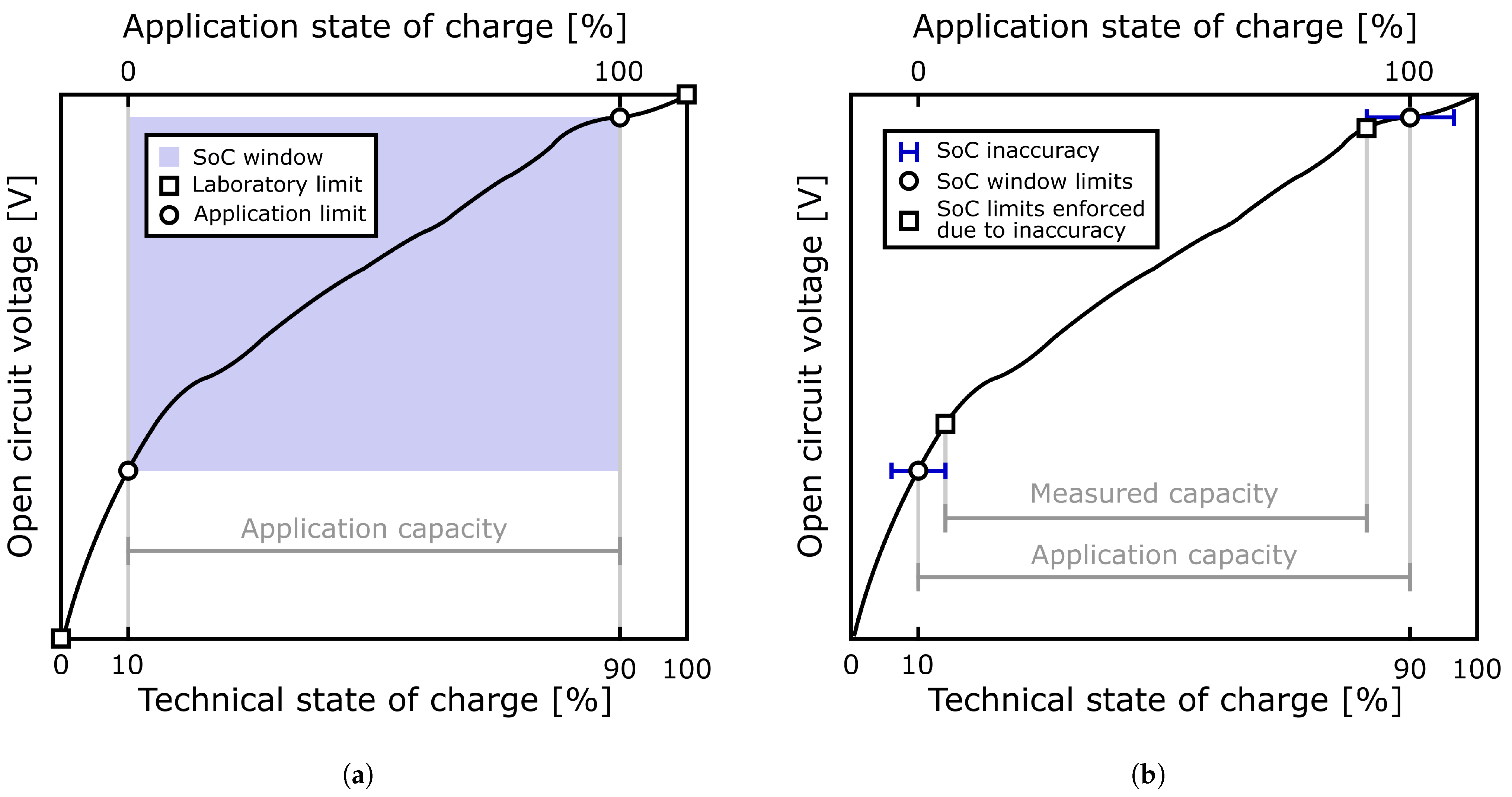
16]. This well-established method cannot be directly applied to a real-world application as the laboratory discharge protocol would consist of discharging from 100% technical SoC to 0% technical SoC, as is illustrated in
Figure 1a. Yet, in real-world applications, the battery manufacturer commonly applies a SoC window [
17], limiting the application operation between a set range of technical SoC; in the example of
Figure 1a, a 10% to 90% SoC window is applied. This makes the laboratory test impossible to apply since the BMS would shut the system down, well before 0% or 100% technical SoC would be reached. This relates to challenge C1 in
Table 1.
An alternative to laboratory methods is the use of the test methodology described in the ISO-12405 standard, which defines a method to measure battery pack capacity in electric vehicles [
18]. Using the example of a capacity test again, the ISO-12405 standard defines battery pack capacity as “Total number of ampere hours that can be withdrawn from a fully charged battery pack under specified conditions”. In the example shown in
Figure 1b “full” would translate into 90% technical SoC and “empty” to 10% technical SoC. The challenge lies in how consistently “full” and “empty” can be reached. If the target is to discharge the battery until 10% SoC is reached, but it would underestimate the SoC by 1% due to inaccuracy of the SoC algorithm, it would mean that the discharge would be stopped at 11% SoC, and the measured capacity would therefore be smaller than the actual application capacity. If this inaccuracy varies over time, it would cause a variation in measured capacity which is completely independent of the actual degradation of the battery cell. Therefore, reaching the same battery charge state consistently is crucial to an accurate measurement of battery capacity degradation. This relates to challenge C2 in
Table 1.
In the study of Thingvad et al. [
11], all challenges described in
Table 1 play a role. In this study, the battery pack capacities of multiple electric vehicles are actively diagnosed through their use and uni-directional charging. The batteries are discharged through driving and heating until 6% application SoC is reached, after that the lights are used “until the battery reaches approx. 3% SoC”. After discharging, the battery pack is fully charged, during which the capacity is measured. The fact that it was not possible to reach 0% application SoC illustrates challenge C1, and the use of the words “approximately 3% SoC” illustrates challenge C2, which implies that it is challenging to reach the same battery charge state consistently. The discharging process described by Thingvad et al. has the benefit of requiring only a uni-directional charger but has the downside of time-consuming steps and necessary human effort for driving and slow discharging through using lights and heating systems. This affects the appeal of the method in real-world applications. It is important for the widespread adoption of the method to balance these costs in terms of time and human effort with the diagnostic value gained. This relates to challenges C3 and C4 in
Table 1.
Challenge C4 is further illustrated by the work of Doan et al. [
12]. In this study, battery state of health (SoH) is estimated by applying online electrochemical impedance spectroscopy. To enable these methods, the addition of specialized power electronics is necessary to inject the current waveforms of multiple different frequencies required to perform EIS. The potential of this type of active diagnosis has been shown in the literature [
12]; however, the additional costs attached to the additional power electronics is an additional challenge to the widespread adoption of such systems.
4. Design and Requirements
The design of the diagnostic protocol was motivated by solving the challenges discussed in
Section 2 (see
Table 1), which led to the requirements for the diagnostic system and method, summarized in
Table 3. This section discusses the requirements for active diagnostics in general and the design decisions taken specifically for the diagnostic protocol and system used in the iSTORMY demonstration.
4.1. Requirement R1
Requirement R1 of
Table 3 was derived from challenge C1, which states that testing outside or near the SoC window carries the unacceptable risk of shutdown. Shutdown is unacceptable from a user and operational viewpoint, but it also affects measurement repeatability and consistency. To prevent interruption, requirement R1 was created, which stated that the diagnostic protocol must operate well within the limits set by the BMS. In the case of the NMC battery pack used in the iSTORMY demonstration (see
Section 5), the existing limits consisted of (A) a SoC window, (B) reduced current limits at the edges of the SoC window, and (C) temperature limits. To operate well within the SoC window and to stay away from any current or temperature limitations, the diagnostic protocol was limited to the terminal voltage range of 3.5 V and 3.9 V and a maximum continuous applied C-rate of C/2. The terminal voltage range was determined by staying at least 0.1 V away from the BMS operating limits but maximizing the range for accuracy’s sake and rounding to the nearest 0.1 V. These two design decisions, limiting the operation to a terminal voltage range and limiting the maximum continuous C-rate, were taken to minimize the risk of triggering the BMS limits.
4.2. Requirement R2
Requirement R2 addresses challenge C2, which highlights the difficulty of consistently reaching the same battery charge state when using State of Charge (SoC) as a reference. To overcome this, R2 mandates that diagnostic protocol setpoints be based on directly measurable quantities, leading to the use of voltage and current targets instead of SoC. This approach enhances consistency as voltage is measured directly by a sensor, unlike SoC which relies on multiple sensor inputs and estimations. It also improves protocol standardization across different applications since voltage and current measurements are more universally harmonized than SoC estimations. As a result, the capacity diagnostic sub-protocol uses voltage-based stop criteria: charging stops when the maximum cell voltage reaches 3.9 V, and discharging stops when the minimum cell voltage reaches 3.5 V.
4.3. Requirement R3
Requirement R3 addresses challenge C3, which states that diagnostic measurements compete with operational time. The requirements states that the diagnostic protocol should consider the trade-off between (A) the protocol time duration, (B) the diagnostic value of the protocol, (C) the temperature increase due to the protocol and (D) the battery aging caused by the protocol. One approach to solving challenge C3 is to reduce the diagnostic protocol duration, which could be done by increasing the current amplitude. However, this has negative consequences for battery aging and would cause the battery temperature to increase more due to the protocol.
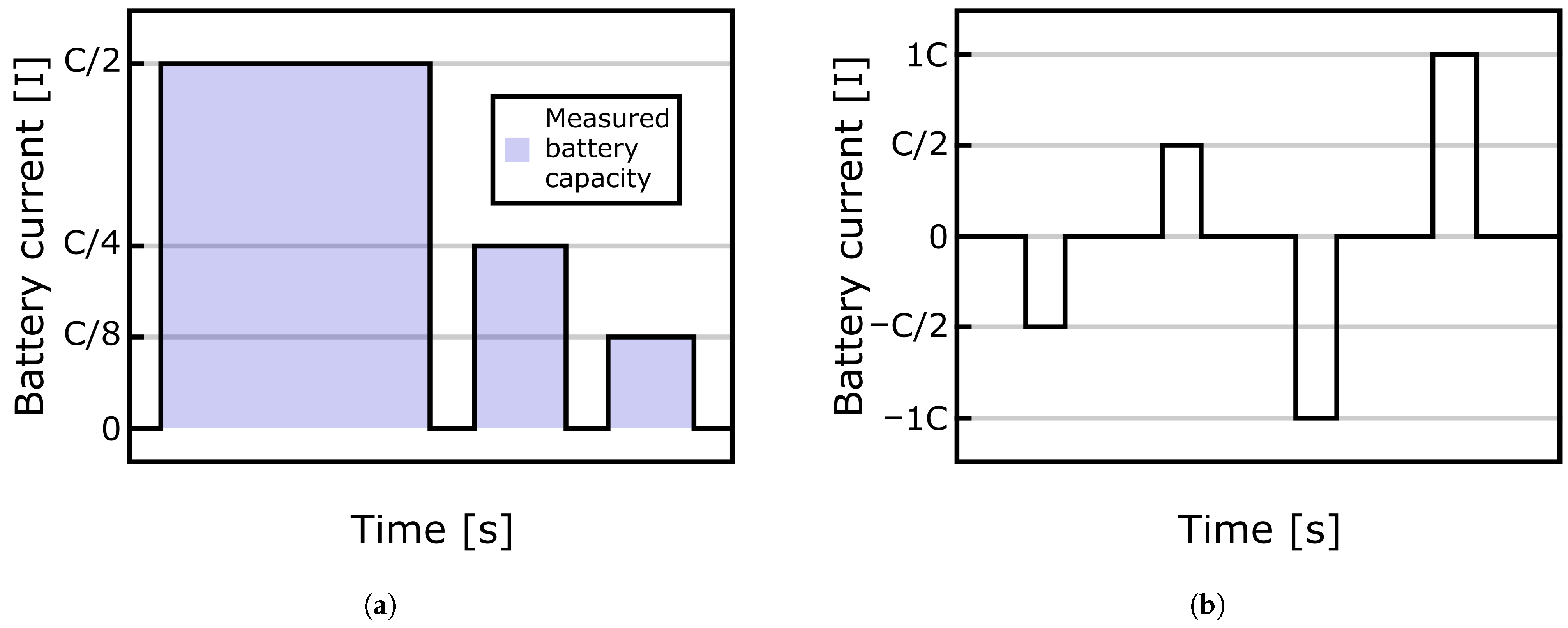
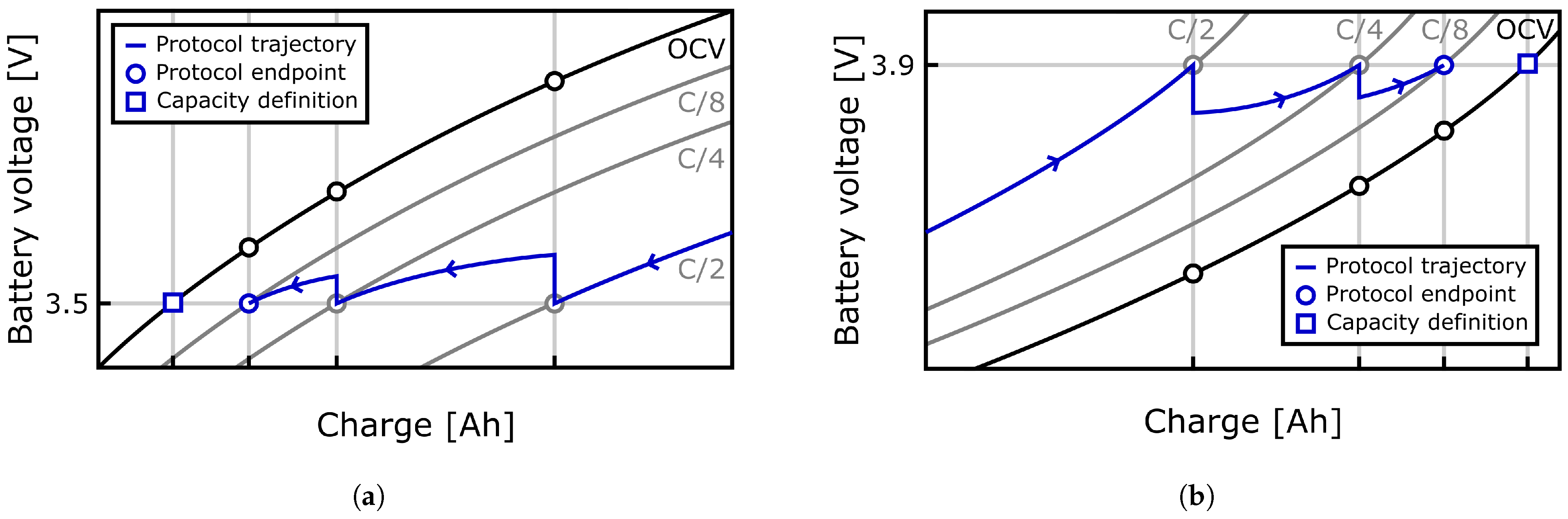
Considering this trade-off, the current amplitudes of the capacity sub-protocol were chosen to be C/2, C/4 and C/8. The first pulse dominates the duration of the sub-protocol; therefore, it was aligned to C/2, the highest available continuous C-rate according to requirement R1. The last pulse determined how closely the target OCV point of the battery capacity definition could be reached (see
Section 3.3). To that end a lower amplitude is more favorable. However, the amplitude of C/8 was chosen as a trade-off between protocol duration and the control limits of the bi-directional charger under small loads. The C/4 step was chosen to save time between the C/2 and C/8 step. The trade-off associated with R3 is visualized in
Figure 4a,b, where the trajectory of the diagnostic protocol in charge-voltage space is illustrated. They show that the diagnostic protocol can approach the capacity definition by applying an ever-diminishing current. However, this would cost an ever-increasing amount of time and would eventually run into the control limits of the bi-directional charger.
Much of the motivation for the capacity sub-protocol design choices applies to the resistance sub-protocol as well. For example, changing the SoC prior to the pulses was done at C/2 amplitude to limit protocol duration but still adhere to R1. The current rates of the current pulses were chosen to be C/2 and 1C to maximize signal to noise ratio while minimizing the risk of triggering the BMS limits and maximizing diagnostic value. The choice for three pulse sets of 4 pulses at different SoC was made to improve accuracy through multiple measurements and sweeping a representative range of SoC while keeping protocol duration in check. Alternating charge and discharge pulses were chosen to stay charge neutral over the long term, and the 10 s pulse duration was chosen to not deviate significantly away from the measured SoC point.
4.4. Requirements R4 and R5
Requirements R4 and R5 address challenge C4, which states that any additional costs required to implement and run the active diagnostics would limit the scale at which the system would be adopted. To minimize the initial cost of implementing the active diagnostics, only existing hardware in the BESS was used. This was possible in the case of the iSTORMY demonstration because the charger in a BESS is bi-directional due to the nature of the application, which suited the requirements for the active-diagnostic protocol (see
Section 5 for details). To minimize operational costs, all operations of the diagnostic system were automated with the exception of the initiation of the diagnostic protocol.
4.5. System Design
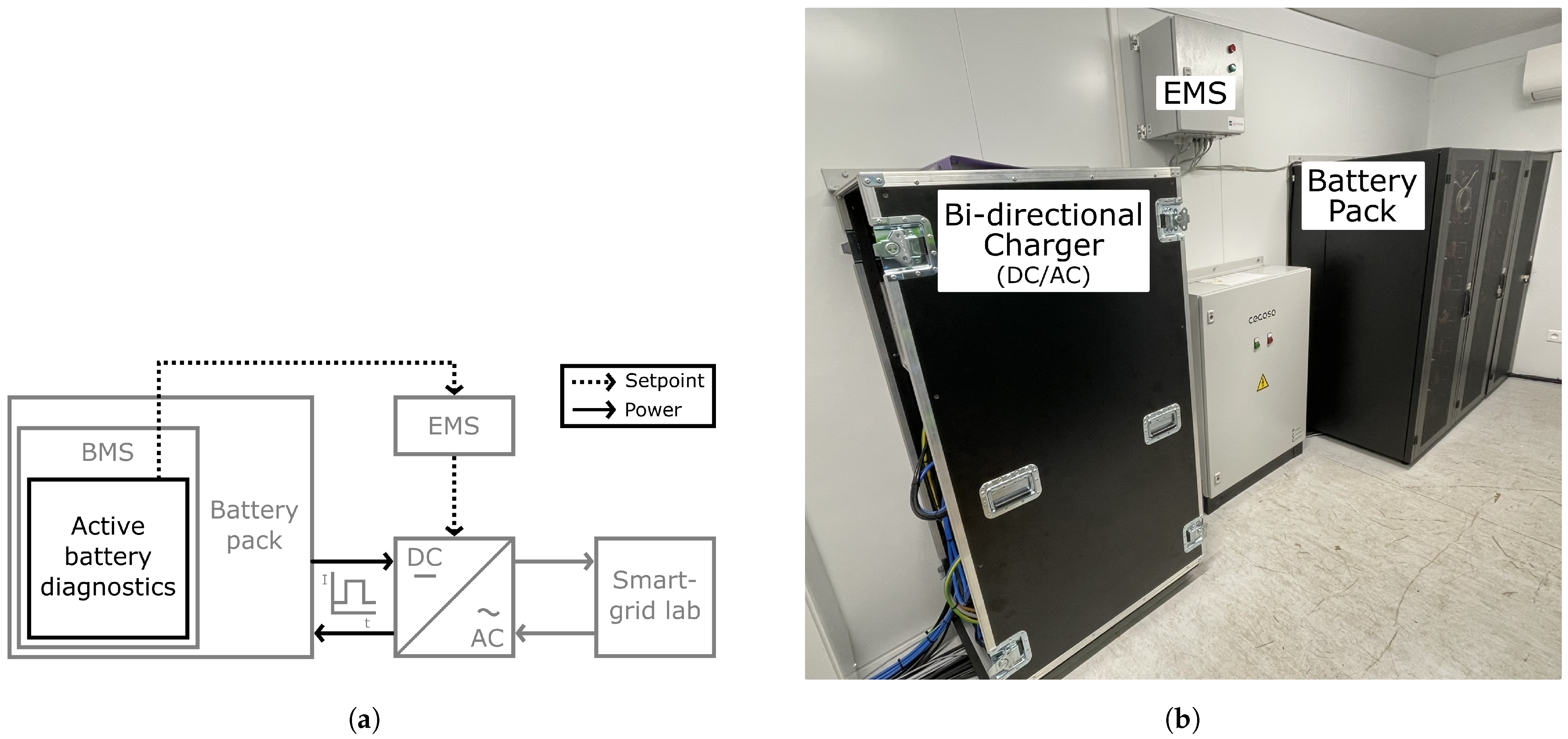
The active-diagnostic system was the hardware and software that applied the diagnostic protocol to the battery pack, measured the resulting battery signals, and analyzed those signals to turn them into battery pack capacity and resistance. A schematic overview of the diagnostic system is shown in
Figure 5a. The diagnostic protocol was applied by sending a power setpoint request from the active-diagnostic software running on the BMS, to the bi-directional charger, via the EMS. At the discretion of the EMS, the bi-directional charger applied the requested power to the battery pack and the BMS measured the resulting voltage, current and temperature of the battery pack. These measurements were buffered for the duration of the diagnostic cycle and after completion were used for analysis. Buffering the data locally has the advantage of having access to high-frequency, low-level measurements of the 280 individual cell voltages. An advantage of running the setpoints through the EMS, is the added level of safety. Because it has the overview of the entire BES system, it is able to (A) override or refuse any individual power setpoint or (B) to start and stop the diagnostic cycle, if deemed unsafe or unwanted.
5. Demonstration
To verify the design requirements, the active battery-diagnostic system and method were tested on the iSTORMY Battery Energy Storage System (BESS) demonstrator as part of the iSTORMY project [
14]. The battery pack that was diagnosed consisted of 280 NMC 50Ah prismatic battery cells, configured in 20 modules arranged in a 4S5P configuration, with each module arranged in a 14S1P battery cell configuration. The demonstration consisted of two active-diagnostic cycles with real-world use-case tests of the BESS in between. The active-diagnostic cycles were performed on the 1st and 31st of October 2024. Due to the limited duration of the demonstration period, the expected degradation of the battery was limited, and the primary focus was to verify the design requirements. Nonetheless, the results of both diagnostic cycles were compared to assess the battery health degradation during this short period and to compare it to the estimated measurement uncertainty.
The demonstration was performed at Concept Grid, an EDF laboratory to test smart-grid solutions in a real distribution grid (see
Figure 5b). Real sources and loads, such as PV inverters and EV chargers, were used in combination with power amplifiers to generate realistic scenarios. Use-case tests such as frequency support to the grid and load leveling of electric vehicle chargers were performed in between both diagnostic cycles. The combination of the facilities, the nature of the use-cases and the iSTORMY BESS created the real-world application conditions necessary to properly verify the design requirements.
6. Results
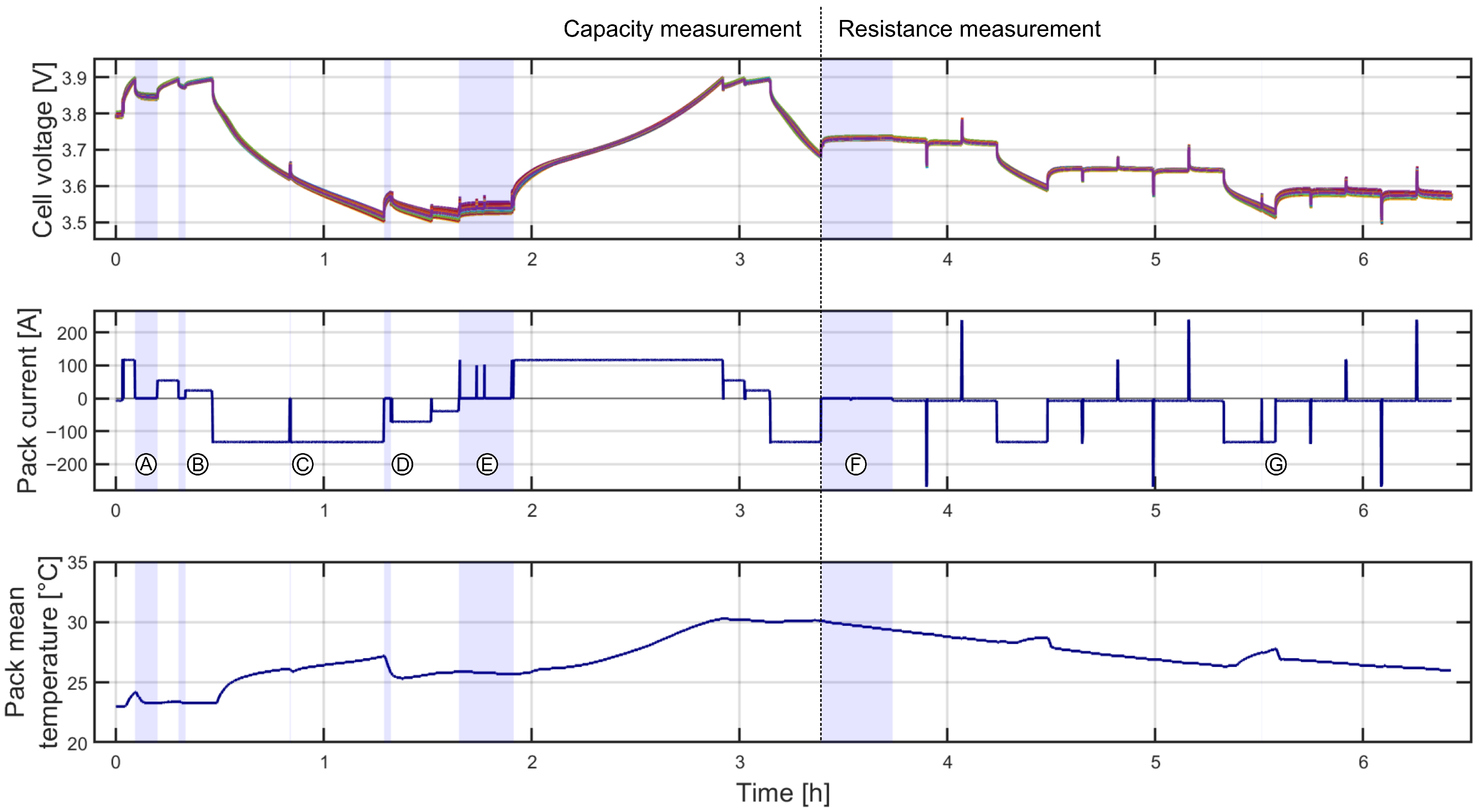
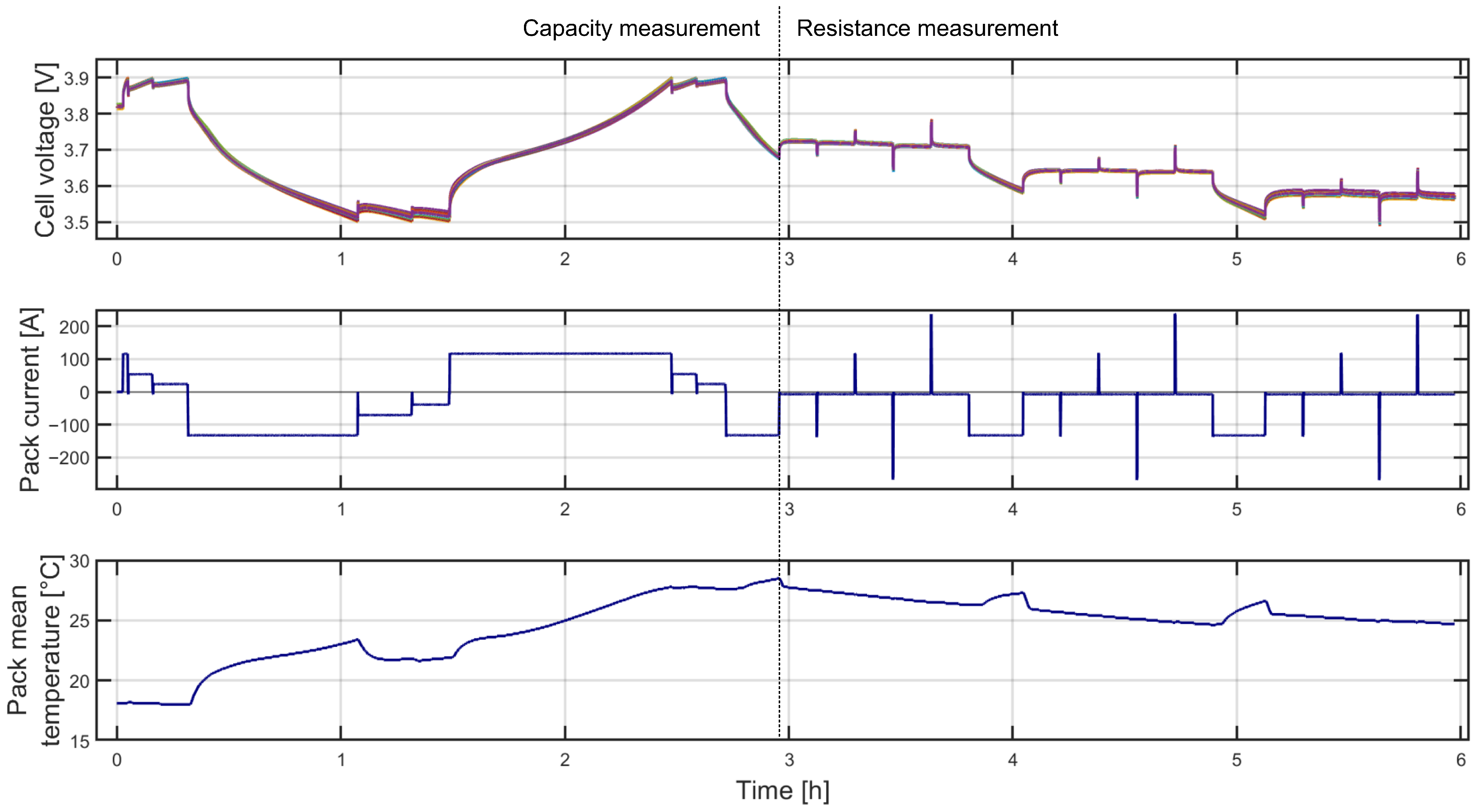
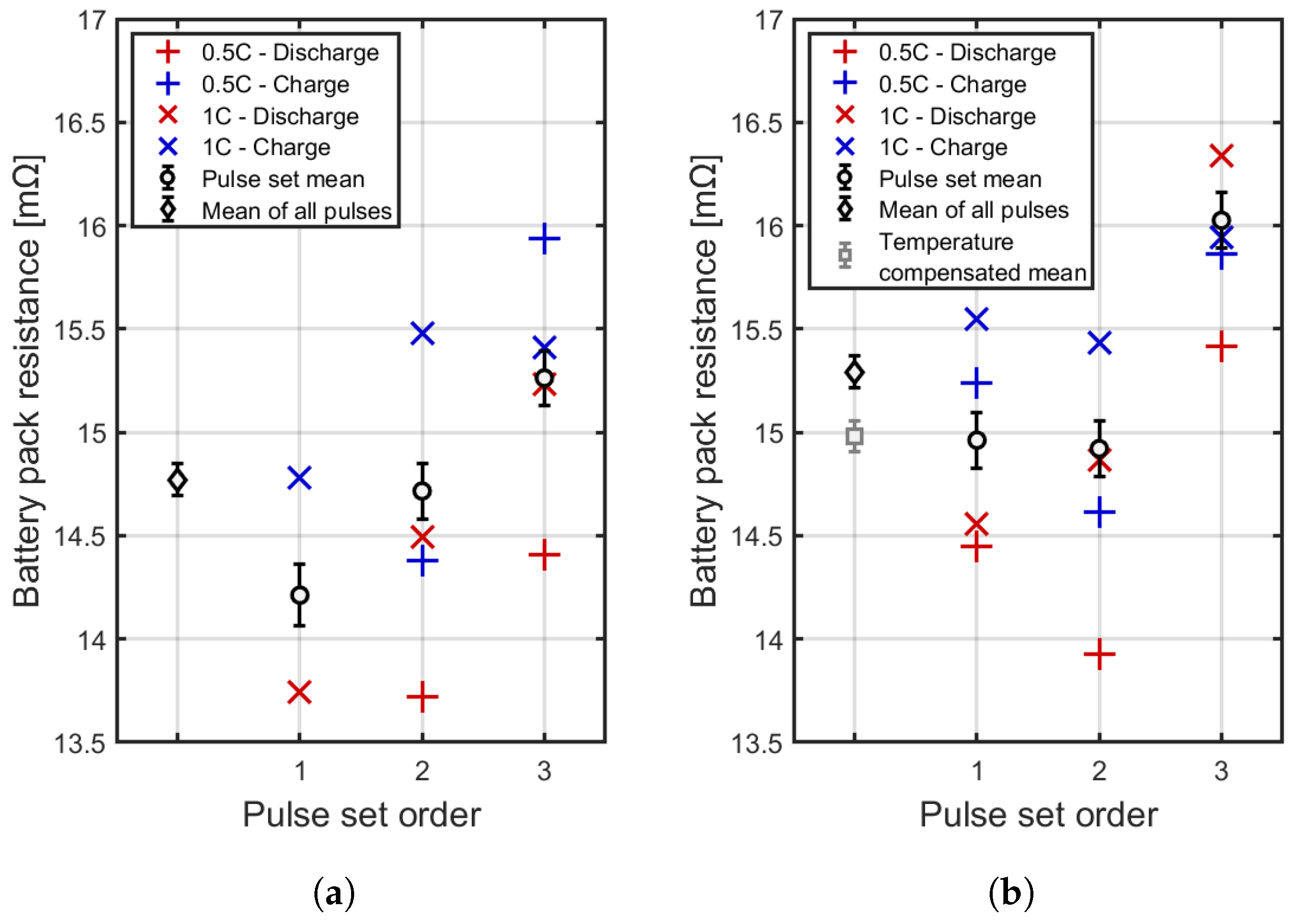
The test results of the active battery-diagnostic system of October the 1st 2024 and October the 31st 2024 are shown in
Figure 6 and
Figure 7, respectively. The analysis results of battery pack capacity are shown in
Table 4, and the analysis results of battery pack resistance are shown in
Figure 8. The analysis indicated a decrease in both discharge and charge battery pack capacity between the two dates. The capacity degradation between the test dates was 2.61 ± 0.47% for discharge capacity and was 0.83 ± 0.51% for charge capacity. Taking the mean of charge and discharge capacity resulted in a degradation of 1.79 ± 0.34%. The results of battery pack resistance show an increase in the mean battery pack resistance over time and an increase over time for every pulse set individually. The total mean battery pack resistance of all three pulse sets combined was 14.77 ± 0.08 mΩ on the 1st of October and 14.98 ± 0.08 mΩ on the 31st of October, which resulted in an increase of 1.42 ± 0.75%. The decrease in capacity and increase in resistance is in line with the expectations since the use case tests during October and the active-diagnostic cycles themselves were expected to degrade battery health during this time, if only by a little.
Important to note is that all capacity and resistance results of the 31st of October were compensated for the temperature difference compared to the 1st of October. By extension, this means that the effect of temperature on the degradation results was compensated for. The discharge capacity of October the 31st was adjusted by +0.45 Ah, the charge capacity was adjusted by +0.46 Ah, and the mean resistance of all pulses was adjusted by −0.31 mΩ.
Another notable aspect of the results is the unintended communication interruptions during the diagnostic cycle of October 1st. These were moments where the communication was interrupted between the bi-directional charger and the active-diagnostic system running on the BMS. These interruptions caused the current output to drop to zero multiple times (markers A through G in
Figure 6), unintentionally relaxing the battery voltage and causing the first set of current pulses in the resistance measurement phase to be skipped.
6.1. Verification of Requirements
Reflecting back on the requirements presented in
Table 3, in light of the results presented, reveal that all requirements were met. No interruptions of the protocol due to exceeding BMS limits occurred, satisfying requirement R1. The capacity and resistance of a battery pack in a real-world application were measured without interference of the BMS. Even though the communication interruptions of the 1st of October did affect the measurements, requirement R1 remained satisfied because they were not caused by BMS safety limit violations. Requirement R2 was also satisfied. Defining the diagnostic protocol by voltages and currents and using terminal voltages to determine when to transition between protocol steps led to a fast and simple control of the diagnostic protocol. Unfortunately, the communication interruptions still affected how consistently the same charge state could be reached, in spite of relying only on direct sensor measurements. The trade-off described in requirement R3 can be considered achieved, due to the successful capacity and resistance measurement in comparison to a total protocol duration of roughly 6.5 h and a maximum battery temperature increase of +7.3 °C and +10.5 °C on 1 and 31 October respectively. A diagnostic cycle run on a monthly basis, with relatively small time investment of 6.5 h per diagnostic cycle in exchange for a consistent measurement of battery health and all that enables, like lifetime optimization and prediction, seems a worthwhile offer to consider. Requirements R4 and R5 were satisfied because no purchase of additional hardware was necessary to run the system, and no time consuming human involvement was necessary to run the diagnostic cycle. Execution of the diagnostic protocol was fully automated with the exception of the start. These cost savings add to the appeal of the proposed active-diagnostic system and method.
To summarize, the active-diagnostic system requires relatively few resources to implement or run. The diagnostic protocol can be executed autonomously, saving human effort, and to implement the system on the application, only software needs to be added. In contrast, using the existing hardware in the application does require software adjustments to make it compatible with the diagnostics, and the dependency on the existing hardware does mean that if there are any communication interruptions or if functionality of any of the required subsystems is lost, the diagnostic system will be affected.
6.2. System and Method Performance
Reflecting back on the goals set in the Introduction Section, the results of the demonstration show that the active-diagnostic system can measure the battery pack capacity and resistance of a real-world application by using a bi-directional charger. The diagnostic cycle of the 31st of October shows that the diagnostic protocol can be applied without issue, which makes periodic consistent diagnostic cycles plausible. In contrast, the diagnostic cycle of the 1st of October does show that communication interruptions can affect operation, and care must be taken to ensure stable communication. When the diagnostic protocol is applied consistently, the C-rates, target voltages and timings of the diagnostic protocol all stay constant over time, eliminating the dependency of the battery health measurements on those factors. By repeatedly applying the same diagnostic protocol over an extended period of time, this system enables consistent tracking of battery health.
Zooming in on the performance of a specific result, the observed capacity degradation of 1.79 ± 0.34% is high compared to the expected value based on the lifetime of the battery system. The estimated measurement uncertainty does give credibility to the result, yet if the degradation is extrapolated linearly, the rate of degradation of 1.79 ± 0.34% per month would mean the battery system would degrade to 80% of initial capacity within roughly a year. Even when heavily used, the battery lifetime of a BESS of this battery type is expected to be at least multiple years. A possible explanation for this result is the fact that the battery pack was brand new at the start of the demonstration. Accelerated aging at the beginning of life has been observed in battery age tests on new cells [
23], where after the initial period the degradation rate slows down. It is possible that the degradation will decrease as time progresses, and that the results solely reflect the beginning of life degradation. Another observation that can put the degradation result into perspective is the measurement uncertainty. Although a 1
uncertainty of 0.34% indicates capacity degradation is highly likely, it is possible that the actual capacity degradation magnitude is lower than 1.79% per month.
Extrapolating the diagnostic performance beyond the scope and duration of the demonstration reveals a positive outlook. After all, the degradation results of capacity decrease and resistance increase and their uncertainties should be judged with the duration of the demonstration period in mind. A month is a relatively short time frame to observe battery degradation, but the intended use of the active-diagnostic system is monthly diagnostic cycles over the span of years. Measurements of degradation over these time frames would have a much more favorable degradation versus uncertainty ratio. As time progresses, the magnitude of battery degradation will increase, while the measurement uncertainty will remain relatively constant, improving the ratio between them and thus the confidence in the measured degradation. Additionally, multiple diagnostic cycles would improve the statistical significance of the degradation results and decrease degradation measurement uncertainty.
In the frame of measurement performance, another result that needs to be discussed is the individual results of discharge and charge capacity degradation. The measured degradation of 2.61 ± 0.47% for discharge capacity and 0.83 ± 0.51% for charge capacity differ significantly. The exact cause of this difference could not be determined, but in all likelihood the capacity measurement was influenced by the interruptions of the protocol on the 1st of October and by extension the degradation results. The interruptions marked A and B in
Figure 6 will have influenced the battery charge state at the end of the capacity sub-protocol to some extent, increasing the discharge-capacity measurement relative to the charge capacity measurement. Since no interruptions occurred on the 31st of October, this likely skewed the results, explaining the larger decrease in discharge capacity relative to charge capacity. The effect of interruptions in future use of the system would likely be smaller as the degradation would be based on multiple diagnostic cycles over a longer period, on top of the possibility of disregarding cycles that led to interruptions in the degradation analysis.
6.3. Diagnostic Protocol Improvements
The diagnostic protocol has proven to be compatible with a real-world application and has shown it is able to measure battery pack capacity and resistance. However, usage of the system has revealed that much can still be improved. Three improvement points are highlighted in the next paragraphs: (A) minimize the effects of SoC imbalance through analysis, (B) add rest periods for consistent charge-state calibration points, and (C) apply CCCV profiles whenever possible.
The first suggested diagnostic protocol improvement focuses on the effect SoC imbalance has on the measurement of battery pack capacity. Variations in SoC imbalance cause variations in measured capacity, yet any decrease in measured capacity due to SoC imbalance can be reversed, which means that it differs from permanent battery degradation. It would be beneficial to the quality of the battery health data if the contribution of permanent degradation and temporary changes could be differentiated since battery lifetime optimization only focuses on permanent degradation. Accessing control over the SoC imbalance is challenging for active diagnostics in real-world applications, so the suggested improvement is to compensate for these factors in analysis. Data-driven techniques and approaches based on the open-circuit voltage curve are prime candidates to make compensation possible.
The second suggested diagnostic protocol improvement focuses on adding rest periods to the protocol to create charge state calibration points. Even though the point of the diagnostic protocol is to improve measurement consistency by applying the same diagnostic protocol over and over again, some factors are out of its control, like the ambient temperature and the quality of sensors. Calibration points in the protocol allow for compensation for these factors, improving the quality of the battery health data. Adding rest periods at specific times in the protocol will allow the battery voltage to relax and will create opportunities to verify the battery charge state by comparison of the terminal voltage with the OCV curve. The minimum suggested improvement is to add rest periods to the end of all capacity sub-protocols to calibrate all measured capacities to the same battery charge state frame of reference (aligns with challenge C2). The expected challenge will be to put the battery pack in true rest state, i.e., zero current flow. In real-world applications it is debatable whether this is feasible considering permanent loads like the BMS electronics.
The third suggested diagnostic protocol improvement focuses on replacing constant-current (CC) steps with constant-current constant-voltage (CCCV) steps.
Figure 4a,b show that the application of an ever-smaller current allows the measurement by the protocol to approach the definition of capacity more closely, which decreases the effect the battery resistance has on capacity measurement. CCCV steps would be able to reach a smaller current in a shorter time than CC steps could, even though it would still not allow an infinitely small current to be applied as the limits of the bi-directional charger efficiency and control still exist.
6.4. Future Potential
In this study, the active-diagnostic system and method have been demonstrated on a single application for a limited period of time for verification purposes, but their potential lies in a scope larger than that. Therefore, the potential of the system and method is discussed in the scenario of large-scale, long-term use on a wide variety of applications. In terms of long-term use, the primary benefit of the system is consistent tracking of battery health. An unchanging diagnostic protocol in combination with compensation for uncontrollable factors provides a stable frame of reference to compare battery health over time. Applying the diagnostic protocol and system to other applications and battery types is, in most cases, only a matter of resizing the protocol. A change in target voltages and C-rates, aligned with the new battery specifications, is likely sufficient. As long as the diagnostic protocol does not change, a consistent comparison of results is possible for a single application. To compare the results of different diagnostic protocols between two different applications, additional analysis is required. For applications without bi-directional charger capability, like automotive, it may be more challenging due to the additional investment required for the charger, which in that case needs to be weighed against the diagnostic benefit. However, if a bi-directional charger is available, as is often the case in BES systems, scaling-up the number of active-diagnostic systems may only require software to be installed. In summary, when applied at scale, the proposed active-diagnostic system has the potential to gather vast quantities of quality battery health data cost effectively, addressing the need for battery health data from real-world applications mentioned in the Introduction Section.
7. Conclusions
The demonstration of the active-diagnostic system proves that the battery pack capacity and resistance of a real-world application can be measured by using a bi-directional charger. The diagnostic cycles performed on the iSTORMY Battery Energy Storage System (BESS) under real-world conditions verified that all the design requirements were met and showcase the method’s compatibility with real-world applications. These results show that a diagnostic cycle can be applied without issues but also show that care must be taken to ensure stable communication between the diagnostic software and the charger as communication failure can disrupt consistency.
The two diagnostic cycles performed at the start and the end of the demonstration period of a month resulted in an observed degradation of 1.79 ± 0.34% in battery capacity and an increase of 1.42 ± 0.75% in battery resistance. Extrapolating these results beyond the duration of the demonstration indicates that quality battery degradation data can be harvested since measurements over a longer time frame will have a much more favorable degradation versus uncertainty ratio. As time progresses, the magnitude of battery degradation will increase, while the measurement uncertainty will remain relatively constant, improving the ratio between them, and thus the confidence in the measured degradation.
The proposed active-diagnostic system and method offer several important advantages for harvesting battery health data from real-world applications. First and foremost, the diagnostic system and method enable consistent tracking of battery health over time. Applying the same diagnostic protocol each time and compensating for uncontrollable factors provide a stable frame of reference for comparison of battery health. Second, the system shows potential for cost-effective harvesting of battery health data due to the limited hardware requirements and limited human efforts required to operate. The operation of the system during the demonstration only required the addition of software to the BESS, and the diagnostic protocol was applied autonomously after initiation by the user. Third, the diagnostic method can be easily applied to a wide range of applications due to the adaptability of the diagnostic protocol. The combination of consistency, cost-effectiveness, and broad applicability of the diagnostic system and method all contribute to addressing the need for battery health data from real-world applications discussed in the Introduction section.
Future Research
Future research should focus on applying the diagnostic method in different types of applications and applying more diagnostic cycles for an extended duration. Doing so will allow for a more complete assessment of diagnostic measurement performance and validation of the method. To further boost measurement performance, the diagnostic protocol should be improved according to the suggestions made in this study.



 ,
,