


Abstract
Accurate prediction of the Remaining Useful Life (RUL) of lithium-ion batteries is essential for improving the reliability, safety, and maintenance planning of electric vehicles and energy storage systems. However, battery degradation is a complex and nonlinear process influenced by multiple operational conditions, making reliable RUL estimation a challenging task. Although numerous data-driven approaches have been proposed in the literature, many studies focus primarily on improving prediction accuracy using a single modeling technique, while limited attention has been given to systematic comparisons of different algorithms and the quantification of prediction uncertainty. This study proposes a comprehensive data-driven framework for lithium-ion battery RUL prediction by integrating both traditional machine learning and deep learning approaches. A Convolutional Neural Network (CNN) model is developed to capture nonlinear degradation patterns from battery cycling data. The dataset was divided using a battery-wise validation strategy to evaluate model generalization. In addition, conventional machine learning algorithms, including k-Nearest Neighbors (KNNs), Random Forest (RF), and Extreme Gradient Boosting (XGBoost), are implemented to perform a comparative analysis of different predictive models. Key degradation-related features derived from voltage, current, temperature, and cycle information are extracted through a structured preprocessing pipeline. Furthermore, prediction uncertainty is quantified by constructing confidence intervals around the estimated RUL values. The predictive performance of the models is evaluated using prognostic metrics such as Root Mean Square Error (RMSE), Relative Prediction Error (RPE), and Prognostic Horizon (PH). The performance of the models is evaluated using multiple prognostic metrics, including Mean Absolute Error (MAE), Root Mean Square Error (RMSE), and the coefficient of determination (R2), to ensure a comprehensive assessment of prediction accuracy. The experimental results demonstrate that the proposed framework provides accurate RUL predictions. Among the evaluated models, the CNN achieved the best performance with a Mean Absolute Error (MAE) of 7.75 and a Root Mean Square Error (RMSE) of 10.80, outperforming traditional machine learning models such as Random Forest and XGBoost. The KNN model also showed competitive performance with an RMSE of 12.07 and an R2 value of 0.64, indicating that similarity-based learning can effectively capture battery degradation patterns.
1. Introduction
Lithium-ion batteries have become the dominant energy storage technology in electric vehicles, portable electronics, and renewable energy systems due to their high energy density, long cycle life, and relatively low self-discharge rate [1]. As the demand for electrified transportation and renewable energy storage continues to increase, ensuring the reliability and safety of lithium-ion batteries has become a critical research topic [2].
Despite their advantages, lithium-ion batteries experience gradual degradation during repeated charge and discharge cycles. This degradation leads to a reduction in battery capacity and an increase in internal resistance, which ultimately limits the battery’s usable lifetime [3]. Therefore, accurate estimation of the Remaining Useful Life (RUL) of batteries is essential for improving battery reliability, enabling predictive maintenance, and enhancing the performance of battery management systems (BMS) [4].
Traditional battery health prediction methods are often based on electrochemical models and state estimation techniques. While these physics-based models can provide detailed insights into battery behavior, they usually require complex parameter identification and high computational cost, which limits their practical applicability in real-time systems [5].
To overcome these limitations, data-driven approaches based on machine learning and deep learning have recently gained significant attention in battery prognostics research. Machine learning algorithms are capable of learning complex nonlinear relationships between operational parameters and battery degradation patterns without relying on explicit physical models [6]. In particular, deep learning architectures such as convolutional neural networks (CNN) and recurrent neural networks (RNN) have demonstrated strong capabilities in capturing temporal degradation patterns from battery cycling data [7].
Several recent studies have explored hybrid machine learning and deep learning frameworks for battery RUL prediction. For example, Mou et al. proposed a CNN-BLSTM model to capture nonlinear degradation patterns in lithium-ion batteries using the NASA battery dataset [8]. Similarly, Li et al. developed a CNN-LSTM-based architecture that improved degradation feature extraction and prediction accuracy [9]. Signal decomposition techniques have also been integrated with deep learning models to enhance prediction stability. Liu et al. introduced a CEEMDAN-PSO-BiGRU framework that decomposes battery signals before applying recurrent neural networks for RUL prediction [10].
Another important aspect of battery prognostics is uncertainty quantification. In practical applications such as electric vehicles, deterministic predictions may not be sufficient to ensure safe operation. Therefore, incorporating uncertainty estimation into RUL prediction models has become increasingly important. Zhang et al. proposed an LSTM-based framework with Monte Carlo dropout to quantify uncertainty in battery RUL prediction [11].
Although significant progress has been made in battery prognostics research, several challenges remain. Many existing studies focus on a single model architecture and rely primarily on capacity degradation signals as input features. In addition, uncertainty analysis is often neglected in RUL prediction studies. These limitations reduce the interpretability and robustness of the prediction models.
To address these challenges, this study proposes a comprehensive machine learning framework for lithium-ion battery RUL prediction using the NASA battery dataset. Multiple machine learning and deep learning models, including CNN, K-Nearest Neighbors (KNN), Random Forest, and XGBoost, are evaluated within a unified experimental framework. Furthermore, an uncertainty analysis based on confidence interval estimation is integrated to assess the reliability of the predicted RUL values. This study addresses these limitations by providing a comparative evaluation of machine learning and deep learning models combined with feature engineering and uncertainty analysis. To the best of the authors’ knowledge, this study is one of the few works that integrates comparative model evaluation, multi-parameter feature engineering, and uncertainty quantification within a unified lithium-ion battery RUL prediction framework. The main contributions of this study are summarized as follows:
- A comparative evaluation of multiple machine learning and deep learning models for lithium-ion battery RUL prediction.
- The integration of multiple operational parameters and degradation-related features for improved degradation modeling.
- The incorporation of uncertainty analysis to enhance prediction reliability.
- Validation of the proposed framework using the widely used NASA lithium-ion battery dataset.
1.1. Literature Survey
Recent studies on lithium-ion battery Remaining Useful Life (RUL) prediction have extensively explored data-driven approaches, particularly focusing on deep learning and hybrid modeling techniques. These approaches aim to capture the complex nonlinear degradation behavior of batteries under varying operating conditions.
Hybrid deep learning architectures have been widely adopted to improve prediction accuracy. For instance, Li et al. [3] proposed a CNN–LSTM model that integrates convolutional layers for feature extraction with recurrent layers for temporal modeling. Similarly, Mou et al. [4] developed a CNN–BLSTM framework that enhances the ability to capture nonlinear degradation characteristics from capacity signals. Although these hybrid models achieve improved predictive performance, they primarily rely on capacity-based features and focus on a single model architecture, limiting their generalizability.
Signal decomposition-based approaches have also been introduced to enhance prediction stability. Liu et al. [5] proposed a CEEMDAN–PSO–BiGRU framework, where battery signals are decomposed into intrinsic mode functions before applying deep learning models. This method improves noise robustness and prediction stability. However, such approaches often involve complex preprocessing pipelines and still rely on a single predictive model without providing a comparative evaluation.
In addition to deterministic models, uncertainty-aware prediction methods have gained increasing attention. Zhang et al. [6] proposed an LSTM-based model with Monte Carlo dropout to quantify uncertainty in RUL prediction. This approach provides confidence bounds for predictions, improving reliability in practical applications. Nevertheless, the study does not include a comparative analysis across different model types, limiting the understanding of relative model performance.
More recent studies have explored advanced architecture such as attention-based deep learning models. Xu et al. [12] introduced an attention-based framework that improves prediction accuracy by focusing on the most relevant degradation features. While this approach enhances feature representation, it does not incorporate uncertainty analysis and is still limited to a single model structure.
Overall, the existing literature demonstrates that individual approaches—whether hybrid models, decomposition techniques, or uncertainty-aware methods—can improve specific aspects of RUL prediction. However, several key limitations remain. First, most studies focus on a single model architecture, lacking a systematic comparison between different machine learning and deep learning approaches. Second, many works rely primarily on capacity-based features, while the integration of multiple operational parameters such as voltage, current, and temperature remains limited. Third, uncertainty quantification is often treated as an isolated component rather than being integrated into a comprehensive prediction framework.
Recent studies have also explored alternative deep learning and probabilistic approaches for battery RUL prediction.
For example, Ren et al. [13] proposed a GRU-based model to improve temporal de-pendency learning, while Wang et al. [14] integrated wavelet transform with LSTM networks to enhance feature representation. In addition, Bayesian deep learning methods have been introduced to improve uncertainty estimation, as demonstrated by Hu et al. [15], providing probabilistic predictions for safety-critical applications. Comprehensive review studies [7,11,16] further highlight the importance of combining multiple modeling strategies and incorporating uncertainty-aware frameworks for robust battery prognostics.
To address these limitations, this study proposes a unified data-driven framework for lithium-ion battery RUL prediction. Unlike previous works, multiple models—including CNN, Random Forest, XGBoost, and K-Nearest Neighbors (KNN)—are evaluated within the same experimental setup, enabling a systematic performance comparison. A multi-parameter feature engineering strategy is employed by incorporating both operational and degradation-related indicators, and uncertainty quantification is integrated through confidence interval estimation to enhance prediction reliability. As summarized in Table 1, the proposed approach distinguishes itself by jointly combining multi-model comparison, rich feature representation, and uncertainty analysis within a single framework.
Table 1.
Comparison of Existing Studies and Proposed Work.
1.2. Contributions and Organization
This study provides several contributions to the field of remaining useful life (RUL) estimation for lithium-ion batteries. The novelty of this work does not lie in proposing new machine learning algorithms but in integrating feature engineering, comparative model evaluation, and uncertainty quantification within a unified RUL prediction framework.
The primary contribution of this work is the development of a comprehensive data-driven framework for lithium-ion battery RUL prediction that integrates both deep learning and traditional machine learning approaches. In particular, a Convolutional Neural Network (CNN) model is employed to capture nonlinear degradation patterns from battery cycling data.
A systematic comparative analysis is conducted between deep learning and conventional machine learning models, including Random Forest (RF), Extreme Gradient Boosting (XGBoost), and K-Nearest Neighbor (KNN) regression. This comparison provides insights into the relative strengths and limitations of different learning algorithms for battery degradation forecasting.
The study introduces a detailed feature engineering strategy that examines the effects of both internal and external battery parameters on prediction performance. Specifically, variables such as resistance, temperature, and derived features including dv/dt, di/dt, and dv/di are analyzed to evaluate their influence on RUL prediction accuracy.
In addition to point prediction, the proposed framework incorporates uncertainty analysis by constructing confidence intervals for predicted RUL values, enabling a more reliable and interpretable prognostic assessment.
The models are evaluated using NASA’s real-world lithium-ion battery degradation dataset. Model performance is assessed using evaluation metrics such as Mean Absolute Error (MAE) and the Coefficient of Determination (R2), and the influence of different input features on prediction accuracy is discussed.
The remainder of this paper is organized as follows. Section 1 presents the introduction and reviews the relevant literature, providing an overview of the research problem. Section 2 describes the methodology, including the dataset, feature engineering process, and the machine learning and deep learning models used in the study. Section 3 presents the experimental results and discusses the key findings. Finally, Section 4 concludes the paper and outlines potential directions for future research.
2. Materials and Methods
2.1. Methodology
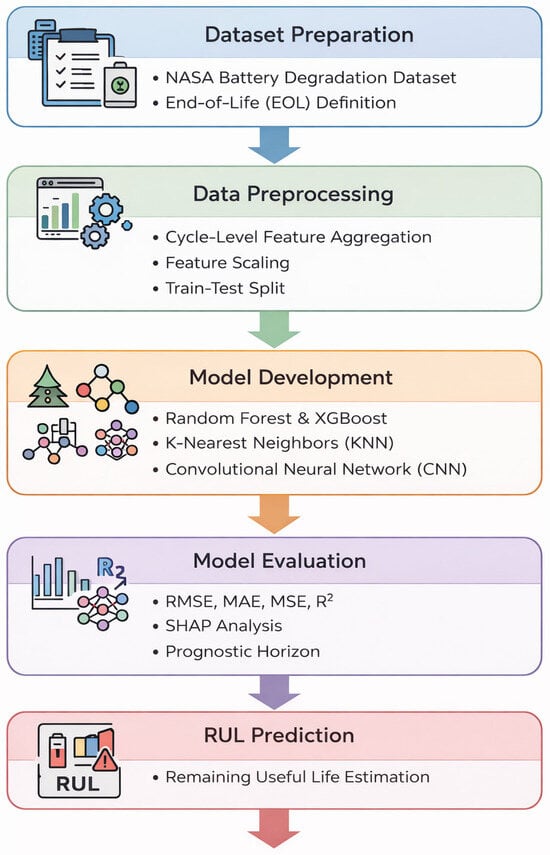
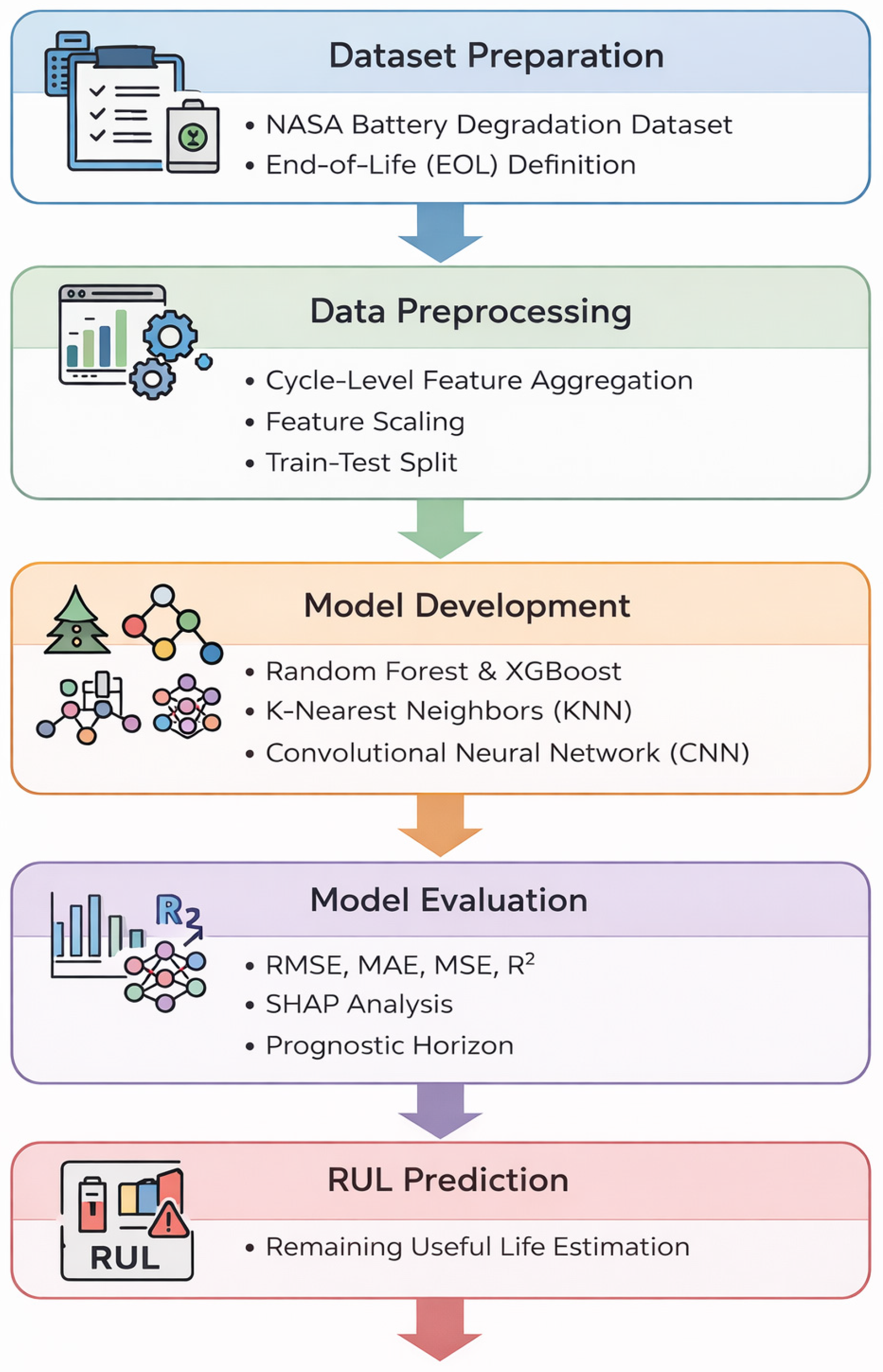
This section presents the proposed machine learning-based framework for predicting the remaining useful life (RUL) of lithium-ion batteries. The methodology consists of five main stages: data preprocessing, cycle-level feature extraction, health indicator generation, machine learning model development, and performance evaluation. The overall workflow of the proposed approach is illustrated in Figure 1.
Figure 1.
RUL Prediction Flow Chart.
2.2. Data Preprocessing and Dataset Preparation
The experiments were conducted using the NASA lithium-ion battery degradation dataset, which contains detailed measurements collected from batteries B0047 and B0048 during repeated charge–discharge cycles. All experiments were implemented in the Python programming language in 3.12 version, utilizing widely adopted scientific computing libraries including NumPy and Pandas for data processing, Scikit-learn for traditional machine learning models, and TensorFlow/Keras for deep learning model development. Visualization of the experimental results was performed using Matplotlib (version 3.10 and Seaborn (version 0.13.2), while SHAP was employed to analyze model interpretability and feature importance.
This experimental configuration provides a reliable and reproducible framework for evaluating the performance of different machine learning and deep learning models for lithium-ion battery remaining useful life prediction. The proposed models were implemented and evaluated on a personal computer equipped with an Intel Core i5-8250U CPU running at 1.60 GHz with 4 cores and 8 logical processors, 8 GB of RAM, and a Windows operating system. The Table 2 provides summary of experimental environments.
Table 2.
Summary of Dataset and Experimental Environment.
The step-by-step procedure of the proposed RUL prediction framework, including data preprocessing, feature extraction, model training, and uncertainty estimation, is summarized in Algorithm 1.
| Algorithm 1. Proposed RUL Prediction Framework |
| Input: Raw battery dataset (voltage, current, temperature, cycle data) |
| Output: Predicted RUL values with uncertainty bounds |
| 1: Load raw battery dataset |
| 2: Perform data preprocessing and cleaning |
| 3: Convert time-series data into cycle-level features |
| 4: Extract degradation-related features (capacity fade, dv/dt, di/dt, etc.) |
| 5: Normalize input features using standard scaling |
| 6: Split dataset using battery-wise validation strategy |
| 7: Train machine learning models (RF, XGBoost, KNN) |
| 8: Train CNN model on extracted features |
| 9: Predict RUL values for test dataset |
| 10: Compute evaluation metrics (MAE, RMSE, R2) |
| 11: Estimate uncertainty using prediction variance (±3σ) |
| 12: Compare model performances |
| End |
The Table 3 summarized the proposed algoritm. The raw battery dataset consists of time-series measurements collected during repeated charge–discharge cycles. These measurements include key electrical and thermal parameters such as voltage, current, temperature, and internal resistance recorded throughout battery operation. Since raw time-series data contain high-frequency signals and a large number of observations, an appropriate preprocessing procedure is required before applying machine learning models.
Table 3.
Summary of the Proposed Algorithm.
In this study, the raw measurements are first transformed into cycle-level features to better represent the long-term degradation behavior of lithium-ion batteries. The dataset is grouped based on the battery identifier and cycle number, and statistical aggregation functions are applied to obtain representative parameters for each cycle.
To evaluate the generalization capability of the proposed models, a battery-wise validation strategy was adopted. Battery B0047 was used for training the models, while battery B0048 was reserved for testing. This strategy prevents data leakage between cycles belonging to the same battery and allows the models to be evaluated on unseen battery degradation trajectories.
To reduce the sensitivity of finite-difference features to measurement noise, the raw signals were first aggregated at the cycle level before computing dynamic indicators such as dv/dt and di/dt.
- dv/dt parameter: It is defined as the change in battery terminal voltage with respect to time.
- di/dt parameter: It is defined as the change in battery terminal current with respect to time.
- dv/di parameter: It is the ratio of the dv/dt and di/dt parameters to each other.
Specifically, the following parameters are aggregated using mean values:
- Measured voltage
- Measured current
- Temperature
- Load voltage
- Load current
- Internal resistance: An operational approximation of the battery’s DC internal resistance is computed using the ratio between measured voltage and current during operation.
In addition, the discharge capacity of the battery is calculated by integrating the current signal over time during the discharge process. The resulting capacity values are accumulated within each cycle to obtain the total discharge capacity corresponding to that cycle.
After constructing the cycle-level dataset, several degradation-related health indicators are extracted to characterize the aging behavior of the battery. These indicators include capacity fade, capacity ratio, rolling capacity mean, and resistance growth. Such indicators provide meaningful representations of battery health conditions and serve as informative input features for the machine learning models.
Since the extracted features have different numerical scales, feature standardization is applied prior to model training. Standard scaling is used to normalize the input features by removing the mean and scaling them to unit variance. This preprocessing step ensures that all features contribute proportionally during the model training process.
To evaluate the prediction models under realistic prognostic conditions, the dataset is divided into training and testing subsets based on battery identifiers rather than random sampling. This strategy prevents data leakage between cycles belonging to the same battery and allows the models to be evaluated on previously unseen battery degradation trajectories.
In this study, multiple batteries are used for training the models, while a separate battery dataset is reserved for testing. The training dataset is used to train the machine learning models, and the testing dataset is used to evaluate the prediction performance.
Finally, the resulting feature matrix and the corresponding remaining useful life (RUL) values are used as the input features and target variables for the machine learning models. The proposed models were developed under the following conditions:
- The dataset is obtained from the NASA lithium-ion battery degradation dataset.
- Battery B0047 is used for training, while battery B0048 is used for testing.
- The end-of-life (EOL) threshold is defined as 70% of the initial battery capacity.
- Input features include voltage, current, temperature, resistance, and derived degradation indicators.
- All input features are standardized prior to model training.
- The models are trained and evaluated under laboratory-controlled operating conditions.
- The prediction models assume that degradation patterns are consistent across similar battery cells.
- These conditions define the operational boundaries of the proposed framework.
2.3. Health Indicator Extraction
Battery degradation is characterized by gradual changes in electrochemical and electrical properties over time. To capture these degradation dynamics, several health indicators are derived from the cycle-level dataset. The following indicators are extracted in this study:
Capacity Fade: Capacity fade represents the cumulative degradation of lithium-ion batteries caused by electrochemical aging mechanisms such as solid electrolyte interphase (SEI) growth and loss of active lithium.
Capacity Ratio: The capacity ratio is defined as the ratio of the current capacity to the initial capacity of the battery.
Rolling Capacity Mean: A rolling average is applied to the capacity signal to reduce measurement noise and highlight long-term degradation trends.
Capacity Slope: Capacity slope represents the rate of capacity degradation between consecutive cycles.
Resistance Growth: Internal resistance growth is calculated as the difference between the current resistance and the initial resistance of the battery. These health indicators provide informative representations of battery aging and serve as key input features for the machine learning models.
Hyperparameters were selected through empirical tuning and preliminary experiments to balance model complexity and generalization performance.
2.4. EOL and RUL Definition
Lithium-ion batteries experience gradual performance degradation during repeated charge–discharge cycles due to various electrochemical aging mechanisms. This degradation typically manifests as a reduction in the available capacity and an increase in internal resistance. Understanding the capacity degradation behavior is essential for accurately estimating the remaining useful life (RUL) of batteries.
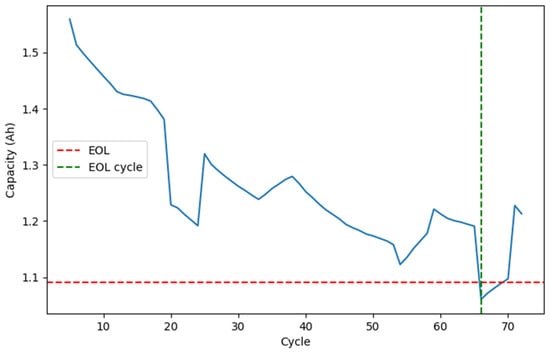
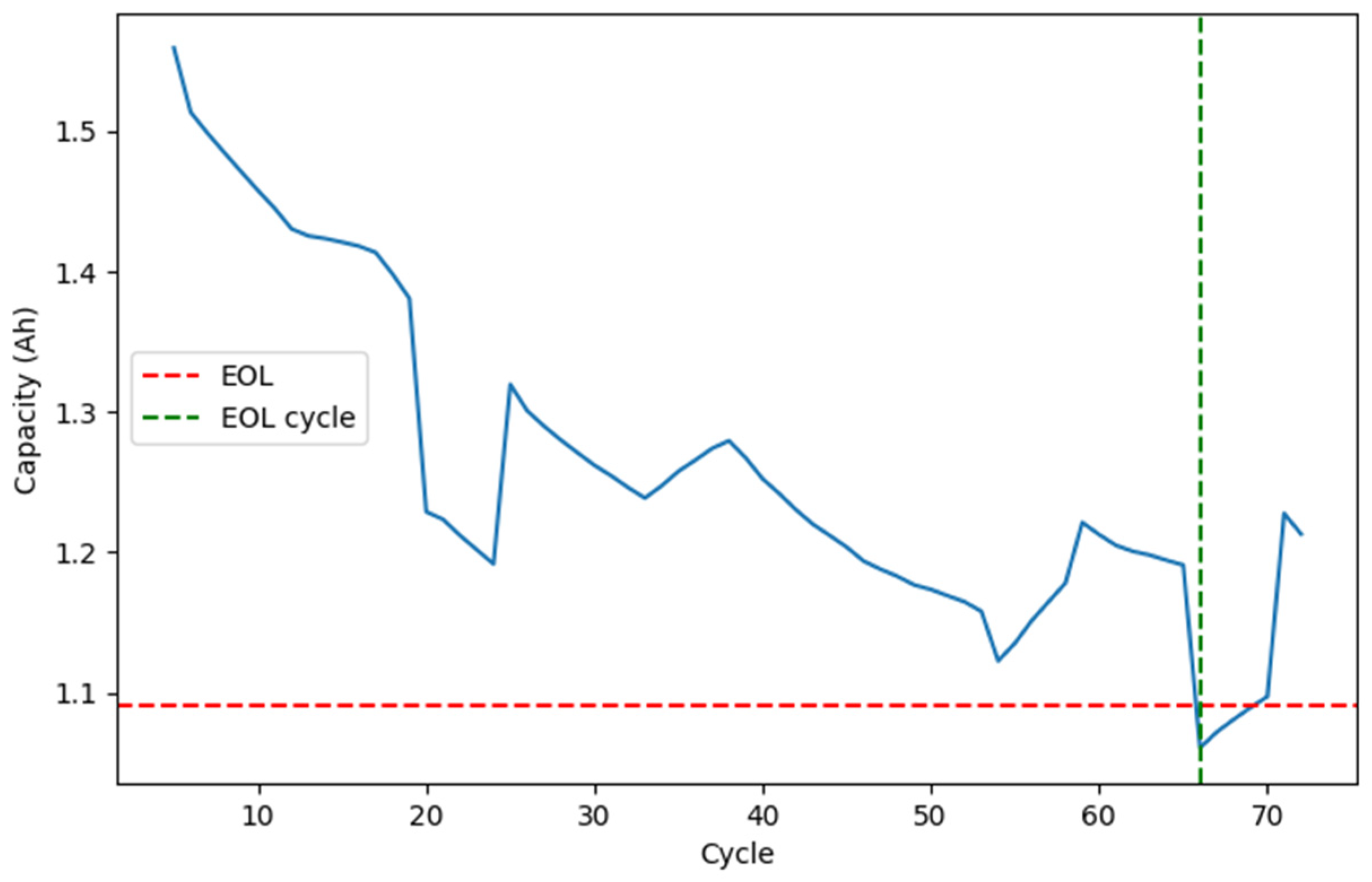
Figure 2 illustrates the capacity degradation trajectory of a representative battery over its operational lifetime. As the cycle number increases, the battery capacity gradually decreases due to aging effects such as electrode material degradation, electrolyte decomposition, and lithium plating. These mechanisms lead to irreversible capacity loss and reduced energy storage capability.
Figure 2.
Capacity degradation and EOL.
To characterize the battery aging process, the discharge capacity is computed for each cycle by integrating the current over time during the discharge phase. The resulting cycle-level capacity values provide a direct indication of the battery health condition.
In battery prognostics studies, the end-of-life (EOL) condition is commonly defined as the point at which the battery capacity falls below a predefined threshold relative to its initial capacity. In this work, the EOL threshold is determined based on the observed degradation trend, as illustrated in Figure 2. Once the battery capacity reaches this threshold (0.7), the battery is considered to have reached its operational limit.
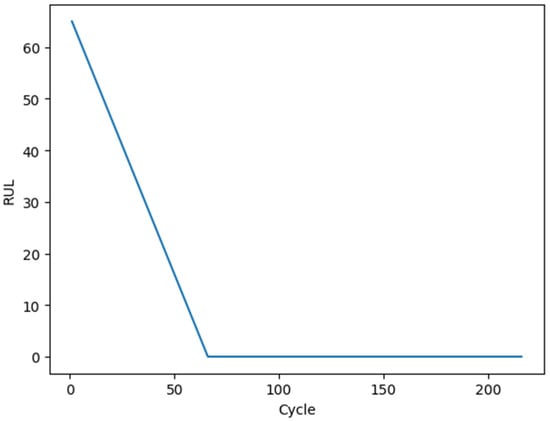
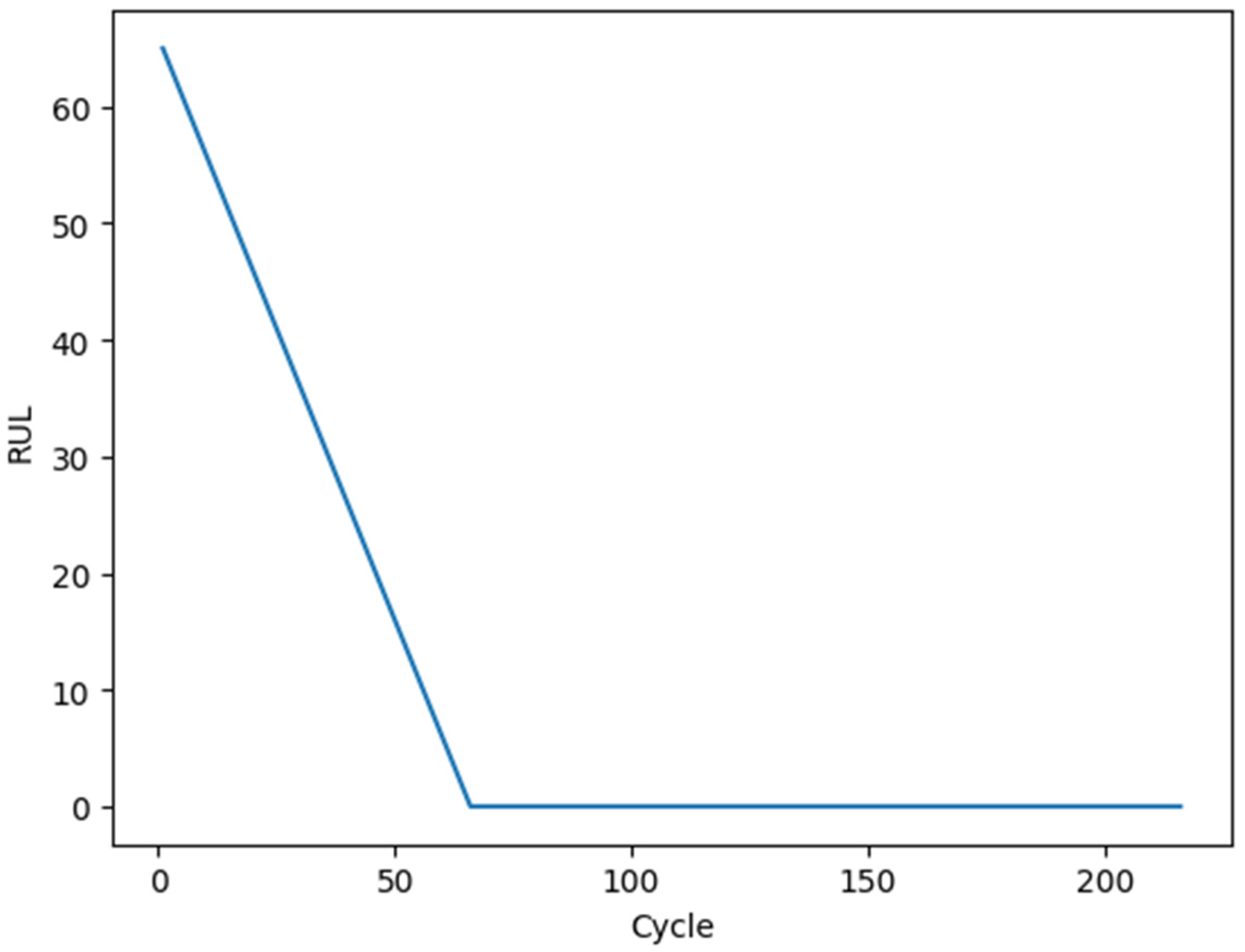
The degradation curve shown in Figure 3 highlights the progressive decline in battery capacity over cycling. This degradation behavior forms the basis for extracting health indicators and defining the remaining useful life of the battery in subsequent stages of the proposed framework.
Figure 3.
RUL Graphic.
2.5. Machine Learning Models
Several machine learning and deep learning models are implemented to predict battery RUL.
2.5.1. Random Forest Regression
Random Forest is an ensemble learning method that builds multiple decision trees and aggregates their predictions, improving model stability and accuracy.
2.5.2. XGBoost Prediction
XGBoost is a gradient boosting algorithm known for its high predictive performance and efficient handling of nonlinear relationships.
2.5.3. K-Nearest Neighbors (KNN)
The KNN algorithm predicts RUL values based on the similarity between data samples in the feature space.
2.6. Deep Learning Models
Convolutional Neural Network (CNN)
To capture nonlinear degradation patterns in lithium-ion battery data, a Convolutional Neural Network (CNN) model was implemented for Remaining Useful Life (RUL) prediction. CNN architectures are widely used in data-driven prognostics due to their ability to automatically extract hierarchical features from sequential or structured data. In the context of battery degradation modeling, convolutional layers can effectively identify complex relationships between operational parameters and aging behavior.
In this study, the CNN model was trained using cycle-level battery features derived from voltage, current, temperature, resistance, and degradation-related indicators such as capacity fade and capacity ratio. These features provide information about both instantaneous operating conditions and long-term degradation dynamics.
The architecture of the proposed CNN model consists of multiple convolutional and fully connected layers designed to learn nonlinear degradation patterns from the input feature matrix. Convolutional layers are used to extract local feature representations, while fully connected layers perform regression to estimate the remaining useful life. The CNN architecture used in this study is summarized in Table 4.
Table 4.
CNN Model Architecture.
2.7. Control Methods and Uncertainty Analysis
The evaluation of prediction accuracy is explained by loss functions that examine the difference between the predicted and the true value. A smaller loss function value means that the difference between the predicted and the true value is less and the model performs better [17].
The Mean Absolute Error (MAE): The metric expresses the average of the absolute values of the difference between the predicted and true values. This error metric is used to evaluate the prediction accuracy and understand the error size [18].
Determination Coefficient: The determination coefficient is a measure of how well a regression model fits the data [18].
Root Mean Square Error (RMSE) is a widely used metric for evaluating the accuracy of regression models. It measures the square root of the average of the squared differences between the predicted values and the actual values. RMSE penalizes larger errors more heavily than smaller ones, making it particularly useful for assessing model performance in applications where large prediction errors are undesirable.
The RMSE is defined as:
where yᵢ represents the true values, ŷᵢ represents the predicted values, and n denotes the total number of observations. A lower RMSE value indicates better model performance, as it reflects smaller deviations between predicted and actual values.
Mean Square Error (MSE) is a commonly used performance metric in regression analysis that measures the average of the squared differences between predicted values and actual values. By squaring the errors, MSE penalizes larger deviations more significantly, making it sensitive to outliers and large prediction errors.
The MSE is defined as:
where yᵢ represents the true values, ŷᵢ represents the predicted values, and n denotes the total number of observations.
A lower MSE value indicates better predictive accuracy of the model [18].
Importance ratings to show which features have the most impact on the model’s decisions. This shows the contribution of each feature to the model based on the structure of the decision trees. Feature importance ratings are calculated as follows:
Here, Gain is the contribution of a feature to a split in the decision tree. Weight is the total effect of a feature across all trees.
Uncertainty estimation is particularly important in battery management systems, where reliable predictions are essential for safe system operation. To evaluate the reliability of the predicted RUL values, an uncertainty analysis framework is integrated into the proposed methodology. Confidence intervals are estimated based on prediction errors, providing an indication of prediction reliability.
3. Results and Discussions
3.1. Data Input
Lithium-ion battery degradation data used in this study were obtained from the publicly available NASA battery dataset. The dataset contains detailed measurements collected during repeated charge–discharge cycling experiments conducted under controlled laboratory conditions. As the batteries undergo continuous cycling, electrochemical aging mechanisms gradually reduce the available capacity and alter internal battery parameters. The experiments were terminated when the batteries reached the predefined end-of-life (EOL) criterion, which corresponds to a 30% reduction in nominal capacity. The dataset includes multiple electrical and thermal measurements recorded throughout the discharge cycles. These measurements provide valuable information about the battery operating conditions and degradation behavior. After preprocessing the raw time-series battery measurements, a cycle-level dataset was constructed to represent the long-term degradation behavior of the batteries. The resulting dataset contains 48,000 observations and 24 extracted features, including electrical measurements, degradation indicators, and derived health indicators. These features capture both the instantaneous operational conditions and the long-term aging characteristics of the batteries. A summary of the extracted features is presented in Table 5.
Table 5.
Feature Extractions.
Tree-based models such as Random Forest and XGBoost have relatively low inference cost, making them suitable for embedded BMS applications. In contrast, deep learning models require higher computational resources but provide improved predictive accuracy.
Battery Discharge Profile
Discharge profiles in the dataset vary depending on the battery. Discharge was performed at 1–4 A constant current (CC) level until the battery voltage dropped to 2.7 V, 2.5 V, and 2.2 V. The parameters in the discharge dataset are defined as follows.
- Vmeasured: Battery terminal voltage (V)
- Cmeasured: Battery output current (A)
- Tmeasured: Battery temperature (°C)
- Cload: Current measured at load (A)
- Vload: Voltage measured at load (V)
- Time: Time vector for the cycle (s)
- Capacity: Battery capacity for discharge to 2.7 V (Ahr)
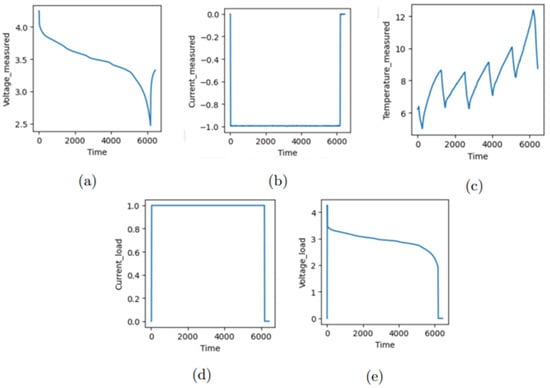
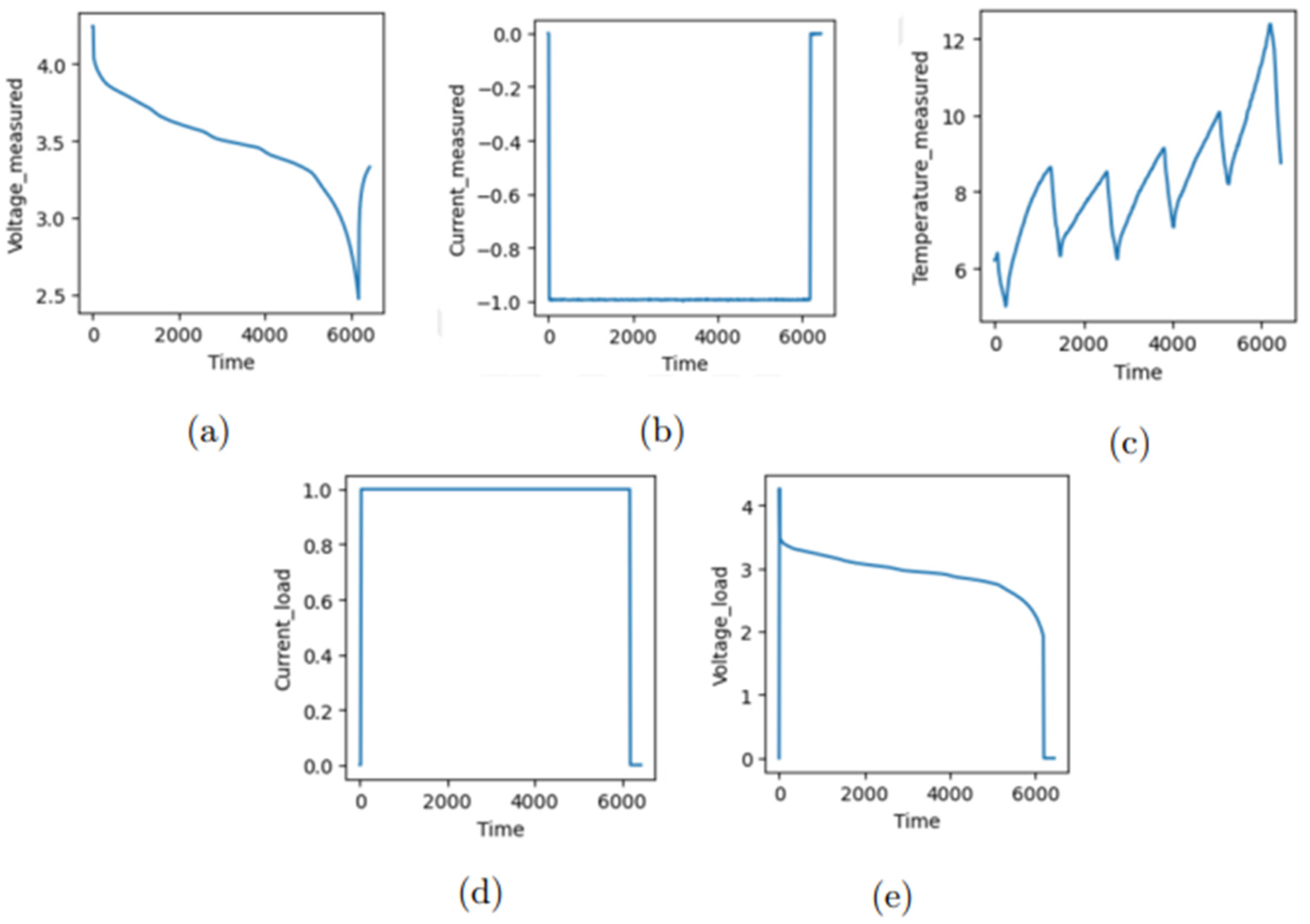
As shown in Figure 4, the voltage, current, temperature, and load-related signals exhibit distinct temporal behaviors during a single discharge cycle, reflecting the electrochemical and thermal characteristics of the lithium-ion battery.
Figure 4.
(a) Battery terminal voltage; (b) Battery output current; (c) Battery temperature; (d) Load current; (e) Load voltage.
3.2. Random Forest Regression Results
To investigate the capability of ensemble learning techniques in modeling lithium-ion battery degradation, a Random Forest regression model was implemented for Remaining Useful Life (RUL) prediction. Random Forest is an ensemble-based learning algorithm that constructs multiple decision trees and aggregates their predictions, thereby improving model robustness and reducing variance compared to individual decision tree models.
In the proposed framework, the Random Forest model was configured with 600 decision trees (n_estimators = 600) to enhance prediction stability and capture complex nonlinear relationships within the dataset. The maximum depth of each tree was limited to 8 (max_depth = 8) to prevent excessive model complexity and reduce the risk of overfitting. Furthermore, the minimum number of samples required to split an internal node was set to 10 (min_samples_split = 10), while the minimum number of samples required at a leaf node was defined as 5 (min_samples_leaf = 5). These hyperparameters were selected to achieve a balance between model generalization and predictive accuracy. A fixed random seed (random_state = 42) was used to ensure reproducibility of the experimental results.
The model was trained using a set of battery operational and degradation-related features extracted from the dataset, including voltage, current, temperature, cycle number, and capacity-based degradation indicators. These features provide important information about the electrochemical aging behavior of lithium-ion batteries and enable the model to learn complex degradation patterns during the battery lifecycle.
The predictive performance of the Random Forest model was evaluated using standard regression metrics. The experimental results obtained on the test dataset yielded a Root Mean Square Error (RMSE) of 17.95 cycles and a coefficient of determination (R2) of 0.21. The RMSE value indicates the average deviation between predicted and actual RUL values, while the R2 score suggests that approximately 21% of the variance in the target variable can be explained by the model.
Although the Random Forest model demonstrates the capability to capture certain degradation trends, the relatively moderate R2 value indicates that battery aging behavior remains highly complex and nonlinear. Lithium-ion battery degradation is influenced by multiple interacting electrochemical mechanisms, including capacity fade, internal resistance growth, and temperature-dependent aging effects. Consequently, modeling these dynamics using a single ensemble learning approach may not fully capture the underlying degradation processes.
Furthermore, the calculated Relative Error metric resulted in an infinite value due to the presence of zero values in the ground-truth RUL labels. Since the Relative Error formulation involves division by the true RUL values, the occurrence of zero targets leads to undefined results. This issue is commonly encountered in RUL prediction tasks, where the final cycle corresponds to zero remaining life.
Overall, the Random Forest model provides a reasonable baseline for lithium-ion battery RUL prediction and demonstrates the capability of ensemble learning methods to model nonlinear degradation behavior. However, further improvements may be achieved by incorporating more advanced deep learning architectures, hybrid modeling approaches, or uncertainty-aware prediction frameworks.
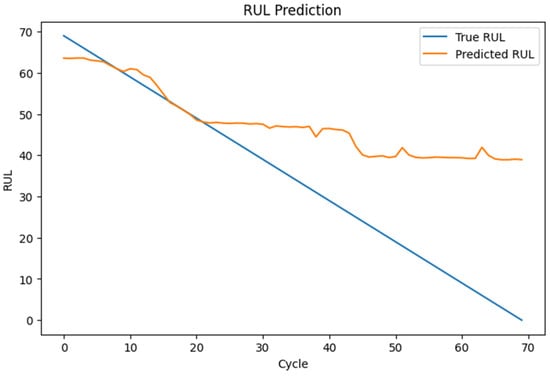
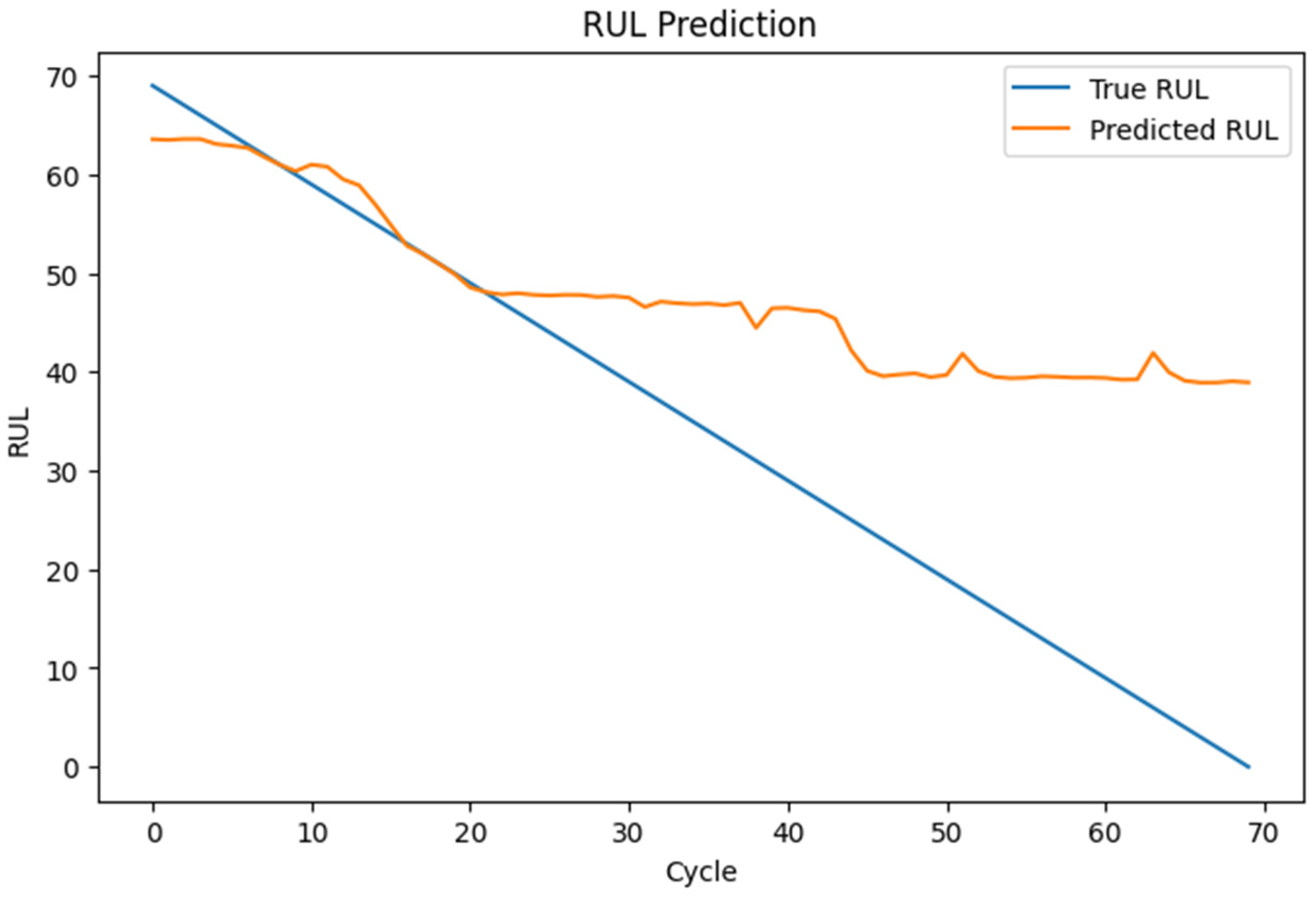
To further illustrate the predictive capability of the Random Forest model, the predicted RUL values were compared with the ground-truth RUL values across battery cycles, as shown in Figure 5. The figure presents the evolution of the predicted and actual RUL values throughout the battery degradation process.
Figure 5.
Comparison of the true remaining useful life (RUL) and the predicted RUL obtained from the Random Forest model across battery cycles.
As observed in Figure 5, the true RUL values follow a nearly linear decreasing trend as the battery approaches its end-of-life, which reflects the progressive degradation of the battery capacity over successive cycles. In contrast, the predicted RUL values generated by the Random Forest model exhibit a smoother and relatively stable behavior across the cycle range.
In the early degradation stages, the predicted RUL values closely follow the ground-truth values, indicating that the model successfully captures the initial degradation trend. However, as the battery approaches later cycles, a noticeable divergence between the predicted and actual RUL values can be observed. While the true RUL decreases steadily toward zero, the predicted values tend to stabilize around a certain level rather than continuing the decreasing trend.
This behavior suggests that the Random Forest model partially captures the degradation dynamics but struggles to accurately extrapolate the remaining lifetime as the battery approaches failure. Ensemble tree-based models such as Random Forest rely heavily on patterns observed in the training data and may have limited capability in modeling strong monotonic degradation trends beyond the observed data distribution.
The observed prediction behavior is consistent with the relatively moderate R2 score (0.21) obtained in the quantitative evaluation. While the model is capable of capturing general degradation patterns, it exhibits limitations in accurately modeling the final stages of battery aging.
These findings highlight the importance of incorporating more advanced modeling strategies, such as deep learning architectures or hybrid prognostic models, which may better capture long-term temporal dependencies and nonlinear degradation dynamics in lithium-ion batteries.
3.3. Extreme Gradient Boosting Regression Results
To further investigate the effectiveness of advanced ensemble learning algorithms in lithium-ion battery prognostics, an Extreme Gradient Boosting (XGBoost) regression model was implemented for Remaining Useful Life (RUL) prediction. XGBoost is a gradient boosting–based ensemble learning method that sequentially constructs decision trees in order to minimize prediction errors and improve model performance. Due to its regularization mechanisms and efficient handling of nonlinear feature interactions, XGBoost has become one of the most widely used algorithms for complex regression problems.
In the proposed framework, the XGBoost model was configured with 600 boosting trees (n_estimators = 600) to enable the model to capture complex degradation patterns within the battery dataset. The maximum depth of each tree was limited to 6 (max_depth = 6) in order to control model complexity and prevent overfitting. Additionally, the learning rate was set to 0.05, allowing the model to gradually update the prediction residuals and improve generalization capability.
To further enhance model robustness, subsample = 0.8 and colsample_bytree = 0.8 were applied. These parameters introduce stochasticity into the training process by sampling subsets of observations and features when constructing trees, thereby reducing the risk of overfitting and improving model generalization performance.
The model was trained using the scaled feature matrix derived from the battery dataset, which includes operational and degradation-related variables such as voltage, current, temperature, cycle number, and capacity-based degradation indicators. Feature scaling was applied to ensure that all input variables contribute proportionally to the learning process and to improve the numerical stability of the training procedure.
The trained XGBoost model was then used to predict the Remaining Useful Life of the battery samples in the test dataset. The predictive performance of the model was evaluated using standard regression metrics, including Root Mean Square Error (RMSE), Mean Absolute Error (MAE), coefficient of determination (R2), and Relative Error (RE).
Due to its gradient boosting framework, XGBoost iteratively minimizes prediction errors by learning from the residuals of previous trees. This capability enables the model to capture complex nonlinear relationships between battery operational parameters and degradation dynamics. Compared with traditional ensemble methods such as Random Forest, boosting-based algorithms often demonstrate improved predictive performance when modeling highly nonlinear degradation processes.
The obtained results indicate that the XGBoost model provides a robust prediction framework for lithium-ion battery RUL estimation. By sequentially refining the prediction errors, the model is capable of learning detailed degradation patterns embedded in the dataset. This characteristic makes XGBoost particularly suitable for battery prognostics applications where degradation behavior is governed by complex electrochemical processes.
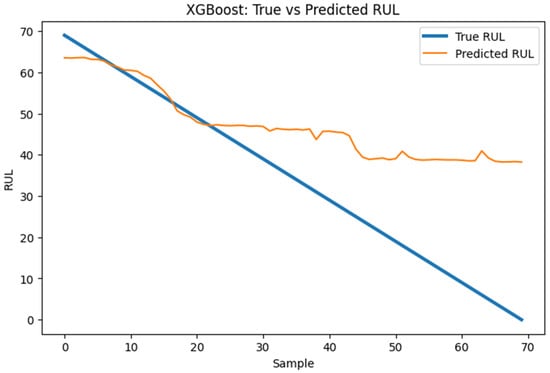
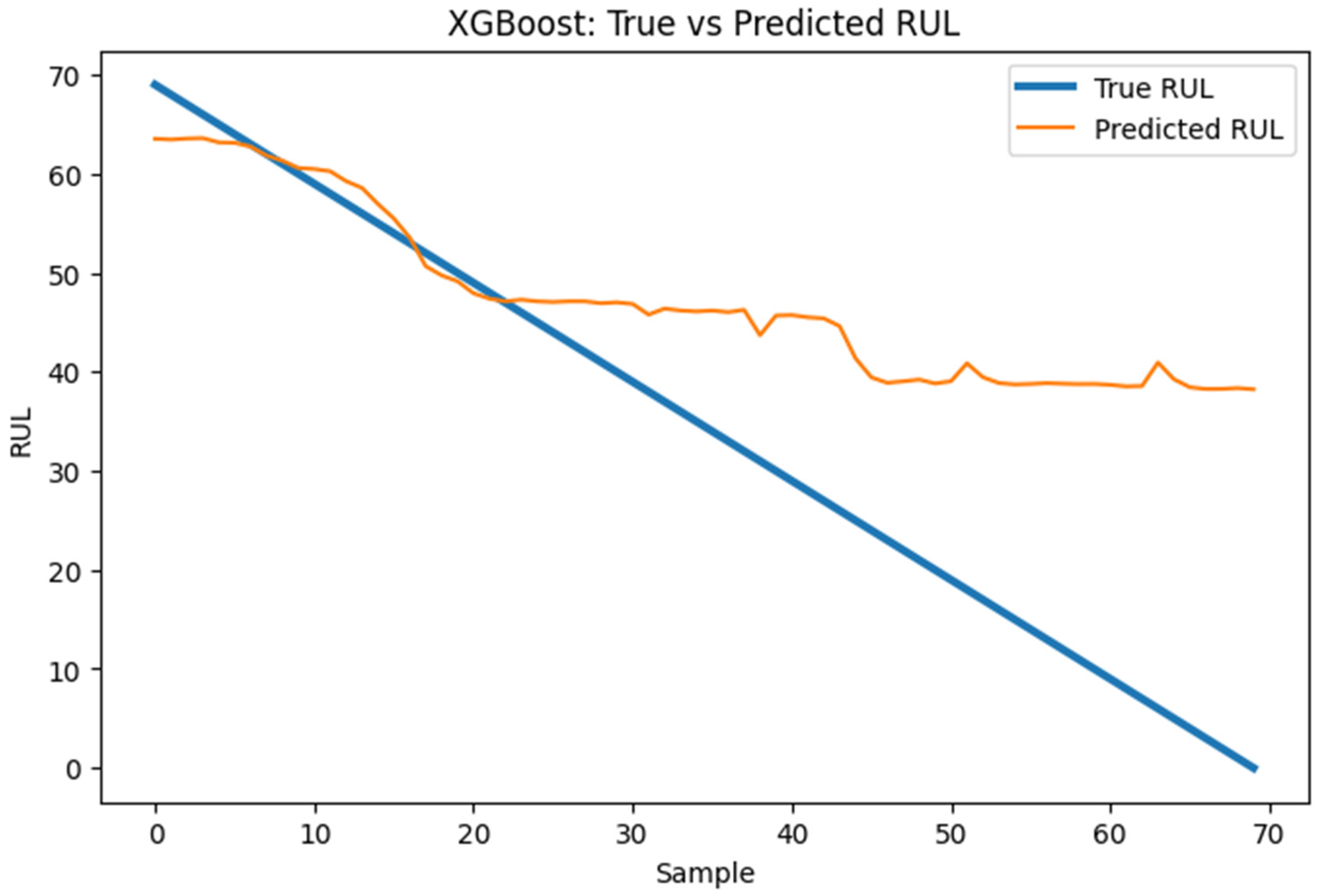
To further analyze the predictive capability of the XGBoost model, the predicted RUL values were compared with the ground-truth RUL values across the battery cycles, as illustrated in Figure 6.
Figure 6.
Comparison of the true remaining useful life (RUL) and the predicted RUL obtained from the XGBoost model across battery cycles.
As shown in Figure 6, the true RUL values exhibit a consistent decreasing trend as the battery approaches its end-of-life, reflecting the progressive degradation behavior observed in lithium-ion batteries. The predicted RUL values generated by the XGBoost model generally follow the overall degradation trajectory, indicating that the model is capable of capturing the underlying degradation dynamics of the battery.
In the early stages of the battery lifecycle, the predicted RUL values closely match the true RUL curve, demonstrating that the model successfully learns the initial degradation patterns from the training data. However, as the battery progresses toward later cycles, a noticeable deviation between the predicted and actual RUL values emerges. While the ground-truth RUL decreases steadily toward zero, the predicted RUL values tend to stabilize around a relatively constant level.
This behavior suggests that although the XGBoost model effectively captures general degradation trends, it exhibits limitations in accurately modeling the final stages of battery aging. Such behavior is commonly observed in data-driven prognostic models, where the model tends to smooth predictions due to the ensemble learning mechanism and the limited availability of training samples near the end-of-life region.
Nevertheless, the overall prediction curve demonstrates that XGBoost is capable of learning complex nonlinear relationships between operational parameters and degradation indicators. The boosting mechanism enables the model to iteratively reduce prediction errors and refine the learned degradation patterns. Consequently, XGBoost provides a strong baseline model for lithium-ion battery RUL prediction and serves as an effective benchmark for comparison with other machine learning and deep learning models considered in this study.
3.4. K-Nearest Neighbor Regression Results
In the proposed framework, the K-Nearest Neighbors (KNN) regression model was implemented using the Minkowski distance metric, which is a generalized distance measure commonly employed in distance-based learning algorithms. In addition, distance-based weighting was applied so that closer neighbors exert a stronger influence on the final prediction than more distant observations. This weighting strategy improves prediction accuracy by emphasizing the most relevant samples in the feature space.
The number of neighbors was set to . The selection of this parameter plays a critical role in determining the performance of the KNN algorithm. If the value of is too small, the model becomes highly sensitive to noise in the dataset and may suffer from overfitting. Conversely, if is too large, the model may oversmooth the predictions by averaging an excessive number of neighboring samples, which can lead to underfitting and reduced sensitivity to local degradation patterns. The choice of provides a balanced compromise between these two extremes, allowing the model to capture local similarities in battery degradation patterns while maintaining robustness against noisy observations.
Prior to training the model, feature scaling was applied to ensure that all input variables contribute equally to the distance calculations. This preprocessing step is particularly important for KNN models, as distance-based algorithms are sensitive to differences in feature magnitudes. The model was subsequently trained using the scaled feature matrix containing battery operational variables and degradation-related indicators.
Once trained, the KNN model estimates the Remaining Useful Life (RUL) of unseen samples by identifying the five nearest neighbors in the feature space and computing a distance-weighted average of their corresponding RUL values. Through this mechanism, the model leverages similarities between battery degradation trajectories to infer the remaining lifetime of the battery.
Overall, the KNN model provides a simple yet effective baseline for RUL prediction. Although it does not explicitly learn a parametric model during training, its ability to capture local relationships within the dataset enables it to approximate nonlinear degradation patterns in lithium-ion batteries.
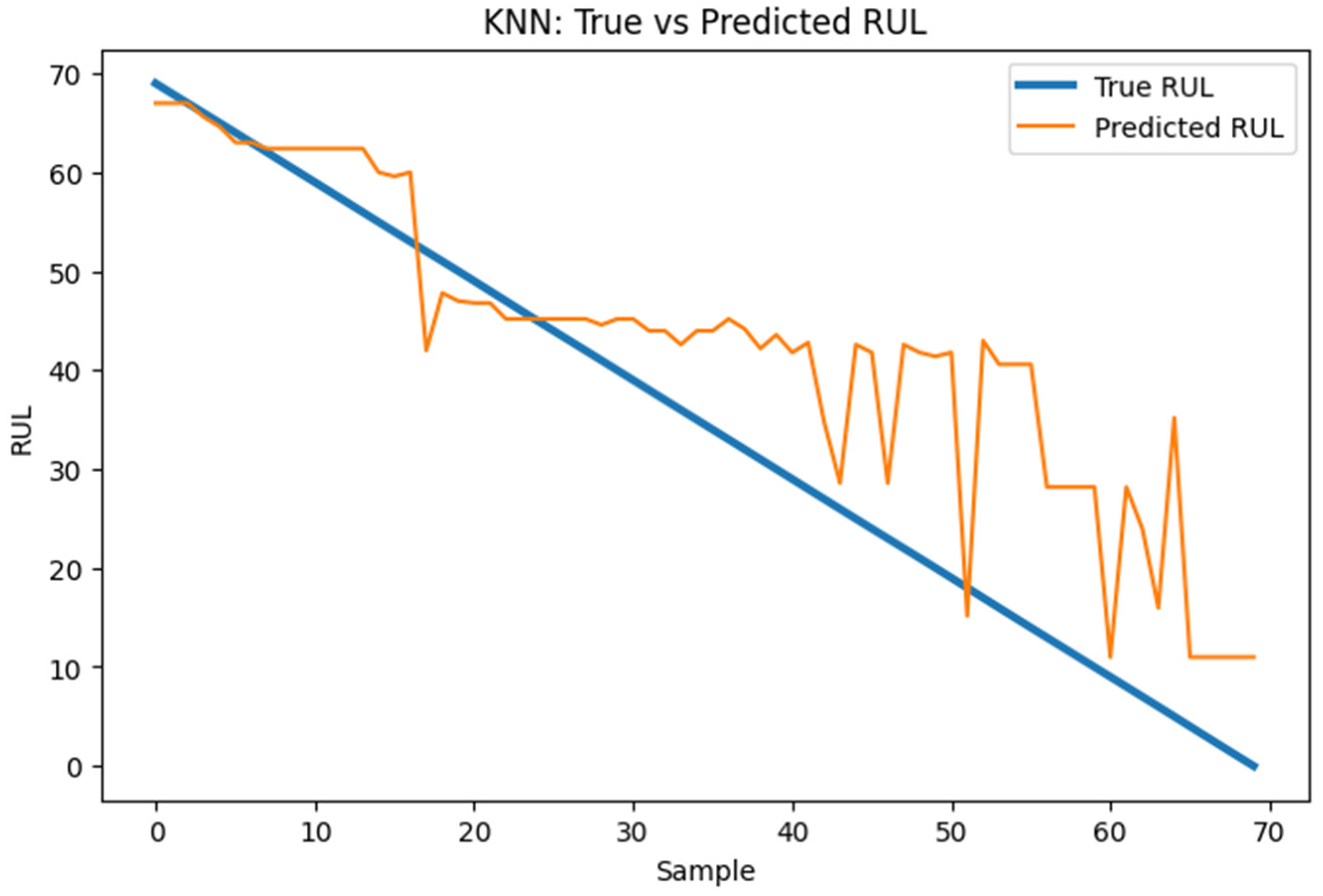
To further evaluate the predictive performance of the KNN model, the predicted RUL values were compared with the ground-truth RUL values across battery samples, as illustrated in Figure 7.
Figure 7.
Comparison of the true remaining useful life (RUL) and the predicted RUL obtained from the KNN model across battery cycles.
As shown in Figure 7, the true RUL values follow a monotonic decreasing trend as the battery approaches its end-of-life, which reflects the progressive degradation behavior of lithium-ion batteries. The predicted RUL values obtained from the KNN model generally follow the overall degradation trend during the early stages of the battery lifecycle.
However, as the battery approaches later cycles, the predicted RUL values exhibit noticeable fluctuations and deviations from the true degradation trajectory. In particular, the prediction curve becomes more irregular, reflecting the sensitivity of instance-based learning algorithms to local variations within the dataset. Since KNN predictions are derived from the average of neighboring samples, the presence of heterogeneous degradation patterns among nearby samples can introduce variability into the prediction results.
Despite these fluctuations, the KNN model is able to capture the general degradation behavior of the battery during the earlier operational cycles. However, the increasing prediction variance observed in later cycles suggests that instance-based learning methods may struggle to accurately extrapolate degradation behavior near the end-of-life region.
These results highlight the limitations of KNN models when applied to highly nonlinear degradation processes such as lithium-ion battery aging. Nevertheless, the model provides a useful baseline for comparison with more advanced ensemble learning and deep learning approaches, including Random Forest, XGBoost, and Convolutional Neural Networks.
3.5. CNN Model Results
To further investigate the capability of deep learning architectures in modeling battery degradation patterns, a Convolutional Neural Network (CNN) model was implemented for Remaining Useful Life (RUL) prediction. CNN models are particularly effective in extracting hierarchical patterns from sequential data, making them suitable for learning complex nonlinear degradation behaviors observed in lithium-ion batteries. The CNN model was trained using battery operational measurements including voltage, current, temperature, load-related variables, and derived electrical features such as dv/dt and di/dt. These features capture both the instantaneous operating conditions and the dynamic characteristics of battery behavior during charge–discharge cycles.
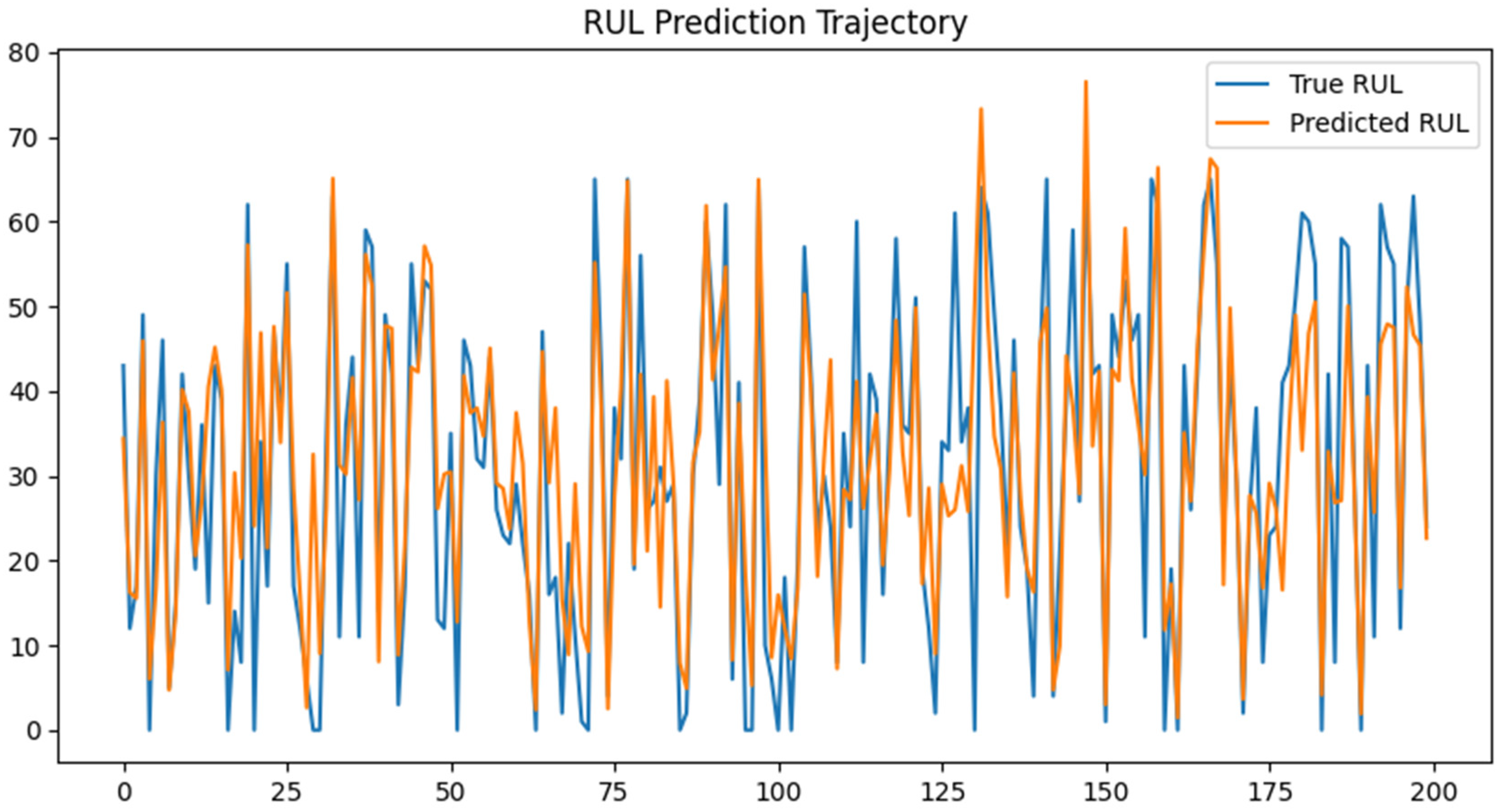
To evaluate the predictive capability of the CNN model, the predicted RUL values were compared with the ground-truth RUL values across the test samples.
As shown in Figure 8, the predicted RUL values generally follow the variations observed in the ground-truth RUL values across the dataset. The CNN model is able to capture the overall fluctuations in battery degradation behavior, indicating that the convolutional layers successfully extract relevant patterns from the input features. Compared with instance-based learning models such as KNN, the CNN model produces smoother predictions while still maintaining sensitivity to local variations in the degradation trajectory.
Figure 8.
CNN RUL Prediction Trajectory.
However, some deviations between the predicted and actual RUL values can still be observed, particularly for samples with very low RUL values. These deviations are expected due to the increasing uncertainty associated with battery behavior near the end-of-life region.
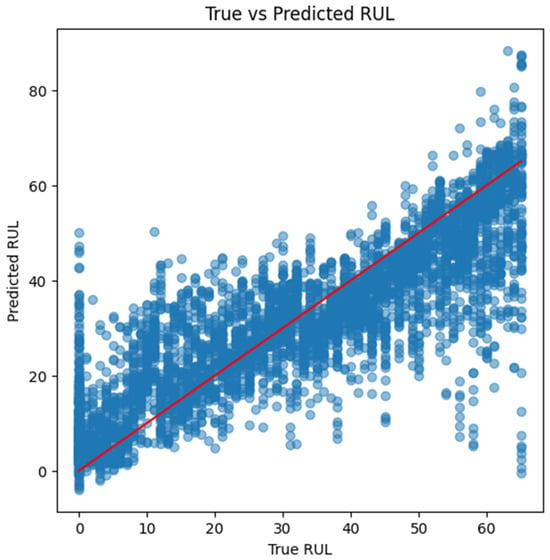
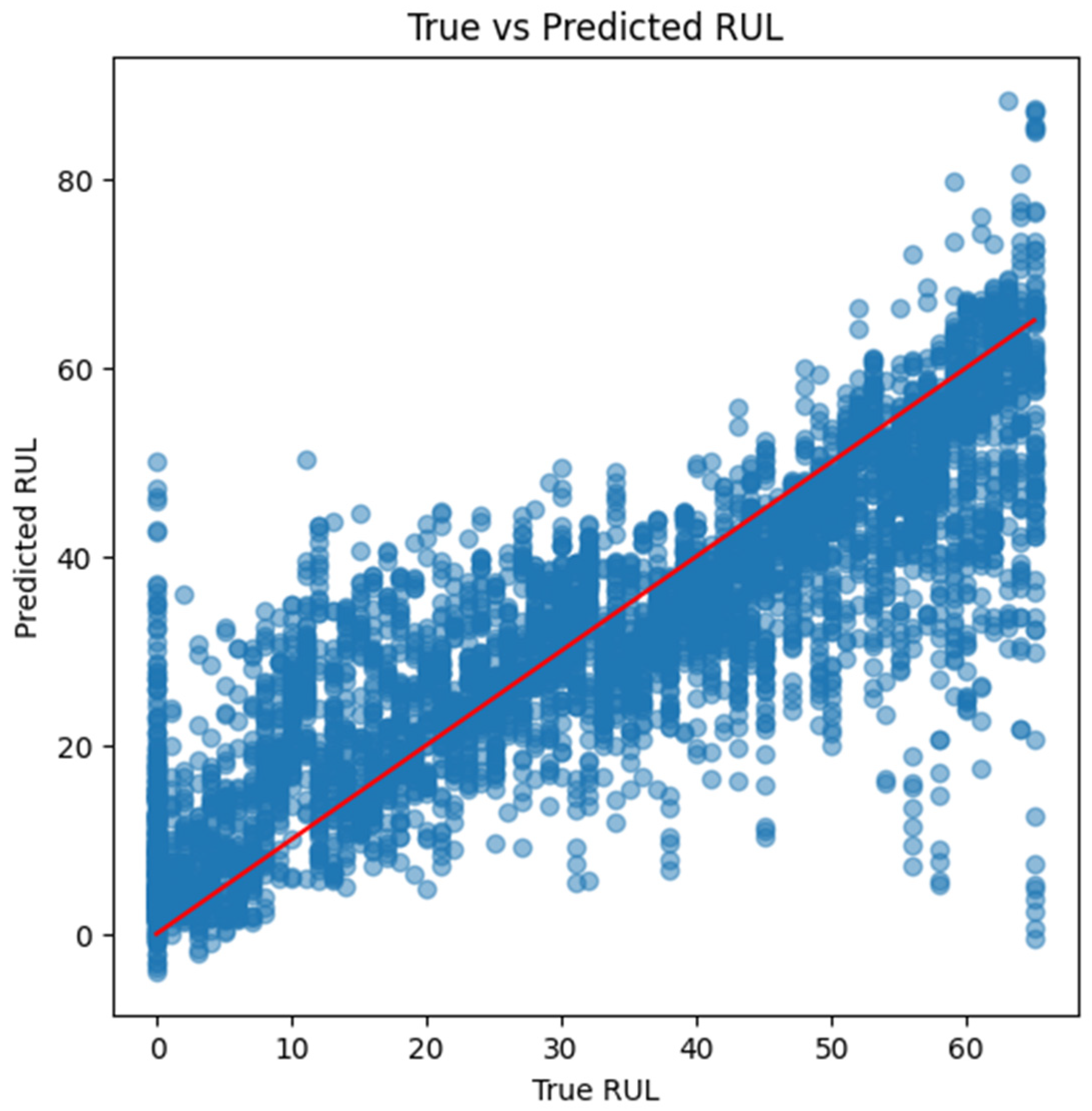
In Figure 9, the blue points indicate individual predicted RUL samples, whereas the red line represents the ideal one-to-one correspondence between true and predicted RUL values.
Figure 9.
True vs. Predicted RUL Distribution.
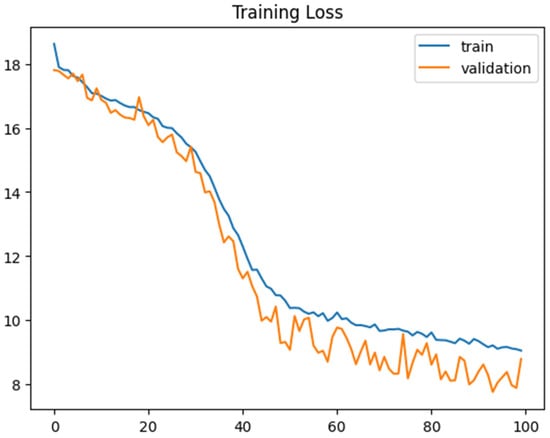
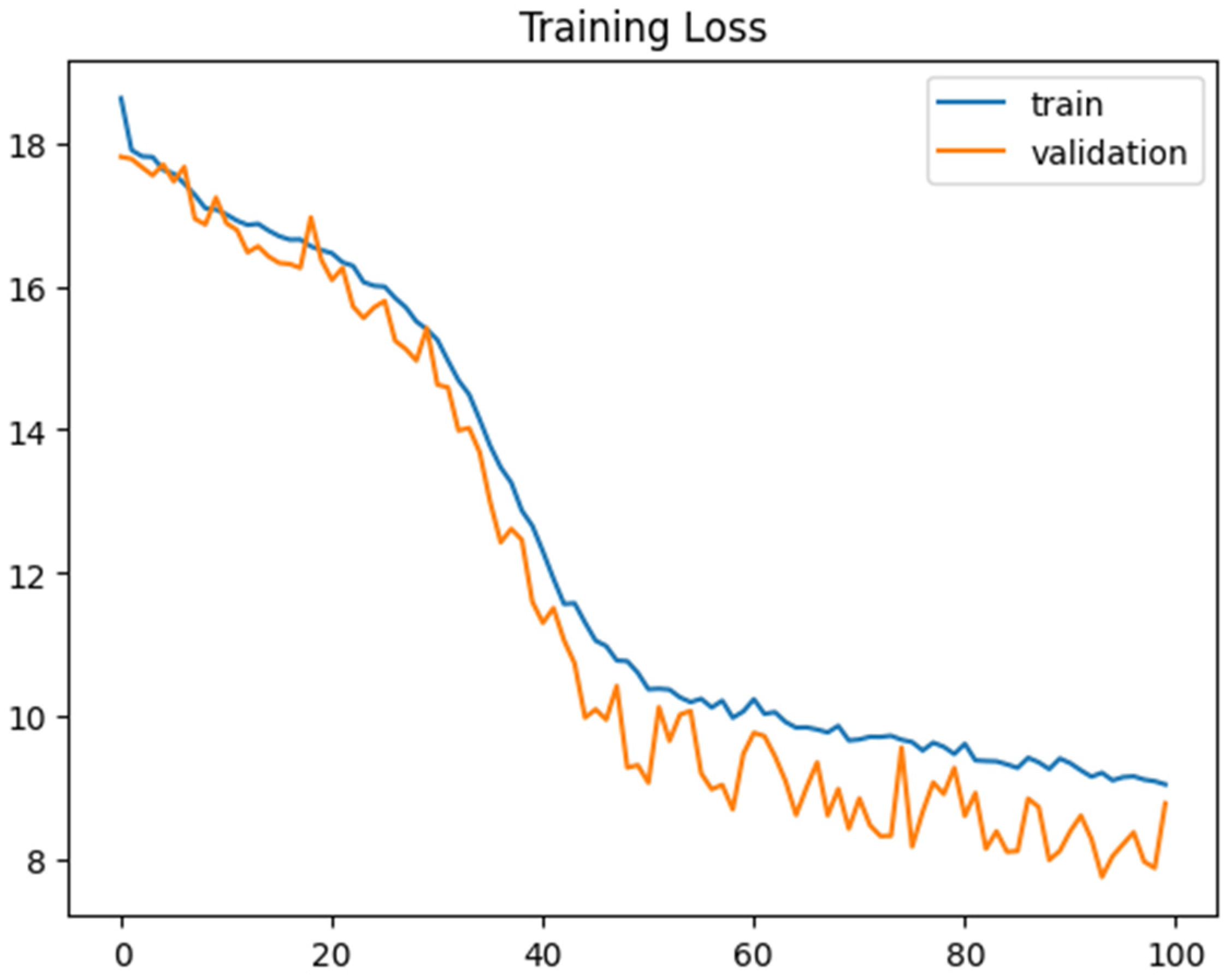
Ideally, perfect predictions would align along the diagonal line representing the equality between predicted and true RUL values. As observed in the figure, a large portion of the predicted samples are distributed around this diagonal line, indicating that the CNN model is capable of learning meaningful relationships between input features and battery degradation behavior. Nevertheless, some dispersion around the diagonal line is still visible, which suggests that prediction errors increase for certain operating conditions or degradation stages. The training and validation loss curves of the CNN model are presented in Figure 10. As illustrated in the figure, both training and validation loss decrease steadily during the training process, indicating that the model successfully learns the underlying patterns within the dataset. The validation loss follows a similar decreasing trend to the training loss, suggesting that the model generalizes well to unseen data and does not exhibit severe overfitting. The convergence behavior of the training process demonstrates the stability of the CNN model and confirms that the selected training configuration allows the network to effectively capture battery degradation dynamics.
Figure 10.
The training and validation loss curves of the CNN model.
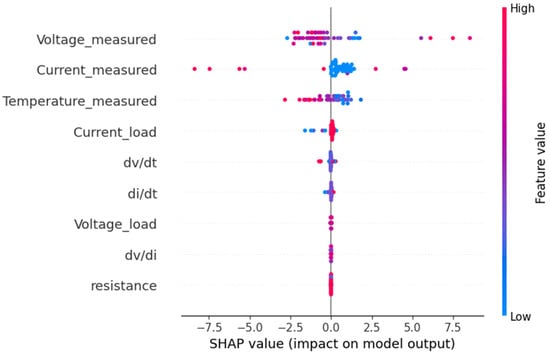
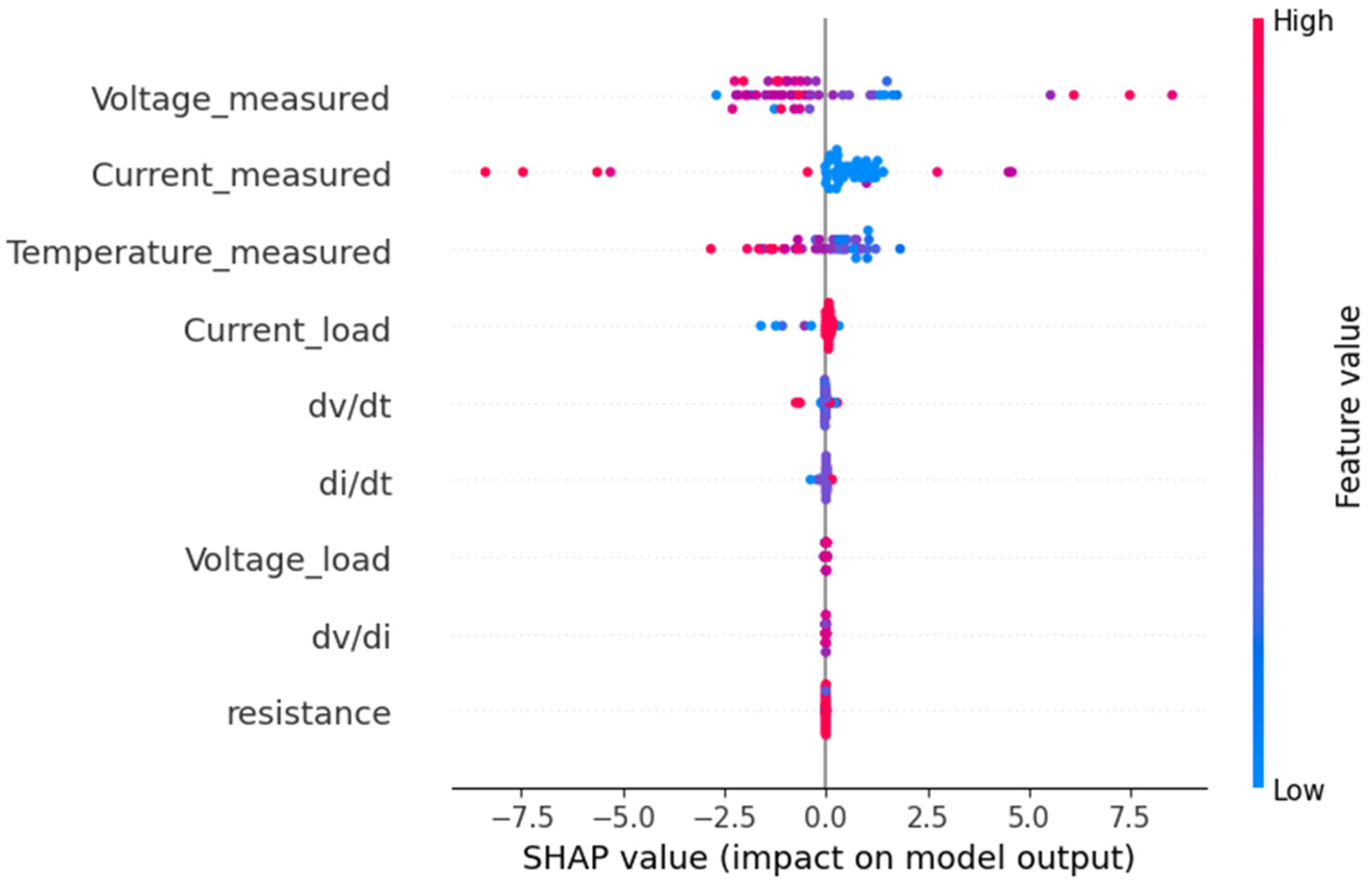
To interpret the predictions of the CNN model and identify the most influential input features, SHAP (SHapley Additive exPlanations) analysis was performed. The SHAP analysis reveals that Voltage_measured, Current_measured, and Temperature_measured are among the most influential features affecting the CNN model predictions. These variables directly reflect the electrochemical state of the battery and therefore provide valuable information about battery degradation. The SHAP summary plot also illustrates how variations in feature values influence the predicted RUL as in Figure 11. Higher voltage and current values tend to have stronger impacts on the prediction output, indicating that the CNN model successfully captures the relationships between operational conditions and battery health. Furthermore, derived electrical indicators such as dv/dt and di/dt also contribute to the model predictions, although their influence is relatively smaller compared to primary operational variables.
Figure 11.
The SHAP analysis of CNN Model.
3.6. Feature Importance Analysis
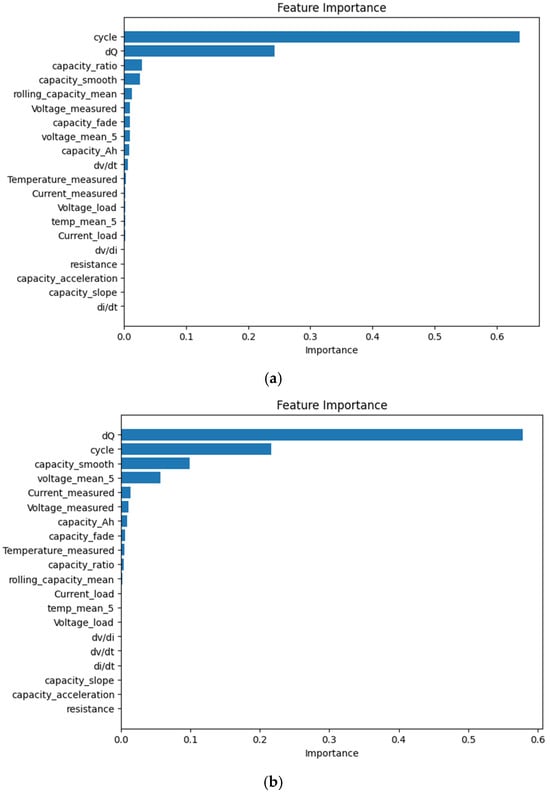
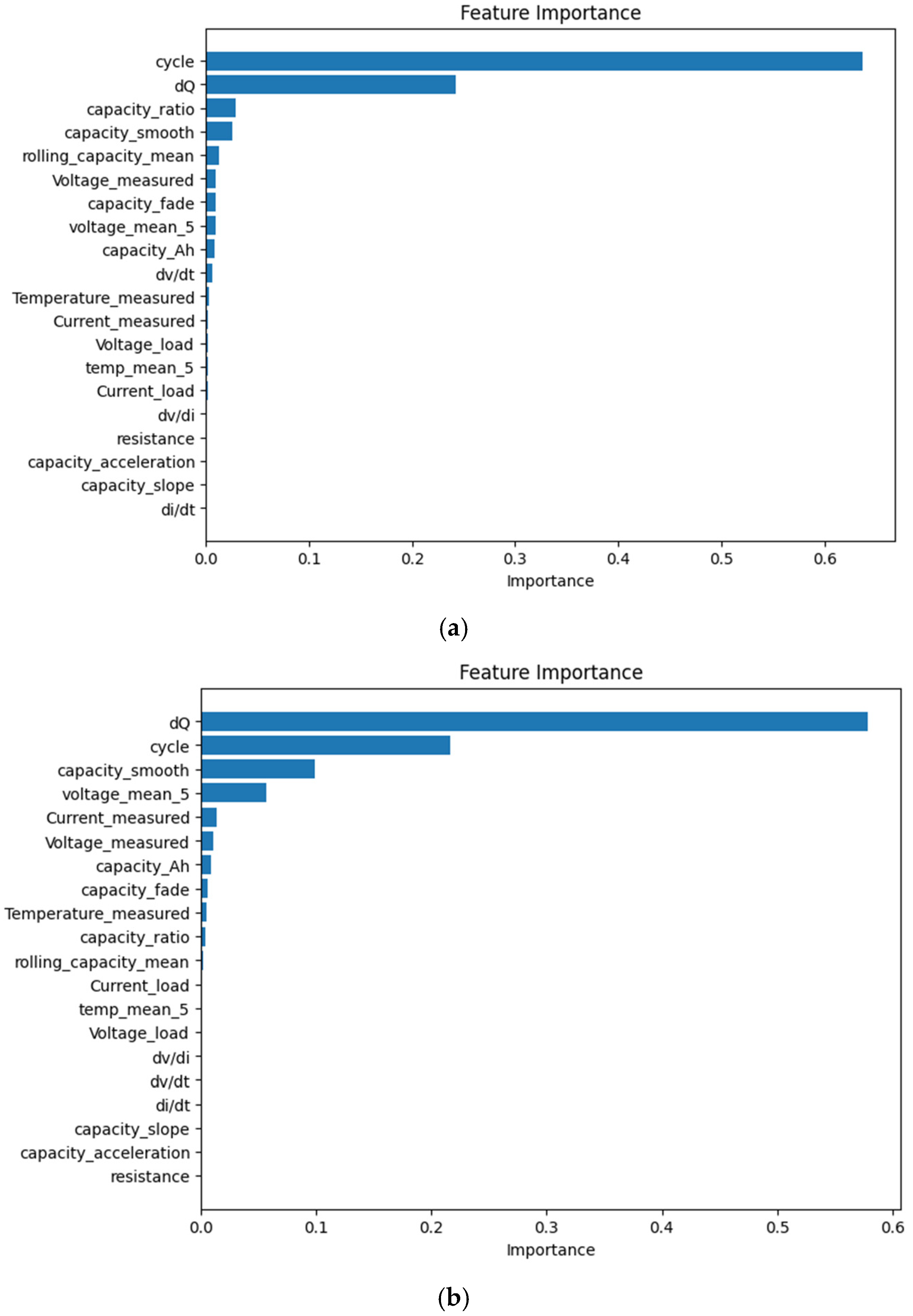
To better understand the contribution of individual input variables to the prediction of battery Remaining Useful Life (RUL), a feature importance analysis was conducted using the ensemble-based models employed in this study. Tree-based models such as Random Forest and XGBoost provide an inherent mechanism for estimating the relative importance of input features by measuring how much each feature contributes to reducing prediction error during the training process. The feature importance results obtained from the Random Forest and XGBoost models are illustrated in Figure 12.
Figure 12.
(a) Feature Importance of Random Forest; (b) Feature Importance of XGBoost Model.
As observed in Figure 12a, the cycle variable is the most influential feature in predicting the remaining useful life of the battery. This result is expected, as the cycle number directly reflects the progression of battery aging during repeated charge–discharge operations. The capacity ratio (capacity_ratio) is identified as the second most important feature, indicating that the relative capacity degradation plays a crucial role in determining battery health. Other features such as capacity smooth and rolling capacity mean also contribute to the prediction performance, suggesting that smoothed representations of the degradation trajectory provide useful information about long-term battery aging trends. In contrast, instantaneous measurements such as voltage and current exhibit relatively lower importance, indicating that cumulative degradation indicators are more informative for RUL prediction. These findings are consistent with the physical degradation mechanisms of lithium-ion batteries, where gradual capacity fade over cycles is one of the most reliable indicators of battery health.
A similar feature importance analysis was conducted using the XGBoost model, as presented in Figure 12b. The results obtained from the XGBoost model reveal a similar importance ranking pattern. The cycle variable again appears as the most dominant predictor of battery RUL, highlighting the strong relationship between cycle progression and battery degradation. The capacity smoothing feature (capacity_smooth) and cycle-related degradation indicators also show high importance values, indicating that XGBoost effectively utilizes temporal degradation information to improve prediction performance. Interestingly, operational parameters such as current and voltage measurements exhibit Slower importance compared to degradation-derived features. This observation suggests that derived degradation indicators, such as capacity trends and smoothed degradation signals, contain more relevant information for modeling long-term battery aging behavior. Overall, the feature importance analysis demonstrates that degradation-related features play a significantly larger role in RUL prediction compared to instantaneous operational measurements. This finding emphasizes the importance of incorporating carefully engineered degradation indicators when developing data-driven battery prognostic models.
3.7. Uncertainty Analysis
Reliable prediction of the Remaining Useful Life (RUL) is essential for practical battery prognostics applications. In real-world battery management systems, prediction models should not only provide accurate point estimates but also quantify the uncertainty associated with the predicted values. Therefore, an uncertainty analysis was performed to evaluate the confidence of the model predictions.
In this study, prediction uncertainty was estimated using the mean and standard deviation of the model predictions. The uncertainty bounds were computed by constructing confidence intervals around the predicted RUL values. The prediction interval can be expressed as:
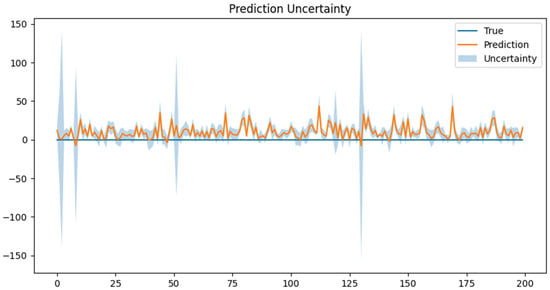
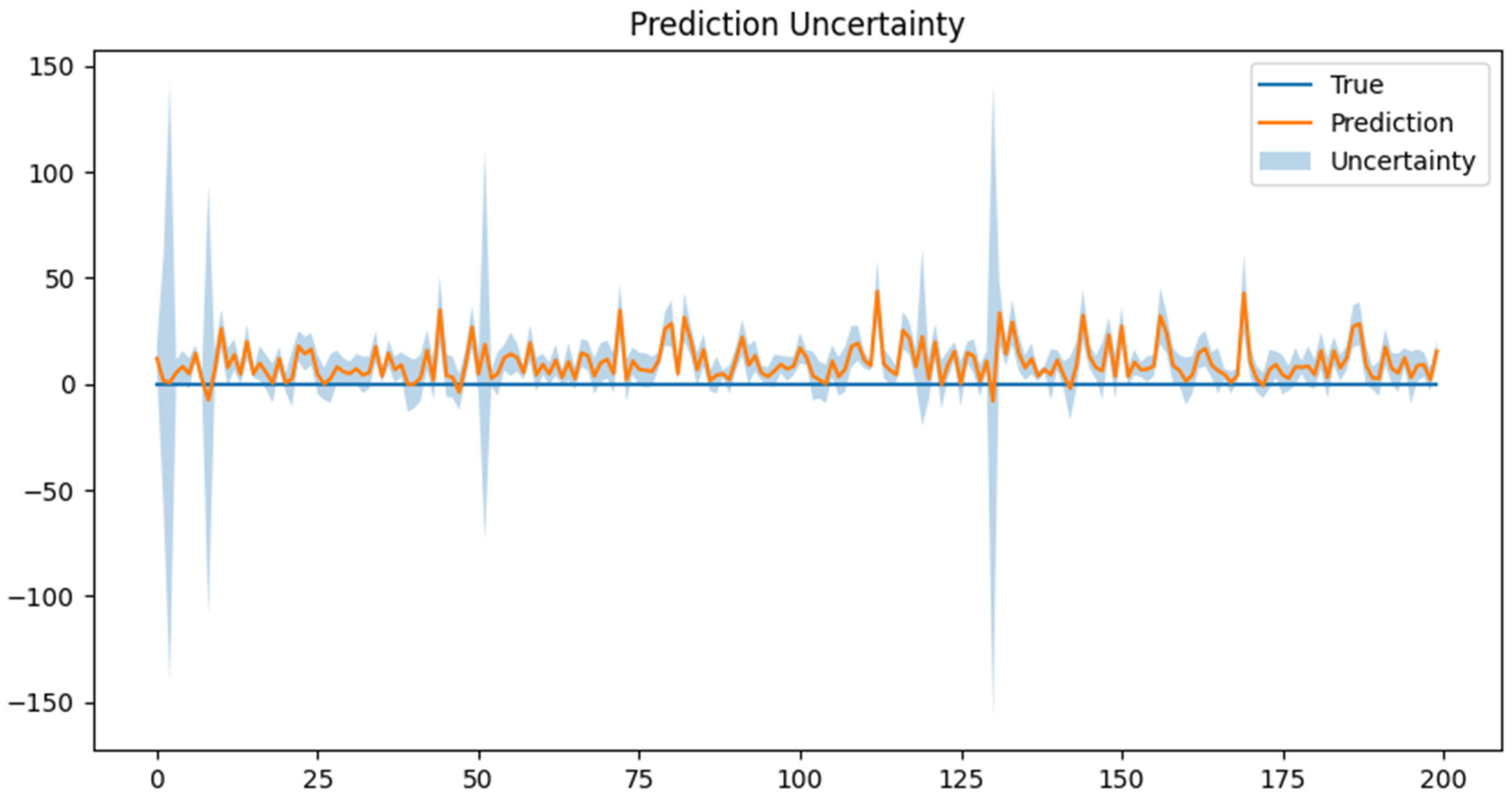
where represents the predicted RUL value, represents the standard deviation of the predictions. The ±3σ interval corresponds to a 99.7% confidence range under the assumption of normally distributed prediction errors. The uncertainty bounds were visualized together with the predicted and ground-truth RUL values, as illustrated in Figure 13. As shown in Figure 13, the shaded region represents the uncertainty interval around the predicted RUL values. The predicted curve lies within the uncertainty band, indicating that the model captures the general trend of the true RUL values while accounting for variability in the predictions.
Figure 13.
Prediction Uncertainty Analysis of CNN Model.
The uncertainty band reflects the variability of the model predictions across the dataset. Regions with wider uncertainty intervals indicate higher prediction variability, which may occur due to complex degradation behavior or limited training data in those regions.
Overall, the uncertainty analysis demonstrates that the proposed model provides not only accurate RUL predictions but also a quantifiable measure of prediction reliability. Incorporating uncertainty estimation into battery prognostics models is particularly important for safety-critical applications such as electric vehicles and energy storage systems, where reliable predictions are required for effective decision-making.
3.8. Comparison of Estimation Metrics
The predictive performance of the implemented models was evaluated using multiple regression metrics including MAE, RMSE, MSE, and R2. The comparative results are summarized in Table 6. Among the evaluated models, the CNN-based deep learning model achieved the best overall performance, producing the lowest MAE and RMSE values. The KNN model demonstrated the second-best performance, while ensemble learning models such as Random Forest and XGBoost exhibited relatively higher prediction errors. These results indicate that deep learning architectures are more capable of capturing the complex nonlinear degradation behavior of lithium-ion batteries.
Table 6.
The comparative results of all models.
One limitation of this study is the use of laboratory-generated battery datasets. Real-world battery operation may involve more complex and dynamic operating conditions.
4. Discussion
To provide a comprehensive evaluation of the proposed approaches for lithium-ion battery Remaining Useful Life (RUL) prediction, a comparative analysis was conducted among four different models: Random Forest, XGBoost, K-Nearest Neighbors (KNN), and Convolutional Neural Networks (CNN). All models were trained using the same dataset and feature representation to ensure a fair comparison.
The predictive performance of the models was evaluated using multiple regression metrics, including Mean Absolute Error (MAE), Root Mean Square Error (RMSE), and Mean Squared Error (MSE). These metrics collectively provide a comprehensive assessment of model accuracy and robustness.
As presented in Table 5, the CNN model achieved the best overall performance, obtaining the lowest error values among all evaluated models. Specifically, the CNN model achieved an RMSE of 10.80 and an MAE of 7.75, significantly outperforming the traditional machine learning models considered in this study.
The KNN model demonstrated the second-best performance, achieving an RMSE of 12.08 and an R2 value of 0.6429, indicating that instance-based learning can effectively capture local similarities in battery degradation trajectories.
In contrast, both Random Forest and XGBoost models produced similar performance results, with an RMSE of approximately 17.95. This suggests that tree-based ensemble methods may have limited capability in capturing the complex nonlinear degradation behavior of lithium-ion batteries when using the selected feature representation.
The superior performance of the CNN model can be attributed to its ability to automatically learn hierarchical feature representations from the input data. Unlike traditional machine learning models that rely on handcrafted features, CNN architectures can extract complex patterns from sequential battery measurements, enabling them to better capture nonlinear degradation dynamics.
Furthermore, the CNN model achieved a large prognostic horizon (PH) value of 4896, indicating its strong capability in providing early and reliable predictions of battery remaining useful life. Such predictive capability is particularly important in practical battery management systems, where accurate early prognostics are required for safe and efficient system operation.
Overall, the comparative results demonstrate that deep learning–based approaches provide significant advantages over conventional machine learning models for lithium-ion battery RUL prediction. These findings highlight the potential of CNN architectures for developing reliable and accurate battery prognostic systems.
These findings highlight that integrating deep learning with feature engineering and uncertainty quantification provides a more robust and reliable framework compared to single-model approaches commonly used in the literature.
5. Conclusions
In this study, a comprehensive data-driven framework was developed for the prediction of the Remaining Useful Life (RUL) of lithium-ion batteries using multiple machine learning and deep learning approaches. Accurate RUL estimation plays a crucial role in battery management systems, enabling predictive maintenance, improved operational safety, and enhanced reliability in energy storage and electric vehicle applications.
To investigate the effectiveness of different predictive paradigms, four models—Random Forest, XGBoost, K-Nearest Neighbors (KNN), and Convolutional Neural Networks (CNN)—were implemented and evaluated using a common dataset and feature representation. The models were trained using operational battery parameters such as voltage, current, temperature, and derived electrical indicators. Their performance was assessed using multiple regression metrics including MAE, RMSE, and MSE, along with prognostic evaluation indicators.
The comparative results demonstrated clear differences in the predictive capability of the evaluated models. Traditional ensemble learning models such as Random Forest and XGBoost exhibited moderate performance in capturing battery degradation patterns. The KNN model achieved improved performance by leveraging local similarities between degradation trajectories. However, the CNN-based deep learning model achieved the best overall predictive accuracy, yielding the lowest error values among all tested approaches.
The superior performance of the CNN model can be attributed to its ability to automatically extract hierarchical and nonlinear patterns from battery operational data. Unlike conventional machine learning methods that rely heavily on handcrafted features, CNN architectures can effectively learn complex degradation behaviors directly from the input data. Furthermore, the obtained prognostic horizon results indicate that the CNN model is capable of providing reliable early predictions of battery remaining useful life, which is highly valuable for real-world battery health management applications.
In addition to prediction accuracy, interpretability analysis using SHAP (SHapley Additive exPlanations) revealed that key operational variables such as voltage, current, and temperature play a dominant role in influencing RUL predictions. These findings are consistent with known electrochemical degradation mechanisms in lithium-ion batteries, further supporting the validity of the proposed modeling approach.
Overall, the results of this study demonstrate that deep learning–based models offer significant advantages for modeling complex battery degradation processes, providing improved prediction accuracy and enhanced capability for capturing nonlinear aging dynamics. The proposed framework therefore provides a promising solution for developing reliable battery prognostics systems.
Future work will focus on extending the proposed approach by incorporating temporal deep learning architectures, such as LSTM and hybrid CNN–LSTM models, and by evaluating the models on larger real-world battery datasets obtained from electric vehicles and energy storage systems. Additionally, integrating physics-informed features and advanced uncertainty quantification methods may further improve the robustness and reliability of battery RUL prediction models.
Author Contributions
Methodology, M.Y.; Software, M.Y.; Validation, M.Y.; Writing—review and editing, E.A. and O.E.; Visualization, E.A. and O.E.; Supervision, E.A. and O.E. All authors have read and agreed to the published version of the manuscript.
Funding
This research received no external funding.
Data Availability Statement
The data presented in this study are openly available in the NASA open access battery degradation at 10.21227/p4st-2305.
Conflicts of Interest
The authors declare no conflicts of interest.
References
- Severson, K.A.; Attia, P.M.; Jin, N.; Perkins, N.; Jiang, B.; Yang, Z.; Chen, M.H.; Aykol, M.; Herring, P.K.; Fraggedakis, D.; et al. Data-driven prediction of battery cycle life before capacity degradation. Nat. Energy 2019, 4, 383–391. [Google Scholar] [CrossRef] [Scilit]
- Zhang, Y.; Xiong, R.; He, H.; Pecht, M. A long short-term memory recurrent neural network for remaining useful life prediction of lithium-ion batteries. IEEE Trans. Veh. Technol. 2018, 67, 5695–5705. [Google Scholar] [CrossRef] [Scilit]
- Li, Y.; Liu, G.; Deng, Z.; Xu, Y.; Lai, L.; Gong, G.; Tong, L.; Zhang, H.; Gong, M.; Yan, M.; et al. Lithium-Ion Battery State of Health Estimation Based on CNN-LSTM-Attention-FVIM Algorithm and Fusion of Multiple Health Features. Appl. Sci. 2025, 15, 7555. [Google Scholar] [CrossRef] [Scilit]
- Mou, J.; Yang, Q.; Tang, Y.; Liu, Y.; Li, J.; Yu, C. Prediction of the Remaining Useful Life of Lithium-Ion Batteries Based on the 1D CNN-BLSTM Neural Network. Batteries 2024, 10, 152. [Google Scholar] [CrossRef] [Scilit]
- Lv, K.; Ma, Z.; Bao, C.; Liu, G. Indirect Prediction of Lithium-Ion Battery RUL Based on CEEMDAN and CNN-BiGRU. Energies 2024, 17, 1704. [Google Scholar] [CrossRef] [Scilit]
- Zhang, H.; Du, D.; Hu, C.; Zhang, J.; Zhang, S.; Xing, Y. Remaining Useful Life Prediction of Lithium Battery with Enhanced Bi-LSTM Network. In 2021 CAA Symposium on Fault Detection, Supervision, and Safety for Technical Processes (SAFEPROCESS); IEEE: New York, NY, USA, 2021; pp. 1–6. [Google Scholar] [CrossRef] [Scilit]
- Li, Y.; Liu, K.; Hu, X. Machine learning-based remaining useful life prediction of lithium-ion batteries: A review. Renew. Sustain. Energy Rev. 2022, 156, 111845. [Google Scholar] [CrossRef] [Scilit]
- Zhang, S.; Liu, Z.; Su, H. A Bayesian Mixture Neural Network for Remaining Useful Life Prediction of Lithium-Ion Batteries. IEEE Trans. Transp. Electrif. 2021, 8, 4708–4721. [Google Scholar] [CrossRef] [Scilit]
- Liu, K.; Shang, Y.; Ouyang, Q.; Widanage, W.D. A Data-Driven Approach With Uncertainty Quantification for Predicting Future Capacities and Remaining Useful Life of Lithium-ion Battery. IEEE Trans. Ind. Electron. 2021, 68, 3170–3180. [Google Scholar] [CrossRef] [Scilit]
- Liu, Z.; Sun, G.; Bu, S.; Han, J.; Tan, X.; Pecht, M. Particle Learning Framework for Estimating the Remaining Useful Life of Lithium-Ion Batteries. IEEE Trans. Instrum. Meas. 2017, 66, 280–293. [Google Scholar] [CrossRef] [Scilit]
- Zhao, Q.; Caib, Y.; Wang, X. Review on Prediction Methods of Remaining Useful Life of Lithium Ion Batteries. Int. J. Front. Sociol. 2021, 3, 35–43. [Google Scholar] [CrossRef] [Scilit]
- Xu, Y. Advanced RUL Estimation for Lithium-Ion Batteries: Integrating Attention-Based LSTM with Mutual Learning-enhanced Artificial Bee Colony Optimization. J. Inst. Eng. India Ser. B 2025, 106, 735–760. [Google Scholar] [CrossRef] [Scilit]
- Ren, L.; Zhao, L.; Hong, S.; Zhao, S.; Wang, H.; Zhang, L. Remaining useful life prediction for lithium-ion battery: A deep learning approach. IEEE Access 2018, 6, 50587–50598. [Google Scholar] [CrossRef] [Scilit]
- Wang, W.; Hu, L.; Ding, G. RUL prediction for lithium-ion batteries based on variational mode decomposition and hybrid network model. SIViP 2023, 17, 3109–3117. [Google Scholar] [CrossRef] [Scilit]
- Hu, C.; Pei, H.; Si, X.-S.; Li, T.; He, C.; Pang, Z. Bayesian Deep-Learning-Based Prognostic Model for Equipment without Label Data Related to Lifetime. IEEE Trans. Syst. Man Cybern. Syst. 2023, 53, 504–517. [Google Scholar] [CrossRef] [Scilit]
- Kim, J.; Baek, J.; Abbas, A.; Rasul, J.M.A.M. Hybrid ensemble learning framework with uncertainty quantification for state-of-health estimation in lithium-ion batteries for robust battery remaining useful life prediction. J. Meas. 2026, 266, 120528. [Google Scholar] [CrossRef] [Scilit]
- Abiodun, O.I.; Jantan, A.; Omolara, A.E.; Dada, K.V.; Mohamed, N.A.E.; Arshad, H. Comprehensive review of artificial neural network applications to pattern recognition. IEEE Access 2019, 7, 158820–158846. [Google Scholar] [CrossRef] [Scilit]
- Lodetti, P.Z.; Neto, E.A.C.A.; Martins, M.A.I.; Costa, G.H.D.S.; Ludwig, M.A. MAE And RMSE Analysis Of K-Means Predictive Algorithm for Photovoltaic Generation. In Proceedings of the 2022 International Conference on Electrical, Computer and Energy Technologies (ICECET), Prague, Czech Republic, 20–22 July 2022; pp. 1–6. [Google Scholar]

Disclaimer/Publisher’s Note: The statements, opinions and data contained in all publications are solely those of the individual author(s) and contributor(s) and not of MDPI and/or the editor(s). MDPI and/or the editor(s) disclaim responsibility for any injury to people or property resulting from any ideas, methods, instructions or products referred to in the content. |
© 2026 by the authors. Licensee MDPI, Basel, Switzerland. This article is an open access article distributed under the terms and conditions of the Creative Commons Attribution (CC BY) license.