


Abstract
Rational design of nanostructures composed of mixed-metal oxides synthesized from metal–organic frameworks (MOFs) is a very promising way to enhance the electrochemical performance (EP) of supercapacitor electrode materials. In this work, a porous nanostructured Cu/Ni-O was synthesized via thermal decomposition of bimetallic Cu/Ni-MOF and characterized as battery-type material for application in advanced energy storage systems. Structural characterization showed successful formation of crystalline CuO and NiO with homogeneous distribution of elements inside the nanostructure. Microscopy studies indicated the formation of an interconnected nanoparticle network with a large number of pores and exposed surface sites, which provided favorable pathways for electrolyte diffusion and charge transport. The obtained results have shown significant redox activity linked with the reversible metal–-organic framework. The specific capacity of the prepared Cu/Ni-O material reached the value of 467.1 C/g (129.8 mAh/g) at 0.5 A/g. Moreover, the electrode possessed significant cycling stability with a capacity retention of 88.27% after 9000 GCD cycles and a coulombic efficiency close to 93.8%. For testing the application potential, the Cu/Ni-O//AC hybrid supercapacitor device was prepared employing Cu/Ni-O as a positive electrode and activated carbon as a negative electrode. The assembled Cu/Ni-O//AC device achieved a specific capacity of 205.9 C/g at 0.3 A/g, along with an energy density of 40.1 Wh/kg at a corresponding power density of 212.8 W/kg. Moreover, the device demonstrated notable cycling stability with 94% capacitance retention after 8000 cycles. The increased EP value could be credited to the combined effect of CuO and NiO, the porous structure of MOF-derived material, and charge transfer paths via the nanostructure.
1. Introduction
The rapid rise in the development of portable electronics, electric cars, and renewable energy sources has created an enormous need for new advanced electrochemical energy storage devices with a high energy density, power density, and great cycling stability [1]. Despite the high energy density of lithium-ion batteries and their dominance in the commercial energy storage field, the slow rate of charge and discharge and low power capability prevent the use of these devices in applications where quick energy supply is needed. On the other hand, supercapacitors show an excellent power density, fast charge–discharge properties, and good cycling stability; nevertheless, their lower energy density is still the main problem hindering practical use [1,2]. Therefore, much research work has been done on the synthesis of new electrode materials which can overcome the limitations of conventional batteries and electrical double-layer capacitors.
In the list of the different emerging electrochemical energy storage technologies, there has been growing interest in battery-type supercapacitors and hybrid supercapacitors owing to the incorporation of both the ability of the electrode material to store high amounts of charge, as well as the fast transfer of charges at the capacitive electrode [2,3,4]. The above-mentioned approach enables an efficient way of increasing the energy and power densities of such storage systems while retaining the admirable cycling performance. Because of the fact that the electrochemical process is mainly controlled by the properties of the electrode materials, the development of new electrode materials of a high quality becomes an essential task in next-generation energy storage systems. Transition metal oxides have been studied intensively as battery-type electrode materials owing to the presence of multiple redox reactions, multiple oxidation states, low cost, natural abundance and the environmentally friendly nature of these materials. However, many single-metal oxides exhibit low conductivity, slow electron kinetics and structural instability during the charge/discharge cycle, thereby limiting the EP of the device. Among the vast array of synthesis routes for the development of new electrode materials, MOFs have proven to be extremely promising sacrificial template materials due to their porous crystalline nature, very high specific surface area, tunable composition, and well-defined distribution of metal centers. As compared with traditional synthesis routes, the thermal decomposition of MOF precursors makes it possible to obtain porous metal oxides that retain the structural features of the initial structure, and at the same time provide for the creation of interconnecting ion channels and electrochemically available active sites. Hence, MOF-derived materials usually possess higher electrolyte accessibility, shortened pathways for ion diffusion, enhanced stability, and better electrochemical reaction rates. Gowdhaman et al. [5] confirmed that the NiO/Ni/rGO composites derived from MOFs presented outstanding specific capacity and impressive cycling performance due to efficient electron transfer facilitated by the conductive carbon framework and plentiful redox centers provided by the nickel oxide. In addition, Zhang et al. [6] proved that MOF-based NiO/V2O3/C heterojunction nanocomposites contributed to increased capacitance and superior rate capability via efficient charge transfer at interfaces and enlarged electrochemical accessible surface areas. Such facts show that rational structural design of MOFs can greatly enhance EP through simultaneous improvement of electrical conductivity, availability of active sites, and ionic diffusion. Meanwhile, the benefits of MOF-based materials have been fully addressed in several review articles. Bhoite et al. [7] stressed that MOF-based metal oxides featured controlled pore structure, large specific surface area, and good stability, and therefore could be considered advanced electrodes for supercapacitors. Similarly, according to Shahzad et al. [8], metal oxides obtained from MOFs typically show better performance than conventional metal oxides due to the hierarchical structure generated by the MOF template which facilitates ion diffusion and charge transfer. From all these findings, it is quite clear that MOF-derived nanomaterials provide a promising approach for developing high-performance electrode materials for advanced electrochemical storage devices.
It has been shown that mixing two or more electroactive metal components within one architecture allows enhancing the EP relative to their separate counterparts. The combination of several transition metals provides additional redox reactions, greater density of electroactive centers, and faster electron and ion transport during consecutive cycles of charge/discharge. Therefore, MOF-based binary and multicomponent metal oxides represent an efficient approach for the enhancement of specific capacity, rate capability, and cycling performance. Several examples of such systems additionally confirm these benefits. Chettiannan et al. [9] developed flower-like MOF-based NiO/Co3O4 electrodes, whose bimetallic composition was optimized in order to improve EP due to the increase in surface area and synergistic redox reactions. Likewise, Naveenkumar et al. [10] synthesized MOF-based CuCo2S4@FeS2 nanohybrids, which provided excellent EP due to the strong interconnection of several electroactive phases and shortening of ion diffusion paths. In another study, Liu et al. [11] fabricated hierarchical Ni(OH)2/NiAl-LDH/rGO heterostructures based on MOF precursors; the combination of conductive networks and a hierarchical porous structure with plenty of Faradaic active sites led to an admirable EP.
Among other transition metal oxides, nickel oxide and copper oxide have received special attention due to their own individual electrochemical properties that can be utilized for storing energy in the battery-type fashion. Nickel oxide features high theoretical capacitance based on reversible redox reactions between Ni2+ and Ni3+ states, while copper oxide additionally features Faradaic activity, low cost, natural abundance, and good electrochemical reversibility. However, pure NiO or CuO-based electrodes usually lack electrical conductivity, suffer from slow reaction rates, and experience degradation under electrochemical cycling. Thus, the combination of both oxides into one porous nanomaterial becomes an appealing approach for increasing conductivity, the number of reactive sites, and the stability of electrode materials. Abdelhamid [12] prepared a bimetallic NiO/CuO MOF-derived nanocomposite within a conductive carbon network and exhibited improved EP when compared with its mono-metal counterparts. It has been shown that the incorporation of NiO and CuO into the MOF-derived carbon matrix is effective for enhancing EP with high specific capacitance of 735 F/g at 0.5 mV/s. Moreover, according to Hussain et al. [13], an oriented Zr-Mn oxide/CuO hybrid electrode showed better charge storage capability due to the synergistic effect between different active electrodes and the designed configuration. It is evident from the above-mentioned results that the combination of Cu- and Ni-based active electrodes improves charge storage behavior.
Other than binary oxide-based materials, heterostructure engineering has also proven to be an effective means for enhancing the properties of the materials used for the construction of electrodes. For instance, Hou et al. [14] synthesized Cu-Co-S@MnO2 heterostructured electrodes via a bimetallic MOF precursor and observed an impressive specific capacitance value of 1483.3 F/g along with about 93% of the capacitance retention after 10,000 cycles, which highlights the positive impact of heterojunctions on electron conduction and ion diffusion in the material. In the same way, Kumar et al. [15] synthesized MOF-derived CuO-Co3O4 heterostructures with a specific capacitance value of 1564.4 F/g at 1 A/g, whereas the corresponding asymmetric supercapacitor provided an energy density value of 48.7 Wh/kg with 91.2% capacitance retention after prolonged cycling. The exceptional EP was due to the cooperative role played by Cu and Co redox couples, as well as vacancy-assisted ion transport in the material. Similarly, Zan et al. [16] and Sun et al. [17] reported the benefits of heterostructure engineering in the construction of electrodes. Although these studies have shown the effectiveness of MOF-based mixed-metal electrodes, most of these systems rely on carbon doping, sulfidation, junction formation, or advanced multistep interface engineering to obtain high EP [12,13,14,15,16,17]. These strategies necessarily lead to increased synthesis complexities and might pose challenges for mass production. In this regard, synthesis of the porous Cu/Ni-O binary oxide via direct thermal conversion of a Cu/Ni-MOF precursor can be a promising solution. The direct conversion method can retain the native porous architecture obtained from the MOF and produce a uniform distribution of CuO and NiO components without further modification steps. This type of material is anticipated to possess plenty of active sites, faster electrolyte penetration, shorter ion diffusion paths, and efficient electron transport owing to the combined contribution of CuO and NiO.
Considering all the above points, the objective of the current study is to prepare a porous MOF-based Cu/Ni-O binary oxide by thermally converting the corresponding bimetallic Cu/Ni-MOF precursor and studying its electrochemical behavior as an electrode material for hybrid supercapacitors. The conversion process of the parent MOF structure is expected to result in the formation of a hierarchical porous oxide structure retaining homogeneous dispersion of CuO and NiO nanoparticles within the oxide structure. The mentioned structural properties will allow the provision of electrochemically active sites, electrolyte penetration, shortening of ion diffusion pathways, and charge transfer at interfaces. Also, the presence of CuO and NiO particles is expected to result in the appearance of complementary Faradaic reactions allowing charge storage via their redox reactions. In order to study the working principle of the prepared electrode for charge storage, its electrochemical characteristics are studied thoroughly by performing cyclic voltammetry, galvanostatic charge–discharge tests, electrochemical impedance spectroscopy, and kinetic studies. Moreover, an asymmetric supercapacitor cell is prepared where the Cu/Ni-O electrode obtained from the MOFs is used as the positive electrode, and activated carbon is used as the negative electrode. The energy parameters of the device, such as specific capacity, energy density, power density, rate capability, and cycling stability, are thoroughly analyzed. This study shows that the direct thermal decomposition of the Cu/Ni-MOF precursor offers a simple method for preparing porous Cu/Ni-O electrodes without any need for carbon hybridization or sulfidation, or even complex interface engineering techniques. With the aid of the integration of the beneficial electrochemical characteristics of CuO and NiO with the porous structure derived from the MOF precursor, this study gives more insights about the rational design of MOF-based binary transition metal oxide electrodes for use in high-performance hybrid supercapacitors.
2. Experimental Details
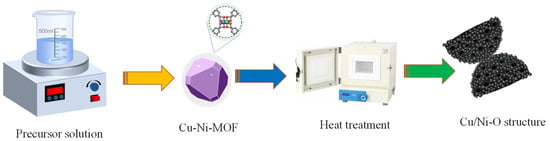
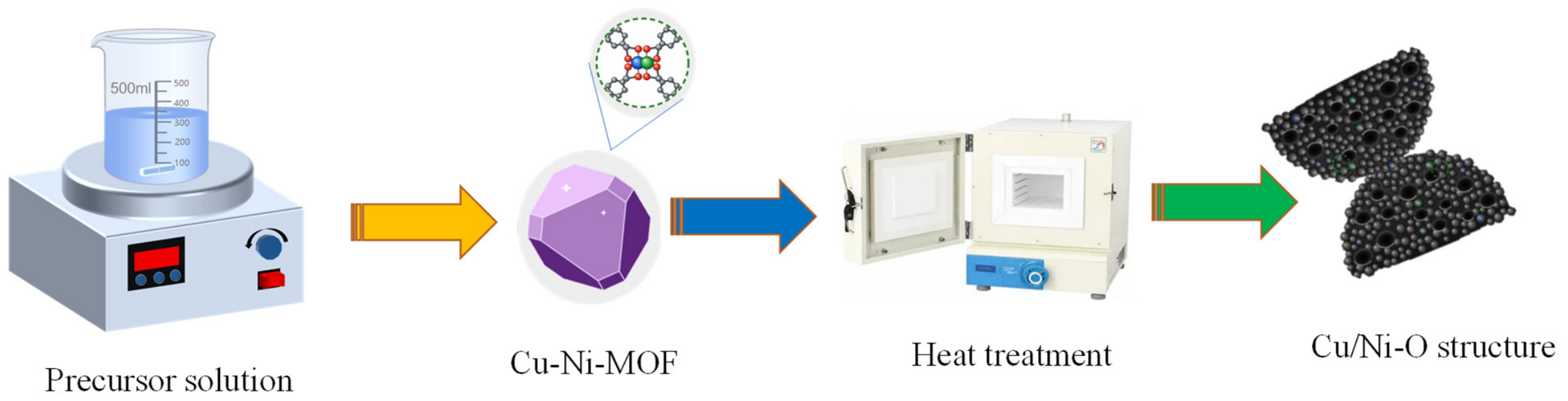
The Cu/Ni-MOFs precursor was prepared using a solvothermal technique (Figure 1). First, 137 mg each of Cu(NO3)2·2.5H2O and Ni(NO3)2·6H2O and 400 mg of PVP were dissolved in 80 mL of a combination of deionized water, DMF and ethanol in a ratio of 1:1:1 (v/v/v). The prepared solution was stirred at 200 rpm for 20 min to acquire a uniform metal-ion solution. Meanwhile, 103 mg of BTC was dissolved in 130 mL of a mixture of the above solvent and then added to the metal precursor solution through a drop-by-drop process. Following complete addition, the homogenous mixture was poured in a 250 mL autoclave made up of Teflon-lined stainless steel and kept at 170 °C for 6 h. The reaction product was then cooled down to room temperature. It was separated by centrifugation, and washed with deionized water and ethanol. Calcination of the as-synthesized Cu/Ni MOF precursor under air atmosphere at 400 °C for 6 h facilitated the removal of the organic matrix, and hence produced a porous MOF-derived Cu/Ni-O nanoparticle. In the process of decomposition, the organic moieties were removed, leaving behind crystalline phases of CuO and NiO with preservation of the porous structure from the MOF template. More details on the methods used can be found in the Supplementary Materials.
Figure 1.
Synthesis procedure of Cu/Ni-O nanostructure.
3. Results and Discussion
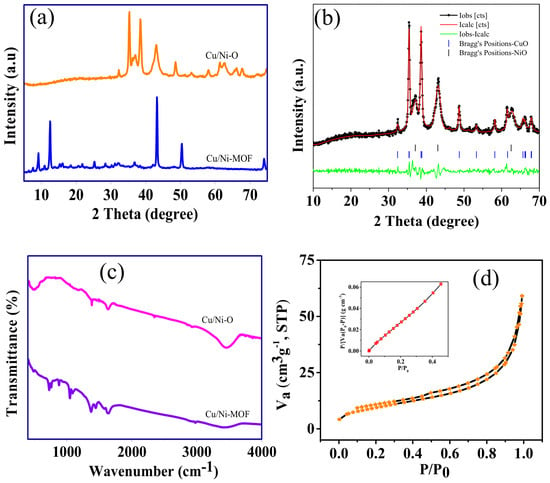
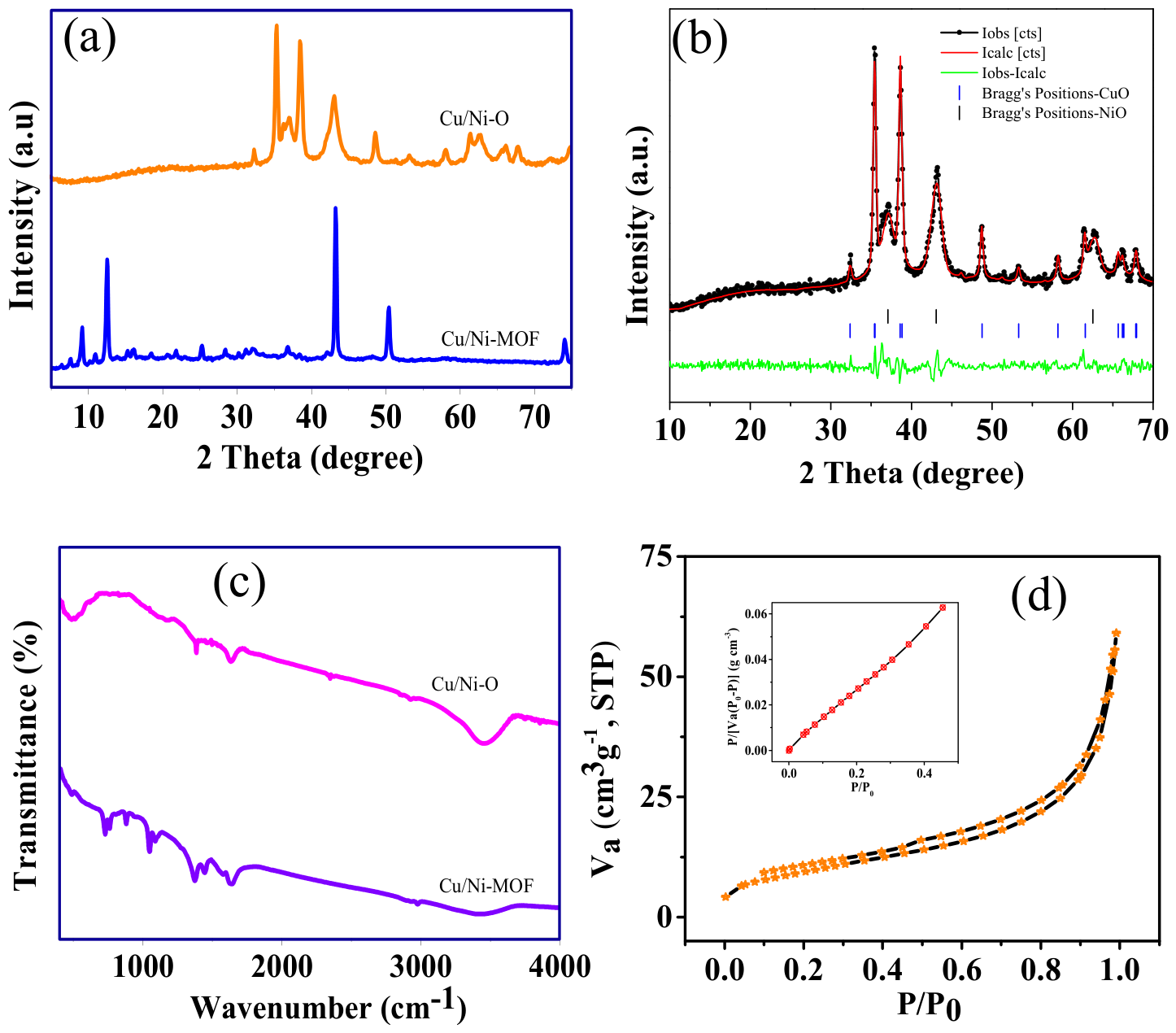
X-ray diffraction analysis was carried out for determining the phase constitution and crystalline structure of the prepared Cu/Ni-O nanostructure, while FTIR analysis was performed for identifying the structural evolution from the precursor Cu/Ni-MOF to the respective mixed-metal oxide. Figure 2a indicates that the Cu/Ni-MOF precursor shows several diffraction peaks. Besides the low-angle reflection from the MOF structure, the sharp peaks at around 43.3°, 50.4° and 74.1° represent the fcc metals of copper (JCPDS 04-0836) [16], confirming partial reduction of copper ions (Cu2+). Upon the calcination process, there is a significant change in the diffraction pattern, suggesting the decomposition of the organic matrix and the formation of crystalline mixed-metal oxides. The diffraction peaks found around 2θ = 32.5°, 35.5°, 38.7°, 48.7°, 53.5°, 58.3°, 61.5°, 66.2°, and 68.0° are assigned to (110), (−111)/(002), (111)/(200), (−202), (020), (202), (−113), (−311), and (220) planes of monoclinic CuO, respectively, matching very well with standard ICDD/JCPDS patterns (e.g., PDF No. 89-2531) [18,19]. However, the reflections at about 37.2°, 43.3°, and 62.9° represent the (111), (200), and (220) crystal planes of cubic NiO, respectively, in line with the well-known ICDD PDF No. 47-1049 [20]. No additional crystalline impurity phases were detected within the resolution of the XRD measurement. Moreover, the sharp diffraction peaks indicate good crystallinity, which is beneficial for charge transfer and electrochemical stability. It is worth noting that the phase transformation of MOF precursors into binary oxides of CuO-NiO has been widely reported. Rietveld refinement (Figure 2b) was performed to resolve the overlapping reflections. It is clear from the deconvolved peaks that both the diffraction peaks of CuO and NiO are resolved, thus verifying the existence of both these crystal forms in the Cu/Ni-O nanostructure.
Figure 2.
(a) XRD pattern of Cu/Ni-MOF and Cu/Ni-O; (b) Rietveld refinement of Cu/Ni-O nanostructure; (c) FTIR pattern of Cu/Ni-MOF and Cu/Ni-O nanostructure; and (d) adsorption/desorption isotherms for N2 (inset: BET plot) of the Cu/Ni-O.
The FTIR spectra for the Cu/Ni-MOF precursor and Cu/Ni-O nanostructure are presented in Figure 2c. The Cu/Ni-MOF spectrum shows some characteristic peaks related to the organic linker molecules. The wide band seen at a high-wavenumber range corresponds to the vibration of the O-H bonds due to adsorbed water molecules and hydroxyl groups on the surface. Also, other peaks seen in the range of approximately 1400–1650 cm−1 correspond to the asymmetric and symmetric stretching vibration of carboxylate groups [21,22]. These are some proofs for successful coordination between metal ions and organic ligands in MOFs. However, after the calcination process, most of the absorption peaks of organic ligands disappeared or attenuated, which is evidence for the decomposition of the MOF structure and elimination of organic components. In addition, some new absorption peaks appear below 700 cm−1 that are due to metal–oxygen vibrations. These peaks are credited to Cu-O and Ni-O stretching vibrations and indicate the presence of mixed Cu/Ni-O oxide structures [23,24]. The considerable decrease in signals due to organic functional groups along with the presence of vibrations of metal oxide further provides robust support for the formation of Cu/Ni-O nanoparticles from the Cu/Ni-MOF precursor. The overall results from XRD and FTIR analysis provide a clear indication of the fact that the thermal conversion process succeeds in forming a highly crystalline Cu/Ni-O nanostructure from the Cu/Ni-MOF. The coexistence of the CuO and NiO phases along with the formation of nanoparticles formed via the MOF route provides sufficient active sites for electrolyte access and charge transfer.
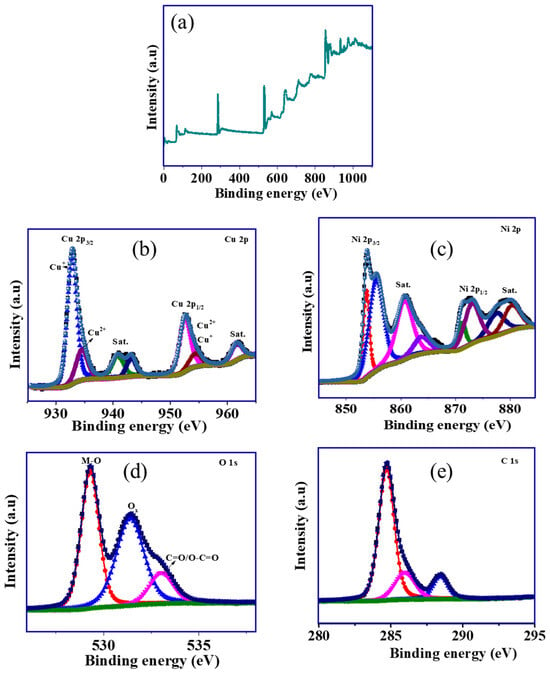
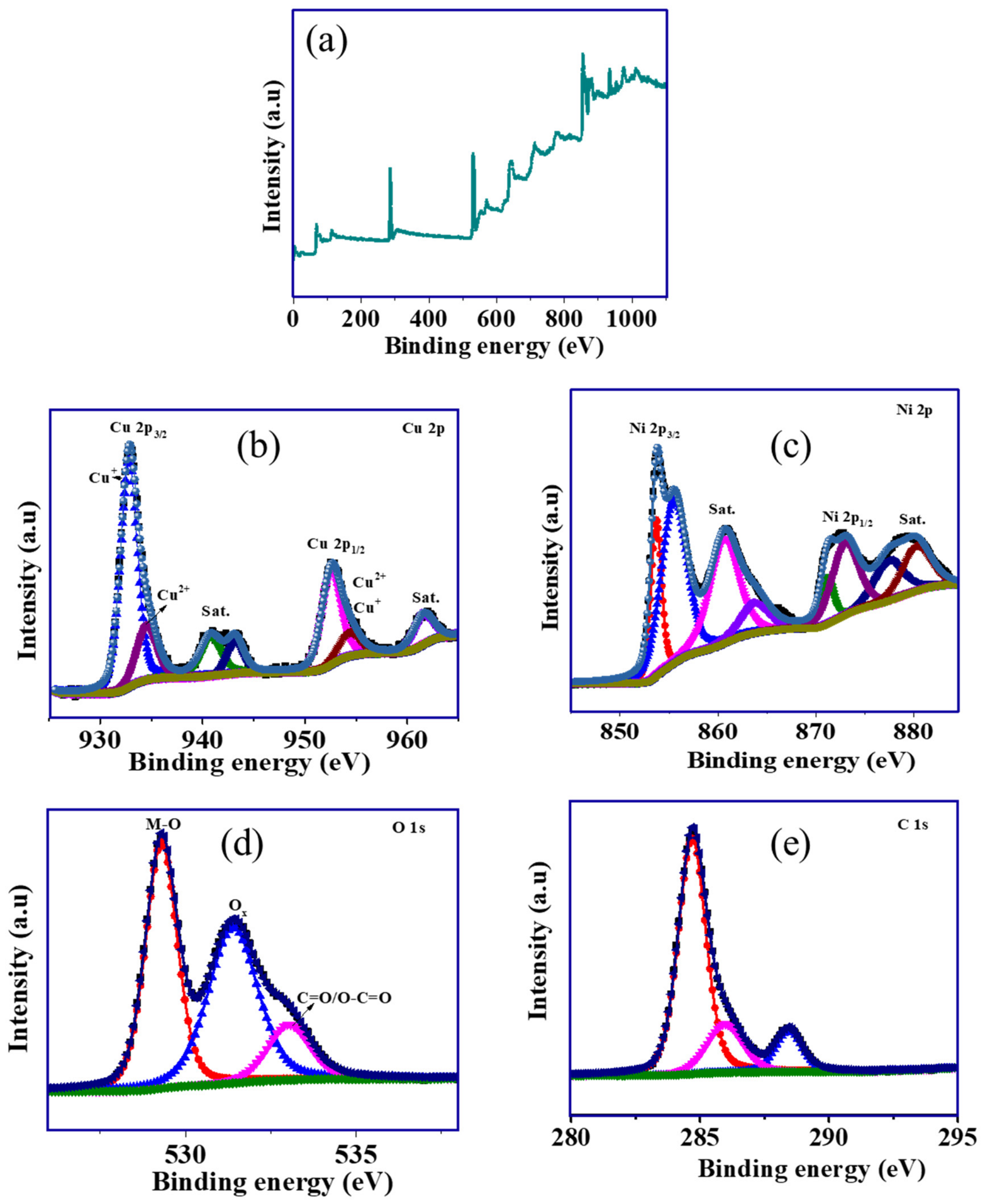
The XPS technique was used for analyzing the elemental composition as well as the surface chemistry of the prepared Cu/Ni-O nanomaterial. The survey scan and the high-resolution spectra of Cu 2p, Ni 2p, O 1s, and C 1s are illustrated in Figure 3a–e. As it can be seen from Figure 3a, the survey scan spectrum reveals the existence of Cu, Ni, O, and C in the prepared sample. The strong peaks of Cu, Ni, and O confirm the formation of mixed-oxide nanomaterial, but the weak peak of carbon is due to the adventitious carbon and carbon compounds resulting from the MOF precursor material. There were no other peaks due to any possible impurities. Figure 3b displays the high-resolution spectra of Cu 2p with two intense peaks around 933.8 eV and 953.7 eV for Cu 2p3/2 and Cu 2p1/2, respectively. The spin–orbit splitting energy of about 19.9 eV is characteristic of Cu2+ in CuO [25,26,27]. The Ni 2p spectrum (Figure 3c) shows two principal peaks at around 853.8 eV and 873.2 eV for Ni 2p3/2 and Ni 2p1/2 levels, correspondingly. Additionally, several satellite peaks at higher binding energies were detected and are typical for nickel oxide family materials [28]. Deconvolution of the spectrum reveals a presence of both Ni2+ and Ni3+ species at the surface, where the predominant Ni2+ signal clearly evidences the formation of NiO, while the presence of Ni3+ could be explained by partial oxidation of the surface layer and charge compensation related to defects [29]. Mixed valence states are useful in electrochemical energy storage as they give additional active sites for redox reactions and electron transfer [30]. Spectrum O 1s (Figure 3d) can be decomposed into several peaks which demonstrate different oxygen environments in the Cu/Ni-O nanostructure. The first one is centered at about 529.5–530.0 eV which corresponds to lattice oxygen (O2−) interacting with Cu and Ni atoms in the oxide matrix [31]. The higher-binding-energy O 1s component can be associated with surface hydroxyl/defect-related oxygen species [31]. These surface hydroxyl/oxygen defect species can improve access to electrolytes, provide additional active sites, and improve charge transfer kinetics. [32]. The third O 1s feature with high binding energy (532.8 eV) corresponds to oxygen present in C=O/O-C=O functional groups of carbonaceous materials formed upon degradation of the ligands, as supported by the O-C=O peak from the C 1s analysis (Figure 3e). Spectrum C 1s (Figure 3e) is characterized by a dominating peak near 284.8 eV corresponding to C-C/C=C bonds which are usually employed in calibration of binding energy [33]. Additional minor peaks with higher binding energies can be ascribed to oxygen-containing carbon species such as C-O and O-C=O. Such carbon species probably come from carbonaceous residues formed during the decomposition of organic ligands in the calcination process [34]. N2 adsorption–desorption isotherm (Figure 2d) of Cu/Ni-O is of Type IV with an H3 hysteresis loop indicating a predominately mesoporous structure. In the low-pressure region (P/P0 < 0.3), adsorption capacity increases steadily due to the occurrence of monolayer–multilayer adsorption onto the oxide surface. The adsorbed volume increases drastically at higher relative pressure levels (P/P0 > 0.8) to a value of around 60 cm3 g−1 (STP) as P/P0 approaches 0.99. Such a dramatic increase in adsorption is credited to capillary condensation within the mesoporosity as well as larger slit-like pores formed between the agglomerated Cu/Ni-O nanoparticles. Cu/Ni-O has specific surface area of 34.9 m2 g−1, a total pore volume of 0.09 cm3 g−1 and a mean pore diameter of 10.3 nm. The mesoporous structure with a moderate surface area allows for facile accessibility of electrolyte ions (OH−) to the electroactive sites. The Cu/Ni-O electrode provides a high specific capacity due to its fast and reversible Faradaic reactions, while the activated carbon electrode provides a fast ion adsorption/desorption rate, high conductivity, and good cycling stability.
Figure 3.
XPS survey and high-resolution spectra of Cu/Ni-O nanostructure: (a) survey spectrum; (b) Cu 2p; (c) Ni 2p; (d) O1s; and (e) C1s spectra.
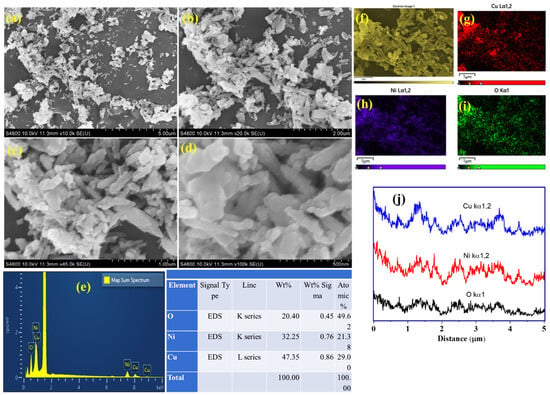
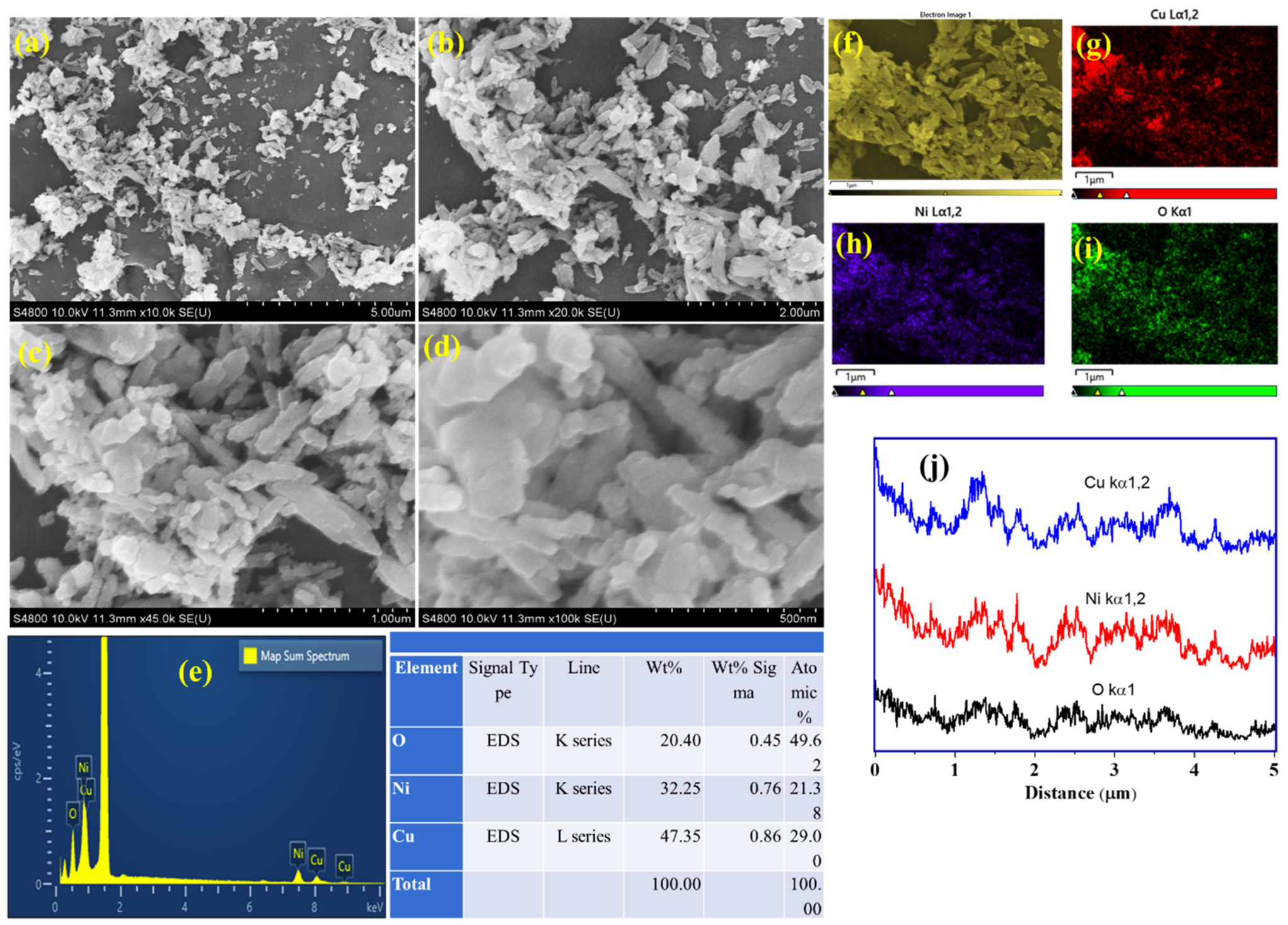
The morphological features and elemental composition of the synthesized Cu/Ni-O nanostructure were studied by means of FE-SEM, EDS, elemental mapping, and line-scan techniques, and represented in Figure 4. According to the low-magnification FE-SEM image in Figure 4a, the Cu/Ni-O nanostructure exhibits an aggregated structure formed by interconnected clusters evenly spread on the surface. This structure represents an open, loosely packed network with a large number of interparticle pores that are capable of enhancing electrolyte accessibility to electrochemically active areas. It is evident that the porous nature of this structure is desirable in terms of application in charge storage devices because it ensures effective ion transport through the nanostructure. With increasing magnification (Figure 4b,c), the Cu/Ni-O nanostructure can be seen as predominantly consisting of irregularly shaped nanosheet-like particles. The nanostructures are oriented randomly and partly overlap each other forming a 3D network. The formation of such thin nanosheets is ascribed to the structure evolution of the starting MOF during thermal decomposition.
Figure 4.
(a–d) FE-SEM images, (e) EDS spectra, (f–i) elemental mapping and (j) line mapping of Cu/Ni-O nanostructure.
The breakdown of the organic framework and the oxidation of the metal sites provide a very textured structure with an increased exposed surface area. Such a hierarchical structure provides a number of electrochemically active sites and reduced ion diffusion paths, making the electrochemical behavior of the material more efficient. High-resolution imaging (Figure 4d) also verifies the existence of thin-layered nanostructures with a very rough surface. The nanosheets are observed to be connected to each other, indicating that the process of fabrication from the MOF structure prevents the creation of large particles. This kind of surface roughness is going to increase the interaction surface area of the electrode with the electrolyte, thus allowing fast Faradaic reactions. In addition to that, such a connection pattern helps create pathways for electrons to travel through the entire electrode structure. The element composition of the Cu/Ni-O nanostructure was analyzed using EDS (Figure 4e). The spectra provide clear evidence of the presence of Cu, Ni, and O elements, which signifies successful synthesis of the binary metal oxides. From the quantitative analysis, the obtained Cu/Ni atomic ratio ≈ 1.36 (Cu 29.0, Ni 21.4, O 49.6 at.%). Oxygen presence is another piece of evidence that confirms the oxidation process undergone by both metals. Elemental mapping images (Figure 4f–i) provide additional information on the distribution of the elements. From the images, it can be observed that Cu, Ni, and O are evenly distributed throughout the entire nanomaterial, implying the presence of intimate mixing of the CuO and NiO phases. The homogenous dispersion of redox centers may improve the process of electron transfer, as well as the use of active material during the electrochemical reaction. Line scanning of the image (Figure 4j) proves the presence of both Cu and Ni ions within the area under investigation. The distribution pattern of both elemental signals is similar and free of sudden changes, meaning that both metal elements have been homogenously dispersed within the structure. The homogenous composition of the nanoparticles demonstrates the effectiveness of mixing Cu and Ni with the help of the MOF template.
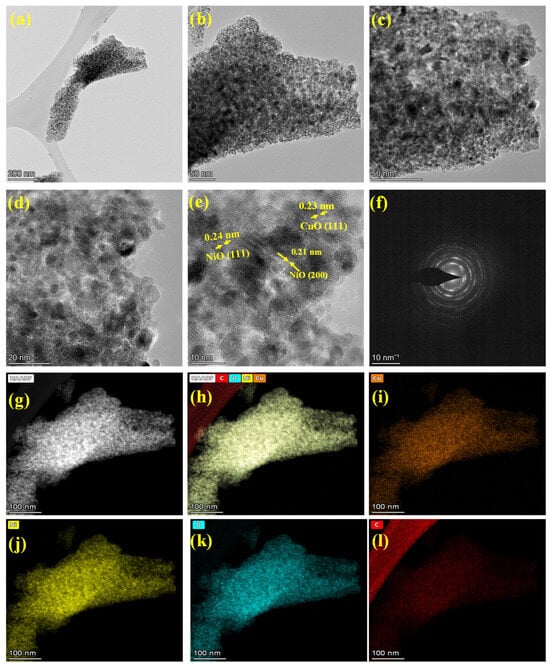
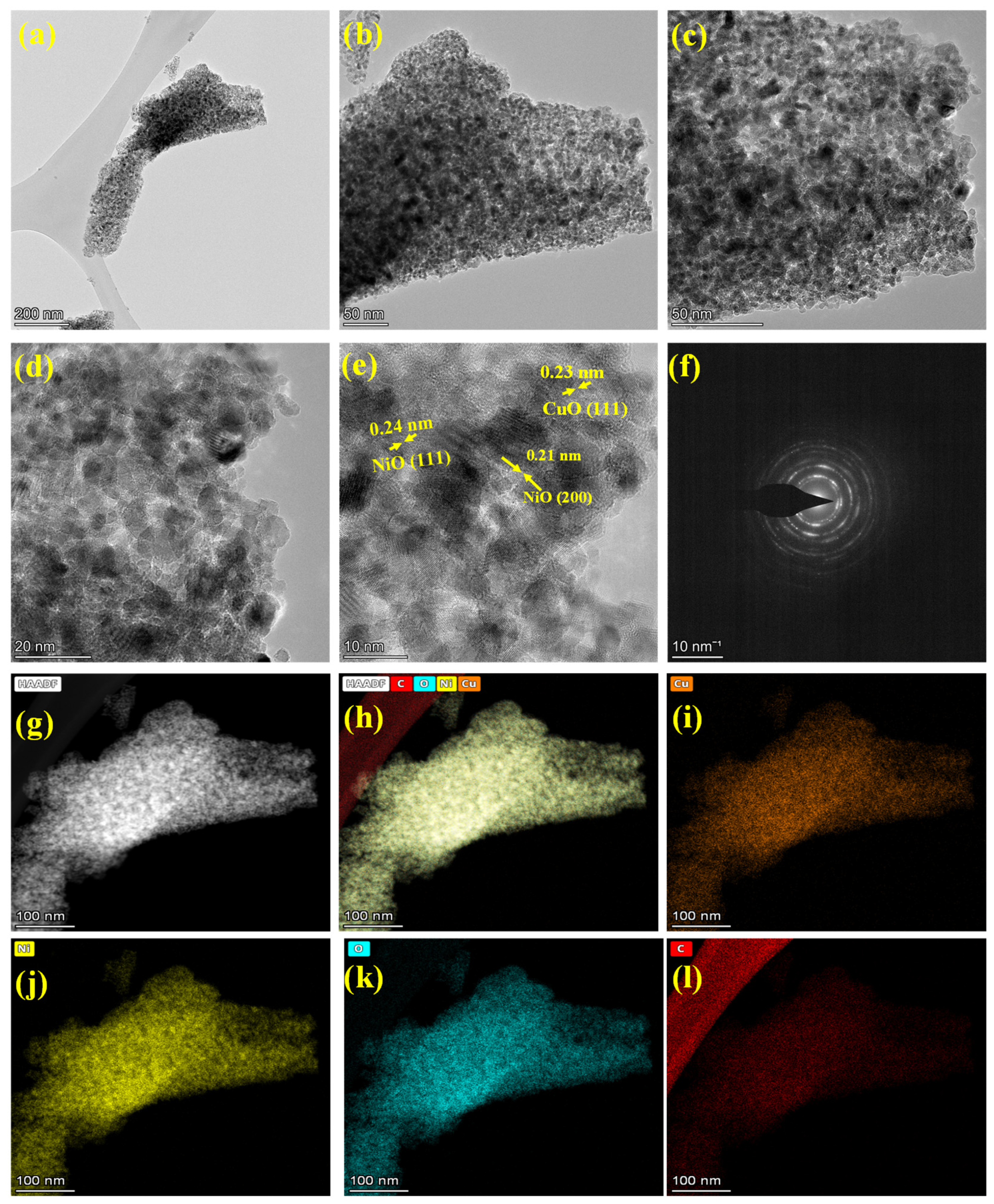
Images of the nanostructured Cu/Ni-O material through the FE-TEM technique have been depicted in Figure 5a–e. The low-magnification TEM micrograph (Figure 5a) indicates that the material is made up of aggregated nanostructures with an irregular porous morphology. The high-magnification TEM micrographs (Figure 5b–d) indicate that the aggregated structures are made up of numerous nanoparticles packed closely together, thereby forming a porous structure with abundant interparticle space. This kind of structure may provide a large surface area between the electrode and electrolyte during the electrochemical process along with ion diffusion. The high-resolution TEM image (Figure 5e) illustrates the presence of distinct lattice fringes, thus proving the existence of crystallinity in the synthesized material. The interplanar distance of 0.23 nm is ascribed to the (111) crystallographic plane of monoclinic CuO, whereas those of 0.24 and 0.21 nm are qualified to the NiO (111) and (200) crystallographic planes, respectively. As displayed in Figure 5f, the SAED pattern indicates several clear diffraction rings, which confirm the polycrystalline nature of the materials. The clear diffraction rings confirm the high crystallinity of the binary oxide nanomaterials. In addition, the HAADF-STEM image (Figure 5g) was employed for the assessment of the elemental distribution in the selected region. The resultant elemental mapping image (Figure 5h) reveals the presence of Cu, Ni, and O in the whole nanostructures. The elemental maps (Figure 5i–k) reveal that Cu, Ni, and O are homogeneously distributed in the structures, confirming the homogeneous incorporation of both metal oxides into the structures. The carbon signal in Figure 5l is mainly due to the lacey-carbon coating of the TEM grid; a small carbon signal due to residues cannot be ruled out. Based on the above results of the TEM and elemental mapping, it could be concluded that a crystalline Cu/Ni-O nanostructure composed of interlinked nanoparticles with homogeneous elemental distribution has been obtained.
Figure 5.
(a–e) FE-TEM images, (f) SAED pattern, (g) HAADF, (h) combined mapping, (i–l) individual mapping images of Cu, Ni, O, and C of Cu/Ni-O nanostructure.
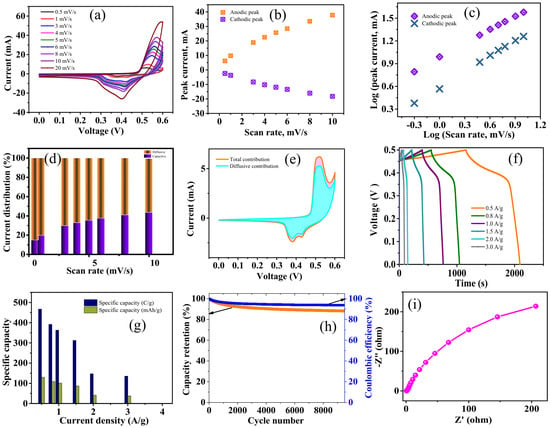
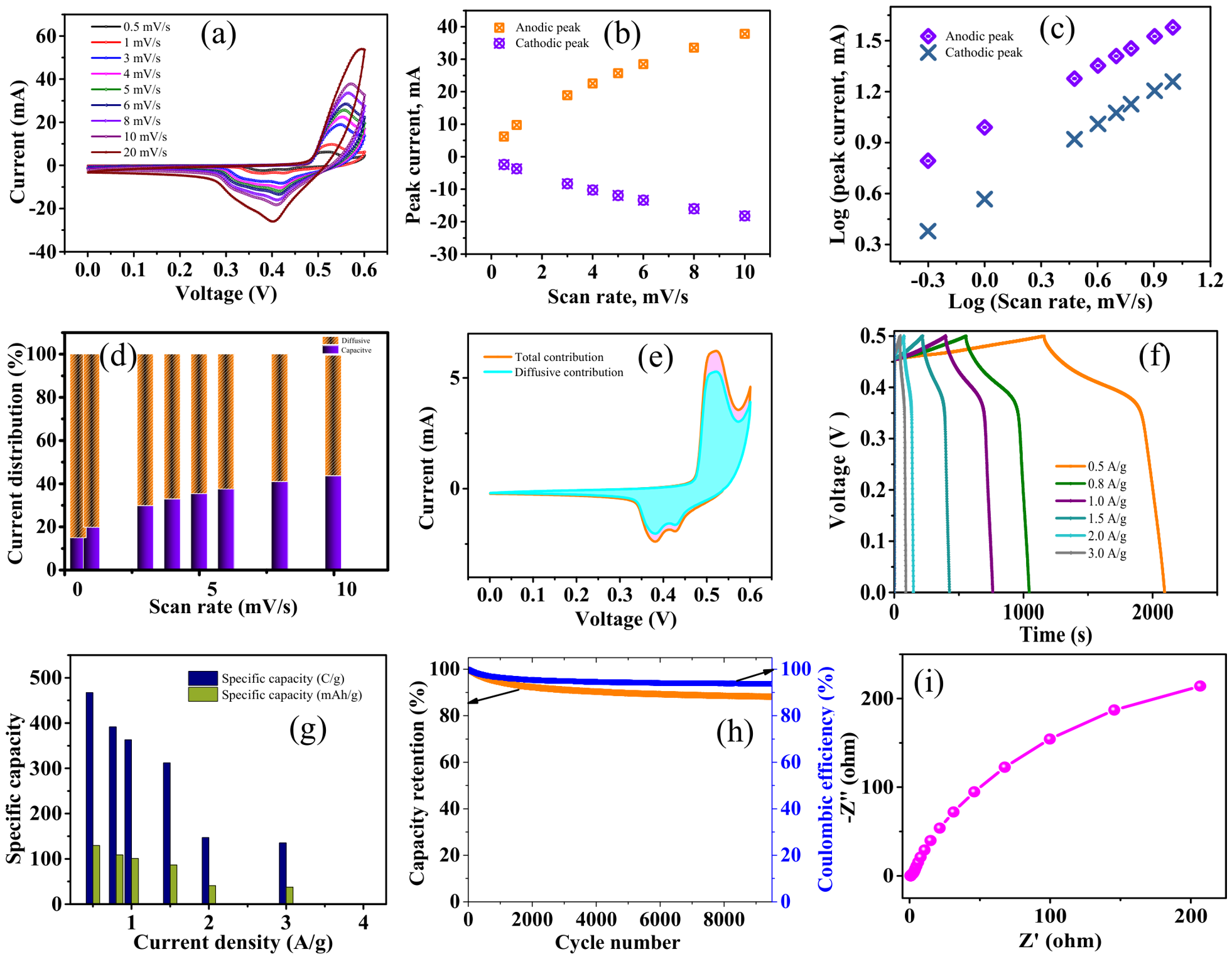
The electrochemical charge storage mechanism of the Cu/Ni-O nanostructured material was analyzed through CV, GCD, EIS and kinetic studies using a three-electrode system. The obtained findings have been depicted in Figure 6. The CV plots obtained at different scan rates have been depicted in Figure 6a. In all the cases, a pair of redox peaks is observed for the material, implying that the charge storage is primarily controlled through redox reactions in the Faradaic regime as compared to a purely electrostatic ion adsorption mechanism. The oxidation and reduction peaks have been observed due to the reversible valence state transition of Cu and Ni compounds in the alkaline electrolyte [35]. With an increase in the scan rate, the area covered by the CV plot gradually increases while keeping an almost similar profile, which suggests that the material shows good electrochemical reversibility and fast charge transfer kinetics [36]. In order to gain better insight into the charge storage mechanism, the dependence of the peak current on the scan rate was studied (Figure 6b,c). Both anodic and cathodic peak currents exhibit an increasing behavior with an increase in scan rate. Log(i) against log(v) data obtained from both peaks are fitted in the light of the power law equation, i = avb, where i represents the peak current, v is the scan rate and b is the kinetic constant. A b constant close to 0.5 is considered a diffusion-controlled process while a constant near to 1.0 is capacitive-controlled [37]. In the case of the Cu/Ni-O electrode, the determined b-values lie in between these ranges, which signifies the participation of both surface-controlled and diffusion-controlled processes for charge storage. The anodic b-value of 0.6 shows a significant contribution from diffusion. The findings by Dunn indicate that surface-controlled capacitance rises with the increase in scan rate, even though diffusion-controlled capacity dominates. This kinetic feature is common for nanostructured transition metal oxide electrodes with high surface accessibility and charge transfer capacity [38]. Figure 6d shows the capacitive and diffusive-controlled proportion of the Cu/Ni-O electrode. The estimated diffusive-controlled proportion is 85.3%, 80.4, 70.3, 67.3, 64.8, 62.7, 59.2, and 56.4 at 0.5, 1, 3, 4, 5, 6, 8, and 10 mV/s, respectively. The diffusion-controlled proportion is 85.3% for 0.5 mV/s, whereas the surface-controlled proportion rises to 43.6% for 10 mV/s, as expected from battery-like characteristics. The total and diffusion-controlled current separation is shown in Figure 6e. The porous nanoscale structure of the Cu/Ni-O electrode probably provides a sufficient number of active centers for quick ion transport, which leads to a high reaction rate and effective use of charge. Figure 6f shows the GCD curves obtained at various current densities. As it can be seen from these curves, all charge–discharge cycles have pronounced nonlinear properties with voltage plateaus, which proves the battery-like charge storage process in the electrode [39]. With increasing current density, the charge–discharge period decreases due to the decreasing time of the ion diffusion and reaction process. However, the general form of the curves practically does not change. The calculated capacity value based on GCD graphs is illustrated in Figure 6g. At the current density of 0.5 A/g, the electrode provides its maximum capacity value of 467.1 C/g (129.8 mAh/g), as there is enough time for the electrolyte ions to reach the active sites. The Cu/Ni-O electrode exhibited specific capacities of 467.1, 391.6, 362.9, 311.8, 146.8, and 135.1 C/g at current densities of 0.5, 0.8, 1, 1.5, 2, and 3 A/g, respectively. These values correspond to 129.8, 108.8, 100.8, 86.6, 40.8, and 37.5 mAh/g, respectively, demonstrating a decline in specific capacity with increasing current density. With the increase in current density, the value of capacity gradually decreases due to the decreasing ability of ions to diffuse into the inner active region. The cyclic stability of the electrode was determined by performing a series of GCD experiments at 10 A/g and is presented in Figure 6h. The Cu/Ni-O electrode possesses a moderate capacity retention rate after long cycling durations, with a coulombic efficiency of 93.8%. This cyclic stability is credited to the stable structure formed from the MOF, which enables ion insertion and desorption without causing degradation. Notable cyclic stability was observed in previous studies of MOF-based mixed-metal-oxide electrodes with porous interconnected frameworks [40]. The EIS (Figure 6i) gives further insight into the charge transfer properties of the electrode, which shows a small intercept at the high-frequency region, implying low resistance from the electrolyte solution. The Nyquist plot has a small intercept at a high frequency and inclined line at a low frequency, showing the diffusion of ions into the porous electrode. This proves that the Cu/Ni-O nanostructured material provides an ideal medium for conducting electricity and electrolyte ion migration, which results in improved EP. The improved EP of the Cu/Ni-O electrode can be attributed to the following reasons: (i) the interaction between CuO and NiO makes it possible to have a number of redox active centers; (ii) the porous structure of the MOF material increases the surface area; (iii) the interconnected structure allows for effective electron transport; and (iv) the uniform dispersion of Cu and Ni enhances charge transfer.
Figure 6.
Electrochemical performance of the Cu/Ni-O nanostructure electrode: (a) CV curves, (b) peak current vs. scan rate, (c) log peak current vs. log scan rate, (d) total contribution mechanism, (e) comparison of CV curves of total contribution and diffusive contribution, (f) GCD curves, (g) specific capacity vs. current densities, (h) cycling stability (at10 A/g), and (i) EIS spectra.
Electrochemical Performance (EP) of the Cu/Ni-O//AC Hybrid Supercapacitor Device
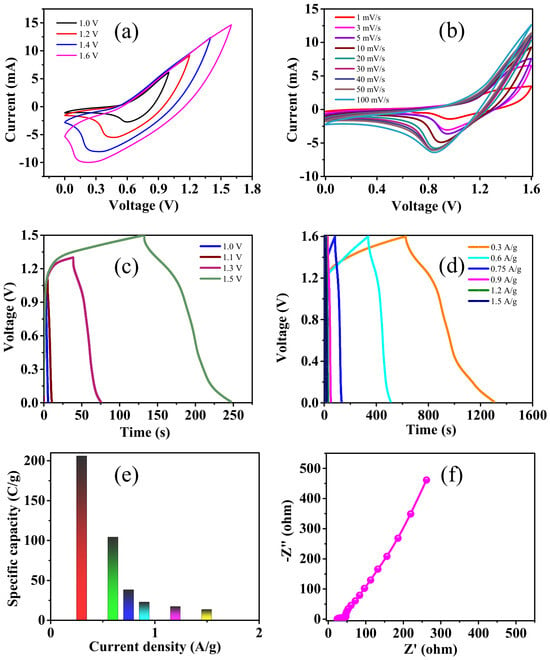
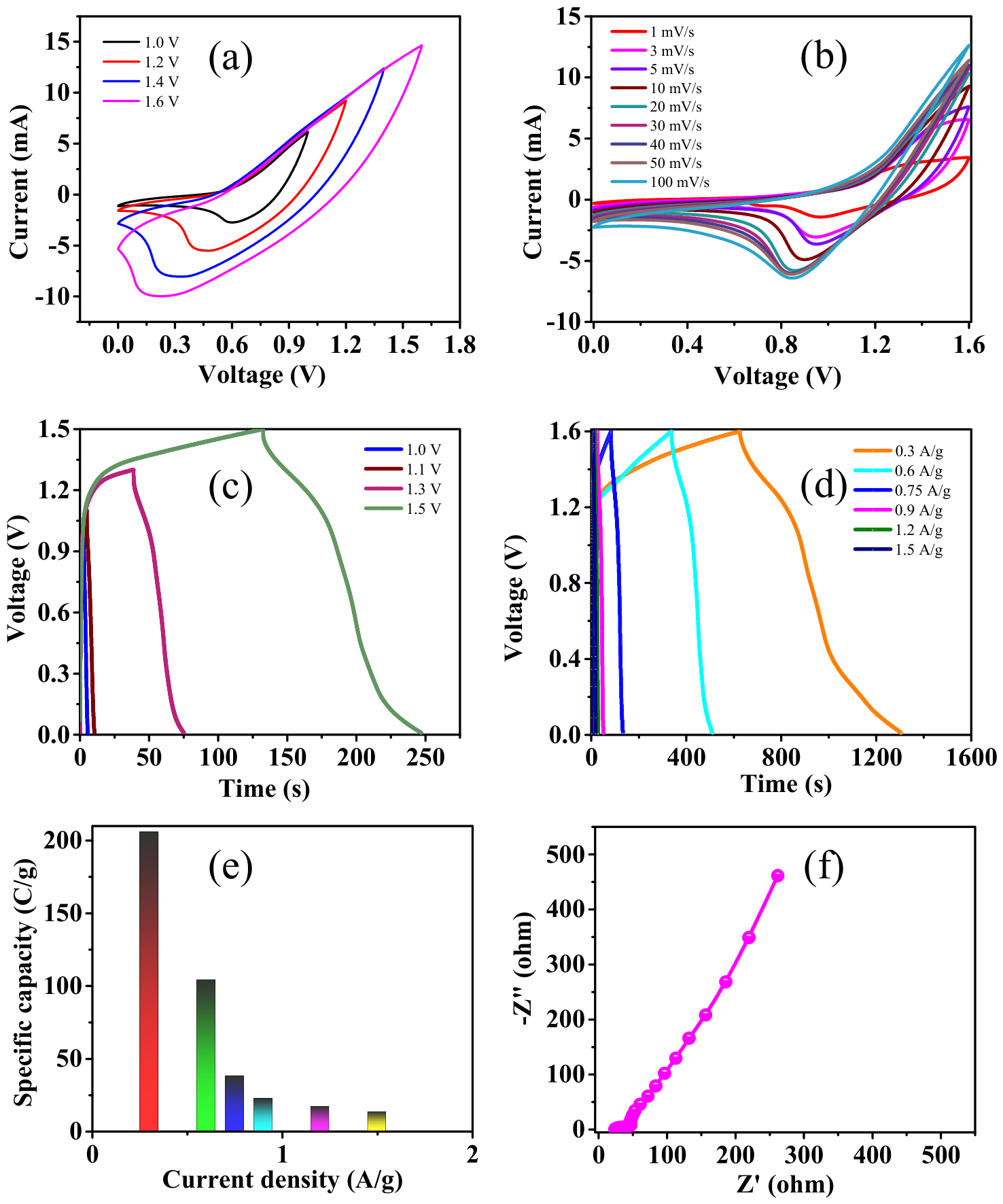
The Cu/Ni-O//AC hybrid supercapacitor cell was constructed using Cu/Ni-O and activated carbon (AC) as positive and negative electrodes, respectively. The amount of active material used was 1.1 mg in case of Cu/Ni-O and 2.2 mg in case of AC, which gives a ratio between positive and negative active materials of 1:2 and an overall active material weight of 3.3 mg. The used mass ratio does not match the theoretical charge-balanced ratio derived based on the properties of both electrodes, implying that there is an excess of charge storage capacity in the positive electrode. By combining a battery-like positive electrode with a capacitive negative electrode based on activated carbon, a wide potential window can be created for better energy storage performance [41,42]. The EP of the fabricated Cu/Ni-O//AC hybrid cell was first studied by cyclic voltammetry (CV) at various voltages and scan rates (Figure 7a,b). It is clear from the CV curves that there are distinct redox behaviors, implying that both the Faradaic reactions and the electric double-layer capacitive charging contribute to the charge storage process. With increasing scan rate, the current value gradually increases without any changes in the curve shapes, showing the high reversibility and good kinetic properties of the electrochemical reaction. Galvanostatic charge–discharge curves for various potentials and current densities have been displayed in Figure 7c,d. All curves reveal nonlinear charge–discharge features with voltage plateaus that prove the battery-type behavior of Cu/Ni-O positive electrode. The time required for charge–discharge becomes shorter with an increase in the current density since less time is available for ion diffusion at higher charging rate. However, the device exhibits a similar profile shape at all the current densities, which demonstrates notable reversibility and structural stability. Specific capacity as a function of current density is depicted in Figure 7e. The estimated capacity values of the Cu/Ni-O//AC device are 205.9, 104.1, 37.8, 22.2, 16.8, and 13.1 C/g at 0.3, 0.6, 0.75, 0.9, 1.2, and 1.5 A/g, respectively. The maximum capacitance value, 112.8 F/g, is achieved by the device at the lowest current density of 0.3 A/g, where electrolyte ions can easily reach all active sites in both electrodes. With an increase in current density, the capacitance reduces since some active sites are inaccessible in fast charge–discharge processes. Such a phenomenon is generally found in hybrid supercapacitors and represents the effect of diffusion limitations at high current densities [43,44]. Figure 7f shows the Nyquist plot of the Cu/Ni-O//AC hybrid supercapacitor. From the high frequency intercept of the real impedance axis, an ohmic resistance (Rs) of about 24.2 Ω is obtained, which means the ohmic resistance is due to the electrolyte, current collectors, and electrode interface. The Nyquist graph shows a dominant inclined linear portion of the graph over the frequency range tested, owing to predominantly capacitive characteristics along with the ability to diffuse ions effectively in the electrode’s structure. The beneficial properties of impedance are accredited to the Cu/Ni-O conductive network from the MOF that facilitates the movement of ions and electrolyte, while maintaining unbroken paths for electrons as well.
Figure 7.
Cu/Ni-O//AC hybrid asymmetric supercapacitor: (a) CV curves at different voltages; (b) CV curves at different scan rates; (c) GCD curves at different voltage windows; (d) GCD curves at different current densities; (e) specific capacity vs. current density; and (f) Nyquist plot.
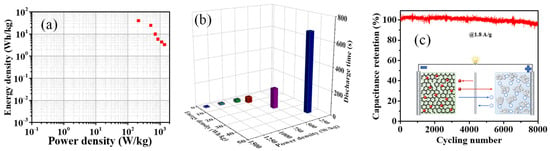
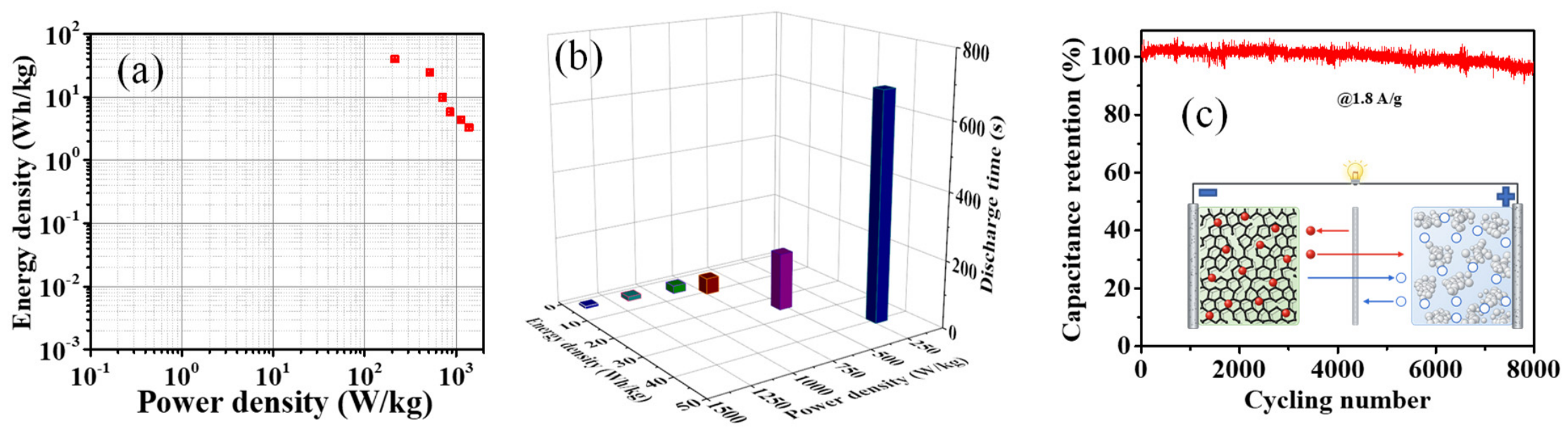
The EP graph of the fabricated Cu/Ni-O//AC cell is given in Figure 8. The Ragone plot (Figure 8a) is used to show the dependence of energy density on power density of the fabricated device. The Cu/Ni-O//AC cell revealed energy densities of 40.1, 24.6, 9.88, 5.85, 4.35, and 3.33 Wh/kg with respect to the power densities of 212.8, 516.1, 714, 862.5, 1132.2, and 1385.44 W/kg, respectively. The energy density of 40.1 Wh/kg was achieved by the Cu/Ni-O//AC hybrid supercapacitor at the power density of 212.8 W/kg. The energy density showed a gradual decrease with increasing power density and maintained 3.33 Wh/kg even at the high-power density of 1385.44 W/kg. A comparison of the Cu/Ni-O//AC hybrid supercapacitor with previously reported copper-based supercapacitors was carried out based on Table S1, indicating the notable EP [45,46,47,48,49,50,51]. MOF-derived material along with the cooperative redox reactions of Cu and Ni make this material a prospective hybrid supercapacitor electrode. It should be noted that the oxide system demonstrates equivalent energy density for low power, because of the contributions from both oxides that improve charge storage capabilities [12,28,33]. The increased efficiency of the electrode material can be credited to its porous nature, which allows electrolytes to penetrate into the electrode material and provides multiple electrochemically active sites for reversible Faradaic reactions. The relation between the power density and discharge time is presented in Figure 8b. It is observed that discharge times decrease with an increase in the value of power density, which is natural for supercapacitor systems subjected to increased current densities. However, the Cu/Ni-O//AC system still demonstrates relatively high discharge times even at increased values of the power density. The increase in the EP of the Cu/Ni-O//AC hybrid supercapacitor can be attributed to the synergy between the battery-like Faradaic reactions of the Cu/Ni-O positive electrode and electric double-layer capacitance of the activated carbon negative electrode. Also, the presence of an interconnected porous structure and uniform distribution of Cu and Ni facilitates fast electron transfer and efficient use of the active material, hence enhancing energy storage performance. The Cu/Ni-O//AC asymmetric device retains 94% of its initial capacitance after 8000 cycles at 1.8 A/g. (Figure 8c). This stability can be attributed to the porous MOF-derived Cu/Ni-O structure, which promotes electrolyte penetration and efficient ion transport while helping preserve the electrode architecture during repeated cycling [52]. Moreover, the reversible Faradaic reactions of the Cu/Ni-O positive electrode, together with the rapid ion adsorption/desorption of the AC negative electrode, contribute to the favorable capacity and cycling durability of the device [53,54]. The charge storage behavior of the hybrid supercapacitor comprising Cu/Ni-O//AC is inserted in Figure 8c. This hybrid supercapacitor is composed of a battery-like Cu/Ni-O positive electrode and an AC negative electrode in PVA/KOH gel electrolyte. The energy storage mechanism is based on combining Faradaic redox reactions occurring at the positive electrode and electrostatic ion adsorption at the carbon electrode to achieve a balance between energy density and fast charge–discharge rates. In the charge cycle, hydroxyl ions (OH−) migrate from the electrolyte to the Cu/Ni-O positive electrode, where they take part in reversible redox reactions of the Cu and Ni active elements. In other words, the Faradaic reactions occur at the Cu/Ni-O positive electrode by means of the variation in the oxidation state of transition metal ions. Simultaneously, potassium ions (K+) move to the negative AC electrode where they are reversibly adsorbed in the form of electrical double layers without participation in any chemical reactions [30,43]. In the case of discharging, the reaction is reversed. In other words, the charge that is stored is released due to the opposite reduction reaction, which leads to the restoration of the electrolyte with OH− ions. In parallel, K+ ions will be desorbed from the surface of the activated carbon and go back to the electrolyte, restoring the electrical double layer.
Figure 8.
(a) Ragone plot, (b) energy density vs. power density vs. discharge time, and (c) working stability and (inset: working mechanism) of Cu/Ni-O//AC device.
4. Conclusions
In the current study, a Cu/Ni-O nanostructure was successfully synthesized via the thermal decomposition of the bimetallic Cu/Ni-MOF precursor and investigated as an electrode material for supercapacitors. The MOF-based synthesis method allowed obtaining a porous interconnected structure consisting of well-dispersed CuO and NiO phases. The above-mentioned structure offers plenty of active sites, improves electrolyte infiltration, and ensures fast ion and electron transportation within the electrode structure. Electrochemical studies revealed that the combined redox activity of Cu and Ni centers contributes to the improvement of the charge storage process. Specifically, the Cu/Ni-O electrode exhibits a specific capacity of 467.1 C/g (129.8 mAh/g) at 0.5 A/g. Furthermore, the electrode shows 88.27% capacity retention after 9000 cycles and coulombic efficiency of around 93.8%. The asymmetrical supercapacitor fabricated with Cu/Ni-O as the positive material and activated carbon as the negative showed specific capacity of 205.9 C/g at 0.3 A/g, alongside with good cycle life and reversibility during the charging–discharging process. It showed an energy density of 40.1 Wh/kg at 212.8 W/kg. The enhanced performance is credited to the presence of the porous MOF-based structure, uniform distribution of elements, and combined effects of CuO and NiO in facilitating reversible Faradaic reactions. These results show that MOF-based Cu/Ni-O nanostructures are potential materials for hybrid supercapacitors and a promising approach for designing high-performance mixed-metal-oxide electrodes in future electrochemical energy storage applications.
Supplementary Materials
The following supporting information can be downloaded at https://www.mdpi.com/article/10.3390/batteries12110464/s1. Table S1: Electrochemical performance of the fabricated supercapacitor device compared with recently reported Cu-based materials. References [45,46,47,48,49,50,51] are cited in the Supplementary Materials.
Author Contributions
N.G.P.: Concept, Writing—Original Draft, Data Curation, J.S.: Supervisor, Reviewing. S.V.P.V.: Data Curation, Conceptualization, Reviewing. All authors have read and agreed to the published version of the manuscript.
Funding
This work is supported by the National Research Foundation of Korea (NRF) grant funded by the Korean government (MSIT) (No. RS-2023-00280665).
Data Availability Statement
The original contributions presented in this study are included in the article and Supplementary Materials. Further inquiries can be directed to the corresponding authors.
Conflicts of Interest
The authors declare that they have no known competing financial interests or personal relationships that could have appeared to influence the work reported in this paper.
References
- Hu, Z.; Li, Y.; Hu, Q.; Chen, R.; Liu, J.; Fan, X. Recent advances in MOF-derived materials for supercapacitors: Modification strategies and electrochemical properties. J. Mater. Chem. A 2026, 14, 1498–1548. [Google Scholar] [CrossRef] [Scilit]
- Dissanayake, K.; Kularatna-Abeywardana, D. A review of supercapacitors: Materials, technology, challenges, and renewable energy applications. J. Energy Storage 2024, 96, 112563. [Google Scholar] [CrossRef] [Scilit]
- Narasipuram, R.P.; Pasha, M.M.; Badugu, S.; Tabassum, S.; Babu, A.R.V.; Kumar, B.N.; Tandon, A.S. Supercapacitors in modern energy systems: A critical review of materials, architectures, digital twins, AI integration, and applications. Energy Eng. 2026, 123, 3. [Google Scholar] [CrossRef] [Scilit]
- Mulik, S.V.; Koyale, P.A.; Soni, S.S.; Maske, S.M.; Dongale, T.D.; Sutar, S.S.; Parale, V.G.; Park, H.H.; Delekar, S.D. Optimized fabrication of supercapacitor using MOF-derived NiCo2O4 with porous carbon as cathode: Electrochemical characterization and stability analysis using time series analysis technique. ACS Appl. Electron. Mater. 2024, 6, 4369–4380. [Google Scholar] [CrossRef] [Scilit]
- Gowdhaman, A.; Kumar, S.A.; Elumalai, D.; Balaji, C.; Sabarinathan, M.; Ramesh, R.; Navaneethan, M. Ni-MOF derived NiO/Ni/r-GO nanocomposite as a novel electrode material for high-performance asymmetric supercapacitor. J. Energy Storage 2023, 61, 106769. [Google Scholar] [CrossRef] [Scilit]
- Zhang, J.; Xie, T.; Zhao, M.; Liu, Y.; Hoa, N.D.; Kasera, A.A.; Zeng, R.; Ma, G.; Luo, Y.; Wu, Y.; et al. Mixed metal-organic framework-derived NiO/V2O3/C heterojunction nanostructures for high-performance hybrid supercapacitors. J. Alloys Compd. 2025, 529, 146334. [Google Scholar] [CrossRef] [Scilit]
- Bhoite, A.A.; Patil, K.V.; Redekar, R.S.; Jang, J.H.; Sawant, V.A.; Tarwal, N.L. Recent advances in metal-organic framework (MOF)-derived metal oxides and their composites with carbon for energy storage applications. J. Energy Storage 2023, 72, 108557. [Google Scholar] [CrossRef] [Scilit]
- Shahzad, A.; Ahmad, F.; Atiq, S.; Saleem, M.; Munir, O.; Khan, M.A.; Arif, S.M.B.; Ain, Q.U.; Sarwar, S.; Asim, M.; et al. Harnessing the potential of MOF-derived metal oxide composites to optimize energy efficiency in batteries and supercapacitors. J. Energy Storage 2024, 87, 111447. [Google Scholar] [CrossRef] [Scilit]
- Chettiannan, B.; Arumugam, G.; Mathan, S.; Selvaraj, M.; Assiri, M.A.; Rajendran, R. Exploring the effect of metal ratio on electrochemical properties of MOF-derived microporous flower-like NiO/Co3O4 electrodes for high-performance asymmetric supercapacitor application. J. Energy Storage 2025, 119, 116326. [Google Scholar] [CrossRef] [Scilit]
- Naveenkumar, P.; Maniyazagan, M.; Kang, N.; Yang, H.-W.; Kim, S.-J. MOF-derived CuCo2S4@FeS2 nanohybrids for supercapacitor applications. J. Power Sources 2025, 513, 145546. [Google Scholar] [CrossRef] [Scilit]
- Liu, Z.; Lv, H.; Gong, Y.; Zhao, Y.; Wei, H.; Ding, G.; Zhang, X.; Chueh, Y.-L.; Gao, C.; Wang, Y. A 3D heterostructural composite comprising MOF-derived Ni(OH)2 and NiAl LDH on rGO for supercapacitors. Chin. J. Chem. 2025, 43, 1869–1884. [Google Scholar] [CrossRef] [Scilit]
- Abdelhamid, H.N. Bimetallic metal-organic framework (MOF)-derived NiO/CuO-embedded carbon for supercapacitor. Appl. Organomet. Chem. 2025, 39, e70193. [Google Scholar] [CrossRef] [Scilit]
- Hussain, I.; Sahoo, S.; Hussain, T.; Ahmad, M.; Javed, M.S.; Lamiel, C.; Gu, S.; Kaewmaraya, T.; Sayed, M.S.; Zhang, K. Theoretical and experimental investigation of in situ grown MOF-derived oriented Zr-Mn-oxide and solution-free CuO as hybrid electrode for supercapacitors. Adv. Funct. Mater. 2023, 33, 2210002. [Google Scholar] [CrossRef] [Scilit]
- Hou, J.; Huang, Z.; Lu, H.; Chen, C.; Wu, X.; Xiao, Y.; Wei, W.; Xue, M.; Ma, Y.; Ma, X.; et al. Integrating bimetallic MOF-derived sulfides with MnO2: Synergistic Cu-Co-S@MnO2 heterojunctions for flexible hybrid supercapacitors. J. Mater. Chem. A 2025, 13, 25042–25053. [Google Scholar] [CrossRef] [Scilit]
- Kumar, A.; Satpathy, B.K.; Goyal, P.; Upadhyay, R.; Kiapi, M.R.A.; Jasuja, K.; Menon, D.; Misra, S.K. Bimetallic MOF-derived CuO-Co3O4 heterostructures as high-capacity electrodes for asymmetric supercapacitors. Chem. Eng. J. 2025, 520, 165685. [Google Scholar] [CrossRef] [Scilit]
- Zan, Y.; Romdhane, F.B.; Miche, A.; Méthivier, C.; Krafft, J.; Jolivalt, C.; Reboul, J. Copper Nanoparticles Supported on ZIF-8: Comparison of Cu(II) Reduction Processes and Application as Benzyl Alcohol Oxidation Catalysts. ACS Appl. Mater. Interfaces 2023, 15, 38716–38728. [Google Scholar] [CrossRef] [Scilit] [PubMed]
- Sun, X.; Wu, S.; Chen, L.; Tong, Q.; Han, L.; Wan, P.; Sun, Y.; Wang, L.; Yang, Q. The construction of high-performance asymmetric supercapacitors by Bi-MOF-derived carbon skeleton with in situ activated Bi2O3/C and B-rGO/amorphous NiCoB. Chem. Eng. J. 2025, 522, 167546. [Google Scholar] [CrossRef] [Scilit]
- Uddin, M.J.; Yeasmin, M.S.; Muzahid, A.A.; Rahman, M.M.; Rana, G.M.M.; Chowdhury, T.A.; Al-Amin, M.; Wakib, M.K.; Begum, S.H. Morphostructural studies of pure and mixed metal oxide nanoparticles of Cu with Ni and Zn. Heliyon 2024, 10, e30544. [Google Scholar] [CrossRef] [Scilit] [PubMed]
- Leishangthem, N.; Singh, N.M. Green-synthesized Tb3+-doped MgO/CuO heterostructures for visible-light photocatalytic remediation through enhanced reactive oxygen species generation. J. Inorg. Organomet. Polym. Mater. 2026. [Google Scholar] [CrossRef]
- Mijajlović, A.; Milikić, J.; Bogdanović, D.B.; Ognjanović, M.; Šljukić, B.; Stanković, D. NiO/TMO (M = Cu, Fe)/MXene ternary composites as efficient bifunctional electrocatalysts for oxygen evolution and reduction reactions. ACS Appl. Eng. Mater. 2026, 4, 4307–4320. [Google Scholar] [CrossRef] [Scilit]
- Yan, Y.; Huang, M.; Wang, Y.; He, D.; He, J. M-Ni-Co MOF (M = Zn, Fe, Mn) for high-performance supercapacitors by adjusting its morphology. Heliyon 2024, 10, e25586. [Google Scholar] [CrossRef] [Scilit] [PubMed]
- Yaseen, S.; Ji, Y.; Li, W.; You, Y.; Xu, G. In situ synthesis of M (Fe, Cu, Co and Ni)-MOF@MXene composites for enhanced specific capacitance and cyclic stability in supercapacitor electrodes. Chem. Eng. J. 2025, 507, 160337. [Google Scholar] [CrossRef] [Scilit]
- Feng, J.; Feng, J.; Luo, S.; Xu, P.; Liang, J.; Qin, S.; Li, J. Understanding the phase structure evolution and charge storage mechanism of FeCoNi-MOFs as electrodes for asymmetric supercapacitors. J. Colloid Interface Sci. 2025, 684, 614–624. [Google Scholar] [CrossRef] [Scilit] [PubMed]
- Kazemi, A.; Torabi, E.; Tamtaji, M.; Manteghi, F.; Rohani, S.; Goddard, W.A., III. High-performance MOF electrode for supercapacitors with enhanced quantum capacitance through optimal multi-metal integration. J. Power Sources 2025, 652, 237616. [Google Scholar] [CrossRef] [Scilit]
- Bhardwaj, A.; Kumar, H.; Sharma, A.K. CuO/NiO-doped ordered mesoporous carbon for high-performance photocatalytic degradation of dye and energy storage application. Inorg. Chem. Commun. 2026, 185, 115997. [Google Scholar] [CrossRef] [Scilit]
- Arulkumar, E.; Thanikaikarasan, S.; Gnanasekaran, L. Harnessing g-C3N4 and rGO synergistic effects for superior photocatalysis in CuO/NiO nanocomposite. J. Mater. Sci. Mater. Electron. 2025, 36, 1682. [Google Scholar] [CrossRef] [Scilit]
- Torres-Ochoa, J.A.; Cabrera-German, D.; Cortazar-Martinez, O.; Bravo-Sanchez, M.; Gomez-Sosa, G.; Herrera-Gomez, A. Peak-fitting of Cu 2p photoemission spectra in Cu0, Cu1+, and Cu2+ oxides: A method for discriminating Cu0 from Cu1+. Appl. Surf. Sci. 2023, 622, 156960. [Google Scholar] [CrossRef] [Scilit]
- Anitha, T.V.; Menon, K.G.; Vimalkumar, T.V. Hierarchically porous nano-sized CuO–NiO hybrid system for supercapacitor applications. Mater. Chem. Phys. 2025, 339, 130767. [Google Scholar] [CrossRef] [Scilit]
- Kannan, K.; Chinnaiah, K.; Gurushankar, K.; Krishnamoorthi, R.; Chen, Y.S.; Kumar, P.S.M.; Li, Y.Y. Investigation of the electrochemical behavior of CuO-NiO-Co3O4 nanocomposites for enhanced supercapacitor applications. Materials 2024, 17, 3976. [Google Scholar] [CrossRef] [Scilit] [PubMed]
- Jeevarathinam, A.; Annamalai, A.; Elumalai, S.; Sangaraju, S.; Hassan, F.M. Defect engineering in supercapacitor electrode materials: Strategies, mechanisms and performance enhancement. J. Energy Storage 2026, 163, 121612. [Google Scholar] [CrossRef] [Scilit]
- Arulkumar, E.; Shree, S.S.; Thanikaikarasan, S. Structure, morphology, composition and optical properties of CuO/NiO nanocomposite for electrochemical energy storage devices. Results Chem. 2023, 6, 101087. [Google Scholar] [CrossRef] [Scilit]
- Hussain, M.N.; Bugday, N.; Hickey, S.G.; Shamraiz, U.; Howard, C.A.; Ji, X.; Yaşar, S. MOF-derived chalcogenides multifunctional heterostructure materials for high-performance supercapacitor and oxygen evolution reaction catalytic activity. J. Mater. Chem. A 2026, 14, 19518–19533. [Google Scholar] [CrossRef] [Scilit]
- Abdelhamid, H.N. Ni/Cu metal-organic frameworks (MOFs)-derived NiO/CuO@C for supercapacitors and oxygen evolution reaction. Surf. Interfaces 2026, 76, 107923. [Google Scholar] [CrossRef] [Scilit]
- Alhakemy, A.Z.; Elsayed, M.H.; Algethami, F.K.; Abdelhamid, H.N. Metal-organic framework (MOF)-derived bimetallic (Ni, Cu) oxide@C electrocatalyst for oxygen evolution reaction. Int. J. Hydrogen Energy 2025, 115, 289–298. [Google Scholar] [CrossRef] [Scilit]
- Wei, Y.M.; Kumar, K.D.; Zhang, L.; Li, J.F. Pseudocapacitive materials for energy storage: Properties, mechanisms, and applications in supercapacitors and batteries. Front. Chem. 2025, 13, 1636683. [Google Scholar] [CrossRef] [Scilit] [PubMed]
- Doroudkhani, Z.S.; Mazloom, J.; Ghaziani, M.M. Optical and electrochemical performance of electrospun NiO-Mn3O4 nanocomposites for energy storage applications. Sci. Rep. 2025, 15, 11436. [Google Scholar] [CrossRef] [Scilit] [PubMed]
- Wang, J.; Polleux, J.; Lim, J.; Dunn, B. Pseudocapacitive contributions to electrochemical energy storage in TiO2 (anatase) nanoparticles. J. Phys. Chem. C 2007, 111, 14925–14931. [Google Scholar] [CrossRef] [Scilit]
- Manikandan, M.; Manikandan, E.; Swetha, V.; Kurpa, S.; Vijay, S. Nickel-copper-cobalt mixed oxide electrode material for high performance asymmetric supercapacitor. Sci. Rep. 2024, 14, 10821. [Google Scholar] [CrossRef] [Scilit] [PubMed]
- Liu, Y.; Jiang, S.P.; Shao, Z. Intercalation pseudocapacitance in electrochemical energy storage: Recent advances in fundamental understanding and materials development. Mater. Today Adv. 2020, 7, 100072. [Google Scholar] [CrossRef] [Scilit]
- Sheng, Z.; Lin, X.; Gao, H.; Huang, L.; Zhang, Y.; Zhao, Y.; Wei, H.; Wang, C.; Xu, D.; Wang, Y. Synthesis of hollow carbon-incorporated NiCoM (M = Mn, Cu, Zn) layered double hydroxide nanocages for hybrid supercapacitors. Int. J. Hydrogen Energy 2022, 47, 29195–29206. [Google Scholar] [CrossRef] [Scilit]
- Leng, X.; Vattikuti, S.V.P.; Zeng, J.; Li, Y.; Tamtam, M.R.; Dang, N.N. Bimetallic Ni-Mo-MOFs as multifunctional electrodes for high-performance supercapacitors and oxygen evolution reaction. Int. J. Hydrogen Energy 2025, 218, 153954. [Google Scholar] [CrossRef] [Scilit]
- Salunkhe, A.D.; Pawar, P.S.; Pagare, P.K.; Kadam, A.N.; Katkar, P.K.; Torane, A.P. MOF-derived NiCo2O4 nanosheets for high-performance asymmetric supercapacitor. J. Electroanal. Chem. 2023, 939, 117475. [Google Scholar]
- Simon, P.; Gogotsi, Y. Perspectives for electrochemical capacitors and related devices. Nat. Mater. 2020, 19, 1151–1163. [Google Scholar] [CrossRef] [Scilit] [PubMed]
- Chodankar, N.R.; Pham, H.D.; Nanjundan, A.K.; Fernando, J.F.S.; Jayaramulu, K.; Golberg, D.; Han, Y.K.; Dubal, D.P. True meaning of pseudocapacitors and their performance metrics: Asymmetric versus hybrid supercapacitors. Small 2020, 16, 2002806. [Google Scholar] [CrossRef] [Scilit] [PubMed]
- Adnan, S.M.; Shoeb, M.; Ansari, M.Z.; Mashkoor, F.; Mobin, M.; Zaidi, S.; Jeong, C. Fabrication of NiO–CuO decorated polyaniline (PANI/NiO–CuO) nanocomposite based symmetric supercapacitor device for high-energy density performance with wide potential window in aqueous electrolyte. Inorg. Chem. Commun. 2023, 157, 111265. [Google Scholar] [CrossRef] [Scilit]
- Pholauyphon, W.; Jorn-am, T.; Supchocksoonthorn, P.; Phetcharee, K.; Sirisit, N.; Manyam, J.; Chanthad, C.; Sangtaweesin, T.; Paoprasert, P. High-specific capacitance, binder-free composite electrodes prepared from carbon dots embedded in copper oxide-nickel oxide nanowires grown on nickel foam for asymmetric supercapacitors. J. Electroanal. Chem. 2024, 976, 118792. [Google Scholar] [CrossRef] [Scilit]
- Manibalan, G.; Govindaraj, Y.; Rajaram, R.; Dugani, R.M.; Ramalingam, G.; Murugadoss, G.; Neelakantan, L.; Murugavel, R. Carbon-Embedded Ru/NiO-CuO Cathode and rGO/α-Co3O4 Anode for Synergetic Charge Transfer for High-Performance Solid-State Asymmetric Supercapacitors. Energy Fuels 2024, 38, 15744–15761. [Google Scholar] [CrossRef] [Scilit]
- Mashkoor, F.; Shoeb, M.; Khan, J.A.; Gondal, M.A.; Jeong, C. Chemical reduction-induced defect-rich and synergistic effects of reduced graphene oxide based Cu-doped NiO nanocomposite (RGO@Cu-NiO NCs) decorated on woven carbon fiber for supercapacitor device and their charge storage mechanism. J. Energy Storage 2024, 104, 114578. [Google Scholar] [CrossRef] [Scilit]
- Supchocksoonthorn, P.; Pholauyphon, W.; Jorn-am, T.; Phetcharee, K.; Sangtawesin, T.; Meesiri, W.; Paoprasert, P. Binder-free CuO-NiO/polyaniline@Ni-foam-based dual-purpose composite electrodes for the production of oxygen evolution reaction catalysts and asymmetric supercapacitors. Chem. Eng. Sci. 2025, 316, 122023. [Google Scholar] [CrossRef] [Scilit]
- Merum, D.; Kang, M. Synergistic CuO-NiO nanohybrids via hydrothermal synthesis for high-performance supercapacitors. Mater. Today Commun. 2025, 49, 114027. [Google Scholar] [CrossRef] [Scilit]
- Somay, M.H.; Peksöz, A. Interface-engineered CuO–NiO@rGO/PANI hybrid electrodes for high-energy asymmetric supercapacitors and enhanced HER activity. Surf. Interfaces 2026, 88, 109106. [Google Scholar] [CrossRef] [Scilit]
- Lu, X.F.; Fang, Y.; Luan, D.; Lou, X.W.D. Metal-organic frameworks derived functional materials for electrochemical energy storage and conversion: A mini review. Nano Lett. 2021, 21, 1555–1565. [Google Scholar] [CrossRef] [Scilit] [PubMed]
- Mustaqeem, M.; Naikoo, G.A.; Rahimi, F.; Pedram, M.Z.; Pourfarzad, H.; Hassan, I.U.; Arshad, F.; Chen, Y.F. Rational design of Cu-based composite electrode materials for high-performance supercapacitors: A review. J. Energy Storage 2022, 51, 104330. [Google Scholar] [CrossRef] [Scilit]
- Abdelaal, M.M.; Hung, T.-C.; Mohamed, S.G.; Yang, C.-C.; Huang, H.-P.; Hung, T.-F. A Comparative Study of the Influence of Nitrogen Content and Structural Characteristics of NiS/Nitrogen-Doped Carbon Nanocomposites on Capacitive Performances in Alkaline Medium. Nanomaterials 2021, 11, 1867. [Google Scholar] [CrossRef] [Scilit] [PubMed]
Disclaimer/Publisher’s Note: The statements, opinions and data contained in all publications are solely those of the individual author(s) and contributor(s) and not of MDPI and/or the editor(s). MDPI and/or the editor(s) disclaim responsibility for any injury to people or property resulting from any ideas, methods, instructions or products referred to in the content. |
© 2026 by the authors. Licensee MDPI, Basel, Switzerland. This article is an open access article distributed under the terms and conditions of the Creative Commons Attribution (CC BY) license.