


Abstract
Water affects the local structure, dynamics, and adsorption properties of metal–organic frameworks (MOFs), yet the molecular-level characterization of confined water remains difficult due to the lack of long-range ordering. Here, we study the water adsorption in microporous MOF Al(HCOO)3 using multinuclear solid-state NMR spectroscopy combined with ab initio molecular dynamics (AIMD) simulations. 1H NMR resolves two distinct confined-water environments and reveals water–framework and water–water contacts. 13C and 27Al NMR further show that water adsorption perturbs the local environments of the formate linkers and AlO6 coordination units. Powder X-ray diffraction shows that the long-range crystalline framework is preserved after water loading, whereas 13C NMR detects a minor mobile formate-containing species that disappears upon re-dehydration, consistent with the partial local hydrolysis of the framework. 2H NMR distinguishes both highly mobile and confined water undergoing rapid anisotropic reorientation. The effective quadrupolar line shape is consistent with rapid anisotropic reorientation, for which C2-axis flips provide one possible motional model. 1H–2H CP-HETCOR NMR further suggests dipolar contacts between restricted water molecules, the formate framework, and neighboring water molecules. AIMD simulations support water–framework interactions associated with the two pore environments and the formation of an interconnected water network. These results provide molecular-level insights into the water adsorption sites and dynamics in Al(HCOO)3 and the previously unreported partial hydrolysis of this MOF.
1. Introduction
Metal–organic frameworks (MOFs) are a class of hybrid porous materials constructed from metal ions or clusters interconnected by organic linkers [1,2]. Their tunable structures, together with large surface areas and accessible pore spaces, offer opportunities for tailoring host–guest interactions at the molecular level [2,3]. These unique structural characteristics have made MOFs promising materials for a broad range of applications, including gas adsorption and separation [3], catalysis [4], and energy storage [5].
Humidity is an important factor affecting the performance of MOFs under practical conditions [6]. As water is ubiquitous in ambient environments, its adsorption can significantly influence both the structural integrity and adsorption behavior of MOFs [7,8]. For example, water molecules may modify the local environment within the pores, thereby affecting the uptake and separation performance of other guest species [9]. Understanding the adsorption behavior of water in MOFs is therefore essential for evaluating their performance under humid conditions and for establishing the molecular origins of water-induced changes in adsorption properties.
Powder X-ray diffraction (PXRD) is widely used to identify crystalline phases and assess the structural integrity of MOFs upon guest adsorption. However, retention of the characteristic framework reflections does not exclude local coordination changes, low-concentration defects, or disordered species that may be difficult to detect by conventional PXRD. Solid-state nuclear magnetic resonance (NMR) complements PXRD by probing local chemical environments and molecular dynamics without requiring long-range order.
Solid-state NMR spectroscopy is a powerful tool for characterizing porous materials, including MOFs [10,11,12,13,14,15,16,17], as it can provide site-specific and atomic-level information that is often inaccessible to other techniques. Solid-state NMR has been widely used to probe MOFs, including metal centers, organic linkers, guest molecules, and host–guest interactions [18,19,20,21,22,23,24,25,]. As an isotope-specific technique, solid-state NMR is particularly well suited for studying adsorption of water in MOFs, owing to its sensitivity to hydrogen-bonding environments, water dynamics, and water–framework interactions [26,27,28,29].
Herein, we report a solid-state NMR investigation of water adsorption in a microporous metal–organic framework Al(HCOO)3 [30]. This material has previously been explored for applications in non-cryogenic air separation [31] and CO2 capture [32], where its behavior under humid conditions is of practical importance. Multi-nuclear solid-state NMR spectroscopy (1H, 2H and 13C and 27Al) has been employed to probe the water-loaded Al(HCOO)3. Detailed analysis is presented to characterize the hydrogen-bonding network, and interactions between confined water molecules and the host framework, providing a molecular-level picture of water adsorption in Al(HCOO)3.
2. Materials and Methods
2.1. Sample Synthesis
All the starting reagents were obtained from Sigma-Aldrich (St. Louis, MO, USA) and used without further purification. The Al(HCOO)3 was synthesized following the previously reported refluxing procedure [32]. The powder was then heated at 150 °C (423 K) for 24 h under dynamic vacuum (<1 mbar) to obtain the dehydrated Al(HCOO)3. To prepare D2O-loaded Al(HCOO)3, the dehydrated sample was placed in a small beaker and exposed to saturated D2O vapor in a sealed larger beaker for 12 h.
2.2. Powder X-Ray Diffraction
The powder X-ray diffraction pattern was recorded using a Rigaku SmartLab X-ray diffractometer (Rigaku Corporation, Tokyo, Japan) operating with Cu Kα radiation (λ = 1.5406 Å). The reflections were collected at 2θ values ranging between 5 and 45°, with an increment of 0.01° and an acquisition rate of 4°/min. The PXRD pattern is shown in Figure S1.
2.3. Solid-State NMR Spectroscopy
All solid-state NMR experiments were performed with a Bruker Avance III HD 600 MHz wide-bore NMR spectrometer (Bruker BioSpin, Rheinstetten, Germany, 14.1 T, v0(27Al) = 156.4 MHz, v0(1H) = 600.2 MHz, v0(13C) = 150.9 MHz, v0(2H) = 92.1 MHz). All experiments were performed using a 1.9 mm Bruker HXY MAS probe.
The single-pulse 1H NMR spectra were collected at a spinning rate of 35 kHz, with a 90° pulse width of 2.75 μs. The 1H-1H single-quantum single-quantum (SQ-SQ, or NOESY-type) 2D NMR spectra was acquired with 256 rotor-synchronized t1 increments using States scheme, and 2 s of recycle delay. A mixing time of 5 ms is used and the scan number of each F1 increment is 16. The radiofrequency-driven dipolar recoupling (RFDR) experiment employed a train of 180° pulses to recouple 1H–1H dipolar interactions during the mixing period [33]. The 1H-1H double-quantum single-quantum (DQ-SQ) 2D NMR was collected using back-to-back (BABA) [34] pulse sequence with 1 rotor period recoupling, 256 rotor-synchronized t1 increments and 2 s of recycle delay. The three-pulse z-filter sequence [35,36] was used for 27Al triple-quantum magic angle spinning (3QMAS) with 80 rotor-synchronized t1 increments and 0.25 s of recycle delay.
The 1H–13C CP-HETCOR NMR spectrum was acquired at a MAS frequency of 35 kHz using a contact time of 1 ms, 64 rotor-synchronized increments, and a recycle delay of 2 s. SPINAL-64 [37] proton decoupling was applied during acquisition. The 1H–27Al CP-HETCOR NMR spectrum was acquired under similar conditions, except that 128 rotor-synchronized increments were used. The 1H–2H CP-HETCOR spectrum was acquired at a MAS frequency of 20 kHz using a contact time of 1 ms, 128 rotor-synchronized increments, and a recycle delay of 2 s, with SPINAL-64 [37] proton decoupling applied during acquisition.
The 2H NMR lineshape is simulated with ssnake software Version 1.5 [38].
2.4. Thermogravimetric Analysis
Thermogravimetric analysis (TGA) is performed on a Netzsch STA 499 F3 Jupiter (NETZSCH-Gerätebau GmbH, Selb, Germany). Samples were heated at a rate of 10 °C min−1 from room temperature to 800 °C under flowing nitrogen.
2.5. Ab Initio Molecular Dynamics
Ab initio molecular dynamics (AIMD) simulations were performed using the CP2K software package Version 2025.2 [39]. The initial configuration was generated by placing 16 water molecules in the unit cell [32], followed by DFT geometry optimization. The optimized structure was then used as the starting configuration for the AIMD simulations, which consisted of a 15 ps equilibration period followed by a 30 ps production run. The simulations were conducted in the NVT ensemble with a CSVR thermostat [40], using a time step of 0.5 fs. The trajectories were saved at every step. The Perdew–Burke–Ernzerhof (PBE) exchange–correlation functional [41] was used with Grimme’s D3 dispersion correction [42]. All calculations used DZVP basis sets and Goedecker–Teter–Hutter (GTH) pseudopotentials with a plane-wave cutoff of 300 Ry [43].
3. Results and Discussion
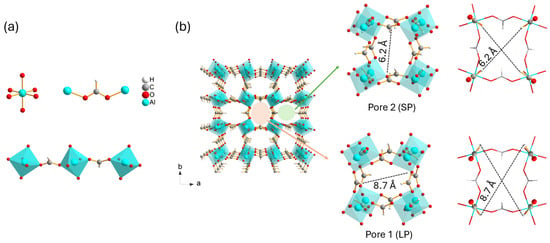
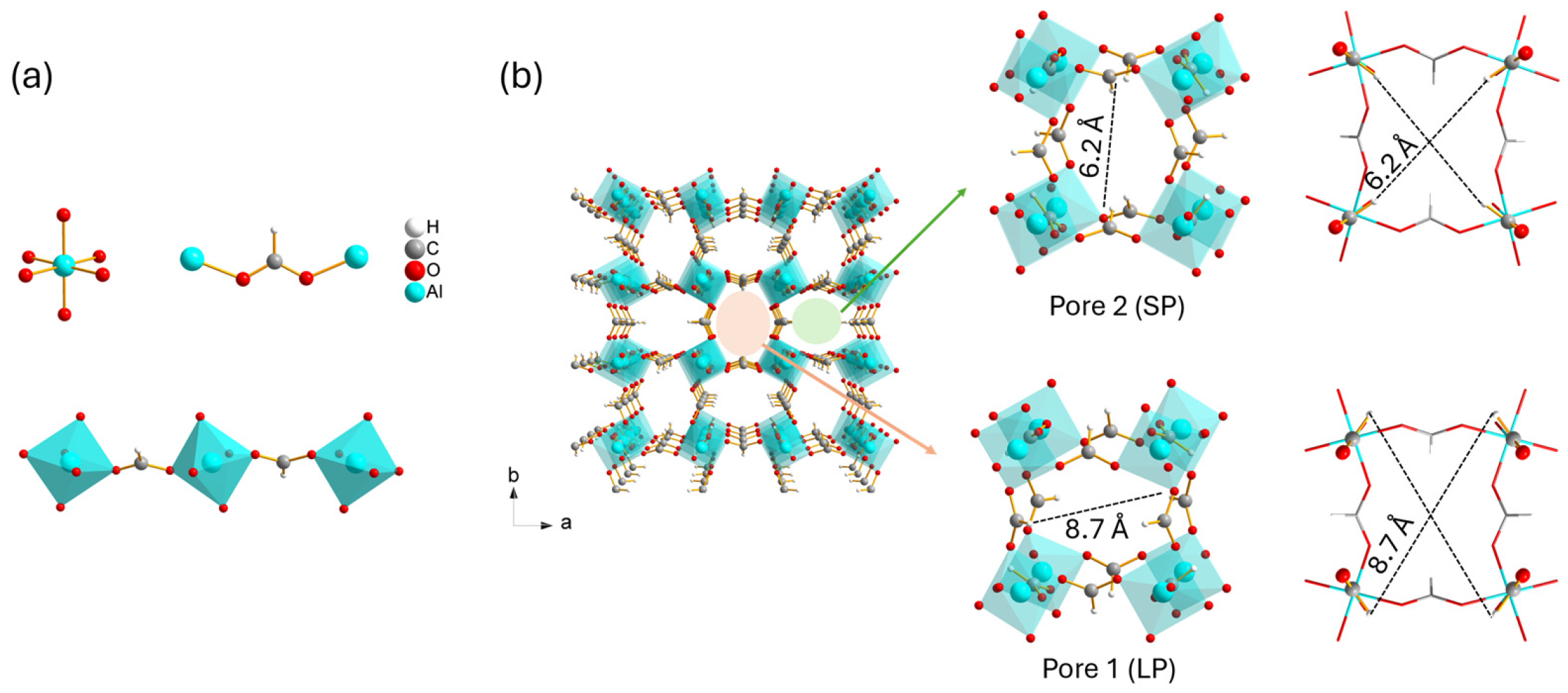
The crystal structure of Al(HCOO)3 is constructed from octahedrally coordinated Al3+ centers and formate (HCOO−) linkers (Figure 1a). Each Al3+ ion is coordinated by six oxygen atoms from six different formate groups, while each formate ligand bridges two neighboring Al centers, giving rise to an extended three-dimensional ReO3-type framework [30]. The framework contains two types of pores that arise from different orientations of the formate linkers (Figure 1b). In the smaller pore, four of the twelve formate C–H groups are directed toward the pore interior, whereas in the larger pore all the formate hydrogens are oriented away from the cavity center. Such differences in pore geometry and the orientation of the formate groups are expected to influence the location, hydrogen-bonding environment, and assembly of guest molecules within Al(HCOO)3.
Figure 1.
Schematic illustration of Al(HCOO)3. (a) Local environments around Al3+ centers and formate (HCOO−) ligands; (b) the 3D topology of Al(HCOO)3 and two types of pores in the framework.
Two of the nuclei examined here, 2H (I = 1) and 27Al (I = 5/2), possess an electric quadrupole moment that interacts with the local electric field gradient (EFG). This quadrupolar interaction depends on the orientation of the EFG relative to the applied magnetic field. Consequently, a single crystallographic site can produce a broad, structured powder pattern rather than a narrow resonance; spectral breadth alone therefore does not establish the presence of multiple chemical environments [44,45].
The 2H NMR spectra are dominated by the first-order quadrupolar interaction. Under magic-angle spinning (MAS), this anisotropic interaction can produce a manifold of spinning sidebands separated by the spinning frequency. The sideband intensity distribution contains information about the quadrupolar coupling constant, CQ, and the EFG asymmetry parameter, ηQ. Rapid molecular reorientation averages the quadrupolar interaction: sufficiently rapid isotropic motion strongly suppresses the anisotropy, whereas anisotropic motion can retain a residual quadrupolar interaction. The resulting line shapes therefore provide information about the geometry and regime of water motion.
For 27Al, the central transition (mI = −1/2 ↔ +1/2) is unaffected by the quadrupolar interaction to first order but can exhibit second-order quadrupolar broadening and shifts. Conventional MAS does not completely remove these second-order effects. Accordingly, the observed 27Al resonance position may reflect both chemical shielding and quadrupolar contributions [44,45]. These principles provide the basis for interpreting the water dynamics and framework perturbations discussed below.
3.1. 1H Solid-State NMR
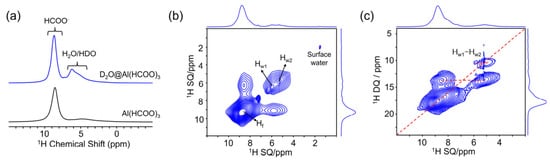
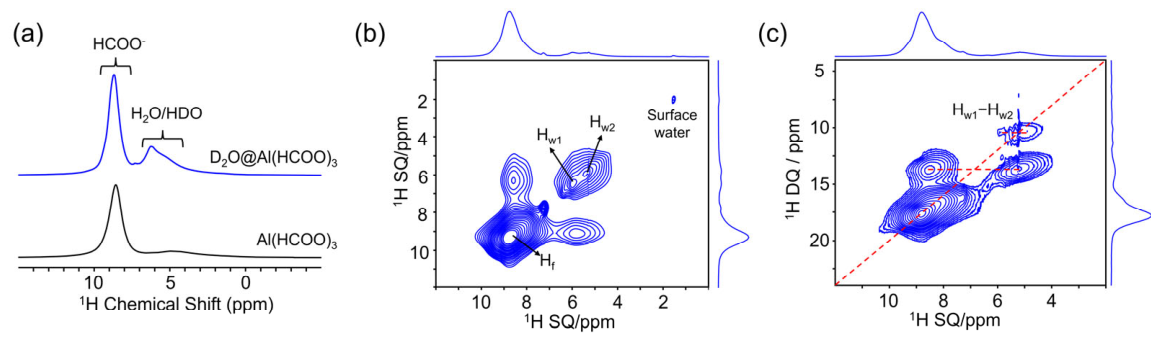
As shown in Figure 2a, the 1H MAS NMR spectrum of dehydrated Al(HCOO)3 exhibits a dominant resonance at ca. 8.5 ppm, which is assigned to the formate linker protons (Hf). Although 99.9 atom % D2O was used for water loading, the residual proton content, in the form of HDO together with trace H2O, was sufficient for the adsorbed water populations to be detected by 1H NMR. For the D2O loaded Al(HCOO)3, the Hf resonance shifts slightly to ca. 8.7 ppm, indicating that the local environment of the formate linkers is perturbed by the adsorbed water. This change indicates water–framework interactions, potentially involving weak -CH···Owater hydrogen bonding [46].
Figure 2.
Solid-state NMR spectra of water-loaded Al(HCOO)3. (a) 1H MAS NMR spectra; (b) two-dimensional 1H–1H single-quantum–single-quantum (SQ–SQ) NMR spectrum with a mixing time of 5 ms; (c) 1H–1H double-quantum–single-quantum (DQ–SQ) correlation spectrum using BABA-1.
After D2O loading, two additional broad 1H resonances centered at ca. 6.0 and 5.3 ppm are observed (Figure 2a) and are denoted Hw1 and Hw2, respectively. These resonances are assigned to two distinct environments of confined water. The more downfield chemical shift of Hw1 indicates a more strongly hydrogen-bonded environment. The deshielding may arise from water–framework interactions, including HCOO···H2O/HDO hydrogen bonding, together with possible water–water hydrogen bonding. Considering the two structurally distinct pores in Al(HCOO)3 (Figure 1b), Hw1 is tentatively assigned to water mainly confined within the smaller pores, where the inward-facing formate groups and stronger confinement could lead to stronger hydrogen-bonding interactions. The Hw2 resonance lies closer to the chemical shift of bulk water, indicating a comparatively weakly hydrogen-bonded and more bulk-water-like environment. Hw2 is therefore tentatively assigned to water located farther from the framework surface and mainly accommodated within the larger pores.
To further examine these assignments, 1H MAS NMR spectra were acquired at different relative humidities (Figure S2 and Table S1). At 11% RH, 1H NMR signal of Hw1 is observed, whereas no separate Hw2 signal is resolved. Both components are detected at 75% and 94% RH, with Hw1/Hw2 relative integrated intensities of approximately 44%/56% and 43%/57%, respectively. The appearance of Hw1 at lower RH suggests preferential occupation of a higher-affinity adsorption environment, possibly associated with the smaller pores, whereas Hw2 may correspond to water in the larger pores.
Complementary 1H NMR relaxation measurements show comparable T1 values of 137.4 and 153.3 ms for signals of Hw1 and Hw2, respectively (Figure S3). Biexponential fits of the transverse decays (Figure S4) yield comparable fast-decay time constants (0.51 and 0.45 ms), but a shorter slow-decay time constant for Hw1 (2.81 ms) than for Hw2 (6.73 ms). This difference possibly reflects more restricted motion and/or less effective motional averaging of local interactions for Hw1. These results provide independent explanations for the interpretation.
To further probe the interactions between the confined water and the framework, two-dimensional 1H–1H SQ–SQ and DQ–SQ correlation experiments were performed (Figure 2b,c). The SQ–SQ spectrum shows cross-peaks between Hf and both Hw1 and Hw2, demonstrating magnetization transfer between the framework and the two water environments. These correlations may arise from dipolar-driven proton spin diffusion and/or motion-induced dipolar cross-relaxation (NOE). Because Hw1 and Hw2 partially overlap and may undergo chemical exchange, their individual correlations with Hf are not fully resolved in the SQ–SQ NMR spectrum.
In addition, a relatively sharp resonance at ca. 7.3 ppm (Figure 2b) is tentatively assigned to a distinct formate environment associated with a minor partially collapsed fraction of the framework. Fitting of the one-dimensional 1H MAS spectrum gives a relative integrated intensity of approximately 0.060% of the total proton signal, corresponding to approximately 0.096% of the combined main and minor formate peak areas (Figure S2). Its small spectral contribution suggests that it is not likely to dominate the observed water–framework correlations. And these signal fractions do not directly quantify structural damage. These formate species experience a local environment different from that of the linkers in the crystalline Al(HCOO)3, as further supported by the 13C NMR results discussed below. Finally, the minor resonance at ca. 1.5 ppm is tentatively assigned to hydroxyl protons associated with Al–OH species formed upon partial hydrolysis of Al(HCOO)3 [47,48].
The DQ–SQ NMR spectrum likewise shows correlations between Hf and the Hw1/Hw2 region. Because DQ coherence is generated through recoupled 1H–1H dipolar interactions, these correlations provide evidence for residual dipolar contacts between the confined water molecules and the formate linkers (Figure 2c). A weak Hw1–Hw2 DQ correlation is also observed, consistent with dipolar-mediated magnetization transfer between the two water environments. Complementary 1H–1H RFDR and NOESY spectra were acquired with the same mixing time of ca. 1.83 ms (Figure S5). The Hw1 slice of the RFDR spectrum also shows a signal in the Hw2 region. These observations are consistent with water–water association, and/or indirect transfer involving framework protons. Because the transfer efficiencies depend on dipolar couplings and molecular motion, these correlations alone do not establish direct pairwise contacts or a continuous hydrogen-bonded water network.
3.2. 27Al and 13C Solid-State NMR
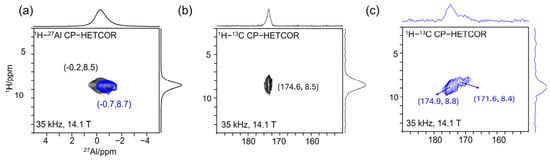
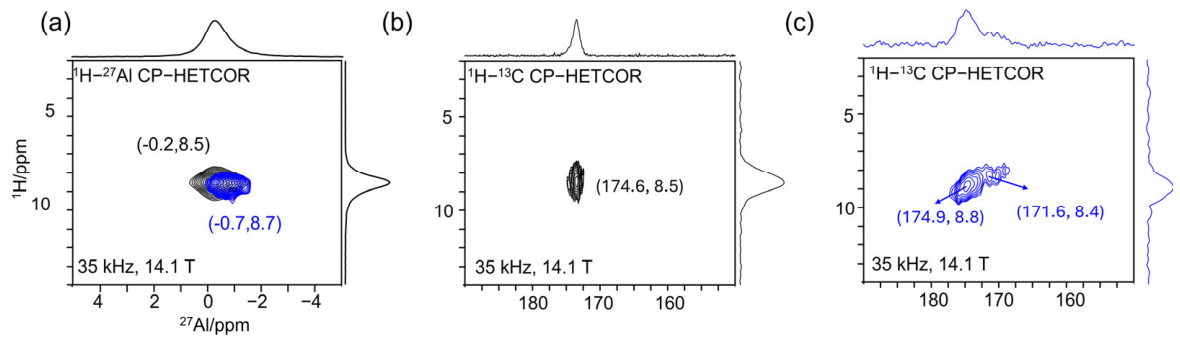
We next examined the perturbation of the Al(HCOO)3 framework induced by water adsorption. The 1H–27Al HETCOR spectrum of dehydrated Al(HCOO)3 shows a single correlation at approximately (−0.2 ppm, 8.5 ppm) (Figure 3a, black lines). This correlation arises from the dipolar proximity between the formate protons and the octahedrally coordinated Al centers, for which the shortest Hf···Al distance is approximately 3 Å in the crystal structure [32]. Following D2O loading, the correlation shifts to (−0.7 ppm, 8.7 ppm). The change in the 1H dimension is consistent with the 1H MAS spectrum and reflects perturbation of the formate proton environment by hydrogen bonding with the adsorbed water. The retention of a single 27Al environment indicates that the octahedral Al geometry is largely preserved upon water loading. The small displacement in the 27Al dimension may reflect changes in chemical shielding and/or second-order quadrupolar contributions. This observation suggests that water adsorption perturbs the electronic environment and/or local geometry of the AlO6 coordination units through interactions with the bridging formate linkers.
Figure 3.
(a) 1H–27Al cross polarization (CP) heteronuclear correlation (HETCOR) spectrum of Al(HCOO)3 (black), and D2O-loaded Al(HCOO)3 (blue); 1H–13C HETCOR spectrum of (b) Al(HCOO)3 and (c) D2O-loaded Al(HCOO)3. All the spectra were acquired at 14.1 T with a spinning rate of 35 kHz.
The influence of water adsorption on the formate linkers was further examined using 1H–13C HETCOR spectroscopy (Figure 3b). Dehydrated Al(HCOO)3 exhibits a single dominant correlation at (174.6 ppm, 8.5 ppm), arising from the intramolecular 1H–13C dipolar coupling within the formate linkers. This single correlation indicates that the formate groups experience a largely uniform local coordination environment in the dehydrated framework.
After D2O loading, two correlations appear at (174.9 ppm, 8.8 ppm) and (171.6 ppm, 8.4 ppm). The splitting into two correlations indicates that water adsorption breaks the equivalence of the formate linkers and generates two distinct local framework environments. Because the 13C chemical shift of the carboxylate group is sensitive to its coordination environment, these changes may arise from water-induced variations in the Al–Oformate bond lengths and Al–O–C geometries. In particular, interactions between the adsorbed water and the formate groups may produce nonuniform local distortions of the framework, causing some formate carbons to shift slightly downfield to 174.9 ppm and others to shift upfield to 171.6 ppm. The corresponding differences in the 1H chemical shifts further indicate that these two formate populations experience different water–framework interactions.
Additional 27Al 3QMAS measurements reveal broadening along the isotropic dimension after water loading, although the line shapes along the MAS dimension remain broadly similar (Figure S6). This broadening possibly reflects a wider distribution of chemical shielding and/or isotropic quadrupolar shifts associated with subtle variations in the local Al environments. Because each Al center is coordinated by six formate linkers, distinct linker environments can coexist with spectroscopically similar Al coordination environments.
3.3. Implications for the Stability of Al(HCOO)3
The structural stability of Al(HCOO)3 upon water adsorption was first examined by powder X-ray diffraction. The PXRD pattern of D2O-loaded Al(HCOO)3 retains the characteristic reflections of the dehydrated framework, with no additional crystalline phases or pronounced loss of diffraction intensity (Figure S1). These results indicate that the long-range crystalline structure of Al(HCOO)3 is preserved after D2O exposure. Nevertheless, PXRD may not be sufficiently sensitive to detect a small fraction of local defects or amorphous degradation products.
Further evidence for such local changes was obtained from the single-pulse 13C MAS NMR spectra (Figure S2). After D2O loading, an additional sharp resonance appears at ca. 163.6 ppm, which is tentatively assigned to formic acid adsorbed within the pores, likely originating from the partial decomposition of Al(HCOO)3. For comparison, a physical mixture of Al(HCOO)3 and authentic formic acid was examined (Figure S7). Besides the free-formic-acid resonance, the mixture exhibits a component near 163.6 ppm, possibly associated with formic acid interacting with the framework. This agreement supports assigning the additional signal in the water-loaded sample to a formic-acid-related species, consistent with limited framework hydrolysis. Its sharp line shape and absence from the CP spectrum are compatible with enhanced mobility, although rotating-frame relaxation and unfavorable CP dynamics may also contribute to the weak CP response. Notably, the 163.6 ppm resonance disappears after the water-loaded sample is re-dehydrated under vacuum, whereas the principal framework-formate resonance remains. This behavior indicates that the mobile species is not a persistent framework environment and can be removed during thermal reactivation.
3.4. 2H Solid-State NMR
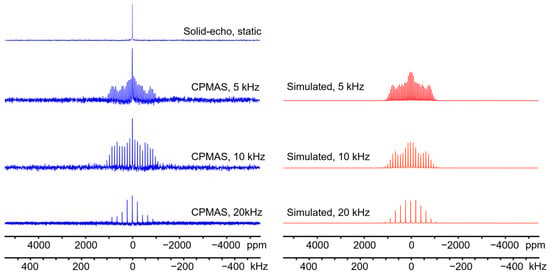
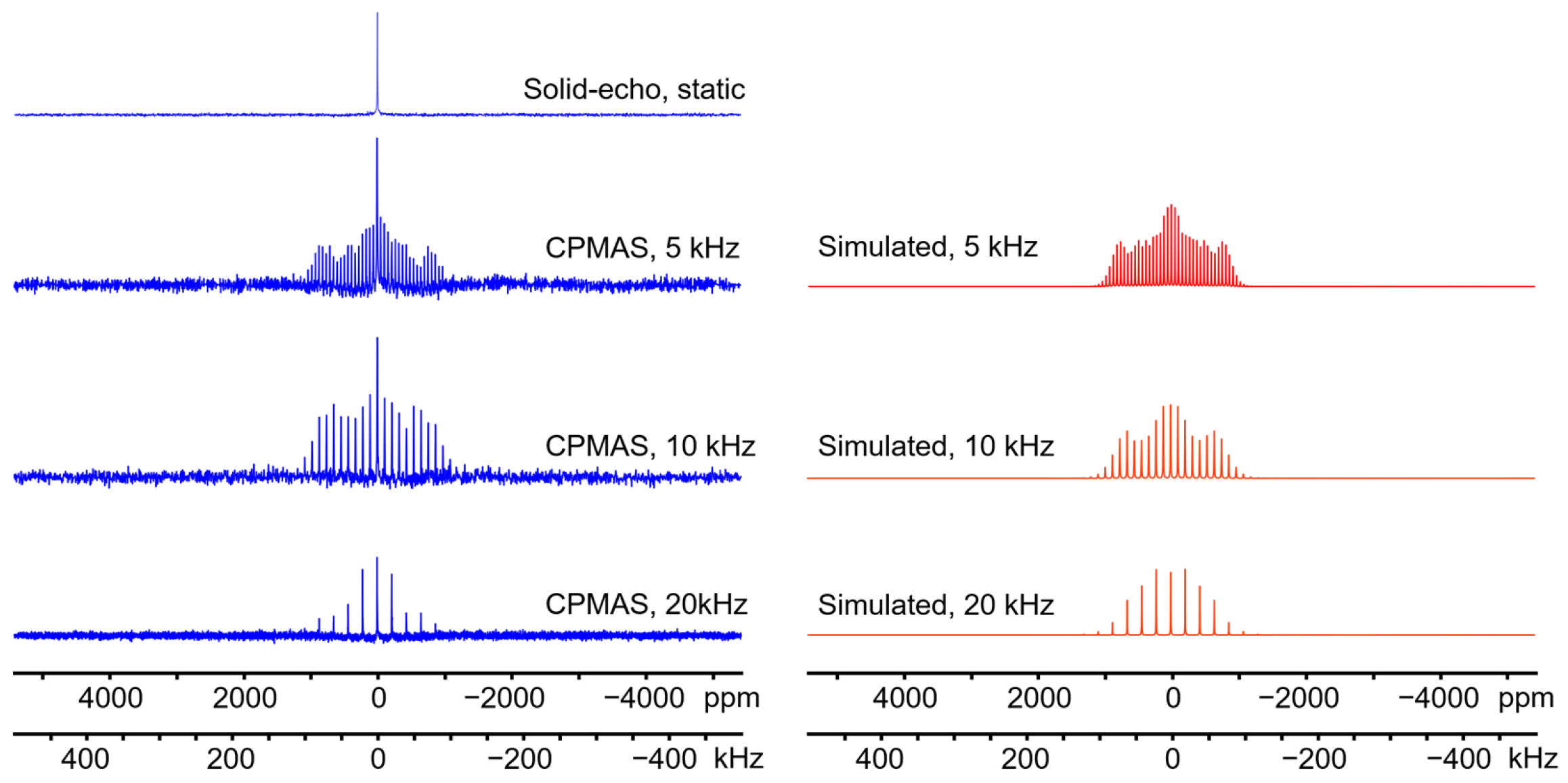
2H solid-state NMR spectroscopy has been widely employed to investigate a broad range of systems, including inorganic salts [49,50], microporous materials [51,52,53,54,55,56], and biological materials [57,58]. The environments and dynamics of the adsorbed water were further investigated using 2H solid-state NMR. The stationary 2H solid-echo spectrum is dominated by a single sharp resonance (Figure 4a), indicating that most of the directly observed D2O molecules undergo rapid motion that strongly averages the 2H quadrupolar interaction. This mobile population may include water located at the external surface of the MOF and/or mobile water within the pores.
Figure 4.
Experimental and simulated 2H solid-state NMR spectra of D2O-loaded Al(HCOO)3. The experimental spectra are shown on the left in blue and the corresponding simulated spectra are shown on the right in red. The spinning-sideband manifolds were reproduced using an effective quadrupolar coupling constant of CQ = 120 kHz and an asymmetry parameter of ηQ = 1.0.
To selectively probe the more restricted water population, 1H–2H CP/MAS spectra were acquired at MAS frequencies of 5, 10, and 20 kHz (Figure 4). Cross-polarization relies on residual 1H–2H dipolar couplings and therefore preferentially detects D2O molecules that are spatially close to proton-containing species and whose motion does not completely average the dipolar interaction. In addition to a sharp resonance from the more mobile D2O population, the CP/MAS spectra exhibit a series of spinning sidebands characteristic of the quadrupolar interaction of spin-1 nuclei.
Simultaneous fitting of the spinning-sideband manifolds acquired at MAS frequencies of 5, 10, and 20 kHz yields an effective quadrupolar coupling constant of CQ = 120 kHz and an asymmetry parameter of ηQ = 1.0. These parameters differ substantially from those of rigid D2O, which typically exhibits CQ = 210 kHz and a nearly axially symmetric quadrupolar tensor with ηQ = 0.0 [50,59]. Rapid anisotropic reorientation averages the 2H electric-field-gradient tensor, producing a reduced effective quadrupolar coupling and a motion-dependent asymmetry parameter. Previous 2H NMR studies of crystalline hydrates have shown that rapid 180° flips of water molecules about their molecular C2 axes reduce CQ to approximately 120–130 kHz and produce a highly asymmetric quadrupolar tensor, with ηQ approaching 1.0 [49,50,59,60]. The close agreement with the present parameters therefore indicates that the confined D2O molecules undergo rapid C2-axis π flips. This motion partially averages the quadrupolar interaction while retaining a strongly anisotropic tensor. These effective parameters describe the averaged EFG tensor and do not uniquely identify the underlying motion. Other anisotropic reorientations, including restricted wobbling or reorientation coupled to translational motion, cannot be excluded.
The C2-flip simulations in Figure S3 illustrate how the line shape approaches the fast-motion limit within this assumed model. Once this limit is reached, the line shape becomes relatively insensitive to further increases in the jump rate [60]. Consequently, the simulations support a possible motional model but do not establish a unique mechanism or a precise reorientation timescale. This suggests the restricted water undergoes rapid anisotropic motion while retaining a residual quadrupolar interaction.
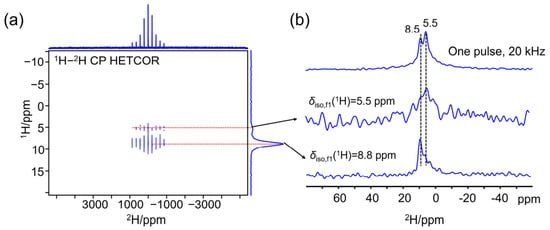
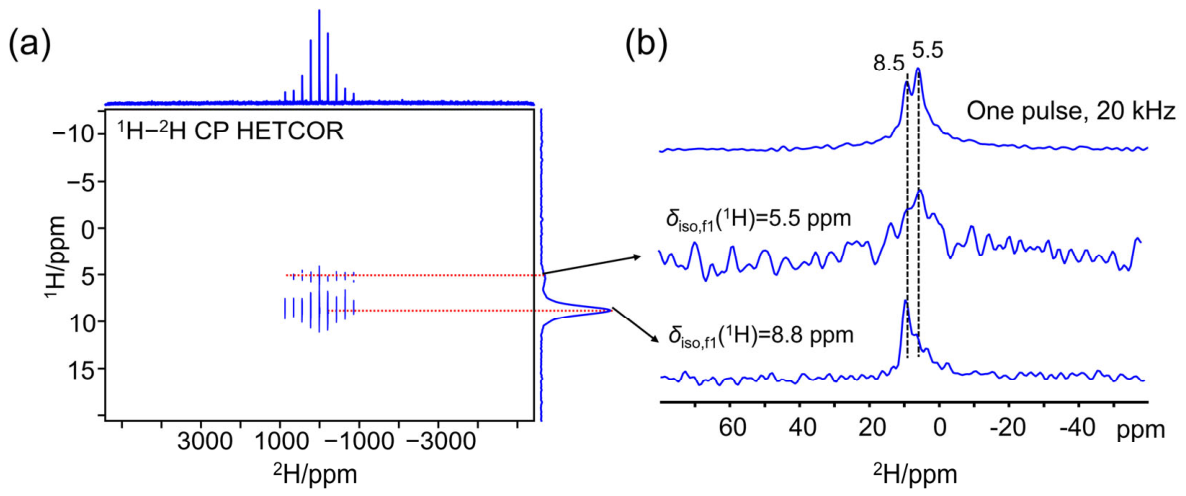
A two-dimensional 1H–2H CP-HETCOR spectrum was subsequently acquired to identify the proton environments in spatial contact with the motionally restricted D2O population (Figure 5a). The quadrupolar 2H signal shows a dominant correlation with the formate proton resonance Hf, demonstrating residual 1H–2H dipolar contacts between the confined D2O molecules and the framework. A weaker correlation is observed with the water 1H resonance at ca. 5.5 ppm, arising from dipolar contacts between residual HDO/H2O protons and nearby D2O deuterons. This water–water correlation supports the presence of close contacts within a hydrogen-bonded water network. Its relatively weak intensity likely reflects partial motional averaging of the 1H–2H dipolar interaction, together with the low residual proton concentration in the D2O-loaded sample.
Figure 5.
(a) Two-dimensional 1H–2H CP-HETCOR NMR spectrum of D2O-loaded Al(HCOO)3 with a contact time of 1 ms. The red dashed lines indicate the F1 (1H) positions at ca. 5.5 ppm (HDO/H2O) and 8.7 ppm (formate protons, Hf) used to extract the F2 slices. (b) The extracted F2 slices in the 2D NMR spectrum.
F2 slices extracted along the F1 chemical shifts of δiso(1H) = ca. 5.5 ppm for HDO/H2O and δiso(1H) = 8.7 ppm for Hf further distinguish the two water environments (Figure 5b). The 5.5 ppm resonance is observed in both slices, indicating that this D2O/HDO population interacts with both neighboring water molecules and the formate framework. In contrast, the higher shift 2H component at ca. 8.5 ppm is observed predominantly in the δiso(1H) = 8.7 ppm slice, indicating a stronger association with the formate-lined pore surface. These two 2H sites are consistent with the two confined-water populations resolved in the 1H MAS spectrum.
3.5. AIMD Analysis
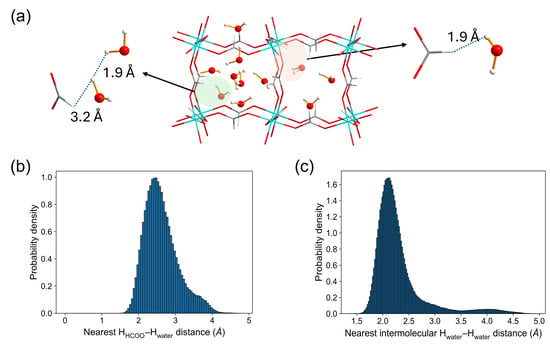
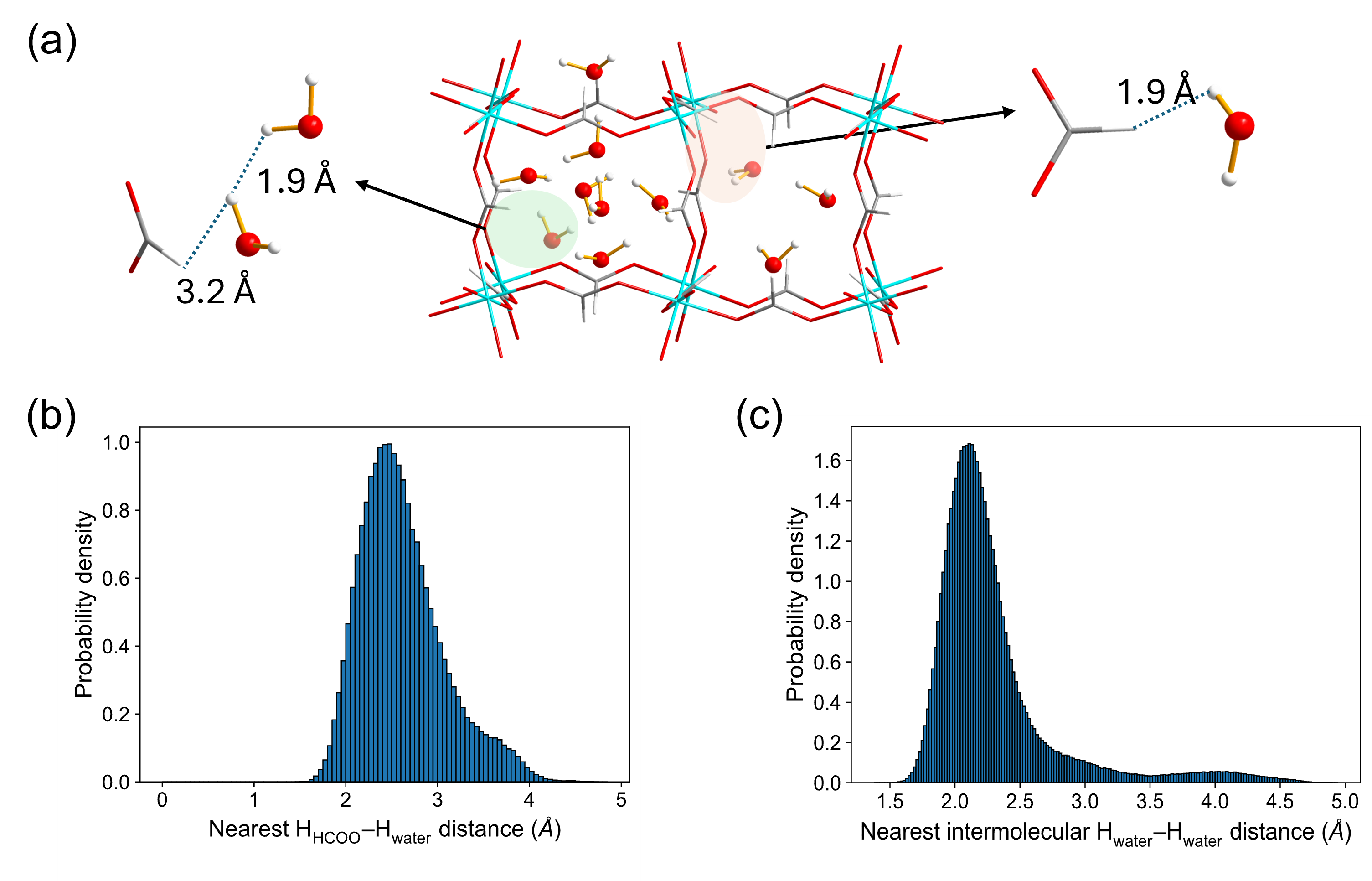
To provide a molecular-level interpretation of the two water environments identified by solid-state NMR, AIMD simulations were performed for water-loaded Al(HCOO)3. Based on the experimental water uptake, 16 H2O molecules were introduced into the framework as the initial configuration. The water loading used in the AIMD model was assessed by TGA of the D2O-loaded sample (Figure S10). The initial mass loss attributed predominantly to water release is ca. 19 wt%, close to the theoretical D2O content of 19.8 wt% for [Al(HCOO)3]8·16D2O. This corresponds to approximately 1.9 D2O molecules per framework formula unit and provides support for the model containing 16 H2O molecules per simulation cell of eight Al(HCOO)3 formula units. The simulation therefore represents a loading close to the experimentally estimated average. As illustrated in Figure 6a, water molecules in the smaller pores exhibit close contacts with the inward-facing formate groups, with representative Hformate···Hwater distances of ca. 1.9 Å. In the larger pores, some water molecules are located farther from the formate protons (ca. 3.2 Å) and interact simultaneously with neighboring water molecules. These configurations suggest that the two pore types provide different water–framework and water–water environments.
Figure 6.
AIMD analysis of water adsorption and water–framework contacts in Al(HCOO)3. (a) The DFT-optimized water-loaded Al(HCOO)3. Representative configurations illustrating water–water and formate–water contacts and the distribution of water molecules within the two types of pores. (b) Probability distribution of the distance between each formate proton and its nearest water proton. (c) Probability distribution of the nearest-neighbor Hwater–Hwater distance calculated over the AIMD trajectory. Al, C, O, and H atoms are shown in cyan, gray, red, and white, respectively.
To account for the dynamic behavior of the confined water, AIMD simulations were conducted at 300 K (see Section 2.5). The nearest Hformate···Hwater distance distribution shows a dominant short-distance component centered at ca. 2.4 Å, with a broad shoulder extending toward 4 Å (Figure 6b). These features indicate the coexistence of water molecules in close contact with the formate-lined pore surface and water molecules located farther from the framework. This heterogeneous water–framework interaction is consistent with the two water environments observed by 1H and 2H NMR and may also account for the two formate environments resolved in the 13C NMR spectra.
After excluding the intramolecular H–H distances within individual water molecules, the nearest intermolecular Hwater···Hwater distance distribution exhibits a dominant maximum at ca. 2.1 Å and a broad tail (Figure 6c). The prevalence of short intermolecular contacts demonstrates close spatial association among the confined water molecules and is consistent with the formation of an interconnected hydrogen-bonded water network. These short Hwater···Hwater contacts also provide the spatial basis for the water–water 1H–2H correlation observed in the CP-HETCOR spectrum. The rapid reorientation and translational motion of the confined water partially average the corresponding dipolar interactions, accounting for the relatively weak 1H-2H CP-HETCOR correlation. Overall, the AIMD results support the NMR-derived picture of two dynamically water populations in the MOFs.
4. Conclusions
Multinuclear and multidimensional solid-state NMR spectroscopy, together with AIMD simulations, provides a molecular-level picture of water adsorption in Al(HCOO)3. 1H NMR identifies two distinct populations of confined water, with the more downfield-shifted population experiencing stronger hydrogen-bonding interactions. 1H–1H SQ–SQ and DQ–SQ correlation experiments establish close spatial contacts between the confined water and the formate framework and further indicate water–water interactions within an interconnected hydrogen-bonded network. Water adsorption also perturbs the host framework, as reflected by changes in the 1H–27Al and 1H–13C correlations and the emergence of two distinct formate environments. 2H solid-state NMR provides further insight into the dynamics of the adsorbed water. While a highly mobile water population gives rise to a strongly motionally averaged 2H NMR signal, cross-polarization selectively reveals a more restricted population retaining 1H–2H dipolar interactions. The effective quadrupolar line shape is consistent with rapid anisotropic reorientation of the confined D2O molecules. Two-dimensional 1H–2H CP-HETCOR spectroscopy directly correlates these water molecules with both the formate framework and neighboring water species, demonstrating the coexistence of water–framework and water–water interactions. The AIMD simulations support this picture by revealing a broad distribution of water–framework distances and short intermolecular water–water contacts.
The multinuclear approach provides complementary information on water adsorption and the framework response. 1H NMR distinguishes the water environments and their humidity-dependent behavior, while 2H NMR constrains the anisotropy of water motion and provides a basis for evaluating possible reorientation models. 13C NMR reveals distinct linker environments and a minor species possibly associated with hydrolysis, whereas 27Al NMR indicates retention of the predominant octahedral coordination alongside a broader distribution of local environments after water loading. These observations complement gravimetric measurements of overall water content. Their combined contribution is a molecular-level connection between water environments, water dynamics, and local framework changes.
Supplementary Materials
The following supporting information can be downloaded at https://www.mdpi.com/article/10.3390/magnetochemistry12110125/s1. Figure S1. The experimental and simulated powder XRD patterns of Al(HCOO)3 and D2O@ Al(HCOO)3. Figure S2. Humidity-dependent 1H MAS NMR spectra of Al(HCOO)3 and their spectral deconvolution. From bottom to top, the spectra correspond to the activated sample and samples exposed to 11%, 75%, and 94% relative humidity (RH). The different relative humidity is controlled with saturated solutions of specific salts following L. Greenspan’s work [61]. Figure S3. The 1H T1 inversion recovery fitting curves of Hw1 and Hw2. Figure S4. The 1H T2 decay bi-exponential fitting curves of Hw1 and Hw2. Figure S5. The 1H-1H (left) RFDR and (right) NOESY NMR spectra of the water loaded Al(HCOO)3. The F1 slices at Hw1 are shown in middle. The mixing time for the two experiments is 64 rotor periods, i.e., ~1.83 ms at 35 kHz spinning. Figure S6. The 27Al 3QMAS NMR spectra of Al(HCOO)3 and D2O@Al(HCOO)3. Figure S7. The 13C solid state NMR spectra of D2O@Al(HCOO)3 and a physical mixture of Al(HCOO)3 and HCOOH. Figure S8. The single pulse 13C MAS NMR spectra of D2O-loaded Al(HCOO)3 before and after redehydration. Figure S9. Numerically simulated 2H NMR quadrupolar pattern with different C2-flip rates. Figure S10. The TGA profile of the D2O@Al(HCOO)3. Table S1. Relative integrated intensities of the Hw1 and Hw2 resonances in the 1H MAS NMR spectra of Al(HCOO)3 under different humidity conditions. Values were calculated from the fitted peak areas and normalized to the sum of the Hw1 and Hw2 integrals for each sample.
Author Contributions
W.Z.: Conceptualization, methodology, investigation, formal analysis, writing—original draft, writing—review and editing; J.X.: Conceptualization, writing—review and editing, funding acquisition. All authors have read and agreed to the published version of the manuscript.
Funding
This work is supported by the National Natural Science Foundation of China (grant no. 22471128) and the Fundamental Research Funds for the Central Universities of Nankai University (023-63263167).
Institutional Review Board Statement
Not applicable.
Informed Consent Statement
Not applicable.
Data Availability Statement
The data in this study is available upon request from the authors.
Acknowledgments
Solid-state NMR experiments were conducted at the NTU Centre of High Field NMR Spectroscopy & Imaging, funded by Nanyang Technological University. JX thanks the financial support from the National Natural Science Foundation of China (grant no. 22471128) and the Fundamental Research Funds for the Central Universities of Nankai University (023-63263167).
Conflicts of Interest
The authors declare no conflicts of interest.
References
- Kitagawa, S. Others Metal–organic frameworks (MOFs). Chem. Soc. Rev. 2014, 43, 5415–5418. [Google Scholar] [CrossRef] [Scilit] [PubMed]
- Furukawa, H.; Cordova, K.E.; O’Keeffe, M.; Yaghi, O.M. The chemistry and applications of metal-organic frameworks. Science 2013, 341, 1230444. [Google Scholar] [CrossRef] [Scilit] [PubMed]
- Li, B.; Wang, H.; Chen, B. Microporous metal–organic frameworks for gas separation. Chem. Asian J. 2014, 9, 1474–1498. [Google Scholar] [CrossRef] [Scilit] [PubMed]
- Dhakshinamoorthy, A.; Li, Z.; Garcia, H. Catalysis and photocatalysis by metal organic frameworks. Chem. Soc. Rev. 2018, 47, 8134–8172. [Google Scholar] [CrossRef] [Scilit] [PubMed]
- Zhang, X.; Chen, A.; Zhong, M.; Zhang, Z.; Zhang, X.; Zhou, Z.; Bu, X.-H. Metal–organic frameworks (MOFs) and MOF-derived materials for energy storage and conversion. Electrochem. Energy Rev. 2019, 2, 29–104. [Google Scholar] [CrossRef] [Scilit]
- Burtch, N.C.; Jasuja, H.; Walton, K.S. Water stability and adsorption in metal–organic frameworks. Chem. Rev. 2014, 114, 10575–10612. [Google Scholar] [CrossRef] [Scilit] [PubMed]
- Zhang, B.; Zhu, Z.; Wang, X.; Liu, X.; Kapteijn, F. Water adsorption in MOFs: Structures and applications. Adv. Funct. Mater. 2024, 34, 2304788. [Google Scholar] [CrossRef] [Scilit]
- Ding, H.; Hu, S.; Chen, W.; An, W.-J.; Xu, J. Hydrolysis Kinetics-Induced Stability Enhancement of Activated Formate-Based MOFs under Dynamic Vapor Flow. Inorg. Chem. 2025, 64, 23980–23989. [Google Scholar] [CrossRef] [Scilit] [PubMed]
- Flaig, R.W.; Osborn Popp, T.M.; Fracaroli, A.M.; Kapustin, E.A.; Kalmutzki, M.J.; Altamimi, R.M.; Fathieh, F.; Reimer, J.A.; Yaghi, O.M. The chemistry of CO2 capture in an amine-functionalized metal–organic framework under dry and humid conditions. J. Am. Chem. Soc. 2017, 139, 12125–12128. [Google Scholar] [CrossRef] [Scilit] [PubMed]
- Chen, S.; Wang, Z.-P.; Lucier, B.E.G.; Zhang, W.; Wang, W. Applications and future development of solid-state nuclear magnetic resonance for investigating metal-organic frameworks. Magn. Reson. Lett. 2026, 7, 200294. [Google Scholar] [CrossRef] [Scilit] [PubMed]
- Xiao, Y.; Li, S.; Xu, J.; Deng, F. Solid-state NMR studies of host–guest chemistry in metal-organic frameworks. Curr. Opin. Colloid Interface Sci. 2022, 61, 101633. [Google Scholar] [CrossRef] [Scilit]
- Li, S.; Lafon, O.; Wang, W.; Wang, Q.; Wang, X.; Li, Y.; Xu, J.; Deng, F. Recent Advances of Solid-State NMR Spectroscopy for Microporous Materials. Adv. Mater. 2020, 32, 2002879. [Google Scholar] [CrossRef] [Scilit] [PubMed]
- Hoffmann, H.C.; Debowski, M.; Müller, P.; Paasch, S.; Senkovska, I.; Kaskel, S.; Brunner, E. Solid-state NMR spectroscopy of metal–organic framework compounds (MOFs). Materials 2012, 5, 2537–2572. [Google Scholar] [CrossRef] [Scilit]
- Brunner, E.; Rauche, M. Solid-state NMR spectroscopy: An advancing tool to analyse the structure and properties of metal–organic frameworks. Chem. Sci. 2020, 11, 4297–4304. [Google Scholar] [CrossRef] [Scilit] [PubMed]
- Ashbrook, S.E.; Dawson, D.M.; Seymour, V.R. Recent developments in solid-state NMR spectroscopy of crystalline microporous materials. Phys. Chem. Chem. Phys. 2014, 16, 8223–8242. [Google Scholar] [CrossRef] [Scilit] [PubMed]
- Nadol, A.; Venel, F.; Giovine, R.; Leloire, M.; Volkringer, C.; Loiseau, T.; Gervais, C.; Mellot-Draznieks, C.; Doumert, B.; Trébosc, J.; et al. Probing the water adsorption and stability under steam flow of Zr-based metal–organic frameworks using 91Zr solid-state NMR spectroscopy. Chem. Sci. 2025, 16, 69–82. [Google Scholar] [CrossRef] [Scilit] [PubMed]
- Fu, Y.; Yao, Y.; Paul, S.; Mochizuki, K.; De Paëpe, G. Water-generated dangling linkers in a metal-organic framework. Nat. Commun. 2026, 17, 3805. [Google Scholar] [CrossRef] [Scilit] [PubMed]
- Witherspoon, V.J.; Xu, J.; Reimer, J.A. Solid-state NMR investigations of carbon dioxide gas in metal–organic frameworks: Insights into molecular motion and adsorptive behavior. Chem. Rev. 2018, 118, 10033–10048. [Google Scholar] [CrossRef] [Scilit] [PubMed]
- Lucier, B.E.; Chen, S.; Huang, Y. Characterization of metal–organic frameworks: Unlocking the potential of solid-state NMR. Acc. Chem. Res. 2018, 51, 319–330. [Google Scholar] [CrossRef] [Scilit] [PubMed]
- Hughes, A.R.; Blanc, F. Recent advances in probing host–guest interactions with solid state nuclear magnetic resonance. CrystEngComm 2021, 23, 2491–2503. [Google Scholar] [CrossRef] [Scilit]
- Zhang, W.; Gan, Z.; Huang, Y. Ultra-high Field Solid-state NMR of Microporous Materials at 1 GHz and Beyond: A Mini Review. Solid. State Nucl. Magn. Reson. 2026, 143, 102080. [Google Scholar] [CrossRef] [Scilit] [PubMed]
- Deng, H.; Bengsch, M.; Fares, C.; Qiu, Z.; Henglin, M.; Neumann, C.N. Solid-state NMR provides location-specific information on the chemical environment inside MOF pores. Chem 2026, 12, 102949. [Google Scholar] [CrossRef] [Scilit]
- Parsons, A.P.; Schneider, C.M.; Katz, M.J. 2H NMR as a Practical Tool for Following MOF Formation: A Case Study of UiO-66. Angew. Chem. 2025, 137, e202420157. [Google Scholar] [CrossRef] [Scilit]
- Zhang, W.; Lucier, B.E.; Martins, V.; Azizivahed, T.; Hung, I.; Xu, Y.; Gan, Z.; Venkatesh, A.; Goh, T.W.; Huang, W. Local order, disorder, and everything in between: Using 91Zr solid-state NMR spectroscopy to probe zirconium-based metal–organic frameworks. Phys. Chem. Chem. Phys. 2025, 27, 4704–4716. [Google Scholar] [CrossRef] [Scilit] [PubMed]
- Borthwick, E.A.; Davis, Z.H.; Ashbrook, S.E. A multinuclear approach to characterising disordered (Al, Sc)-MIL-53 using solid-state NMR spectroscopy. Microporous Mesoporous Mater. 2025, 399, 113868. [Google Scholar] [CrossRef] [Scilit]
- Chen, S.; Zhang, Z.; Chen, W.; Lucier, B.E.; Chen, M.; Zhang, W.; Zhu, H.; Hung, I.; Zheng, A.; Gan, Z.; et al. Understanding water reaction pathways to control the hydrolytic reactivity of a Zn metal-organic framework. Nat. Commun. 2024, 15, 10776. [Google Scholar] [CrossRef] [Scilit] [PubMed]
- Gul-E-Noor, F.; Jee, B.; Pöppl, A.; Hartmann, M.; Himsl, D.; Bertmer, M. Effects of varying water adsorption on a Cu3 (BTC) 2 metal–organic framework (MOF) as studied by 1H and 13C solid-state NMR spectroscopy. Phys. Chem. Chem. Phys. 2011, 13, 7783–7788. [Google Scholar] [CrossRef] [Scilit] [PubMed]
- Schiller, V.; Knippen, K.; Loidl, A.; Lunkenheimer, P.; Volkmer, D.; Vogel, M. 2H NMR studies on the dynamics of supercooled water in a metal–organic framework. J. Chem. Phys. 2023, 159, 034501. [Google Scholar] [CrossRef] [Scilit] [PubMed]
- Pizzanelli, S.; Freni, A.; Farmahini, A.H.; Gordeeva, L.G.; Sarkisov, L.; Solovyeva, M.V.; Forte, C. Water dynamics in NH2-MIL-125: Insights from a combined 1H NMR relaxometry and computational investigation. J. Phys. Chem. C 2021, 125, 14416–14429. [Google Scholar] [CrossRef] [Scilit]
- Tian, Y.-Q.; Zhao, Y.-M.; Xu, H.-J.; Chi, C.-Y. CO2 template synthesis of metal formates with a ReO3 net. Inorg. Chem. 2007, 46, 1612–1616. [Google Scholar] [CrossRef] [Scilit] [PubMed]
- Mullangi, D.; Evans, H.A.; Yildirim, T.; Wang, Y.; Deng, Z.; Zhang, Z.; Mai, T.T.; Wei, F.; Wang, J.; Hight Walker, A.R.; et al. Noncryogenic air separation using aluminum formate Al (HCOO)3 (ALF). J. Am. Chem. Soc. 2023, 145, 9850–9856. [Google Scholar] [CrossRef] [Scilit] [PubMed]
- Evans, H.A.; Mullangi, D.; Deng, Z.; Wang, Y.; Peh, S.B.; Wei, F.; Wang, J.; Brown, C.M.; Zhao, D.; Canepa, P.; et al. Aluminum formate, Al (HCOO)3: An earth-abundant, scalable, and highly selective material for CO2 capture. Sci. Adv. 2022, 8, eade1473. [Google Scholar] [CrossRef] [Scilit] [PubMed]
- Bennett, A.; Griffin, R.; Ok, J.; Vega, S. Chemical shift correlation spectroscopy in rotating solids: Radio frequency-driven dipolar recoupling and longitudinal exchange. J. Chem. Phys. 1992, 96, 8624–8627. [Google Scholar] [CrossRef] [Scilit]
- Feike, M.; Demco, D.; Graf, R.; Gottwald, J.; Hafner, S.; Spiess, H.W. Broadband multiple-quantum NMR spectroscopy. J. Magn. Reson. Ser. A 1996, 122, 214–221. [Google Scholar] [CrossRef] [Scilit]
- Frydman, L.; Harwood, J.S. Isotropic spectra of half-integer quadrupolar spins from bidimensional magic-angle spinning NMR. J. Am. Chem. Soc. 1995, 117, 5367–5368. [Google Scholar] [CrossRef] [Scilit]
- Medek, A.; Harwood, J.S.; Frydman, L. Multiple-quantum magic-angle spinning NMR: A new method for the study of quadrupolar nuclei in solids. J. Am. Chem. Soc. 1995, 117, 12779–12787. [Google Scholar] [CrossRef] [Scilit]
- Fung, B.; Khitrin, A.; Ermolaev, K. An improved broadband decoupling sequence for liquid crystals and solids. J. Magn. Reson. 2000, 142, 97–101. [Google Scholar] [CrossRef] [Scilit] [PubMed]
- Van Meerten, S.; Franssen, W.; Kentgens, A. ssNake: A cross-platform open-source NMR data processing and fitting application. J. Magn. Reson. 2019, 301, 56–66. [Google Scholar] [CrossRef] [Scilit] [PubMed]
- Kühne, T.D.; Iannuzzi, M.; Del Ben, M.; Rybkin, V.V.; Seewald, P.; Stein, F.; Laino, T.; Khaliullin, R.Z.; Schütt, O.; Schiffmann, F.; et al. CP2K: An electronic structure and molecular dynamics software package-Quickstep: Efficient and accurate electronic structure calculations. J. Chem. Phys. 2020, 152, 194103. [Google Scholar] [CrossRef] [Scilit] [PubMed]
- Bussi, G.; Donadio, D.; Parrinello, M. Canonical sampling through velocity rescaling. J. Chem. Phys. 2007, 126, 014101. [Google Scholar] [CrossRef] [Scilit] [PubMed]
- Perdew, J.P.; Burke, K.; Ernzerhof, M. Generalized gradient approximation made simple. Phys. Rev. Lett. 1996, 77, 3865. [Google Scholar] [CrossRef] [Scilit] [PubMed]
- Grimme, S.; Antony, J.; Ehrlich, S.; Krieg, H. A consistent and accurate ab initio parametrization of density functional dispersion correction (DFT-D) for the 94 elements H-Pu. J. Chem. Phys. 2010, 132, 154104. [Google Scholar] [PubMed]
- Goedecker, S.; Teter, M.; Hutter, J. Separable dual-space Gaussian pseudopotentials. Phys. Rev. B 1996, 54, 1703. [Google Scholar] [CrossRef] [Scilit] [PubMed]
- Ashbrook, S.E.; Sneddon, S. New methods and applications in solid-state NMR spectroscopy of quadrupolar nuclei. J. Am. Chem. Soc. 2014, 136, 15440–15456. [Google Scholar] [CrossRef] [Scilit] [PubMed]
- Reif, B.; Ashbrook, S.E.; Emsley, L.; Hong, M. Solid-state NMR spectroscopy. Nat. Rev. Methods Primers 2021, 1, 2. [Google Scholar] [CrossRef] [Scilit]
- Xu, J.; Terskikh, V.V.; Chu, Y.; Zheng, A.; Huang, Y. Mapping out chemically similar, crystallographically nonequivalent hydrogen sites in metal–organic frameworks by 1H solid-state NMR spectroscopy. Chem. Mater. 2015, 27, 3306–3316. [Google Scholar] [CrossRef] [Scilit]
- Vayssilov, G.N.; Aleksandrov, H.A.; Dib, E.; Costa, I.M.; Nesterenko, N.; Mintova, S. Superacidity and spectral signatures of hydroxyl groups in zeolites. Microporous Mesoporous Mater. 2022, 343, 112144. [Google Scholar] [CrossRef] [Scilit]
- Munakata, H.; Koyama, T.; Yashima, T.; Asakawa, N.; O-nuki, T.; Motokura, K.; Miyaji, A.; Baba, T. Temperature effect on 1H chemical shift of hydroxyl groups in zeolites and their catalytic activities as solid acids. J. Phys. Chem. C 2012, 116, 14551–14560. [Google Scholar] [CrossRef] [Scilit]
- Kolokolov, D.I.; Glaznev, I.S.; Aristov, Y.I.; Stepanov, A.G.; Jobic, H. Water dynamics in bulk and dispersed in silica CaCl2 hydrates studied by 2H NMR. J. Phys. Chem. C 2008, 112, 12853–12860. [Google Scholar] [CrossRef] [Scilit]
- Long, J.R.; Ebelhäuser, R.; Griffin, R. 2H NMR Line Shapes and Spin- Lattice Relaxation in Ba (ClO3) 2 2H2O. J. Phys. Chem. A 1997, 101, 988–994. [Google Scholar]
- Kolokolov, D.I.; Diestel, L.; Caro, J.; Freude, D.; Stepanov, A.G. Rotational and Translational Motion of Benzene in ZIF-8 Studied by 2H NMR: Estimation of Microscopic Self-Diffusivity and Its Comparison with Macroscopic Measurements. J. Phys. Chem. C 2014, 118, 12873–12879. [Google Scholar] [CrossRef] [Scilit]
- Kolokolov, D.; Stepanov, A.; Guillerm, V.; Serre, C.; Frick, B.; Jobic, H. Probing the dynamics of the porous Zr terephthalate UiO-66 framework using 2H NMR and neutron scattering. J. Phys. Chem. C 2012, 116, 12131–12136. [Google Scholar] [CrossRef] [Scilit]
- Ratcliffe, C.; Soldatov, D.; Ripmeester, J. Dynamics and disposition of benzene guest molecules in the micropore channels of a flexible metal-organic framework studied by 2H NMR and X-ray crystallography. Microporous Mesoporous Mater. 2004, 73, 71–79. [Google Scholar] [CrossRef] [Scilit]
- Lucier, B.E.; Zhang, Y.; Lee, K.J.; Lu, Y.; Huang, Y. Grasping hydrogen adsorption and dynamics in metal–organic frameworks using 2H solid-state NMR. Chem. Commun. 2016, 52, 7541–7544. [Google Scholar] [CrossRef] [Scilit] [PubMed]
- Xu, J.; Sinelnikov, R.; Huang, Y. Capturing guest dynamics in metal–organic framework CPO-27-M (M= Mg, Zn) by 2H solid-state NMR spectroscopy. Langmuir 2016, 32, 5468–5479. [Google Scholar] [CrossRef] [Scilit] [PubMed]
- Martins, V.; Lucier, B.E.; Liu, Z.; Liang, H.; Zheng, A.; Terskikh, V.V.; Zhang, W.; Desveaux, B.E.; Huang, Y. Cold, hot, dry, and wet: Locations and dynamics of CO2 and H2O co-adsorbed in an ultramicroporous MOF. Inorg. Chem. 2023, 62, 11152–11167. [Google Scholar] [CrossRef] [Scilit] [PubMed]
- Nukuna, B.N.; Goshe, M.B.; Anderson, V.E. Sites of hydroxyl radical reaction with amino acids identified by 2H NMR detection of induced 1H/2H exchange. J. Am. Chem. Soc. 2001, 123, 1208–1214. [Google Scholar] [CrossRef] [Scilit] [PubMed]
- Losonczi, J.A.; Prestegard, J.H. Improved dilute bicelle solutions for high-resolution NMR of biological macromolecules. J. Biomol. NMR 1998, 12, 447–451. [Google Scholar] [CrossRef] [Scilit] [PubMed]
- Stepanov, A.G.; Shegai, T.O.; Luzgin, M.V.; Essayem, N.; Jobic, H. Deuterium solid-state NMR study of the dynamic behavior of deuterons and water molecules in solid D3PW12O40. J. Phys. Chem. B 2003, 107, 12438–12443. [Google Scholar] [CrossRef] [Scilit]
- Wittebort, R.; Olejniczak, E.; Griffin, R. Analysis of deuterium nuclear magnetic resonance line shapes in anisotropic media. J. Chem. Phys. 1987, 86, 5411–5420. [Google Scholar] [CrossRef] [Scilit]
- Greenspan, L. Humidity fixed points of binary saturated aqueous solutions. J. Res. Natl. Bur. Stand. A Phys. Chem. 1977, 89. [Google Scholar] [CrossRef] [Scilit]
Disclaimer/Publisher’s Note: The statements, opinions and data contained in all publications are solely those of the individual author(s) and contributor(s) and not of MDPI and/or the editor(s). MDPI and/or the editor(s) disclaim responsibility for any injury to people or property resulting from any ideas, methods, instructions or products referred to in the content. |
© 2026 by the authors. Licensee MDPI, Basel, Switzerland. This article is an open access article distributed under the terms and conditions of the Creative Commons Attribution (CC BY) license.