


Highlights
What are the main findings?
- Free amino acid accumulation in cucurbit fruits is highly tissue- and species-specific, with glutamine, aspartate, asparagine, arginine, and citrulline forming a coordinated nitrogen-metabolism core module, whereas methionine and valine remain consistently low across fruit tissues.
- Species classification based on free amino acid profiles diverges markedly from traditional gene-based domestication taxonomy; glutamine, γ-aminobutyric acid, citrulline, and arginine are identified as hub metabolites that best discriminate fruit tissue types.
What are the implications of the main findings?
- The results establish an integrated functional model linking nitrogen assimilation, flavor/energy metabolism, stress tolerance/defense signaling, and storage across different fruit tissues of diverse Cucurbitaceae crops.
- The observed divergence between metabolic and gene-based classifications indicates strong environmental selection and nonlinear gene–metabolite relationships, providing metabolic markers and a framework for precision breeding and domestication studies in Cucurbitaceae.
Abstract
Free amino acids serve as a crucial hub connecting plant life activities with human nutrition. The fruits of Cucurbitaceae crops are natural nitrogen reservoirs, rich in free amino acids such as citrulline, arginine, and γ-aminobutyric acid (GABA). To investigate the spatial accumulation characteristics and differential distribution of free amino acids in cucurbit fruits, this study measured the contents of 19 free amino acids in the fruit stem, epicarp, endocarp, pulp, and seeds of 10 cucurbit species (12 varieties) at the mature stage. The results revealed that free amino acid accumulation exhibits significant tissue specificity and species specificity, forming diverse nitrogen metabolism hubs. Glutamine, aspartate, asparagine, arginine, and citrulline constitute a highly coordinated core module of nitrogen metabolism in Cucurbitaceae. Methionine, valine, and some other amino acids were consistently present at extremely low levels across tissues, indicating a competitive diversion of conserved metabolic pathways coexisting among species. Species classification based on free amino acids differed markedly from traditional taxonomy based on gene domestication, implying environmental selection pressures and non-linear gene-metabolite network relationships. Glutamine, GABA, citrulline, and arginine were identified as core hub metabolites supporting tissue type classification. This study revealed the allocation characteristics of free amino acids in fruits of various cucurbit crops and established a functional model integrating nitrogen assimilation, flavor/energy metabolism, stress tolerance/defense signaling, and storage across different tissue types of multiple cucurbit crops, providing new perspectives for precision breeding and domestication mechanism research in Cucurbitaceae.
1. Introduction
Cucurbitaceae crops, encompassing a diverse array of genera and species distributed worldwide, rank among the most important vegetable crops and constitute an indispensable component of the human diet. Beyond serving as a major source of human nutrition, cucurbit fruits have emerged as a valuable model system for investigating inter-organ nutrient allocation and stress adaptation in plants [1]. Although numerous genomic studies have uncovered various domestication traits in Cucurbitaceae species, a critical knowledge gap persists regarding the tissue-specific distribution patterns of free amino acids—the central carriers of nitrogen metabolism—and their association with domestication processes [2].
Free amino acids fulfill multifaceted and essential roles in plant life activities. For instance, GABA regulates carbon-nitrogen balance, participates in leaf senescence and pollen tube elongation, responds rapidly to both biotic and abiotic stresses, and can function as an endogenous signaling molecule in plant pathways [3]. Arginine, as a core nitrogen storage nutrient, also serves as a biosynthetic precursor for pivotal compounds including glutamate, γ-aminobutyric acid, creatine, nitric oxide, polyamines, and agmatine, thereby directly or indirectly participating in diverse plant life processes [4]. Concurrently, free amino acids act as a key hub linking plant metabolic physiology and human nutrition; alterations in their content directly influence fruit flavor, nutritional quality, and related traits. The biosynthesis of certain fruit aroma compounds originates from the metabolism of specific free amino acids, such as isoleucine, leucine, valine, and alanine [5]. Some free amino acids directly contribute to taste sensations—including umami, sweetness, bitterness, and aromatic notes—with glutamate and aspartate imparting umami, for example. Specific amino acids also function as important bioactive nutrients conferring significant health benefits in humans, such as arginine and citrulline [6]. In summary, free amino acids are not merely substrates for protein synthesis but also integrally participate in growth, development, stress resistance, and the formation of flavor and nutritional quality. Although cucurbit fruits are rich in free amino acids, fundamental questions remain unresolved: Does a cross-tissue “functional zoning of free amino acid metabolism” exist in Cucurbitaceae crops? Does the spatial distribution of free amino acids reflect adaptive strategies underlying fruit development? What evolutionary principles govern free amino acid metabolic networks across different species? Addressing these questions is crucial for unraveling the metabolic basis of life activities and fruit quality formation in Cucurbitaceae.
Mounting evidence from studies on tissue-specific accumulation, developmental dynamics, and regulatory mechanisms of free amino acids in fruits has demonstrated pronounced spatial heterogeneity across different fruit tissues. In Shatian pomelo, among the five tissues examined—exocarp, mesocarp, segment membrane, juice sac, and seeds—amino acids and their derivatives (277 compounds) are predominantly enriched in the exocarp and juice sac, with comparatively lower levels in other tissues, revealing distinct tissue-specific metabolite accumulation patterns [7]. In citrus fruits, the amino acid accumulation profiles in the flavedo and juice sac are distinctly different: at the immature stage, the total content of nine amino acids in the juice sac is generally higher than that in the flavedo; as the fruit matures, the relative contents of proline, aspartate, and glutamate increase in the flavedo, whereas the total amino acid content in the juice sac declines overall [8]. Comparable investigations have been conducted in Cucurbitaceae crops. In young summer squash fruits, free amino acid contents decrease to varying degrees during early development in the peduncle, placenta, mesocarp wall, and end wall, but the magnitude of decrease differs among these tissues [9]. In different cucumber varieties, the types and contents of 25 free amino acids in the peel and flesh exhibit significant inter-variety and inter-tissue differences, suggesting that the peel serves as an important amino acid reservoir [10]. However, conventional studies have predominantly focused on different tissues within a single species, lacking systematic cross-species analyses and, critically, overlooking the complex responses of metabolic plasticity to environmental signals and genetic backgrounds. In this study, we integrated free amino acid data from five tissue types across ten Cucurbitaceae crops to explore the spatiotemporal regulatory principles governing nitrogen allocation, stress responses, and nutritional quality, thereby providing a reference for constructing metabolic models for cucurbit crops. By comparing the discrepancies between metabolic classification and gene domestication lineages, we elucidate the distinct roles of environmental selection and functional selection in the evolution of metabolic phenotypes. This work offers a theoretical framework for optimizing stress-resistant cultivation techniques and designing functional agricultural products, promotes a shift in crop metabolism research from a “gene-centric” perspective toward “systemic interaction” thinking, and provides a data foundation for future research on the mechanisms underlying tissue-specific differences in amino acid accumulation during cucurbit fruit development, as well as a reference for the nutritional evaluation of cucurbit fruits.
2. Materials and Methods
2.1. Plant Materials
The experimental materials were 10 species of Cucurbitaceae crops, ‘22-X05’, ‘Donghu 32’, ‘Fuyu 158’, ‘Spoon Bottle Gourd’, ‘Ouya Bamboo Tube Loofah’, ‘SM12’ (thick-skinned),‘Crispy Stick No.8’ (thin-rinded), ‘XYGCN-2202’ (Big shape), ‘NG01’ (Small shape), ‘Siliangjin No.2’, ‘Green Doctor 106’, ‘Zhongxing Red No.9’ (Table 1).
Table 1.
Cucurbitaceae Material Names and Germplasm Classification.
2.2. Field Experiment
The field experiment was conducted in 2024 in conventional plastic greenhouses at the Experimental Base of Zhengzhou Convention and Exhibition Center, Henan Province. All plant materials were sown for seedling production on March 15 and transplanted into the plastic greenhouses at the three-leaf-and-one-bud stage (mid-April). The experiment adopted a design strategy of zonal planting and intraspecific randomization: because the tested materials belonged to different genera and species within Cucurbitaceae, and to facilitate precise management of species-specific agronomic practices (e.g., pollination timing, pruning frequency, and pesticide types) as well as to prevent cross-transmission of pathogens among different crops, cultivars of the same species were arranged in separate independent greenhouses (for example, the watermelon cultivar ‘Zhongxing Red No.9’ was placed in a watermelon-dedicated greenhouse), with 2 m spacing between greenhouses. Within each species greenhouse, the tested cultivars (genotypes) were arranged in a completely randomized block design, with three biological replicate plots per cultivar and 10 plants per plot. All materials were grown using vertical trellis cultivation with single-vine training, and only one fruit was retained per plant to standardize source-sink relationships.
The greenhouses were covered with 0.08 mm-thick polyethylene film; they were naturally ventilated during the day and closed at night for heat preservation. During cultivation, the environmental parameters were: day temperature 29–33 °C, night temperature 15–23 °C, air relative humidity (RH) 65–85%, natural sunlight (greenhouse film transmittance approximately 85%), and no supplemental artificial lighting. The soil in the experimental field was classified as fluvo-aquic soil, with the basic physicochemical properties of the plow layer (0–30 cm) as follows: pH 7.2 (soil:water ratio 1:2.5), organic matter content 12.5 g·kg−1, alkaline-hydrolyzable nitrogen 85.6 mg·kg−1, available phosphorus (Olsen-P) 32.4 mg·kg−1, and available potassium 156.7 mg·kg−1. Before transplanting, the land was prepared, and basal fertilizers were applied at rates of 45 t·ha−1 of decomposed cow manure, 750 kg·ha−1 of compound fertilizer (N:P2O5:K2O = 15:15:15), and 375 kg·ha−1 of superphosphate (P2O5 ≥ 16%), all incorporated into the soil by plowing. After transplanting, drip irrigation was applied once to promote seedling establishment. After fruit set, a topdressing of high-potassium water-soluble fertilizer (N:P2O5:K2O = 10:5:30) was applied at 225 kg·ha−1, split into two applications via drip irrigation at a 10-day interval. Throughout the growth period, drip irrigation under plastic film was used, and soil water content was maintained at 70–80% of field capacity.
Disease and pest control followed the strategy of “prevention first, integrated management.” Before transplanting, roots were dipped in an 800-fold dilution of 70% thiophanate-methyl wettable powder to prevent Fusarium wilt. During the growing period, 10% difenoconazole water-dispersible granules at 1500-fold dilution were applied to control powdery mildew, and 72% cymoxanil-mancozeb wettable powder at 600-fold dilution was applied to control downy mildew. For insect pests, 10% cyantraniliprole oil dispersion at 1000-fold dilution and 1.8% abamectin emulsifiable concentrate at 2000-fold dilution were applied alternately to control aphids, melon flies, and spider mites, with applications every 7–10 days, and spraying was stopped 7 days before harvest.
The tested materials belonged to different species within Cucurbitaceae and had markedly different commercial maturity periods. To standardize harvest criteria, fruits of each cultivar were tagged with the pollination date, and harvest time was determined comprehensively based on their typical commercial maturity indicators: cultivar ‘Ouya Bamboo Tube Loofah’, ‘Donghu 32’ and ‘Siliangjin No.2’ at 10 days after pollination (DAP); ‘Fuyu 158’, ‘Spoon Bottle Gourd’ and ‘Green Doctor 106’at 15 DAP; ‘Crispy Stick No.8’ at 26 DAP; ’22-X05’ and ‘Zhongxing Red No.9’ at 35 DAP; ‘SM12’ and ‘NG01’ at 45 DAP; ‘XYGCN-2202’ at 55 DAP. For all cultivars, harvesting was conducted within 12 h after the above criteria were met. Three fruits per cultivar, with good growth, uniform size, and free from pests, diseases, and mechanical damage, were randomly selected as the three biological replicates (from different individual plants). Immediately after harvest, five tissue parts—fruit stem, epicarp, endocarp, pulp, and seeds—were rapidly sampled. The samples were wrapped in aluminum foil, plunged into liquid nitrogen for rapid freezing, and then transferred to a vacuum freeze-dryer (CHRISTALPHA2-4LD, Christ, Osterode am Harz, Germany) for complete dehydration (4 days). After drying, the samples were ground into a fine powder using a mortar and pestle, then sieved through a 40-mesh screen, and the resulting powder was stored at −20 °C until analysis.
2.3. Lab Experimental and Data Analysis
Determination of free amino acids was performed on a Shimadzu high-performance liquid chromatograph (LC-20AD) equipped with a fluorescence detector (excitation wavelength: 250 nm, emission wavelength: 395 nm). Chromatographic separation was carried out using a Shim-pack Scepter C18-120 column (5 μm, 4.6 mm × 250 mm, Shimadzu, Japan). Mobile phase A was prepared by mixing 95 mL of 800 mmol/L potassium dihydrogen phosphate solution, 5 mL of 800 mmol/L disodium hydrogen phosphate solution, 10 mL of 1 mol/L triethylamine hydrochloride solution, 55 mL of acetonitrile, and 835 mL of ultrapure water; the final pH was 5.6. Mobile phase B was prepared by mixing 100 mL of 800 mmol/L potassium dihydrogen phosphate solution, 500 mL of acetonitrile, and 400 mL of ultrapure water; the final pH was 4.6. The flow rate was set at 1 mL/min. A binary high-pressure linear gradient elution was employed, with the total flow rate delivered by pump A and pump B summing to 100%. The gradient program (concentration of pump A) was as follows: 0–25 min, 100%; 25–40 min, 97%; 40–55 min, 81%; 55–68 min, 74%; 68–88 min, 0%.
The 25 amino acid standards included L-alanine (Ala), L-arginine (Arg), L-citrulline (Cit), L-ornithine (Orn), L-asparagine (Asn), L-aspartic acid (Asp), L-cysteine (Cys), γ-aminobutyric acid (GABA), L-glutamine (Gln), L-glutamic acid (Glu), glycine (Gly), L-histidine (His), L-isoleucine (Ile), L-leucine (Leu), L-lysine (Lys), L-methionine (Met), L-phenylalanine (Phe), L-proline (Pro), L-hydroxyproline (Hyp), L-serine (Ser), L-threonine (Thr), L-tyrosine (Tyr), L-valine (Val), sarcosine (Sar), and L-theanine (The). The purity of each standard was ≥98%, and all were purchased from Zhengzhou Shengbaxin Biotechnology Co., Ltd. When preparing standard solutions, the actual weighed mass of each standard was corrected according to the purity stated on its label. The standards were dissolved in ultrapure water (Resistivity ≥ 18 MΩ·cm (25 °C); total organic carbon (TOC) ≤ 50 μg/L; sodium and chloride ions ≤ 1 μg/L) and diluted to concentrations of 5000, 2500, 1250, 625, and 312.5 nmol/mL to construct calibration curves.
For sample preparation, 1.00 g of tissue powder was placed in a conical flask, and 100 mL of boiling ultrapure water was added. The mixture was incubated in a 95 °C water bath for 10 min, during which it was stirred thoroughly five times with a glass rod. Immediately after the water bath, the hot mixture was vacuum-filtered through a 0.22 μm aqueous mixed cellulose ester (MCE) microfiltration membrane. After the filtrate had cooled to ambient laboratory temperature (26 °C), it was made up to 125 mL with ultrapure water. Subsequently, 10 μL of the sample solution was transferred to a 250 μL glass insert vial, followed by the sequential addition of 20 μL of derivatization reagent (6-aminoquinolyl-N-hydroxysuccinimidyl carbamate solution) and 70 μL of derivatization buffer (0.20 mol/L borate buffer; pH adjusted to 8.8 with phosphoric acid). The vial was sealed with a screw cap with a PTFE septum, vortex-mixed for 10 s, and heated in an oven at 55 °C for 10 min. Immediately after heating, the vial was placed on the sample rack, and the analytical sequence was started. Each sample was measured three times (freshly prepared for each replicate).
25 target amino acids exhibited good linearity in the standard solutions, with correlation coefficients (R2) > 0.997. The theoretical limits of detection (LOD) and quantification (LOQ) were calculated based on signal-to-noise ratios (S/N) of 3 and 10, respectively. However, in the chromatographic analysis of actual biological tissue samples, the peak responses of L-ornithine (Orn), L-cysteine (Cys), L-histidine (His), L-hydroxyproline (Hyp), sarcosine (Sar), and L-theanine (The) were extremely low and severely interfered with by impurity peaks in the complex matrix. Consequently, the target peaks could not be effectively baseline-resolved from baseline noise and adjacent interferences, and the chromatographic peak positions were even difficult to locate accurately, making the integrated quantitative results unreliable. Therefore, these six amino acids were excluded from subsequent statistical analyses. Ultimately, only the remaining 19 free amino acids, which displayed clear peak shapes, good resolution, and signal-to-noise ratios satisfying the quantification requirement (S/N ≥ 10), were collated and analyzed. Intra-day precision was evaluated by six consecutive replicate injections (n = 6), and the relative standard deviations (RSD) of the peak areas for the 19 quantifiable target analytes were all below 5.0%. In the following figures and tables, the relative percentages (%) were calculated by normalization using the total peak area sum of the retained 19 amino acids as the denominator. Because the absolute responses of the excluded six amino acids in the actual samples were close to the background noise level with extremely low contents, their exclusion had a negligible effect on the comparison of the normalized relative proportions among the remaining 19 amino acids. All results in this study are presented on a dry weight (DW) basis; therefore, comparisons of free amino acid concentrations among different tissue samples do not require correction for moisture content. Amino acid abundance data were [log2-transformed], normalized by [total ion current/median centering], and subsequently scaled using [Pareto/unit variance] scaling. Pairwise correlations were computed using [Spearman’s rank/Pearson] correlation. Raw p-values were corrected for multiple testing via the Benjamini–Hochberg false discovery rate (FDR) procedure, and associations with a corrected p < 0.05 were considered significant. Principal component analysis (PCA) was performed on the scaled data. Hierarchical clustering and heatmap construction were based on [Euclidean/Pearson correlation] distance and [Ward/complete] linkage. The Shannon diversity index (H) was calculated as H = −Σ(Pi × ln Pi), where Pi is the relative abundance of the i-th metabolite. A metabolic similarity tree was constructed using [Bray–Curtis/Jaccard] dissimilarity and the unweighted pair-group method with arithmetic mean (UPGMA). Throughout the study, the significance threshold was set at p < 0.05 (or adjusted p < 0.05). Graphs were plotted using Excel, TBtools (version 1.123.0.0) [11], Origin 2024b (version 10.15), the tidyverse package (version 2.0.0.9000), the vegan package (version 2.7-5), and the ggtree package (version 4.3.0) for the measurement results.
3. Results
3.1. Tissue Distribution of Total Free Amino Acid Content
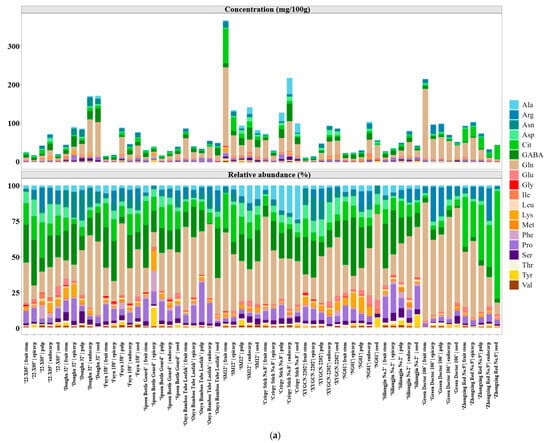
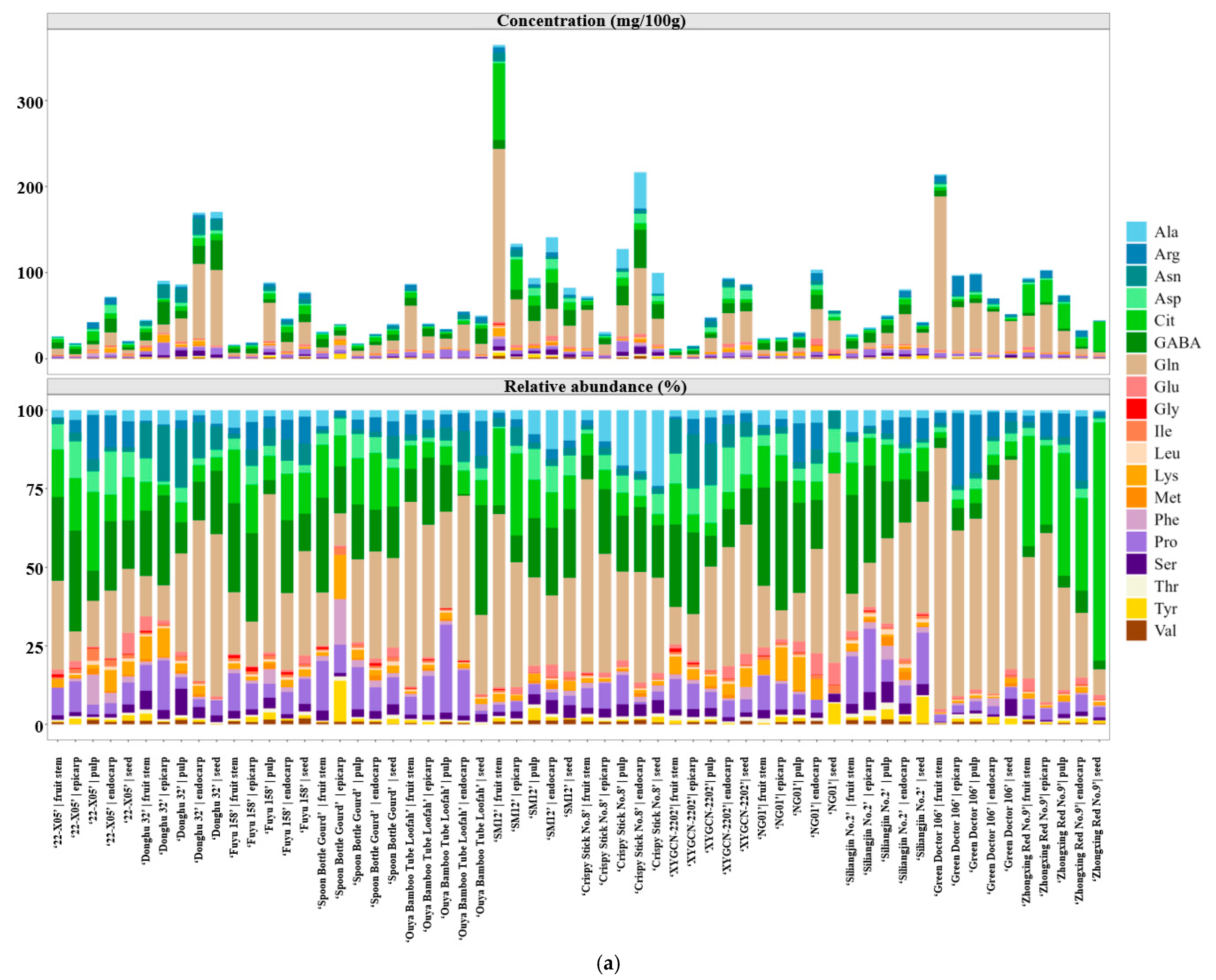
Significant variation in total free amino acid content was observed across the five tissues among the 12 cucurbit materials. The highest levels were found in the endocarp of ’22-X05’, ‘Crispy Stick No.8’, ‘XYGCN-2202’, ‘NG01’ and ‘Siliangjin No.2’, with the endocarp of ‘Crispy Stick No.8’ showing the greatest value within this group. In ‘Zhongxing Red No.9’ and ‘SM12’, maxima occurred in the epicarp and fruit stem, respectively, and the fruit stem of ‘SM12’ represented the highest value across all materials. ‘Donghu 32’ had similar contents in seed and endocarp (seed slightly higher), while in ‘Ouya Bamboo Tube Loofah’ and ‘Green Doctor 106’ the fruit stem was the primary site of accumulation. ‘Spoon Bottle Gourd’ displayed comparable amounts in seed and epicarp (seed marginally higher), whereas in ‘Fuyu 158’ the pulp became the predominant tissue. Substantial fold differences between tissue maxima and minima were evident; for instance, the endocarp of ‘XYGCN-2202’ was roughly eight-fold higher than its fruit stem. Overall, free amino acids predominantly accumulated in the endocarp for ’22-X05’, ‘Crispy Stick No.8’, the two pumpkin types (‘XYGCN-2202’ and ‘NG01’) and ‘Siliangjin No.2’, in the epicarp for ‘Zhongxing Red No.9’, in the fruit stem for ‘SM12’, ‘Ouya Bamboo Tube Loofah’ and ‘Green Doctor 106’, and were shared between seed and endocarp in ‘Donghu 32’. ‘Spoon Bottle Gourd’ distributed free amino acids between seed and epicarp, while its variety ‘Fuyu 158’ shifted accumulation toward the pulp (Figure 1a).
Figure 1.
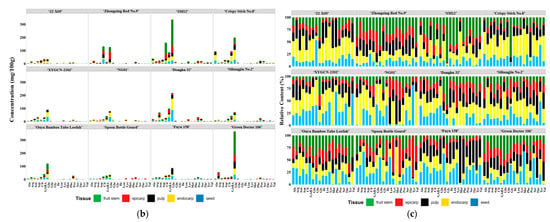
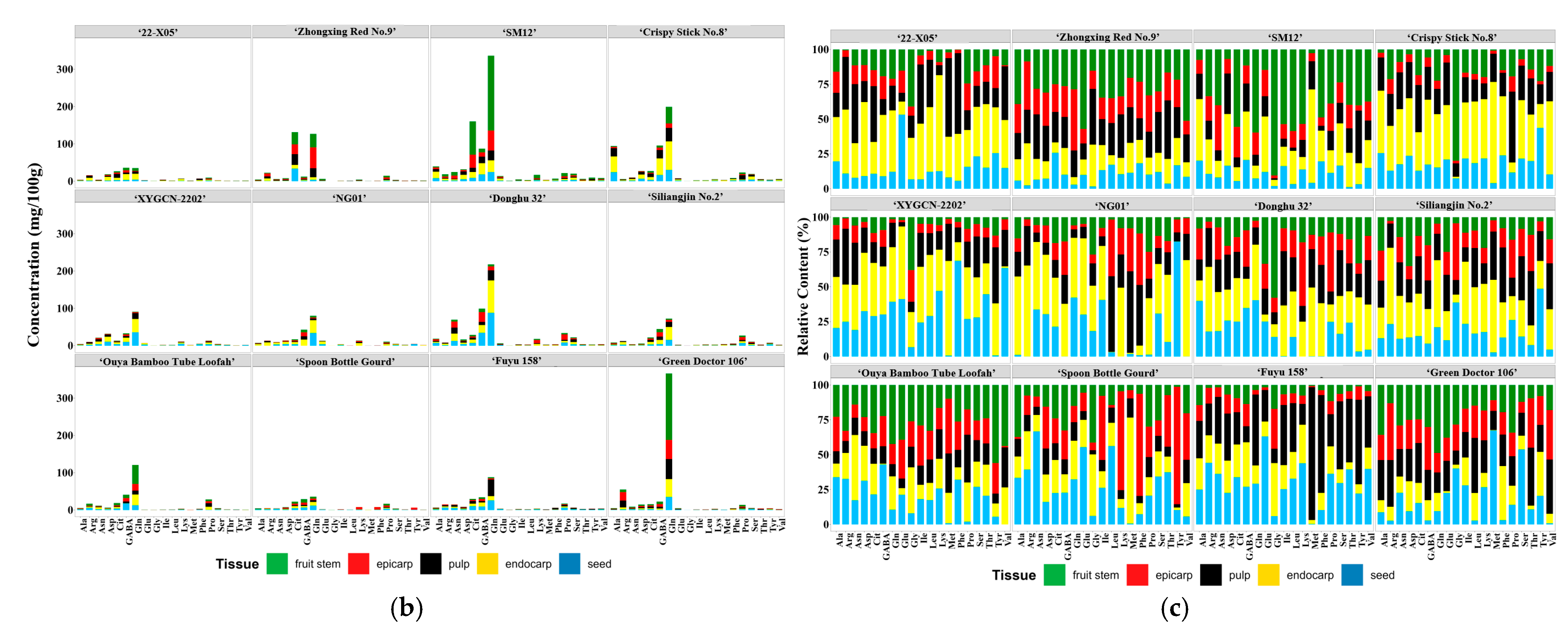
Accumulation characteristics in different Cucurbitaceae tissue parts. (a) Total content and distribution proportion of free amino acids in 5 tissues; (b) content of 19 free amino acids among different species; (c) distribution proportion of 19 free amino acids in tissues of different species.
3.2. Amino Acid Composition Profiles of 12 Cucurbitaceae Tissues
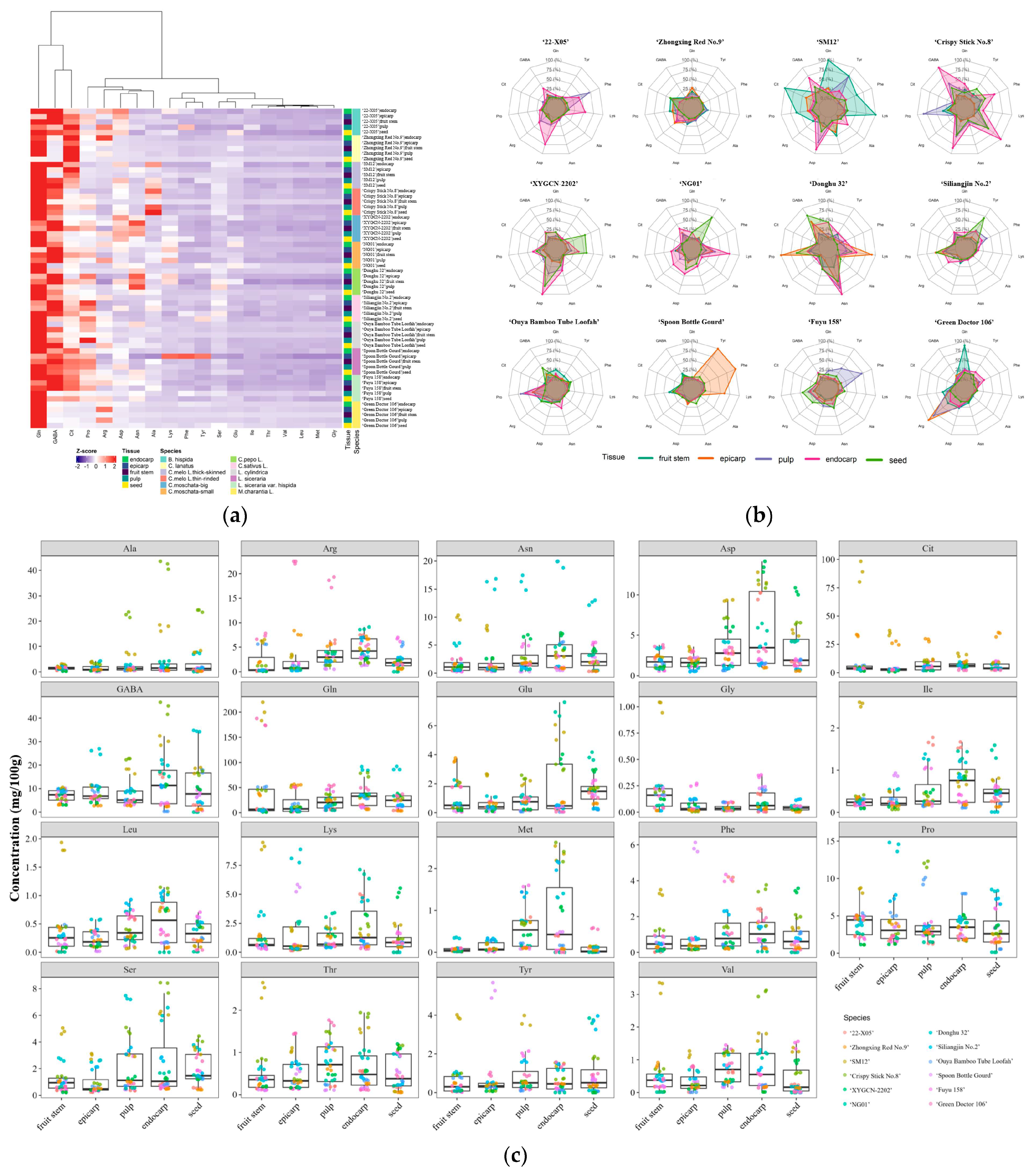
The free amino acid profiles varied markedly among tissues and cultivars. For example, Gln was the predominant free amino acid in all tissues, but its relative contribution differed substantially among cultivars and tissue types. GABA exhibited extreme tissue-specific accumulation: it was abundant in the endocarp of ‘Crispy Stick No.8’, yet nearly absent in the endocarp of ‘Ouya Bamboo Tube Loofah’; high GABA levels were also observed in the epicarp and seeds of certain cultivars, such as seeds of ‘Donghu 32’, whereas other cultivars like ‘Green Doctor 106’ and ‘Zhongxing Red No.9’ contained very low GABA. Cit was exceptionally abundant in seeds of ‘Zhongxing Red No.9’ and in the fruit stem and epicarp of ‘SM12’, but remained low in other varieties. Arg showed pronounced differences between epicarp and pulp, with notably high levels in ‘Green Doctor 106’ but minimal levels in several other epicarps. Asn was distinctively elevated in all tissues of ‘Donghu 32’, whereas most other accessions contained only low amounts. Pro was particularly high in the pulp of ‘Ouya Bamboo Tube Loofah’ and in the epicarp of ‘Donghu 32’. The epicarp of ‘Spoon Bottle Gourd’ simultaneously accumulated high levels of Tyr, Phe and Lys. Met was generally very low across all samples (Figure 1b,c; Supplementary Table S1). These results reveal the diversity in the partitioning strategies of free amino acids among different fruit tissues in Cucurbitaceae.
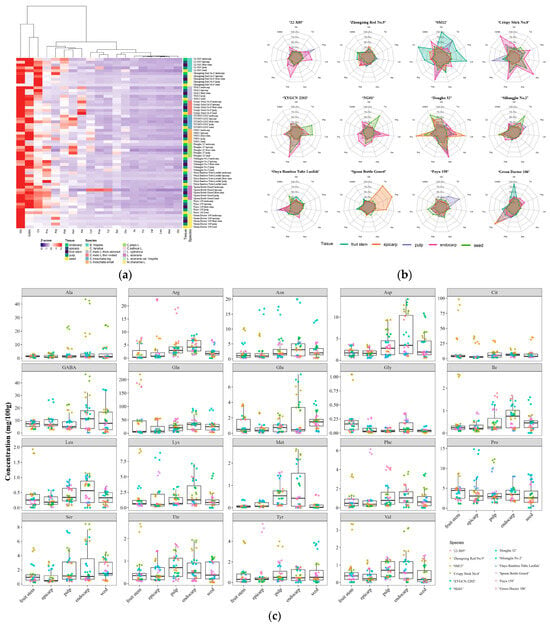
A comprehensive analysis of free amino acids across 12 Cucurbitaceae species revealed metabolic diversity at three levels: differentiation of transport forms, tissue-specific division of labor, and adaptive accumulation of special amino acids. (1) Differentiation of free amino acid transport forms: Gln serves as the core nitrogen carrier in all species examined, but its principal accumulation site differs among genotypes—occurring mainly in the fruit stem, endocarp, seeds or epicarp depending on the cultivar. (2) Citrulline accumulation shows pronounced intergeneric divergence: watermelon lines contain very high Cit levels, whereas pumpkin, luffa, bottle gourd and certain melon cultivars generally exhibit extremely low Cit concentrations. (3) Tissue-specific enrichment of special amino acids reflects diverse adaptive strategies. GABA accounts for a high proportion of the free amino acid pool in the epicarp of several cultivars and is highly enriched in the endocarp or seeds of other genotypes, while seeds of some accessions (e.g., ‘NG01’) contain almost no GABA, suggesting species-specific differences in seed dormancy or germination strategies (Supplementary Table S1). Arg shows marked accumulation in the epicarp and pulp of ‘Green Doctor 106’, likely involved in bitter-tasting defense. Pro enrichment in ‘Ouya Bamboo Tube Loofah’ pulp and ‘Siliangjin No.2’ epicarp indicates a role in osmotic adjustment. In the epicarp of ‘Spoon Bottle Gourd’, Phe, Tyr and Lys simultaneously reach high levels, possibly related to fruit skin sclerification/lignification and photoprotection (Supplementary Table S1; Figure 2a,b). Overall, free amino acid metabolism in Cucurbitaceae is highly plastic; metabolic reprogramming allows drastic reallocation of free amino acids among organs, and across species, adaptation to their ecological niches and fruit development patterns is achieved by changing the major free amino acid storage organ (fruit stem, endocarp, epicarp or seeds) and selecting characteristic auxiliary amino acids (Cit, Arg, Asn, GABA, Phe/Tyr, etc.) (Figure 2c).
Figure 2.
Distribution of free amino acids. (a) Heatmap of free amino acid accumulation in tissues of different species; (b) radar chart of distribution of 11 free amino acids with relatively high contents across five tissues; (c) boxplot distribution of free amino acids in tissues of different species.
3.3. Tissue Distribution Characteristics of Essential Amino Acids
The concentrations of seven free essential amino acids (EAAs; Thr, Val, Met, Ile, Leu, Lys, Phe) were generally low across cucurbit fruit tissues, with marked interspecific and tissue-specific differences. Seeds served as the primary site of free EAA accumulation in most species, particularly in pumpkin and zucchini (e.g., large-fruited ‘XYGCN-2202’). A unique feature was the epicarp of ‘Spoon Bottle Gourd’, which simultaneously accumulated high levels of phenylalanine, Tyr and Lys, together representing a substantial proportion of its total free amino acid pool. In contrast, free EAAs in melon were generally low, although the fruit stem of thick-skinned ‘SM12’ (a non-edible part) contained a markedly higher concentration of Lys than its edible pulp. Among edible parts, only a few tissues exhibited comparatively elevated levels of individual EAAs, such as lysine in the endocarp of small-fruited ‘NG01’, thin-rinded melon endocarp and zucchini pulp, and phenylalanine in ‘Fuyu 158’ pulp. Apart from these exceptions, individual free EAA concentrations in pulp and endocarp were generally low, indicating that these edible parts are not a major dietary source of EAAs for humans. Fruit stems consistently had extremely low free EAA levels (Supplementary Table S1), suggesting this conducting organ does not primarily function in free amino acid storage. Notably, the epicarp of ‘Spoon Bottle Gourd’ (though usually inedible) and Cucurbita seeds possess relatively high free EAA nutritional value and merit further development (Figure 1b,c).
3.4. Distribution Differences in Flavor-Related Amino Acids
Umami free amino acids, Asp and Glu, were generally low but accumulated markedly in specific species and tissues. Asp reached notable levels in the endocarp of ‘22-X05’ and in the endocarp and seeds of ‘XYGCN-2202’, whereas all tissues of ‘Green Doctor 106’ contained extremely low Asp and Glu, in stark contrast to its very high glutamine content. Among sweet-tasting free amino acids, Ala was exceptionally rich in the endocarp and pulp of ‘Crispy Stick No.8’, accounting for substantial proportions of total free amino acids and contributing sweet and umami sensations; Pro constituted a high proportion of total free amino acids in the pulp of ‘Ouya Bamboo Tube Loofah’. Gly and Ser were detected only at trace levels. The bitter amino acid Arg showed the greatest interspecific variation: the epicarp and pulp of ‘Green Doctor 106’ exhibited the highest Arg proportions, underlying its characteristic bitterness, while Arg in most other cultivars remained low. The epicarp of ‘Spoon Bottle Gourd’ contained unusually elevated Phe and Tyr (Figure 1b,c; Supplementary Table S1), likely producing a complex astringent-bitter note. These characteristic free amino acids can serve as important metabolic markers for improving the flavor quality of cucurbit fruits.
3.5. Distribution Differences in Functional Amino Acids
The four amino acids Gln, GABA, Cit and Arg possess well-defined health-promoting properties in humans, yet their tissue distribution patterns show pronounced interspecific variation among cucurbit crops. Gln was the most abundant and widely distributed free amino acid. The fruit stem was a typical organ of extreme Gln accumulation, with remarkably high levels in certain varieties such as ‘Green Doctor 106’ and ‘SM12’, whereas ‘Fuyu 158’ contained only minimal amounts. The endocarp and seeds also served as important storage sites. The health-promoting potential is more prominent in high-accumulating varieties, including ‘Donghu 32’, ‘Green Doctor 106’ and ‘SM12’. GABA displayed the most dramatic variation in content, with the highest levels observed in the endocarp of ‘Crispy Stick No.8’ and the seeds of ‘Donghu 32’. The relative proportion of GABA was generally high in non-edible tissues such as epicarp and fruit stem but remained low in the pulp. As dietary GABA sources, the endocarp of ‘Crispy Stick No.8’ and the seeds of ‘Donghu 32’ represent excellent natural choices. Cit distribution also exhibited marked interspecific differentiation. ‘Zhongxing Red No.9’ and ‘SM12’ were identified as ultra-high accumulators. In ‘Zhongxing Red No.9’, Cit was exceptionally abundant in both seeds and pulp, making it a widely recognized Cit-rich functional food. In most other varieties, Cit levels were generally low across tissues. Arg has important immunomodulatory functions in humans. In ‘Green Doctor 106’, the Arg content in the epicarp and pulp was the highest among all tested tissues. In the majority of other varieties, Arg levels were low (Figure 1b,c; Supplementary Table S1). The high-Arg variety ‘Green Doctor 106’ could be used to develop functional foods that enhance immunity.
3.6. Metabolic Similarity of Free Amino Acids in Cucurbit Crops and Core Metabolic Pathway Network of Cucurbit Fruits
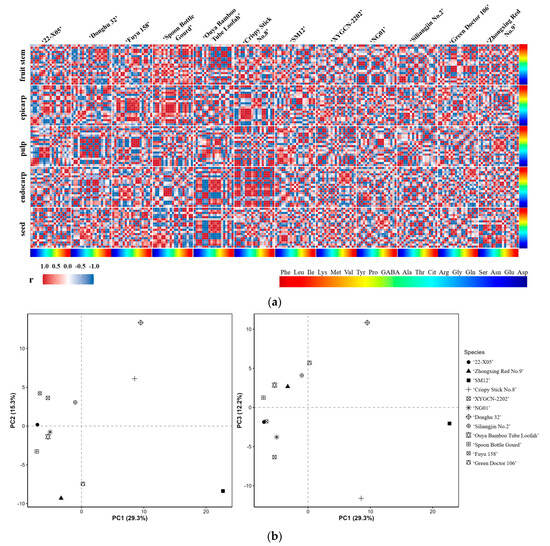
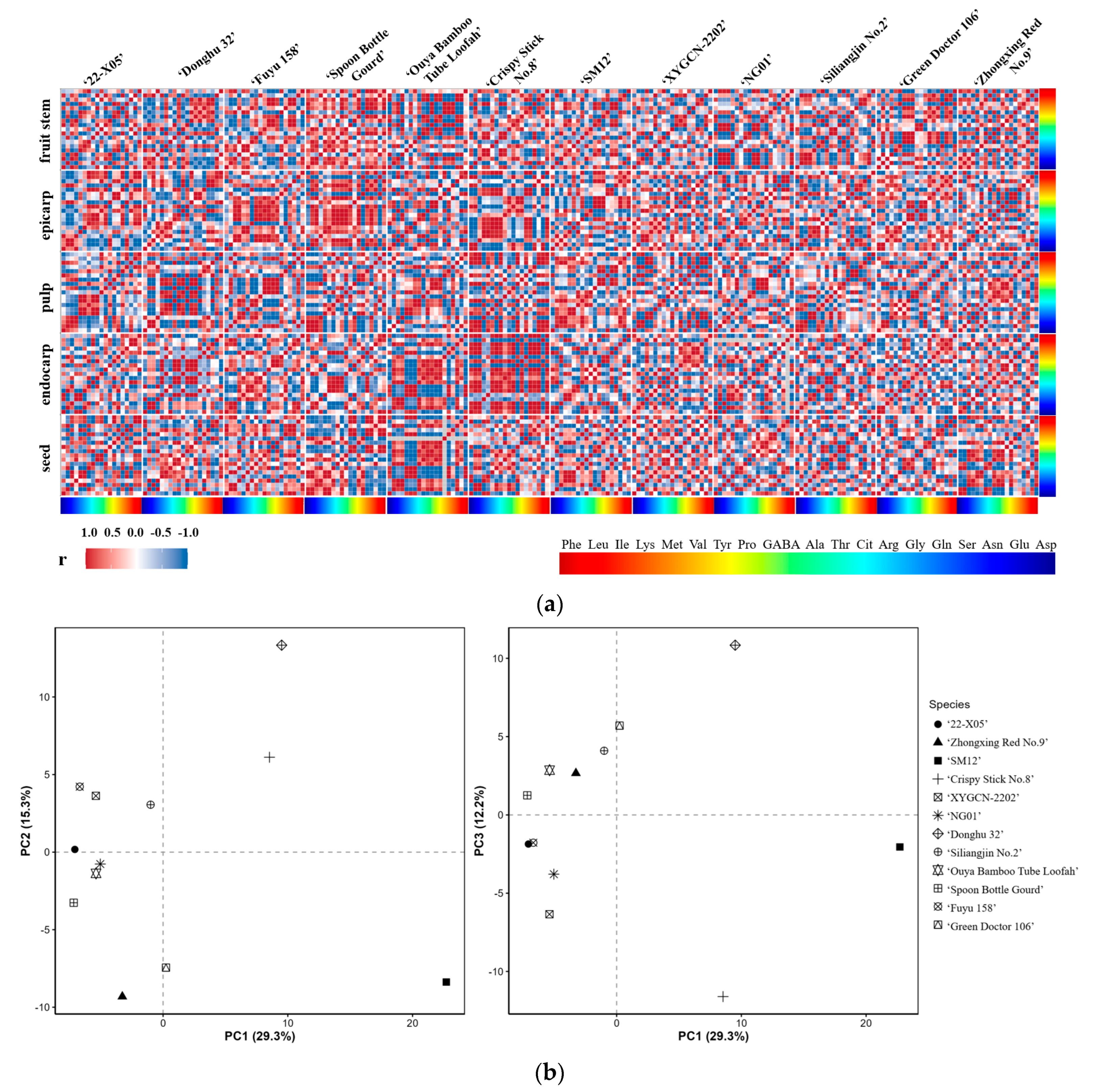
Correlation analysis of 19 free amino acids across 60 tissues from 12 cucurbit crops revealed that Gln had the highest correlation with total free amino acid content, indicating that Gln abundance directly determines the size of the free amino acid pool. Gln and GABA correlations in the endocarp were strongly species-specific: some cultivars exhibited strong correlations, whereas others showed almost no correlation, revealing differential reliance on the GABA shunt. Similarly, Gln and Arg were strongly positively correlated in certain cultivars, consistent with their proximity in the urea cycle, but this correlation was weak in others. Phe and Tyr were positively correlated in the epicarp of all examined species, reaching an extreme value in ‘Spoon Bottle Gourd’, indicating that coordinated regulation of aromatic amino acids is a hallmark of the gourd epicarp. The branched-chain amino acids (Val, Ile, Leu) showed pairwise correlation coefficients exceeding 0.8 across all tissues, pointing to shared catabolic or biosynthetic control. In addition, the endocarp of ‘Siliangjin No.2’ accumulated high Met content (Figure 1a), which was not significantly correlated with the branched-chain amino acids (Figure 3a), suggesting tissue-specific Met accumulation.
Figure 3.
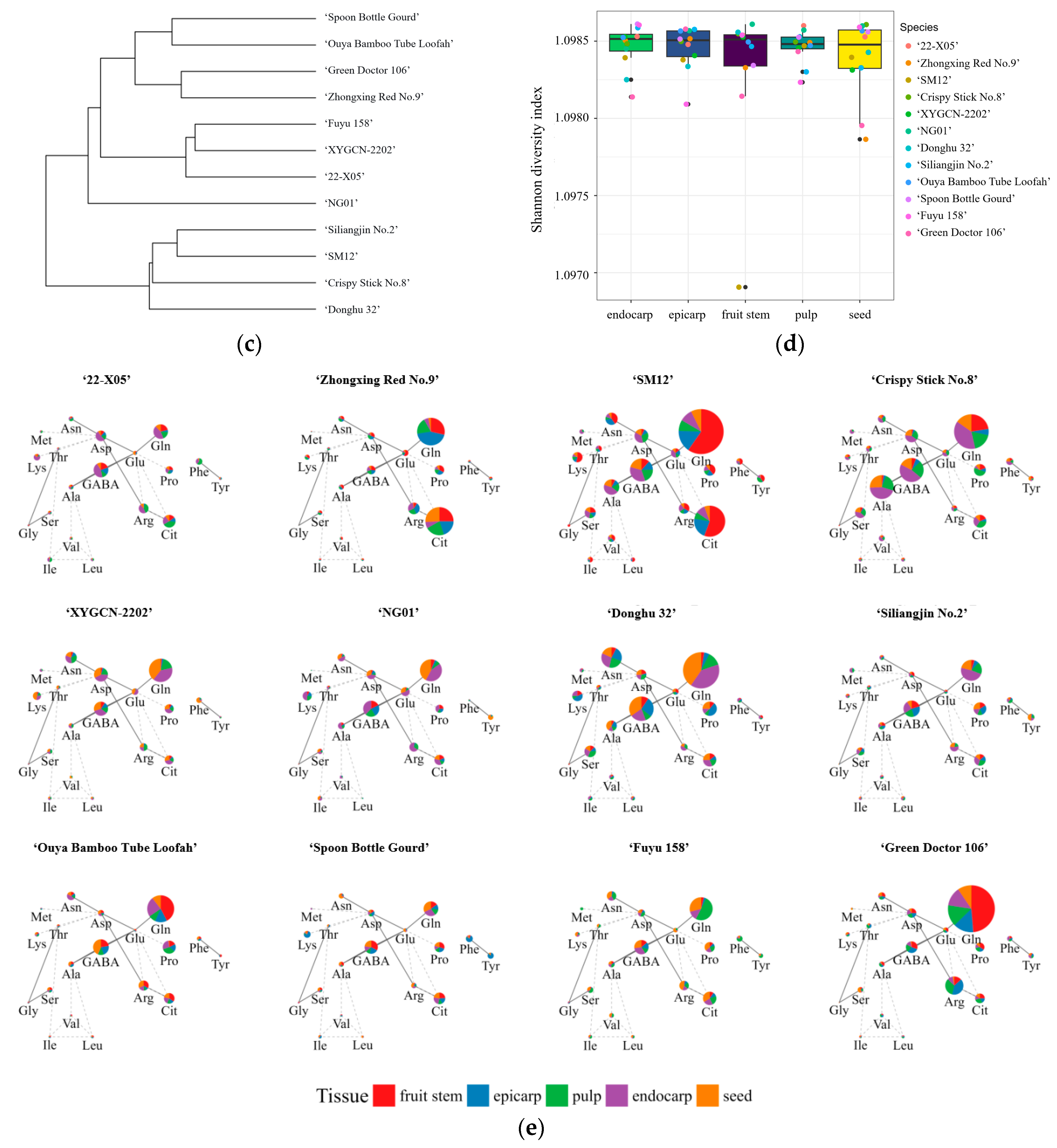
Similarity analysis of different species based on free amino acid accumulation. (a) Correlation of free amino acid accumulation in tissues of different species; (b) PCA of different species based on free amino acid accumulation; (c) phylogenetic tree of metabolic similarity among different species; (d) analysis of Shannon diversity index in different tissues; (e) cucurbitaceae-specific metabolic network of free amino acids.
PCA and phylogenetic tree analyses showed that the PC1 versus PC2 score plot clearly distinguished two major metabolic clusters, and the PC2 versus PC3 plot validated this grouping while further separating ‘NG01’ along the PC3 axis, reflecting its unique metabolic profile. The phylogenetic tree topology was highly congruent with the PCA results, splitting into two major branches at the root, with ‘NG01’ forming an independent basal branch. The detected metabolite variables effectively discriminate among cucurbit species and cultivars, and the concordance between PCA and the phylogenetic tree provides a reliable basis for downstream differential feature mining and genetic relationship elucidation (Figure 3b,c). The diversity of free amino acids remained high across tissues with minimal variation; only seeds in a few species showed slightly lower outlier values, and interspecific differences were much smaller than inter-tissue differences (Figure 3d).
The universal core metabolic network of free amino acids in cucurbit fruits centers on the GS-GOGAT cycle (glutamine synthetase-glutamate synthase cycle). As the predominant long-distance transport form of amino acid nitrogen, Gln is delivered via the phloem to various fruit tissues, often reaching the highest concentrations in the fruit stem. Once inside the tissue, Gln transfers its amide nitrogen to α-ketoglutarate via GOGAT to regenerate Glu, which then initiates three divergent pathways: (1) the GABA shunt—Glu is irreversibly decarboxylated to GABA by glutamate decarboxylase (enhanced in certain cultivars); (2) the asparagine pathway—oxaloacetate is transaminated to Asp, which then reacts with the amide nitrogen of Gln to form Asn; (3) the urea cycle intermediate pathway—Glu condenses with carbamoyl phosphate to form citrulline, which is subsequently converted to Arg. Additionally, Ala can be generated directly by transamination of pyruvate and, together with GABA, indicates a hypoxic metabolic state in the endocarp; proline (Pro), derived from Glu, participates in osmotic regulation; and aromatic amino acids originating from the shikimate pathway are abnormally enriched in the epicarp of bottle gourd, potentially involved in lignification and photoprotection. Thus, free amino acid metabolism in cucurbit fruits exhibits a network architecture of “one core (Gln), three branches (GABA, Asn, Cit-Arg), and multiple auxiliary pathways (Ala, Pro, aromatics).” Different species selectively enhance specific branches according to their ecological adaptation and fruit development patterns, resulting in high inter-tissue and inter-species diversity. Our quantitative data provide direct experimental evidence for this network and uncover several previously unreported species-specific metabolic features, such as the GABA-Ala pool in the endocarp of ‘Crispy Stick No.8’, the tyrosine pool in seeds of ‘NG01’, the phenylalanine/tyrosine/lysine pool in the epicarp of common ‘Spoon Bottle Gourd’, and the arginine pool in the epicarp of ‘Green Doctor 106’ (Figure 3e).
4. Discussion
This study proposes a “tissue-level functional partitioning” model for free amino acid metabolism in cucurbit fruits, revealing spatial compartmentalization of free amino acid pools linked to stress resistance, storage, and flavor functions. In ‘SM12’, the fruit stem serves as the primary hub for phloem-unloaded free amino acids, accumulating high levels of Gln and Glu. In ‘Crispy Stick No.8’, this hub shifts inward to the endocarp, resulting in substantially lower Gln and Cit in the fruit stem and marked GABA enrichment in the endocarp (Supplementary Table S1). Such reprogramming of free amino acid allocation, driven by cultivation niches, demonstrates remarkable metabolic plasticity in Cucurbitaceae. Similarly, previous studies report that Cit content in watermelon is upregulated under high-nitrogen conditions [12] and GABA in melon increases considerably under drought stress [13], highlighting that these free amino acid traits are dynamically shaped by gene-by-environment interactions and providing direct biochemical evidence for the “metabolic division of labor” hypothesis at the level of free amino acid networks.
Systematic association analysis across 60 tissue samples showed that Gln had a highly significant positive correlation with total free amino acids; together with Asp, Asn, Arg, and Cit, it formed a highly coordinated core free amino acid module. The robustness of this module aligns with a network architecture reminiscent of “one hub, three branches, and multiple auxiliary routes” in free amino acid metabolism, where the GS-GOGAT cycle provides the central Gln hub, supplemented by the GABA shunt, the Asn pathway, and the Cit/Arg urea cycle as the three major branches. In this network, Gln functions as a central free amino acid carrier that governs the total pool size, consistent with its role as the major transported amino acid in cucurbit phloem sap [14]. The specific reinforcement of the Cit-Arg coupling module in ‘Zhongxing Red No.9’ and ‘SM12’ indicates that the urea cycle branch has been independently recruited in certain cultivars to coordinate nitrogen storage and defense responses. This parallels the well-documented hyper-accumulation of citrulline in watermelon, where Cit and Arg in the rind serve as a nitrogen reservoir and contribute to oxidative stress tolerance [15,16]. This quantifiable free amino acid core module thus provides a clear biochemical target for improving nitrogen-use efficiency and stress resistance in cucurbit breeding.
Notably, metabolic phenotyping based on free amino acids deviates substantially from traditional classifications based on domestication genes, offering a new dimension for understanding evolution and domestication. Although ‘Green Doctor 106’ and ‘NG01’ share no direct homology in known domestication gene clusters, both exhibit pronounced Arg enrichment in the epicarp (Supplementary Table S1). This suggests that pathways such as the urea cycle were independently activated under convergent selective pressure for defense, constituting a typical case of functional convergent evolution in metabolism. Concurrently, phenomena such as high Gln accumulation in the endocarp of ‘22-X05’ and the anomalous co-enrichment of Phe/Tyr in the epicarp of ‘Spoon Bottle Gourd’ are likely driven by unannotated regulatory elements, implying that artificial selection has inadvertently preserved metabolic diversity. This is reminiscent of observations in tomato, where extensive metabolome diversity was retained despite strong selection on fruit size genes [17]. Additionally, some metabolic differences (e.g., Tyr in the seeds of ‘Spoon Bottle Gourd’) may result from genetic drift rather than adaptive selection, providing empirical support for the role of neutral theory in metabolic evolution. These findings challenge the gene-centric domestication narrative and underscore the unique value of the metabolome in capturing non-genetic regulation and functional convergence.
The metabolic division-of-labor model constructed in this study offers new strategies for precision breeding: for example, the high-GABA endocarp trait could be introgressed across species to improve drought-tolerance quality, or free amino acid flux could be redirected toward essential amino acid synthesis in seeds by modulating competing branch pathways. When coupled with optimized nitrogen-water cultivation regimes, this approach is expected to achieve a dynamic balance among quality, stress resistance, and yield. Future research should integrate multi-omics approaches to dissect fine-tuned regulation at non-genomic levels, such as post-transcriptional control (e.g., the effect of mRNA stability on aberrant Gln accumulation in ‘Ouya Bamboo Tube Loofah’ fruit stems) and enzyme activity feedback inhibition (e.g., inhibition of Arg by Gln). Domestication studies should also shift from a “single-gene-centric” perspective to an analytical framework focused on “metabolic pathway modules”, and functionally validate Cucurbitaceae-specific pathways—such as the Cit hyper-accumulation module in ‘Zhongxing Red No.9’—in model systems [18]. High-resolution tracking of free amino acid profiles across fruit developmental stages will pinpoint critical metabolic transition nodes, ultimately enabling metabolically phenotype-driven design breeding of Cucurbitaceae crops.
5. Conclusions
This study reveals a fundamental divergence in free amino acid tissue distribution among cucurbitaceous crops, driven by species-specific reinforcement of distinct metabolic branches that shape nitrogen-use strategies adapted to their ecological niches and fruit quality. Glu acts as the universal nitrogen carrier, yet its accumulation intensity and organ distribution differ markedly across species. Essential amino acids are generally scarce, with seeds and epicarp serving as the main storage sites, leaving most edible tissues largely deficient. Umami amino acids remain low in abundance, sweet amino acids are selectively enriched in certain tissues, and bitter amino acids concentrate predominantly in the epicarp and seeds; consequently, edible parts tend to exhibit a mild or slightly bitter taste. Among functional amino acids, glutamine accumulates ubiquitously at high levels, especially in the fruit stem and endocarp, GABA is enriched in epicarp and select seeds, and citrulline and arginine display species- and tissue-specific high accumulation. Overall, cucurbit crops have evolved a nitrogen allocation system based on tissue-specific metabolic compartmentalization that integrates functional homology and divergence, reflecting species-specific metabolic channeling, organ division of labor, and an adaptive burst of secondary metabolism under environmental stress.
Supplementary Materials
The following supporting information can be downloaded at: https://www.mdpi.com/article/10.3390/horticulturae12091129/s1, Supplementary Table S1: Determination of Free Amino Acid Contents in 5 Tissue Parts of 12 Cucurbitaceaes.
Author Contributions
Conceptualization, D.Y., W.K.; methodology, D.Y., W.K.; software, D.Y.; validation, D.Y.; formal analysis, D.Y.; investigation, Z.C., W.K.; resources, W.L., W.K.; data curation, D.Y., W.K.; writing-original draft preparation, D.Y.; writing-review and editing, Xuqiang Lu, N.H., W.K., X.L. (Xiaowen Luo), J.Z. and D.Z.; visualization, D.Y.; supervision, X.L. (Xuqiang Lu); project administration, H.Z.; funding acquisition, H.Z. All authors have read and agreed to the published version of the manuscript.
Funding
This research was funded by Henan Province Key Research and Development Program (241111521500), China Agriculture Research System (CARS-23-G5), Agricultural Science and Technology Innovation Program (CAAS-ASTIP-2026-ZFRI).
Data Availability Statement
The original contributions presented in this study are included in the article. Further inquiries can be directed to the corresponding authors.
Acknowledgments
The authors acknowledge the East China Center for kindly providing experimental materials.
Conflicts of Interest
Author Zihao Chen was employed by Donghai Agricultural Comprehensive Experimental Station and Danmei Zhu was employed by Service Center of Dongtai Modern Agricultural Industry Demonstration Park. The remaining authors declare that the research was conducted in the absence of any commercial or financial relationships that could be construed as a potential conflict of interest.
References
- Yang, D.D.; Zhu, H.J.; Zhao, Y.; Liu, W.G. Research progress on regulation of citrulline metabolism in vegetable crops. Chin. Cucurbits Veg. 2023, 36, 1–10. [Google Scholar]
- Rimando, A.M.; Perkins-Veazie, P. Free amino acid profiles and domestication-associated variations in watermelon fruit. Sci. Hortic. 2024, 321, 112456. [Google Scholar]
- Michaeli, S.; Fromm, H. Closing the loop on the GABA shunt in plants: Are GABA metabolism and signaling entwined? Front. Plant Sci. 2015, 6, 419. [Google Scholar] [CrossRef] [Scilit] [PubMed]
- Yang, H.Q.; Gao, H.J. Physiological function of arginine and its metabolites in plants. J. Plant Physiol. Mol. Biol. 2007, 33, 1–8. [Google Scholar]
- Gonda, I.; Bar, E.; Portnoy, V.; Lev, S.; Burger, J.; Schaffer, A.A.; Tadmor, Y.; Gepstein, S.; Giovannoni, J.J.; Katzir, N.; et al. Branched-chain and aromatic amino acid catabolism into aroma volatiles in Cucumis melo L. Fruit. J. Exp. Bot. 2010, 61, 1119–1128. [Google Scholar] [CrossRef] [Scilit] [PubMed]
- Naiker, M. A Simple Isocratic HPLC-UV Method for the Simultaneous Determination of Citrulline and Arginine in Australian Cucurbits and Other Fruits. Chromatographia 2016, 79, 1029–1036. [Google Scholar]
- Wang, L.; Li, J.; Zhang, Y. Widely Targeted Metabolomics Reveal the Distribution of Metabolites in Shatian Pomelo Fruit. Molecules 2025, 30, 3126. [Google Scholar]
- Mou, J.L.; Lu, Y.; Zhang, Z.H.; Ye, J.; Deng, X. Dynamic analysis of amino acids, vitamin E and lipids during citrus fruit ripening. Food Sci. 2024, 46, 198–205. [Google Scholar]
- Li, X.; Wang, H.; Chen, L. Amino acid metabolism regulation and chilling tolerance mechanism of postharvest zucchini fruit. Front. Plant Sci. 2024, 14, 1402521. [Google Scholar] [CrossRef] [Scilit] [PubMed]
- Zhang, S.; Liu, X.; Wang, Y. Spatial difference and variety variation of free amino acids in cucumber peel and flesh tissues. Acta Hortic. Sin. 2023, 50, 1021–1030. [Google Scholar]
- Chen, C.; Wu, Y.; Li, J.; Wang, X.; Zeng, Z.; Xu, J.; Liu, Y.; Feng, J.; Chen, H.; He, Y.; et al. TBtools-II: A “one for all, all for one” bioinformatics platform for biological big-data mining. Mol. Plant. 2023, 16, 1733–1742. [Google Scholar] [CrossRef] [Scilit] [PubMed]
- Song, Q. Functional Relevance of Citrulline in the Vegetative Tissues of Watermelon During Abiotic Stresses. Front. Plant Sci. 2020, 11, 512. [Google Scholar] [CrossRef] [Scilit] [PubMed]
- Ren, K.; Kong, W.; Tang, T.; Yang, Y.; Su, Y.; Lv, H.; Wu, H.; Liu, C.; Wang, Y.; Cheng, H. Comprehensive evaluation of drought resistance of Melon (Cucumis melo L.) based on morphological and physiological traits. BMC Plant Biol. 2025, 25, 1487. [Google Scholar] [CrossRef] [Scilit] [PubMed]
- Mitchell, D.E.; Gadus, M.V.; Madore, M.A. Patterns of assimilate production and translocation in muskmelon (Cucumis melo L.): I. Diurnal patterns. Plant Physiol. 1992, 99, 959–965. [Google Scholar] [CrossRef] [Scilit] [PubMed]
- Yokota, A.; Kawasaki, S.; Iwano, M.; Nakamura, C.; Miyake, C.; Akashi, K. Citrulline, a novel compatible solute in drought-tolerant wild watermelon leaves, is an efficient hydroxyl radical scavenger. FEBS Lett. 2002, 507, 438–442. [Google Scholar] [CrossRef] [Scilit] [PubMed]
- Song, Q. Metabolic and Transcriptional Regulation of Citrulline in Watermelon. Master’s Thesis, Texas A&M University, College Station, TX, USA, 2020. [Google Scholar]
- Zhu, G.; Wang, S.; Huang, Z.; Zhang, S.; Liao, Q.; Zhang, C.; Lin, T.; Qin, M.; Peng, M.; Yang, C.; et al. Rewiring of the fruit metabolome in tomato breeding. Cell 2018, 172, 249–261. [Google Scholar] [CrossRef] [Scilit] [PubMed]
- Yuan, P.; Umer, M.J.; He, N.; Zhao, S.; Lu, X.; Zhang, X.; Shang, J.; Zhu, H.; Gong, C.; Diao, W.; et al. Convergent Metabolite Accumulation and Neutral Genetic Variation Shaped Fruit Quality Traits in Cucurbit Crops. New Phytol. 2023, 239, 1567–1582. [Google Scholar]

Disclaimer/Publisher’s Note: The statements, opinions and data contained in all publications are solely those of the individual author(s) and contributor(s) and not of MDPI and/or the editor(s). MDPI and/or the editor(s) disclaim responsibility for any injury to people or property resulting from any ideas, methods, instructions or products referred to in the content. |
© 2026 by the authors. Licensee MDPI, Basel, Switzerland. This article is an open access article distributed under the terms and conditions of the Creative Commons Attribution (CC BY) license.