


Abstract
Plant architecture is a critical agronomic trait in watermelon (Citrullus lanatus), with vine length directly influencing planting density, light interception, and field management efficiency. Short-vine forms have become important agronomic targets in breeding due to their advantages of high-density planting, efficient light utilization, and simplified field management. In this study, a dwarf mutant, designated PKH207, was identified from an ethyl methanesulfonate (EMS)-mutagenized population of the watermelon inbred line G42. The mutant exhibited significantly reduced plant height and shortened internodes due to decreased cell expansion in stem tissues. Genetic analysis indicated that the dwarf phenotype in PKH207 is controlled by a single recessive gene, which was named Cldw2 (Citrullus lanatus dwarf mutant 2). Using a population of 558 F2 plants, bulked segregant analysis sequencing (BSA-seq) and linkage mapping delimited the causal locus to a 540.6 kb region on chromosome 10. Within this interval, a single-nucleotide polymorphism (SNP) mutation was identified in the gene ClG42_10g0100600, encoding an α-tubulin, and this gene was determined to be the candidate gene for the dwarf phenotype. Transcriptome analysis revealed that this mutation significantly disrupts key biological processes, including cell wall biosynthesis, microtubule cytoskeleton organization, and auxin signaling pathways, contributing to the dwarfism phenotype. This study identifies a novel dwarfing allele in cucurbits and provides a direct molecular target for breeding compact watermelon cultivars suited to high-density production.
1. Introduction
Plant architecture is a critical agronomic trait, directly determining planting density, management practices, and ultimate yield. As its central component, plant height influences cultivation methods, harvest index, and core physiological processes such as photosynthetic efficiency. Dwarf genotypes, valued for superior lodging resistance, adaptability to high-density planting, and suitability for intensive cultivation, have become prime targets in modern breeding, establishing a new paradigm for architectural optimization. Since the Green Revolution, the strategic deployment of dwarfing alleles has significantly increased productivity in major cereals such as wheat and rice, underscoring the transformative potential of plant height manipulation in sustainable agriculture [1].
Extensive genetic studies across species have revealed that dwarfism is frequently associated with disruptions in the biosynthesis or signal transduction pathways of phytohormones such as gibberellin (GAs), auxin (e.g., IAA), brassinosteroid (BRs), and strigolactone (SLs) [2]. To date, numerous dwarf mutants have been characterized in key crops such as wheat [3,4], rice [5], maize [6], soybean [7], and cotton [8], with many causal genes cloned and functionally validated. In wheat, elite dwarfing alleles such as Rht-1, Rht-2, Rht8, and Rht24 have been widely utilized [9,10,11]. Rht-1 (reduced height-1) and Rht-2 (reduced height-2) encode negative transcriptional regulators of GA signaling, conferring GA-insensitive dwarfism [9], while Rht8 (reduced height-8) encodes a ribonuclease H protein involved in the GA biosynthesis pathway [11]. The Rht24 (reduced height-24) allele of GA2oxA9 reduces plant height while maintaining grain yield and improving nitrogen use efficiency and photosynthetic rate [10]. In rice, over 90 dwarf mutants have been identified, and more than 80 genes, including sd1 (semidwarf-1) and d1 (dwarf-1), have been cloned [5]. SD1 encodes GA20ox (gibberellin 20-oxidase), a key enzyme in GA synthesis, and its mutation affects plant height and panicle architecture [12]. d1 disrupts gibberellin signal transduction, inhibiting leaf sheath elongation and leading to dwarfism [13]. In maize, the Brd1 (brassinosteroid-deficient dwarf-1) gene encodes a C-6 oxidase involved in the final step of brassinosteroid oxidation, and its mutation suppresses BR synthesis, resulting in significantly reduced plant height [14].
Parallel progress has been made in dissecting the molecular basis of dwarfism in cucurbit crops. In cucumber, the CsSI (Cucumis sativus short internode) gene, which encodes an ERECTA-family receptor-like kinase, was cloned from the dwarf mutant si107 and shown to regulate internode elongation [15]. Another study identified an extreme-dwarf line, C257, generated by EMS mutagenesis, and found that the mutation resides in CsCYP85A1 (Cucumis sativus cytochrome P450 85A1), a brassinosteroid C-6 oxidase required for BR biosynthesis [16]. In melon, the dwarf gene CmSI (Cucumis melo short internode), identified as an ERECTA-like serine/threonine receptor kinase, has been fine-mapped as the putative gene underlying compact growth [17]. In pumpkin, researchers combined bulked segregant analysis (BSA) with fine genetic mapping to map the dwarf gene CmaCh03G013990, which encodes GA2ox2 (Cucurbita maxima gibberellin 2-oxidase 2) in the gibberellin biosynthesis pathway [18]. Overall, these findings underscore the conserved role of key phytohormonal pathways, particularly GAs and BRs biosynthesis and signaling, in controlling vine length across cucurbits.
Watermelon (Citrullus lanatus) is a globally important horticultural crop, highly valued for its nutritional content of sugars, vitamins, and organic acids [19]. China is the world’s largest producer and consumer of watermelon, contributing over 70% of global output (63.24 million t) in 2022, according to FAO statistics (http://www.fao.org) [20]. Intensifying production pressure, driven by rising labor costs, land-use constraints, and the expansion of protected cultivation, has created an urgent demand for cultivars compatible with high-density, mechanized systems. Compact or dwarf genotypes, characterized by shortened vines and reduced labor inputs, are ideal for this purpose and have thus become a major breeding priority. To date, four independent dwarf loci have been molecularly characterized in watermelon. Through BSA-seq, the watermelon dwarf gene dsh (dwarf vine and small fruit) was mapped to chromosome 7, with its candidate gene predicted to encode a GA20-oxidase-like protein [21]. The same dwarf gene, Cla015407, which encodes GA3ox, was mapped using different genetic populations [22,23,24]. Another dwarf gene, Cla015405, which encodes a GA2ox involved in the gibberellin metabolic pathway, was also mapped [25]. Additionally, another dwarf gene, Cla010337, mapped via BSA-seq, encodes an ABCB transporter potentially involved in auxin transport, thereby influencing plant height [26]. These studies systematically reveal the central role of gibberellin metabolism and signaling in watermelon dwarfism, while preliminarily exploring the potential contributions of other hormonal pathways (e.g., auxin), laying a foundation for elucidating the genetic regulatory network of watermelon plant architecture. For information on all genes and mutants appearing in this section, please refer to Supplementary Table S3.
However, the genetic background of watermelon germplasm is relatively narrow due to a severe domestication bottleneck, resulting in very limited dwarf mutant resources in existing germplasms. Existing germplasm resources can no longer meet breeding demands, making the identification of new dwarf mutants crucial. Artificial mutagenesis is an effective approach for broadening genetic variation, inducing heritable mutations that create novel alleles and phenotypes for germplasm innovation. Ethyl methanesulfonate (EMS) mutagenesis is widely used for this purpose due to its operational simplicity, broad mutation spectrum, high efficiency, and stable heritability [27]. It has been successfully applied to generate mutant populations in diverse crops, including rice [28], wheat [29], soybean [30], tomato [31], cotton [32], Chinese cabbage [33], pepper [34], cucumber [35], and watermelon [36].
Therefore, the discovery and characterization of novel dwarfism mutations are critically important for expanding the narrow genetic basis of plant architecture in watermelon. New dwarfing alleles not only enrich our understanding of the molecular regulation of plant height but also provide essential genetic resources for breeding compact, high-density-adapted cultivars. Each such mutation offers a unique opportunity to dissect the regulatory networks controlling plant architecture and to expand the genetic toolkit for watermelon improvement. In this study, we identified and characterized a new dwarf mutant, PKH207, and fine-mapped its causal gene and investigated its molecular basis and the gene networks regulating plant architecture.
2. Materials and Methods
2.1. Plant Materials
A stably inherited dwarf mutant, designated PKH207, was isolated from an ethyl methanesulfonate (EMS)-mutagenized population of the watermelon inbred line G42, generated in collaboration with the Institute of Advanced Agricultural Sciences, Peking University. A homozygous inbred line was obtained through multiple generations of self-pollination. Subsequently, PKH207 was used as the male parent to cross with G42 to generate F1 progeny, which were then self-pollinated to produce an F2 mapping population. Seeds were germinated using the warm water soaking method and sown in seedling trays. Seedlings were raised in a greenhouse and transplanted into the greenhouse at the Maozhuang Science & Education Station of Henan Agricultural University at the three-true-leaf stage. Plants were grown under standard field practices, trained to a single vine, and pruned according to local commercial practice. For phenotypic evaluation, five plants each of PKH207 and G42 were randomly selected, and plant height, internode number, and internode length were recorded at 20, 30, and 40 days after transplantation (DAT). An independent samples t-test was used for analysis of significant differences in these traits between two lines. The entire F2 population was phenotyped for plant height, and the observed segregation ratios were tested against expected Mendelian ratios using the χ2-test.
2.2. Cytological Observation of Internode Cells
To investigate the cytological basis of the dwarf phenotype, we compared the internode cellular characteristics between the two parental lines. The 5th (number from bottom to top) internode of stems from G42 and PKH207 plants at 40 DAT was collected for histological analysis. Stem segments (approximately 5 mm in length) were immediately fixed in FAA solution (formalin:glacial acetic acid:70% ethanol = 1:1:18) at 4 °C for 24 h. Following fixation, the samples were dehydrated through a graded ethanol series: 50% (1 h), 70% (1 h), 85% (1 h), 95% (1 h), and 100% (2 × 1 h). The dehydrated tissues were then cleared in xylene (2 × 30 min) and infiltrated with molten paraffin wax (Biosharp, China) at 60 °C for 2 h. After infiltration, the tissues were embedded in paraffin blocks. Using a Leica RM2235 rotary slicer (Leica Biosystems, Nussloch, Germany), paraffin embedded stem segments were sliced into 10 μm thick sections, mounted on glass slides, and dried overnight at 40 °C. The sections were deparaffinized in xylene (2 × 10 min), rehydrated through a descending ethanol series (100%, 95%, 85%, 70%, 50%; 5 min each), and stained with 0.05 (w/v) toluidine blue O for 2 min. After staining, the sections were rinsed briefly in distilled water, dehydrated rapidly through an ascending ethanol series, cleared in xylene, and mounted with neutral resin. Observations and image acquisition were performed using an Olympus BX53 light microscope (Olympus Corporation, Japan). For each parental line, ten randomly selected sections were examined and compared. The paraffin sectioning protocol followed standard procedures as described in Ruzin [37].
2.3. BSA-Seq Analysis
Twenty-five individuals with normal height and twenty-five dwarf individuals were randomly selected from the F2 population. Genomic DNA was extracted from young leaf tissue collected from each plant, and equal amounts of DNA were pooled according to phenotype to generate two bulk samples: a wild-type pool and a dwarf pool. The two DNA pools were subjected to genome resequencing following the standard Illumina protocol, using paired-end sequencing on an Illumina HiSeq 2500 platform (Beijing Berry Genomics Co.,Ltd, China). Sequencing depth for both libraries reached at least 40×. Raw resequencing data were filtered with Fastp to remove short and low-quality reads. Clean reads were then aligned to the watermelon reference genome “G42” (watermelondb.cn) using the Burrows-Wheeler Alignment Tool (BWA, v0.7.17). Candidate genomic regions were identified through BSA-seq analysis, and Δ(SNP-index) plots were generated with the ggplot2 (v4.0.0) package in R [38]. The primers used in this study are detailed in Supplementary Table S2.
2.4. Molecular Marker Development and Linkage Analysis
Resequencing data from the mutant and the wild-type pools were aligned to the watermelon reference genome “G42” using BWA, followed by variant calling and screening with GATK. For mutation sites that differed between the mutant pool and G42, derived Cleaved Amplified Polymorphic Sequence (dCAPS) and Insertion/Deletion (InDel) markers were designed using dCAPS Finder 2.0 and primer3 [39]. PCR amplification of the molecular markers and subsequent gel electrophoresis detection were performed following the method described by Dou [40]. Linkage analysis was conducted using the Kosambi mapping function in JoinMap 5.0, with an LOD threshold set to 5.0 [41].
2.5. Subcellular Localization
The coding sequence (CDS) of ClG42_10g0100600 (excluding the stop codon) was amplified from G42 and inserted into the SmaI and SpeI sites of the pCAMBIA1300 vector via homologous recombination. The resulting plasmid, pCAMBIA1300-35S-Cldw2-GFP, was introduced into Agrobacterium tumefaciens strain GV3101 and subsequently used for transient expression in tobacco leaves via agroinfiltration. The empty vector pCAMBIA1300-35S-GFP served as a control. After one day of dark incubation followed by one day under light conditions, green fluorescent protein signals in tobacco epidermal cells were observed using an LSM700 confocal laser scanning microscope (Nikon, Tokyo, Japan).
2.6. Quantitative Real-Time PCR (qRT-PCR) Analysis
At 40 DAT, total RNA was extracted from roots, stems, male flowers, ovaries, and leaves of PKH207 and G42 plants. cDNA was synthesized using reverse transcriptase (Vazyme, Nanjing, China). Quantitative real-time PCR (qRT-PCR) was performed with SYBR® Premix Ex Taq (TaKaRa Bio, Tokyo, Japan). Three biological replicates were included for each sample, and each biological replicate was measured in three technical replicates. Data were analyzed using the 2−ΔΔCT method. Gene-specific primers for qRT-PCR were designed based on the Cucurbit Genomics Database (http://cucurbitgenomics.org/) (accessed on 10 November 2024) and the NCBI website (https://blast.ncbi.nlm.nih.gov/Blast.cgi) (accessed on 10 November 2024) [42].
2.7. RNA-Seq Analysis
Stem segments from the 5th (counting from the apex downward) internode were collected from PKH207 and G42 plants at 40 DAT to construct RNA-seq libraries, with three biological replicates prepared for each genotype [43]. Libraries were sequenced on an Illumina HiSeq™ 4000 platform (Beijing Berry Genomics Co., Ltd., China). Raw reads were filtered using Fastp to remove adapter-contaminated, N-rich, and low-quality reads. Clean reads were then aligned to the watermelon reference genome “G42” using HISAT2, and read counts per annotated gene were summarized with featureCounts. Differentially expressed genes (DEGs) between PKH207 and G42 were identified using the DESeq2 (v1.50.2) package in R, with an adjusted p-value < 0.05 as the significance threshold. Selected DEGs were further validated by qRT-PCR in stems of PKH207 and G42. Gene Ontology (GO) and Kyoto Encyclopedia of Genes and Genomes (KEGG) pathway enrichment analyses of DEGs were performed using TBtools (v2.423) [44], and results were visualized via the online platform Microbioinformatics [45].
3. Results
3.1. Phenotypic and Genetic Analysis of the Dwarf Mutant Pkh207
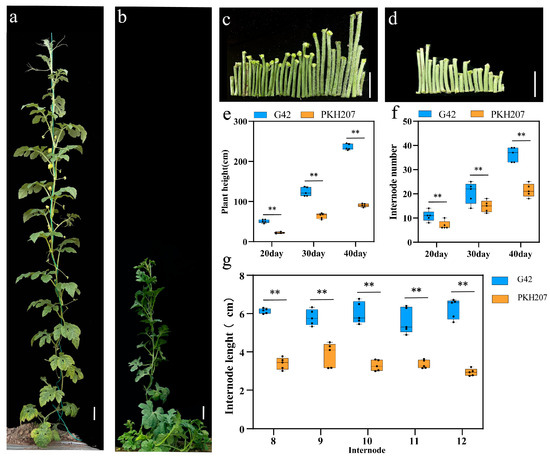
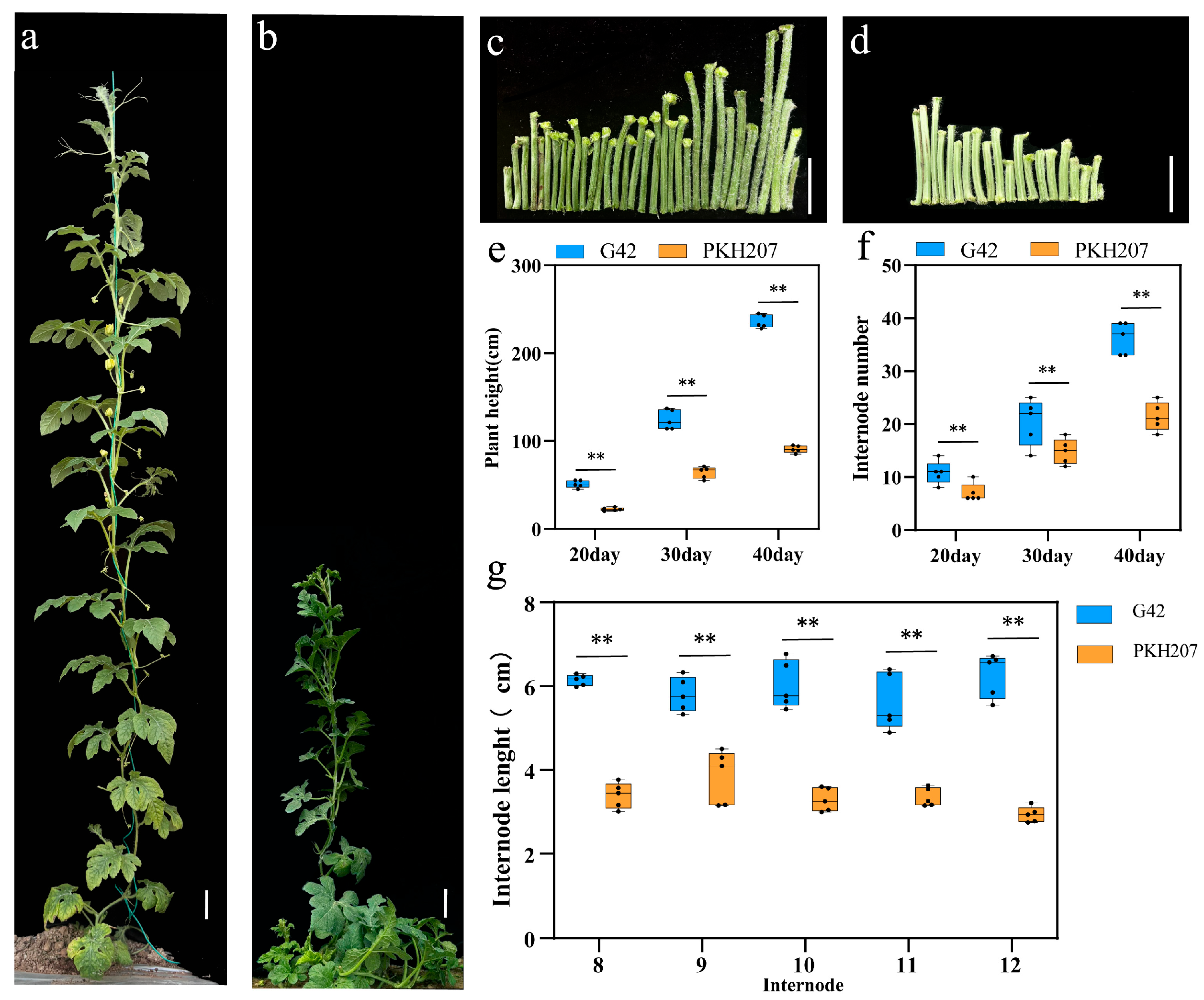
A dwarf mutant, designated PKH207, was identified from an EMS-mutagenized population of the watermelon inbred line G42 (Figure 1b). The dwarf phenotype was consistently inherited over multiple generations. Quantitative measurements of plant height and internode number were performed at 20, 30, and 40 DAT for both G42 (Figure 1a) and PKH207. Significant differences were observed throughout the entire growth and development period (Figure 1c,d). Compared with G42, the mutant exhibited a 61.5% reduction in plant height (Figure 1e), a 40.8% decrease in internode number (Figure 1f), and a significant shortening of internode length (Figure 1g) at 40 DAT. In addition to the dwarf phenotype, we observed that the size of female flowers of PKH207 was smaller compared to G42, and the longitudinal and transverse diameters of the mature fruits of PKH207 were smaller than those of G42, while soluble solids content remained unchanged. (Supplementary Figure S2). To determine the genetic basis of the dwarf phenotype, PKH207 was crossed with G42 to generate F1 progeny. All F1 plants displayed normal plant height, similar to G42. Self-pollination of the F1 plants produced an F2 segregating population of 558 individuals, of which 438 exhibited the normal height phenotype and 120 were dwarf, fitting into a 3:1 segregation ratio (Supplementary Table S1). This result indicates that the dwarf trait in PKH207 is controlled by a single recessive gene, which we named Cldw2 (Citrullus lanatus dwarf mutant).
Figure 1.
Phenotypic observation and statistical analysis of mutant PKH207 and wild-type G42 plants. (a) G42 plant at 30 DAT. (b) Mutant PKH207 plant at 30 DAT. (c) Internodes of G42 stem. (d) Internodes of PKH207 stem. (e) Plant height at different stages. (f) Internode number at different stages. (g) Length of internodes 8–12 at 30 DAT. Plant height, internode number and length of internodes were determined from three plants. Data are presented as mean ± standard deviation (mean ± SD). Error bars represent the standard deviation (SD) of three biological replicates. Asterisks indicate statistically significant differences between PKH207 and G42 (** p < 0.01, Student’s t-test). Scale bar = 3 cm.
3.2. Cytological Observation of Stem Internode Tissues
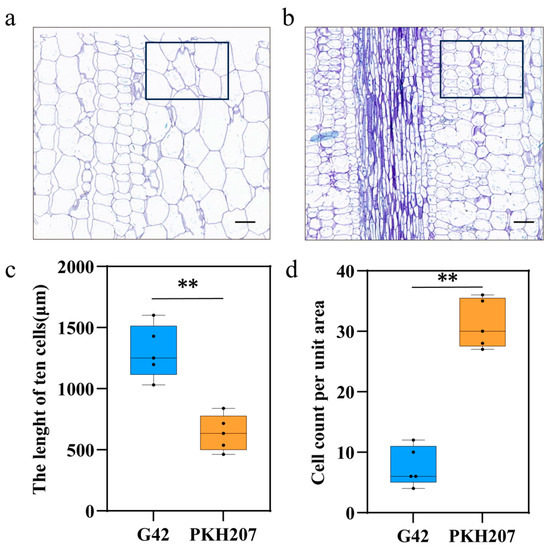
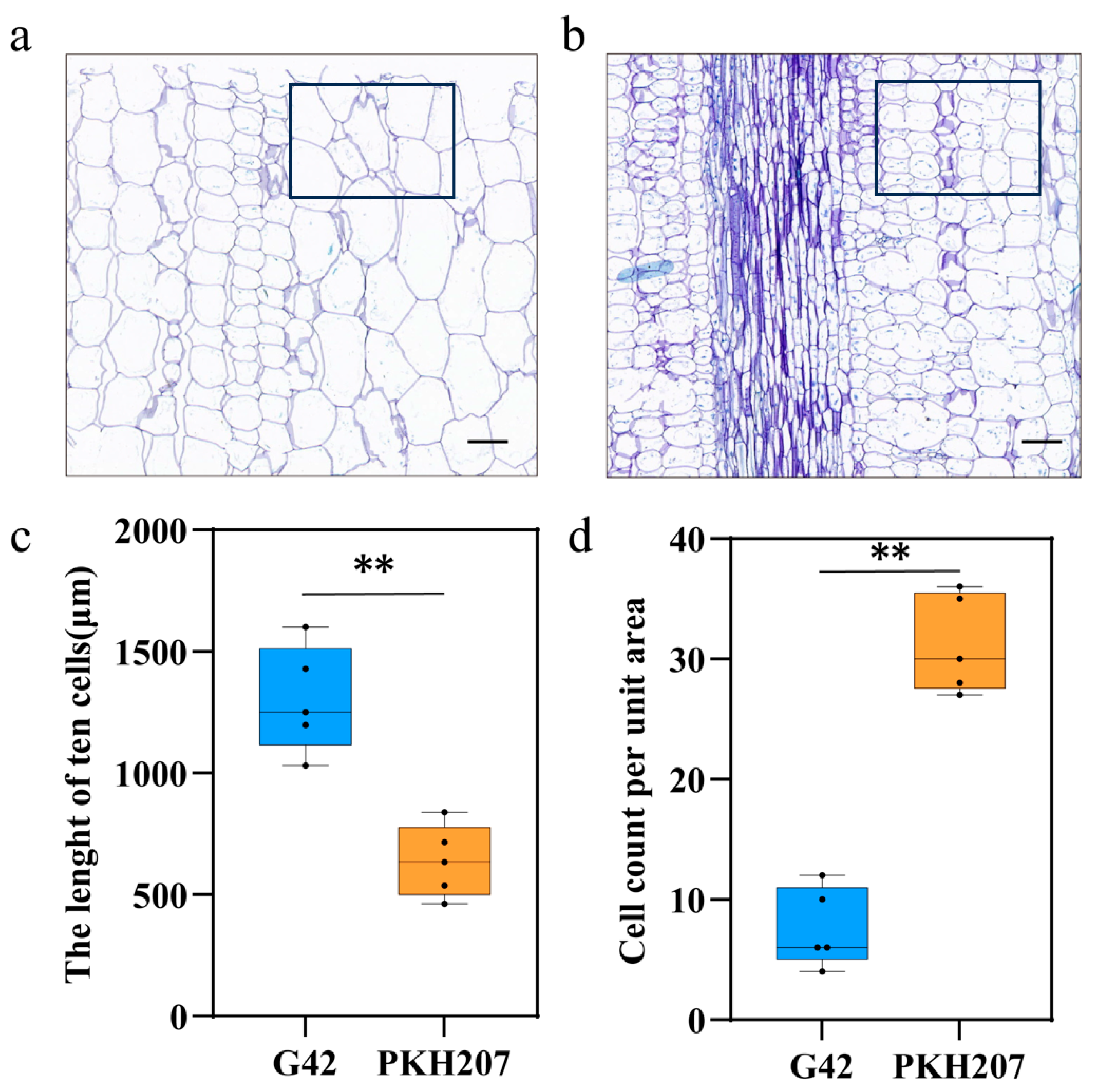
To investigate the cytological basis of the dwarf phenotype in PKH207, paraffin sections were prepared from the 5th (Number from bottom to top) internode of stems from both PKH207 and G42 plants. A comparative analysis of cellular morphology and dimensions was conducted between the two parental lines. Cytological observations revealed that the internode cells of PKH207 were markedly smaller than those of G42 (Figure 2a,b). Specifically, the longitudinal length of ten consecutive cells in G42 measured 1259 μm, which was significantly greater than the 679 μm observed in PKH207 (Figure 2c). Furthermore, the cell number per unit area was noticeably lower in G42 (9 cells) compared to PKH207 (33 cells) (Figure 2d). These results indicate that the shortened internodes in the mutant PKH207 result from a reduction in cell length within the internode tissues.
Figure 2.
Paraffin sections of stem internode cells and cell number statistics. (a) Longitudinal section of G42 stem. (b) Longitudinal section of PKH207 stem. (c) Length of ten consecutive cells. (d) Total number of cells per unit area (100,000 μm2). The boxes in subfigures (a,b) represent an example range for counting the number of cells per unit area. Error bars represent the standard deviation (SD) of three biological replicates. Asterisks indicate statistically significant differences between the two lines (** p < 0.01, Student’s t-test). Scale bar = 100 μm.
3.3. Mapping of the Cldw2 Gene
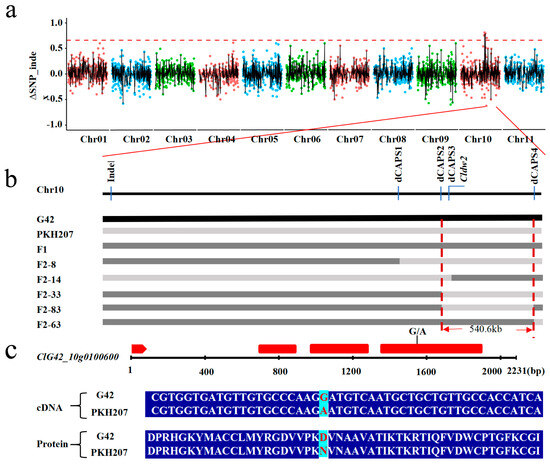
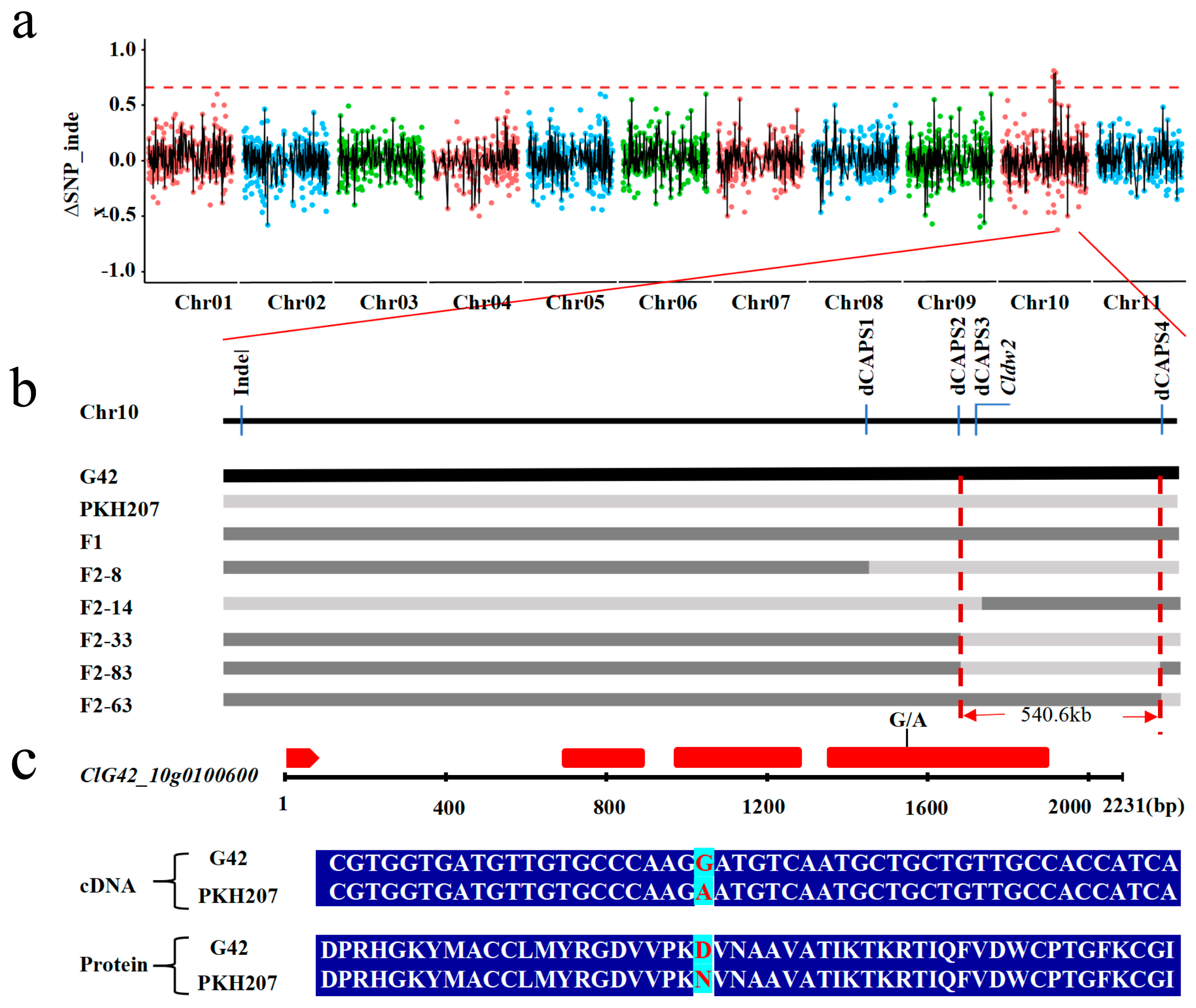
To rapidly map the Cldw2 locus, we performed BSA-seq analysis using an F2 population. A total of 39.95 Gb clean data were obtained and aligned to the watermelon reference genome “G42”, with a short-read alignment success rate exceeding 95%. In total, 37,906 SNP and InDel sites were detected. Analysis of the Δ(SNP-index) values between the mutant and normal pools revealed a significant peak above the threshold at the distal end of chromosome 10 (Figure 3a).
Figure 3.
Map-based cloning and sequence comparison of the candidate ClG42_10g0100600 gene. (a) BSA-seq analysis revealing the candidate region on Chromosome 10. The x-axis represents the genomic region, and the y-axis shows the Δ(SNP-index) value. The red horizontal line indicates the significance threshold, and the peak region exceeding the significance threshold marks the locus associated with the target trait. (b) Fine-mapping of the Cldw2 locus to a 540.6 kb interval, where ClG42_10g0100600 is the candidate gene. Markers and recombinant events are indicated. Black is the dominant genotype, dark gray is the heterozygous genotype, and light gray is the recessive genotype. (c) Gene structure and sequence alignment of the candidate gene. The exon/intron distribution of ClG42_10g0100600 is shown, with red boxes representing exons. A single-nucleotide polymorphism (SNP) in the fourth exon (indicated in red) results in amino acid substitution between the parental lines G42 and PKH207.
Based on the variant sites identified near the peak region, we developed molecular markers, including three dCAPS markers and one InDel marker. A genetic linkage map for Cldw2 was constructed using a subset of 96 individuals (Figure 3b). Ultimately, Cldw2 was delimited to a 540.6 Kb genomic region (21,130,885–21,671,450 bp) between markers dCAPS2 and dCAPS3. Within this region, only one SNP site (21,608,269: G→A) differed between the mutant pool and G42. A dCAPS4 marker developed based on this SNP site showed co-segregation with the dwarf phenotype in the subset population (Supplementary Figure S1). Subsequent genotyping of the entire 558 F2 population with dCAPS4 confirmed its complete co-segregation with the dwarf phenotype, indicating that this SNP is very likely the causative mutation for dwarfism in PKH207.
According to the watermelon reference genome annotation, this SNP (21,608,269: G→A) is located in the coding region of the gene ClG42_10g0100600. This gene is 2232 bp in length, contains four exons and three introns, and contains a PLN00221 conserved domain and encodes an α-tubulin protein. The G→A substitution at position 1858 in the fourth exon results in a non-synonymous amino acid change from aspartic acid to asparagine at the 327th position. This amino acid substitution occurs within the conserved domain and is predicted to affect protein function (Figure 3c). Taken all together, these findings indicate that ClG42_10g0100600 is the candidate gene underlying the Cldw2 locus.
3.4. Expression Pattern and Phylogenetic Analysis
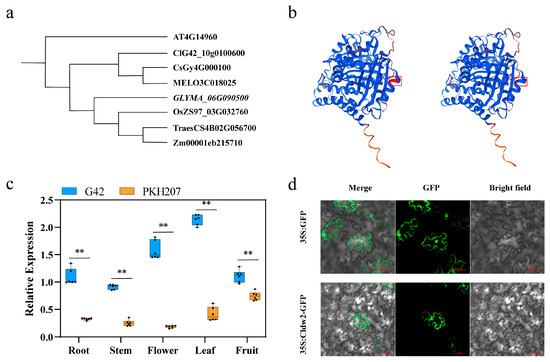
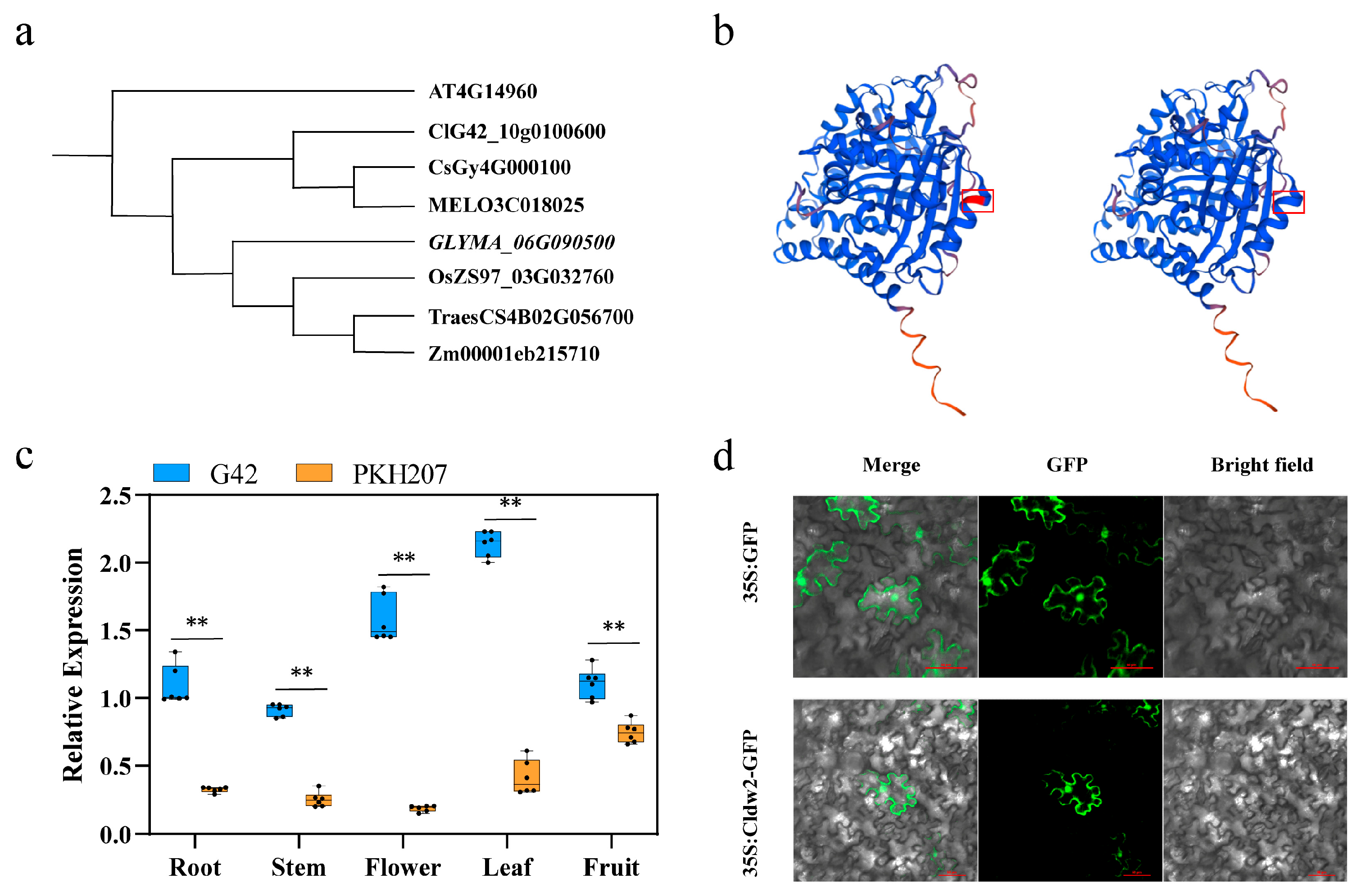
To investigate the evolutionary conservation and potential function of Cldw2 across plant species, we performed a protein BLAST (v2.17.0) search using the Cldw2 protein sequence against multiple species in the Phytozome14 database. These included the model plant (Arabidopsis), major field crops (maize, rice, wheat, and soybean), and cucurbit crops (cucumber and melon). Multiple sequence alignment revealed high amino acid similarity among all identified homologs (Figure 4a). The closest homology to watermelon ClG42_10g0100600 was observed in melon and cucumber. The G→A substitution at position 1859 within the conserved domain of Cldw2 results in a non-synonymous change from aspartic acid to asparagine (Supplementary Figure S3). Although this substitution occurs within a functionally important region, the predicted three-dimensional structure of the Cldw2 protein appears unaltered (Figure 4b), suggesting that the dwarf phenotype may result from more subtle functional disruptions rather than structural changes in the protein.
Figure 4.
Phylogenetic relationship, protein structure, and expression pattern analysis of the Cldw2 gene. (a) Phylogenetic tree of Cldw2 homologs from various plant species. AT4G14960 (Arabidopsis thaliana), CsGy4G000100 (Cucumis sativus), MELO3C018025 (Cucumis melo), GLYMA_06G090500 (Glycine max), OsZS97_03G032760 (Oryza sativa), TraesCS4B02G056700 (Triticum aestivum), and Zm00001eb215710 (Zea mays). The tree was constructed using the neighbor-joining method with 1000 bootstrap replicates. (b) Predicted three-dimensional structure of the Cldw2 protein. The model was generated by homology modeling using the Swiss-Model online website. The amino acid substitution site between G42 and PKH207 is indicated in red. (c) Tissue-specific expression of Cldw2 in G42 and PKH207. Relative transcript levels were examined in roots, stems, leaves, flowers, and fruits by qRT-PCR. Error bars represent the standard deviation (SD) of three biological replicates. Asterisks indicate statistically significant differences between the two lines (** p < 0.01, Student’s t-test). (d) Subcellular localization of the Cldw2 protein. The Cldw2-GFP fusion protein was transiently expressed in Nicotiana benthamiana leaves and visualized by confocal microscopy. GFP signals (green) were merged with bright-field. Scale bar = 50 μm.
To determine the expression pattern of Cldw2 in watermelon, we evaluated its transcript levels in different tissues of PKH207 and G42 using qRT-PCR. The results showed that Cldw2 was expressed in all examined tissues, with significantly lower expression in PKH207 than in G42 across all tissue types (Figure 4c). To investigate the subcellular localization of the Cldw2 protein, its CDS (without the stop codon) was fused to the GFP under the control of the 35S promoter. Transient expression of this 35S: Cldw2-GFP construct in tobacco leaves revealed GFP fluorescence signals in both the nucleus and the plasma membrane, indicating nuclear and membrane localization of the Cldw2 protein (Figure 4d).
3.5. Transcriptome Analysis
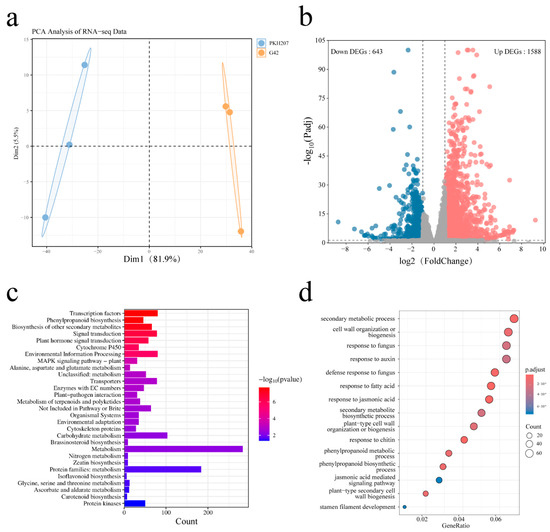
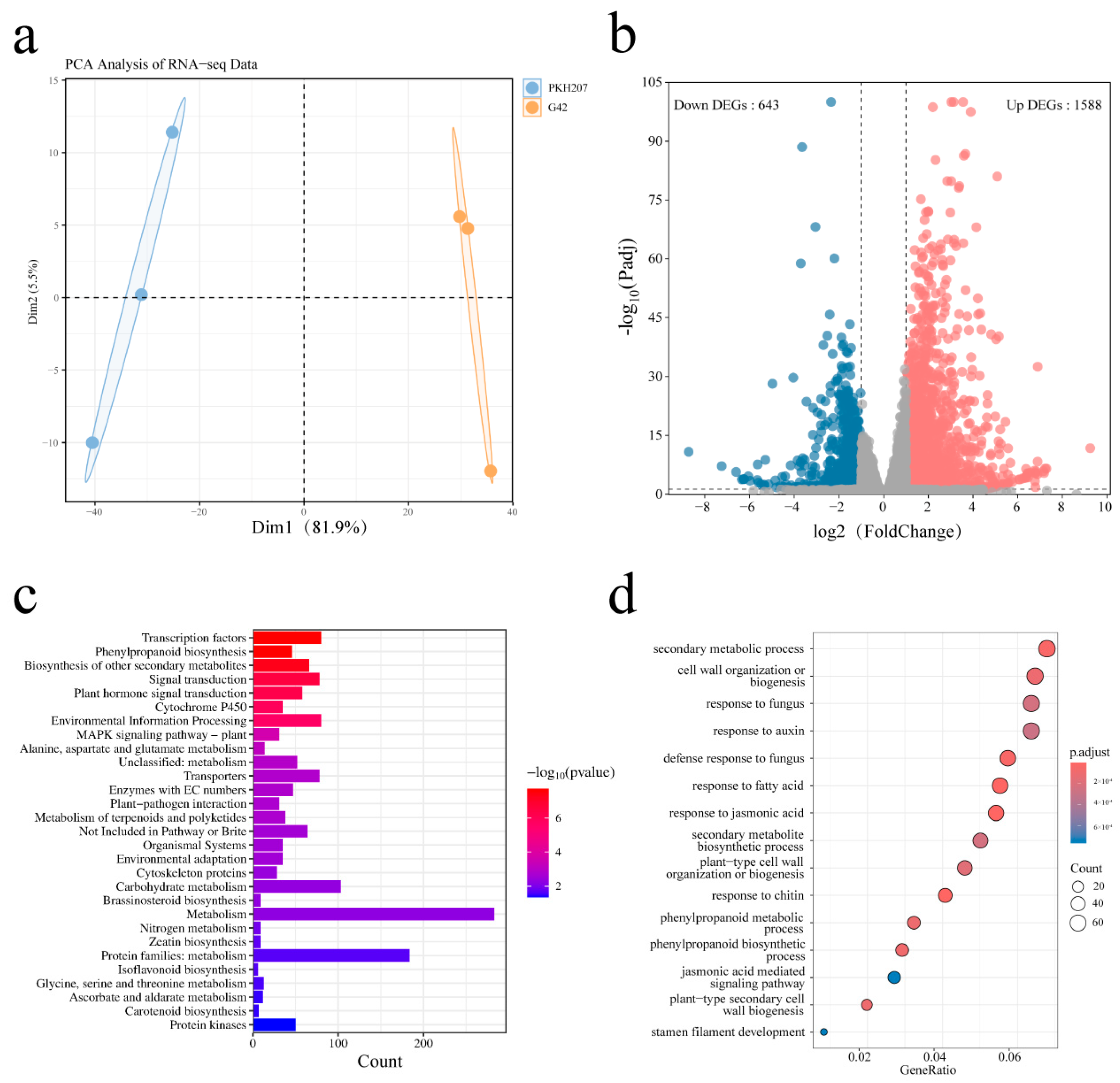
To uncover the molecular mechanism underlying the dwarf phenotype regulated by Cldw2 in watermelon, we performed RNA-seq analysis on stem tissues of G42 (wild-type) and the dwarf mutant PKH207, with three biological replicates per genotype. A total of 37.29 Gb of clean data were obtained, with an average of 6.21 Gb per sample. All samples showed high alignment efficiency to the reference genome, with alignment rates exceeding 96%. Principal component analysis (PCA) indicated high reproducibility among biological replicates and clear separation between the two genotypes (Figure 5a). Comparative transcriptome profiling identified 2231 differentially expressed genes (DEGs) in PKH207 compared to G42, of which 1588 were significantly upregulated and 643 were downregulated in the mutant (Figure 5b).
Figure 5.
Transcriptome profiling of stems from G42 and PKH207. (a) Principal component analysis (PCA) of transcriptome data from stem samples of G42 (orange) and PKH207 (blue). Each point represents a biological replicate, and the percentage of variance explained by each principal component is indicated in parentheses. (b) Volcano plot showing differentially expressed genes (DEGs) between G42 and PKH207. The x-axis represents the log2 fold change (G42 vs. PKH207), and the y-axis represents the –log10 (adjusted p-value). Red and blue dots indicate genes with significantly upregulated and downregulated expression, respectively (padj < 0.05), while gray dots represent genes with no significant difference in expression between the two genotypes. (c) KEGG enrichment analysis of DEGs. (d) Gene Ontology (GO) enrichment analysis of DEGs.
GO and KEGG enrichment analyses revealed that the DEGs were significantly enriched in pathways associated with cell wall organization or biosynthesis, response to auxin stimulus, and cytoskeleton organization. KEGG analysis specifically highlighted significant enrichment in plant hormone signal transduction and brassinosteroid biosynthesis pathways (Figure 5c). In the GO enrichment analysis, the Biological Process category was significantly enriched for terms such as cell wall organization or biogenesis (GO:0009699), carbohydrate biosynthetic process (GO:0098656), and plant-type cell response to auxin stimulus (GO:0071365) (Figure 5d). In the Cellular Component category, enriched terms included the kinesin complex (GO:0005871), microtubule-associated complex (GO:0005875), and microtubule cytoskeleton (GO:0015630). The Molecular Function category showed significant enrichment for cytoskeletal motor activity (GO:0003774) and amino acid transmembrane transporter activity (GO:0015171).
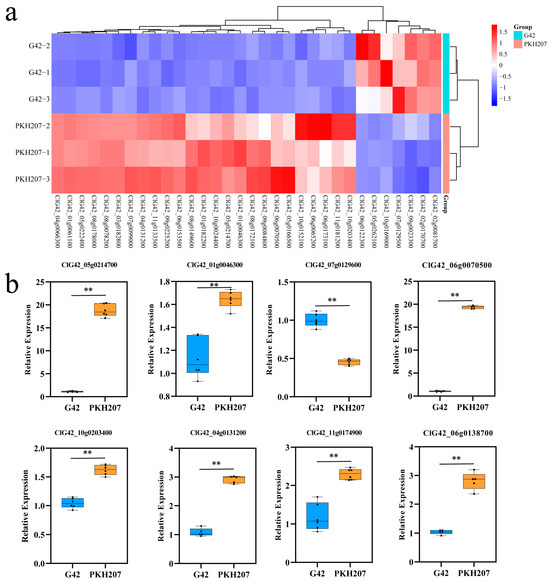
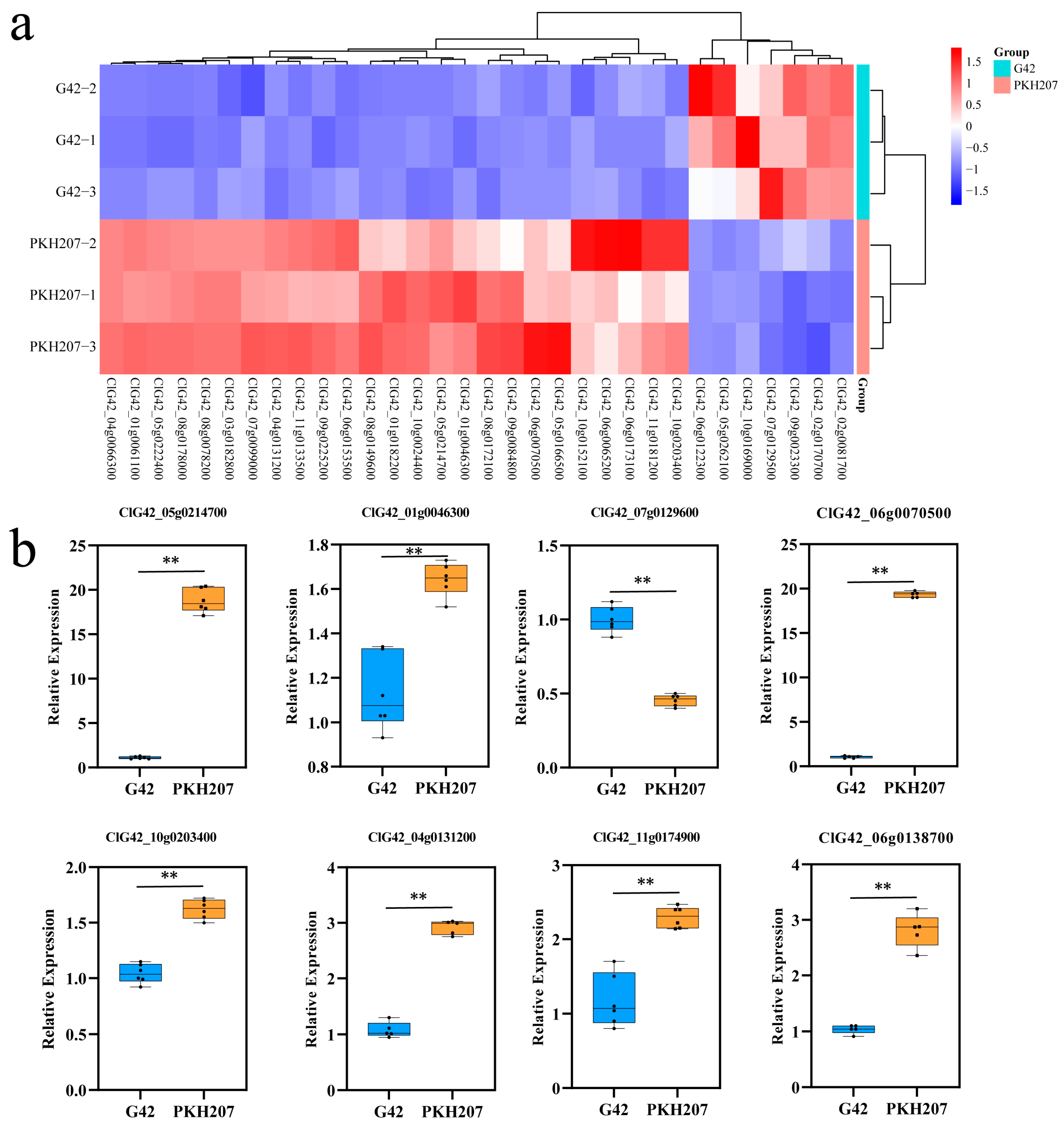
Given the established association between plant dwarfism and hormone pathways and the significant enrichment of auxin-related terms in our transcriptome analysis, we constructed a clustering heatmap focused on auxin-related DEGs (Figure 6a). A detailed inspection of these genes revealed altered expression patterns for several genes involved in auxin synthesis and metabolism, such as the auxin-induced protein AUX2-11 (involved in early auxin response), the AUX/IAA transcriptional repressor IAA19 (a core negative regulator in auxin signaling with typical auxin response elements), the R2R3-MYB transcription factor MYB77 (responsive to K and auxin deficiency and interacting with UVR8 to regulate auxin response and lateral development), the auxin efflux carrier PIN1 (involved in stem and root development), and the transcriptional regulator AXR3 (a repressor of auxin-induced protein expression). Subsequent qRT-PCR validation of selected auxin-related genes confirmed expression patterns consistent with the RNA-seq data (Figure 6b).
Figure 6.
Expression patterns of selected differentially expressed genes (DEGs) in stems of G42 and PKH207. (a) Heatmap showing the expression profiles of representative DEGs involved in auxin signaling, cell wall biosynthesis, and microtubule organization. (b) qRT-PCR validation of eight selected DEGs. ClG42_05g0214700 (ClMYB77), ClG42_01g0046300 (ClAUX2-11), ClG42_07g0129600 (ClIAA19), ClG42_06g0070500 (ClMYB14), ClG42_10g0203400 (ClRVE8), ClG42_04g0131200 (Clbt1), ClG42_11g0174900 (ClUMAMIT17), and ClG42_06g0138700 (ClXBAT32). During the analysis process, some unreasonable data were excluded. The internal reference gene used was ClActin, and the primer sequences were ClActin-F (CCATGTATGTTGCCATCCAG) and ClActin-R (GGATAGCATGGGGTAGAGCA). Relative expression levels are shown as mean ± SD (n = 3 biological replicates, each with three technical replicates). Asterisks indicate significant differences (** p < 0.01, Student’s t-test).
4. Discussion
In this study, we characterized a new dwarf mutant, PKH207, derived from an EMS-mutagenized population. Phenotypic analysis revealed that its dwarf architecture results from shorter internode length, reduced internode number, and reduced cell expansion in stem tissues. Additionally, PKH207 also exhibits smaller female flowers and fruits while retaining soluble solid content compared to wild-type plants, distinguishing it from previously reported dwarf germplasms. Through genetic analysis, BSA-seq, and linkage analysis of an F2 population derived from a cross between PKH207 and G42, the causal gene was mapped to ClG42_10g0100600, which encodes an α-tubulin protein containing a PLN00221 conserved domain. An SNP within this conserved domain causes a non-synonymous amino acid change (Asp to Asn). Using a developed dCAPS marker, we confirmed complete co-segregation of this SNP with the dwarf phenotype in the F2 population, establishing it as the causative mutation underlying the PKH207 phenotype.
Cldw2 encodes an α-tubulin (TUA), a core component of microtubules. Microtubules are essential for various fundamental cellular processes, including cell division, morphogenesis, and wall patterning [46,47]. The mutation within the conserved domain of α-tubulin in PKH207 likely compromises microtubule assembly or dynamics, thereby inhibiting cell elongation. Interestingly, in Arabidopsis, mutations in α-tubulin genes (e.g., tua1, tua4) often cause helical growth and twisting of roots and stems rather than pure dwarfism, suggesting that the specific position and nature of the amino acid substitution determine the specific phenotypic outcome. The Asp-to-Asn substitution in Cldw2 may preferentially affect cell elongation without disrupting microtubule orientation, which could account for the absence of twisting in the watermelon mutant. This contrasts with the rice OsTUBA3 mutant, which exhibits grain notching without overall dwarfism [48]. In soybean IT1 mutants, mutations in the gene encoding alpha microtubule protein result in the mutant plant exhibiting a compact plant structure, shorter plant height, and shorter petioles [49]. Collectively, these observations indicate that the phenotypic consequences of α-tubulin mutations are highly dependent on the species, the specific tubulin isotype, and the location of the amino acid substitution.
Numerous studies have established that dwarfism in plants mostly results from mutations in genes involved in the biosynthesis or signal transduction of key phytohormones. Disruptions in the synthesis or transport pathways of gibberellins [22], auxins [50,51], brassinosteroids [52,53], strigolactones [2,54], and transporters such as the ABCB family have all been implicated in dwarf phenotypes [26,55,56]. The ABCB family represents the second largest subfamily of ABC transporters in plants, with established roles in the transmembrane transport of auxins, secondary metabolites, and xenobiotics, particularly playing a crucial role in auxin transport [57]. Our transcriptome analysis revealed a significant enrichment of DEGs in auxin-related pathways, including auxin synthesis, transport, and response. Several key auxin-related genes exhibited altered expression in the Cldw2 mutant: the auxin-induced gene AUX2-11 was upregulated; the transcription factor MYB77, which responds to auxin deficiency, was also upregulated; whereas the auxin signaling core repressor AUX/IAA (IAA19) was downregulated. These expression changes suggest that Cldw2 may also regulate plant height through auxin-mediated regulatory networks.
Recently, a semi-dominant dwarfing allele of the α-tubulin gene (ClTUA/ClG42_10g0100600) was reported in watermelon [58]. In their study, a C→T transition at nucleotide position 1851 led to a proline (Pro) to serine (Ser) substitution, and the F2 population exhibited a 1:2:1 segregation ratio (long-vine: semidwarf: dwarf). However, our mutant allele Cldw2 carries a unique SNP within the conserved domain, leading to the substitution of aspartic acid for asparagine. This allele displays a typical recessive inheritance pattern, with a 3:1 segregation ratio (long-vine: dwarf) in the F2 population and no intermediate phenotypes. Phenotypically, PKH207 mutants retain the ability to produce female flowers and set fruit, albeit with reduced fruit size, while maintaining soluble solid content. This is distinct from the previously reported homozygous mutant, which produced few to no female flowers. Mechanistically, although Hu et al. [58] described a dosage-dependent reduction in IAA levels, our transcriptomic analyses suggest a distinct auxin regulatory network involving altered expression of genes such as AUX2-11, MYB77, and IAA19. The main contrasts between our findings and those of Hu et al. [58] are inheritance pattern (recessive vs. semi-dominant), phenotype of homozygotes (dwarf with female flowers and fruits vs. dwarf with few to no female flowers), and auxin regulatory network (altered expression of AUX2-11, MYB77, IAA19 vs. dosage-dependent reduction in IAA levels). Collectively, different allelic mutations in the same α-tubulin gene can lead to distinct genetic models and phenotypic effects in watermelon. The identification of Cldw2 as a novel recessive allele at this locus expands the known allelic series and provides a valuable genetic resource for dwarf watermelon breeding programs. Although PKH207 shows reduced fruit size, its soluble solid content remains unchanged. The recessive nature of Cldw2 allows its use in hybrid breeding (F1 plants are normal height). For direct cultivation, it may be suitable for high-density planting of smaller-fruited varieties or for ornamental purposes. Future studies should evaluate yield per unit area under dense planting conditions to determine if it is suitable for commercial production.
Collectively, our findings support a model in which Cldw2 modulates plant architecture by affecting both auxin pathways and cytoskeletal organization, thereby regulating cell elongation and internode development in watermelon.
5. Conclusions
In conclusion, we identified a novel recessive dwarf mutant, PKH207, in watermelon. The dwarf phenotype is caused by a single SNP in the α-tubulin gene Cldw2. This mutation reduces cell expansion and internode length while maintaining fruit quality. Transcriptome analysis revealed that Cldw2 affects auxin signaling and cytoskeletal organization. To our knowledge, this is the first α-tubulin-based dwarfing allele reported in cucurbits that exhibits recessive inheritance and retains female fertility. Cldw2 provides a valuable genetic resource for breeding compact, high-density-adapted watermelon cultivars. Future studies should investigate the biochemical effects of this mutation and evaluate its breeding potential.
Supplementary Materials
The following supporting information can be downloaded at https://www.mdpi.com/article/10.3390/horticulturae12050539/s1, Supplementary Figure S1. Validation of the dCAPS marker in the F2 population by polyacrylamide gel electrophoresis. Supplementary Figure S2. Phenotypic comparison of flowers and fruits between G42 and PKH207. Supplementary Figure S3. Protein analysis of ClG42_10g0100600. Supplementary Table S1. Genetic analysis of the dwarf trait in the F2 population (G42×PKH207). Supplementary Table S2. The information of Primers used in this study. Supplementary Table S3. Detailed information of genes/mutants listed in this study.
Author Contributions
J.T. and J.D. designed and supervised the research; P.T. conducted the research; S.D., Q.K., Y.G., X.L., Y.L., S.P., W.Y. (Weige Yuan), and M.Y. contributed to the experimental design and data interpretation; J.H., H.N., H.Z., J.D., D.L., and W.Y. (Wenkai Yan) edited the manuscript; and L.Y., J.T., and P.T. participated in data analysis and manuscript writing. All authors have read and agreed to the published version of the manuscript.
Funding
This research was supported by the National Natural Science Foundation of China (Grant No. 32172602, 32472739), the Excellent Youth Foundation of the Henan Scientific Committee (Grant No. 242300421030), the Key Science and Technology Project of Henan Province (Grant No. 262102111150), the Natural Science Foundation of Henan (Grant No. 262300421473), the Science and Technology Project of the Tibetan Plateau Seed Breeding Technology Innovation Center (No. LSQSCNYQ2025006), and the Scientific and Technological Innovation Team in Colleges and Universities in Henan (No. 26IRTSTHN014).
Institutional Review Board Statement
Not applicable.
Data Availability Statement
The original contributions presented in this study are included in the article/Supplementary Material. Further inquiries can be directed to the corresponding author.
Acknowledgments
The authors are grateful to members of Yang’s lab for technical assistance and discussions. Acknowledgments to Xingping Zhang and Yun Deng from the Peking University Institute of Advanced Agricultural Sciences for providing the mutant materials.
Conflicts of Interest
The authors declare no competing interests.
References
- Monna, L. Positional Cloning of Rice Semidwarfing Gene, Sd-1: Rice “Green Revolution Gene” Encodes a Mutant Enzyme Involved in Gibberellin Synthesis. DNA Res. 2002, 9, 11–17. [Google Scholar] [CrossRef] [Scilit]
- Liu, F.; Wang, P.; Zhang, X.; Li, X.; Yan, X.; Fu, D.; Wu, G. The Genetic and Molecular Basis of Crop Height Based on a Rice Model. Planta 2018, 247, 1–26. [Google Scholar] [CrossRef] [Scilit] [PubMed]
- Worland, A.J.; Sayers, E.J.; Korzun, V. Allelic Variation at the Dwarfing Gene Rht8 Locus and Its Significance in International Breeding Programmes. Euphytica 2001, 119, 157–161. [Google Scholar] [CrossRef] [Scilit]
- Guo, B.; Jin, X.; Chen, J.; Xu, H.; Zhang, M.; Lu, X.; Wu, R.; Zhao, Y.; Guo, Y.; An, Y.; et al. ATP-Dependent DNA Helicase (TaDHL), a Novel Reduced-Height (Rht) Gene in Wheat. Genes 2022, 13, 979. [Google Scholar] [CrossRef] [Scilit] [PubMed]
- Yang, D.; Zheng, X.; Cheng, C.; Wang, W.; Xing, D.; Lu, L.; Liu, C.; Ye, N.; Zeng, M.; Ye, X. A Dwarfing Mutant Caused by Deactivation Function of Alpha Subunit of the Heterotrimeric G-Protein in Rice. Euphytica 2014, 197, 145–159. [Google Scholar] [CrossRef] [Scilit]
- Li, J.; Ali, S.A.; Xiao, G.; Chen, F.; Yuan, L.; Gu, R. Phenotypic Characterization and Genetic Mapping of the Dwarf Mutant M34 in Maize. J. Integr. Agric. 2019, 18, 948–957. [Google Scholar] [CrossRef] [Scilit]
- Sun, Z.; Feng, G.; Yang, X.; Liu, D.; Liang, Z.; Qin, Y.; Wang, Z.; Yan, Z.; Liu, C. Identification and Fine Mapping of a Mutant Pv-nts Gene Responsible for Dwarf and Thin Stem of Snap Bean (Phaseolus vulgaris L.). Plant Breed. 2024, 143, 872–882. [Google Scholar] [CrossRef] [Scilit]
- Zhao, L.; Di, J.; Guo, Q.; Zhao, J.; Zhou, X.; Chen, X. The Differentially Expressed Genes Identification in Dwarf Mutant of Gossypium Hirsutum by RNA-Seq Approach. Agri Gene 2017, 5, 37–44. [Google Scholar] [CrossRef] [Scilit]
- Peng, J.; Richards, D.E.; Hartley, N.M.; Murphy, G.P.; Devos, K.M.; Flintham, J.E.; Beales, J.; Fish, L.J.; Worland, A.J.; Pelica, F.; et al. ‘Green Revolution’ Genes Encode Mutant Gibberellin Response Modulators. Nature 1999, 400, 256–261. [Google Scholar] [CrossRef] [Scilit]
- Tian, X.; Xia, X.; Xu, D.; Liu, Y.; Xie, L.; Hassan, M.A.; Song, J.; Li, F.; Wang, D.; Zhang, Y.; et al. Rht24b, an Ancient Variation of TaGA2ox-A9, Reduces Plant Height without Yield Penalty in Wheat. New Phytol. 2022, 233, 738–750. [Google Scholar] [CrossRef] [Scilit]
- Xiong, H.; Zhou, C.; Fu, M.; Guo, H.; Xie, Y.; Zhao, L.; Gu, J.; Zhao, S.; Ding, Y.; Li, Y.; et al. Cloning and Functional Characterization of Rht8, a “Green Revolution” Replacement Gene in Wheat. Mol. Plant 2022, 15, 373–376. [Google Scholar] [CrossRef] [Scilit]
- Sasaki, A.; Ashikari, M.; Ueguchi-Tanaka, M.; Itoh, H.; Nishimura, A.; Swapan, D.; Ishiyama, K.; Saito, T.; Kobayashi, M.; Khush, G.S.; et al. A Mutant Gibberellin-Synthesis Gene in Rice. Nature 2002, 416, 701–702. [Google Scholar] [CrossRef] [Scilit]
- Ferrero-Serrano, Á.; Assmann, S.M. The α-Subunit of the Rice Heterotrimeric G Protein, RGA1, Regulates Drought Tolerance during the Vegetative Phase in the Dwarf Rice Mutant D1. J. Exp. Bot. 2016, 67, 3433–3443. [Google Scholar] [CrossRef] [Scilit]
- Makarevitch, I.; Thompson, A.; Muehlbauer, G.J.; Springer, N.M. Brd1 Gene in Maize Encodes a Brassinosteroid C-6 Oxidase. PLoS ONE 2012, 7, e30798. [Google Scholar] [CrossRef] [Scilit]
- Xu, X.; Hu, Q.; Wang, J.; Wang, X.; Lou, L.; Xu, J.; Yang, X.; Chen, X. A 2-Bp Deletion in the Protein Kinase Domain Region of the ERECTA-like Receptor Kinase Gene in Cucumber Results in Short Internode Phenotype. Plant Sci. 2023, 327, 111536. [Google Scholar] [CrossRef] [Scilit]
- Wang, H.; Li, W.; Qin, Y.; Pan, Y.; Wang, X.; Weng, Y.; Chen, P.; Li, Y. The Cytochrome P450 Gene CsCYP85A1 Is a Putative Candidate for Super Compact-1 (Scp-1) Plant Architecture Mutation in Cucumber (Cucumis sativus L.). Front. Plant Sci. 2017, 8, 266. [Google Scholar] [CrossRef] [Scilit] [PubMed]
- Yang, S.; Zhang, K.; Zhu, H.; Zhang, X.; Yan, W.; Xu, N.; Liu, D.; Hu, J.; Wu, Y.; Weng, Y.; et al. Melon Short Internode (CmSi) Encodes an ERECTA-like Receptor Kinase Regulating Stem Elongation through Auxin Signaling. Hortic. Res. 2020, 7, 202. [Google Scholar] [CrossRef] [Scilit]
- Xiang, C.; Duan, Y.; Shu, Q.; Bo, K.; Weng, Y.; Sui, X.; Wang, C. CmaGA2ox2 Is Associated with Dwarf Plant Architecture Controlled by the Single Dominant CmaDw-1 Locus in Winter Squash. Hortic. Plant J. 2025; in press. [CrossRef] [Scilit]
- Yuan, P.; He, N.; Zhao, S.; Lu, X.Q.; Zhu, H.J.; Diao, W.N.; Gong, C.S.; Muhammad, J.U.; Liu, W. Metabolomics Comparative Study on Fruits of Edible Seed Watermelon, Egusi and Common Watermelon. Chin. J. Agric. Sci. 2021, 54, 4179–4195. [Google Scholar] [CrossRef]
- Pang, R.; Xie, X.; Guo, L.; Wang, R. Analysis of the Current Status of Quality and Safety Standards for Watermelon and Melon in China. China Crop Veg. 2022, 35, 1–10. (In Chinese) [Google Scholar]
- Dong, W.; Wu, D.; Li, G.; Wu, D.; Wang, Z. Next-Generation Sequencing from Bulked Segregant Analysis Identifies a Dwarfism Gene in Watermelon. Sci. Rep. 2018, 8, 2908. [Google Scholar] [CrossRef] [Scilit]
- Gebremeskel, H.; Dou, J.; Li, B.; Zhao, S.; Muhammad, U.; Lu, X.; He, N.; Liu, W. Molecular Mapping and Candidate Gene Analysis for GA3 Responsive Short Internode in Watermelon (Citrullus lanatus). Int. J. Mol. Sci. 2019, 21, 290. [Google Scholar] [CrossRef] [Scilit] [PubMed]
- Sun, Y.; Zhang, H.; Fan, M.; He, Y.; Guo, P. A Mutation in the Intron Splice Acceptor Site of a GA3ox Gene Confers Dwarf Architecture in Watermelon (Citrullus lanatus L.). Sci. Rep. 2020, 10, 14915. [Google Scholar] [CrossRef] [Scilit] [PubMed]
- Wei, C.; Zhu, C.; Yang, L.; Zhao, W.; Ma, R.; Li, H.; Zhang, Y.; Ma, J.; Yang, J.; Zhang, X. A Point Mutation Resulting in a 13 Bp Deletion in the Coding Sequence of Cldf Leads to a GA-Deficient Dwarf Phenotype in Watermelon. Hortic. Res. 2019, 6, 132. [Google Scholar] [CrossRef] [Scilit]
- Jang, Y.J.; Yun, H.S.; Rhee, S.-J.; Seo, M.; Kim, Y.; Lee, G.P. Exploring Molecular Markers and Candidate Genes Responsible for Watermelon Dwarfism. Hortic. Environ. Biotechnol. 2020, 61, 173–182. [Google Scholar] [CrossRef] [Scilit]
- Zhu, H.; Zhang, M.; Sun, S.; Yang, S.; Li, J.; Li, H.; Yang, H.; Zhang, K.; Hu, J.; Liu, D.; et al. A Single Nucleotide Deletion in an ABC Transporter Gene Leads to a Dwarf Phenotype in Watermelon. Front. Plant Sci. 2019, 10, 1399. [Google Scholar] [CrossRef] [Scilit]
- Chen, L.; Duan, L.; Sun, M.; Yang, Z.; Li, H.; Hu, K.; Yang, H.; Liu, L. Current Trends and Insights on EMS Mutagenesis Application to Studies on Plant Abiotic Stress Tolerance and Development. Front. Plant Sci. 2023, 13, 1052569. [Google Scholar] [CrossRef] [Scilit]
- Unan, R.; Deligoz, I.; Al-Khatib, K.; Mennan, H. Protocol for Ethyl Methanesulphonate (EMS) Mutagenesis Application in Rice. Open Res. Eur. 2022, 1, 19. [Google Scholar] [CrossRef] [Scilit]
- Wang, D.; Li, Y.; Wang, H.; Xu, Y.; Yang, Y.; Zhou, Y.; Chen, Z.; Zhou, Y.; Gui, L.; Guo, Y.; et al. Boosting Wheat Functional Genomics via an Indexed EMS Mutant Library of KN9204. Plant Commun. 2023, 4, 100593. [Google Scholar] [CrossRef] [Scilit]
- Jeong, J.; Kulkarni, K.P.; Chang, J.H.; Ha, B.; Kang, S.T.; Bilyeu, K.; Jo, H.; Song, J.T.; Lee, J. A Novel Allele of GmSACPD-C Associated with High Seed Stearic Acid Concentration in an EMS-Induced Mutant PE980 in Soybean. Crop Sci. 2018, 58, 192–203. [Google Scholar] [CrossRef] [Scilit]
- Zhang, M.; Du, H.; Pang, S.; Guo, X.; Zhang, G.; Ji, X. Creation and Phenotypic Analysis of an EMS Mutant Library for Processing Tomatoes. J. Plant Growth Regul. 2025, 44, 3937–3948. [Google Scholar] [CrossRef] [Scilit]
- Wei, Y.; Liu, Y.; Ali, A.M.; Xiao, R.; Liang, C.; Meng, Z.; Wang, Y.; Wang, P.; Wang, X.; Zhang, R. Rich Variant Phenotype of Gossypium hirsutum L. Saturated Mutant Library Provides Resources for Cotton Functional Genomics and Breeding. Ind. Crops Prod. 2022, 186, 115232. [Google Scholar] [CrossRef] [Scilit]
- Lu, Y.; Dai, S.; Gu, A.; Liu, M.; Wang, Y.; Luo, S.; Zhao, Y.; Wang, S.; Xuan, S.; Chen, X.; et al. Microspore Induced Doubled Haploids Production from Ethyl Methanesulfonate (EMS) Soaked Flower Buds Is an Efficient Strategy for Mutagenesis in Chinese Cabbage. Front. Plant Sci. 2016, 7, 1780. [Google Scholar] [CrossRef] [Scilit]
- Siddique, M.I.; Back, S.; Lee, J.-H.; Jo, J.; Jang, S.; Han, K.; Venkatesh, J.; Kwon, J.-K.; Jo, Y.D.; Kang, B.-C. Development and Characterization of an Ethyl Methane Sulfonate (EMS) Induced Mutant Population in Capsicum annuum L. Plants 2020, 9, 396. [Google Scholar] [CrossRef] [Scilit]
- Xiang, Y.; Cui, H.; Fu, L.; Wang, X.; Zhou, Y.; Yao, S.; Li, M.; Liu, H.; Pan, Y. Ethyl Methanesulfonate (EMS) Mutagenesis with Cucumber Pollens and a Case Study of the Map-Based Gene Cloning with EMS-Induced Mutants. Plant Sci. 2026, 364, 112985. [Google Scholar] [CrossRef] [Scilit] [PubMed]
- Yin, L.; Hou, Y.; Chen, X.; Huang, X.; Feng, M.; Wang, C.; Wang, Z.; Yue, Z.; Zhang, Y.; Ma, J.; et al. Construction of Watermelon Mutant Library Based on 60Co γ-Ray Irradiation and EMS Treatment for Germplasm Innovation. Horticulturae 2023, 9, 1133. [Google Scholar] [CrossRef] [Scilit]
- Steven, E. Ruzin Plant Microtechnique and Microscopy; Oxford University Press: New York, NY, USA, 1999. [Google Scholar]
- Fekih, R.; Takagi, H.; Tamiru, M.; Abe, A.; Natsume, S.; Yaegashi, H.; Sharma, S.; Sharma, S.; Kanzaki, H.; Matsumura, H.; et al. MutMap+: Genetic Mapping and Mutant Identification without Crossing in Rice. PLoS ONE 2013, 8, e68529. [Google Scholar] [CrossRef] [Scilit]
- Neff, M.M.; Turk, E.; Kalishman, M. Web-Based Primer Design for Single Nucleotide Polymorphism Analysis. Trends Genet. 2002, 18, 613–615. [Google Scholar] [CrossRef] [Scilit]
- Dou, J.; Yang, H.; Sun, D.; Yang, S.; Sun, S.; Zhao, S.; Lu, X.; Zhu, H.; Liu, D.; Ma, C.; et al. The Branchless Gene Clbl in Watermelon Encoding a TERMINAL FLOWER 1 Protein Regulates the Number of Lateral Branches. Theor. Appl. Genet. 2022, 135, 65–79. [Google Scholar] [CrossRef] [Scilit]
- Duan, S.; Guo, Y.; Wang, Y.; Jawad Umer, M.; Liu, D.; Yang, S.; Niu, H.; Sun, S.; Yang, L.; Dou, J.; et al. HD-Zip Transcription Factor Is Responsible for No-Lobed Leaf in Watermelon (Citrullus lanatus L.). Phyton 2023, 92, 1311–1328. [Google Scholar] [CrossRef] [Scilit]
- Yang, S.; Wang, X.; Yan, W.; Zhang, Y.; Song, P.; Guo, Y.; Xie, K.; Hu, J.; Hou, J.; Wu, Y.; et al. Melon Yellow-Green Plant (Cmygp) Encodes a Golden2-like Transcription Factor Regulating Chlorophyll Synthesis and Chloroplast Development. Theor. Appl. Genet. 2023, 136, 66. [Google Scholar] [CrossRef] [Scilit]
- Liu, D.; Yang, H.; Yuan, Y.; Zhu, H.; Zhang, M.; Wei, X.; Sun, D.; Wang, X.; Yang, S.; Yang, L. Comparative Transcriptome Analysis Provides Insights into Yellow Rind Formation and Preliminary Mapping of the Clyr (Yellow Rind) Gene in Watermelon. Front. Plant Sci. 2020, 11, 192. [Google Scholar] [CrossRef] [Scilit] [PubMed]
- Chen, C.; Chen, H.; Zhang, Y.; Thomas, H.R.; Frank, M.H.; He, Y.; Xia, R. TBtools: An Integrative Toolkit Developed for Interactive Analyses of Big Biological Data. Mol. Plant 2020, 13, 1194–1202. [Google Scholar] [CrossRef] [Scilit] [PubMed]
- Tang, D.; Chen, M.; Huang, X.; Zhang, G.; Zeng, L.; Zhang, G.; Wu, S.; Wang, Y. SRplot: A Free Online Platform for Data Visualization and Graphing. PLoS ONE 2023, 18, e0294236. [Google Scholar] [CrossRef] [Scilit]
- Cleary, J.M.; Hancock, W.O. Molecular Mechanisms Underlying Microtubule Growth Dynamics. Curr. Biol. 2021, 31, R560–R573. [Google Scholar] [CrossRef] [Scilit]
- Wasteneys, G.O. Progress in Understanding the Role of Microtubules in Plant Cells. Curr. Opin. Plant Biol. 2004, 7, 651–660. [Google Scholar] [CrossRef] [Scilit] [PubMed]
- Xu, C.; Chen, B.; Huang, S.; Deng, Z.; Wang, T. A Point Mutation in the Rice Alpha-tubulin Gene OsTUBA3 Causes Grain Notching. New Phytol. 2023, 240, 1052–1065. [Google Scholar] [CrossRef] [Scilit]
- Su, B.; Guo, Y.; Li, Z.; Gao, H.; Wei, Z.; Qiu, L. Ideal Type 1 Is Caused by a Point Mutation in the α-Tubulin Gene That Affects Microtubule Arrangement in Soybean. Crop J. 2023, 11, 713–722. [Google Scholar] [CrossRef] [Scilit]
- Chen, Y.; Fan, X.; Song, W.; Zhang, Y.; Xu, G. Over-expression of OsPIN2 Leads to Increased Tiller Numbers, Angle and Shorter Plant Height through Suppression of OsLAZY1. Plant Biotechnol. J. 2012, 10, 139–149. [Google Scholar] [CrossRef] [Scilit]
- Li, Z.; Zhang, X.; Zhao, Y.; Li, Y.; Zhang, G.; Peng, Z.; Zhang, J. Enhancing Auxin Accumulation in Maize Root Tips Improves Root Growth and Dwarfs Plant Height. Plant Biotechnol. J. 2018, 16, 86–99. [Google Scholar] [CrossRef] [Scilit]
- Choe, S. Brassinosteroid Biosynthesis and Inactivation. Physiol. Plant. 2006, 126, 539–548. [Google Scholar] [CrossRef] [Scilit]
- Hong, Z.; Ueguchi-Tanaka, M.; Umemura, K.; Uozu, S.; Fujioka, S.; Takatsuto, S.; Yoshida, S.; Ashikari, M.; Kitano, H.; Matsuoka, M. A Rice Brassinosteroid-Deficient Mutant, Ebisu Dwarf (D2), Is Caused by a Loss of Function of a New Member of Cytochrome P450. Plant Cell 2003, 15, 2900–2910. [Google Scholar] [CrossRef] [Scilit]
- Domagalska, M.A.; Leyser, O. Signal Integration in the Control of Shoot Branching. Nat. Rev. Mol. Cell Biol. 2011, 12, 211–221. [Google Scholar] [CrossRef] [Scilit] [PubMed]
- Sidler, M.; Hassa, P.; Hasan, S.; Ringli, C.; Dudler, R. Involvement of an ABC Transporter in a Developmental Pathway Regulating Hypocotyl Cell Elongation in the Light. Plant Cell 1998, 10, 1623–1636. [Google Scholar] [CrossRef] [Scilit]
- Cho, M.; Cho, H. The Function of ABCB Transporters in Auxin Transport. Plant Signal. Behav. 2013, 8, e22990. [Google Scholar] [CrossRef] [Scilit]
- Cecchetti, V.; Brunetti, P.; Napoli, N.; Fattorini, L.; Altamura, M.M.; Costantino, P.; Cardarelli, M. ABCB1 and ABCB19 Auxin Transporters Have Synergistic Effects on Early and Late Arabidopsis Anther Development. J. Integr. Plant Biol. 2015, 57, 1089–1098. [Google Scholar] [CrossRef] [Scilit]
- Hu, Z.; Zhang, L.; Shi, J.; Ying, Q.; Zhang, H.; Zhang, X.; Deng, Y.; Wang, Y. A Point Mutation of the Alpha-Tubulin Gene ClTUA Causes Dominant Dwarf Phenotype in Watermelon (Citrullus lanatus). Horticulturae 2025, 11, 562. [Google Scholar] [CrossRef] [Scilit]
Disclaimer/Publisher’s Note: The statements, opinions and data contained in all publications are solely those of the individual author(s) and contributor(s) and not of MDPI and/or the editor(s). MDPI and/or the editor(s) disclaim responsibility for any injury to people or property resulting from any ideas, methods, instructions or products referred to in the content. |
© 2026 by the authors. Licensee MDPI, Basel, Switzerland. This article is an open access article distributed under the terms and conditions of the Creative Commons Attribution (CC BY) license.