


Abstract
This study evaluated the effects of thermocomposting followed by vermicomposting on the physicochemical properties of insect frass and its suitability as a germination and growth substrate for kale, tomato, and bell pepper. Vermicomposting improved frass stability by reducing pH, electrical conductivity, carbon content, and the C/N ratio, while increasing total nitrogen, cation exchange capacity, and calcium and magnesium availability, indicating enhanced maturity and nutrient retention. Peat–frass mixtures (20–100%), increased pH from acidic conditions in the control to near neutral in 100% frass and raised electrical conductivity from 0.67 dS m−1 to the highest values in the pure frass treatment. Tomato seedlings exhibited strong tolerance and enhanced growth at all frass proportions, with seedling heights exceeding 33 cm compared with the control. Kale showed optimal growth at 20–60% frass, while 80–100% reduced early development. In bell pepper, emergence declined at high frass proportions, although seedlings grown with ≥40% frass reached heights of approximately 8.3–8.6 cm. Vermicomposted frass also influenced plant metabolism, increasing flavonoid accumulation and modifying antioxidant activity. These findings demonstrate that stabilized frass can serve as a sustainable substrate component, contributing to organic waste valorization and improved seedling production when applied at crop-specific proportions.
1. Introduction
The use of black soldier fly (Hermetia Illucens L.) larval frass is primarily in agriculture, where fresh and thermocomposted are the two types reported in the literature according to their post-harvest stabilization. Fresh frass does not receive any post-harvest treatment and is used after larvae collection [1]. Thermocomposted frass undergoes thermal composting after harvesting the larvae [2]. The importance of frass is not due to its mineral nutrients, which are low compared to other alternative sources, but rather to the rhizobacteria, biogenic amines, and phytohormones in the frass, which play an important role as plant growth promoters [1].
Fresh black soldier fly (Hermetia illucens L.) larval frass is characterized by high moisture content, elevated electrical conductivity, alkaline pH, and the presence of readily degradable organic compounds, including phenolic substances that may induce phytotoxic effects [1]. In contrast, thermocomposted frass undergoes a controlled thermophilic phase driven by microbial activity, resulting in partial organic matter stabilization, reduction of phytotoxic compounds, decreased ammonium content, and improved maturity and agronomic suitability [2].
Fresh frass as a germination substrate has been reported, with proportions up to 20%, providing adequate chemical and agronomic properties for lettuce (Lactuca sativa L., cv. Chiara), basil (Ocimum basilicum L., cv. ISI 602), and tomato (Solanum lycopersicum L., cv. Roma V.F.) [3]. Another study found no significant difference in tomato production compared with the peat moss substrate; a 10 to 40% replacement produces a yield similar to conventional practices [4]. Kawasaki et al. reported that with a low amount of fresh frass, germination percentages, total leaf number, and fresh weight of komatsuna plants (Brassica rapa var. perviridis) increase [5]. However, stunted growth has been reported in corn plants due to phytotoxicity [6] and chlorosis [7], necessitating further stabilization through composting.
Stabilizing fresh frass through the thermocomposting process has been suggested and reported to improve physical and chemical properties and to reduce the concentration of harmful compounds such as phenols originally present in fresh frass [8]. According to various authors, the composting process of frass involves allowing the fresh material to rest, during which microbial activity induces a temperature rise that subsequently declines gradually [2,8,9]. This thermophilic phase and overall maturation process may take between 30 and 90 days to complete [10]. Wu et al. [9] reported an increase in the degree of humification after 32 days of thermocomposting, as well as an increase in germination rate and germination index [8], and an increase in the maize grain yield [11]. However, due to its physical and chemical properties, additional stabilization, such as vermicomposting, could be applied, allowing earthworms to utilize residual nutrients and make them more available to plants [12].
Vermicomposting is a biological-chemical process of organic waste decomposition driven by earthworm and microbial activity, resulting in a neutral pH, a more porous substrate, and more nutrients available for plants [13]. Vermicompost improves the vegetative characteristics under low water stress [14], increases organic matter and reduces substrate salinity [15], and contains bioavailable nutrients, enzymes, and humic acid that promote growth and yield [16]. Although this technology has been widely applied to domestic, agricultural, and agro-industrial wastes [17], its potential for managing waste generated by the emerging black soldier fly larvae rearing industry remains largely unexplored.
Therefore, this study aims to evaluate the suitability of vermicomposted black soldier fly larvae frass as a component of germination substrate and to determine its effects on seed emergence, seedling growth, and antioxidant content in kale, bell pepper, and tomato seedlings. Frass stabilized through an initial thermocomposting stage followed by vermicomposting was mixed with peat moss at different proportions (0, 20, 40, 60, 80, and 100%). The physicochemical properties of the resulting substrates were characterized, including pH, electrical conductivity, nutrient content, and cation exchange capacity. Germination assays were performed under controlled conditions to determine emergence percentage, while seedling development was evaluated through measurements of plant height, stem diameter, and leaf number. Additionally, biochemical analyses were conducted to quantify total phenolics, flavonoids, and antioxidant activity in order to assess the physiological responses of seedlings to the different substrate compositions. This approach allowed us to determine both the agronomic performance and the metabolic effects associated with the use of vermicomposted frass as an alternative horticultural substrate.
2. Materials and Methods
2.1. Obtention and Vermicomposting of Black Soldier Fly Larval Frass (BSFLF)
The black soldier fly larvae residues produced by horticultural waste biotransformation, collection, management, and thermocomposting were previously described by [18] and were subsequently vermicomposted. The earthworms (Eisenia foetida) were obtained from the Laboratory of Bioengineering at the Universidad Autonoma de Queretaro, Mexico. Vermicomposting was conducted outdoors using the heap method, in which a heap 25 cm height and 6 m length was established on the ground lined with polythene sheets and daily irrigated to maintain a moisture content of 70%. The stocking density was 50 worms per kilogram of frass [19]. Vermicomposting lasted six months; after this, earthworms were collected, and a mature vermicompost was obtained.
2.2. Laboratory Analysis Methods of Vermicomposted BSFLF (VF)
After vermicomposting, the frass was sieved to obtain air-dried particles of 2 mm. The Mexican guideline NMX-FF-109-SCFI-2008 [20] was followed to determine the pH, electrical conductivity, moisture content, organic matter, organic carbon, total nitrogen, carbon-to-nitrogen ratio, cation exchange capacity, apparent density, and carbon-to-phosphorus ratio. Nitrate nitrogen was calculated according to Cataldo et al. [21]; phosphorus was determined following the Mexican guideline NMX-DGN-AA-32-1976 [22]; potassium, calcium, and sodium concentrations were determined by flame photometry using a JENWAY flame photometer, following the manufacturer’s protocol (Protocol P05-001A; JENWAY Ltd., Stone, UK) [23]; magnesium concentration was determined according to Harris [24], and humic and fulvic acids were quantified following the Kononova-Belchikovas method [25].
2.3. Germination Substrates Preparation
To evaluate the potential of VF as a germination medium, six substrate formulations were prepared with varying volumetric proportions of commercial peat moss (PM) and VF. The treatments included: 100% peat moss (Control), 80% PM + 20% VF (T20), 60% PM + 40% VF (T40), 40% PM + 60% VF (T60), 20% PM + 80% VF (T80), and 100% VF (T100). The peat moss used was PREMIER® Sphagnum Peat Moss (Premier Horticulture, Inc., Quakertown, PA, USA).
2.4. Germination Test and Agronomic Performance of Seedlings
A germination experiment was conducted using the prepared substrates under greenhouse conditions. Temperature ranged from 8.1 °C to 38.2 °C, relative humidity from 16.6% to 76.8%, and natural photoperiod with maximum light intensity of 2448 μmol/m2·s were recorded. Seeds of kale (Brassica oleracea cv. Blue Ridge; SAKATA® Seed America, Inc., Morgan Hill, CA, USA), tomato (Solanum lycopersicum cv. Wander; CLAUSE VEGETABLE SEEDS, Portes-les-Valence, France), and bell pepper (Capsicum annuum cv. California; Westar Seeds International Inc., El Centro, CA, USA) were sown manually, with one seed per Styrofoam pot (8 cm diameter, 9 cm height, volume 0.236 L) that were filled with the respective germination substrates. Each treatment included 10 pots, arranged in a completely randomized design with three replicates, and an equal number of seeds per replicate.
Seed emergence was evaluated under controlled greenhouse conditions using the different substrate treatments. In this study, emergence refers to the visible appearance of the seedling above the substrate surface, whereas germination strictly denotes radicle protrusion, which was not directly measured. For each treatment, seeds of kale, tomato, and bell pepper were sown at a uniform depth of approximately 0.5–1.0 cm in seedling trays filled with the corresponding substrate mixtures.
After sowing, trays were irrigated and kept under greenhouse conditions. Seed emergence was monitored daily, and a seed was considered emerged when the cotyledons were visibly above the substrate surface. Final emergence percentage was calculated for each treatment as the ratio of emerged seedlings to the total number of seeds sown, multiplied by 100. Emergence data were recorded until no additional seedlings emerged for three consecutive days, ensuring accurate assessment of germination.
Agronomic performance was evaluated thirty days after sowing by measuring plant height, stem diameter, and the total number of true leaves for each replicate within each treatment.
2.5. Antioxidant Content Determination
The extraction was carried out according to Cardador et al. [26], using 25 mg of a dry kale sample and 200 mg of a wet kale, bell pepper and tomato sample, followed by the addition of 2.5 mL of methanol (HPLC grade, Sigma-Aldrich, St. Louis, MO, USA). Samples were kept in the dark and shaken, and after 24 h, they were centrifuged at 5000 rpm for 10 min at 4 °C, and only the supernatant was collected.
2.5.1. Total Phenolic and Flavonoid Contents
Total phenolic content in leaves was assessed using the Folin–Ciocalteu method according to Singleton et al. [27], adapted for 96-well microplates. Then, 4 μL equivalent to 0.01 g of the extraction was mixed with 250 μL of Folin–Ciocalteu reagent (Sigma-Aldrich, St. Louis, MO, USA) and 1250 μL of Na2CO3 solution (Sigma-Aldrich, St. Louis, MO, USA) (20%), and incubated at room temperature for 2 h. Absorbance was measured at 760 nm using a spectrophotometer (Thermo ScientificTM model MULTISKANTM GO, Dubuque, IA, USA). Gallic acid (Sigma-Aldrich, St. Louis, MO, USA) was used to construct the calibration curve (0–20 mg), and the results were expressed as gallic acid equivalents per gram of sample.
Total flavonoid content in methanolic extracts was determined spectrophotometrically, according to Oomah et al. [28]. Initially, 50 μL of methanolic extract was mixed with 180 μL of distilled water and 20 μL of 2-aminoethyl diphenylborinate at 1% in a 96-well microplate. Absorbance was measured at 404 nm using a MULTISKAN GO spectrophotometer (Thermo Scientific TM, Dubuque, IA, USA). Extract absorbance was compared with a rutin standard curve (up to 2 μg/mL), with results expressed as rutin equivalents per gram of sample.
2.5.2. Antioxidant Capacity Determination Using 2,2-Diphenyl-1-picrylhydrazyl (DPPH) and 2,2′-Azinobis (3-Ethylbenzothiazoline-6-sulfonic Acid) (ABTS) Assays
DPPH quantification was determined according to Zenil et al. [29]: 20 μL of methanolic extract and 200 μL of DPPH were deposited in a 96-well microplate. Absorbance was measured at 520 nm at 0, 10, 30, 60, and 90 min, using a spectrophotometer (Thermo ScientificTM model MULTISKANTM GO). Results were expressed as percentage of DPPH radical scavenging activity (% inhibition).
The ABTS assay was performed as described by Pellegrini et al. [30]: 230 μL of ABTS solution and 20 μL of the sample were deposited in a 96-well microplate. Absorbance was measured at 734 nm using a spectrophotometer (Thermo ScientificTM model MULTISKANTM GO). Results were expressed as percentage of ABTS radical scavenging activity (% inhibition).
2.6. Statistical Analysis
Data were analyzed using STATGRAPHICS Centurion software (version XVI; Statgraphics Technologies, Inc., The Plains, VA, USA). When significant differences were detected, different post hoc tests were applied depending on the dataset. Tukey’s HSD test was used for variables with larger sample sizes to control the family-wise error rate across multiple comparisons. For variables with limited replication (n = 3), Fisher’s LSD test was applied following a significant ANOVA to improve the sensitivity for detecting treatment differences. Statistical significance was set at p < 0.05.
3. Results
3.1. Chemical Composition of Vermicomposted Frass
The chemical composition of peatmoss and vermifrass (VF) used is reported in Table 1.
Table 1.
Chemical composition of VF expressed in dry matter.
3.2. Effect of Vermicomposted Frass on Seedling Emergence
The emergence percentage of kale, tomato, and bell pepper seeds differed among substrates (Table 2). Kale and tomato seeds had high emergence across all treatments, with no significant differences compared to the control (p < 0.05), indicating substrate composition did not negatively affect their emergence. In contrast, bell pepper seeds showed a marked decrease in emergence at higher substrate concentrations. The control and 20% treatments achieved high emergence rates, but a significant reduction was observed at 40%, 60%, 80%, and 100% substrate proportions. These results suggest that higher substrate concentrations may inhibit bell pepper seed germination, whereas kale and tomato seeds demonstrated greater tolerance to substrate variation during germination.
Table 2.
Emergence (%) of kale, tomato and bell pepper seeds in different germination substrates after sowing.
3.3. Effect of Vermicomposted Frass as a Germination Substrate on Seedling Growth
The chemical properties of the germination substrates were significantly influenced by the proportion of vermicomposted frass incorporated into the mixtures (Table 3). The pH increased progressively with increasing frass content, shifting from acidic in the control to moderately acidic in T20–T80, and reaching a significantly higher, near-neutral pH in T100 (p < 0.05). A similar trend was observed for electrical conductivity, which increased proportionally with frass concentration. EC values rose from 0.674 dS/m in the control to progressively higher levels across treatments, reaching the highest conductivity in T100. Each treatment differed significantly from the preceding one, indicating that the addition of vermicomposted frass markedly elevates soluble salt concentrations in the substrate. Overall, these results demonstrate that frass incorporation strongly modifies the chemical environment of germination substrates, particularly by increasing pH and EC in a dose-dependent manner.
Table 3.
Mean values of pH and electrical conductivity (E.C.) of germination substrates with different contents of vermicomposted frass and peat moss.
The growth of bell pepper seedlings showed clear differences among the germination substrates evaluated (Table 4). In contrast to the results of the emergency test, seedling height increased significantly in treatments containing 40% to 100% vermicomposted frass, reaching values between 8.29 and 8.59 cm, compared with the control and T20, which remained below 6.0 cm (p < 0.05). A similar trend was observed for stem diameter, where T40–T100 exhibited significantly larger diameters than T20, which had the lowest value, while the control had an intermediate diameter of 2.67 mm. The number of true leaves also increased notably in the higher substrate treatments, with T60–T100 producing the highest leaf numbers, significantly greater than the control and T20. Overall, these results indicate that substrate proportions of 40% or higher promote enhanced seedling development in bell pepper, improving plant height, stem robustness, and leaf formation relative to the control (Figure 1).
Table 4.
Mean values of height, stem diameter, and number of true leaves of bell pepper seedlings in different germination substrates at the harvest moment.
Figure 1.
Representative bell pepper seedlings grown in different germination substrates: (a) 100% peat moss (Control), (b) 80% PM + 20% VF (T20), (c) 60% PM + 40% VF (T40), (d) 40% PM + 60% VF (T60), (e) 20% PM + 80% VF (T80), and (f) 100% VF (T100).
The growth response of kale seedlings varied significantly across the different germination substrates (Table 5). The height of seedlings was highest in the T20 treatment, which showed a significant increase compared with all other treatments (p < 0.05). Intermediate heights were recorded at T40 and T60, while T80 and T100 resulted in notably shorter plants, with T100 showing the lowest height. A similar pattern was observed for stem diameter, with T20 again exhibiting the greatest value, followed by T40 and T60, whereas T100 produced the smallest. The number of true leaves also increased at intermediate substrate proportions, with T20, T40, and T60 yielding the highest leaf numbers, significantly surpassing the control. In contrast, T100 and T80 showed reduced leaf production, with values similar to the control. Overall, the results indicate that 20–60% substrate proportions enhance kale seedling growth, whereas 80–100% substrate concentrations negatively affect early development (Figure 2).
Table 5.
Mean values of height, stem diameter, and number of true leaves of kale seedlings in different germination substrates at the harvest moment.
Figure 2.
Representative kale seedlings grown in different germination substrates: (a) 100% peat moss (Control), (b) 80% PM + 20% VF (T20), (c) 60% PM + 40% VF (T40), (d) 40% PM + 60% VF (T60), (e) 20% PM + 80% VF (T80), and (f) 100% VF (T100).
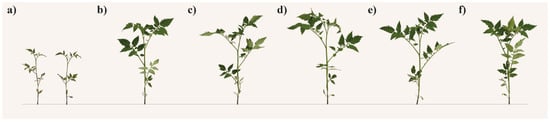
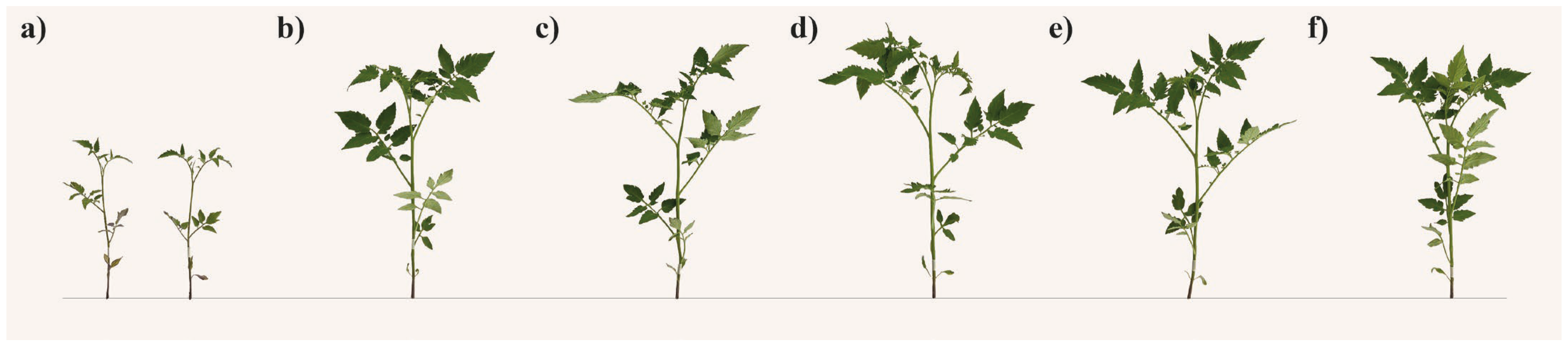
The growth performance of tomato seedlings differed significantly among germination substrates (Table 6). Seedling height increased across all treatments with vermicomposted frass, ranging from 33.40 to 36.58 cm, all significantly higher than the control (p < 0.05). A similar trend was observed for stem diameter, with T20–T100 exhibiting substantially thicker stems than the control. The number of true leaves also increased significantly in all substrate treatments, ranging from 7.91 to 8.23, approximately doubling the leaf number observed in the control. Notably, no significant differences were observed among the T20–T100 treatments, suggesting that even the lowest proportion (20%) resulted in maximum seedling growth. Overall, incorporating the germination substrate enhances tomato seedling development, improving height, stem robustness, and foliage production compared to the control (Figure 3).
Table 6.
Mean values of height, stem diameter, and number of true leaves of tomato seedlings in different germination substrates at the harvest moment.
Figure 3.
Representative tomato seedlings grown in different germination substrates: (a) 100% peat moss (Control), (b) 80% PM + 20% VF (T20), (c) 60% PM + 40% VF (T40), (d) 40% PM + 60% VF (T60), (e) 20% PM + 80% VF (T80), and (f) 100% VF (T100).
3.4. Effect of Vermicomposted Frass as a Germination Substrate on Antioxidant Content
The total phenolic content in kale seedlings varied moderately among substrates, ranging from 3.77 to 4.36 mg gallic acid equivalents/g, with T100 exhibiting the highest level (p < 0.05). In contrast, flavonoid levels increased markedly as the treatment proportion increased, reaching a maximum at T100, which was significantly higher than in the control and all other substrates. Antioxidant activity measured by ABTS showed clear differences among treatments, with the highest values recorded in T60 and T100, whereas T20 exhibited the lowest antioxidant capacity. Conversely, DPPH radical scavenging activity (% inhibition) was highest in the control and decreased notably in all treatments, with the lowest percentages observed in T20, T60, T80, and T100. These results (Table 7) indicate that the phenolic composition and antioxidant response of kale seedlings are strongly influenced by the germination substrate, with substantial increases in flavonoids but an overall reduction in DPPH activity in treated substrates compared to the control.
Table 7.
Total phenols, flavonoids, and ABTS and DPPH percentages in leaves of kale seedlings in different germination substrates.
The accumulation of phenolic compounds and antioxidant activity in bell pepper seedlings was significantly influenced by the germination substrate (Table 8). Total phenols exhibited limited variation among treatments, ranging from 0.08 to 0.13 mg gallic acid equivalents/g, and the highest concentration was observed in T60, which differed significantly from the control (p < 0.05). In contrast, flavonoid content showed a marked decline as the proportion of the treatment substrate increased, decreasing from 58.69 mg rutin equivalents/g in the control to 15.41 mg/g in T100. Antioxidant capacity measured by the ABTS assay displayed a distinct treatment-dependent pattern, with T20 exhibiting the highest radical scavenging activity, and T60 the lowest. Meanwhile, DPPH activity varied less markedly across treatments, though the control and T60–T80 groups showed intermediate values, and the lowest percentage was observed in T100. Overall, these results (Table 8) demonstrate that increasing levels of the alternative substrate reduce flavonoid accumulation and alter antioxidant performance, indicating a strong physiological response of bell pepper seedlings to substrate composition.
Table 8.
Total phenols, flavonoids, and ABTS and DPPH percentages in leaves of bell pepper seedlings in different germination substrates.
The biochemical profile of tomato seedlings showed a pronounced response to the germination substrate (Table 9). Total phenols varied widely among treatments, ranging from 0.10 to 7.72 mg gallic acid equivalents/g, with T40 exhibiting the highest concentration, significantly surpassing the control (p < 0.05). Flavonoid levels also differed significantly, with the greatest accumulation observed in T20, while T80 showed the lowest value among treatments. Antioxidant activity measured through the ABTS assay revealed two distinct groups: the control, T20, T40, and T60 displayed similarly high radical scavenging capacities, whereas T80 and T100 showed markedly reduced activity. In contrast, DPPH activity declined with increasing treatment intensity, with the lowest values recorded in T80 and T100, while the control and T20 maintained the highest scavenging percentages. These findings demonstrate that substrate composition strongly modulates phenolic metabolism and antioxidant performance in tomato seedlings, with certain substrates enhancing phenolic synthesis while simultaneously diminishing DPPH reactivity.
Table 9.
Total phenols, flavonoids, and ABTS and DPPH percentages in leaves of tomato seedlings in different germination substrates.
4. Discussion
4.1. Physicochemical Changes During Vermicomposting
The pH decreased toward neutrality, which is consistent with findings from other studies using composted manure and other organic residues to produce vermicompost [31]. This shift is attributed to the mineralization of nitrogen and phosphorus compounds, the release of CO2, and the production of humic and fulvic acids through microbial metabolism [13,32,33].
The electrical conductivity (EC) value decreased compared with thermocomposted frass, consistent with observations reported by Lazcano [31]. This reduction is attributed to lower ammonium production and the leaching or precipitation of soluble salts resulting from the irrigation of the vermicompost [13,33]. Because moisture was maintained at approximately 70% of water holding capacity, significant leaching was unlikely; however, minor localized percolation may have occurred during irrigation events.
For oxidizable organic matter, a reduction in value was observed, similar to that reported by [13], because the synergistic interaction between earthworms and microorganisms is a key driver of organic matter degradation and nutrient release. Earthworms fragment organic material and improve soil conditions, enhancing microbial activity, while their gut microbes further transform organic compounds, accelerating nutrient cycling [34].
Vermicomposting reduced carbon content more effectively than traditional composting [34]. This is due to earthworms enhancing the breakdown of organic matter by physically fragmenting it and stimulating microbial activity. During the process, labile carbon is rapidly decomposed, especially in the maturation stage, leading to a decrease in total and oxidizable carbon. Thus, vermicomposting promotes faster stabilization and greater carbon loss compared to traditional methods [35].
The results obtained in this study were consistent with previous research, reinforcing the role of earthworms in nitrogen increase during vermicomposting [35]. Earthworms enhance nitrogen availability by mineralizing organic nitrogen through mucus secretions and nitrogen-rich excreta. These biological processes, along with organic matter reduction, contribute to the efficient cycling of nutrients, increasing total nitrogen content in vermicompost [34], primarily due to carbon losses and substrate mass reduction during vermicomposting rather than to a net gain of nitrogen.
The decrease in the C/N ratio observed in this study can be attributed to the differential rates of carbon and nitrogen transformation during vermicomposting. As reported by Ferraz-Ramos [36], carbon losses occur predominantly through microbial and earthworm-mediated respiration, which releases carbon dioxide into the atmosphere. In contrast, nitrogen remains relatively conserved, with a portion being mineralized and made available through earthworm excretions and microbial activity. Consequently, the faster depletion of carbon compared to nitrogen leads to a progressive reduction in the C/N ratio, as also observed in the present study.
The cation exchange capacity (CEC) observed in the vermicomposted frass indicates maturity and stability. This is consistent with the findings of Yin et al. [37], who established that a value above 60 cmol/kg can be classified as a mature product, characterized by a well-developed humified structure and a high capacity to retain essential nutrients. This increase indicates a significant transformation of the original organic matter into stable humic compounds (humic and fulvic acids). These compounds are mainly responsible for the increase in CEC, as they contain carboxylic and phenolic functional groups capable of retaining cations via electrostatic interactions, as reported by López et al. [34].
For apparent density (AD), an increase was observed as a result of the vermicomposting process. This finding is consistent with previous reports [38], which attribute this increase to a reduction in particle size of the material consumed by the earthworms. This reduction occurs due to mechanical degradation by worms during feeding and digestion, leading to the fragmentation of organic matter and consequently to smaller particle sizes in the final vermicompost [39].
The apparent increase in calcium (Ca) and magnesium (Mg) observed in the frass during the vermicomposting process is primarily associated with transformations in chemical speciation, redistribution within the substrate matrix, and mass reduction of organic matter rather than with a net addition of these elements. During vermicomposting, earthworms facilitate the release of exchangeable cations from organic and mineral fractions through mechanical fragmentation, enhanced microbial activity, and gut-associated biochemical processes [39]. It has been reported that the gut microbiota of earthworms can utilize calcium oxalate as an energy source, releasing calcium ions, which are subsequently absorbed by the calciferous glands of the gut to form calcium bicarbonate (Ca(HCO3)2) [13]. The bicarbonate produced in excess of the metabolic requirements of the earthworm is excreted along with the digested material, thereby increasing the calcium content of the final vermicompost [40]. This process explains the increases in calcium reported in various vermicomposting studies [13] and is consistent with the results from the analyzed frass, which showed a higher Ca content compared to the initial substrate.
Regarding magnesium (Mg), the higher content observed in the frass can be attributed to biological activity within the vermicomposting system. Previous reports indicate that post-depositional microbial activity, particularly fungi and microalgae colonizing freshly excreted worm casts, contributes to the progressive release and accumulation of Mg in mature vermicompost [13].
Levels of phosphorus, potassium, sodium, and humic and fulvic acids have lower contents compared to conventional composting. This trend is consistent with findings reported by several authors. Initially, the nutrient content of vermicompost is largely determined by the composition of the substrate used to feed the larvae [12], which explains the variability observed among different treatments. The lower nutrient contents observed may be associated with substrate transformation processes during vermicomposting, including mineral redistribution, microbial immobilization, and organic matter mass reduction. Although previous studies have attributed nutrient losses to leaching during irrigation [41], significant leaching was unlikely under the controlled moisture conditions (≈70% water holding capacity) used in the present study; however, minor localized percolation during irrigation events may have occurred, potentially contributing to limited losses of soluble nutrient fractions.
4.2. Agronomic Performance and Germination Response
It has been reported that fresh frass contains high concentrations of phytotoxic compounds, such as phenolic substances, which can inhibit seed germination and emergence. Early studies primarily attributed growth inhibition to phytotoxicity associated with these compounds [8]. However, through stabilization processes such as composting and vermicomposting, a degradation of up to 95% of phenolic compounds can occur after approximately 12 months, thereby significantly reducing the phytotoxicity of the frass and improving its suitability for agricultural applications [8]. Moreover, even when an inert substrate is supplemented with equivalent amounts of ammonium and nitrate to those present in the frass, the seed germination index is still primarily influenced by the chemical properties of the frass, including its high pH and electrical conductivity, as well as the potential presence of phytotoxic organic compounds [42].
In this context, it is important to differentiate between osmotic stress and true phytotoxicity. While initial reports emphasized phytotoxic compounds as the main cause of growth inhibition [8], it can now be added that part of the observed inhibition may also be attributed to osmotic stress induced by the high electrical conductivity of frass. Elevated electrical conductivity can limit water uptake during seed imbibition, thereby reducing or delaying emergence [43], without necessarily involving direct toxic biochemical effects. In contrast, phytotoxicity refers to the inhibitory action of specific compounds, such as phenolic substances or other organic metabolites, that interfere with seed metabolism and cellular processes. Therefore, reductions in emergence observed at high frass proportions may result from a combination of salinity-related osmotic effects and residual phytotoxic compounds.
For kale and tomato, no negative effect on seed emergence was observed; however, for bell pepper, it has been reported that this species may be intolerant of high-salinity substrates, resulting in growth inhibition [44]. This aligns with the findings of the present study, in which bell pepper emergence decreased as the proportion of frass increased.
These results contrast with those reported by De Paula et al. [45], who stabilized frass through vermicomposting without a prior thermocomposting phase and obtained low germination index values in substrates composed of 100% vermicomposted frass. This suggests that the preliminary thermocomposting step creates more favorable physical and chemical conditions both for earthworm growth and activity and for producing a more stable substrate that can be used at high proportions without inducing phytotoxic effects on plants.
The addition of vermicomposted frass to the control substrate resulted in a progressive increase in pH, a response attributable to the naturally occurring salt content of the frass. A comparable trend was reported by Setti et al. [3]. Furthermore, the high cation exchange capacity characteristic of organic agricultural substrates, such as vermicomposted frass, enables the retention and release of ions including H+, Ca2+, and Mg2+, thereby contributing to pH neutralization [46]. This mechanism helps explain the buffering effect observed in peat moss–frass mixtures containing 20% to 80% frass, in which pH values shifted toward neutrality despite the initial acidity of the peat-based substrate.
The observed increase in EC value is attributable to the high salt content inherent to this material [47]. A similar trend was reported by Setti et al. [3], who evaluated germination substrates amended with increasing proportions of frass and observed a proportional rise in electrical conductivity as the frass content increased. However, in the present study, the substrate composed of 100% frass exhibited a lower electrical conductivity value than in the reference study, which may be explained by the absence of a vermicomposting process in the frass used in that investigation [18]. The reduction in electrical conductivity observed here could be associated with the vermicomposting treatment applied to the frass, as this process is known to generate soluble metabolites, such as ammonium (NH4+), and promote the precipitation of dissolved salts, as proposed by Lim et al. [13]. Regarding nutrient content in the different germination mixtures, Setti et al. [3] reported a proportional increase as the proportion of frass incorporated into the substrate increases.
The use of frass can enhance pepper (Capsicum annuum L.) plant growth [48]. However, vermicomposting can further improve the physical and chemical properties of frass, promoting better plant development. In the present study, at the seedling stage, plant growth improved as the proportion of vermicomposted frass increased. This effect may be associated with the enhanced root development characteristic of this phenological stage [49], which allows seedlings to more efficiently utilize the nutrients available in the different substrates tested.
Some authors have reported that using frass can enhance kale growth [2,50]. However, plant growth may be negatively affected when the substrate exhibits high electrical conductivity [51], as observed in the present study. In this case, substrates containing 80% and 100% vermicomposted frass resulted in reduced plant growth compared with the control treatment.
Several authors have reported that frass enhances tomato plant growth [42,52,53], consistent with this study. However, its use is generally recommended at low doses to avoid growth inhibition associated with phytotoxic compounds and high electrical conductivity.
4.3. Antioxidant Content in Seedlings
Phenolic compound content varied among plant species, reflecting the specific metabolic characteristics of each variety. This difference can be attributed to the intrinsic metabolic characteristics of kale, a species known for its strong capacity to synthesize and accumulate phenolic compounds and flavonoids from early developmental stages [54].
The germination substrate decisively influenced the accumulation of phenolic compounds and the antioxidant capacity of kale, tomato, and bell pepper seedlings. The marked differences in chemical composition between peat and vermicompost help explain the significant increase in flavonoids observed in the seedlings, whereas the comparatively smaller variation in total phenols suggests a weaker effect. Vermicompost exhibited a higher availability of essential nutrients, particularly N, P, and K, along with a lower C/N ratio; conditions that enhance photosynthetic activity and, consequently, promote enzymatic activation (e.g., PAL) and the induction of more specialized metabolic pathways, such as flavonoid biosynthesis [55]. Additionally, its higher electrical conductivity suggests the presence of moderate osmotic stress, which can trigger a specific antioxidant response characteristic of flavonoids [56], without necessarily stimulating the production of other phenolic groups.
However, in kale seedlings, the discrepancy observed between the higher flavonoid content and the reduced DPPH antioxidant activity in some treatments indicates that antioxidant capacity is not solely dependent on total flavonoid concentration. The radical scavenging activity measured by the DPPH assay depends strongly on the specific chemical structure, degree of hydroxylation, and redox properties of individual phenolic compounds [57]. Therefore, an increase in total flavonoids does not necessarily result in a proportional increase in DPPH activity if the accumulated compounds exhibit comparatively lower hydrogen-donating capacity. In contrast, tomato and bell pepper showed a more consistent relationship between phenolic content and antioxidant response, suggesting species-specific metabolic regulation.
These factors indicate that the physicochemical properties of the substrate not only modulate overall phenolic metabolites synthesis but can also direct metabolic flux toward the selective accumulation of specific compounds such as flavonoids. This selective increase is consistent with the hierarchical nature of the plant biosynthetic pathway, in which gallic acid is synthesized prior to rutin [58], a water-soluble antioxidant, while the production of more lipophilic compounds remains comparatively lower.
5. Conclusions
The stabilization of frass through thermocomposting followed by vermicomposting improved its physicochemical properties and enhanced its suitability for agricultural use. The process promoted organic matter degradation, reduced electrical conductivity and carbon content, and improved nutrient dynamics, including increased nitrogen availability and higher cation exchange capacity, indicating a more stable and mature material.
The incorporation of vermicomposted frass into peat-based substrates modified pH and electrical conductivity in a dose-dependent manner, generating species-specific responses. Tomato showed high tolerance and consistent growth, kale performed optimally at intermediate proportions, and bell pepper was more sensitive during germination but responded positively at later vegetative stages.
Furthermore, substrate composition influenced the biochemical profile of seedlings, particularly the accumulation of flavonoids and antioxidant capacity, with notable effects in kale. These findings demonstrate that vermicomposted frass can serve as a sustainable alternative substrate for seedling production, provided that its proportion is adjusted according to species requirements and developmental stage.
Future research should focus on long-term crop performance under field conditions, the identification of specific phenolic compounds responsible for antioxidant responses, and the optimization of stabilization time to further reduce phytotoxicity and salinity-related constraints.
Author Contributions
Conceptualization, J.F.G.-T. and H.G.-L.; methodology, B.P.-P.; software, H.A.-B.; validation, A.A.F.-P. and J.F.G.-T.; formal analysis, J.F.G.-T.; investigation, H.G.-L.; resources, J.F.G.-T., A.A.F.-P. and H.G.-L.; data curation, H.A.-B. and E.R.-G.; writing—original draft preparation, H.G.-L.; writing—review and editing, H.A.-B., E.R.-G. and A.A.F.-P.; visualization, B.P.-P. and E.R.-G.; supervision, J.F.G.-T.; project administration, J.F.G.-T.; funding acquisition, J.F.G.-T., A.A.F.-P. and H.A.-B. All authors have read and agreed to the published version of the manuscript.
Funding
The authors are grateful for the financial support provided by SECIHTI (Secretaría de Ciencia, Humanidades, Tecnología e Innovación) through the Hugo González-Lara grant (663475) to carry out doctoral studies.
Data Availability Statement
The original contributions presented in the study are included in the article, further inquiries can be directed to the corresponding authors.
Acknowledgments
The authors gratefully acknowledge the Autonomous University of Querétaro for the use of the facilities at the Amazcala campus of the Faculty of Engineering.
Conflicts of Interest
The authors declare no conflicts of interest.
References
- Green, T. A Biochemical Analysis of Black Soldier Fly (Hermetia illucens) Larval Frass Plant Growth Promoting Activity. PLoS ONE 2023, 18, e0288913. [Google Scholar] [CrossRef] [Scilit]
- Abiya, A.A.; Kupesa, D.M.; Beesigamukama, D.; Kassie, M.; Mureithi, D.; Thairu, D.; Wesonga, J.; Tanga, C.M.; Niassy, S. Agronomic Performance of Kale (Brassica oleracea) and Swiss Chard (Beta vulgaris) Grown on Soil Amended with Black Soldier Fly Frass Fertilizer under Wonder Multistorey Gardening System. Agronomy 2022, 12, 2211. [Google Scholar] [CrossRef] [Scilit]
- Setti, L.; Francia, E.; Pulvirenti, A.; Gigliano, S.; Zaccardelli, M.; Pane, C.; Caradonia, F.; Bortolini, S.; Maistrello, L.; Ronga, D. Use of Black Soldier Fly (Hermetia illucens (L.), Diptera: Stratiomyidae) Larvae Processing Residue in Peat-Based Growing Media. Waste Manag. 2019, 95, 278–288. [Google Scholar] [CrossRef] [Scilit]
- Chavez, M.Y.; Uchanski, M.; Tomberlin, J.K. Impacts of Black Soldier Fly, (Diptera: Stratiomyidae) Larval Frass on Tomato Production. J. Econ. Entomol. 2023, 116, 1490–1495. [Google Scholar] [CrossRef] [Scilit] [PubMed]
- Kawasaki, K.; Kawasaki, T.; Hirayasu, H.; Matsumoto, Y.; Fujitani, Y. Evaluation of Fertilizer Value of Residues Obtained after Processing Household Organic Waste with Black Soldier Fly Larvae (Hermetia illucens). Sustainability 2020, 12, 4920. [Google Scholar] [CrossRef] [Scilit]
- Alattar, M.; Alattar, F.; Popa, R. Effects of Microaerobic Fermentation and Black Soldier Fly Larvae Food Scrap Processing Residues on the Growth of Corn Plants (Zea mays). Plant Sci. Today 2016, 3, 57–62. [Google Scholar] [CrossRef] [Scilit]
- Romano, N.; Fischer, H.; Powell, A.; Sinha, A.K.; Islam, S.; Deb, U.; Francis, S. Applications of Black Solider Fly (Hermetia illucens) Larvae Frass on Sweetpotato Slip Production, Mineral Content and Benefit-Cost Analysis. Agronomy 2022, 12, 928. [Google Scholar] [CrossRef] [Scilit]
- Song, S.; Ee, A.W.L.; Tan, J.K.N.; Cheong, J.C.; Chiam, Z.; Arora, S.; Lam, W.N.; Tan, H.T.W. Upcycling Food Waste Using Black Soldier Fly Larvae: Effects of Further Composting on Frass Quality, Fertilising Effect and Its Global Warming Potential. J. Clean. Prod. 2021, 288, 125664. [Google Scholar] [CrossRef] [Scilit]
- Wu, N.; Yu, X.; Liang, J.; Mao, Z.; Ma, Y.; Wang, Z.; Wang, X.; Liu, X.; Xu, X. A Full Recycling Chain of Food Waste with Straw Addition Mediated by Black Soldier Fly Larvae: Focus on Fresh Frass Quality, Secondary Composting, and Its Fertilizing Effect on Maize. Sci. Total Environ. 2023, 885, 163386. [Google Scholar] [CrossRef] [Scilit] [PubMed]
- Beesigamukama, D.; Mochoge, B.; Korir, N.K.; Fiaboe, K.K.M.; Nakimbugwe, D.; Khamis, F.M.; Dubois, T.; Subramanian, S.; Wangu, M.M.; Ekesi, S.; et al. Biochar and Gypsum Amendment of Agro-Industrial Waste for Enhanced Black Soldier Fly Larval Biomass and Quality Frass Fertilizer. PLoS ONE 2020, 15, e0238154. [Google Scholar] [CrossRef] [Scilit] [PubMed]
- Tanga, C.M.; Beesigamukama, D.; Kassie, M.; Egonyu, P.J.; Ghemoh, C.J.; Nkoba, K.; Subramanian, S.; Anyega, A.O.; Ekesi, S. Performance of Black Soldier Fly Frass Fertiliser on Maize (Zea mays L.) Growth, Yield, Nutritional Quality, and Economic Returns. J. Insects Food Feed 2022, 8, 185–196. [Google Scholar] [CrossRef] [Scilit]
- Basri, N.E.A.; Azman, N.A.; Ahmad, I.K.; Suja, F.; Jalil, N.A.A.; Amrul, N.F. Potential Applications of Frass Derived from Black Soldier Fly Larvae Treatment of Food Waste: A Review. Foods 2022, 11, 2664. [Google Scholar] [CrossRef] [Scilit]
- Lim, S.L.; Wu, T.Y.; Sim, E.Y.S.; Lim, P.N.; Clarke, C. Biotransformation of Rice Husk into Organic Fertilizer through Vermicomposting. Ecol. Eng. 2012, 41, 60–64. [Google Scholar] [CrossRef] [Scilit]
- Alhverdizadeh, S.; Danaee, E. Environment and Water Engineering Effect of Humic Acid and Vermicompost on Some Vegetative Indices and Proline Content of Catharanthus Roseous under Low Water Stress. Environ. Water Eng. 2023, 9, 141–152. [Google Scholar] [CrossRef]
- Liu, M.; Wang, C.; Liu, X.; Lu, Y.; Wang, Y. Saline-Alkali Soil Applied with Vermicompost and Humic Acid Fertilizer Improved Macroaggregate Microstructure to Enhance Salt Leaching and Inhibit Nitrogen Losses. Appl. Soil Ecol. 2020, 156, 103705. [Google Scholar] [CrossRef] [Scilit]
- Hemati, A.; Alikhani, H.A.; Ajdanian, L.; Babaei, M.; Lajayer, B.A.; van Hullebusch, E.D. Effect of Different Enriched Vermicomposts, Humic Acid Extract and Indole-3-Acetic Acid Amendments on the Growth of Brassica Napus. Plants 2022, 11, 227. [Google Scholar] [CrossRef] [Scilit]
- Sharma, K.; Garg, V.K. Vermicomposting of Waste: A Zero-Waste Approach for Waste Management. In Sustainable Resource Recovery and Zero Waste Approaches; Elsevier: Amsterdam, The Netherlands, 2019; pp. 133–164. [Google Scholar] [CrossRef] [Scilit]
- González-Lara, H.; Parra-Pacheco, B.; Aguirre-Becerra, H.; Feregrino-Perez, A.A.; Garcia-Trejo, J.F. Effects of Using Thermocomposted Frass from Black Soldier Fly Larvae as a Germination Substrate on the Phytotoxicity, Germination Index, Growth and Antioxidant Contents in Kale (Brassica oleracea). Agronomy 2024, 14, 1392. [Google Scholar] [CrossRef] [Scilit]
- Ali, U.; Sajid, N.; Khalid, A.; Riaz, L.; Rabbani, M.M.; Syed, J.H.; Malik, R.N. A Review on Vermicomposting of Organic Wastes. Environ. Prog. Sustain. Energy 2015, 34, 1050–1062. [Google Scholar] [CrossRef] [Scilit]
- NMX-FF-109-SCFI-2008; Humus de Lombriz (Lombricomposta)—Especificaciones Y Métodos de Prueba. Diario Oficial de la Federación: Cuauhtemoc, Mexico, 2008.
- Cataldo, D.A.; Maroon, M.; Schrader, L.E.; Youngs, V.L. Rapid Colorimetric Determination of Nitrate in Plant Tissue by Nitration of Salicylic Acid. Commun. Soil Sci. Plant Anal. 1975, 6, 71–80. [Google Scholar] [CrossRef] [Scilit]
- NMX-DGN-AA-32-1976; Determinación de Fósforo Total en Desechos Sólidos (Método del Fosfovanadomolibdato). Centro de Calidad Ambiental: Chihuahua, Mexico, 1976.
- JENWAY Ltd. Flame Photometer Operating Protocol P05-001A; JENWAY Ltd.: Stone, UK, 2010. [Google Scholar]
- Harris, D.C. Análisis Químico Cuantitativo; Reverté: Barcelona, Spain, 2003. [Google Scholar]
- Banov, M.; Tsolova, V.; Kirilov, I. Reclamation of heaps and industrial sites built in the region of Madjarovo mine (Bulgaria). Bulg. J. Agric. Sci. 2020, 26, 192–197. [Google Scholar]
- Cardador-Martínez, A.; Loarca-Piña, G.; Oomah, B.D. Antioxidant Activity in Common Beans (Phaseolus vulgaris L.). J. Agric. Food Chem. 2002, 50, 6975–6980. [Google Scholar] [CrossRef] [Scilit]
- Singleton, V.L.; Orthofer, R.; Lamuela-Raventós, R.M. [14] Analysis of total phenols and other oxidation substrates and antioxidants by means of folin-ciocalteu reagent. In Methods in Enzymology; Academic Press: Cambridge, MA, USA, 1999; Volume 299, pp. 152–178. [Google Scholar]
- Oomah, B.D.; Cardador-Martínez, A.; Loarca-Piña, G. Phenolics and Antioxidative Activities in Common Beans (Phaseolus vulgaris L). J. Sci. Food Agric. 2005, 85, 935–942. [Google Scholar] [CrossRef] [Scilit]
- Zenil Lugo, N.; Colinas León, M.T.; Bautista Bañuelos, C.; Vázquez Rojas, T.R.; Lozoya Saldaña, H.; Martínez Damián, M.T. Total phenols and antioxidant capacity estimated with DPPH/ABTS assays in roses on preservative solutions. Rev. Mex. Cienc. Agrícolas 2014, 5, 1029–1039. [Google Scholar]
- Re, R.; Pellegrini, N.; Proteggente, A.; Pannala, A.; Yang, M.; Rice-Evans, C. Antioxidant Activity Applying an Improved ABTS Radical Cation Decolorization Assay. Free Radic. Biol. Med. 1999, 26, 1231–1237. [Google Scholar] [CrossRef] [Scilit]
- Lazcano, C.; Gómez-Brandón, M.; Domínguez, J. Comparison of the Effectiveness of Composting and Vermicomposting for the Biological Stabilization of Cattle Manure. Chemosphere 2008, 72, 1013–1019. [Google Scholar] [CrossRef] [Scilit]
- Mainoo, N.O.K.; Barrington, S.; Whalen, J.K.; Sampedro, L. Pilot-Scale Vermicomposting of Pineapple Wastes with Earthworms Native to Accra, Ghana. Bioresour. Technol. 2009, 100, 5872–5875. [Google Scholar] [CrossRef] [Scilit] [PubMed]
- Gong, X.; Li, S.; Carson, M.A.; Chang, S.X.; Wu, Q.; Wang, L.; An, Z.; Sun, X. Spent Mushroom Substrate and Cattle Manure Amendments Enhance the Transformation of Garden Waste into Vermicomposts Using the Earthworm Eisenia fetida. J. Environ. Manag. 2019, 248, 109263. [Google Scholar] [CrossRef] [Scilit]
- López, R.; Antelo, J.; Silva, A.C.; Bento, F.; Fiol, S. Factors That Affect Physicochemical and Acid-Base Properties of Compost and Vermicompost and Its Potential Use as a Soil Amendment. J. Environ. Manag. 2021, 300, 113702. [Google Scholar] [CrossRef] [Scilit] [PubMed]
- Karmegam, N.; Vijayan, P.; Prakash, M.; John Paul, J.A. Vermicomposting of Paper Industry Sludge with Cowdung and Green Manure Plants Using Eisenia fetida: A Viable Option for Cleaner and Enriched Vermicompost Production. J. Clean. Prod. 2019, 228, 718–728. [Google Scholar] [CrossRef] [Scilit]
- Ferraz Ramos, R.; Almeida Santana, N.; de Andrade, N.; Scheffer Romagna, I.; Tirloni, B.; de Oliveira Silveira, A.; Domínguez, J.; Josemar Seminoti Jacques, R. Vermicomposting of Cow Manure: Effect of Time on Earthworm Biomass and Chemical, Physical, and Biological Properties of Vermicompost. Bioresour. Technol. 2022, 345, 126572. [Google Scholar] [CrossRef] [Scilit]
- Yin, Z.; Zhang, L.; Li, R. Effects of Additives on Physical, Chemical, and Microbiological Properties during Green Waste Composting. Bioresour. Technol. 2021, 340, 125719. [Google Scholar] [CrossRef] [Scilit]
- Hanc, A.; Dreslova, M. Effect of Composting and Vermicomposting on Properties of Particle Size Fractions. Bioresour. Technol. 2016, 217, 186–189. [Google Scholar] [CrossRef] [Scilit] [PubMed]
- Ratnasari, A.; Syafiuddin, A.; Mehmood, M.A.; Boopathy, R. A Review of the Vermicomposting Process of Organic and Inorganic Waste in Soils: Additives Effects, Bioconversion Process, and Recommendations. Bioresour. Technol. Rep. 2023, 21, 101332. [Google Scholar] [CrossRef] [Scilit]
- Lim, P.N.; Wu, T.Y.; Shyang Sim, E.Y.; Lim, S.L. The Potential Reuse of Soybean Husk as Feedstock of Eudrilus eugeniae in Vermicomposting. J. Sci. Food Agric. 2011, 91, 2637–2642. [Google Scholar] [CrossRef] [Scilit]
- Hoang, H.G.; Thuy, B.T.P.; Lin, C.; Vo, D.-V.N.; Tran, H.T.; Bahari, M.B.; Le, V.G.; Vu, C.T. The Nitrogen Cycle and Mitigation Strategies for Nitrogen Loss during Organic Waste Composting: A Review. Chemosphere 2022, 300, 134514. [Google Scholar] [CrossRef] [Scilit]
- Salomon, M.J.; Cavagnaro, T.R.; Burton, R.A. Potential of Black Soldier Fly Larvae Frass (BSFL) as a Novel Fertilizer: Impacts on Tomato Growth, Nutrient Uptake, and Mycorrhizal Formation. Plant Soil 2025, 513, 417–434. [Google Scholar] [CrossRef] [Scilit]
- Charlo, H.C.O.; Ferreira Setor De Olericultura, A.F.; Vargas, P.F.; Castoldi, R.; Melo, D.M.; Braz, L.T. Alterations in Levels of NPK, Electrical Conductivity and PH of Substrate, in Cultivation of Peppers. In XXVIII International Horticultural Congress on Science and Horticulture for People (IHC2010): International Symposium on 927; International Society for Horticultural Science: Leuven, Belgium, 2012. [Google Scholar]
- Orosco-Alcalá, B.E.; Núñez-Palenius, H.G.; Díaz-Serrano, F.; Pérez-Moreno, L.; Valencia-Posadas, M.; Trejo-Tellez, L.I.; Cruz-Huerta, N.; Valiente-Banuet, J.I. Grafting Improves Salinity Tolerance of Bell Pepper Plants during Greenhouse Production. Hortic. Environ. Biotechnol. 2021, 62, 831–844. [Google Scholar] [CrossRef] [Scilit]
- do Casal de Paula, F.; de Mendonça Costa, M.S.S.; de Lima, J.C.; dos Santos, L.T. Stabilization of Black Soldier Fly Larval Frass through Vermicomposting with Cattle Manure: Agricultural and Chemical Assessment. Clean. Waste Syst. 2025, 12, 100415. [Google Scholar] [CrossRef] [Scilit]
- Silber, A. Chemical Characteristics of Soilless Media. In Soilless Culture: Theory and Practice Theory and Practice; Elsevier: Amsterdam, The Netherlands, 2019; pp. 113–148. [Google Scholar] [CrossRef] [Scilit]
- Chiam, Z.; Lee, J.T.E.; Tan, J.K.N.; Song, S.; Arora, S.; Tong, Y.W.; Tan, H.T.W. Evaluating the Potential of Okara-Derived Black Soldier Fly Larval Frass as a Soil Amendment. J. Environ. Manag. 2021, 286, 112163. [Google Scholar] [CrossRef] [Scilit]
- El Amerany, F.; Ait Ali, O.; Rhazi, M. Chitosan Reduces the Toxicity of Frass from Black Soldier Flies (Hermetia illucens) Used to Cultivate Pepper (Capsicum annuum L.). Euro-Mediterr. J. Environ. Integr. 2025, 10, 3607–3622. [Google Scholar] [CrossRef] [Scilit]
- Gurung, S.K.; Mickan, B.S.; Jenkins, S.N.; Rengel, Z.; Siddique, K.H.M.; Solaiman, Z.M. Turning Waste into Resilience: The Effect of Black Soldier Fly Larvae Frass and Wheat Straw Biochar on Bell Pepper Growth, Soil Fertility and Rhizosphere Bacteria under Water Stress. Plant Soil 2025. [Google Scholar] [CrossRef] [Scilit]
- Romano, N.; Datta, S.N.; Sinha, A.K.; Pande, G.S.J. Partially Replacing Synthetic Fertilizer with Black Soldier Fly (Hermetia illucens) Larvae Frass Enhances Kale (Brassica oleracea Var. Sabellica) Production. Technol. Hortic. 2023, 3, 8. [Google Scholar] [CrossRef] [Scilit]
- Yang, T.; Samarakoon, U.; Altland, J.; Ling, P. Influence of Electrical Conductivity on Plant Growth, Nutritional Quality, and Phytochemical Properties of Kale (Brassica napus) and Collard (Brassica oleracea) Grown Using Hydroponics. Agronomy 2024, 14, 2704. [Google Scholar] [CrossRef] [Scilit]
- Chavez, M.Y.; Uchanski, M.; Tomberlin, J.K. Impacts of Black Soldier Fly, Hermetia illucens, Larval Frass on the Emergence and Seedling Vigor of Three Vegetable Crop Species. J. Insects Food Feed 2024, 11, 819–832. [Google Scholar] [CrossRef] [Scilit]
- Jiang, S.; Tang, X.; Wang, H.; Henawy, A.R.; Zhang, Q.; Shen, K.; Li, G.; Xiang, F.; Zhang, Z. Biofertilizer Derived from Black Soldier Fly (Hermetia illucens L.) Larval Frass Promotes Tomato Growth and Suppresses Bacterial Wilt Disease. Bioresour. Technol. 2026, 440, 133408. [Google Scholar] [CrossRef] [Scilit]
- Tan, J.; Jiang, H.; Li, Y.; He, R.; Liu, K.; Chen, Y.; He, X.; Liu, X.; Liu, H. Growth, Phytochemicals, and Antioxidant Activity of Kale Grown under Different Nutrient-Solution Depths in Hydroponic. Horticulturae 2023, 9, 53. [Google Scholar] [CrossRef] [Scilit]
- Li, Z.; Jiang, H.; Yan, H.; Jiang, X.; Ma, Y.; Qin, Y. Carbon and Nitrogen Metabolism under Nitrogen Variation Affects Flavonoid Accumulation in the Leaves of Coreopsis Tinctoria. PeerJ 2021, 9, e12152. [Google Scholar] [CrossRef] [Scilit] [PubMed]
- Baozhu, L.; Ruonan, F.; Yanting, F.; Runan, L.; Hui, Z.; Tingting, C.; Jiong, L.; Han, L.; Xiang, Z.; Chun-peng, S. The Flavonoid Biosynthesis Regulator PFG3 Confers Drought Stress Tolerance in Plants by Promoting Flavonoid Accumulation. Environ. Exp. Bot. 2022, 196, 104792. [Google Scholar] [CrossRef] [Scilit]
- Zheng, C.-D.; Li, G.; Li, H.-Q.; Xu, X.-J.; Gao, J.-M.; Zhang, A.-L. DPPH-Scavenging Activities and Structure-Activity Relationships of Phenolic Compounds. Nat. Prod. Commun. 2010, 5, 1759–1765. [Google Scholar] [CrossRef] [Scilit]
- Rahaman, M.S.; Siraj, M.A.; Islam, M.A.; Shanto, P.C.; Islam, O.; Islam, M.A.; Simal-Gandara, J. Crosstalk between Xanthine Oxidase (XO) Inhibiting and Cancer Chemotherapeutic Properties of Comestible Flavonoids- a Comprehensive Update. J. Nutr. Biochem. 2022, 110, 109147. [Google Scholar] [CrossRef] [Scilit] [PubMed]





Disclaimer/Publisher’s Note: The statements, opinions and data contained in all publications are solely those of the individual author(s) and contributor(s) and not of MDPI and/or the editor(s). MDPI and/or the editor(s) disclaim responsibility for any injury to people or property resulting from any ideas, methods, instructions or products referred to in the content. |
© 2026 by the authors. Licensee MDPI, Basel, Switzerland. This article is an open access article distributed under the terms and conditions of the Creative Commons Attribution (CC BY) license.