


Abstract
Strawberry powdery mildew, caused by Podosphaera aphanis, severely impacts the yield and quality of strawberry fruit and necessitates sustainable control strategies. Here, we assessed the growth and hormone content of strawberry seedlings (Fragaria × ananassa ‘Hongyan’) to evaluate the abilities of four plant growth-promoting bacteria (PGPB), Azospirillum brasilense, Phytobacter diazotrophicus, Variovorax soli, and Microbacterium phyllosphaerae, in a 42-day consecutive culture. Among all treatments, our results showed that the strains V. soli and M. phyllosphaerae increased the seedling biomass by 25.6–25.8% and decreased the disease index by 30–32.5% compared to the control. Moreover, the strain M. phyllosphaerae could produce 22.32 μg·mg−1 indole-3-acetic acid (IAA) after 24 h in a consecutive culture system and still maintain the IAA at 8.12 ng·mg−1 in seedlings. In addition, the salicylic acid (SA) and jasmonic acid (JA) hormones of the seedlings increased by 293% and 35.3% after inoculating with V. soli and M. phyllosphaerae, respectively. Further analysis of the coordination between plant hormones and plant growth showed that the accumulation of SA might have had a positive relation with biomass, whereas JA was negative under powdery mildew infection. These findings highlight that the V. soli and M. phyllosphaerae strains could offer the dual benefits of growth promotion and different defense strategies against powdery mildew for sustainable strawberry production.
1. Introduction
Strawberries (Fragaria × ananassa ‘Hongyan’) are a popular perennial economic crop in the Rosaceae family [1]. However, strawberries are highly susceptible to powdery mildew, which is caused by Podosphaera aphanis under conditions of weak light, high humidity, and in greenhouses [2]. In particular, “Hongyan” is widely cultivated in China due to its excellent fruit quality, but it has poor resistance to Podosphaera aphanis [3]. Leaf chlorosis and yellowing can be caused by powdery mildew, and the white mold layer covering strawberry leaves and fruit seriously affects the yield and quality of the strawberries [4]. In some reports, powdery mildew has caused strawberry yield losses exceeding 50% [5]. Previously, the large-scale application of traditional pesticides and chemical fertilizers gradually caused a series of problems, such as soil compaction and soil fertility decline [6]. In addition, a study on pesticide sensitivity has reported that Podosphaera aphanis shows resistance to pesticides that are commonly used in California [7]. To continue to steadily grow and develop the strawberry industry, it is crucial to explore and apply environmentally friendly and green planting methods and technologies to control powdery mildew.
At present, plant growth-promoting bacteria (PGPB) are being considered as an alternative to gradually replacing chemical fertilizers in production areas because they can improve soil fertility and reshape soil microbial communities [8,9]. PGPB can colonize the interior or exterior surfaces of plants, influencing plant growth by fixing nitrogen and secreting plant hormones such as indole-3-acetic acid [10,11]. Moreover, numerous studies have shown that PGPB can promote plant growth by improving chlorophyll storage, increasing plant height, and increasing biomass [12,13].
On the other hand, PGPBs with specific biocontrol functions are increasingly being used to replace chemical pesticides, such as Bacillus sp. and Arthrobacter sp. [14]. Azotobacter sp. has been reported to reduce the water stress caused by vascular diseases and prevent potato blight [15,16]. Potato root rot resistance is improved by inoculation strain Bacillus sp. by producing siderophores, plant hormones, antibiotics, and other antagonistic molecules [17,18]. Moreover, inoculation with strain Azospirillum brasilense may induce accumulations of secondary metabolites (such as phenols and flavonoids) to enhance the resistance to Tetranychus urticae in strawberry seedlings [19]. However, there is limited literature on using PGPB to biological control strawberry powdery mildew.
Biological control of PGPB has been reported several mechanisms, one of the most important reasons is PGPB usually can activate the defense response of plants to protect from pathogens [20]. Two different resistance mechanisms are usually involved, the induced systemic resistance (ISR) associated with the core signaling jasmonic acid (JA)/Ethylene (ET) pathways, and systemic acquired resistance (SAR) with the salicylic acid pathway [21,22,23,24]. For instance, the application of Bacillus amyloliquefaciens can significantly promote the gene expression related to the salicylic acid (SA) pathway such as SlMPK3 and SlNPR1 in tomatoes [25]. Another, strain Pseudomonas canadensis is inoculated in tomato infected with Botrytis cinerea, which can promote the JA accumulation and improve the resistance in seedlings [26]. However, some PGPB have negative effects on plant growth; for example, Arthrobacter sp. has been reported to reduce the leaf area and biomass in maize [27]. Thus, it is necessary to evaluate the application of different PGPB under different conditions and plants. Specifically, consider the hypothesis that certain PGPB may simultaneously promote growth and activate hormonal defense.
In this study, to examine the effects of inoculation of PGPB on strawberry resistance to powdery mildew, we focus on investigating the interactions of strawberry seedlings and different PGPB strains. First, we determined the plant growth of powdery mildew infected seedlings and evaluated the growth properties in detail. Then, we measured the plant hormones, including SA, JA, jasmonic acid–isoleucine (JA-ile) and indole-3-acetic acid (IAA), to analyze the relation with plant resistance to powdery mildew. We found that the growth-promoting and disease-resistant mechanisms related to strawberry seedlings are based on the IAA secretion ability and the strawberry’s defense strategy induced by different PGPB.
2. Materials and Methods
2.1. Bacterial Strains and Experimental Design
Four bacterial strains, namely (1) Azospirillum brasilense 1224T (RIKEN BRC, Tsukuba, Japan), (2) Phytobacter diazotrophicus W45 (screened strain preserved in the lab), (3) Variovorax soli LXC3-3 (CGMCC No. 24867), and (4) Microbacterium phyllosphaerae LX2-4 (CGMCC No. 24868) were used in this study. Bacterial strains (1) and (2) were cultivated in the minimal agar medium (MMAB) [28], whereas (3) and (4) were grown in R2A agar medium, respectively. Components of the MMAB medium were provided in Table S1. Before the pot experiment, the single colony of the four strains in agar media were selected and amplified in LB liquid medium for further use.
A 42-day glass greenhouse experiment was conducted at Zhejiang Academy of Agricultural Sciences (120.2051° E, 30.3192° N), Hangzhou, China. The experiment began on 2 March 2022, and no artificial lighting was used. The greenhouse was used for strawberries cultivation, and the strawberries were always infected and had shown symptoms of powdery mildew. Uniform 15-day-old seedlings of strawberry cultivar ‘Hongyan’ were selected as the plant material and planted into the 2L pots. An artificial substrate composed of coconut coir, peat, and perlite (v/v/v = 2:6:2) was used and it was kept moist throughout the entire experiment. Five treatments were set as below: control group (CK), with no bacterial strains applied; Treatment groups: applied with bacterial strains (1), (2), (3), and (4), respectively, which were denoted as T1, T2, T3, and T4. Each pot had a single strawberry seedling, and each treatment contained 20 biological replicates. The experiment was performed under a completely randomized design, and the cultivation condition was kept in a closed and transparent glass greenhouse with a relative humidity of 80% and an average maximum and minimum temperatures of 25 °C and 8 °C, respectively.
2.2. Bacterial Strains Application and Planting Management
On day 7, 14, and 28, four bacterial strains with an effective viable bacteria concentration of 107 cfu·mL−1 were applied in drench to treat the strawberry seedlings, respectively. The inoculum volume was 50 mL and the same volume of culture medium was applied in the CK group. After being cultivated in the conditions provided in Section 2.1 for 10–14 days, all the strawberry seedlings were naturally infected and shown symptoms of powdery mildew. Thereafter, the experiment site was maintained with relative humidity at 40% and same temperature as before.
2.3. Physiological and Growth Measurements of Strawberry Seedling
2.3.1. Plant Observation and Height Measurement
The occurrence of powdery mildew was identified by the presence of white flocculent mycelia on the leaves. Throughout the experiment, the appearance and disappearance of strawberry powdery mildew in different treatments were recorded. The disease severity of seedlings was assessed according to Xiao et al., and the scoring range was established as follows: 0 = no visible symptoms; 1 = 1–10% of leaf area affected; 2 = 11–25%; 3 = 26–50%; 4 = greater than 50% [29]. The disease index (%) was calculated using the following formula:
Additionally, on days 14, 28, and 42, the above ground height of strawberry plants in each pot was measured from the plant collar to the terminal end.
2.3.2. Relative Content of Chlorophyll in Leaves
On days 0, 7, 14, 21, 28, 35 and 42, 20 leaves of strawberry seedlings in different treatments were randomly selected for the measurement of the relative content of chlorophyll (SPAD value) via a handheld multifunctional plant meter MultispeQ (Beijing Huinoride Technology Co., Ltd., Beijing, China). The used wavelengths were 650 nm and 940 nm.
2.3.3. Plant Biomass Measurement
At the end of the experiment (42 days), strawberry seedlings in different treatments were harvested for biomass determination. After removing the artificial substrate, the stems and roots of the seedlings were separated, washed with tap water and wiped carefully. The fresh weights of the whole plant and the above-ground part were measured. Then, the fresh samples were packed into an envelope and dried in an oven at 105 °C to a constant weight for dry weight measurement.
2.3.4. Root Morphology Analysis
The separated roots of the strawberry seedlings were also used for morphology analysis. The root image was obtained, and the length and width of root in each treatment were measured by ImageJ software (version 1.54g). The ratio root length to root width was calculated to reflect the root density.
2.4. Detection of Bacterial IAA Production
The secretion of bacterial IAA was determined by Salkowski analysis [30]. Briefly, the bacterial strains were continuously cultured in the 100 mL R2A liquid medium (containing 2 mM tryptophan) and incubated on a Orbital Shaker Incubator at 30 °C, 160 rpm. At 24, 48 and 72 h, 1 mL bacterial medium was collected and centrifuged at 10,000 rpm, 3 min. Supernatant (400 μL) was added to 800 μL Salkowski reagent (containing 60% perchloric acid and 0.5 M ferric chloride), and the mixture was incubated in the dark for 30 min. In parallel, the cell dry weight was also determined after drying at 60 °C for three days. The IAA production was determined by measuring the absorbance (A530) of mixture at 530 nm with spectrophotometer (Beijing Puxi General Instrument Co., Ltd., Beijing, China). To calculate the production of IAA, the standard curve was plotted based on the absorbance values of IAA standard solution (0, 5, 10, 20, 50, 100 μg/mL) reacted with Salkowski reagent. Then the IAA production of strains was expressed as the amount of IAA per gram of dry cell weight.
2.5. Determination of Plant Hormones
The plant hormones IAA, SA, JA and JA-ile were determined as follows. Briefly, the whole strawberry seedlings were ground and homogenized thoroughly on day 14 (I) and 42 (R), then 100 mg of the sample was weighed and mixed with 1 mL of ice-cold 50% aqueous acetonitrile (ACN, v/v). The samples were sonicated for 3 min at 4 °C and subsequently extracted using a benchtop laboratory rotator for 30 min at 4 °C. After centrifugation (10 min, 12,000 rpm, 4 °C), the supernatant was transferred to microtubes. All samples were purified using C18 reversed-phase, polymer-based, solid phase extraction (RP-SPE) cartridges (50 mg/1 mL, Anpel Appliance Co., Ltd., Hangzhou, China), that had been washed with 1 mL of MeOH and 1 mL of deionized water, then equilibrated with 50% aqueous ACN (v/v). After loading a sample, the cartridge was then eluted with 1 mL of 30% ACN (v/v) and this fraction was collected. The eluates were evaporated to dryness under a gentle stream of nitrogen and stored at −20 °C until analysis.
For UHPLC-ESI-MS/MS analysis, the samples were dissolved in 200 μL of 30% ACN (v/v) and transferred to insert-equipped vials. Methanol, acetonitrile and acetic acid were purchased from ANPEL (Anpel Appliance Co., Ltd., Hangzhou, China). All solvents were of LC-MS grade. And ultra-pure water was prepared in-house using a Milli-Q water purification system (Millipore, Bedford, MA, USA). The samples were analyzed by using an UPLC-Orbitrap-MS system (Thermo Fisher Scientific, Waltham, MA, USA). The UPLC analytical conditions are listed in Tables S2 and S3. High-resolution mass spectrometry (HRMS) data were recorded on a Q Exactive hybrid Q-Orbitrap mass spectrometer (Thermo Fisher Scientific, Waltham, MA, USA) equipped with a heated ESI source (Thermo Fisher Scientific, Waltham, MA, USA) utilizing the SIM-MS acquisition method. The ESI source parameters are listed in Table S4. Data were acquired on the Q-Exactive using Xcalibur 4.1 (Thermo Fisher Scientific, Waltham, MA, USA), and processed using TraceFinder™4.1 Clinical (Thermo Fisher Scientific, Waltham, MA, USA). To visualize the differences in plant hormone levels among different treatment groups, the raw data were transformed using Z-scores. The Z-score for each sample was calculated using the following formula:
The x represents the raw value of a specific sample, μ is the mean of all biological replicates for a specific hormone, and σ is the standard deviation.
2.6. Data Analysis
Numerical data were analyzed using Microsoft 365 (Version 2501, Microsoft Corp., Redmond, WA, USA) and IBM SPSS Statistics 27 (Version 27.0.1.0, IBM Corp., Armonk, NY, USA), and the significance of the data was analyzed by One-Way ANOVA and Duncan test or Two-Way ANOVA and Tukey test. The bar graphs, box plots, and violin plots were generated with GraphPad Prism 10 (Version 10.4.1, GraphPad Software, San Diego, CA, USA), while 3D plot and heatmap were produced using Origin 2026 (Version 10.3.0.180, OriginLab Corp., Northampton, MA, USA). The Mantel Correlations were analyzed and visualized on the “ChiPlot” online platform (https://www.chiplot.online/, accessed on 15 September 2025); the corresponding codes are available at https://github.com/hannet91/ggcor/tree/master/man (accessed on 15 September 2025). Each figure caption specifies the test method and the number of biological replicates.
3. Results
3.1. Observation of Powdery Mildew of Strawberry Seedlings
The strawberry powdery mildew appeared on day 10 as the white flocculent mycelia were observed on the leaves of all strawberry plants (Figure S1), and the disease index was calculated and shown in Figure S2. On day 14, the leaves infected with mildew, curled and turned yellow; some leaves even withered and fell off in the treatment CK, T1, T2 and T4, but the disease index was only 35% in T3. As the cultivation period progressed, the disease index was 40% and 47.5% in T3 and T4 on day 28, respectively, and the powdery mildew symptoms gradually relieved under observation. On day 42, the symptoms of powdery mildew infection remained in CK, but were rarely observed in T3 (disease index was 13.75%) and T4 (disease index was 11.25%).
3.2. Chlorophyll Content in Leaves of Seedlings
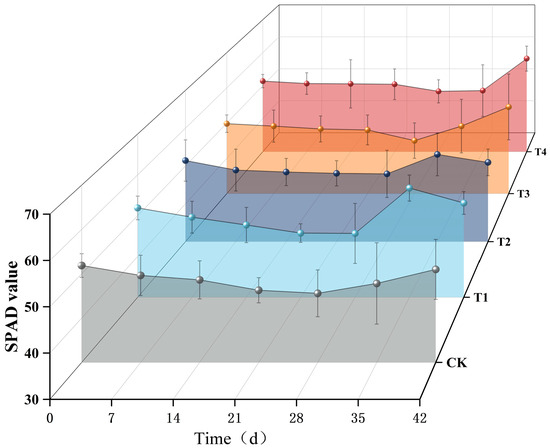
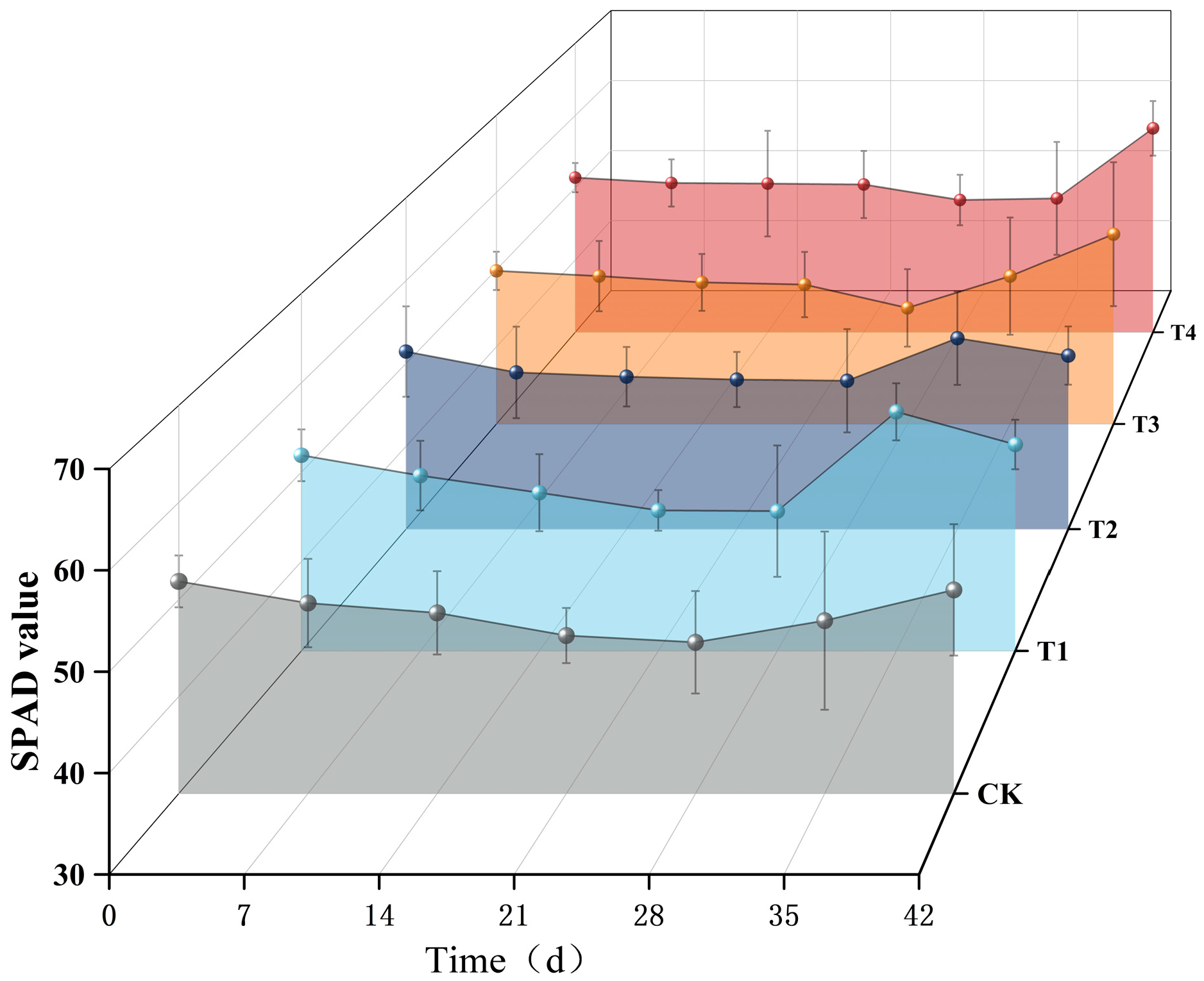
The relative chlorophyll content of strawberry seedlings was represented by SPAD values (Figure 1 and Table S5). There were no significant differences in SPAD values among treatment groups during the first 7 days of cultivation. From day 7 to 28, SPAD values decreased in all groups; notably, they significantly decreased by 8.14% and 8.38% in CK and T3, respectively. However, as culture time extended (day 28–35), SPAD values significantly increased in T1 (24.34%), T2 (10.70%), and T3 (9.13%). Ultimately, the SPAD value in T4 was significantly higher than in other groups. Above all, the results indicated that, compared to day 0, the relative chlorophyll content recovered fastest in T1 and T2. While, it was promoted the most in T4 by strain M. phyllosphaerae, and the SPAD value had the smallest variation in T3 compared to other treatments.
Figure 1.
The relative content of chlorophyll (SPAD value) in strawberry seedlings in different treatment groups varies with cultivation time. The data were represented by mean ± standard deviation of the relative chlorophyll contents of 20 random leaves in each treatment. Each point on the line graph represents the mean of 20 relative chlorophyll contents.
3.3. Morphology Analysis of Seedlings Along with Powdery Mildew
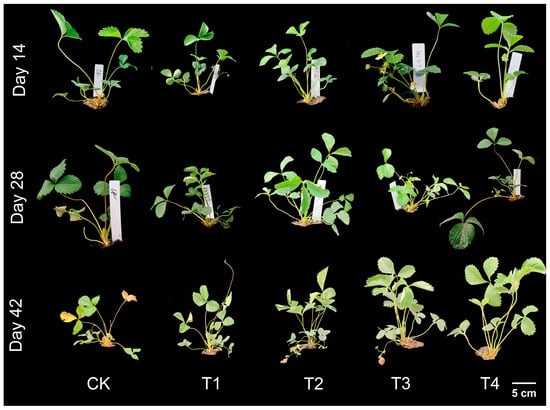
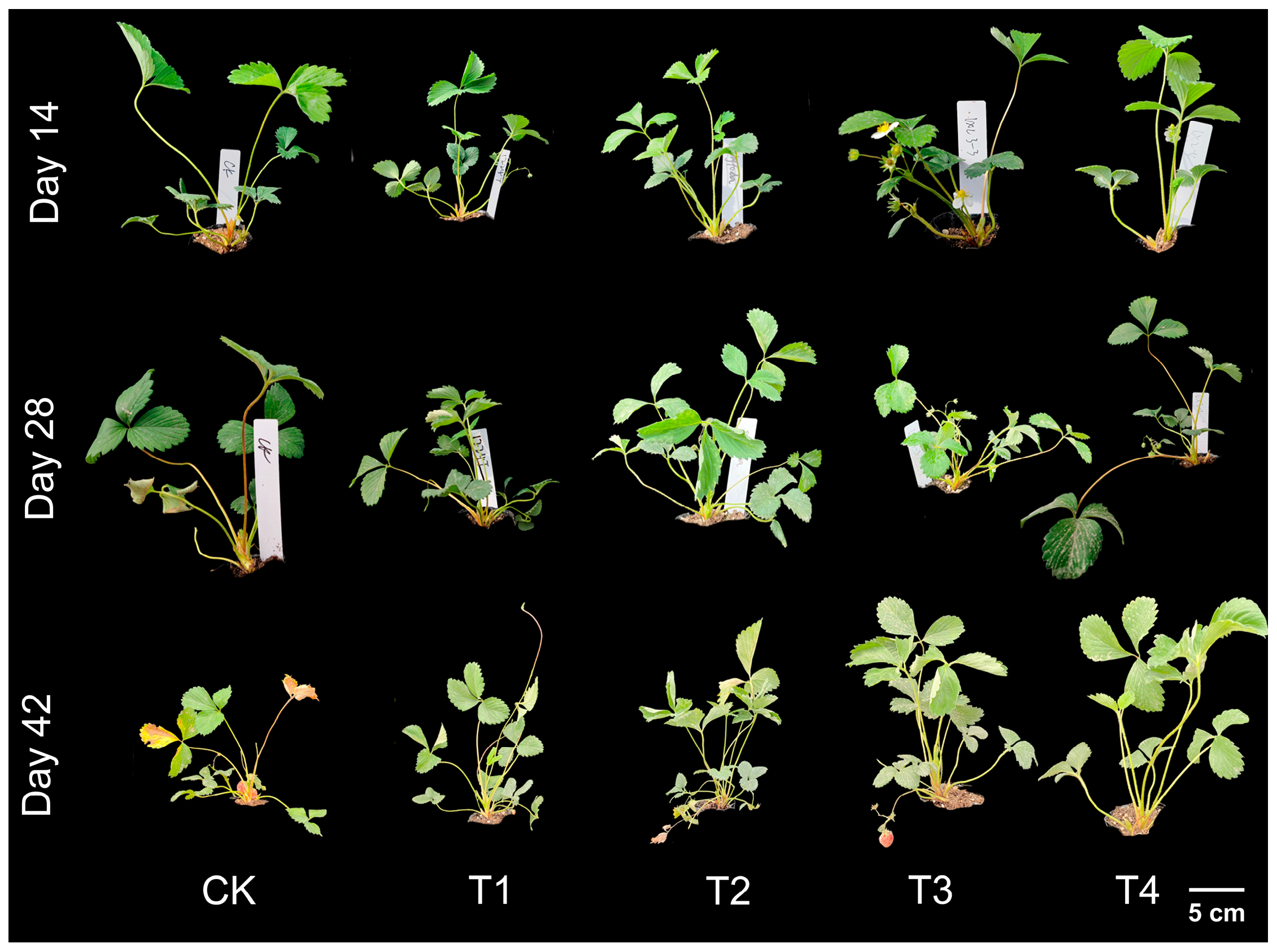
The above-ground growth and length of strawberry seedlings in each different treatment were observed and measured (Figure 2 and Table S6). The length of above-ground strawberry seedlings increased in all treatment groups over time. After 42 days consecutive cultivation, the above-ground length of seedlings inoculated with A. brasilense (T1) increased 31.6% to 24.84 cm compared to day 14. While, the other seedlings were 24.42 cm (20.7% increased), 27.32 cm (26.6% increased), 22.83 cm (28.8% increased), 26.19 cm (23.7% increased), in treatment CK, T2, T3 and T4, respectively. These results indicated that the PGPB could stimulate the strawberry seedlings above-ground growth differently.
Figure 2.
The growth of strawberry seedlings on day 14, 28, and 42 under consecutive culture. Scale bar: 5 cm.
3.4. Plant Growth of Strawberry Seedling
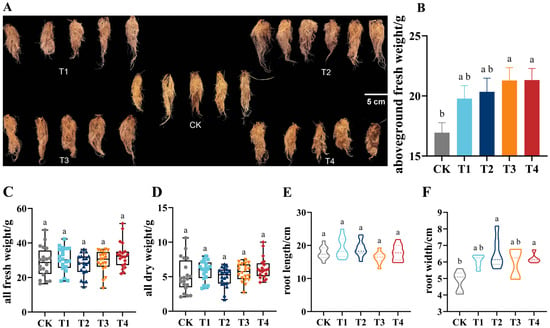
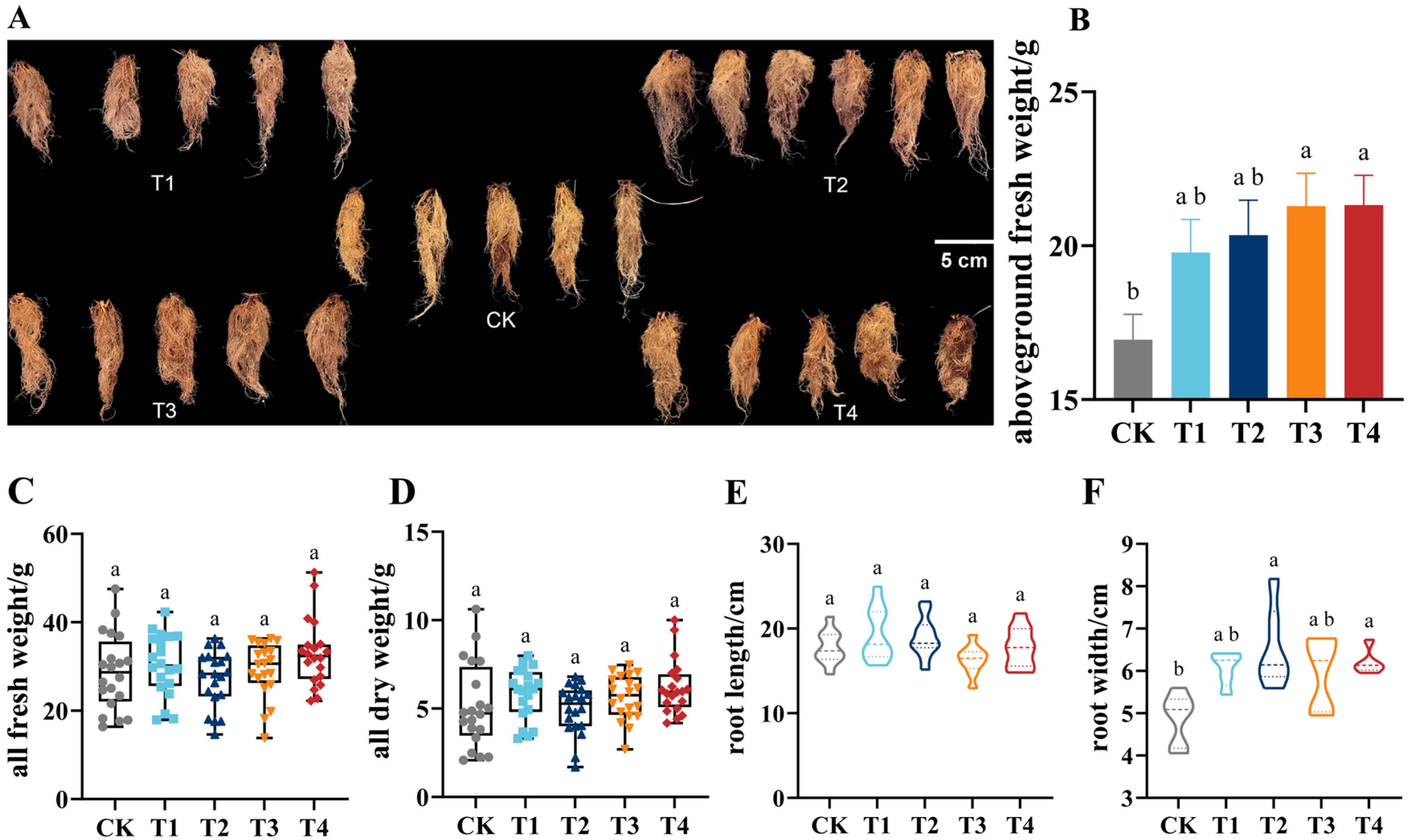
Root growth was determined on day 42. The results showed that the average root length of seedlings ranged from 16.34 cm to 19.31 cm (Figure 3A). Compared with CK, the root length (RL) of seedlings was 8.62% and 6.89% longer in T1 and T2, respectively (Figure 3E). And the root width (RW) was 24.3% to 33.7% wider in T1 and T4 (Figure 3F). In addition, the low ratio of root length to root width indicated that strawberry seedlings might have better tolerant resistance in T3. While the ratio in CK was 3.64, which was the highest among all treatment groups (Table S7).
Figure 3.
The development and biomass of strawberry seedlings after 42 days of cultivation. The physical images of the roots of plants in different treatment groups (A); the fresh weight of the strawberry aboveground part (B), the fresh weight of the entire plant (C), and the dry weight of the entire plant (D). The data in each processing group represents the mean ± standard deviation of 20 individual replicates. In box plots, each point represents a numerical value. (E,F) show the root length and root width of strawberry seedlings in different treatment groups. The data in each processing group were represented by the mean ± standard deviation of 10 and 5 individual replicates. The dashed and dotted lines within the violin plots indicate the median and quartiles, respectively. One-way ANOVA was performed, followed by Duncan’s multiple range test. Different letters indicate significant differences within each treatment (p < 0.05).
The above-ground fresh weight (AFW), fresh weight (FW) and dry weight (DW) of strawberry seedlings were measured. The results showed the AFW of seedlings increased in all treatments (Figure 3B). Compared with CK, the AFW increased from 16.7% to 25.6%; notably, T3 and T4 reached 21.29 and 21.32 g per plant, respectively. Further, regarding FW, seedlings in T4 showed the highest value (33.33 g per plant), increasing by 14.6% compared with CK (Figure 3C). In parallel, the DW of seedlings was 5.99 and 5.93 g per plant in T1 and T4, respectively (Figure 3D). These results indicated the biomass of seedlings was increased by applying four bacterial strains.
3.5. IAA Production of PGPB Strains
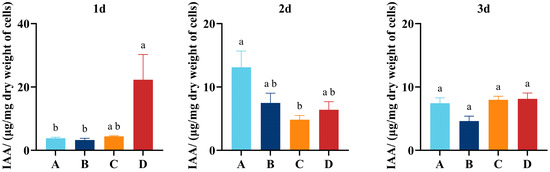
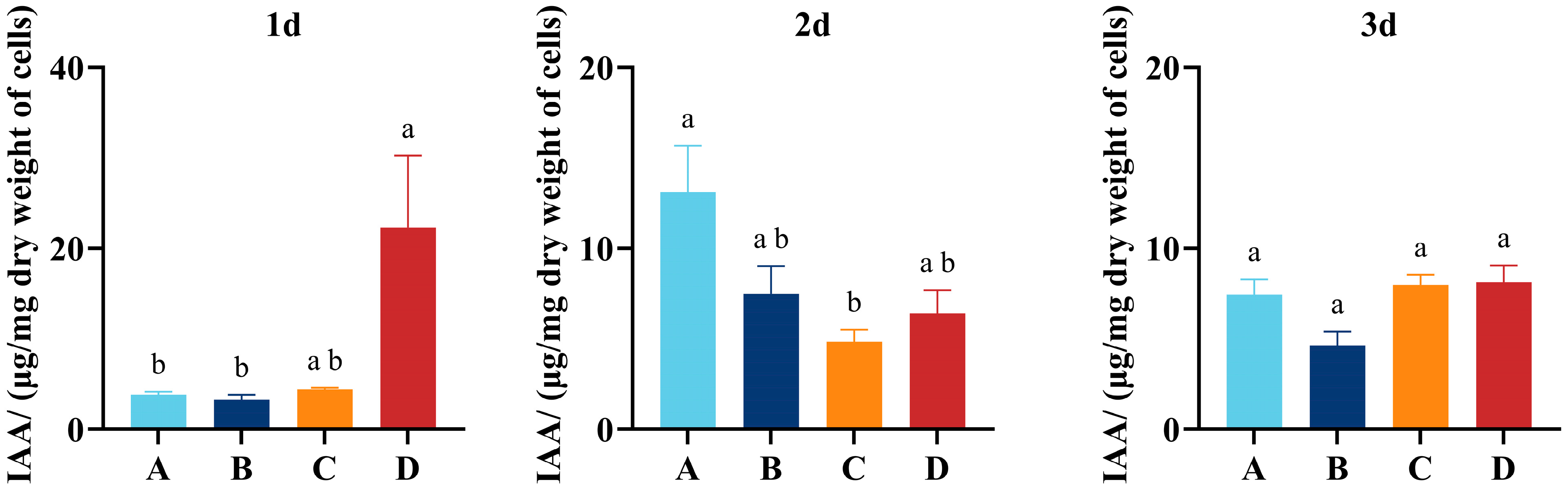
The ability to produce IAA of four PGPB strains was determined in the culture medium (Figure 4). The results showed that M. phyllosphaerae produced the highest IAA (22.32 μg·mg−1) after 24 h consecutive culture. After 48 h, A. brasilense and V. soli produced IAA 13.10 and 4.85 μg·mg−1, respectively. However, the content of IAA produced by M. phyllosphaerae dropped sharply to 6.40 μg·mg−1. On the day 3, the content of IAA maintained at 8.12 μg·mg−1 with P. diazotrophicus. However, it still increased to 7.97 μg·mg−1 with A. brasilense. Overall, these results indicated that strain M. phyllosphaerae might have the highest capacity of IAA production, but strain V. soli had the sustained ability to produce IAA among all the four strains.
Figure 4.
The production of indole-3-acetic acid (IAA) from PGPB: Azospirillum brasilense (A), Phytobacter diazotrophicus (B), Variovorax soli (C), and Microbacterium phyllosphaerae (D) on day 1, 2, and 3 in consecutive culture system. One-way ANOVA was performed, followed by Duncan’s multiple range test. Different letters indicate significant differences within each treatment (p < 0.05). The data are presented as the mean ± standard deviation of 3 replicates.
3.6. Plant Hormone and Correlation with Plant Growth
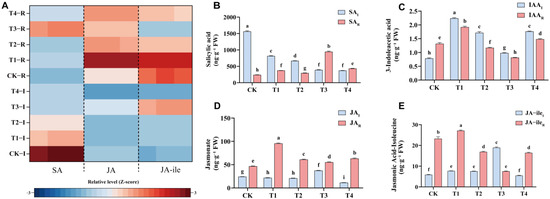
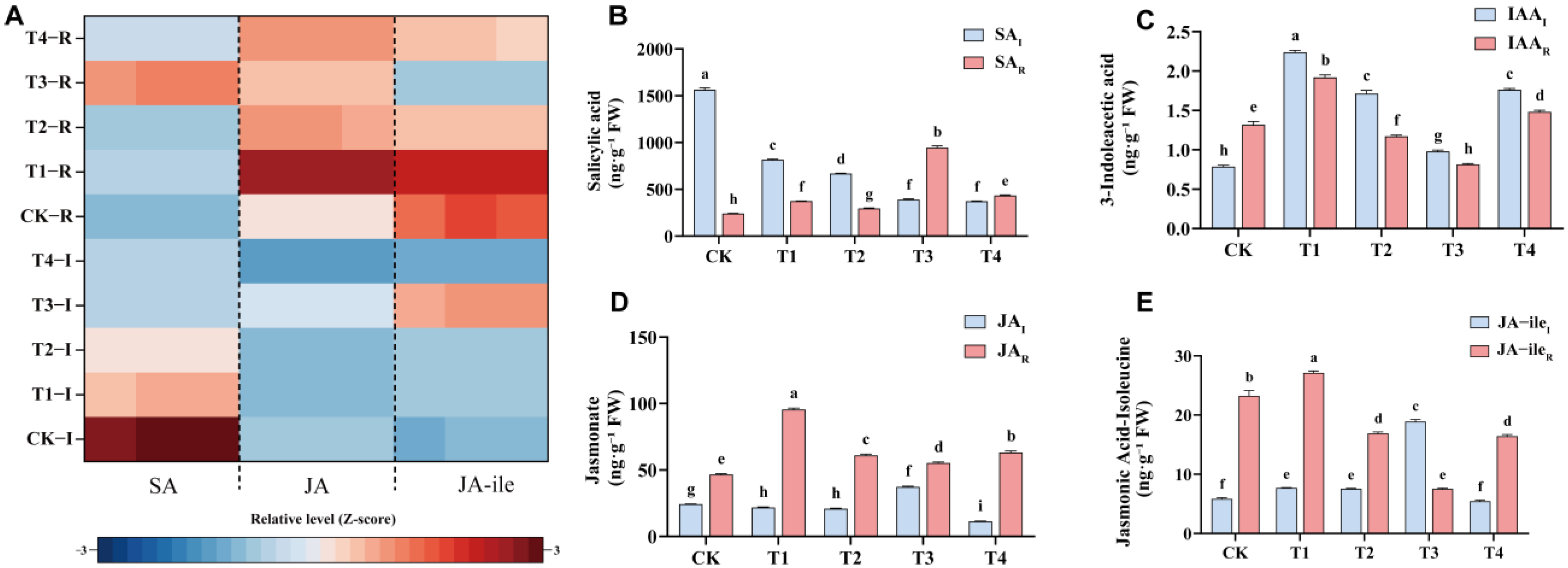
Levels of plant hormone SA, JA, JA-ile and IAA related to plant immunity and growth were determined on day 14 (I) and 42 (R) (Figure 5 and Figure S3). The SA content was 1564.24 ng·g−1 on day 14 in CK, and only 240.59 ng·g−1 on day 42. However, the SA levels remained 945.93 ng·g−1 in T3 on day 42, which was highest among all samples. Another, hormone JA content showed a higher content on day 42 than day 14 in all groups, except for T1. In parallel, JA-ile as the material to confirm activation of the JA pathway, indicated that JA activity was increased in all treatment except T3, due to the content of JA-ile was 7.53 ng·g−1 (on day 42) significantly lower than it on day 14. On day 42, IAA levels decreased in all inoculation treatments compared to day 14, whereas increased to 1.318 ng·g−1 in the CK. However, the IAA in CK was still significantly (p < 0.05) lower than in T1 and T4. Interestingly, the IAA in CK was significantly (p < 0.05) higher than T3 on day 42, even though V. soli produces IAA. Above all, the difference in plant hormone analysis indicated that strain A. brasilense and M. phyllosphaerae had an influence on JA and IAA accumulation in strawberry seedlings, while strain V. soli influenced seedlings on SA accumulation.
Figure 5.
Plant hormone levels in strawberry seedlings. (A) Normalized Z-scores represented the relative hormone levels determined on day 14 (I) and 42 (R) in each treatment group. (B) Absolute content of salicylic acid (SA) in strawberry seedlings. (C) Absolute content of indole-3-acetic acid (IAA) in strawberry seedlings. (D) Absolute content of jasmonic acid (JA) in strawberry seedlings. (E) Absolute content of jasmonic acid–isoleucine (JA-ile) in strawberry seedlings. Two-way ANOVA was performed in (B–E), followed by Tukey’s HSD test. Different letters indicate significant differences within each treatment (p < 0.05). The data were presented as the mean ± standard deviation of 3 individual replicates.
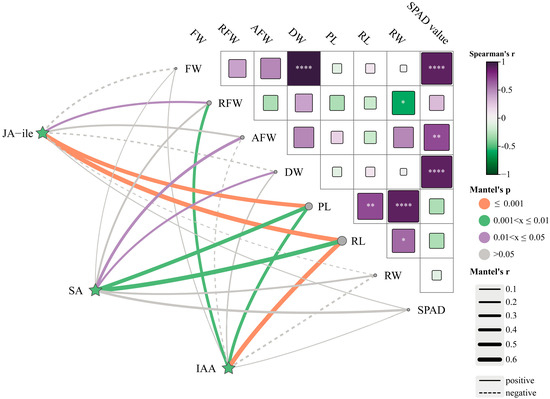
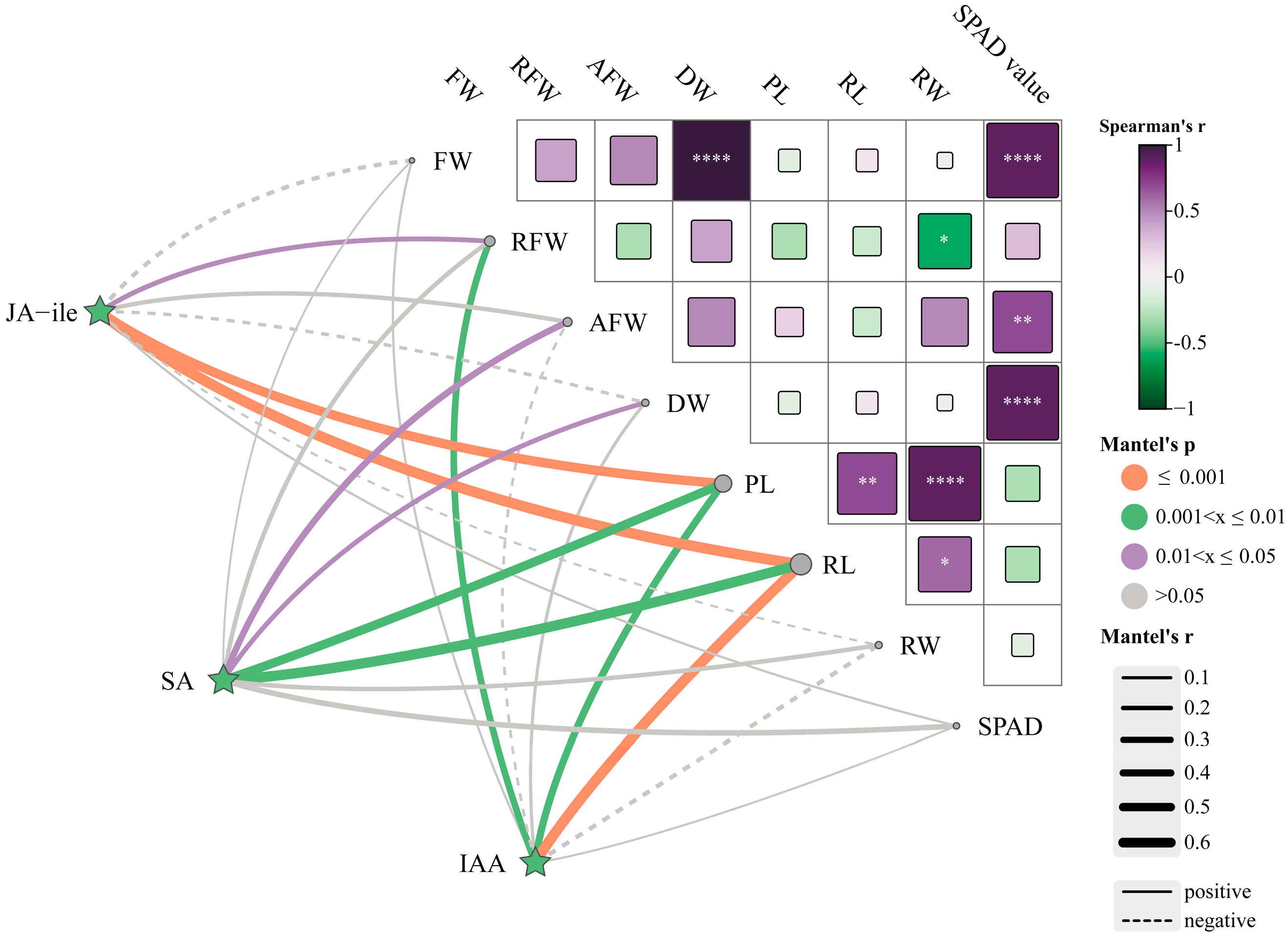
The correlation of plant growth property was analyzed using the pairwise Spearman’s rank correlation coefficient, and the association between plant growth properties and plant hormones was determined based on the Mantel test. As shown in Figure 6, the SPAD value of seedling leaves was positively and significantly correlated with FW, AFW, and DW, but showed a negative correlation with PL, RL and RW. Interestingly, the Mantel test suggested that hormone SA was correlated with the above-ground weight of seedlings (AFWrSA = 0.346, p ≤ 0.05), but JA-ile was correlated with root fresh weight (RFWrJA-ile = 0.227, p ≤ 0.05), similar to IAA (RFWrIAA = 0.358, p ≤ 0.01). Besides, three hormones all showed a significant correlation with plant length (PL).
Figure 6.
Correlations of IAA (indole-3-acetic acid), SA (salicylic acid) and JA-ile (jasmonic acid–isoleucine) with strawberry seedling growth traits. The “FW, RFW, AFW, DW, PL, RL, RW and SPAD value” represent the fresh weight, root fresh weight, aboveground fresh weight, dry weight, plant length, root length, root width and relative chlorophyll content of strawberry seedlings on the day 42, respectively. The size of the squares represents the absolute value of Spearman’s r and different color represents positive or negative correlation. The association between hormones and growth properties is assessed using the Mantell test. Line thickness and color represent the r and p-values of the Mantell correlation test, respectively. Solid lines suggest a positive Mantell correlation, while dashed lines suggest a negative one. Asterisks indicate statistical significance: * p < 0.05; ** p < 0.01; **** p < 0.0001. The data were presented as the mean ± standard deviation of 3 individual replicates.
4. Discussion
Strawberry powdery mildew, caused by the obligate biotrophic pathogen Podosphaera aphanis, represents a major constraint in strawberry cultivation [31]. With the development of greenhouse cultivation, the high humidity inside the greenhouse has provided a favorable environment for the occurrence and spread of powdery mildew [32]. The present work also showed the symptoms in strawberry seedlings in 10 days and significantly influenced the SPAD value of leaves in the greenhouse (Figure 1 and Figure S1 & Table S5). To control this disease in an environmentally friendly way, four PGPB were applied to seedlings to enhance resistance against powdery mildew and promote growth. Observations and measurements of the plant growth of strawberry seedlings, specifically root width and above-ground fresh weight, were significantly increased by inoculation with P. diazotrophicus, V. soli and M. phyllosphaerae (Figure 3B,F). However, there were no significant differences in total fresh weight and total dry weight among the treatments (Figure 3C,D). This may be due to the regulation of plasma membrane aquaporins by inoculation with these PGPB, which increased the water content of the aboveground parts [33]. Regarding the mechanism, although salicylic acid (SA)-dependent systemic acquired resistance (SAR) is the canonical defense against biotrophic fungi, most PGPB studies in strawberry have predominantly reported activation of the JA/ET pathways, which are typically associated with necrotrophs and herbivores [34,35]. The present work revealed this discrepancy by demonstrating that superior biocontrol is achieved only when PGPB-induced hormone signaling is precisely aligned with the pathogen. Remarkably, two distinct and highly effective defense strategies emerged from the four tested strains, both reducing the final disease index to 11.25–26.25% (Figure S2), yet operating through entirely different branches of the plant immune network.
Plant growth promotion was unequivocally auxin driven [36]. In vitro culture systems, it showed that M. phyllosphaerae LX2-4 (T4) was the strongest and earliest IAA producer (22.32 μg·mg−1 dry cell weight at 24 h), whereas A. brasilense 1224T (T1) exhibited more sustained secretion (Figure 4). In parallel, endogenous IAA levels in T1- and T4-inoculated seedlings remained significantly higher than in CK (Figure S3B), resulting in 31.6% greater shoot height (T1) and 14.6% higher total fresh weight (T4) on day 42 (Figure 3C & Table S6). Moreover, the Mantel test confirmed a highly significant positive relationship between endogenous IAA and root fresh weight (r = 0.358, p ≤ 0.01) (Figure 6), consistent with rhizobacterial IAA acting via TIR1/AFB receptors to reprogram root architecture and drive cell division and elongation even under biotic stress [37,38]. Although strong IAA production can enhance plant disease resistance by promoting plant growth and the accumulation of callose to increase the biomass [39,40], it is insufficient to suppress disease, as evidenced by the only moderate biocontrol efficacy of T1 (Figure S2).
Effective resistance against pathogens requires precise control of defense hormone type, amplitude, and duration [41,42,43,44]. The SA and JA are the core components of this process [45,46]. The strain V. soli LXC3-3 (T3) showed a classic, prolonged SAR response in infected seedlings. Figure 5B showed the SA levels were sustained above 900 (ng·g−1 fresh weight) until day 42, which was approximately fourfold higher than in CK and persisted longer than in other treatments. This exceptional durability likely arises from continuous upregulation of the PAD4/EDS5-dependent isochorismate pathway coupled with suppression of SA catabolism via methyltransferase or glycosylation inhibition, thereby maintaining high expression of PR1, PR2, and PR5 and creating a cellular environment strongly antagonistic to biotrophic feeding structures [47,48]. Besides, T3 showed the lowest IAA content among all treatments (Figure S3B), and it may be due to the interaction between SA and IAA, the SA interferes with auxin perception to prevent overaccumulation, and IAA antagonizes SA-mediated defense responses [49]. Previous studies have demonstrated that SA suppresses the expression of the auxin receptor genes T1R1 and AFBs, and stabilizes Aux/IAA repressor proteins to block the transcription of auxin-responsive genes [50]. The results highlighted that the antagonism between SA and IAA is not merely a passive competition for energy but a highly evolved regulatory network, and this precise regulation ensures that plants can transiently prioritize immunity overgrowth upon pathogen perception.
In striking contrast, A. brasilense (T1) and M. phyllosphaerae (T4) achieved disease control through the accumulation of JA/JA-ile (Figure 5A,D,E), which is recognized as the precise signature of the ISR pathway [51,52]. Although the disease index declined in all three treatments, only T4 achieved disease control equivalent to that of T3 (Figure S2). Moreover, the plant biomass of seedlings in T4 was better than T1 (Figure 3B), it might be due to the precise control between IAA and JA/JA-ile. It is well known that a lot of defense related materials are sharing the common precursor tryptophan with IAA, but the accumulation of JA will divert the tryptophan flux away from the indole-3-pyruvate auxin biosynthesis pathway and toward the production of secondary metabolites [53,54]. Therefore, the accumulation of JA will cause high metabolic costs on plants, unlike the SA-mediated pathway that maintains low impacts to growth [55,56]. The negative correlation between JA-ile and biomass in the Mantel test might indicate the relation between the IAA and JA-ile (Figure 6), but T4 might confine JA signaling within a growth-compatible window to maintain the growth.
Thus, strains V. soli LXC3-3 (T3) and M. phyllosphaerae LX2-4 (T4) represented two evolutionarily distinct but equally successful strategies. One being a prolonged SA-driven SAR, and the other an IAA-buffered precisely JA-ile-dependent ISR, both matched to the biotrophic pathogen of powdery mildew exquisitely. Despite high IAA accumulation, strains A. brasilense 1224T (T1) and P. diazotrophicus W45 (T2) might elicit brief, low-amplitude spikes in defense hormones that decayed before irreversible infection pathways were established, indicating that for obligate biotrophic pathogens, the duration of elevated defense hormone levels is often more critical than the peak amplitude [57]. One limitation of this study is that it was conducted only in pot experiments with a single variety (“Hongyan”), which may affect the generalizability in practical applications. Future studies should explore the interactions of V. soli and M. phyllosphaerae with native microbial communities and their compatibility with sustainable agricultural practices in the field.
5. Conclusions
Our results demonstrate that four kinds of PGPB could provide protection against strawberry powdery mildew through parallel pathways: auxin-driven plant growth promotion and pathogen-specific, persistent activation of salicylic acid or jasmonic acid dependent resistance. Strains Variovorax soli and Microbacterium phyllosphaerae represent two highly effective but mechanistically different defense strategies, providing a novel microbial resource and predictive signaling framework for sustainable horticultural disease control. These findings suggest that these PGPB have the potential to be integrated into sustainable biological management programs, thereby reducing the use of chemical fungicides. Although this study establishes a framework for promoted growth and induced resistance, future studies should be focused on validating field efficacy, the isotopic discrimination between microbial and plant derived IAA and the potential molecular mechanisms of how different strains induce different resistance hormone pathways.
Supplementary Materials
The following supporting information can be downloaded at: https://www.mdpi.com/article/10.3390/horticulturae12020225/s1, Figure S1: Symptoms of powdery mildew on strawberry leaves; Figure S2: The disease index of strawberry seedlings inoculated with different PGPB on day 14, 28 and 42 of consecutive culture; Figure S3: Accumulation of different plant hormone in strawberry seedling on day 14 (A, C, E & G) and day 42 (B, D, F & H); Table S1: Components of MMAB culture medium; Table S2: The analytical conditions of UPLC; Table S3: The Gradient Program of UPLC; Table S4: The ESI source parameters; Table S5: The SPAD value of strawberry seedling in different treatment groups; Table S6: Plant above-ground length of strawberry seedlings in different treatment groups; Table S7: The root length and root width of strawberry seedling in different treatment groups.
Author Contributions
Writing—original draft preparation, formal analysis, W.J.; funding acquisition, writing—original draft preparation, L.H.; formal analysis, investigation, X.X.; visualization, C.H.; resources, W.Z.; methodology, F.Z.; supervision, Y.Z.; funding acquisition, writing—review and editing Y.Y. All authors have read and agreed to the published version of the manuscript.
Funding
This research was funded by the National Natural Science Foundation of China (32402676), Sannong Jiufang S&T project in Zhejiang Province (2025SNJF029), Local Cooperation Project of Zhejiang Academy of Agricultural Sciences (SY202304) and the Zhejiang Provincial Natural Science Foundation of China (No. LY20B070011).
Data Availability Statement
The original contributions presented in this study are included in the article/Supplementary Material. Further inquiries can be directed to the corresponding authors.
Conflicts of Interest
The authors declare no competing interests.
Abbreviations
The following abbreviations are used in this manuscript:
| PGPB | Plant growth-promoting bacteria |
| IAA | Indole-3-acetic acid |
| SA | Salicylic acid |
| JA | Jasmonic acid |
| JA-ile | Jasmonic acid–isoleucine |
| SPAD value | Relative chlorophyll content |
| ACN | Acetonitrile |
| FW | Fresh weight |
| AFW | Aboveground fresh weight |
| RFW | Root fresh weight |
| PL | Plant length |
| RL | Root length |
| RW | Root width |
References
- Esitken, A.; Yildiz, H.E.; Ercisli, S.; Figen Donmez, M.; Turan, M.; Gunes, A. Effects of plant growth promoting bacteria (PGPB) on yield, growth and nutrient contents of organically grown strawberry. Sci. Hortic. 2010, 124, 62–66. [Google Scholar] [CrossRef] [Scilit]
- Amsalem, L.; Freeman, S.; Rav-David, D.; Nitzani, Y.; Sztejnberg, A.; Pertot, I.; Elad, Y. Effect of climatic factors on powdery mildew caused by Sphaerotheca macularis f. sp. Fragariae on strawberry. Eur. J. Plant Pathol. 2006, 114, 283–292. [Google Scholar] [CrossRef] [Scilit]
- Che, M.; Luo, Y.; Ge, C.; Ling, Y.; Mo, Q.; Luo, S.; Tang, H. The performance of three strawberry varieties on phenological period and quality in Hanyuan County. AIP Conf. Proc. 2018, 1956, 020013. [Google Scholar] [CrossRef] [Scilit]
- Berrie, A.; Xu, X. Developing biopesticide-based programmes for managing powdery mildew in protected strawberries in the UK. Crop Prot. 2021, 149, 105766. [Google Scholar] [CrossRef] [Scilit]
- Yang, M.; He, T.; Moukarzel, R.; Li, M.; Li, M.; Zhang, Z.; He, Y.; Liu, Y.; Yu, L.; Zhu, S.; et al. Phyllosphere microbiome responses to nano-berberine and chemical fungicides in powdery mildew infected strawberry. Front. Plant Sci. 2025, 16, 712123. [Google Scholar] [CrossRef] [Scilit]
- Savci, S. Investigation of effect of chemical fertilizers on environment. APCBEE Procedia 2012, 1, 287–292. [Google Scholar] [CrossRef] [Scilit]
- Palmer, M.G.; Holmes, G.J. Fungicide sensitivity in strawberry powdery mildew caused by Podosphaera aphanis in California. Plant Dis. 2021, 105, 2601–2605. [Google Scholar] [CrossRef] [Scilit] [PubMed]
- Catalan, P.; Chalhoub, B.; Chochois, V.; Garvin, D.F.; Hasterok, R.; Manzaneda, A.J.; Mur, L.A.J.; Pecchioni, N.; Rasmussen, S.K.; Vogel, J.P.; et al. Update on the genomics and basic biology of Brachypodium: International Brachypodium Initiative (IBI). Trends Plant Sci. 2014, 19, 414–418. [Google Scholar] [CrossRef] [Scilit] [PubMed]
- Pandey, V.; Chandra, K. Agriculturally important microorganisms as biofertilizers: Commercialization and regulatory requirements in Asia. In Agriculturally Important Microorganisms: Commercialization and Regulatory Requirements in Asia; Singh, H.B., Sarma, B.K., Keswani, C., Eds.; Springer: Singapore, 2016; pp. 133–145. [Google Scholar]
- Zhang, J.; Wang, P.; Fang, L.; Zhang, Q.-A.; Yan, C.; Chen, J. Isolation and characterization of phosphate-solubilizing bacteria from mushroom residues and their effect on tomato plant growth promotion. Pol. J. Microbiol. 2017, 66, 57–65. [Google Scholar] [CrossRef] [Scilit]
- Duca, D.R.; Glick, B.R. Indole-3-acetic acid biosynthesis and its regulation in plant-associated bacteria. Appl. Microbiol. Biotechnol. 2020, 104, 8607–8619. [Google Scholar] [CrossRef] [Scilit]
- Flores-Félix, J.D.; Silva, L.R.; Rivera, L.P.; Marcos-García, M.; García-Fraile, P.; Martínez-Molina, E.; Mateos, P.F.; Velázquez, E.; Andrade, P.; Rivas, R. Plants probiotics as a tool to produce highly functional fruits: The case of Phyllobacterium and vitamin C in strawberries. PLoS ONE 2015, 10, e0122281. [Google Scholar] [CrossRef] [Scilit] [PubMed]
- Todeschini, V.; AitLahmidi, N.; Mazzucco, E.; Marsano, F.; Gosetti, F.; Robotti, E.; Bona, E.; Massa, N.; Bonneau, L.; Marengo, E.; et al. Impact of beneficial microorganisms on strawberry growth, fruit production, nutritional quality, and volatilome. Front. Plant Sci. 2018, 9, 1611. [Google Scholar] [CrossRef] [Scilit] [PubMed]
- Islam, S.; Akanda, A.M.; Prova, A.; Islam, M.T.; Hossain, M.M. Isolation and identification of plant growth promoting rhizobacteria from cucumber rhizosphere and their effect on plant growth promotion and disease suppression. Front. Microbiol. 2016, 6, 1360. [Google Scholar] [CrossRef] [Scilit]
- Romero, A.M.; Vega, D.; Correa, O.S. Azospirillum brasilense mitigates water stress imposed by a vascular disease by increasing xylem vessel area and stem hydraulic conductivity in tomato. Appl. Soil Ecol. 2014, 82, 38–43. [Google Scholar] [CrossRef] [Scilit]
- Mehmood, T.; Li, G.; Anjum, T.; Akram, W. Azospirillum lipoferum strain AL-3 reduces early blight disease of potato and enhance yield. Crop Prot. 2021, 139, 105349. [Google Scholar] [CrossRef] [Scilit]
- Wang, C.-J.; Wang, Y.-Z.; Chu, Z.-H.; Wang, P.-S.; Liu, B.-Y.; Li, B.-Y.; Yu, X.-L.; Luan, B.-H. Endophytic Bacillus amyloliquefaciens YTB1407 elicits resistance against two fungal pathogens in sweet potato (Ipomoea batatas (L.) Lam.). J. Plant Physiol. 2020, 253, 153260. [Google Scholar] [CrossRef] [Scilit] [PubMed]
- El-Saadony, M.T.; Saad, A.M.; Soliman, S.M.; Salem, H.M.; Ahmed, A.I.; Mahmood, M.; El-Tahan, A.M.; Ebrahim, A.A.M.; Abd El-Mageed, T.A.; Negm, S.H.; et al. Plant growth-promoting microorganisms as biocontrol agents of plant diseases: Mechanisms, challenges and future perspectives. Front. Plant Sci. 2022, 13, 923880. [Google Scholar] [CrossRef] [Scilit]
- Hosseini, A.; Hosseini, M.; Schausberger, P. Plant growth-promoting rhizobacteria enhance defense of srawberry plants against Spider mites. Front. Plant Sci. 2022, 12, 783578. [Google Scholar] [CrossRef] [Scilit]
- Cao, M.; Narayanan, M.; Shi, X.; Chen, X.; Li, Z.; Ma, Y. Optimistic contributions of plant growth-promoting bacteria for sustainable agriculture and climate stress alleviation. Environ. Res. 2023, 217, 114924. [Google Scholar] [CrossRef] [Scilit]
- Pieterse, C.M.J.; van Wees, S.C.M.; van Pelt, J.A.; Knoester, M.; Laan, R.; Gerrits, H.; Weisbeek, P.J.; van Loon, L.C. A Novel signaling pathway controlling induced systemic resistance in Arabidopsis. Plant Cell 1998, 10, 1571–1580. [Google Scholar] [CrossRef] [Scilit]
- Salwan, R.; Sharma, M.; Sharma, A.; Sharma, V. Insights into plant beneficial microorganism-triggered induced systemic resistance. Plant Stress 2023, 7, 100140. [Google Scholar] [CrossRef] [Scilit]
- Durrant, W.E.; Dong, X. Systemic acquired resistance. Annu. Rev. Phytopathol. 2004, 42, 185–209. [Google Scholar] [CrossRef] [Scilit]
- Kaleh, A.M.; Singh, P.; Ooi Chua, K.; Harikrishna, J.A. Modulation of plant transcription factors and priming of stress tolerance by plant growth-promoting bacteria: A systematic review. Ann. Bot. 2024, 135, 387–402. [Google Scholar]
- Beris, D.; Theologidis, I.; Skandalis, N.; Vassilakos, N. Bacillus amyloliquefaciens strain MBI600 induces salicylic acid dependent resistance in tomato plants against tomato spotted wilt virus and potato virus Y. Sci. Rep. 2018, 8, 10320. [Google Scholar] [CrossRef] [Scilit]
- Mazuecos-Aguilera, I.; Anta-Fernández, F.; Crespo-Barreiro, A.; Martínez-Quesada, A.; Lombana-Larrea, L.; González-Andrés, F. Plant growth-promoting rhizobacteria enhanced induced systemic resistance of tomato against Botrytis cinerea phytopathogen. Front. Plant Sci. 2025, 16, 1570986. [Google Scholar] [CrossRef] [Scilit] [PubMed]
- Araújo, V.L.V.P.; Fracetto, G.G.M.; Silva, A.M.M.; Pereira, A.P.d.A.; Freitas, C.C.G.; Barros, F.M.d.R.; Santana, M.C.; Feiler, H.P.; Matteoli, F.P.; Fracetto, F.J.C.; et al. Potential of growth-promoting bacteria in maize (Zea mays L.) varies according to soil moisture. Microbiol. Res. 2023, 271, 127352. [Google Scholar] [CrossRef] [Scilit]
- Hong, L.; Orikasa, Y.; Sakamoto, H.; Ohwada, T. Plant tissue localization and morphological conversion of Azospirillum brasilense upon initial interaction with Allium cepa L. Microorganisms 2019, 7, 275. [Google Scholar] [CrossRef] [Scilit]
- Xiao, C.L.; Chandler, C.K.; Price, J.F.; Duval, J.R.; Mertely, J.C.; Legard, D.E. Comparison of epidemics of botrytis fruit rot and powdery mildew of strawberry in large plastic tunnel and field production systems. Plant Dis. 2001, 85, 901–909. [Google Scholar] [CrossRef] [Scilit] [PubMed]
- Ait Bessai, S.; Bensidhoum, L.; Nabti, E.-h. Optimization of IAA production by telluric bacteria isolated from northern Algeria. Biocatal. Agric. Biotechnol. 2022, 41, 102319. [Google Scholar] [CrossRef] [Scilit]
- Heaven, T.; Cockerton, H.M.; Xu, X.; Goddard, M.; Armitage, A.D. A genomic resource for the strawberry powdery mildew pathogen Podosphaera aphanis. Phytopathology® 2023, 113, 355–359. [Google Scholar] [CrossRef] [Scilit] [PubMed]
- Asalf, B.; Onofre, R.B.; Gadoury, D.M.; Peres, N.A.; Stensvand, A. Pulsed aater mists for suppression of strawberry powdery mildew. Plant Dis. 2021, 105, 71–77. [Google Scholar] [CrossRef] [Scilit] [PubMed]
- Marulanda, A.; Azcón, R.; Chaumont, F.; Ruiz-Lozano, J.M.; Aroca, R. Regulation of plasma membrane aquaporins by inoculation with a Bacillus megaterium strain in maize (Zea mays L.) plants under unstressed and salt-stressed conditions. Planta 2010, 232, 533–543. [Google Scholar] [CrossRef] [Scilit]
- Elías, J.M.; Guerrero-Molina, M.F.; Martínez-Zamora, M.G.; Díaz-Ricci, J.C.; Pedraza, R.O. Role of ethylene and related gene expression in the interaction between strawberry plants and the plant growth-promoting bacterium Azospirillum brasilense. Plant Biol. 2018, 20, 490–496. [Google Scholar] [CrossRef] [Scilit] [PubMed]
- Mir, Z.A.; Ali, S.; Manzoor, S.; Sharma, D.; Sharma, D.; Tyagi, A.; Wani, A.W.; Kumar, S.; Ayele, B.T. Plant defense hormones: Thermoregulation and their role in plant adaptive immunity. J. Plant Growth Regul. 2025, 44, 2689–2706. [Google Scholar] [CrossRef] [Scilit]
- Lin, W.; Zhou, X.; Tang, W.; Takahashi, K.; Pan, X.; Dai, J.; Ren, H.; Zhu, X.; Pan, S.; Zheng, H.; et al. TMK-based cell-surface auxin signalling activates cell-wall acidification. Nature 2021, 599, 278–282. [Google Scholar] [CrossRef] [Scilit] [PubMed]
- Qi, L.; Kwiatkowski, M.; Chen, H.; Hoermayer, L.; Sinclair, S.; Zou, M.; del Genio, C.I.; Kubeš, M.F.; Napier, R.; Jaworski, K.; et al. Adenylate cyclase activity of TIR1/AFB auxin receptors in plants. Nature 2022, 611, 133–138. [Google Scholar] [CrossRef] [Scilit]
- Etesami, H.; Glick, B.R. Bacterial indole-3-acetic acid: A key regulator for plant growth, plant-microbe interactions, and agricultural adaptive resilience. Microbiol. Res. 2024, 281, 127602. [Google Scholar] [CrossRef] [Scilit]
- Tortora, M.L.; Díaz-Ricci, J.C.; Pedraza, R.O. Protection of strawberry plants (Fragaria ananassa Duch.) against anthracnose disease induced by Azospirillum brasilense. Plant Soil 2012, 356, 279–290. [Google Scholar] [CrossRef] [Scilit]
- Guerrero-Molina, M.F.; Lovaisa, N.C.; Salazar, S.M.; Martínez-Zamora, M.G.; Díaz-Ricci, J.C.; Pedraza, R.O. Physiological, structural and molecular traits activated in strawberry plants after inoculation with the plant growth-promoting bacterium Azospirillum brasilense REC3. Plant Biol. 2015, 17, 766–773. [Google Scholar] [CrossRef] [Scilit]
- Huot, B.; Yao, J.; Montgomery, B.L.; He, S.Y. Growth–defense tradeoffs in plants: A balancing act to optimize fitness. Mol. Plant 2014, 7, 1267–1287. [Google Scholar] [CrossRef] [Scilit]
- Glazebrook, J. Contrasting mechanisms of defense against biotrophic and necrotrophic pathogens. Annu. Rev. Phytopathol. 2005, 43, 205–227. [Google Scholar] [CrossRef] [Scilit]
- Pieterse, C.M.J.; Van der Does, D.; Zamioudis, C.; Leon-Reyes, A.; Van Wees, S.C.M. Hormonal modulation of plant immunity. Annu. Rev. Cell Dev. Biol. 2012, 28, 489–521. [Google Scholar] [CrossRef] [Scilit]
- De Vos, M.; Van Oosten, V.R.; Van Poecke, R.M.P.; Van Pelt, J.A.; Pozo, M.J.; Mueller, M.J.; Buchala, A.J.; Métraux, J.-P.; Van Loon, L.C.; Dicke, M.; et al. Signal signature and transcriptome changes of Arabidopsis during pathogen and insect attack. Mol. Plant-Microbe Interact. 2005, 18, 923–937. [Google Scholar] [CrossRef] [Scilit] [PubMed]
- Zhang, P.; Jackson, E.; Li, X.; Zhang, Y. Salicylic acid and jasmonic acid in plant immunity. Hortic. Res. 2025, 12, uhaf082. [Google Scholar] [CrossRef] [Scilit] [PubMed]
- Pieterse, C.M.J.; Leon-Reyes, A.; Van der Ent, S.; Van Wees, S.C.M. Networking by small-molecule hormones in plant immunity. Nat. Chem. Biol. 2009, 5, 308–316. [Google Scholar] [CrossRef] [Scilit] [PubMed]
- Wang, C.; Gao, F.; Wu, J.; Dai, J.; Wei, C.; Li, Y. Arabidopsis putative deacetylase AtSRT2 regulates basal defense by suppressing PAD4, EDS5 and SID2 expression. Plant Cell Physiol. 2010, 51, 1291–1299. [Google Scholar] [CrossRef] [Scilit]
- Feng, J.; Zhang, M.; Yang, K.-N.; Zheng, C.-X. Salicylic acid-primed defence response in octoploid strawberry ‘Benihoppe’ leaves induces resistance against Podosphaera aphanis through enhanced accumulation of proanthocyanidins and upregulation of pathogenesis-related genes. BMC Plant Biol. 2020, 20, 149. [Google Scholar]
- Rawat, S.S.; Laxmi, A. Rooted in communication: Exploring auxin–salicylic acid nexus in root growth and development. Plant Cell Environ. 2025, 48, 4140–4160. [Google Scholar] [CrossRef] [Scilit]
- Wang, D.; Pajerowska-Mukhtar, K.; Culler, A.H.; Dong, X. Salicylic acid inhibits pathogen growth in plants through repression of the auxin signaling pathway. Curr. Biol. 2007, 17, 1784–1790. [Google Scholar] [CrossRef] [Scilit]
- Pieterse, C.M.; Zamioudis, C.; Berendsen, R.L.; Weller, D.M.; Van Wees, S.C.; Bakker, P.A. Induced systemic resistance by beneficial microbes. Annu. Rev. Phytopathol. 2014, 52, 347–375. [Google Scholar] [CrossRef] [Scilit]
- Fonseca, S.; Chini, A.; Hamberg, M.; Adie, B.; Porzel, A.; Kramell, R.; Miersch, O.; Wasternack, C.; Solano, R. (+)-7-iso-Jasmonoyl-L-isoleucine is the endogenous bioactive jasmonate. Nat. Chem. Biol. 2009, 5, 344–350. [Google Scholar] [CrossRef] [Scilit] [PubMed]
- Staswick, P.; Rowe, M.; Spalding, E.P.; Splitt, B.L. Jasmonoyl-l-tryptophan disrupts IAA activity through the AUX1 auxin permease. Front. Plant Sci. 2017, 8, 736. [Google Scholar] [CrossRef] [Scilit] [PubMed]
- Müller, M.; Munné-Bosch, S. Ethylene response factors: A key regulatory hub in hormone and stress signaling. Plant Physiol. 2015, 169, 32–41. [Google Scholar] [CrossRef] [Scilit]
- Chan, C. Progress in salicylic acid-dependent signaling for growth–defense trade-off. Cells 2022, 11, 2985. [Google Scholar] [CrossRef] [Scilit] [PubMed]
- Guo, Q.; Yoshida, Y.; Major, I.T.; Wang, K.; Sugimoto, K.; Kapali, G.; Havko, N.E.; Benning, C.; Howe, G.A. JAZ repressors of metabolic defense promote growth and reproductive fitness in Arabidopsis. Proc. Natl. Acad. Sci. USA 2018, 115, E10768–E10777. [Google Scholar] [CrossRef] [Scilit]
- Mengiste, T.; Liao, C.J. Contrasting mechanisms of defense against biotrophic and necrotrophic pathogens, 20 years later: What has changed? Annu. Rev. Phytopathol. 2025, 63, 279–308. [Google Scholar] [CrossRef] [Scilit]
Disclaimer/Publisher’s Note: The statements, opinions and data contained in all publications are solely those of the individual author(s) and contributor(s) and not of MDPI and/or the editor(s). MDPI and/or the editor(s) disclaim responsibility for any injury to people or property resulting from any ideas, methods, instructions or products referred to in the content. |
© 2026 by the authors. Licensee MDPI, Basel, Switzerland. This article is an open access article distributed under the terms and conditions of the Creative Commons Attribution (CC BY) license.