


Abstract
Expansins are crucial cell wall-loosening proteins that play a vital role in various plant developmental processes, including fruit ripening and softening. However, a comprehensive genome-wide analysis of the expansin family in apple (Malus × domestica) and the specific functions of its members in postharvest fruit ripening remain to be explored. In this study, we identified 51 expansin genes in the apple genome and classified them into four subfamilies (EXPA, EXPB, EXLA, and EXLB). Cis-element analysis of the promoters of apple expansin genes showed that these promoters are rich in various hormone-responsive elements, including abscisic acid (ABA)-responsive elements (ABREs) and ethylene-responsive elements (EREs), suggesting potential hormonal regulation of expansin genes. Expression profiling identified six ripening-associated expansin genes. Among them, MdEXPA5, MdEXPA17, and MdEXPA23 were positively regulated by both ethylene and ABA, while being suppressed by the ethylene action inhibitor 1-MCP. Further functional characterization demonstrated that transient overexpression of MdEXPA17 accelerated fruit softening, skin yellowing, ethylene production, and increased total soluble solid (TSS) content. Conversely, silencing of MdEXPA17 significantly delayed these ripening processes. Our study provides a systematic overview of the apple expansin gene family and supports a role for MdEXPA17 in promoting postharvest fruit ripening and softening. These findings offer valuable insights into the molecular mechanisms of apple fruit ripening and provide potential targets for genetic improvement of fruit quality and shelf life.
1. Introduction
Plant growth and development, organ morphogenesis, and adaptation to environmental stresses are governed by the precise regulation of diverse functional genes. Among them, expansin proteins constitute a plant-specific multigene family that loosens cell walls by disrupting hydrogen bonds between wall polysaccharides, thereby inducing acid-dependent wall extension [1,2,3]. Through this mechanism, expansins play central roles in cell wall relaxation and cell expansion during the growth and environmental adaptation of higher plants [4,5]. Expansins are highly conserved in structure, and the mature proteins typically comprise two characteristic domains: an N-terminal domain with sequence similarity to the catalytic domain of glycoside hydrolase family 45 (GH45) and enriched in conserved cysteines, and a C-terminal polysaccharide-binding domain enriched in conserved tryptophans. Based on phylogenetic relationships and sequence features, the expansin superfamily is divided into four subfamilies—Expansin A (EXPA), Expansin B (EXPB), Expansin-Like A (EXLA), and Expansin-Like B (EXLB) [6]. Members of the EXPA and EXPB subfamilies contain the HFD (His-Phe-Asp) motif that is critical for wall-loosening activity, whereas EXLA and EXLB subfamilies generally lack this motif, and their functions remain less well defined [7]. In fleshy fruits, this wall-loosening activity is a key driver of the ripening-associated softening that dictates texture, shelf life, and marketability. Controlling this process is particularly crucial for apple, a globally important climacteric fruit for which postharvest softening can lead to substantial quality deterioration and economic loss.
The functional diversity of expansins has been broadly demonstrated across species. In plant developmental regulation, SlEXP1 acts cooperatively with endo-β-1,4-glucanase SlCEL2 to promote tomato fruit softening and wall disassembly [8]; overexpression of AcEXPA23 in kiwifruit enhances lateral root development [9]; OfEXPA2/4 in sweet osmanthus participate in petal cell expansion during anthesis [10]; and OsEXPA7 influences grain size and quality in rice [11]. In stress responses, TaEXPA19 improves low-temperature tolerance in wheat [12], maize ZmEXPA6 enhances salt tolerance when overexpressed in Arabidopsis [13], and GsEXPB1 confers salt tolerance in transgenic soybean [14]. Collectively, these studies highlight the multi-functionality of expansins in plant development and stress adaptation; however, in apple, a systematic genome-wide identification, coupled with analysis of their hormone-responsive roles and functional validation during postharvest fruit ripening, remains to be fully elucidated.
Apple is a pome fruit, botanically classified as a false (accessory) fruit, in which the edible fleshy cortex develops primarily from the hypanthium tissue rather than the ovary. Nevertheless, it undergoes marked textural changes associated with cell wall disassembly during ripening, making it a valuable system for studying postharvest softening. Postharvest softening in certain widely cultivated apple cultivars can lead to deterioration of fresh-fruit quality, shortened shelf life, increased disease susceptibility, and substantial economic losses. As a climacteric fruit, apple ripening and softening are regulated by the ethylene signaling pathway. Cell wall disassembly is a central physiological event during fruit softening, involving the coordinated activity of a range of enzymes such as polygalacturonases (PGs), pectin methylesterases (PMEs), xyloglucan endotransglycosylase/hydrolases (XTHs), as well as non-enzymatic wall-loosening proteins such as expansins [15,16]. Notably, allelic variation at MdEXP-A1 can reduce flesh firmness at harvest and is a key determinant of fruit texture [17]; heterologous overexpression of the apple expansin-like gene MdEXLB1 in tomato accelerates fruit softening, indicating functional conservation of expansins in fruit texture regulation across species [18].
In this study, we systematically investigated the expansin gene family in apple and their potential roles in fruit ripening and storability. Genome-wide identification and characterization were performed, followed by expression analysis under ethylene, 1-methylcyclopropene (1-MCP), and abscisic acid (ABA) treatments in the mid-ripening cultivar ‘Golden Delicious’. Key candidate genes, including MdEXPA17, were further functionally validated through transient overexpression and gene silencing assays. Together, these results provide candidate genes and a molecular basis for breeding apple cultivars with improved storability.
2. Materials and Methods
2.1. Identification of the Apple Expansin Family
The protein sequences of tomato expansin genes were downloaded from the Sol Genomics Network (https://solgenomics.net, accessed on 29 September 2025). The apple genome sequences and annotation (GDDH13 v1.1 assembly) were acquired from Phytozome v12.1.6 (https://phytozome.jgi.doe.gov/pz/portal.html, accessed on 29 September 2025). Using TBtools (v2.363) [19] software, all apple protein sequences were subjected to BLAST analysis against the dataset containing tomato expansin protein family members. To ensure comprehensive identification, a Hidden Markov Model (HMM) search was also performed using the expansin domain profiles (PF01357 and PF03330) from the Pfam database against the apple proteome with HMMER v3.3.2. Candidate sequences from both BLAST and HMM searches were merged, and redundancy was reduced by retaining only the longest protein isoform per gene locus and applying CD-HIT clustering (identity threshold 0.9). The Pfam (http://pfam.xfam.org/search#tabview=tab1, accessed on 29 September 2025) and NCBI-CDD databases (https://www.ncbi.nlm.nih.gov/cdd/, accessed on 29 September 2025) were employed to screen the candidate gene sequences for conserved domains. Only candidates containing both characteristic expansin domains, as determined by Pfam and NCBI-CDD domain searches with an E-value < 1 × 10⁻⁵ were retained. The physicochemical properties of the identified expansin proteins—including the number of amino acids, molecular weight, isoelectric point, instability index, aliphatic index, and hydrophilicity—were analyzed using the Protein Parameter Calc tool in TBtools. Their subcellular localization was predicted via the Cell-PLoc-2 website (http://www.csbio.sjtu.edu.cn/bioinf/plant-multi/, accessed on 10 October 2025).
2.2. Phylogenetic Tree Construction
To investigate the evolutionary relationships within the expansin superfamily and compare the gene family structures between apple and tomato, an unrooted phylogenetic tree was constructed. The protein sequences of 51 apple expansins and 37 tomato expansins were aligned and analyzed using MEGA X (10.0.5). A phylogenetic tree was constructed using the Neighbor-Joining (NJ) method, which was selected for its computational efficiency and established utility in comparing gene family phylogenies across species. The tree was built with 1000 bootstrap replicates. The resulting phylogenetic tree was annotated and visually optimized using ITOL (https://itol.embl.de/, accessed on 13 October 2025).
2.3. Gene Structure, Protein Conserved Domain, and Motif Analysis
Gene structure was analyzed using the Gene Structure View module of TBtools. To gain deeper insights into the structural characteristics of expansins in apple, we performed a systematic analysis using the batch CD-search tool (https://www.ncbi.nlm.nih.gov/Structure/cdd/wrpsb.cgi, accessed on 13 October 2025) under default parameters (E-value < 0.01), and required ≥80% coverage of the reference domain model to ensure complete domain architecture while accommodating sequence variation. Conserved motifs of the expansin proteins from ‘Golden Delicious’ apple (GDDH13 v1.1) were predicted via the MEME online platform (https://meme-suite.org/tools/meme, accessed on 13 October 2025), with the number of motifs set to 10 and all other parameters kept as default. The resulting data were documented for further analysis.
2.4. Chromosomal Localization and Collinearity Analysis
Genomic coordinates of the identified apple expansin genes were retrieved from the ‘Golden Delicious’ (GDDH13 v1.1) genome annotation. These genes were named sequentially based on their physical positions from the proximal (top) to the distal (bottom) regions of each chromosome, and their distribution was visualized using the gene location visualization module in TBtools. To investigate potential gene duplication events of apple expansin genes during evolution, intra-genomic collinearity analysis was performed using the Advanced Circos function in TBtools. To classify duplication events, tandem duplications were defined as two or more MdEXP genes located within a 100 kb genomic region on the same chromosome, with no more than one non-EXP gene intervening. Segmental or whole-genome duplications (WGDs) were identified based on intra-genomic syntenic blocks detected by the analysis, and gene pairs residing in these collinear blocks were classified as segmental duplicates. Putative duplicated gene pairs, indicative of segmental or tandem duplications, were extracted from the collinearity results and highlighted in the final visualization.
2.5. Analysis of Cis-Elements of the Apple Expansin Promoter
In this study, the 2 kb upstream regulatory region, which does not necessarily correspond to the true promoter or transcription start site (TSS), was extracted and analyzed for cis-element identification. This 2000 bp upstream sequence of the start codon (ATG) of each expansin gene was extracted from the Malus × domestica genome database (GDDH13 1.1) and submitted to the PlantCARE server (http://bioinformatics.psb.ugent.be/webtools/plantcare/html/, accessed on 16 October 2025) to analyze the distribution of cis-elements of the expansin family genes.
2.6. Plant Materials and Treatment Methods
The mid-ripening apple cultivar ‘Golden Delicious’ was used in this study. Mature fruits were collected in August 2024 from a commercial orchard located in Lingbao City, Henan Province, China. A randomized sampling strategy was applied, collecting fruits from uniformly managed trees. At harvest, fruits exhibiting a green ground color, indicative of the early ripening stage of this cultivar, and a diameter of 75–80 mm were selected. All fruits were carefully inspected, and those showing mechanical injury, disease symptoms, or insect damage were excluded.
The fruits were divided into three treatment groups, each consisting of approximately 80 fruits. For each treatment, fruits were randomly distributed into three independent, sealed 25 L containers, with each container constituting a biological replicate. Treatments were carried out under the following conditions: (a) 1-methylcyclopropene (1-MCP, 1 μL·L−1, 20 °C, 24 h), (b) ethylene (100 μL·L−1, 20 °C, 24 h), and (c) control (air, 20 °C, 24 h). After treatment, the fruits were stored in air at 20 °C and 85–90% relative humidity. Sampling was performed at 0, 7, 14, 21, and 28 days. At each sampling time point, 12 fruits per treatment (four fruits per replicate) were randomly selected, while the remaining fruits were retained for subsequent sampling time points. After peeling, the pulp tissue adjacent to the peel was excised, immediately snap-frozen in liquid nitrogen, and stored at −80 °C for subsequent analysis.
To investigate the effect of abscisic acid (ABA) on postharvest ripening of apple fruits, mature ‘Golden Delicious’ apple fruits were subjected to exogenous ABA and NDGA (nordihydroguaiaretic acid, an ABA synthesis inhibitor) treatments. Fruits were arranged in plastic crates and evenly sprayed with 1.13 mmol·L−1 ABA, 0.10 mmol·L−1 NDGA, or distilled water (control), respectively. Spraying was repeated every 8 h for a total of three applications. Treated fruits were stored at 20 °C and 85–90% relative humidity. Sampling was conducted at 0, 5, 10, 15, 20, and 25 days. At each sampling time, 12 apples were randomly selected and divided into three biological replicates. After peeling, the pulp tissue near the peel was collected, rapidly frozen in liquid nitrogen, and stored at –80 °C.
2.7. Determination of Physiological Indicators
The methodology for physiological traits measurement was detailed in our previous work [20].
Fruit firmness: In brief, fruit firmness was determined using a TA-XT PLUS texture analyzer (Stable Micro System, Godalming, UK) equipped with a 5 mm diameter P/5 probe. The penetration depth and test speed were set to 5.0 mm and 1.00 mm·s−1, respectively. Prior to measurement, a thin layer of the peel was removed from two opposite sites on the equatorial plane of each apple. Each sample group consisted of 12 individual fruit replicates.
Ethylene production: Ethylene production rate was determined by gas chromatography (GC). Two apples were sealed in a 2 L fresh-keeping box at room temperature (20 °C) for 2 h. Then, a 1 mL headspace gas sample was withdrawn using a gas-tight syringe and injected into a Shimadzu GC 2010 Plus (Shimadzu, Kyoto, Japan) system equipped with a flame ionization detector (FID) and a GDX-502 packed chromatographic column. The instrument settings were as follows: injector temperature 110 °C, column temperature 60 °C, detector temperature 200 °C, nitrogen as the carrier gas at a flow rate of 20 mL·min−1. Each sample group was set with 3 biological replicates to ensure data reliability. The ethylene production rate (μL·kg−1·h−1) was calculated using the formula: (c × V)/(m × t), where c is the ethylene concentration (μL·L−1), V is the volume of the sample box (L), m is the sample mass (kg), and t is the incubation time (h).
Soluble solid content: A digital refractometer (PAL-α, ATAGO, Tokyo, Japan) was used to measure soluble solid content. A representative piece of pulp was collected from opposite sides of the fruit’s equatorial plane. The average of the two measurements from opposite sides of each fruit was calculated as the final soluble solid content. Each group contained 12 replicates.
Peel color: The peel color difference was determined using a high-precision colorimeter (HP-C210, Shenzhen Huapu Electronic Technology Co., Ltd., Shenzhen, China). Given the spatial variation in peel coloration, two pairs of opposing points were selected on the equatorial plane to ensure reliable measurements. The final color value was defined as the average of these four measurements. Each sample group included 12 biological replicates. Three color indices were analyzed in this study: L*, a*, and b*. The lightness index (L*) assesses the perceived brightness of the peel color. The red-green chromaticity index (a*) evaluates the degree of red or green tint in the color—positive a* values indicate increasing redness, and negative values indicate greenness. The yellow-blue chromaticity index (b*) measures the yellowness or blueness of the peel, with positive b* values corresponding to increasing yellow hues.
2.8. RNA Extraction and Quantitative Real-Time PCR (qRT-PCR)
Total RNA was extracted from apple pulp using the CTAB method. The RNA was reverse-transcribed into complementary DNA (cDNA) using the HiScript III RT SuperMix for qPCR (+gDNA wiper) kit (Vazyme, Nanjing, China). Specific primers for qRT-PCR were designed using Primer3, with MdACT [21] and EF-1a [22] as the reference genes (primer sequences provided in Table S1). qRT-PCR reactions were conducted on the QuantStudiomTM 5 System using the SupRealQ Purple Universal SYBR qPCR Master Mix (U+) kit (Vazyme, Nanjing, China). The qRT-PCR reactions were performed in a total volume of 20 µL, containing 10.0 µL PCR Master Mix, 1.0 µL template of cDNA, 1.0 µL each of forward and reverse primers (10 µM), and 7.0 µL of ddH2O. A no-template control (NTC) was included for each primer set to ensure the reliability of the results. The thermal cycling program was as follows: initial denaturation at 95 °C for 30 s; 40 cycles of 95 °C for 5 s and 60 °C for 30 s (data acquisition); followed by melt curve analysis: 95 °C for 15 s, 60 °C for 60 s, and a continuous temperature ramp from 60 °C to 95 °C at a rate of 0.15 °C/s with fluorescence acquisition. Amplification specificity was confirmed by a single peak in the melt curve. Based on standard curves, the mean amplification efficiency (E) for all primer pairs was between 1.90 and 2.10, with correlation coefficients (R2) > 0.990. Each biological sample was analyzed with three technical replicates. Individual technical replicates (wells) with Ct values deviating by more than 0.5 cycles from the mean Ct of the other two replicates were identified as outliers and excluded from analysis. Relative gene expression levels were calculated using the 2−ΔΔCt method [23], and data were analyzed and visualized using GraphPad Prism 10 software.
2.9. Transient Overexpression and Virus-Induced Gene Silencing of MdEXPA17 in ‘Golden Delicious’ Apple Fruit
To investigate the potential function of MdEXPA17 in fruit ripening and softening, transient gene overexpression and virus-induced gene silencing (VIGS) assays were performed in ‘Golden Delicious’ apple fruits.
For transient overexpression, the coding sequence (CDS) of MdEXPA17 was inserted into the pRI101 vector (primers provided in Table S1). This recombinant construct, pRI101-MdEXPA17, was transformed into Agrobacterium tumefaciens GV3101 via electroporation. Apples harvested two weeks prior to commercial maturity fruit were selected for the experiment, with 240 fruits used in total. Each fruit was infiltrated with 3 mL of Agrobacterium suspension carrying either pRI101-MdEXPA17 or the pRI101 empty vector [20]. In brief, the infection solution was slowly injected from the top of the fruit (near the calyx) using a sterile 1 mL syringe with three sequential 1 mL injections, and red ink was added to the infection solution as a visual marker. After infiltration, fruits were maintained at 20 °C and sampled at 0, 3, 6, 9, and 12 days post-infiltration. Pulp tissue containing the red ink was collected from three biological replicates (each consisting of three fruits), immediately frozen in liquid nitrogen, and stored for subsequent RNA extraction and qRT-PCR analysis.
For VIGS-mediated knockdown of MdEXPA17, a 180 bp fragment spanning the untranslated region (UTR) of MdEXPA17 was cloned into the TRV2 vector (primers listed in Table S1). The recombinant TRV2-MdEXPA17 construct, along with empty TRV1 and TRV2 vectors, was individually transformed into A. tumefaciens GV3101. Apple fruits were infected with a mixture containing TRV1 and TRV2-MdEXPA17 (v/v, 1:1), while the control experiment received a TRV1 and TRV2 A. tumefaciens mixture (v/v, 1:1). After infection, the apples were kept at 20 °C until sampling.
2.10. Transcriptomic Data Source for Candidate Gene Screening
To identify ripening-associated expansin genes, we analyzed an RNA-seq dataset from postharvest ‘Qinguan’ apple fruit at postharvest ripening stages. The experiment included two groups: fruit treated with 1-MCP (0.045 μL·L−1, 24 h) and an air-exposed control. Pulp tissue was sampled at 7 and 21 days of storage at 20 °C, with three biological replicates per condition. The raw sequencing data are available under NCBI BioProject accession PRJNA871053. Expression information was retrieved from the original dataset. No additional RNA-seq data processing was performed in this study.
2.11. Statistical Analysis
Statistical analyses were performed using SPSS software (IBM, version 27.0). Data obtained from experiments involving multiple treatments and sampling time points were analyzed using two-way analysis of variance (ANOVA), with treatment and time as fixed factors. Normality was assessed using the Shapiro–Wilk test, and no violation was detected (Table S2). When significant main effects or interactions were detected, post hoc comparisons were conducted using Tukey’s multiple comparison test. The heatmap was constructed with TBtools (v2.363), and line graphs were generated using GraphPad Prism (v10.4.1, GraphPad Software) and Microsoft Office Visio 2013.
3. Results
3.1. Identification and Classification of Apple Expansin Family Genes
A total of 51 expansin genes were identified in the apple genome following the removal of redundant sequences from the database. In accordance with the nomenclature established by Kende et al. [6] for the expansin superfamily, genes containing only a single expansin domain were excluded and not classified as expansin members. We systematically compared and analyzed the structural features of different expansin genes, including their coding sequences (CDS) and genomic sequences, to confirm their identities as members of the expansin family (Table 1 and Table S3).
Table 1.
Comprehensive characteristics of the apple expansin gene family.
We subsequently analyzed the physicochemical properties of the 51 identified expansin members, including gene ID, amino acid (aa) length, isoelectric point (pI), molecular weight (Mw), aliphatic index (AI), grand average of hydropathicity (GRAVY), instability index, and predicted subcellular localization. The encoded proteins varied from 103 to 314 aa, corresponding to molecular weights of approximately 11.61 to 34.05 kDa. The pI values ranged between 4.45 (MdEXLB2) and 11.33 (MdEXPA34), indicating the presence of both acidic and basic proteins. Most proteins exhibited an instability index below 40, suggesting that they are predicted stable. The aliphatic index ranged from 57.5 (MdEXPA2) to 82.12 (MdEXLB5), reflecting variations in potential thermal stability. Furthermore, most GRAVY values were negative, implying that these proteins are predominantly hydrophilic (Table 1).
Subcellular localization prediction results show that all members of the apple expansin gene family are predicted to localize in the cell wall (Table 1). This localization characteristic is consistent with their established role as cell wall–loosening proteins, which modulate cell wall remodeling and thereby influence cell expansion and other wall-related processes.
3.2. Evolutionary Relationship, Conserved Motifs, and Gene Structure Analysis
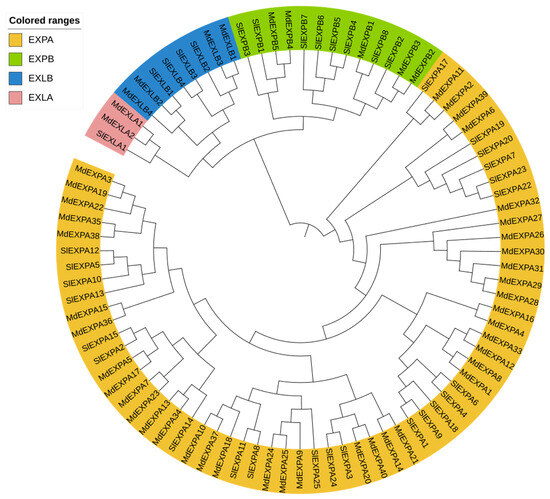
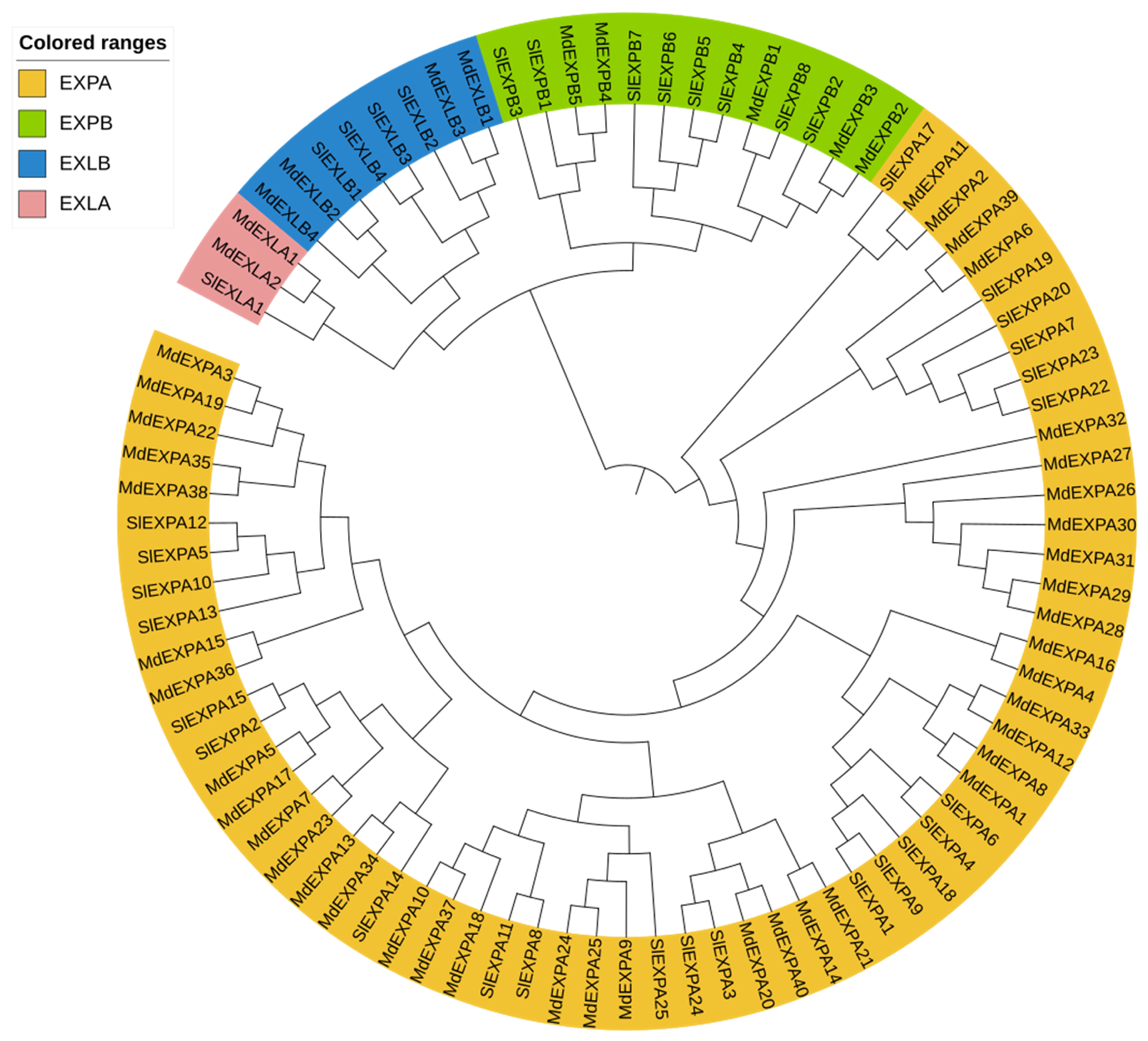
To investigate the evolutionary relationships between expansin families in apple and tomato, we constructed a phylogenetic tree comprising all identified expansin members from both species (Figure 1). Based on established classification criteria for plant expansins, these proteins were categorized into four subfamilies: MdEXPA, MdEXPB, MdEXP-likeA (MdEXLA), and MdEXP-likeB (MdEXLB). The expansin and expansin-like genes were named according to their chromosomal distribution and order. The EXPA subfamily contained the largest number of members, forming distinct species-specific clades. In contrast, the EXPB, EXLA, and EXLB subfamilies contained fewer members and exhibited closer clustering within individual species (Figure 2A).
Figure 1.
The phylogenetic tree of expansin proteins from apple (Malus × domestica) and tomato (Solanum lycopersicum). The tree was constructed using the Neighbor-joining (NJ) method in MEGAX with 1000 bootstrap replicates. The analysis categorized apple expansins into four subfamilies, which are color-coded as follows: EXPA, EXPB, EXLA and EXLB.
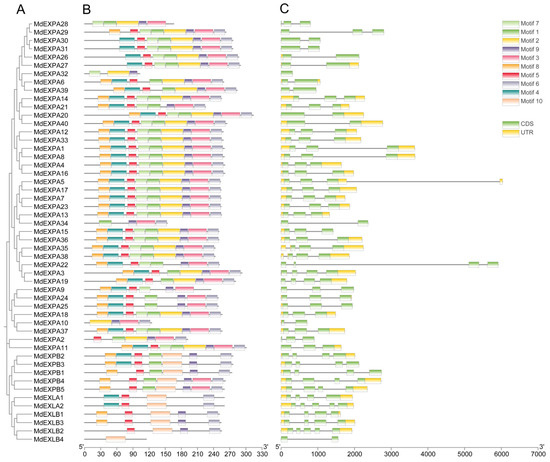
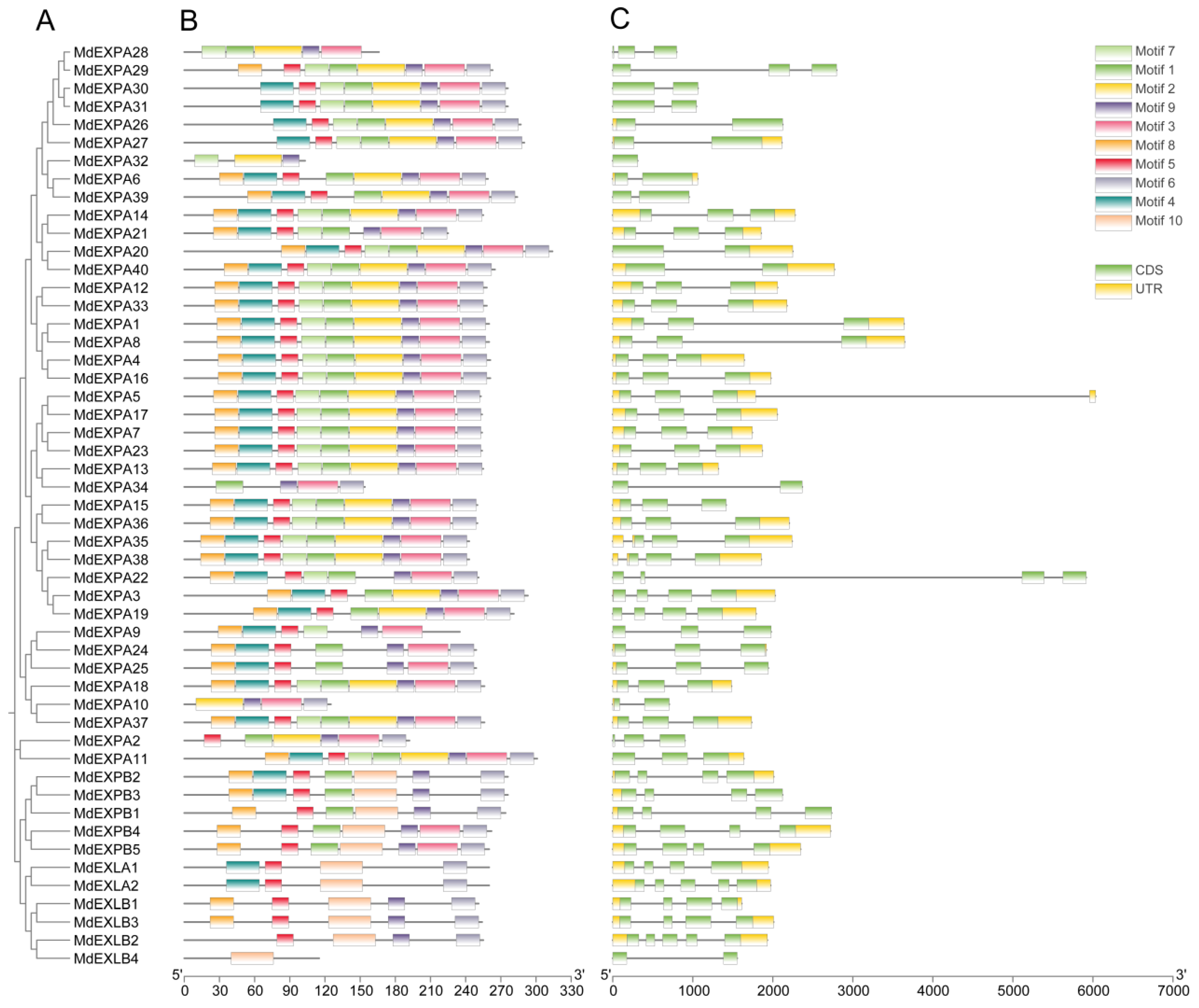
Figure 2.
Phylogenetic relationship, conserved motifs, and gene structure of the apple expansin gene family. (A) The phylogenetic tree was constructed based on the full-length amino acid sequences of apple expansin proteins. (B) Distribution of conserved protein motifs identified in each member; the scale bar at the bottom shows motif lengths in amino acids (aa). (C) Gene structures of the apple expansins, the scale bar at the bottom indicates sequence length in base pairs (bp).
To further explore structural diversity among apple expansins, we identified conserved motifs using the MEME web server (Figure 2B). Ten motifs (Motif 1–10) were detected. Motif 1 and Motif 3 were present in all expansin proteins, suggesting that they represent core structural features. EXPA subfamily members consistently contained Motifs 1, 2, 3, 5, and 9, while the motif composition differed significantly in EXPB, EXLA, and EXLB. Members within the same phylogenetic subgroup shared highly similar motif patterns, supporting functional similarity within subgroups, whereas motif variations between subfamilies may contribute to their functional divergence.
We also analyzed the gene structure of apple expansins, including CDS and untranslated regions (UTRs). Genes clustered in the same phylogenetic branch generally displayed similar CDS numbers, sequence lengths, and UTR distribution pattern, indicating structural consistent with evolutionary relationships. Conversely, variations in CDS fragment number and UTR length among different members suggest potential regulatory divergence, which may contribute to their functional diversity (Figure 2C).
3.3. Chromosomal Localization and Collinearity Analysis of the Apple Expansin Gene Family
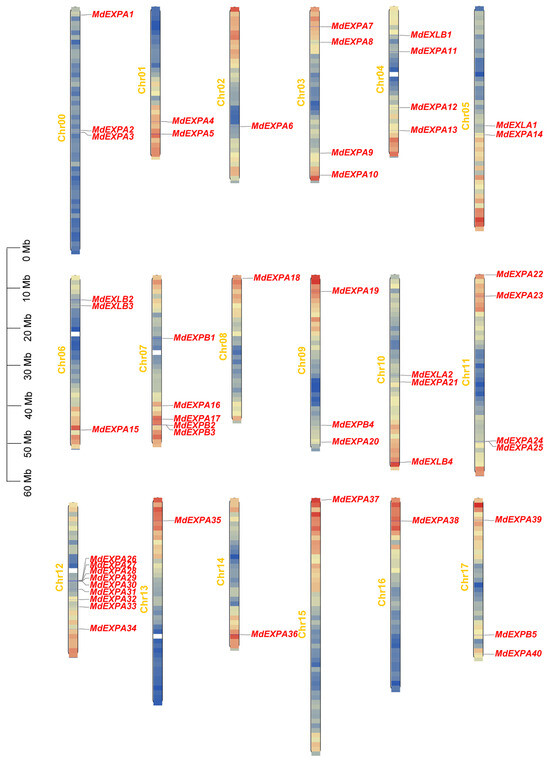
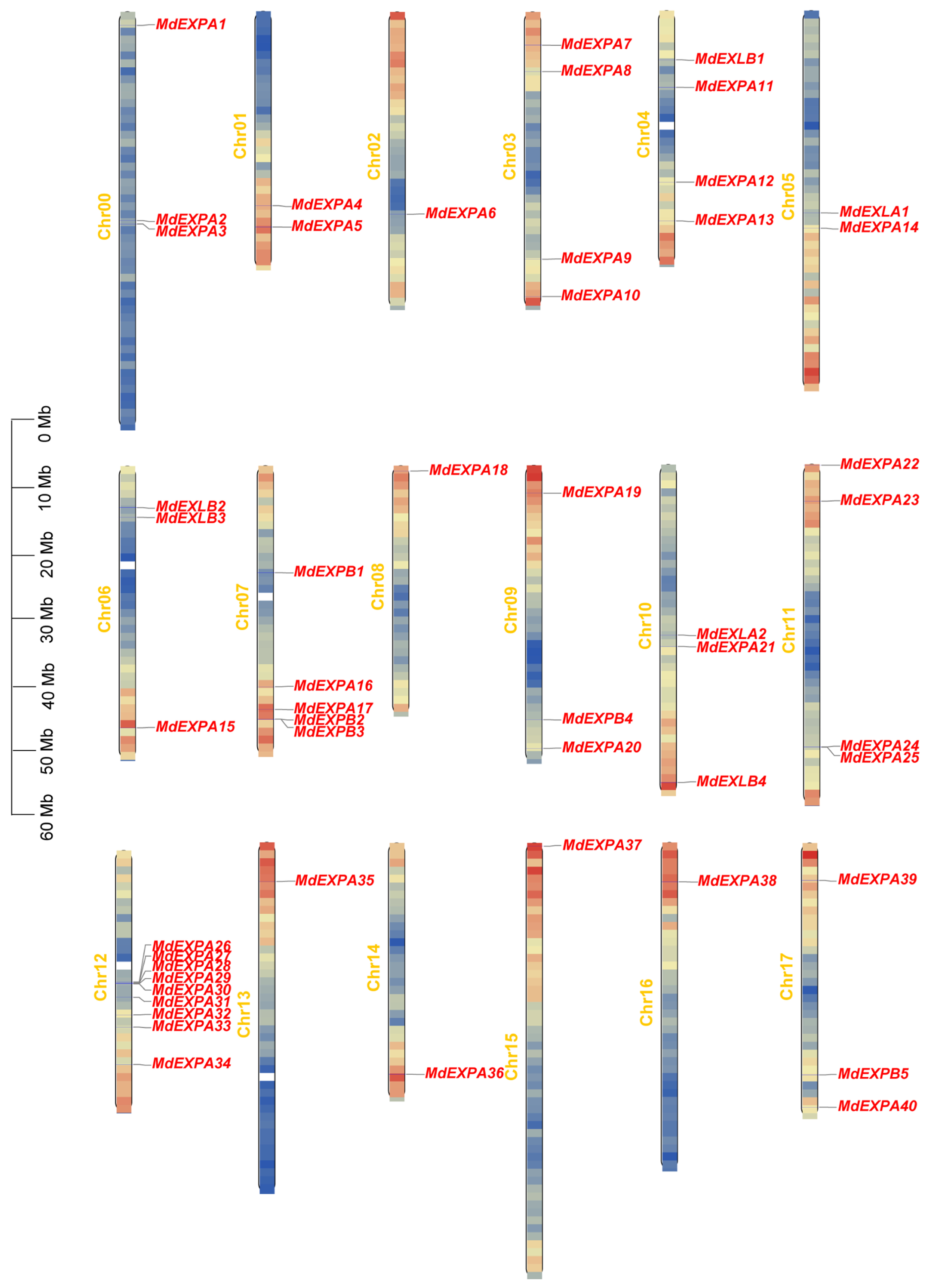
The chromosomal locations of the apple expansin genes were determined using the bioinformatics tool TBtools to generate a distribution map across the 17 core chromosomes and the unanchored scaffold group (denoted Chr00) of the apple genome. This family consists of four subfamilies (EXPA, EXPB, EXLA, and EXLB), and its members exhibit a significant uneven distribution across apple chromosomes Chr00 to Chr17 (Figure 3). Chr12 harbors the highest number of MdEXPA members, forming a large gene cluster that includes MdEXPA26 to MdEXPA34 and other genes. Chr07 contains a cross-subfamily cluster consisting of MdEXPA16, MdEXPA17, MdEXPB3, and MdEXPB5.
Figure 3.
Chromosomal distribution of expansin genes in apple. The scale on the left indicates chromosome length (Mb, mega base pairs). The chromosomes are labeled as Chr00 to Chr17, where Chr00 represents unanchored genomic scaffolds. The color gradient in the background illustrates gene density, ranging from low (blue) to high (red).
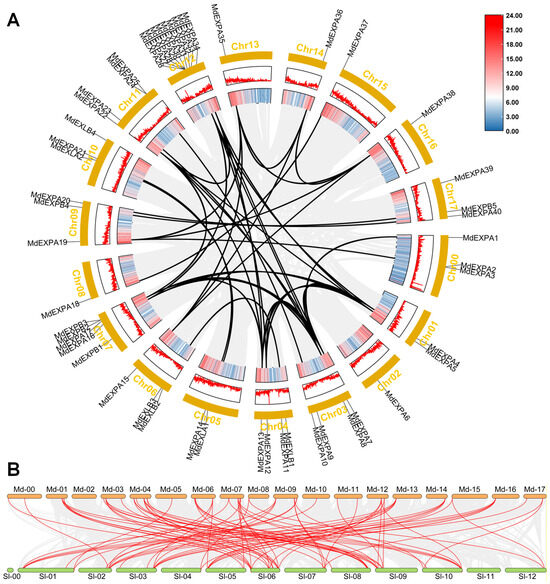
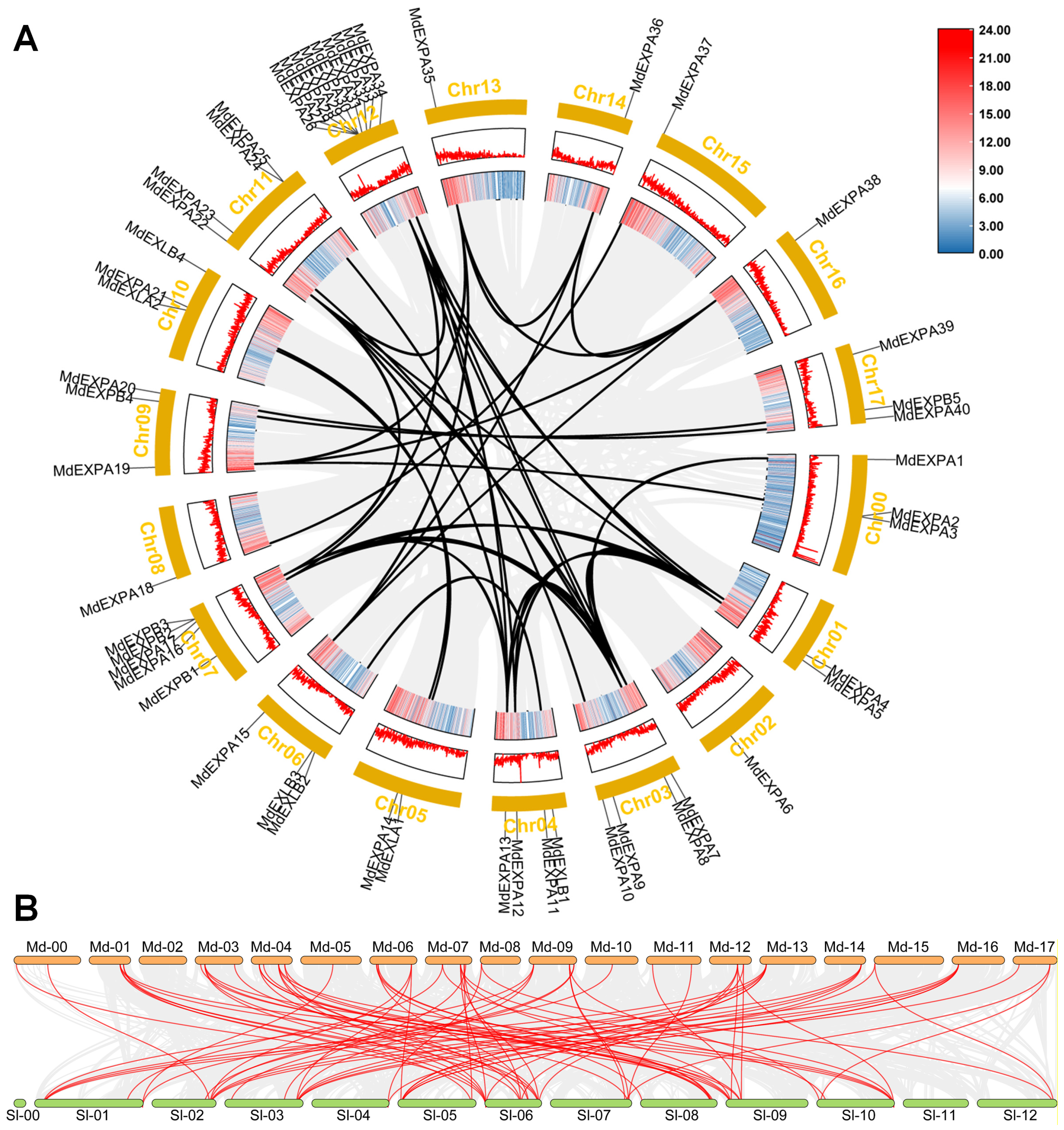
To investigate potential gene duplication events and evolutionary relationships within the apple expansin family, collinearity analysis was performed. The results revealed 9 tandem duplications and 41 segmental/WGD events, supporting functional conservation among apple expansin genes during evolution, along with functional divergence and coordination across subfamilies, which is consistent with previous findings (Figure 4A). Furthermore, cross-species collinearity analysis between apple and tomato identified 76 homologous expansin gene pairs between their respective chromosomes, indicating a high degree of conservation at the expansin gene level (Figure 4B). These findings underscore the evolutionary conservation of expansin genes and provide a molecular basis for further investigation into their roles in various physiological processes, such as fruit softening and stress adaptation.
Figure 4.
Genome collinearity and duplication of EXP genes. (A) Intra-genomic synteny and duplication events of expansin genes in the apple genome. The color gradient in the background illustrates gene density, ranging from low (blue) to high (red). (B) Synteny analysis of the apple expansin gene family members between apple and tomato. Chromosomes of apple (Malus × domestica, Md00–Md17) and tomato (Solanum lycopersicum, Sl00–Sl12) are shown around the periphery. Colinear lines connect homologous expansin gene pairs between the two species.
3.4. Cis-Element Analysis of the Expansin Family Genes
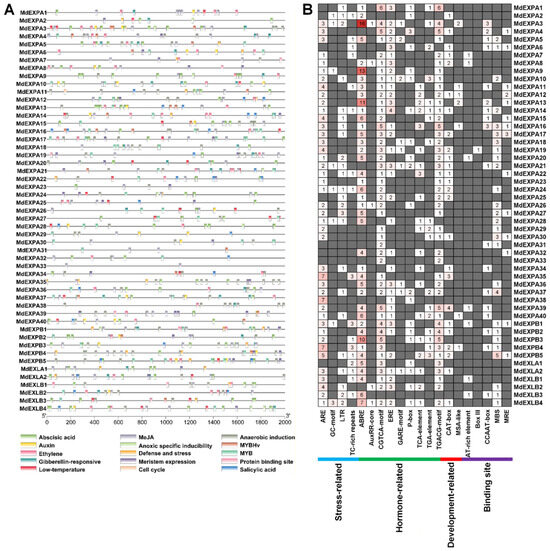
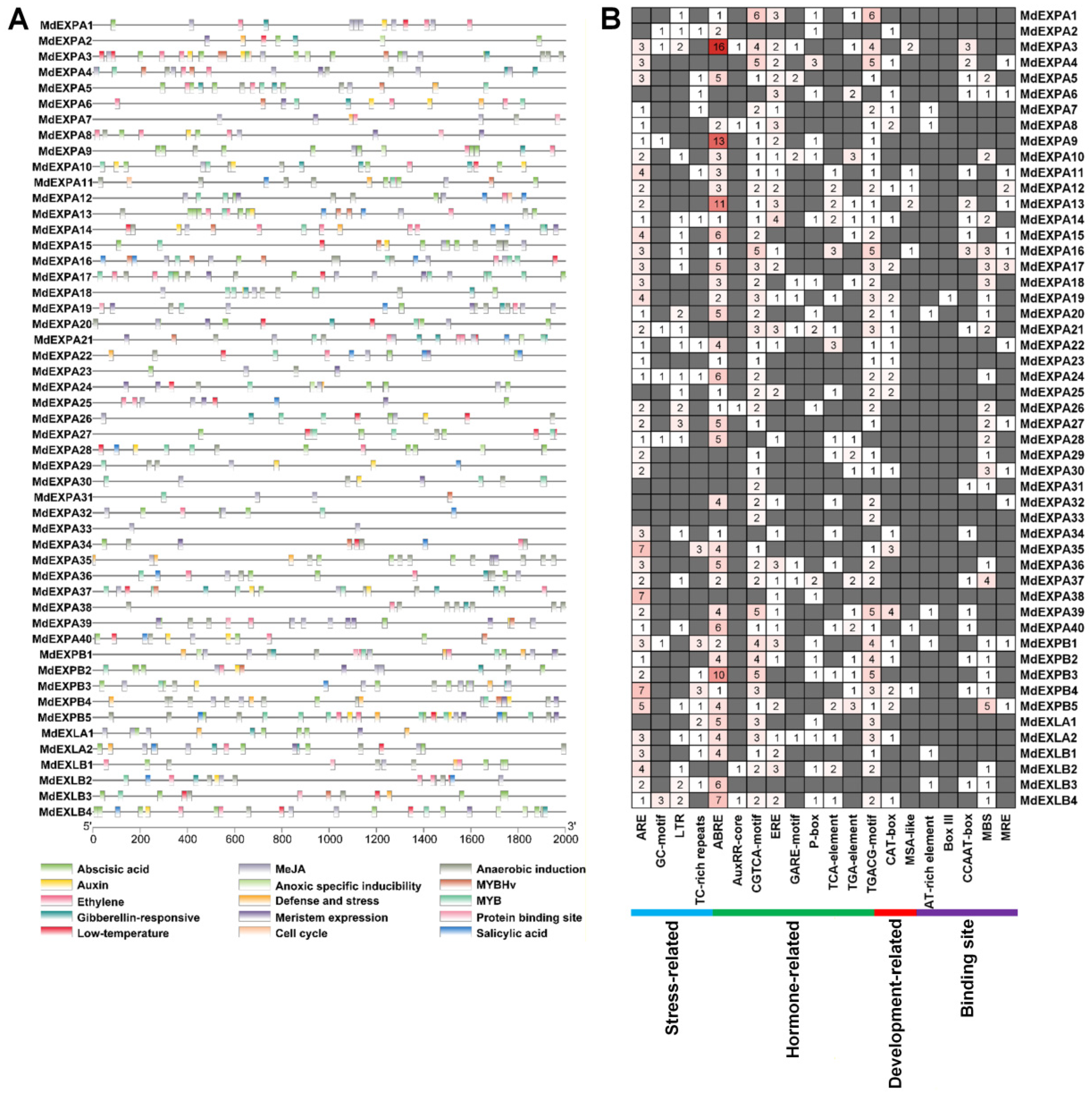
In order to investigate the potential functions and the regulatory patterns of apple expansin family genes, we extracted 2000 bp promoter sequences upstream of the start codon (ATG) of each expansin gene for cis-elements analysis (hereafter referred to as the promoter region for the purpose of this analysis). Results indicated that the elements could be divided into four major categories: stress-responsive elements (e.g., anoxic specific inducibility, anaerobic induction, defense/stress, and low temperature response), hormone-responsive elements (auxin, methyl jasmonate (MeJA), gibberellin, ABA, salicylic acid and ethylene), the transcription factor-binding sites (e.g., NF-Y and MYB), and development-related elements (cell cycle regulation) (Figure 5A).
Figure 5.
Cis-element analysis of the promoters of apple expansin genes. (A) The different colored rectangles show the different types of cis-elements and their positions in each expansin gene. (B) Heatmap showing the numbers of cis-elements identified in the promoters of expansin genes; color intensity corresponds to element count.
Except for MdEXPA31, MdEXPA33, and MdEXPA38, all other expansin gene promoter regions contained at least five different types of hormone-responsive cis-elements, including auxin-responsive elements (AuxRR-core, TGA-element), MeJA-responsive elements (CGTCA-motif, TGACG-motif), gibberellin-responsive elements (GARE-motif, P-box), ABA-responsive elements (ABREs), salicylic acid-responsive elements (TCA-element), and ethylene-responsive elements (EREs) (Figure 5B).
Notably, ABREs were the most abundant hormone-responsive cis-elements: 41 out of the 51 expansin gene promoter regions contained at least one ABRE, and its total frequency ranked first among the other elements. Furthermore, the MeJA-responsive elements CGTCA-motif and TGACG-motif were the most widely distributed, present in 45 and 44 expansin genes, respectively, and often appeared in pairs. This pattern suggests a potential association of expansin genes with JA-related regulatory processes. Additionally, ARE, the core cis-element responsive to abiotic stress (anaerobic induction-responsive element), was present in nearly all expansin gene promoter regions with only five genes lacking this element. This prevalence hints at a potential, yet unverified, role for some expansin family members in responses to abiotic stresses such as anaerobiosis; however, this hypothesis remains to be experimentally confirmed.
3.5. Expression Analysis of the Relationship Between Apple Expansin Genes and Fruit Ripening
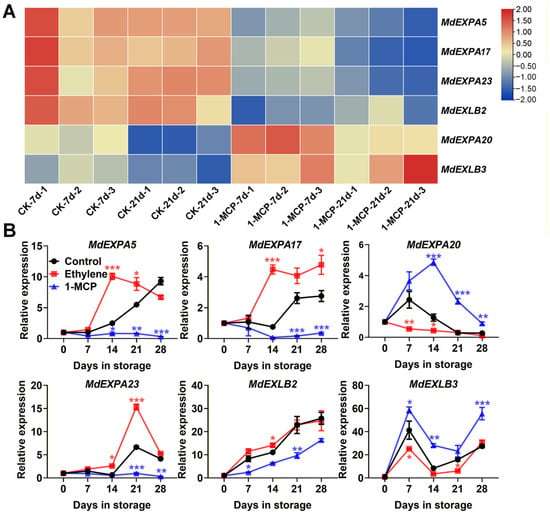
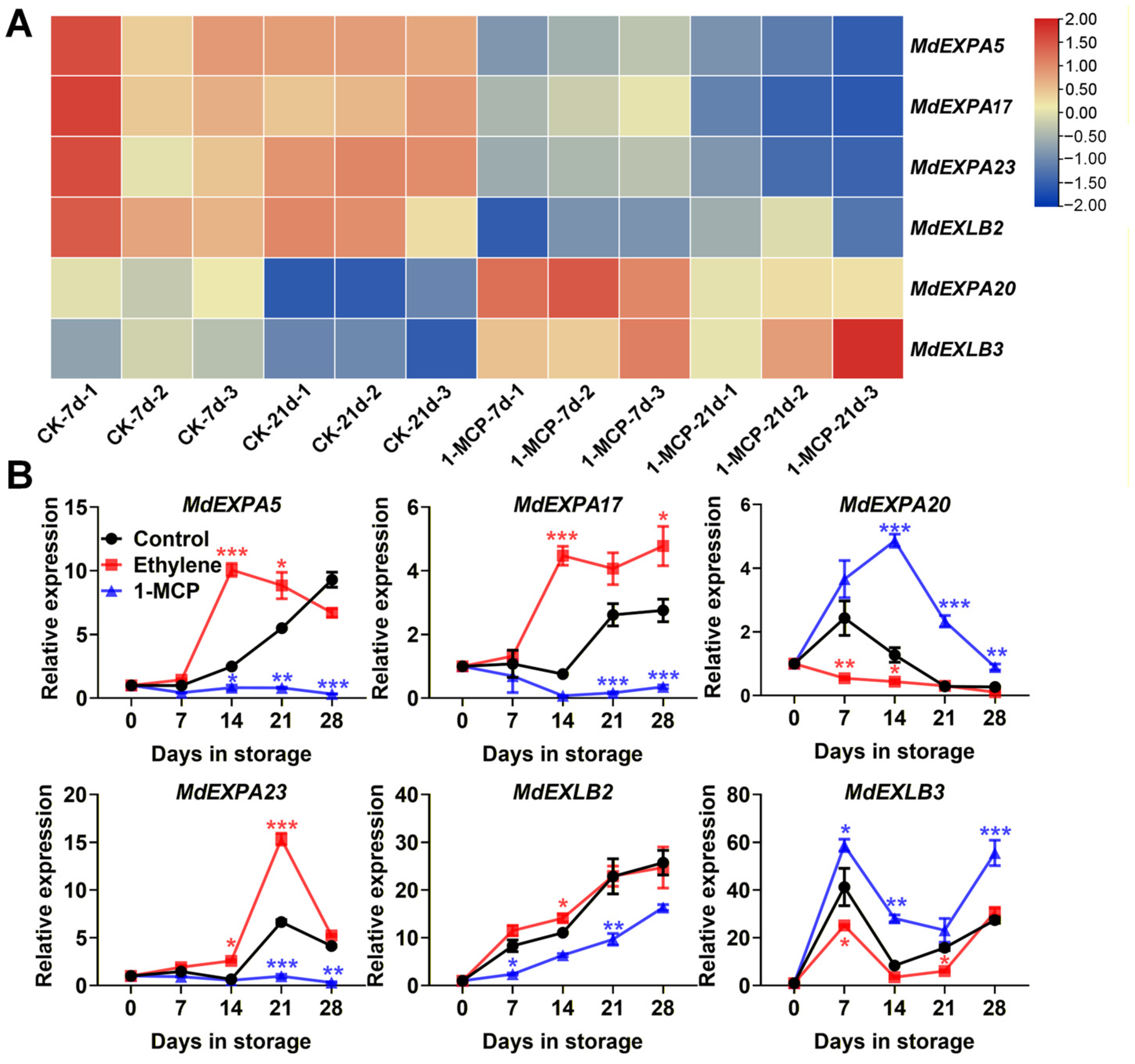
To investigate the involvement of expansin genes in apple fruit ripening, we screened six differentially expressed expansin genes based on our previous transcriptome data from ‘Qinguan’ apple fruit. A heatmap generated using TBtools revealed that the expression levels of four genes were inhibited by exogenous 1-MCP, whereas the other two were induced (Figure 6A). Therefore, we further analyzed the expression of these genes in response to ethylene and 1-MCP treatments using qRT-PCR. The results showed that MdEXPA5, MdEXPA17, MdEXPA23, and MdEXLB2 were significantly upregulated under ethylene treatment and downregulated under 1-MCP treatment (Figure 6B), suggesting a positive correlation with postharvest ripening and softening of apple fruit. In contrast, the expression of MdEXPA20 and MdEXLB3 was suppressed by ethylene treatment and enhanced by 1-MCP (Figure 6B), indicating a negative association with ripening and softening of apple fruit.
Figure 6.
Heatmap analysis of six differentially expressed expansin genes from RNA-seq, and their relative expression levels in ‘Golden Delicious’ apples. (A) Differentially expressed expansin genes identified by RNA-seq in response to 1-MCP treatment during ‘Qinguan’ fruit storage. The mRNA abundance is represented by color intensity. The scale bar on the right of the heatmap corresponds to log2(fold change), where a larger value indicates a higher gene expression level. (B) Expression patterns of expansin genes in response to ethylene or 1-MCP treatment during ‘Golden Delicious’ apple fruit ripening. Black, blue, and red lines indicate transcript levels in control, 1-MCP-treated, and ethylene-treated fruit, respectively. Error bars represent ± SEs from three biological replicates (* p < 0.05; ** p < 0.01; *** p < 0.001).
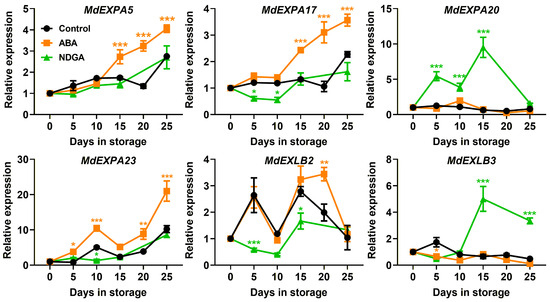
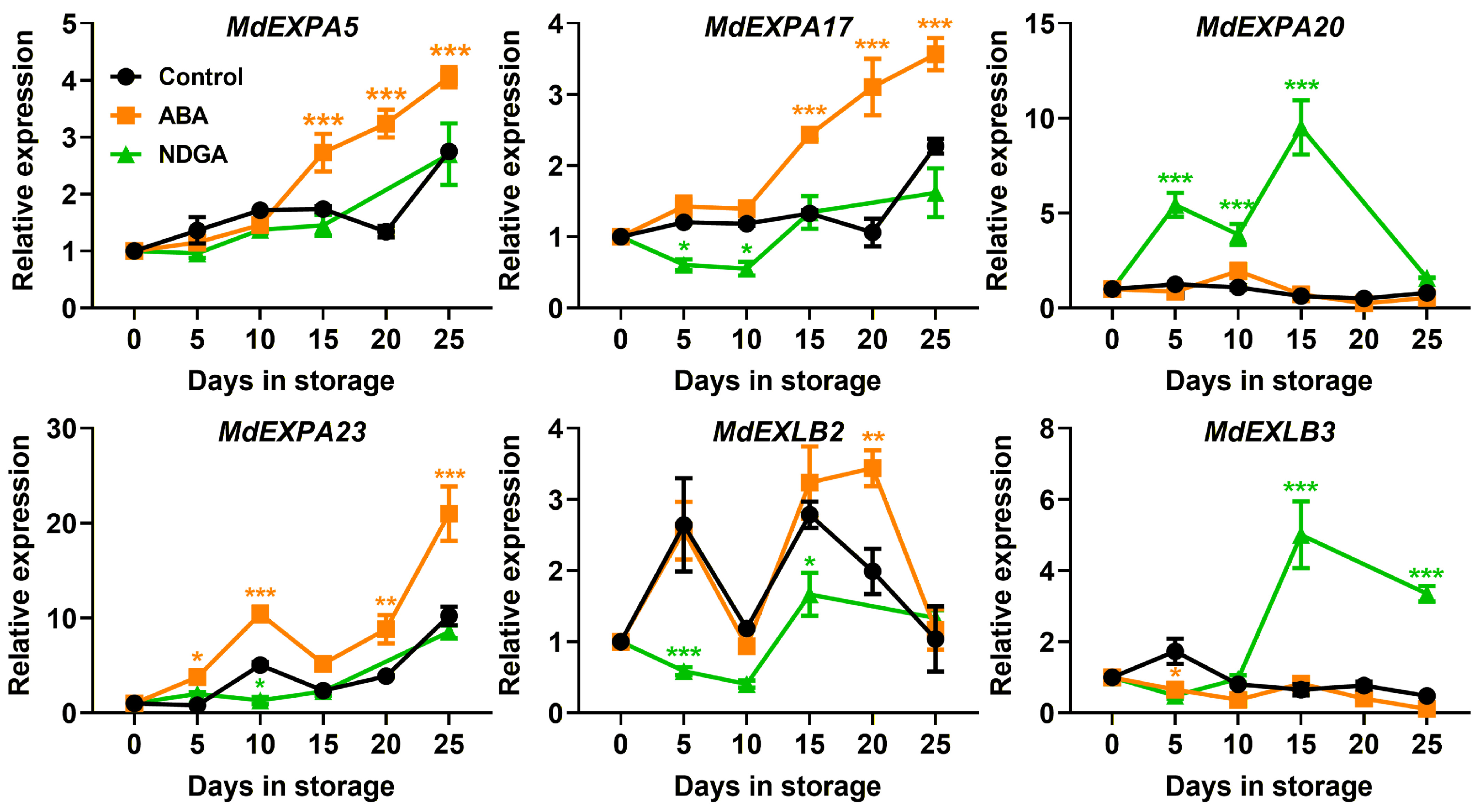
To examine whether these candidate expansin genes respond to ABA, we further analyzed their expression in ‘Golden Delicious’ fruits at the mature green stage treated with exogenous ABA and NDGA. Similar to their response to ethylene and 1-MCP, MdEXPA5, MdEXPA17, and MdEXPA23 were significantly induced by ABA, with expression peaking at 25 days of storage (Figure 7). Conversely, MdEXPA20 and MdEXLB3 were markedly upregulated in NDGA-treated fruits (Figure 7). Collectively, MdEXPA5, MdEXPA17, and MdEXPA23 may act as potential positive regulators of ethylene- and ABA-mediated postharvest ripening and softening of apple fruit.
Figure 7.
Expression profiles of expansin genes upon ABA or NDGA treatment during the storage of ‘Golden Delicious’ apple fruit. Black, green, and yellow lines represent the expression levels of the gene’s transcripts in control, NDGA, and ABA-treated fruit, respectively. Error bars denote ± SEs from three biological replicates (* p < 0.05; ** p < 0.01; *** p < 0.001).
3.6. Verification of MdEXPA17 Protein Function in Apple Fruit Ripening and Softening
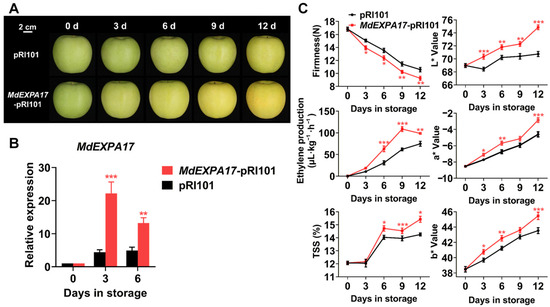
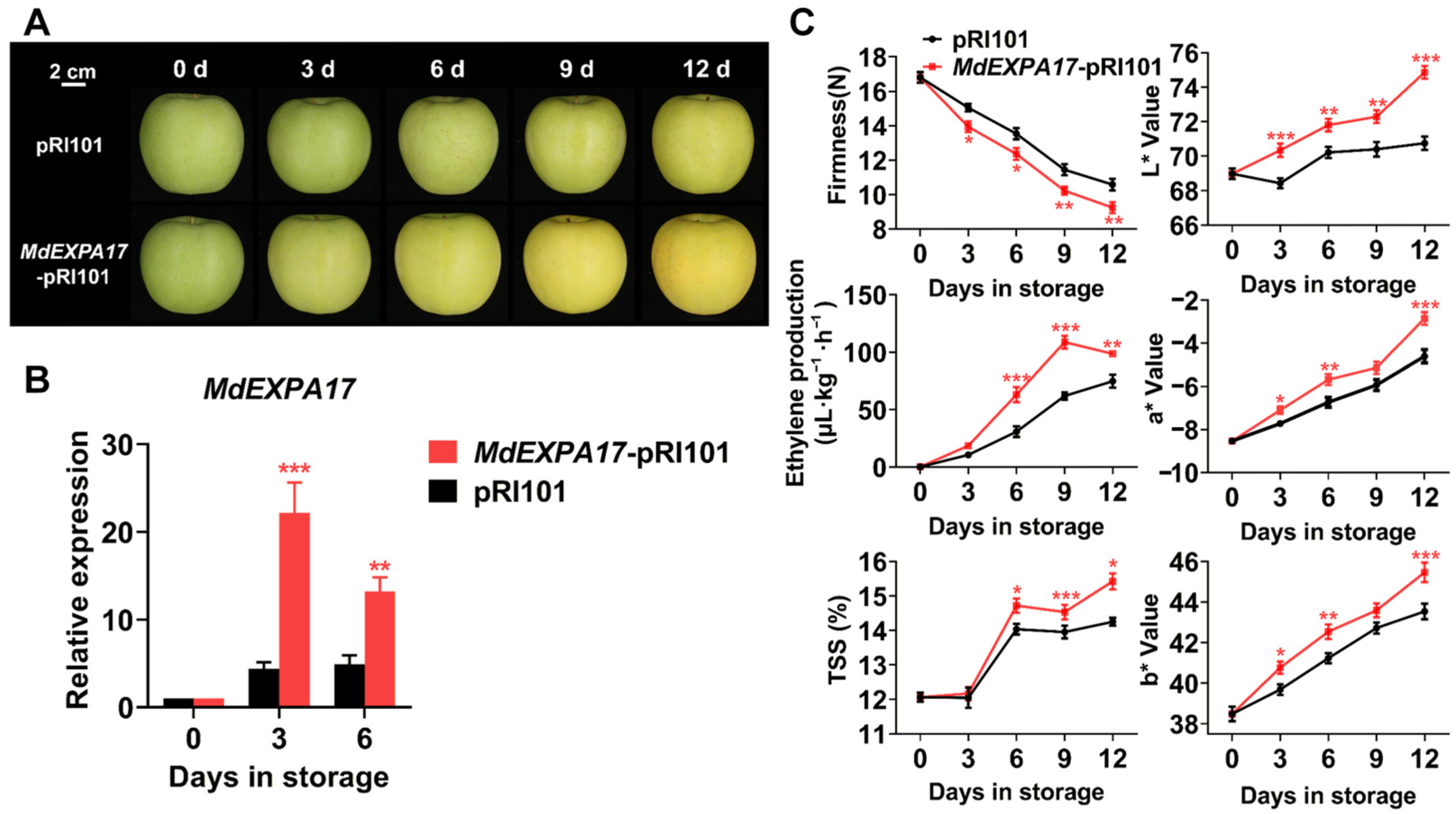
Among the three potential positive regulators, MdEXPA17 exhibited the most consistent induction in response to both ethylene- and ABA treatments. To investigate the role of the MdEXPA17 in fruit ripening and softening, transient overexpression and gene silencing experiments were conducted in ‘Golden Delicious’ apples at mature green stage. As shown in Figure 8A, on the sixth day of storage, apples injected with MdEXPA17-pRI101 overexpression vector exhibited more yellow coloration compared with the control. Consistent with this, the expression levels of MdEXPA17 in apples injected with MdEXPA17-pRI101 were significantly higher than that in control group on both day 3 and day 6 of storage (Figure 8B). Phenotypic and physiological analyses revealed that significant differences in fruit color emerged from day 3, and became more pronounced on days 6, 9, and 12. Correspondingly, L*, a*, and b* values in the overexpression group were significantly higher than the control group on days 3, 6, and 12 (Figure 8C). Furthermore, the ethylene release rate in the overexpression group remained higher than that of the control throughout storage, with a statistically significant increase observed from day 6 onward. Fruit firmness declined markedly in MdEXPA17-overexpressing fruits, becoming significantly lower than the control from day 3, while the total soluble solid (TSS) content increased and was significantly higher from day 6 (Figure 8C).
Figure 8.
Transient overexpression of MdEXPA17 in ‘Golden Delicious’ apple fruit. (A) Phenotypic comparison between apple fruit overexpressing MdEXPA17 and those transformed with the empty vector pRI101 (control). (B) Relative expression levels of endogenous MdEXPA17 in ‘Golden Delicious’ fruit during the storage of 0, 3, and 6 days. (C) Changes in firmness, ethylene production rate, and chromaticity values of apple fruit throughout the storage period. The chromaticity parameters are defined as follows: L* represents lightness, a* indicates the color gradient from green (−) to red (+), and b* represents the gradient from blue (−) to yellow (+). Error bars represent ±SEs from three biological replicates (* p < 0.05; ** p < 0.01; *** p < 0.001).
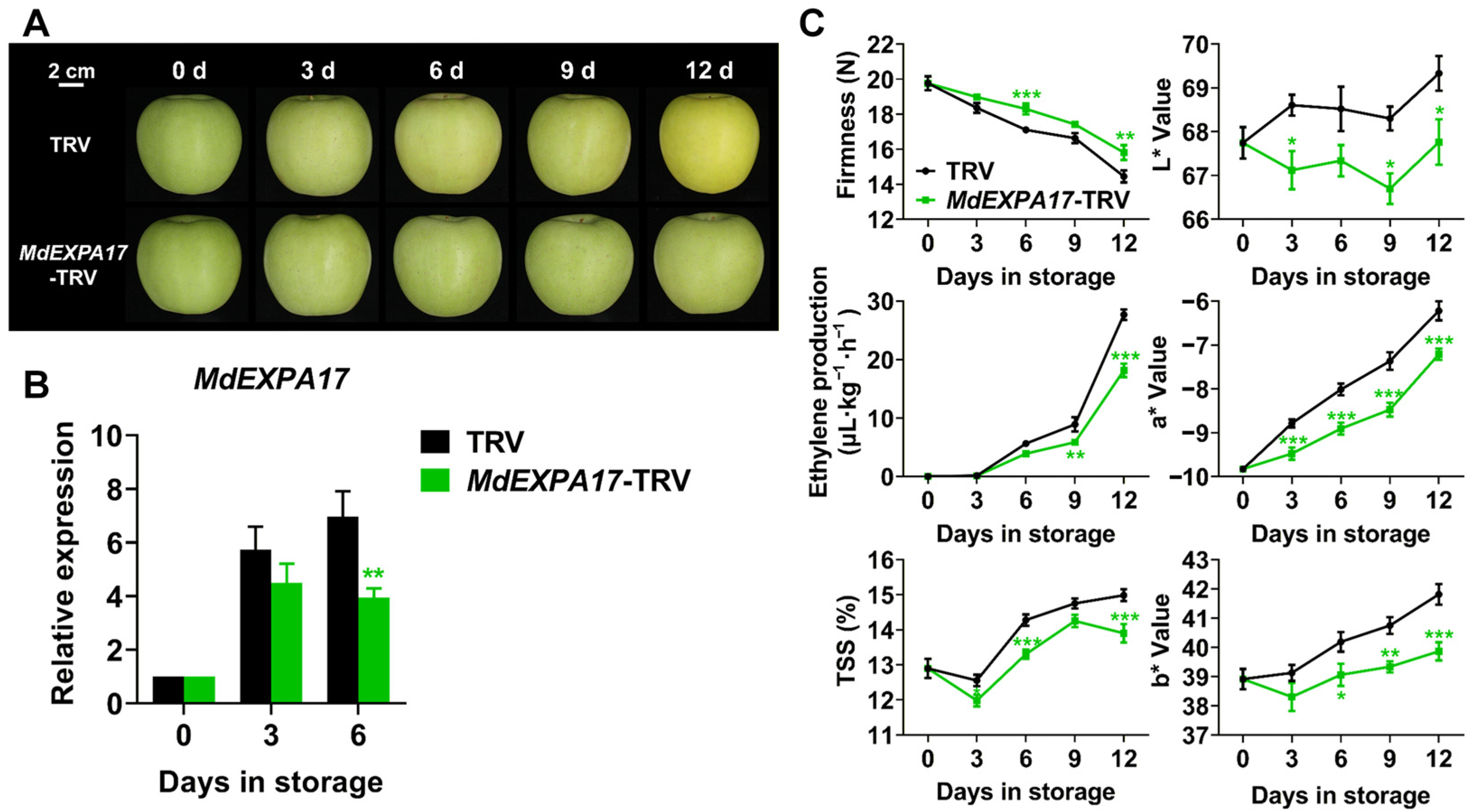
In contrast, silencing of MdEXPA17 significantly delayed fruit ripening and softening. During storage, fruits infiltrated with the MdEXPA17-TRV silencing vector remained noticeably greener peel than the control (Figure 9A). The expression level of MdEXPA17 in the silenced group was significantly suppressed by day 6 (Figure 9B). Accordingly, L*, a*, and b* values, as well as ethylene release rates, were significantly lower in the silenced group than in the control during storage, with ethylene production showing significant differences on days 9 and 12. Additionally, the decline in firmness was slowed in MdEXPA17 silenced fruits, resulting in significantly higher firmness than the control on days 6 and 12, while TSS content remained significantly lower throughout storage (Figure 9C).
Figure 9.
Transient silencing of MdEXPA17 in ‘Golden Delicious’ apple fruit. (A) Phenotype comparison between MdEXPA17-silenced fruit and those infected with the empty TRV2 vector (control). (B) Relative expression levels of endogenous MdEXPA17 in ‘Golden Delicious’ fruit during the storage of 0, 3, and 6 days. (C) Changes in firmness, ethylene production rate, and chromaticity values of apple fruit throughout the storage period. The chromaticity parameters are defined as follows: L* represents lightness, a* indicates the color gradient from green (−) to red (+), and b* represents the gradient from blue (−) to yellow (+). Error bars represent ±SEs from three biological replicates (* p < 0.05; ** p < 0.01; *** p < 0.001).
4. Discussion
Expansins are plant-specific cell wall-loosening proteins that orchestrate cell enlargement, organ development, and fruit ripening/softening [24]. To date, expansin-mediated functions have been reported in beet [25], wheat [26], cucumber [27], grape [28], and other crops. By integrating genome-wide identification, evolutionary analyses, hormone responsiveness, and targeted functional assays, this study provides a comprehensive framework and candidate gene resources of the apple (Malus × domestica) expansin family. The cis-element and expression data suggest regulatory links to ethylene and ABA signaling during fruit ripening, while the functional validation of MdEXPA17 directly supports its role as a positive regulator of postharvest softening. these findings offer foundational insights and potential targets for future efforts to improve fruit quality and storability.
Based on the 41 expansin members previously identified in apple [29], we optimized the identification pipeline and detected 10 additional genes, for a total of 51 genes. Expansin proteins vary in amino-acid length, molecular mass, and isoelectric point, underscoring structural heterogeneity within the family. Subcellular localization prediction indicates that all MdEXP members are secreted to the cell wall, consistent with expansins’ canonical role in cell wall loosening. This observation aligns with evidence that poplar PagEXPA1 modulates cell growth via protein interactions [30].
Comparative phylogeny with tomato resolved four subfamilies, with EXPA comprising the largest number of members, reflecting both conservation and lineage-specific diversification [31]. Intra-subfamily conservation of motifs and gene structures (e.g., EXPA members commonly harbor Motifs 1–4 and contain 3–5 exons) contrasts with inter-subfamily differences, for example, EXPB-specific Motifs 8 and 10, providing a structural basis for functional divergence. Chromosomal mapping shows an uneven distribution of the 51 genes across 18 chromosomes, with a prominent EXPA-rich cluster on Chr12. Together with cross-genome collinearity and prior broad-scale analyses [32], these patterns implicate whole-genome and segmental duplication as major drivers of family expansion. High synteny with tomato further supports deep conservation and facilitates orthology-based gene functional inference, including parallels with peach expansins (PpEXPs) implicated in fruit-texture development [33].
Our promoter cis-element analysis highlights conserved yet diversified regulation of the apple expansin gene family. Among the 51 MdEXP gene promoters, 41 contain ABA-responsive elements (ABREs) and 45 harbor MeJA-responsive CGTCA-motifs, with ABREs most abundant, suggesting potential ABA-related regulation. This pattern, coupled with our observation that ABA treatment significantly upregulated several key MdEXP genes, is consistent with conserved ABA-related regulatory mechanisms across species. Resembles banana expansin promoters, which are enriched in ABA- and stress-responsive elements and are upregulated by ABA during fruit ripening and stress [34], indicating conserved ABA-related regulation across species. Interestingly, our qRT-PCR analysis showed that ABA treatment significantly upregulated several key MdEXP genes. This expression pattern is consistent with the enrichment of ABREs in their promoters, supporting an ABA-dependent, hormone-mediated transcriptional regulation mechanism. Similarly, in wheat, ABA significantly induces the expression of TaEXPB7-B, and the transcription factor TaWABI5 can bind ABREs in the TaEXPB7-B promoter to further enhance cold stress tolerance [35]. Moreover, the widespread anaerobic response elements (AREs) in MdEXP promoters, consistent with the ARE-enriched wheat TaEXPB1A promoter [36], further imply a conserved role of expansins in hypoxia-related responses. Nonetheless, hormone and stress treatments combined with expression and functional analyses will be required to validate the roles of these elements in MdEXP gene expression.
Hormone treatments and expression profiling in this study may suggest a functional divergence among expansins during apple fruit ripening. Based on the expression patterns, six differentially expressed genes—MdEXPA5/17/23, MdEXLB2/3, and MdEXPA20—could be grouped into distinct expression clusters showing differential responses to ethylene, 1-MCP, and ABA. MdEXPA5/17/23 and MdEXLB2 expression increased during maturation, were induced by ethylene, suppressed by 1-MCP, and positively associated with softening. By contrast, MdEXPA20 and MdEXLB3 exhibited different dynamics and negative associations with softening. While these patterns imply the existence of cooperative and antagonistic regulatory modules, direct causal evidence for a role in ripening has been experimentally demonstrated only for MdEXPA17.
Transient overexpression of MdEXPA17 accelerated coloration, elevated ethylene production, and reduced firmness in ‘Golden Delicious’, whereas MdEXPA17 silencing led to the opposite phenotype, providing experimental evidence for its involvement in promoting apple ripening and softening. These findings are consistent with earlier evidence for MdEXP7 studies in apple [37] and with ABA-sensitive regulation of GsEXPA8 in soybean [38], indicating conserved expansin functions across species. Moreover, given the reported role of MdEXLB1 in promoting tomato softening [18], our data indicate MdEXLB2 as an emerging regulator in fleshy fruit texture.
Overall, this study provides an integrated framework linking expansin family evolution, hormone-responsive regulation, and functional relevance during postharvest apple fruit ripening. By combining genome-wide analyses with hormone treatments and targeted functional assays, our results indicate the presence of distinct regulatory and functional modules within the apple expansin gene family associated with ethylene- and ABA-mediated ripening processes. Moreover, functional characterization of MdEXPA17 supports its involvement in apple fruit ripening and provides a basis for future studies exploring its potential application in the regulation of fruit softening.
5. Conclusions
This study characterized the EXP gene family in Malus × domestica, identifying 51 MdEXP genes divided into four conserved subfamilies (MdEXPA, MdEXPB, MdEXLA, MdEXLB) via phylogenetic and structural analyses. These genes show uneven chromosomal distribution (clustered on Chr07/12), with duplication events driving family expansion; their promoters contain putative hormone- (ethylene/ABA) and stress-responsive cis-elements. Expression profiling under ripening-related treatments identified MdEXPA17 (positively regulated by ethylene/ABA and suppressed by 1-MCP/NDGA), and transient overexpression/silencing assays support a role for MdEXPA17 in promoting postharvest ripening/softening. Collectively, these findings advance our understanding of MdEXP involvement in apple fruit ripening and highlight MdEXPA17 as a candidate target for future breeding or biotechnological strategies aimed at modulating softening and postharvest performance, pending validation in stable transgenic systems and field-scale conditions.
Supplementary Materials
The following supporting information can be downloaded at: https://www.mdpi.com/article/10.3390/horticulturae12020130/s1, Table S1: List of primers used for the qRT-PCR and vector constructions. Table S2: Assessment of normality for key variables using the Shapiro–Wilk test. Table S3: Amino acid sequences of MdEXP family proteins.
Author Contributions
Conceptualization, M.W., N.J., Y.S. and X.Z.; formal analysis, M.W., N.J. and J.W.; visualization, M.W., N.J., J.W., X.H., Q.L. and Y.S.; investigation, M.W., N.J., J.J., J.S., R.W., K.Z. and P.H.; resources, Y.S., W.X., Y.L., Y.Z., L.C. and T.B.; writing—original draft, M.W., N.J. and Y.S.; writing—review and editing, M.W., Y.S. and X.Z.; funding acquisition, Y.S. and X.Z. All authors have read and agreed to the published version of the manuscript.
Funding
This work was supported by the Young Talents Lifting Project from Henan Association for Science and Technology (2025HYTP067); the Key R & D and Promotion Projects in Henan Province (252102110359); the Central Guided Local Science and Technology Development Funding of Henan Province (Z20241471014); the Modern Agricultural Industry Technology Systems Project of Henan Province (HARS-22-09-Z2).
Data Availability Statement
The original contributions presented in this study are included in the article; further inquiries can be directed to the corresponding authors.
Conflicts of Interest
The authors declare no conflicts of interest.
References
- McQueen-Mason, S.; Cosgrove, D.J. Disruption of Hydrogen Bonding between Plant Cell Wall Polymers by Proteins That Induce Wall Extension. Proc. Natl. Acad. Sci. USA 1994, 91, 6574–6578. [Google Scholar] [CrossRef] [Scilit]
- Cosgrove, D.J. Cell Wall Loosening by Expansins. Plant Physiol. 1998, 118, 333–339. [Google Scholar] [CrossRef] [Scilit]
- Whitney, S.E.C.; Gidley, M.J.; McQueen-Mason, S.J. Probing Expansin Action Using Cellulose/Hemicellulose Composites. Plant J. 2000, 22, 327–334. [Google Scholar] [CrossRef] [Scilit]
- Sampedro, J.; Cosgrove, D.J. The Expansin Superfamily. Genome Biol. 2005, 6, 242. [Google Scholar] [CrossRef] [Scilit]
- Cosgrove, D.J. Relaxation in a High-Stress Environment: The Molecular Bases of Extensible Cell Walls and Cell Enlargement. Plant Cell 1997, 9, 1031–1041. [Google Scholar] [CrossRef] [Scilit]
- Kende, H.; Bradford, K.J.; Brummell, D.A.; Cho, H.T.; Cosgrove, D.J.; Fleming, A.J.; Gehring, C.; Lee, Y.; McQueen-Mason, S.; Rose, J.K.C.; et al. Nomenclature for Members of the Expansin Superfamily of Genes and Proteins. Plant Mol. Biol. 2004, 55, 311–314. [Google Scholar] [CrossRef] [Scilit]
- Cosgrove, D.J. Plant Expansins: Diversity and Interactions with Plant Cell Walls. Curr. Opin. Plant Biol. 2015, 25, 162–172. [Google Scholar] [CrossRef] [Scilit] [PubMed]
- Li, X.; Xu, D.; Zhang, L.; Zhao, L. ENDOGLUCANASE SlCEL2 and EXPANSIN SlEXP1 Synergistically Affect Cellulose Degrading and Tomato Fruit Softening. BMC Plant Biol. 2025, 25, 704. [Google Scholar] [CrossRef] [Scilit] [PubMed]
- Wu, Z.; Li, M.; Zhong, Y.; Li, L.; Cheng, D.; Gu, H.; Guo, X.; Qi, X.; Chen, J. Overexpression of AcEXPA23 Promotes Lateral Root Development in Kiwifruit. Int. J. Mol. Sci. 2022, 23, 8026. [Google Scholar] [CrossRef] [Scilit]
- Miao, Y.; Li, W.; Zhu, H.; Wang, Y.; Fang, Q.; Xiao, Z.; Deng, J.; Lan, Y.; Zhong, S.; Zhao, H. The Roles of OfEXPA2 and OfEXPA4 on Petal Cell Expansion during Flower Opening in Osmanthus fragrans. Sci. Hortic. 2024, 338, 113720. [Google Scholar] [CrossRef] [Scilit]
- Zhang, X.; Wang, Y.; Liu, M.; Yan, P.; Niu, F.; Ma, F.; Hu, J.; He, S.; Cui, J.; Yuan, X.; et al. OsEXPA7 Encoding an Expansin Affects Grain Size and Quality Traits in Rice (Oryza sativa L.). Rice 2024, 17, 36. [Google Scholar] [CrossRef] [Scilit]
- Li, F.; Hu, B.; Peng, L.; Feng, X.; Miao, Y.; Dong, J.; Wang, M.; Wang, X.; Li, F.; Xu, Y. Overexpression of the TaEXPA19 Gene Improves Low-Temperature Tolerance in Winter Wheat (Triticum aestivum). Plant Breed. 2024, 143, 142–154. [Google Scholar] [CrossRef] [Scilit]
- Sun, Y.; Liu, Q.; Yan, Z.; Ma, S.; Liu, X.; Mu, C.; Yao, G.; Leng, B. Overexpression of Maize Expansin Gene ZmEXPA6 Improves Salt Tolerance of Arabidopsis thaliana. Agronomy 2025, 15, 2240. [Google Scholar] [CrossRef] [Scilit]
- Wang, L.; Sun, Y.; Liu, W.; Shi, X.; Ma, J.; He, F.; Li, F.; Feng, X. Overexpression of the Wild Soybean Expansin Gene GsEXPB1 Enhances Salt Stress Tolerance in Transgenic Soybeans. Plants 2025, 14, 2851. [Google Scholar] [CrossRef] [Scilit]
- Brummell, D.A.; Harpster, M.H. Cell Wall Metabolism in Fruit Softening and Quality and Its Manipulation in Transgenic Plants. Plant Mol. Biol. 2001, 47, 311–339. [Google Scholar] [CrossRef] [Scilit]
- Wang, Y.; Guo, L.; Zhao, X.; Zhao, Y.; Hao, Z.; Luo, H.; Yuan, Z. Advances in Mechanisms and Omics Pertaining to Fruit Cracking in Horticultural Plants. Agronomy 2021, 11, 1045. [Google Scholar] [CrossRef] [Scilit]
- Su, Q.; Feng, Y.; Li, X.; Wang, Z.; Zhong, Y.; Zhao, Z.; Yang, H. Allelic Variation in an Expansin, MdEXP-A1, Contributes to Flesh Firmness at Harvest in Apples. Mol. Hortic. 2025, 5, 3. [Google Scholar] [CrossRef] [Scilit] [PubMed]
- Chen, Y.; Xie, B.; An, X.; Ma, R.; Zhao, D.; Cheng, C.; Li, E.; Zhou, J.; Kang, G.; Zhang, Y. Overexpression of the Apple Expansin-like Gene MdEXLB1 Accelerates the Softening of Fruit Texture in Tomato. J. Integr. Agric. 2022, 21, 3578–3588. [Google Scholar] [CrossRef] [Scilit]
- Chen, C.; Wu, Y.; Li, J.; Wang, X.; Zeng, Z.; Xu, J.; Liu, Y.; Feng, J.; Chen, H.; He, Y.; et al. TBtools-II: A “One for All, All for One” Bioinformatics Platform for Biological Big-Data Mining. Mol. Plant 2023, 16, 1733–1742. [Google Scholar] [CrossRef] [Scilit] [PubMed]
- Wang, M.; Wu, Y.; Zhan, W.; Wang, H.; Chen, M.; Li, T.; Bai, T.; Jiao, J.; Song, C.; Song, S.; et al. The Apple Transcription Factor MdZF-HD11 Regulates Fruit Softening by Promoting Mdβ-GAL18 Expression. J. Exp. Bot. 2024, 75, 819–836. [Google Scholar] [CrossRef] [Scilit]
- Bowen, J.; Ireland, H.S.; Crowhurst, R.; Luo, Z.; Watson, A.E.; Foster, T.; Gapper, N.; Giovanonni, J.J.; Mattheis, J.P.; Watkins, C.; et al. Selection of Low-Variance Expressed Malus × domestica (Apple) Genes for Use as Quantitative PCR Reference Genes (Housekeepers). Tree Genet. Genomes 2014, 10, 751–759. [Google Scholar] [CrossRef] [Scilit]
- Weiß, S.; Winkelmann, T. Transcriptome Profiling in Leaves Representing Aboveground Parts of Apple Replant Disease Affected Malus × domestica ‘M26’ Plants. Sci. Hortic. 2017, 222, 111–125. [Google Scholar] [CrossRef] [Scilit]
- Livak, K.J.; Schmittgen, T.D. Analysis of Relative Gene Expression Data Using Real-Time Quantitative PCR and the 2−ΔΔCT Method. Methods 2001, 25, 402–408. [Google Scholar] [CrossRef] [Scilit] [PubMed]
- Cosgrove, D.J.; Li, L.C.; Cho, H.T.; Hoffmann-Benning, S.; Moore, R.C.; Blecker, D. The Growing World of Expansins. Plant Cell Physiol. 2002, 43, 1436–1444. [Google Scholar] [CrossRef] [Scilit] [PubMed]
- Faris Abdulkhadum Al-Mamoorı, D.; Celik Altunoglu, Y.; Horuz, E.; Özkan Kök, B. Investigation of the Expansin Gene Family in Sugar Beet (Beta vulgaris) by the Genome-Wide Level and Their Expression Responses under Abiotic Stresses. Biol. Futur. 2023, 74, 295–307. [Google Scholar] [CrossRef] [Scilit]
- Yue, H.; Shu, D.; Wang, M.; Xing, G.; Zhan, H.; Du, X.; Song, W.; Nie, X. Genome-Wide Identification and Expression Analysis of the Hd-Zip Gene Family in Wheat (Triticum aestivum L.). Genes 2018, 9, 70. [Google Scholar] [CrossRef] [Scilit]
- Liu, X.; Dong, S.; Miao, H.; Bo, K.; Li, C.; Yang, Y.; Gu, X.; Zhang, S. Genome-Wide Analysis of Expansins and Their Role in Fruit Spine Development in Cucumber (Cucumis sativus L.). Hortic. Plant J. 2022, 8, 757–768. [Google Scholar] [CrossRef] [Scilit]
- Dal Santo, S.; Vannozzi, A.; Tornielli, G.B.; Fasoli, M.; Venturini, L.; Pezzotti, M.; Zenoni, S. Genome-Wide Analysis of the Expansin Gene Superfamily Reveals Grapevine-Specific Structural and Functional Characteristics. PLoS ONE 2013, 8, e62206. [Google Scholar] [CrossRef] [Scilit]
- Zhang, S.; Xu, R.; Gao, Z.; Chen, C.; Jiang, Z.; Shu, H. A Genome-Wide Analysis of the Expansin Genes in Malus × domestica. Mol. Genet. Genom. 2014, 289, 225–236. [Google Scholar] [CrossRef] [Scilit]
- Hao, Y.; Chu, L.; He, X.; Zhao, S.; Tang, F. PagEXPA1 Combines with PagCDKB2;1 to Regulate Plant Growth and the Elongation of Fibers in Populus Alba × Populus Glandulosa. Int. J. Biol. Macromol. 2024, 268, 131559. [Google Scholar] [CrossRef] [Scilit]
- Lu, Y.; Liu, L.; Wang, X.; Han, Z.; Ouyang, B.; Zhang, J.; Li, H. Genome-wide Identification and Expression Analysis of the Expansin Gene Family in Tomato. Mol. Genet. Genom. 2016, 291, 597–608. [Google Scholar] [CrossRef] [Scilit] [PubMed]
- Wang, Z.; Cao, J.; Lin, N.; Li, J.; Wang, Y.; Liu, W.; Yao, W.; Li, Y. Origin, Evolution, and Diversification of the Expansin Family in Plants. Int. J. Mol. Sci. 2024, 25, 11814. [Google Scholar] [CrossRef] [Scilit]
- Guo, Y.; Song, C.; Gao, F.; Zhi, Y.; Zheng, X.; Wang, X.; Zhang, H.; Hou, N.; Cheng, J.; Wang, W.; et al. Exploring the PpEXPs Family in Peach: Insights into Their Role in Fruit Texture Development through Identification and Transcriptional Analysis. Horticulturae 2024, 10, 332. [Google Scholar] [CrossRef] [Scilit]
- Backiyarani, S.; Anuradha, C.; Thangavelu, R.; Chandrasekar, A.; Renganathan, B.; Subeshkumar, P.; Giribabu, P.; Muthusamy, M.; Uma, S. Genome-Wide Identification, Characterization of Expansin Gene Family of Banana and Their Expression Pattern under Various Stresses. 3 Biotech 2022, 12, 101. [Google Scholar] [CrossRef] [Scilit]
- Feng, X.; Xu, Y.; Peng, L.; Yu, X.; Zhao, Q.; Feng, S.; Zhao, Z.; Li, F.; Hu, B. TaEXPB7-B, a β-Expansin Gene Involved in Low-Temperature Stress and Abscisic Acid Responses, Promotes Growth and Cold Resistance in Arabidopsis thaliana. J. Plant Physiol. 2019, 240, 153004. [Google Scholar] [CrossRef] [Scilit]
- Chen, S.; Ren, H.; Luo, Y.; Feng, C.; Li, H. Genome-Wide Identification of Wheat (Triticum aestivum L.) Expansin Genes and Functional Characterization of TaEXPB1A. Environ. Exp. Bot. 2021, 182, 104307. [Google Scholar] [CrossRef] [Scilit]
- Costa, F.; Van De Weg, W.E.; Stella, S.; Dondini, L.; Pratesi, D.; Musacchi, S.; Sansavini, S. Map Position and Functional Allelic Diversity of MdExp7, a New Putative Expansin Gene Associated with Fruit Softening in Apple (Malus × domestica Borkh.) and Pear (Pyrus communis). Tree Genet. Genomes 2008, 4, 575–586. [Google Scholar] [CrossRef] [Scilit]
- Liu, M.; Tang, J.; Ma, S.; Liu, Y.; Wang, X.; Du, X.; Sun, X.; Zeng, Y.; Zeng, Y.; Ding, X.; et al. GsEXPA8 Enhances Soybean Tolerance of NaHCO3 Stress by Regulating Root Morphology. Agronomy 2025, 15, 16. [Google Scholar] [CrossRef] [Scilit]

Disclaimer/Publisher’s Note: The statements, opinions and data contained in all publications are solely those of the individual author(s) and contributor(s) and not of MDPI and/or the editor(s). MDPI and/or the editor(s) disclaim responsibility for any injury to people or property resulting from any ideas, methods, instructions or products referred to in the content. |
© 2026 by the authors. Licensee MDPI, Basel, Switzerland. This article is an open access article distributed under the terms and conditions of the Creative Commons Attribution (CC BY) license.