


Highlights
What are the main findings?
- Methane-rich water (MRW) prolongs the postharvest life of cut lisianthus.
- NR-associated NO signaling is involved in MRW-prolonged vase life.
- MRW-induced NO accumulation maintains redox homeostasis via antioxidant defense.
- MRW suppresses ethylene production by inhibiting ACS/ACO activities and reducing ACC levels.
What are the implications of the main findings?
- The link between MRW and NO signaling provides new insights into gasotransmitter interactions during petal senescence.
- These findings lay a foundation for developing MRW-based postharvest technologies, pending validation under commercial conditions.
Abstract
Lisianthus (Eustoma grandiflorum) is a commercially important cut flower with a short postharvest life. This study investigated whether methane-rich water (MRW) could extend its vase life and explored the underlying mechanisms. Cut lisianthus flowers were treated with MRW at concentrations ranging from 0.13 to 1.30 mM, and physiological and biochemical parameters were measured. The results showed that MRW extended vase life in a non-monotonic, dose-dependent manner, with a maximal effect at 0.65 mM (42.43% increase over the control), comparable to 1.04 mM but declining at 1.30 mM. MRW also maintained flower diameter and water content. These physiological improvements were accompanied by higher nitric oxide (NO) levels and a slower decline in nitrate reductase (NR) activity. Pharmacological assays using an NO scavenger and an NR inhibitor partially reversed the effects of MRW, while an NO donor partially mimicked them, suggesting that NR-associated NO accumulation may contribute to the observed responses. Further analysis revealed that MRW coincided with enhanced antioxidant enzyme activities, reduced ROS accumulation, and suppressed ethylene production. Together, these findings suggest that MRW induces NO accumulation that is at least partly associated with NR activity, and this process correlates with enhanced antioxidant defenses and suppressed ethylene biosynthesis.
1. Introduction
Lisianthus (Eustoma grandiflorum) is a popular herbaceous ornamental in the Gentianaceae family, known for its large rose-like flowers and long stems, native to northern Mexico and the southern United States, and now extensively cultivated worldwide [1,2,3]. Nevertheless, its postharvest longevity remains a critical bottleneck for cut-flower applications. Like many cut flowers, lisianthus is susceptible to physiological deterioration attributed to impaired water retention and stress resistance [4,5,6]. While treatments like salicylic acid and brassinosteroids have been explored to address these challenges [5,7], finding additional, cost-effective, and sustainable preservation strategies for cut flower postharvest care remains an ongoing endeavor.
Methane, once largely dismissed as a biologically inert atmospheric constituent, has garnered cross-disciplinary attention for its beneficial biological effects in both medical and plant systems [8,9]. In parallel, seminal work by Ernst et al. [10] provided a unifying physicochemical basis for these observations, demonstrating that methane formation is driven by reactive oxygen species (ROS)-mediated Fenton-type chemistry across all living organisms, repositioning methane as a molecule intrinsically coupled to oxidative stress responses rather than a metabolic byproduct. Consistent with these findings, exogenous methane delivery via methane-rich water (MRW) has been widely reported to modulate root architecture and enhance abiotic stress tolerance in plants [11,12,13,14,15,16]. Pharmacological dissection in vegetative tissues further indicates that nitrate reductase (NR)-derived nitric oxide (NO) plays important roles in these effects [9,11,15]. Notably, NO is a well-characterized signaling molecule in cut flower senescence, shown to delay deterioration by coordinating antioxidant defenses and repressing ethylene production [17,18,19,20,21].
The deterioration of cut flowers is fundamentally driven by redox-imbalanced cellular homeostasis. Once detached from the mother plant, cut flowers face abrupt termination of water and nutrient supply, which impairs cellular metabolism and triggers uncontrolled ROS accumulation [22,23]. Unrestricted accumulation of key ROS, including hydrogen peroxide (H2O2) and superoxide anion (O2−), triggers ROS-mediated oxidative damage that overwhelms endogenous antioxidant enzyme scavenging systems, specifically superoxide dismutase (SOD), peroxidase (POD), ascorbate peroxidase (APX), and catalase (CAT), ultimately driving lipid peroxidation, routinely quantified as thiobarbituric acid reactive substances (TBARS) [24,25,26]. In parallel, ethylene biosynthesis, governed by 1-aminocyclopropane-1-carboxylic acid synthase (ACS) and 1-aminocyclopropane-1-carboxylic acid oxidase (ACO) activity together with ACC accumulation, serves as a key driver of petal senescence [27,28,29,30,31]. These redox and hormonal arms are not independent; their convergence defines the senescence trajectory.
Against this backdrop, this study examined whether MRW can influence this senescence trajectory in cut lisianthus flowers. Dose–response experiments were first conducted to identify MRW concentrations that improve vase life and preserve key physiological traits (flower diameter and water content). Subsequent pharmacological assays, including NR activity blockade and NO scavenging, were applied to assess potential associations between MRW treatment and endogenous NO signaling, without presupposing a causal link. Downstream consequences were traced through ROS accrual, antioxidant enzyme stoichiometry, and ethylene pathway outputs to characterize MRW’s broader physiological impacts.
2. Materials and Methods
2.1. Production of Methane-Rich Water via Gas Bubbling
Methane-rich water (MRW) was produced by bubbling methane gas (99.9% purity; Bengbu Lianhua Industrial Gas Co., Ltd., Anhui, China.) into 1 L volumes of distilled water, with the gas flow maintained at 160 mL/min for at least 30 min. Bubbling was sustained until dissolved methane levels reached a steady plateau, confirming that the solution was fully saturated. The methane concentration of the resulting solution was measured at approximately 1.37 mM at 20 °C via gas chromatography (GC, Agilent 7820, Agilent Technologies, Santa Clara, CA, USA) fitted with a flame ionization detector (FID) and a Porapak Q column. Oxygen (99.99%, v/v, Bengbu Lianhua Industrial Gas Co., Ltd.) was then bubbled into the solution until the O2 concentration was restored to the level of the distilled water used for preparation, as monitored with a dissolved oxygen electrode (DO530, Lohand Biological, Hangzhou, China).
After O2 restoration, the methane concentration was measured again at approximately 1.30 mM. Working solutions at 0.13–1.30 mM were prepared by gently diluting this solution with distilled water. The methane concentrations of these diluted solutions were calculated based on the measured concentration of the above solution and dilution ratios. Under vase conditions, the methane concentration of the 0.65 mM working solution, measured immediately after dilution, decreased to approximately 0.36 mM after 12 h and 0.20 mM after 24 h. All treatment solutions were renewed every 24 h.
2.2. Chemicals
Sodium nitroprusside (SNP) was used as the NO-releasing compound in pharmacological assays. Light-inactivated SNP (hereafter referred to as old SNP) was prepared by exposing SNP to light for 10 days to remove residual NO [11,15,17,20,32]. Complete inactivation was verified by the absence of detectable NO in the solution using the Griess assay. 2-(4-Carboxyphenyl)-4,4,5,5-tetramethylimidazoline-1-oxyl-3-oxide potassium salt (cPTIO) and sodium tungstate (tungstate) were employed as an NO scavenger and an inhibitor of NR (an enzyme involved in NO synthesis), respectively [17,33,34]. The concentrations of SNP, cPTIO, and tungstate were determined based on preliminary experiments in cut lisianthus under the present experimental conditions, with reference to concentrations previously reported for NO/NR signaling in cut rose [17]. The final concentrations used were: SNP at 150 μM, cPTIO at 500 μM, and tungstate at 250 μM.
2.3. Plant Material Preparation
Fresh cut lisianthus (Eustoma grandiflorum cv. Rosita) with white flowers was purchased from a wholesale flower market in Bengbu, Anhui Province, China, and immediately transferred to the laboratory within 1 h. The base of the stems was kept in water during transport. Upon arrival, cut flowers with a flower diameter of 6.0 ± 0.3 cm and at a uniform developmental stage were selected. Stems that were vigorous, straight, free from mechanical damage and disease, and of uniform thickness and length were chosen. Selected stems were rehydrated in distilled water for 2 h. Stems were then re-cut underwater to a uniform length of 25 cm using a sharp cutter disinfected with 95% (v/v) ethanol prior to use, with the uppermost two leaves retained.
2.4. Experimental Design and Treatment Conditions
Referring to previous reports [17,23] with minor modifications, all experiments were arranged in a randomized complete block design. All experiments were independently repeated at least three times. Within each independent experiment, three independent vases (n = 3) were used per treatment, with each vase containing 15 flower stems sharing the same treatment solution. Each vase was treated as the experimental unit, yielding a total of 45 flowers per treatment per block. Each independent experimental run was considered as a block, and treatments were randomly assigned to individual vases within each block. All treatment solutions were renewed daily, and the experimental conditions were maintained at 25 ± 1 °C under a 14: 10 h light/dark cycle throughout the vase period. The sample tissue used for analysis was the flower petals.
For dose–response experiments, cut flowers were incubated in 300 mL of distilled water (control) or MRW at 0.13, 0.26, 0.65, 1.04, or 1.30 mM methane, respectively. For pharmacological co-treatment assays, cut flowers were incubated in control, 0.65 mM MRW, 150 μM SNP or old SNP, 500 μM cPTIO, 250 μM sodium tungstate, or combinations of MRW with each pharmacological reagent throughout the vase period.
For non-destructive assessments, vase life was recorded daily and defined as the number of days from the start of treatment until the terminal flower lost its ornamental value. For stems with multiple buds, only the terminal flower was used to determine vase life. Lateral flowers that opened later were not considered. Flower diameter was measured on days 0, 2, 4, 6, 7, 8, 9, and 10 until vase termination on the terminal flower of each stem. Measurements were taken on all 15 flowers within each vase, and the mean value per vase was calculated and used as a single data point for statistical analysis. For water content measurement, a separate set of three vases per treatment was used. At each time point, two flowers were randomly taken from each vase for fresh and dry weight determination. For ethylene release rate measurement, three flowers were randomly selected from each vase on day 6 and sealed in gas-tight containers for headspace gas collection. For antioxidant enzymes, lipid peroxidation, and ethylene-related assays (ACC content, ACS activity, and ACO activity), five flowers were randomly selected from each vase on day 6. From each flower, the three outermost petals were excised. The methods for these assays are described in the following sections. For histological staining targeting H2O2 and O2−, one outermost petal from each of six flowers per vase was used, resulting in six petals per vase.
2.5. Determination of Vase Life and Maximum Flower Diameter
Vase life was recorded as the number of days from initial placement in treatment solutions (day 0) until 50% of petals wilted or stems exhibited bent-neck with an angle greater than 45° [17,23,35]. Additionally, the water content of petals was measured via fresh and dry weight determination, calculated as: Water content (%) = [(FW − DW)/FW] × 100, where FW is the fresh weight of petals and DW is the dry weight after oven-drying. Maximum flower diameter was measured daily using a digital caliper.
2.6. Analysis of NO and NR Activity
NO content was determined using the Griess reagent system (G2930, Promega, Madison, WI, USA) [36,37]. NR activity was spectrophotometrically measured by detecting nitrite production at 540 nm, and results are expressed as μmol NO2− h−1 kg−1 fresh weight [38].
2.7. Assays of Redox Homeostasis
Redox homeostasis was evaluated by measuring key oxidative stress markers and antioxidant parameters. H2O2 and O2− accumulation were detected via 3,3′-diaminobenzidine (DAB) and nitroblue tetrazolium (NBT) staining, respectively [39]. Petal segments were subjected to 12 h incubation in 0.1% (w/v) DAB solution or 2 h incubation in 0.1% (w/v) NBT solution, with all steps performed in the dark at ambient temperature.
H2O2 content was also quantified via spectrophotometry according to previous methods [23]. A 0.5 g amount of petal tissue was ground with a mortar and pestle on ice and extracted into 2 mL of 0.2 M HClO4. The extract was held for 5 min, followed by centrifugation at 10,000× g for 10 min at 4 °C. An aliquot of 500 μL supernatant was added to 500 μL assay reagent containing 0.5 mM ammonium ferrous sulfate, 50 mM H2SO4, 0.2 mM xylenol orange, and 200 mM sorbitol. Absorbance was determined at 560 nm after 45 min of incubation at 30 °C. A standard curve was generated by adding variable amounts of H2O2 (100 nM, 500 nM, 1 μM, 5 μM, 10 μM, and 20 μM), and results are expressed as μmol g−1 fresh weight (FW).
Lipid peroxidation was assessed via quantification of thiobarbituric acid reactive substances (TBARS) [40]. Fresh petal tissue of 0.3 g was homogenized in 5 mL of 80% (v/v) ethanol at 4 °C. The homogenate was centrifuged at 3000× g for 10 min at 4 °C. Two aliquots of 1 mL of supernatant were each mixed with 1 mL of reagent. One reagent contained 20% trichloroacetic acid, 0.01% butylated hydroxytoluene, and 0.65% thiobarbituric acid. The other contained the same components without thiobarbituric acid. Both mixtures were heated at 95 °C for 25 min, cooled on ice, and centrifuged at 3000× g for 10 min. Absorbance was read at 440, 532, and 600 nm. The difference between the two sets of readings was used to correct for background interference from anthocyanins and other pigments. MDA equivalents were calculated using the extinction coefficient of 157 mM−1 cm−1 and are expressed as mmol kg−1.
Extraction of antioxidant enzymes from fresh petal tissues was carried out following the method described previously [23]. Protein content was quantified via the Bradford assay using bovine serum albumin as the calibration standard [41]. SOD activity was determined by evaluating the inhibition of NBT photochemical reduction [42]. One unit (U) of SOD was defined as the amount of enzyme required to cause 50% inhibition of the reduction rate of NBT. POD activity was assessed via monitoring guaiacol oxidation at 470 nm, using an extinction coefficient of 26.6 mM−1 cm−1 [43]. CAT activity was measured spectrophotometrically by tracking H2O2 decomposition over 1 min at 240 nm, with the reaction monitored using an extinction coefficient of 39.4 mM−1 cm−1 [44]. APX activity was determined by measuring the decline in absorbance at 290 nm during ascorbic acid oxidation, applying an extinction coefficient of 2.8 mM−1 cm−1 [45].
2.8. Assays of Ethylene Metabolism Parameters
The ethylene production rate of intact inflorescences was determined via a static enclosure assay. Briefly, three inflorescences were enclosed in an airtight polyethylene container (500 mL internal volume) and allowed to accumulate ethylene for 1 h at 21 ± 2 °C. Headspace gas samples were collected using a 1 mL syringe and analyzed via gas chromatography (GC8A, Shimadzu, Kyoto, Japan) equipped with a 2 m stainless steel column packed with Unibeads C80/100 mesh and a flame ionization detector. Nitrogen served as the carrier gas, and the column, injector, and detector temperatures were set at 220 °C, 100 °C, and 100 °C, respectively. Ethylene was identified and quantified by comparing retention times and peak areas with an external ethylene standard. The ethylene production rate is expressed as nL C2H4 g−1 h−1.
ACC content was determined following the method described previously with minor modifications [46]. Fresh petal tissue of 0.5 g was homogenized in 2 mL of 80% ethanol at 4 °C. The homogenate was centrifuged at 12,000× g for 15 min at 4 °C. The supernatant was concentrated under vacuum at 40 °C and redissolved in 2 mL of distilled water. An aliquot of 0.5 mL was placed in a sealed vial with 0.1 mL of 10 mM HgCl2 on ice. Then 0.1 mL of NaOCl/NaOH reagent was injected through the septum. The reagent was prepared by mixing 5% NaOCl and saturated NaOH at a ratio of 2:1 by volume. After 5 min incubation on ice, 1 mL of headspace gas was withdrawn and analyzed by GC. Authentic ACC was used as an internal standard to correct conversion efficiency. Results are expressed as nmol g−1.
ACS activity was assayed by measuring ACC formation from SAM. Fresh petal tissue of 0.3 g was homogenized in 1.5 mL of ice-cold 100 mM Tricine-KOH buffer at pH 8.0 containing 4 mM DTT, 10 μM PLP, and 1% PVP [47]. The homogenate was centrifuged at 15,000× g for 20 min at 4 °C. The supernatant was desalted using a PD-10 column pre-equilibrated with 10 mM Tricine-KOH at pH 8.0 containing 1 mM DTT and 10 μM PLP. The reaction mixture consisted of 0.5 mL of desalted extract, 50 mM Tricine-KOH at pH 8.0, 20 μM PLP, and 100 μM SAM in a total volume of 1 mL. After incubation at 30 °C for 30 min, the reaction was stopped by adding 0.1 mL of 100 mM HgCl2. The ACC produced was converted to ethylene and quantified by GC as described above. Activity is expressed as nmol g−1 h−1.
ACO activity was measured following the method described previously with minor modifications [48]. Fresh petal tissue of 0.3 g was homogenized in 1.5 mL of ice-cold 0.1 M Tris-HCl buffer at pH 7.2 containing 30 mM sodium ascorbate, 5 mM DTT, 10% glycerol, 10 μM NaCl, 0.1% PVP, and 2% PVPP. The homogenate was centrifuged at 14,000× g for 20 min at 2 °C. The supernatant was used immediately. The reaction mixture was composed of 0.1 M Tris-HCl at pH 7.2, 1 mM ACC, 30 mM sodium ascorbate, 5 mM DTT, 0.1 mM FeSO4, and 30 mM NaHCO3. After incubation at 30 °C for 30 min in a sealed vial, headspace ethylene was quantified by GC. Activity is expressed as nmol g−1 h−1.
2.9. Statistical Analysis
Statistical analyses were performed using SPSS 22.0 (SPSS Inc., Chicago, IL, USA). All data are presented as mean ± standard error (SE) of three replicate vases. Each experiment was repeated three times independently. Due to variation between experimental runs, data from different runs were not pooled. Representative results from one experiment are presented. For the comparison of multiple treatment concentrations across storage time, one-way analysis of variance (ANOVA) was performed at each individual time point, followed by the Tukey–Kramer test for mean separation. Different letters within the same time point indicate significant differences among treatments (p < 0.05). For comparisons between the MRW-treated group and the control group, Student’s two-tailed t-test was applied at specific time points, with significance indicated as * p < 0.05 and ** p < 0.01.
3. Results
3.1. Methane-Rich Water Extends the Vase Life of Cut Lisianthus Flowers
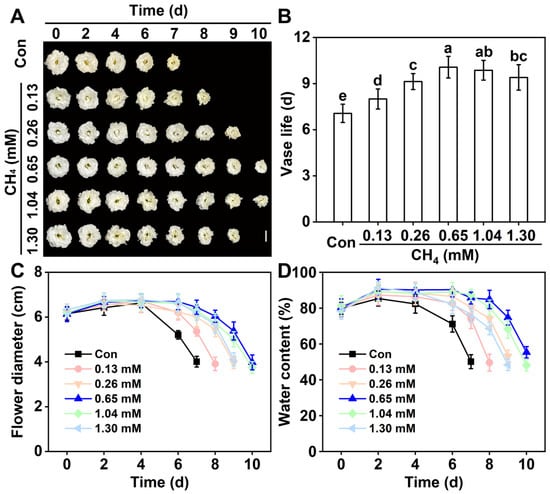
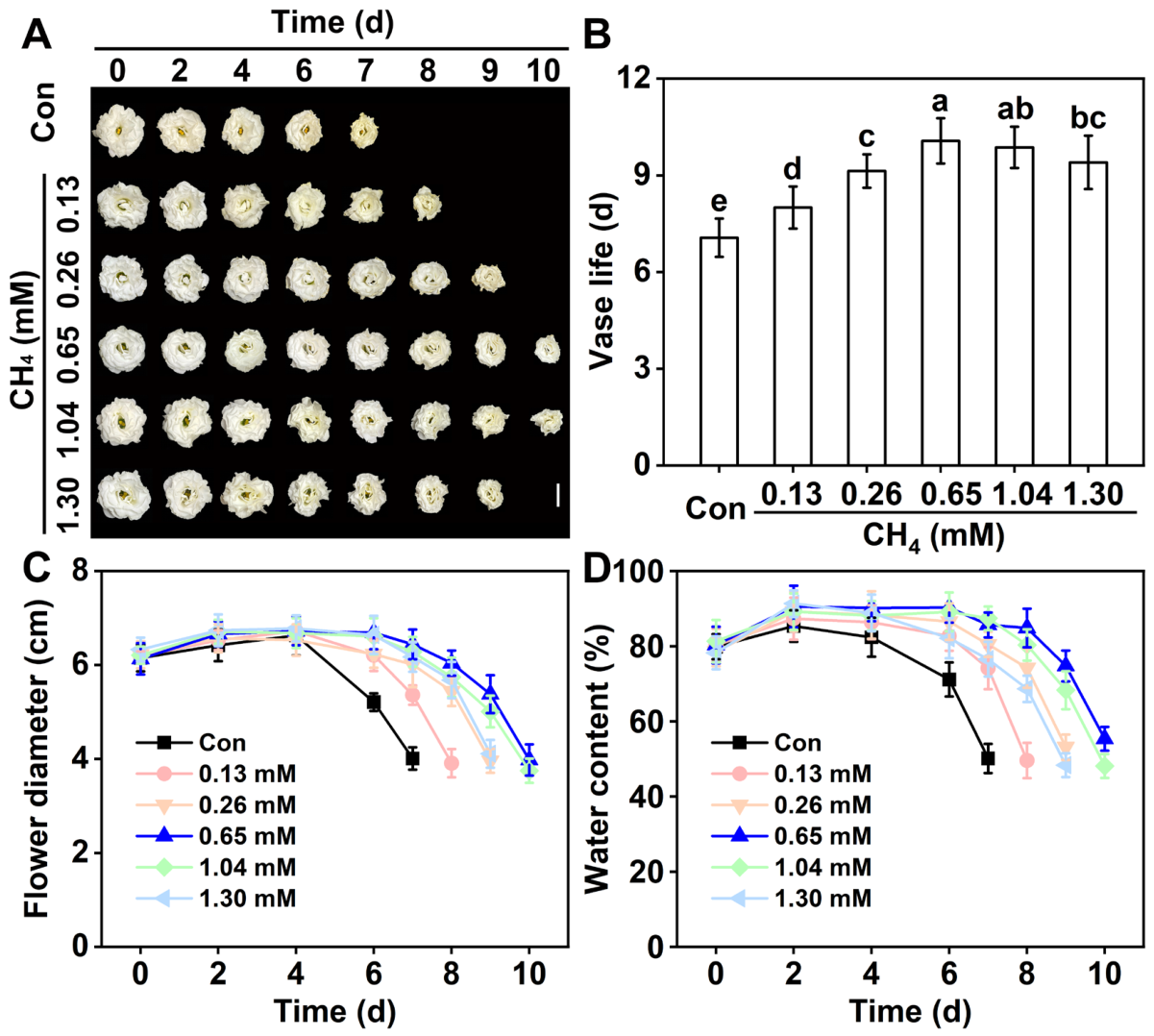
Rapid dehydration and abbreviated vase life compromise the commercial value of cut lisianthus. In an attempt to address these constraints, MRW was screened across a concentration gradient (0.13–1.30 mM). The results showed that all MRW treatments in this study significantly extended vase life compared to the control (Figure 1A,B). Control flowers had a vase life of 7.07 days, whereas 0.65 mM MRW extended it to 10.07 days, representing a 42.43% increase. Vase life under 1.04 mM MRW reached 9.87 days, which was comparable to 0.65 mM and not statistically different. Flowers treated with 1.30 mM MRW lasted 9.40 days, slightly shorter than 1.04 mM but statistically similar. Vase life under 0.26 mM MRW was 9.13 days, trailing the higher concentrations yet remaining equivalent to 1.30 mM. Even the lowest dose (0.13 mM) yielded 8.00 days, which, although less effective than 0.26 mM, still significantly outperformed the control. Concurrently, MRW mitigated the decline in both flower diameter (Figure 1C) and water content (Figure 1D), with 0.65 and 1.04 mM maintaining the highest levels throughout the experimental period.
Figure 1.
Effects of methane-rich water (MRW) on vase life, flower diameter, and water content of cut lisianthus flowers. Stems were held in distilled water (Con) or MRW at 0.13, 0.26, 0.65, 1.04, and 1.30 mM methane, respectively. (A) Representative images of cut flowers (scale bar = 3 cm). (B) Vase life. (C) Flower diameter. (D) Water content. Values are mean ± SE (n = 3). Different letters within the same time point indicate significant differences among treatments (p < 0.05) according to the Tukey–Kramer test.
3.2. Nitric Oxide Is Involved in MRW-Prolonged Vase Life of Cut Lisianthus Flowers
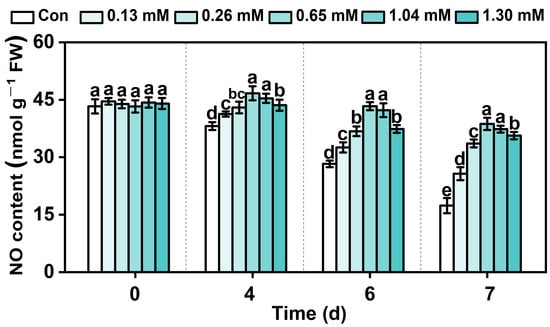
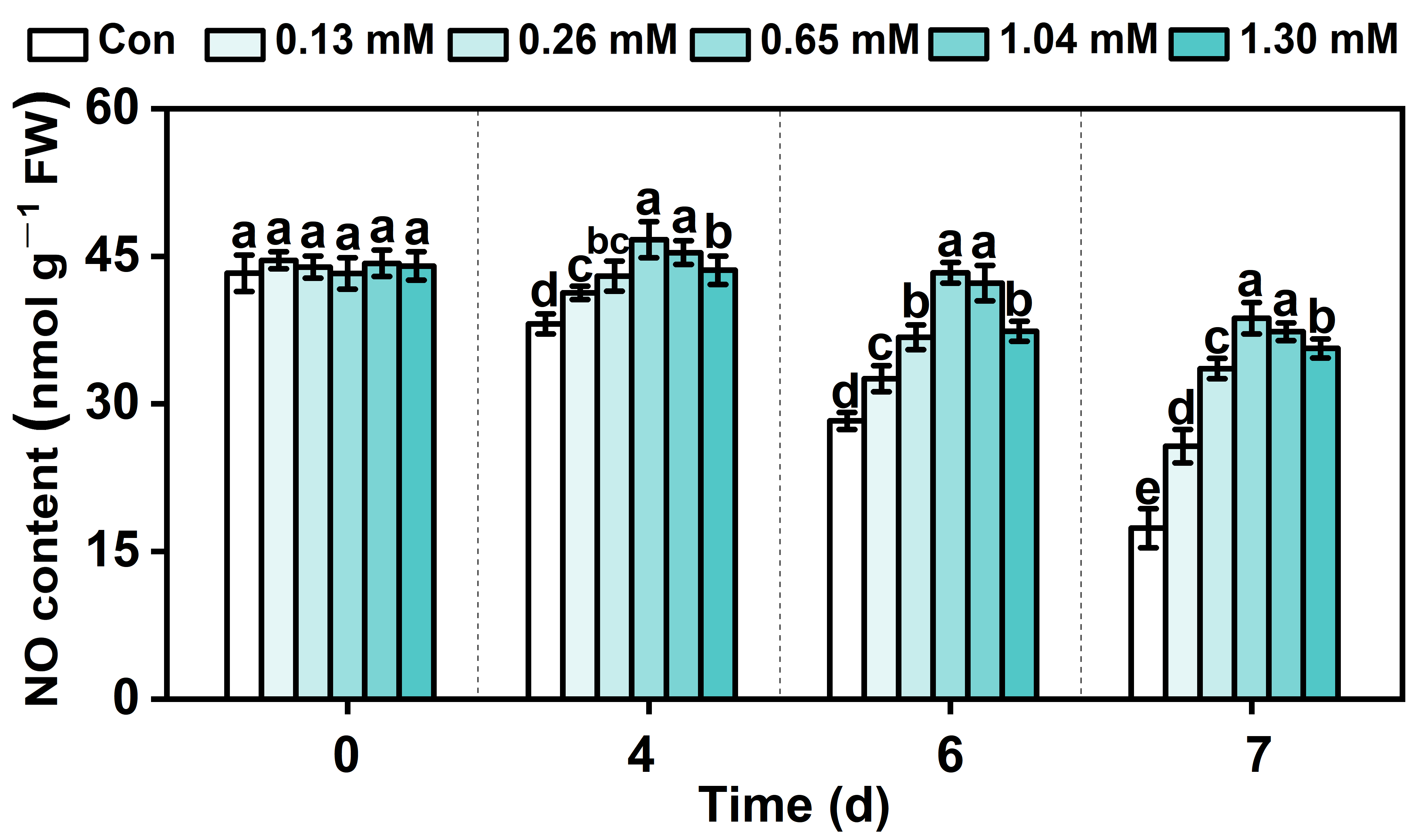
Accumulating evidence indicates that NO is integral to MRW-mediated root development and abiotic stress tolerance. To elucidate the mechanism by which MRW delays senescence in cut lisianthus flowers, NO dynamics were investigated. As shown in Figure 2, MRW induced a marked increase in NO-related signals in a concentration-dependent manner up to 0.65 mM, with 0.65 and 1.04 mM showing comparable levels. All MRW treatments maintained NO levels significantly above the control, although the effect was less pronounced at 0.13, 0.26, and 1.30 mM compared to 0.65 and 1.04 mM, mirroring the phenotypic ranking in Figure 1. Although 0.65 and 1.04 mM MRW showed comparable effects, 0.65 mM was selected for subsequent pharmacological validation as the lower concentration achieving maximal efficacy.
Figure 2.
NO levels in response to MRW during the vase period. Stems were held in Con or MRW on days 0, 4, 6, and 7. NO content determined by the Griess reagent assay. Different letters within the same time point indicate significant differences among treatments (p < 0.05) according to the Tukey–Kramer test.
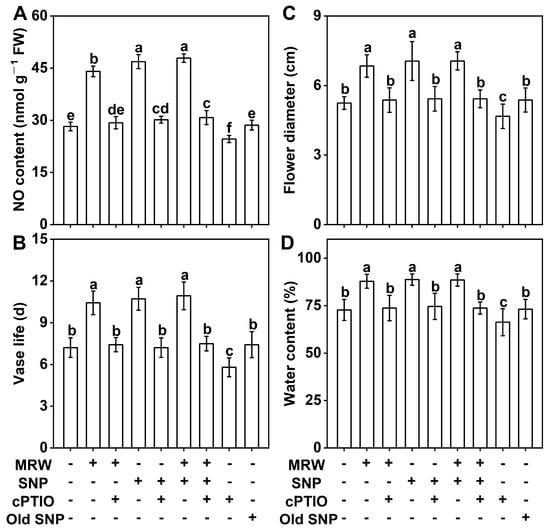
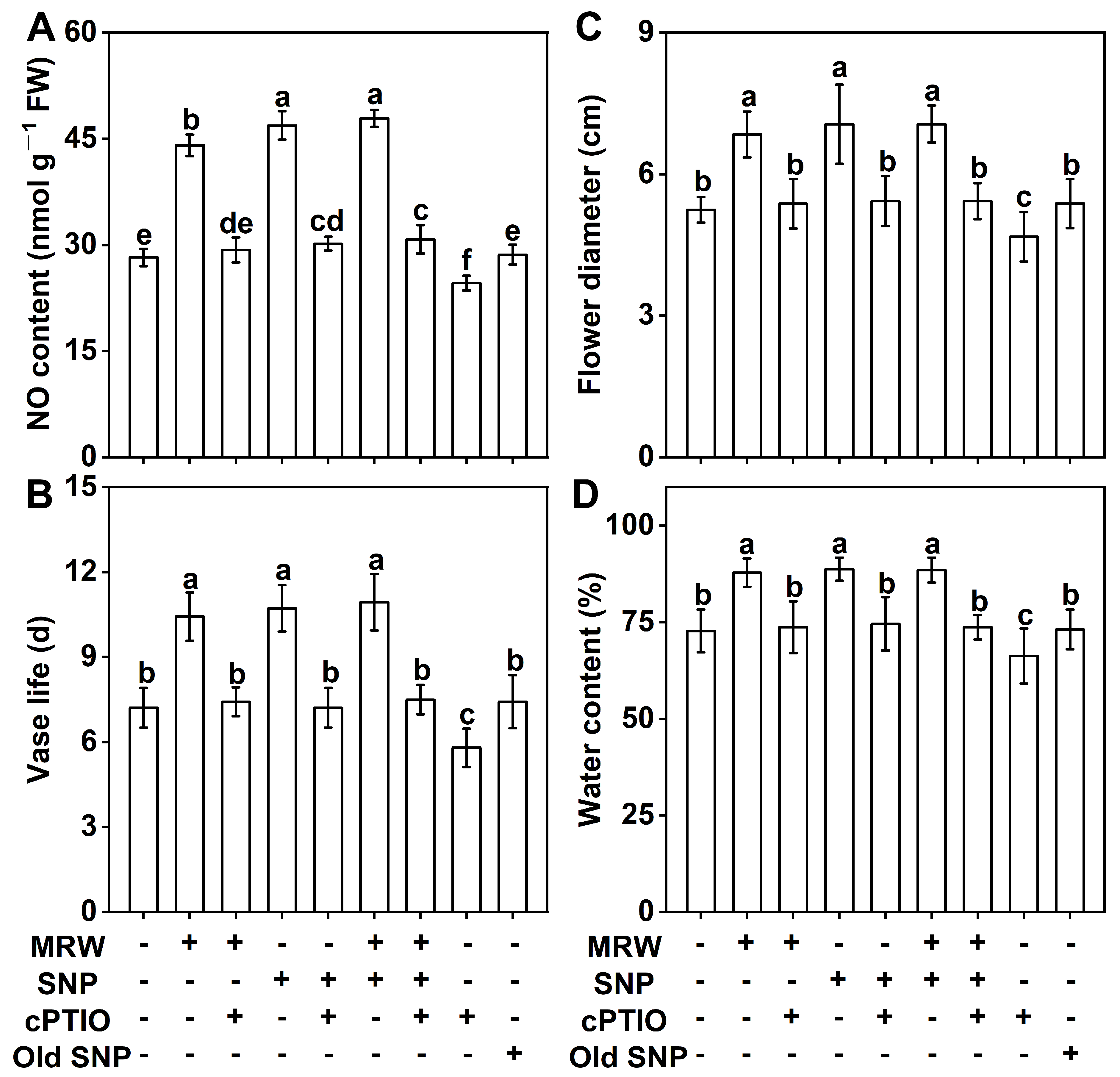
Pharmacological experiments were subsequently conducted to verify the necessity of NO signaling. As shown in Figure 3, the NO scavenger cPTIO (500 μM) largely reversed the vase life extension conferred by MRW, reducing NO-related signals to near-control levels and nullifying the improvements in flower diameter and water content observed on day 6, which corresponded to the stage of most rapid senescence progression in the control group. Conversely, the NO donor SNP (150 μM) mimicked the beneficial effects of MRW, inducing a marked increase in NO content comparable to that of the optimal MRW treatment, along with concomitant enhancements in vase life, flower diameter, and water content. In contrast, the light-exposed inactive control (old SNP) failed to elevate NO levels or improve any of the measured physiological traits. Notably, the combination of MRW and SNP did not further enhance vase life or induce an additive increase in NO levels compared to MRW alone, suggesting possible saturation of the NO-mediated response.
Figure 3.
MRW-induced prolongation of vase life in cut lisianthus flowers is sensitive to the removal of endogenous NO. Stems were treated with Con, 0.65 mM MRW, 150 μM SNP (an NO donor) or old SNP (an inactive NO donor), 500 μM cPTIO, or their combinations for 6 days. (A) NO content determined by visible spectrophotometry. (B) Vase life. (C) Flower diameter. (D) Water content. Different letters indicate significant differences among treatments (p < 0.05) according to the Tukey–Kramer test.
3.3. Nitrate Reductase Activity Is Associated with MRW-Induced NO Accumulation
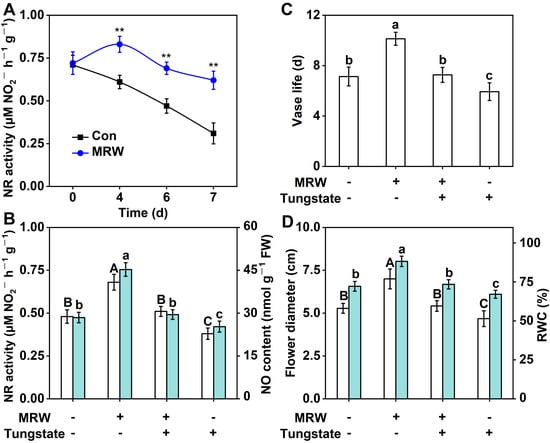
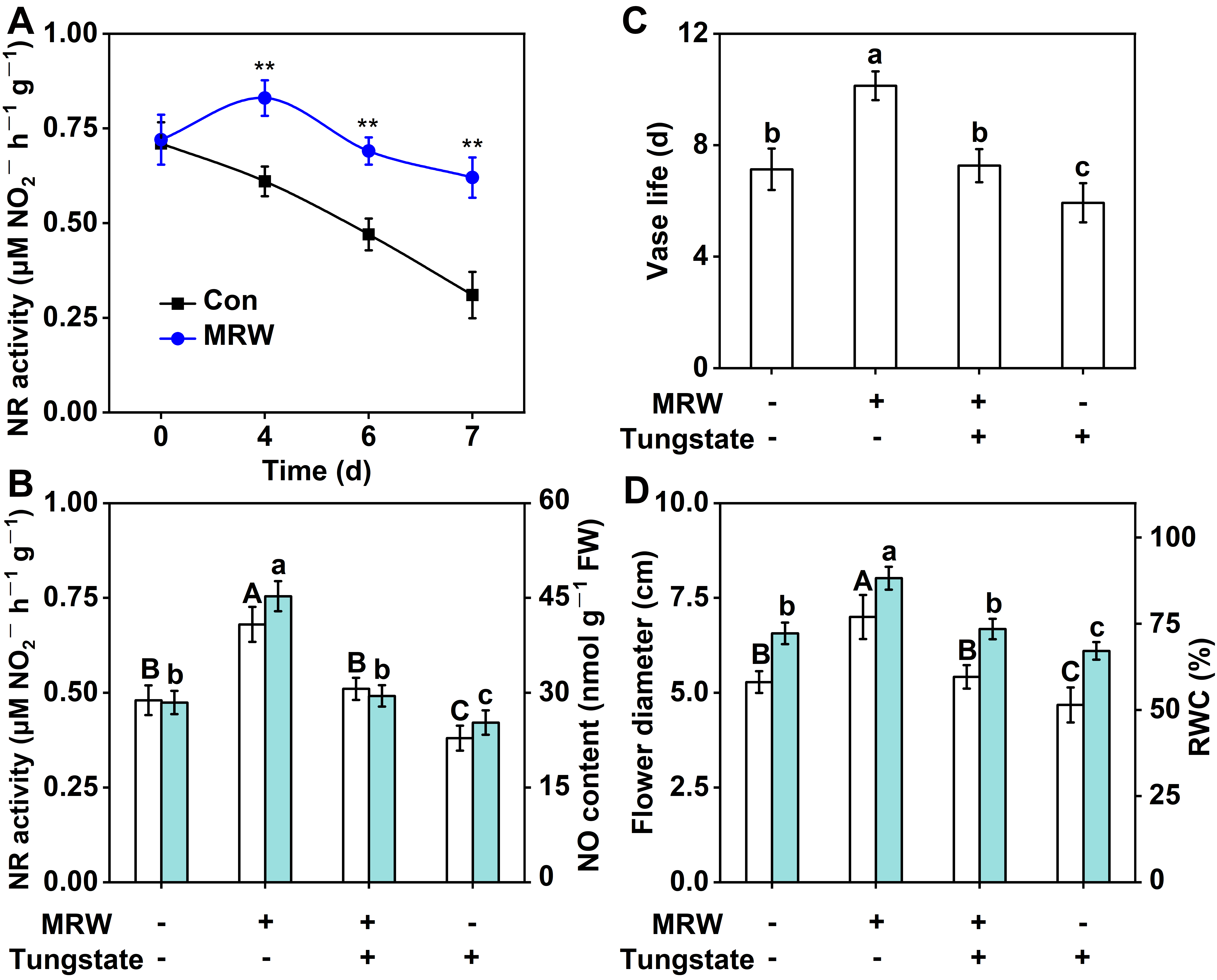
To identify the biosynthesis origin of the NO elevation, the involvement of NR was investigated. The results showed that NR activity gradually declined during the vase life; however, MRW treatment significantly alleviated this decrease, maintaining higher enzymatic activity compared to the control (Figure 4A). Pharmacological inhibition of NR with tungstate (250 μM) suppressed this enzymatic activation, which in turn reduced MRW-induced NO accumulation to near-control levels and abolished the associated extension of vase life. Specifically, tungstate treatment alone shortened the vase life to 83.2%. By day 6, this treatment had also decreased flower diameter by 11.4% and water content by 7.1%, indicating that basal NR activity is involved in maintaining normal postharvest physiology (Figure 4B–D). Collectively, these data suggest NR was involved in MRW-induced NO accumulation, which may contribute to the delay of senescence.
Figure 4.
Involvement of nitrate reductase (NR) in MRW-induced NO production and vase life prolongation of cut lisianthus flowers. Stems were treated with Con, 0.65 mM MRW, 250 μM tungstate, or their combinations throughout the experimental period. (A) NR activities in cut flowers treated with Con or MRW on days 0, 4, 6, and 7. (B) NR activity (left) and NO content (right) on day 6. (C) Vase life. (D) Flower diameter (left) and water content (right) on day 6. Asterisks indicate significant differences according to Student’s t-test (p < 0.01). Different letters indicate significant differences among treatments (p < 0.05) according to the Tukey–Kramer test.
3.4. MRW-Induced Reestablishment of Redox Homeostasis Associates with NO Signalling
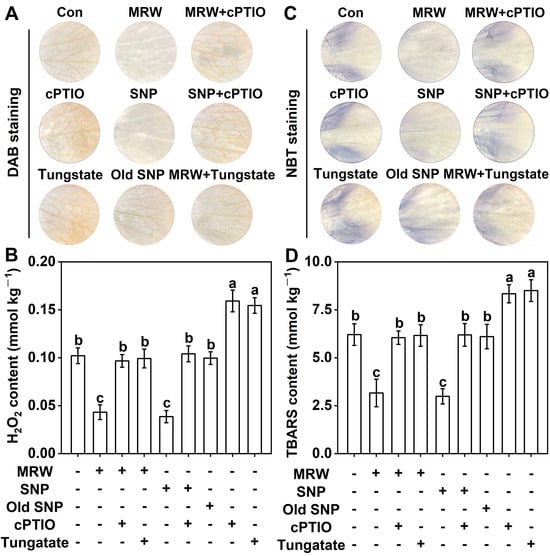
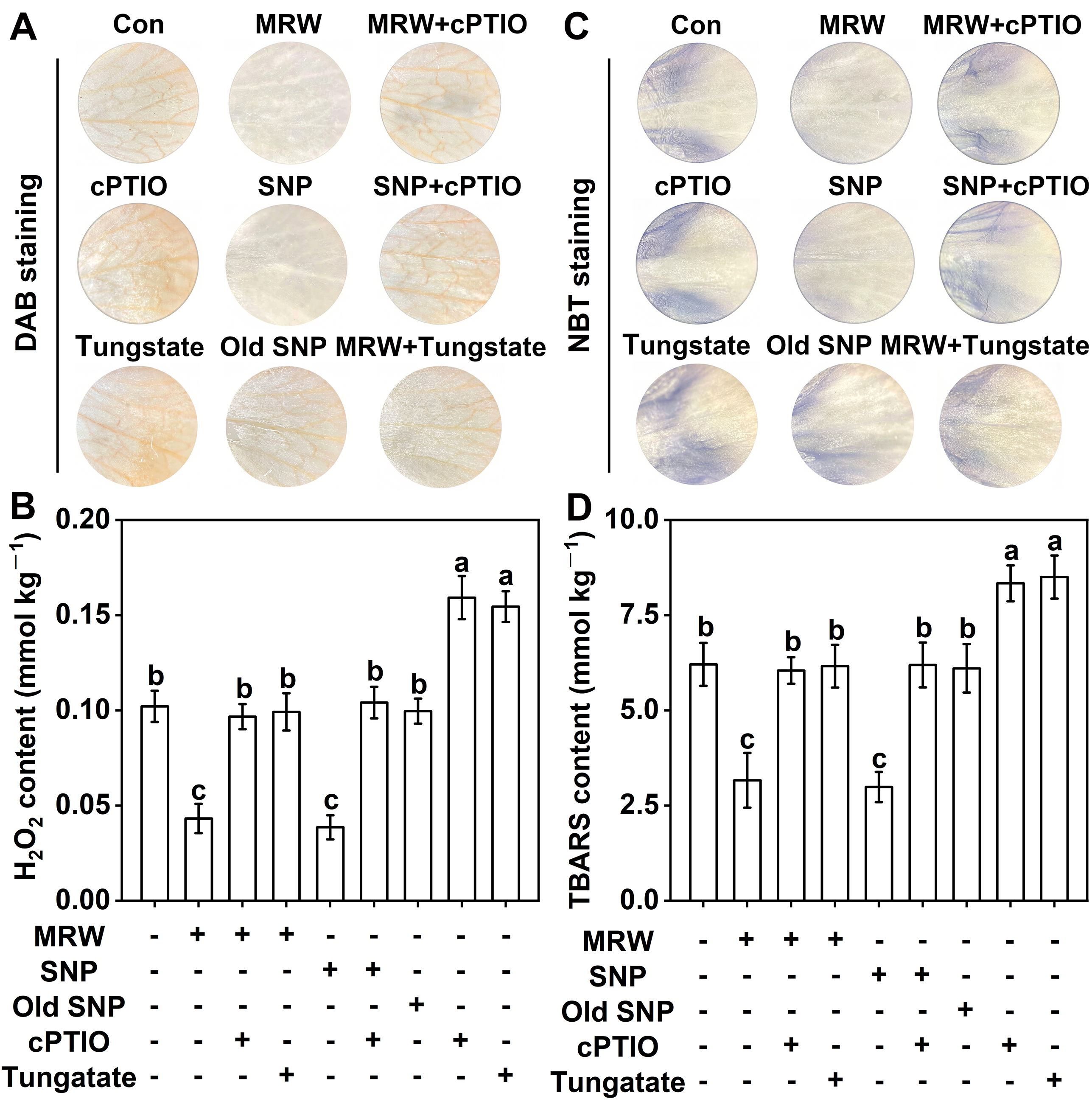
Mounting evidence links NO signaling to the orchestration of cellular redox homeostasis; therefore, the impact of MRW on oxidative status was investigated. Related results showed that MRW treatment effectively suppressed ROS accumulation. Specifically, histochemical analysis revealed that the staining intensities for H2O2 and O2− were markedly attenuated by day 6 compared to the control, as visualized by DAB (Figure 5A) and NBT (Figure 5C) staining, respectively. This qualitative suppression of H2O2 was also quantitatively corroborated by spectrophotometric assays, which showed a reduction of 57.7% in H2O2 content (Figure 5B). Consistent with these observations, lipid peroxidation (assessed as TBARS content) was decreased by 49.0% (Figure 5D). Notably, these antioxidative effects appeared to be largely NO-associated. Co-treatment with the NO scavenger cPTIO or the NR inhibitor tungstate substantially reversed the MRW-induced suppression of ROS, restoring both staining intensities and quantified contents to levels comparable to those of the control (Figure 5). Consistently, the application of SNP alone mimicked MRW’s ROS-suppressing effects, whereas old SNP was ineffective, supporting the role of NO in mediating these effects.
Figure 5.
MRW restores redox homeostasis in cut lisianthus flowers via NO signaling. Stems were treated with Con, MRW, SNP, old SNP, cPTIO, tungstate, or their combinations for 6 days. (A) Representative photographs of DAB staining for H2O2. (B) Quantitative H2O2 content determined by visible spectrophotometry. (C) Representative photographs of NBT staining for O2−. (D) Thiobarbituric acid reactive substances (TBARS) content. Different letters indicate significant differences among treatments (p < 0.05) according to the Tukey–Kramer test.
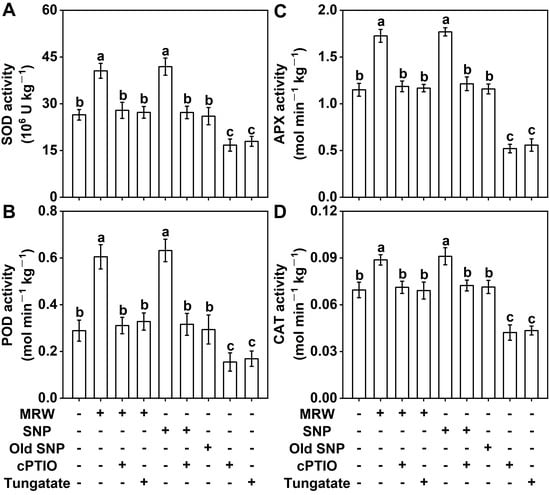
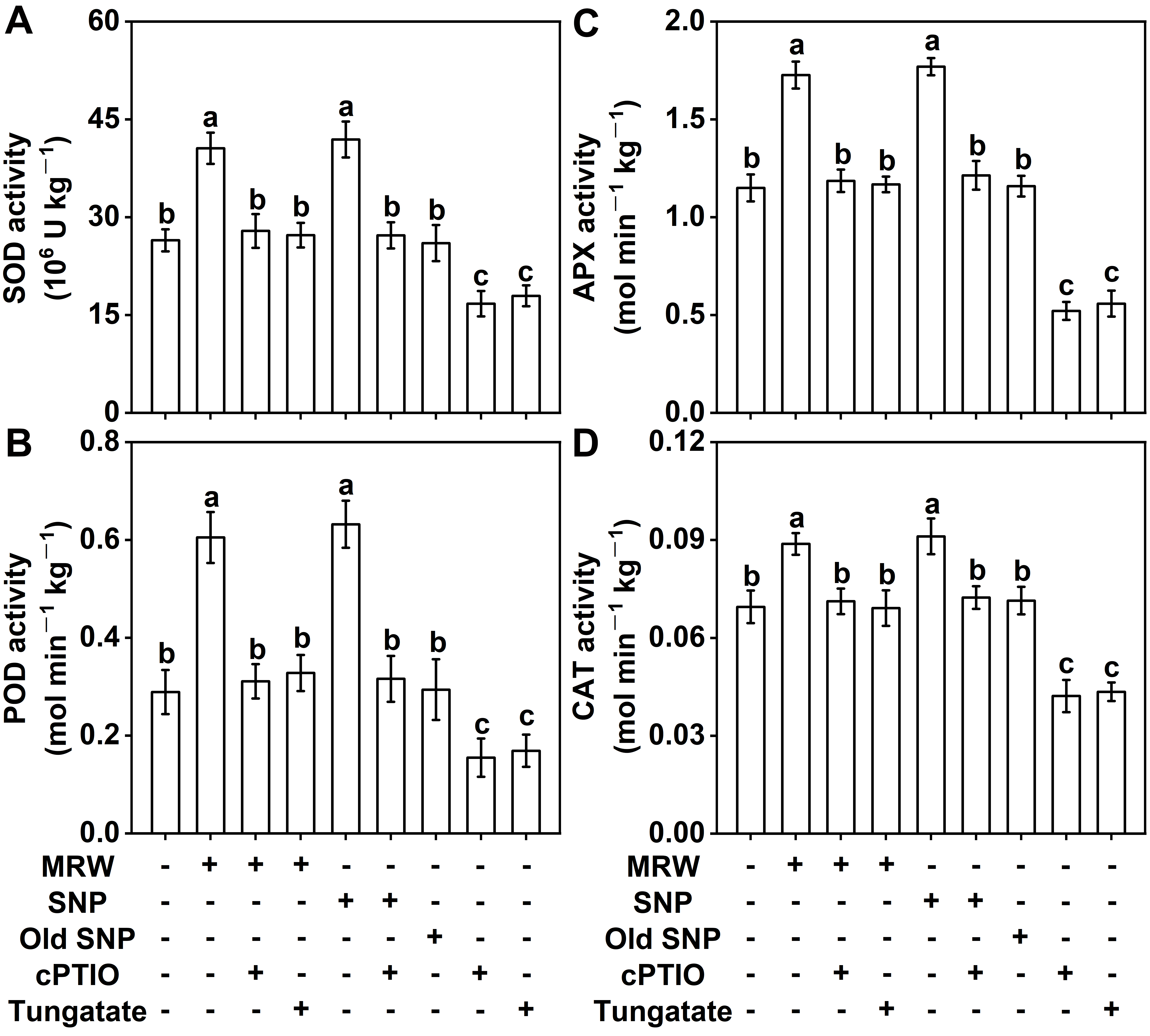
To further elucidate the mechanism underlying this ROS suppression, the antioxidant defense system was examined. As shown in Figure 6, MRW treatment enhanced the activities of SOD, POD, APX, and CAT by 53.4%, 109.3%, 50.1%, and 27.7%, respectively, compared to the control. Mirroring the ROS results, these enzymatic elevations were entirely abrogated by cPTIO or tungstate co-treatment, which restored enzyme activities to the control baseline. Conversely, SNP alone recapitulated the enhancing effects of MRW on antioxidant enzymes. These findings indicate that the enhancement of antioxidant defense and mitigation of oxidative damage by MRW occurred concomitantly with NO accumulation, and the reversal of these effects by tungstate suggests the involvement of NR in this process.
Figure 6.
MRW modulates antioxidant enzyme activities via the NO signaling pathway. Stems were treated with Con, MRW, SNP, old SNP, cPTIO, tungstate, or their combinations for 6 days. Activities of (A) superoxide dismutase (SOD), (B) peroxidase (POD), (C) ascorbate peroxidase (APX), and (D) catalase (CAT) under different treatments. Different letters indicate significant differences among treatments (p < 0.05) by the Tukey–Kramer test.
3.5. MRW Suppresses Ethylene Biosynthesis in a NO-Associated Manner
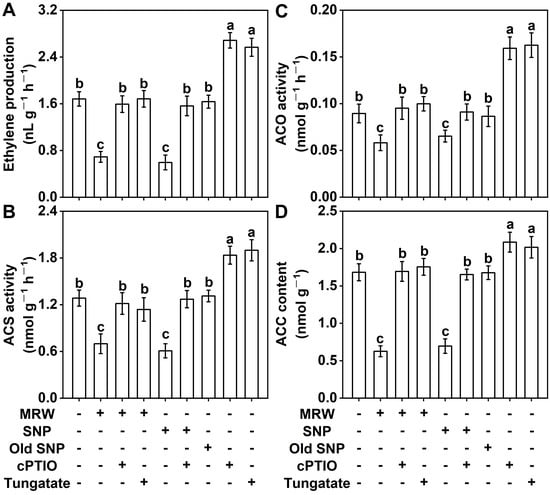
Finally, the regulation of ethylene, a key senescence-promoting hormone, was evaluated. As shown in Figure 7, MRW treatment significantly suppressed ethylene production by 58.9% relative to the control. This suppression was associated with the downregulation of the ethylene biosynthetic machinery: ACS activity decreased by 45.6%, ACO activity by 35.0%, and ACC content by 62.8%. Pharmacological interventions revealed that co-treatment with cPTIO or tungstate partially reversed the MRW-mediated inhibition of ethylene production, restoring ethylene emission rates, ACS/ACO activities, and ACC levels to those of the control group (Figure 7). Mirroring the redox results, no significant differences were observed between MRW and SNP treatments in ethylene suppression. These results link the suppression of ethylene biosynthesis by MRW to NR-derived NO accumulation, connecting gasotransmitter signaling to hormonal regulation during senescence.
Figure 7.
MRW modulates ethylene signaling in an NO-dependent manner. Stems were treated with Con, MRW, SNP, old SNP, cPTIO, tungstate, or their combinations for 6 days. (A) Ethylene production. (B) 1-aminocyclopropane-1-carboxylic acid synthase (ACS) activity. (C) 1-aminocyclopropane-1-carboxylic acid oxidase (ACO) activity. (D) 1-aminocyclopropane-1-carboxylic acid (ACC) content. Different letters indicate significant differences among treatments (p < 0.05) according to the Tukey–Kramer test.
4. Discussion
Methane is traditionally viewed through an environmental lens as the second most important greenhouse gas contributing to global climate change [49]. Consequently, a major thrust of agricultural research has focused on the development of low-CH4 plant varieties, such as the SUSIBA2-expressing rice, which yields high starch while minimizing methane emissions [50], implying a negative connotation for methane in plant production. However, the findings of the present study partially challenge the commonly held view that CH4 is universally detrimental. By demonstrating its potent anti-senescence effects in cut flowers, this research reinforces the “double-edged sword” concept, where CH4 serves as a vital biological regulator.
This aligns with recent findings from our group showing that methane alleviates cadmium toxicity in alfalfa [16] and parallel studies in fruit systems demonstrating that MRW delays the quality degradation of postharvest strawberries [51]. While methane was reported to mitigate browning in edible daylily buds [52], its function as a gaseous signal in prolonging the postharvest longevity of high-value ornamental cut flowers like lisianthus has not been established. The results provided here indicate that exogenous methane, delivered via MRW, significantly extends the vase life of cut lisianthus (Figure 1). The optimal concentration of 0.65 mM MRW resulted in a 42.43% increase in vase life. Although MRW shows promise as a potential “green” alternative, it should be noted that the present study did not conduct cost analysis, large-scale stability testing, or direct comparison with conventional preservatives. Therefore, these practical advantages remain speculative and warrant further investigation.
Consistent with the paradigm established in developmental and stress responses, the present study suggests that NO may act as a downstream mediator of MRW treatment in the context of cut flower senescence. While earlier investigations established that the CH4-NO module is essential for adventitious rooting in cucumber [11] and osmotic stress tolerance in mung bean [11,15], the results provided here extend these observations to the regulation of postharvest longevity in lisianthus (Figure 2 and Figure 3). Pharmacological dissection confirmed that the MRW-associated NO accumulation appears to contribute to delaying senescence, as the beneficial effects were substantially reduced by the NO scavenger cPTIO. This apparent association between MRW treatment and NO accumulation suggests that methane may function upstream of NO in the signaling hierarchy. Furthermore, consistent with the rooting and osmotic stress models [11,15], the origin of this NO in lisianthus was associated with the NR pathway. MRW effectively alleviated the decline in NR activity during the vase period (Figure 4), suggesting that methane may enhance endogenous NO accumulation at least partly through NR activity. However, it should be noted that tungstate is not a fully specific NR inhibitor. By replacing molybdenum in the molybdopterin cofactor, tungstate may also inhibit other molybdoenzymes, including aldehyde oxidase, which is involved in abscisic acid (ABA) biosynthesis. Therefore, the observed effects of tungstate could be partially attributable to impaired ABA production rather than solely to NR inhibition. Therefore, these conclusions are based on pharmacological evidence and require molecular genetic validation in future studies. Similarly, cPTIO, used here as a NO scavenger, may also interact with other reactive nitrogen/oxygen species and thereby influence cellular redox status beyond its intended target [53]. In the case of SNP, light-inactivated SNP (old SNP) was included as a control to account for NO-independent effects of the donor molecule, such as the release of iron/cyanide-containing breakdown products. Furthermore, the Griess assay employed in this study measures nitrite, an indirect and relatively stable downstream metabolite of NO, rather than NO radicals themselves. Given the short half-life and high reactivity of NO, a low Griess signal does not constitute evidence for the absence of NO. Therefore, the pharmacological data presented herein are interpreted as indicating that MRW-induced vase-life extension may involve NR-associated NO signaling, rather than demonstrating an exclusive or quantitative NO-dependent mechanism.
The senescence of lisianthus is fundamentally driven by an oxidative collapse [22]. In the present study, MRW treatment was associated with elevated NO levels, suppressed the accumulation of H2O2 and O2−, and reduced lipid peroxidation (Figure 5), coinciding with increased activities of SOD, POD, CAT, and APX (Figure 6). The enhancement of APX activity is consistent with previous observations in strawberries, where MRW improved redox buffering through the AsA-GSH cycle [51]. While such reestablishment of redox homeostasis resonates with physiological observations in postharvest daylily buds [52], the present work raises the possibility that methane functions as a signaling molecule rather than a passive antioxidant. However, this interpretation relies on pharmacological evidence, and direct molecular evidence for methane signaling is still lacking.
Interestingly, the role of ROS in methane signaling appears to be context-dependent. While MRW reduces oxidative damage in senescent petals, research involving members of this team established that H2O2 actually acts as a vital signaling intermediate in methane-induced root development and stress alleviation [13,16]. This apparent contradiction can be reconciled by the concentration- and tissue-dependent nature of ROS. At low levels, ROS function as signaling molecules, whereas at high levels, they cause oxidative damage. Accordingly, in actively growing tissues such as roots, controlled H2O2 bursts serve as developmental signals, while in senescing petals, the physiological priority shifts to keeping ROS below the cytotoxic threshold. Thus, methane fine-tunes ROS dynamics in a context-dependent manner, utilizing them as signaling triggers at low concentrations while enhancing scavenging systems to prevent toxic accrual during senescence, thereby maintaining cellular integrity.
In addition to redox regulation, MRW significantly influenced the hormonal trajectory of senescence. Ethylene biosynthesis was markedly downregulated by MRW treatment (Figure 7), and pharmacological evidence suggests that MRW-associated NO may mediate this repression. However, the present study did not provide direct evidence for NO-mediated modification of ACS or ACO, such as S-nitrosylation analysis or gene expression data. Therefore, the precise mechanism by which NO affects ethylene biosynthesis remains to be elucidated. This NO–ethylene crosstalk represents a critical regulatory node; evidence suggests that NO can interfere with ethylene biosynthesis either through direct S-nitrosylation of enzymes or by coordinating antioxidant defenses to repress senescence-associated genes [54]. By simultaneously boosting antioxidant capacity and suppressing the ethylene pathway, the combined effects of MRW provide a two-pronged strategy to delay senescence, consistent with regulatory frameworks established in previous investigations of gasotransmitters in this species [21,23].
Several limitations of this study should be acknowledged. First, although oxygen was reintroduced after methane saturation to restore the original dissolved O2 concentration, the possibility that subtle changes in solution properties induced by gas bubbling may have contributed to the observed effects cannot be entirely excluded. Second, the reliance on pharmacological inhibitors, particularly tungstate, provides correlative rather than definitive causal evidence for NR involvement. Therefore, future studies employing molecular genetic approaches would be warranted to further validate the proposed model. In addition, the proposed pathway linking MRW to NR-derived NO accumulation and downstream effects on antioxidant defense and ethylene biosynthesis is based exclusively on these pharmacological experiments. Molecular-level validation, including NR gene expression analysis and direct detection of NO-mediated protein modifications such as S-nitrosylation, would be necessary to confirm the proposed signaling cascade. Third, the present study did not include a matched gas-bubbled control (distilled water bubbled with an inert gas such as N2 or Ar following the same procedure). Therefore, the possibility that the physical effects of gas bubbling may have contributed to the observed responses cannot be entirely excluded. Future studies incorporating such controls would help isolate the specific effects of methane. Fourth, the biochemical parameters in this study were measured on day 6, when MRW-treated flowers were at an earlier stage of senescence than the controls. Whether the observed changes in ROS and ethylene metabolism represent direct targets of MRW action or secondary consequences of delayed senescence warrants further investigation. Time course experiments at earlier time points would help address this question.
Several emerging sustainable preservatives have been explored for cut flower preservation, including nanoparticle-based treatments, essential oils, and hydrogen-rich water [16,34,38]. Compared with these approaches, MRW offers the advantage of using a simple gas dissolution method without requiring specialized equipment or chemical additives. However, direct comparisons of efficacy, cost, and practical feasibility are currently lacking, as the present study was not designed as a comparative evaluation. Such head-to-head studies would be valuable to position MRW within the broader landscape of green postharvest technologies. Another practical consideration is whether a limited early-stage MRW treatment, rather than continuous exposure throughout the vase period, would be sufficient to delay senescence. If so, this could reduce material and labor costs for commercial application. However, the present study was designed with daily renewal of MRW, and the necessity of continuous treatment was not evaluated. Future studies comparing continuous versus pulse treatments at different developmental stages would help determine the minimal effective exposure window for MRW.
Beyond the scientific limitations discussed above, several practical challenges would need to be addressed before MRW could be considered for commercial application. These include the logistics of methane gas supply, safety considerations related to the flammability of methane, and the shelf stability of the MRW solution during storage. None of these factors were evaluated in the present study, and their assessment would require dedicated investigation under industrial conditions. Therefore, the practical applicability of MRW as a postharvest technology remains uncertain at this stage.
5. Conclusions
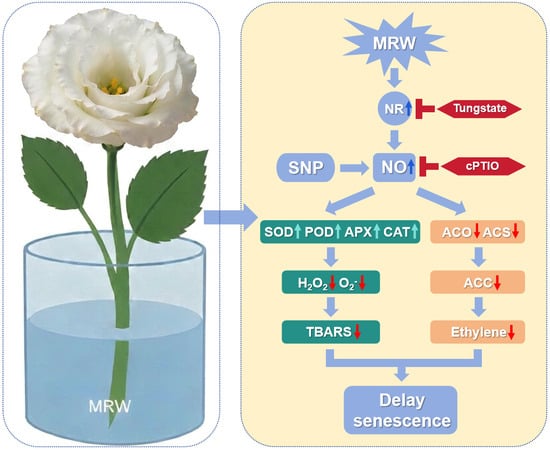
In conclusion, the present study proposes a hypothetical model (Figure 8) wherein MRW treatment induces NO accumulation that is at least partly associated with NR activity. This process correlates with re-established cellular redox homeostasis and suppressed ethylene biosynthesis, ultimately extending the postharvest longevity of cut lisianthus. However, these conclusions are based on pharmacological and physiological evidence, and future studies employing molecular genetic approaches are warranted to further validate the proposed model.
Figure 8.
A proposed model illustrating the role of NR-derived NO in MRW-induced vase life extension of cut lisianthus flowers, involving the restoration of redox homeostasis and modulation of ethylene signaling.
Author Contributions
Conceptualization, G.Z., L.Q. and Y.S.; methodology, K.L., Y.Z. and Y.L.; formal analysis, G.Z., K.L., Y.Z. and Y.L.; investigation, G.Z. and K.L.; data curation, G.Z., K.L. and Y.Z.; resources, L.Q. and Y.S.; writing—original draft preparation, G.Z.; writing—review and editing, Y.S.; supervision, G.Z. and Y.S.; funding acquisition, G.Z. All authors have read and agreed to the published version of the manuscript.
Funding
This research was supported by the Key Research Projects of Higher Education Institutions in Anhui Province (2024AH050312), the Anhui Kexing Biotechnology Co., Ltd. Technology Development Project (20240804), and the Talent Funds of Anhui Science and Technology University (SK202202).
Data Availability Statement
The original contributions presented in this study are included in the article. Further inquiries can be directed to the corresponding author.
Conflicts of Interest
The authors declare no conflicts of interest.
Abbreviations
The following abbreviations are used in this manuscript:
| ACC | 1-aminocyclopropane-1-carboxylic acid |
| ACO | ACC oxidase |
| ACS | ACC synthase |
| ANOVA | Analysis of variance |
| APX | Ascorbate peroxidase |
| AsA-GSH | Ascorbate–glutathione |
| CAT | Catalase |
| CH4 | Methane |
| Con | Control |
| cPTIO | 2-(4-Carboxyphenyl)-4,4,5,5-tetramethylimidazoline-1-oxyl-3-oxide potassium salt |
| DAB | 3,3′-diaminobenzidine |
| DW | Dry weight |
| FID | Flame ionization detector |
| FW | Fresh weight |
| GC | Gas chromatography |
| H2O2 | Hydrogen peroxide |
| MRW | Methane-rich water |
| NBT | Nitroblue tetrazolium |
| NO | Nitric oxide |
| NR | Nitrate reductase |
| O2− | Superoxide anion |
| POD | Peroxidase |
| ROS | Reactive oxygen species |
| SE | Standard error |
| SNP | Sodium nitroprusside |
| SOD | Superoxide dismutase |
| TBARS | Thiobarbituric acid reactive substances |
References
- Fang, F.; Oliva, M.; Ovadia, R.; Bar, E.; Nissim-Levi, A.; Kumar, V.; Wang, R.; Neeman, A.; Zaccai, M.; Lewinsohn, E.; et al. Increased substrate availability reveals the potential of scentless lisianthus flowers in producing fragrant benzenoid-phenylpropanoids. Physiol. Plant. 2021, 172, 19–28. [Google Scholar] [CrossRef] [Scilit] [PubMed]
- Onozaki, T.; Satou, M.; Azuma, M.; Kawabe, M.; Kawakatsu, K.; Fukuta, N. Evaluation of 29 lisianthus cultivars (Eustoma grandiflorum) and one inbred line of E. exaltatum for resistance to two isolates of Fusarium solani by using hydroponic equipment. Hortic. J. 2020, 89, 473–480. [Google Scholar] [CrossRef] [Scilit]
- Kawabata, S.; Yokoo, M.; Nii, K. Quantitative analysis of corolla shapes and petal contours in single-flower cultivars of lisianthus. Sci. Hortic. 2009, 121, 206–212. [Google Scholar] [CrossRef] [Scilit]
- Musembi, N.N.; Hutchinson, M.J.; Waithaka, K. The effects of 6-benzylaminopurine and gibberellic acid on postharvest physiology of lisianthus (Eustoma grandiflorum) flowers: I. Novel synergism improves water balance and vase life. Acta Hortic. 2015, 1077, 47–56. [Google Scholar] [CrossRef] [Scilit]
- Kwon, H.S.; Leporini, C.; Kim, S.; Heo, S. Prolonged vase life by salicylic acid treatment and prediction of vase life using petal color senescence of cut lisianthus. Postharvest Biol. Technol. 2024, 209, 112726. [Google Scholar] [CrossRef] [Scilit]
- Tomizawa, E.; Ohtomo, S.; Asai, K.; Ohta, Y.; Takiue, Y.; Hasumi, A.; Nishihara, M.; Nakatsuka, T. Additional betalain accumulation by genetic engineering leads to a novel flower color in lisianthus (Eustoma grandiflorum). Plant Biotechnol. 2021, 38, 323–330. [Google Scholar] [CrossRef] [Scilit] [PubMed]
- Darvish, M.; Shirzad, H.; Asghari, M.; Noruzi, P.; Alirezalu, A.; Pateiro, M.; Takshe, A.; Lorenzo, J.M. 24-Epibrasinolide modulates the vase life of lisianthus cut flowers by modulating ACC oxidase enzyme activity and physiological responses. Plants 2021, 10, 995. [Google Scholar] [CrossRef] [Scilit] [PubMed]
- Boros, M.; Tuboly, E.; Mészáros, A.; Amann, A. The role of methane in mammalian physiology—Is it a gasotransmitter? J. Breath Res. 2015, 9, 014001. [Google Scholar] [CrossRef] [Scilit] [PubMed]
- Li, L.; Wei, S.; Shen, W. The role of methane in plant physiology: A review. Plant Cell Rep. 2020, 39, 171–179. [Google Scholar] [CrossRef] [Scilit] [PubMed]
- Ernst, L.; Steinfeld, B.; Barayeu, U.; Klintzsch, T.; Kurth, M.; Grimm, D.; Dick, T.P.; Rebelein, J.G.; Bischofs, I.B.; Keppler, F. Methane formation driven by reactive oxygen species across all living organisms. Nature 2022, 603, 482–487. [Google Scholar] [CrossRef] [Scilit] [PubMed]
- Qi, F.; Xiang, Z.; Kou, N.; Cui, W.; Xu, D.; Wang, R.; Zhu, D.; Shen, W. Nitric oxide is involved in methane-induced adventitious root formation in cucumber. Physiol. Plant. 2017, 159, 366–377. [Google Scholar] [CrossRef] [Scilit] [PubMed]
- Jiang, X.; He, J.; Cheng, P.; Xiang, Z.; Zhou, H.; Wang, R.; Shen, W. Methane control of adventitious rooting requires γ-glutamyl cysteine synthetase-mediated glutathione homeostasis. Plant Cell Physiol. 2019, 60, 802–815. [Google Scholar] [CrossRef] [Scilit] [PubMed]
- Zhao, Y.; Zhang, Y.; Liu, F.; Wang, R.; Huang, L.; Shen, W. Hydrogen peroxide is involved in methane-induced tomato lateral root formation. Plant Cell Rep. 2019, 38, 377–389. [Google Scholar] [CrossRef] [Scilit] [PubMed]
- Han, B.; Duan, X.; Wang, Y.; Zhu, K.; Zhang, J.; Wang, R.; Hu, H.; Qi, F.; Pan, J.; Yan, Y.; et al. Methane protects against polyethylene glycol-induced osmotic stress in maize by improving sugar and ascorbic acid metabolism. Sci. Rep. 2017, 7, 46185. [Google Scholar] [CrossRef] [Scilit] [PubMed]
- Zhang, Y.; Su, J.; Cheng, D.; Wang, R.; Mei, Y.; Hu, H.; Shen, W.; Zhang, Y. Nitric oxide contributes to methane-induced osmotic stress tolerance in mung bean. BMC Plant Biol. 2018, 18, 207. [Google Scholar] [CrossRef] [Scilit] [PubMed]
- Zhao, Y.; Yang, J.; Jiang, F.; Zhao, G. Hydrogen peroxide is involved in methane-alleviated cadmium toxicity in alfalfa (Medicago sativa L.) seedlings by enhancing cadmium chelation onto root cell walls. Plants 2024, 13, 2639. [Google Scholar] [CrossRef] [Scilit] [PubMed]
- Li, Y.; Li, L.; Wang, S.; Liu, Y.; Zou, J.; Ding, W.; Du, H.; Shen, W. Magnesium hydride acts as a convenient hydrogen supply to prolong the vase life of cut roses by modulating nitric oxide synthesis. Postharvest Biol. Technol. 2021, 177, 111526. [Google Scholar] [CrossRef] [Scilit]
- Naing, A.H.; Lee, K.; Arun, M.; Lim, K.B.; Kim, C.K. Characterization of the role of sodium nitroprusside (SNP) involved in long vase life of different carnation cultivars. BMC Plant Biol. 2017, 17, 149. [Google Scholar] [CrossRef] [Scilit] [PubMed]
- Bruand, C.; Meilhoc, E. Nitric oxide in plants: Pro- or anti-senescence. J. Exp. Bot. 2019, 70, 4419–4427. [Google Scholar] [CrossRef] [Scilit] [PubMed]
- Sadeghi, S.; Jabbarzadeh, Z. The effect of pre- and post-harvest sodium nitroprusside treatments on the physiological changes of cut Alstroemeria aurea ‘Orange Queen’ during vase life. BMC Plant Biol. 2024, 24, 678. [Google Scholar] [CrossRef] [Scilit] [PubMed]
- Naziri Moghaddam, N.; Kaviani, B.; Safari Motlagh, M.R.; Khorrami Raad, M. Effect of sodium nitroprusside on the vase life of cut rose, lisianthus, and sunflower. J. Ornam. Plants 2021, 11, 185–195. [Google Scholar]
- Van Doorn, W.G.; Woltering, E.J. Physiology and molecular biology of petal senescence. J. Exp. Bot. 2008, 59, 453–480. [Google Scholar] [CrossRef] [Scilit] [PubMed]
- Su, J.; Nie, Y.; Zhao, G.; Cheng, D.; Wang, R.; Chen, J.; Zhang, S.; Shen, W. Endogenous hydrogen gas delays petal senescence and extends the vase life of lisianthus cut flowers. Postharvest Biol. Technol. 2019, 147, 148–155. [Google Scholar] [CrossRef] [Scilit]
- He, D.; Yu, S.; Qu, L.; Yang, Y.; Luo, J.; Zhang, Y. Methyl jasmonate enhances vase life and alters physiological and molecular responses in tree peony “Luoyang Hong” cut flowers. Postharvest Biol. Technol. 2025, 224, 113481. [Google Scholar] [CrossRef] [Scilit]
- Qu, L.; He, D.; Su, D.; Zhang, Y.; Sun, D.; Luo, J. Exogenous spermine delays the petal senescence of tree peony ‘Luoyanghong’ cut flowers by affecting physiological and molecular responses. Postharvest Biol. Technol. 2025, 228, 113684. [Google Scholar] [CrossRef] [Scilit]
- Sukpitak, C.; Munné-Bosch, S.; Seraypheap, K. Brassinosteroids alleviate postharvest water deficit stress in cut Dendrobium “Khao Sanan” orchid through modulation of protective mechanisms, osmotic regulation, and endogenous hormonal levels. Postharvest Biol. Technol. 2024, 211, 112832. [Google Scholar] [CrossRef] [Scilit]
- Van Doorn, W. Categories of petal senescence and abscission: A re-evaluation. Ann. Bot. 2001, 87, 447–456. [Google Scholar] [CrossRef] [Scilit]
- Li, S.; Shi, S.; Shi, T.; Wei, X.; Xiao, T.; Gao, S.; Zhou, S.; Shaaban, M.; Shi, G. Postharvest water loss decreases vase quality of itoh peony cut flowers by regulating aquaporins activity. Postharvest Biol. Technol. 2026, 234, 114100. [Google Scholar] [CrossRef] [Scilit]
- Scariot, V.; Paradiso, R.; Rogers, H.; De Pascale, S. Ethylene control in cut flowers: Classical and innovative approaches. Postharvest Biol. Technol. 2014, 97, 83–92. [Google Scholar] [CrossRef] [Scilit]
- Shi, T.; Shi, S.; Wang, Y.; Zhou, S.; Shaaban, M.; He, S.; Shi, G.; Wang, Z. Prolonging the vase life of ltoh peony cut flowers via inhibited ethylene action and improved energy metabolism. Ind. Crops Prod. 2026, 246, 123362. [Google Scholar] [CrossRef] [Scilit]
- Xu, S.; Zheng, F.; Geng, X.; Jiang, Z.; Mao, L.; Su, J. Transcriptome sequencing reveals the senescence mechanism of ethylene-insensitive cut Rhododendron flowers. Postharvest Biol. Technol. 2023, 205, 112502. [Google Scholar] [CrossRef] [Scilit]
- Xie, Y.; Mao, Y.; Zhang, W.; Lai, D.; Wang, Q.; Shen, W. Reactive oxygen species-dependent nitric oxide production contributes to hydrogen-promoted stomatal closure in Arabidopsis. Plant Physiol. 2014, 165, 759–773. [Google Scholar] [CrossRef] [Scilit] [PubMed]
- Bright, J.; Desikan, R.; Hancock, J.T.; Weir, I.S.; Neill, S.J. ABA-induced NO generation and stomatal closure in Arabidopsis are dependent on H2O2 synthesis. Plant J. 2006, 45, 113–122. [Google Scholar] [CrossRef] [Scilit] [PubMed]
- Su, J.; Zhang, Y.; Nie, Y.; Cheng, D.; Wang, R.; Hu, H.; Chen, J.; Zhang, J.; Du, Y.; Shen, W. Hydrogen-induced osmotic tolerance is associated with nitric oxide-mediated proline accumulation and reestablishment of redox balance in alfalfa seedlings. Environ. Exp. Bot. 2018, 147, 249–260. [Google Scholar] [CrossRef] [Scilit]
- Li, L.; Liu, Y.; Wang, S.; Zou, J.; Ding, W.; Shen, W. Magnesium hydride-mediated sustainable hydrogen supply prolongs the vase life of cut carnation flowers via hydrogen sulfide. Front. Plant Sci. 2020, 11, 595376. [Google Scholar] [CrossRef] [Scilit] [PubMed]
- Bai, X.; Chen, J.; Kong, X.; Todd, C.D.; Yang, Y.; Hu, X.; Li, D. Carbon monoxide enhances the chilling tolerance of recalcitrant Baccaurea ramiflora seeds via nitric oxide-mediated glutathione homeostasis. Free Radic. Biol. Med. 2012, 53, 710–720. [Google Scholar] [CrossRef] [Scilit] [PubMed]
- Guo, Y.; Li, J.; Liu, L.; Yang, W.; Zhou, Y.; Wei, C.; Ma, J.; Zhang, Y.; Yang, J.; Liu, Y.; et al. Nitric oxide cross-links calcium signals to enhance cold tolerance via inhibiting calmodulin expression in watermelon. Plant Physiol. 2025, 198, kiaf243. [Google Scholar] [CrossRef] [Scilit] [PubMed]
- Zhao, M.-G.; Chen, L.; Zhang, L.-L.; Zhang, W.-H. Nitric reductase-dependent nitric oxide production is involved in cold acclimation and freezing tolerance in Arabidopsis. Plant Physiol. 2009, 151, 755–767. [Google Scholar] [CrossRef] [Scilit] [PubMed]
- Li, L.; Yin, Q.; Zhang, T.; Cheng, P.; Xu, S.; Shen, W. Hydrogen nanobubble water delays petal senescence and prolongs the vase life of cut carnation (Dianthus caryophyllus L.) flowers. Plants 2021, 10, 1662. [Google Scholar] [CrossRef] [Scilit] [PubMed]
- Hodges, D.M.; DeLong, J.M.; Forney, C.F.; Prange, R.K. Improving the thiobarbituric acid-reactive-substances assay for estimating lipid peroxidation in plant tissues containing anthocyanin and other interfering compounds. Planta 1999, 207, 604–611. [Google Scholar] [CrossRef] [Scilit]
- Bradford, M.M. A rapid and sensitive method for the quantitation of microgram quantities of protein utilizing the principle of protein-dye binding. Anal. Biochem. 1976, 72, 248–254. [Google Scholar] [CrossRef] [PubMed]
- Beauchamp, C.; Fridovich, I. Superoxide dismutase: Improved assays and an assay applicable to acrylamide gels. Anal. Biochem. 1971, 44, 276–287. [Google Scholar] [CrossRef] [Scilit] [PubMed]
- Egley, G.H.; Paul, R.N.; Vaughn, K.C.; Duke, S.O. Role of peroxidase in the development of water-impermeable seed coats in Sida spinosa L. Planta 1983, 157, 224–232. [Google Scholar] [CrossRef] [Scilit] [PubMed]
- Aebi, H. Catalase in vitro. In Methods in Enzymology; Elsevier: Amsterdam, The Netherlands, 1984; Volume 105, pp. 121–126. [Google Scholar] [CrossRef] [Scilit] [PubMed]
- Nakano, Y.; Asada, K. Hydrogen peroxide is scavenged by ascorbate-specific peroxidase in spinach chloroplasts. Plant Cell Physiol. 1981, 22, 867–880. [Google Scholar] [CrossRef] [Scilit]
- Concepcion, M.; Lizada, C.; Yang, S.F. A simple and sensitive assay for 1-aminocyclopropane-1-carboxylic acid. Anal. Biochem. 1979, 100, 140–145. [Google Scholar] [CrossRef] [Scilit] [PubMed]
- Fernández-Maculet, J.C.; Yang, S.F. Extraction and partial characterization of the ethylene-forming enzyme from apple fruit. Plant Physiol. 1992, 99, 751–754. [Google Scholar] [CrossRef] [Scilit] [PubMed]
- Kato, M.; Hyodo, H. Purification and characterization of ACC oxidase and increase in its activity during ripening of pear fruit. J. Jpn. Soc. Hortic. 1999, 68, 551–557. [Google Scholar] [CrossRef] [Scilit]
- Kirschke, S.; Bousquet, P.; Ciais, P.; Saunois, M.; Canadell, J.G.; Dlugokencky, E.J.; Bergamaschi, P.; Bergmann, D.; Blake, D.R.; Bruhwiler, L.; et al. Three decades of global methane sources and sinks. Nat. Geosci. 2013, 6, 813–823. [Google Scholar] [CrossRef] [Scilit]
- Su, J.; Hu, C.; Yan, X.; Jin, Y.; Chen, Z.; Guan, Q.; Wang, Y.; Zhong, D.; Jansson, C.; Wang, F.; et al. Expression of barley SUSIBA2 transcription factor yields high-starch low-methane rice. Nature 2015, 523, 602–606. [Google Scholar] [CrossRef] [Scilit] [PubMed]
- Sun, Y.; Jiang, F.; Zhao, G.; Li, K.; Chen, T.; Zhou, Z.; Qian, L. Mechanisms of methane-rich water regulation of antioxidant systems in delaying postharvest quality degradation of strawberries. Food Ferment. Ind. 2026, 52, 309–317. [Google Scholar] [CrossRef]
- Hu, H.; Liu, D.; Li, P. Methane delays the senescence and browning in daylily buds by re-established redox homeostasis. J. Sci. Food Agric. 2018, 98, 1977–1987. [Google Scholar] [CrossRef] [Scilit] [PubMed]
- Pfeiffer, S.; Leopold, E.; Hemmens, B.; Schmidt, K.; Werner, E.R.; Mayer, B. Interference of carboxy-PTIO with nitric oxide- and peroxynitrite-mediated reactions. Free Radic. Biol. Med. 1997, 22, 787–794. [Google Scholar] [CrossRef] [Scilit] [PubMed]
- Liao, W.-B.; Zhang, M.-L.; Yu, J.-H. Role of nitric oxide in delaying senescence of cut rose flowers and its interaction with ethylene. Sci. Hortic. 2013, 155, 30–38. [Google Scholar] [CrossRef] [Scilit]
Disclaimer/Publisher’s Note: The statements, opinions and data contained in all publications are solely those of the individual author(s) and contributor(s) and not of MDPI and/or the editor(s). MDPI and/or the editor(s) disclaim responsibility for any injury to people or property resulting from any ideas, methods, instructions or products referred to in the content. |
© 2026 by the authors. Licensee MDPI, Basel, Switzerland. This article is an open access article distributed under the terms and conditions of the Creative Commons Attribution (CC BY) license.