


Highlights
What are the main findings?
- •
- Legumes produced greater biomass and N accumulation than non-legumes, with >96% of N derived from the atmosphere, as estimated by the difference method.
- •
- Legume residues enhanced subsequent lettuce biomass, N status, and photosynthetic performance across the rotation.
What are the implications of the main findings?
- •
- Legumes as cover crops improve nutrient cycling and subsequent crop productivity.
- •
- Species selection is critical for sustainable management of cover crops.
Abstract
This study evaluates the performance of seven cover crop species, five legumes, one grass, and one brassica, and their residual effects on a lettuce–lettuce–oat rotation. A completely randomised design with eight treatments and three replicates was established in 12 L pots to assess biomass production, nutrient accumulation, and the effects of cover crops on subsequent crops and soil properties. Legumes produced significantly higher biomass (97.0–152.9 g pot−1) than non-legumes (7.5–11.1 g pot−1). Nitrogen (N) accumulation was also significantly higher in legumes (2.2–3.1 g pot−1) than in non-legumes (0.1 g pot−1). More than 96% of the N accumulated by legumes was derived from the atmosphere, as estimated using the difference method, highlighting the importance of atmospheric N fixation to legume N accumulation under the conditions of this experiment. Differences among legume species were also observed. Although legumes showed lower concentrations of phosphorus (P) and other nutrients in plant tissues, this was attributed to a dilution effect associated with greater biomass production rather than restricted nutrient uptake. Cover crops had marked effects on subsequent cash crops. Crops grown after legumes showed significantly higher biomass, N status, and photosynthetic performance than those following non-legumes or the control. These effects were strongest in the first crop but persisted throughout the rotation. In contrast, non-legumes did not differ from the control. N recovery proved to be a sensitive indicator of these differences, confirming the key role of legumes in supplying N through residue mineralisation. Legumes also influenced soil properties by increasing nitrate availability and promoting slight soil acidification, potentially associated with enhanced nitrification. Overall, the results highlight the importance of species selection in cover cropping, with legumes playing a central role in improving subsequent crop productivity.
1. Introduction
Agricultural intensification is widely recognised as one of the principal drivers of global biodiversity loss, soil degradation, and contamination of water bodies and the atmosphere [1,2]. Simultaneously, increasing soil productivity to feed a continuously growing human population while reducing the environmental footprint of agricultural activities constitutes a central challenge for twenty-first-century agriculture [3,4]. Addressing this dual challenge requires adopting more sustainable, resource-efficient agricultural practices. Among these, the integration of cover crops into cropping systems has been widely proposed as a strategy to reduce nutrient losses, disrupt pest and disease cycles, and enhance soil fertility [5,6]. When specifically aimed at improving soil nutrient status, this practice is commonly referred to as green manuring [7,8].
Historically, fallow periods were incorporated into crop rotations to mitigate nutrient depletion and maintain soil fertility [9,10]. However, replacing bare fallows with cover crops has proven more effective in improving soil properties and reducing environmental externalities [9,11]. Depending on their functional traits and management objectives, cover crops may enhance the retention of mineral N within the soil–plant system, particularly when used as winter cover or catch crops [12,13], protect soil from erosion [14,15], or provide supplementary forage in mixed farming systems [16,17].
A major constraint to crop productivity worldwide is N availability. The industrial synthesis of N fertilisers through the Haber–Bosch process is highly energy-intensive and dependent on fossil fuels [18]. Rising fertiliser costs and the negative downstream impacts of N losses on aquatic ecosystems and the atmosphere have intensified interest in biologically based alternatives. In this context, legumes are particularly relevant due to their capacity to fix atmospheric N through symbiosis with rhizobia, thereby reducing or potentially eliminating the need for mineral N fertilisation [3,19]. Following incorporation, the mineralisation of N-rich legume residues can supply substantial amounts of N to subsequent crops, increasing productivity and improving overall agroecosystem efficiency [11,20]. For this reason, legumes are frequently preferred over other botanical groups as green manures [8,21].
Beyond N fixation, certain legume species also contribute to the mobilisation of other essential nutrients, particularly P [22,23]. Some species have evolved specialised mechanisms to access sparingly soluble P forms. The development of cluster (proteoid) roots and the exudation of organic acids and phenolic compounds into the rhizosphere play a critical role in solubilising P that would otherwise remain unavailable to many crops [24,25]. Once taken up, P is returned to the soil through plant residues and subsequently mineralised, thereby increasing nutrient availability for subsequent crops [22,24]. Concurrently, cover crops from other botanical groups, such as grasses and brassicas, provide complementary ecosystem functions, including high biomass production, increased C inputs to the soil, and suppression of soil-borne pathogens, thereby creating favourable conditions for the growth of subsequent crops [26,27]. These contrasting functions highlight the importance of considering the botanical group when assessing the nutrient-related and residual effects of cover crops on subsequent crops and soil properties.
Despite the growing adoption of cover crops and the expanding scientific literature on their benefits, comparative evaluations among species, particularly those aimed at optimising their effects on subsequent cash crops, remain relatively scarce. Previous studies have demonstrated substantial interspecific variability among legumes in terms of biomass production and biological N fixation [7,28]. However, although previous studies have provided evidence of differences between legume and non-legume cover crops in nitrogen accumulation, nitrogen availability, and their effects on subsequent crop performance and soil properties [7,29], further comparative assessment is needed to clarify these differences across species and growing conditions. Moreover, the effects of cover crops on subsequent crop performance and soil N availability may vary depending on species characteristics, environmental conditions, and management practices, highlighting the need to consider potentially contrasting findings across studies [7,8,9,20]. Although commercial seed mixtures often combine legumes, grasses, and brassicas, direct experimental comparisons among species under the same environmental and management conditions remain scarce, constraining evidence-based species selection and the optimisation of cover crop benefits at the farm level.
The present study addresses this gap by evaluating the biomass production of five legume species with potential use as green manures, along with one grass and one brassica species included for comparison. In addition to quantifying biomass and nutrient accumulation, particularly N, the residual effects of the cover crops were assessed within a lettuce–lettuce–oat rotation. Thus, the following hypotheses were tested: (i) legumes, owing to their access to atmospheric N, produce greater biomass than non-legume species; (ii) legumes promote greater growth of cash crops compared with non-legume species and an uncultivated control; (iii) different cover crop species differentially influence nutrient cycling, with legumes expected to enhance N availability; and (iv) non-legume species, characterised by higher C-to-N ratios in their tissues, contribute more substantially to soil organic matter accumulation than legumes. These hypotheses were evaluated based on cover crop biomass production and nutrient accumulation, the residual effects on lettuce and oat growth, and soil properties, including soil organic matter.
2. Materials and Methods
2.1. Experimental Conditions
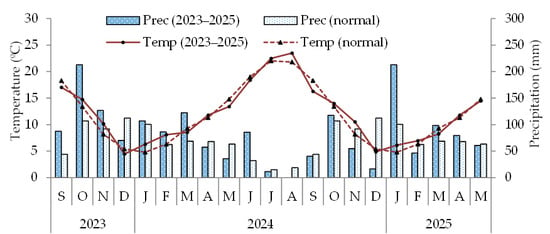
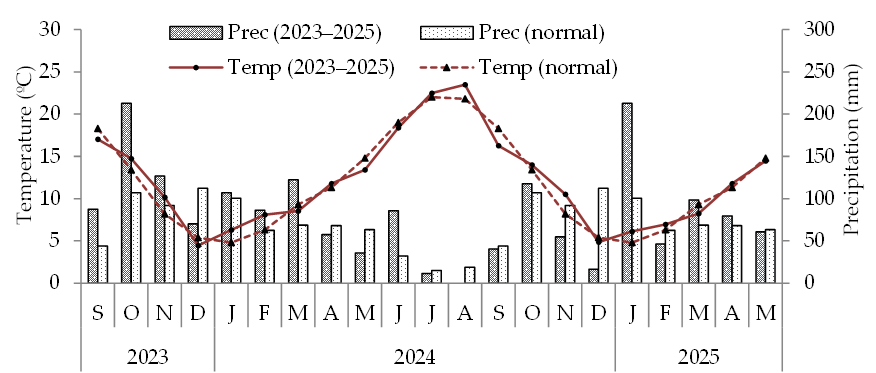
This study comprised four cropping cycles and was conducted in Bragança (41°47′50″ N, 6°45′42″ W; 686 m a.s.l.), located in northeastern Portugal, between September 2023 and May 2025. The region has a Mediterranean climate (Csb, according to the Köppen classification) and is characterised by cold, rainy winters and warm, dry summers. The mean annual air temperature is 12.9 °C, and the mean annual precipitation is 783.9 mm [30]. The monthly mean air temperature and cumulative monthly precipitation for the climatological normal of Bragança, as well as the values recorded during the experimental period, are presented in Figure 1.
Figure 1.
Monthly mean air temperature and cumulative monthly precipitation for the climatological normal of Bragança and values recorded during the experimental period [30].
In this study, an agricultural soil was collected from a field that had been left fallow for two years. Soil samples were taken from the arable layer (0–0.20 m depth). The soil was sieved fresh through a 4 mm mesh and subsequently air-dried. Each pot was filled with 16 kg of dry soil. Three subsamples were further sieved through a 2 mm mesh, oven-dried at 40 °C, and used to determine relevant physicochemical properties. According to the World Reference Base for Soil Resources [31], the soil is classified as a Regosol of colluvial origin. It has a sandy clay loam texture, with particle-size distribution of 229, 241, and 530 g kg−1 of clay, silt, and sand, respectively. Additional relevant soil properties are presented in Table 1.
Table 1.
Soil properties (mean ± standard deviation, = 3) determined prior to the establishment of the experiment at 0–0.20 m depth.
2.2. Experimental Design
The experiment was arranged in a completely randomised design with eight treatments and three replicates per treatment (three pots). The treatments consisted of seven cover crop species and an uncultivated control. The species included in the study were oat (Avena sativa L., cv. Boa Fé), rapeseed (Brassica napus L., hybrid PT225), subterranean clover (Trifolium subterraneum L. var. subterraneum (Katz. & Morley) Zohary & Heller, cv. Denmark), crimson clover (Trifolium incarnatum L., cv. Diogene), broad bean (Vicia faba L., cv. Favel), white lupine (Lupinus albus L., cv. Estoril), and blue lupine (L. angustifolius L., cv. Karo).
2.3. Trial Establishment and Management
Sowing was carried out on 19 September 2023. Aboveground biomass of the cover crops was harvested on 22 April 2024. From each pot, a 30 g subsample of fresh biomass was collected, oven-dried at 70 °C until constant weight, weighed, and subsequently ground to pass through a 1 mm mesh for elemental analysis. An additional fourth pot per treatment was established to produce supplementary biomass to compensate for the biomass removed from the three experimental replicates for laboratory analysis. Although four replicates were established per treatment, only three were included in the ANOVA, as the biomass harvested from the fourth pot was used to compensate for the biomass removed from the three experimental replicates for laboratory analysis.
The fresh biomass produced in each pot was chopped into small pieces and subsequently incorporated into the soil within the upper 15 cm layer. After a short period to allow the cover crop residues to initiate mineralisation, lettuce was transplanted for the first cropping cycle. Two lettuce plants (Lactuca sativa L., cv. Summer Wonder) were transplanted per pot at phenological stage 13 (third true leaf unfolded), according to the BBCH scale [32]. Transplanting was carried out on 4 May 2024. Harvest took place on 24 June 2024 at phenological stage 49 (typical head size, form, and firmness reached). Lettuce heads were weighed fresh, oven-dried at 70 °C until constant weight, and ground. Plant tissues were analysed for elemental composition and nitrate concentration. A second lettuce cycle was established on 13 September 2024, with two plants transplanted per pot at the third true leaf unfolded stage. Harvest was performed on 15 November 2024, following the same procedures as in the first cropping cycle. On 18 November 2024, oats were sown to evaluate the longer-term nutrient release effect of the incorporated residues. A rate of 2 g of oat seed per pot was used. Oat was harvested on 9 May 2025 at phenological stage 33 (node 3 at least 2 cm above node 2), according to Meier [32]. The harvested biomass was oven-dried at 70 °C, ground, and subjected to elemental chemical analysis.
Following sowing and transplanting, pots were regularly monitored for weed emergence, and any weeds were removed immediately to maintain uniform biomass composition across treatments. The cropping cycles of the different species occurred throughout the year, which, under a Mediterranean climate, implies cold, rainy periods in winter and warm, dry conditions in summer (Figure 1). Consequently, during lettuce cropping cycles conducted under warmer, drier conditions, supplementary irrigation was required. Irrigation was not applied at fixed volumes or predetermined intervals, as the rate of water loss varied considerably with lettuce plant size (influenced by the treatments) and with fluctuations in air temperature. To ensure that the lettuce plants were not subjected to water stress at any stage of growth, irrigation was adjusted daily, with small volumes of water applied incrementally as required, as is commonly recommended in pot experiments [32].
2.4. Field Measurements
During the two lettuce cropping cycles, physiological and nutritional performance was monitored using portable equipment. Leaf greenness and chlorophyll a fluorescence were assessed on fully expanded young leaves. Leaf greenness was measured using a portable SPAD-502 Plus chlorophyll meter (Spectrum Technologies, Inc., Aurora, IL, USA). The SPAD-502 provides dimensionless values proportional to leaf chlorophyll content by measuring light transmittance at 650 nm (red light, absorbed by chlorophyll) and 940 nm (infrared light, not absorbed by chlorophyll). For each plant, mean SPAD values were calculated from 30 individual readings taken on the young, fully expanded leaves. Chlorophyll a fluorescence was determined using the dark-adaptation protocol with the OS-30p+ fluorometer (Opti-Sciences, Inc., Hudson, NH, USA). Measurements were performed on the youngest fully expanded leaves after a dark-adaptation period of more than 35 min. Minimum (F0), maximum (Fm), and variable fluorescence (Fm) were obtained from dark-adapted leaves, and the maximum quantum efficiency of photosystem II (Fv/Fm) was calculated as (Fm − F0)/Fm.
2.5. Soil Analyses
The initial soil samples, collected as described in Section 2.1, were analysed to characterise the growing medium. At the end of the study, a homogeneous soil sample was collected from each pot to assess the effects of the treatments on soil properties. These samples were sieved again through a 2 mm mesh and oven-dried at 40 °C in a forced-air oven prior to analysis.
Thereafter, the soil samples were analysed for particle-size distribution (clay, silt, and sand fractions) using the Robinson pipette method following sedimentation-based separation. Soil pH (H2O) was measured potentiometrically with a calibrated pH meter at a soil-to-water ratio of 1:2.5. Organic C was determined by wet digestion using the Walkley–Black method, based on dichromate oxidation. Extractable P and potassium (K) were determined using the Egner–Riehm method (ammonium lactate extract), and exchangeable bases, as well as cation exchange capacity (CEC), were assessed by ammonium acetate extraction at pH 7.0. Soil boron (B) was quantified by hot-water extraction followed by colourimetric determination using azomethine-H. The availability of the micronutrients iron (Fe), manganese (Mn), zinc (Zn), and copper (Cu) was determined after extraction with ammonium acetate–EDTA, and concentrations were measured by atomic absorption spectrometry. Detailed descriptions of the analytical procedures are available in Van Reeuwijk [33].
Approximately halfway through and near the end of the two lettuce cropping cycles, soil nitrate content was determined using anion-exchange membranes (AEMs) inserted directly into the soil. Briefly, 1 × 2 cm strips of AEM were pre-saturated with 0.5 M NaHCO3 prior to deployment. The membranes were then gently inserted into the soil using a spatula and left in situ for four days. At the end of the incubation period, the membranes were carefully retrieved with forceps, rinsed with distilled water, and placed in 20 mL of 0.5 N hydrochloric acid, where they were agitated at 180 rpm for 4 h. Nitrate concentrations in the resulting extracts were subsequently determined by UV-Vis spectrophotometry.
2.6. Plant Tissue Analyses
The cover crops were cut at ground level, and a sample of the harvested biomass was collected for analysis. The subsequent crops were also cut at ground level, and the entire above-ground biomass was collected for analysis. Plant tissue samples from cover crops, lettuce, and oat were dried to constant weight, ground to a fine powder, and analysed for their elemental composition. Total N concentration was determined using the Kjeldahl method. B and P were quantified by colourimetric analysis, and K was measured by flame emission spectrometry. Calcium (Ca), magnesium (Mg), Mn, Fe, Cu, and Zn were determined by atomic absorption spectrophotometry following nitric acid digestion of the samples in a microwave oven. For a detailed description of these methodologies, the reader is referred to Temminghoff and Houba [34]. Nitrate concentration in lettuce samples was determined using 1 g of dry tissue, which was shaken in 50 mL of water, then filtered through Whatman No. 42 filter paper; the nitrate concentration in the filtrate was measured using a UV–Vis spectrophotometer.
2.7. Statistical Analysis
The data analysis was conducted using SPSS Statistics software (v. 25, IBM SPSS, Armonk, NY, USA). Normality assumptions were checked using the Shapiro–Wilk test and homogeneity of variances was assessed using the Levene test. Subsequently, a one-way ANOVA was performed to identify differences among treatments. When significant differences were found, mean separation was performed using the Tukey HSD post hoc test (α = 0.05).
2.8. Atmospheric Nitrogen Contribution to Legumes
The percentage of N derived from the atmosphere (%Ndfa) was estimated using the difference method, which compares the N content in legume tissues to that found in the non-legume species [35]:
The difference method assumes that legumes and non-legumes access similar amounts of soil-derived N, with differences in tissue N content attributed to atmospheric N fixation, although differences in rooting depth and N uptake may introduce uncertainty into the estimates [35].
3. Results
3.1. Cover Crops
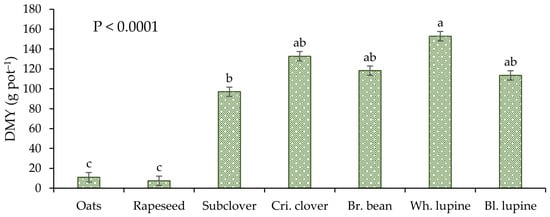
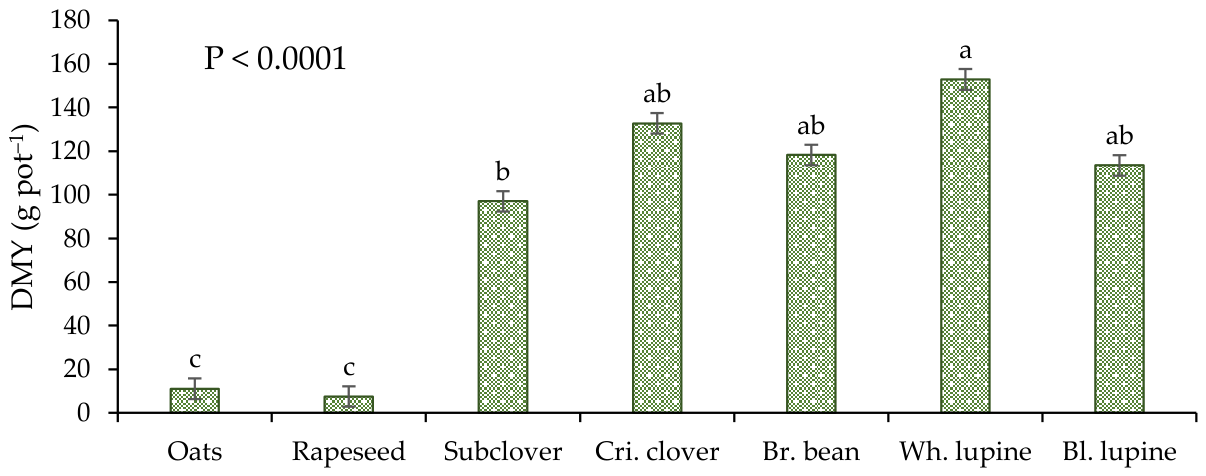
Cover crop dry matter yield (DMY) differed significantly among species (p < 0.0001), reflecting the effect of botanical group on biomass accumulation (Figure 2). Legumes exhibited markedly higher values than non-legume species. Among the legumes, white lupin recorded the highest DMY (152.9 g pot−1), a value significantly greater than that of subterranean clover (97.0 g pot−1).
Figure 2.
Dry matter yield (DMY) of species grown as cover crops. Means followed by the same letter are not significantly different according to the Tukey HSD test (α = 0.05).
N concentration in plant tissues and total N accumulated in the aboveground biomass varied significantly among cover crops (Table 2). Regarding tissue N concentration, oat exhibited the lowest mean value, followed by rapeseed. Among the legumes, subterranean clover showed the highest mean concentration, whereas white lupin presented the lowest. In terms of N recovery, legumes showed significantly higher values than non-legume cover crops, whereas no significant differences were observed among species within either group. N derived from the atmosphere was estimated to exceed 230 kg ha−1 for both legume species, accounting for more than 96% of the total N contained in the aboveground biomass.
Table 2.
Nitrogen (N) concentration in tissues and total N in aboveground biomass (N recovery) in cover crops, and N derived from the atmosphere in legumes.
P concentration in the tissues of the cover crops varied significantly among species, with most legumes exhibiting lower mean values than non-legume species (Table 3). Among the legumes, subterranean clover showed the highest values, followed by crimson clover. K and Ca concentrations in the tissues also varied significantly among species. For K, the clovers showed particularly high values, whereas the lowest values were recorded in the lupins. Ca concentrations in the tissues were particularly low in the grass and higher in the rapeseed, with subterranean clover exhibiting the highest values.
Table 3.
Macronutrient concentration in the aboveground biomass of cover crops.
The concentrations of all analysed micronutrients varied significantly among species (Table S1). Oat exhibited a particularly low B concentration (0.9 mg kg−1), whereas crimson clover (21.1 mg kg−1), subterranean clover (21.1 mg kg−1), and rapeseed (20.9 mg kg−1) showed significantly higher concentrations than the remaining species (11.9–13.6 mg kg−1). Fe concentrations reached the highest and lowest mean values in subterranean clover and crimson clover, respectively. Mn concentration was particularly high in white lupin, reaching concentrations up to 10 times higher than those recorded in some other species. Zn concentrations appeared to be higher in legumes than in rapeseed and oat. Cu concentrations were particularly high in subclover and blue lupin, and low in oat and rapeseed. However, this pattern was not consistent across all legumes, as broad bean and crimson clover also exhibited low Cu concentrations.
Total P recovered in the aboveground biomass reached the highest value in crimson clover, differing significantly from some legumes, such as white lupin and broad bean, as well as from oat and rapeseed (Table 4). For K, particularly low values were observed in oat and rapeseed, whereas the clovers showed particularly high values. Similarly, Ca values were particularly low in oat, followed by rapeseed.
Table 4.
Macronutrient recovery in the aboveground biomass of cover crops.
The recovery of micronutrients in the aboveground biomass differed significantly among species for all micronutrients analysed (Table S2). Total B recovered in plant tissues reached high values in the clovers, particularly in crimson clover (2.79 mg pot−1), and was low and very low in rapeseed (0.16 mg pot−1) and oat (0.01 mg pot−1), respectively. Fe values were particularly low in oat and rapeseed, whereas they were considerably higher in subterranean clover. Mn values were particularly high in white lupin and differed significantly from those of all other species. Zn and Cu values were very low in oat and rapeseed and considerably higher in the legumes overall.
3.2. Cash Crops
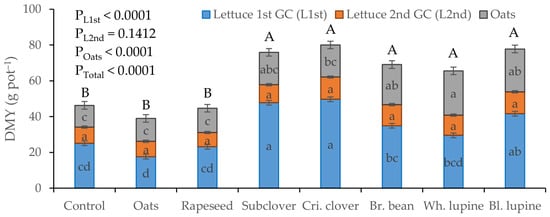
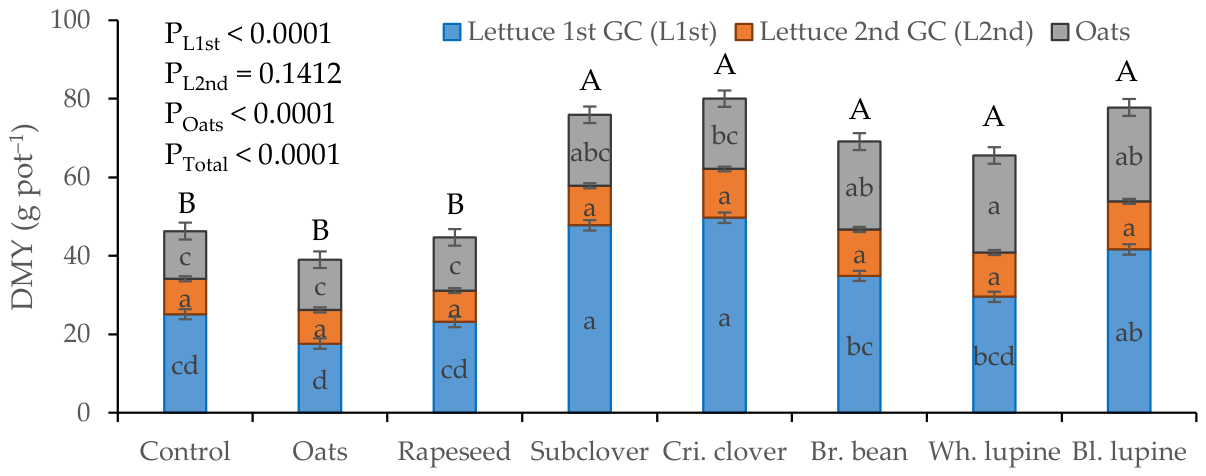
The crops grown following the incorporation of the cover crops showed significant differences in DMY depending on the preceding cover crop (Figure 3). The cumulative DMY across the three-cycle lettuce–lettuce–oat sequence was significantly higher after legumes than after non-legume cover crops or the control treatment. Non-legume cover crops did not differ significantly from the control. Among the legumes, the clovers stood out in the first lettuce cycle, showing significant differences from white lupin and broad bean. In the total cumulative DMY, no significant differences were observed among the legumes, although the highest mean value was recorded for crimson clover and the lowest for white lupin.
Figure 3.
Dry matter yield (DMY) in the first (1st) and second (2nd) lettuce growth cycles (GC) and in oat, depending on the different cover cropping strategies. For each crop (lowercase) and for the total cumulative DMY (uppercase), means followed by the same letter are not significantly different according to the Tukey HSD test (α = 0.05).
SPAD values during the first lettuce cycle were generally significantly higher following legume cover crops than after non-legume cover crops or the control, at both sampling dates (Table 5). In the second cycle, differences among cover crops diminished, although the pattern of significantly higher values for legumes was restored at the second sampling. Fv/Fm values showed a pattern consistent with SPAD measurements but were less sensitive than SPAD at discriminating the effects of cover crops on lettuce, with significant differences among treatments occurring less frequently.
Table 5.
SPAD readings and chlorophyll fluorescence (variable-to-maximum fluorescence ratio, Fv/Fm) during the first and second lettuce growth cycles under different cover cropping strategies.
N concentration in lettuce tissues differed significantly among treatments with different cover crops in both cropping cycles (Table 6). Consistently, lower N concentrations were observed in lettuce grown in the control treatment following oat and rapeseed. In the first lettuce cycle, differences were also observed among the legumes, with white lupin and blue lupin showing the highest and lowest mean values, respectively. Concentrations of the other nutrients varied significantly with the preceding cover crop only during the first lettuce cycle. P concentration in the tissues varied significantly among treatments in the first cycle and did not follow a pattern related to the botanical family of the cover crop. Accordingly, the highest and lowest values were recorded in legumes, specifically subterranean clover and blue lupin, respectively. For K, during the first cycle, low values were observed following broad bean and also in the control, oat, and rapeseed treatments, whereas higher values were recorded following crimson clover. For Ca, particularly low values were observed following broad bean and blue lupin, whereas higher values were recorded in the control treatment during the first cycle. For Mg, higher values were observed following white lupin, whereas lower values were recorded following rapeseed and in the control treatment during the first cycle. The effect of the cover crops in the second cycle resulted in significant differences only for N concentration.
Table 6.
Macronutrient concentrations in lettuce dry matter during the first and second cycles under different cover-cropping strategies.
B concentration in lettuce tissues varied significantly among treatments (Table S3). In the first cycle, some legume cover crops (broad bean, white lupin, and narrow-leafed lupin) resulted in the lowest values, whereas in the second cycle, the lowest concentrations were observed in the non-legume treatments (oat, control, and rapeseed). The cultivation of cover crops did not influence the concentrations of the other micronutrients in lettuce tissues in either the first or second growth cycle.
Nitrate content in lettuce tissues exhibited a pattern consistent with the different cover cropping strategies (Table 7). Across both lettuce cropping cycles, significantly lower values were observed in the control treatment and in the treatments with oat and rapeseed. Among the legumes, differences were also noted, though they were less consistent across both cropping cycles.
Table 7.
Nitrate content in lettuce tissues during the first and second cycles under different cover cropping strategies.
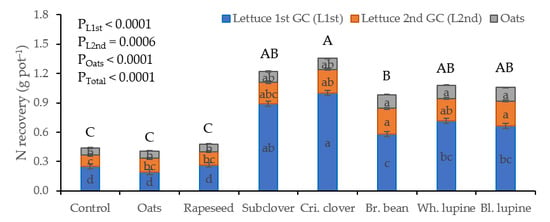
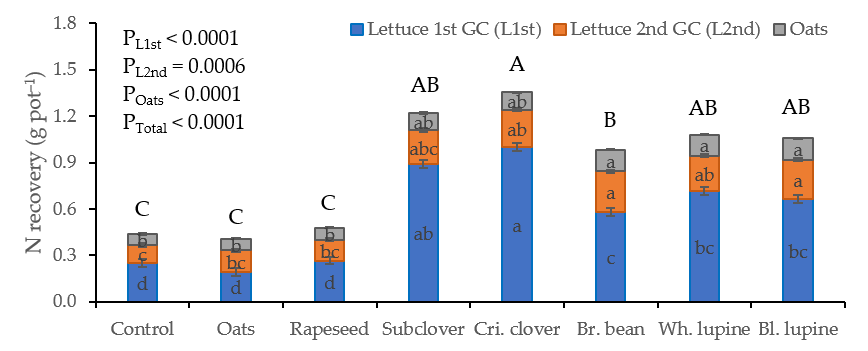
Total N recovered by the crop, which depends on both DMY and tissue nutrient concentration, provides a good indication of nutrient dynamics within the soil–plant system. N recovered in the aboveground biomass of crops grown following the cover crops differed significantly among treatments (Figure 4). Values in the control, oat, and rapeseed treatments did not differ significantly from each other but were significantly lower than those in the other treatments. Significant differences were also observed among the legume cover crops. Total N recovered by the lettuce–lettuce–oat sequence was significantly higher when these crops followed crimson clover compared to broad bean.
Figure 4.
Nitrogen recovered by lettuce during the first (1st) and second (2nd) growth cycles (GC) and in oat, depending on the different cover cropping strategies. For each crop (lowercase) and for the total cumulative DMY (uppercase), means followed by the same letter are not significantly different according to the Tukey HSD test (α = 0.05).
3.3. Soil Properties
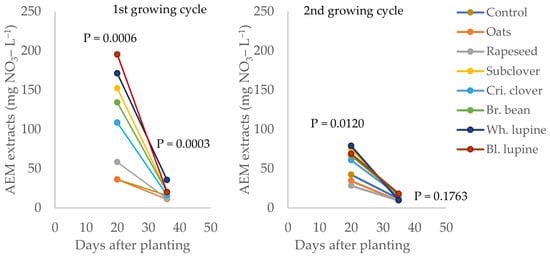
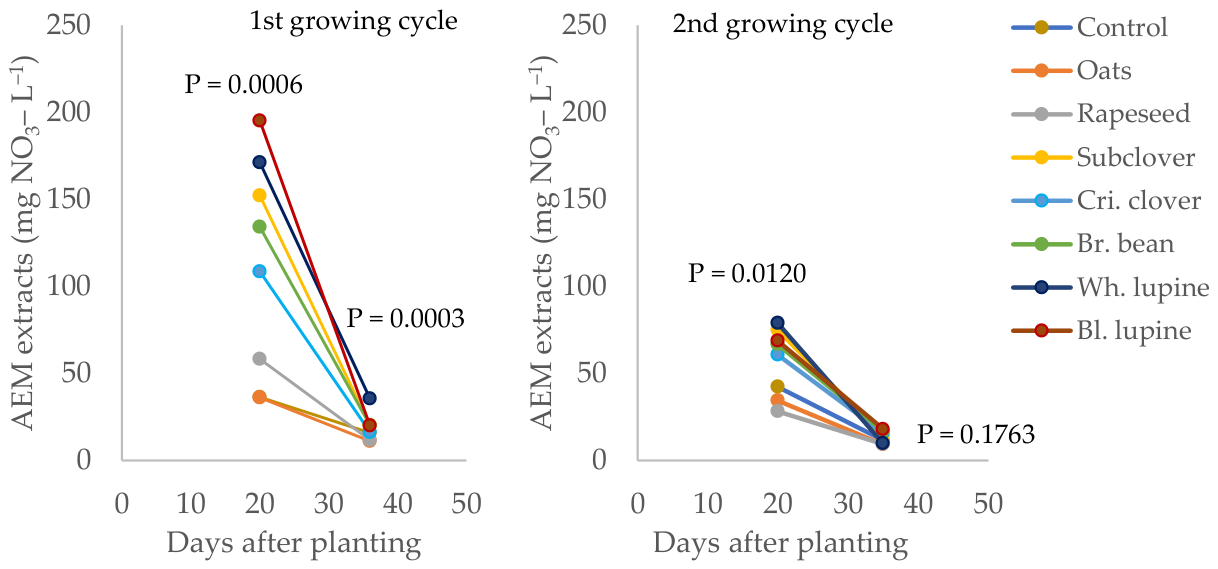
Nitrate concentration in extracts from anion-exchange membranes inserted into the soil during the first lettuce cropping cycle varied significantly among treatments at both sampling dates (Figure 5). Legume cover crops, particularly the lupins, exhibited the highest values. In the second lettuce cycle, significant differences among treatments were still observed at the first sampling, but not at the second. At this first sampling, values in the control, oat, and rapeseed treatments were significantly lower.
Figure 5.
Nitrate concentration in extracts from anion-exchange membranes at mid and end of the lettuce cropping cycles under different cover cropping strategies.
Soil organic C did not vary significantly among treatments (Table 8), with mean values ranging from 14.30 to 16.57 g kg−1. Non-legume cover crops tended to exhibit lower mean values. Soil pH varied significantly among treatments, with legume cover crops generally showing the lowest mean values. Extractable P also did not differ significantly across the different cover cropping strategies. The same was observed for exchangeable bases and CEC.
Table 8.
Soil organic carbon, pH, extractable phosphorus, and cation exchange capacity (CEC) at the end of the study under different cover cropping strategies.
4. Discussion
4.1. Performance of Cover Crops
The species used as cover crops in this study differed significantly in DMY, with legumes clearly outperforming non-legumes, although variability was also observed among the legume species themselves. Legumes also exhibited significantly higher N concentrations in plant tissues than non-legumes, with particularly striking differences in total aboveground N recovery. Moreover, the proportion of N derived from the atmosphere in legumes exceeded 96%, as estimated by the difference method. Nodulated legumes can access atmospheric N through symbiotic associations with N-fixing microorganisms [19]. N is generally a limiting factor in both natural and agricultural ecosystems, and most plant species respond positively to external N inputs [36,37]. This underpins the widespread inclusion of legumes in agroecosystems, whether as green manures [5,28], in crop rotations [20,38], or in intercropping systems [39,40].
In the present study, the large differences in DMY between legumes and non-legumes indicate a growth environment strongly limited in available N. This is further supported by the finding that more than 96% of the N in legumes was derived from the atmosphere, as estimated by the difference method. These values are particularly high, as values above 50% are generally considered elevated [41], although levels exceeding 70% have frequently been reported for species such as faba bean and white lupin [7,42].
The concentrations of P in plant tissues were generally lower in legumes than in rapeseed and oat, except for subterranean clover, which showed values comparable to those of non-legumes. However, P recovery in non-legumes remained low, largely due to their limited biomass production. Therefore, the lower P concentrations observed in legumes should not necessarily be interpreted as restricted access to soil P. Indeed, some legumes, such as white lupin, can access sparingly soluble P through adaptive strategies, including the formation of proteoid roots and the exudation of organic acids that enhance P mobilisation in the rhizosphere [24,25]. A plausible explanation is that greater N availability in legumes stimulated substantial biomass production, potentially diluting P concentrations in plant tissues. Dilution or concentration effects are well documented in situations where, under similar nutrient availability, differences in biomass accumulation arise from factors other than the supply of that nutrient [43,44]. The absence of increased P recovery in non-legumes is consistent with this interpretation. Moreover, several studies indicate that legumes can be physiologically efficient in P use, producing relatively high biomass despite low tissue P concentrations [45,46].
The grass species showed the lowest B concentrations, whereas rapeseed exhibited values comparable to those of legumes, which were generally high. Among legumes, white lupine and faba bean showed significantly lower B concentrations than the remaining species. However, due to its lower biomass production, rapeseed did not match legumes in total B uptake, with significantly lower values. Under equivalent soil B availability, dicot species typically exhibit higher B concentrations in their tissues. B is an essential micronutrient for plant development, playing a key role in the biosynthesis and structural integrity of cell walls. A significant proportion of B in plants is associated with cis-diol groups of pectins in cell walls [47,48]. This is particularly relevant in dicots, whose cell walls contain high levels of pectin (~30–35%), a feature associated with greater B requirements and accumulation [48,49]. In contrast, monocots have lower pectin content (~5–10%), with structural rigidity largely provided by silicon (Si), hemicellulose, and lignin, while Ca contributes locally where pectin is present [50,51]. The higher abundance of cis-diol compounds in dicot species may therefore contribute to greater B binding and accumulation in plant tissues, even under similar soil availability [48]. As dicots, legumes tend to accumulate higher levels of B [7,52].
Overall, the cover crops exhibited significant differences in tissue concentrations of most of the macro- and micronutrients analysed, except for Mg. This pattern broadly reflects the metabolic requirements of different botanical groups and their contrasting capacities for nutrient uptake [48,53], as previously discussed for P and B. In turn, these differences may influence nutrient cycling in the soil, with potential consequences for the subsequent crop’s performance.
4.2. Effects on Subsequent Cash Crops
The crops grown after the cover crops, here referred to as cash crops (lettuce–lettuce–oat), produced significantly greater biomass when cultivated in soils previously planted with legumes than in soils previously planted with oat, rapeseed, or the control treatment. At the end of the oat cycle, all legume-based cover crop treatments were associated with higher DMYs than both the control and non-legume treatments. Subsequent crops do not directly access atmospheric N; rather, their enhanced growth may be associated with the N fixed by legumes. This is the fundamental principle underlying the use of legume green manures, which have been widely studied as a means of supplying N to main crops [20,28,54]. Legumes fix atmospheric N, which is incorporated into their tissues (roots and shoots). When these residues are incorporated into the soil, their relatively high N content may promote rapid heterotrophic microbial mineralisation [55,56]. This may help explain the pronounced differences observed during the first lettuce cycle. Over time, N release is expected to decline according to decomposition dynamics, with faster turnover generally associated with residues richer in N [57,58]. Nevertheless, significant differences persisted up to the third cropping cycle.
Indices of plant N status, such as SPAD readings, tissue N concentration, and nitrate content, as well as indices of photosynthetic performance, such as chlorophyll fluorescence, were consistently higher in pots previously cultivated with legumes than in those with non-legumes or the control. In contrast, values in pots with non-legume cover crops did not differ significantly from the control. SPAD readings are widely used as an index of plant N status [59,60]. Increased N availability enhances chlorophyll content and leaf greenness, thereby increasing red-light absorption and resulting in higher SPAD values [61]. Plants primarily take up N from the soil as nitrate, which can accumulate in tissues when available in excess, a phenomenon often referred to as luxury consumption [3,53]. Lettuce is considered a nitrate hyperaccumulator [62,63], and regulatory frameworks restrict its commercialisation when nitrate concentrations exceed established thresholds [64,65]. Elevated N levels in plant tissues enhance photosynthetic performance, primarily because N is a key component of the carboxylation machinery, the electron transport chain, and light-harvesting complexes [36,66]. This is often reflected in higher Fv/Fm values [36,67], ultimately leading to increased DMY.
N recovery across the lettuce–lettuce–oat sequence was the most sensitive indicator for discriminating between the effects of cover crops. Crops grown after the control, oat, and rapeseed treatments showed no significant differences among these treatments. In contrast, all legume treatments resulted in significantly higher N recovery compared with both the control and non-legume treatments. Differences were also observed among legumes, with crops following faba bean showing significantly lower values than those following crimson clover. N recovery integrates both tissue N concentration and biomass production, making it a robust indicator of N supply to plants [68,69]. Non-legumes did not differ from the control, as neither provided additional N to subsequent crops. Among legumes, faba bean appeared to supply less N to the following crops than crimson clover. Although comparative studies using these two species as cover crops are lacking, faba bean is generally associated with high but variable N fixation [7,70], whereas clovers tend to exhibit low fixation rates [7,71]. In this case, however, the observed differences may reflect variation in N mineralisation rather than fixation. Lupin showed higher tissue N concentrations, which could indicate that a greater fraction of fixed N was rapidly mineralised, potentially enhancing short-term N availability. In general, short-term N mineralisation tends to increase with substrate N concentration [3,72].
For the other nutrients, differences in their concentrations in the tissues of the subsequent lettuce crop varied considerably. For some nutrients, a greater quantity accumulated in the cover-crop biomass was reflected in higher concentrations in lettuce tissues, whereas this was not the case for others. The clovers, for example, which accumulated large amounts of P and K in their tissues, were associated with higher concentrations of these nutrients in lettuce during the first cropping cycle. This further supports the notion that leguminous cover crops may provide benefits beyond N supply, an aspect that has been well documented, for example, in relation to P [23,73].
Mn, in particular, merits further consideration. Although Mn is an essential plant nutrient, it can also be associated with toxicity because its solubility in soil may increase substantially under acidic conditions [3]. White lupin accumulated tissue concentrations of Mn up to ten times higher than those observed in some of the other species, despite all species being grown in the same soil. This is consistent with its well-documented capacity for Mn hyperaccumulation [74,75]. The lower Mn concentrations observed in the other species may be related to mechanisms of Mn exclusion that limit its uptake [76,77], or to retention in roots, which restricts its translocation to the shoots [76,78]. Nevertheless, Mn concentrations in lettuce grown in pots previously cultivated with white lupin did not differ significantly from those recorded in lettuce grown in the other treatments. Thus, the greater Mn accumulation by white lupin was not associated with higher Mn concentrations in the subsequent lettuce crop and does not appear to constitute a drawback to its use as a cover crop.
4.3. Effects on Soil Properties
Nitrate concentrations measured using anion exchange membranes were significantly higher in soils previously cultivated with legumes than with non-legumes. However, values in the second lettuce cycle were lower than in the first. Anion-exchange membranes are widely used to monitor soil N dynamics under various conditions [69,79]. In this study, they confirmed increased nitrate availability in legume treatments and a stronger short-term effect, consistent with the rapid mineralisation of N-rich residues reported in previous studies [55,56].
Soil organic C did not differ significantly among treatments, although clovers generally showed higher mean values than the control, while some legumes, such as white lupin, also exhibited low values. Soil C content is influenced by inputs of photosynthetic products from plant tissues and, potentially, mycorrhizae [80,81,82]. Thus, systems with higher primary productivity tend to accumulate more soil organic C [83,84,85]. In this study, C inputs resulted from the full incorporation of cover crop biomass and the roots of subsequent crops. Despite differences in biomass production, final soil organic C levels did not differ significantly among treatments. This may reflect a balance between C inputs and losses through mineralisation [86,87], with treatments incorporating more biomass potentially also experiencing faster decomposition, thereby limiting net C accumulation.
Soil pH tended to be lower in legume than in non-legume treatments and the control. Soil acidification under cropping is often attributed to the export of basic cations [3,87]. Dicots tend to take up more divalent cations, as observed in Table 3, which may contribute to acidification [53]. However, in this study, no nutrient removal occurred, as cover crops were incorporated into the soil as green manures. Another important mechanism of acidification is nitrification, which generates excess H+ ions during the microbial conversion of NH4+ to NO3− [3,88]. In this context, the N inputs from legumes may have enhanced nitrification processes during residue mineralisation, potentially contributing to the observed soil acidification. Similar acidification effects have been reported for legume green manures [56,89] and for urea- and ammonium-based fertilisers, which undergo nitrification prior to plant uptake [90,91,92]. No significant effects were detected on other soil properties, including exchangeable bases and CEC.
5. Conclusions
The results of this study show that legume cover crops outperformed non-legume species in terms of biomass production and N accumulation, potentially reflecting their ability to fix atmospheric N. These findings support the hypothesis that legumes can produce greater biomass under N-limited conditions. Furthermore, differences among legume species highlight interspecific variability in their growth and N dynamics.
Legume-based cover crops enhanced the growth and N status of subsequent cash crops across the lettuce–lettuce–oat rotation. These benefits were particularly evident in the short term, but remained detectable over successive cropping cycles. In contrast, non-legume species did not differ significantly from the control in their effects on subsequent crops, indicating a limited contribution to crop growth and N status under the conditions of this experiment.
Cover crop species differed in their accumulation of macro- and micronutrients, and some of these differences were reflected in the nutrient status of the subsequent lettuce crop. However, greater nutrient accumulation by individual species did not necessarily translate into increased nutrient concentrations in the subsequent crop. Notably, despite white lupin’s high capacity for Mn accumulation, this did not result in higher Mn concentrations in lettuce. At the soil level, cover crop species also differed in their effects on soil properties. Legumes increased soil nitrate availability and N recovery, although they were also associated with a slight decrease in soil pH. These differences in nitrate availability and soil pH may partly reflect differences in N dynamics during residue decomposition, although N fixation and mineralisation were not directly measured.
Contrary to the initial hypothesis, non-legume species did not contribute to higher soil organic matter levels. The absence of significant differences among treatments suggests no detectable short-term effect on soil organic matter under the experimental conditions, although differences in biomass production and decomposition may have influenced this outcome; these processes were not directly assessed.
Finally, these findings should be interpreted in the context of the pot experiment. Root confinement, the limited, artificial soil volume, and irrigation conditions may have influenced plant growth and soil processes, thereby limiting the extrapolation of the results to field conditions. Further field studies are therefore needed to determine whether and to what extent these responses persist under practical cropping conditions.
Supplementary Materials
The following supporting information can be downloaded at https://www.mdpi.com/article/10.3390/horticulturae12111352/s1. Table S1. Micronutrient concentration in the aboveground biomass of cover crops. Table S2. Micronutrient recovery in the aboveground biomass of cover crops. Table S3. Micronutrient concentrations in lettuce dry matter during the first and second cycles under different cover-cropping strategies.
Author Contributions
Conceptualization, M.Â.R.; methodology, M.A.; investigation, P.A.; resources, M.Â.R. and M.A.; data curation, P.A. and M.Â.R.; writing—original draft preparation, P.A.; writing—review and editing, M.Â.R. and M.A.; supervision, M.Â.R.; project administration, M.Â.R.; funding acquisition, M.Â.R. and M.A. All authors have read and agreed to the published version of the manuscript.
Funding
This work was supported by national funds through FCT/MCTES (PIDDAC): CIMO UID/00690/2025 (10.54499/UID/00690/2025) and UID/PRR/00690/2025 (10.54499/UID/PRR/00690/2025); SusTEC, LA/P/0007/2020 (DOI: 10.54499/LA/P/0007/2020), and through the individual research grant PRT/BD/154361/2023 of Peltier Aguiar (DOI: 10.54499/PRT/BD/154361/2023).
Data Availability Statement
The original contributions presented in this study are included in the article/supplementary material. Further inquiries can be directed to the corresponding author.
Conflicts of Interest
The authors declare no conflicts of interest.
References
- Hussain, M.Z.; Robertson, P.; Basso, B.; Hamilton, S. Leaching losses of dissolved organic carbon and nitrogen from agricultural soils in the upper US Midwest. Sci. Total Environ. 2020, 734, 139379. [Google Scholar] [CrossRef] [Scilit]
- Crippa, M.; Solazzo, E.; Guizzardi, D.; Monforti-Ferrario, F.; Tubiello, F.N.; Leip, A. Food systems are responsible for a third of global anthropogenic GHG emissions. Nat. Food 2021, 2, 198–209. [Google Scholar] [CrossRef] [Scilit]
- Weil, R.R.; Brady, N.C. The Nature and Properties of Soils; Pearson Education Limited: Edinburgh, UK, 2017. [Google Scholar]
- FAO; IFAD; UNICEF; WFP; WHO. The State of Food Security and Nutrition in the World 2023. Urbanization. In Agrifood Systems Transformation and Healthy Diets Across the Rural–Urban Continuum; FAO: Rome, Italy, 2023. [Google Scholar] [CrossRef] [Scilit]
- Moisés, C.; Arrobas, M.; Tsitos, D.; Pinho, D.; Rezende, R.F.; Rodrigues, M.Â. Regenerative agriculture: Insights and challenges in farmer adoption. Sustainability 2025, 17, 7235. [Google Scholar] [CrossRef] [Scilit]
- Gajewski, P.; Majchrzak, L.; Bocianowski, J.; Kaczmarek, Z. Effects of cover crops and tillage methods on selected physical and water retention properties of Luvisol. Int. Agrophys. 2025, 39, 73–86. [Google Scholar] [CrossRef] [Scilit]
- Aguiar, P.; Arrobas, M.; Nharreluga, E.A.; Rodrigues, M.Â. Different species and cultivars of broad beans, lupins, and clovers demonstrated varying environmental adaptability and nitrogen fixation potential when cultivated as green manures in Northeastern Portugal. Sustainability 2024, 16, 10725. [Google Scholar] [CrossRef] [Scilit]
- Kucerik, J.; Brtnicky, M.; Mustafa, A.; Hammerschmiedt, T.; Kintl, A.; Sobotkova, J.; Alamri, S.; Baltazar, T.; Latal, O.; Naveed, M.; et al. Utilization of diversified cover crops as green manure-enhanced soil organic carbon, nutrient transformation, microbial activity, and maize growth. Agronomy 2024, 14, 2001. [Google Scholar] [CrossRef] [Scilit]
- Hauggaard-Nielsen, H.; Mundus, S.; Jensen, E.S. Nitrogen dynamics following grain legumes and subsequent catch crops and the effects on succeeding cereal crops. Nutr. Cycl. Agroecosyst. 2009, 84, 281–291. [Google Scholar] [CrossRef] [Scilit]
- Żarczyński, P.J.; Krzebietke, S.J.; Sienkiewicz, S.; Wierzbowska, J. The role of fallows in sustainable development. Agriculture 2023, 13, 2174. [Google Scholar] [CrossRef] [Scilit]
- Vaziritabar, Y.; Frei, M.; Yan, F.; Vaziritabar, Y.; Honermeier, B. Enhancing nitrogen use efficiency and plant productivity in long-term precrop/crop rotation and fertilization management. Field Crops Res. 2024, 306, 109210. [Google Scholar] [CrossRef] [Scilit]
- Böldt, M.; Taube, F.; Vogeler, I.; Reinsch, T.; Kluß, C.; Loges, R. Evaluating different catch crop strategies for closing the nitrogen cycle in cropping systems—Field experiments and modelling. Sustainability 2021, 13, 394. [Google Scholar] [CrossRef] [Scilit]
- Auzins, A.; Leimane, I.; Krievina, A.; Morozova, I.; Miglavs, A.; Lakovskis, P. Evaluation of environmental and economic performance of crop production in relation to crop rotation, catch crops, and tillage. Agriculture 2023, 13, 1539. [Google Scholar] [CrossRef] [Scilit]
- De Baets, S.; Poesen, J.; Meersmans, J.; Serlet, L. Cover crops and their erosion-reducing effects during concentrated flow erosion. Catena 2011, 85, 237–244. [Google Scholar] [CrossRef] [Scilit]
- Gongora, V.R.M.; Secco, D.; Bassegio, D.; de Marins, A.C.; Chang, P.; Savioli, M.R. Impact of cover crops on soil physical properties, soil loss, and runoff in compacted Oxisol of southern Brazil. Geoderma Reg. 2022, 31, e00577. [Google Scholar] [CrossRef] [Scilit]
- Delandmeter, M.; de Faccio Carvalho, P.C.; Bremm, C.; dos Santos Cargnelutti, C.; Bindelle, J.; Dumont, B. Integrated crop and livestock systems increase both climate change adaptation and mitigation capacities. Sci. Total Environ. 2024, 912, 169061. [Google Scholar] [CrossRef] [Scilit]
- Soares, S.; Souza, W.; Homem, B.; Ramalho, I.; Borré, J.; Pereira, M.; Pinheiro, É.; Marchao, R.; Alves, B.; Boddey, R.; et al. The use of integrated crop–livestock systems as a strategy to improve soil organic matter in the Brazilian Cerrado. Agronomy 2024, 14, 2547. [Google Scholar] [CrossRef] [Scilit]
- Petukhov, A.N.; Atlaskin, A.A.; Smorodin, K.A.; Kryuchkov, S.S.; Zarubin, D.M.; Atlaskina, M.E.; Petukhova, A.N.; Stepakova, A.N.; Golovacheva, A.A.; Markov, A.N.; et al. An efficient technique for ammonia capture in the haber–bosch process loop-membrane-assisted gas absorption. Polymers 2022, 14, 2214. [Google Scholar] [CrossRef] [Scilit]
- Hungria, M.; Nogueira, M.A. Nitrogen fixation. In Marschner’s Mineral Nutrition of Plants, 4th ed.; Rengel, Z., Cakmak, I., White, P.J., Eds.; Elsevier: Chennai, India, 2023; pp. 615–650. [Google Scholar] [CrossRef] [Scilit]
- Mesfin, S.; Gebresamuel, G.; Haile, M.; Zenebe, A. Potentials of legumes rotation on yield and nitrogen uptake of sub-sequent wheat crop in northern Ethiopia. Heliyon 2023, 9, e16126. [Google Scholar] [CrossRef] [Scilit]
- Feng, Y.; Chen, H.; Fu, L.; Yin, M.; Wang, Z.; Li, Y.; Cao, W. Green manuring enhances soil multifunctionality in tobacco field in Southwest China. Microorganisms 2024, 12, 949. [Google Scholar] [CrossRef] [Scilit]
- Tang, X.; Zhang, C.; Yu, Y.; Shen, J.; van der Werf, W.; Zhang, F. Intercropping legumes and cereals increases phosphorus use efficiency: A meta-analysis. Plant Soil 2021, 460, 89–104. [Google Scholar] [CrossRef] [Scilit]
- Aguiar, P.; Arrobas, M.; Aguiar, C.; Rodrigues, N.; Jongen, M.; Teixeira, R.F.M.; Domingos, T.; Rodrigues, M.Â. Liming alone is not enough: The role of phosphorus and boron in supporting legume pasture growth. Agron. Res. 2025, 23, 1417–1435. [Google Scholar] [CrossRef]
- Buoso, S.; Zamboni, A.; Franco, A.; Commisso, M.; Guzzo, F.; Varanini, Z.; Pinton, R.; Tomasi, N.; Zanin, L. Nodulating white lupins take advantage of the reciprocal interplay between N and P nutritional responses. Physiol. Plant. 2022, 174, 13607. [Google Scholar] [CrossRef] [Scilit]
- Lambers, H. Phosphorus acquisition and utilization in plants. Annu. Rev. Plant Biol. 2022, 73, 17–42. [Google Scholar] [CrossRef] [Scilit]
- El-Remaly, E.; Osman, A.; El-Gawad, H.A.; Althobaiti, F.; Albogami, S.M.; Dessoky, E.; El-Mogy, M. Bio-management of root-knot nematodes on cucumber using biocidal effects of some Brassicaceae crops. Horticulturae 2022, 8, 699. [Google Scholar] [CrossRef] [Scilit]
- Dong, F.; Zeng, W. Effects of fall and winter cover crops on weed suppression in the United States: A meta-analysis. Sustainability 2024, 16, 3192. [Google Scholar] [CrossRef] [Scilit]
- Raimundo, S.; Arrobas, M.; Ribeiro, A.C.; Rodrigues, M.Â. White lupin and hairy vetch as green manures: Impacts on yield and nutrient cycling in an organic almond orchard. Agronomy 2025, 15, 1974. [Google Scholar] [CrossRef] [Scilit]
- Ma, J.; Yin, B.; Gao, T.; He, K.; Huang, X.; Jiang, T.; Zhen, W. Legume–non-legume cover crop mixtures enhance soil nutrient availability and physical properties: A meta-analysis across Chinese agroecosystems. Agronomy 2025, 15, 1756. [Google Scholar] [CrossRef] [Scilit]
- IPMA (Instituto Português do Mar e da Atmosfera). Normais Climatológicas. Available online: http://www.ipma.pt/pt/oclima/normais.clima/ (accessed on 26 August 2026). (In Portuguese)
- IUSS Working Group WRB. World Reference Base for Soil Resources: International Soil Classification System for Naming Soils and Creating Legends for Soil Maps, 4th ed.; International Union of Soil Sciences (IUSS): Vienna, Austria, 2022; p. 38. [Google Scholar]
- Meier, U. Growth Stages of Mono- and Dicotyledonous Plants; Federal Biological Research Centre for Agriculture and Forestry: Berlin, Germany, 2018. [Google Scholar]
- Van Reeuwijk, L.P. Procedures for Soil Analysis, 6th ed.; Technical Paper, 9; ISRIC: Wageningen, The Netherlands; FAO: Rome, Italy, 2002; ISBN 90-6672-044-1. [Google Scholar]
- Temminghoff, E.E.; Houba, V.J. (Eds.) Plant Analysis Procedures, 2nd ed.; Kluwer Academic Publishers: London, UK, 2004. [Google Scholar] [CrossRef] [Scilit]
- Unkovich, M.; Herridge, D.; Peoples, M.; Cadisch, G.; Boddey, B.; Giller, K.; Alves, B.; Chalk, P. Measuring Plant-Associated Nitrogen Fixation in Agricultural Systems; ACIAR Monograph No. 136; Centre for International Agricultural Research: Canberra, Australia, 2008. [Google Scholar]
- Guo, P.J.; Ren, X.; Shi, A.; Xu, P.; Zhang, F.; Guo, Y.; Feng, X.; Zhao, X.; Yu, H.; Jiang, C. Optimized nitrogen application ameliorates the photosynthetic performance and yield potential in peanuts as revealed by OJIP chlorophyll fluorescence kinetics. BMC Plant Biol. 2024, 24, 774. [Google Scholar] [CrossRef] [Scilit]
- Xu, Y.; Gao, Q.; Xue, L.; Zhang, J.; Wang, C. Optimized nitrogen fertilizer management enhances soybean (Glycine max (L.) Merril.) yield and nitrogen use efficiency by promoting symbiotic nitrogen fixation capacity. Front. Plant Sci. 2025, 16, 1604251. [Google Scholar] [CrossRef] [Scilit]
- Uzoh, I.M.; Igwe, C.A.; Okebalama, C.B.; Babalola, O. Legume-maize rotation effect on maize productivity and soil fertility parameters under selected agronomic practices in a sandy loam soil. Sci. Rep. 2019, 9, 8539. [Google Scholar] [CrossRef] [Scilit]
- Ton, A. Advantages of grain legume-cereal intercropping in sustainable agriculture. Turk. J. Agric. Food Sci. Technol. 2021, 9, 1560–1566. [Google Scholar] [CrossRef] [Scilit]
- Dimande, P.; Arrobas, M.; Rodrigues, M.Â. Intercropped maize and cowpea increased the land equivalent ratio and enhanced crop access to more nitrogen and phosphorus compared to cultivation as sole crops. Sustainability 2024, 16, 1440. [Google Scholar] [CrossRef] [Scilit]
- Andrews, M.; James, E.; Sprent, J.; Boddey, R.; Gross, E.; Reis, F.B., Jr.; Agrobiologia, E. Nitrogen fixation in legumes and actinorhizal plants in natural ecosystems: Values obtained using 15N natural abundance. Plant Ecol. Divers. 2011, 4, 131–140. [Google Scholar] [CrossRef] [Scilit]
- Palmero, F.; Fernandez, J.A.; Garcia, F.O.; Haro, R.J.; Prasad, P.V.V.; Salvagiotti, F.; Ciampitti, I.A. A quantitative review into the contributions of biological nitrogen fixation to agricultural systems by grain legumes. Eur. J. Agron. 2022, 136, 126514. [Google Scholar] [CrossRef] [Scilit]
- Bell, R. Diagnosis and prediction of deficiency and toxicity of nutrients. In Marschner’s Mineral Nutrition of Plants, 4th ed.; Rengel, Z., Cakmak, I., White, P.J., Eds.; Elsevier: Chennai, India, 2023; pp. 477–495. [Google Scholar] [CrossRef] [Scilit]
- Thurner, M.; Yu, K.; Manzoni, S.; Prokushkin, A.; Thurner, M.A.; Wang, Z.; Hickler, T. Nitrogen concentrations in boreal and temperate tree tissues vary with tree age/size, growth rate, and climate. Biogeosciences 2025, 22, 1475–1493. [Google Scholar] [CrossRef] [Scilit]
- Veneklaas, E.; Lambers, H.; Bragg, J.; Finnegan, P.; Lovelock, C.; Plaxton, W.; Price, C.; Scheible, W.; Shane, M.; White, P.; et al. Opportunities for improving phosphorus-use efficiency in crop plants. New Phytol. 2012, 195, 306–320. [Google Scholar] [CrossRef] [Scilit]
- Lambers, H.; Britto Costa, P.; Cawthray, G.R.; Denton, M.D.; Finnegan, P.M.; Hayes, P.E.; Oliveira, R.S.; Power, S.C.; Ranathunge, K.; Shen, Q.; et al. Strategies to acquire and use phosphorus in phosphorus-impoverished and fire-prone environments. Plant Soil 2022, 476, 133–160. [Google Scholar] [CrossRef] [Scilit]
- Behera, B.; Kancheti, M.; Raza, M.B.; Shiv, A.; Mangal, V.; Rathod, G.; Altaf, M.A.; Kumar, A.; Aftab, T.; Kumar, R.; et al. Mechanistic insight on boron-mediated toxicity in plants vis-à-vis its mitigation strategies: A review. Int. J. Phytoremediat. 2023, 25, 9–26. [Google Scholar] [CrossRef] [Scilit]
- Cakmak, I.; Brown, P.; Colmenero-Flores, J.M.; Husted, S.; Kutman, B.Y.; Nikolic, M.; Rengel, Z.; Schmidt, S.B.; Zhao, F.J. Micronutrients. In Marschner’s Mineral Nutrition of Plants, 4th ed.; Rengel, Z., Cakmak, I., White, P.J., Eds.; Elsevier: Chennai, India, 2023; p. 283. [Google Scholar] [CrossRef] [Scilit]
- Wimmer, M.A.; Eichert, T. Review: Mechanisms for boron deficiency-mediated changes in plant water relations. Plant Sci. 2013, 203–204, 25–32. [Google Scholar] [CrossRef] [Scilit]
- Mohnen, D. Pectin structure and biosynthesis. Curr. Opin. Plant. Biol. 2008, 11, 266–277. [Google Scholar] [CrossRef] [Scilit]
- Kumar, S.; Soukup, M.; Elbaum, R. Silicification in Grasses: Variation between Different Cell Types. Front. Plant Sci. 2017, 8, 438. [Google Scholar] [CrossRef] [Scilit]
- Bryson, G.; Mills, H.A.; Sasseville, D.N.; Jones, J.B., Jr.; Barker, A.V. Plant Analysis Handbook III: A Guide to Sampling, Preparation, Analysis and Interpretation for Agronomic and Horticultural Crops, 3rd ed.; Micro-Macro Publishing: Athens, GA, USA, 2014. [Google Scholar]
- Hawkesford, M.J.; Cakmak, I.; Coskun, D.; De Kok, L.J.; Lambers, H.; Schjoerring, J.K.; White, P.J. Functions of macronutrients. In Marschner’s Mineral Nutrition of Plants, 4th ed.; Rengel, Z., Cakmak, I., White, P.J., Eds.; Elsevier, Ltd.: Chennai, India, 2023; pp. 201–281. [Google Scholar] [CrossRef] [Scilit]
- Rodrigues, M.Â.; Arrobas, M. Cover cropping for increasing fruit production and farming sustainability. In Fruit Crops; Srivastava, A.K., Hu, C., Eds.; Elsevier: Amsterdam, The Netherlands, 2020; pp. 279–295. ISBN 978-0-12-818732-6. [Google Scholar]
- Gardner, M.J.; Condon, J.R.; Dear, B.S.; Conyers, M.K.; Newell, M.T.; Hayes, R.C.; Li, G.D. Nitrogen mineralisation rates from chicory-based pastures. Eur. J. Agron. 2024, 155, 127116. [Google Scholar] [CrossRef] [Scilit]
- Liu, W.; He, C.; Han, S.W.; Lin, B.; Dang, Y.P.; Zhao, X.; Zhang, H. Enhancing soil ecosystem multifunctionality through combined conservation tillage and legume-based crop rotation in the North China Plain. Agric. Ecosyst. Environ. 2025, 379, 109355. [Google Scholar] [CrossRef] [Scilit]
- Lazicki, P.; Geisseler, D.; Lloyd, M. Nitrogen mineralisation from organic amendments is variable but predictable. J. Environ. Qual. 2020, 49, 483–495. [Google Scholar] [CrossRef] [Scilit]
- Geisseler, D.; Smith, R.; Cahn, M.; Muramoto, J. Nitrogen mineralization from organic fertilizers and composts: Literature survey and model fitting. J. Environ. Qual. 2021, 50, 1325–1338. [Google Scholar] [CrossRef] [Scilit]
- Wicharuck, S.; Suang, S.; Chaichana, C.; Chromkaew, Y.; Mawan, N.; Soilueang, P.; Khongdee, N. The implementation of the SPAD-502 Chlorophyll meter for the quantification of nitrogen content in Arabica coffee leaves. MethodsX 2024, 12, 102566. [Google Scholar] [CrossRef] [Scilit]
- Shivashankar, K.; Potdar, M.P.; Gawdiya, S.; Golshetti, A.; Kanade, A.K.; Balol, G.; Biradar, D.P.; Math, K.K.; Al-Ansari, N.; El-Hendawy, S.; et al. SPAD dynamics in maize crop with precision nitrogen management under rain-fed and irrigated conditions. Sci. Rep. 2025, 15, 22842. [Google Scholar] [CrossRef] [Scilit]
- Opti-Sciences. Desktop Plant Stress Guide, 3rd ed.; Opti-Sciences: Hudson, WI, USA, 2014; Available online: https://www.optisci.com/assets/basic_plant_stress_guide.pdf (accessed on 15 April 2022).
- Tabaglio, V.; Boselli, R.; Fiorini, A.; Ganimede, C.; Beccari, P.; Santelli, S.; Nervo, G. Reducing nitrate accumulation and fertilizer use in lettuce with modified intermittent nutrient film technique (NFT) system. Agronomy 2020, 10, 1208. [Google Scholar] [CrossRef] [Scilit]
- Abd–Elrahman, S.H.; Saudy, H.S.; El-Fattah, D.A.A.; Hashem, F. Effect of irrigation water and organic fertilizer on reducing nitrate accumulation and boosting lettuce productivity. J. Soil. Sci. Plant Nutr. 2022, 22, 2144–2155. [Google Scholar] [CrossRef] [Scilit]
- FSA; Food Standards Agency. Nitrate Surveillance: Summary; Food Standards Agency: York, UK, 2022. [Google Scholar] [CrossRef] [Scilit]
- European Commission. Commission Regulation (EU) 2023/915 of 25 April 2023 on maximum levels for certain contaminants in food and repealing Regulation (EC) No. 1881/2006. Off. J. Eur. Union 2023, L 119, 103–157. [Google Scholar]
- Li, K.; Liu, D.N.; Li, L.Y.; Gao, Y.; Gao, W.-J.; Chen, B.-W.; Luo, F.; Yao, Y. Effects of nitrogen application amount on nitrogen distribution and photosynthesis in tea leaves. Front. Plant Sci. 2025, 16, 1575317. [Google Scholar] [CrossRef] [Scilit]
- Ferreira, I.Q.; Arrobas, M.; Moutinho-Pereira, J.M.; Correia, C.M.; Rodrigues, M.A. The effect of nitrogen applications on the growth of young olive trees and nitrogen use efficiency. Turk. J. Agric. For. 2020, 44, 278–289. [Google Scholar] [CrossRef] [Scilit]
- Rodrigues, M.Â.; Sawimbo, A.; da Silva, J.M.; Correia, C.M.; Arrobas, M. Sewage sludge increased lettuce yields by releasing valuable nutrients while keeping heavy metals in soil and plants at levels well below international legislative limits. Horticulturae 2024, 10, 706. [Google Scholar] [CrossRef] [Scilit]
- Dimande, P.; Arrobas, M.; Rodrigues, M.Â. Sewage sludge provided nitrogen to maize (Zea mays L.) very rapidly, demonstrating a high short-term net mineralization rate. J. Soil. Sci. Plant Nutr. 2025, 25, 7139–7151. [Google Scholar] [CrossRef] [Scilit]
- De Notaris, C.; Enggrob, E.E.; Olesen, J.E.; Sørensen, P.; Rasmussen, J. Faba bean productivity, yield stability and N2-fixation in long-term organic and conventional crop rotations. Field Crops Res. 2023, 295, 108894. [Google Scholar] [CrossRef] [Scilit]
- Dhamala, N.R.; Eriksen, J.; Carlsson, G.; Søegaard, K.; Rasmussen, J. Highly productive forage legume stands show no positive biodiversity effect on yield and N2-fixation. Plant Soil 2017, 417, 169–182. [Google Scholar] [CrossRef] [Scilit]
- Gomes, A.; Gutierrez, D.; Castaneda, S.; Brennan, E.; Smith, R.; Fendorf, S. Nitrogen mineralization of cover crop residue depends on carbon-to-nitrogen ratio and soil temperature. J. Environ. Qual. 2026, 55, e70107. [Google Scholar] [CrossRef] [Scilit]
- Chen, Z.; Wang, X.; Huang, S.-B.; Munz, S.; Graeff-Hönninger, S.; Hartung, J.; Liang, X.-G.; Shen, S.; Zhou, S.L. Legume-based rotation increases soil phosphorus availability and enhances subsequent crop yields. Eur. J. Agron. 2025, 170, 127707. [Google Scholar] [CrossRef] [Scilit]
- Blamey, F.P.C.; Hernandez-Soriano, M.C.; Cheng, M.; Tang, C.; Paterson, D.J.; Lombi, E.; Wang, W.H.; Scheckel, K.G.; Kopittke, P.M. Synchrotron-based techniques shed light on mechanisms of plant sensitivity and tolerance to high manganese in the root environment. Plant Physiol. 2015, 169, 2006–2020. [Google Scholar] [CrossRef] [Scilit]
- Olt, P.; Alejandro-Martinez, S.; Fermum, J.; Ramos, E.; Peiter, E.; Ludewig, U. The vacuolar transporter LaMTP8.1 detoxifies manganese in leaves of Lupinus albus. Physiol. Plant. 2022, 174, e13807. [Google Scholar] [CrossRef] [Scilit]
- Alejandro, S.; Höller, S.; Meier, B.; Peiter, E. Manganese in plants: From acquisition to subcellular allocation. Front. Plant Sci. 2020, 11, 300. [Google Scholar] [CrossRef] [Scilit]
- Zheng, Z.C.; Chen, H.H.; Yang, H.; Shen, Q.; Chen, X.F.; Huang, W.L.; Yang, L.T.; Guo, J.; Chen, L.S. Citrus sinensis manganese tolerance: Insight from manganese-stimulated secretion of root exudates and rhizosphere alkalization. Plant. Physiol. Biochem. 2024, 206, 108318. [Google Scholar] [CrossRef] [Scilit]
- Li, J.; Jia, Y.; Dong, R.; Huang, R.; Liu, P.; Li, X.; Wang, Z.; Liu, G.; Chen, Z. Advances in the mechanisms of plant tolerance to manganese toxicity. Int. J. Mol. Sci. 2019, 20, 5096. [Google Scholar] [CrossRef] [Scilit]
- Castro, L.L.; Whalen, J.K. Ion exchange membranes are sensitive indicators of ammonium and nitrate released from green manures with low C/N ratios. Eur. J. Soil Biol. 2016, 77, 4–8. [Google Scholar] [CrossRef] [Scilit]
- Silva, E.; Arrobas, M.; Gonçalves, A.; Martins, S.; Raimundo, S.; Pinto, L.; Brito, C.; Moutinho-Pereira, J.; Correia, C.M.; Rodrigues, M.Â. A controlled-release fertilizer improved soil fertility but not olive tree performance. Nutr. Cycl. Agroecosys. 2021, 120, 1–15. [Google Scholar] [CrossRef] [Scilit]
- Balík, J.; Suran, P.; Sedlář, O.; Kulhánek, M.; Procházková, S.; Asrade, D.A.; Smatanová, M. The effect of long-term farmyard manure and mineral fertilizer application on the increase in soil organic matter quality of cambisols. Agronomy 2023, 13, 2960. [Google Scholar] [CrossRef] [Scilit]
- Aluoch, S.O.; Raseduzzaman, M.; Li, X.; Li, Z.; Bizimana, F.; Yawen, Z.; Mosongo, P.S.; Mburu, D.M.; Waweru, G.; Dong, W.; et al. Combined mineral and organic fertilizer application enhances soil organic carbon and maize yield in semi-arid Kenya: A DNDC model-based prediction. Agronomy 2025, 15, 346. [Google Scholar] [CrossRef] [Scilit]
- Oldfield, E.E.; Bradford, M.A.; Wood, S.A. Global meta-analysis of the relationship between soil organic matter and crop yields. Soil 2019, 5, 15–32. [Google Scholar] [CrossRef] [Scilit]
- Chen, X.; Chen, S.; Arthur, M.A.; McCulley, R.L.; Liu, X.; Xiong, D.; Xu, C.; Yang, Z.; Yang, Y. Primary productivity regulates rhizosphere soil organic carbon: Evidence from a chronosequence of subtropical Chinese fir (Cunninghamia lanceolata) plantation. Sci. Total Environ. 2024, 955, 177082. [Google Scholar] [CrossRef] [Scilit]
- Salisu, M.A.; Ampim, P.A.Y.; Oyebamiji, Y.O.; Kotochi, A.B.A.; Imoro, M.M. Cover crops enhance soil organic carbon and soil quality for sustainable crop yield: A systematic review. Agronomy 2025, 15, 2865. [Google Scholar] [CrossRef] [Scilit]
- Ågren, G.I.; Hyvönen, R.; Berglund, S.L.; Hobbie, S.E. Estimating the critical N: C from litter decomposition data and its relation to soil organic matter stoichiometry. Soil Biol. Biochem. 2013, 67, 312–318. [Google Scholar] [CrossRef] [Scilit]
- Li, J.; Ren, T.; Li, Y.; Chen, N.; Yin, Q.; Li, M.; Liu, H.; Liu, G. Organic materials with high C/N ratio: More beneficial to soil improvement and soil health. Biotechnol. Lett. 2022, 44, 1415–1429. [Google Scholar] [CrossRef] [Scilit]
- Neumann, G.; Ludewig, U.; Neumann, G.; Ludewig, U. Rhizosphere chemistry influencing plant nutrition. In Marschner’s Mineral Nutrition of Plants, 4th ed.; Rengel, Z., Cakmak, I., White, P.J., Eds.; Academic Press: Chennai, India, 2023; pp. 545–585. [Google Scholar] [CrossRef] [Scilit]
- Zhong, J.; Li, Z.; Tang, H.; Dong, W.; Wei, C.; He, T. The application of varying amount of green manure combined with nitrogen fertilizer altered the soil bacterial community and rice yield in karst paddy areas. BMC Plant Biol. 2024, 24, 646. [Google Scholar] [CrossRef] [Scilit]
- Zhang, L.; Zhao, Z.; Jiang, B.; Baoyin, B.; Cui, Z.; Wang, H.; Li, Q.; Cui, J. Effects of long-term application of nitrogen fertilizer on soil acidification and biological properties in China: A meta-analysis. Microorganisms 2024, 12, 1683. [Google Scholar] [CrossRef] [Scilit]
- Tao, J.; Fan, L.; Jiang, T.; Song, X.; Zhao, M.; Zhou, J.; Kuzyakov, Y.; Zamanian, K. In situ visualisation of soil profile acidification and processes following nitrogen fertilisation and liming. Geoderma 2025, 456, 117243. [Google Scholar] [CrossRef] [Scilit]
- Hua, W.; Niu, S.; Zhao, C.; Wang, J.; Yang, X.; Shi, Y.; Ni, K. Contrasting Responses of N2O Mitigation to Different Nitrification Inhibitors in Tea Plantation Soils. Horticulturae 2025, 11, 1470. [Google Scholar] [CrossRef] [Scilit]

Disclaimer/Publisher’s Note: The statements, opinions and data contained in all publications are solely those of the individual author(s) and contributor(s) and not of MDPI and/or the editor(s). MDPI and/or the editor(s) disclaim responsibility for any injury to people or property resulting from any ideas, methods, instructions or products referred to in the content. |
© 2026 by the authors. Licensee MDPI, Basel, Switzerland. This article is an open access article distributed under the terms and conditions of the Creative Commons Attribution (CC BY) license.