

You are currently viewing a new version of our website. To view the old version click .

Fermentation, Volume 3, Issue 2

June 2017 - 16 articles

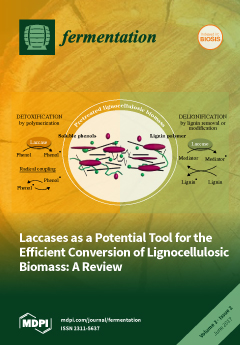
Cover Story: In the modern biorefinery concept, laccases constitute a potential tool for the complete utilization of lignocellulosic biomass in new value-added products and fuels. Laccases and laccase-mediator systems are effective in oxidative modification and/or partial depolymerization of lignin, increasing the hydrolysis yields of pretreated materials. Laccases can also remove selectively lignin-derived phenols released from biomass pretreatment, diminishing the impact of these inhibitors on the subsequent saccharification and fermentation stages. This review compiles the latest studies about the application of laccases as useful and environmentally friendly delignification and detoxification technologies, highlighting the main challenges and ways to make these technologies a reality for the lignocellulose-based industry. View this paper
  • Issues are regarded as officially published after their release is announced to the table of contents alert mailing list .
  • You may sign up for email alerts to receive table of contents of newly released issues.
  • PDF is the official format for papers published in both, html and pdf forms. To view the papers in pdf format, click on the "PDF Full-text" link, and use the free Adobe Reader to open them.

Articles (16)

  • Feature Paper
  • Review
  • Open Access
150 Citations
33,779 Views
26 Pages

Biomass and other carbonaceous materials can be gasified to produce syngas with high concentrations of CO and H2. Feedstock materials include wood, dedicated energy crops, grain wastes, manufacturing or municipal wastes, natural gas, petroleum and ch...

  • Feature Paper
  • Article
  • Open Access
22 Citations
8,318 Views
18 Pages

In fermentations of lignocelluloses, redox potentials (If not indicated otherwise, redox potentials in Volt are taken versus Normal Hydrogen Reference Electrodes (NHE).) E0 of laccases/plant peroxidases by 0.79/0.95 V enable oxidations of phenolic su...

  • Feature Paper
  • Review
  • Open Access
214 Citations
36,765 Views
14 Pages

Succinic Acid: Technology Development and Commercialization

  • Nhuan P. Nghiem,
  • Susanne Kleff and
  • Stefan Schwegmann

Succinic acid is a precursor of many important, large-volume industrial chemicals and consumer products. It was once common knowledge that many ruminant microorganisms accumulated succinic acid under anaerobic conditions. However, it was not until th...

  • Article
  • Open Access
29 Citations
21,173 Views
12 Pages

Amylase Production from Thermophilic Bacillus sp. BCC 021-50 Isolated from a Marine Environment

  • Altaf Ahmed Simair,
  • Imrana Khushk,
  • Abdul Sattar Qureshi,
  • Muhammad Aqeel Bhutto,
  • Haider Ali Chaudhry,
  • Khalil Ahmed Ansari and
  • Changrui Lu

The high cost of fermentation media is one of the technical barriers in amylase production from microbial sources. Amylase is used in several industrial processes or industries, for example, in the food industry, the saccharification of starchy mater...

  • Article
  • Open Access
37 Citations
16,246 Views
8 Pages

Alcoholic fermentations were performed, adapting the technology to exploit the residual thermal energy (hot water at 83–85 °C) of a cogeneration plant and to valorize agricultural wastes. Substrates were apple, kiwifruit, and peaches wastes; and corn...

  • Article
  • Open Access
53 Citations
10,803 Views
13 Pages

A trickle-bed reactor (TBR) when operated in a trickle flow regime reduces liquid resistance to mass transfer because a very thin liquid film is in contact with the gas phase and results in improved gas–liquid mass transfer compared to continuous sti...

  • Feature Paper
  • Review
  • Open Access
97 Citations
17,626 Views
25 Pages

Carboxylic acids are traditionally produced from fossil fuels and have significant applications in the chemical, pharmaceutical, food, and fuel industries. Significant progress has been made in replacing such fossil fuel sources used for production o...

  • Feature Paper
  • Review
  • Open Access
227 Citations
50,972 Views
20 Pages

Microbial Propionic Acid Production

  • R. Axayacatl Gonzalez-Garcia,
  • Tim McCubbin,
  • Laura Navone,
  • Chris Stowers,
  • Lars K. Nielsen and
  • Esteban Marcellin

Propionic acid (propionate) is a commercially valuable carboxylic acid produced through microbial fermentation. Propionic acid is mainly used in the food industry but has recently found applications in the cosmetic, plastics and pharmaceutical indust...

  • Article
  • Open Access
18 Citations
5,798 Views
11 Pages

Valorization of a Pulp Industry By-Product through the Production of Short-Chain Organic Acids

  • Diogo Queirós,
  • Rita Sousa,
  • Susana Pereira and
  • Luísa S. Serafim

In this work, hardwood sulfite spent liquor (HSSL)—a by-product from a pulp and paper industry—was used as substrate to produce short-chain organic acids (SCOAs) through acidogenic fermentation. SCOAs have a broad range of applications, including the...

  • Article
  • Open Access
43 Citations
13,734 Views
10 Pages

Kinetic models for bioethanol production from waste sorghum leaves by Saccharomyces cerevisiae BY4743 are presented. Fermentation processes were carried out at varied initial glucose concentrations (12.5–30.0 g/L). Experimental data on cell growth an...

of 2

Get Alerted

Add your email address to receive forthcoming issues of this journal.

XFacebookLinkedIn
Fermentation - ISSN 2311-5637