You are currently viewing a new version of our website. To view the old version click .

Gels, Volume 9, Issue 6

June 2023 - 74 articles

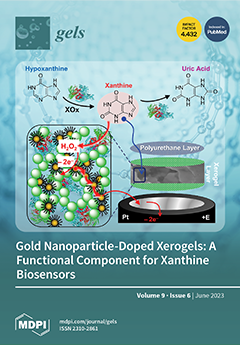
Cover Story: First-generation amperometric xanthine biosensors, assembled via layer-by-layer methodology and featuring xerogels doped with gold nanoparticles, were effective for xanthine detection in both clinical (disease diagnosis) and industrial (meat freshness) applications. Embedding the xerogel layer with a network of alkanthiolate- monolayer-protected gold nanoparticles enhanced biosensor performance, with improved sensitivity, linear range, and response time. Additionally, the biosensors exhibited stable sensitivity and discrimination against common interferent species over time. Signal deconvolution, critical to deciphering xanthine within the natural purine metabolism mechanism, along with the portability, low cost, and small size, are all attributes of the presented sensor. View this paper
  • Issues are regarded as officially published after their release is announced to the table of contents alert mailing list .
  • You may sign up for email alerts to receive table of contents of newly released issues.
  • PDF is the official format for papers published in both, html and pdf forms. To view the papers in pdf format, click on the "PDF Full-text" link, and use the free Adobe Reader to open them.

Articles (74)

  • Article
  • Open Access
8 Citations
3,144 Views
22 Pages

Lincomycin HCl-Loaded Borneol-Based In Situ Gel for Periodontitis Treatment

  • Napaphol Puyathorn,
  • Nutdanai Lertsuphotvanit,
  • Takron Chantadee,
  • Wiwat Pichayakorn and
  • Thawatchai Phaechamud

19 June 2023

Solvent exchange-induced in situ forming gel (ISG) has emerged as a versatile drug delivery system, particularly for periodontal pocket applications. In this study, we developed lincomycin HCl-loaded ISGs using a 40% borneol-based matrix and N-methyl...

  • Article
  • Open Access
13 Citations
3,234 Views
23 Pages

18 June 2023

Transdermal drug delivery has been widely adopted as a plausible alternative to the oral route of administration, especially for drugs with poor systemic bioavailability. The objective of this study was to design and validate a nanoemulsion (NE) syst...

  • Article
  • Open Access
2 Citations
2,074 Views
16 Pages

16 June 2023

Alginates are a family of natural polysaccharides with promising potential in biomedical applications and tissue regeneration. The design of versatile alginate-based structures or hydrogels and their stability and functionality depend on the polymer&...

  • Article
  • Open Access
7 Citations
2,413 Views
13 Pages

Hollow Particles Obtained by Prilling and Supercritical Drying as a Potential Conformable Dressing for Chronic Wounds

  • Maria Rosaria Sellitto,
  • Chiara Amante,
  • Rita Patrizia Aquino,
  • Paola Russo,
  • Rosalía Rodríguez-Dorado,
  • Monica Neagu,
  • Carlos A. García-González,
  • Renata Adami and
  • Pasquale Del Gaudio

16 June 2023

The production of aerogels for different applications has been widely known, but the use of polysaccharide-based aerogels for pharmaceutical applications, specifically as drug carriers for wound healing, is being recently explored. The main focus of...

  • Article
  • Open Access
31 Citations
3,602 Views
21 Pages

15 June 2023

Propranolol is the first-line drug for managing migraine attacks. D-limonene is a citrus oil known for its neuroprotective mechanism. Thus, the current work aims to design a thermo-responsive intranasal limonene-based microemulsion mucoadhesive nanog...

  • Article
  • Open Access
7 Citations
2,601 Views
15 Pages

14 June 2023

In this study, Clitoria ternatea (CT) was incorporated into the structure of sodium montmorillonite (Na+-MMT), then these new nanoparticles (CT-MMT) were added to sol-gel-based hybrid silanol coatings (SGC). The results of the CT-MMT investigation us...

  • Article
  • Open Access
7 Citations
2,742 Views
11 Pages

14 June 2023

High water cut of produced fluid is one of the most common problems in reservoir development. At present, injecting plugging agents and other profile control and water plugging technologies are the most widely used solutions. With the development of...

  • Article
  • Open Access
5 Citations
4,092 Views
12 Pages

Determination of Physicochemical, Textural, and Sensory Properties of Date-Based Sports Energy Gel

  • Syahrul Anis Hazwani Mohd Baroyi,
  • Yus Aniza Yusof,
  • Nashratul Shera Mohamad Ghazali,
  • Alhussein M. Al-Awaadh,
  • Kazunori Kadota,
  • Shuhaimi Mustafa,
  • Hazizi Abu Saad,
  • Nor Nadiah Abdul Karim Shah and
  • Mohammad Fikry

13 June 2023

Applying energy supplements in gel form may circumvent gastric discomfort and thus it is a practical alternative. The main objective of this investigation was to develop date-based sports energy gels consisting of highly nutritious ingredients such a...

  • Communication
  • Open Access
3 Citations
2,579 Views
8 Pages

Synthesis and Investigation of Novel Optical Active SiO2 Glasses with Entrapped YAG:Ce Synthesized via Sol–Gel Method

  • Monika Skruodiene,
  • Meldra Kemere,
  • Greta Inkrataite,
  • Madara Leimane,
  • Rimantas Ramanauskas,
  • Ramunas Skaudzius and
  • Anatolijs Sarakovskis

13 June 2023

We present a crack-free optically active SiO2 glass-composite material containing YAG:Ce synthesized via a modified sol–gel technique. A glass-composite material consisting of yttrium aluminum garnet doped with Ce3+ (YAG:Ce) was entrapped into...

  • Article
  • Open Access
6 Citations
3,414 Views
15 Pages

Nanocomposite Hydrogels with Polymer Grafted Silica Nanoparticles, Using Glucose Oxidase

  • Ali A. Mohammed,
  • Siwei Li,
  • Tian Sang,
  • Julian R. Jones and
  • Alessandra Pinna

13 June 2023

Nanocomposite hydrogels offer remarkable potential for applications in bone tissue engineering. They are synthesized through the chemical or physical crosslinking of polymers and nanomaterials, allowing for the enhancement of their behaviour by modif...

of 8

Get Alerted

Add your email address to receive forthcoming issues of this journal.

XFacebookLinkedIn
Gels - ISSN 2310-2861