


Skip to Content
You are currently on the new version of our website. Access the old version .

Gels, Volume 7, Issue 2

2021 June - 42 articles

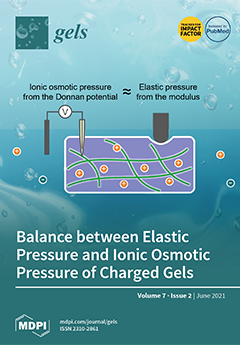
Cover Story: The equilibrium swelling degree of a highly swollen charged gel has been thought to be determined by the balance between its elastic pressure and ionic osmotic pressure. In this study, the balance between the elastic pressure and ionic osmotic pressure of charged gels has been verified using purely experimental methods. The elastic pressure of the gels was measured through the indentation test, whereas the ionic osmotic pressure was determined by the electric potential measurement without any fittings. The two experimentally determined pressures of the gels were well balanced at their swelling equilibrium, suggesting the validity of the above-mentioned relationship. View this paper
  • Issues are regarded as officially published after their release is announced to the table of contents alert mailing list .
  • You may sign up for email alerts to receive table of contents of newly released issues.
  • PDF is the official format for papers published in both, html and pdf forms. To view the papers in pdf format, click on the "PDF Full-text" link, and use the free Adobe Reader to open them.

Articles (42)

  • Review
  • Open Access
48 Citations
6,886 Views
28 Pages

Hydrogels for Three-Dimensional Ionizing-Radiation Dosimetry

  • Maurizio Marrale and
  • Francesco d’Errico

21 June 2021

Radiation-sensitive gels are among the most recent and promising developments for radiation therapy (RT) dosimetry. RT dosimetry has the twofold goal of ensuring the quality of the treatment and the radiation protection of the patient. Benchmark dosi...

  • Article
  • Open Access
22 Citations
4,717 Views
14 Pages

15 June 2021

Hydrogels that have both permanent chemical crosslinks and transient physical crosslinks are good model systems to represent tough gels. Such “dual-crosslink” hydrogels can be prepared either by simultaneous polymerization and dual crosslinking (one-...

  • Article
  • Open Access
21 Citations
4,560 Views
15 Pages

A Collagen-Mimetic Organic-Inorganic Hydrogel for Cartilage Engineering

  • Laurine Valot,
  • Marie Maumus,
  • Luc Brunel,
  • Jean Martinez,
  • Muriel Amblard,
  • Danièle Noël,
  • Ahmad Mehdi and
  • Gilles Subra

15 June 2021

Promising strategies for cartilage regeneration rely on the encapsulation of mesenchymal stromal cells (MSCs) in a hydrogel followed by an injection into the injured joint. Preclinical and clinical data using MSCs embedded in a collagen gel have demo...

  • Article
  • Open Access
4 Citations
4,208 Views
12 Pages

14 June 2021

We investigated the linear dynamic viscoelasticity of dual cross-link (DC) poly(vinyl alcohol) (PVA) (DC-PVA) hydrogels with permanent and transient cross-links. The concentrations of incorporated borate ions to form transient cross-links in the DC-P...

  • Article
  • Open Access
87 Citations
9,416 Views
19 Pages

11 June 2021

The generation of 3D tissue constructs with multiple cell types and matching mechanical properties remains a challenge in cardiac tissue engineering. Recently, 3D bioprinting has become a powerful tool to achieve these goals. Decellularized extracell...

  • Article
  • Open Access
31 Citations
4,774 Views
16 Pages

9 June 2021

Different combinations of polymers, aspartic acid (ASP), alginic acid (AL), and monomer acrylic acid (AA) were crosslinked in the presence of an initiator ammonium peroxodisulfate (APS) and cross-linker ethylene glycol dimethacrylate (EGDMA) to devel...

  • Article
  • Open Access
2 Citations
4,986 Views
18 Pages

9 June 2021

The effects of neutralization and salt on the structure and mechanical properties of polyacrylic acid (PAA) gels under equivolume conditions were investigated by small-angle X-ray scattering (SAXS) measurements and tensile tests. We attained the equi...

  • Article
  • Open Access
14 Citations
3,476 Views
11 Pages

8 June 2021

In this work, two typical fluorescent sensors were generated by exploiting molecularly imprinted polymeric hydrogels (MIPGs) for zearalenone (ZON) and glucuronic acid (GA) detection, via the analyte’s self-fluorescence property and receptor’s fluores...

  • Article
  • Open Access
29 Citations
5,525 Views
13 Pages

2 June 2021

A superhydrophobic fluorinated silica functionalized chitosan (F-CS) aerogel is constructed and fabricated by a simple and sustainable method in this study in order to achieve highly efficient gravity-driven oil/water separation performance. The fluo...

  • Perspective
  • Open Access
11 Citations
5,304 Views
18 Pages

On the Determination of Mechanical Properties of Aqueous Microgels—Towards High-Throughput Characterization

  • Ingrid Haga Oevreeide,
  • Renata Szydlak,
  • Marcin Luty,
  • Husnain Ahmed,
  • Victorien Prot,
  • Bjørn Helge Skallerud,
  • Joanna Zemła,
  • Małgorzata Lekka and
  • Bjørn Torger Stokke

31 May 2021

Aqueous microgels are distinct entities of soft matter with mechanical signatures that can be different from their macroscopic counterparts due to confinement effects in the preparation, inherently made to consist of more than one domain (Janus parti...

  • Article
  • Open Access
40 Citations
5,267 Views
14 Pages

Physicochemical and Rheological Characterization of Different Low Molecular Weight Gellan Gum Products and Derived Ionotropic Crosslinked Hydrogels

  • Calogero Fiorica,
  • Giuseppina Biscari,
  • Fabio Salvatore Palumbo,
  • Giovanna Pitarresi,
  • Annalisa Martorana and
  • Gaetano Giammona

26 May 2021

A series of four different low molecular weight gellan gum products was obtained by alkaline hydrolysis with the aim to investigate the impact of the molecular weight on the rheological properties of the polysaccharide aqueous dispersions and on the...

  • Review
  • Open Access
59 Citations
7,363 Views
16 Pages

Nanogels as a Versatile Drug Delivery System for Brain Cancer

  • Brielle Stawicki,
  • Tyler Schacher and
  • Hyunah Cho

26 May 2021

Chemotherapy and radiation remain as mainstays in the treatment of a variety of cancers globally, yet some therapies exhibit limited specificity and result in harsh side effects in patients. Brain tissue differs from other tissue due to restrictions...

  • Article
  • Open Access
5 Citations
3,251 Views
11 Pages

21 May 2021

Organogels have recently been considered as materials for transdermal drug delivery media, wherein their transport and mechanical properties are among the most important considerations. Transport through organogels has only recently been investigated...

  • Review
  • Open Access
43 Citations
7,115 Views
30 Pages

Development of Polymer-Assisted Nanoparticles and Nanogels for Cancer Therapy: An Update

  • Bibi Noorheen Haleema Mooneerah Neerooa,
  • Li-Ting Ooi,
  • Kamyar Shameli,
  • Nuraina Anisa Dahlan,
  • Jahid M. M. Islam,
  • Janarthanan Pushpamalar and
  • Sin-Yeang Teow

17 May 2021

With cancer remaining as one of the main causes of deaths worldwide, many studies are undergoing the effort to look for a novel and potent anticancer drug. Nanoparticles (NPs) are one of the rising fields in research for anticancer drug development....

  • Review
  • Open Access
39 Citations
7,334 Views
13 Pages

Nanoclay/Polymer-Based Hydrogels and Enzyme-Loaded Nanostructures for Wound Healing Applications

  • Angel M. Villalba-Rodríguez,
  • Sara Martínez-González,
  • Juan Eduardo Sosa-Hernández,
  • Roberto Parra-Saldívar,
  • Muhammad Bilal and
  • Hafiz M. N. Iqbal

14 May 2021

Multi-polymeric nanocomposite hydrogels with multi-functional characteristics have been engineered with high interest around the globe. The ease in fine tunability with maintained compliance makes an array of nanocomposite biomaterials outstanding ca...

  • Review
  • Open Access
8 Citations
5,443 Views
12 Pages

11 May 2021

Fibroin is a fibrous protein that can be conveniently isolated from the silk cocoons produced by the larvae of Bombyx mori silk moth. In its form as a hydrogel, Bombyx mori silk fibroin (BMSF) has been employed in a variety of biomedical applications...

  • Communication
  • Open Access
6 Citations
3,912 Views
11 Pages

Reduction of PVA Aerogel Flammability by Incorporation of an Alkaline Catalyst

  • Zhi-Han Cheng,
  • Mo-Lin Guo,
  • Xiao-Yi Chen,
  • Ting Wang,
  • Yu-Zhong Wang and
  • David A. Schiraldi

8 May 2021

Sodium hydroxide was used as a base catalyst to reduce the flammability of poly(vinyl alcohol) (PVA) aerogels. The base-modified aerogels exhibited significantly enhanced compressive moduli, likely resulting in decreased gallery spacing and increased...

  • Article
  • Open Access
39 Citations
6,377 Views
23 Pages

Fabrication and Characterization of Poly (vinyl alcohol) and Chitosan Oligosaccharide-Based Blend Films

  • Dilshad Qureshi,
  • Ayasharani Sahoo,
  • Biswaranjan Mohanty,
  • Arfat Anis,
  • Viktoryia Kulikouskaya,
  • Kseniya Hileuskaya,
  • Vladimir Agabekov,
  • Preetam Sarkar,
  • Sirsendu Sekhar Ray and
  • Kunal Pal
  • + 1 author

6 May 2021

In the present study, we report the development of poly (vinyl alcohol) (PVA) and chitosan oligosaccharide (COS)-based novel blend films. The concentration of COS was varied between 2.5–10.0 wt% within the films. The inclusion of COS added a brown hu...

  • Article
  • Open Access
5 Citations
2,995 Views
10 Pages

Flowability of Gel-Matrix and Magnetorheological Response for Carrageenan Magnetic Hydrogels

  • Junko Ikeda,
  • Tomoki Kurihara,
  • Keiju Ogura,
  • Shota Akama,
  • Mika Kawai and
  • Tetsu Mitsumata

6 May 2021

The relationship between rheological features in the absence of a magnetic field and magnetic response was investigated for κ-carrageenan magnetic hydrogels containing carbonyl iron particles. The concentration of carrageenan was varied from 1.0 to 5...

  • Review
  • Open Access
20 Citations
5,246 Views
12 Pages

1 May 2021

Due to the limited regenerative capabilities of cardiomyocytes, incidents of myocardial infarction can cause permanent damage to native myocardium through the formation of acellular, non-conductive scar tissue during wound repair. The generation of s...

  • Review
  • Open Access
7 Citations
3,382 Views
24 Pages

1 May 2021

The rational design and engineer of organogel-based smart materials and stimuli-responsive materials with tuned properties requires the control of the non-covalent forces driving the hierarchical self-assembly. Chirality, as well as cis/trans relativ...

  • Article
  • Open Access
12 Citations
4,701 Views
21 Pages

Bolaamphiphilic Bis-Dehydropeptide Hydrogels as Potential Drug Release Systems

  • Carolina Amorim,
  • Sérgio R. S. Veloso,
  • Elisabete M. S. Castanheira,
  • Loic Hilliou,
  • Renato B. Pereira,
  • David M. Pereira,
  • José A. Martins,
  • Peter J. Jervis and
  • Paula M. T. Ferreira

29 April 2021

The self-assembly of nanometric structures from molecular building blocks is an effective way to make new functional materials for biological and technological applications. In this work, four symmetrical bolaamphiphiles based on dehydrodipeptides (p...

  • Article
  • Open Access
12 Citations
5,771 Views
14 Pages

Effect of Doxycycline Microencapsulation on Buccal Films: Stability, Mucoadhesion and In Vitro Drug Release

  • Venu Gopal Reddy Patlolla,
  • Nikolina Popovic,
  • William Peter Holbrook,
  • Thordis Kristmundsdottir and
  • Sveinbjörn Gizurarson

28 April 2021

The aim of this work was to stabilize doxycycline in mucoadhesive buccal films at room temperature (25 °C). Since doxycycline is susceptible to degradation such as oxidation and epimerization, tablets are currently the only formulation that can keep...

  • Review
  • Open Access
42 Citations
6,544 Views
20 Pages

21 April 2021

The fundamental attributes of charged hydrogels containing predominantly water and controllable amounts of low molar mass electrolytes are of tremendous significance in biological context and applications in healthcare. However, a rigorous theoretica...

  • Article
  • Open Access
11 Citations
3,574 Views
12 Pages

Cellular Automata Modeling of Silica Aerogel Condensation Kinetics

  • Nina H. Borzęcka,
  • Bartosz Nowak,
  • Rafał Pakuła,
  • Robert Przewodzki and
  • Jakub M. Gac

21 April 2021

The formation of silica aerogels and the kinetics of condensation were investigated numerically. The influence of the reaction-limited to the diffusion-limited aggregation (RLA to DLA) transition on the reaction kinetics curves and the evolution of t...

  • Article
  • Open Access
16 Citations
5,416 Views
10 Pages

Insights into Mechanical Behavior and Biological Properties of Chia Seed Mucilage Hydrogels

  • Pasquale Sacco,
  • Sara Lipari,
  • Michela Cok,
  • Matilde Colella,
  • Eleonora Marsich,
  • Francesco Lopez and
  • Ivan Donati

20 April 2021

In this contribution we report insights on the rheological properties of chia (Salvia hispanica) seed mucilage hydrogels. Creep experiments performed in steady state conditions allowed calculation of Newtonian viscosities for chia hydrogels with diff...

  • Article
  • Open Access
4 Citations
3,622 Views
9 Pages

20 April 2021

Considerable attention has been paid to emulsion gels (EGs) in recent years due to their interesting applications in food. The aim of this work is to shed light on the role played by chia oil in the technological and structural properties of EGs made...

  • Article
  • Open Access
7 Citations
3,950 Views
12 Pages

Supramolecular Fractal Growth of Self-Assembled Fibrillar Networks

  • Pedram Nasr,
  • Hannah Leung,
  • France-Isabelle Auzanneau and
  • Michael A. Rogers

14 April 2021

Complex morphologies, as is the case in self-assembled fibrillar networks (SAFiNs) of 1,3:2,4-Dibenzylidene sorbitol (DBS), are often characterized by their Fractal dimension and not Euclidean. Self-similarity presents for DBS-polyethylene glycol (PE...

  • Article
  • Open Access
8 Citations
4,506 Views
13 Pages

13 April 2021

Ion-pair comonomers (IPCs) where both the anion and cation contain polymerizable functional groups offer a route to prepare polyampholyte, ion-containing polymers. Polymerizing vinyl functional groups by free-radical polymerization produces bridging...

  • Article
  • Open Access
31 Citations
6,296 Views
21 Pages

Ionotropic Gelation Fronts in Sodium Carboxymethyl Cellulose for Hydrogel Particle Formation

  • William N. Sharratt,
  • Carlos G. Lopez,
  • Miriam Sarkis,
  • Gunjan Tyagi,
  • Róisín O’Connell,
  • Sarah E. Rogers and
  • João T. Cabral

12 April 2021

Hydrogel microparticles (HMPs) find numerous practical applications, ranging from drug delivery to tissue engineering. Designing HMPs from the molecular to macroscopic scales is required to exploit their full potential as functional materials. Here,...

  • Article
  • Open Access
7 Citations
2,990 Views
9 Pages

8 April 2021

Filamentous anionic polyelectrolytes are common in biological materials. Some examples are the cytoskeletal filaments that assemble into networks and bundled structures to give the cell mechanical resistance and that act as surfaces on which enzymes...

  • Article
  • Open Access
13 Citations
3,896 Views
12 Pages

Accounting for Cooperativity in the Thermotropic Volume Phase Transition of Smart Microgels

  • Simon Friesen,
  • Yvonne Hannappel,
  • Sergej Kakorin and
  • Thomas Hellweg

8 April 2021

A full quantitative description of the swelling of smart microgels is still problematic in many cases. The original approach of Flory and Huggins for the monomer–solvent interaction parameter χ cannot be applied to some microgels. The reason for this...

  • Article
  • Open Access
19 Citations
3,679 Views
10 Pages

Designing a Transparent and Fluorine Containing Hydrogel

  • Paolo Ravarino,
  • Demetra Giuri,
  • Davide Faccio and
  • Claudia Tomasini

8 April 2021

Physical hydrogels are supramolecular materials obtained by self-assembly of small molecules called gelators. Aromatic amino acids and small peptides containing aromatic rings are good candidates as gelators due to their ability to form weak bonds as...

  • Article
  • Open Access
14 Citations
6,227 Views
14 Pages

Experimental Verification of the Balance between Elastic Pressure and Ionic Osmotic Pressure of Highly Swollen Charged Gels

  • Tasuku Nakajima,
  • Ken-ichi Hoshino,
  • Honglei Guo,
  • Takayuki Kurokawa and
  • Jian Ping Gong

1 April 2021

The equilibrium swelling degree of a highly swollen charged gel has been thought to be determined by the balance between its elastic pressure and ionic osmotic pressure. However, the full experimental verification of this balance has not previously b...

  • Article
  • Open Access
13 Citations
3,795 Views
30 Pages

1 April 2021

Biomedical applications of thermo-responsive (TR) hydrogels require these materials to be biocompatible, non-cytotoxic, and non-immunogenic. Due to serious concerns regarding potential toxicity of poly(N-isopropylacrylamide) (PNIPAm), design of alter...

  • Review
  • Open Access
33 Citations
6,150 Views
15 Pages

Injectable Cryogels in Biomedicine

  • Duygu Çimen,
  • Merve Asena Özbek,
  • Nilay Bereli,
  • Bo Mattiasson and
  • Adil Denizli

1 April 2021

Cryogels are interconnected macroporous materials that are synthesized from a monomer solution at sub-zero temperatures. Cryogels, which are used in various applications in many research areas, are frequently used in biomedicine applications due to t...

  • Article
  • Open Access
3 Citations
3,469 Views
9 Pages

Microcapillary Reactors via Coaxial Electrospinning: Fabrication of Small Poly(Acrylic Acid) Gel Beads and Thin Threads of Biological Cell Dimensions

  • Susan K. Kozawa,
  • Audrey Lord,
  • Jonah J. Scott-McKean,
  • Anne Y. Walker,
  • Alberto C. S. Costa and
  • Gary E. Wnek

30 March 2021

Poly(acrylic acid) (PAA) bulk gels and threads, typically derived via free-radical polymerization, are of interest as anionic polyelectrolyte mimics of cellular cytosol and as models for early protocells. The thread dimensions have been limited by th...

  • Review
  • Open Access
146 Citations
14,145 Views
23 Pages

Synthesis of Nanogels: Current Trends and Future Outlook

  • Emanuele Mauri,
  • Sara Maria Giannitelli,
  • Marcella Trombetta and
  • Alberto Rainer

29 March 2021

Nanogels represent an innovative platform for tunable drug release and targeted therapy in several biomedical applications, ranging from cancer to neurological disorders. The design of these nanocarriers is a pivotal topic investigated by the researc...

  • Article
  • Open Access
16 Citations
5,592 Views
17 Pages

Durability of Thermal Renders with Lightweight and Thermal Insulating Aggregates: Regranulated Expanded Cork, Silica Aerogel and Expanded Polystyrene

  • André Morgado,
  • António Soares,
  • Inês Flores-Colen,
  • Maria do Rosário Veiga and
  • Maria Glória Gomes

25 March 2021

Following the trend of energy-efficient construction, renders with thermal insulation properties have been studied for replacing conventional renders. However, there are still few studies on the durability of these renders that may become a barrier f...

  • Review
  • Open Access
25 Citations
5,889 Views
28 Pages

Recent Advances of Taxol-Loaded Biocompatible Nanocarriers Embedded in Natural Polymer-Based Hydrogels

  • Silvia Voci,
  • Agnese Gagliardi,
  • Roberto Molinaro,
  • Massimo Fresta and
  • Donato Cosco

24 March 2021

The discovery of paclitaxel (PTX) has been a milestone in anti-cancer therapy and has promoted the development and marketing of various formulations that have revolutionized the therapeutic approach towards several malignancies. Despite its peculiar...

  • Article
  • Open Access
59 Citations
7,240 Views
15 Pages

Synthesis and Characterization of Silver–Strontium (Ag-Sr)-Doped Mesoporous Bioactive Glass Nanoparticles

  • Shaher Bano,
  • Memoona Akhtar,
  • Muhammad Yasir,
  • Muhammad Salman Maqbool,
  • Akbar Niaz,
  • Abdul Wadood and
  • Muhammad Atiq Ur Rehman

24 March 2021

Biomedical implants are the need of this era due to the increase in number of accidents and follow-up surgeries. Different types of bone diseases such as osteoarthritis, osteomalacia, bone cancer, etc., are increasing globally. Mesoporous bioactive g...

Get Alerted

Add your email address to receive forthcoming issues of this journal.

XFacebookLinkedIn
Gels - ISSN 2310-2861