


Amesia hispanica sp. nov., Producer of the Antifungal Class of Antibiotics Dactylfungins
 ,
,  , , and
Abstract
1. Introduction
2. Materials and Methods
2.1. Fungal Isolation
2.2. Morphological Characterization
2.3. DNA Isolation, Amplification and Phylogenetic Study
2.4. Fermentation, Extraction, and Isolation
2.5. Chromatography and Spectral Methods
2.6. Biological Assays
2.7. Biogeographic Study
3. Results
3.1. Phylogenetic Study
3.2. Taxonomy
- Key to species of Amesia
- 1. Reniform ascospores.............................................................................................Amesia khuzestanica
- 1. Ovate, fusiform or pyriform ascospores............................................................................................2
- 2. Ascomata with straight or flexuous hairs surrounding the ostiole................................................3
- 2. Ascomata with coiled hairs surrounding the ostiole.......................................................................5
- 3. Ascospores ovate to ellipsoidal, (7.0–)8.0–9.0(–9.5) × (5.5–)6.0–6.5(–7.0) μm..........A. cymbiformis
- 3. Ascospores fusiform or pyriform.......................................................................................................4
- 4. Ascospores (8.0–)8.5–10.5(–11.0) × 4.5–5.5(–6.0) μm...................................................A. atrobrunnea
- 4. Ascospores 14–16 × 5–6 μm...............................................................................................A. dreyfussii
- 5. Ascospores ovate, 6.0–7.0(–7.5) × 4.0–5.0(–5.5) μm........................................................A. nigricolor
- 5. Ascospores fusiform or broadly fusiform.........................................................................................6
- 6. Ascomata not densely ornamented with hairs, ascospores 9.0–12.0 × 5.5–7.0 μm.....A. hispanica
- 6. Ascomata densely ornamented with hairs.......................................................................................7
- 7. Ascospores 8.5–10 × 5.5–6.5 μm.................................................................................A. gelasinospora
- 7. Ascospores 10–15 × 5–7.5 μm....................................................................................................A. raii
3.3. Isolation and Structure Elucidation of Secondary Metabolites
3.4. Physico-Chemical Characteristics of the Isolated Metabolites
3.4.1. Dactylfungin A (1)
3.4.2. 21″-Hydroxy-dactylfungin A (2)
3.4.3. 25″-Dehydroxy-dactylfungin A (3)
3.4.4. Cochliodinol (4)
3.5. Biological Activities
4. Discussion
Supplementary Materials
Author Contributions
Funding
Institutional Review Board Statement
Informed Consent Statement
Data Availability Statement
Acknowledgments
Conflicts of Interest
References
- Hyde, K.D.; Xu, J.; Rapior, S.; Jeewon, R.; Lumyong, S.; Niego, A.G.T.; Abeywickrama, P.D.; Aluthmuhandiram, J.V.S.; Brahamanage, R.S.; Brooks, S.; et al. The Amazing Potential of Fungi: 50 Ways We Can Exploit Fungi Industrially. Fungal Divers. 2019, 97, 1–136. [Google Scholar] [CrossRef]
- Atanasov, A.G.; Zotchev, S.B.; Dirsch, V.M.; Orhan, I.E.; Banach, M.; Rollinger, J.M.; Barreca, D.; Weckwerth, W.; Bauer, R.; Bayer, E.A.; et al. Natural Products in Drug Discovery: Advances and Opportunities. Nat. Rev. Drug Discov. 2021, 20, 200–216. [Google Scholar] [CrossRef] [PubMed]
- Mapook, A.; Hyde, K.D.; Hassan, K.; Kemkuignou, B.M.; Čmoková, A.; Surup, F.; Kuhnert, E.; Paomephan, P.; Cheng, T.; de Hoog, S.; et al. Ten Decadal Advances in Fungal Biology Leading towards Human Well-Being. Fungal Divers. 2022, 116, 547–614. [Google Scholar] [CrossRef] [PubMed]
- Miethke, M.; Pieroni, M.; Weber, T.; Brönstrup, M.; Hammann, P.; Halby, L.; Arimondo, P.B.; Glaser, P.; Aigle, B.; Bode, H.B.; et al. Towards the Sustainable Discovery and Development of New Antibiotics. Nat. Rev. Chem. 2021, 5, 726–749. [Google Scholar] [CrossRef]
- Alastruey-Izquierdo, A.; Mellado, E.; Peláez, T.; Pemán, J.; Zapico, S.; Alvarez, M.; Rodríguez-Tudela, J.L.; Cuenca-Estrella, M. Population-Based Survey of Filamentous Fungi and Antifungal Resistance in Spain (FILPOP Study). Antimicrob. Agents Chemother. 2013, 57, 3380–3387. [Google Scholar] [CrossRef]
- Lestrade, P.P.A.; Meis, J.F.; Melchers, W.J.G.; Verweij, P.E. Triazole Resistance in Aspergillus fumigatus: Recent Insights and Challenges for Patient Management. Clin. Microbiol. Infect. 2019, 25, 799–806. [Google Scholar] [CrossRef]
- Dannaoui, E. Antifungal Resistance in Mucorales. Int. J. Antimicrob. Agents 2017, 50, 617–621. [Google Scholar] [CrossRef]
- Bermas, A.; Geddes-McAlister, J. Combatting the Evolution of Antifungal Resistance in Cryptococcus neoformans. Mol. Microbiol. 2020, 114, 721–734. [Google Scholar] [CrossRef]
- Harms, K.; Milic, A.; Stchigel, A.M.; Stadler, M.; Surup, F.; Marin-Felix, Y. Three New Derivatives of Zopfinol from Pseudorhypophila mangenotii Gen. Et Comb. Nov. J. Fungi 2021, 7, 181. [Google Scholar] [CrossRef]
- Harms, K.; Surup, F.; Stadler, M.; Stchigel, A.M.; Marin-felix, Y. Morinagadepsin, a Depsipeptide from the Fungus Morinagamyces vermicularis Gen. Et Comb. Nov. Microorganisms 2021, 9, 1191. [Google Scholar] [CrossRef]
- Shao, L.; Marin-Felix, Y.; Surup, F.; Stchigel, A.M.; Stadler, M. Seven New Cytotoxic and Antimicrobial Xanthoquinodins from Jugulospora vestita. J. Fungi 2020, 6, 188. [Google Scholar] [CrossRef] [PubMed]
- Charria-Girón, E.; Surup, F.; Marin-Felix, Y. Diversity of Biologically Active Secondary Metabolites in the Ascomycete Order Sordariales. Mycol. Prog. 2022, 21, 43. [Google Scholar] [CrossRef]
- Ibrahim, S.R.M.; Mohamed, S.G.A.; Sindi, I.A.; Mohamed, G.A. Biologically Active Secondary Metabolites and Biotechnological Applications of Species of the Family Chaetomiaceae (Sordariales): An Updated Review from 2016 to 2021. Mycol. Prog. 2021, 20, 595–639. [Google Scholar] [CrossRef]
- Wang, X.W.; Houbraken, J.; Groenewald, J.Z.; Meijer, M.; Andersen, B.; Nielsen, K.F.; Crous, P.W.; Samson, R.A. Diversity and Taxonomy of Chaetomium and Chaetomium-like Fungi from Indoor Environments. Stud. Mycol. 2016, 84, 145–224. [Google Scholar] [CrossRef] [PubMed]
- García, D.; Stchigel, A.M.; Guarro, J. A New Species of Poroconiochaeta from Russian Soils. Mycologia 2003, 95, 525–529. [Google Scholar] [CrossRef]
- The Royal Horticultural Society London, R.H.S. Colour Chart; The Royal Horticultural Society: London, UK, 1996. [Google Scholar]
- White, T.J.; Bruns, T.; Lee, S.; Taylor, J. Amplification and Direct Sequencing of Fungal Ribosomal RNA Genes for Phylogenetics. In PCR Protocols; Elsevier: Amsterdam, The Netherlands, 1990; pp. 315–322. [Google Scholar]
- Vilgalys, R.; Hester, M. Rapid Genetic Identification and Mapping of Enzymatically Amplified Ribosomal DNA from Several Cryptococcus Species. J. Bacteriol. 1990, 172, 4238–4246. [Google Scholar] [CrossRef]
- Miller, A.N.; Huhndorf, S.M. Multi-Gene Phylogenies Indicate Ascomal Wall Morphology Is a Better Predictor of Phylogenetic Relationships than Ascospore Morphology in the Sordariales (Ascomycota, Fungi). Mol. Phylogenet. Evol. 2005, 35, 60–75. [Google Scholar] [CrossRef]
- O’Donnell, K.; Cigelnik, E. Two Divergent Intragenomic RDNA ITS2 Types within a Monophyletic Lineage of the Fungus Fusarium Are Nonorthologous. Mol. Phylogenet. Evol. 1997, 7, 103–116. [Google Scholar] [CrossRef]
- Groenewald, J.Z.; Nakashima, C.; Nishikawa, J.; Shin, H.D.; Park, J.H.; Jama, A.N.; Groenewald, M.; Braun, U.; Crous, P.W. Species Concepts in Cercospora: Spotting the Weeds among the Roses. Stud. Mycol. 2013, 75, 115–170. [Google Scholar] [CrossRef]
- Kearse, M.; Moir, R.; Wilson, A.; Stones-Havas, S.; Cheung, M.; Sturrock, S.; Buxton, S.; Cooper, A.; Markowitz, S.; Duran, C.; et al. Geneious Basic: An Integrated and Extendable Desktop Software Platform for the Organization and Analysis of Sequence Data. Bioinformatics 2012, 28, 1647–1649. [Google Scholar] [CrossRef]
- Katoh, K.; Standley, D.M. MAFFT Multiple Sequence Alignment Software Version 7: Improvements in Performance and Usability. Mol. Biol. Evol. 2013, 30, 772–780. [Google Scholar] [CrossRef]
- Kumar, S.; Stecher, G.; Li, M.; Knyaz, C.; Tamura, K. MEGA X: Molecular Evolutionary Genetics Analysis across Computing Platforms. Mol. Biol. Evol. 2018, 35, 1547–1549. [Google Scholar] [CrossRef]
- Mason-Gamer, R.J.; Kellogg, E.A. Testing for Phylogenetic Conflict Among Molecular Data Sets in the Tribe Triticeae (Gramineae). Syst. Biol. 1996, 45, 524–545. [Google Scholar] [CrossRef]
- Wiens, J.J. Testing Phylogenetic Methods with Tree Congruence: Phylogenetic Analysis of Polymorphic Morphological Characters in Phrynosomatid Lizards. Syst. Biol. 1998, 47, 427–444. [Google Scholar] [CrossRef]
- Alfaro, M.E.; Zoller, S.; Lutzoni, F. Bayes or Bootstrap? A Simulation Study Comparing the Performance of Bayesian Markov Chain Monte Carlo Sampling and Bootstrapping in Assessing Phylogenetic Confidence. Mol. Biol. Evol. 2003, 20, 255–266. [Google Scholar] [CrossRef]
- de Hoog, G.S.; Ahmed, S.A.; Najafzadeh, M.J.; Sutton, D.A.; Keisari, M.S.; Fahal, A.H.; Eberhardt, U.; Verkleij, G.J.; Xin, L.; Stielow, B.; et al. Phylogenetic Findings Suggest Possible New Habitat and Routes of Infection of Human Eumyctoma. PLoS Negl. Trop. Dis. 2013, 7, e2229. [Google Scholar] [CrossRef] [PubMed]
- Vu, D.; Groenewald, M.; de Vries, M.; Gehrmann, T.; Stielow, B.; Eberhardt, U.; Al-Hatmi, A.; Groenewald, J.Z.; Cardinali, G.; Houbraken, J.; et al. Large-Scale Generation and Analysis of Filamentous Fungal DNA Barcodes Boosts Coverage for Kingdom Fungi and Reveals Thresholds for Fungal Species and Higher Taxon Delimitation. Stud. Mycol. 2019, 92, 135–154. [Google Scholar] [CrossRef] [PubMed]
- Wang, X.W.; Han, P.J.; Bai, F.Y.; Luo, A.; Bensch, K.; Meijer, M.; Kraak, B.; Han, D.Y.; Sun, B.D.; Crous, P.W.; et al. Taxonomy, Phylogeny and Identification of Chaetomiaceae with Emphasis on Thermophilic Species. Stud. Mycol. 2022, 101, 121–243. [Google Scholar] [CrossRef]
- Safi, A.; Mehrabi-Koushki, M.; Farokhinejad, R. Amesia khuzestanica and Curvularia iranica Spp. Nov. from Iran. Mycol. Prog. 2020, 19, 935–945. [Google Scholar] [CrossRef]
- Ahmed, S.A.; Khan, Z.; Wang, X.; Moussa, T.A.A.; Al-Zahrani, H.S.; Almaghrabi, O.A.; Sutton, D.A.; Ahmad, S.; Groenewald, J.Z.; Alastruey-Izquierdo, A.; et al. Chaetomium-like Fungi Causing Opportunistic Infections in Humans: A Possible Role for Extremotolerance. Fungal Divers. 2016, 76, 11–26. [Google Scholar] [CrossRef]
- van den Brink, J.; Facun, K.; de Vries, M.; Stielow, J.B. Thermophilic Growth and Enzymatic Thermostability Are Polyphyletic Traits within Chaetomiaceae. Fungal Biol. 2015, 119, 1255–1266. [Google Scholar] [CrossRef]
- Cedeño-sanchez, M.; Charria-Girón, E.; Lambert, C.; Luangsa-ard, J.J.; Decock, C.; Franke, R. Segregation of the Genus Parahypoxylon (Hypoxylaceae, Xylariales) from Hypoxylon by a Polyphasic Taxonomic Approach. MycoKeys 2023, 95, 131–162. [Google Scholar] [CrossRef]
- Nothias, L.F.; Petras, D.; Schmid, R.; Dührkop, K.; Rainer, J.; Sarvepalli, A.; Protsyuk, I.; Ernst, M.; Tsugawa, H.; Fleischauer, M.; et al. Feature-Based Molecular Networking in the GNPS Analysis Environment. Nat. Methods 2020, 17, 905–908. [Google Scholar] [CrossRef]
- Wang, M.; Carver, J.J.; Phelan, V.V.; Sanchez, L.M.; Garg, N.; Peng, Y.; Nguyen, D.D.; Watrous, J.; Kapono, C.A.; Luzzatto-Knaan, T.; et al. Sharing and Community Curation of Mass Spectrometry Data with Global Natural Products Social Molecular Networking. Nat. Biotechnol. 2016, 34, 828–837. [Google Scholar] [CrossRef] [PubMed]
- Štěpánek, O.; Čmoková, A.; Procházková, E.; Grobárová, V.; Černý, J.; Slapničková, M.; Zíková, A.; Kolařík, M.; Baszczyňski, O. Piperazine-Modified Ketoconazole Derivatives Show Increased Activity against Fungal and Trypanosomatid Pathogens. ChemMedChem 2022, 17, e202200385. [Google Scholar] [CrossRef] [PubMed]
- Arendrup, M.C.; Friberg, N.; Mares, M.; Kahlmeter, G.; Meletiadis, J.; Guinea, J.; Arendrup, M.C.; Meletiadis, J.; Guinea, J.; Friberg, N.; et al. How to Interpret MICs of Antifungal Compounds According to the Revised Clinical Breakpoints v. 10.0 European Committee on Antimicrobial Susceptibility Testing (EUCAST). Clin. Microbiol. Infect. 2020, 26, 1464–1472. [Google Scholar] [CrossRef] [PubMed]
- Réblová, M.; Hernández-Restrepo, M.; Sklenář, F.; Nekvindová, J.; Réblová, K.; Kolařík, M. Consolidation of Chloridium: New Classification into Eight Sections with 37 Species and Reinstatement of the Genera Gongromeriza and Psilobotrys. Stud. Mycol. 2022, 103, 86–211. [Google Scholar] [CrossRef]
- Větrovský, T.; Morais, D.; Kohout, P.; Lepinay, C.; Algora, C.; Awokunle Hollá, S.; Bahnmann, B.D.; Bílohnědá, K.; Brabcová, V.; D’Alò, F.; et al. GlobalFungi, a Global Database of Fungal Occurrences from High-Throughput-Sequencing Metabarcoding Studies. Sci. Data 2020, 7, 228. [Google Scholar] [CrossRef]
- Aggarwal, R.; Kharbikar, L. Phylogenetic Relationships of Chaetomium Isolates Based on the Internal Transcribed Spacer Region of the RRNA Gene Cluster. Afr. J. Biotechnol. 2013, 12, 914–920. [Google Scholar] [CrossRef]
- Núñez, A.; Amo de Paz, G.; Rastrojo, A.; Ferencova, Z.; Gutiérrez-Bustillo, A.M.; Alcamí, A.; Moreno, D.A.; Guantes, R. Temporal Patterns of Variability for Prokaryotic and Eukaryotic Diversity in the Urban Air of Madrid (Spain). Atmos. Environ. 2019, 217, 116972. [Google Scholar] [CrossRef]
- Zheng, Y.; Maitra, P.; Gan, H.-Y.; Chen, L.; Li, S.; Tu, T.; Chen, L.; Mi, X.; Gao, C.; Zhang, D.; et al. Soil Fungal Diversity and Community Assembly: Affected by Island Size or Type? FEMS Microbiol. Ecol. 2021, 97, fiab062. [Google Scholar] [CrossRef] [PubMed]
- Malhotra, G.; Mukerji, K.G. Fungi of Delhi XXIX. Three New Species of Chaetomium from Decaying Wood. Rev. Mycol. 1976, 40, 179–184. [Google Scholar]
- Arx, J.A.; Guarro, J.; Figueras, M.J. The Ascomycete Genus Chaetomium. Hedwigia 1986, 79, 662. [Google Scholar]
- Xaio, J.Z.; Shigenori, K.; Nobuji, Y.; Takashi, M.; Yoshikazu, S. Dactylfungins, Novel Antifungal Antibiotics Produced By Dactylaria parvispora. J. Antibiot. 1992, 46, 48–55. [Google Scholar] [CrossRef] [PubMed]
- Xu, G.B.; He, G.; Bai, H.H.; Yang, T.; Zhang, G.L.; Wu, L.W.; Li, G.Y. Indole Alkaloids from Chaetomium globosum. J. Nat. Prod. 2015, 78, 1479–1485. [Google Scholar] [CrossRef]
- McGlacken, G.P.; Fairlamb, I.J.S. 2-Pyrone Natural Products and Mimetics: Isolation, Characterisation and Biological Activity. Nat. Prod. Rep. 2005, 22, 369. [Google Scholar] [CrossRef]
- Lee, J. Recent Advances in the Synthesis of 2-Pyrones. Mar. Drugs 2015, 13, 1581–1620. [Google Scholar] [CrossRef] [PubMed]
- Evidente, A.; Conti, L.; Altomare, C.; Bottalico, A.; Sindona, G.; Segre, A.L.; Logrieco, A.; Chirnico-agrarie, D.S.; Federico, N.; Studi, U.; et al. Fusapyrone and Deoxyfusapyrone, Two Antifungal Alpha-pyrones From Fusarfum semitectum. Nat. Toxins 1994, 2, 4–13. [Google Scholar] [CrossRef]
- Altomare, C.; Pengue, R.; Favilla, M.; Evidente, A.; Visconti, A. Structure−Activity Relationships of Derivatives of Fusapyrone, an Antifungal Metabolite of Fusarium semitectum. J. Agric. Food Chem. 2004, 52, 2997–3001. [Google Scholar] [CrossRef]
- Nagai, K.; Kamigiri, K.; Matsumoto, H.; Kawano, Y.; Yamaoka, M.; Shimoi, H.; Watanabe, M.; Suzuki, K. YM-202204, a New Antifungal Antibiotic Produced by Marine Fungus Phoma sp. J. Antibiot. 2002, 55, 1036–1041. [Google Scholar] [CrossRef]
- Furumoto, T.; Fukuyama, K.; Hamasaki, T.; Nakajima, H. Neovasipyrones and Neovasifuranones: Four New Metabolites Related to Neovasinin, a Phytotoxin of the Fungus, Neocosmospora vasinfecta. Phytochemistry 1995, 40, 745–751. [Google Scholar] [CrossRef]
- Hiramatsu, F.; Miyajima, T.; Murayama, T.; Takahashi, K.; Koseki, T.; Shiono, Y. Isolation and Structure Elucidation of Neofusapyrone from a Marine-Derived Fusarium Species, and Structural Revision of Fusapyrone and Deoxyfusapyrone. J. Antibiot. 2006, 59, 704–709. [Google Scholar] [CrossRef] [PubMed]
- Honma, M.; Kudo, S.; Takada, N.; Tanaka, K.; Miura, T.; Hashimoto, M. Novel Neofusapyrones Isolated from Verticillium dahliae as Potent Antifungal Substances. Bioorg. Med. Chem. Lett. 2010, 20, 709–712. [Google Scholar] [CrossRef]
- Atanasoff-Kardjalieff, A.K.; Lünne, F.; Kalinina, S.; Strauss, J.; Humpf, H.-U.; Studt, L. Biosynthesis of Fusapyrone Depends on the H3K9 Methyltransferase, FmKmt1, in Fusarium mangiferae. Front. Fungal Biol. 2021, 2, 671796. [Google Scholar] [CrossRef]
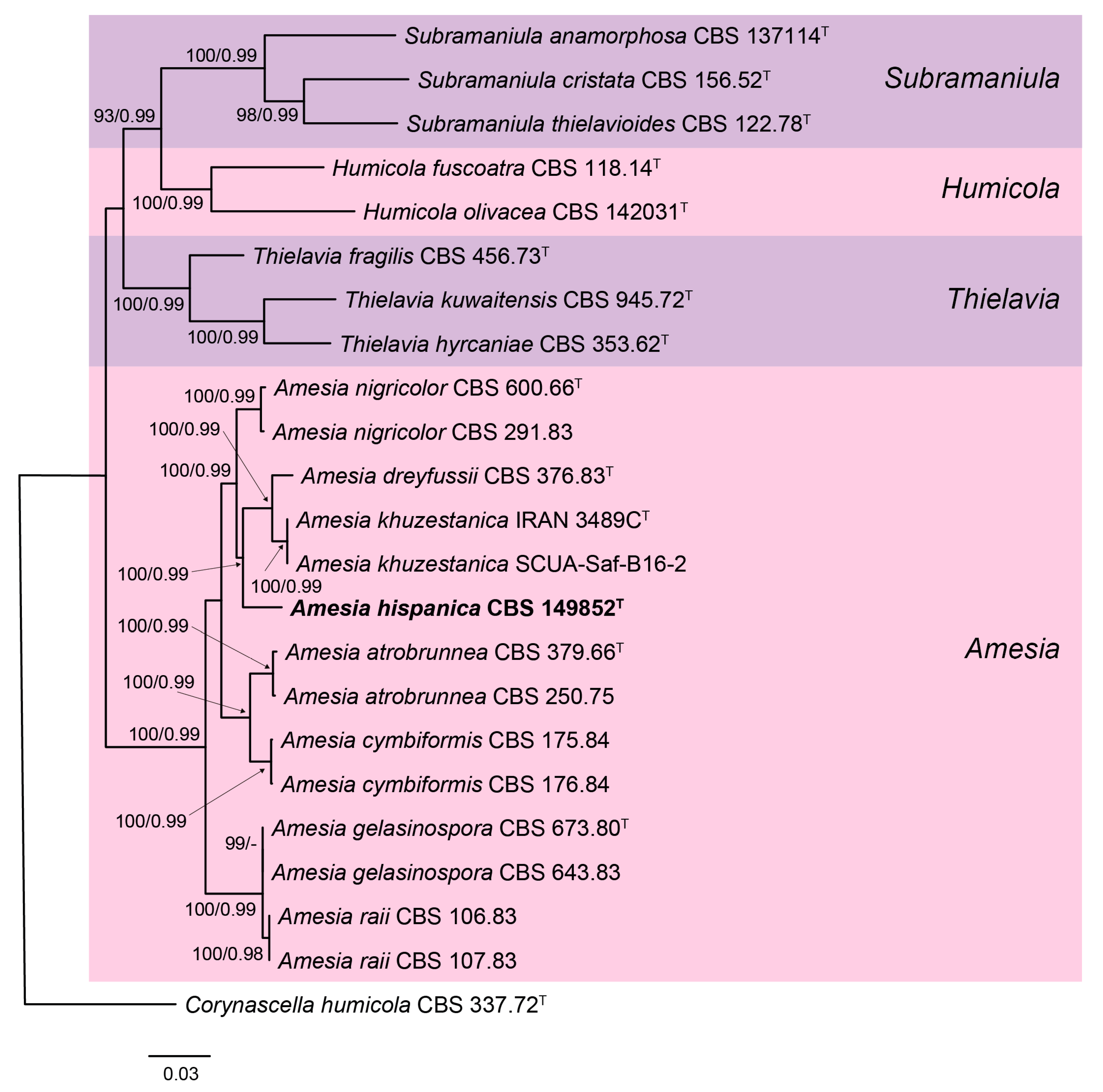
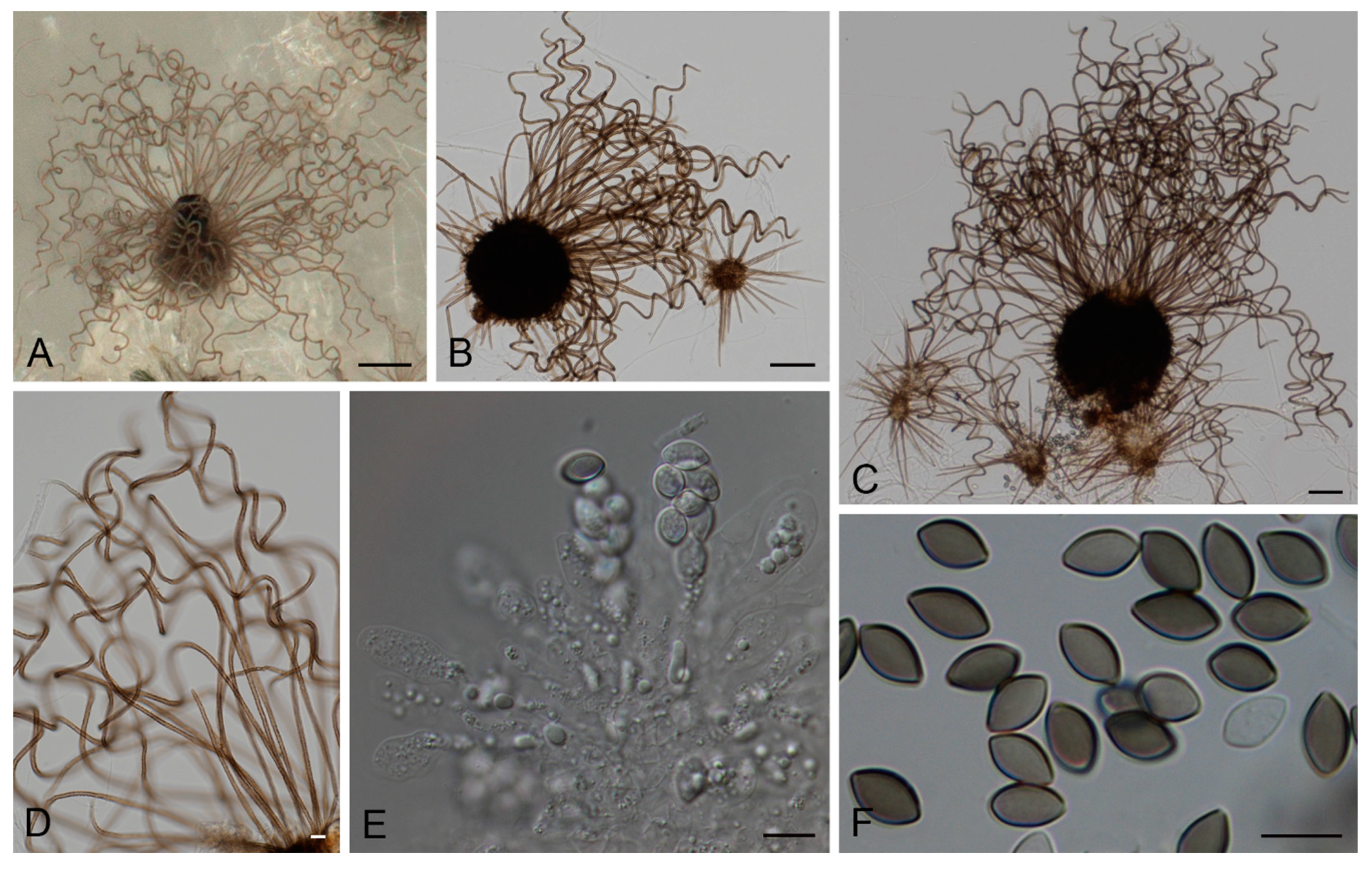
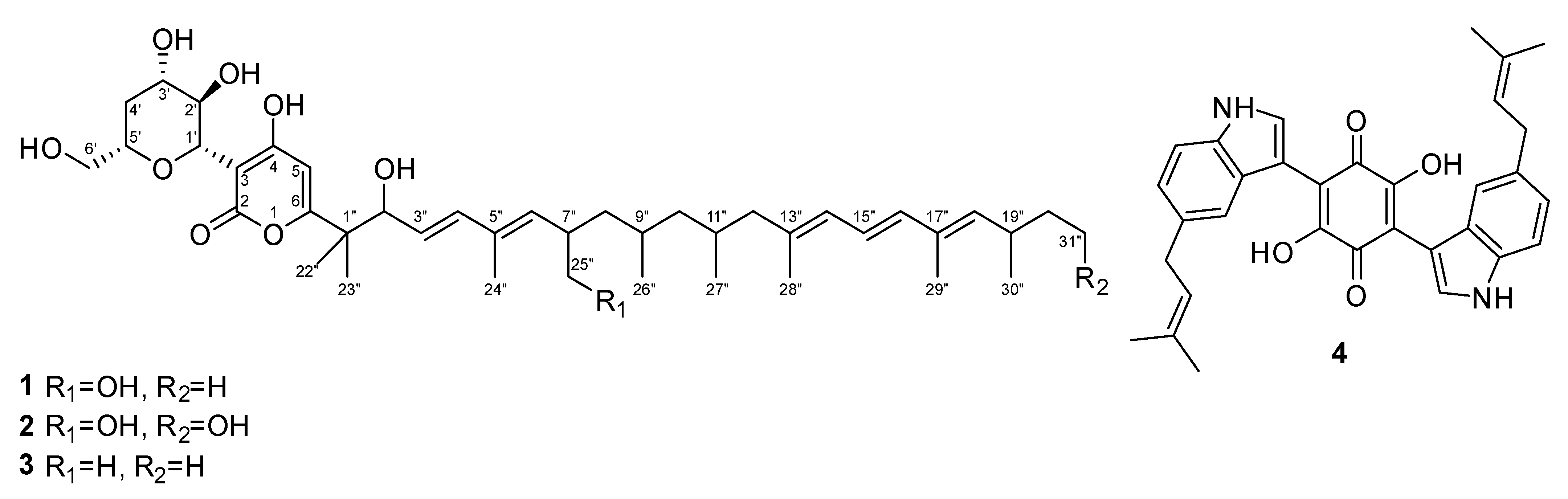
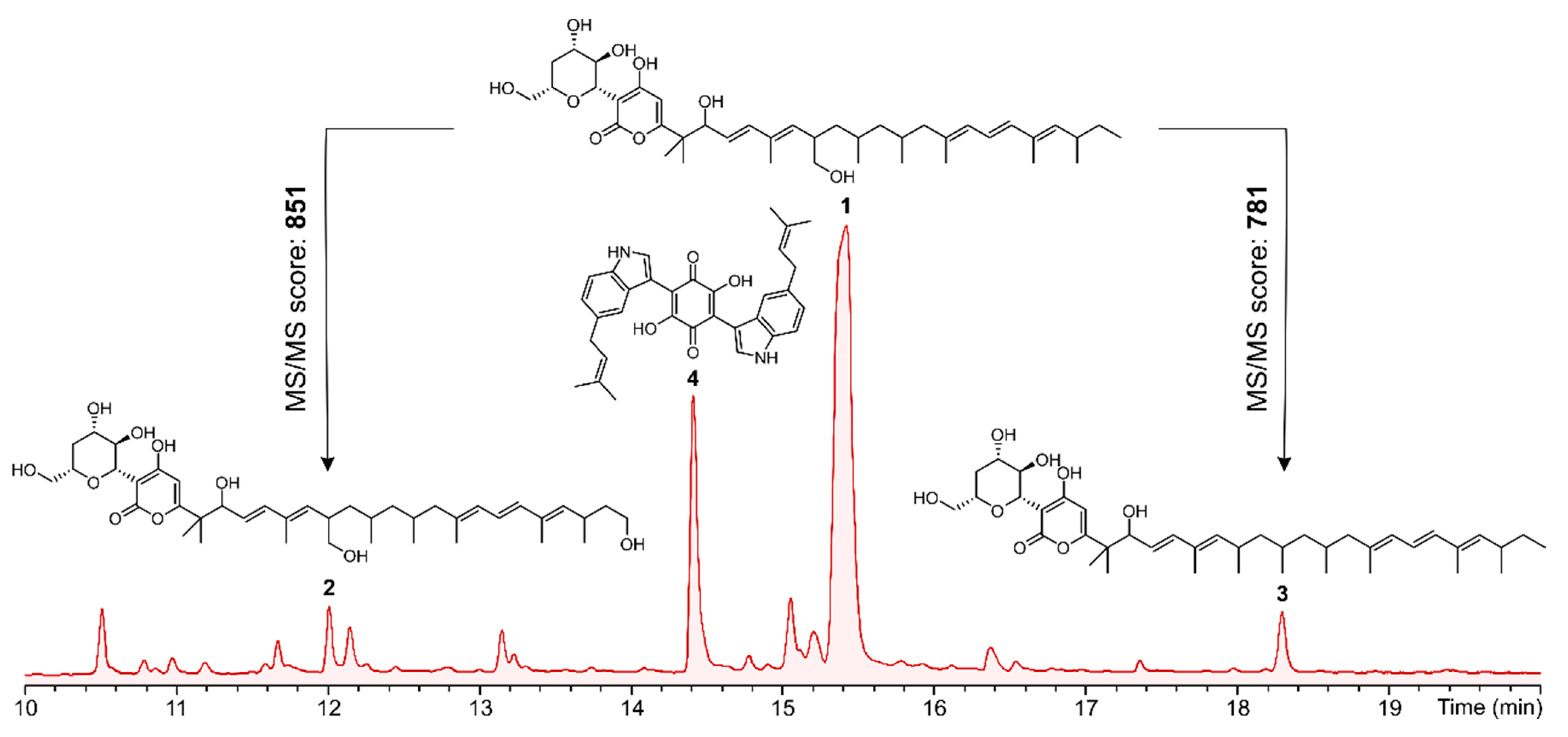

| Taxa | Strain | GenBank Accession Number | References | |||
|---|---|---|---|---|---|---|
| LSU | ITS | rpb2 | tub2 | |||
| Amesia atrobrunnea | CBS 379.66 T | JX280666 | JX280771 | KX976798 | KX976916 | [14,28] |
| CBS 250.75 | MH872650 | KX976575 | KX976799 | KX976917 | [14,29] | |
| A. cymbiformis | CBS 175.84 | MH873429 | KX976576 | KX976799 | KX976917 | [14,29] |
| CBS 176.84 | MH873430 | KX976577 | KX976800 | KX976918 | [14,29] | |
| A. dreyfussii | CBS 376.83T | MH873331 | MH861613 | MZ342985 | MZ343023 | [29,30] |
| A. khuzestanica | IRAN 3489CT | - | MT551117 | MN275706 | MN275701 | [31] |
| SCUA-Saf-B16-2 | - | MT551118 | MN275707 | MN275702 | [31] | |
| A. nigricolor | CBS 600.66T | MH870559 | KX976578 | KX976802 | KX976920 | [14,29] |
| CBS 291.83 | MH873317 | KX976579 | KX976803 | KX976921 | [14,29] | |
| A. gelasinospora | CBS 673.80T | MH873069 | KX976580 | KX976804 | KX976922 | [14,29] |
| CBS 643.83 | KX976706 | KX976581 | KX976805 | KX976923 | [14] | |
| A. hispanica | CBS 149852T | OQ100832 | OQ100090 | OQ108867 | OQ108868 | Present study |
| A. raii | CBS 107.83T | - | - | MZ342968 | - | [30] |
| CBS 106.83 | - | - | MZ342967 | - | [30] | |
| Corynascella humicola | CBS 337.72T | MH872209 | KX976656 | KX976850 | KX976998 | [14,29] |
| Humicola fuscoatra | CBS 118.14T | MH866152 | KX976675 | KX976882 | KX977017 | [14,29] |
| H. olivacea | CBS 142031T | KX976770 | KX976676 | KX976883 | KX977018 | [14] |
| Subramaniula anamorphosa | CBS 137114T | KP970641 | KP862598 | KP900667 | KP900704 | [32] |
| S. cristata | CBS 156.52T | KX976788 | KX976690 | KX976903 | KX977038 | [14] |
| S. thielavioides | CBS 122.78T | KP970654 | KP862597 | KP900670 | KP900708 | [32] |
| Thielavia fragilis | CBS 456.73T | KX976791 | KX976693 | KX976907 | KX977042 | [14] |
| T. hyrcaniae strain | CBS 353.62T | KM655368 | KM655329 | KX976908 | KX977043 | [14,33] |
| T. kuwaitensis strain | CBS 945.72T | MH872326 | KM655332 | KX976909 | KX977044 | [14,29,33] |
| Bioassay | Test Organism/Cell Line | Compound | Positive Control | |||
|---|---|---|---|---|---|---|
| 1 | 2 | 3 | 4 | |||
| MIC (µg/mL) | Rhizopus arrhizus | 100 | 100 | 50 | nt | 16.65 1 |
| Cryptococcus neoformans * | 6.25 | - | - | nt | 2.08 1 | |
| Aspergillus fumigatus | 6.25 | 25 | 100 | nt | 33.3 1 | |
| Schizosaccharomyces pombe | - | - | 4.2 | - | 8.3 2 | |
| Wickerhamomyces anomalus | - | - | - | - | 8.3 2 | |
| Mucor hiemalis | - | - | 66.6 | - | 8.3 2 | |
| Candida albicans | - | - | - | - | 8.3 2 | |
| Rhodotorula glutinis | 66.6 | - | 4.2 | 66.6 | 4.2 2 | |
| Acinetobacter baumanii | - | - | - | - | 0.26 3 | |
| Escherichia coli | - | - | - | - | 1.7 4 | |
| Bacillus subtilis | - | 66.6 | - | 66.6 | 8.3 4 | |
| Mycobacterium smegmatis | - | - | - | - | 1.7 5 | |
| Staphylococcus aureus | - | - | - | - | 0.42 4 | |
| Pseudomonas aeruginosa | - | - | - | - | 0.21 6 | |
| Chromobacterium violaceum | - | - | - | - | 0.42 4 | |
| IC50 (µM) | L929 | - | - | 32.1 | 5.5 | 0.00134 7 |
| KB 3.1 | - | - | 19.0 | 4.9 | 0.00006 7 | |
Disclaimer/Publisher’s Note: The statements, opinions and data contained in all publications are solely those of the individual author(s) and contributor(s) and not of MDPI and/or the editor(s). MDPI and/or the editor(s) disclaim responsibility for any injury to people or property resulting from any ideas, methods, instructions or products referred to in the content. |
© 2023 by the authors. Licensee MDPI, Basel, Switzerland. This article is an open access article distributed under the terms and conditions of the Creative Commons Attribution (CC BY) license (https://creativecommons.org/licenses/by/4.0/).
Share and Cite
Charria-Girón, E.; Stchigel, A.M.; Čmoková, A.; Kolařík, M.; Surup, F.; Marin-Felix, Y. Amesia hispanica sp. nov., Producer of the Antifungal Class of Antibiotics Dactylfungins. J. Fungi 2023, 9, 463. https://doi.org/10.3390/jof9040463
Charria-Girón E, Stchigel AM, Čmoková A, Kolařík M, Surup F, Marin-Felix Y. Amesia hispanica sp. nov., Producer of the Antifungal Class of Antibiotics Dactylfungins. Journal of Fungi. 2023; 9(4):463. https://doi.org/10.3390/jof9040463
Chicago/Turabian StyleCharria-Girón, Esteban, Alberto Miguel Stchigel, Adéla Čmoková, Miroslav Kolařík, Frank Surup, and Yasmina Marin-Felix. 2023. "Amesia hispanica sp. nov., Producer of the Antifungal Class of Antibiotics Dactylfungins" Journal of Fungi 9, no. 4: 463. https://doi.org/10.3390/jof9040463
APA StyleCharria-Girón, E., Stchigel, A. M., Čmoková, A., Kolařík, M., Surup, F., & Marin-Felix, Y. (2023). Amesia hispanica sp. nov., Producer of the Antifungal Class of Antibiotics Dactylfungins. Journal of Fungi, 9(4), 463. https://doi.org/10.3390/jof9040463

