


Abstract
This study evaluated the in vitro and in planta efficacy of six chemical fungicides (boscalid, captan, copper oxychloride, difenoconazole, pyraclostrobin, and potassium hydrogen carbonate) and two biological control agents (Bacillus amyloliquefaciens subsp. plantarum D747 and Trichoderma atroviride strain SC1) against Diaporthe amygdali, the causal agent of twig canker and shoot blight disease of almond. In vitro assays demonstrated that D. amygdali is highly sensitive to captan, difenoconazole, and pyraclostrobin. Regarding biological products, dual antagonism assays showed high efficacy for T. atroviride. Subsequently, the pre- and post-infection activity of all products was assessed on one-year-old almond plants. Efficacy varied significantly depending on the timing of application. Trichoderma atroviride was effective at all application times, achieving mean percent disease control (MPDC) values of 100% when applied preventively. Pre-infection applications of difenoconazole and pyraclostrobin resulted in 100% MPDC. However, their efficacy progressively decreased when applied post-infection. Bacillus amyloliquefaciens and captan showed variable results, reaching a maximum of 73% and 87% MPDC, respectively, when applied before inoculation. In contrast, boscalid, copper oxychloride, and potassium hydrogen carbonate exhibited very low MPDC values, regardless of application timing. These findings provide valuable information for improving management strategies against D. amygdali in almond orchards.
1. Introduction
Traditionally, almond cultivation in Spain has been considered marginal, frequently associated with suboptimal soils, reliant on rainfed conditions, and managed with minimal inputs, resulting in low yields [1]. However, in recent years, the increasing market value of almonds has transformed this crop into a highly profitable crop when grown in suitable soils with proper agricultural practices [2,3,4].
The intensification of almond cultivation has introduced new phytosanitary challenges, including a rising incidence of pathogens that reduce crop productivity [5,6,7]. Among these pathogens, Diaporthe amygdali has been identified as a significant threat to almond production in the Mediterranean Basin [8,9,10,11,12].
Diaporthe amygdali is the causal agent of twig canker and shoot blight disease of almond trees [8,10,13]. The symptoms of this disease develop in late winter or early spring with rapid drying of shoots, flowers, and leaves. Brown lesions are initially observed around the buds of green shoots and later progress into annual cankers, sometimes accompanied by a gummy exudate, along with twig wilting. In severe attacks, D. amygdali can lead to tree defoliation [13].
The management of twig canker and shoot blight in almond orchards has primarily relied on calendar-based phytosanitary treatments, which are adjusted according to the phenological stages of the crop [1,14]. Currently available control options are limited due to the low number of fungicides authorized for this crop. In Spain, although a threshold of 5% affected buds has been proposed as a management guideline, no fungicide treatments have proven curative efficacy under field conditions once infection is established [1,15].
Several studies have evaluated the in vitro and in planta efficacy of fungicides against D. amygdali, affecting both almond and peach trees [14,16,17,18,19,20,21,22]. In peach orchards, Lalancette and Robison (2002) [14] observed that autumn fungicide treatments reduced canker incidence by 45–63%, while spring applications achieved only 10–28% control. Chlorothalonil and captan were most effective when applied in both seasons, reducing canker incidence by 46–71% [14]. Schnabel and Lalancette (2003) [19] established a classification of fungicide efficacy against D. amygdali in peach, indicating that chlorothalonil, captan, thiram, and ferbam were the most effective, in that order. Thomidis et al. (2009) [20] demonstrated that fungicides such as iprodione, carbendazim, thiophanate-methyl, and tebuconazole completely inhibit mycelial growth of D. amygdali peach isolates in vitro. ZhaoLin et al. (2013) [22] reported prochloraz to be the most effective fungicide against D. amygdali in peach both in vitro and in planta, providing 90–95% control of infected twigs in field trials, while carbendazim and difenoconazole achieved 70–80% efficacy. More recently, Feng et al. (2020) [16] investigated the use of biofungicides against D. amygdali isolated from peach, demonstrating that D-limonene-loaded nanoemulsions inhibited D. amygdali growth by 51.7% with an EC50 of 35.74 μg/mL.
Regarding D. amygdali management on almonds, Tuset et al. (1997) [21] assessed the efficacy of fungicides including benomyl, imazalil, and methyl-thiophanate, reporting reductions in disease severity of 65%, 35%, and 55%, respectively, when spraying the leaves of almond seedlings. Moreover, Rhouma et al. (2008) [18] evaluated the efficacy of benomyl, carbendazim, methyl-thiophanate, copper, and procymidone. Their results showed that benomyl, carbendazim, and methyl-thiophanate completely inhibited mycelial growth and conidial germination of D. amygdali isolated from almond in vitro, and in field trials located in Tunisia, these fungicides reduced infected shoots by more than 70% [18].
While fungicides are known for their benefits in crop production, including increased yields, improved consistency, and enhanced profitability, they also pose significant risks to human health and the environment due to their toxicity and persistence [23]. Furthermore, overuse of fungicides potentially leads to resistance development, threatening long-term efficacy and food security [24,25].
Biological control represents a sustainable alternative that may help to reduce the application rates of fungicides as part of an integrated management strategy. The use of Biological Control Agents (BCAs) against D. amygdali has been scarcely explored. Rhouma et al. (2008) [18] showed that Trichoderma viride and T. harzianum reduced the mycelial growth of D. amygdali by around 25% and decreased the incidence of infected buds by over 50% compared to untreated control, when applied to almond trees both in autumn and spring. In addition, a bacterial suspension of Bacillus licheniformis W10 and its antifungal protein completely inhibit mycelial growth, conidial germination and germ-tube elongation of D. amygdali from peach, and reduce sporulation [26].
Diaporthe amygdali presents a broad infection risk period, as α-conidia can germinate and infect almond trees over a wide range of temperatures (between 5 and 35 °C), allowing infections to occur year-round [27]. Furthermore, many almond cultivars have been reported to be susceptible or highly susceptible to the pathogen [28,29], probably because most of them are derived from a few elite cultivars used intensively in breeding programs worldwide [30].
Recently, genomic analyses of D. amygdali have revealed candidate virulence genes and other factors involved in pathogenicity. The identification of a broad range of biosynthetic gene clusters for secondary metabolites, including those for known phytotoxins and potential novel compounds, along with a large set of candidate effectors, highlights the metabolic versatility and complexity of the D. amygdali secretome [31].
For these reasons, the management of D. amygdali on almond relies on cultural practices and fungicide treatments according to a schedule adjusted by phenological stages of the crop [1,14,19]. However, these treatments are limited to preventive applications made before flowering and leaf autumn, based on the assessed risk of the orchard and local weather conditions, due to their lack of curative efficacy [15]. Lalancette and Robison (2002) [14] considered that an effective fungicide program for D. amygdali would provide at least 90% disease control, but studies performed with different products on peach and almond so far have reported much lower efficacy [16,18,19,21]. Additionally, several of the fungicides evaluated in previous studies have been banned, further reducing chemical control options, and resistance of D. amygdali to thiophanate-methyl, boscalid and fluopyram has been reported [32,33].
Implementing more sustainable management practices, especially those that incorporate biological control, may help to reduce the incidence and severity of diseases affecting almond trees, an issue of great importance for both growers and the almond industry [34]. In the specific case of twig canker and shoot blight disease caused by D. amygdali, further research is crucial to enhance our knowledge and to develop more effective control strategies. Therefore, the objectives of this study were: (i) to evaluate the in vitro efficacy of chemical fungicides and biological control agents (BCAs) currently in use against D. amygdali isolates obtained from almond; and (ii) to determine their pre- and post-infection effectiveness on almond plants.
2. Materials and Methods
2.1. Fungal Isolates
Two fungal isolates of D. amygdali, PHAL-4 and PHAL-45, obtained from almond trees in Spain showing symptoms of twig canker and shoot blight disease and previously characterized [10] were used in this study. They were stored in 15% glycerol solution at −80 °C in cryovials (1.5 mL) in the fungal collection of the Instituto Agroforestal Mediterráneo—Universitat Politècnica de València (Spain). Isolates were grown on potato dextrose agar (PDA; Biokar-Diagnostics, Zac de Ther, France) for 7 days at 25 °C in the dark before the experiments. Both isolates were used for the in vitro evaluation of fungicides and biological control agents (BCAs), while for the evaluation of pre- and post-infection activity on almond plants, only PHAL-45 was used.
2.2. Chemical Fungicides and Biological Control Agents
Six chemical fungicides were evaluated in vitro to determine their efficacy in inhibiting mycelial growth and conidial germination of D. amygdali. Additionally, two BCAs were tested to assess their antagonistic activity against this pathogen (Table 1). The active ingredients and BCAs evaluated were selected based on their authorization for use in almond production and/or for the control of the disease in Spain, according to MAPA (2025) [35] at the time the experiment was conducted.
2.3. Mycelial Growth and Conidial Germination Assay
For mycelial growth evaluation, appropriate volumes of each fungicide were added to potato dextrose agar (PDA; Condalab, Madrid, Spain) to achieve final concentrations of 0.1, 1, 10 and 100 mg a.i. L−1. Mycelial plugs (6 mm in diameter), obtained from the margins of 7-day-old actively growing cultures of D. amygdali isolates PHAL-4 and PHAL-45, were transferred to fungicide-amended plates. Each fungicide concentration and isolate had five replicates. Control PDA plates were prepared similarly but with sterile distilled water added instead of the fungicide solution. Fungicide-amended plates were incubated in the dark at 25 °C for 5 days, after which the diameter of each colony was measured twice perpendicularly. Measurements were made at the same time and averaged. The experiment was performed twice.
For conidial germination evaluation, colonies of D. amygdali were incubated at 25 𠂰C with a photoperiod of 12 h light and 12 h darkness for 30 days to obtain mature pycnidia. A conidial suspension was obtained for each isolate by flooding the agar surface with 12 mL of sterile distilled water and scraping with a sterile spatula. The resulting spore suspension was filtered through two layers of cheesecloth into an Erlenmeyer flask (250 mL). The filtrate was diluted with sterile water, and conidial concentration was adjusted with a hemocytometer to 105 α conidia mL−1. Appropriate volumes of each fungicide were added to PDA to obtain a final concentration of 0.1, 1, 10 and 100 mg of active ingredient per liter (mg a.i. L−1). Two 20 µL drops of the conidial suspensions were deposited on one PDA Petri plate. Five replicates per isolate and per concentration of each fungicide were assessed, and the experiment was performed twice. Control PDA plates were prepared similarly, but with sterile distilled water added instead of the fungicide solution. The plates were incubated for 24 h at 25 °C in the dark. After 24 h, the percentage of germinated conidia was determined by examining 100 conidia in each drop using a microscope (×40 magnification). A conidium was considered germinated when the length of the germ tube was longer than the length of the conidium.
Percentage inhibition of mycelial growth and conidial germination for each isolate at each concentration was calculated as a relative percentage to the corresponding control treatments. Percentages of mycelial growth and conidial germination inhibitions were converted to probits and plotted against log10 values of the fungicide concentration. Probit regression analysis was used to calculate the effective concentration values that inhibited mycelial growth and conidial germination by 50% (EC50 values). The EC50 value was calculated for each isolate and fungicide.
2.4. Dual Culture Antagonism Assay
Antagonistic activity of Trichoderma atroviride SC1 was evaluated using dual cultures. Mycelium plugs of 6 mm diameter were cut from the growing edge of 7-day-old cultures grown on PDA of T. atroviride SC1 and D. amygdali isolates PHAL-4 and PHAL-45. Plugs of T. atroviride SC1 and D. amygdali isolates were plated 1 cm from opposite edges of round 90 mm PDA plates (7 cm apart from each other) along the same diameter. For Bacillus amyloliquefaciens subsp. plantarum D747 dual culture, one drop of 20 µL prepared according to the application rate was placed opposite the D. amygdali mycelium plug as explained before. For both BCAs, Petri plates were incubated at 25 °C in the dark for 11 days. Diaporthe amygdali isolates PHAL-4 and PHAL-45 were individually grown without the presence of BCAs under the same conditions as experimental controls. Each BCA/D. amygdali combination was replicated five times, and the experiment was performed twice.
Table 1.
Chemical fungicides and biological control agents used in the experiments.
After the incubation time, the area occupied by each D. amygdali isolate was measured using ImageJ software (version 2.14.0) [37] based on a reference distance common to all images. The percent of mycelium growth inhibition was calculated using the formula:
[M20] in which A is the area of the pathogen grown in dual culture, and B is the area of the pathogen growing without the BCA (control) [38].
2.5. Evaluation of Pre- and Postinfection Activity of Chemical Fungicides and Biological Control Agents on Almond Plants
Pre- and post-infection activity against D. amygdali was evaluated using 60 cm tall 1-year-old almond plants of cv. “Avijor”, grown on their own roots in plastic pots (220 cc) containing peat moss. Five wounds were made on the stem of each plant by a sterile awl (3 mm in diameter) before the application of the different products in the case of pre-infection treatments, or before the inoculation in the case of post-infection treatments. The first puncture was done on the main stem 15 cm above the surface of the substrate, and four additional punctures were done up in the stem with a separation of 5 cm each. Pre- and post-infection activity of the products was evaluated at different application times: 7, 3, 1, or 0 days before inoculation, or 1, 2 or 3 days after inoculation. These application timings were selected to assess both preventive and potential curative effects.
Products were prepared according to their application rate and were applied with a hand sprayer (W560, Wanger Spraytech Iberica S.A., Molins de Rei, Spain) until runoff. For fungal inoculation, a uniform layer of fine droplets of a conidial suspension adjusted to 105 conidia mL−1 of isolate PHAL-45 was sprayed using a hand sprayer (W560, Wagner Spraytech Iberica S.A., Spain). Different types of control plants were prepared depending on the day the wound was made. Five plants were wounded 7 days before inoculation; five plants were wounded 3 days before inoculation; five were wounded one day before inoculation and, finally, five were wounded on the inoculation day. These control plants were inoculated on the same day (day-0) but were not treated and were used to consider the effect of natural wound healing on infection over time.
Following inoculation, the plants were covered for 24 h with plastic bags to ensure leaf wetness. For the day-0 application (day of inoculation), sprayed plants were allowed to dry for one hour prior to inoculation. There were five replicate plants for each product and application time combination. The experiment was conducted in an environmentally controlled greenhouse at 25 °C, where the plants were randomly distributed, and the experiment was performed twice.
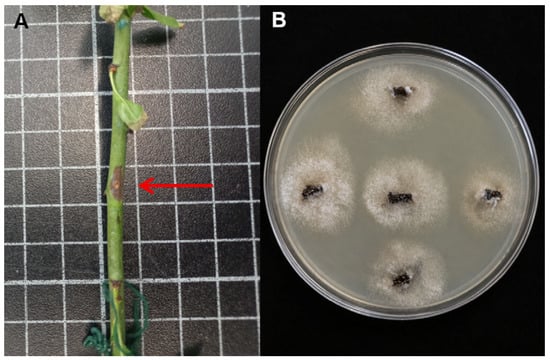
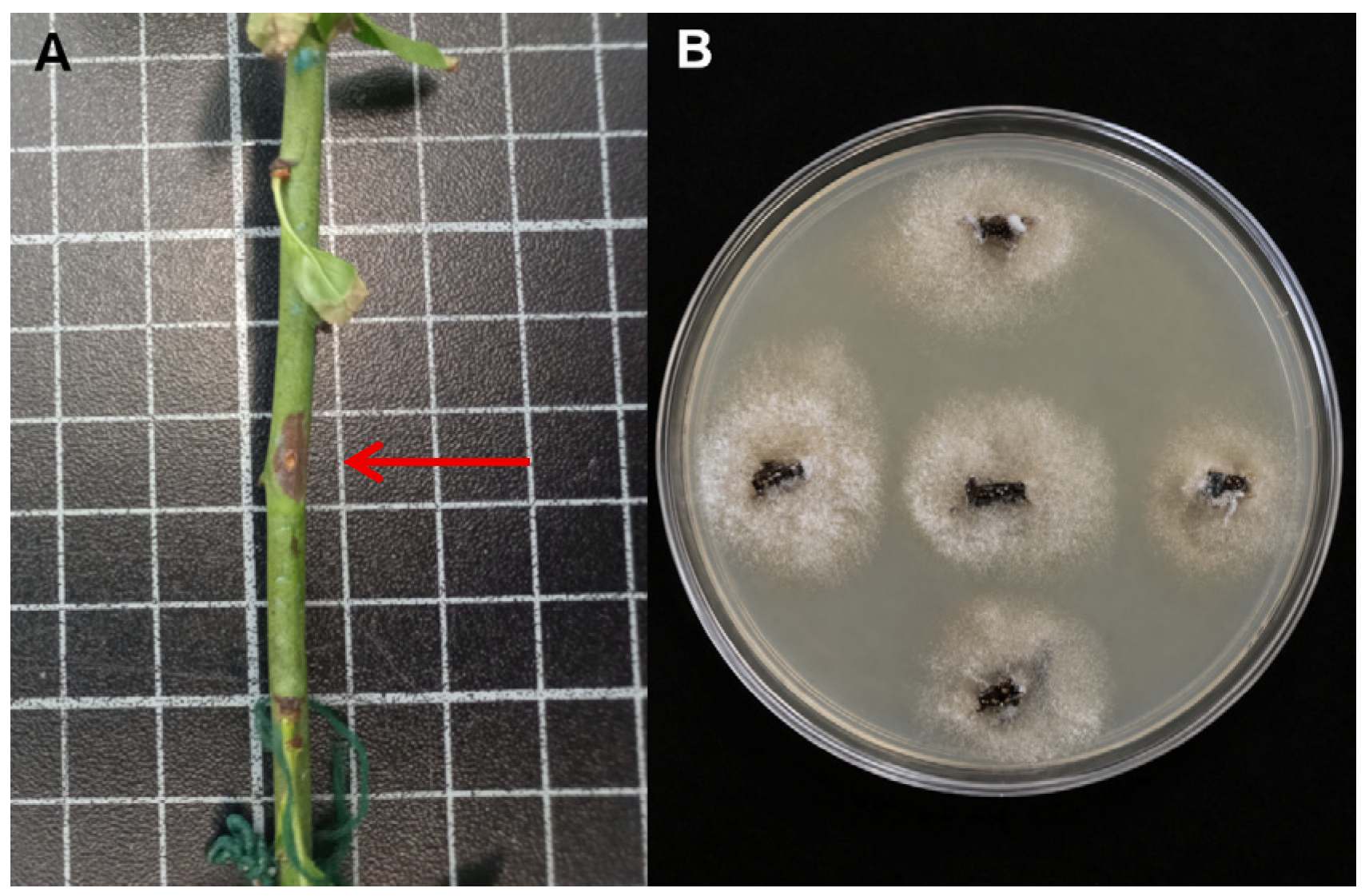
The number of infected wounds per stem was evaluated 12 days after inoculation. For this purpose, five fragments of stem per plant, each containing one wound, were cut, surface disinfected by dipping them in 70% ethanol for 1 min, washed in sterile water, and then dried in a laminar flow cabinet. The five fragments were placed in one PDA plate amended with 0.5 g L−1 of Streptomycin Sulfate (PDAS) to re-isolate the pathogen to determine if the wounds were infected (Figure 1). The percentage of the wounds that were infected was calculated as the number of wounds from which D. amygdali was re-isolated divided by the total number of wounds per stem. The data are presented as the mean percent recovery (MPR). The mean percent disease control (MPDC) was calculated based on the MPR of the corresponding control treatments as:
Figure 1.
Evaluation of pre- and post-infection activity of chemical fungicides and biological control agents on almond plants. (A) Detail of lesion development from the inoculated wound indicated by an arrow; (B) Colonies of Diaporthe amygdaly growing on PDAS from lesions, after 7 days of incubation at 25 °C.
2.6. Statistical Analysis
Data analyses were performed using RStudio version 2025.09.1+401 [39]. For in vitro experiments, including mycelial growth and conidia germination evaluation (EC50 data), the effects of the factors were analyzed using generalized linear mixed models (GLMMs) fitted with a Tweedie distribution and a log link using the glmmTMB function from the glmmTMB package [40]. Prior to model fitting, no significant differences were detected between experiments by the Kruskal–Wallis test (p = 0.089 and p = 0.7795, for mycelial growth and conidia germination, respectively). GLMMs were built by considering the products (fungicides and BCAs) and the isolates as fixed factors, and the experiment as a random factor. The dispersion and residuals of the models were tested by using the functions testDispersion and simulateResiduals of the DHARMa package. Once the significance of fixed effects was assessed (Table 2), pairwise comparisons of means were performed using the emmeans package [41] with Bonferroni adjustment, and grouping letters were generated using the cld function from the multcomp package [42].
Table 2.
Likelihood ratio (Chi-square) tests for fixed effects in the generalized linear mixed models (GLMMs) on mycelial growth and conidial germination of Diaporthe amygdali.
In the dual culture antagonism assay, the Kruskal–Wallis rank-sum test showed that there were no significant differences between the experiments (Table 3). Thus, data from the two experiments were combined.
Table 3.
Kruskal–Wallis rank-sum test for fixed effects on mycelial growth of Diaporthe amygdali.
For the in planta experiment, the effects of product, application time and experiment on MPDC (%) were analyzed using the Kruskal–Wallis rank-sum test by the kruskal_test function of the rstatix package [43]. Once the significance of effects was assessed, pairwise comparisons of MPDC from different products at different days from inoculation were performed using Dunn’s test with Bonferroni adjustment. Letter groups were generated using the multcompLetters function from the multcompView package [44].
3. Results
3.1. Mycelial Growth and Conidial Germination Assay
Significant differences were found among fungicides for both mycelial growth and conidial germination (p < 0.01). Mean EC50 values for the reduction in D. amygdali mycelial growth and conidial germination are shown in Table 4. Captan, difenoconazole, and pyraclostrobin were the most effective fungicides at inhibiting mycelial growth. Their EC50 values for isolates PHAL-4 and PHAL-45 were 24.0 and 24.8 mg a.i. L−1, 0.22 and 0.14 mg a.i. L−1, and <0.1 and 0.1 mg a.i. L−1, respectively. Boscalid, copper oxychloride and potassium hydrogen carbonate were not effective in inhibiting mycelial growth of D. amygdali.
Regarding conidial germination, captan and pyraclostrobin were the most effective fungicides, with EC50 values for isolates PHAL-4 and PHAL-45 of 1.87 and 1.58 mg a.i. L−1 and 0.42 and 0.10 mg a.i. L−1, respectively. Boscalid, copper oxychloride and difenoconazole were less effective, with EC50 values for isolates PHAL-4 and PHAL-45 of 19.79 and 7.68 mg a.i. L−1, 11.24 and 8.38 mg a.i. L−1, and 5.91 and 5.60 mg a.i. L−1, respectively, while potassium hydrogen carbonate was not effective in inhibiting conidial germination of D. amygdali. In general, the EC50 values obtained between the isolates PHAL-4 and PHAL-45 did not differ substantially, except for spore germination of PHAL-45 with boscalid and copper oxychloride, which showed slightly higher sensitivity than PHAL-4.
Table 4.
EC50 values for the in vitro inhibition of mycelial growth and conidial germination of Diaporthe amygdali by the chemical fungicides evaluated.
3.2. Dual Culture Antagonism Assay
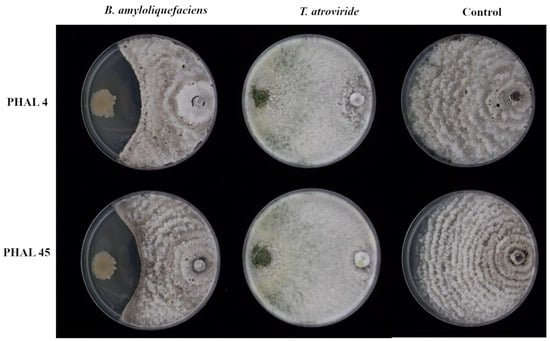
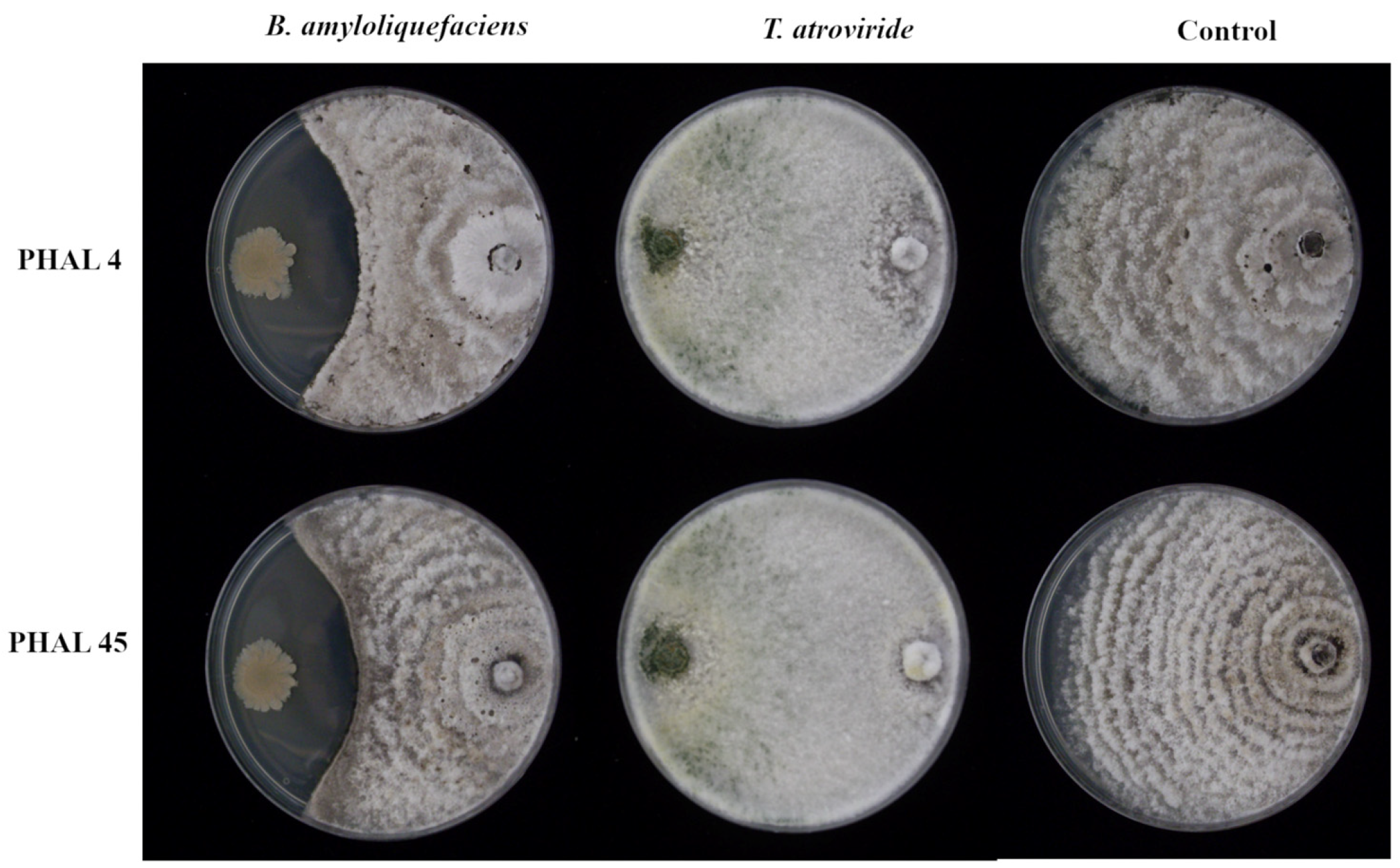
Petri plates showing the results of the dual culture antagonism assay with the two BCAs against D. amygdali are shown in Figure 2. Significant differences between B. amyloliquefaciens subsp. plantarum D747 and T. atroviride SC1 were observed, with PGI values of 29% and 100%, respectively.
Figure 2.
Potato dextrose agar Petri plates showing the antagonistic activity of Bacillus amyloliquefaciens subsp. plantarum D747 and Trichoderma atroviride SC1 against Diaporthe amygdali in the dual culture antagonism assay after 11 days of incubation at 25 °C.
3.3. Evaluation of Pre- and Postinfection Activity of Chemical Fungicides and Biological Control Agents
Statistical analysis showed that there were significant differences among the different products and among application times evaluated (Table 5). In addition, there were no significant differences between the experiments.
Table 5.
Kruskal–Wallis rank-sum test for effects on mean percent disease control (MPDC, %).
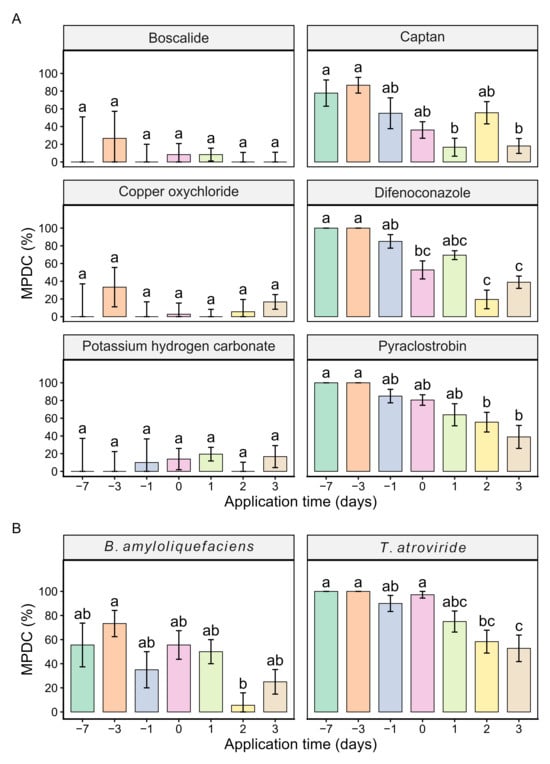
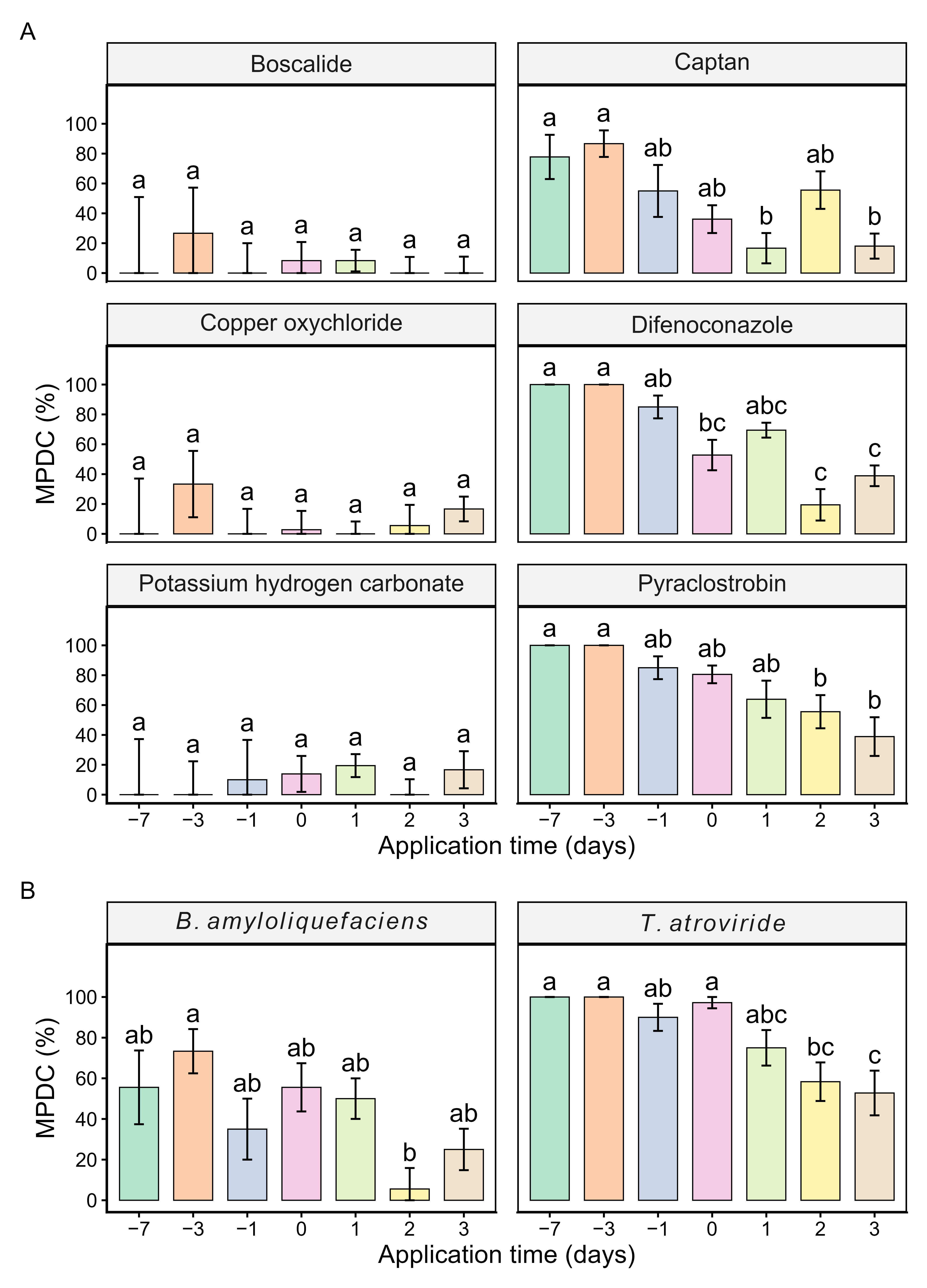
MPR in the non-treated controls increased as the time interval between wounding and inoculation decreased (Supplementary Table S1). Therefore, the analysis was performed relative to the corresponding control. Figure 3 shows the MPDC values of the chemical fungicides and BCAs applied at different times (pre- and post-infection activity). Trichoderma atroviride SC1 was effective at all application times evaluated, with MPDC from 90% to 100% when it was applied as preventive, but when it was applied as post-infection, its efficacy was around 60%. Difenoconazole and pyraclostrobin resulted in MPDC values of 100% when they were applied before inoculation. However, when these fungicides were applied after inoculation, their efficacy progressively decreased, reaching MPDC values of 39% for both of them at 3 days after inoculation. Bacillus amyloliquefaciens subsp. plantarum D747 and captan had variable results, reaching maximum MPDC values of 73% and 87%, respectively, when applied three days before inoculation. Finally, in general, for boscalid, copper oxychloride and potassium hydrogen carbonate MPDC values were very low at most application times (maximum MPDC values of 27%, 33% and 19%, respectively), indicating that these products were the least effective against D. amygdali in both pre-infection and post-infection strategies.
Figure 3.
Mean percent disease control (MPDC, %) of eight products applied at different times (pre- and post-infection): (A) chemical fungicides and (B) biological control agents. Mean percent disease control (MPDC) was calculated as the reduction in mean percent recovery (MPR) relative to the inoculated corresponding control treatment: 100 × (1 − [MPR treatment/MPR control]). Error bars indicate the standard error. Values represented are the mean of ten plants, and different letters within each product show significant differences.
4. Discussion
The present study evaluated six chemical fungicides and two BCAs, through in vitro and in planta experiments, for their potential to control twig canker and shoot blight of almond caused by D. amygdali.
The in vitro experiments with chemical fungicides showed that D. amygdali was highly sensitive to captan, difenoconazole and pyraclostrobin, which were effective in reducing both mycelial growth and conidial germination. Captan showed intermediate EC50 values for mycelial growth, and its performance was better at inhibiting conidial germination. The results obtained with difenoconazole agree with previous in vitro evaluations performed by ZhaoLin et al. (2013) [22] in which difenoconazole showed very low EC50 values (0.0692 mg a.i. L−1) for the mycelial growth of D. amygdali isolates from peach.
Mycelium of D. amygdali was not sensitive to boscalid, copper oxychloride and potassium hydrogen carbonate, while conidia germination was slightly affected by boscalid and copper oxychloride. Potassium hydrogen carbonate did not reduce conidia germination even at high concentrations. Rhouma et al. (2008) [18] performed an in vitro evaluation of fungicides using D. amygdali isolates from almond, in which copper reduced mycelial growth at high doses but did not completely inhibit it.
When these six chemical fungicides were evaluated for their pre- and post-infection activity using almond plants, our results confirmed that pyraclostrobin and difenoconazole were highly effective against D. amygdali when they were applied in a pre-infection strategy, achieving 100% control. However, their efficacy decreased progressively when applied post-infection. Captan showed intermediate performance when it was applied both pre-infection and post-infection. The fungicides boscalid, copper oxychloride and potassium hydrogen carbonate showed, in general, very low effectiveness for the control of D. amygdali either in pre-infection or post-infection applications.
Some of the fungicides used in our study against D. amygdali had been evaluated previously in field trials. In peach orchards, the results of these studies align with our findings. Lalancette and Robison (2002) [14] showed intermediate effectiveness for captan, as this fungicide is more effective in spring applications compared to autumn applications. ZhaoLin et al. (2013) [22] demonstrated a high efficacy of difenoconazole against shoot blight in this crop. On the other hand, in almond orchards, Rhouma et al. (2008) [18], using a copper-based fungicide, observed a 40% reduction in infected shoots when this fungicide was applied during both the autumn and spring periods.
Regarding BCAs, our results showed that T. atroviride SC1 had a high efficacy against D. amygdali both in dual culture antagonism assays and in planta, being more effective in almond plants when it was used preventively, reaching 100% of control at seven days pre-infection applications. Consistent with our findings, Rhouma et al. (2008) [18] reported a high efficacy of T. harzianum and T. viridae strains against D. amygdali on almond trees in both autumn and spring treatments. Bacillus amyloliquefaciens subsp. plantarum D747 had intermediate efficacy against D. amydali both in vitro and in planta.
The results of this study should be interpreted within the context of the experimental conditions, as all inoculations were performed through artificial wounds on one-year-old potted almond plants. Consequently, the efficacy of the product showed performance against wound-mediated infections rather than natural infections. In almond orchards, D. amygdali infection and the efficacy of the products may be influenced by inoculum availability and weather conditions [45]. Therefore, further field trials are required to determine whether the efficacies observed here are maintained under a natural infection scenario. In addition, the in planta assays were conducted using a single D. amygdali isolate, which does not represent variability in fungicide sensitivity and virulence occurring among isolates. Thus, future studies should also include multiple isolates.
Interestingly, fungicides and BCAs showing high efficacy against D. amygdali in our study had been previously evaluated to control other important almond diseases [46,47,48]. Holland et al. (2021) [46] evaluated difenoconazole in a mix with azoxystrobin or cyprodinil to protect pruning wounds against almond trunk pathogens such as Botryosphaeria dothidea, Neofusicoccum parvum, Cytospora sorbicola, Ceratocystis destructans and Eutypa lata, obtaining 66% or 29% efficacy of 66% in a mix with azoxystrobin or cyprodinil, respectively. In addition, Adaskaveg et al. (2022) [49] reported difenoconazole as an excellent and consistent fungicide for the control of brown rot (Monilinia spp.) and anthracnose (Colletotrichum spp.) in almond. Olmo et al. (2017) [47] demonstrated that pyraclostrobin and boscalid reduced the canker lesions compared with those resulting from the untreated almond pruning wounds against Botryosphaeriaceae spp. Adaskaveg et al. (2022) [49] reported that the mix of pyraclostrobin and boscalid was highly effective in controlling brown rot and anthracnose. Moreover, the efficacy of pyraclostrobin and boscalid in a mix was assessed in almond field trials against M. laxa, showing an efficacy of 82.4% and 85.2% in two subsequent years [48].
Regarding BCAs, Holland et al. (2021) [46] found that T. atroviride SC1 had an efficacy of 90% in protecting almond pruning wounds against trunk pathogens. Adaskaveg et al. (2022) [49] indicated that B. amyloliquefaciens had limited or erratic efficacy in controlling brown rot and anthracnose. More recently, Travadon et al. (2023a) [50] evaluated BCAs including T. atroviride SC1 using detached almond stems in the laboratory against the canker pathogens Cytospora plurivora, Eutypa lata, Neofusicoccum parvum, and Neoscytalidium dimidiatum. The results of the detached-almond-stem experiment indicated that T. atroviride SC1 significantly reduced infections by all four pathogens. The abilities of T. atroviride were further evaluated by these authors in field trials to evaluate the protection of almond pruning wounds against E. lata and N. parvum. These results showed that T. atroviride protected almond pruning wounds as efficiently as thiophanate-methyl, a well-known, recommended fungicide for treatment of almond pruning wounds [50]. Additionally, Travadon et al. (2023b) [51] assessed commercial BCAs including B. amyloliquefaciens MBI 600 and T. atroviride SC1 for their ability to prevent almond pruning wound infections by E. lata and N. parvum under field conditions. The results showed that B. amyloliquefaciens treatment was not significantly different from nontreated control plants. In contrast, T. atroviride SC1 provided the best protection against E. lata and N. parvum [51].
The present work provides phenotypic efficacy data for currently available commercial fungicides and well-established commercial biocontrol strains. However, mechanistic aspects, such as the production of volatile or soluble antifungal metabolites, the colonization capacity of biocontrol strains in almond stem tissues, and the induction of host defense responses, were not investigated. Future research should address these mechanisms and explore how chemical fungicides interfere with the physiological processes involved in D. amygdali infection.
5. Conclusions
Our findings provide important insights on the efficacy of captan, difenoconazole, and pyraclostrobin, both in vitro and in planta, supporting their potential use for the management of D. amygdali in almond. We also demonstrate that the use of BCAs is an alternative tool for the management of this disease, with T. atroviride being highly promising. As only one isolate was used in this study, it should be considered that the results may not be representative of the entire pathogen population. These results, together with previous evidence of efficacy against other relevant almond fungal diseases, highlight that different effective products can be combined to design more sustainable integrated pest management strategies, alternating chemical fungicides and BCAs in almond orchards.
Supplementary Materials
The following supporting information can be downloaded at: https://www.mdpi.com/article/10.3390/jof12090700/s1, Table S1: Mean percent recovery (MPR) of Diaporthe amygdali in the non-treated controls according to the days comprised between wounding and inoculation.
Author Contributions
Conceptualization, C.F., J.A. and M.B.; methodology, C.F., J.A. and A.R.; software, M.B.; validation, J.A. and M.B.; formal analysis, C.F. and M.B.; investigation, C.F. and A.R.; resources, J.A., A.R. and M.B.; data curation, C.F. and A.R.; writing—original draft preparation, C.F.; writing—review and editing, J.A., A.R. and M.B.; visualization, J.A.; supervision, J.A. and M.B.; project administration, M.B.; funding acquisition, J.A. and M.B. All authors have read and agreed to the published version of the manuscript.
Funding
This research was financially supported by the Agencia Nacional de Investigación e Innovación (ANII), Uruguay, scholarship code POS_EXT_2021_1_172115. This research was funded by the INIA (Instituto Nacional de Investigación y Tecnología Agraria y Alimentaria), Spain, through Project RTA2017-00009-C04-04, and matching funds from the ERDF (European Regional Development Fund) and Grant PID2020-114648RR-C33 funded by MCIN/AEI/10.13039/501100011033.
Institutional Review Board Statement
Not applicable.
Informed Consent Statement
Not applicable.
Data Availability Statement
The raw data supporting the conclusions of this article will be made available by the authors on request.
Conflicts of Interest
The authors declare that they have no known competing financial interests or personal relationships that could have appeared to influence the work reported in this paper.
References
- Arquero, O.; Belmonte, A.; Casado, B.; Cruz-Blanco, M.; Espadafor, M.; Fernández, J.L.; Gallego, J.C.; García, A.; Lorite, I.; Lovera, M.; et al. Manual Del Almendro; Junta de Andalucia: Sevilla, Spain, 2013. [Google Scholar]
- Calderón-Pavón, A.; Francisco García-Tejero, I.; Noguera-Artiaga, L.; Lipan, L.; Sendra, E.; Hernández, F.; Francisco Herencia-Galán, J.; Antonio Carbonell-Barrachina, Á.; Hugo Durán Zuazo, V. Linking Almond Yield and Quality to the Production System and Irrigation Strategy Considering the Plantation Age in a Mediterranean Semiarid Environment. Agronomy 2025, 15, 1448. [Google Scholar] [CrossRef] [Scilit]
- Egea, J.; Dicenta, F. Análisis de La Evolución Territorial y Varietal Del Cultivo Del Almendro En España. Vida Rural 2015, 404, 36–42. [Google Scholar]
- Malagón, J. Cultivo Del Almendro; Dirección General de Desarrollo Rural: Moncada, Spain, 2020. [Google Scholar]
- Agustı-Brisach, C.; López-Moral, A.; Lovera, M.; Roca, L.F.; Raya, M.C.; Luque, F.; Arquero, O.; Trapero, A. Emerging Diseases of Almond Crop in Southern Spain. Acta Hortic. 2024, 1, 307–312. [Google Scholar] [CrossRef] [Scilit]
- Barrios Sanromà, G.; Aymamí, A. El Futuro de La Sanidad Vegetal Del Almendro. Fruticultura 2016, 49, 128–151. [Google Scholar]
- Ollero-Lara, A.; López-Moral, A.; Lovera, M.; Raya, M.C.; Roca, L.F.; Arquero, O.; Trapero, A. Las Enfermedades Del Almendro En Andalucía. Fruticultura 2016, 49, 166–183. [Google Scholar]
- Diogo, E.L.F.; Santos, J.M.; Phillips, A.J.L. Phylogeny, Morphology and Pathogenicity of Diaporthe and Phomopsis Species on Almond in Portugal. Fungal Divers. 2010, 44, 107–115. [Google Scholar] [CrossRef] [Scilit]
- Gusella, G.; La Quatra, G.; Agustí-Brisach, C.; Trapero, A.; Polizzi, G. Elucidating the Almond Constriction Canker Caused by Diaporthe amygdali in Sicily (South Italy). J. Plant Pathol. 2023, 105, 987–1000. [Google Scholar] [CrossRef] [Scilit]
- León, M.; Berbegal, M.; Rodríguez-Reina, J.M.; Elena, G.; Abad-Campos, P.; Ramón-Albalat, A.; Olmo, D.; Vicent, A.; Luque, J.; Miarnau, X.; et al. Identification and Characterization of Diaporthe spp. Associated with Twig Cankers and Shoot Blight of Almonds in Spain. Agronomy 2020, 10, 1062. [Google Scholar] [CrossRef] [Scilit]
- Varjas, V.; Izsépi, F.; Nagy, G.; Pájtli, É.; Vajna, L. Phomopsis Blight on Almond in Hungary (Pathogen: Phomopsis amygdali, Teleomorph: Diaporthe amygdali). Növényvédelem 2017, 53, 532–538. [Google Scholar]
- Župić, I.; Kožarić-Silov, G. Aktualni Problemi u Zaštiti Intenzivnih Nasada Bajama Od Bolesti i Štetnika. Glas. Biljn. Zašt. 2017, 17, 384–393. [Google Scholar]
- Adaskaveg, J.E. Phomopsis Canker and Fruit Rot. In Compendium of Nut Crop Diseases in Temperate Zones; Teviotdale, B.L., Michailides, T.J., Pscheidt, J.W., Eds.; APS Press: St. Paul, MN, USA, 2002; pp. 27–28. ISBN 0890542848. [Google Scholar]
- Lalancette, N.; Robison, D.M. Effect of Fungicides, Application Timing, and Canker Removal on Incidence and Severity of Constriction Canker of Peach. Plant Dis. 2002, 86, 721–728. [Google Scholar] [CrossRef] [Scilit] [PubMed]
- Gil, A.M.; Arribas Carrasco, G.; Barrios Sanromà, G. Guía de Gestión Integrada de Plagas: Almendro; Ministerio de Agricultura, Alimentación y Medio Ambiente: Madrid, Spain, 2015; ISBN 9788449114434. [Google Scholar]
- Feng, J.; Wang, R.; Chen, Z.; Zhang, S.; Yuan, S.; Cao, H.; Jafari, S.M.; Yang, W. Formulation Optimization of D-Limonene-Loaded Nanoemulsions as a Natural and Efficient Biopesticide. Colloids Surf. A Physicochem. Eng. Asp. 2020, 596, 124746. [Google Scholar] [CrossRef] [Scilit]
- Ji, Z.; Liu, Y.; Gao, R.; Zhang, L.; Zhu, F.; Yang, L.; Dong, J.; Xu, J. Biocontrol Potential of Bacillus licheniformis W10 against Peach Shoot Blight Caused by Phomopsis amygdali. Eur. J. Plant Pathol. 2023, 165, 559–567. [Google Scholar] [CrossRef] [Scilit]
- Rhouma, A.; Ali, M.; Ouerteni, K.; Mezghanni, M. Chemical and Biological Control of Phomopsis amygdali the Causal Agent of Contriction Canker of Almond in Tunisia. Tunis. J. Plant Prot. 2008, 3, 69–74. [Google Scholar]
- Schnabel, G.; Lalancette, N. Constriction Canker Management in Peach. Southeast. Reg. Peach Newsl. 2003, 3, 6–11. [Google Scholar]
- Thomidis, T.; Michailides, T.; Exadaktylou, E. Contribution of Pathogens to Peach Fruit Rot in Northern Greece and Their Sensitivity to Iprodione, Carbendazim, Thiophanate-Methyl and Tebuconazole Fungicides. J. Phytopathol. 2009, 157, 194–200. [Google Scholar] [CrossRef] [Scilit]
- Tuset, J.J.; Hinarejos, C.; Portilla, M.T. Incidence of Phomopsis amygdali, Botryosphaeria berengeriana and Valsa cincta Diseases in Almond under Different Control Strategies. EPPO Bull. 1997, 27, 449–454. [Google Scholar] [CrossRef] [Scilit]
- ZhaoLin, J.; HuiJun, D.; HuiQin, Z.; JianFang, J.; CaiZhen, X.; JingYou, X. Virulence and Control Efficacy in Field of Fungicides on Phomopsis amygdali of Peach. J. Fruit Sci. 2013, 30, 281–284. [Google Scholar]
- Oliver, R.P.; Beckerman, J.L. Fungicides in Practice; CABI: London, UK, 2022; ISBN 9781789246902. [Google Scholar]
- Yin, Y.; Miao, J.; Shao, W.; Liu, X.; Zhao, Y.; Ma, Z. Fungicide Resistance: Progress in Understanding Mechanism, Monitoring, and Management. Phytopathology 2023, 113, 707–718. [Google Scholar] [CrossRef] [Scilit] [PubMed]
- European Food Safety Authority (EFSA); Bellisai, G.; Bernasconi, G.; Binaglia, M.; Carrasco Cabrera, L.; Castellan, I.; Castoldi, A.F.; Santonja, G.G.; Greco, L.; Istace, F.; et al. Updated Reasoned Opinion on the Toxicological Properties and Maximum Residue Levels (MRLs) for the Benzimidazole Substances Carbendazim and Thiophanate-Methyl. EFSA J. 2024, 22, e8569. [Google Scholar] [CrossRef] [Scilit] [PubMed]
- Huang, F.; Hou, X.; Dewdney, M.M.; Fu, Y.; Chen, G.; Hyde, K.D.; Li, H. Diaporthe Species Occurring on Citrus in China. Fungal Divers. 2013, 61, 237–250. [Google Scholar] [CrossRef] [Scilit]
- Francia, C.; Lázaro, E.; Novellón, M.; Ramón-Albalat, A.; Beluzán, F.; Vicent, A.; Berbegal, M.; Armengol, J. Biology and Epidemiology of Diaporthe amygdali: Understanding How Environmental Factors Influence Fungal Growth, Sporulation, Infection and Lesion Development on Almond. Front. Plant Sci. 2025, 16, 1717223. [Google Scholar] [CrossRef] [Scilit] [PubMed]
- Beluzán, F.; Miarnau, X.; Torguet, L.; Zazurca, L.; Abad-Campo, P.; Luque, J.; Armengol, J. Susceptibility of Almond (Prunus dulcis) Cultivars to Twig Canker and Shoot Blight Caused by Diaporthe amygdali. Plant Dis. 2022, 106, 1890–1897. [Google Scholar] [CrossRef] [Scilit] [PubMed]
- Lucchese, P.G.; Dlalah, N.; Buisine, A.; Nigro, F.; Pollastro, S.; Duval, H. Study on the Susceptibility of Some Almond (Prunus dulcis) Cultivars to the Pathogen Diaporthe amygdali. Plants 2026, 15, 165. [Google Scholar] [CrossRef] [Scilit]
- Pérez de los Cobos, F.; Martínez-García, P.J.; Romero, A.; Miarnau, X.; Eduardo, I.; Howad, W.; Mnejja, M.; Dicenta, F.; Socias i Company, R.; Rubio-Cabetas, M.J.; et al. Pedigree Analysis of 220 Almond Genotypes Reveals Two World Mainstream Breeding Lines Based on Only Three Different Cultivars. Hortic. Res. 2021, 8, 11. [Google Scholar] [CrossRef] [Scilit] [PubMed]
- Turco, S.; Brugneti, F.; Cardacino, A.; Mazzaglia, A. Harnessing Genomics of Diaporthe amygdali for Improved Control of Peach Twig Canker and Shoot Blight (TCSB). Plants 2025, 14, 2960. [Google Scholar] [CrossRef] [Scilit] [PubMed]
- Fontaine, S.; Caddoux, L.; Remuson, F.; Barrès, B. Thiophanate-Methyl and Carbendazim Resistance in Fusicoccum amygdali, the Causal Agent of Constriction Canker of Peach and Almond. Plant Pathol. 2022, 71, 785–792. [Google Scholar] [CrossRef] [Scilit]
- Froelich, M.H.; Schnabel, G. Investigation of Fungi Causing Twig Blight Diseases on Peach Trees in South Carolina. Plant Dis. 2019, 103, 705–710. [Google Scholar] [CrossRef] [Scilit] [PubMed]
- Larkin, R.P. Soil Health Paradigms and Implications for Disease Management. Annu. Rev. Phytopathol. 2015, 53, 199–221. [Google Scholar] [CrossRef] [Scilit] [PubMed]
- MAPA Consultas Fitosanitarias. Available online: https://servicio.mapa.gob.es/regfiweb# (accessed on 1 July 2025).
- De Liñán, C. Vademecum de Productos Fitosanitarios y Nutricionales; TecnoAgrícola de España: Madrid, Spain, 2024. [Google Scholar]
- Rueden, C.T.; Schindelin, J.; Hiner, M.C.; DeZonia, B.E.; Walter, A.E.; Arena, E.T.; Eliceiri, K.W. ImageJ2: ImageJ for the next Generation of Scientific Image Data. BMC Bioinform. 2017, 18, 529. [Google Scholar] [CrossRef] [Scilit] [PubMed]
- Úrbez-Torres, J.R.; Tomaselli, E.; Pollard-Flamand, J.; BoulÉ, J.; Gerin, D.; Pollastro, S. Characterization of Trichoderma Isolates from Southern Italy, and Their Potential Biocontrol Activity against Grapevine Trunk Disease Fungi. Phytopathol. Mediterr. 2020, 59, 425–439. [Google Scholar] [CrossRef]
- Posit Team. RStudio: Integrated Development Environment for R. Posit Software; PBC: Boston, MA, USA, 2025; Available online: https://posit.co/Posit (accessed on 6 October 2025).
- Brooks, M.E.; Kristensen, K.; van Benthem, K.J.; Magnusson, A.; Berg, C.W.; Nielsen, A.; Skaug, H.J.; Mächler, M.; Bolker, B.M. GlmmTMB Balances Speed and Flexibility among Packages for Zero-Inflated Generalized Linear Mixed Modeling. R J. 2017, 9, 378–400. [Google Scholar] [CrossRef] [Scilit]
- Lenth, R.V.; Piaskowski, J. Emmeans: Estimated Marginal Means, Aka Least-Squares Means. Available online: https://cran.r-project.org/package=emmeans (accessed on 5 February 2026).
- Hothorn, T.; Bretz, F.; Westfall, P. Simultaneous Inference in General Parametric Models. Biom. J. 2008, 50, 346–363. [Google Scholar] [CrossRef] [Scilit] [PubMed]
- Kassambara, A. Rstatix: Pipe-Friendly Framework for Basic Statistical Tests. Available online: https://cran.r-project.org/web/packages/rstatix/index.html (accessed on 23 July 2026).
- Graves, S.; Piepho, H.-P.; Selzer, L. MultcompView: Visualizations of Paired Comparisons. Available online: https://cran.r-project.org/package=multcompView (accessed on 23 July 2026).
- Beluzán, F.; Vicent, A.; Conesa, D.; Torrentí, F.; Olmo, D.; León, M.; Abad-Campos, P.; Armengol, J. Effect of Weather Variables on the Inoculum of Diaporthe amygdali Causal Agent of Twig Canker and Shoot Blight in Almond Orchards. Phytopathology 2025, 115, 649–658. [Google Scholar] [CrossRef] [Scilit] [PubMed]
- Holland, L.A.; Travadon, R.; Lawrence, D.P.; Nouri, M.T.; Trouillas, F. Evaluation of Pruning Wound Protection Products for the Management of Almond Canker Diseases in California. Plant Dis. 2021, 105, 3368–3375. [Google Scholar] [CrossRef] [Scilit] [PubMed]
- Olmo, D.; Gramaje, D.; Armengol, J. Evaluation of Fungicides to Protect Pruning Wounds from Botryosphaeriaceae Species Infections on Almond Trees. Phytopathol. Mediterr. 2017, 56, 77–86. [Google Scholar] [CrossRef] [Scilit]
- Uysal, A. Control of Monilinia Blossom and Twig Blight (Monilinia laxa) by Boron, Pyroligneous Acid and Boscalid. J. Plant Pathol. 2023, 106, 211–223. [Google Scholar] [CrossRef] [Scilit]
- Adaskaveg, J.E.; Michailides, T.; Eskalen, A. Fungicides, Bactericides, Biocontrols, and Natural Products for Deciduous Tree Fruit and Nut, Citrus, Strawberry, and Vine Crops in California 2022; University of California Agriculture and Natural Resources: California, CA, USA, 2022. [Google Scholar]
- Travadon, R.; Lawrence, D.P.; Li, S.; Trouillas, F.P. Evaluation of Biological Control Agents for the Protection of Almond Pruning Wounds against Infection by Fungal Canker Pathogens. Phytopathology 2023, 113, 1417–1427. [Google Scholar] [CrossRef] [Scilit] [PubMed]
- Travadon, R.; Lawrence, D.P.; Li, S.; Trouillas, F.P. Field Evaluation of Biological Wound Treatments for the Management of Almond, Cherry, and Grapevine Fungal Canker Diseases. Biol. Control 2023, 185, 105292. [Google Scholar] [CrossRef] [Scilit]

Disclaimer/Publisher’s Note: The statements, opinions and data contained in all publications are solely those of the individual author(s) and contributor(s) and not of MDPI and/or the editor(s). MDPI and/or the editor(s) disclaim responsibility for any injury to people or property resulting from any ideas, methods, instructions or products referred to in the content. |
© 2026 by the authors. Licensee MDPI, Basel, Switzerland. This article is an open access article distributed under the terms and conditions of the Creative Commons Attribution (CC BY) license.