


Abstract
Fungal colorants are promising high-value bioproducts, but their translation from laboratory-scale production to commercially relevant products remains constrained by the fragmented development of strains, upstream and downstream operations, stabilization, and applications. This critical review argues that colorant productivity alone is insufficient to define its biotechnological success and that fungal colorant development should be treated as a closed-loop process in which application requirements and performance data inform upstream and downstream decisions. Genome mining, multi-omics, metabolic engineering, and data-driven approaches provide opportunities to connect biological information with strain development and process optimization, although their predictive value remains dependent on experimental validation and reliable biological and process data. Agro-industrial co-products can support fungal biorefineries, but their sustainability depends on the complete production chain rather than on substrate replacement alone. Likewise, stabilization should be evaluated according to application-specific stability and functional performance rather than solely on the basis of pigment retention or encapsulation efficiency. Overall, the evidence supports a shift from production-centered optimization toward integrated fungal biomanufacturing, in which application evaluation feeds back into strain selection, process development, downstream processing, and stabilization. A closed-loop production–stabilization–application framework is therefore proposed to guide the development of reproducible, stable, safe, sustainable, and application-ready fungal colorants.
1. Introduction
Fungal biotechnology provides versatile platforms for the production of high-value bioproducts. Within this field, fungal colorants are of particular interest because their chemical diversity enables applications extending from coloration to functional properties in food, cosmetic, textile, and other industrial products [1,2,3].
Fungal colorants comprise diverse chemical classes, including carotenoids, melanins, polyketide-derived compounds such as azaphilones and anthraquinones, naphthoquinones, and flavins. Genera including Monascus, Talaromyces, Penicillium, Aspergillus, and Fusarium have been investigated as important colorant producers, while differences among species and strains provide opportunities to obtain products with distinct chromatic and physicochemical properties [1,2,3,4]. In addition, fungal colorants can be produced under controlled cultivation conditions, potentially reducing the seasonal and geographical limitations associated with agricultural sources [2].
However, fungal diversity and colorant production capacity do not necessarily translate into technologically or commercially viable products. Development involves interconnected challenges encompassing strain selection, metabolic regulation, cultivation, substrate utilization, recovery, stabilization, safety, and application. High colorant productivity alone may therefore be insufficient, because strains can differ in chemical composition, stability, safety, and processability [5,6,7].
A further challenge is the fragmentation of research across individual stages of the production chain. Studies commonly address strain discovery, cultivation optimization, chemical characterization, biological activity, or stabilization separately, whereas the interactions among these stages ultimately determine the performance of the final bioproduct. For example, fungal secondary metabolism can respond to nutritional and environmental conditions, resulting in changes in colorant production and composition [8,9]. Similarly, structural modifications of fungal colorants can alter their chromatic and physicochemical properties, affecting their stability and application potential [10,11,12]. These observations highlight the need to connect biosynthesis, processing, stabilization, and application rather than optimizing each stage fragmentedly.
Recent advances in fungal biotechnology provide new approaches to address these challenges. Genome mining and the identification of biosynthetic gene clusters can support the discovery and characterization of pathways responsible for secondary metabolite biosynthesis, while metabolic engineering and genome editing provide opportunities to modify these pathways. In fungal colorant production, CRISPR-based engineering has already been applied to improve production in Monascus ruber, demonstrating the potential of targeted genetic modification for strain development [5,13]. Multi-omics approaches can further connect biosynthetic potential with pathway modulation and metabolite production, facilitating a mechanistic understanding of fungal colorant biosynthesis.
At the process level, cultivation conditions strongly influence fungal metabolism and colorant production. Factors such as carbon and nitrogen availability, pH, temperature, oxygen availability, and stress conditions can affect colorant accumulation and composition, while differences among strains further contribute to production variability [8,9,14]. Consequently, advances in process optimization, scale-up, and data-driven approaches should be considered together with molecular strategies for strain development to improve the predictability and reproducibility of fungal colorant production.
Accordingly, this critical review examines fungal colorant biotechnology from an integrated production–stabilization–application perspective, focusing on how fungal diversity, biosynthetic potential, strain development, sustainable feedstocks, bioprocess engineering, downstream processing, stabilization, and application requirements interact to determine the technological value of the final bioproduct. Rather than providing a systematic inventory of fungal colorants, this review adopts a critical and integrative perspective to identify the major technological bottlenecks limiting their translation from laboratory-scale production to reproducible, safe, stable, and commercially relevant bioproducts, evaluate key trade-offs, and propose a closed-loop framework in which application requirements and performance data feed back into biological, process, downstream, and stabilization decisions.
2. Fungal Diversity and Potential for Colorant Production
Fungi are versatile platforms for natural colorant production due to their metabolic diversity, ecological adaptability, and capacity to synthesize structurally diverse secondary metabolites. Compared with many agricultural sources, fungal colorants can be produced under controlled cultivation conditions, potentially reducing the effects of seasonality and geographical variation [2]. Fungal colorant production has been reported across diverse fungal groups, with genera such as Monascus, Talaromyces, Penicillium, Aspergillus, Fusarium, and Rhodotorula representing important examples [1,2,3].
The genus Monascus is one of the most established fungal platforms for natural colorant production. Species such as Monascus purpureus and M. ruber produce mixtures of yellow, orange, and red colorants, commonly referred to as Monascus colorants, and have been extensively investigated for food and industrial applications [5,15]. In contrast, Talaromyces has attracted increasing attention because several species, including Talaromyces purpurogenus and Talaromyces atroroseus, produce extracellular red and yellow colorants [9,14]. Extracellular production is particularly relevant from a bioprocessing perspective because it may facilitate product recovery and reduce the need for extensive cell disruption. Moreover, substantial differences among strains indicate that fungal biodiversity represents an important reservoir for identifying producers with distinct color profiles, productivity, and physicochemical characteristics [7,9,16].
Beyond these established genera, Penicillium, Aspergillus, Fusarium, and other filamentous fungi contribute to the diversity of known fungal colorant producers. Colorant-producing fungi have also been isolated from marine, extreme, and other poorly explored environments, expanding the range of fungal taxa and ecological niches associated with colorant biosynthesis. This diversity is particularly relevant for biotechnology because different strains may provide distinct colorant profiles, production phenotypes, tolerance to process conditions, or extracellular secretion capabilities [1,2,16]. Accordingly, systematic bioprospecting remains an important strategy for expanding the fungal colorant portfolio and identifying strains with characteristics suited to specific technological applications [4].
The chemical diversity of fungal colorants is closely associated with the diversity of their biosynthetic origins and provides a broad molecular basis for natural color production. Among the best-characterized groups are carotenoids, melanins, and polyketide-derived colorants, with flavins representing an additional important class of fungal chromophores [1,3].
Fungal carotenoids, a class of terpenoid compounds, are typically associated with yellow, orange, and red hues, whereas melanins, which belong to a chemically distinct class of colorants, predominantly produce brown to black pigmentation. Polyketide-derived colorants constitute one of the most structurally diverse groups and include azaphilones, anthraquinones, hydroxyanthraquinones, naphthoquinones, and other quinone derivatives, collectively contributing to yellow, orange, red, purple, and, in some cases, blue coloration. Flavin-derived compounds, such as riboflavin, are mainly associated with yellow pigmentation. Together, these chemical classes contribute to the broad chromatic range observed among fungi, spanning yellow, orange, red, purple, blue, brown, and black hues [1,12]. Table 1 summarizes the chemical diversity of fungal colorants.
Table 1.
Major chemical classes, representative compounds, fungal producers, and biosynthetic origins of fungal colorants.
Among polyketide-derived colorants, azaphilones are particularly relevant because relatively conserved biosynthetic scaffolds can give rise to compounds with markedly different chromatic properties. This is especially evident in Monascus, whose azaphilone colorants include yellow compounds such as monascin and ankaflavin, orange colorants such as rubropunctatin and monascorubrin, and red derivatives such as rubropunctamine and monascorubramine [10]. Their conjugated pyranoquinone-type structures contribute to their intense coloration, while reactions with primary amines and other nucleophiles can generate structurally modified derivatives with altered spectral and physicochemical properties [10,11]. This chemical plasticity illustrates how fungal metabolism can generate structurally related colorants with distinct properties [17].
More broadly, fungal colorants can undergo structural modifications, including oxidation, reduction, and reactions with nucleophilic compounds, which may alter their chromophoric systems and consequently their color and physicochemical properties [10,11,12]. Thus, fungal metabolic diversity provides a molecular basis for generating structurally distinct colorants with different solubility and stability profiles. These structure–property relationships contribute to explaining the versatility of fungal colorants and provide a foundation for understanding how their production can be modulated through biotechnology [17,18].
The biotechnological value of fungi as colorant producers extends beyond the number of colorant-producing species or the diversity of colors they generate. Fungal secondary metabolism is highly plastic, allowing colorant production and composition to respond to nutritional, environmental, developmental, and physiological conditions [1,2]. Changes in carbon and nitrogen availability, pH, temperature, oxygen availability, and stress conditions can alter colorant accumulation and, in some cases, the relative abundance of individual compounds [8,9]. Consequently, distinct colorant profiles may be obtained from the same species or closely related strains, supporting the view of fungal colorants as tunable phenotypes rather than fixed species traits [14]. However, productivity alone does not define biotechnological suitability, as strains may simultaneously produce undesirable metabolites. Strain selection should therefore consider productivity, chemical profile, stability, and metabolic safety [5].
Nevertheless, the presence of bioactive metabolites should not be equated with safety. Some fungal secondary metabolites with biological activity may be undesirable or toxic, depending on their nature and exposure level. For example, fungi of the genus Monascus produce valuable azaphilone pigments, including monascin, ankaflavin, monascorubrin, and rubropunctatin, but certain strains may also produce citrinin, a mycotoxin associated with hepatotoxic and nephrotoxic effects in humans. This co-production highlights the importance of distinguishing desirable pigment production from the potential formation of harmful metabolites [19]. Therefore, the development of functional fungal colorants requires rigorous characterization of both target and non-target metabolites. A commercially relevant colorant-producing strain should consequently combine desirable color and functionality with chemical safety, reproducibility, processability, and compatibility with the intended application [6,7].
Overall, fungal diversity provides a broad biological and chemical resource for the development of natural colorants with differentiated chromatic and functional properties. The combination of diverse fungal taxa, extensive metabolite repertoires, strain-to-strain variability, and metabolic plasticity creates substantial opportunities for tailoring colorant production to specific technological needs [5]. However, realizing this potential requires approaches capable of identifying, characterizing, and rationally manipulating the underlying biological machinery. This has driven increasing interest in genome mining, multi-omics, metabolic engineering, and genome editing as strategies to exploit fungal colorant diversity and improve the predictability of colorant production [5,13,15].
3. Unlocking Fungal Colorant Biosynthesis Through Biotechnology
Many fungal colorants are associated with biosynthetic gene clusters (BGCs) containing core synthases (Polyketide synthase (PKS), Nonribosomal peptide synthetase (NRPS), terpene synthases), tailoring enzymes, transporters, and transcription factors controlled by hierarchical regulatory networks [13,20,21]. Filamentous fungi such as Aspergillus oryzae, A. nidulans, and Penicillium rubens are increasingly used as heterologous hosts for reconstructing these pathways because they provide the cellular machinery and precursor supply required for complex biosynthesis [21]. The ability of fungi to produce diverse colorants reflects the interplay between fungal diversity, biosynthetic capacity, metabolic regulation, and environmental conditions, providing the biological basis for the chemical diversity observed across fungal colorant systems (Figure 1).
Figure 1.
Determinants of fungal colorant diversity. Fungal colorant diversity arises from the interaction between fungal diversity, biosynthetic pathways, metabolic regulation, and cultivation conditions, which collectively influence colorant biosynthesis and the resulting chemical and chromatic diversity.
Fungal colorant diversity is therefore not determined solely by the presence of BGCs, but also by their regulation and expression under specific physiological and cultivation conditions [21]. In Monascus, cultivation conditions can alter mycelial morphology, precursor availability, gene expression, and the relative production of red, orange, and yellow colorants [22]. pH also affects the chemical profile of Monascus colorants, while nitrogen source and mycelial morphology influence azaphilone production [20].
Regulation occurs through both pathway-specific transcription factors and global regulatory networks [21]. Cluster-specific regulators such as AflR, LovE, and AzaR can activate individual BGCs, including otherwise silent pathways. For example, overexpression of AzaR activated the cryptic azanigerone pathway in Aspergillus niger, while activation of afoA induced the silent asperfuranone cluster in A. nidulans [20]. Global regulators, including LaeA and the Velvet complex, coordinate secondary metabolism with environmental and developmental signals [21].
Chromatin-level regulation provides an additional control layer for BGC expression. DNA methylation, histone acetylation, and histone methylation influence cluster accessibility, while manipulation of chromatin modifiers can activate otherwise silent pathways [21,23]. For example, deletion of the histone deacetylase hdaA in Aspergillus terreus activated butyrolactone biosynthesis and induced new azaphilone derivatives. Chemical epigenetic approaches, including histone deacetylase (HDAC) inhibitors and 5-azacytidine, have also been used to stimulate cryptic pathways [20,23].
Exploiting these regulatory mechanisms first requires identification of unexpressed pathways through genome mining. Modern approaches recognize conserved signatures of Non-ribosomal peptide synthetases (nrPKSs), Highly reducing polyketide synthases (hrPKSs), NRPSs, hybrid PKS–NRPS systems, and terpene synthases [13,24]. In azaphilone pathways, characteristic combinations of nrPKS, hrPKS or fatty acid synthase (FAS), FAD-dependent monooxygenase, and O-acyltransferase provide useful markers for identifying candidate BGCs [13,20].
These architectures are represented in experimentally characterized clusters, including the Monascus MonAzP cluster, asperfuranone cluster, A. niger azanigerone cluster, and Chaetomium globosum chaetoviridin/chaetomugilin cluster [13,20]. Whole-genome sequencing has further expanded this potential; in T. atroroseus, genome analysis was used to identify uncharacterized colorant pathways and support downstream cell-factory engineering [25].
Despite these characterized pathways, a large proportion of fungal BGCs remain poorly characterized, limiting the connection between genomic potential and experimentally observed metabolites. Genome-mining approaches and computational frameworks increasingly enable the identification and prioritization of BGCs for natural-product discovery [24]. A representative example is azaphilone biosynthesis: a targeted cblaster search using core proteins from the azanigerone pathway identified 193 BGCs with potential for azaphilone biosynthesis, of which only 8 had been associated with known azaphilone-derived compounds, leaving 185 orphan BGCs for further investigation [13]. This illustrates the unexplored biosynthetic space that genome mining can reveal for fungal-derived colorant discovery.
Identifying candidate BGCs, however, is only the first step toward accessing their biosynthetic potential. Functional characterization requires activation of otherwise silent pathways, either in native hosts through promoter refactoring, transcription-factor overexpression, or chromatin modification, or through heterologous expression using appropriately engineered constructs [23,26].
Connecting genomic predictions with experimentally observed colorant production requires the integration of complementary molecular datasets. As discussed in studies of fungal secondary-metabolite discovery, genomics and genome mining identify biosynthetic potential, transcriptomics reveals condition-dependent gene expression, proteomics provides information on the abundance of pathway-associated proteins, and metabolomics characterizes the resulting chemical profiles and metabolic intermediates [23,27]. These approaches provide complementary rather than interchangeable information: the presence of a BGC does not demonstrate that it is expressed, and gene expression alone does not establish that the corresponding pigment accumulates.
Studies of Monascus illustrate how these datasets can be used to investigate fungal colorant biosynthesis. Integrated metabolomic and transcriptomic analyses associated differences in azaphilone colorant profiles with changes in intracellular metabolism and gene expression, indicating that pigment production cannot necessarily be explained by BGC expression alone [27]. In a complementary study, comparative proteomics, quantitative reverse-transcription PCR, and UPLC-QTOF-MS/MS were used to investigate the effects of glycerol and soluble starch on azaphilone production in Monascus purpureus FAFU618. Glycerol favored the accumulation of monascin and ankaflavin, whereas soluble starch favored rubropunctatin and monascorubrin. These changes were accompanied by differences in protein abundance and the expression of genes associated with primary and secondary metabolism [28]. Together, these studies demonstrate how multi-omics can connect cultivation conditions to molecular responses and the composition of the resulting colorant mixture.
Environmental and nutritional conditions further shape this molecular landscape. The One Strain–Many Compounds (OSMAC) principle provides a framework for understanding how cultivation conditions can alter secondary-metabolite profiles. In M. purpureus FAFU618, glycerol and soluble starch as carbon sources resulted in distinct intracellular and extracellular azaphilone colorant profiles and were associated with differential expression of proteins and biosynthetic genes involved in primary and secondary metabolism [28]. Nitrogen source similarly influenced colorant diversity through changes in intracellular metabolites and transcriptional networks [27]. Thus, integrated multi-omics can help identify metabolic constraints and regulatory nodes that influence pathway flux and product composition, providing an empirical basis for rational strain development [21,27].
For integrated biomanufacturing, the value of multi-omics lies in connecting these molecular findings with measurable process outcomes. Combining genomic and molecular information with fermentation data, such as colorant titer, productivity, substrate utilization, and pigment composition, can help prioritize promising strains, identify conditions for targeted colorant production, and guide subsequent process optimization. These predictions must nevertheless be validated experimentally, since changes in gene expression or metabolite profiles do not necessarily translate into improved production performance. Linking molecular characterization with cultivation optimization, downstream recovery, and product stabilization therefore provides a more comprehensive framework for the development of fungal colorants [21,27].
Translating these insights into strain engineering increasingly relies on genome-editing technologies. CRISPR/Cas9 and Cas12a enable targeted knockouts, knock-ins, promoter integration, and programmable transcriptional regulation [29]. In fungal colorant systems, CRISPR/Cas9 has been used to validate the T. atroroseus talA cluster and to generate M. purpureus strains with deletion of the citrinin BGC [29]. CRISPR-mediated promoter integration and CRISPR activation approaches have also been used to activate silent biosynthetic pathways and increase secondary-metabolite production [29].
Machine learning is increasingly being integrated into the design–build–test–learn (DBTL) cycle to support sgRNA design, promoter and gene-expression optimization, pathway reconstruction, and prediction of titer, rate, and yield [30]. Hybrid mechanistic and machine-learning approaches can integrate genomics, transcriptomics, proteomics, metabolomics, and fluxomics to improve genotype-to-phenotype prediction, particularly when experimental datasets are limited [30].
Data-driven approaches have also shown practical potential in fungal colorant bioprocessing. In Talaromyces amestolkiae, an artificial neural network predicted red colorant production and outperformed polynomial response-surface models in describing experimental kinetics, identifying monosodium glutamate and pH as important process variables [31]. Combined with statistical optimization and bioreactor engineering, such approaches provide a basis for more predictive process development [3].
Overall, the convergence of genome mining, multi-omics, CRISPR-based engineering, heterologous expression, and data-driven modeling is shifting fungal colorant biotechnology from empirical screening toward more predictive development. Key priorities include functional validation of orphan BGCs, standardized multi-omics datasets, expanded genome-editing tools for non-model producers, and integration of these approaches within automated DBTL workflows [24,26,29,30].
4. Sustainable Feedstocks and Fungal Biorefineries
The transition toward more sustainable biomanufacturing systems has increased interest in renewable and underutilized biomass as feedstocks for microbial production [32]. Within this context, agro-industrial co-products represent attractive resources because they are generated in large quantities and frequently contain carbohydrates, proteins, minerals, and other compounds that can support microbial growth and metabolite biosynthesis [32,33]. Rather than being considered solely as waste requiring disposal, these materials can be incorporated into biotechnological processes as alternative carbon and nutrient sources, potentially reducing dependence on refined substrates traditionally used in fermentation media [32]. Fungal systems are particularly relevant to this strategy because of their metabolic versatility, extracellular enzyme production, and ability to grow under both submerged and solid-state fermentation conditions [34]. Consequently, agro-industrial residues have been investigated not only for fungal biomass and enzyme production but also for the biosynthesis of colorants and other high-value secondary metabolites [35].
However, the suitability of an agro-industrial co-product as a fermentation substrate cannot be determined solely by its availability or economic value. Its chemical composition and physicochemical properties can influence fungal growth and product formation, while differences among feedstocks may affect their suitability for fermentation [36]. Fruit peels, cereal brans, oilseed cakes, sugarcane residues, and dairy co-products can provide readily available carbohydrates, whereas lignocellulosic materials present a more complex matrix in which cellulose and hemicellulose are associated with lignin. The availability and balance of carbon, nitrogen, minerals, vitamins, and other growth-promoting compounds therefore determine whether a residue can function as a complete fermentation medium or requires supplementation [37]. This distinction is particularly relevant to fungal colorant production because carbon availability does not necessarily translate directly into colorant biosynthesis; the carbon-to-nitrogen ratio, mineral composition, pH, oxygen availability, and physiological state of the fungus can redirect metabolism toward biomass formation or secondary metabolite production [38]. Therefore, substrate selection should not be based solely on colorant production, but on the overall contribution of the feedstock to process productivity, resource efficiency, product quality, and environmental performance.
The use of agro-industrial hydrolysates as alternative carbon sources can also require detoxification to reduce the concentration of compounds that inhibit microbial growth and metabolite production. In this context, De Lima and Santi et al. (2026) [39] demonstrated the potential of detoxified agro-industrial hydrolysates for red colorant production by Talaromyces sp. The study evaluated sugarcane hydrolysate, orange hydrolysate, rice husk hydrolysate, corn cob hydrolysate, and sugarcane juice as alternative carbon sources following detoxification with activated carbon. These substrates supported red colorant production, highlighting the potential of different agro-industrial streams as feedstocks for fungal pigment biosynthesis. This approach illustrates how hydrolysate detoxification can facilitate the use of complex, residue-derived carbon sources in fermentation, potentially reducing reliance on refined sugars. However, substrate suitability should also be evaluated in terms of residual inhibitor concentrations, nutrient availability, colorant productivity, and the additional material and processing requirements associated with detoxification.
The valorization of lignocellulosic biomass further expands this approach by providing access to agricultural residues such as straw, bagasse, husks, and stalks [40]. However, lignocellulose presents an important technological challenge because cellulose and hemicellulose are embedded within a lignin-rich structure that limits enzymatic and microbial accessibility. Fungal systems can contribute to overcoming this recalcitrance through the secretion of cellulases, hemicellulases, laccases, and peroxidases, making filamentous fungi particularly relevant to lignocellulosic biorefineries. Recent studies describe fungal-mediated conversion of lignocellulosic residues as a route to multiple bio-based products and emphasize the ability of fungi to participate in both biomass deconstruction and subsequent bioconversion steps [41,42]. Nevertheless, direct utilization of untreated lignocellulosic materials may be limited by their structural complexity and by imbalances in nutrient availability.
Pretreatment therefore represents a critical interface between biomass accessibility and fungal metabolism. Preprocessing via physical, chemical, physicochemical, enzymatic, and biological approaches can increase surface area, reduce lignin shielding, disrupt cellulose crystallinity, and release soluble sugars [43]. However, pretreatment should not be regarded simply as a means of maximizing sugar release. Increasing treatment severity can promote sugar degradation and the formation of inhibitory compounds such as furfural, 5-hydroxymethylfurfural (HMF), acetic acid, and phenolic compounds, which may interfere with microbial growth and fermentation. The optimal pretreatment must therefore balance substrate accessibility with inhibitor formation, water and chemical consumption, and overall process feasibility [44,45]. Biological pretreatment using ligninolytic fungi or enzymes may reduce chemical requirements, although its relatively long processing time remains a limitation for industrial implementation.
These considerations become particularly important when agro-industrial substrates are incorporated into fungal biorefineries. Rather than designing a process around a single product, fungal biorefineries integrate feedstock processing, fungal cultivation, product recovery, and secondary-stream valorization to improve overall resource utilization [46,47]. Soluble sugars released during pretreatment can support microbial cultivation, while other biomass fractions and process streams may be directed toward additional value-added products, depending on feedstock characteristics and process configuration [46,47]. For colorant production, this integrated perspective is particularly relevant because downstream recovery may involve solvent extraction, filtration, concentration, and purification, pinpointing that the environmental and economic performance of the process cannot be assessed from fermentation productivity alone.
Accordingly, the incorporation of agro-industrial co-products into fungal biorefineries should follow a sustainability-by-design approach, in which environmental, economic, and resource-efficiency criteria are considered from the early stages of feedstock and process selection rather than evaluated only after process development [48,49]. Sustainability should therefore be assessed across the complete production chain, considering feedstock availability and variability, pretreatment, cultivation, energy and material requirements, downstream recovery, transportation, and residual-stream valorization. Techno-economic analysis (TEA) and life-cycle assessment (LCA) provide complementary approaches for identifying technical, economic, and environmental trade-offs and for comparing alternative biorefinery configurations [50]. Importantly, the use of a low-cost or renewable feedstock should not be considered inherently sustainable if its processing generates disproportionate energy, material, environmental, or economic burdens. A sustainability-by-design approach addresses this limitation by incorporating sustainability criteria into early-stage process and feedstock selection, allowing environmental and economic performance to influence process development rather than being evaluated only after the process has been established [48,49]. Such an approach can guide the selection of feedstocks and process configurations toward fungal biomanufacturing routes that simultaneously improve resource efficiency, economic feasibility, environmental performance, and product quality.
Overall, the use of agro-industrial co-products should be viewed not merely as a strategy for replacing conventional fermentation substrates, but as an opportunity to redesign fungal biomanufacturing systems around integrated resource utilization. Future development should consequently consider feedstock characterization, pretreatment, nutrient balancing, colorant productivity, downstream processability, safety, scale-up, and residual-stream valorization as interconnected factors. Such an approach can help transform individual laboratory-scale demonstrations into robust fungal biorefinery platforms consistent with circular bioeconomy principles.
5. Bioprocess Engineering and Optimization for Fungal Colorant Production
The development of fungal colorants requires the integration of biological and engineering parameters because cultivation conditions can influence fungal growth, secondary metabolism, and process performance. Carbon and nitrogen availability, pH, temperature, oxygen transfer, agitation, moisture, and fungal morphology can interact during cultivation, making process optimization particularly challenging. These interactions are especially relevant in fungal systems because morphology and broth rheology can influence mass transfer and oxygen availability during cultivation [51,52].
Fermentation mode is an important component of process design. Submerged fermentation (SmF) provides relatively high control over pH, temperature, dissolved oxygen, agitation, nutrient concentration, and process monitoring, whereas solid-state fermentation (SSF) can facilitate the use of agro-industrial residues and operate with lower water requirements. However, SSF presents additional challenges associated with heat and mass transfer, moisture distribution, substrate heterogeneity, and process monitoring, particularly during scale-up [2,3]. Therefore, the selection of SmF or SSF should consider the characteristics of the fungal strain, feedstock, target colorant, and downstream process rather than production level alone.
The influence of cultivation conditions on fungal colorant production has been demonstrated across different genera and fermentation configurations. For example, in Monascus purpureus, differences between SmF and SSF have been associated with changes in colorant production and citrinin formation, illustrating the importance of evaluating target pigments alongside potentially undesirable metabolites [51]. In Talaromyces spp., and Rhodotorula glutinis cultivation variables such as pH, agitation, and nutrient availability have been investigated to optimize pigment production, demonstrating the importance of balancing growth conditions with secondary metabolism [53,54]. Similarly, pigment production by Penicillium spp. has been investigated under different cultivation conditions, including the use of alternative nutrient sources and process configurations, highlighting the influence of medium composition on pigment formation. These examples demonstrate that process optimization must be tailored to the fungal species, target metabolite, and fermentation system rather than based on a universal set of operating conditions.
From an engineering perspective, these studies also highlight the need to consider the relationships among cultivation conditions, fungal morphology, oxygen transfer, and product formation. Conditions that promote biomass accumulation do not necessarily maximize colorant productivity, and improvements in pigment production must be evaluated alongside product composition, process reproducibility, and safety. Accordingly, fermentation optimization should integrate biological responses with engineering parameters to identify operating conditions that improve productivity while maintaining the desired product quality.
This example illustrates why process performance should not be evaluated solely by the amount of colorant produced when chemical composition and safety are relevant product attributes. The following subsections further explore these interactions through specific examples of fungal colorant production, highlighting how cultivation conditions, fermentation strategies, and process engineering influence pigment productivity, product characteristics, and process safety across different fungal genera.
5.1. Design of Experiments and Multidimensional Process Optimization
Design of experiments (DoE) provides a systematic approach for evaluating the effects and interactions of multiple process parameters. Screening designs, including Plackett–Burman designs, can be used to identify influential factors, whereas response surface methodology (RSM) can subsequently characterize nonlinear effects and interactions among selected parameters. Such sequential strategies have been applied to fungal colorant production. For example, Sharmila et al. [55] used a Plackett–Burman design to screen medium ingredients for red colorant production by M. purpureus and subsequently applied a central composite design to optimize selected medium components. Similar statistical optimization was applied to Talaromyces albobiverticillius, where carbon and nitrogen sources were screened and subsequently optimized using a central composite design [56]. RSM has also been applied to Monascus systems to optimize fermentation and extraction conditions simultaneously [57]. Table 2 summarizes the principal bioprocess strategies reported for fungal colorant production and their effects on cultivation, morphology, product formation, and process performance.
Table 2.
Bioprocess strategies and their effects on fungal colorant production.
Importantly, DoE should not be interpreted simply as a more efficient strategy for maximizing a single production response. Colorant titer, yield, and volumetric productivity are useful indicators of fermentation performance, but they do not necessarily describe the complete technological performance of a process. In Monascus, for example, changes in pH and nitrogen source can modify both the amount and composition of the colorants produced, demonstrating that an increase in total colorant production may be accompanied by changes in the desired product profile [52]. Accordingly, multidimensional optimization considers biological, process, product, and economic criteria, whereas formal multi-objective optimization provides a methodological framework for evaluating competing objectives simultaneously [63].
The methodological basis for this approach can be supported by multi-objective optimization studies in other bioprocesses. Shadbahr et al. [64] demonstrated simultaneous optimization of ethanol yield/cellulose conversion and enzyme consumption in a cellulosic ethanol process, while Gujarathi et al. [65] explicitly treated yield and productivity as conflicting objectives in a fed-batch lysine bioreactor and identified Pareto fronts representing alternative process solutions. These studies do not concern fungal colorants directly, but they give methodological cues for applying multi-objective optimization when process objectives are potentially conflicting.
Accordingly, multidimensional optimization remains a relatively underexplored opportunity in fungal colorant bioprocessing, rather than an established standard approach in the field. For fungal colorants, relevant objectives may include colorant productivity, product composition, safety, downstream processability, resource consumption, and economic performance. The specific objectives and constraints should be defined according to the intended application and development stage.
Nutritional variables provide a clear example of these trade-offs. Carbon and nitrogen sources can affect fungal growth and secondary metabolism, but their effects are strain- and colorant- dependent. In M. anka, changes in pH and nitrogen source altered both the amount and relative composition of colorants, indicating that nutritional optimization should consider the desired product profile rather than total colorant concentration alone [52]. Similarly, optimization studies with T. albobiverticillius demonstrate that changes in carbon and nitrogen sources can simultaneously affect colorant and biomass formation [56].
Environmental stimuli should likewise be evaluated as interacting process factors. In M. purpureus, pH and agitation have been associated with changes in mycelial morphology and yellow colorant production, with specific morphological characteristics correlating with higher production levels [59]. As exemplified by microparticle-enhanced cultivation, microparticle addition altered mycelial morphology, increased yellow colorant production, and affected the expression of biosynthetic genes [61]. These findings highlight the inclusion of morphology and process-related variables in fermentation development rather than consideration of morphology solely because of cultivation conditions.
Beyond process-level optimization, molecular and omics-based approaches offer opportunities to elucidate the mechanisms underlying fungal colorant biosynthesis. Fungi comprise diverse groups, including yeasts, filamentous fungi, and mushroom-forming fungi, with distinct biosynthetic capabilities. In several characterized fungal pigment-producing systems, particularly those producing azaphilone-type pigments, biosynthetic gene clusters (BGCs) contain genes encoding core biosynthetic enzymes, tailoring enzymes, transporters, and pathway-specific regulators. Genome mining can identify candidate BGCs and reveal the biosynthetic potential of fungal strains; however, the presence of a predicted BGC does not, by itself, demonstrate its expression under specific cultivation conditions or establish the identity of the resulting metabolites.
The relevance of these approaches to fungal colorants is illustrated by Huang et al. [66], who identified a putative azaphilone biosynthetic gene cluster in Talaromyces sp. and investigated its function through overexpression of a pathway-specific transcription factor and gene-inactivation experiments, linking the cluster to the production of sclerotiorin-type azaphilones. This example demonstrates how genomic information and functional validation can advance the understanding of pigment biosynthesis beyond the identification of compounds alone.
Integrating genomic information with transcriptomic, proteomic, and metabolomic analyses can further connect biosynthetic potential with gene expression, enzyme activity, and metabolite accumulation. Transcriptomics can help identify changes in BGC expression under different cultivation conditions, whereas metabolomic profiling can reveal changes in pigment composition and the accumulation of associated metabolites. When integrated with DoE and fermentation data, these approaches may help identify how nutritional and environmental variables affect both colorant production and product composition. Such knowledge can support the rational selection of strains and cultivation conditions, as well as metabolic engineering strategies involving the manipulation of pathway-specific regulators, modification of biosynthetic genes, or activation of otherwise silent BGCs [26,67].
Data-driven approaches, including machine-learning models, are also being investigated to prioritize fungal BGCs and predict properties of their associated secondary metabolites. However, these predictions remain dependent on the availability and quality of characterized genomic and chemical data, and experimental validation is essential. Although these strategies have advanced fungal secondary-metabolite research, their integration into the industrial development and optimization of fungal colorant production remains an emerging opportunity [67,68].
During scale-up, changes in hydrodynamics, oxygen transfer, and fungal morphology can affect process performance. Therefore, scale-up criteria should be selected according to the dominant limitation of the specific fermentation rather than applied universally [69].
Downstream processing should also be considered during process development. Colorant localization, chemical properties, and stability influence the appropriate recovery strategy, while extraction conditions can affect recovery efficiency and the characteristics of the recovered product [7,70]. This relationship indicates that downstream processability should be considered during upstream process development rather than addressed only after fermentation optimization [71].
The integration of upstream and downstream optimization has already been demonstrated in fungal colorant research. Embaby et al. [57], for example, applied response surface methodology to Monascus cultivation using agro-industrial residues while simultaneously considering fermentation and extraction conditions, illustrating the possibility of extending statistical optimization beyond the fermentation stage. Such approaches are consistent with an integrated production perspective in which fermentation performance is evaluated according to its contribution to the final recoverable and usable product.
Overall, process optimization for fungal colorants should therefore move from single-response maximization toward multidimensional process evaluation. Titer, yield, and productivity remain relevant metrics, but they should be interpreted together with product composition, safety, downstream recovery, stability, resource requirements, scalability, and economic feasibility. DoE provides an experimental framework for identifying influential variables and their interactions, whereas multi-objective optimization and data-driven approaches offer opportunities to evaluate trade-offs among competing process objectives. For fungal colorants, this represents an emerging direction rather than a fully established methodology and provides a logical bridge between bioprocess engineering, data-driven development, and the closed-loop production–stabilization–application framework proposed in this review. In this context, integrating BGC information with transcriptomic, metabolomic, and fermentation data could help link cultivation conditions to both colorant productivity and chemical composition. These integrated strategies remain an emerging direction for fungal colorant bioprocessing and provide a logical bridge between molecular biology, bioprocess engineering, data-driven development, and the closed-loop production–stabilization–application framework proposed in this review.
5.2. Downstream Processing: From Fermentation Broth to Colorant Ingredient
Downstream processing begins with the separation and recovery of the colorant-containing fraction and can represent a substantial proportion of the overall production cost. The appropriate recovery strategy depends primarily on colorant localization, chemical properties, stability, and is associated with fungal biomass or extracellular components [7,70]. Fungal colorants may be intracellular, extracellular, or distributed between both fractions, and this distinction determines whether cell disruption is required. Extracellular colorants can generally be recovered from the clarified fermentation broth by centrifugation or filtration, followed by concentration and purification, whereas intracellular colorants require additional operations to disrupt or permeabilize the fungal biomass [4,7].
In Monascus, colorant localization can vary with culture conditions. Low-pH cultivation, for example, can favor intracellular orange colorants while promoting the formation of extracellular water-soluble colorants under particular nitrogen conditions [72]. Therefore, downstream processing should ideally be considered together with upstream process design. A fermentation strategy that increases extracellular secretion may simplify recovery by reducing the need for biomass disruption, whereas intracellular accumulation can increase solvent demand and downstream complexity.
Solid–liquid extraction using solvent remains one of the most widely used approaches for recovering fungal colorants. Ethanol, methanol, acetone, ethyl acetate, water, and hydroalcoholic mixtures have been employed according to colorant solubility, polarity, matrix composition, and intended application. For food and cosmetic applications, ethanol, water, and hydroalcoholic systems are particularly attractive because of their favorable safety profiles and suitability for downstream processing [73]. The extraction conditions can also influence the chemical stability and composition of the recovered colorants. In particular, orange Monascus colorants such as rubropunctatin and monascorubrin are highly reactive toward amino-containing compounds and can undergo amination reactions leading to the formation of red derivatives. Consequently, acidic extraction conditions, typically using acidified aqueous ethanol, have been employed to minimize these transformations and preserve the original colorant profile during extraction and analysis [74].
Extraction efficiency depends on solvent composition, solid-to-liquid ratio, temperature, extraction time, particle size, and agitation. These variables can themselves be optimized using DoE. Shetty et al. [75], for example, applied RSM to optimize extraction of red colorant from Monascus sanguineus grown on broken rice, considering extraction time, ethanol concentration, liquid-to-solid ratio, and agitation speed. The optimized process produced 143.3 ODU/gds (OD units (ODU) per gram of the dry substrate), demonstrating that downstream parameters can be as influential as fermentation variables.
Emerging extraction technologies can reduce solvent consumption and extraction time. Ultrasound-assisted extraction promotes cell disruption and mass transfer through acoustic cavitation and has been investigated extensively for natural colorants. Its effectiveness depends on sonication power, frequency, treatment time, temperature, and solvent-to-solid ratio; excessive energy input, however, it promote oxidation or thermal degradation of sensitive compounds [76]. Microwave-assisted extraction and other intensified extraction approaches may similarly accelerate mass transfer, although their applicability to fungal colorants requires colorant-specific validation rather than direct extrapolation from plant-derived colorants [76].
Following extraction, clarification and concentration are necessary to obtain a technically useful colorant ingredient. Centrifugation and filtration are commonly employed for removing fungal solids, whereas membrane processes, adsorption, solvent partitioning, and chromatography can be used when higher purity is required [77]. Macroporous adsorption resins are particularly promising for colorant fractionation because they can combine adsorption and selective desorption while reducing reliance on repeated liquid–liquid extraction [78].
Chromatographic methods, particularly reversed-phase HPLC, remain important for the analytical characterization and purification of individual colorant molecules. However, the downstream strategy should be selected according to the required product specification and intended application, since the cost and complexity of recovery and purification increase with the processing requirements and target purity [7]. Alternative separation approaches, including membrane filtration and adsorption-based processes, have also been investigated for fungal colorants. Membrane-based filtration has been demonstrated for the concentration and separation of individual fungal colorants from Fusarium solani, while macroporous resin adsorption has been used to separate yellow and orange Monascus colorants [78,79]. These approaches illustrate that downstream processing can be configured according to the characteristics of the colorant and the required product specification, with chromatography remaining particularly relevant when highly purified individual molecules are required.
The final drying step converts the concentrated colorant extract into a stable and transportable ingredient. Lyophilization is widely used at laboratory scale because it operates at low temperatures and can better preserve thermolabile compounds, but its relatively high energy consumption and long processing time can limit industrial application [80]. Spray drying is more attractive for large-scale production because it provides continuous operation, rapid solvent/water removal, and good control over powder characteristics. However, exposure to elevated temperatures can affect colorant stability, requiring optimization of inlet and outlet temperatures, feed solids, residence time, and carrier composition [81].
Overall, downstream process selection should balance colorant recovery, purity, stability, solvent consumption, energy demand, scalability, and regulatory requirements. Accordingly, downstream processability should be considered a strain-selection criterion, particularly when comparing intracellular and extracellular producers. For intracellular colorants, efficient cell disruption and solvent penetration are critical, whereas extracellular colorants may permit simpler clarification and concentration schemes. Importantly, the extraction process itself can modify colorant composition, particularly for chemically reactive fungal colorants such as azaphilones. Thus, an integrated upstream–downstream strategy is essential to maximize not only colorant concentration but also the preservation of the desired color characteristics and chemical profile throughout the conversion of fermentation broth into a standardized colorant ingredient.
6. Stabilization and Encapsulation of Fungal Colorants
The stabilization of fungal colorants is a critical step in their transition from microbial production to practical applications. Despite their chemical diversity and promising technological and biological properties, fungal colorants can be affected by pH, temperature, light, solubility limitations, aggregation, and interactions with other formulation components [82,83]. Importantly, stability is not solely an intrinsic property of the colorant molecule but also depends on the physicochemical environment in which it is dispersed. Interactions with proteins, polysaccharides, cyclodextrins, and other matrix components can modify colorant solubility, aggregation, chemical reactivity, and resistance to environmental stresses [83,84,85]. Consequently, stabilization should be regarded as the engineering of colorant–matrix interactions rather than simply the protection of an isolated molecule.
The mechanisms underlying instability depend strongly on fungal colorant chemistry. Oxidation, photochemical reactions, structural transformation, aggregation, precipitation, and reactions with other compounds may modify chromophore integrity and consequently affect color intensity and hue. This is particularly relevant for azaphilone colorants, whose chemical reactivity can be exploited to generate derivatives with different properties but may compromise color reproducibility when uncontrolled [10,11]. In Monascus, for example, orange colorants such as monascorubrin can react with amino-containing compounds to generate red derivatives. This amination reaction is strongly influenced by pH, being promoted under alkaline conditions and inhibited under acidic conditions [11]. Conversely, complexation with hydroxypropyl-β-cyclodextrin (HP-β-CD) can improve water solubility and maintain the orange color over a broad pH range [83].
The pH is therefore a major determinant of fungal colorant stability because it can simultaneously affect solubility, aggregation, ionization, and chemical reactivity. In aqueous systems, acidic conditions can promote precipitation of Monascus colorants, limiting their use in low-pH formulations. Gum arabic prevented colorant precipitation at pH 3–4 through colorant–polymer interactions, electrostatic repulsion, and steric stabilization [82]. Similarly, HP-β-CD complexation improved the solubility and pH stability of monascorubrin while preserving its orange color between pH 3.5 and 9.0 [83]. These studies demonstrate that substantial improvements in stability can be achieved by dispersion and molecular complexation without necessarily forming a conventional microcapsule.
Temperature is an important factor affecting the stability of fungal colorants, particularly during thermal processing and under acidic conditions. Sodium caseinate formed complexes with Monascus colorants and improved their solubility and stability during heating under acidic conditions, partly by reducing aggregation [85]. These findings indicate that carrier materials can modify the chemical and physical microenvironment surrounding the colorant, thereby influencing its stability under specific processing conditions.
Light exposure represents another critical factor affecting colorant stability. Protein–polysaccharide systems have provided protection against light exposure; soy protein isolate–maltodextrin complexes retained approximately 80% of the colorant under illumination and reduced color differences relative to the free colorant, with hydrophobic interactions and hydrogen bonding contributing to stabilization [84]. However, the effectiveness of photostabilization depends on the light conditions and the characteristics of the colorant. Recent work on Monascus colorants demonstrated substantial differences in stability depending on the light source, with simulated sunlight causing pronounced degradation and the response varying among colorant fractions. Mechanistic analysis suggested that electron-transfer processes involving the conjugated chromophore contribute to photodegradation [86]. Therefore, stabilization strategies should be selected according to the predominant stress encountered during processing, storage, and application, since a system effective against thermal degradation may not provide equivalent protection against light-induced degradation or oxidative stress.
These findings support a technological continuum extending from simple stabilization and complexation to microencapsulation and more structured delivery systems. Rather than representing a linear replacement of one technology by another, these approaches constitute complementary tools that can be selected according to the dominant instability mechanism and the requirements of the final application. Simple stabilization strategies may be sufficient when the main limitation is precipitation, aggregation, or poor solubility [82,83]. Molecular complexation can additionally modify colorant reactivity and accessibility, whereas microencapsulation provides a physical barrier between the colorant and the surrounding environment. More complex architectures, including liposomes, hydrogels, and protein microgels, can provide additional control over interfacial interactions, stability, and, in some systems, release behavior [87,88,89,90].
Among microencapsulation technologies, spray drying is particularly relevant for fungal colorants because it enables liquid colorant preparations to be converted into dry powders using a scalable process. However, its performance depends strongly on wall-material composition and processing conditions. In Monascus, maltodextrin-based carrier systems have been investigated to improve the physical and color properties of spray-dried colorant powders, while sodium alginate-based formulations have also been explored for improving colorant stability [87,91].
Microcapsules produced through emulsification/internal gelation followed by spray or freeze drying have also demonstrated improved stability of Monascus red colorants under selected environmental stresses [87]. Therefore, spray drying should be considered not merely as a drying operation but also as a means of modifying the physical environment surrounding the colorant.
The importance of carrier selection is particularly evident when comparing encapsulation efficiency with actual colorant performance. In T. amestolkiae, chitosan microparticles achieved approximately 86% encapsulation efficiency, whereas maltodextrin achieved approximately 56%. Nevertheless, both systems improved thermal stability, while maltodextrin provided greater protection of the red colorant under alkaline conditions [92]. Thus, higher encapsulation efficiency did not translate into superior protection under every stress condition. This observation highlights a fundamental limitation of using encapsulation efficiency as the primary indicator of stabilization performance: encapsulation efficiency alone does not necessarily predict the preservation of colorant properties under different stress conditions.
Alternative delivery architectures further expand the stabilization toolbox. Liposomes containing Monascus red colorants improved stability under several environmental stresses, including pH, temperature, light, metal ions, and storage, and reduced colorant degradation during illumination compared with free colorant [88]. Protein-based systems have also emerged as promising alternatives. Direct protein microgelation produced sub-10 μm particles and improved the stability of Monascus red colorants under heating, acidic conditions, and sunlight by approximately 10–20% relative to the free colorant [90]. These systems illustrate the increasing shift from passive encapsulation toward deliberate engineering of the colorant’s physicochemical microenvironment.
Importantly, colorant stability and formulation-level color stability should be considered related but distinct endpoints. Changes in the color of a final formulation may result from chemical degradation of the colorant but may also reflect aggregation, precipitation, redistribution, phase behavior, or other physical changes in the surrounding matrix. Consequently, colorimetric parameters such as CIELAB and ΔE are valuable indicators of product-level color performance but do not, by themselves, establish molecular colorant degradation. Comprehensive stability assessment should therefore combine colorimetric measurements with complementary analyses of colorant retention and chemical integrity [84,92].
This distinction is particularly relevant when evaluating fungal colorants intended for complex formulations. A carrier may preserve the apparent color while altering colorant accessibility or chemical form, whereas another system may retain the colorant chemically but produce undesirable changes in its optical properties. Therefore, the most appropriate stabilization strategy should be defined by the requirements of the final application rather than by encapsulation efficiency alone. This application specific stability should be evaluated according to the relevant processing, storage, and use conditions of the intended product. For example, systems limited by precipitation may benefit from simple polymeric stabilization or complexation, whereas colorants susceptible to photodegradation may require molecular inclusion, protective matrices, or structured delivery systems. Applications requiring controlled release may justify more complex architectures such as hydrogels, liposomes, or protein microgels [82,83,87,88,90].
Overall, fungal colorant stabilization has evolved from improving solubility and preventing precipitation toward increasingly sophisticated control of colorant–matrix interactions and delivery architectures. However, greater structural complexity should not automatically be interpreted as superior stabilization. The appropriate strategy depends on colorant chemistry, degradation mechanism, processing conditions, formulation environment, and intended application. Future studies should therefore move beyond encapsulation efficiency and integrate colorant retention, chemical integrity, CIELAB color parameters, degradation kinetics, particle and matrix characteristics, and preservation of biological or technological functionality. Such a multidimensional approach would enable fungal colorants to be developed not merely as protected colorants, but as engineered functional ingredients whose stability is optimized within their intended application environment [82,83,87,88,90,92]. As summarized in Table 3, reported stabilization strategies reveal a progressive technological evolution from relatively simple stabilization and complexation approaches toward structured microencapsulation systems and, more recently, liposomal and protein-microgel platforms.
Table 3.
Strategies for stabilization and encapsulation of fungal colorants and their reported effects on colorant performance.
This progression should not be interpreted as a linear replacement of one technology by another, but rather as an expansion of the technological toolbox available for fungal colorants. Simpler stabilization or complexation strategies may be preferable when the main limitation is solubility, precipitation, or chemical reactivity, whereas microencapsulation and more structured delivery systems become particularly relevant when protection against multiple stresses or controlled release is required.
7. From Colorants to Multifunctional Ingredients: Applications of Fungal Colorants
Fungal colorants are increasingly investigated not only for coloration but also as multifunctional ingredients in food, cosmetics, textiles, pharmaceuticals, nutraceuticals, packaging, and biomaterials. Their additional antioxidant and antimicrobial activities, however, vary with colorant structure, fungal species, production conditions, and formulation context [1,3]. Application requirements should therefore be considered as design criteria for the colorant production platform, rather than as downstream endpoints. The intended application determines the required color characteristics, chemical composition, stability, safety, formulation compatibility, and functional performance. Importantly, natural origin and multifunctionality do not, by themselves, establish safety or regulatory acceptability. These attributes must be demonstrated for the specific colorant, production process, and intended conditions of use, taking into account the regulatory requirements of the target market.
7.1. Cosmetics: Coloration Combined with Biological Functionality
Cosmetic applications require colorants that provide the desired coloration while meeting formulation and safety requirements. Fungal colorants have been investigated for antioxidant, antimicrobial, and photoprotective properties, while fungal-derived melanins have attracted attention because of their optical, UV-absorbing, and antioxidant properties [3,93,94]. These multifunctional properties must nevertheless be demonstrated in the intended formulation. A red azaphilone colorant produced by T. amestolkiae, for example, was incorporated into facial cream, shampoo, and multifunctional jelly-stick formulations and evaluated for physicochemical properties, antioxidant activity, cytotoxicity, and formulation performance [95]. Thus, cosmetic applications demand a colorant production platform capable of delivering controlled composition and color properties together with formulation compatibility, stability, safety, and, where relevant, validated biological functionality.
Regulatory authorization is an additional requirement for cosmetic applications. In the European Union, Regulation (EC) No. 1223/2009 restricts the use of colorants in cosmetic products to substances listed in Annex IV, subject to the applicable conditions and restrictions. In the United States, color additives must be approved by the Food and Drug Administration (FDA) for their intended cosmetic use, and some also require batch certification [96,97]. Accordingly, experimental incorporation into a cosmetic formulation or demonstration of antioxidant activity does not, on its own, establish that a fungal colorant is suitable or authorized for commercial use. Its identity, purity, toxicological profile, formulation-specific safety, and compliance with the relevant regulatory framework must also be established.
7.2. Textiles: From Coloration to Functional Materials
Textile applications require colorants that can provide reproducible coloration while maintaining adequate performance on the target fiber. Fungal colorants have been investigated as alternatives to conventional dyes and, in some cases, as sources of additional antioxidant or antimicrobial functionality [1,3]. An orange colorant produced by Gonatophragmium triuniae, for example, combined textile dyeing potential with antioxidant and antibacterial activities [98]. Similarly, T. albobiverticillius produced a colorant from pineapple peel waste that was evaluated for textile dyeing and exhibited antibacterial and antioxidant properties [99]. Process conditions and colorant–fiber interactions also determine performance. Monascus colorants incorporated into a nanosuspension enabled one-bath dyeing of silk/polyamide fabrics with good rubbing and washing fastness, UV resistance, and dye-bath reuse, whereas performance varied among regenerated cellulose fibers according to the colorant–fiber combination [100,101].
Therefore, textile applications demand a production platform that provides reproducible colorant properties, compatibility with the target fiber, and application-specific fastness and functional performance. Beyond textiles, fungal colorants may also find applications in active and intelligent packaging. In intelligent packaging, pigments with pH-sensitive or redox-responsive properties can serve as colorimetric indicators of changes in food quality, such as pH variations associated with microbial growth or spoilage [102]. These indicators can produce visible color changes that provide information about the condition of the packaged product. In active packaging, fungal pigments may also contribute to functional packaging systems, provided that their properties are suitable for the intended application. However, their practical implementation requires careful evaluation of color stability, sensitivity, reproducibility, compatibility with packaging materials, and safety under the intended conditions of use.
7.3. Active and Intelligent Packaging: Color as a Functional Signal
In active and intelligent packaging, colorants can serve not only as coloring agents but also as visual indicators or functional components. pH-dependent color changes may provide visual responses to changes in food systems, while antioxidant and antimicrobial activities may contribute to active packaging, depending on colorant chemistry, concentration, and matrix characteristics [103]. An azaphilone colorant from T. purpurogenus, for example, exhibited antimicrobial and antioxidant activities and was evaluated for incorporation into bio-based active packaging [104]. Accordingly, packaging applications demand a production platform capable of controlling colorant composition, stability, and functional response within the intended packaging matrix. For intelligent packaging, the relevant color response must also remain associated with the chemical change that the system is intended to indicate.
The practical implementation of these materials requires careful evaluation of color stability, response sensitivity, reproducibility, compatibility with packaging materials, and safety under the intended conditions of use. When food contact is involved, compliance with the applicable food-contact requirements must also be considered, particularly where migration or the release of functional compounds could affect the packaged food.
7.4. Food and Nutraceutical Applications: From Traditional Use to Value-Added Ingredients
Food applications are among the most established uses of fungal colorants, particularly those produced by Monascus. Their technological relevance derives from their coloring capacity and, for selected molecules, associated biological activities [1,71,105]. Their performance, however, depends strongly on the food matrix and processing conditions. Fungal colorants have been investigated in dairy products, bakery products, beverages, cereals, confectionery, and other foods, with stability during processing and storage remaining an important consideration [1,71]. Mullaiselvan et al. [106] compared monascorubrin from M. purpureus and rubropunctatin from T. purpurogenus as natural food colorants. Both showed favorable thermal and pH stability under selected conditions, antioxidant activity, high recovery after spray drying, and stable red coloration when incorporated into yogurt and ice cream. Because temperature, pH, light, oxygen, and interactions with food components can alter colorant properties, stabilization and formulation are important criteria of application development [71]. Thus, food applications demand a colorant production platform capable of delivering reproducible composition and color, adequate stability under application-relevant conditions, and compatibility with the intended food matrix.
In addition to technological performance, regulatory authorization and chemical safety are essential criteria for food and nutraceutical applications. In the European Union, food colors must be authorized under Regulation (EC) No. 1333/2008 and used in accordance with the applicable conditions and restrictions. In the United States, food color additives are subject to premarket approval for their intended uses; importantly, the generally recognized as safe (GRAS) exemption does not apply to substances when they are used as color additives [107,108]. Consequently, evidence of traditional use, favorable functional properties, or successful incorporation into a food matrix cannot independently establish that a fungal colorant is legally permitted for the intended application.
This example should not be interpreted as evidence that all Monascus-derived colorants are unsafe. Rather, it demonstrates the importance of strain-specific assessment, control of fermentation conditions, and characterization of both the target pigments and non-target metabolites. For fungal colorants intended for food use, safety assessment should therefore address relevant mycotoxins and other potentially hazardous metabolites, product purity, batch-to-batch consistency, and exposure under the proposed conditions of consumption. A maximum permitted contaminant level also does not constitute authorization of the colorant itself.
For food, nutraceutical, cosmetic, pharmaceutical, and medical applications, the safety and regulatory assessment must ultimately reflect the intended product category, route of exposure, target population, and applicable jurisdiction.
7.5. Emerging Applications at the Interface with Nanotechnology and Biomedicine
Beyond established applications in food, cosmetics, textiles, and packaging, fungal colorants are also being investigated in emerging applications involving nanotechnology and biomedicine. For example, extracellular Monascus colorants have been used experimentally as reducing agents for the synthesis of silver nanoparticles, with the resulting nanoparticles showing antimicrobial and other functional properties [109,110]. Biomedical applications similarly require careful chemical characterization and validation, since biological activities reported for fungal extracts or complex metabolite mixtures cannot necessarily be attributed to individual colorants [2,3].
For pharmaceutical applications, regulatory requirements differ from those governing food and cosmetic products. In the European Union, Directive 2009/35/EC establishes requirements concerning the coloring matters that may be added to human and veterinary medicinal products, including compliance with the applicable permitted lists and purity criteria [111]. In the United States, color additives must be approved for the intended use in the relevant product category, and authorization for food or cosmetic use does not automatically authorize pharmaceutical use [96,107]. Therefore, the use of a fungal pigment in a pharmaceutical formulation requires consideration of its identity, purity, impurities, toxicological profile, compatibility with other formulation components, route of administration, and applicable regulatory requirements. Where a fungal metabolite is intended to exert a therapeutic effect rather than serve solely as a colorant, its regulatory assessment must also reflect that intended function.
More importantly, emerging applications should be application driven. The requirements of the final application should define the relevant product attributes, including composition, purity, stability, solubility, matrix compatibility, safety, and functional performance [7]. For nanotechnology and biomedical applications, additional criteria such as dispersibility, colloidal stability, biocompatibility, and toxicity may be taken into account [112]. For emerging applications, production and stabilization strategies should be selected according to the specific requirements of each application, including colorant stability, safety, compatibility, functionality, and regulatory compliance.
Overall, the development of fungal colorants for established and emerging applications requires an integrated approach that combines production optimization with chemical characterization, control of potentially hazardous co-produced metabolites, application-specific performance testing, toxicological evaluation, and regulatory assessment. Incorporating these criteria into the early stages of bioprocess development can help ensure that the selected production platform delivers not only the desired color and functionality, but also a reproducible, safe, and application-appropriate product.
8. From Laboratory Success to Commercial Bioproducts: Remaining Bottlenecks
Despite the increasing number of fungal colorants documented with promising technological and functional properties, their transition from laboratory-scale production to commercially viable bioproducts remain constrained by interconnected biological, process, downstream, safety, regulatory, and economic bottlenecks. Commercial development therefore cannot be evaluated solely by colorant productivity or demonstration of a specific application. Instead, technological readiness depends on reproducible production, controlled chemical composition, efficient recovery, adequate stability, safety, and consistent performance in the intended application [1,113].
Product stability represents one of the main interfaces between production and application. Fungal colorants can be affected by pH, light, oxygen, temperature, solubility, aggregation, and interactions with formulation components, with these effects depending on colorant composition and application matrix [71,86,114]. Consequently, a colorant that performs adequately immediately after production may not retain its desired properties during processing or storage. Protein complexation, encapsulation, liposomal systems, and other stabilization strategies have been investigated, but improved encapsulation efficiency or retention does not necessarily translate into superior functional performance [85,87,88]. Stabilization should therefore be considered during product development rather than treated solely as a downstream correction.
Chemical composition and safety constitute another major bottleneck. Fungal biosynthesis can generate multiple secondary metabolites, and cultivation conditions may alter metabolite profiles. Thus, production of a desirable colorant does not necessarily result in a chemically defined or application-ready product. Strain selection should therefore consider chemical composition, undesirable co-metabolites, safety, reproducibility, and suitability for the intended application in addition to productivity [71,115]. This calls for a multidimensional technological phenotype rather than colorant yield as the principal criterion for strain selection.
Apart from product stability, chemical composition and safety, downstream processing is regarded as critical bottleneck. Colorant localization, chemical properties, solvent requirements, susceptibility to degradation, and concentration in the fermentation broth influence recovery and purification strategies [7,70]. Intracellular production may require additional cell-disruption and extraction steps, whereas extracellular production can facilitate recovery while introducing other challenges related to broth composition and product stability. Downstream processability should therefore be considered during strain and process development rather than only after fermentation optimization. Extraction, purification, concentration, drying, and stabilization can also contribute substantially to process complexity, energy demand, and final product cost [7].
Scale-up and reproducibility represent a further technological barrier. Performance observed in shake flasks or small bioreactors cannot necessarily be extrapolated directly to larger systems because changes in oxygen transfer, mixing, rheology, power input, and fungal morphology can alter the physiological environment and product formation [16,69,116]. In filamentous fungi, morphological changes can also alter broth rheology and mass transfer, creating coupled effects during scale-up [16,116]. Scale-up therefore requires process-relevant criteria that account for the dominant transport and physiological limitations rather than simple proportional increases in reactor volume [69,116].
Economic and environmental feasibility provide an additional level of technological validation. Agro-industrial co-products may reduce dependence on refined substrates and support fungal biorefineries, but substrate substitution alone does not establish process sustainability. Pretreatment, supplementation, sterilization, aeration, agitation, extraction, purification, drying, transportation, and waste management may introduce additional economic and environmental burdens. LCA and TEA are therefore needed to determine whether residue-based processes provide meaningful advantages over conventional production routes [7,117]. Similarly, integrated fungal biorefineries may improve resource efficiency, but their benefits must be demonstrated at the process level rather than inferred from the use of low-cost feedstocks.
Application validation represents the final connection between technical production and product performance. Demonstrating coloration or biological activity under laboratory conditions does not necessarily establish suitability for a commercial formulation. Colorant performance can vary with pH, temperature, processing conditions, matrix composition, storage conditions, and interactions with formulation components [71]. Application-specific specifications and acceptance criteria should therefore be defined early enough to influence strain selection, fermentation, recovery, stabilization, and formulation. A commercially relevant fungal colorant should consequently be evaluated according to its ability to consistently meet the requirements of the intended application [6,115].
Regulatory requirements should likewise be considered during product development, as safety, identity, purity, specifications, and permitted use depend on the intended application and regulatory jurisdiction [7]. For food applications, safety assessment is particularly important because fungal producers may generate undesirable metabolites in addition to the target colorant [2]. Regulatory considerations should therefore be incorporated into technical development rather than addressed only after technological feasibility has been demonstrated. The main bottlenecks identified across these stages, together with the corresponding technological directions discussed in this review, are summarized in Table 4.
Table 4.
Major bottlenecks and technological directions for fungal colorant commercialization.
Taken together, these bottlenecks demonstrate that the principal challenge is not the lack of fungal diversity or the inability of fungi to produce colorants, but the integration of biological potential with process and product requirements. Laboratory studies frequently optimize individual variables or demonstrate specific properties, whereas commercial development requires reproducibility across the complete chain from strain selection and cultivation to recovery, stabilization, safety, and application. The technological gap can therefore be understood as a transition from “production success” to “product-system success,” in which productivity is only one component of overall performance. Addressing this gap will require integrated bioprocess development supported by multi-omics, metabolic engineering, process modeling, data-driven optimization, downstream engineering, stabilization science, and application-specific validation. Importantly, application performance data should feed back into strain selection and process, downstream, and stabilization decisions rather than being treated solely as a final endpoint [1,113].
9. Future Directions: Toward Integrated Fungal Biomanufacturing
The limitations identified in this review indicate that future development of fungal colorants should move from isolated process optimization toward integrated biomanufacturing strategies. Rather than treating strain selection, cultivation, recovery, stabilization, and application as independent stages, future development should increasingly consider their interdependence [1,113]. These reviews emphasize the diversity, applications, productivity, and stability of fungal colorants, providing a basis for considering their development across multiple stages rather than focusing exclusively on production.
9.1. Toward Multidimensional Strain Selection and Engineering
Future strain-selection strategies should move beyond colorant productivity as an isolated criterion. Colorant composition, stability, extracellular production, safety, and processability may also influence the suitability of a strain for subsequent development. Experimental studies have shown that fungal cultivation conditions can affect colorant characteristics and stability. For example, thermal and UV degradation of an extracellular colorant produced by T. purpurogenus was dependent on temperature and exposure conditions [8]. More recently, extracellular colorant production by T. purpureogenus was investigated under stress conditions, demonstrating the relevance of cultivation conditions to extracellular colorant production [9]. These observations shed light on the use of process- and product-relevant phenotypes during strain evaluation rather than relying exclusively on production level.
Genome mining provides another route for improving strain selection. The identification of biosynthetic gene clusters can reveal unexplored biosynthetic potential, as demonstrated by the identification of candidate azaphilone biosynthetic clusters through sequence-based analysis [13]. Such information can subsequently be combined with experimental strain characterization to prioritize candidates for further investigation. Metabolic engineering provides a complementary strategy for modifying established producers. In M. ruber, CRISPR/Cas9-mediated disruption of specific genes increased natural food colorant production, demonstrating the feasibility of targeted genetic modification for improving production [5]. Future development can therefore increasingly connect genome-level information with experimentally validated strain engineering, while maintaining chemical and application-specific characterization of the resulting products.
9.2. From Empirical Optimization Toward Data-Informed Bioprocess Development
A further opportunity is to connect biological information with process behavior. Fungal cultivation involves interactions among nutritional and environmental conditions, while morphology, mixing, and oxygen transfer can influence fermentation performance. These interactions become particularly important during scale-up, when maintaining laboratory operating conditions does not necessarily reproduce the same physiological environment at larger scales.
Scale-up studies in fungal fermentation have demonstrated that oxygen transfer and mixing can determine the appropriate scale-up criterion. In a viscous fungal fermentation, for example, oxygen-transfer capacity was identified as the limiting factor and constant dissolved oxygen was selected as an appropriate scale-up criterion [116]. This illustrates why scale-up should be based on the dominant process limitation rather than on direct replication of laboratory agitation or aeration settings. Design of experiments and data-driven approaches may therefore provide complementary tools for evaluating interactions among process variables. Their future use in fungal colorant production should, however, remain coupled to experimental validation and process understanding rather than being treated as a replacement for biological experimentation.
9.3. Sustainability-by-Design and Integrated Fungal Biorefineries
Sustainability should increasingly be incorporated into process design rather than evaluated only through the replacement of conventional substrates. Experimental work has demonstrated the feasibility of producing fungal colorants using agro-industrial by-products under submerged and solid-state fermentation, illustrating the potential of alternative feedstocks for colorant production [118]. Reviews of lignocellulosic biorefineries likewise identify fungal colorant production as one possible route for increasing the value obtained from biomass fractions [119].
Future development should therefore evaluate feedstock selection together with the requirements of the complete process. The use of an agro-industrial residue should not, by itself, be interpreted as evidence of overall process sustainability. TEA and LCA can instead be used as decision-support tools when comparing alternative process configurations. This perspective also supports integrated fungal biorefineries in which colorant production is considered together with the valorization of additional biomass fractions or process streams. Fungal biorefineries have been proposed as platforms for multiple-product generation and resource recovery from waste [46]. For fungal colorant production, however, the feasibility of additional products should be established according to the characteristics of the feedstock, process, and target products rather than assumed from the biorefinery concept itself.
9.4. Upstream–Downstream Co-Design and Predictive Stability
Downstream processing should increasingly be considered during upstream development. The localization and chemical characteristics of fungal colorants influence their recovery, while extraction and downstream operations can affect the characteristics of the recovered product [7,70]. Experimental work on extracellular Talaromyces colorant production also illustrates the potential relevance of extracellular production when developing recovery strategies [9].
Stabilization should likewise be connected to the intended application. Studies of fungal colorants have investigated complexation and other formulation strategies to modify stability, including protein–polysaccharide systems for improving the photostability of Monascus colorants [84] and other approaches involving encapsulation and formulation [83,85]. These studies support the importance of evaluating stability under conditions relevant to the intended product rather than relying exclusively on formulation-process metrics. A future opportunity is therefore to develop predictive stability approaches that connect colorant characteristics, formulation conditions, processing, and storage. At present, such approaches should be regarded as a future development opportunity, rather than as an established standard methodology for fungal colorant production.
9.5. Safety-by-Design and Application-Driven Development
Safety should increasingly be considered during strain and process development rather than only during final product evaluation. The production of fungal colorants can involve complex metabolite profiles, making chemical characterization and assessment of undesirable co-produced compounds important components of product development [6,115].
Some genetic engineering tools have been applied to not only promote higher yields of colorants, then also to delete the metabolic pathways associated with the production of mycotoxins like citrinin [29]. In this context, these genetic tools such as CRISPR-Cas9 can be employed to ensure the safe production of colorants by deleting or silencing genes involved in the metabolic pathways responsible for mycotoxins or other undesirable metabolites [29].
Application requirements should likewise be incorporated into development criteria from an early stage. The performance of fungal colorants can depend on processing and matrix conditions, as illustrated by studies evaluating their behavior in different application environments [71]. Future development should therefore define relevant product attributes and acceptance criteria according to the intended application and use these criteria to guide strain selection, production, downstream processing, and stabilization. Importantly, application evaluation should not represent the end point of development: performance data generated during validation can be fed back into these upstream and downstream decisions, enabling iterative refinement of the production platform.
9.6. Toward Integrated Fungal Biomanufacturing
Taken together, these directions support a transition from production-centered development toward a closed-loop fungal biomanufacturing framework. Genome mining and experimental strain engineering can increase access to biosynthetic potential; multi-omics can provide complementary biological information when suitable datasets are available; and data-driven approaches can support process analysis and iterative prediction–validation cycles. These approaches can be connected to application-specific criteria so that biological, process, downstream, stabilization, and application data inform successive development decisions.
The resulting framework should therefore be viewed not as a linear production–stabilization–application continuum, but as a closed loop in which application requirements define relevant product attributes and acceptance criteria, guide strain selection and process development, and inform downstream processing and stabilization. Application validation then generates product and process performance data that can feed back into subsequent strain, process, downstream, and stabilization decisions. Within this loop, multi-omics and data-driven approaches provide tools for connecting biological information with process and product performance, while experimental validation remains essential. The objective is not to establish a single standardized methodology, but to connect biological, process, product, and application information within iterative fungal colorant development [1,113]. The resulting framework is summarized in Figure 2.
Figure 2.
Closed-loop framework for integrated fungal colorant biomanufacturing [95].
10. Conclusions
Fungal colorants represent a promising class of high-value bioproducts, but their development requires moving beyond strain discovery and colorant productivity toward integrated and reproducible biomanufacturing. The critical analysis presented here shows that technological potential depends on the interaction among biosynthetic capacity, process performance, downstream processability, stability, safety, sustainability, and application requirements. Accordingly, strain selection and process development should consider product and process attributes beyond production level, while sustainability should be evaluated across the complete production chain rather than solely through substrate selection.
The future development of fungal colorants should therefore adopt a closed-loop production–stabilization–application framework, in which application requirements and performance data feed back into strain selection, process development, downstream processing, and stabilization. Genome mining, multi-omics, metabolic engineering, data-driven approaches, and bioprocess engineering can support this iterative development, provided that computational and predictive approaches remain coupled to experimental validation. This framework can help connect biological potential with product and application requirements and support the transition from laboratory-scale production toward reproducible, stable, safe, sustainable, and application-ready bioproducts.
Author Contributions
Conceptualization, F.D.O. and S.S.D.S.; methodology, F.D.O. and J.G.O.D.L.; investigation, F.D.O., J.G.O.D.L., C.d.A.L., L.H.R., V.C.S.-E. and S.S.D.S.; formal analysis, F.D.O. and J.G.O.D.L.; writing—original draft preparation, F.D.O., J.G.O.D.L., C.d.A.L. and L.H.R.; writing—review and editing, F.D.O., V.C.S.-E. and S.S.D.S.; supervision, F.D.O. and S.S.D.S.; project administration, S.S.D.S.; funding acquisition, V.C.S.-E. and S.S.D.S. All authors have read and agreed to the published version of the manuscript.
Funding
This study was financially supported by São Paulo Research Foundation (FAPESP) Process numbers 2021/06686-8, 2021/09175-4, 2023/09789-8, 2024/16477-5, 2025/20365-0; and National Council for Scientific and Technological Development (CNPq). Silvio S. da Silva thanks the CNPq—grant no. 304166/2022-7 and INCT Yeasts: Biodiversity, preservation and biotechnological innovation”, funded by CNPq, Brasília, Brazil, grant #406564/2022. Valeria C. Santos-Ebinuma thanks the National Council for Scientific and Technological Development (CNPq/Brazil, process #306475/2025-1).
Institutional Review Board Statement
Not applicable.
Informed Consent Statement
Not applicable.
Data Availability Statement
No new data were created or analyzed in this study. Data sharing is not applicable to this article.
Acknowledgments
The authors like to thank the funding agencies for their valuable support.
Conflicts of Interest
The authors declare no conflicts of interest.
References
- Afroz Toma, M.; Rahman, M.H.; Rahman, M.S.; Arif, M.; Nazir, K.H.M.N.H.; Dufossé, L. Fungal Pigments: Carotenoids, Riboflavin, and Polyketides with Diverse Applications. J. Fungi 2023, 9, 454. [Google Scholar] [CrossRef] [Scilit] [PubMed]
- Lin, L.; Xu, J. Production of Fungal Pigments: Molecular Processes and Their Applications. J. Fungi 2023, 9, 44. [Google Scholar] [CrossRef] [Scilit] [PubMed]
- Meruvu, H.; Dos Santos, J.C. Colors of Life: A Review on Fungal Pigments. Crit. Rev. Biotechnol. 2021, 41, 1153–1177. [Google Scholar] [CrossRef] [Scilit] [PubMed]
- Kalra, R.; Conlan, X.A.; Goel, M. Fungi as a Potential Source of Pigments: Harnessing Filamentous Fungi. Front. Chem. 2020, 8, 369. [Google Scholar] [CrossRef] [Scilit] [PubMed]
- Ree Yoon, H.; Han, S.; Chul Shin, S.; Cheong Yeom, S.; Jin Kim, H. Improved Natural Food Colorant Production in the Filamentous Fungus Monascus ruber Using CRISPR-Based Engineering. Food Res. Int. 2023, 167, 112651. [Google Scholar] [CrossRef] [Scilit] [PubMed]
- Poorniammal, R.; Prabhu, S.; Dufossé, L.; Kannan, J. Safety Evaluation of Fungal Pigments for Food Applications. J. Fungi 2021, 7, 692. [Google Scholar] [CrossRef] [Scilit] [PubMed]
- Morales-Oyervides, L.; Ruiz-Sánchez, J.P.; Oliveira, J.C.; Sousa-Gallagher, M.J.; Méndez-Zavala, A.; Giuffrida, D.; Dufossé, L.; Montañez, J. Biotechnological Approaches for the Production of Natural Colorants by Talaromyces/Penicillium: A Review. Biotechnol. Adv. 2020, 43, 107601. [Google Scholar] [CrossRef] [Scilit] [PubMed]
- Bhatnagar, S.; Aoyagi, H. Thermal and UV Degradation Kinetics of Water-Soluble Extracellular Pigment Produced by Talaromyces purpurogenus. Food Bioprocess Technol. 2022, 15, 606–619. [Google Scholar] [CrossRef] [Scilit]
- Bhatnagar, S.; Aoyagi, H. Extracellular Pigment Production from Talaromyces purpureogenus under Stress Conditions and Potential of Produced Pigments as Anti-Glycation Agents. Appl. Food Res. 2026, 6, 101560. [Google Scholar] [CrossRef] [Scilit]
- Chen, W.; Chen, R.; Liu, Q.; He, Y.; He, K.; Ding, X.; Kang, L.; Guo, X.; Xie, N.; Zhou, Y.; et al. Orange, Red, Yellow: Biosynthesis of Azaphilone Pigments in Monascus Fungi. Chem. Sci. 2017, 8, 4917–4925. [Google Scholar] [CrossRef] [Scilit] [PubMed]
- Jia, L.; Tu, X.; He, K.; Wang, C.; Yin, S.; Zhou, Y.; Chen, W. Monascorubrin and Rubropunctatin: Preparation and Reaction Characteristics with Amines. Dye. Pigment. 2019, 170, 107629. [Google Scholar] [CrossRef] [Scilit]
- Tang, Q.; Li, Z.; Chen, N.; Luo, X.; Zhao, Q. Natural Pigments Derived from Plants and Microorganisms: Classification, Biosynthesis, and Applications. Plant Biotechnol. J. 2025, 23, 592–614. [Google Scholar] [CrossRef] [Scilit] [PubMed]
- Williams, K.; Greco, C.; Bailey, A.M.; Willis, C.L. Core Steps to the Azaphilone Family of Fungal Natural Products. ChemBioChem 2021, 22, 3027–3036. [Google Scholar] [CrossRef] [Scilit] [PubMed]
- Xia, X.; Liu, L.-Y.; Liu, M.; Hu, G.-J.; Li, W.-T.; Wang, Z.-Y.; Pei, Y.; Li, Y.-H.; Li, J.-J.; Wang, Y.-X.; et al. Isolation, Identification, and Production Optimization of Natural Functional Pigments Produced by Talaromyces atroroseus LWT-1. Front. Microbiol. 2025, 16, 1612109. [Google Scholar] [CrossRef] [Scilit] [PubMed]
- Gong, P.; Shi, R.; Liu, Y.; Luo, Q.; Wang, C.; Chen, W. Recent Advances in Monascus Pigments Produced by Monascus purpureus: Biosynthesis, Fermentation, Function, and Application. LWT 2023, 185, 115162. [Google Scholar] [CrossRef] [Scilit]
- Venkatachalam, M.; Mares, G.; Dufossé, L.; Fouillaud, M. Scale-Up of Pigment Production by the Marine-Derived Filamentous Fungus, Talaromyces albobiverticillius 30548, from Shake Flask to Stirred Bioreactor. Fermentation 2023, 9, 77. [Google Scholar] [CrossRef] [Scilit]
- de Oliveira, F.; de Azevedo Lima, C.; Gouveia Alves Pinto, D.C.; Ferreira, L.C.; Bauab, T.M.; da Silva, S.S.; Santos-Ebinuma, V.C. Purple-Red Azaphilone Alkaloids from Talaromyces amestolkiae Showing Antimicrobial Activity. Biochem. Eng. J. 2026, 228, 110065. [Google Scholar] [CrossRef] [Scilit]
- de Oliveira, F.; Rocha, I.L.D.; Cláudia Gouveia Alves Pinto, D.; Ventura, S.P.M.; Gonzaga dos Santos, A.; José Crevelin, E.; de Carvalho Santos Ebinuma, V. Identification of Azaphilone Derivatives of Monascus Colorants from Talaromyces amestolkiae and Their Halochromic Properties. Food Chem. 2022, 372, 131214. [Google Scholar] [CrossRef] [Scilit] [PubMed]
- Feng, Y.; Shao, Y.; Zhou, Y.; Chen, W.; Chen, F. Monascus Pigments. In Industrial Biotechnology of Vitamins, Biopigments, and Antioxidants; John Wiley & Sons, Ltd.: Hoboken, NJ, USA, 2016; pp. 497–535. ISBN 978-3-527-68175-4. [Google Scholar]
- Pavesi, C.; Flon, V.; Mann, S.; Leleu, S.; Prado, S.; Franck, X. Biosynthesis of Azaphilones: A Review. Nat. Prod. Rep. 2021, 38, 1058–1071. [Google Scholar] [CrossRef] [Scilit] [PubMed]
- Yu, W.; Pei, R.; Zhou, J.; Zeng, B.; Tu, Y.; He, B. Molecular Regulation of Fungal Secondary Metabolism. World J. Microbiol. Biotechnol. 2023, 39, 204. [Google Scholar] [CrossRef] [Scilit] [PubMed]
- Li, T.; Zhao, W.; Wang, C.; Shi, K.; Chen, G. Regulated Synthesis and Metabolism of Monascus Pigments in a Unique Environment. World J. Microbiol. Biotechnol. 2022, 39, 46. [Google Scholar] [CrossRef] [Scilit] [PubMed]
- Hautbergue, T.; Jamin, E.L.; Debrauwer, L.; Puel, O.; Oswald, I.P. From Genomics to Metabolomics, Moving toward an Integrated Strategy for the Discovery of Fungal Secondary Metabolites. Nat. Prod. Rep. 2018, 35, 147–173. [Google Scholar] [CrossRef] [Scilit] [PubMed]
- Dinglasan, J.L.N.; Otani, H.; Doering, D.T.; Udwary, D.; Mouncey, N.J. Microbial Secondary Metabolites: Advancements to Accelerate Discovery towards Application. Nat. Rev. Microbiol. 2025, 23, 338–354. [Google Scholar] [CrossRef] [Scilit] [PubMed]
- Thrane, U.; Rasmussen, K.B.; Petersen, B.; Rasmussen, S.; Sicheritz-Pontén, T.; Mortensen, U.H. Genome Sequence of Talaromyces atroroseus, Which Produces Red Colorants for the Food Industry. Genome Announc. 2017, 5, e01736-16. [Google Scholar] [CrossRef] [Scilit] [PubMed]
- Cox, R.J. Engineered and Total Biosynthesis of Fungal Specialized Metabolites. Nat. Rev. Chem. 2024, 8, 61–78. [Google Scholar] [CrossRef] [Scilit] [PubMed]
- Huang, D.; Wang, Y.; Zhang, J.; Xu, H.; Bai, J.; Zhang, H.; Jiang, X.; Yuan, J.; Lu, G.; Jiang, L.; et al. Integrative Metabolomic and Transcriptomic Analyses Uncover Metabolic Alterations and Pigment Diversity in Monascus in Response to Different Nitrogen Sources. mSystems 2021, 6, e0080721. [Google Scholar] [CrossRef] [Scilit] [PubMed]
- Huang, Z.-R.; Zhou, W.-B.; Yang, X.-L.; Tong, A.-J.; Hong, J.-L.; Guo, W.-L.; Li, T.-T.; Jia, R.-B.; Pan, Y.-Y.; Lin, J.; et al. The Regulation Mechanisms of Soluble Starch and Glycerol for Production of Azaphilone Pigments in Monascus purpureus FAFU618 as Revealed by Comparative Proteomic and Transcriptional Analyses. Food Res. Int. 2018, 106, 626–635, Erratum in Food Res. Int. 2019, 122, 564–565. https://doi.org/10.1016/j.foodres.2018.06.025. [Google Scholar] [CrossRef] [Scilit] [PubMed]
- Woodcraft, C.; Chooi, Y.-H.; Roux, I. The Expanding CRISPR Toolbox for Natural Product Discovery and Engineering in Filamentous Fungi. Nat. Prod. Rep. 2023, 40, 158–173. [Google Scholar] [CrossRef] [Scilit] [PubMed]
- Patra, P.; Disha, B.R.; Kundu, P.; Das, M.; Ghosh, A. Recent Advances in Machine Learning Applications in Metabolic Engineering. Biotechnol. Adv. 2023, 62, 108069. [Google Scholar] [CrossRef] [Scilit] [PubMed]
- dos Reis, B.D.; de Oliveira, F.; Santos-Ebinuma, V.C.; Filletti, É.R.; de Baptista Neto, Á. Assessment of Artificial Neural Networks to Predict Red Colorant Production by Talaromyces amestolkiae. Bioprocess Biosyst. Eng. 2023, 46, 147–156. [Google Scholar] [CrossRef] [Scilit] [PubMed]
- Aggarwal, N.; Pham, H.L.; Ranjan, B.; Saini, M.; Liang, Y.; Hossain, G.S.; Ling, H.; Foo, J.L.; Chang, M.W. Microbial Engineering Strategies to Utilize Waste Feedstock for Sustainable Bioproduction. Nat. Rev. Bioeng. 2024, 2, 155–174. [Google Scholar] [CrossRef] [Scilit]
- Pérez-Contreras, S.; Hernández-Rosas, F.; Lizardi-Jiménez, M.A.; Herrera-Corredor, J.A.; Baltazar-Bernal, O.; Avalos-de la Cruz, D.A.; Hernández-Martínez, R. Sugarcane Industry By-Products: A Decade of Research Using Biotechnological Approaches. Recycling 2025, 10, 154. [Google Scholar] [CrossRef] [Scilit]
- de Moura, I.V.L.; Araujo, S.C.; Sampaio, I.C.F.; da Silva, E.G.P.; Franco, M.; de Oliveira, J.R. Production of Cellulases by Trichoderma, Aspergillus, and Penicillium: Optimization Strategies, Biomass Valorization, and Industrial Perspectives. Biomass 2026, 6, 64. [Google Scholar] [CrossRef] [Scilit]
- Mehri, D.; Perendeci, N.A.; Goksungur, Y. Utilization of Whey for Red Pigment Production by Monascus purpureus in Submerged Fermentation. Fermentation 2021, 7, 75. [Google Scholar] [CrossRef] [Scilit]
- Šelo, G.; Planinić, M.; Tišma, M.; Tomas, S.; Koceva Komlenić, D.; Bucić-Kojić, A. A Comprehensive Review on Valorization of Agro-Food Industrial Residues by Solid-State Fermentation. Foods 2021, 10, 927. [Google Scholar] [CrossRef] [Scilit] [PubMed]
- Liu, Z.; de Souza, T.S.P.; Holland, B.; Dunshea, F.; Barrow, C.; Suleria, H.A.R. Valorization of Food Waste to Produce Value-Added Products Based on Its Bioactive Compounds. Processes 2023, 11, 840. [Google Scholar] [CrossRef] [Scilit]
- Lima, C.d.A.; Bento, H.B.S.; Picheli, F.P.; de Oliveira, F.; Neto, A.P.d.S.; Pedrolli, D.B.; Masarin, F.; da Silva, S.S.; Santos-Ebinuma, V.C. Raw Citrus By-Product Valorization: Unlocking the Potential of Biotransformation by Talaromyces amestolkiae to Obtain Cellulolytic Enzymes and Natural Colorants. Biofuels Bioprod. Biorefining 2026, 20, 806–816. [Google Scholar] [CrossRef] [Scilit]
- de Lima, J.G.O.; de Santi, N.S.M.; Veloso, I.I.K.; De Oliveira, F.; Coelho, G.D.; Santos-Ebinuma, V.d.C. Agro-Industrial Coproducts as Sustainable Substrates for Colorant Biosynthesis by Talaromyces sp. Processes 2026, 14, 3059. [Google Scholar] [CrossRef] [Scilit]
- Blasi, A.; Verardi, A.; Lopresto, C.G.; Siciliano, S.; Sangiorgio, P. Lignocellulosic Agricultural Waste Valorization to Obtain Valuable Products: An Overview. Recycling 2023, 8, 61. [Google Scholar] [CrossRef] [Scilit]
- Jones, M.P.; Bismarck, A. Fungal Biorefinery: Mushrooming Opportunities. Glob. Chall. 2025, 9, 2400315. [Google Scholar] [CrossRef] [Scilit] [PubMed]
- Sharma, N.; Shekhar, P.; Kumar, V.; Kaur, H.; Jayasena, V. Microbial Pigments: Sources, Current Status, Future Challenges in Cosmetics and Therapeutic Applications. J. Basic Microbiol. 2024, 64, 4–21. [Google Scholar] [CrossRef] [Scilit] [PubMed]
- Chen, J.; Ma, X.; Liang, M.; Guo, Z.; Cai, Y.; Zhu, C.; Wang, Z.; Wang, S.; Xu, J.; Ying, H. Physical–Chemical–Biological Pretreatment for Biomass Degradation and Industrial Applications: A Review. Waste 2024, 2, 451–473. [Google Scholar] [CrossRef] [Scilit]
- Kammoun, M.; Margellou, A.; Toteva, V.B.; Aladjadjiyan, A.; Sousa, A.F.; Luis, S.V.; Garcia-Verdugo, E.; Triantafyllidis, K.S.; Richel, A. The Key Role of Pretreatment for the One-Step and Multi-Step Conversions of European Lignocellulosic Materials into Furan Compounds. RSC Adv. 2023, 13, 21395–21420. [Google Scholar] [CrossRef] [Scilit] [PubMed]
- Nanda, S.; Mohammad, J.; Reddy, S.N.; Kozinski, J.A.; Dalai, A.K. Pathways of Lignocellulosic Biomass Conversion to Renewable Fuels. Biomass Convers. Biorefinery 2014, 4, 157–191. [Google Scholar] [CrossRef] [Scilit]
- Chatterjee, S.; Venkata Mohan, S. Fungal Biorefinery for Sustainable Resource Recovery from Waste. Bioresour. Technol. 2022, 345, 126443. [Google Scholar] [CrossRef] [Scilit] [PubMed]
- Varriale, L.; Ulber, R. Fungal-Based Biorefinery: From Renewable Resources to Organic Acids. ChemBioEng Rev. 2023, 10, 272–292. [Google Scholar] [CrossRef] [Scilit]
- Ramonet, F. Operationalizing BioSSbD: A Safe-and-Sustainable-by-Design Framework for Biorefineries. Biofuels Bioprod. Biorefining 2026, in press. [Google Scholar] [CrossRef] [Scilit]
- Sarkis, M.; Monteiro, M.; Bernardi, A.; Chiplunkar, R.; Kontoravdi, C.; Papathanasiou, M.M. Sustainable by Design: A First Attempt on Bioprocessing. Comput. Chem. Eng. 2026, 205, 109454. [Google Scholar] [CrossRef] [Scilit]
- Filina, A.; Jemaa, N.; Saulnier-Bellemare, T.; Bessède, E.; Lecocq, C.; Scaldaferri, M.C.; Lefebvre, S. Techno-Economic Analysis (TEA) and Life-Cycle Assessment (LCA) Methodology as a Tool for Biorefining Technology Benchmarking and Iterative Process Design. Biomass Bioenergy 2026, 204, 108390. [Google Scholar] [CrossRef] [Scilit]
- Zhang, L.; Li, Z.; Dai, B.; Zhang, W.; Yuan, Y. Effect of Submerged and Solid-State Fermentation on Pigment and Citrinin Production by Monascus purpureus. Biol. Futur. 2013, 64, 385–394. [Google Scholar] [CrossRef] [Scilit] [PubMed]
- Shi, K.; Song, D.; Chen, G.; Pistolozzi, M.; Wu, Z.; Quan, L. Controlling Composition and Color Characteristics of Monascus Pigments by pH and Nitrogen Sources in Submerged Fermentation. J. Biosci. Bioeng. 2015, 120, 145–154. [Google Scholar] [CrossRef] [Scilit] [PubMed]
- de Lima, J.G.O.; da Silva, J.S.; da Silva, O.K.P.; Lima, C.d.A.; Rotta, L.H.; de Souza, D.C.M.; Primo, F.L.; Santos-Ebinuma, V.d.C.; Araújo, J.G.; Coelho, G.D. Statistical Optimization of Submerged Cultivation of Talaromyces sp. for Natural Colorant Production Using a Box–Behnken Design: Physicochemical Stability and in vitro Cytotoxicity Assessment in Human Neonatal Dermal Fibroblasts. Processes 2026, 14, 2602. [Google Scholar] [CrossRef] [Scilit]
- Oliveira de Lima, J.G.; Alves Oshiro, A.; Falcão Haddad, F.; de Souza Alves Guimarães, A.; Scarim, C.B.; de Baptista Neto, Á.; Santos-Ebinuma, V.C. Biotechnological Advances in Torularhodin Production: Artificial Neural Networks as a Tool for Improving and Biocompatibility Studies. Prep. Biochem. Biotechnol. 2025, 55, 1273–1283. [Google Scholar] [CrossRef] [Scilit] [PubMed]
- Sharmila, G.; Nidhi, B.; Muthukumaran, C. Sequential Statistical Optimization of Red Pigment Production by Monascus purpureus (MTCC 369) Using Potato Powder. Ind. Crops Prod. 2013, 44, 158–164. [Google Scholar] [CrossRef] [Scilit]
- Venkatachalam, M.; Shum-Chéong-Sing, A.; Caro, Y.; Dufossé, L.; Fouillaud, M. OVAT Analysis and Response Surface Methodology Based on Nutrient Sources for Optimization of Pigment Production in the Marine-Derived Fungus Talaromyces albobiverticillius 30548 Submerged Fermentation. Mar. Drugs 2021, 19, 248. [Google Scholar] [CrossRef] [Scilit] [PubMed]
- Embaby, A.M.; Hussein, M.N.; Hussein, A. Monascus Orange and Red Pigments Production by Monascus purpureus ATCC16436 through Co-Solid State Fermentation of Corn Cob and Glycerol: An Eco-Friendly Environmental Low Cost Approach. PLoS ONE 2018, 13, e0207755. [Google Scholar] [CrossRef] [Scilit] [PubMed]
- Gmoser, R.; Ferreira, J.A.; Lennartsson, P.R.; Taherzadeh, M.J. Filamentous Ascomycetes Fungi as a Source of Natural Pigments. Fungal Biol. Biotechnol. 2017, 4, 4. [Google Scholar] [CrossRef] [Scilit] [PubMed]
- Lv, J.; Zhang, B.-B.; Liu, X.-D.; Zhang, C.; Chen, L.; Xu, G.-R.; Cheung, P.C.K. Enhanced Production of Natural Yellow Pigments from Monascus purpureus by Liquid Culture: The Relationship between Fermentation Conditions and Mycelial Morphology. J. Biosci. Bioeng. 2017, 124, 452–458. [Google Scholar] [CrossRef] [Scilit] [PubMed]
- Chen, G.; Huang, T.; Bei, Q.; Tian, X.; Wu, Z. Correlation of Pigment Production with Mycelium Morphology in Extractive Fermentation of Monascus anka GIM 3.592. Process Biochem. 2017, 58, 42–50. [Google Scholar] [CrossRef] [Scilit]
- Huang, J.; Guan, H.-W.; Huang, Y.-Y.; Lai, K.-S.; Chen, H.-Y.; Xue, H.; Zhang, B.-B. Evaluating the Effects of Microparticle Addition on Mycelial Morphology, Natural Yellow Pigments Productivity, and Key Genes Regulation in Submerged Fermentation of Monascus purpureus. Biotechnol. Bioeng. 2021, 118, 2503–2513. [Google Scholar] [CrossRef] [Scilit] [PubMed]
- Kim, H.J.; Kim, J.H.; Oh, H.J.; Shin, C.S. Morphology Control of Monascus Cells and Scale-up of Pigment Fermentation. Process Biochem. 2002, 38, 649–655. [Google Scholar] [CrossRef] [Scilit]
- Mandal, C.; Gudi, R.D.; Suraishkumar, G.K. Multi-Objective Optimization in Aspergillus niger Fermentation for Selective Product Enhancement. Bioprocess Biosyst. Eng. 2005, 28, 149–164. [Google Scholar] [CrossRef] [Scilit] [PubMed]
- Shadbahr, J.; Zhang, Y.; Khan, F.; Hawboldt, K. Multi-Objective Optimization of Simultaneous Saccharification and Fermentation for Cellulosic Ethanol Production. Renew. Energy 2018, 125, 100–107. [Google Scholar] [CrossRef] [Scilit]
- Gujarathi, A.M.; Patel, S.P.; Al Siyabi, B. Multi-Objective Optimization of Fed-Batch Bioreactor for Lysine Production. Mater. Manuf. Process. 2023, 38, 2071–2080. [Google Scholar] [CrossRef] [Scilit]
- Huang, X.; Li, D.; Long, B.; Li, H.; Li, J.; Wang, W.; Xu, K.; Yu, X. Activation of a Silent Gene Cluster from the Endophytic Fungus Talaromyces sp. Unearths Cryptic Azaphilone Metabolites. J. Agric. Food Chem. 2024, 72, 15801–15810. [Google Scholar] [CrossRef] [Scilit] [PubMed]
- Riedling, O.; Walker, A.S.; Rokas, A. Predicting Fungal Secondary Metabolite Activity from Biosynthetic Gene Cluster Data Using Machine Learning. Microbiol. Spectr. 2024, 12, e03400-23. [Google Scholar] [CrossRef] [Scilit] [PubMed]
- Prakash, S.; Kumari, H.; Sinha, M.; Kumar, A. Regulation and Induction of Fungal Secondary Metabolites: A Comprehensive Review. Arch. Microbiol. 2025, 207, 189. [Google Scholar] [CrossRef] [Scilit] [PubMed]
- Garcia-Ochoa, F.; Gomez, E. Bioreactor Scale-up and Oxygen Transfer Rate in Microbial Processes: An Overview. Biotechnol. Adv. 2009, 27, 153–176. [Google Scholar] [CrossRef] [Scilit] [PubMed]
- Dufossé, L.; Caro, Y.; Fouillaud, M. Fungal Pigments: Deep into the Rainbow of Colorful Fungi. J. Fungi 2017, 3, 45. [Google Scholar] [CrossRef] [Scilit] [PubMed]
- Egea, M.B.; Dantas, L.A.; de Sousa, T.L.; Lima, A.G.; Lemes, A.C. The Potential, Strategies, and Challenges of Monascus Pigment for Food Application. Front. Sustain. Food Syst. 2023, 7, 1141644. [Google Scholar] [CrossRef] [Scilit]
- Wang, S.; Zhao, S.; Li, D.; Meng, Y.; Yuan, W.; Liang, Y. Sources, Synthesis, Physicochemical and Functional Properties of Monascus Pigments and Their Encapsulation Strategies for Food Applications. Food Sci. Hum. Wellness 2026, 16. [Google Scholar] [CrossRef] [Scilit]
- Daud, N.F.S.; Said, F.M.; Chisti, Y.; Yasin, N.H.M. Recovery of Red Pigments from Monascus purpureus FTC 5357 by Extraction of Fermented Solids: Operational Conditions and Kinetics. Braz. Arch. Biol. Technol. 2021, 64, e21200182. [Google Scholar] [CrossRef] [Scilit]
- Shi, K.; Chen, G.; Pistolozzi, M.; Xia, F.; Wu, Z. Improved Analysis of Monascus Pigments Based on Their pH-Sensitive UV-Vis Absorption and Reactivity Properties. Food Addit. Contam. Part A 2016, 33, 1396–1401. [Google Scholar] [CrossRef] [Scilit] [PubMed]
- Kumar Shetty, A.V.; Dave, N.; Murugesan, G.; Pai, S.; Pugazhendhi, A.; Varadavenkatesan, T.; Vinayagam, R.; Selvaraj, R. Production and Extraction of Red Pigment by Solid-State Fermentation of Broken Rice Using Monascus sanguineus NFCCI 2453. Biocatal. Agric. Biotechnol. 2021, 33, 101964. [Google Scholar] [CrossRef] [Scilit]
- Linares, G.; Rojas, M.L. Ultrasound-Assisted Extraction of Natural Pigments From Food Processing By-Products: A Review. Front. Nutr. 2022, 9, 891462. [Google Scholar] [CrossRef] [Scilit] [PubMed]
- de Lima, J.G.O.; Veríssimo, N.V.P.; de Azevedo Lima, C.; Picheli, F.P.; de Paula, A.V.; Santos-Ebinuma, V.d.C. Improvement of Torularhodin Production by Rhodotorula glutinis through the Stimulation of Physicochemical Stress and Application of the Bioproduct as an Additive in the Food Industry. Bioprocess Biosyst. Eng. 2025, 48, 543–563. [Google Scholar] [CrossRef] [Scilit] [PubMed]
- Chen, S.; Su, D.-X.; Gao, M.-X.; Zhang, J.-L.; Liu, Y.-B.; Wu, Q.-H.; Yang, H.-L.; Li, L. A Facile Macroporous Resin-Based Method for Separation of Yellow and Orange Monascus Pigments. Food Sci. Biotechnol. 2021, 30, 545–553. [Google Scholar] [CrossRef] [Scilit] [PubMed]
- Birkedal Kristensen, S.; Nikbakht Fini, M.; Bruun Pedersen, T.; Laurids Sørensen, J.; Muff, J. Membrane Based Separation and Purification of Fusarubins from Fusarium solani. Sep. Purif. Technol. 2021, 278, 119576. [Google Scholar] [CrossRef] [Scilit]
- Patel, S.M.; Pikal, M.J. Emerging Freeze-Drying Process Development and Scale-up Issues. AAPS PharmSciTech 2011, 12, 372–378. [Google Scholar] [CrossRef] [Scilit] [PubMed]
- Troyano, J.; Çamur, C.; Garzón-Tovar, L.; Carné-Sánchez, A.; Imaz, I.; Maspoch, D. Spray-Drying Synthesis of MOFs, COFs, and Related Composites. Acc. Chem. Res. 2020, 53, 1206–1217. [Google Scholar] [CrossRef] [Scilit] [PubMed]
- Jian, W.; Sun, Y.; Wu, J.-Y. Improving the Water Solubility of Monascus Pigments under Acidic Conditions with Gum Arabic. J. Sci. Food Agric. 2017, 97, 2926–2933. [Google Scholar] [CrossRef] [Scilit] [PubMed]
- Wu, S.; Bao, Y.; Wang, D.; Wang, X.; Liu, H.; Li, Z.; Chen, M.; Wang, C.; Guo, Q. Water-Soluble Complexes of Orange Pigments from Monascus sp. with HP-β-CD: Preparation, Inclusion Mechanism, and Improved Stability. J. Mol. Liq. 2020, 300, 112212. [Google Scholar] [CrossRef] [Scilit]
- Wang, Q.; Li, X.; Hao, J.; Xu, D. Stability Mechanism of Monascus Pigment–Soy Protein Isolate–Maltodextrin Complex. J. Sci. Food Agric. 2024, 104, 7173–7181. [Google Scholar] [CrossRef] [Scilit] [PubMed]
- Ali, I.; Al-Dalali, S.; Hao, J.; Ikram, A.; Zhang, J.; Xu, D.; Cao, Y. The Stabilization of Monascus Pigment by Formation of Monascus Pigment-Sodium Caseinate Complex. Food Chem. 2022, 384, 132480. [Google Scholar] [CrossRef] [Scilit] [PubMed]
- Zhang, X.; Zhao, Y.; Yan, W.; Wang, P.; Li, J.; Lu, Y. Light Stability and Mechanism of Monascus Pigment under Different Lights. LWT 2024, 191, 115666. [Google Scholar] [CrossRef] [Scilit]
- Zhang, H.; Zhu, L.; Shao, Y.; Wang, L.; He, J.; He, Y. Microencapsulation of Monascus Red Pigments by Emulsification/Internal Gelation with Freeze/Spray-Drying: Process Optimization, Morphological Characteristics, and Stability. LWT 2023, 173, 114227. [Google Scholar] [CrossRef] [Scilit]
- Long, P.; Zhu, L.; Lai, H.; Xu, S.; Dong, X.; Shao, Y.; Wang, L.; Cheng, S.; Liu, G.; He, J.; et al. Monascus Red Pigment Liposomes: Microstructural Characteristics, Stability, and Anticancer Activity. Foods 2023, 12, 447. [Google Scholar] [CrossRef] [Scilit] [PubMed]
- Mwaheb, M.A.; Hasanien, Y.A.; Zaki, A.G.; Abdel-Razek, A.S.; Al Halim, L.R.A. Fusarium verticillioides Pigment: Production, Response Surface Optimization, Gamma Irradiation and Encapsulation Studies. BMC Biotechnol. 2024, 24, 84. [Google Scholar] [CrossRef] [Scilit] [PubMed]
- Xue, Y.; Zhang, X.; Wang, Z. Improving the Color Stability of Red Monascus Pigments by Direct Protein Microgelation. Food Res. Int. 2025, 199, 115389. [Google Scholar] [CrossRef] [Scilit] [PubMed]
- Xu, D.; Xu, Y.; Liu, G.; Hou, Z.; Yuan, Y.; Wang, S.; Cao, Y.; Sun, B. Effect of Carrier Agents on the Physical Properties and Morphology of Spray-Dried Monascus Pigment Powder. LWT 2018, 98, 299–305. [Google Scholar] [CrossRef] [Scilit]
- Galván, K.L.P.; Veríssismo, N.V.P.; Santana, J.S.; Lemos, P.V.F.; de Souza, C.O.; Cardoso, L.G.; de Jesus Assis, D.; Marcelino, H.R.; de Oliveira, T.T.B.; Biasoto, A.T.C.; et al. Encapsulation of Polyketide Colorants in Chitosan and Maltodextrin Microparticles. Int. J. Biol. Macromol. 2024, 269, 132173. [Google Scholar] [CrossRef] [Scilit] [PubMed]
- Panzella, L.; Ebato, A.; Napolitano, A.; Koike, K. The Late Stages of Melanogenesis: Exploring the Chemical Facets and the Application Opportunities. Int. J. Mol. Sci. 2018, 19, 1753. [Google Scholar] [CrossRef] [Scilit] [PubMed]
- de Lima, I.A.; de Azevedo Lima, C.; de Annunzio, S.R.; de Oliveira, F.; da Silva, S.S.; Fontana, C.R.; de Carvalho Santos-Ebinuma, V. Fungal Derived Dye as Potential Photosensitizer for Antimicrobial Photodynamic Therapy. J. Photochem. Photobiol. B Biol. 2025, 264, 113116. [Google Scholar] [CrossRef] [Scilit] [PubMed]
- Teixeira, J.B.; Silva, P.G.P.; de Lima, J.G.O.; Carvalho, M.; Gonçalves, L.M.; Porphirio Veríssimo, N.V.; Marto, J.M.; Santos-Ebinuma, V.C. Redefining Red: Microbial Polyketides in Eco-Friendly Cosmetic Development. ACS Omega 2025, 10, 62300–62311. [Google Scholar] [CrossRef] [Scilit] [PubMed]
- Program, H.F. Color Additives and Cosmetics: Fact Sheet; FDA: Silver Spring, MD, USA, 2024.
- European Union. Regulation (EC) No 1223/2009 of the European Parliament and of the Council of 30 November 2009 on Cosmetic Products (Recast) (Text with EEA Relevance); European Union: Brussels, Belgium, 2009; Volume 342. [Google Scholar]
- Lagashetti, A.C.; Singh, S.K.; Dufossé, L.; Srivastava, P.; Singh, P.N. Antioxidant, Antibacterial and Dyeing Potential of Crude Pigment Extract of Gonatophragmium triuniae and Its Chemical Characterization. Molecules 2022, 27, 393. [Google Scholar] [CrossRef] [Scilit] [PubMed]
- Umesh, M.; Suresh, S.; Santosh, A.S.; Prasad, S.; Chinnathambi, A.; Al Obaid, S.; Jhanani, G.K.; Shanmugam, S. Valorization of Pineapple Peel Waste for Fungal Pigment Production Using Talaromyces albobiverticillius: Insights into Antibacterial, Antioxidant and Textile Dyeing Properties. Environ. Res. 2023, 229, 115973. [Google Scholar] [CrossRef] [Scilit] [PubMed]
- Wang, Y.; Wu, L.; Wu, J.; Zheng, Q.; Fu, R.; Ren, Y. Recyclable, Eco-Friendly Dyeing of Silk/Polyamide Two-Component Fabric Using Sustainable Monascus Pigments Based on a Nano Suspension System. Int. J. Biol. Macromol. 2025, 306, 141265. [Google Scholar] [CrossRef] [Scilit] [PubMed]
- Räisänen, R.; Primetta, A.; Toukola, P.; Fager, S.; Ylänen, J. Biocolourants from Onion Crop Side Streams and Forest Mushroom for Regenerated Cellulose Fibres. Ind. Crops Prod. 2023, 198, 116748. [Google Scholar] [CrossRef] [Scilit]
- Khan, S.; Monteiro, J.K.; Prasad, A.; Filipe, C.D.M.; Li, Y.; Didar, T.F. Material Breakthroughs in Smart Food Monitoring: Intelligent Packaging and On-Site Testing Technologies for Spoilage and Contamination Detection. Adv. Mater. 2024, 36, 2300875. [Google Scholar] [CrossRef] [Scilit] [PubMed]
- Elkhateeb, W.; Daba, G. Fungal Pigments: Their Diversity, Chemistry, Food and Non-Food Applications. Appl. Microbiol. 2023, 3, 735–751. [Google Scholar] [CrossRef] [Scilit]
- Elmansy, E.A.; Hamed, S.R.; Ibrahim, G.S.; El Rehim, M.H.A.; Mohamed, S.A.H.; El-Shall, F.N. Extraction and Identification of Azophilone Pigment from Talaromyces purpurogenus SHNRC3: A Promising Antimicrobial Agent for Active Packaging. Biocatal. Agric. Biotechnol. 2026, 73, 103993. [Google Scholar] [CrossRef] [Scilit]
- Abedelmaksoud, T.G.; Al-Kharsa, M.M.; Younis, M.I.; Tlay, R.H. Natural Pigments in Clean-Label Foods: A Matrix-Guided Critical Review of Sources, Stability, Biofunctionality, Regulation, and Industrial Applications. Food Res. Int. 2026, 244, 120506. [Google Scholar] [CrossRef] [Scilit] [PubMed]
- Mullaiselvan, I.; Kanagaraj, V.; Ravikumar, H.; Duraisamy, V.; Elangovan, N.; Munisamy, P. Comparative Evaluation of Spray Dried Fungal Pigments Monascorubrin and Rubropunctatin for Application as Natural Food Colorants in Dairy Products. Food Chem. 2025, 496, 146755. [Google Scholar] [CrossRef] [Scilit] [PubMed]
- Program, H.F. Color Additives in Foods; FDA: Silver Spring, MD, USA, 2024.
- European Union. Regulation (EC) No 1333/2008 of the European Parliament and of the Council of 16 December 2008 on Food Additives (Text with EEA Relevance); European Union: Brussels, Belgium, 2008; Volume 354. [Google Scholar]
- Koli, S.H.; Mohite, B.V.; Suryawanshi, R.K.; Borase, H.P.; Patil, S.V. Extracellular Red Monascus Pigment-Mediated Rapid One-Step Synthesis of Silver Nanoparticles and Its Application in Biomedical and Environment. Bioprocess Biosyst. Eng. 2018, 41, 715–727. [Google Scholar] [CrossRef] [Scilit] [PubMed]
- Zhang, R.; Yu, J.; Guo, X.; Li, W.; Xing, Y.; Wang, Y. Monascus Pigment-Mediated Green Synthesis of Silver Nanoparticles: Catalytic, Antioxidant, and Antibacterial Activity. Appl. Organomet. Chem. 2021, 35, e6120. [Google Scholar] [CrossRef] [Scilit]
- European Union. Directive 2009/35/EC of the European Parliament and of the Council of 23 April 2009 on the Colouring Matters Which May Be Added to Medicinal Products (Recast) (Text with EEA Relevance); European Union: Brussels, Belgium, 2009; Volume 109. [Google Scholar]
- Chavan, A.; Mavlankar, G.; Kakde, U.B.; Dufossé, L.; Deshmukh, S.K. From Pigment Chemistry to Nanomaterials: Fungal Pigments as Reducing and Stabilizing Agents in Green Nanoparticle Synthesis. Microorganisms 2026, 14, 792. [Google Scholar] [CrossRef] [Scilit] [PubMed]
- Abel, G.; Amobonye, A.; Bhagwat, P.; Pillai, S. Diversity, Stability and Applications of Mycopigments. Process Biochem. 2023, 133, 270–284. [Google Scholar] [CrossRef] [Scilit]
- Molelekoa, T.B.J.; da Silva, L.S.; Regnier, T.; Augustyn, W. Application and Stability of Fungal Pigments Using Jelly Sweets as a Food Model System. Int. J. Food Sci. Technol. 2023, 58, 6761–6774. [Google Scholar] [CrossRef] [Scilit]
- Agboyibor, C.; Kong, W.-B.; Chen, D.; Zhang, A.-M.; Niu, S.-Q. Monascus Pigments Production, Composition, Bioactivity and Its Application: A Review. Biocatal. Agric. Biotechnol. 2018, 16, 433–447. [Google Scholar] [CrossRef] [Scilit]
- Pollard, D.J.; Kirschner, T.F.; Hunt, G.R.; Tong, I.-T.; Stieber, R.; Salmon, P.M. Scale up of a Viscous Fungal Fermentation: Application of Scale-up Criteria with Regime Analysis and Operating Boundary Conditions. Biotechnol. Bioeng. 2007, 96, 307–317. [Google Scholar] [CrossRef] [Scilit] [PubMed]
- de Oliveira, F.; Dias, A.C.; Sánchez-Muñoz, S.; Balbino, T.R.; Santos-Ebinuma, V.C.; da Silva, S.S. Sustainability Feasibility of Fungi-Based Biocolorants by Biotechnological Routes. Chem. Eng. J. 2024, 494, 152942. [Google Scholar] [CrossRef] [Scilit]
- Molelekoa, T.B.J.; Regnier, T.; da Silva, L.S.; Augustyn, W. Production of Pigments by Filamentous Fungi Cultured on Agro-Industrial by-Products Using Submerged and Solid-State Fermentation Methods. Fermentation 2021, 7, 295. [Google Scholar] [CrossRef] [Scilit]
- Arruda, G.L.; Raymundo, M.T.F.R.; Cruz-Santos, M.M.; Shibukawa, V.P.; Jofre, F.M.; Prado, C.A.; da Silva, S.S.; Mussatto, S.I.; Santos, J.C. Lignocellulosic Materials Valorization in Second Generation Biorefineries: An Opportunity to Produce Fungal Biopigments. Crit. Rev. Biotechnol. 2025, 45, 393–412. [Google Scholar] [CrossRef] [Scilit] [PubMed]
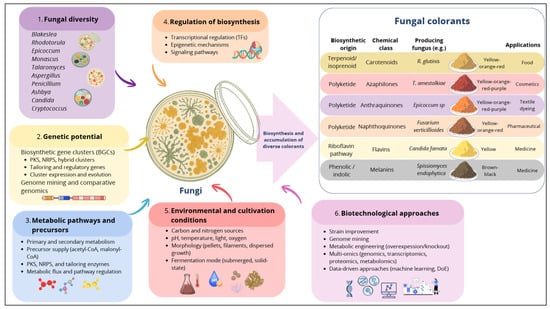
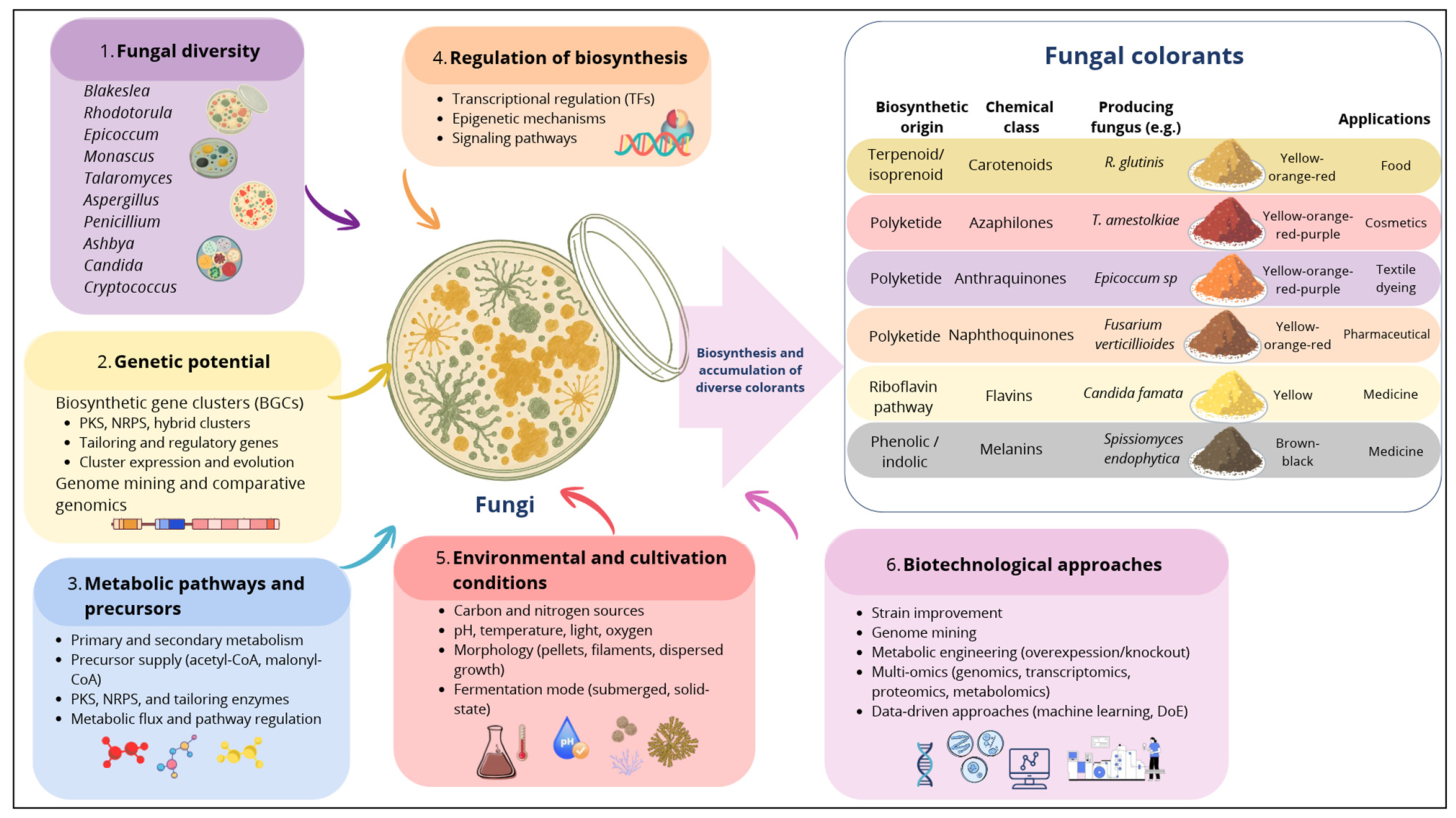
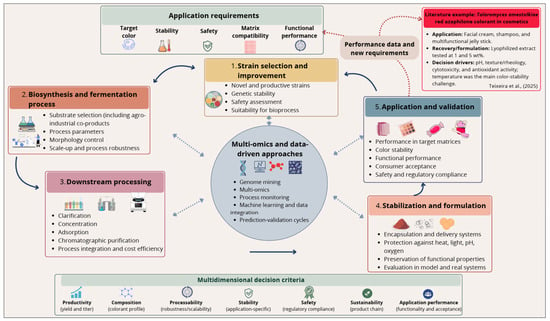
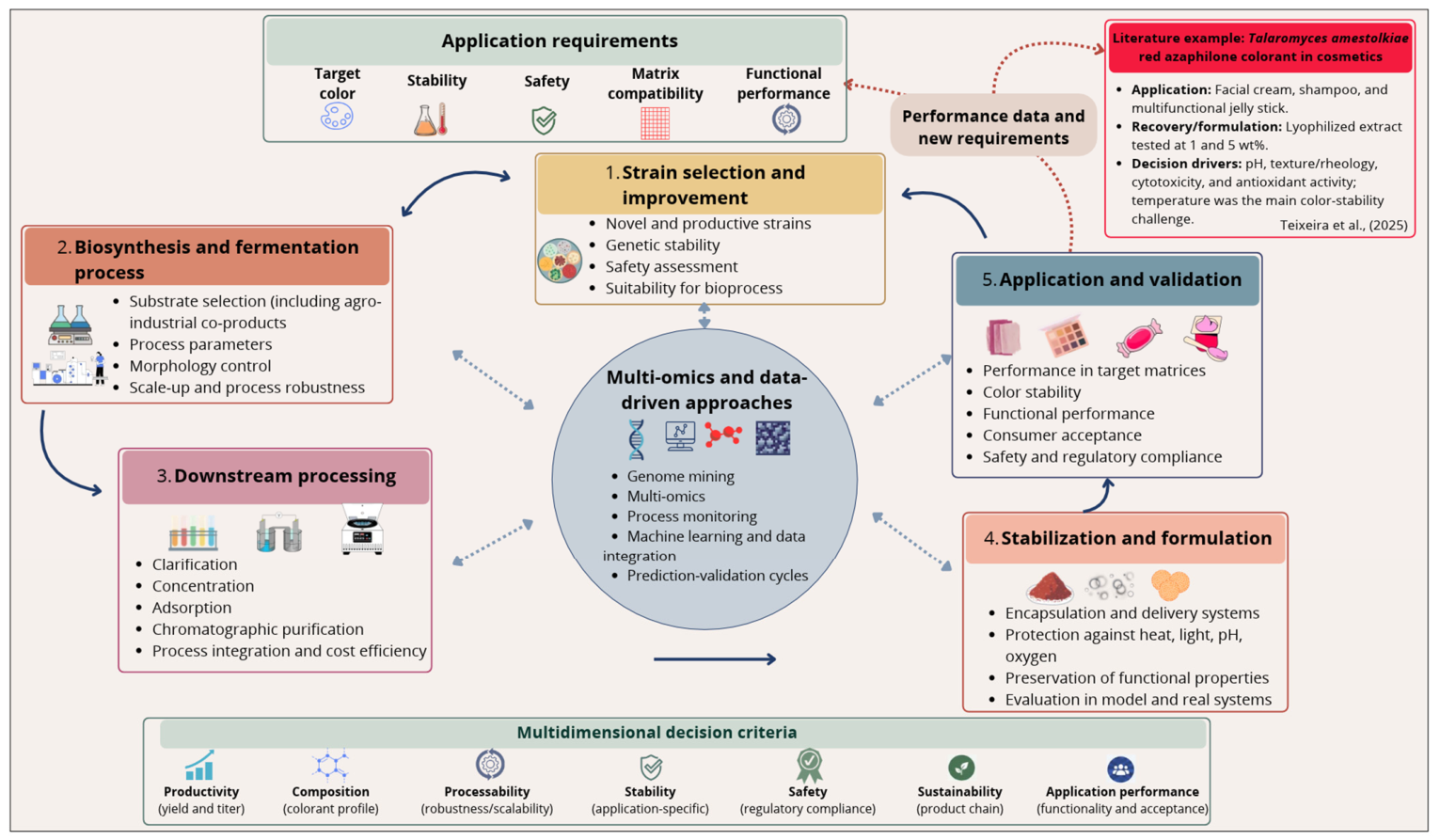

Disclaimer/Publisher’s Note: The statements, opinions and data contained in all publications are solely those of the individual author(s) and contributor(s) and not of MDPI and/or the editor(s). MDPI and/or the editor(s) disclaim responsibility for any injury to people or property resulting from any ideas, methods, instructions or products referred to in the content. |
© 2026 by the authors. Licensee MDPI, Basel, Switzerland. This article is an open access article distributed under the terms and conditions of the Creative Commons Attribution (CC BY) license.