


You are currently viewing a new version of our website. To view the old version click .

Journal of Fungi, Volume 11, Issue 3

March 2025 - 74 articles

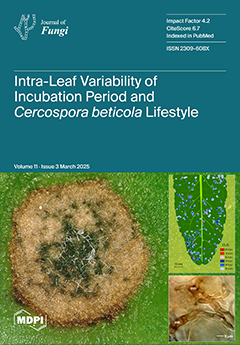
Cover Story: Cercospora beticola, the most important fungal pathogen in sugar beets, has a long incubation period (IP) and is classified as a hemibiotroph. A single infection period under controlled conditions resulted in minor IP differences among host genotypes and individual plants, greater differences among leaves within plants, and substantial variation within individual leaves. A GIS approach enabled the tracking of lesion appearance and growth for up to 27 days. The first lesions appeared 10 days after inoculation; however, the number of lesions increased for another 7 to 17 days, while lesion growth was limited. The asymptomatic fungal colonization of tissue was associated with thick hyphae, which became thinner after the appearance of lesions. Despite the lengthy incubation period, evidence of a C. beticola biotroph phase is lacking. View this paper
  • Issues are regarded as officially published after their release is announced to the table of contents alert mailing list .
  • You may sign up for email alerts to receive table of contents of newly released issues.
  • PDF is the official format for papers published in both, html and pdf forms. To view the papers in pdf format, click on the "PDF Full-text" link, and use the free Adobe Reader to open them.

Articles (74)

  • Article
  • Open Access
4 Citations
1,653 Views
30 Pages

Five New Phyllachora Species from Tar Spot Fungi on Poaceae in Sichuan China

  • Pengwei Su,
  • Yuechi Liao,
  • Yan Jin,
  • Yanpeng Chen,
  • Asanka Madhushan,
  • Jian-Kui Liu and
  • Sajeewa S. N. Maharachchikumbura

7 March 2025

Tar spot is a prevalent fungal disease characterized by shiny black spots on the leaves, stems, and fruits of various plants. It is typically caused by members of the family Phyllachoraceae, which consists of biotrophic and obligate plant parasitic f...

  • Review
  • Open Access
2 Citations
4,617 Views
44 Pages

Sustainable Management of Major Fungal Phytopathogens in Sorghum (Sorghum bicolor L.) for Food Security: A Comprehensive Review

  • Maqsood Ahmed Khaskheli,
  • Mir Muhammad Nizamani,
  • Entaj Tarafder,
  • Diptosh Das,
  • Shaista Nosheen,
  • Ghulam Muhae-Ud-Din,
  • Raheel Ahmed Khaskheli,
  • Ming-Jian Ren,
  • Yong Wang and
  • San-Wei Yang

6 March 2025

Sorghum (Sorghum bicolor L.) is a globally important energy and food crop that is becoming increasingly integral to food security and the environment. However, its production is significantly hampered by various fungal phytopathogens that affect its...

  • Article
  • Open Access
1,401 Views
17 Pages

Snake Fungal Disease (Ophidiomycosis) in Northern Pine Snakes (Pituophis melanoleucus melanoleucus) in New Jersey: Variations by Year, Sex, and Morphological Sampling Site

  • Joanna Burger,
  • Christian Jeitner,
  • Robert T. Zappalorti,
  • John Bunnell,
  • Kelly Ng,
  • Emile DeVito,
  • David Schneider and
  • Michael Gochfeld

6 March 2025

Ophidiomyces ophidiicola, the fungus causing Snake Fungal Disease (SFD) or ophidiomycosis, is prevalent in North American snakes and can have deleterious population effects. Northern pine snakes (Pituophis melanoleucus melanoleucus) in New Jersey oft...

  • Article
  • Open Access
1,247 Views
16 Pages

6 March 2025

Helvella leucopus, an endangered wild edible fungus, is renowned for its distinct health benefits and nutritional profile, with notable differences in the bioactive and nutritional properties between its cap and stipe. To investigate the molecular ba...

  • Article
  • Open Access
3 Citations
2,149 Views
10 Pages

External Validation of Risk Prediction Score for Candidemia in Critically Ill Patients: A Retrospective Observational Study

  • Nurul Mazni Abdullah,
  • Saw Kian Cheah,
  • Raha Abdul Rahman,
  • Nadia Md Nor,
  • Muhammad Maaya and
  • Qurratu Aini Musthafa

6 March 2025

Candidemia is associated with high mortality in critically ill patients. Early diagnosis of candidemia is imperative for starting treatment. Therefore, this study was designed to externally validate the candidemia risk prediction scores. This single-...

  • Article
  • Open Access
1 Citations
1,413 Views
22 Pages

Decoding Pecan’s Fungal Foe: A Genomic Insight into Colletotrichum plurivorum Isolate W-6

  • Ke Deng,
  • Ying Zhang,
  • Saibin Lv,
  • Chulong Zhang and
  • Lihong Xiao

5 March 2025

Pecan (Carya illinoinensis) is a world-renowned nut crop that is highly favored by consumers for its high content of healthy nutrients. For a long time, anthracnose has severely threatened the yield and quality of pecan, causing significant economic...

  • Article
  • Open Access
1 Citations
2,098 Views
21 Pages

5 March 2025

Beauveria bassiana PfBb is a new strain with high host specificity to the target pest Phauda flammans. We conducted a series of experiments to optimize the biphasic fermentation system of B. bassiana PfBb by screening the medium compositions and ferm...

  • Article
  • Open Access
1 Citations
1,626 Views
12 Pages

Chronic Cavitary Pulmonary Histoplasmosis–Novel Concepts Regarding Pathogenesis

  • John F. Fisher,
  • Michael Saccente,
  • George S. Deepe,
  • Natasha M. Savage,
  • Wajih Askar and
  • Jose A. Vazquez

5 March 2025

Because the apices of the lungs are most commonly involved in chronic cavitary histoplasmosis (CCPH), it has been assumed by many to have a pathogenesis which is similar to post-primary tuberculosis. Fungi such as Aspergillus may colonize pulmonary b...

  • Article
  • Open Access
2 Citations
1,642 Views
20 Pages

4 March 2025

Agaricus bisporus, a globally cultivated edible fungus, faces significant challenges from fungal diseases like cobweb disease caused by Cladobotryum mycophilum, which severely impacts yield. This study aimed to explore the genetic basis of disea...

  • Article
  • Open Access
3 Citations
1,411 Views
14 Pages

4 March 2025

Monacolin K (MK), a secondary metabolite produced by Monascus spp. with the ability to inhibit cholesterol production, is structurally identical to lovastatin produced by Aspergillus terreus. In the lovastatin biosynthetic pathway, the polyketide syn...

of 8

Get Alerted

Add your email address to receive forthcoming issues of this journal.

XFacebookLinkedIn
J. Fungi - ISSN 2309-608X