


Abstract
Background: This exploratory study aimed to investigate the association of preoperative HbA1c with early postoperative outcomes in diabetic patients undergoing isolated coronary artery bypass grafting (CABG). Methods: A total of 1056 patients who underwent CABG between January 2022 and November 2025 were retrospectively evaluated. After applying the exclusion criteria, 416 diabetic patients who underwent elective isolated CABG were included. Patients were divided into Group A (HbA1c ≥ 7%, n = 266) and Group B (HbA1c < 7%, n = 150). HbA1c was also analysed as a continuous variable using logistic regression adjusted for EuroSCORE II (and additionally for body mass index in the superficial sternal wound infection model), and across three categories (<7%, 7–8.9% and ≥9%). Results: Baseline characteristics were similar between the groups. Superficial sternal wound infection (SSWI) occurred in 18.4% vs. 12.7% (OR 1.56, 95% CI 0.88–2.76), deep sternal wound infection in 4.9% vs. 5.3% (OR 0.91, 95% CI 0.37–2.25), and hospital mortality in 4.9% vs. 2.0% (OR 2.52, 95% CI 0.71–8.98) of patients in Groups A and B, respectively; none of these differences were statistically significant. When analysed as a continuous variable, each 1% increase in HbA1c was associated with higher odds of SSWI (adjusted OR 1.18, 95% CI 1.03–1.35, p = 0.018). The incidence of SSWI was 12.7%, 14.0% and 24.1% in patients with HbA1c < 7%, 7–8.9% and ≥9%, respectively (p = 0.027). No significant associations were observed for other outcomes. Conclusions: In diabetic patients undergoing elective isolated CABG, HbA1c ≥ 7% was not significantly associated with early postoperative outcomes; however, higher HbA1c was associated with an increased risk of SSWI, with the highest incidence observed in patients with HbA1c ≥ 9%. Given the small number of events, clinically important differences in other outcomes, including mortality, cannot be excluded.
1. Introduction
Coronary artery bypass grafting (CABG) is the most commonly performed cardiac procedure. A significant number of CABG patients also have diabetes mellitus (DM). The proportion of patients with DM among those undergoing CABG increased from 7% in the 1970s to 37% in the 2000s [1]. DM is closely associated with poorer long-term outcomes following CABG [2]. Both preoperative and perioperative hyperglycemia have been associated with worse outcomes after CABG, regardless of DM status [3]. However, there is no consensus on the impact of long-term hyperglycemia on postoperative outcomes.
HbA1c, also known as glycated hemoglobin, reflects average glycemic control over the preceding 90–120 days. Numerous studies have evaluated the effects of HbA1c in patients undergoing CABG [4,5,6,7,8]. However, the 2024 European Association for Cardio-Thoracic Surgery (EACTS) guidelines on perioperative medication in adult cardiac surgery state that the significance of preoperative HbA1c in terms of cardiac surgery complications is currently unknown [9]. A study by Halkos et al. reported that high HbA1c was strongly associated with adverse events after CABG [6]. Another study found that perioperative glucose control was associated with surgical outcomes, but HbA1c was a less useful predictor [8]. Goksedef et al. also reported that high HbA1c did not pose a risk for postoperative infectious complications [4].
These studies compared groups using different HbA1c cut-off values. However, many of them included both diabetic and non-diabetic patients, and the prevalence of DM differed significantly between the HbA1c groups. Regardless of HbA1c level, the microvascular and macrovascular effects of DM influence postoperative outcomes. Therefore, to reduce this heterogeneity, we included only patients with DM, although this approach does not ensure comparable diabetes severity, which may also be influenced by diabetes duration, treatment and complications. The aim of this study was to investigate the association of HbA1c with postoperative outcomes in diabetic patients undergoing isolated CABG.
2. Methods
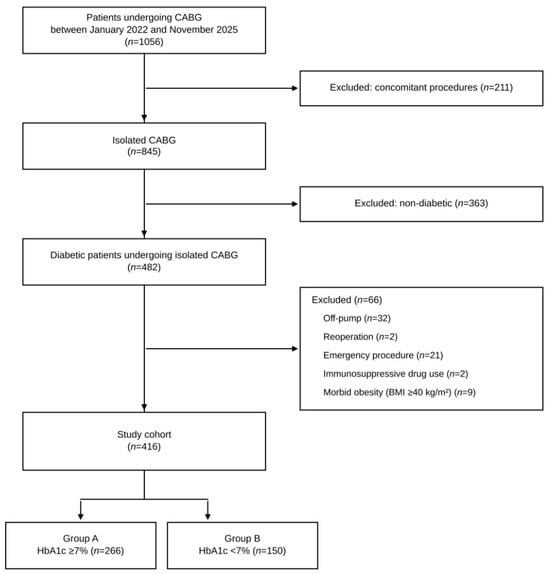
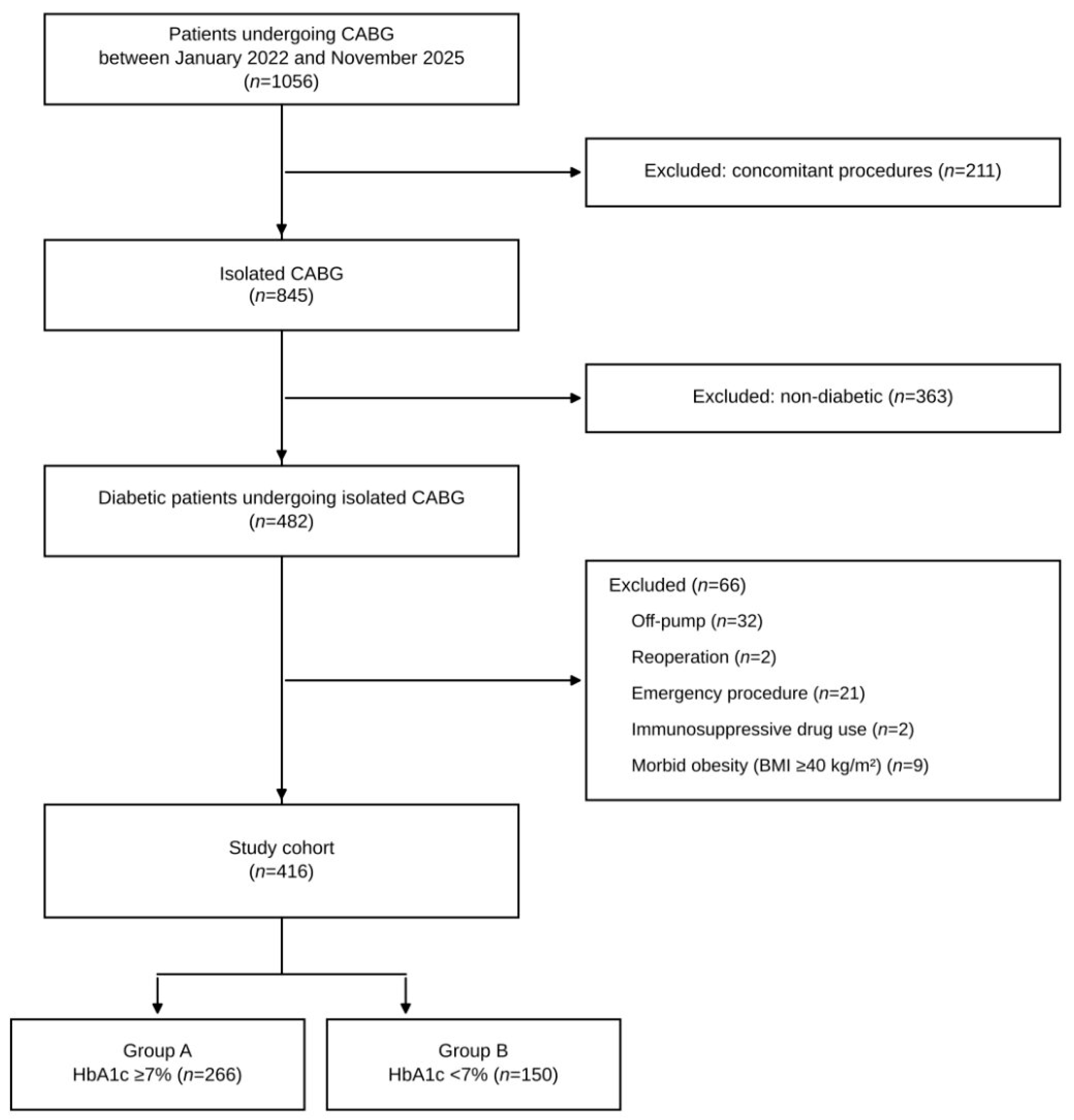
In this retrospective, single-center observational study, all patients aged 18 years and older who underwent CABG at the Cardiovascular Surgery Clinic of Basaksehir Cam and Sakura City Hospital, Istanbul, between January 2022 and November 2025 (n = 1056) were screened for eligibility. Patients were excluded if they were non-diabetic or underwent concomitant procedures, off-pump CABG, emergency surgery, or reoperation; were morbidly obese (body mass index ≥ 40 kg/m2); had a history of transplantation; or were receiving immunosuppressive therapy (Figure 1). Finally, 416 patients were included in the study. The American Diabetes Association (ADA) recommends lowering HbA1c levels to approximately 7.0% to reduce microvascular complications in adults [10]. Therefore, patients were divided into two groups according to this value: Group A (n = 266) (HbA1c ≥ 7%) and Group B (n = 150) (HbA1c < 7%). Diabetes mellitus was defined as a previously established diagnosis of diabetes under pharmacological treatment.
Figure 1.
Flow diagram for study participants.
Patients’ medical records were reviewed, and demographic characteristics, comorbidities, preoperative transthoracic echocardiography (TTE) findings, preoperative laboratory parameters, surgical procedure details, cross-clamp (XCL) times, cardiopulmonary bypass (CPB) times, the European System for Cardiac Operative Risk Evaluation (EuroSCORE) II, vasoactive inotrope scores (VIS), bleeding amount, blood product usage, postoperative complications (new-onset atrial fibrillation (NOAF), cerebrovascular accident (CVA), need for continuous renal replacement therapy (CRRT), superficial sternal wound infection (SSWI), deep sternal wound infection (DSWI), saphenous/groin wound infection, sternal vacuum-assisted closure (VAC), saphenous/groin VAC, gastrointestinal bleeding, need for percutaneous coronary intervention (PCI), need for thoracentesis, need for tracheostomy, postoperative re-exploration, delayed sternal closure, and postoperative intra-aortic balloon pump (IABP) and extracorporeal membrane oxygenation (ECMO) support, including cannulation site, technique and configuration), duration of intubation, length of hospital and intensive care unit (ICU) stay, and hospital mortality were recorded. Six patients underwent on-pump beating-heart CABG without aortic cross-clamping.
SSWI and DSWI were defined according to the Centers for Disease Control and Prevention (CDC) criteria [11]. Wound infections were recorded during hospitalization and at outpatient follow-up visits up to 90 days after surgery. NOAF was defined as atrial fibrillation lasting ≥30 s on continuous monitoring or ECG in patients without preoperative atrial fibrillation. Re-exploration was defined as reoperation for bleeding or cardiac tamponade. Oral antidiabetic agents were discontinued upon admission, and glycemic control was achieved with subcutaneous insulin. In accordance with current recommendations, blood glucose levels were targeted below 180 mg/dL during the perioperative period [12]. Surgery was performed once target glucose levels were achieved, regardless of HbA1c level. Intraoperatively and during the ICU stay, blood glucose was monitored every 30 min, with a target of <180 mg/dL. Achieved perioperative glucose levels were not available for analysis. HbA1c was measured within one week before surgery. In our clinic, bilateral internal thoracic artery (ITA) grafting is not routinely performed in diabetic patients; therefore, no patient in the study received bilateral ITA grafts. Hospital mortality was defined as death from any cause during the index hospitalization. HbA1c, baseline characteristics and in-hospital outcome data were available for all patients. All patients who attended our outpatient clinic were followed up for 90 days; however, complications treated at other centers after discharge may not have been captured.
This study was approved by the Istanbul Basaksehir Cam and Sakura City Hospital Ethics Committee (Decision no: 2025-445, 23 December 2025). The study was conducted in accordance with the Declaration of Helsinki. Artificial intelligence-assisted technology (Claude, Anthropic) was used solely for language editing during the preparation of this manuscript. The authors reviewed and edited the AI-assisted content as necessary and take full responsibility for the content of the publication.
3. Statistics
Data were analyzed using SPSS software version 27.0 (IBM, Armonk, NY, USA). Continuous variables were presented as median, interquartile range (IQR), and minimum–maximum values. Categorical variables were expressed as numbers and percentages. The normality of distribution was assessed by the Kolmogorov–Smirnov test. Because most continuous variables were not normally distributed, continuous variables were compared using the Mann–Whitney U test. Categorical variables were compared using the Pearson χ2 test or, when any expected cell count was below 5, Fisher’s exact test. Odds ratios (ORs) with 95% confidence intervals (CIs) were calculated for postoperative binary outcomes. The associations of HbA1c with superficial sternal, deep sternal, and saphenous/groin wound infections and hospital mortality were further evaluated using binary logistic regression, with HbA1c entered both as a dichotomous variable (≥7% vs. <7%) and as a continuous variable (OR per 1% increase). Because of the limited number of events, models for SSWI were adjusted for EuroSCORE II and body mass index, and models for the other outcomes were adjusted for EuroSCORE II only. Outcomes were also compared across three HbA1c categories (<7%, 7–8.9% and ≥9%). The level of statistical significance was set at p < 0.05.
4. Results
Of 1056 patients who underwent CABG during the study period, 845 underwent isolated CABG and 482 had diabetes. After exclusions, 416 patients were included in the study. Baseline characteristics are presented in Table 1. The median age was 61 (IQR 12.3) years, and 320 (76.9%) patients were male. No differences were found between the groups in terms of baseline demographic characteristics such as age and gender. Comorbidities were also similar between the groups. The proportion of patients operated on under dual antiplatelet therapy was also similar between the groups. There was no significant difference between the groups in terms of EuroSCORE II (median 1.6 vs. 1.6, p = 0.86). Apart from HbA1c, preoperative laboratory parameters did not differ between the groups. There was no difference in preoperative ejection fraction (EF) (median 55% vs. 55%, p = 0.54). The rates of minimally invasive CABG and coronary endarterectomy were similar between the groups. There was no difference between the groups in terms of left internal thoracic artery (LITA) use (89.1% vs. 88.7%, p = 0.89). The number of grafts was also similar between the groups (median 3 vs. 3, p = 0.59). There was no significant difference between the groups in terms of CPB times and XCL times (median 127 vs. 130 min, p = 0.95; and 80 vs. 80 min, p = 0.80, respectively). Postoperative bleeding on days 1 and 2 was also similar between the groups. Similarly, intraoperative and postoperative use of red blood cells (RBCs) and fresh frozen plasma (FFP) did not differ between the groups.
Table 1.
Comparison of patient demographics, comorbidities, laboratory parameters, echocardiographic findings, operative data and blood products between Group A and Group B.
A comparison of postoperative outcomes is presented in Table 2. There was no statistically significant difference between the groups in terms of CVA, need for CRRT, NOAF, gastrointestinal bleeding, need for PCI, need for thoracentesis, tracheostomy, or postoperative VIS. The rates of DSWI were similar between the groups (4.9% vs. 5.3%; OR 0.91, 95% CI 0.37–2.25; p = 0.84). SSWI was numerically more frequent in Group A, although the difference did not reach statistical significance (18.4% vs. 12.7%; OR 1.56, 95% CI 0.88–2.76; p = 0.13). Similarly, saphenous/groin wound infection rates did not differ (6.4% vs. 4.0%; OR 1.64, 95% CI 0.63–4.25; p = 0.31). Sternal VAC and saphenous/groin VAC rates were also similar between the groups (5.3% vs. 5.3%, p = 0.98; and 0.8% vs. 1.3%, p = 0.62, respectively). Hospital mortality was 4.9% in Group A and 2.0% in Group B (OR 2.52, 95% CI 0.71–8.98; p = 0.14). There were no significant differences in re-exploration for bleeding or tamponade (6.8% vs. 6.0%, p = 0.76), delayed sternal closure (0.4% vs. 0%, p = 1.00), postoperative IABP (1.9% vs. 0%, p = 0.16), or ECMO support (0.8% vs. 0.7%, p = 1.00). Of the three patients who required ECMO, two received veno-arterial and one veno-venous support; cannulation was central in one patient and percutaneous femoral in two. Similarly, no statistically significant difference was found between the groups in terms of intubation time, ICU stay, and hospital stay (median 9 vs. 9 h, p = 0.94; 2 vs. 2 days, p = 0.59; and 7 vs. 7 days, p = 0.21, respectively).
Table 2.
Comparison of postoperative outcomes between Group A and Group B.
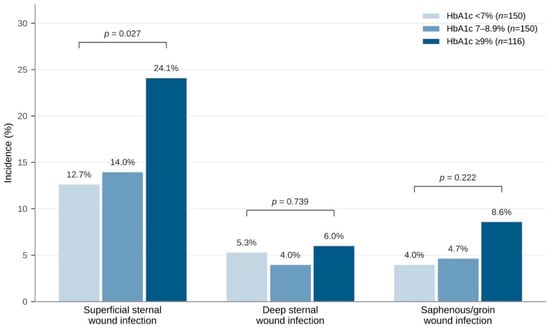
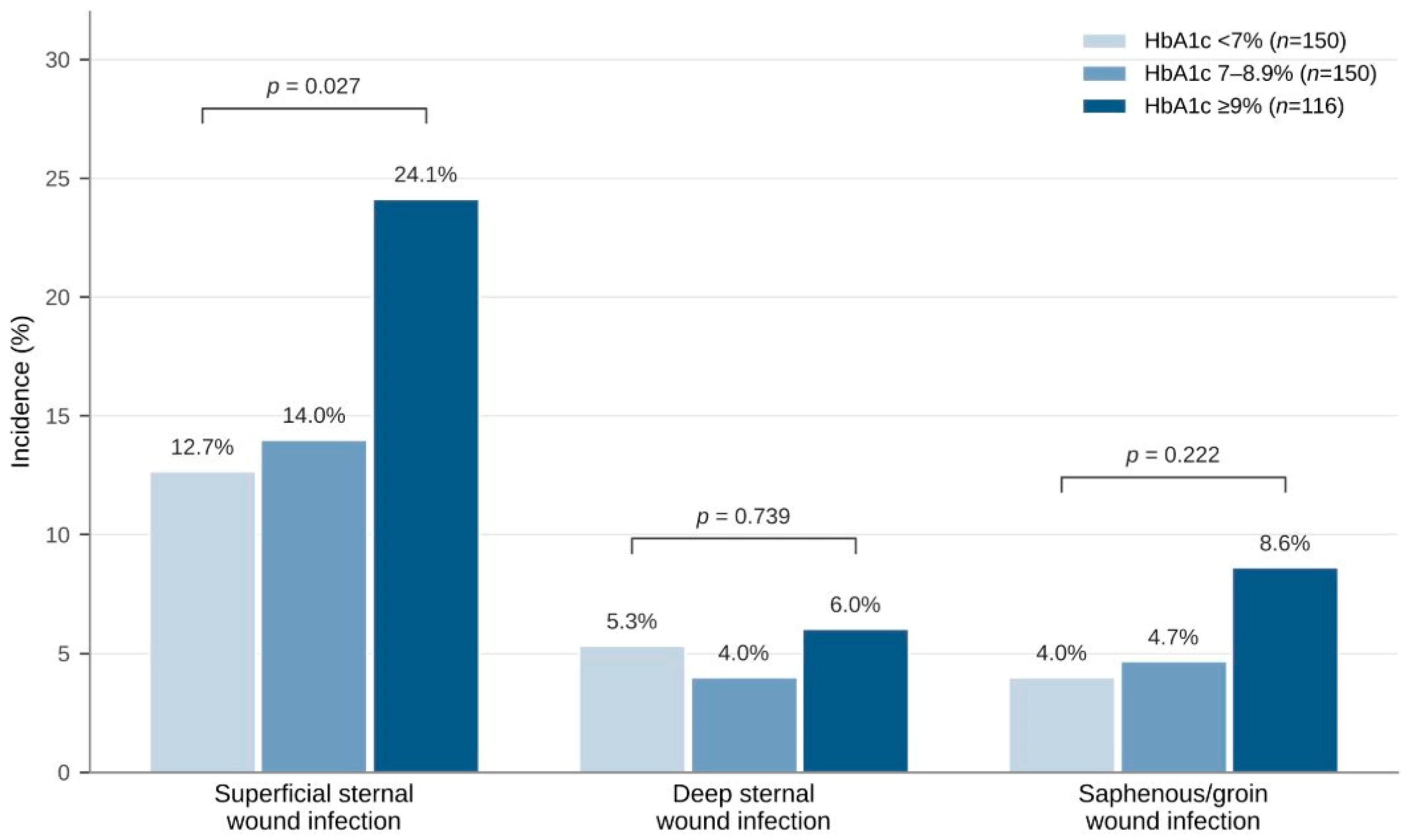
In exploratory regression analyses (Table 3), HbA1c ≥7% was not significantly associated with any of the examined outcomes. When HbA1c was analysed as a continuous variable, each 1% increase was associated with higher odds of SSWI (unadjusted OR 1.15, 95% CI 1.01–1.31, p = 0.036; adjusted OR 1.18, 95% CI 1.03–1.35, p = 0.018). No significant association was observed for DSWI, saphenous/groin wound infection, or hospital mortality (for hospital mortality, adjusted OR per 1% increase 1.08, 95% CI 0.82–1.42). When patients were categorised according to HbA1c level (Table 4, Figure 2), the incidence of SSWI differed across categories (12.7% for <7%, 14.0% for 7–8.9% and 24.1% for ≥9%; p = 0.027). No significant differences were observed for DSWI (p = 0.739), saphenous/groin wound infection (p = 0.222), or hospital mortality (p = 0.208).
Table 3.
Association of preoperative HbA1c with postoperative outcomes: logistic regression analyses with HbA1c as a dichotomous (≥7% vs. <7%) and continuous (per 1% increase) variable.
Table 4.
Postoperative outcomes according to preoperative HbA1c category.
Figure 2.
Incidence of superficial sternal, deep sternal, and saphenous/groin wound infection according to preoperative HbA1c category.
5. Discussion
Hyperglycemia is closely associated with impaired neutrophil phagocytic activity, increased inflammation, oxidative stress, and poor endothelial function [7,13]. In cardiac surgery, hyperglycemia during CPB is an independent risk factor for morbidity and mortality in both diabetic and non-diabetic patients [14]. Therefore, strict perioperative glycemic control is recommended in patients undergoing cardiac surgery. It has been reported that prolonged hyperglycemia can cause more severe damage than acute hyperglycemia alone [15]. However, it is unclear whether this adverse effect can be mitigated by strict preoperative glycemic control. HbA1c, a measure of chronic hyperglycemia, is a sensitive and reliable marker of impaired glucose metabolism. However, its prognostic significance for complications after cardiac surgery remains unclear.
In cardiac surgery, which inherently carries significant morbidity and mortality, the role of HbA1c, which reflects glycemic status over a 90–120-day period, in determining surgical strategy is controversial. Delaying surgery to lower HbA1c, particularly in patients requiring CABG, remains a matter of debate. Concerns that cardiovascular events may occur while waiting for HbA1c to decrease encourage surgeons to proceed with surgery after achieving short-term glycemic control. However, it is unclear whether high HbA1c is associated with adverse postoperative outcomes. While higher HbA1c has been reported to be associated with more adverse postoperative outcomes, it has also been reported that HbA1c alone does not constitute a risk factor for complications such as postoperative infection [4]. One important reason for these conflicting results may be that many of these studies evaluated patients with and without DM [4,5,6,16,17,18,19,20,21,22]. It is well known that diabetes is a significant risk factor in cardiac surgery. Indeed, DM is included in the most commonly used risk scores for cardiac surgery, such as EuroSCORE II and the Society of Thoracic Surgeons (STS) score. However, in studies that divided patients according to an HbA1c cut-off value, the prevalence of DM differed significantly between groups. This may influence postoperative outcomes and represents an important limitation of these studies. Studies including only patients with DM are limited. Therefore, we analyzed only patients with DM to avoid the confounding effect of the presence or absence of DM between the groups. Kim et al. and Tsuruta et al. also studied only patients with DM; however, both studies included off-pump CABG patients and reported conflicting results [23,24]. In contrast, our study evaluated diabetic patients undergoing on-pump CABG.
We applied strict selection criteria. In our clinic, preoperative glycemic control is achieved in all patients undergoing elective CABG; because this is not possible in emergency cases, emergency operations were excluded. We also excluded all patients without a diagnosis of diabetes mellitus. Furthermore, to minimize confounding, we excluded patients with preoperative conditions known to increase the risk of wound and infectious complications, such as morbid obesity and immunosuppressive therapy. Only isolated CABG procedures were included to minimize the influence of operative factors. After applying these criteria, 416 patients with similar preoperative and operative characteristics were analyzed. In this cohort, HbA1c ≥ 7% was not significantly associated with early postoperative outcomes; however, when HbA1c was analysed as a continuous variable, higher HbA1c was associated with an increased risk of superficial sternal wound infection.
In our study, 57% of patients undergoing isolated CABG had DM, and 64% of the study patients had HbA1c levels at or above the ADA-recommended target of 7%. This indicates that a substantial proportion of CABG patients have chronic hyperglycemia. Additionally, stress-related hyperglycemia is common among patients scheduled for CABG upon hospitalization. Some authors recommend performing cardiac surgery in patients with established diabetes once HbA1c has reached near-normal levels after treatment optimization [25]. However, in CABG candidates, the cardiovascular risks associated with delaying surgery until HbA1c reaches the recommended level may be significant. Therefore, short-term perioperative glycemic control with insulin has become increasingly common. In our clinic, elective surgery is not postponed in diabetic patients until HbA1c normalizes; instead, surgery is performed once adequate short-term glycemic control is achieved. However, as our study did not compare immediate with deferred surgery, it cannot determine whether postponing surgery to improve HbA1c is beneficial or unnecessary.
There are conflicting results in the literature regarding HbA1c and wound complications in CABG patients. Some studies have associated higher HbA1c levels with a higher risk of sternal wound complications [6,16,18,19,20,25,26]. Conversely, other studies have found no significant association between high HbA1c and sternal wound complications [4,17,27,28]. However, these studies used different HbA1c cut-off values and evaluated both diabetic and non-diabetic patients. The few studies in the literature that examined only diabetic patients also present conflicting results. In their study of diabetic CABG patients, Kim et al. found a higher rate of sternal wound infections in those with HbA1c ≥ 7%, whereas Tsuruta et al. found similar rates of mediastinitis regardless of HbA1c level [23,24]. However, these studies evaluated off-pump CABG patients. In a matched study by Knapik et al. that included on-pump patients, no significant difference was found in terms of wound infection at the 7% HbA1c cut-off value [29]. In our study, the rates of sternal wound infections did not differ significantly at the 7% threshold. However, when HbA1c was analysed as a continuous variable, each 1% increase was associated with an 18% increase in the odds of SSWI after adjustment for EuroSCORE II and body mass index. Moreover, the incidence of SSWI was similar in patients with HbA1c < 7% and 7–8.9% (12.7% and 14.0%), but nearly doubled in those with HbA1c ≥ 9% (24.1%). These findings suggest that the risk of superficial wound infection may increase progressively with higher HbA1c levels; however, the category-based results are exploratory and do not establish ≥ 9% as a specific risk threshold. A recent meta-analysis also reported that poor preoperative glycometabolic status was associated with adverse outcomes after cardiac surgery [25]. In contrast, no association was observed for DSWI, which is a rarer complication and may be more strongly influenced by surgical and patient-related factors. However, since these analyses are exploratory, it would be beneficial to evaluate these findings in prospective studies.
Renal complications are another controversial issue. Some studies have associated high HbA1c levels with worse renal function after cardiac surgery [5,6,7,18,20,22,30]. However, other studies have found no association between high HbA1c and renal dysfunction [17,19,26,27,28]. In studies on diabetic patients, both Tsuruta et al. and Knapik et al. found no association between high HbA1c and renal failure [24,29]. Kim et al. reported a clinically relevant but statistically non-significant increase in renal failure in the high HbA1c group [23]. In our study, the need for CRRT did not differ significantly between the groups. However, CRRT captures only the most severe form of postoperative acute kidney injury, and milder forms of renal dysfunction were not assessed; therefore, our findings do not exclude an association between HbA1c and acute kidney injury.
The association between HbA1c and mortality has been one of the most extensively investigated topics. A few studies have reported an adverse effect of high HbA1c on mortality in CABG patients [6]. Alserius et al. reported a trend toward increased mortality with higher HbA1c levels [16]. However, other studies have found no significant association between high HbA1c and mortality [4,5,8,17,18,19,20,21,22,26,27,28,29,30]. In our study, hospital mortality did not differ significantly between the groups; however, it was numerically higher in patients with HbA1c ≥ 7%. In addition, no relationship was observed when HbA1c was analysed as a continuous or categorical variable. Given the small number of deaths (n = 16) and the wide confidence interval, our study cannot exclude a clinically relevant effect on mortality. In addition, intubation time, ICU stay, hospital stay and the incidence of NOAF were similar between the groups, consistent with most previous studies [5,17,23,28], although some studies have reported an association between HbA1c and postoperative AF in diabetic patients [31].
HbA1c ≥ 7% was not significantly associated with early postoperative outcomes in diabetic patients undergoing elective isolated CABG. However, higher HbA1c levels were associated with an increased risk of SSWI, with the highest incidence observed in patients with HbA1c ≥ 9%; this exploratory finding should not be interpreted as a validated risk threshold. It should be emphasized that the absence of statistically significant differences does not demonstrate the absence of an effect. Hospital mortality and CVA rates were numerically higher in patients with HbA1c ≥ 7%, and the wide confidence intervals for these outcomes remain compatible with clinically important differences. Furthermore, as our study did not compare immediate with deferred surgery, it cannot establish whether postponing elective CABG to improve HbA1c is beneficial. Future prospective studies are needed to determine whether optimization of HbA1c, particularly in patients with markedly elevated levels, improves postoperative outcomes, and to define the optimal duration of preoperative glycemic control.
6. Limitations
This study has several limitations. First, it was a retrospective, single-center, non-randomized study. Second, no primary outcome was specified before analysis; therefore, all analyses should be considered exploratory, and, given the number of comparisons, isolated significant findings should be interpreted with caution. Third, the sample size and the low number of events limited the precision of the estimates, particularly for mortality and CVA, and clinically important differences cannot be excluded. Fourth, achieved perioperative glucose levels, insulin requirements, and the interval from admission to surgery could not be analyzed because of incomplete records; therefore, we could not assess whether differences in perioperative glycemic control influenced the outcomes. Fifth, the duration of diabetes and the type of antidiabetic therapy were not available; thus, residual confounding by diabetes severity cannot be excluded, although adjustment for EuroSCORE II partially accounted for baseline risk. In addition, because diabetes was defined as an established diagnosis under pharmacological treatment, diet-controlled and newly diagnosed patients were not included, which may limit the generalisability of our findings to these patients. Sixth, renal outcomes were limited to the need for CRRT, which captures only severe acute kidney injury, and perioperative myocardial infarction was not assessed using a standardized definition. Seventh, only in-hospital and early postoperative outcomes were evaluated; long-term survival and late complications were not assessed, and complications treated at other centers after discharge may have been missed. Finally, our study did not compare immediate with deferred surgery and therefore cannot address the optimal timing of CABG in patients with elevated HbA1c.
7. Conclusions
In this retrospective cohort of diabetic patients undergoing elective isolated on-pump CABG, HbA1c ≥ 7% was not significantly associated with early postoperative outcomes. However, higher HbA1c levels were associated with an increased risk of superficial sternal wound infection, with the highest incidence observed in patients with HbA1c ≥ 9%; this exploratory finding requires confirmation in prospective studies. Given the small number of events, clinically important differences in other outcomes, including mortality, cannot be excluded. Prospective studies are needed to clarify whether preoperative optimization of HbA1c improves outcomes after CABG.
Author Contributions
Conceptualization, O.F.B. and M.Y.; methodology, O.F.B. and M.Y.; validation, O.F.B. and M.Y.; formal analysis, O.F.B. and M.Y.; investigation, O.F.B., Z.T., K.C., C.A., M.O.D., B.Ç., N.K., and M.Y.; resources, O.F.B., K.C., and B.Ç.; data curation, O.F.B., K.C., and B.Ç.; writing—original draft preparation, O.F.B. and M.Y.; writing—review and editing, O.F.B., Z.T., K.C., C.A., M.O.D., B.Ç., N.K., F.G.Ö., and M.Y.; visualization, O.F.B., Z.T., K.C., C.A., M.O.D., B.Ç., N.K., F.G.Ö., and M.Y.; supervision, O.F.B., Z.T., K.C., C.A., M.O.D., B.Ç., N.K., F.G.Ö., and M.Y.; project administration, O.F.B. and M.Y. All authors have read and agreed to the published version of the manuscript.
Funding
This research received no external funding.
Institutional Review Board Statement
The study was approved by Istanbul Basaksehir Cam and Sakura City Hospital Ethics Committee (2025-445, 23 December 2025). The study was conducted in accordance with the local legislation and institutional requirements. All procedures adopted in this study followed the Declaration of Helsinki.
Informed Consent Statement
Patient consent was waived due to the retrospective study design.
Data Availability Statement
The datasets generated and/or analysed during the current study are not publicly available due to institutional data protection policies.
Acknowledgments
We would like to thank Esra Arslan Beyazal for her invaluable contributions to the creation of the database.
Conflicts of Interest
The authors declare no conflicts of interest.
Abbreviations
| CABG | Coronary artery bypass grafting |
| DM | Diabetes mellitus |
| CPB | Cardiopulmonary bypass |
| ECMO | Extracorporeal membrane oxygenation |
| IABP | Intra-aortic balloon pump |
| TTE | transthoracic echocardiography |
| XCL | cross-clamp |
| EuroSCORE | The European System for Cardiac Operative Risk Evaluation |
| VIS | Vasoactive inotrope scores |
| NOAF | New-onset atrial fibrillation |
| CVA | Cerebrovascular accident |
| CRRT | Continuous renal replacement therapy |
| SSWI | Superficial sternal wound infection |
| DSWI | Deep sternal wound infection |
| VAC | Vacuum-assisted closure |
| PCI | Percutaneous coronary intervention |
| ICU | Intensive care unit |
| RBCs | Red blood cells |
| FFP | Fresh frozen plasma |
| STS | Society of Thoracic Surgeons |
| MI | Myocardial infarction |
| LITA | Left internal thoracic artery |
| ITA | Internal thoracic artery |
| ADA | American Diabetes Association |
| CDC | Centers for Disease Control and Prevention |
| OR | Odds ratio |
| CI | Confidence interval |
References
- Raza, S.; Sabik, J.F., III; Ainkaran, P.; Blackstone, E.H. Coronary artery bypass grafting in diabetics: A growing health care cost crisis. J. Thorac. Cardiovasc. Surg. 2015, 150, 304–312. [Google Scholar] [CrossRef] [Scilit] [PubMed]
- Zhang, H.; Yuan, X.; Osnabrugge, R.L.; Meng, D.; Gao, H.; Zhang, S.; Rao, C.; Hu, S.; Zheng, Z. Influence of diabetes mellitus on long-term clinical and economic outcomes after coronary artery bypass grafting. Ann. Thorac. Surg. 2014, 97, 2073–2079. [Google Scholar] [CrossRef] [Scilit] [PubMed]
- Navaratnarajah, M.; Rea, R.; Evans, R.; Gibson, F.; Antoniades, C.; Keiralla, A.; Demosthenous, M.; Kassimis, G.; Krasopoulos, G. Effect of glycaemic control on complications following cardiac surgery: Literature review. J. Cardiothorac. Surg. 2018, 13, 10. [Google Scholar] [CrossRef] [Scilit] [PubMed]
- Göksedef, D.; Ömeroğlu, S.; Yalvaç, E.; Bitargil, M.; İpek, G. Is elevated HbA1c a risk factor for infection after coronary artery bypass grafting surgery. Turk. J. Thorac. Cardiovasc. Surg. 2010, 18, 252–258. [Google Scholar]
- Gumus, F.; Polat, A.; Sinikoglu, S.N.; Yektas, A.; Erkalp, K.; Alagol, A. Use of a lower cut-off value for HbA1c to predict postoperative renal complication risk in patients undergoing coronary artery bypass grafting. J. Cardiothorac. Vasc. Anesth. 2013, 27, 1167–1173. [Google Scholar] [CrossRef] [Scilit] [PubMed]
- Halkos, M.E.; Puskas, J.D.; Lattouf, O.M.; Kilgo, P.; Kerendi, F.; Song, H.K.; Guyton, R.A.; Thourani, V.H. Elevated preoperative hemoglobin A1c level is predictive of adverse events after coronary artery bypass surgery. J. Thorac. Cardiovasc. Surg. 2008, 136, 631–640. [Google Scholar] [CrossRef] [Scilit] [PubMed]
- Madhu, M.; Patni, A. Use of pre-operative hemoglobin a1c to predict early post-operative renal failure and infection risks in patients who are not diabetics and undergoing elective off pump coronary artery bypass graft surgery. Ann. Card. Anaesth. 2023, 26, 160–165. [Google Scholar] [CrossRef] [Scilit] [PubMed]
- van den Boom, W.; Schroeder, R.A.; Manning, M.W.; Setji, T.L.; Fiestan, G.O.; Dunson, D.B. Effect of A1C and glucose on postoperative mortality in noncardiac and cardiac surgeries. Diabetes Care 2018, 41, 782–788. [Google Scholar] [CrossRef] [Scilit] [PubMed]
- Jeppsson, A.; Rocca, B.; Hansson, E.C.; Gudbjartsson, T.; James, S.; Kaski, J.K.; Landmesser, U.; Landoni, G.; Magro, P.; Pan, E.; et al. 2024 EACTS Guidelines on perioperative medication in adult cardiac surgery. Eur. J. Cardio-Thorac. Surg. 2025, 67, ezae355. [Google Scholar] [CrossRef] [Scilit] [PubMed]
- American Diabetes Association Professional Practice Committee for Diabetes. 6. Glycemic Goals, Hypoglycemia, and Hyperglycemic Crises: Standards of Care in Diabetes-2026. Diabetes Care 2026, 49, S132–S149. [Google Scholar] [CrossRef] [Scilit] [PubMed]
- Horan, T.C.; Andrus, M.; Dudeck, M.A. CDC/NHSN surveillance definition of health care–associated infection and criteria for specific types of infections in the acute care setting. Am. J. Infect. Control 2008, 36, 309–332. [Google Scholar] [CrossRef] [Scilit] [PubMed]
- Lazar, H.L.; McDonnell, M.; Chipkin, S.R.; Furnary, A.P.; Engelman, R.M.; Sadhu, A.R.; Bridges, C.R.; Haan, C.K.; Svedjeholm, R.; Taegtmeyer, H.; et al. Society of Thoracic Surgeons Blood Glucose Guideline Task Force The Society of Thoracic Surgeons practice guideline series: Blood glucose management during adult cardiac surgery. Ann. Thorac. Surg. 2009, 87, 663–669. [Google Scholar] [CrossRef] [Scilit] [PubMed]
- Giacco, F.; Brownlee, M. Oxidative stress and diabetic complications. Circ. Res. 2010, 107, 1058–1070. [Google Scholar] [CrossRef] [Scilit] [PubMed]
- Doenst, T.; Wijeysundera, D.; Karkouti, K.; Zechner, C.; Maganti, M.; Rao, V.; Borger, M.A. Hyperglycemia during cardiopulmonary bypass is an independent risk factor for mortality in patients undergoing cardiac surgery. J. Thorac. Cardiovasc. Surg. 2005, 130, 1144-e1. [Google Scholar] [CrossRef] [Scilit] [PubMed]
- Saito, Y.; Takahashi, I.; Iwane, K.; Okubo, N.; Nishimura, M.; Matsuzaka, M.; Wada, N.; Miwa, T.; Umeda, T.; Nakaji, S. The influence of blood glucose on neutrophil function in individuals without diabetes. Luminescence 2013, 28, 569–573. [Google Scholar] [CrossRef] [Scilit] [PubMed]
- Alserius, T.; Anderson, R.E.; Hammar, N.; Nordqvist, T.; Ivert, T. Elevated glycosylated haemoglobin (HbA1c) is a risk marker in coronary artery bypass surgery. Scand. Cardiovasc. J. 2008, 42, 392–398. [Google Scholar] [CrossRef] [Scilit] [PubMed]
- Bardia, A.; Khabbaz, K.; Mueller, A.; Mathur, P.; Novack, V.; Talmor, D.; Subramaniam, B. The association between preoperative hemoglobin A1C and postoperative glycemic variability on 30-day major adverse outcomes following isolated cardiac valvular surgery. Anesth. Analg. 2017, 124, 16–22. [Google Scholar] [CrossRef] [Scilit] [PubMed]
- Faritous, Z.; Ardeshiri, M.; Yazdanian, F.; Jalali, A.; Totonchi, Z.; Azarfarin, R. Hyperglycemia or high hemoglobin A1C: Which one is more associated with morbidity and mortality after coronary artery bypass graft surgery? Ann. Thorac. Cardiovasc. Surg. 2014, 20, 223–228. [Google Scholar] [CrossRef] [Scilit] [PubMed]
- Finger, B.; Brase, J.; He, J.; Gibson, W.J.; Wirtz, K.; Flynn, B.C. Elevated hemoglobin A1c is associated with lower socioeconomic position and increased postoperative infections and longer hospital stay after cardiac surgical procedures. Ann. Thorac. Surg. 2017, 103, 145–151. [Google Scholar] [CrossRef] [Scilit] [PubMed]
- Narayan, P.; Kshirsagar, S.N.; Mandal, C.K.; Ghorai, P.A.; Rao, Y.M.; Das, D.; Saha, A.; Chowdhury, S.R.; Rupert, E.; Das, M. Preoperative glycosylated hemoglobin: A risk factor for patients undergoing coronary artery bypass. Ann. Thorac. Surg. 2017, 104, 606–612. [Google Scholar] [CrossRef] [Scilit] [PubMed]
- Nicolini, F.; Santarpino, G.; Gatti, G.; Reichart, D.; Onorati, F.; Faggian, G.; Dalén, M.; Khodabandeh, S.; Fischlein, T.; Maselli, D.; et al. Utility of glycated hemoglobin screening in patients undergoing elective coronary artery surgery: Prospective, cohort study from the E-CABG registry. Int. J. Surg. 2018, 53, 354–359. [Google Scholar] [CrossRef] [Scilit] [PubMed]
- Robich, M.P.; Iribarne, A.; Leavitt, B.J.; Malenka, D.J.; Quinn, R.D.; Olmstead, E.M.; Ross, C.S.; Sawyer, D.B.; Klemperer, J.D.; Clough, R.A.; et al. Intensity of glycemic control affects long-term survival after coronary artery bypass graft surgery. Ann. Thorac. Surg. 2019, 107, 477–484. [Google Scholar] [CrossRef] [Scilit] [PubMed]
- Kim, H.J.; Shim, J.K.; Youn, Y.N.; Song, J.W.; Lee, H.; Kwak, Y.L. Influence of preoperative hemoglobin A1c on early outcomes in patients with diabetes mellitus undergoing off-pump coronary artery bypass surgery. J. Thorac. Cardiovasc. Surg. 2020, 159, 568–576. [Google Scholar] [CrossRef] [Scilit] [PubMed]
- Tsuruta, R.; Miyauchi, K.; Yamamoto, T.; Dohi, S.; Tambara, K.; Dohi, T.; Inaba, H.; Kuwaki, K.; Daida, H.; Amano, A. Effect of preoperative hemoglobin A1c levels on long-term outcomes for diabetic patients after off-pump coronary artery bypass grafting. J. Cardiol. 2011, 57, 181–186. [Google Scholar] [CrossRef] [Scilit] [PubMed]
- Corazzari, C.; Matteucci, M.; Kołodziejczak, M.; Kowalewski, M.; Formenti, A.M.; Giustina, A.; Beghi, C.; Barili, F.; Lorusso, R. Impact of preoperative glycometabolic status on outcomes in cardiac surgery: Systematic review and meta-analysis. J. Thorac. Cardiovasc. Surg. 2022, 164, 1950–1960. [Google Scholar] [CrossRef] [Scilit] [PubMed]
- Ramadan, M.; Abdelgawad, A.; Elshemy, A.; Sarawy, E.; Emad, A.; Mazen, M.; Aziz, A.A. Impact of elevated glycosylated hemoglobin on hospital outcome and 1 year survival of primary isolated coronary artery bypass grafting patients. Egypt. Heart J. 2018, 70, 113–118. [Google Scholar] [CrossRef] [Scilit] [PubMed]
- Almogati, J.G.; Ahmed, E.O. Glycated hemoglobin as a predictor of the length of hospital stay in patients following coronary bypass graft surgery in the Saudi population. Braz. J. Cardiovasc. Surg. 2019, 34, 28–32. [Google Scholar] [CrossRef] [Scilit] [PubMed]
- Engoren, M.; Schwann, T.A.; Habib, R.H. Elevated hemoglobin A1c is associated with readmission but not complications. Asian Cardiovasc. Thorac. Ann. 2014, 22, 800–806. [Google Scholar] [CrossRef] [Scilit] [PubMed]
- Knapik, P.; Cieśla, D.; Filipiak, K.; Knapik, M.; Zembala, M. Prevalence and clinical significance of elevated preoperative glycosylated hemoglobin in diabetic patients scheduled for coronary artery surgery. Eur. J. Cardio-Thorac. Surg. 2011, 39, 484–489. [Google Scholar] [CrossRef] [Scilit] [PubMed]
- Kocogulları, C.U.; Kunt, A.T.; Aksoy, R.; Duzyol, C.; Parlar, H.; Saskın, H.; Fındık, O. Hemoglobin A1c levels predicts acute kidney injury after coronary artery bypass surgery in non-diabetic patients. Braz. J. Cardiovasc. Surg. 2017, 32, 83–89. [Google Scholar] [CrossRef] [Scilit] [PubMed]
- Surer, S.; Seren, M.; Saydam, O.; Bulut, A.; Kiziltepe, U. The relationship between HbA1c & atrial fibrillation after off-pump coronary artery bypass surgery in diabetic patients. Pak. J. Med. Sci. 2016, 32, 59. [Google Scholar] [CrossRef] [Scilit] [PubMed]

Disclaimer/Publisher’s Note: The statements, opinions and data contained in all publications are solely those of the individual author(s) and contributor(s) and not of MDPI and/or the editor(s). MDPI and/or the editor(s) disclaim responsibility for any injury to people or property resulting from any ideas, methods, instructions or products referred to in the content. |
© 2026 by the authors. Licensee MDPI, Basel, Switzerland. This article is an open access article distributed under the terms and conditions of the Creative Commons Attribution (CC BY) license.